Slashdot Mirror
Domain: cern.ch
Stories and comments across the archive that link to cern.ch.
Comments · 855
-
Re:Please explain to this non-physics-type geek
I'm way behind on this discussion but it looks like people are misinterpreting this report. The CDF experiment at Fermilab had reported last April on a possible observation of a new particle. They say that it is *not* a Higgs candidate, but could be something else (even more startling than a Higgs, such as a supersymmetric particle). Something with a mass of about 140 MeV/c^2 appears to be decaying into W and two quarks. This report is here: http://www.fnal.gov/pub/today/archive_2011/today11-04-07.html
TFA is a report from the D0 experiment that they do not see this same thing. They should have been able to see it if it were real, but they did not. If D0 had also seen the same kind of signal that CDF did, then things would really get exciting! But for now I guess one could say that results are inconclusive on whether or not there is new physics here.
1) This is (probably) not about the Higgs at all.
2) This is not (yet) about CERN/LHC. D0 and CDF are the two collider experiments sitting on Fermilab's main ring, and they share a healthy kind of rivalry. The LHC at CERN hosts six experiments: http://public.web.cern.ch/public/en/lhc/LHCExperiments-en.html . The beams at these accelerators are designed to intersect (collide) at certain points around which various impressive arrays of detectors are built. Hence we have multiple experiments with independent data sets and their own unique strengths and systematics running in parallel at the same lab.Disclaimer: I'm not really current on any of this but I can at least point out that all this discussion is off-topic and even the
-
Re:If that's not playing God,
In fact there is an accelerator built specifically to produce antimatter: the Antiproton Decelerator which supplied the anti-protons to the ALPHA experiment. Also, its a bit funny that you seem to forget that the ALPHA project built their equipment specifically to produce and store anti-atoms.
-
Re:Wow Support a Distro that may be dead
You can expect Scientific Linux 6 to be released in the not too distant future.
http://linux.web.cern.ch/linux/scientific6/ -
New State of Matter
Or are unexpected observations being made leading to new physics?
You mean like jet quenching which is a signature for a new state of matter called quark-gluon plasma where protons and neutrons "melt"?
However you are labouring under the false assumption that only signatures not predicted by theorists are indications of new physics. New physics requires both experimental evidence AND a theoretical model sometimes the model comes first, sometimes the data. Finding data which confirms a new theory would be just as unexpected as finding data which did not agree with any theoretical model.
-
Re:Most powerful accelerator
It's called the beam dump.
-
Different meaning.
What they are saying in that paragraph is that enough data has been collected to rule out the possibility of squarks whose energy is 700 TeV or less. By the end of the year enough data will have been collected to rule out 1 TeV squarks. However, the total energy of the collider will be 7 TeV for the entire duration (two 3.5 TeV beams hitting head-on). This is the same energy level that was met before it shut down for the winter break.
-
Different meaning.
What they are saying in that paragraph is that enough data has been collected to rule out the possibility of squarks whose energy is 700 TeV or less. By the end of the year enough data will have been collected to rule out 1 TeV squarks. However, the total energy of the collider will be 7 TeV for the entire duration (two 3.5 TeV beams hitting head-on). This is the same energy level that was met before it shut down for the winter break.
-
Re:He'd have screwed it up.Taken from http://info.cern.ch/:
The idea was to connect hypertext with the Internet and personal computers, thereby having a single information network to help CERN physicists share all the computer-stored information at the laboratory. Hypertext would enable users to browse easily between texts on web pages using links. The first examples were developed on NeXT computers.
-
Re:He'd have screwed it up.Taken from http://info.cern.ch/:
The idea was to connect hypertext with the Internet and personal computers, thereby having a single information network to help CERN physicists share all the computer-stored information at the laboratory. Hypertext would enable users to browse easily between texts on web pages using links. The first examples were developed on NeXT computers.
-
You are the unified field of existence.
John Hagelin developed the supersymmetric flipped SU(5) model of Grand Unified Theory.
http://cdsweb.cern.ch/record/178057/files/198706298.pdf
http://www.youtube.com/watch?v=cuuKBInwQRU&feature=related
According to John Hagelin, consciousness is the unified field. -
Re:What if it doesn't exist?Actually, I work with neutrinos. The latest MiniBooNE/MINOS results are really, really weird; I'd hold any conclusions for now, because they have very little statistics for the antineutrino runs (and some lack of knowledge of the primary proton beans). Some say the next MINOS analysis is already on its way and will be very surprising, but we'll see.
The main problem is that those experiments suggest that CPT symmetry is broken (or, in non-technical terms, that a reaction with antimatter isn't the same as the same reaction with matter with the opposite charge, time reversed and seen in the mirror). CPT symmetry can be shown to be equivalent to Poincaré invariance, which means that these results challenge not only the standard model, but special relativity itself. Such an extraordinary claim needs really extraordinary evidence, so let's wait for more statistics for now.
-
Re:Gee, why cooperate when you can be redundant?
As I see it, the Higgs could fit into one of two energy ranges:
1. A range that the limited LHC and Fermilab can both probe now, with the LHC having some advantage.
2. A range that only the full LHC can reach.
If it falls into the latter, then nobody is discovering the Higgs for a few years until they get the LHC in gear. If it falls into #1, does it REALLY matter that much who finds it first?Currently excluded
Tevatron sensitivity, slide 18
Only the 180 - maybe 190 GeV range is allowed but outside the Tevatron's reach energy-wise. The LHC and Tevatron aren't redundant, though. Any signal seen by both can be combined for more certainty.
Upgrading the LHC from 7 to 14 TeV doesn't really help find the Higgs.Also, who knows what other interesting physics we'll find at the higher LHC design energies, that we're just pushing off for years sticking where we are at now?
I don't know what the odds of not seeing SUSY at 7 TeV but seeing it at 14 are, but I don't think they're that great. If SUSY exists at the electroweak scale, at least some of the particles should be seen at 7 TeV. OTOH, colliding at 14 TeV should make it easier (faster) to see new particles, even if they are around 1 TeV. Dunno what the arguments for and against running a year more before the upgrade have really been.
-
Thanks
Thanks, but it is actually an international effort with those of us in Canada working on ATLAS making up ~5% of the collaboration. For those with a more technical mind there is the actual paper which was accepted by PRL this morning (after being submitted yesterday!). To give you an idea of what the events actually look like you can go here. As you can see there are around 1,000 tracks in a typical event!
-
Thanks
Thanks, but it is actually an international effort with those of us in Canada working on ATLAS making up ~5% of the collaboration. For those with a more technical mind there is the actual paper which was accepted by PRL this morning (after being submitted yesterday!). To give you an idea of what the events actually look like you can go here. As you can see there are around 1,000 tracks in a typical event!
-
Modern reality of internation science
Like most big physics done at CERN, ALPHA is a broad collaboration between many nations.
-
Annihilate Inaccurate Story
No but I wish it were possible to annihilate all the inaccuracies in the story! Alpha has NOTHING to do with the LHC other than happening to be in the same lab. These guys need to get the anti-protons down to almost zero velocity so starting with the highest energy machine on the planet would be stupid.
In fact Alpha uses the Anti-proton Decelerator which uses the CERN Proton Synchrotron (PS) which is one of the low energy machines at CERN accelerating protons to only 25 GeV - which is so low in energy that the protons have to be accelerated by another machine, the SPS, before they can even be injected into the LHC for final acceleration! -
No; "powerful explosions" belongs to literature
First, most of the energy released in matter-antimatter annihilation is carried away by neutrinos.
Secondly...CERN covered this on one occasion:
The inefficiency of antimatter production is enormous: you get only a tenth of a billion (10-10) of the invested energy back. If we could assemble all the antimatter we've ever made at CERN and annihilate it with matter, we would have enough energy to light a single electric light bulb for a few minutes.
Can we make antimatter bombs?
No. It would take billions of years to produce enough antimatter for a bomb having the same destructiveness as ‘typical’ hydrogen bombs, of which there exist more than ten thousand already.
Sociological note: scientists realized that the atom bomb was a real possibility many years before one was actually built and exploded, and then the public was totally surprised and amazed. On the other hand, the public somehow anticipates the antimatter bomb, but we have known for a long time that it cannot be realized in practice.
-
A link to Fox News? But not the CERN site?
I'm not trying to rag on Fox News here, but why link them and not CERN's press release page?
-
Re:Big Science in the US
recall the magnet explosion last year that shut down the LHC for a year?
I'm currently playing Angry Birds on my phone, so, yes, hilariously.
BTW, I highly recommend both the LHC and Angry Birds. The latter is highly playable, apparently the physics are correct (at least, the gravity is, not so sure about feathered-friend vs. oaken plank) and all puzzles are solvable at the maximum bonus if you have the touch.
-
Re:I haven't been following this.
I'm somewhat disappointed by this, it seems some at CERN might be, too (text in lower left part of the image)
-
Re:what bs are you posting
Similar energetic collisions happen in the upper atmosphere because of cosmic radiation. That's why you need the tin foil hat! (not tin foil shoes)
-
Re:From the comments below the article...
I think this is the comment you're referring to:
12. Bethany Says:
September 21st, 2010 at 8:20 am
Alright, here's what I calculated:
The protons are high energy with lorentz factor of gamma=7500, kinetic energy is about K=7×10^6 eV. The paper cited below says that the stopping power of a proton going 10^6 eV is about 2.5×10^8 eV cm^2 g^-1. Using the density of muscular tissue rho=1g cm^3 and the thickness of my hand of 1 cm, the energy deposited is 2.5×10^8 eV. In other units its 1.07×10^-11 calories, 4.49×10^-11 Joules, and 1×10^-14 grams of TNT. If there are hundred billion protons per bunch in the beam (as the video said) then for every bunch you get 4.49 Joules or 0.001 grams of TNT of energy. (emphasis mine)
There are two beams, each of which contains 2808 bunches. Don't worry about the effect of multiple passes, though, since there won't be any tissue left in the beam's path by the time the first pass is over.
A more informative comment showed up later:
31. Xerxes Says:
September 21st, 2010 at 10:45 am
I think the hand-beam question is best answered by this document: http://lsag.web.cern.ch/lsag/BeamdumpInteraction.pdf
Granted, a carbon block isn't an exact model of the human hand, but it's probably close enough. The key points are:
1) "this energy deposit over 85 s is long enough to change the density of the target material. The density decreases at the inner part of the beam heated region because of the outgoing shock waves in the transverse direction. As an example, after the impact of 200 bunches with a size of = 0.2 mm, a maximum temperature of 7000K and a density decrease by a factor of 4 is expected." The results of heating your hand to 7000K and increasing its volume by a factor of 4 are probably best not imagined. Since a full beam is 2808 bunches instead of 200, you might want to scale that by a factor of 10 too.
2) But on the other hand (hehe): "The beam tunnels through the target and deposits the energy with a penetration depth of 10 m to 15 m" Since your hand is not 10m thick, you won't pick up the full effect. This paper goes into some detail of the spatial distribution of the energy dump: http://cdsweb.cern.ch/record/972357/files/lhc-project-report-930.pdf So at hand-thickness of 2ish cm, you'd only get maybe an eighth of the effects of #1, so your hand will only reach the more modest temperature of 1000K (times 10 for a full 2808 bunches?). The shockwave from the blast will extend several cm in the transverse direction; translation, the rest of your hand will be blown off by the middle of your hand exploding. Probably the part of the accelerator apparatus downstream of your hand picks up the rest of the energy. The rest of you probably wouldn't want to be standing next to it when it blows.
Cool pictures of the effects of a low-energy (450-GeV) beam on copper plates are in http://dx.doi.org/10.1109/PAC.2005.1590851
(I spent so much time looking up references, several other people made the same points. Oh well.)
Note particularly the fact that if one beam hit the solid graphite beam dump without being swept around during the pass, the surface would be at 7000 C, and would be well in the process of exploding, by the time the first 200 bunches had hit. Your hand, having a lower boiling point than graphite, would begin to remove itself from the path of the beam somewhat sooner, and would therefore probably absorb rather less energy. That may be small consolation, though, since it pretty much means that the splattered remnants of your hand wouldn't be as intensely radioactive as the carbon in the beam dump would be. -
Re:From the comments below the article...
I think this is the comment you're referring to:
12. Bethany Says:
September 21st, 2010 at 8:20 am
Alright, here's what I calculated:
The protons are high energy with lorentz factor of gamma=7500, kinetic energy is about K=7×10^6 eV. The paper cited below says that the stopping power of a proton going 10^6 eV is about 2.5×10^8 eV cm^2 g^-1. Using the density of muscular tissue rho=1g cm^3 and the thickness of my hand of 1 cm, the energy deposited is 2.5×10^8 eV. In other units its 1.07×10^-11 calories, 4.49×10^-11 Joules, and 1×10^-14 grams of TNT. If there are hundred billion protons per bunch in the beam (as the video said) then for every bunch you get 4.49 Joules or 0.001 grams of TNT of energy. (emphasis mine)
There are two beams, each of which contains 2808 bunches. Don't worry about the effect of multiple passes, though, since there won't be any tissue left in the beam's path by the time the first pass is over.
A more informative comment showed up later:
31. Xerxes Says:
September 21st, 2010 at 10:45 am
I think the hand-beam question is best answered by this document: http://lsag.web.cern.ch/lsag/BeamdumpInteraction.pdf
Granted, a carbon block isn't an exact model of the human hand, but it's probably close enough. The key points are:
1) "this energy deposit over 85 s is long enough to change the density of the target material. The density decreases at the inner part of the beam heated region because of the outgoing shock waves in the transverse direction. As an example, after the impact of 200 bunches with a size of = 0.2 mm, a maximum temperature of 7000K and a density decrease by a factor of 4 is expected." The results of heating your hand to 7000K and increasing its volume by a factor of 4 are probably best not imagined. Since a full beam is 2808 bunches instead of 200, you might want to scale that by a factor of 10 too.
2) But on the other hand (hehe): "The beam tunnels through the target and deposits the energy with a penetration depth of 10 m to 15 m" Since your hand is not 10m thick, you won't pick up the full effect. This paper goes into some detail of the spatial distribution of the energy dump: http://cdsweb.cern.ch/record/972357/files/lhc-project-report-930.pdf So at hand-thickness of 2ish cm, you'd only get maybe an eighth of the effects of #1, so your hand will only reach the more modest temperature of 1000K (times 10 for a full 2808 bunches?). The shockwave from the blast will extend several cm in the transverse direction; translation, the rest of your hand will be blown off by the middle of your hand exploding. Probably the part of the accelerator apparatus downstream of your hand picks up the rest of the energy. The rest of you probably wouldn't want to be standing next to it when it blows.
Cool pictures of the effects of a low-energy (450-GeV) beam on copper plates are in http://dx.doi.org/10.1109/PAC.2005.1590851
(I spent so much time looking up references, several other people made the same points. Oh well.)
Note particularly the fact that if one beam hit the solid graphite beam dump without being swept around during the pass, the surface would be at 7000 C, and would be well in the process of exploding, by the time the first 200 bunches had hit. Your hand, having a lower boiling point than graphite, would begin to remove itself from the path of the beam somewhat sooner, and would therefore probably absorb rather less energy. That may be small consolation, though, since it pretty much means that the splattered remnants of your hand wouldn't be as intensely radioactive as the carbon in the beam dump would be. -
source
full announcement (pdf)
New two-particle correlations observed in the CMS detector at the LHC
full paper (also pdf)
Observation of Long-Range, Near-Side Angular Correlations in Proton-Proton Collisions at the LHC -
source
full announcement (pdf)
New two-particle correlations observed in the CMS detector at the LHC
full paper (also pdf)
Observation of Long-Range, Near-Side Angular Correlations in Proton-Proton Collisions at the LHC -
Re:90's OS
You said:
> Well, the WWW didn't exist in 1989I didn't say it did, but that NeXTstep was available in 1989, and hence in the 90s. From:
``CERN, the European Organization for Nuclear Research, is where it all began in March 1989....When they settled on a name in May 1990, it was the WorldWideWeb.''
William
-
We did make the Internet
CERN disagrees.
CERN does not disagree. CERN was the birthplace of the World Wide Web" and the internet is much more than just the web. Here's A Short History of Internet Protocols at CERN from the horse's mouth.
Falcon
-
Re:Stop Making It Bigger. Start Making It Faster!
At a recent CERN colloquium, Evangelos Eleftheriou of IBM Research advocated using Flash cache & SSDs as an extra storage layer between RAM and old-fashioned harddisks. I think the argument was simply that price and performance is between both, and is foreseen to stay that way for the foreseeable future, so it's the most economic option for now.
-
Re:Not sure what to make of the LHC so far
You're comparing apples and oranges. All of these big experiments have things they need to get to get worked out before they're running at their design strength. That's the problem with building machines that are their own prototypes.
I can't speak for all of them, but the detector I work on has been performing excellently (all its detector subsystems, etc..). There was a flaw in some of the accelerator magnets of the main LHC ring, and it needs to be fixed, which involves warming up and cooling down the magnets (which takes 3 months each eway)
Fermilab, by comparison has been running for something like 20 years, they did their shakedown phase a long time ago, and now they're tuned to run optimally. It's the lifecycle of these things.
You're totally right, but I wish the planners took that kind of thinking into account. They all said this would be up and running 5 years ago, for much less cost than it has accrued.
http://public.web.cern.ch/press/PressReleases/Releases1996/PR09.96ECouncil96.html
That was from 1996, so I understand this stuff changes, but it *always* goes over time and over budget. Can't the planners be a bit more realistic? Right now you're saying "look, these things happen," but before they said "these things won't happen." At least, i feel like thats how it goes. I haven't been too involved so someone let me know if I'm wrong.
I guess the politicians are weary enough and these things are hard to get funding for, so people want to over promise a bit, but it just leaves a bad taste in people's mouths.
Personally i think this stuff is worth way more money than wars and bailouts and whatnot, so I'm not complaining about the funding, i just think that these things constantly going over budget is the whole reason politicians are reluctant to buy in in the first place!
-Taylor -
Re:Figures
In forty years, those slides will still be sitting in a box and will be viewable. However, it's not like you can put a DVD/CD in your attic and let it sit there, forgotten, for 40years.
I'll bet you can put pictures on the internet though, and be sure that they will last a lot longer than 40 years, *if* someone in the world finds them valuable. I reckon stuff on the internet will last longer than slides or DVDs, but it is too early to test that conjecture. Perhaps if you lock them into some companies website, they might disappear without your consent, but that would be stupid, wouldn't it?
http://musiclub.web.cern.ch/MusiClub/bands/cernettes/firstband.html
-
Re:Where's the applications?
I believe the GP is arguing about the lost opportunity of that $10 billion. There is a finite pool of cash, and many other projects that are asking for funding. Something else got the axe so the super collider could get built... given the light of the debt crises in the western nations, maybe that cash would have been better spent later rather than right now.
Fair enough, let's address those claims.
The construction of LHC was approved in 1995, way before there was a crisis in Europe. The total project cost (about half of the $10B figure according to this) is therefore spread across more than 15 years (assuming not all experiments have been run) and 20 countries. CERN's budget for last year was about $1B (see previous link) and a similar figure in 2008 and I fully expect them to spend that money on nuclear research, as per their charter; there are other organizations that concern themselves with world hunger, bank bailouts, etc.
Now, let's put the numbers into perspective.
There are *individuals* that can finance the LHC 5 times over. Speaking about countries, in 2009 Germany was the largest contributor to CERN with ~$200M, which was roughly 0.006% of their GDP.Oh, and by the way, the discovery was made at Fermilab's Tevatron, which is both older and significantly cheaper than the LHC.
-
Re:Sounds good.
I have a 12 24in monitor setup at work when I'm on shift. The guy next to me has 6 24in + 4 40 inch monitors. Its very nice
To prove it, heres a web cam, my station is the big one at the end. That said I imagine we are a fairly unique case, I dont think many people need to monitor and control the triggering and data acquisition of a large particle physics experiment. But just pointing out there is a use case for the card -
Re:Is 1% significant?
Their error, as stated in the linked abstract, is less than 0.3%. So, if you believe they're doing statistics correctly, yes, the signal is greater than the noise. More importantly, even, say 1.0 - 0.3 = 0.7% is HUGE: the common estimate of matter-antimatter asymmetry at the big bang was merely a billion-and-one to a billion. (linky: http://livefromcern.web.cern.ch/livefromcern/antimatter/academy/AM-travel02c.html). And that extra one in a billion is all the matter we have today.
That ratio means that the energy of the big bang was much less (100 / 1,000,000,000) than what it was previously estimated to result in the matter we see today. Kind of a large difference.
-
Re:Is 1% significant?
Their error, as stated in the linked abstract, is less than 0.3%. So, if you believe they're doing statistics correctly, yes, the signal is greater than the noise. More importantly, even, say 1.0 - 0.3 = 0.7% is HUGE: the common estimate of matter-antimatter asymmetry at the big bang was merely a billion-and-one to a billion. (linky: http://livefromcern.web.cern.ch/livefromcern/antimatter/academy/AM-travel02c.html). And that extra one in a billion is all the matter we have today.
-
Re:I want more!
Have a look here: http://lcg.web.cern.ch/LCG/image.htm for Google Earth based dashboards showing WLCG live grid sites, links, data transfer and job activity.
-
Re:Data to crunch
You have particles entering the detector every ~40ns and hundreds of different instruments making measurements, which leads to a ton of data very quickly.
Not exactly true. It's running at 40 MHz, so that's 25 ns bunch spacing. Further, you don't exactly have to 'crunch' the data as it comes in, there are multiple triggers that throw lots of data away based momentum cuts and other criteria before it ever makes out of the detectors.
In ATLAS, for example, there are ~ 10e+9 interactions/sec. The Level1 Trigger, consists of fast, custom electronics programmed in terms of adjustable parameters to control filtering algorithms. Input is from summing electronics in the EM and hadron calorimiters, and signals from the fast muon trigger chambers. The info is rather coarse at this point (transverse momentum cuts, narrow jet criteria, etc), and at level one the info rate is decreased in about ~2us (including communication time), from 40MHz to about 75KHz. Level2 now does a closer look, taking more time and focusing on specific regions of interest (RoIs). This process takes about 10ms, and data rate is reduced to about 1KHz for sending to the event filter. Here, the full granularity of the detector (the 'detector means all the bits - Inner detectors: Pixels, strips, Transition Radiation tracker - The calorimiters - The muon tubes at the outside radius) and runs whatever selections algorithms are in use. This takes a few seconds, and output is reduced to about 100Hz and written to disc for a gazillion grad students (like myself) to analyze endlessly and get our PhDs.
There is much more to it of course, but you can find info about it on line if you really are interested in the details. Have a look at the ATLAS Technical Design Report: http://atlas.web.cern.ch/Atlas/GROUPS/PHYSICS/TDR/TDR.html
-
NOT gamma-rays
AMS is not a gamma-ray detector. It is designed to measure cosmic rays. http://ams.cern.ch/AMS/ams_homepage.html
-
Re:First events
Here are the Atlas official plots:
http://atlas.web.cern.ch/Atlas/public/EVTDISPLAY/events.htmlCMS:
http://cms.web.cern.ch/cms/Media/Images/EventDisplays/7_0TeVCollisions/index.htmlLHCb:
http://cdsweb.cern.ch/record/1255400Alice:
http://cdsweb.cern.ch/record/1255398?ln=enand finally all the CERN public photos:
http://cdsweb.cern.ch/collection/LHC%20First%20Physics%20Photos -
Re:First events
Here are the Atlas official plots:
http://atlas.web.cern.ch/Atlas/public/EVTDISPLAY/events.htmlCMS:
http://cms.web.cern.ch/cms/Media/Images/EventDisplays/7_0TeVCollisions/index.htmlLHCb:
http://cdsweb.cern.ch/record/1255400Alice:
http://cdsweb.cern.ch/record/1255398?ln=enand finally all the CERN public photos:
http://cdsweb.cern.ch/collection/LHC%20First%20Physics%20Photos -
Re:First events
Here are the Atlas official plots:
http://atlas.web.cern.ch/Atlas/public/EVTDISPLAY/events.htmlCMS:
http://cms.web.cern.ch/cms/Media/Images/EventDisplays/7_0TeVCollisions/index.htmlLHCb:
http://cdsweb.cern.ch/record/1255400Alice:
http://cdsweb.cern.ch/record/1255398?ln=enand finally all the CERN public photos:
http://cdsweb.cern.ch/collection/LHC%20First%20Physics%20Photos -
Re:First events
Here are the Atlas official plots:
http://atlas.web.cern.ch/Atlas/public/EVTDISPLAY/events.htmlCMS:
http://cms.web.cern.ch/cms/Media/Images/EventDisplays/7_0TeVCollisions/index.htmlLHCb:
http://cdsweb.cern.ch/record/1255400Alice:
http://cdsweb.cern.ch/record/1255398?ln=enand finally all the CERN public photos:
http://cdsweb.cern.ch/collection/LHC%20First%20Physics%20Photos -
Re:First events
Here are the Atlas official plots:
http://atlas.web.cern.ch/Atlas/public/EVTDISPLAY/events.htmlCMS:
http://cms.web.cern.ch/cms/Media/Images/EventDisplays/7_0TeVCollisions/index.htmlLHCb:
http://cdsweb.cern.ch/record/1255400Alice:
http://cdsweb.cern.ch/record/1255398?ln=enand finally all the CERN public photos:
http://cdsweb.cern.ch/collection/LHC%20First%20Physics%20Photos -
Resources
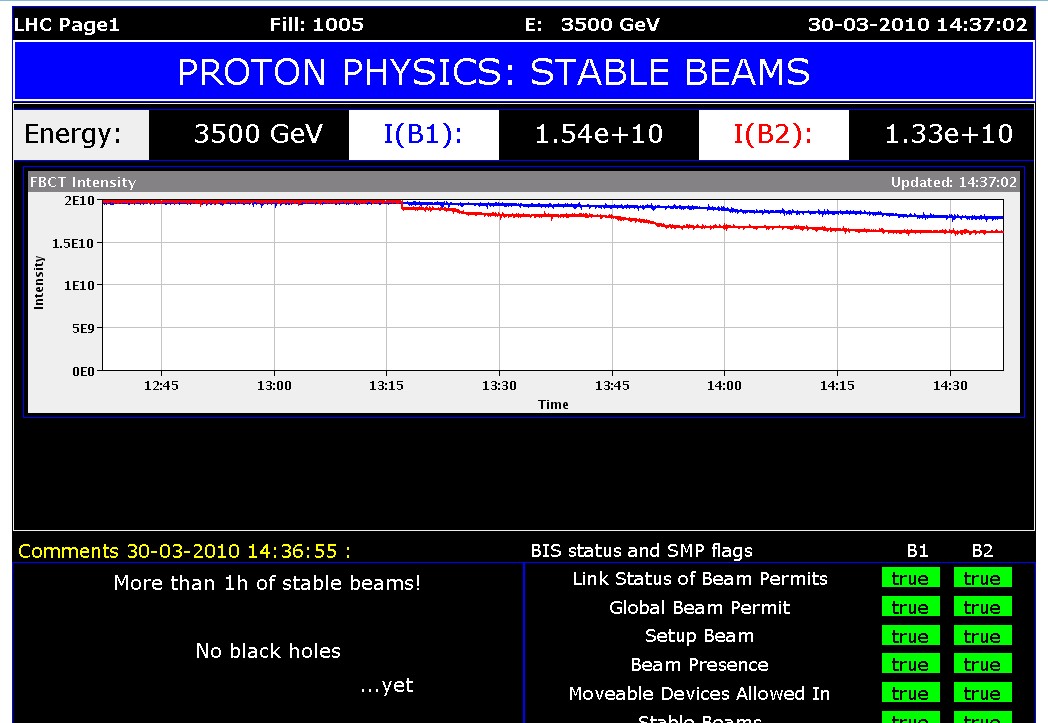
You can see the beam status here: http://op-webtools.web.cern.ch/op-webtools/vistar/vistars.php?usr=LHC1 and follow the webcast here http://webcast.cern.ch/lhcfirstphysics/. The webcast screen also has links to each of the experiments.
-
Resources
You can see the beam status here: http://op-webtools.web.cern.ch/op-webtools/vistar/vistars.php?usr=LHC1 and follow the webcast here http://webcast.cern.ch/lhcfirstphysics/. The webcast screen also has links to each of the experiments.
-
First events
One of the first events seen in Atlas:
http://imgur.com/ugwnl.pngand in CMS:
http://cmsdoc.cern.ch/events/snapshotA.png -
Re:Energetically Equivalent to...
http://lhc-machine-outreach.web.cern.ch/lhc-machine-outreach/beam.htm
362 MJ. But they're talking about the kinetic energy of the aircraft carrier, not the energy output of it's engines that is required to keep it at speed, so if the carrier in question is American, it would have the equivalent energy when it was moving at about 5 knots.
-
Re:Who cares?
Actually, this goes in steps. They went from ~1.18TeV (which was already the highest energy for a proton beam ever achieved in lab) to 3.5TeV. The experiments will run at 3.5TeV for some time, then another shutdown to get them to the design energy of 7TeV per beam (14 TeV per collision). All is happening as planned.
The "problems" you mention happened with every single collider, ever. When you get to a new scale, you expect things to happen differently from your original idea; so you plan to allow time to solve problems. The accelerator itself is an experiment, and one that is going very well.
You want hard results? ALICE published a science paper on collisions almost four months ago. You can see more from ALICE, ATLAS, CMS and LHCb. Lots of simulations, descriptions and detection methods, but at least the two "smaller" groups (LHCb and ALICE) have measurements already, at one sixth of the energy they were designed to work on. In fact, LHCb will only have actual b hadrons to see when they start colliding protons at 3.5TeV; but they still could find a meaningful result to publish, sooner than anticipated by anyone with even passing understanding of collider physics. Is that enough? Or do people actually believe things go like this?
-
Energetically Equivalent to...
About 3 1/2 mosquitoes. I had no idea how tiny the amounts of energy they are using. http://public.web.cern.ch/Public/en/Science/Glossary-en.php#E
-
The press release is one week old
The press release you called 'pompous' is one week old -- when the record energy hadn't yet been reached. Apparently going to CERN's front page is too much effort for slashdot's editors. Anyway, here's the current press release
-
Re:What would happen?