Slashdot Mirror
Domain: cern.ch
Stories and comments across the archive that link to cern.ch.
Comments · 855
-
Re:Two questions.
Mexico is not a CERN member state, which pay most of the CERN budget.
While Mexico has a co-operation agreement with CERN, it (like most countries with observer status or co-operation agreements, which also includes the US, Russia and China) has apparently not contributed to the 2019 budget: https://fap-dep.web.cern.ch/rp...
-
Re:Two questions.
I'd assume that it will be paid mostly by CERN member states. Top contributors to CERN's 2019 budget:
- Germany (21%)
- United Kingdom (16%)
- France (14%)
- Italy (10%)
See https://fap-dep.web.cern.ch/rp... for details.
-
Re:good riddance.
He didnt show up to the workgroup with a new model for detecting leptons, a new theory of strong force interaction, or anything else that would have been legitimately controversial. Alessandro Strumia showed up to shitpost about gender.
Are you curious why? I'll help.
https://indico.cern.ch/event/714346/overview
In addition to talks on nuclear and string theory, SM and BSM phenomenology, lattice field theory and cosmology, each day talks and panel discussions will be dedicated to research on gender in academia, with an aim to further the development and implementation of action plans to support women and other minorities in physics. -
Re:Naturlich
-
Re:Easily done
Nonsense - plain html with no layout is far smaller.
This must be what you are looking for - this is number 1! http://info.cern.ch/hypertext/...
-
Re:Titanium and gold are two different metals - si
Alloy
Then, according to the CERN writing guidelines (and others) that would be "titanium-gold" so bzzzt... thanks for playing
Chemical compounds
Chemical compounds and alloys should be hyphenated, but the elements should not be capitalised:
The current in the dipole magnets is carried by cables made of niobium-titanium (NbTi). -
Re:would geneva turn into a ghetto?
Not likely. Anyway, particle physics isn't only about colliders. For example, Fermilab, former home of the Tevatron, is now primarily doing neutrino research. CERN will be around for a long, long time, even if they changed their focus away from colliders.
-
Re: Mobile Web
i don't like "mobile web" sites because there's too much emphasis on NOTHING. everything turns into click bait on content sites, no actual content skimmable on main pages. and corporate sites? forget it, the fucking vertical scrolling NOTHINGNESS that says absolutely NOTHING. it's total bullshit... then top it off with the shitty "three bars" navigation menu crap.. on a desktop.. what.the.fuck.
the best "mobile friendly" sites are the ones from WAY THE FUCK BACK before even layout tables ruled the web (kinda like this... hell, gopher:// would be more platform independent and infinitely more useful than the utter shit that pollutes the web today.
-
Malware Warning at CERN site
I started clicking around, and Google popped up a malware warning for the "Astrophysics Abstracts" link at http://info.cern.ch/hypertext/... .
Anyone know of a way to confirm or deny this warning, other than letting my computer get infected?
-
Root
How do you do c++ scripts?
You use a package like ROOT which we use at CERN for data analysis. The original author had the idea that he would save physicists the time to learn a separate scripting language by using interpreted C++ as a scripting language. As you can imagine this did not work out very well. Firstly C++ has an appallingly bad syntax for scripting use and secondly there are many features they were unable to script like virtual functions.
The result that the scripting language was more of a C+/- which was badly documented and also very buggy. One of the worst ones I ever found ws actually using compiled code where adding a blank line i.e. just a new line character to the source code caused duplicate symbol errors due to using the C preprocessor to generate a symbol which only differed by the line number the macro was called on!
Debugging in general was also bizarre because the error messages you got rarely if ever pointed you to the problem and the memory management is also extremely unclear. The only thing which kept it somewhat usable was the development of the python interface...which of course completely undermined the original vision of scripted C++. -
It's Swiss
-
Re:They can't
Microwaves do not "destabilize atoms". They heat water by agitating those specific molecules. The heated water in turn cooks food. The real problem is you think you know more than you actually do.
-
Re: No reason not to make them available publicly
Why? What interest does the general population have in access to the LHC data? They've already release a subset of the data for educational purposes, in addition to this considerable data dump. It serves no public interest to make the whole data set available to everyone, and in fact would run contrary to the public interest: the data set is absolutely massive (the LHC produces petabytes of data per day), and the costs associated with making that data available to the public would be non-negligible.
If a specific individual is interested in access to the data, they're certainly free to email their local (or not even necessarily local) university department associated with the LHC and ask for it, and they could probably get access to a subset of it, if they've shown genuine interest. And by "genuine interest", I mean have already downloaded, processed, examined, and understand much of the already publicly available data, to the point where they are capable of performing actual scientific research on the data, and aren't simply interested in wasting already-precious scientific research money and time in making some kind of political or philosophical point.
-
Re: Predictive power
Exactly. It's perfectly normal that our theories are built around the limits of our knowledge. A theory may work great until we start gathering new data in new ways which shows that there are problems in it... and then the theory needs to be expanded. That doesn't mean that the previous theory was wrong - just limited.
Honestly, there's enough problems with event horizons and singularities that I really think it's about time that we accept that they may well just not exist. We have a known force of the universe, inflation, that when the universe was packed into a very energy dense state led to the dilation of space until the universe reached a less energy-dense state. Why should we assume that this is something only applicable to the Big Bang, rather than a general rule of the universe? When you apply a dilation-driven inflation gravity to the environment of a black hole, suddenly singularities and event horizons disappear. A black hole is often described as a waterfall of spacetime rushing in; inflation is like a flood of spacetime rushing out. Infalling particles are shifted to a tangential path; all of the energy of the black hole exists at the event horizon in a quasi-2d state. In such a scenario, black holes are - from an infinite-observer's perspective - basically nothing more than a frozen store of spacetime, ever so slowly leaking out, until - unthinkably long in the future, when they sit all alone in an empty void - they catastrophically explode in an inflationary flood of energy from which new matter can ultimately condense. Miniature versions of the Big Bang itself.
No naked singularities. No information paradox. No firewall. Explanatory power for the Big Bang. Why isn't this a theoretical route worth pursuing more?
-
Dated info.
The lecture didn't cover anything newer than Hawking Radiation. Where's the discussion over the Firewall Paradox?
-
Re:Tinkering
CERN is a pretty strong supporter of open access:
https://cds.cern.ch/record/195... -
Re:CERN - Now hiring!
Also, they are hiring at many levels, and do a lot of training / internships, so while the competition is tough, its far from impossible. Which are paid reasonable to very good, with good benefits.
Have a look at:
https://jobs.web.cern.ch/ -
Re:That's how Science Works
The fundamental axiom of science is that an objective reality exists, is independent of the observer, and that by investigation, truths about that reality can be discovered.
-
Re:Are and storms that fierce on Mars?
- space radiation being handwaved away by "Hab is radiation-proof" while it's an inflatable structure.
At least the story is internally consistent: because the Hab is radiation-proof, radio waves don't go through it, which is why Mark Watney has to go outside the Hab just to check his email. (Actually, I think he ought to have strung a network cable; he cheerfully did more difficult tasks than that at various points in the book. But then the plot complication caused by going outside so often might not have occurred.)
When I like a book or movie I tend to try to come up with explanations of anything I wonder about. My explanation of how the Hab is radiation-proof: a superconducting magnetic shield. Only protects against charged particles though...wouldn't stop gamma rays. How common is random gamma radiation on the surface of Mars?
Here's an article about spacecraft using magnetic shields:
http://home.web.cern.ch/about/updates/2015/08/superconducting-shield-astronauts
P.S. I've also seen reviewers complaining that Mark Watney oversells the dangers of the radiation inside an RTG. In the book at least he is joking around a lot and using imprecise terms such as "box full of radiation" so I don't accept this as a valid complaint.
-
Re:Lots more information
Read again: 6Gb every 17 seconds (reading a big sensor is slow work)
That's 353Mb/s, which neatly fits in a Gig-E pipe and can be recorded by the puniest 5" HDD out there.
To sustain that rate for the whole night (10 hours or 36ks), you need about 12.7Tb of storage... a 3TB drive will do with room to spare.
Build a good size RAID, put tape backup (you have the whole day), not exactly a challenge.(FYI, the LHC is many orders of magnitude higher: http://home.web.cern.ch/about/...)
-
Re:Here's to bullshit!
just saying: natural external radiation beats man-made https://cernatschool.web.cern....
-
Re:Please Speak English
You aren't the target audience for the scientific article. That's what the press release is for. Abstracts are not the same as introductions. They are necessarily succinct, to the point where use of jargon is required.
-
Re:Life in 'MURICA
Funny, cause the US funds some of the LHC as well. There was no reason to duplicate the work anyways.
-
Now I understand something on the LHC 2015 Schedul
For several months I have been checking on the on the official LHC schedule:
https://espace.cern.ch/be-dep/...
and had been wondering about the notation "leap second" on the Wednesday of week 27 of 2015. This posting now makes me understand what is going on. I can imagine lots of consequences for the both the machine (think of how far in the lab frame a 7.5 TeV proton goes in 1 s) and the enormous (at least enormous if you aren't Amazon, Apple, Google, or Microsoft) pile of HTC servers on 6 continents we use to reduce the data into Nobel prizes (hopefully prizes plural...).
Fred -
Take a look--
https://op-webtools.web.cern.c...
Live on the web -- this is a summary page, with much more available -
15 Petabytes
Apparently it will collect 15 petabytes a year.
http://www.lhc-closer.es/1/3/1...Here is a picture of server room
http://home.web.cern.ch/about/... -
In lab = Surrounded by Electrons
Where the heck those extra electrons came from?
They could easily come from all the material which is surrounding the graphite. As the charge builds up on the graphite due to all the electrons being expelled it will develop an increasingly strong electric field eventually will pull electrons from the walls of the chamber. Since the vacuum will also not be perfect the remaining gas molecules could also transfer charge by moving back and forth between the graphite and the chamber walls.
A similar effect exists in the LHC where the electrons are 'helped' to leave the walls by synchrotron radiation hitting the walls of the beam pipe and are then dragged along by the electric field of a bunch of protons forming a electron cloud. This effect is one of the primary limiting factors on the number of protons we can have in an LHC beam. -
Re:watched a movie yesterday
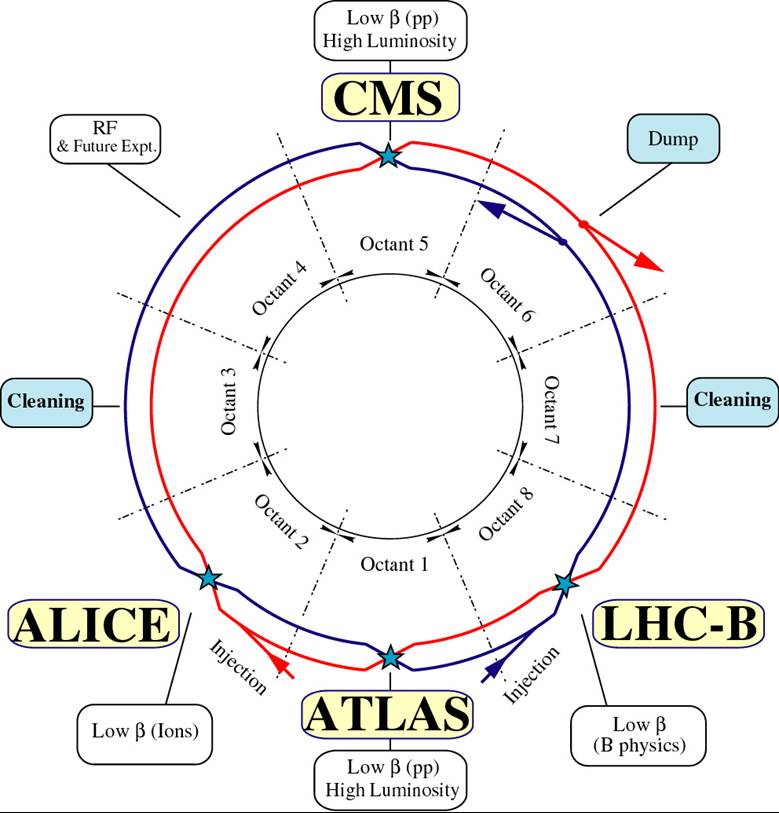
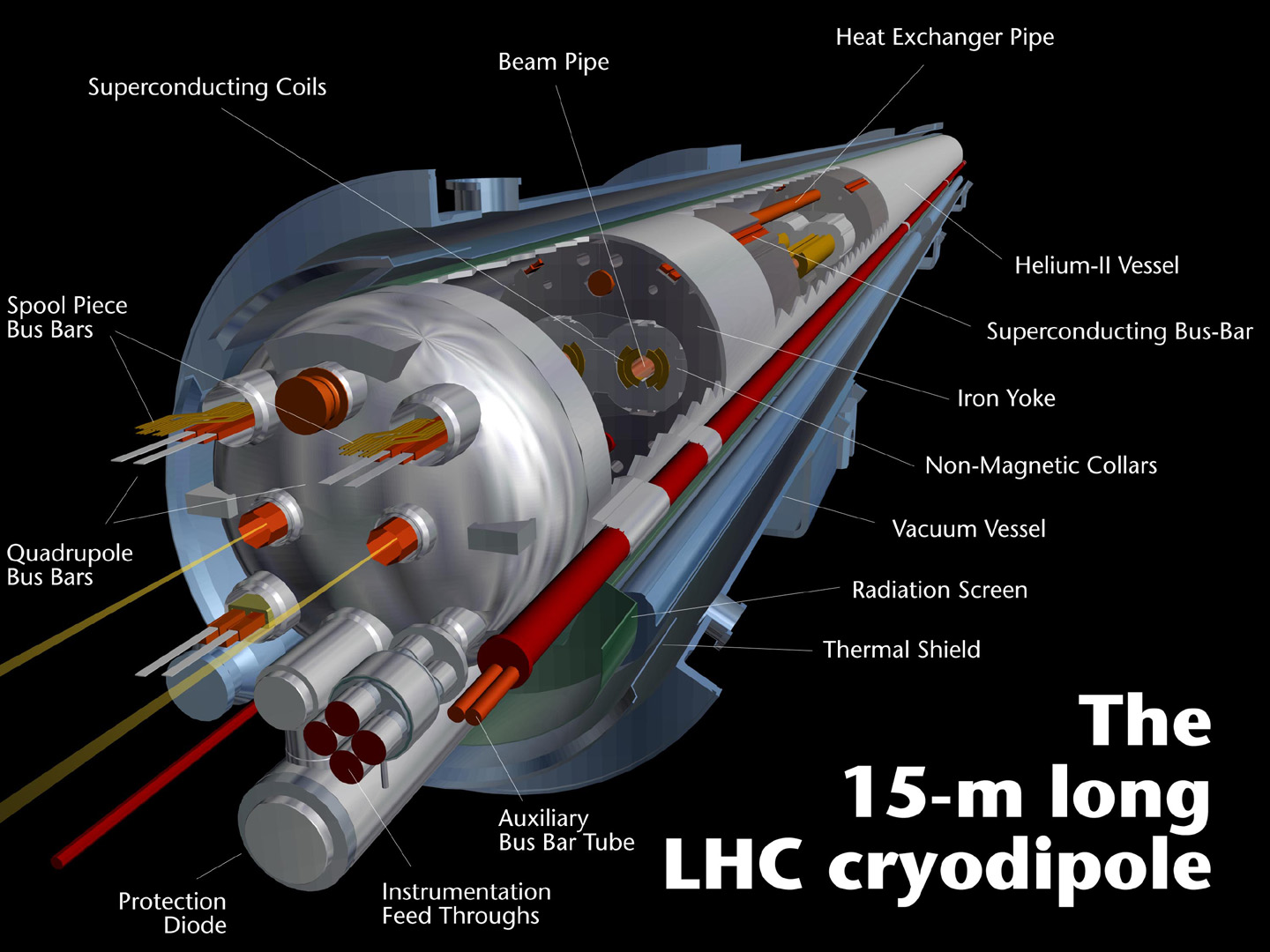
You're right: the LHC beams are made up of separate bunches of protons. These bunches only collide at the 4 detectors. If they collided anywhere else, there wouldn't be anything to detect the products of the collision, so that collision would be a waste. Until the collision in the detectors, the protons moving in opposite directions are kept in separate beam lines: http://lhc-machine-outreach.we.... Here's a look inside the beam pipe: http://lhc-machine-outreach.we...
The time between collisions is 25 nanoseconds, meaning there is 25 feet between each bunch (light travels at about 1 foot per nanosecond). When two bunches collide, there are only 20-30 proton-proton collisions because the protons are so small compared to the size of the bunches. By the time the next bunches arrive at the collision point, the debris from the first collisions are completely gone from the original collision point (about 25 feet away in all directions).
-
Re:watched a movie yesterday
You're right: the LHC beams are made up of separate bunches of protons. These bunches only collide at the 4 detectors. If they collided anywhere else, there wouldn't be anything to detect the products of the collision, so that collision would be a waste. Until the collision in the detectors, the protons moving in opposite directions are kept in separate beam lines: http://lhc-machine-outreach.we.... Here's a look inside the beam pipe: http://lhc-machine-outreach.we...
The time between collisions is 25 nanoseconds, meaning there is 25 feet between each bunch (light travels at about 1 foot per nanosecond). When two bunches collide, there are only 20-30 proton-proton collisions because the protons are so small compared to the size of the bunches. By the time the next bunches arrive at the collision point, the debris from the first collisions are completely gone from the original collision point (about 25 feet away in all directions).
-
Re:watched a movie yesterday
You're right: the LHC beams are made up of separate bunches of protons. These bunches only collide at the 4 detectors. If they collided anywhere else, there wouldn't be anything to detect the products of the collision, so that collision would be a waste. Until the collision in the detectors, the protons moving in opposite directions are kept in separate beam lines: http://lhc-machine-outreach.we.... Here's a look inside the beam pipe: http://lhc-machine-outreach.we...
The time between collisions is 25 nanoseconds, meaning there is 25 feet between each bunch (light travels at about 1 foot per nanosecond). When two bunches collide, there are only 20-30 proton-proton collisions because the protons are so small compared to the size of the bunches. By the time the next bunches arrive at the collision point, the debris from the first collisions are completely gone from the original collision point (about 25 feet away in all directions).
-
OP Vistars
I was hooked to this real-time monitoring when the LHC was operating two years ago : http://op-webtools.web.cern.ch...
Posting this in case anyone is interested. -
Re:Finally
Right after discovering the Force, too.
-
Re:Again and Again
the only timelines in which we exist are the ones where the LHC is delayed due to technical problems after technical problems. I wonder how many unexpected delays it will take before people at CERN get the message that reaching 13 TeV destroys the Earth.
Been there, done that (failed April Fool's Day Slashdot submission),
Evidence Suggests LHC Test Already Begun
TheRealHocusLocus (2319802) writes
"With a deliberate surge of electrical current a small metal fragment has been vaporized to fix a glitch in CERN's Large Hadron Collider in a circular chain of events that will lead into its presence as the result of a future test. "Clearly there are exciting times ahead," suggested a member of the CERN community. "At some point --- perhaps during the 13 TeV test in May --- a TKO (Terrifically Kinetic Outburst) will occur and this tiny fragment of the machine will cross the proton stream to lodge between a magnet and diode a few days ago, preventing the scheduled March 31 start-up. This delay is confirmation that it works. You could even say we're now on 'borrowed time'."
Vaporizing the fragment unseen was part of the plan. Why not analyze it to determine which component will fail and what else could happen? "Because we didn't, obviously! Sorry. That was suggested, but there were fears that doing so would further delay the test. And spoil the surprise." Upcoming experiments planned for 2015 will attempt to more accurately reproduce early conditions after the Big Bang, and explore the possibility that cosmic Gamma Ray Bursts originate from advanced civilizations performing physics experiments.
In other news CERN has confirmed the existence of 'The Force' by charting a recently detected disturbance, as if billions of voices are soon to cry out then go silent." -
Not double energy yet
So far the beams are just at the injection energy of 450 GeV from the SPS and you can see some splash event in ATLAS here. The real test will be when they ramp the magnets up to 11kA currents for the 6.5 TeV beams. Hopefully this time our understanding of the universe will break before the machine.
-
Clinging to a hopeless theory?
The lack of evidence for dark matter is becoming kind of embarrassing to the theory. Anything that should provide direct evidence doesn't - dark matter is seemingly only necessary to explain large-scale gravitational behavior, but is not otherwise in evidence.
For me, as a layman, dark matter was never persuasive: "there's this stuff that only has an effect way out there where we need it, but has no local effect where it would screw up our nice models". Sure there is. There are other theories that seem to be at least as reasonable. For example, what if the speed of light is not a constant across all time and space? This could dramatically change the behavior of the universe on large scales. I'm no cosmologist, but I understand that there are other theories as well.
-
Post-LS1 Powering Tests Campaign
-
CERNLIB on PC hardware: speaking from experience
First my credentials: I have an M.Sc. in experimental particle physics and spent six months at CERN collecting and analyzing that data, so this is the voice of experience, not guesswork. I was there in the year 2000, and have since moved into teaching.
She'll want to be running the CERNlib under Linux. You can download that here. CERN is the world's biggest particle physics installation, and they produce PAW (Physics Analysis Workstation) and GEANT (forget the acronym; it was in beta and unavailable in my day) which are the standard software tools for particle physics analysis. CERN also releases their own version of Linux, available here. That's what she wants to be running for her goals, on a computer that has well above average processor power, memory and hard drive performance, but nothing particularly impressive for video and sound.
-
CERNLIB on PC hardware: speaking from experience
First my credentials: I have an M.Sc. in experimental particle physics and spent six months at CERN collecting and analyzing that data, so this is the voice of experience, not guesswork. I was there in the year 2000, and have since moved into teaching.
She'll want to be running the CERNlib under Linux. You can download that here. CERN is the world's biggest particle physics installation, and they produce PAW (Physics Analysis Workstation) and GEANT (forget the acronym; it was in beta and unavailable in my day) which are the standard software tools for particle physics analysis. CERN also releases their own version of Linux, available here. That's what she wants to be running for her goals, on a computer that has well above average processor power, memory and hard drive performance, but nothing particularly impressive for video and sound.
-
Re:As a PhD in particle physics...
CERN is so geeky it has its own[1] Linux distro.
http://linux.web.cern.ch/linux...
[1] OK, it's a respin of Dead Rat really...
-
Re:for software
Use what the big boys/girls use: ROOT https://root.cern.ch/ , includes a C++ interpreter. Most excellent, even for non-physics. Maybe the linux crowd will catch on someday.
"Catch on" as in "use it on something other than the RHEL6-based SLC6, for which they offer a binary download", in case you don't want to install from source?
-
Re:for software
Use what the big boys/girls use: ROOT https://root.cern.ch/ , includes a C++ interpreter. Most excellent, even for non-physics. Maybe the linux crowd will catch on someday.
"Catch on" as in "use it on something other than the RHEL6-based SLC6, for which they offer a binary download", in case you don't want to install from source?
-
Re:for software
Use what the big boys/girls use: ROOT https://root.cern.ch/ , includes a C++ interpreter. Most excellent, even for non-physics. Maybe the linux crowd will catch on someday.
"Catch on" as in "use it on something other than the RHEL6-based SLC6, for which they offer a binary download", in case you don't want to install from source?
-
C++
C++ might be a well known language but it is generally never though of as a script language. However if you are curious you can have a look at ROOT C++ or as some of us like to call it C+/-...because it is only C++ to within some (wide) margin of error.
-
Re:No big red button?
Or... power down the Large Hadron Collider, and see what happens
-
Python + ROOT "C++" = Python
Possibly because it often isn't coding in real C++. In ATLAS, and particle physics in general, we use this awful data analysis package called ROOT which is about the worst example of C++ code you can possibly imagine (although it has significantly improved over the years). This package uses a C++ interpreter so that you can write C++ scripts. Sadly this interpreter cannot implement the full set of C++ so major bits of functionality are missing like virtual functions so it's hard to really call this C++.
Unfortunately, while there are many issues with ROOT, it is incredibly fast at I/O and has lots of features which do what we need (if you can navigate past the bugs, memory leaks and dodgy documentation). One way to do help with this is to use the Python interface so many of us use the Python interface as a shield from the full horror of ROOT. The other alternative is to write compiled C++ code which gives you the complete C++ functionality but still leaves you with the minefield of linking to ROOT. To give an example of how bad this can be a few years ago they had a bug which made you code dependent on the comments i.e. by adding a comment line the code generated a duplicate symbol error when linked. After a day of tracking this down to a pre-processor macro I was told by the root development team that they already knew about this bug but could not fix it...that was also the day I switched to using the Python interface! -
Re:hmmmm
I wonder what people will do with this data or what can be learned from it?
Don't worry, countries that are not a member of CERN, and other dictatorships, will be interested.
-
Re:El psy congroo
This is just a ploy by CERN to divert our attention away from their clandestine plans to take over the world.
What, again?
-
Re:Not exactly
Its a good question .
I don't understand astrophysical shocks, but see: http://www.slac.stanford.edu/e...
As far as I can tell the rely on magnetic fields bending the particles back into the shock.When relativistic particle trajectories are bent by magnetic fields, they emit synchrotron radiation which increases rapidly with increasing particle energy.
Longitudinal fields don't do the same thing. There is a tiny amount of radiation, but it is not strongly dependent on particle energy. I believe this is because Lorentz contraction increases transverse, but not longitudinal electromagnetic fields: http://en.wikipedia.org/wiki/C...
Ideally the fields in the plasma accelerator are longitudinal on axis. If the particle enters slightly off axis it will get a transverse kick and will radiate synchrotron radiation, and we do see that. For very high energies that radiation might be large, but the effect would be to damp the transverse motion of the particle, but not affect the longitudinal acceleration.
I know that the plasma wakefield people are seriously thinking about TeV scale machines: https://accelconf.web.cern.ch/...
It is possible that the concept fails at some much higher energy.
-
Thank God for the dead
hmm... lets see
COBOL.. dead
BSD.. dead
TAPEAnd yet there would be no LHC datacenter without tape.
The CERN Tier-0 in Meyrin currently provides around 45 PetaBytes of data storage on disk and 90 PetaBytes on tape for physics, and includes the majority of the 100,000 processing cores in the CERN Data Centre.
ref:
http://information-technology....
http://www.economist.com/blogs...
http://storageservers.wordpres...
http://scribol.com/science/hal... -
Re:Compared to Facebook
I think SKA will have similar setup as LHC. I.e - there will be heavy filtering on several levels to get only "interesting" data in the end. See LHC example
Disclaimer: Posting AC since affiliated with CERN storage.