Slashdot Mirror
Domain: cmu.edu
Stories and comments across the archive that link to cmu.edu.
Comments · 2,977
-
Re:Amen
I don't think many people feel flash memory is the future due to its numerous limitations.
I was impressed by this Carnegie Mellon project though: http://www.ece.cmu.edu/~mems/
Which aims to place drives on a grid, overcoming all the problems of a revolving drive and dramatically improving seek time. -
Re:But what about...
That's peanuts, here's DeCSS in Brainfuck.
-
It doesn't mean that it can't happen...
but what it does mean is that we must find another way to make it happen.
One of the sins that we get into is saying that something can't happen because it can't happen in the only way we can imagine it happening.
From a lecture by Stephen Rudich
So yeah, maybe it can't happen the way they are talking about, but there's bound to be another way.
Don't say impossible too early...
-
Re:hmm we heard this before
Calculators are why students can't do math by themselves anymore. Whoever had the idea that in my sophomore year of high school, I should be required to purchase a TI-89 calculator should be shot.
In my senior year of high school, I took calc 1 and 2 from a decent state school. This course also integrated the TI-89.
Once I got to college, I entered the land of multi-variable calculus. Since the school I'm going to is a high-end private institution, of course they don't allow us to use calculators at all in Calc 3. Silly me. I haven't taken an integral since we first learned about each method of integration. Why? "here's how you can take an integral on your TI-89" were the first words out of the teacher's mouth as soon as we'd learned the basic concepts.
So I spent the first two weeks of school here cramming calculus 1 and 2 into my head *again*. 2-3 hours a night just to get caught up with the rest of the students (often sophomores), who had learned it right.
Now I shun the calculator for all purposes except straight calculations (in a physics course, for example). For mathematics either you can do it with your head/on paper, or it's a big enough task that you need a full fledged CAS. There's really no place for a calculator in math.
Brian -
How about a spinning space elevator?
Major detail... Venus's day is 225 earth days long. It is spinning far too slowly to support a space elevator that relies on a geosynchronous orbit at the top.
Very good point! How about a spinning space elevator . It consists of an orbiting spinning tether. Both ends of the tether dip into the atmosphere and nearly touch the ground at one or more landing points along the equator. While the center of mass of the tether is orbiting at what ever required velocity, the tether is counterrotating with a tip velocity that compensates for the orbital velocity. Thus, the tip of the tether becomes nearly stationary as it touches down at the landing point(s). As a side benefit, the tip of the tether furthest from the ground is moving at nearly twice the velocity of the orbiting tether mass and can sling payloads into interplanetary orbits. -
Re:Kind of a side question
NetMeeting was useful in that it brought decent IM to a consumer grade OS (Windows 98), but I can recollect CUSeeMe around 1993.
-
It's no mystery...You can't help but see faces, it's hardwired into your brain.
-
Software Jobs will not return
CMM Company Appraisals
Take a look, there are definately more CMM level 4 and 5's in India than most of the rest of the world. This is why the IT industry looks to India for a quality product, and why companies outsource software production. -
De-what?
Yeah, but your browser would have to support CSS encryption.
-
Re:hurray!J.D., I appreciate you and a few others making the effort to bring some intelligence to this discussion of mining the Moon and near-Earth-asteroids. It's too bad most other responders don't appear to take mining of space resources seriously, but that is their loss because the discussion is now moving beyond the laughing at a new idea stage (for the more intelligent humans, that is) and moving on to the "You may be right. So what?" stage. By the time the scoffers, game-players and those without the courage to do anything new and therefore risky wake up too late and say " I said mining space resources was a good idea all along" it will be far too late - other smarter and braver souls will have already profited and they will be whining about being left out of the division of new wealth.
Be that as it may, on to commentary on JD's reply. If a 1.25 second delay is the worst problem associated with using teleoperated robots then robotic mining of space resources is already doable with current technology. There are at least two good reasons why 1) teleoperated lunar robots are not going to be moving that fast, unless it is in a factory type setup that they are mounted on tracks and doing repetitive tasks or on familiar terrain such as a road. If an obstacle, such as a bolder, is in the way then it will still be there in the same spot till the operator gets the robot positioned just right to deal with it. 2) All teleoperated robots are semi-autonomous, and after spending all that money to send robots to the Moon they will certainly be equipped the best AI navigation software, more than one type of tactile feedback, not to mention hardware such as IR rangefinders. Even teleoperated mobile robots here on Earth, where there is no time delay in the commands, almost have to be semi-autonomous on rough terrain. Then again I'm no expert, so I asked a robotics expert, and he said:
"Lunar robots won't be purely teleoperated, estimates are that an Earth operator of a lunar robot will have a 6 seconds delay (signal traveling forth and back and signal processing) till verifying the lunar robot has performed as expected. This makes the most attractive solution (and cost-effective) to command such type of robot a mix of tele-operation and AI, that is, operators give "macro-commands" or "goal-directed commands" to the robot and its implemented AI tries to find the most appropriate solution to achieve that goal/command.
The use of railroaded robots inside a factory quite simplifies the needed AI (processing, debugging and navigation).
I suggest to anyone interested in exploring the possibilities of Space
robotics and associated AI to visit these,
here
and here
Hope this helps
V.P. -
Re:hurray!J.D., I appreciate you and a few others making the effort to bring some intelligence to this discussion of mining the Moon and near-Earth-asteroids. It's too bad most other responders don't appear to take mining of space resources seriously, but that is their loss because the discussion is now moving beyond the laughing at a new idea stage (for the more intelligent humans, that is) and moving on to the "You may be right. So what?" stage. By the time the scoffers, game-players and those without the courage to do anything new and therefore risky wake up too late and say " I said mining space resources was a good idea all along" it will be far too late - other smarter and braver souls will have already profited and they will be whining about being left out of the division of new wealth.
Be that as it may, on to commentary on JD's reply. If a 1.25 second delay is the worst problem associated with using teleoperated robots then robotic mining of space resources is already doable with current technology. There are at least two good reasons why 1) teleoperated lunar robots are not going to be moving that fast, unless it is in a factory type setup that they are mounted on tracks and doing repetitive tasks or on familiar terrain such as a road. If an obstacle, such as a bolder, is in the way then it will still be there in the same spot till the operator gets the robot positioned just right to deal with it. 2) All teleoperated robots are semi-autonomous, and after spending all that money to send robots to the Moon they will certainly be equipped the best AI navigation software, more than one type of tactile feedback, not to mention hardware such as IR rangefinders. Even teleoperated mobile robots here on Earth, where there is no time delay in the commands, almost have to be semi-autonomous on rough terrain. Then again I'm no expert, so I asked a robotics expert, and he said:
"Lunar robots won't be purely teleoperated, estimates are that an Earth operator of a lunar robot will have a 6 seconds delay (signal traveling forth and back and signal processing) till verifying the lunar robot has performed as expected. This makes the most attractive solution (and cost-effective) to command such type of robot a mix of tele-operation and AI, that is, operators give "macro-commands" or "goal-directed commands" to the robot and its implemented AI tries to find the most appropriate solution to achieve that goal/command.
The use of railroaded robots inside a factory quite simplifies the needed AI (processing, debugging and navigation).
I suggest to anyone interested in exploring the possibilities of Space
robotics and associated AI to visit these,
here
and here
Hope this helps
V.P. -
Re:so cool
You know, there are some other cults that rely on electronic gizmos and want to take all your money!
-
death ray120 lasers...
anyone else thinking death ray & world domination??
-
Re:could it be?I think of the innovative ideas that have been tossed aside (Xerox, HP, IBM...etc) and I wonder why more failed projects aren't Open Sourced. The reasons for Open Sourcing such projects (hopefully under the GPL) would be similar to garage and rummage sales. In the junk-bin, where others throw their trash, someone will find their treasure (anyone watch the Antique Roadshow?). These include valuable ideas and how they were implemented, if not code itself that could be ported to Linux. Ideas like Lotus Agenda which is currently being brought back and given a new life by Mitch Kapor with an Open Source license. I hope that eventually it will be included as part of UserLinux.
What other favorites from the past could be contributed to a UserLinux distribution, making it irresistable? How about Clipper, isn't that dead yet? Couldn't its corpse (implementation) be examined for clues in how to improve ReKall? I like the idea of integrating Coda into UserLinux, a product from 1987. I wonder, has IBM bothered contributed portions of OS/2's object-oriented GUI to either GNOME or KDE? Also, let's not forget the hundreds (thousands?) of games cast aside by their developers. I for one, would love to see an Open Sourced version of a game like Elite.
= 9J =
-
Ray Tracing Jell-O Brand Gelatin
Quite possibly the most impressive paper from SIGGRAPH 87. The abstract reveals the importance of this paper: "New technology is presented for imaging a restricted class of dessert foods."
Here's the author's page on the topic, and a usenet post containing most of the text, including the important Schrodinger wave equation for the Jell-O field J. -
Ray Tracing Jell-O Brand Gelatin
Quite possibly the most impressive paper from SIGGRAPH 87. The abstract reveals the importance of this paper: "New technology is presented for imaging a restricted class of dessert foods."
Here's the author's page on the topic, and a usenet post containing most of the text, including the important Schrodinger wave equation for the Jell-O field J. -
Re:WarningGreat points.
Just wanted to add to the parent post. While cramming hard for theory courses don't forget to take "soft" courses in your English, Drama, Design, Art, and Psychology departments. It all depends on what these departments have to offer, but it doesn't hurt to understand a bit about humans work as well. It's good to get some grounding in different mechanisms of human communication, and to develop a good aesthetic sense, particularly if you want to have any involvement in the design side of things, or help you work with game designers who may seem a little insane.
At the very least taking these other courses is a good way to meet women (which arguably may draw you away from the game industry, but that's a different manner) that you might not otherwise meet in hardcore theory and engineering courses.
One interesting degree (Masters level) is in Carnegie Mellon's Entertainment Technology department. Check out their Curriculum. It doesn't teach specific technologies that apply to the video game industry, and in fact the focus is much broader, but it's not a bad foundation for starting a career in the videogame/tech-entertainment industry. They've got a good track record for placing graduates in top-notch organizations.
-
Re:DMCA? No!
Sorry--when I say technological measure, I mean it to abbreviate "technological measure that effectively controls access to a work," since that is the only context in which technological measures are relevant in the DMCA.
Software is technological, and if part of it prevents you from using another part of it, then it 'effectively controls access'. I don't see how you can claim otherwise.
Here's how I claim otherwise. Let's look at the definition again:
(DMCA)
a technological measure ''effectively controls access to a work'' if the measure, in the ordinary course of its operation, requires the application of information, or a process or a treatment, with the authority of the copyright owner, to gain access to the work.
Forget the words "controls access to a work," because the condition is defined immediately afterwards. You can't use those words as a basis for arguing that software is a technological measure (... TECATAW). Instead, the software must require, in the ordinary course of its operation, the application of information, a process or a treatment in order to gain access to the work.
First, as I've said before, the copyrighted work is the bits of the program. Those bits do not require anything to happen in order for them to be accessed. It's true that in order to execute certain bits on the computer in a useful way, you need to change the branch instruction or trick the program in some other way. But executing is different from accessing, and the DMCA only talks about access.
Second, there is no application of information, process or treatment. I can't even fathom how you think this fits. The DMCA was designed with scrambled television signals in mind, in which case the process is the descrambling or decoding, and the information is the encryption key. The copyrighted work is obfuscated and inaccessible without the descrambling. But the computer program in our example is entirely accessible, and needs no process, treatment, or application information to be accessed.
Of course, this doesn't even consider the fact that a network-drive-as-physical driver would have substantial non-infringing use, certainly exempting it (if not acts of circumvention) as a circumvention device.
Again, in case anybody is jumping in on this discussion late: I am entirely opposed to the DMCA; I think it's a bad law that should be repealed. I have even had my own run-in. But believing that the law somehow applies to every instance of using a computer in a way that somebody else doesn't like is just foolish, and worse, it may lead to a culture where we instantly fold as soon as the DMCA card is drawn. I don't want to live in that culture, so let's not encourage this! -
Re:Why just home?
This paper describes a filesystem (called S4) that keeps versions of every write(), up to some specified time window. You can mount a read-only version of the filesystem as it existed at any arbitrary time in the past (up to the size of the window). For a lot of people, they think several weeks would be a reasonable window.
-
Re:DMCA? No!
They aren't lawsuits, they're cease and desist letters, which are hardly even "legal threats," because if they threaten to sue you and don't, then that is illegal.
For my part, I fought the C&D letters and they eventually backed down.
It's important to know what the DMCA actually outlaws! -
iscsi
What you are after is iSCSI. iSCSI standards for Internet SCSI and is a "method of encapsulating SCSI over TCP/IP". iSCSI allows a network share to appear as a local scsi drive to the operating system. So you need a server that supports the iSCSI protocol and a client that support it also.
This site seems to be quite informative on the status of the various Linux projects. Check this out for a server implementation -
CODA and AFS
If you have a very reliable connection you may want to go for AFS
In case the connection is not realiable (or not fast enough), you may want to try CODA which is a distributed filesystem which supports disconnected operations. Beware: AFS is a mature project, while CODA may still be a work-in-progress. -
CODA and AFS
If you have a very reliable connection you may want to go for AFS
In case the connection is not realiable (or not fast enough), you may want to try CODA which is a distributed filesystem which supports disconnected operations. Beware: AFS is a mature project, while CODA may still be a work-in-progress. -
Re:What about the Asimo?
Asimo is worthless, even more so that C3P0 or R2D2. I balk at seeing science fiction robots in the Hall of Fame, but the concept of one of the more worthless PR robots floating around today being inducted makes me want to gag myself. Asimo is an impressive bit of engineering, but I feel that all those man hours could have been better used. Much the same with Kizmet. MIT has been wasting the time of some pretty good researchers on relatively worthless projects. Or atleast that's my $.02.
Oh, and my nomination? NavLab and R. Daneel. Yes, R. Daneel is science fiction, but Asimov is the man. -
You're wrong.I find it very hard to believe that it will be ruled illegal. (Of course, the DeCSS ruling sort of found some code to be illegal, but that cat is well out of the bag now and is as well for programs other than DeCSS that have been the subject of legal harassment based on the DMCA.)
But even if it is found illegal, so what? It will be a very long time before there are no countries in the world willing to distribute something like this. And if it becomes a standard part of common Linux distributions (for example), it will be damn hard to shut down.
-
You're wrong.I find it very hard to believe that it will be ruled illegal. (Of course, the DeCSS ruling sort of found some code to be illegal, but that cat is well out of the bag now and is as well for programs other than DeCSS that have been the subject of legal harassment based on the DMCA.)
But even if it is found illegal, so what? It will be a very long time before there are no countries in the world willing to distribute something like this. And if it becomes a standard part of common Linux distributions (for example), it will be damn hard to shut down.
-
Re:Hope they fix the nomination page...
Ahh, good ol' Shakey. I don't know if he'll get in--the younger folk at CMU don't seem too familiar with Nilsson's work.
At IJCAI this year, I was on the WUSTL team competing in the Robot Challenge. In homage to Shakey, we had our robot, Lewis, play "Take Five" for background music, as this is the background music in the Shakey video*. CMU also sent a large contingent to participate in the Robot Challenge. Not a one of their students got the joke. Even after being told it was a reference to Shakey, I don't think anybody from CMU gave us anything other than blank looks. Some of the other people on the Grace team got it, but none of the CMU'ers. Well, at least not anybody getting their hands dirty--I believe Dani Goldberg got it.
But yes, Shakey is certainly deserving to be in the hall of fame. A lot of great achievements in robotics were realized in Shakey--he was fully autonomous, capable of rather complicated planning, and did navigation by visual landmarks. Of course, he had to think for 15 to 20 minutes between actions, hence "Take Five", but this was the late 60's. No fancy on-board computers, laser rangefinders, or probabilistic methods, but duplicating Shakey's performance from scratch is a signifigent piece of work even today.
* I believe this is the same video. My internet connection is too slow to verify, but I've never heard of another Shakey video
-
Re:Hope they fix the nomination page...
Ahh, good ol' Shakey. I don't know if he'll get in--the younger folk at CMU don't seem too familiar with Nilsson's work.
At IJCAI this year, I was on the WUSTL team competing in the Robot Challenge. In homage to Shakey, we had our robot, Lewis, play "Take Five" for background music, as this is the background music in the Shakey video*. CMU also sent a large contingent to participate in the Robot Challenge. Not a one of their students got the joke. Even after being told it was a reference to Shakey, I don't think anybody from CMU gave us anything other than blank looks. Some of the other people on the Grace team got it, but none of the CMU'ers. Well, at least not anybody getting their hands dirty--I believe Dani Goldberg got it.
But yes, Shakey is certainly deserving to be in the hall of fame. A lot of great achievements in robotics were realized in Shakey--he was fully autonomous, capable of rather complicated planning, and did navigation by visual landmarks. Of course, he had to think for 15 to 20 minutes between actions, hence "Take Five", but this was the late 60's. No fancy on-board computers, laser rangefinders, or probabilistic methods, but duplicating Shakey's performance from scratch is a signifigent piece of work even today.
* I believe this is the same video. My internet connection is too slow to verify, but I've never heard of another Shakey video
-
Re:What I haven't seen explained...
Agreed, that's the first thing that came to mind. Why not put something in space that could be in the sunlight all the time and not even have to deal with shadows.
And what's this about robots building the god-damn assembly out of freaking dust!?! I guess, MAYBE in 50 years. But certainly not now. Hans Moravec's site shows a lot of cool progress he's making towards generalized robot vision... the type of vision that will be necessary for any sort of autonomous assembling operation.
-
Usenet belongs at the LOC, Royal Library, etc.Usenet is currently the most significant "born digital" internation collection of documents. No I don't mean all those binary groups, but the ones that are conveniently already in ASCII, ISO-8859-*, or Unicode. Amidst the noise, there is a lot of knowledge there.
A significant amount of early Internet history is there as well: Stuff you don't/won't see in AOL or MSN and stuff you certainly won't see in newspapers or books anymore because it doesn't validate today's corporate dogma.
The Usenet archives need to find some independent mirrors before Google gets torn to shreds and its remains sold of to appease shareholder pressure. It's not hard to imaging the new group of MBA overlords deciding that maintenance of the archive is not profitable enough to warrant the active effort it takes to keep it from entropy.
-
Is this new??
RedZone Robotics and Carnegie Mellon had this years ago on their Pioneer robot which did structural analysis at Chernobyl. It was deployed in the summer of 1999, though I think the build was complete by the start of 1999.
I was told the 3D Mapper was from SGI, but I have a feeling they provided the computers, not the mapping technology. Also, the resulting 3D environment could be explored via a VR helmet and gloves. Pretty slick stuff, I have video of it somewhere. -
Is this new??
RedZone Robotics and Carnegie Mellon had this years ago on their Pioneer robot which did structural analysis at Chernobyl. It was deployed in the summer of 1999, though I think the build was complete by the start of 1999.
I was told the 3D Mapper was from SGI, but I have a feeling they provided the computers, not the mapping technology. Also, the resulting 3D environment could be explored via a VR helmet and gloves. Pretty slick stuff, I have video of it somewhere. -
Re:RTFA, this patent is quite specific!
So CMU is supposed to pay 25$*client for every ACAP client? Oh, that's not the same thing... how 'bout putting a shameless cache to app config in the acap client and get in the lawyers' crosshairs?
-
Re:What a royal pussy!
You didn't hear what the nut-cult did to the government? sued 'em:
None of the following is disputed by Scientology officials and, indeed, some of it was boasted about by David Miscavige [Head of the nut cult] in his October 1993 speech:
* The IRS and its individual officers were sued for $128m.
* 2,500 lawsuits were launched against the IRS.
* Private detectives were employed to find out what "crimes" IRS officials were guilty of in their private lives.
* Freedom magazine printed lurid allegations about "IRS crimes".
They only dropped the lawsuits after the IRS agreed to grant them tax exempt status.
"We stepped up our efforts to get government documents about us, through the Freedom of Information Act. This would escalate to literally thousands of requests, and when the IRS wouldn't comply we never failed to take them to court. Slowly we were able to start piecing together the picture. And we were also beginning to impinge on government resources. In fact, the attorneys working for the government defending these law suits were to become so inundated that their entire budget would be wiped out handling our cases - so much so that they didn't even have money to attend the annual American Bar Association conference of lawyers - which they were supposed to speak at! [David Miscavige, speech to IAS, 8 October 1993]
"The purpose of a lawsuit is not to win, but to harass." -
P2P solutions: Freenet, Oceanstore?
Intermezzo and Coda both do this, but I don't think there's any windows versions available. There are some Microsoft things available too, but obviously those aren't for linux. NBD (which everyone else has mentioned) isn't distributed, so that's not really what you're looking for.
What you might be able to do is put together a microcosm of Freenet or something like it, running on just your home computers. There may be other Peer-to-Peer solutions available that are faster/more stable. Do some searching on peer-to-peer distributed storage networks. I know of two researchy ones: OceanStore and Chord. Good luck! -
Re:Mozilla video incompatibilities
SunPin wrote:
Without voice dictation, I can't move to Linux so if you planned to tell me just that, try offering a suggestion instead.
Yeah, dictation on Linux is in a pretty sorry state, and I don't see it getting out of that state without still yet more academic development.
However the latest version of ViaVoice is now available for Mac OS X. That's a serious step up from Windows in stability and system quality. -
Re:When the internet was young..Wired soda machines and all that brain-candy didn't come along until about 10 years ago..
Try 20 years ago. 1982. Or Earlier. See http://www-2.cs.cmu.edu/~coke/. See "Ancient History" at the bottom. This pre-dates http. I remember fingering the coke machine back in 1990 or so.
-
Re:Great! kind of
Really?
Open Source Projects at Apple.
Feel free to download the source code to the OS. They have an x86 version available as well.
Or, you can download a forked project at OpenDarwin.
By the way, OS X is based on FreeBSD and the Mach microkernel from Carnegie Mellon University, not Linux. Unix was open-source long before Torvalds learned how not to crap his diapers. Indeed, IBMs mainframe source code was open to their customers as well.
Closed-source is a Microsoft invention.
-
Re:Fubarmon and Snafunkel
It's "50 Ways to Hose Your Code", but still, yeah.
Something like that.
-
Re:This is old hat.I agree that this has been done before. Can someone with a bit of knowledge about the IBM system please contrast it with CODA?
Beyond the obvious CODA = $0.00
-
Re:15 fnc, 4 cmd, 9 movement, and 5 misc keys
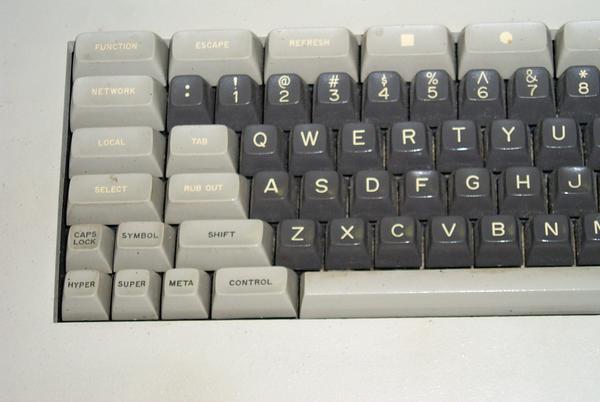
Please, that's nothing. Check out this keyboard from an old Symbolics Lisp machine.
Yeah, that's right. Wanna know what happens when you type Hyper-Super-Meta-Control-Symbol-Shift-Square? So do I...
See also space-cadet keyboard. -
Re:What is the deal with "wearable"...?
But please don't call these 'wearable'... We already did this with cellphones, PDAs, and walkmans, and we didn't start calling these 'wearable' just because our coat has a special pocket for them, did we?
I agree there's definitely some issues with the buzzword surrounding this technology. What a pointless adjective: it's on your body, you're wearing it, we get it.
Ironically, half of CMU's "wearable" computing projects don't even appear to be wearable!! Start with the TIA-P link and you'll see what I mean... apparently, being able to hold it in your hand makes it "wearable". I just submitted this post with my wearable mouse
We need a new term for this sort of thing. Actually, we need two more terms. One for the useful stuff, and one for the stuff pointlessly sewn into clothing that can't even be washed because it has electronics in it. -
Re:Excellent!I have been talking with the admins here about using a REAL IMAP server and it is something they plan to do in a year or two. Exchange is proprietary crap, that is why only MS Software can work with it so well. Maybe talk to someone at your company about using a REAL IMAP server that is standards compliant, then you can use any mailer you like.
I've implemented many mail servers using the Cyrus IMAP Server and have nothing but praises for it. It runs on Solaris, Linux, *BSD operating systems and performs amazingly as a standards compliant IMAP server.
-
Re:PRS (Personal Response System)A significant majority of us still think that academic integrity is something that needs to be upheld, and that's enough to not do it.
In which case, I would assume that students would attend class and participate because it's a good idea, not because there is a mechanism to force them to be present.
I'm not trying to debate this to death, but the reason I'm going through all this is because while I was in college I was subjected through innumerable schemes to boost attendance and participation, some of which involved technical solutions similar to the one you've described. I found the best solution was when the professor laboriously learned everyone's name and addressed them personally when discussing the topic at hand.
The end result is that the professor knew when students missed class, and blatant non-attendance would result in the student somehow being pointed out. This was usually done by the professor greeting him and welcoming him back, usually with a prominent seat up in front to be properly reacquainted with the classroom.
Good old John
-
Mirror of HardOCP forum thread
I remembered seeing this a couple of days ago on HardOCP's boards. I mirrored the thread about it (as
http://andrew.cmu.edu/~pnelson/big.html
(and yes, I did just download the 4 individual pages and cat them together =P) -
Just to make it clear..
Okay, so I read this paper as a part of the SOSP reading group here at school. Just want to make it clear that this is not the file system used by the front end that we all see. It is used by internal dev groups as well as the web spiders that they employ. Their unique usage has definitely led to a number of interesting choices (such as the atomic appends) for the file system design. Read the paper for more details -
Just to make it clear..
Okay, so I read this paper as a part of the SOSP reading group here at school. Just want to make it clear that this is not the file system used by the front end that we all see. It is used by internal dev groups as well as the web spiders that they employ. Their unique usage has definitely led to a number of interesting choices (such as the atomic appends) for the file system design. Read the paper for more details -
Name collisions
People should know that there has been at least one project called "Y Window System" already (Not to mention W and Z...):
Here, 1998 vintage
There was also the YY window system. but that's long dead - 1992 era.
-
Same thing, but with movies
The guys from the french review site x86-secret decided to not only do the same type of thing, but make a bunch of videos available too! They mostly consist of old hardware (even though there is some new stuff) + fireworks = BOOM!!
http://explosive-reviews.x86-secret.com/
And because I'm nice, and it's not my bandwith, I'm currently mirroring them:
http://www.andrew.cmu.edu/~pnelson/explosive-revie ws.x86-secret.com/ -
Doug Comer, not L Ron Hubbard...