Slashdot Mirror
Domain: code.org
Stories and comments across the archive that link to code.org.
Stories · 148
-
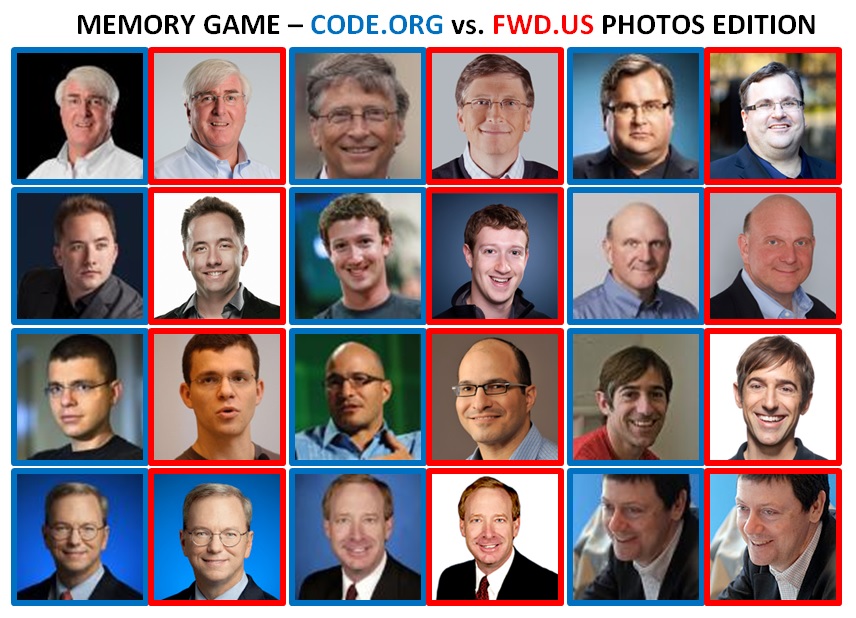
Billionaire Donors Lavish Millions On Code.org Crowdfunding Project
theodp (442580) writes "Whether it's winning yacht races, assembling the best computer science faculty, or even dominating high school basketball, billionaires like to win. Which may help explain why three tech billionaires — Code.org backers (and FWD.us founders) Mark Zuckerberg, VC John Doerr, and Sean Parker — stepped up to the plate and helped out Code.org's once-anemic Hour of Code Indiegogo crowdfunding project with $500k donations. When matched by Code.org's largest donors (Bill Gates, Reid Hoffman and others), the three donations alone raised $3,000,000, enough to reach the organization's goal of becoming the most funded crowdfunding campaign ever on Indiegogo. On its campaign page, Code.org remarked that "to sustain our organization for the long haul, we need to engage parents and community members," which raises questions about how reliant the K-12 learn-to-code movement might be on the kindness of its wealthy corporate and individual donors. Code.org started shedding some light on its top donors a few months back, but contributor names are blank in the 2013 IRS 990 filing posted by the organization on its website, although GuideStar suggests the biggest contributors in 2013 were Microsoft ($3,149,411) and Code.org founders Hadi and Ali Partovi ($1,873,909 in Facebook stock). Coincidentally, in a Reddit AMA at Code.org's launch, CEO and Founder Hadi Partovi noted that his next-door-neighbor is Microsoft General Counsel and Code.org Board member Brad Smith, whose FWD.us bio notes is responsible for Microsoft's philanthropic work. Just months before Code.org and FWD.us emerged on the lobbying scene, Smith announced Microsoft's National Talent Strategy, which called for "an increase in developing the American STEM pipeline in exchange for these new [H-1B] visas and green cards," a wish that President Obama is expected to grant shortly via executive action." -
Mark Zuckerberg And John Doerr Donate $1M To Expand The Hour Of Code Campaign
theodp writes Techcrunch reports that Mark Zuckerberg has donated $500K to expand the Hour of Code campaign, which aims to reach 100 million students this year with its learn-to-code tutorials, including its top-featured tutorial starring Zuckerberg (video). Techcrunch adds that Zuckerberg's donation will be matched by fellow tutorial team teacher Bill Gates (video), Microsoft, Reid Hoffman, Salesforce, Google, and others. Zuck and Gates appear to have a sizable captive audience — a Code.org District Partnership Model brochure on the code-or-no-HS-diploma-for-you Chicago Public Schools' website calls for partner districts to "hold a district-wide Hour of Code event each year" for three years. -
Mark Zuckerberg And John Doerr Donate $1M To Expand The Hour Of Code Campaign
theodp writes Techcrunch reports that Mark Zuckerberg has donated $500K to expand the Hour of Code campaign, which aims to reach 100 million students this year with its learn-to-code tutorials, including its top-featured tutorial starring Zuckerberg (video). Techcrunch adds that Zuckerberg's donation will be matched by fellow tutorial team teacher Bill Gates (video), Microsoft, Reid Hoffman, Salesforce, Google, and others. Zuck and Gates appear to have a sizable captive audience — a Code.org District Partnership Model brochure on the code-or-no-HS-diploma-for-you Chicago Public Schools' website calls for partner districts to "hold a district-wide Hour of Code event each year" for three years. -
Microsoft, Facebook Declare European Kids Clueless About Coding, Too
theodp writes: Having declared U.S. kids clueless about coding, Facebook and Microsoft are now turning their attention to Europe's young 'uns. "As stewards of Europe's future generations," begins the Open Letter to the European Union Ministers for Education signed by Facebook and Microsoft, "you will be all too aware that as early as the age of 7, children reach a critical juncture, when they are learning the core life skills of reading, writing and basic maths. However, to flourish in tomorrow's digital economy and society, they should also be learning to code. And many, sadly, are not." Released at the launch of the European Coding Initiative — aka All You Need is Code! (video) — in conjunction with the EU's Code Week, the letter closes, "As experts in our field, we owe it to Europe's youth to help equip them with the skills they will need to succeed — regardless of where life takes them." -
Microsoft Co-opts Ice Bucket Challenge Idea To Promote Coding In Latin America
theodp writes: Microsoft is aiming to offer free programming courses to over a million young Latin Americans through its Yo Puedo Programar and Eu Posso Programar initiatives ("I Can Program"). People between the ages of 12 and 25 will be able to sign up for the free online courses "One Hour Coding" and "Learning to Program," which will be offered in conjunction with Colombia's Coding Week (Oct. 6-10). The online courses will also be available in Argentina, Brazil, Chile, Ecuador, Mexico, Peru and Puerto Rico. "One Hour Coding" (aka Hour of Code in the U.S.) is a short introductory course in which participants will learn how the technology works and how to create applications, and it offers "a playful immersion in the computer sciences," Microsoft said in a statement. In the virtual, 12-session "Learning to Program" course, students will discover that "technical complexity in application development tools is a myth and that everyone can do it," the statement added. Taking a page from the ALS Ice Bucket Challenge its execs embraced, Microsoft is encouraging students to complete the Hour of Code and challenge four other friends to do the same (Google Translate). -
Code.org Discloses Top Donors
theodp (442580) writes "Under the leadership of Code.org, explained the ACM, it joined CSTA, NCWIT, NSF, Microsoft and Google in an effort "to reshape the U.S. education system," including passing a federal law making Computer Science a "core subject" in schools. If you're curious about whose money helped fuel the effort, Code.org's Donors page now lists those who gave $25,000+ to $3,000,000+ to the K-12 CS cause (the nonprofit plans to raise $20-30 million for 2015-16 operations). Microsoft is at the top of the list as a Platinum Supporter ($3,000,000+), while Bill Gates is Gold ($1,000,000+), and Steve Ballmer is Silver ($500,000+). Interestingly, six of Code.org's ten biggest donors are also Founders of Mark Zuckerberg's FWD.us tech immigration reform PAC." -
Reading, Writing, 'Rithmetic, and Blockly
theodp writes As teachers excitedly tweet about completing their summer CS Professional Development at Google and Microsoft, and kids get ready to go back to school, Code.org is inviting educators to check out their K-5 Computer Science Curriculum (beta), which is slated to launch in September (more course details). The content, Code.org notes, is a blend of online activities ("engineers from Google, Microsoft, Facebook, and Twitter helped create this tutorial," footnotes explain) and 'unplugged' activities, lessons in which students can learn computing concepts with or without a computer. It's unclear if he's reviewed the material himself, but Chicago Mayor Rahm Emanuel is grateful for the CS effort ("Thank you for teaching our students these critical skills"). -
Reading, Writing, 'Rithmetic, and Blockly
theodp writes As teachers excitedly tweet about completing their summer CS Professional Development at Google and Microsoft, and kids get ready to go back to school, Code.org is inviting educators to check out their K-5 Computer Science Curriculum (beta), which is slated to launch in September (more course details). The content, Code.org notes, is a blend of online activities ("engineers from Google, Microsoft, Facebook, and Twitter helped create this tutorial," footnotes explain) and 'unplugged' activities, lessons in which students can learn computing concepts with or without a computer. It's unclear if he's reviewed the material himself, but Chicago Mayor Rahm Emanuel is grateful for the CS effort ("Thank you for teaching our students these critical skills"). -
Reading, Writing, 'Rithmetic, and Blockly
theodp writes As teachers excitedly tweet about completing their summer CS Professional Development at Google and Microsoft, and kids get ready to go back to school, Code.org is inviting educators to check out their K-5 Computer Science Curriculum (beta), which is slated to launch in September (more course details). The content, Code.org notes, is a blend of online activities ("engineers from Google, Microsoft, Facebook, and Twitter helped create this tutorial," footnotes explain) and 'unplugged' activities, lessons in which students can learn computing concepts with or without a computer. It's unclear if he's reviewed the material himself, but Chicago Mayor Rahm Emanuel is grateful for the CS effort ("Thank you for teaching our students these critical skills"). -
Reading, Writing, 'Rithmetic, and Blockly
theodp writes As teachers excitedly tweet about completing their summer CS Professional Development at Google and Microsoft, and kids get ready to go back to school, Code.org is inviting educators to check out their K-5 Computer Science Curriculum (beta), which is slated to launch in September (more course details). The content, Code.org notes, is a blend of online activities ("engineers from Google, Microsoft, Facebook, and Twitter helped create this tutorial," footnotes explain) and 'unplugged' activities, lessons in which students can learn computing concepts with or without a computer. It's unclear if he's reviewed the material himself, but Chicago Mayor Rahm Emanuel is grateful for the CS effort ("Thank you for teaching our students these critical skills"). -
Reading, Writing, 'Rithmetic, and Blockly
theodp writes As teachers excitedly tweet about completing their summer CS Professional Development at Google and Microsoft, and kids get ready to go back to school, Code.org is inviting educators to check out their K-5 Computer Science Curriculum (beta), which is slated to launch in September (more course details). The content, Code.org notes, is a blend of online activities ("engineers from Google, Microsoft, Facebook, and Twitter helped create this tutorial," footnotes explain) and 'unplugged' activities, lessons in which students can learn computing concepts with or without a computer. It's unclear if he's reviewed the material himself, but Chicago Mayor Rahm Emanuel is grateful for the CS effort ("Thank you for teaching our students these critical skills"). -
AP Computer Science Test Takers Up 8,000; Pass Rate Down 6.8%
theodp (442580) writes "Code.org reports that preliminary data on students who took the Advanced Placement (AP) Computer Science Exam in 2014 show an increase of 8,276 students over 2013 and represent what the College Board called "the first real indication of progress in AP CS enrollment for women and underserved minorities in years." Girls made up 20% of the 39,393 total test takers, compared to 18.7% of the 31,117 test takers in 2013. Black or African American students saw their share increase by 0.19%, from 3.56% to 3.75% (low, but good enough to crush Twitter). Code.org credits the increased enrollment to its celebrity-studded CS promo film starring Bill Gates and Mark Zuckerberg ("I even made a personal bet (reflected in my contractual commitment to Code.org donors) that our video could help improve the seemingly immovable diversity numbers in computer science," Code.org founder Hadi Partovi notes). However, some of the increase is likely attributable to the other efforts of Code.org's donors. Microsoft ramped up its TEALS AP CS program in 2013-2014, and — more significantly — Google helped boost AP CS study not only through its CS4HS program, but also by funding the College Board's AP STEM Access program, which offered $5 million to schools and teachers to encourage minority and female students to enroll in AP STEM courses. This summer, explains the College Board, "All AP STEM teachers in the participating schools (not just the new AP STEM teachers), who increase diversity in their class, receive a [$100] DonorsChoose.org gift card for each student in the course who receives a 3, 4, or 5 on the AP Exam." The bad news for AP CS teachers anticipating Google "Excellence Funding" bounties (for increasing course enrollment and completion "by at least five underrepresented students") is that AP CS pass rates decreased to 60.8% in 2014 (from 67.6% in 2013), according to Total Registration. Using these figures and a back-of-the-envelope calculation, while enrollment saw a 26.6% increase over last year, the total number of students passing increased by 13.9%." -
AP Computer Science Test Takers Up 8,000; Pass Rate Down 6.8%
theodp (442580) writes "Code.org reports that preliminary data on students who took the Advanced Placement (AP) Computer Science Exam in 2014 show an increase of 8,276 students over 2013 and represent what the College Board called "the first real indication of progress in AP CS enrollment for women and underserved minorities in years." Girls made up 20% of the 39,393 total test takers, compared to 18.7% of the 31,117 test takers in 2013. Black or African American students saw their share increase by 0.19%, from 3.56% to 3.75% (low, but good enough to crush Twitter). Code.org credits the increased enrollment to its celebrity-studded CS promo film starring Bill Gates and Mark Zuckerberg ("I even made a personal bet (reflected in my contractual commitment to Code.org donors) that our video could help improve the seemingly immovable diversity numbers in computer science," Code.org founder Hadi Partovi notes). However, some of the increase is likely attributable to the other efforts of Code.org's donors. Microsoft ramped up its TEALS AP CS program in 2013-2014, and — more significantly — Google helped boost AP CS study not only through its CS4HS program, but also by funding the College Board's AP STEM Access program, which offered $5 million to schools and teachers to encourage minority and female students to enroll in AP STEM courses. This summer, explains the College Board, "All AP STEM teachers in the participating schools (not just the new AP STEM teachers), who increase diversity in their class, receive a [$100] DonorsChoose.org gift card for each student in the course who receives a 3, 4, or 5 on the AP Exam." The bad news for AP CS teachers anticipating Google "Excellence Funding" bounties (for increasing course enrollment and completion "by at least five underrepresented students") is that AP CS pass rates decreased to 60.8% in 2014 (from 67.6% in 2013), according to Total Registration. Using these figures and a back-of-the-envelope calculation, while enrollment saw a 26.6% increase over last year, the total number of students passing increased by 13.9%." -
Is K-12 CS Education the Next Common Core?
theodp (442580) writes In an interview with The Washington Post's Lyndsey Layton that accompanied her report on How Bill Gates Pulled Off the Swift Common Core Revolution (the Gates Foundation doled out $233 million in grants to git-r-done), Gates denied that he has too much influence in K-12 education. Despite Gates' best efforts, however, there's been more and more pushback recently from both teachers and politicians on the standards, GeekWire's Taylor Soper reports, including a protest Friday by the Badass Teacher Association, who say Gates is ruining education. "We want to get corporations out of teaching," explained one protester. If that's the case, the "Badasses" probably won't be too pleased to see how the K-12 CS education revolution is shaping up, fueled by a deep-pocketed alliance of Gates, Google, Microsoft, Facebook, and others. Google alone has already committed $90 million to influence CS education. And well-connected Code.org, which has struck partnerships with school districts reaching over 2M U.S. students and is advising NSF-funded research related to the nation's CS 10K Project, will be conducting required professional development sessions for K-12 CS teachers out of Google, Microsoft, and Amazon offices this summer in Chicago, New York City, Boston, and Seattle. So, could K-12 CS Education ("Common Code"?) become the next Common Core? -
Is K-12 CS Education the Next Common Core?
theodp (442580) writes In an interview with The Washington Post's Lyndsey Layton that accompanied her report on How Bill Gates Pulled Off the Swift Common Core Revolution (the Gates Foundation doled out $233 million in grants to git-r-done), Gates denied that he has too much influence in K-12 education. Despite Gates' best efforts, however, there's been more and more pushback recently from both teachers and politicians on the standards, GeekWire's Taylor Soper reports, including a protest Friday by the Badass Teacher Association, who say Gates is ruining education. "We want to get corporations out of teaching," explained one protester. If that's the case, the "Badasses" probably won't be too pleased to see how the K-12 CS education revolution is shaping up, fueled by a deep-pocketed alliance of Gates, Google, Microsoft, Facebook, and others. Google alone has already committed $90 million to influence CS education. And well-connected Code.org, which has struck partnerships with school districts reaching over 2M U.S. students and is advising NSF-funded research related to the nation's CS 10K Project, will be conducting required professional development sessions for K-12 CS teachers out of Google, Microsoft, and Amazon offices this summer in Chicago, New York City, Boston, and Seattle. So, could K-12 CS Education ("Common Code"?) become the next Common Core? -
Is K-12 CS Education the Next Common Core?
theodp (442580) writes In an interview with The Washington Post's Lyndsey Layton that accompanied her report on How Bill Gates Pulled Off the Swift Common Core Revolution (the Gates Foundation doled out $233 million in grants to git-r-done), Gates denied that he has too much influence in K-12 education. Despite Gates' best efforts, however, there's been more and more pushback recently from both teachers and politicians on the standards, GeekWire's Taylor Soper reports, including a protest Friday by the Badass Teacher Association, who say Gates is ruining education. "We want to get corporations out of teaching," explained one protester. If that's the case, the "Badasses" probably won't be too pleased to see how the K-12 CS education revolution is shaping up, fueled by a deep-pocketed alliance of Gates, Google, Microsoft, Facebook, and others. Google alone has already committed $90 million to influence CS education. And well-connected Code.org, which has struck partnerships with school districts reaching over 2M U.S. students and is advising NSF-funded research related to the nation's CS 10K Project, will be conducting required professional development sessions for K-12 CS teachers out of Google, Microsoft, and Amazon offices this summer in Chicago, New York City, Boston, and Seattle. So, could K-12 CS Education ("Common Code"?) become the next Common Core? -
Is K-12 CS Education the Next Common Core?
theodp (442580) writes In an interview with The Washington Post's Lyndsey Layton that accompanied her report on How Bill Gates Pulled Off the Swift Common Core Revolution (the Gates Foundation doled out $233 million in grants to git-r-done), Gates denied that he has too much influence in K-12 education. Despite Gates' best efforts, however, there's been more and more pushback recently from both teachers and politicians on the standards, GeekWire's Taylor Soper reports, including a protest Friday by the Badass Teacher Association, who say Gates is ruining education. "We want to get corporations out of teaching," explained one protester. If that's the case, the "Badasses" probably won't be too pleased to see how the K-12 CS education revolution is shaping up, fueled by a deep-pocketed alliance of Gates, Google, Microsoft, Facebook, and others. Google alone has already committed $90 million to influence CS education. And well-connected Code.org, which has struck partnerships with school districts reaching over 2M U.S. students and is advising NSF-funded research related to the nation's CS 10K Project, will be conducting required professional development sessions for K-12 CS teachers out of Google, Microsoft, and Amazon offices this summer in Chicago, New York City, Boston, and Seattle. So, could K-12 CS Education ("Common Code"?) become the next Common Core? -
Chelsea Clinton At NCWIT: More PE, Less Zuckerberg
theodp (442580) writes "Among the speakers at last week's National Center for Women & Information Technology (NCWIT) Summit was Chelsea Clinton, who spoke fondly of the Commodore she received as a kid on Christmas Day in 1987. During the Q&A, Clinton was asked (Vimeo), 'What do you see as some of the right policies that could help put Computer Science — which is undeniably the most important 21st Century skill — into our classrooms?' To which the former First Daughter responded, 'I won't quibble with the fact that I think it's very important. I also think other things admittedly are important.' Such as? Aligning Computer Science with Common Core, for one thing ('Ensure that Computer Science is part of the definition of science'). Using state budget surpluses to hire additional physical education teachers for elementary and middle school students, for another ('For Computer Science, as any subject, kids that are well-fed with healthy food and who have been activated in their bodies will able to learn and retain information in any subject better than if they're not'). And, last but not least, 'continuing to tell stories of people that are not...people who don't look like Mark Zuckerberg as successful in Computer Science and technology.' NCWIT, by the way, was listed as a "major partner" on last December's Hour of Code, which arguably made Mark Zuckerberg the face of Computer Science for K-12 students in the nationwide campaign embraced by President Obama during CSEdWeek." -
Kids To Get the Best CS Teachers $15/Hr Can Buy
theodp (442580) writes "Billionaire-backed Code.org, enthusiastically tweets U.S. Dept. of Education Chief Arne Duncan, is 'providing tremendous leadership in bringing coding & computer science to our nation's schools.' Including bringing kids in Broward County Public Schools the best computer science teachers $15.00-an-hour can buy, according to a document on the school district's website. One wonders how the Broward teachers feel about Code.org apparently coughing up $38.33-an-hour for Chicago teachers who attend the required Code.org professional development, which ironically covers equity issues. Duncan's shout-out comes days after Code.org claimed in its Senate testimony that 'our students have voted with their actions [participating in an hour-long, Angry Birds-themed Blockly tutorial starring Mark Zuckerberg and Bill Gates]: that learning computer science is this generation's Sputnik moment, that it's part of the new American Dream, and that it should be available to every student, in every school, as part of the standard curriculum.'" -
Should Microsoft Give Kids Programmable Versions of Office?
theodp (442580) writes "Over at Microsoft on the Issues, Microsoft continues to lament the computer programming skills gap of American kids, while simultaneously lobbying for more H-1B visas to fill that gap. Saying that states must do more to 'help students gain critical 21st century skills,' Microsoft credits itself and partner Code.org for getting 30,606,732 students to experience coding through the Hour of Code, claiming that K-12 kids have 'written 1,332,784,839 lines of code' (i.e., dragged-and-dropped puzzle pieces), So, if it's concerned about helping students gain programming skills, shouldn't Microsoft be donating fully-functional desktop versions of MS-Office to schools, which would allow kids to use Visual Basic for Applications (VBA)? While Microsoft's pledge to give 12 million copies of its Office software to schools was heralded by the White House and the press, a review of the 'fine print' at Microsoft suggests it's actually the online VBA-free version of Office 365 Education that the kids will be getting, unless their schools qualify for the Student Advantage program by purchasing Office for the faculty and staff. Since Microsoft supported President Obama's call for kids to 'Don't Just Play on Your Phone, Program It', shouldn't it give kids the chance to program MS-Office, too?" -
Code.org Resurrects 'Flappy Bird' As Programming Lesson
Nerval's Lobster writes "Flappy Bird might be kaput, but its hilariously awkward hero is serving another useful purpose in its afterlife: teaching people how to code. Flappy Bird, a free mobile game for Android and iOS that asks the player to guide the titular avian through an obstacle course of vertical pipes, became a sensation earlier this year, seizing the top spots on the Apple and Google Play app stores. Its creator, Dong Nguyen, said the game earned him an average of $50,000 a day through in-app advertising — but that didn't stop him from yanking the game offline in early February. Now Code.org has resurrected Flappy Bird, Phoenix-style, from the smoking wreckage, with a free tutorial that allows anyone with a bit of time to code his or her very own version of the game. There's no actual code to learn, thanks to a visual interface that allows budding developers to drag 'blocks' of commands into place. 'Flappy Bird recently met its untimely death. We might've been tempted to cry all day and give up on spreading computer science (not really, but R.I.P Flappy Bird),' read a note on Code.org's blog. 'Instead, we built a new drag-and-drop tutorial that lets you build your own Flappy game — whether it's Flappy Bird, or Flappy Easter Bunny, Flappy Santa, Flappy Shark with Lasers, Flappy Fairy or Flappy Underwater Unicorn.' Childish? Maybe. But it could help draw people into coding for fun or profit." -
Non-Coders As the Face of the Learn-to-Code Movements
theodp writes "You wouldn't select Linus Torvalds to be the public face for the 'Year of Basketball.' So, why tap someone who doesn't code to be the face of 'The Year of Code'? Slate's Lily Hay Newman reports on the UK's Year of Code initiative to promote interest in programming and train teachers, which launched last week with a Director who freely admits that she doesn't know how to code. "I'm going to put my cards on the table," Lottie Dexter told Newsnight host Jeremy Paxman on national TV. I've committed this year to learning to code...so over this year I'm going to see exactly what I can achieve. So who knows, I might be the next Zuckerberg." "You can always dream," quipped the curmudgeonly Paxman, who was also unimpressed with Dexter's argument that the national initiative could teach people to make virtual birthday cards, an example straight out of Mark Zuckerberg's Hour of Code playbook (coming soon to the UK). Back in the States, YouTube chief and Hour of Code headliner Susan Wojcicki — one of many non-coder Code.org spokespersons — can be seen on YouTube fumbling for words to answer a little girl's straightforward question, "What is one way you apply Computer Science to your job at Google?". While it's understandable that companies and tech leaders probably couldn't make CS education "an issue like climate change" (for better or worse) without embracing politicians and celebrities, it'd be nice if they'd at least showcase a few more real-life coders in their campaigns." -
Should Everybody Learn To Code?
theodp writes "In July, the Association for Computing Machinery announced it was partnering with Code.org, with ACM contributing funding and its Director of Public Policy to Code.org in a push to 'ensure that every K-12 student in the US has the opportunity to study computer science.' Interestingly, joining others questioning the conventional Presidential wisdom that everybody-must-get-code is the Communications of the ACM, which asks in its February issue, Should Everybody Learn to Code? By the way, Code.org is bringing its Hour of Code show to the UK in March. The new National Curriculum for England that is to be taught in all primary and secondary schools beginning in September includes a new emphasis on Computer Science curricula, said to have been sparked by a speech given by Google Chairman Eric Schmidt in 2011." -
K-12 CS Education Funding: Taxes, H-1B Fees, Donations?
theodp writes "Back in 2010, Bill Gates Sr. made the case for I-1098, an initiative for a WA state income tax that Gates argued was needed to address K-12 funding inequity, which he claimed was forcing businesses "to import technically-trained employees, while our own people are shut out of highly paid careers." Opposed by the deep-pocketed, high-tech studded Defeat 1098, the initiative was defeated. Four years later, some of the same high-tech leaders who records show funded Defeat 1098 — including Microsoft CEO Steve Ballmer ($425K), Microsoft General Counsel Brad Smith ($10K), Code.org founder Hadi Partovi ($10K), Amazon CEO Jeff Bezos ($100K), Microsoft Corporation ($75K) — have gotten behind groups like Mark Zuckerberg's FWD.us and Code.org, which are singing a similar Chicken Little tune, telling lawmakers that U.S. students will continue to be shut out of highly paid computer science careers without additional K-12 funding, and the U.S. will lose its competitive edge unless tech is permitted to import even more technically-trained employees. In a departure from Gates' income-tax based solution, Microsoft and Code.org argue that the-problem-is-the-solution, proposing that tech visa fees be used to fund K-12 CS programs. To 'accept that computer science classes are only available to the privileged few,' writes Code.org, 'seems un-American'. So, as some of the nation's biggest K-12 school systems turn to Code.org for CS education programs, should they expect the funding to come from taxes, H-1B tech visa fees, or the-kindness-of-wealthy-strangers philanthropy?" -
K-12 CS Education Funding: Taxes, H-1B Fees, Donations?
theodp writes "Back in 2010, Bill Gates Sr. made the case for I-1098, an initiative for a WA state income tax that Gates argued was needed to address K-12 funding inequity, which he claimed was forcing businesses "to import technically-trained employees, while our own people are shut out of highly paid careers." Opposed by the deep-pocketed, high-tech studded Defeat 1098, the initiative was defeated. Four years later, some of the same high-tech leaders who records show funded Defeat 1098 — including Microsoft CEO Steve Ballmer ($425K), Microsoft General Counsel Brad Smith ($10K), Code.org founder Hadi Partovi ($10K), Amazon CEO Jeff Bezos ($100K), Microsoft Corporation ($75K) — have gotten behind groups like Mark Zuckerberg's FWD.us and Code.org, which are singing a similar Chicken Little tune, telling lawmakers that U.S. students will continue to be shut out of highly paid computer science careers without additional K-12 funding, and the U.S. will lose its competitive edge unless tech is permitted to import even more technically-trained employees. In a departure from Gates' income-tax based solution, Microsoft and Code.org argue that the-problem-is-the-solution, proposing that tech visa fees be used to fund K-12 CS programs. To 'accept that computer science classes are only available to the privileged few,' writes Code.org, 'seems un-American'. So, as some of the nation's biggest K-12 school systems turn to Code.org for CS education programs, should they expect the funding to come from taxes, H-1B tech visa fees, or the-kindness-of-wealthy-strangers philanthropy?" -
The Whole Story Behind Low AP CS Exam Stats
theodp writes "At first glance, the headline in The Salt Lake Tribune — Very Few Utah Girls, Minorities Take Computer Science AP Tests — appears to be pretty alarming. As does the headline No Girls, Blacks, or Hispanics Take AP Computer Science Exam in Some States over at Education Week. Not One Girl Took The AP Computer Science Test In Some States warns a Business Insider headline. And so on and so on and so on. So how could one quibble with tech-giant backed Code.org's decision to pay teachers a $250 "Female Student Bonus", or Google's declaration that 'the ultimate goal of CS First is to provide proven teaching materials, screencasts, and curricula for after-school programs that will ignite the interest and confidence of underrepresented minorities and girls in CS,' right? But the thing is, CollegeBoard AP CS exam records indicate that no Wyoming students at all took an AP CS exam (xls) in 2013, and only a total of 103 Utah students (xls) had reported scores. Let's not forget about the girls and underrepresented minorities, but since AP CS Exam Stats are being spun as a measure of CS education participation (pdf) and equity, let's not forget that pretty much everyone has been underrepresented if we look at the big AP CS picture. If only 29,555 AP CS scores were reported (xls) in 2013 for a HS population of about 16 million students, shouldn't the goal at this stage of the game really be CS education for all?" -
The Whole Story Behind Low AP CS Exam Stats
theodp writes "At first glance, the headline in The Salt Lake Tribune — Very Few Utah Girls, Minorities Take Computer Science AP Tests — appears to be pretty alarming. As does the headline No Girls, Blacks, or Hispanics Take AP Computer Science Exam in Some States over at Education Week. Not One Girl Took The AP Computer Science Test In Some States warns a Business Insider headline. And so on and so on and so on. So how could one quibble with tech-giant backed Code.org's decision to pay teachers a $250 "Female Student Bonus", or Google's declaration that 'the ultimate goal of CS First is to provide proven teaching materials, screencasts, and curricula for after-school programs that will ignite the interest and confidence of underrepresented minorities and girls in CS,' right? But the thing is, CollegeBoard AP CS exam records indicate that no Wyoming students at all took an AP CS exam (xls) in 2013, and only a total of 103 Utah students (xls) had reported scores. Let's not forget about the girls and underrepresented minorities, but since AP CS Exam Stats are being spun as a measure of CS education participation (pdf) and equity, let's not forget that pretty much everyone has been underrepresented if we look at the big AP CS picture. If only 29,555 AP CS scores were reported (xls) in 2013 for a HS population of about 16 million students, shouldn't the goal at this stage of the game really be CS education for all?" -
Is Computer Science Education Racist and Sexist?
theodp writes "What's wrong with this picture?" asked Code.org at its launch earlier this year, lamenting the lack of Computer Science students in a race and gender reference-free infographic. But as the organization has grown via public/private partnerships and inked agreements to drive the CS curriculum for the Chicago and NYC school systems, the same stats webpage has adopted a new gender and racial equity focus, positioning Computer Science education as "a chance to level the playing field" for women, Hispanic and African American students. The new message is consistent with the recently-forged Code.org partnership with the NSF-funded Exploring Computer Science (ECS, "a K-12/university partnership committed to democratizing computer science") and Computer Science Principles (CSP, "a new course under development that seeks to broaden participation in computing and computer science"). According to The Research Behind ECS, an "insidious 'virtual segregation' that maintains inequality" is to blame for keeping the number of African Americans and Latino/as CS students disproportionately low. So, what might the future of Code.org's proposed equity-based U.S. K-12 CS education look like? "Including culturally relevant instructional materials represented a driving focus of our course development," explained ECS Team members who now advise Code.org. "Cultural design tools encourage students to artistically express computing design concepts from Latino/a, African American, or Native American history as well as cultural activities in dance, skateboarding, graffiti art, and more. These types of lessons are important for students to build personal relationships with computer science concepts and applications – an important process for discovering the relevance of computer science for their own life." And — ironically for Code.org — it could mean less coding." -
Is Computer Science Education Racist and Sexist?
theodp writes "What's wrong with this picture?" asked Code.org at its launch earlier this year, lamenting the lack of Computer Science students in a race and gender reference-free infographic. But as the organization has grown via public/private partnerships and inked agreements to drive the CS curriculum for the Chicago and NYC school systems, the same stats webpage has adopted a new gender and racial equity focus, positioning Computer Science education as "a chance to level the playing field" for women, Hispanic and African American students. The new message is consistent with the recently-forged Code.org partnership with the NSF-funded Exploring Computer Science (ECS, "a K-12/university partnership committed to democratizing computer science") and Computer Science Principles (CSP, "a new course under development that seeks to broaden participation in computing and computer science"). According to The Research Behind ECS, an "insidious 'virtual segregation' that maintains inequality" is to blame for keeping the number of African Americans and Latino/as CS students disproportionately low. So, what might the future of Code.org's proposed equity-based U.S. K-12 CS education look like? "Including culturally relevant instructional materials represented a driving focus of our course development," explained ECS Team members who now advise Code.org. "Cultural design tools encourage students to artistically express computing design concepts from Latino/a, African American, or Native American history as well as cultural activities in dance, skateboarding, graffiti art, and more. These types of lessons are important for students to build personal relationships with computer science concepts and applications – an important process for discovering the relevance of computer science for their own life." And — ironically for Code.org — it could mean less coding." -
Is Computer Science Education Racist and Sexist?
theodp writes "What's wrong with this picture?" asked Code.org at its launch earlier this year, lamenting the lack of Computer Science students in a race and gender reference-free infographic. But as the organization has grown via public/private partnerships and inked agreements to drive the CS curriculum for the Chicago and NYC school systems, the same stats webpage has adopted a new gender and racial equity focus, positioning Computer Science education as "a chance to level the playing field" for women, Hispanic and African American students. The new message is consistent with the recently-forged Code.org partnership with the NSF-funded Exploring Computer Science (ECS, "a K-12/university partnership committed to democratizing computer science") and Computer Science Principles (CSP, "a new course under development that seeks to broaden participation in computing and computer science"). According to The Research Behind ECS, an "insidious 'virtual segregation' that maintains inequality" is to blame for keeping the number of African Americans and Latino/as CS students disproportionately low. So, what might the future of Code.org's proposed equity-based U.S. K-12 CS education look like? "Including culturally relevant instructional materials represented a driving focus of our course development," explained ECS Team members who now advise Code.org. "Cultural design tools encourage students to artistically express computing design concepts from Latino/a, African American, or Native American history as well as cultural activities in dance, skateboarding, graffiti art, and more. These types of lessons are important for students to build personal relationships with computer science concepts and applications – an important process for discovering the relevance of computer science for their own life." And — ironically for Code.org — it could mean less coding." -
Is Computer Science Education Racist and Sexist?
theodp writes "What's wrong with this picture?" asked Code.org at its launch earlier this year, lamenting the lack of Computer Science students in a race and gender reference-free infographic. But as the organization has grown via public/private partnerships and inked agreements to drive the CS curriculum for the Chicago and NYC school systems, the same stats webpage has adopted a new gender and racial equity focus, positioning Computer Science education as "a chance to level the playing field" for women, Hispanic and African American students. The new message is consistent with the recently-forged Code.org partnership with the NSF-funded Exploring Computer Science (ECS, "a K-12/university partnership committed to democratizing computer science") and Computer Science Principles (CSP, "a new course under development that seeks to broaden participation in computing and computer science"). According to The Research Behind ECS, an "insidious 'virtual segregation' that maintains inequality" is to blame for keeping the number of African Americans and Latino/as CS students disproportionately low. So, what might the future of Code.org's proposed equity-based U.S. K-12 CS education look like? "Including culturally relevant instructional materials represented a driving focus of our course development," explained ECS Team members who now advise Code.org. "Cultural design tools encourage students to artistically express computing design concepts from Latino/a, African American, or Native American history as well as cultural activities in dance, skateboarding, graffiti art, and more. These types of lessons are important for students to build personal relationships with computer science concepts and applications – an important process for discovering the relevance of computer science for their own life." And — ironically for Code.org — it could mean less coding." -
Code.org Stats: 507MM LOC, 6.8MM Kids, 2K YouTube Views
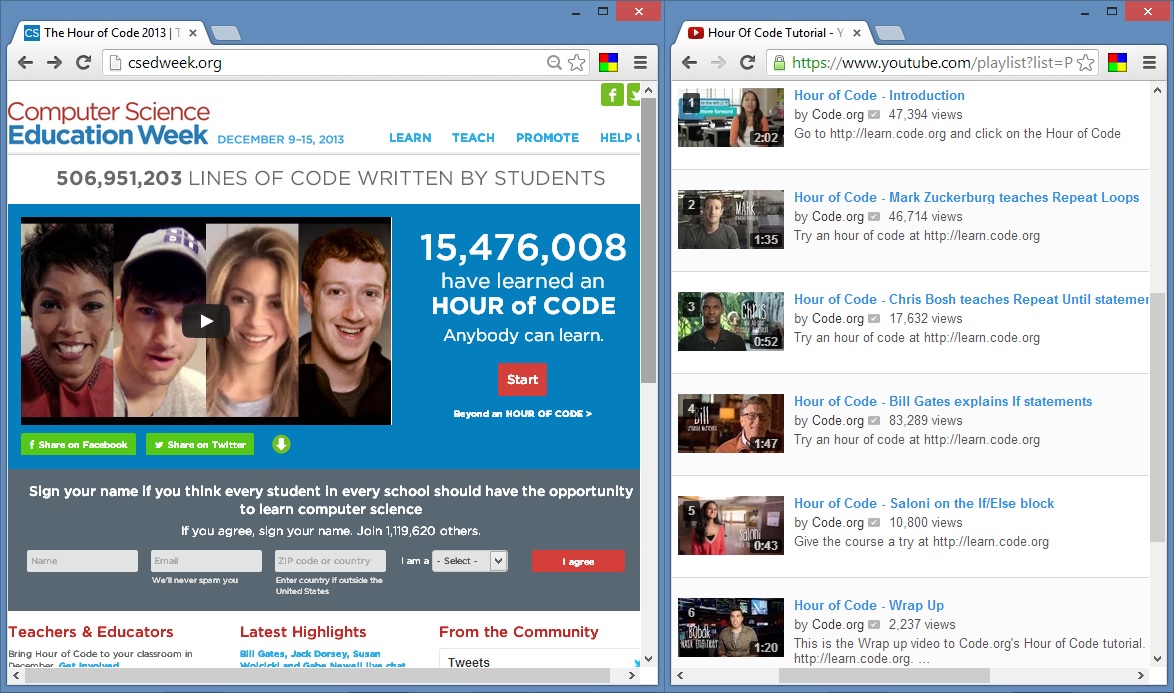
theodp writes "On the final day of Computer Science Education Week, the Hour of Code bravado continues. Around 12:30 a.m. Sunday (ET), Code.org was boasting that in just 6 days, students of its tutorials have "written" more than 10x the number of lines of code in Microsoft Windows. "Students of the Code.org tutorials have written 507,152,775 lines of code. Is this a lot? By comparison, the Microsoft Windows operating system has roughly 50 million lines of code." Code.org adds, "In total, 15,481,846 students have participated in the Hour of Code. Of this group, 6,872,757 of them used the tutorials by Code.org, and within the Code.org tutorial, they've written 507,152,775 lines of code." On YouTube, however, a playlist of the Code.org tutorial videos has distinctly lower numbers, with only 2,246 views of the Code.org Wrap Up video reported as of this writing. So, any thoughts on why the big disconnect, and how close the stats might reflect reality? Code.org does explain that an 'Hour of Code' is not necessarily an 'hour of code' ("Not everybody finishes an Hour of Code tutorial. Some students spend one hour. Some spend 10 minutes. Some spend days. Instead of counting how many students 'finish one hour'; or how much time they spent, this [LOC] is our simplest measure of progress"). So, with millions being spent on efforts to get Code.org into the nation's schools — New York and Chicago have already committed their 1.5 million K-12 students — is it important to get a better understanding of what the Hour of Code usage stats actually represent — and what their limitations might be — and not just accept as gospel reports like AllThingsD's 15 Million Students Learned to Program This Week, Thanks to Hour of Code ("every other school family in the U.S. has a child that has done the Hour of Code")?" -
Chicago Public Schools Promoting Computer Science to Core Subject
dmiller1984 writes "The Chicago Public Schools, the third-largest public school system in the United States, announced a five-year plan today that would add at least one computer science course to every CPS high school, and elevate computer science to a core requirement instead of an elective. CPS announced this through a partnership with code.org, stating that the non-profit would provide free curriculum, professional development, and stipends for teachers." -
The Yin and Yang of Hour of Code & Immigration Reform
theodp writes "The weeklong Hour of Code kicks off tomorrow, with Mark Zuckerberg and Bill Gates doing their part to address a declared nationwide CS crisis by ostensibly teaching the nation's schoolchildren how to code. But a recent NY Times Op-Ed by economist Paul Collier criticizing Zuckerberg's FWD.us PAC as self-serving advocacy (echoing earlier criticism) serves as a reminder that Zuckerberg and Gates' Code.org and Hour of Code involvement is the Yin to their H-1B visa lobbying Yang. The two efforts have been inextricably linked together for Congress, if not for the public. And while Zuckerberg argues it's 'the right thing to do', Collier argues that there are also downsides to the tech giants' plans to shift more bright, young, enterprising people from the poorest countries to the richest. 'An open door for the talented would help Facebook's bottom line,' Collier concludes, 'but not the bottom billion.'" -
Excite Kids To Code By Focusing Less On Coding
the agent man writes "The Hour of Code event taking place December 9-15 has produced a number of tutorials with the goal to excite 10 millions kids to code. It's really interesting to contrast the different pedagogical approaches behind the roughly 30 tutorials. The University of Colorado's 'Make a 3D Game' tutorial wants to excite kids to code by focusing less on coding. This pedagogy is based on the idea that coding alone, without non-coding creativity, has a hard time attracting kids who are skeptical of computer science, including a high percentage of girls who think 'programming is hard and boring.' Instead, the 'Make a 3D Game' activity has the kids create sharable 3D shapes and 3D worlds in their browsers, which they then want to bring to life — through coding. There is evidence that this strategy works. The article talks about the research exploring how kids get excited through game design, and how they can later leverage coding skills acquired to make science simulations. You can try the activity by yourself or with your kids, if you're curious." -
Zuckerberg Shows Kindergartners Ruby Instead of JavaScript
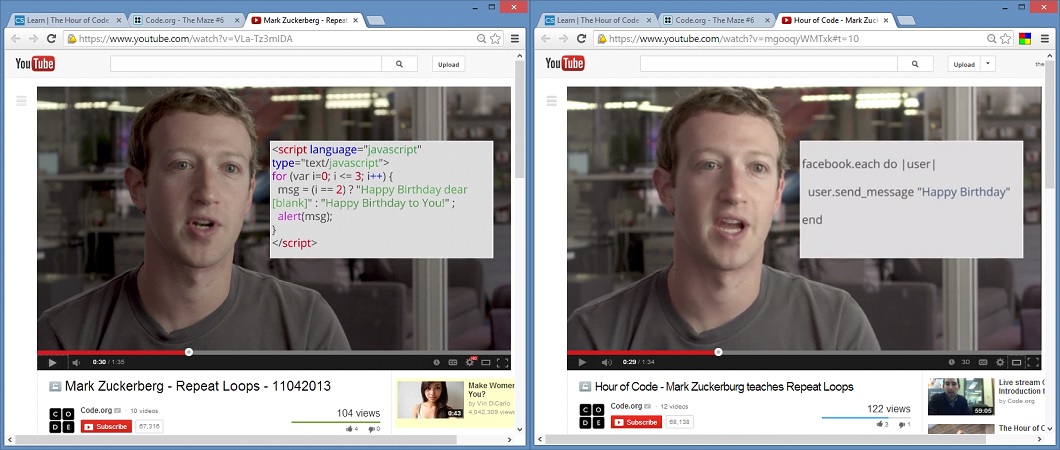
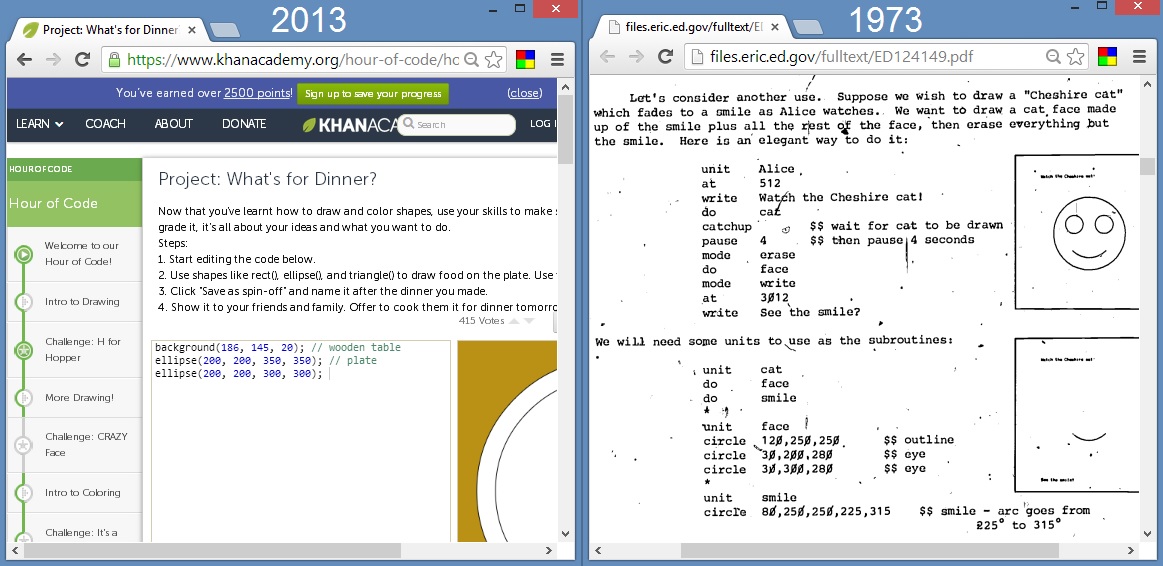
theodp writes "If one was introducing coding to 10 million K-12 kids over 5 days, one might settle on a programming language for examples more than a few weeks before D-Day. But the final tutorials for the Hour of Code aren't due now until the day they're to be taught, so Code.org was able to switch the example Facebook CEO Mark Zuckerberg uses to illustrate Repeat Loops from JavaScript to what looks like Ruby (earlier /. discussion of the JavaScript example), which will no doubt make things clearer for the kindergarten set working on the accompanying Angry Birds tutorial. Khan Academy, on the other hand, is sticking with JavaScript for its Hour of Code tutorial aimed at middle-schoolers, which culminates in a project showing the kids how they can draw a circular plate by invoking an ellipse function with equal major and minor axes. By the way, as Bret Victor might point out, the 2013 Khan Academy lesson looks a lot like circa-1973 PLATO!" -
Code.org Wants Participating Students' Data For 7 Years
theodp writes "As part of its plan to improve computer science education in the U.S., the Mark Zuckerberg and Bill Gates-backed Code.org is asking school districts to sign a contract calling for Code.org to receive 'longitudinal student achievement data' for up to seven academic years in return for course materials, small teacher stipends, and general support. The Gates Foundation is already facing a backlash from the broader academic community over attempts to collect student data as part of its inBloom initiative. The Code.org contract also gives the organization veto power over the district teachers selected to participate in the Code.org program, who are required to commit to teaching in the program for a minimum of two school years." -
Code.org: More Money For CS Instructors Who Teach More Girls
theodp writes "The same cast of billionaire characters — Mark Zuckerberg, Bill Gates, Steve Ballmer, Eric Schmidt — is backing FWD.us, which is lobbying Congress for more visas to 'meet our workforce needs,' as well as Code.org, which aims to popularize Computer Science education in the U.S. to address a projected CS job shortfall. In laying out the two-pronged strategy for the Senate, Microsoft General Counsel and Code.org Board member Brad Smith argued that providing more kids with a STEM education — particularly CS — was 'an issue of critical importance to our country.' But with its K-8 learn-to-code program which calls for teachers to receive 25% less money if fewer than 40% of their CS students are girls, Smith's Code.org is sending the message that training too many boys isn't an acceptable solution to the nation's CS crisis. 'When 10 or more students complete the course,' explains Code.org, "you will receive a $750 DonorsChoose.org gift code. If 40% or more of your participating students are female, you'll receive an additional $250, for a total gift of $1,000 in DonorsChoose.org funding!" The $1+ million Code.org-DonorsChoose CS education partnership appears to draw inspiration from a $5 million Google-DoonorsChoose STEM education partnership which includes nebulous conditions that disqualify schools from AP STEM funding if projected participation by female students in AP STEM programs is deemed insufficient. So, are Zuckerberg, Gates, Ballmer, and Schmidt walking-the-gender-diversity-talk at their own companies? Not according to the NY Times, which just reported that women still account for only about 25% of all employees at Code.org supporters Apple, Google, Facebook, and Microsoft. By the way, while not mentioning these specific programs, CNET reports that Slashdot owner Dice supports the STEM efforts of Code.org and Donors Choose." -
Code.org: More Money For CS Instructors Who Teach More Girls
theodp writes "The same cast of billionaire characters — Mark Zuckerberg, Bill Gates, Steve Ballmer, Eric Schmidt — is backing FWD.us, which is lobbying Congress for more visas to 'meet our workforce needs,' as well as Code.org, which aims to popularize Computer Science education in the U.S. to address a projected CS job shortfall. In laying out the two-pronged strategy for the Senate, Microsoft General Counsel and Code.org Board member Brad Smith argued that providing more kids with a STEM education — particularly CS — was 'an issue of critical importance to our country.' But with its K-8 learn-to-code program which calls for teachers to receive 25% less money if fewer than 40% of their CS students are girls, Smith's Code.org is sending the message that training too many boys isn't an acceptable solution to the nation's CS crisis. 'When 10 or more students complete the course,' explains Code.org, "you will receive a $750 DonorsChoose.org gift code. If 40% or more of your participating students are female, you'll receive an additional $250, for a total gift of $1,000 in DonorsChoose.org funding!" The $1+ million Code.org-DonorsChoose CS education partnership appears to draw inspiration from a $5 million Google-DoonorsChoose STEM education partnership which includes nebulous conditions that disqualify schools from AP STEM funding if projected participation by female students in AP STEM programs is deemed insufficient. So, are Zuckerberg, Gates, Ballmer, and Schmidt walking-the-gender-diversity-talk at their own companies? Not according to the NY Times, which just reported that women still account for only about 25% of all employees at Code.org supporters Apple, Google, Facebook, and Microsoft. By the way, while not mentioning these specific programs, CNET reports that Slashdot owner Dice supports the STEM efforts of Code.org and Donors Choose." -
Code.org: More Money For CS Instructors Who Teach More Girls
theodp writes "The same cast of billionaire characters — Mark Zuckerberg, Bill Gates, Steve Ballmer, Eric Schmidt — is backing FWD.us, which is lobbying Congress for more visas to 'meet our workforce needs,' as well as Code.org, which aims to popularize Computer Science education in the U.S. to address a projected CS job shortfall. In laying out the two-pronged strategy for the Senate, Microsoft General Counsel and Code.org Board member Brad Smith argued that providing more kids with a STEM education — particularly CS — was 'an issue of critical importance to our country.' But with its K-8 learn-to-code program which calls for teachers to receive 25% less money if fewer than 40% of their CS students are girls, Smith's Code.org is sending the message that training too many boys isn't an acceptable solution to the nation's CS crisis. 'When 10 or more students complete the course,' explains Code.org, "you will receive a $750 DonorsChoose.org gift code. If 40% or more of your participating students are female, you'll receive an additional $250, for a total gift of $1,000 in DonorsChoose.org funding!" The $1+ million Code.org-DonorsChoose CS education partnership appears to draw inspiration from a $5 million Google-DoonorsChoose STEM education partnership which includes nebulous conditions that disqualify schools from AP STEM funding if projected participation by female students in AP STEM programs is deemed insufficient. So, are Zuckerberg, Gates, Ballmer, and Schmidt walking-the-gender-diversity-talk at their own companies? Not according to the NY Times, which just reported that women still account for only about 25% of all employees at Code.org supporters Apple, Google, Facebook, and Microsoft. By the way, while not mentioning these specific programs, CNET reports that Slashdot owner Dice supports the STEM efforts of Code.org and Donors Choose." -
Code.org: More Money For CS Instructors Who Teach More Girls
theodp writes "The same cast of billionaire characters — Mark Zuckerberg, Bill Gates, Steve Ballmer, Eric Schmidt — is backing FWD.us, which is lobbying Congress for more visas to 'meet our workforce needs,' as well as Code.org, which aims to popularize Computer Science education in the U.S. to address a projected CS job shortfall. In laying out the two-pronged strategy for the Senate, Microsoft General Counsel and Code.org Board member Brad Smith argued that providing more kids with a STEM education — particularly CS — was 'an issue of critical importance to our country.' But with its K-8 learn-to-code program which calls for teachers to receive 25% less money if fewer than 40% of their CS students are girls, Smith's Code.org is sending the message that training too many boys isn't an acceptable solution to the nation's CS crisis. 'When 10 or more students complete the course,' explains Code.org, "you will receive a $750 DonorsChoose.org gift code. If 40% or more of your participating students are female, you'll receive an additional $250, for a total gift of $1,000 in DonorsChoose.org funding!" The $1+ million Code.org-DonorsChoose CS education partnership appears to draw inspiration from a $5 million Google-DoonorsChoose STEM education partnership which includes nebulous conditions that disqualify schools from AP STEM funding if projected participation by female students in AP STEM programs is deemed insufficient. So, are Zuckerberg, Gates, Ballmer, and Schmidt walking-the-gender-diversity-talk at their own companies? Not according to the NY Times, which just reported that women still account for only about 25% of all employees at Code.org supporters Apple, Google, Facebook, and Microsoft. By the way, while not mentioning these specific programs, CNET reports that Slashdot owner Dice supports the STEM efforts of Code.org and Donors Choose." -
Teachers Get 1 Week To Test Tech Giants' Hour of Code
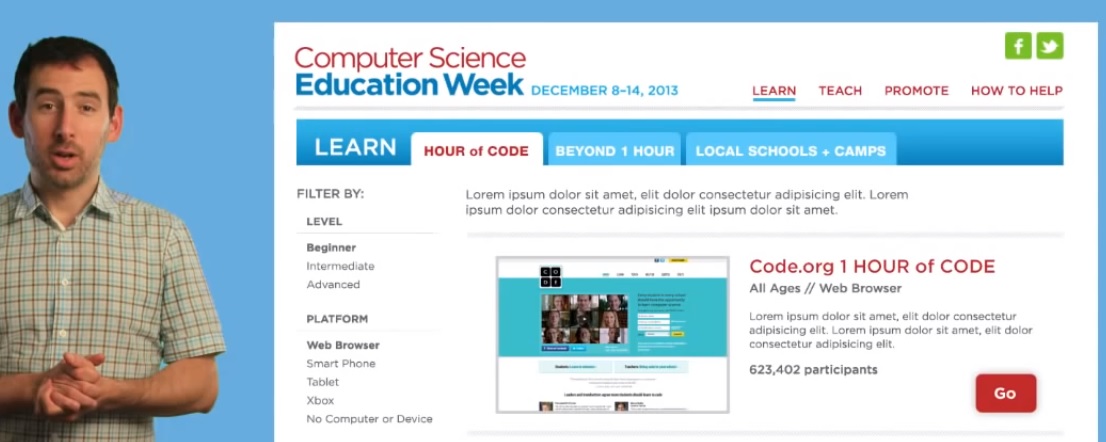
theodp writes "In a move straight out of Healthcare.gov's playbook, teachers won't get to preview the final lessons they're being asked to roll out to 10 million U.S. students until a week before the Dec. 9th launch of the Hour of Code nation-wide learn-to-code initiative, according to a video explaining the project, which is backed by the nation's tech giants, including Facebook, Microsoft, Apple, Google, and Amazon. The Hour of Code tutorial page showcased to the press sports Lorem Ipsum pseudo-Latin text instead of real content, promised tutorial software is still being developed by Microsoft and Google, and celebrity tutorials by Bill Gates and Mark Zuckerberg are still a work-in-progress. With their vast resources and deep pockets, the companies involved can still probably pull something off, but why risk disaster for such a high-stakes effort with a last-minute rush? One possible explanation is that CS Education Week, a heretofore little-recognized event, is coming up soon. Then again, tech immigration reform is back on the front burner, an initiative that's also near-and-dear to many of same players behind Hour of Code, including Microsoft Chief Counsel Brad Smith who, during the Hour of Code kickoff press conference, boasted that Microsoft's more-high-tech-visas-for-U.S.-kids-computer-science-education deal found its way into the Senate Immigration Bill, but minutes later joined his fellow FWD.us panelists to dismiss a questioner's suggestion that Hour of Code might somehow be part of a larger self-serving tech industry interest." -
MS Tackles CS Education Crisis With Popularity Contest
theodp writes " The lack of education in computer science is an example of an area of particularly acute concern,' Microsoft General Counsel Brad Smith told Congress (PDF) as he sold lawmakers on the need to improve 'America's access to high skilled foreign talent'. Smith added that Microsoft also wants to 'help American students and workers gain the skills needed for the jobs that will fuel the innovation economy.' Towards that end, Microsoft will award $100,000 worth of donations to five technology education nonprofits 'who teach programming and provide technical resources to those who might not otherwise get the chance.' So, how will Microsoft determine who's most worthy? With a popularity contest, of course! At the end of October, the top five vote-getting nonprofits — only Windows AzureDev Community members are eligible to vote — will split the Microsoft Money. By the way, currently in second place but trying harder is Code.org, the seemingly dual-missioned organization advised by Microsoft's Smith which has reached out to its 140,000 Facebook fans, and 17,000 Twitter followers in its quest for the $50,000 first prize." -
Elon Musk Quits Mark Zuckerberg's Lobbying Club
theodp writes "Valleywag's Adrian Chen wasn't the only one troubled by the tactics of Mark Zuckerberg's FWD.us political lobbying group. Composed of a Who's Who of tech millionaires and billionaires, the group boasted its control of massive distribution channels, broad popularity with Americans, and money would make it a political force to be reckoned with. But the group came under fire for embracing decidedly old-school political tactics, forming both left-leaning and right-leaning subsidiaries, thus broadening its appeal to those who might help advance its agenda. Reports that FWD.us had funded ads praising Arctic oil drilling drew fire from critics, including Tesla/SpaceX CEO Elon Musk, who FWD.us listed as a 'Major Supporter.' Not anymore. Valleywag reports that Musk has quit Zuckerberg's lobbying cabal, apparently feeling that the group's ends did not justify their hit-both-sides-of-the-aisle-to-get-what-you-want means. 'I have spent a lot of time fighting far larger lobbying organizations in DC and believe that the right way to win on a cause is to argue the merits of that cause,' Musk said. 'This statement may surprise some people, but my experience is that most (not all) politicians and their staffs want to do the right thing and eventually do.' By the way, didn't members of the Zuck PACk create, fund, and appear on Code.org, which lamented the sad state of U.S. CS education and featured a slick documentary showing technically clueless little kids, just weeks before launching their pro-techie immigration push? Hey, all's fair in love and lobbying!" -
Is Code.org Too Soulless To Make an Impact?
theodp writes "By trotting out politicians (Bill Clinton, Mike Bloomberg, Marco Rubio, Al Gore) and celebrities (Chris Bosh, will.i.am, Ashton Kutcher), Tuesday's Code.org launch certainly was a home run with the media. But will it actually strike a chord with kids and inspire them to code? Dave Winer has his doubts, and explains why — as someone who truly loves programming — code.org rubbed him the wrong way. 'I don't like who is doing the pitching,' says Winer, 'and who isn't. Out of the 83 people they quote, I doubt if many of them have written code recently, and most of them have never done it, and have no idea what they're talking about.' Code.org's because-you-can-make-a-lot of-money-doing-it pitch also leaves Dave cold. So, why should one code, Dave? 'Primarily you should do it because you love it, because it's fun — because it's wonderful to create machines with your mind. Hugely empowering. Emotionally gratifying. Software is math-in-motion. It's a miracle of the mind. And if you can do it, really well, there's absolutely nothing like it.' Nice. So, could Code.org use less soulless prattle from 'leaders and trendsetters' and more genuine passion from programmers?" Just force all ninth graders to learn Scheme instead of Microsoft Word. -
Tech Leaders Encourage Teaching Schoolkids How To Code
rtoz writes "Code.org has released infographics and a video to explain why students should be taught to code in school. They've gathered support from leaders in politics and the tech industry. Mark Zuckerberg says, 'Our policy at Facebook is literally to hire as many talented engineers as we can find. There just aren't enough people who are trained and have these skills today.' Former U.S. President Bill Clinton adds, 'At a time when people are saying, "I want a good job – I got out of college and I couldn't find one," every single year in America, there is a standing demand for 120,000 people who are training in computer science.' Bill Gates said, 'Learning to write programs stretches your mind, and helps you think better, creates a way of thinking about things that I think is helpful in all domains.' Google's Eric Schmidt is looking beyond first-world countries: 'For most people on Earth, the digital revolution hasn't even started yet. Within the next 10 years, all that will change. Let's get the whole world coding!'" Part of the standing demand for computer science jobs may be influenced by bad policies from tech companies, like Yahoo's ban on working from home. -
Tech Leaders Encourage Teaching Schoolkids How To Code
rtoz writes "Code.org has released infographics and a video to explain why students should be taught to code in school. They've gathered support from leaders in politics and the tech industry. Mark Zuckerberg says, 'Our policy at Facebook is literally to hire as many talented engineers as we can find. There just aren't enough people who are trained and have these skills today.' Former U.S. President Bill Clinton adds, 'At a time when people are saying, "I want a good job – I got out of college and I couldn't find one," every single year in America, there is a standing demand for 120,000 people who are training in computer science.' Bill Gates said, 'Learning to write programs stretches your mind, and helps you think better, creates a way of thinking about things that I think is helpful in all domains.' Google's Eric Schmidt is looking beyond first-world countries: 'For most people on Earth, the digital revolution hasn't even started yet. Within the next 10 years, all that will change. Let's get the whole world coding!'" Part of the standing demand for computer science jobs may be influenced by bad policies from tech companies, like Yahoo's ban on working from home. -
T-Shirt Competition Update
Albert Strasheim writes "Just a quick update on the status of the Linux T-shirt Competition. So far I've received 42 entries, and they've all been posted here and here. There's still 5 days left to get entries in so move, move, move! :-) After the competition and voting the t-shirts will be on sale @ $18.00 each, including international shipping and handling. Mastercard, VISA and Amex cards, and bankdrafts, will be accepted. " A lot of the designs won't work as t-shirts, but I did see a couple of really sharp ones that will. Several other ones looked inspired by my DFtP shirt too :)