Slashdot Mirror
Domain: columbia.edu
Stories and comments across the archive that link to columbia.edu.
Comments · 1,401
-
USA statistically outlier.
The US is a bizarre statistically outlier when it comes to healthcare spending and outcomes:
http://www.stat.columbia.edu/~cook/movabletype/mlm/healthscatter2.png
Drastically outspending everyone while having some of the poorest outcomes.
Sadly, because of lobby money it will never be fixed.
-
Hey! I resemble that!
Some of us actually grew up playing Adventure (still playable online today -- wow!) on something that looks suspiciously similar to that! In my case, a LA36 DECWriter II, which apparently came standard with hippie dress, porn mustache and butterfly collar. I think I still have the old 300 baud acoustic coupler modem lying around somewhere.
-
Re:So what's the word, people.
well said, with very minor nitpick: s/other Arab/Arab/ - whether Iraq is an Arab country (or Persian country) depends on who you ask, but I don't know of anyone with any knowledge of Iranian history who would call Iran an Arab country.
I have no knowledge of who's responsible for the worm, but Steve Bellovin wrote about it very intelligently.
-
Re:where on the periodic table?
funny, but actually IBM started with punched cards for external storage, gears for internal memory, and later patch panels for ROM.
-
The Geek Plays Hide and Seek
New Zealand has a population of 4 million.
73% of unmixed European descent. Demographics of New Zealand
Metro New York City has a population of 19 million, and is ethnically, religiously, and culturally diverse.
Approximately 36% of the city's population is foreign-born. In New York no single country or region of origin dominates. The ten largest countries of origin for modern day immigration are the Dominican Republic, China, Jamaica, Guyana, Mexico, Ecuador, Haiti, Trinidad and Tobago, Colombia and Russia. The largest ethnic groups in New York City are African American, Italian, Jewish, and Irish.
The New York City metropolitan area is home to the largest Jewish community outside Israel, and the city proper contains the largest Jewish community in the world. It is also home to nearly a quarter of the nation's South Asians, the largest African American community of any city in the country, and comprised as of 2008 a population of 659,596 ethnic Chinese. the largest outside of Asia. New York CityThe Islamic population in 2004-2005 was around 600,000. Columbia Presents First-Ever Study on Muslim Political, Social, Religious Identity in NYC
Manhattan has 354 million square feet of office space.
But New York remains importantly, if less visibly, a manufacturing center. There are no unmarketable skills, however obscure.
The fool on the run takes to the back roads, the Pacific, the Klondike - where the youngest child will point him out as the stranger. The one who doesn't belong. Doesn't dress the part. Doesn't act the part.
-
Re:Wow.. these kids are pretty trusting...
If so, then they learned it from the USA which learned it from Prussia which learned it from India's training for the underclasses of the Hindu caste system
Citation needed. I'm sick of people going on and on about the caste system without understanding anything about it. Castes initially began with the division of labor, broadly into the priests, warriors, artisans and untouchables. Within each category there are thousands of subcategories. It is very important to note that no Hindu scripture endorses or enforces the concept, thus you can still call yourself a Hindu if you don't want to follow the system. The trouble with caste started by people being locked into it by birth. The son of a blacksmith could not aspire to any other profession, for example. The untouchable castes were ostracized by the upper castes. There was no 'training' as such for anybody, and lower classes stayed illiterate. If anything, the rote learning that is so common today in Indian education can be traced to Lord Macaulay, who famously dismissed all Indian/Arabic literature as not worth even a shelf in a Western library. (note 10) He started the education system in India, which was aimed at producing clerks for the East India Company and later the British administration. These people would understand enough English to get work done but not form any kind of critical thinking that might lead to unrest and rebellion.
-
water circulation
Water takes about 400 years to go full cycle from surface to bottom to surface again.
Do you have a reference for that. No really i am serious. I have seen figures from 100-1000 years for ocean turnover. Yet i have failed miserably at finding good references.
Not any more. I had that oceanography course a Very Long Time Ago and no longer have the text book. AFAIK is was some kind of average accounting for volume of flow and distance. Recent generations have probably had time to come up with better estimates, but A 2004 EES lecture shows what you have, a guesstimate of 100-1000 years for thermohaline circulation. Some water is going to take a long time to turn over. Other water will go the short route.
-
Re:Physicist speaking
Brian Greene himself, in his book, describes it as "The only game in town". Weinberg says the same thing - quoted here
http://www.math.columbia.edu/~woit/wordpress/?p=1917
(I know Woit's blog reads non-partisan, but the quote is genuine).
Now, I think string theory is a great idea. It's really elegant, it has nice features, but personally I don't think it's right. I prefer background independence, and it's my belief (totally unsupported) that diff invariance is the main lesson of GR that we should take over to quantum mechanics. But, as someone working on other theories, I go to conferences and see brilliant ideas handwavingly dismissed because they're not strings.
If you listen to Smolin (again, not totally unbiased I admit) he tells of colleagues working on strings because they're the only way to get a job:
http://www.scientificamerican.com/article.cfm?id=the-inelegant-universeOr if you just talk to LQG researchers, like Rovelli, Ashtekar, Smolin, Friedel etc they'll all tell you about being told to give up on it and do strings.
-
Re:Oops
It seems I may have jumped the gun on this one. My bad for being such an easy mark of sensationalist pop science headlines.
If we took time to accept your apology, that would divert precious comments from the long
-
You and Me Both, Buddy
It seems I may have jumped the gun on this one. My bad for being such an easy mark of sensationalist pop science headlines.
Don't feel bad, I submitted it a day before you did. What really blows my mind is that Not Even Wrong used my submission as evidence that Slashdot was running a story on it:
Update: No press campaign for a “finally string theory is testable” claim is complete without a Slashdot story
Big news for theoretical physicists who are fed up with the inability to test String Theory
(that's from my submission)
-
Oops
It seems I may have jumped the gun on this one. My bad for being such an easy mark of sensationalist pop science headlines.
-
Re:5 page paper?
-
Re:Consumer Focus or Consumer Manipulation?
I have a FM tuner in my android-based smartphone. I don't use it because I rarely listen to FM radio anymore. I can't find enough stations with programming that I enjoy, and there are too many annoying commercials. Why bother with that when I can use Pandora, or buy the songs that I like in MP3 format?
Another big problem, for me at least, is that the NYC radio market is absolute garbage if you don't listen to mainstream top-40 crap, hip-hop, or Spanish (Latin American) music. Fortunately there are two awesome alternatives that I do listen to regularly when I'm in my car. The best station (and only station that plays modern rock/metal) is a college station that's commercial free, and the next best thing also happens to be a college radio station (I didn't know this; just found out now when searching the link!). -
Re:USD per watt and watts per sqm
My point in bringing it up was not that you were wrong, but that you were not being critical and honest. Wow, you are really sensitive to ad hominems, but you call me "George Bush" which is quite obviously an ad hominem. At least mine was in response to a claim you actually made.
Right. So I'm not wrong I'm just "twisting the truth". So it's not an ad hominem attack it's just a flat out insult. Why the fuck wouldn't I be sensitive to the connotation that I'm a liar. Take a step back and have some manners and I won't ridicule you in return. That behavior is typical of Nuclear Fanboi's > stdout when it should be >
You should have mentioned that
As I said "I'm short on time so I'll summarise" because I do have *other* obligations.
CFCs are currently used in the refinement process but that the plants responsible for them were designed and built in the 1950s before CFCs were even on the radar. Further, efforts are underway to develop a new process that does not use CFCs. And already, the CFC use was reduced by 2/3 since 2001.
That's awesome but it doesn't change the facts CFC 114 is STILL USED for enrichment TODAY, and that up to 1 million pounds of CFC114 have leaked into the atmosphere per year since the inception of the Montreal protocol in 1995. CFC 114 attacks the ozone layer, the ozone layer that protects that algae that makes THE OXYGEN WE BREATHE.
But you don't have to believe me just read the submissions made to the UN for the Montreal Protocol. Or of course Environmental effects of ozone depletion: 1998 Assessment. and the epa data is available for your analysis.
Do you think your remarks, which left out even a mere mention of these developments, were critical and honest about the requirement of CFCs in uranium production?
I did mention them, I said "So you're saying that all the problems with ultracentrifuge technology has been solved, it's commercially implemented on an industrial scale in America and that Paducah has been shut down.". If we were having a specific conversation about enrichment I might ask you if they have solved the problems with bearing technology in the devices or improved the energy efficiency per SWU or some other thing that changes the status quo. I see nothing in the article you sent me about an actual implementation date or that the unit was functioning in an industrial capacity. So since ultracentrifuge, American Centrifuge etc are not actually implemented industrial processes, absol-fucking-lootley I think it's not only critical and honest but more importantly completely specifically relevant.
Otherwise, did you run across that information and find something conflicting and credible to reject USEC's claims, and then decide the whole thing is not worth mentioning? Presenting pertinent facts and honest reporting about *both sides* is essential to being critical and honest.
What's critical is an article, link, or what ever that Paducah has been shut down, that the CFC114 process has been retired and then might be worth mentioning, it might be pertinent. What's honest is UltraCentrifuge is what might be, not what is. Sure it will be great if they actually get it going and stop using CFC114, one day.
But even if they do it won't change the energy equation for the Nuclear industry. That why wind and solar are far more useful and usable technologies.
Citation? That seems like basic economics and common sense to me. The energy used to gather and refine the fu
-
Re:Patent and disclosure...
Weirdly, Shazam have published a fairly thorough paper on how their search algorithm works. While devoid of any actual code, it doesn't seem as though the blog in question has given away any trade secrets that aren't easily derived from this paper and other bodies of work online.
Of course, by threatening the guy Shazam & LDS have created their very own Streisand Effect; this is front page on
As for me, I won't be using their software, and I will be contacting them to register my disgust, though it probably will make no difference in their attitude. -
Re:Patent and disclosure...
His implementation was different than their's, and if that's the case, they've got bigger issues, as one of their developers wrote a PDF on how Shazam Works..
And this guy certainly wasn't the first to write an article about How Shazam Works either.
They're afraid of the code.
-
Re:Sigh, I just threw out my VT320
Thinking about your post makes me feel even older. When I was in college the "new" terminals were VT-100. The lab was open 24 hours a day because there weren't enough terminals to go around. For those who knew where to look, there were a few VT-52s hiding in relative obscurity.
When I was in college the terminals hiding in relative obscurity were the decwriter hardcopy terminals. That is, they were ignored in a corner until someone started to use them. The noise turned out to be a good way of chasing at least one or two people from their VT-102s. (Also taught you 'ed', no fancy "visual" editing on a hardcopy terminal).
-
Re:IBM tells Microsoft...
You lost me. Could you expound on your comment?
The IBM S/360 was a mainframe. The Apple ][ was a personal computer.
I would assume that all mainframes had ports, otherwise how would you hook up the peripherals?
Anyway let's get some facts straight:
The first "Personal Computer" meaning a computer that was sold and designed to be used by a single person was the IBM 601 Auto-Point Computer it was billed as a Personal Automatic Computer (PAC) and was announced in 1957.
The first "Personal Computer" aimed at the hobbyist (soon to be renamed home) market and sold already assembled was the Apple I in 1976.
The first All-In-One computer Personal Computer aimed at the home market was the Commodore PET introduced in 1977.
The first personal computer aimed at the home market that featured internal expansion cards was the Apple ][ introduced in 1977. The expansion bus was open and created the first consumer level third-party expansion market due to the successful sales of the Apple ][.
Mostly what IBM did for the PC was legitimize it, saying 'this is a serious tool which can be used for business'.
The Apple ][ was already legitimized by its sales and the great word processor for its time (Wordstar and Magic Windows), and the all-time killer application called VisiCalc.
IBM came late to the party, and when it introduced the IBM PC in 1981. IBM instead used its established business in mainframes to sell it's PC to medium size businesses. This is when the adage "No one gets fired for buying an IBM" really took off. Because of its price, the IBM PC didn't really take off in the home computing market. However IBM didn't protect its design and an IBM PC Compatible market was soon created. The clones flooded the market with cheap PCs. This allowed home users to buy a cheap computer and use the same software at home that they use at work (a marketing whisper campaign that promoted software piracy as a means to sell computers *wink wink*).
IBM could never get its act together. They did everything they could to shoot themselves in the foot.
First they decided to fight the clones over the use of the ROM BASIC (called BASIC A). Microsoft came out with GWBASIC that didn't need the ROMs. I believe this is where the term "IBM PC compatible" became forever replaced with "MS-DOS Compatible".
Then came the IBM PCjr which was introduced in 1984. IBM desperate to keep its business oriented IBM PC out of the "low end" value priced market, introduced one of the biggest flop in PC history - the IBM PCjr. Almost everything on it was purposely crippled or ill designed to give you an incentive to buy the more expensive IBM PC. Too bad IBM completely disregarded all the clones that were on the market. Why pay for a PCjr when you can get a PC Clone for around the same price (or cheaper).
The final straw was when IBM in 1987 decided that they couldn't beat the clones and instead introduced the MCA bus with the idea that they could make money by licensing the bus. Then they got greedy and decided to make the license fee too expensive in order to make their computers (the infamous PS/2 line) more competitive. The clone industry countered with the EISA bus, which eventually was replaced by the PCI bus.
In the end, Microsoft was what made the PC Computer what it is today - not IBM.
I really need to switch to decaf...
-
Re:You can't code on iOS you fucktwits
I was under the impression that it was 44.1khz because of the video hardware they hacked together to see what they were doing while developing CDs?
Yes, 44.1 kHz was a multiple of the scan rate and the active lines in a field:
Explanation of 44.1 kHz CD sampling rateIt also serves as some overhead for the Nyquist-Shannon sampling. There is no such thing as an ideal low-pass filter so you'll get some leakage of frequencies over 20k, plus the theorem states that you need infinite past and future data to 100% recover the waveform. Going to 44.1 kHz and getting 10% overhead is a good rule of thumb, although going to 48 kHz and getting 20% can't hurt.
If you're recording audio, you should probably sample at 96khz so that when you pass it through a plugin that does something temporally with the audio, there's less artifacts.
Yeah, if you're doing a lot of post-processing then going for an even higher sampling rate can help a bit but it's really diminishing returns. 96 kHz is definitely overkill and 192 kHz is just idiotic.
For playback, you don't need 96khz, unless you have thousand-dollar speakers. (I tried some out, the difference exists).
Some thousand-dollar speakers are worth the cost although there is a lot of snake oil at that price point. Caveat emptor on pricy acoustic gear! However, 96 kHz will sound almost exactly the same as 44.1 kHz no matter how expensive the speakers.
On the other hand, a bad audio player will have poorly designed digital to analog converters which won't interpolate the digital signal in such a way as to reconstruct the original signal faithfully. In that case a 44.1 kHz signal can sound worse than a 96 kHz signal because of zero-order hold, aliasing, and other factors.
This doesn't mean that expensive equipment is automatically better, just that a lot of times you get what you pay for on the extreme low-end. Most mid-range equipment does a decent job reproducing the original signal.
-
Re:300dpi is magic number, like 20kHz on CD
Not to be pedantic, but CD audio quality is 44.1 kHz
44.1 kHz is the sampling frequency, 20 kHz is the audio signal frequency. According to the Nyquist-Shannon Sampling Theorm in order to accurately capture a signal you need to sample at least at twice the rate of the highest frequency you want to capture. That means you should sample at a minimum of 40 kHz to accurately capture 20 kHz signals.
Now, you want to overshoot a bit because of how the filters work so you should choose a sampling rate that's a bit higher than the minimum necessary. They chose 44.1 kHz partially for this reason, but also because of the reason found on this site:
From John Watkinson, The Art of Digital Audio, 2nd edition, pg. 104:
In the early days of digital audio research, the necessary bandwidth of about 1 Mbps per audio channel was difficult to store. Disk drives had the bandwidth but not the capacity for long recording time, so attention turned to video recorders. These were adapted to store audio samples by creating a pseudo-video waveform which would convey binary as black and white levels. The sampling rate of such a system is constrained to relate simply to the field rate and field structure of the television standard used, so that an integer number of samples can be stored on each usable TV line in the field. Such a recording can be made on a monochrome recorder, and these recording are made in two standards, 525 lines at 60 Hz and 625 lines at 50 Hz. Thus it is possible to find a frequency which is a common multiple of the two and is also suitable for use as a sampling rate.
The allowable sampling rates in a pseudo-video system can be deduced by multiplying the field rate by the number of active lines in a field (blanking lines cannot be used) and again by the number of samples in a line. By careful choice of parameters it is possible to use either 525/60 or 625/50 video with a sampling rate of 44.1KHz.
In 60 Hz video, there are 35 blanked lines, leaving 490 lines per frame or 245 lines per field, so the sampling rate is given by :
60 X 245 X 3 = 44.1 KHz
In 50 Hz video, there are 37 lines of blanking, leaving 588 active lines per frame, or 294 per field, so the same sampling rate is given by
50 X 294 X3 = 44.1 Khz.
-
Re:well GREATSame here. Luckily, we'll be able to grow teeth back shortly.
http://cumc.columbia.edu/news/press_releases/MAOtooth.html
A technique pioneered in the Tissue Engineering and Regenerative Medicine Laboratory of Dr. Jeremy Mao, the Edward V. Zegarelli Professor of Dental Medicine at Columbia University Medical Center, can orchestrate stem cells to migrate to a three-dimensional scaffold infused with growth factor, holding the translational potential to yield an anatomically correct tooth in as soon as nine weeks once implanted.
-
Re:externality
No, it doesn't. Plants are NOT limited by CO2 concentration, they are limited by the efficiency of light-gathering biological systems.
However, increased CO2 concentration allows plants to expend less water during photosynthesis. It doesn't make them grow faster, but increases their drought-resistance.
Here is a nice article: http://www.ldeo.columbia.edu/~liepert/pdf/DArrigo_etal.pdf
-
Re:always the loudest wins.
"On what evidence do you base the claim that the MWP was regional?"
Although there is no generally accepted definition of the MWP in the litrature the IPCC glossary defines the MWP as - "An interval between AD 1000 and 1300 in which some Northern Hemisphere regions were warmer than during the Little Ice Age that followed."
For a much more detailed answer to your question Section 4.2 of a Jones/Mann paper published in Geophysical review gives a well referenced rundown as to why the MWP and LIA are no longer considered global anomolies. The six graphs in fig 4 (unfortunately split in half by a block of text) gives a nice visual representation of the available proxy records for various regions. Section 4.2 also sheds a bit of light as to why Jones expressed his contempt for the Soon and Baliunas paper in the climategate emails.
I don't expect you to wade through the whole paper, nor do I claim the expertise to verify it all myself but IMHO it is an excellent litratrature review that highlights the various pros and cons of climate reconstructions for the past couple of millenia. -
Re:Show me the data
"I look in the raw data section and low and behold, there is no raw data linked to for the stratosphere. Damn. Guess I'll have to settle for processed data."
http://hadobs.metoffice.com/hadat/hadat2.html - go crazy.
Etc.
Raw data is easily obtainable. But I'm not going to jump through hoops to find you every single dataset. There are so many datasets that it's impossible to put them on a single page.
Several major datasets are cataloged here:
http://iridl.ldeo.columbia.edu/
http://www.esrl.noaa.gov/psd/data/gridded/Also, learn to read dataset names. 9641C_201003_RAW.MAX contains raw unadjusted monthly data. I.e. they are not adjusted for urbanization effects and broken sensors. Since it's a MONTHLY measurement made of multiple daily measurements, they must be averaged, thus the word 'mean'.
You can ask NOAA for daily datasets for all weather stations, but they are huge and are not necessary for climate projections.
You can grab them directly from here:
ftp://ftp.ncdc.noaa.gov/pub/data/ushcn/v2/monthly/It even has a nice README: ftp://ftp.ncdc.noaa.gov/pub/data/ushcn/v2/monthly/readme.txt
So stop being an idiot and jumping at everything without even trying to assume that not every climate scientist is an idiot.
-
Re:Why they tell you to turn off your phone...
"It's quite common actually, and many documented studies have proven it does occur."
Define 'proven'. Single-bit errors in memory are usually described as hardware failures. Memtest86 tests for this, I think, as did many older PC diagnostics. Memory isn't flawless. Are you implying that some appreciable fraction of memory bit flips are actualyl comsic-ray induced, and if so, what study says how many?
"You don't hear much because well, the effects are minimal in most cases. A flipped bit in RAM does nothing if it's just unused memory, for example."
My system at work uses virtually all of its RAM at some point during the day, so I expect this is not so easy an analysis as it appears to be. And I'm already juggling a few paramaters that make it seem very, very difficult, and I'm not much of a mathematician.
Some of your other comments offer even more variables and make it seem even more unlikely, to me, that cosmic rays cause that many problems.
From the Wikipedia; "Studies by IBM in the 1990s suggest that computers typically experience about one cosmic-ray-induced error per 256 megabytes of RAM per month." Interesting, as it was somewhat late in the 90s before many computers had 256MB or RAM... I think. I was pretty happy to have a 486DX-50 with 8MB RAM in 1994 or so. A GB of RAM I didn't get until after 200, IIRC. IBM must be using some statistical analysis, so maybe my poor 486 got as many as 30 hits a month. Being a Novell server, it was using most of its memory, but not a very busy server so I may have missed some events. However, it did go +800 days without a restart or uncorrectable error. Must be lucky. Actually truth is, using a single PC as an example is kinda useless, isn't it? Not a significant sample.
I'm not entirely discounting cosmic radiation damage as a problem, but blaming these car problems in cosmic rays is the height of foolishness, to me. At that rate, I would expect Ford Tauruses to be havign all sorts of problems in the past. Oh, wait, probably the lack of such computer integration saved them. I'm being serious. But how do Civics and Accords avoid this today? Is there any real evidence that design can limit the damage from cosmic rays?
As for glitches, software is imperfect. Much more likely to be a coding error, I think.
For me, this paper offered the only quick reference to how many particles enter the earth's atmosphere - about one a second. Hmm. How many get to the surface? Even one a second, 31 million a year? Wow. With a surface area of 510M sq. km., that is what, 0.06 hits per sq. km.? Actually, just knowing how darned hard it is to detect these particles tells me they aren't common enough to be common, in a practical sense.
I'm still a little skeptical. Once, yeah. Twice? sure. 100 times? Dunno.
-
Re:cu
Did you compile it yourself, on a no longer available operating system and a non-gcc based compiler? Can you do it _again_, now 30 or more years later?
Good luck with that. There some ancient binaries and source code at ftp://kermit.columbia.edu/kermit/bin/ and ftp://kermit.columbia.edu/kermit/old/. But it wouldn't be clear to me that our original poster has the tools to install it if it's not already present.
-
Re:cu
Did you compile it yourself, on a no longer available operating system and a non-gcc based compiler? Can you do it _again_, now 30 or more years later?
Good luck with that. There some ancient binaries and source code at ftp://kermit.columbia.edu/kermit/bin/ and ftp://kermit.columbia.edu/kermit/old/. But it wouldn't be clear to me that our original poster has the tools to install it if it's not already present.
-
Re:cu
Fairly recent Xenix binaries of Kermit exist: http://www.columbia.edu/kermit/ck80binaries.html#sco
-
Serious roleplaying- RTTP
This is actually amusing, since I'm going to be using a "serious roleplay" game in my seminar course this fall. The Reacting to the Past project has created a number of detailed scenarios where students take on a historical role and then try to achieve their victory conditions. The one I'll be using models the debate in the British Royal Society over awarding the Copley medal to Charles Darwin in 1864. Some students will be only interested in the award itself, others will be trying for separate objectives such as getting women elected to the society or endorsing scientific study of prayer. Most of the grade will come from how well they perform, but there are additional points for specific achievements.
There's a growing recognition at least in higher ed that games can be really quite useful for teaching and learning- I've also used simple simulation games to model things like the economics of the steel industry, and we have a couple of economists who built entire chunks of their curriculum around multi-player games in classrooms.
-
Re:Load leveling Vs. Supply leveling
If you actually look at impact on the environment, nuclear is competitive.
You mean it's competitive with coal, because I have looked at Nuclear power's impact on the environment and apart from being staggeringly resource intensive it is extremely toxic. From, yes, mining to enrichment where CFC 114 is still used for enrichment today, and up to 1 million pounds of CFC114 leaks into the atmosphere every year even after the inception of the Montreal protocol in 1995. CFC 114 attacks the ozone layer, the ozone layer that protects that algae that makes the oxygen we breathe.
Reference:Environmental effects of ozone depletion: 1998 Assessment.
I will ignore BAU operations of Nuclear plants for now, but the issue of spent fuel and radioactive waste still has not been addressed. When Dixie Lee Ray was the head of the Atomic Energy Commission he proclaimed that the disposal of nuclear fuel would be "the greatest non-problem in history" and would be accomplished by 1985, yet here we are in 2010, over twenty years past that date and still there is no High level waste disposal site anywhere. The closest anyone has come is the Swiss and even their project is a multi-decade test project and extremely expensive.
followed distantly by the Chernobyl accident (which IMHO comprises virtually all radiation released by nuclear plants).
My concern is Radioactive isotope release into the environment, which is significant, and the bio-accumulation that occurs in the food chain from the release of these toxic elements. Daily this problem gets worse.
You have not answered how a technology, specific to the deployments of wind turbines will make Nuclear power more economical. As the U.S has significant wind resources it makes complete sense to develop these assets as Nuclear power is not green at all, especially when compared to wind power.
-
Re:Gay rights are civil rights.
I am not sure where you get your facts, but I think they are wrong. I was able to name anyone as the beneficiary of my life insurance policy. It didn't matter if they were related to me or not. Maybe laws are different outside of California, I don't know. Here is a page that talks about how a gay couple can deal with common financial pitfalls (a lot of which are good ideas for anybody, gay or straight). I really don't see the discrimination here (the real discrimination I see comes from people who actually hate gays for no good reason. That is dumb).
-
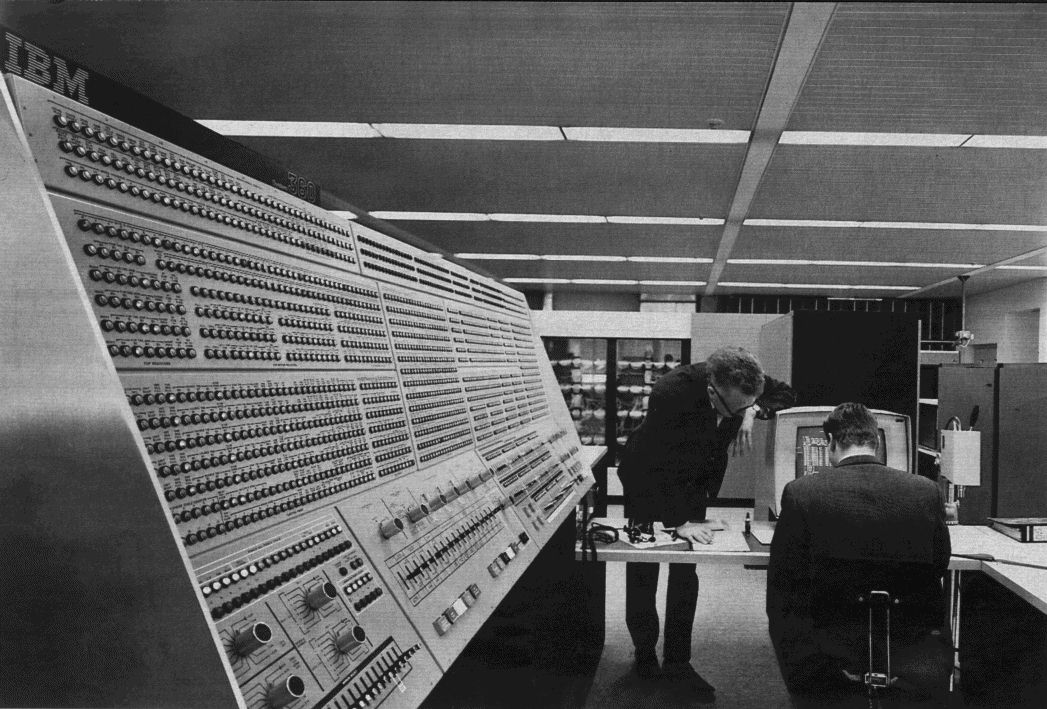
Re:You young whippersnappers and your newfangled..
Back when men were men, this is what a manly console looked like; http://www.columbia.edu/acis/history/360-91-panel.jpg
The younguns should note the suit and tie. It was how we got things done. That's right. Getting things done required a Real Man wearing a Real Suit And Tie. Or labcoat and tie.
-
You young whippersnappers and your newfangled...
You young whippersnapers and your newfangled serial consoles.
Back when men were men, this is what a manly console looked like; http://www.columbia.edu/acis/history/360-91-panel.jpg
-
Re:Absence of Evidence
Thanks for that comment. It inspired me to post a snippet of a similar conversation I had months ago, with your links and some others added:
Is it right, however, to lump together those who are skeptical of evolution with those who are skeptical of AGW, particularly CO2-driven AGW ?
Creationists confuse religious faith with falsifiable science. Among the general public, climate-change contrarians (and your average Greenpeace/PETA loony) confuse political affiliation with falsifiable science. In both cases, scientists are much less likely to agree with either claim, and that likelihood decreases with increasing relevance of the scientist's field. That's probably why both groups tend to accuse the scientific community of conspiracy and/or widespread incompetence.
At my blog, the following statement is both legible and has popup titles describing why that link was chosen. Here it is without the links first: "And, in my experience there's a significant overlap between the two groups. Most of their arguments seem to be at similar intellectual and educational levels."
And, in my experience there's a significant overlap between the two groups. Most of their arguments seem to be at similar intellectual and educational lev els.
-
Re:Does it matter that it exists or not?
Cool, that's an awesome website! I especially liked the graphic here. I think the "Phil current" curve describes me well. I agree with Phil that the IPCC's error bars seem a little narrow, but not by much.
-
Re:Yet AgainUncertainty works in favor of climate action. Even if there's a 1% chance of the world warming by more then 6 degrees, then from an expected value point of view, the cost of reducing CO2 emissions would be far lower then the cost of dealing with it later.
.
Due to rather basic physics, we know that global warming is almost certainly not going to make the earth's temperature decrease, so if you argue that there is uncertainty, that just raises the probability of catostrophic global warming, strengthening the case for drastic action. It's really rather basic probability theory (95% confidence intervals grow wider with increases in variance...).
The "denier" point of view only makes sense if one is very very sure that temperatures are not going to rise. Oddly, deniers don't make these arguments much...
http://www.stat.columbia.edu/~cook/movabletype/archives/2009/12/say_a_little_pr.html is a great article on this.
-
Re:Does it matter that it exists or not?That's actually the controversy. Greenhouse effect from CO2 raises temperature which causes water to evaporate. The water vapor forms clouds which affect albedo. Clouds are white, so more sunlight is reflected back to space, lowering temperature. The whole water vapor thing is the main negative feedback.
.
The extent to which the second effect counteracts the first one depends on things like ocean currents, and that's where the need for complicated climate models begin to come in. But other then vapor, pretty much every other feedback effect is positive (Heat causes permafrost to melt, causing for CO2 to be released into the atmosphere. That sort of thing).
http://www.stat.columbia.edu/~cook/MT/mt-search.fcgi?blog_id=1&tag=global%20warming&limit=20 is a really great introduction to the details of everything.
-
Hard shell, gooey centre security obsolete
-
Re:Premature
If that is so, then why do the actual measurements (as calibrated) agree with the observed ozone concentration?
If what is so, specifically? It almost sounds like you're asking me to justify the statement "If you're implying that scientists detected the possible increase in stratospheric ozone without realizing it would have a warming effect on the stratosphere, that's not true."
But that would be silly. Atmospheric physicists have long known that ozone warms the stratosphere by absorbing UV from the sun. As a side effect, we get protected from severe sunburns. That's why governments banned CFCs to protect the ozone layer. And that's probably why we're seeing ozone recovery today.
So maybe you meant: "the stratosphere has an extremely low heat capacity compared to the lower atmosphere (let alone the ocean)."
The heat capacity of the ocean can be approximated by neglecting deep water because heat rises, and ocean mixing is too slow to matter on a human timescale. The heat capacity of the upper 1 m of the ocean turns out (p 126) to be ~1.5E21 J/K.
Now compare that to the stratosphere. To start with, assume it's an ideal gas and integrate the density from the tropopause to the mesopause. Then compare the heat capacities of the stratosphere and ocean. They're crude approximations, of course, but look at the differences in the exponents. Then consider that global warming is a boundary value problem concerning a decades-long energy imbalance. That's why Dr. Pielke advocates using ocean heat content rather than air temperatures.
... why do the actual measurements (as calibrated) agree with the observed ozone concentration?
What sentence in the paper gives you this impression? Every relevant sentence I can find is loaded with qualifiers like "may relate", "may provide evidence", "may suggest", etc. That's not an accident; scientific language is used like a scalpel.
I agree with the authors; their research is good reason to suggest that stratospheric temperatures are increasing because of ozone recovery. It's interesting research. I just don't see any other point to be drawn from it.
I don't think those other forcings are affecting this data as much as you would have us believe. I am not saying they don't exist...
Scientists have known about sudden stratospheric warmings since 1971: Matsuno,T., 1971 : A dynamical model of stratospheric warmings. J. Atmos. Sci., 28, 1479-1494.
They've been studied for almost 40 years, but still aren't well understood because of the complexity of the stratosphere, multitude of forcings, and difficulty/sparseness of measurements.
Again, I find it interesting how you pick at what you perceive to be statistical uncertainties in the "counter" evidence, when you don't seem to have such problems accepting extremely questionable data from a paltry few ancient tree rings
Again, what are you talking about? I just haven't seen any papers that fit this (obviously fraudulent/ridiculous) description. I'd like to at least see these extremely questionable papers that you've repeatedly accused me of accepting.
And while you have stated before that the temperature
-
Re:This is not science.
... they did discuss the MM papers
Of course, chapters 9 and 11 each mention McIntyre 3 times. Each time, their claim is briefly but not extensively discussed because their conclusions on page 117 include: "The instrumentally measured warming of about 0.6C during the 20th century is also reflected in borehole temperature measurements, the retreat of glaciers, and other observational evidence, and can be simulated with climate models."
As far as I can tell, the largest caveats to emerge from the NAS report are concerns about the uncertainty estimates (especially prior to 1600 CE) and this point on page 115: Even less confidence can be placed in the original conclusions by Mann et al. (1999) that "the 1990s are likely the warmest decade, and 1998 the warmest year, in at least a millennium" because the uncertainties inherent in temperature reconstructions for individual years and decades are larger than those for longer time periods, and because not all of the available proxies record temperature information on such short timescales.
Second, the two papers you mention (Rutherford 2005 and Wahl and Ammann 2007) are based on CRU data, the Rutherford paper even has Jones and Mann as coauthors.
My point is that those papers can't be affected by the claimed MM PCA "mistake" because they use different methodologies.
There was ample opportunity to cook (deliberately or via unintentional observer bias) the CRU estimates to restore the hockey stick by 2005.
I've already linked the results of independent temperature reconstructions. And last year I said: Each time series in the graph I previously linked is referenced in chapter 6 here. Turn to page 469 and examine Table 6.1 (later, if you get bored, consider checking out column 2 of page 466 which reviews the claims of MM03 and MM05.) Every time series is referenced well enough to be found on google scholar-- for example here's one of them. As you've seen from the graph, they all support the abrupt temperature increase in Mann's graph. (I freely admit that all these authors could be drooling morons, sheeple incapable of independent thought, or evil conspirators... any of these scenarios or a linear combination of them would completely discredit my position.)
Notice how all these reconstructions are consistent. Most interesting is PS2004, which reconstructs past temperatures using a borehole. By measuring the temperature of the ground at various depths, past temperatures can be reconstructed using heat conduction equations.
This isn't based on CRU data at all, yet is consistent with it. That's not too surprising, because there's no evidence that the CRU data has been "cooked" as you imply.
-
Scientific research as a real open source project
I would go further than just publishing the code used in scientific research. I would build the code by running it a real open source project. In fact, I've done exactly that, and it worked out incredibly well. I believe our open source approach lead to better science, and also better software.
I worked with researchers from MIT and Columbia on a research project that involved gathering and analyzing a large amount of publication data. The results of the study are about to be published (you can read the working paper at the lead researcher's website).
We intended the code for this project to be released from the beginning, so we ran it as an open source project. I followed the basic formula from Karl Fogel's excellent (and free to download) book, Producing Open Source Software: set up a website for the project, created lots of documentation, tried to make it as easy as possible for someone to get up and running, made the source available via Subversion, and made it easy to contact us.
Quality was really important for us, so we put a lot of effort into testing. I definitely believe that the fact that we intended the project to be open source from the beginning helped with that. We weren't treating the code as some piece of throwaway or replaceable lab equipment. I'm convinced that treating it as a real product of the research caused us to take the development and the quality much more seriously than a lot of researchers. I've since heard from other researchers who are starting to use the software as well, and everyone who sees it feels that it came out really well.
There was another scientific benefit that should definitely appeal to anyone who lives in the publish-or-perish world of science research. We published a paper specifically on the project (Azoulay P, Stellman A, Zivin JG. PublicationHarvester. An open-source software tool for science policy research. Research Policy 35 (2006) 970-974. -- there's a link to the PDF on the lead researcher's website.)
It's funny -- I wrote an article a few years ago with Jennifer Greene for O'Reilly ONLamp called What Corporate Projects Should Learn from Open Source. I'm now convinced that science research projects can also learn a great deal from open source as well.
-
Re:It's shitty science, Rei.
Just as Carbon Dioxide traps heat on Earth is an unproven, yet indisputable fact...
Yes, it's completely unproven, except for the millions of spectra taken of the molecule, which show its resonance in the infrared part of the spectrum.
To add to your correction; without the greenhouse effect, the Earth's surface would be completely frozen based on how much subsurface energy comes from the core and how much from sunlight. These values we know fairly accurately. http://eesc.columbia.edu/courses/ees/climate/lectures/radiation/
-
National Atmospheric and Science Administration
The National Atmospheric and Science Administration has been a clearing house for all things 'science' since the 70's. Being related to space or aeronautics is not a prerequisite. If you want funding and it can be made to sound vaguely sciency, head to NASA!! Climate 'research', or something, is just the latest piglet with a tit.
Killing manned space flight has been a part of Obama's platform since he entered the national scene, regardless of subsequent back-peddling. Grownups know this, which is why those Congressmen with a direct stake in this are actively opposing this guy.
What might have been a credible future for space exploration is going to the NEA, and what is left of NASA will belong to Hanson.
Enjoy.
-
Re:Welcome to Capitalism
http://www.stat.columbia.edu/~cook/movabletype/mlm/healthscatter.png
Glad that anti-socialism angle is working out so well for your country.
-
Doubters should watch the Columbia presentation
Doubters should really watch the Columbia University presentation. It's entertaining and very technical and will probably address your every concern. Too many genuine experts here don't know what they are talking about because they are ignorant of the way OnLive actually works. It's more clever than you probably think.
YouTube Mirror
http://www.youtube.com/watch?v=2FtJzct8UK0 -
Re:It's finally time for the Honeywell 316!
I think it needs some music too.
-
Re:Nuclear Would Use Less Land with Higher Output
The total volume is waste is tiny, and it's not that dangerous.
70,000 tons of pu-239 alone in the united states. And thats before we start counting u-235 mine tailings, the reactors themselves when they are decommissioned, triated water, the list goes on. If you are referring to pu-239 it is an iron analogue and will, for example, cause leukemia when ingested into the body via leakage into a water table.
It's not more dangerous than the output of other industrial sites like oil refineries and solvent plants.
Spoken like someone who doesn't understand how bio-concentration and bio-accumulation works in the food chain. Radioactive isotopes that make it into the environment will eventually end up in the human food chain and they will poison until they are no longer radioactive. Nature might be able to adapt fast enough but it's very doubtful that human beings will be able to.
Considering that the carbon footprint of the nuclear power cycle is staggeringly low (even taking into account plant construction and uranium mining), nuclear power is the best and most obvious solution to climate change.
Again, you don't understand the issues at hand. The damage is caused by CFC114 greenhouse gases that the enrichment process release are not because they are 20,000 times more potent than C02 at retaining heat in the atmosphere but the effect of depletion of the ozone layer allowing UV destruction of phytoplankton and zooplankton that makes THE OXYGEN WE BREATHE. But you don't have to believe me just read the submissions made to the UN for the Montreal Protocol. Or of course Environmental effects of ozone depletion: 1998 Assessment.
Since the Nuclear industry is the number one industrial emitter of CFC's into the environment these oceanic effects can be directly attributed to the inability of the Nuclear Industry to act as a responsible global citizen. I have the EPA data, go look it up for yourself, it's a bit convoluted to extract but it is there.
On the point of carbon equivalence thats 8 618 255.03 kilograms of CFC114 since it was banned. That's the equivalent of 172,365,100,000 kilograms of carbon dioxide from the enrichment process alone and does not include the 1 Gigawatt of coal fired power used to run Paducah or the mining of Uranium. 2.4 gigajoules per ton for soft ores and 5.5 gigajoules per ton for hard hard ores. To get a kilogram of uranium you have to process 500 tons of hard ore (as there is almost no soft ore left) - and even that is assuming an extremely optimistic extraction efficiency approaching %50 and that assumes you have a high grade ore. That's 8.4 Terrawatt hours just for the mining to fuel one reactor - all C02 consumption by the Nuclear industry. The 8.4 Terrawatt hours DO NOT include waste disposal, does not include treatment of mine tailings and my figures are generous with the overall concentration of ore per tonne of rock - once it falls below 0.01% there is a net energy debt with nuclear power.
So the carbon footprint of Nuclear is only 'staggeringly low' when compared to coal. I'd imagine it's 'staggeringly high' when compared to wind, wave, solar or geothermal, especially if the tower is constructed with low carbon concrete. So Nuclear is only a solution to global warming if you are prepared to pass on an environmental and radioactive isotope cost to future generations the same way our generation has been handed a carbon cost to deal with in the form of externalities.
We don't even need thorium reactors. There's enough conventional nuclear fuel to last millennia even without reprocessing. We can extract the stuff from seawater.
For the minute concentrations of uranium in seawater the amount of energy used to extract the uranium would be
-
Re:Is this a giant scam?
I still maintain that this simply can't work, and that it's an absolutely braindead money pit of an idea if it's not a total scam.
Idea: let's take the most latency sensitive, computationally demanding, and visually intensive thing you can do with a modern computer and try to apply the thin client model to it.
A single instance of the application in question will demand the full resources of the most powerful PC you can throw at it, but we'll just wave our hands and mutter something about virtualization to convince stupid investors that we have magic at our disposal. Because they are morons and because we put on a good show, they'll believe that you can somehow run many instances of a game on the equivalent of a single PC. We'll also be encoding 720p video in realtime at a quality / bandwidth ratio that no codec today can deliver; this will presumably happen on the same computing hardware that's already running multiple instances of cutting edge 3D games.
Finally, we'll throw in some shit about the iphone, because people can't stop fellating apple lately.
Anyone who believes this is technically feasible, much less economically viable, is fucking *retarded*.
ol well if need proof simply for fact watch this http://tv.seas.columbia.edu/videos/545/60/79?file=1&autostart=true he is and does show To a class of 100 or so all of 40 using iphones to watch his game play at the podium.. LOl u need to wake teh f#^a up
-
Netflix didn't just anonymize the dataVia http://www.stat.columbia.edu/~cook/movabletype/archives/2009/12/privacy_vs_know.html:
I'm not sure whether the litigators have read this particular section of the Netflix prize rules:
To prevent certain inferences being drawn about the Netflix customer base, some of the rating data for some customers in the training and qualifying sets have been deliberately perturbed in one or more of the following ways: deleting ratings; inserting alternative ratings and dates; and modifying rating dates.
So yes, you can match a set of reviews with someone else, but how will you know that it's really a person and not a random coincidence? 0.5 million review traces give plenty of opportunity for a false positive match. Netflix learned from AOL's data release disaster, which resulted in a few people getting fired.
-
Eben Moglen's Blog Post
The SFLC's Eben Moglen is okay with Oracle taking on MySQL:
http://emoglen.law.columbia.edu/blog/cases/oracle-sun/ec-hearing-and-after.html?seemore=y
Among other interesting analysis:
"In fact, I think they're wrong. I don't think the GPL is a bad economic fit for MySQL. I believe that Oracle sees clearly the nature of its business interests. It knows that MySQL is much, much more valuable to it alive than dead. In fact, Oracle has almost as much reason to improve MySQL as it has to improve its flagship product. For a small firm, like MySQL AB, dual-licensing revenue was the only efficient revenue source with which to develop the product. But for Oracle, service revenue is much more significant than dual-licensing royalties. As all parties who have spoken about the merger agree, regardless of which side they are on, enterprises that use Oracle are very likely to use MySQL also, because MySQL is the world leader in number of installs. Which means that companies that pay Oracle to service Oracle are very likely to pay Oracle to service MySQL as well, if Oracle is not only servicing MySQL but acting as primary funder and participant in a flourishing MySQL ecology. Even if Oracle were only willing to invest in MySQL the extent of its ability to increase the MySQL service business, Oracle would be the best thing that ever ichappened to MySQL. In fact, Oracle has an immense incentive to invest far more in MySQL than the extent of its increased winnings in the MySQL service market. MySQL driven technologically and economically by Oracle will be a price-zero full-GPL missile aimed at Microsoft SQL Server. "