Slashdot Mirror
Domain: computinghistory.org.uk
Stories and comments across the archive that link to computinghistory.org.uk.
Comments · 30
-
Re:Acorn Archimedes
I used the Archimedes in 1987 to emulate the IBM PC.
Many people could at first not believe that:
"You mean you can read MS-DOS formatted disks?"
"No, I mean that I use it to compile my Modula-2 programming assignments using the MS-DOS TopSpeed compiler - and also to run WordPerfect."
- 1988 Archimedes PC Emulator Manual.
- 1988 Archimedes PC Emulator PCW Review
- 1991 Archimedes PC Emulator Manual
ARM was not so much known for its low power consumption at the time, but rather for its speed: the Archimedes was running circles around the Amiga and all other personal computers.
I think we had to wait until the NeXTcube to see something as advanced as the Archimedes.
This time also the software (from OS up) was ahead of its time. -
Re:Acorn Archimedes
I used the Archimedes in 1987 to emulate the IBM PC.
Many people could at first not believe that:
"You mean you can read MS-DOS formatted disks?"
"No, I mean that I use it to compile my Modula-2 programming assignments using the MS-DOS TopSpeed compiler - and also to run WordPerfect."
- 1988 Archimedes PC Emulator Manual.
- 1988 Archimedes PC Emulator PCW Review
- 1991 Archimedes PC Emulator Manual
ARM was not so much known for its low power consumption at the time, but rather for its speed: the Archimedes was running circles around the Amiga and all other personal computers.
I think we had to wait until the NeXTcube to see something as advanced as the Archimedes.
This time also the software (from OS up) was ahead of its time. -
Re:Acorn Archimedes
I used the Archimedes in 1987 to emulate the IBM PC.
Many people could at first not believe that:
"You mean you can read MS-DOS formatted disks?"
"No, I mean that I use it to compile my Modula-2 programming assignments using the MS-DOS TopSpeed compiler - and also to run WordPerfect."
- 1988 Archimedes PC Emulator Manual.
- 1988 Archimedes PC Emulator PCW Review
- 1991 Archimedes PC Emulator Manual
ARM was not so much known for its low power consumption at the time, but rather for its speed: the Archimedes was running circles around the Amiga and all other personal computers.
I think we had to wait until the NeXTcube to see something as advanced as the Archimedes.
This time also the software (from OS up) was ahead of its time. -
Re:Acorn ArchimedesI used the Archimedes in 1987 to emulate the IBM PC.
Many people could at first not believe that:"You mean you can read MS-DOS formatted disks?"
"No, I mean that I use it to compile my Modula-2 programming assignments using the MS-DOS TopSpeed compiler - and also to run WordPerfect."
- 1988 Archimedes PC Emulator Manual.
- 1988 Archimedes PC Emulator PCW Review
- 1991 Archimedes PC Emulator Manual
ARM was not so much known for its low power consumption at the time, but rather for its speed: the Archimedes was running circles around the Amiga and all other personal computers. -
Re:Acorn ArchimedesI used the Archimedes in 1987 to emulate the IBM PC.
Many people could at first not believe that:"You mean you can read MS-DOS formatted disks?"
"No, I mean that I use it to compile my Modula-2 programming assignments using the MS-DOS TopSpeed compiler - and also to run WordPerfect."
- 1988 Archimedes PC Emulator Manual.
- 1988 Archimedes PC Emulator PCW Review
- 1991 Archimedes PC Emulator Manual
ARM was not so much known for its low power consumption at the time, but rather for its speed: the Archimedes was running circles around the Amiga and all other personal computers. -
Re:Acorn ArchimedesI used the Archimedes in 1987 to emulate the IBM PC.
Many people could at first not believe that:"You mean you can read MS-DOS formatted disks?"
"No, I mean that I use it to compile my Modula-2 programming assignments using the MS-DOS TopSpeed compiler - and also to run WordPerfect."
- 1988 Archimedes PC Emulator Manual.
- 1988 Archimedes PC Emulator PCW Review
- 1991 Archimedes PC Emulator Manual
ARM was not so much known for its low power consumption at the time, but rather for its speed: the Archimedes was running circles around the Amiga and all other personal computers. -
Re:Arm64
Unless they are going to emulate x86 on arm64, this thing is DOA
You just woke up from a one year sleep or something?
Make that a 31 year sleep, x86 emulators have been available for ARM since 1987.
-
Re:Arm64
Unless they are going to emulate x86 on arm64, this thing is DOA
You just woke up from a one year sleep or something?
Make that a 31 year sleep, x86 emulators have been available for ARM since 1987.
-
Re:Zhaoxin
Sounds to me that you're not that familiar with the Alpha. Here is the DEC Alpha Multia - http://www.computinghistory.or... . They would run Windows NT, also Linux which is what I used them for. That's a desktop, made to be a desktop and used as a desktop. It even had the sound card. It was a really nice neat little box.
I used to buy these. I had no trouble buying them for less than the slower intel desktops at the time. The Intel boxes were not just a bit slower, they were clearly a lot slower. Annoyingly a lot slower.
I have a lot of experience with the alpha, from the Multia up to big mainframes. That multia even when you could buy them as surplus machines would still beat the current Intel boxes. We did extensive testing on it. It wasn't until around 2000 that Intel finally caught up enough that I was willing to part with the multia. When processors were moving towards the 1ghz range. The frames we kept around until 2013. Not that they were faster, they weren't for years, however moving off was tough.
-
Re:Punchcards and dial-up
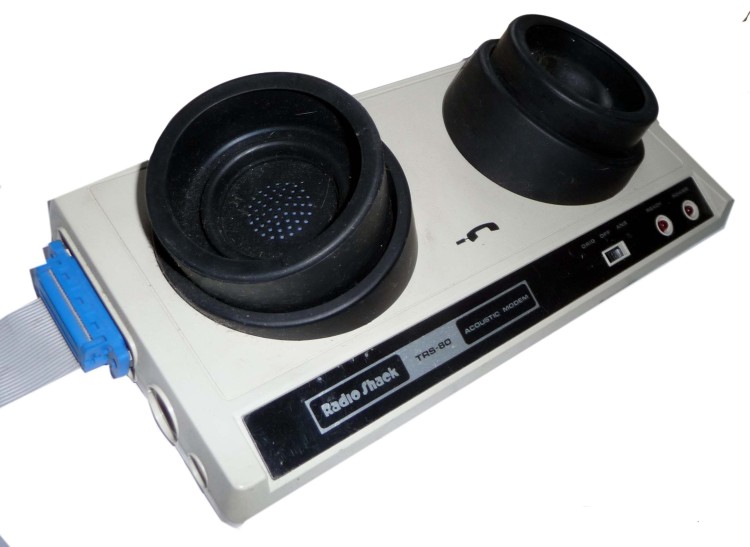
I've never seen an acoustic coupler that wasn't also the modem.
-
Re:ARM Processors coming to Desktops?
In the mid to late eighties, ARM was a desktop processor - and running enough circles around Intel at the time to be able to emulate x86 in software.
-
Re:You never heard about Bochs
Did you ever hear of the x86 emulator which exists for ARM since July 1987?
1988 Review in PCW
1991 Edition of the manual -
Re:You never heard about Bochs
Did you ever hear of the x86 emulator which exists for ARM since July 1987?
1988 Review in PCW
1991 Edition of the manual -
Re:Apparently
ARM will never be able to compete with x86 in terms of computing power and x86 can't compete with ARM in terms of efficiency and low power.
Be careful with words like "never", I remember very well when ARM was running circles around 80x86 in terms of computing power: back in 1987, ARM's selling point was speed rather than low power.
AFAICT: The Wikipedia article you link to doesn't mention x86 processors at all...
I used to run a software PC Emulator on Archimedes(1) in 1987, ARM (around 4 to 8 Mips (2)) was at that time emulating 8086 at the speed of an IBM PC/XT or AT (both below 1 Mips (3)).
While calculating a screen-sized Mandelbrot fractal at the time took minutes (up to half an hour) on IBM PC, the Archimedes did it in seconds.
(1) The 80186 co-processor card mentioned at the end of the linked article was unfortunately never released, the emulation was 100% in software.
(2) Acorn Archimedes speed
(3) IBM PC/XT and AT speed -
Re:OS for the new "Microcontroller"
Nowadays it seems pretty much all non-trivial chips include an ARM core with enough storage and ram to run circles around any desktop computer found in the 80s or even early 90s.
In fact, ARM at 4MHz (reading ROM) or 8MHz (after copying ROM into RAM) was running circles around 80s desktops in 1987 - I used to emulate an IBM PC on an Acorn Archimedes at that time.
-
Welcome to the 1980's
In the 1980's there was a company "Convergent Technologies" that made a snap-together systems with separate boxes for CPU, Disk, graphics cards etc.
Here's some pictures:
http://www.computinghistory.or...Some history:
https://en.wikipedia.org/wiki/...
https://en.wikipedia.org/wiki/...And their patents:
http://bitsavers.trailing-edge...However, the Microsoft patents are for stackable components that use a flux fountain.
The Convergent Technologies component boxes are side-by-side and aren't held together by magnets. -
Happy birthday old friend
I bought an Acorn Archimedes 305 in 1987, it had an ARM2 CPU at 4/8 MHz. It was one of the first available ARM systems (only preceded by an £4000 expansion box for the Acorn BBC B and a developer version of the Archimedes which was not available to the public), and the first ARM system which was affordable. It came with the Arthur 0.2 Operating System in EPROM, which was later replaced by RISC OS 1.2.
I learned ARM assembly programming from Pete Cockerell's excellent book.
Today, ARM is known for low power consumption, but in the 1980s it's main selling point was its superior speed. At 4.5 MIPS (and up to a whopping 18 MIPS in laboratory conditions), it was running circles around the competition (Intel 80x86 & Motorola 680xx). The Archimedes had software emulation of the 80x86, which ran at IBM-PC/XT speed (in the IBM-PC/AT era). I used this emulator to run WordPerfect and the TopSpeed Modula-2 compiler in MS-DOS for programming assignments at university.
I still have the Acorn Prolog-X box sitting at a honorary place on my bookshelf above my current computer, just out of nostalgia. -
Happy birthday old friend
I bought an Acorn Archimedes 305 in 1987, it had an ARM2 CPU at 4/8 MHz. It was one of the first available ARM systems (only preceded by an £4000 expansion box for the Acorn BBC B and a developer version of the Archimedes which was not available to the public), and the first ARM system which was affordable. It came with the Arthur 0.2 Operating System in EPROM, which was later replaced by RISC OS 1.2.
I learned ARM assembly programming from Pete Cockerell's excellent book.
Today, ARM is known for low power consumption, but in the 1980s it's main selling point was its superior speed. At 4.5 MIPS (and up to a whopping 18 MIPS in laboratory conditions), it was running circles around the competition (Intel 80x86 & Motorola 680xx). The Archimedes had software emulation of the 80x86, which ran at IBM-PC/XT speed (in the IBM-PC/AT era). I used this emulator to run WordPerfect and the TopSpeed Modula-2 compiler in MS-DOS for programming assignments at university.
I still have the Acorn Prolog-X box sitting at a honorary place on my bookshelf above my current computer, just out of nostalgia. -
Re:History repeats itself...
The first ARM desktop computer, the Acorn Archimedes, got quite early on a PC emulator which, if I recall correctly, emulated a 80186. The ARM 2 processor, running at 8 MHz could emulate this processor at close to 5-6 MHz (again, if I recall correctly).
From: http://chrisacorns.computinghi...
"In use the Archimedes PC Emulator program gives quite acceptable performance if you don't want to go too fast. While the hard disk access is extremely fast, the computing speed is only average and the screen display speed is slow."
And it gives the 'computing index' performance as about 1/10 of an AT PC. That's pretty much my experience of PC emulators; for apps that spend most of the time waiting for user input, it's fine, but anything that requires real computing power needs a CPU that's about 10x the performance of the CPU you want to emulate.
-
Re:Surely ironic
Quite how much it was "satire" upon that point or that it was simply a catchy- but still obviously non-literal- visual metaphor (as I commented above) is open to question.
Either way, it's definitely not meant to be taken straight. I mean, I doubt this computer magazine is literally suggesting that one can squeeze more data into their computer by robot hand forcing it in! -
Re:and the all important $$$ factor
In the early 90s we paid over $30,000 for a 160MB SSD. And it wasn't even flash, it lost all the data when you turned it off.
http://www.computinghistory.org.uk/det/3043/Anamartic-Wafer-Scale-160MB-Solid-State-Disk/
Made Windows 3.1 boot really fast though
-
Re:If Google sold servers...
Sorry, you're wrong. Wish you were right.
I've always been appalled by the way PCs rely on big, hot, wasteful noisy internal power supplies. When IBM entered the workstation market, 30 years ago (Oh, Lord, that makes me feel old) I worked for a company that made a pre-PC x86 system that relied entirely on external, passively cooled power supplies. To me, this was clearly the way of the future, but once IBM entered the market, everything had to be IBM compatible, even the way the power system worked. Because if you couldn't use IBM-compatible power supplies, your system cost too much to build. (I once had to throw out a perfectly good Zenith PC with a blown PS; although it was mostly IBM-compatible, its power supply was proprietary, and cost too much to replace.)
So, Google can't go into the hardware business, because their machines would cost too much and would rely too much on proprietary infrastructure. Easier to justify using your own technology regardless of cost when you're gigantic and profitable.
HP and Dell's nightmare isn't Google. It's cloud computing in general. The cloud providers (which includes Google, if you ignore the fact that they only provide high-level cloud services, unlike Amazon) mostly build their own hardware. Those that don't buy cheap no-name hardware.
-
Re:People must be blind..
What's particularly innovative about the ipad design? Like what's so innovative that it deserves a patent? (i personally believe the ipad to be an innovative device, i just don't see what's so special about its design)
Samsung's innovation is substantial... they used to actually have innovation. But looking at their history its obvious that if it wasn't for Apple, they likely wouldn't have changed the designs of their tablets which, prior to the iPad 2010 release, were completely different:
Here is Samsung's early tablet, the 1992 Pen Master
Not too bad for 1992!Fast forward to 2006... we have the Samsung Q1
Also, not a bad offering at the time... but, again, completely different than iPad, in 14 years Samsung's basic tablet design has not really evolved much, besides the advancement in the underlying technology, they added some buttons to the bezel... a new innovation.Moving forward to 2011, we have the Samsung Series 7 Convertable.
Just a glance reveals the impact iPad's 2010 release had on Samsung design... even with a keyboard, the new tablet is far more similar to iPad's design than previous Samsung tablet designs, though it still runs a newer version of Windows, the bezel width has decreased and the buttons have disappeared.As for Samsung's current offering, we have the Samsung Galaxy! The bezel width has expanded from the design of the Series 7, and Windows is replaced with a version of Android that is not all that different from iOS. Here it is with Apple's iPad:
side by sideI'll leave it up to the discriminating slashdotter to decide if Samsung has possibly encroached on any of Apple's design patents, even if a legal expert and the only authority that matters has already conveniently done this for us (but what could they possibly know that slashdotters don't!).
If you're looking for good examples of how one can avoid encroaching on Apple's designs, look at Apple's Mac Mini and its competition. PC manufacturers have offered a multitude of small PCs that perform similarly to the Mac Mini without having to resort to copying it outright. They have innovated a plethera of attractive designs that don't even come close to looking like the Mini while still retaining a small desktop footprint. The point here is that it can be done... the design of the iPad is not the only possible design for a tablet... Samsung themselves have proved that, yet they have aparently abandoned the idea of innovating their tablet design any further.
-
Re:The old ads ARE great!
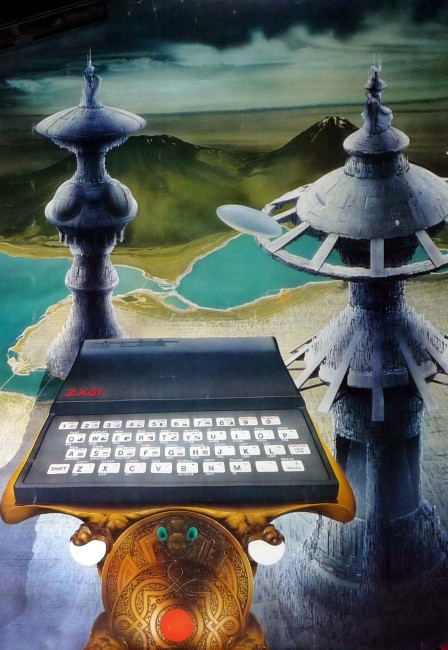
...but I don't see my favourite piece of ZX81 ephemera, the promotional poster that placed on some sort of darkly psychedelic space opera lectern:
http://www.computinghistory.org.uk/userdata/images/large/PRODPIC-9064.jpg
I actually learnt the QWERTY layout from a free copy of that, while waiting excitedly for the actual computer (an expected Christmas present). Yes, I would tell you to get off my lawn, but I actually have a hedge maze patrolled by a dinosaur:
-
Re:Finally a reason for socially inept people to b
You must have been rolling in the dough back then to have 16MB ram. 8MB about broke my bank.
Well, I had a T5200 portable which had 14MB RAM (its maximum) along with a 100MB disk. It had a 20MHz 386 which had the protected-mode bug which was only supposed to affect 16MHz chips (maybe Toshiba just overclocked it) and a 387 chip, too. It also only had the lousy orange plasma VGA display, because they didn't release the color VGA LCD until a year later. Damn thing was built like a tank, and survived repeatedly being accidentally dropped onto concrete - impossible to kill the thing. It cost a few thousand, but hardly broke the bank.
-
Re:no surprise
-
Re:here's one
-
Re:Aren't there already products like this?
Was originally available for the BBC Micro and could be plugged into the Archimedes if you had the user port podule installed.
Happy days, almost wants me to get my A310 or RiscPC 600 out of the cupboard.
-
Re:HA HA HA
You can buy similar hardware (from my favorite company HP or even many others such as Asus)
I beg to differ.
Albeit the processor/memory/hard drive/video card are the same, I see little innovation coming from individual PC vendors. They basically imitate each other. It almost seems as they are collaborating instead of competing, each one improving in a small step that everyone else will then copy.
I wouldn't mention that other pc makers wouldn't probably even exist without the apple 2. And Windows also, without the Macintosh, the mouse they got from xerox and made useful in people's computers, and the Mac OS.
No, I will talk about the notebooks.
Before Apple entered the notebook business, notebooks had the keyboard touching the outer border, with no wrist rest. The back of the keyboard was so useless than canon even managed to stick a printer in there [1]. So you can account for the wrist rest. Oh, and also the trackpad. Because my HP notebook had a button that would spit an imitation of a mouse to the left side [2].
Let's take the more recent computers. They brought to market the glass screens, backlit keyboard (not sure about this one), webcams with a little light to warn you they are in use (in a notebook), the multi-touch trackpad for scrolling first - the other manufacturers' solution was to waste space on the right side. The vents on the hinge, so the computer won't blow at you or at your desk and its innards are a little bit more protected, the magnetic latch, the first general-purpose notebooks with 6+ hours of battery life, batteries with a button to see its charge without turning the computer on, the transparent metal for the sleep light, the removal of the useless lights/sticks/extra buttons leaving the computer with what it needs, the metal casing, the unibody casing... So they are innovating on engineering, and as far as I see, much more than anyone else.
HP has nice research with memristors. Let's hope they finish it. I would like to see every computer manufacturer bringing so much innovation to their products as Apple does. But for the last 30 years, that's not the case.
So no, you cannot buy similar hardware, when they bring a new thing. You have to wait for hp/asus/whatever to catch up. Besides, the main innovation on the engineering process was made not by the brands themselves, but by the engineering team in east asia (mostly taiwan) who builds the machines for the american companies, like foxconn with desktop chassis for dell/hp/compaq, quanta with notebooks for everyone else, and so on.
Now apple is using stainless steel, too (on the old ipod shuffle and now on the iphone), a new manufacturing process for the glass for the iphone's screen, and that liquidmetal thing. Let's see what they come up with these, and how long it will take for the rest of the market to get up with.
Please correct me where I am wrong.
[1] http://www.computerweekly.com/blogs/hardware-hoarders/2009/06/dan-darcys-1993-canon-bj-notebook-bn22.html
[2] http://www.computinghistory.org.uk/cgi-bin/sitewise.pl?act=big&p=3405&pic=2 -
Re:smartbook is nice, but where are the ARM nettop
The advantages, IMHO, of ARM are all tilted for use in the mobile space.
Being 5, 15, whatever watts more efficient than an Atom is a high price to pay for breaking x86 compatibility when you're hooked to a wall outlet, considering your choice in monitor likely has as much impact on your final power bill as your ARM/Atom choice.I don't get this. Mind you, I first used ARM powered desktop machines (running BSD) in 1989, so it doesn't seem that new or revolutionary to me. But unless you're tied to legacy proprietary applications, what does it matter what the processor is? The ARM processor family has always been a competitive alternative to Intel, if you were not tied to Windows. And with Debian and Ubuntu available for ARM, I shall be very keen to have one of these babies as a useful mobile workstation.