Slashdot Mirror
Domain: coursera.org
Stories and comments across the archive that link to coursera.org.
Comments · 101
-
Re:I want to see
What I want to see, is the original study that determined CO2 emissions were a greenhouse gas.
I want all the details required to independently recreate the experiment and make my own observations.
I'm a chemist and I can give you a bit more information. It's nothing special about CO2 that makes it a greenhouse gas. It's the fact that it has three atoms that makes it a greenhouse gas. Molecules with two atoms can only stretch or shorten their single bond. However, any molecule with three or more atoms can also bend it's bonds (think of a scissoring movement). This scissoring is the most important vibration involved in greenhouse effect, due to the frequencies at which it occurs. Now, any molecule with three or more atoms can vibrate like this. And bigger molecules tend to have more available modes of vibration (if you have 20 atoms, there's many more ways to bend three atom formations, than if you have only three). So it all boils down to the availability in the atmosphere. Water and CO2 exist in big quantities in the atmosphere. Butane (with 14 atoms in total) is much better as a greenhouse gas, but it exists in a much smaller quantity, so ends up having an overall smaller contribution. A quick search led to this video about the subject. It goes a bit more in detail than what I mentioned here (it explains that not only bending matters, but other modes as well), but still not so much that you'd feel overwhelmed.
Good luck with your experiments! -
Re: Job Requirements
$50000? I am only getting $32000
Maybe yoy need a negotiation course
-
Re:AI / ML is not a hobbyWow. That is pretty much the only serious answer so-far
I think you are right in saying that AI/ML is not something you pick up over a long weekend. Still, it should be possible for someone to give it a shot without doing a PhD.
There is a really nice Coursera course I can recommend: https://www.coursera.org/learn... If you follow that and make all the assignments, this will take you some months (assuming you don't do it fulltime), but you end up knowing a lot more about ML then a lot of others. Also there are tons of books that cover Machine Learning basics. Then, if you want to get your hands dirty, you can go to Kaggle and participate. I think if you do that for a while, and prove that you are really good at it, a company/recruiter looking for an ML person might be interested even if you don't have a degree in an ML-related field.
And as to the original question, what kind of job titles? I noticed that many times "Data Science" openings have something to do with some kind of machine learning. But the term is >>very As to "toying with Tensorflow", this is of no use whatsoever, IMHO, if you don't know anything about machine learning. So, first learn more about that, and then see how Tensorflow fits in, is what I would suggest.
Anyway, long story short: go for it!! You won't be an expert in a month, but you are in for a treat
-
Like everything else start with the basics
I feel your confusion. This may be "old school" but I feel it's solid (or has been for me). Start with learning the basic rules.
A lot of people like Python but because most languages use certain characters to enclose blocks of code (and python only uses indents) I would suggest starting with Java or C/C++. Many here will say Python is easier (ruby is probably easiest for many), but your goal will be to have room to grow. You'll find more languages conform to the C/C++ or Java syntax style rules than Python or Ruby. I find it easier to ready than Python myself.
Do yourself a favor and skip VB.net. If you want pure Microsoft (and I would advise against that, would have saved me much grief early in my career) you can do C# and you'll be better prepared for languages with more platforms.
Java, for example you can use in many enterprise system and embedded systems, including Android. C/C++ you can use for robotic controllers, IPhones (objective-c), real-time critical applications (and gaming!!).
Some may suggest starting with scripting languages like PHP, Python or Ruby. there is faster "joy", but I'd sooner suggest starting with MIT's Scratch https://scratch.mit.edu/ (GUI language for teaching children basic of programming). It's a great teaching tool for anyone I think. Hey, it's still valid basics which converts the GUI instructs into 'C'. the reason
I'm so "hung up" on starting with C/C++ or Java is most newer languages take a lot of their cues from the concepts widely used in C/C++/Java. once you learn one of these (especially C++/Java) you can step into any other language out there with relative ease. Some good sites to start would include:
http://lifehacker.com/five-bes...
Note: These are all free or have free options
http://www.learn-c.org/
http://landofcode.com/programm...
https://ocw.mit.edu/courses/el...
https://ocw.mit.edu/courses/el...
https://www.codecademy.com/lea...
http://www.coursera.org/ (real university level courses, a little intimidating at first, but worth it)
http://www.cplusplus.com/doc/t...
For python:
https://www.python.org/
For Ruby:
https://www.ruby-lang.org/en/
the courses as udemy are a little light so I'd only go there for review.
I've given many options here although I've stated my preference. The other advantage to using C/C++ or Java is they make using these invaluable books easier to read:
Writing Solid Code: Microsoft Techniques for Developing Bug-free C. Programs (Microsoft Programming Series) by Maguire, Steve
Code Complete by Steve McConnell
Yes, these books are from MS and old, but I found them invaluable (and I wish MS had actually practice what came from their own publishing companies when writing the code for W2K and XP). Was required reading at one workplace. You'll want to learn about Object-Oriented approaches as well as syntax. It's a lot to take in and this is just the beginning, but it's fun journey. Oh, I would agree, don't bother with Basic. You are better off with Python or Ruby. -
Re:Vacant lot analogy
I think you are correct.
Also it seems a lot of other websites focusing on online courses used the coursera APIs, https://building.coursera.org/... , including https://www.class-central.com/ .
So it is more than just playing in the vacant lot, I think some sites were making some cash from their online courses via the API and now their business model is getting flushed.
-
Impressed with R's speed
I encountered R via Johns Hopkins University's data science series of Coursera courses which I highly recommend. The first one is at https://www.coursera.org/learn...
As a mainly Python programer, but someone with an eclectic interest in programing languages (I enjoy Prolog, Lisp, ML...), I've found R very intriguing: it's a very "functional" programing language, but also object oriented (using dollar signs instead of the customary dots). I've also found R to be incredibly quick -- provided you know and use the right builtin functions. I once tried to solve an assignment with a for loop and killed the process after it hadn't finished within a day. Using "aggregate" did the job within an instant of pressing enter.
I've found R to have numerous strange quirks I haven't got the hang of, resulting in weird results sometimes which I can't debug. The Coursera course mentioned above teaches a style of R I'm not particularly fond of using various libraries, which I'm ideologically opposed to in the same way I prefer battling with JavaScript directly rather than learning JQuery as an intermediary "dialect".
What are your pointers for the "right way" to program in R?
-
Certification?
Have you considered online education towards a certificate in machine learning? For example, The University of Washington, via Coursera, offers a certificate in Machine Learning after about 30 weeks of study and a capstone project. You'll need some background in statistics, and familiarity with Python, and you'll have to put in several hours a week. Total cost is about $500.
-
Looking forward to the next year!
This may read like I'm a Julia fan-boy
I found out about Julia from the Machine Learning course from Coursera. Not directly, for at that time it was Octave; the advice given there was "trust me, for machine learning, this syntax is better." Indeed for many machine learning algorithms, the basis of understanding it, is vector and matrix operations. The innovation of Matlab which both Octave, which is essentially a gnu, open-source implementation of Matlab, and Julia is making vector valued variables first class (e.g. M*X, M^-1 where M is a matrix and X is a vector) makes things succinct and clear -- btw M^-1 is a representation of the inverse of M, an O^3 order algorithm in 4 characters?
Now yes, Python has numpy, which is close syntactically, but there are yet other comparisons were is not quite so easy, and Julia has an advantage here in that it's so new that devs are still tolerant of syntax changes -- for instance the behavior of {} was changed between Julia 0.3 and 0.4. And so if there's something new on the horizon that needs a re-org, Julia is better able to handle it.
The other thing of course which Julia and Python and R communities are attempting to do is to figure out the best way to extract the optimizations available from LLVM, and owing to it's close ties to and ability to modify to conform to changes of LLVM, Julia also has an advantage. As I've posted before, expect Julia to be able to scale almost linearly on the Xenon Phi (Knight's Landing+) for HPC linear algebra oriented applications -- expect this by Julia 0.5. -
Sounds suspiciously like Eliza
As someone who enjoys programming computers to play strategy games (I highly recommend the General Game Playing MooC at https://www.coursera.org/cours... for anyone else interested in this hobby), I do concede artificial intelligence has a long way to go before it's a match for natural stupidity. But AI is not all BS.
While I have no idea how Google's algorithms work, this does sound suspiciously similar to the old Emacs game Eliza (https://en.wikipedia.org/wiki/ELIZA) whose original programer Joseph Weizenbaum created it as a joke he later regretted when people though it really was psycoanalyzing them. Eliza demonstrated a few lines of code can easily give an impression of artificial intelligence, especially if it randomly generates the occasional snarky comment.
-
Poor quality of courses
The extremely low pass rate for free online courses provides some evidence for this.
This is what's known as a "rationalization". Pick the one explanation you like, and then find some evidence to support it.
To really choose the best answer without experimentation, you write down *all* the possible explanations, and then pick the one that seems most likely.
(If you can do experiments you can eliminate explanations directly - but when you can't do this, the best course is to list all explanations and pick the simplest one.)
A simpler explanation of the low pass rate is that the online courses are of poor quality.
And indeed, many of the online courses are very low quality - especially the ones from high-end players.
The "Probabalistic Graphical Models" course by Stanford is known as a weeder (students get caught off guard with the difficulty), and the online version demonstrates this: the video shows Daphne Koller standing at a lectern droning on and on(*) with no vocal variety, reading the text of the online slides to the viewer... completely uninteresting and making a simple course boring as hell. (sample video.)
I thumbed through the edX course listing and hit on a course I liked - and the introductory video contained absolutely *no* information about the course! The full text of the course description read something like: "Join me as we explore the boundaries of $subject". (Is it a difficult course? Is it introductory or advanced? What level of math is required? What's the syllabus?)
I mentioned it to the head of edX in a private E-mail, and he responded by saying "that's an affiliate course [ie - from an affiliate institution] and we don't have control of the quality or content".
(WTF? You're running a startup and you don't have control over the quality? And he seemed to intimate that he was more interested in building the scope of their selection than the quality.)
Kahn academy is trying to get feedback from students to improve their presentation and make their lectures more effective, but I don't see any other players doing this.
Everyone's just taping their lectures and putting them online(**). The situation won't change until everyone burns through all the seed money and has to start making a profit based on results. For example, edX got $60 million in seed money, and they're burning through it with no viable business plan.
(*) Keep in mind that I'm critiquing the course, and not Professor Koller.
(**) For a counterpoint example, consider Donald Sadoway's Introduction to Solid State Chemistry, which is *not* a MOOC lecture series but is free for online viewing. Light years ahead of any MOOC course and well worth viewing.
-
Poor quality of courses
The extremely low pass rate for free online courses provides some evidence for this.
This is what's known as a "rationalization". Pick the one explanation you like, and then find some evidence to support it.
To really choose the best answer without experimentation, you write down *all* the possible explanations, and then pick the one that seems most likely.
(If you can do experiments you can eliminate explanations directly - but when you can't do this, the best course is to list all explanations and pick the simplest one.)
A simpler explanation of the low pass rate is that the online courses are of poor quality.
And indeed, many of the online courses are very low quality - especially the ones from high-end players.
The "Probabalistic Graphical Models" course by Stanford is known as a weeder (students get caught off guard with the difficulty), and the online version demonstrates this: the video shows Daphne Koller standing at a lectern droning on and on(*) with no vocal variety, reading the text of the online slides to the viewer... completely uninteresting and making a simple course boring as hell. (sample video.)
I thumbed through the edX course listing and hit on a course I liked - and the introductory video contained absolutely *no* information about the course! The full text of the course description read something like: "Join me as we explore the boundaries of $subject". (Is it a difficult course? Is it introductory or advanced? What level of math is required? What's the syllabus?)
I mentioned it to the head of edX in a private E-mail, and he responded by saying "that's an affiliate course [ie - from an affiliate institution] and we don't have control of the quality or content".
(WTF? You're running a startup and you don't have control over the quality? And he seemed to intimate that he was more interested in building the scope of their selection than the quality.)
Kahn academy is trying to get feedback from students to improve their presentation and make their lectures more effective, but I don't see any other players doing this.
Everyone's just taping their lectures and putting them online(**). The situation won't change until everyone burns through all the seed money and has to start making a profit based on results. For example, edX got $60 million in seed money, and they're burning through it with no viable business plan.
(*) Keep in mind that I'm critiquing the course, and not Professor Koller.
(**) For a counterpoint example, consider Donald Sadoway's Introduction to Solid State Chemistry, which is *not* a MOOC lecture series but is free for online viewing. Light years ahead of any MOOC course and well worth viewing.
-
Re:Define "Qualified"
Almost every job I apply to, when I do get a response, I get a form letter: "Blah blah blah, we're impressed by your skills and experience, but we're going to concentrate on other candidates who match our needs more closely right now. kthxbye."
Never apply online. You are lucky enough to be getting a form letter for your trouble; most people just never hear anything, if they go that route.
I play the numbers. 100 applications leads to about 10 summary rejections and about 3 screening phone calls. Maybe 1000 applications to get to the second interview. It is an extremely inefficient process, but I have no industry contacts, and my part-time work frequently overlaps the industry's party times.
A few of the companies make me jump through hoops, the coding challenges, before sending me the same form letter.
OK, here's the reality of things. As an autodidact, you are probably not very qualified to work on a team, because you lack the proper vocabulary to communicate with your team members. This will come through in an in-person interview (really, the only kind anyone should consider, unless they are about to graduate, and take a phone interview instead).
The way it will come through is that you will perhaps know how to solve a problem using the computer, and you might even write the correct code on the whiteboard, but you won't talk about "Big 'O' notation" (algorithmic time order complexity) correctly, you'll probably think "everything is a linked list" or "everything is a btree", and you won't be able to name algorithms, and you won't be able to answer questions like "Why did you use a bubble sort, rather than a quicksort? Why didn't you do an insertion sort when you were building your data structure?".
Prejudice much? I did take algorithms in college, and I read algorithms papers. So far, only 1 company got as far as discussing the algorithm, and they were impressed. But they're busy doing a death march, trying to get a particularly complex product into the market, and in the end they were spooked by the lack of "qualifications." That was 1 month of stringing me along for nothing.
If you insist on this (non-degreed) route as an autodidact, my advice is to get the Knuth Algoriths books, and Sedgewick C++ algorithms book, and several other books that include discussions on "Big O", and learn the vocabulary so that you'll be prepared for your next interview.
Yes, well, I already have a bookshelf full of books and scientific papers to read. Sedgewick also has a very interesting MOOC on algorithms (that doesn't give you a qualification). It's just impossible to concentrate on studying when I'm in the wrong level of Maslow's Hierarchy.
I don't need more books. I need money.
I suspect that I will have to start my own company, just to create my own qualifications. This job market sucks.
Starting your own company will solve your employment problem.
Actually, it might not, because I don't have any ideas right now that would lead to money, except for some ideas that would require me to immediately spend money that I don't have. That's a downside of working at a charity-type non-profit: You tend to look for solutions that don't involve money. There's not much difference between self-employed with no revenue, and unemployed.
-
Coursera course
It's already started, but you could try 'Software Security' from the University of Maryland: https://www.coursera.org/cours.... At least it gives a solid foundation.
-
Re:Write-only code.
Dan Grossman's Coursera offering has Racket as one of the languages too.
-
Basic:tedious, user unfriendly, not problem orient
Basic as a language is tedious, user unfriendly, and not problem oriented. Java is a lot better. My kids 6. and 8. grade took Stanfords CS101, and I was truly impressed with how fun it was for them, as well as what they could accomplice.
Everything is done right in the browser. Try it out for yourself. Khan academy has tried a "fun game" in java approach, but this is much less focussed and kids seem to tire of it as soon as they have made the limo break the sound barrier.
1. A lot of graphical processing, like finding traffic signs in urban environment (for automatic driving) to bluescreen manipulation.
2. Also building databases and doing datamining.
3. Networking
4. More programming; Digital media, analog, security etcNick Parlante is the teacher, and a great guy.
https://www.coursera.org/cours... -
Re:Cape Wind Will Die
China is building new nuclear reactors in a little over 5 years.
And its not just China, South Korea, India, Russia, are all doing nuclear at sane costs and sane schedules. That's called have a rational nuclear regulator.
I'm not a nuclear professional, but after all the anti nuclear crap that hit the media after Fukushima that got me so pissed off I decided to study nuclear, and all I studied showed me nuclear is being unfairly targeted. Massive lies and miss information.
Even today, the most expensive nuclear project in the world, Olkiluoto in Finland is still cheaper then energiewende, with all of its overruns. And I've heard plenty of arguments why Areva EPR is likely the most expensive reactor on the market today. GE ESBWR and Westinghouse AP1000 seems much cheaper. Yet the anti nuke types take Olkiluoto as the reference to discuss.
Wind $1.25 per peak capacity Watts... If your effective capacity factor is 20%, then you're up to $ 6.25 per Watt, and then you must add the fossil backup costs. Must talk levelized costs.
Then you need to account for the fact that a nuclear reactor can be built fairly close to its primary market, while wind turbines must be built where the wind is, then you must add transmission line costs, substations, lots of things the greenies conveniently ignore in their calculations. When you add all of that up, even with wind capacity factor of 30% it is more expensive even than Olkiluoto that you love to quote as poster child of nuclear too expensive.
Nuclear doesn't have to be expensive.
The current Westinghouse reactor offering, the AP600 and AP1000 started development work before Chernobyl. It took 26 yrs from conception to certification of the AP600 cause the US NRC didn't know how to certify a passively safe reactor, so it took them 16 years to certify it.
This isn't an intrinsic, unavoidable nuclear problem, but rather how the US NRC is setup to certify it, it can be improved.
There is a lot of vested interest in nuclear failing, or at least not innovating and continuing to be expensive.
You can either pretend we don't need it like the Germans, do nothing to help like American politicians or demand we make it more rational which will reduce nuclear costs substantially in the short term.
If you listen to actual energy professionals even those that do utility scale solar and wind, the actual technical professionals admit the same problems I'm pointing out to you. It's a fact.
Nuclear doesn't need GW scale to be economical.
Water cooled nuclear likes GW scale plants.
Gen IV reactors work just fine at 250MW scale, and they do load following, so a site with 4x 250MW reactors can reliably supply power to a market with 1GW demand without need for fossil backups while load following wind/solar if needed. But once you have a nuclear reactor, wind and solar aren't useful.
It's helpful to actually learn about nuclear from factual nuclear sites, instead of from anti nuclear sites, those are not environmentalists, but rather shills paid to bash nuclear to keep coal and natural gas in power for as long as possible.
I sugest:
https://www.coursera.org/cours... -
Re:What's the evidence this will work?
Online classes have interactions in the forums. In the Jazz improv MOOC, Gary Burton noted that in physical classes he teaches, students rarely talk to each other outside of class. In online classes, the interaction between students is greater. Probably because of the convenience, and lesser importance of visual cues such as clothing, smells, attractiveness, accents, loudness, etc.
-
Some suggestions
Go to Toastmasters and get a CC ("Competent Communicator") or any of theit further awards. It'll teach you how to present and interact with others in a professional scenario.
Pick a karate school you like and get a black belt. It'll teach you discipline and focus, and help you keep your health as you get older.
Join the SCA and work yourself up to becoming a knight. If you take it seriously it'll teach you honor and integrity.
Take first aid, CPR, and EMT training. Take some survival courses.
Take MIT courses from edX or Coursera for the certificate and grade.
-
Background info/learning resource: Coursera course
Even though this course has "public health" in the title, it is really quite generic. The methods used and very(!) well explained by the very likable John McGready (Johns Hopkins University) are exactly the same as what is relevant to understand for what is being discussed here.
Statistical Reasoning for Public Health 1: Estimation, Inference, & Interpretation
A conceptual and interpretive public health approach to some of the most commonly used methods from basic statistics.
-
Re:Wow. Another article.
What hot particles from nuclear reactors ?
Alpha, beta, gamma and neutron radiation ?
Except for neutrons, I get all of those while sunbathing in Guarapari-ES-Brazil (yes that beach shown on Pandora's promise, I sunbathed meters from that spot).
You show in your writing you can't differentiate radionuclides from radiation particles, which disqualifies you completely from making any radiation analysis.
Go get a radiation related degree then we can talk some, or at least take a class like this:
https://class.coursera.org/nuc...
Like I did, with 95% grade.
Then we can discuss rationally, with facts.
Be concerned about coal. Nuclear kills when a serious accident happens. Coal kills dozens to hundreds EVERY SINGLE DAY.
Coal powerplants emits a thousand times the level of radiation a nuclear reactor emits under normal operations. Plus poisonous heavy metals.
Nuclear is safe. Coal isn't. Even natural gas pollution and industrial accidents are a much more serious hazard to human life, killing ten thousand every year worldwide.
Coal kills every year more people than nuclear reactors killed over the 80 years we've been operating them.
Mercury, Cadmium, Lead, Arsenic, Radium, Uranium, Thorium, just a small list of elements that come out of a coal plant ash pile (and goes up in its exhaust unless very advanced / expensive filters are installed). While spent nuclear fuel is safety stored in drums with extreme safety margins, coal ash piles are stored outdoors, ripe for a flood to wash it away into the nearest river and contaminate drinking water.
Go fight the real enemies.
Nuclear is the only alternative for baseload energy sources which doesn't produce CO2 and could power the whole planet.
I'm not defending even a 50% nuclear world. Perhaps 25-30% for a few generations until we can master solar+wind+utility scale eletricity storage. -
Re:Oh dear - money grows on trees...
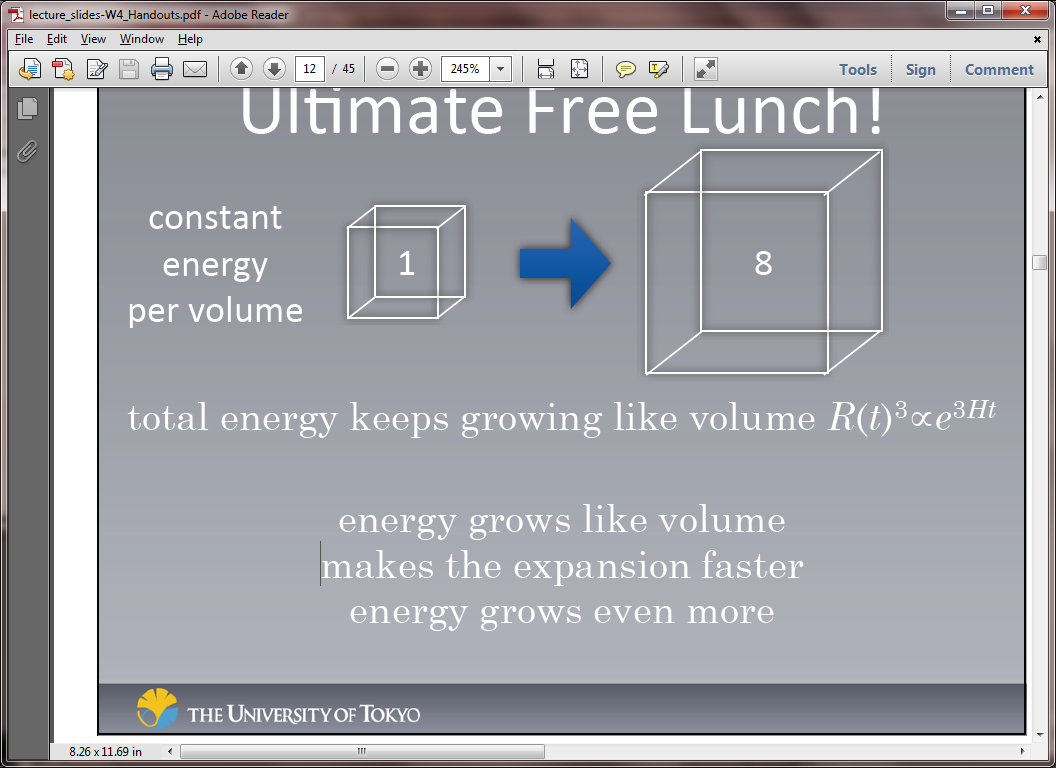
Actually, the universe itself is the ultimate free lunch. Dark energy too has been so described. In economics, banks expand their balance sheets to create a free lunch:
From Economics of Money and Banking, Part I, Lecture 5-5 "Correspondent Banking Bilateral Balances", from about 5:11 to 5:32:
Bank A is saying "I owe you a thousand dollars", Bank B is saying "No I owe you a thousand dollars." They both owe each other a thousand dollars. So they've created these deposits from thin air, they're just a swap of IOUs; they've expanded their balance sheets - both of them. How can that possibly do anything? You know - there's no such thing as a free lunch, it seems like it couldn't possibly do anything.
But it does.
Government created the first free lunch when Alexander Hamilton started running a National Debt by assuming the states' war debts in the very first administration. Conservatives were predicting doom and gloom within a few years then, yet standards of living have risen for over 200 years.
Utitlities should be a public good, not a profit-making entity. The government can and should create money (or borrow at zero cost through the Fed) to provide citizens with power. Profit creates perverse incentives, like garbage companies raising their rates when people use less garbage. Government should override these sociopathic tendencies of market signals.
Using all caps, as the parent post did ("HAVE TO BE PAID FOR"), is a sign that the argument is emotional, not rational. Free lunches exist all over. People try to deny them by yelling. Don't get distracted by them.
-
Re:Stop with the SLASHVERTISEMENTS!
-
Re:Maybe 40k
Making amonia, hydrogen, methane from high temp nuclear, amazing possibilities, is 550C hot enough ? The ruskies already have at least one commercial reactor in operation capable of producing 550C stream.
Yeah, those pesky illogical wind turbine credits are killing all baseload generation in the USA. If only they would reformulate those credits as a percentage of the actual electricity revenues of wind generators, we could restore a minimum level of economic rationality to the market.
But... I did read a lot on the MSR front. Those reactors promise much simpler architecture. They could cost less than 1/3rd per MW than LWRs even at the 250-500MWe scale, their economics would be totally different, actually competitive with wind even with today's crazy credits, plus MSRs load follow without control rods or boron injections. Huge negative temperature coefficient, so if demand goes up, more heat is extracted from the primary loop, temps go down, reactivity goes up, demand goes down, less heat is extracted from the primary loop, temps go up, reactivity goes down. Was demonstrated ad nauseum in the 60s @ ORNL MSR demonstrator, they could control the reactor power by just changing airflow over the heat exchanger (demonstrator had just a heat exchanger dumping heat on the air).
I also took this online class:
https://www.coursera.org/cours...
All of those active safety systems on LWR reactors, none are needed. MSRs need no computer based realtime control computers, even human operators aren't critical, its walk away safe.
It sounds too good to be true, but so far the only bad thing that was said about it was alleged corrosion problems, which was denied by the few retired ORNL techs that worked on the project 40 years ago.
The pesky problem is the NRC. Everytime I read something factual about the NRC, it just shows they are the biggest monkey wrench trying to kill nuclear power in the USA. And the radical greens call the NRC in bed with the nuclear industry. -
Re:Well, we really should be at that stage by now.
Yep, 200 hrs isn't much, but the documents I read explain in detail why the USA and Germany renewable energy policy is stupid.
Don't know if you will be able to read this without enrolling into the course first:
https://class.coursera.org/nuc...
I never claimed I was an expert, rather I claim is that the more I read about nuclear, the more I'm impressed with the in depth detail and clarity the nuclear experts write with, the more I read about solar+wind, but more I come with the impression those guys know nothing about the grid, specially cost x benefit facts.
If solar+wind were that great, Hawaii would be already running on solar+wind alone, after all they have pretty much the most expensive electricity of the USA.
BTW, I'm totally pro wind and solar where you have LARGE HYDRO plants that can do fast load following in large scale. That's just not true for the USA and most of Europe.
BTW2, like most critics you failed to combat my argument with this little thing called facts. All you did was try to embarrass me without exposing any of your argument, which I know is weak.
BTW3, Germany is clear proof solar+wind isn't ready for prime time (not even 20% combined capacity), by shutting down just 5 nuclear power plants, the Germany solar+wind expansion caused activation of lots of peaking coal and peaking natural gas plants, which are far less efficient than baseload. Solar+Wind is destroying baseload capacity in the areas where specially wind is being aggressively pursued. However like I said, in places with lots of hydro, hydro can do agile load following then lots of solar and wind can be used to maintain hydro reservoir levels, like in my Brazil -
It's the interaction, stupid!
People sign up and never finish because the courses are downright awful. And there's no mind nor incentive for them to get better. Instructors think that just recording a lecture and putting it online is good education, but it isn't.
Watch Daphne Koller droning on about graphical models as the video shows her standing at a lectern talking, or showing a powerpoint-style frame while she reads the text on the frame to us.
Watch Anant Agarwal go through a *hugely* dense and boring derivation, only to stop before the end and say "but this derivation is too hard, there's an easier way". Twice. For the same result.
Try to figure out how many degrees of freedom a soccer ball has, then argue with Sebastian Thrun because the answer he thought you should have entered is not the mathematically correct one. (Also, see if you can figure out what this has to do with AI.)
For a breath of fresh air, watch Donald Sadoway take you through a delightful and satisfying explanation of chemistry. (Ignore the 1st lecture which is about class scheduling.) It's wonderful.
I could cite two dozen *major* problems with selected online courses - things that go counter to the fundamental goal of learning that would be obvious to someone familiar with human learning mechanisms or a testing group or even a member of Toastmasters. When I point these out to the chief scientist at edX, he responds with "we can't change the way we do things because of X".
Let me repeat that: the *chief scientist* at edX has no control over teaching techniques or video methods or course quality.
Some people (ie - Dr. Sadoway in the link above) have figured out how to do it right, but the vast majority aren't interested in quality. It's unfortunate that edX got all those millions in seed money, because we'll have to wait until they burn through it before they get hungry enough to worry about quality and effectiveness.
It's insane.
-
Re:So.. what?
Clueless nuclear fanboys ? I'm yet to find such people. Nuclear isn't sexy, so it doesn't tend to attract the clueless.
Most nuclear proponents have STEM background.
You probably mean the professional nuclear engineers that are tired of having to refute absurd anti nuclear accusations.
If you want to get just enough education to see the nuclear facts, enroll to this free online course:
https://www.coursera.org/cours...
I'm not sure one can enroll and get the materials right now since there's no current class going on. -
Re:Warp Drive
I see no evidence of any programming that "learns" or is the slightest bit adaptive.
Ever heard of neural networks? Machine learning? Here is a course given Andrew Ng at Stanford. Watch the intro video, and you will see, amongst other things an autonomous helicopter that was taught, not programmed but taught to do an inverted takeoff. This stuff is already real.
To quote the video:
Machine learning is the science of getting computers to learn without being explicitly programmed.
-
Coursera ....
Hi I think this course is perfect for you. https://www.coursera.org/cours... Regards
-
Coursera
Also sign up at Coursera. They have a course titled "Beginning Game Programming with C#" taught by the University of Colorado. The course also teaches basic C# syntax, so it's very beginner friendly. You just have to wait for it to be offered again before signing up.
-
There is Coursera training for
Try Beginning Game Programming with C#
About the Course
The Beginning Game Programming with C# course is all about learning how to develop video games using the C# programming language. Why use C# instead of C++, Java, ActionScript, or some other programming language you may have heard of? First, using C# lets us use the Microsoft XNA and open-source MonoGame frameworks, which help us quickly develop games for Windows, Android, iOS, Mac OS, and others. Second, the Unity game engine is very popular with indie game developers, and C# is one of the programming languages you can use in the Unity environment. And finally, C# is a really good language for learning how to program. -
Take a free class
Like this one coursera or you could check into one of the many free game engines like these: develop-online
-
Re:Nuclear power is a battery
-
Re:lazers
Excuse me for hijacking the first post, but there are so many people writing stupid things below, that I have to point this out: https://www.coursera.org/cours...
Learn about neurology, it is very interesting. Preferentially, learn it before writing something about it as if you know it. -
Re:France: 75% of electricity from nuclear
Please go out and complete an into to nuclear technology course, show you can actually grasp all technical parameters of a reactor. That you know the difference between the really disastrous pre-Chernobyl RBMK, to a way safer Three Mile Island/Fukushima Gen II to an AP1000 to a fast sodium reactor to a FLiBe Molten Salt reactor.
https://class.coursera.org/nuc... -
Re:France: 75% of electricity from nuclear
I have been studying nuclear power since the outrageous absurd statements that were made anti nuclear power back them.
The more I dug the cleared it became that most of the nuclear cost problems are a result of way too zealous nuclear regulation.
Like 99% of the knowledge I accumulated after high school, I learned by myself.
I recently completed a college intro course to nuclear technology, with an A+ grade:
https://class.coursera.org/nuc...
It made those same claims in general terms. What the course and you'll see.
Radiation is everywhere, alpha, beta, gamma, x-ray, microwave radiation isn't something we can avoid.
Our body is constantly producing beta and gamma radiation.
Anybody that learn the basics about radiation quickly sees all the anti nuclear BS from a far more logical lenses, and see how much the anti nuclear prey on our ignorance.
BTW its Marcelo. m.a.c.pacheco -
Re:It is expensive and it always will be.
Spent fuel is 96% fuel. Combined with the depleted uranium its 99% fuel. It just takes a more efficient reactor to burn it.
Nuclear energy is orders of magnitude environmentally cleaner even than natural gas.
The main issue is nuclear regulators decided to make it economically unfeasible to to nuclear power.
Learn about it and you will find out you are wrong.
https://class.coursera.org/nuc... -
Re:I have a project
So you hate nuclear power and have no interest in properly learning about it, instead taking your knowledge from Hollywood sensationalization of radioactivity and nuclear power. We find those by the bucket nowadays. The difference is most don't dare speak, because the aren't sure. Those that actually think they got it right are the most dangerous.
Here is a source for serious information on nuclear power, without any BS:
https://class.coursera.org/nuc... -
Re:Misleading Summary...
Mainstream adoption of functional principles? Target developers on mainstream runtimes (JVM, CLR) with languages such as clojure and F#.
In Meijer's case he explores Monads within Scala in the following course:
https://www.coursera.org/cours...
He gives as simple a layman's definition of Monads as possible, in fact deliberately sidestepping the mathematics behind it.
-
Massive open online courses (MOOCs)
You can find a lot of open CS courses from prominent universities offered online with lecture videos, assignments, projects, the works:
edX
udacity
coursera
Some offer certificates, but most universities won't accept these. You can try to get the silly credits like English requirement done at a community college which will offer night classes. If you can't give up your 9 to 5 then you can attend a state school or community college part time. Some employers partner with state/community colleges for internships and jobs such as Lone Star College and HP (which actually share a campus in northwest Houston!). -
Re:Are there good uses?Martin Odersky, Scala inventor, recently held a course on Coursera.
From a functional perspective the basic idea is to handle asynch callbacks with a Future monad.
-
Re:Have you been up to Coursera?
The Georgia Institute of Technology Physics class has practical labs.
-
Coursera as well
Coursera has been offering this for some months as well. For about 50$ per course they offer you a "validated certificate", meaning they check if it's really you taking the course. I don't know if this can be used as credit for at certain colleges. I know some courses actually had the college students taking the online course as well. https://www.coursera.org/signature/
-
Re:Many of them are crap
Dude, check out Andrew Ng's Coursera course before ranting about lack of post-production. This is no longer a blackboard video-taped version of his class but one that has been specifically tailored towards an MOOC audience, and it very much follows the "tell, show, do" mantra: https://class.coursera.org/ml-003/lecture/preview
-
Re:Guesses as to end effect?
What's the problem with deficits, exactly?
The gold standard was regularly suspended in times of (regularly occurring) crisis. The private banking system evolved the clearinghouse to try to provide some needed elasticity. Quoting the Lecture 5 Notes from the Economics of Money and Banking, Part 1 MOOC:
Of particular interest is what happens in a financial crisis, when all member banks find themselves short of gold, because of outflows into circulation or abroad. Then there is no chance of solving the problem by arranging for weak banks to borrow temporarily from strong banks. Instead, weak banks borrow from the clearinghouse, which creates additional reserves from thin air simply expanding both sides of the balance sheet.
[Can't post the table because of slashdot's junk character and whitespace filters
In effect, what happens is that intraday deficits and surpluses are not paid but rather put off to another day.
The advantage of a central bank off the gold standard is that much-needed elasticity in times of crises can be created, in a more equitable manner than when a private individual like J. P. Morgan controls the clearinghouse, and expands credit only to his friends.
There are other reasons why the gold standard is impractical, and banks themselves evolved away from it: it's impractical to transfer physical quantities of gold each day to meet intra-bank payments, for example. So banks started giving each other credit, and treating the gold as a virtual reserve anyway. Doing away with the gold standard altogether was a natural step.
A longer exposition of the natural need for elasticity, which the gold standard fails to satisfy, from the Lecture 3 Notes:
Already in 1873 the country experienced the first of a series of financial crises, all of which
followed a similar pattern.In slack times the farm banks would find themselves with excess funds for which they
could find no local outlet. They might use them to buy a security (bond) but they had always to
keep in mind that they would need the funds come fall. So they tended to deposit the funds in
New York where they could earn interest. New York banks would therefore find themselves
with excess funds, which they also knew were only seasonal, so they wanted a short term
investment. They would buy liquid securities or make short term loans. Of particular interest is
the phenomenon of the call loan made to stock market speculators. Thus in slack periods (late
winter) we might find something like what Young shows (p. 302), where country banks have
excess reserves. He mentions the number 50 million as the withdrawal at harvest time, which
note is pretty close to the excess 2% reserves. At harvest time there is a cash drain from the
system, and that means a cash drain from New York, which New York seeks to remedy by
calling in loans and raising reserves from abroad.Thus the cash drain spread into the stock market, causing selling by those who were using
call loans to finance their speculative positions. And it spread to the international money
market, pulling in gold from London. The consequence was a very definite seasonal pattern in
interest rates, as the harvest expansion of credit took place on a fixed reserve basis. The result
was not only a seasonal interest rate but also periodic financial crises, caused whenever banks
had to make cash payments but lacked the cash to do so. Young makes the correct point that the
problem was the inelasticity of reserves. If somehow reserves could be reduced in slack times
and expanded in tight times, the problem could be solved. How to make reserves elastic? The
answer was to make reserves a form of credit. -
Re:Oh, it's a lot older than that.
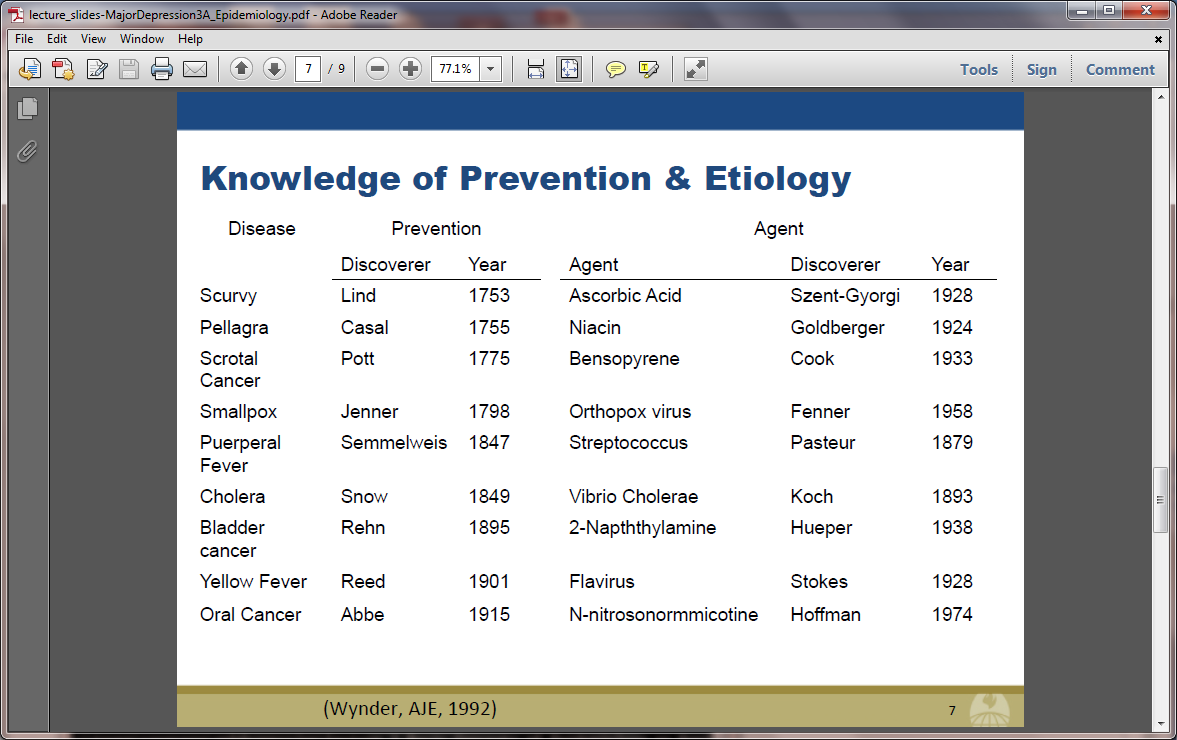
And yet, in the Major Depression in the Population MOOC, we had a slide showing how often in history treatment precedes a scientific understanding of the cause of a disease: http://subbot.org/coursera/pmhdepression/prevention_vs_etiology.png
-
Re:I for one would love to see DBs be more like Ex
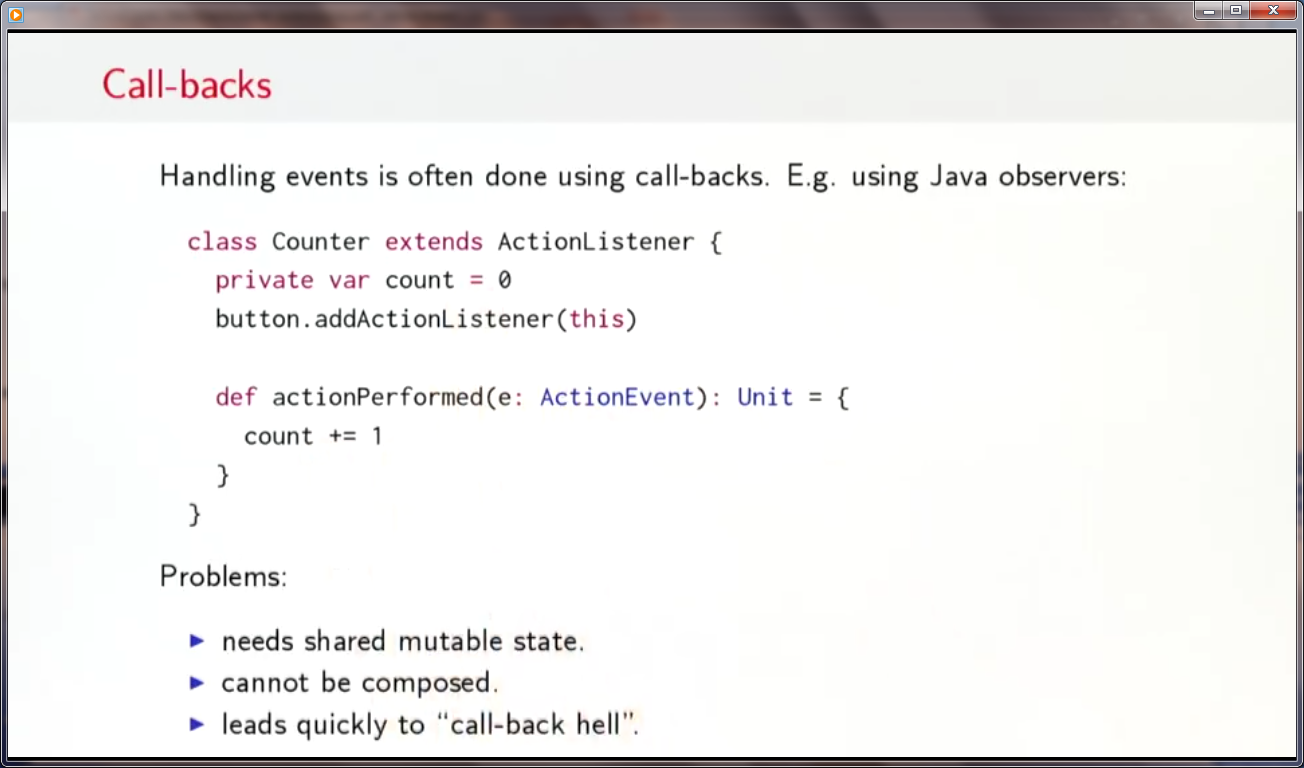
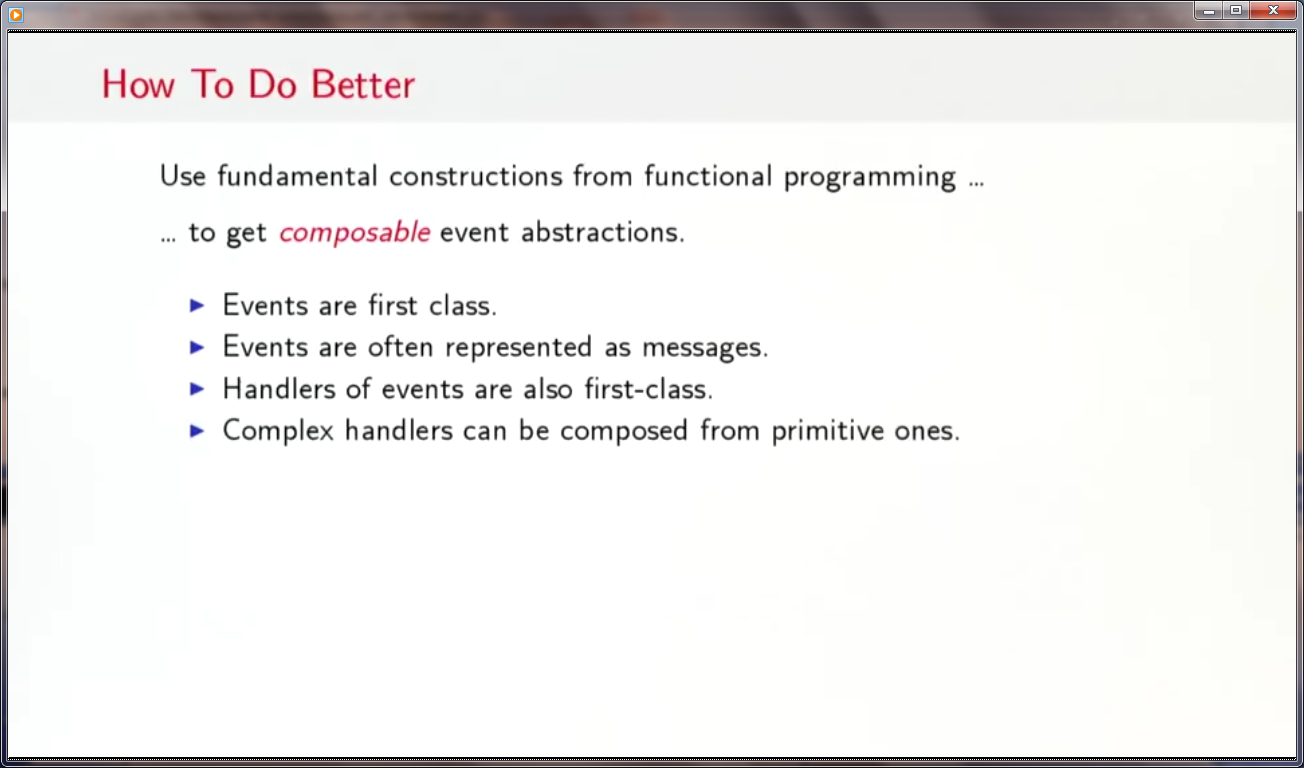
In Coursera's Reactive Programming MOOC, the difference between reactive programming event-handling and traditional event-handling is described in two slides from the introductory lecture:
http://subbot.org/coursera/reactive/callbacks.png
http://subbot.org/coursera/reactive/howtodobetter.pngA traditional Java event-handler is first presented, and the problems enumerated: it relies on a side-effect (the variable "count" in the example), which involves shared mutable state; events and their handlers are not first class. Reactive programming tries to do better so that complex handlers can be composed from primitive ones.
-
Re:"and the traders count milliseconds"
Quoting from Mehring's Notes for Lecture 10, in Economics of Money and Banking, Part One:
In financial theory, it is common practice to assume perfect arbitrage, and hence also
complete liquidity. Assets are assumed to trade at their fundamental value since any other price
would create an arbitrage profit opportunity. In effect, the world that the finance theorists
imagine is a world in which the VBT outside spread is very very narrow, so there is no room and
no need for dealers. In the real world, the outside spread is quite wide, dealers offer prices inside
that spread but the prices can deviate very far from fundamental value. That is the world Fischer
Black was talking about in his infamous presidential address to the American Finance
Association when he said that he thought markets were efficient, meaning price was usually
within a factor of two of true value.We can understand what Black is saying by referring back to the Treynor model.
Suppose that fundamental value is the price that dealers would quote if their inventories were
exactly zero, so they are not exposed to any price risk. The Treynor model then shows how
market making by dealers pushes price away from fundamental value, on one side or another, by
more or less depending on the size of the outside spread and the dealer’s maximum long and
short position limits. Standard asset price theory abstracts from this effect, in effect treating the
outside spread as collapsed around fundamental value, so there is no need for dealers. Some
markets are close approximations to this, but others are not; some times are close approximations
to this, but others are not.If efficiency is completely arbitrary, then the prices that high-frequency traders even out, which the post I was responding to hailed as the legitimate foundation of capitalism, are based on what? They're just pushing prices around to make a profit. Why is that "legitimate"?
Dealers profit from the general lack of liquidity. Wouldn't it be better if a "public option" existed, which provided liquidity without a profit motive? You wouldn't have to regulate dealers; just provide another option which worked in the public interest, pushing prices lower than dealers alone will.
-
Re:"and the traders count milliseconds"
Market-making dealers push prices away from their efficient levels, as even Fischer Black noted. From Perry Mehrling's Lecture 22 Notes, in his Economics of Money and Banking, Part Two MOOC:
On Monday, December 30, 1985, Fischer gave the presidential address to the American Finance Association which was meeting in New York, and stunned his audience with the following words:
“We might define an efficient market as one in which price is within a factor of 2 of value; i.e. the price is more than half of value and less than twice value. By this definition, I think almost all markets are efficient almost all of the time. ‘Almost all’ means at least 90 percent.”
Here we can detect, I think, the influence of Fischer Black’s friend, Jack Treynor, who had originally introduced him to his own version of the capital asset pricing model but gone on to a life in the markets rather than academia, and in that life had produced the dealer model that we have been using in previous lectures. Think about what the dealer model says. It says, just as Fischer relates, that the price of a security fluctuates within bounds set by the value based trader, bounds that can be rather far from true value. At any moment in time, the price of the security will lie somewhere within those bounds, exactly where depends on the inventory of the dealer.
Dealers profit by exploiting market inefficiencies, and pushing prices away from their efficient levels, within a factor of 2. So if the efficient level of a barrel of oil is $100, the dealers can push the price down to $50 or up to $200. That's a pretty wide margin of error.
-
Re:Study and practice this in private.
Not affiliated at all with Coursera, but I noticed this free course the other day. Starts in January.
-
Re:Yes.
"a pricing mechanism to judge whether various stages of production are efficient or not."
Even Fischer Black realized that prices are set by dealers in modern economies, and are pushed away from efficient levels by those dealers. From Perry Mehrling's Lecture 22 Notes for his Economics of Money and Banking, Part 2 MOOC:
On Monday, December 30, 1985, Fischer gave the presidential address to the
American Finance Association which was meeting in New York, and stunned
his audience with the following words:“We might define an efficient market as one in which price is within a factor of 2 of
value; i.e. the price is more than half of value and less than twice value. By this
definition, I think almost all markets are efficient almost all of the time. ‘Almost all’
means at least 90 percent.”A factor of 2 means, for example, that if the "real value" of oil is $100/barrel, the price set by dealers could be in the range $50/barrel to $200/barrel. That's a wide margin of error. Dealers profit from pushing the price away from the efficient level.