Slashdot Mirror
Domain: creativecommons.org
Stories and comments across the archive that link to creativecommons.org.
Comments · 953
-
quazi-offtopic
Just thought I'd plug creative commons attempt to make a science commons. I'm really interested to see how this turns out. I'd apply for a job as director, but the requirements are steep to say the least.
-
quazi-offtopic
Just thought I'd plug creative commons attempt to make a science commons. I'm really interested to see how this turns out. I'd apply for a job as director, but the requirements are steep to say the least.
-
Proactively Protect Lost Freedoms
I just finished reading Free Culture, Lawrence Lessig's latest book. That was an interesting read, and I found it remarkably similar on some points to thoughts I've had on the subject lately.
The last few chapters discuss ways that individuals and governments can and should act to preserve free culture and prevent the culture cartels from gaining more influence. He gives several examples of proactive efforts to preserve freedoms that were lost as technology developed. The Free Software movement was the first example, and Lessig explained how the GPL proactively protects freedom to derivitize, use, and distribute software. It has taken a couple of decades, but there is now a healthy and vibrant ecology in the copyleft commons of software.
He then listed several examples of using ideas from the FSF copyleft commons to proactively protect freedom of non-software things. The Public Library of Science was discussed, as well as the Creative Commons. I remember reading the philosophy section of the GNU project website a few years ago and thinking, "You know, these guys are really on to something..." The ball is rolling, and with work and time we will have a free culture protected by copyleft, including art, literature, music, software, entertainment, and scientific discovery. This is not about communism. It's about FREEDOM, sweet FREEDOM.
-
No, he is not re-inventing the wheel
He wants maps which are under a Creative-Commons type of copyright licence because he wants to be able to publish derivative works such as annotated or modified versions of the original map . The copyright licences on most existing maps, as used by map24.com, are not compatible with Creative-Commons licences, which prevents him from using them.
-
Re:Some CC licenses are free IMO...Read section 4 of the actual CC-by-sa license. Amongst the restrictions on those who resdistribute the work is that:
You may not distribute, publicly display, publicly perform, or publicly digitally perform the Work with any technological measures that control access or use of the Work in a manner inconsistent with the terms of this License Agreement.
Doesn't that deal with most of the problem?
-
Some CC licenses are free IMO...There are a lot of different Creative Commons licenses, some of which are clearly not free in the GNU sense.
However, the by attribution/share-alike license seems like a fairly close analogue to the GPL for non-software content. It lets people freely use, copy, and make derivative works from your content, under the conditions that they acknowledge the source and make the derived work available under the same license. The one thing it doesn't do is insist on the availability of modifiable copy, which is going to be very problematic to define appropriately for a broad variety of media and for many is a moot point.
Anyway, while I can see why the GPL is appropriate for you if you're insisting on "source code", but in my opinion it doesn't make a license for non-software that doesn't have this requirement non-free.
-
Creative Commons
Don't forget the Creative Commons, which also offers a directory of CC-licensed art.
If you're interested in eventually ceding the work to the public domain, you should definitely examine the Founder's Copyright, which sounds a lot like what you're already trying to do. This might be better than simply writing it down on a "piece of paper", because this is a full legal contract and procedure.
-
Creative Commons
Don't forget the Creative Commons, which also offers a directory of CC-licensed art.
If you're interested in eventually ceding the work to the public domain, you should definitely examine the Founder's Copyright, which sounds a lot like what you're already trying to do. This might be better than simply writing it down on a "piece of paper", because this is a full legal contract and procedure.
-
The FDL is a PITAI'm a contributor to the Wikipedia, which is licensed under the FDL. As such, I've seen a lot of debate about the license. In my opinion, while the intention is fine, the specifics of the text make it unsuitable for anything except software documentation. It is too long and complex, with too many over-specific provisions, many of which are designed around the assumption that it will be used for documentation.
It is my belief that if the Wikipedia was restarted from scratch, it would probably use the Creative Commons By-attribution share-alike license, at least for the text, which accomplishes essentially the same thing but is much, much clearer.
-
Creative Commons!The Creative Commons license brings licensing to the masses. As an independent filmmaker, I am so overjoyed to be able to have websites such as Magnatune where I can find decent artists who want exposure for their music, something some of my films can provide. At the same time, I get good quality audio for my films. They win. I win. It's a wonderful thing.
To anyone who has not explored the CC licences, I highly encourage them to check it out and learn about this really cool license.
Also, I didn't notice any really significant changes in the 2.0 licenses. Did anyone catch something blaringly obvious that I missed?
-
Re:... all is not lost
This is very true, however, I have trouble finding sorting the good from the bad. For example, creative commons has a CD of free music called Copy Me, Remix Me which has some really good stuff. But where to go from here? There needs to be a webpage that can do some amazon.com style preference aggregating to help me find new free music that I like based on my past preferences.
-Colin -
Re:... all is not lost
This is very true, however, I have trouble finding sorting the good from the bad. For example, creative commons has a CD of free music called Copy Me, Remix Me which has some really good stuff. But where to go from here? There needs to be a webpage that can do some amazon.com style preference aggregating to help me find new free music that I like based on my past preferences.
-Colin -
Re:Next I suppose
"Maybe we should have open sourced movies now?
check out the creative commons license. -
Re:Backing up vs. Piracy
"Maybe we should have open sourced movies now?
check out the creative commons license. -
Side note on CC confusion
I myself have noticed alot of confusion concerning the usage of the creative commons licences. The original idea seemed simple to me - pick which clauses you want and list them. They even provided simple icons to help mark what your licence allows. But apparently alot of people just don't get it. I don't know how many sites I have seen that simply state that thier works are available under a creative commons license, without bothering to mention which one.
However the problem is not entirely the fault of the artists. I went back to the creative commons site today, and it took me ten minutes to find the original simple page explaining the different licences. Before that I went through their "Choose a licence" path it and they actually encourage people to mark the works on their websites vaguely as being under a creative commons licence. To get the terms of the specific license you must click on the link.
This is bad practice. People are used to the name of the license telling them roughly what you can do with the licence. GPL, BSD, Open Source, Shareware, Freeware, these all give you at least a rough idea of what you can do with the work. Therefore someone stumbing on the Creative Commons Licence for the first time would naturally extend what they know to think it is yet another licence. But it isn't - it is a collection of licences.
Consider the first time someone encounters a creative commons licence. Unsure of what it is suppose they actually do click the link on the bottom of the page and read the (very nice and clear) human readable creed. They will then think "okay that is what they creative commons licence allows" and never bother to click on any other link again, because they think they already know what the licence allows.
I do not think that creative commons concept is too confusing for people, but it is different, and the way it is being handled does nothing to indicate to people that it is different. At the very least people should display the applicable clause icons next to the creative commons link, so that people may notice that there is something different.
PS:
This does not directly apply to this case since prior to April 24th these had no licencing information, and after that the notice was clearly displayed, and in either case Lindows should have contacted the author to get permission. It is just a side discussion. -
Re:Are you sure?
i urge all artists who are sick of being duped by corporate-sponsored free hosting to post their songs at archive.org. it is free, you get a static URL that you can point to from your band's website, and you can even easily designate a creative commons music sharing license.
-
Very alpha!It's not the most stable piece of software I've ever used. Pages randomly vanish (ie trying to get Pop selected, or infact most sub-sub genres causes problems) searching is screwed and the site is very limited. I would say that the software is way way alpha and really you can only upload individual songs to individual artists.
Have experimentally uploaded a track by MEME vs XAN to see how it works but at the moment it seems the link is screwed. Maybe it'll work later.
Not sure where they are going with this as it is extremely basic but I would have loved to be able to specify a Creative Commons license as I was adding the song...
ps. If you are impatient to hear my track anyway you can get Meme Vs Xan - 24 - immediately from Loca Downloads
-
Re:What is there to copyright?
Most, if not all, of the Gentoo Documentation is released under the Creative Commons License.
-
Re:It's technology, stupid
Consider the phrase
licensed. -
Re:The GPL is not a EULA
It is an EULA nonetheless. By using the the materials (program, source code, documentation, etc.), you are agreeing to the restrictions imposed and the rights granted. Show me a definition of the EULA that says it CANNOT grant rights and privileges. In the same manner, Creative Commons is of sorts, a customizable EULA. Similarly, you do not own the copyright of that GPL program that you downloaded (and its attendant source code). However, in the case of the GPL you have a license (the GPL) that allows you to redistribute the program (and even charge for it) as long as you distribute the corresponding source code with modifications. That is the quid pro quo: the GPL has granted you rights you did not have under copyright, and in return has asked you to make your contributions available. If this does not sound like an EULA, I don't know what does. Just like any other EULA, rights are granted under certain conditions. Feel free to mod me down to (-1, Troll) if you like, because I know the
-
Re:Does...
No, because implicit in the agreement that everyone makes with Slashdot when posting is permission for Slashdot to reproduce and store the post upon their servers.
That means that even if it is a conversation, permission has already been given to Slashdot, at least, to copy and record it.
So, for example, I can't sue Slashdot for reproducing my words here, because my post is indication of my consent to have them reproduced.
But if you save a copy, I could potentially accuse you of copyright infringment, because I have only granted Slashdot a right to reproduce.
But fair use would cover that, probably, and I license this post under the Creative Commons Attribution-ShareAlike License
But do note that copyright is a separate issue from the chat logging issue.
(Dang, I sound like a stinkin' lawyer!) IANAL. -
Rethinking intellectual property
I'm all for a resistance to things like the RIAA, companys that abuse copyright law, and absurd notions of what constitutes intellectual property.
However I feel that when people use P2P networks as the only way to fight back, but don't use things like creative commons or the the GNU than they are really hurting the resistance movement that people have created to fight back aginst abuse copyright laws, and absurd notions of intellecutal property.
IMO There has to be more reason to use P2P than "I don't have to pay for it," there has to be the desire to make a political or philosophical statement.
Anyway, I'm just preaching to the converted here... -
Re:7.6% is one number but there are many reasons
I hear you, but the artists are in on this with the RIAA. They are doing this to themselves. Until we show them that they are on the path to destruction, they will continue. I hope for a Creative Commons with a lot less post production and a much greater percentage of the profit going to the artist. Sooner or later, monopolistic behavior will get you in trouble. I think that buying used music is probably the best illustration of the point that needs to be made. People will pay for music. They won't pay a ridiculous price and they are getting tired of heavy-handed attempts by associations, etc to limit choice and fair use. Hopefully, someone will begin tracking used music sales (like Amazon) and the case will become clear. Pound on the music thieves all you want. (carefully dismounts soapbox).
-
You may all ready know this...
... but just in case you did not I'll toss it up here.
Lawrence Lessing (another lawyer who has done lots of writing about the internet, and been talked about on Slashdot often) posts what IMO is some very insightful information on "cyberlaw" at his blog from time to time. If you enjoyed this interview, and have not cheked out Lessing's work.
Here are some of the groups that Lessing is working / has worked with...
creative commons
eff
puclib knowledge
fsf
-
Re:academic libraryI don't think you're a minority. In physics (my area) at least, many more Ph.D.'s are produced than than can possibly be employed permanently in research. Many people go on to careers in the private sector, but I'm sure maintain their interest in scientific developments, and have the training to read the scientific literature.
Fortunately, though, in physics there is the network of prepring/eprint servers where many papers go prior to publication. (See Arxiv.org, for example.) However, they have the disadvantage of not having been peer-reviewed yet. I would like to see a respected, true Open Access journal in physics. There are many "free" physics journals available (see Directory of Open Access Journals), but none fit my desire for a respected, peer-reviewed, open access journal.
-
Draconian desperationThe media cartels are obviously getting desperate if the best they can come up with is attempting to buy more draconian business-model-preservation law. First the DMCA and the NetAct, and now this.
I mean, 10 years for "expropriating" the potential sale of proprietary data that a judge deems "worth" more than $10,000? Give me a break. Actually, they probably will give me a break; 10 years is more than they want, and they'll compromise downward a bit for what they really wanted in the first place.
Still, the chilling effect of a law like this would only hasten the inevitable development of more secure P2P, and the spread of open source and open content.
Enforcing perpetual copyright is next to impossible without a global police state, and I'm much more likely to fund the Bruce Perens and Corey Doctorows of the world because they've earned my respect by choosing open licenses over the default "AllmineMineMINE!(C)(R)!".
--
-
Creative Commons
Musicians who are interested in this might also be interested in the creative commons license.
-
simple
Lots of solutions have been suggested -- VMWare, a self-signed root certificate, various driver hacks, and hardware hacks all the way down to a quality microphone.
For that matter, what about ReactOS? And what about user feedback?
Most users would not buy a DVD that required them to play it on a computer. Somehow, I'm guessing the hardware on any "trusted" DVD player will be _very_ easy to hack -- something like a modchip? Add to that the fact that we already have non-compliant DVD players, and most of us don't want to go buy a new one.
As for me, I will quietly sit here borrowing CDs from people and ripping flac files (or buying them from magnatune), and as soon as DVD burners or terabyte storage gets cheap enough and a good format is available, I'll be ripping full-quality DVDs.
Once they've got us all locked into an Orwellian DMCA scheme, I laugh and pull out my multi-terabyte archive of stuff, release it onto Kazaa, start giving away burned copies on street corners with only a license that insists that for each copy I give to someone, they must burn two for someone else...
This is not because I'm evil, and I hope that I will never end up doing that. I would rather use something like Magnatune and actually pay the artists and be completely unrestricted in how I use the music. I would rather still use Creative Commons licensed stuff, but honestly, I haven't seen The Matrix nearly enough times. Fatboy Slim, Prodigy, and Jimi Hendrix are all still damn good. I don't need to buy new music, and so I would start the piracy like mad if I ever thought that such things would be limited in their use.
I would probably choke to death on rage when I could no longer listen to classic songs about freedom, or even songs from ICP and Limp Bizkit about breaking heads for no reason in absolute disrespect of authroity, without surrenduring my freedoms to a central authority -- without playing them all on some offshoot of Longhorn.
I almost did anyway when I heard Metallica bitching about Napster -- I wanted to throw some of their own lyrics back at them. Lyrics like "So fucking what?" was my first reaction. My next reaction was somewhat longer: "All the justice pain and greed money talking" but I'm not sure that's actually what's being said. Either way, the whole song "And Justice For All" rebels against exactly what I thought of Metallica as doing.
-
Re:Lessig the Grey vs. Creative CommonsIt is indeed possible to create a Creative Commons license that bars someone from creating derivative works. However, this isn't entirely a contradiction. It may be a compromise meant to allow the maximum public benefit to be created under current copyright conditions (which limit derivative works). The idea that Lessig is amenable to compromise despite having stronger believes which he expresses in his blog doesn't prove that he's being hypocritical.
The fact is, if you look at this, you see that the license includes a notice that fair use is still protected, and that the CC license with "no derivative" clause does so in order to facilitate copying and sharing. It is still closer to Lessig's position than current copyright law.
I do believe and agree that in this area, compromise like what Lessig may be endorsing with the CC license (and like copyright law itself has been doing for the last hundred years) might create confusion about what the 'principles' of copyright law are. This surely will make some of us uncomfortable -- especially those of us who believe that copyright is supposed to make some sort of moral/logical sense, and not merely be a pragmatic engine for creativity.
However, as we've already seen, copyright does not operate under any principles except to enable more creativity than it disables. Copyright is not a moral law. It does not have unimpeachable logic that directs its content. Thus, Lessig need not either be totally black or white, and does not contradict himself by agreeing to less than he wishes for in his blog--since copyright allows [sorry, I can't help it] "gray" principles.
-
Lessig the Grey vs. Creative CommonsFrom something I sent to Dave Farber's IP:
Given the recent Grey Tuesday brouhaha that followed the release of DJ Danger Mouse's Grey Album, it's worth pausing for a moment to take a look at the Creative Commons:
"We work to offer creators a best-of-both-worlds way to protect their works while encouraging certain uses of them -- to declare 'some rights reserved.'"
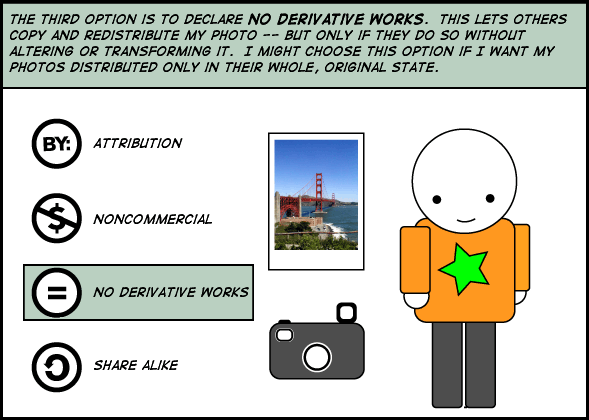
Among the rights an artist may choose to reserve when configuring their Creative Commons license is "No Derivative Works," explained in cartoon here:
http://creativecommons.org/images/comics/10.gif
Indeed, the Creative Commons' leading example musician is Roger McGuinn who: "chose the Creative Commons license that maximizes a combination of free distribution with artistic control and integrity." -- note that Roger McGuinn chose "No Derivative Works."
However, the Grey Tuesday movement seeks to take that right away. Notably, Larry Lessig (Creative Commons Chairman of the Board) commented in his blog:
http://www.lessig.org/blog/archives/001754.shtml
"Should the law give DJ Danger Mouse the right to remix without permission? I think so, though I understand how others find the matter a bit more grey."
"Should the law give DJ Danger Mouse a compulsory right to remix? That is, the right, conditioned upon his paying a small fee per sale? Again, I think so, and again, you might find this a bit less grey."
So, what exactly does Creative Commons mean by "some rights reserved" -- would it perhaps be more accurate if they said: "some rights reserved until we can cook up a new compulsory license to take those rights away"?
-
Re:Bah.
GPL wasn't meant for such things as static (as in finished) text. That's why Creative Commons license was created to fill that hole. L/GPL serves well when living organisms are concerned, such as codebase, because it constantly evolves. Once a book is transcribed, corrections and/or additions won't be necessary majority of the time.
From what I understand, a specific license would fit the bill to swathe Project Gutenberg library, such as Attribution-NoDerivative 1.0. They have few options under which authors can license their content properly. As evident in the article, placing confidence in individuals who say they would do the right thing just isn't enough in these modern IP-dominated era.
Fortunately, all is not lost. There has got to be more to the story than just rumor based upon a spinoff website where they try to capitalize on original PG fame, however small it might be at this point. -
Re:First Sale Doctrine and GPL
>I assumed the person I was replying to was talking about the scenario where the source code was not distributed along with the binary.
Fair enough, but the original poster was quite clear on this (point 3).
On the rest of it, we broadly agree and I think it would take case law to split the hairs on our very slightly different interpretations that lead to the same conclusion.
I was really playing devil's advocate in suggesting that you (as a rights holder) could argue (note: "argue") that Section 3 applies to any distribution, including individual unit sales. You'd have to argue that because company Y received value in terms of the GPLd code, they are bound by the license (even though it's not a contract). My point was that even if you argued that successfully (unlikely) then first sale doctrine would protect company Y from your only means of punishing them for the license violation.
It's a convoluted area. It might be the case that rights holders can (with a license rather than a contract) only prevent copying and not distribution. But consider the Creative Commons by-nd-nc, which is replete with restrictions on distribution as well as copying. They seem to think otherwise.
-
Let's improve the discussion by citing specifics.
Comparing anything to perfection is unproductive; it serves to reinforce our biases by presenting us with a false dichotomy (you can have whatever argument is being proposed or you can have perfection, which is never available). Let's look at specific claims.
As much as there are some FSF fans wish that the GPL was the only software license [...]
Please name who these people are and cite the evidence that gives you this impression.
[...] it's not the one-size-fits-all solution for everybody. That's why the LGPL exists. That's why Creative Commons exists. That's why many common open-source programs have forked the GPL to make it their own.
That explanation barely gets into why the LGPL exists. The Creative Commons doesn't recommend their licenses for software. The GNU project started over a decade before the open source movement began and the GNU project was founded to talk about software freedom, not a development methodology. I'd also be interested to learn who, besides the Affero General Public License has "forked" the GNU GPL. The Creative Commons has listed the GNU GPL, not forked it.
[...] but let's not treat the GPL like it's a religion. It's not perfect.
Who, exactly, is doing this and what, exactly, are they saying?
-
Re:We're #2!
They could do it free with some Common Content released under a Creative Commons license. No music tax for people in Canada, almost no cost to Apple, and other people get their music heard. Sure 99% of iPods buyers will delete it all, but who cares? If 1% listen for just a minute, it's that much exposure that the musican had, at no cost to them.
-
Re:Creative Commons more suitableWhat is wrong with using the GPL for a book (compared with Creative Commons), apart from offering fewer choices to the user? If you are happy with others making money of the book, I don't see a problem with it. I was surprised to read the statement in the article:
First, the GPL is a software license, and is less suitable as a copyleft license for books than the GFDL or a CC license.
The GFDL places quite a few restrictions on use of a work compared with the GPL. There is also the Open Publication License which seems to be less restrictive than the GFDL. -
Creative Commons more suitableA Creative Commons license would seem to be a much better approach than trying to use the GPL. They even have a section explicitly for educators. Since SCO hasn't tried to sue MIT yet, most people are probably unaware that it is available.
-
Re:So what? Its already been signed.
Very interesting, you should also consider trying to do a campaign to reduce copyright lengths, maybe to 20 years like patents.
I was also hoping to join an activist group / campaign (politically if they have one) at the local, national or international level to try and reduce copyright lengths. (The creative commons and Larry Lessig's blog are good sites but are not a campaign for copyright reduction laws per say).
If they can pass laws that keep on extending copyright law, I don't see why there can't be an opposition political movement that -
A Creative Commons licenced Wiki ?
Why not?
But, it could be just nice to add the RDF descriptor of the choosen licence in order to display it on my FireFox browser using mozCC extension.
"twice as good as View Source" -
Creativity...
-
Re:Suggestion for "Mix Tape"Yes, the video is released under the Creative Commons Attribution-NonCommercial-ShareAlike License, so you can remix this to improve it. I'm checking with Sheryl as to whether she is okay with me offering the 2 GB raw DV format version of Mix Tape (720x480 resolution) to people who want to remix. That way you avoid adding even more compression artifacts to the video.
Given the file size and low number of interested users, I would probably have to send people DVD-Rs in exchange for some nominal fee to cover media and postage costs. Of course, that might violate the non-commercial clause, so maybe we would have to do it some other way. Anyone interested in the source should email me, and I'll see what we can work out.
-
Open Media for Linux PDAs?
The CreativeCommons GetContent page contains a huge list of media. But what I am looking for is content, which fits to a Linux PDA like the SHARP Zaurus series. Are there eBooks, AudioBooks and movies, especially designed for small computers? BTW: Though there are many sites, which offer free mobile cell phone logos and ringtones, are there any logos and ringtones available under the Creative Common Licenses or the GPL?
-
Open Media for Linux PDAs?
The CreativeCommons GetContent page contains a huge list of media. But what I am looking for is content, which fits to a Linux PDA like the SHARP Zaurus series. Are there eBooks, AudioBooks and movies, especially designed for small computers? BTW: Though there are many sites, which offer free mobile cell phone logos and ringtones, are there any logos and ringtones available under the Creative Common Licenses or the GPL?
-
Not Completely Lost... [karma whore warning]
Thanks to the wayback machine: http://web.archive.org/web/*/http://www.webmonkey
. com has, for the most part, working links to a great deal of content, not to mention a nice view of the evolution of the graphic design proclivities.
Hopefully the terralycos lawyers won't ask the wayback to pull the content.
As an aside, I wonder, but am doubtful, about whether alternate licensing could be arranged for the content, perhaps some form of the Creative Commons License??
cleetus -
Re:Not another word game...I think you're largely right. However, you're wrong that open source is essentially the same as free software. Free software is really about copyleft, and the FSF recommends copyleft licenses. Open source is a more permissive idea.
One of the problems with the ' free software' brand is that it has the word 'software' in it and so it can't easily be applied to other domains. The 'sharealike' concept from Creative Commons is better and expresses essentially the same idea. GPL'd software = sharealike open source. Sharealike even has a logo -- that's right, it's copyleft.
I prefer 'sharelike' to 'copyleft' (although either one is good). It expresses what I really like about GPL'd software like Linux. Anyone can share in it, but they all share back as well.
-
Re:Dorky GPL question:
Maybe this would be one way to do it? -
Re:GPL...
The GPL isn't about the freedom of the people who use it, it's about the freedom of the *software*.
Of course, 'free' isn't probably the best word here; the Creative Commons licenses hit the nail on the head with "share alike". -
They could work with Creative Commons.I hope they take a look at what rights they want to protect, and if it fits one of the existing Creative Commons licenses, use it.
More importantly, if it doesn't fit one, it does identify a need for another license, and they could work with creative commons to create a new license that fits that need that everyone can use.
-
Re:Godel's Theorem?
I don't understand the problem with XML.
I mean, if this format of data-storing was that bad, why the hell is SGML being used to this day?
Anyway, the point of XML is not to automagically be meaningful for every computer software, it is to be parseable by every computer software. At least, for every XML parser computer software.
It means you will be able to feed it into a DOM tree and analyze it no matter what schema it conforms to -- no matter how many schemas it conforms to either -- hell, if you're nice to it, you may even find *parts* of it you (the software) can understand. This is achieved by the single fact that the document is XML. Nevermind, at first, if it is valid.
Based on this fact, you may have documents on the Web that carry semantically meaningful information for a variety of "clients" that are still readable by other clients without needing a parser full of special-exceptions-found-in-practice quirks mode.
With that in mind, people are encouraged to add semantic information to their (XHTML or whatever) pages, knowing that at the very least, it will be ignored. Slowly, this will increase, and "semantic web enable" browsers will offer some neat stuff based on it. Like that Mozilla extension that verifies it a page is licensed under a Creative Commons license. -
And this..
is why I release all my music under CreativeCommons by-nc-sa. (Not like I was expecting to get rich off of it anyway.)
-
Re:It's not surprising really.
CC explained
First time i hear about it. Look like realy cool. The document I linked too is really interresting.