Slashdot Mirror
Domain: dejobaan.com
Stories and comments across the archive that link to dejobaan.com.
Comments · 76
-
Our Indie First-Person Shooter
I'll take a moment to plug our indie-developed first-person shooter, Inago Rage. We tried to make the game different from most by focusing gameplay on short burts of flight (MPEG), but what we really concentrated on was the ability for players to create their own arenas (scroll down) without having to use external mod tools. Basically, we've implemented a drag-and-drop system to allow players to place buildings, towers, bridges, enemies, prizes, and particle generators.
The graphics are not likely to outdo those of this past year's AAA titles, but I'm happy with what we were able to produce. There are a good number of reasonably-priced tools that (I think) make it possible for smaller studios to create visually attractive games.
We're hoping to release a demo by the end of Janary, and have experimented with attempts at web commercials to get the word out. (The holy grail of the Viral Video eludes us, as yet -- we'll keep trying). We're also in the alpha test stage of an overhead shooter using the same technology called Last Man on Mars (WMV video).
Here's hoping Inago Rage will be a contender for the top 10 indie titles of 2005.
__________________________
Inago Rage -
Re:Open Source
It's been my experience that Indie developers are, as you say, eager to share resources that benefit the game development community. This might include marketing strategies, source code, or tools. However, as businesses, small studios have to have something to sell; traditional business models suggest that it makes sense to retain control of certain assets.
One scenario where a business might open source an entire product is an MMOG where the client and server are under an open license, and revenue is generated by unique, pay-for-play quests. I'm sure that the optimal level of open-sourceness varies from project to project.
(As a sidenote,
________________________________________________
Inago Rage - An Independent Game About Building and Shooting Things -
Recent Trends in Indie Gaming
Three recent trends lend credibility to the image of those modest studios (indies) developing games: 1) the fact that many such developers are are coming from industry proper; 2) the actual nomenclature "Indie" being a positive term; and 3) small studios' newfound ability to create games that are visually appealing.
First: An interesting but not-well-known fact is that many members of the indie gaming community come from a background of well-known companies. Take, for example, the Moonpod team, which had experience at Gremlin and Infogrames before starting out on their own. Monkeystone is headed by none other than id's John Romero. I would argue that games industry experience is not a prerequisite for the development of a good game; but the recent movement of folks from big gaming companies to their own studios makes independents more credible. Put simply: if folks who have worked on shipped, big-budget games are now part of the indie community, there must be something to the indie community.
Second: The actual term used for smaller studios (Independents or Indies) is an important one. You could call many of the products in this category "Shareware Games," but there's a horribly negative connotation to that term. "Indie Games" evokes the notion of a small, dedicated team of professionals crafting out something new and interesting. By contrast, the term "Shareware Games" evokes the notion of some dude in his basement churning out a buggy arcade clone that looks like it was written for the Intellivision. To parahrase someone, (I want to say Chris Barrie): A rose by any other name might smell as sweet, but may be less appealing if it were called "sewage-weed." The adoption of the "Indie" label has helped legitimize games made by smaller studios.
Fifth (20 years from now, we'll be those old farts still making Python references to people born in twenty-oh-one): Independents can make games that look good. It may be because indies now have access to tools that would have made Pixar cry during its formative years. (Maya, for example, can be had for about $2k, and is even free for personal use.) It may also be because there's great talent now available. Either way, I think indie titles, taken as a whole, have become visually appealing. During the '90s, shareware titles had a bad reputation for being ugly, because they lagged so far behind the cutting-edge. These days, titles like Starscape, Dark Horizons: Lore, and Wik & The Fable of Souls are (IMO) looking pretty good. And, while indie titles may not be as spectacular as those developed by a major studio, (our own Inago Rage focuses on bright colors, but doesn't quite outdo Tron 2.0, for example), decent sales suggest that gamers like what Independents are doing.
However, given the dearth of posts in this thread, I still believe we have a long way to go.
_____________________ -
Re:Some REAL questions to Gariott
Why not pose some REAL questions here? Here's my go. Richard, if you're reading this, endulge us
Since we're having fun, let me play the part of an Imaginary Richard Garriott and see what he has to say.
MikShapi: 1. Is single-player CRPG'ing a dead-end as far as you're concerned (and does your future lie in MMO) or do you see yourself involved in future major single-player titles?
Imaginary Richard Garriott responds: I've been authoring them since Alkabeth, and have no intention of stopping now! Some might consider the genre to have become stale, but the way I see it, it merely needs a nudge in a different direction. Things like physics simulation have been adopted from academic and industrial research. The next big thing coming out of that research could as easily be convincing AI; and I think this is what we really need to bring our computer role-playing gameworlds to life.
MS: 2. Are we going to see any future CRPG-games you are involved in with an ultima-*like* atmosphere? (never mind the brand) and are they going single-player or MMO?
IRG: The Ultima series was very much an extension of myself; in the same way you might be able to pick out a Jeunet film, I'm certain you'd be able to pick a Lord Brittish game out of a group, even if it didn't bear the name "Ultima."
MS: 3. Are we going to see any future CRPG-games you're involved in with vast illinear worlds like Ultima 6/7 or Morrowind and are they going single-player or MMO?
IRG: I think you coined a new term there. [Chuckles] Seriously: if our games can become a little more intelligent, there won't be such a distinction anymore -- linear worlds will cease to exist altogether. In other industries, there has been a great deal of research work done on compelling, computer-generated content. (For example, they finally have algorithms that can create a reasonable symphony.) It's been used in games to an extent -- the Diablo series and its spiritual predecessors, the Roguelikes, demonstrated the use of this in a primitive fashion. Consider what will happen when developers expand on this -- when events and new gameworld rules generate naturally and logically from existing conditions. At this point, CRPGs may truly become the "virtual worlds" they've been promising us for years.
MS: 4. What's your favourite *CRPG* game you were not involved in?
IRG: Alternate Reality by, I think, Datasoft.
MS: 5. What's the coolest thing in the CRPG market you're looking forward to? (Other than Half-Life 2 you're obviously playing same as we all, judging by that 'physics engine' bit)
IRG: The coolest element? I think it's collaborative building. The ability for players, as a group, to shape the gameworlds they're in is something I'd always hoped to see in an RPG.
---
That concludes the interview with Imaginary Richard Gariott. We now return you to your Real Richard Gariott, who is sipping port from the window of his observatory.
_________________________________
Inago Rage - Fight, Fly, and Create your own levels in an indie first-person shooter. -
Always Megan Morrone
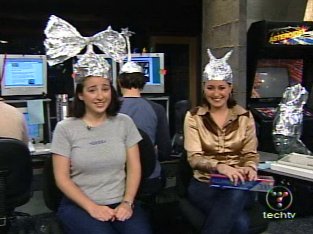
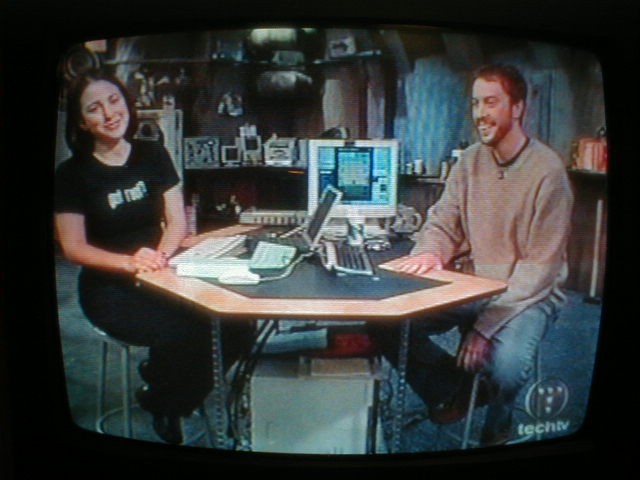
Some years ago, TechTV's Megan Morrone featured one of our games on The Screensavers (screengrab here, with the game on in the background). Indie studios receive relatively modest press coverage, so seeing one of our own titles on the tele-vision was unreal and wonderful.
G4's X-Play seems more geared towards the mainstream/console market; either they don't cover independents, or I accidentally offended them in our press release. ____________________________________
Inago Rage - Create. Fly. Fight. -
Re:George Broussard of 3d realms' take on this
I think the big question is, how can we get small game studios back? Is it really not possible for a small team to make commercial games?
I believe that the problem smaller studios face can be overcome with some lateral thinking. The problem is two-fold: production costs and marketing costs are too high to allow indies to compete on equal footing with the big boys. The solution, then, is to not compete on equal footing.
Don't: Try to copy a game that took 60 people 3 years to create.
Do: Draw from an existing genre, but come up with a unique twist -- something meaty that doesn't exist elsewhere.
Don't: Compete with larger productions on the same style of graphics.
Do: Come up with a unique look; it's easier to wow people with a fresh style. (Though Monolith is not a small studio, Tron 2.0 was the opposite of the hyper-realism trend, and set itself apart on appearance, among other things.)
Don't: Try to out-advertise Activision, Microsoft, or Infogr- er- Atari. A small studio's meager advertising budget should be used towards development.
Do: Make as much use of word-of-mouth marketing as is humanly possible. It's easier to connect with your individual players because... well... there are fewer of them.
Don't: Re-invent the wheel. id Software must create its own 3D engine from scratch; you don't (necessarily) have to.
Do: Make as much use of middleware as possible. You don't need to be an artist to create skycubes. You don't need to know DirectX or OpenGL intimately to create an engine. You don't need to write your audio engine from scratch.
And I deeply believe better games would be coming out of a smaller and more laid back studio...
I like the cut of your jib. I hope you're right.
________________________
Inago Rage - A first-person shooter where you fight in arenas of your own creation. -
Starglider for the Atari ST
I've long held the Starglider series to be the first of a "new" generation of games, in that it made an enormous leap forward in immersion. It was one of the first games I'd ever seen for the Atari ST, and the first game I'd ever encountered with digitized music. ("What, you're not impressed? I nearly crapped myself when I saw this at the 1937 World's Fair!") It was also the first computer game I'd seen with such fluid 3D graphics.
The sequel improved on the original in many ways; not only was it more graphically rich, but the game universe was lavish with detail. In 1988, here was a game that allowed you to travel out to Jupiter to frolic with a school of dolphin-like critters that rode space-currents. While not important to the gameplay proper, it's elements like that that make a 1.44MB world seem both infinitely large and endlessly explorable. (Naturally, I'm also a fan of Elite.)
_____________________________________________
Inago Rage - Bound between rooftoops and create your own 3D arenas in this indie-developed first person shooter. Coming Real Soon. Honest. -
Launch is Everything (But it Doesn't Have to Be)
I'd like to see the industry place more emphasis on what happens over product's lifetime than on its initial launch.
As a former developer of Palm entertainment software, and current developer of Windows software, my perception is that the PDA market encouraged post-release support, whereas the desktop market strongly focuses on the initial "bang." The juciest press in desktop gaming are the previews and the initial review, (and in some cases, games are reviewed before they're released). By comparison, little mention of a game is made after it's released, even if substantial improvements are made.
Passage like, "...if they'd only spent more time polishing off this game, it'd have been fantastic!" should be a sign to a developer that they need to go and polish off the damn game. As an independent studio, we're able to do that; but I'm not sure we'd be rewarded for it. Even large companies making content available such as Unreal Tournament 2004's Community Bonus Pack receive minimal press. That free (community-produced, even) expansion made the game an even better purchase; I'd go so far as to suggest that the initial review should be upgraded as a result.
Traditionally, we 1) develop a game, 2) release it, and 3) add to it/improve it over its lifetime. Players love to see new content, especially if it's free. With our upcoming title, my perception is that we have to get it right on the first try, or we'll receive poor reviews. Developers are given incentive to move on to a new title, rather than improve an existing one, as it means another round of previews and another full review. I'd much rather listen to what the community says, tweak as needed, and be recognized for it. -
Launch is Everything (But it Doesn't Have to Be)
I'd like to see the industry place more emphasis on what happens over product's lifetime than on its initial launch.
As a former developer of Palm entertainment software, and current developer of Windows software, my perception is that the PDA market encouraged post-release support, whereas the desktop market strongly focuses on the initial "bang." The juciest press in desktop gaming are the previews and the initial review, (and in some cases, games are reviewed before they're released). By comparison, little mention of a game is made after it's released, even if substantial improvements are made.
Passage like, "...if they'd only spent more time polishing off this game, it'd have been fantastic!" should be a sign to a developer that they need to go and polish off the damn game. As an independent studio, we're able to do that; but I'm not sure we'd be rewarded for it. Even large companies making content available such as Unreal Tournament 2004's Community Bonus Pack receive minimal press. That free (community-produced, even) expansion made the game an even better purchase; I'd go so far as to suggest that the initial review should be upgraded as a result.
Traditionally, we 1) develop a game, 2) release it, and 3) add to it/improve it over its lifetime. Players love to see new content, especially if it's free. With our upcoming title, my perception is that we have to get it right on the first try, or we'll receive poor reviews. Developers are given incentive to move on to a new title, rather than improve an existing one, as it means another round of previews and another full review. I'd much rather listen to what the community says, tweak as needed, and be recognized for it. -
Launch is Everything (But it Doesn't Have to Be)
I'd like to see the industry place more emphasis on what happens over product's lifetime than on its initial launch.
As a former developer of Palm entertainment software, and current developer of Windows software, my perception is that the PDA market encouraged post-release support, whereas the desktop market strongly focuses on the initial "bang." The juciest press in desktop gaming are the previews and the initial review, (and in some cases, games are reviewed before they're released). By comparison, little mention of a game is made after it's released, even if substantial improvements are made.
Passage like, "...if they'd only spent more time polishing off this game, it'd have been fantastic!" should be a sign to a developer that they need to go and polish off the damn game. As an independent studio, we're able to do that; but I'm not sure we'd be rewarded for it. Even large companies making content available such as Unreal Tournament 2004's Community Bonus Pack receive minimal press. That free (community-produced, even) expansion made the game an even better purchase; I'd go so far as to suggest that the initial review should be upgraded as a result.
Traditionally, we 1) develop a game, 2) release it, and 3) add to it/improve it over its lifetime. Players love to see new content, especially if it's free. With our upcoming title, my perception is that we have to get it right on the first try, or we'll receive poor reviews. Developers are given incentive to move on to a new title, rather than improve an existing one, as it means another round of previews and another full review. I'd much rather listen to what the community says, tweak as needed, and be recognized for it. -
I'll go one step further...I'd say that both individuals and entire development studios should grab more recognition for their creations. If you browse Mobygames, games are listed by publisher:
- Medal of Honor: Allied Assault by Electronic Arts
- Star Wars Battlefront by Lucasarts
- Asheron's Call by Microsoft
- Chronicles of Riddick: Escape from Butcher Bay by Vivendi
- ...etc...
What seems clear to me is that middlebrow games criticism cannot function without some reference to authors: a critic needs to know who to blame or praise, how to assign and imagine intentionality, how to accessibly discuss the intertextual relations between games.
The gaming public does, indeed, seem to care who's recognized for a title. Development studios should be lauded for their successes, just as book authors are. To wit, we'll be self-publishing our next title. I'll personally bear responsibility for the game, whether it unleashes a horrible plague upon the world, or becomes a hit.
I'm sorta hoping for the latter.
____________________________
Inago Rage - Bound between rooftoops and create your own 3D arenas.
Give the Stress Test a go, and let us know if you enjoy it. -
Extra Added Cool for the PlayerI love DVD commentaries that talk about how a movie was produced. I'd like to do something similar for our upcoming title, (which I'm supposed to be working on right now instead of posting to Slashdot). Since it's an independent production, we have a good amount of leeway in terms of what random gunk we can add in, though we end up starving if we put in the wrong stuff. My thoughts were to include the following:
- The crude-but-playable prototype from two years ago. There's a clear line of ancestry there, but it's always nice to see how things have evolved.
- A bit on how the game's focus changed, and why we incorporated building elements into it.
- A segment on the actual development process, from the initial concept to media development, coding, and refining.
- Outtakes! Maybe you'll get a chuckle seeing the early AI as it forced the multi-segmented Parade Dragon to loop in and collide with itself.
- How you can create artwork without a budget or artistic talent.
- Why I think (hope?) indie studios can earn a living.
____________________________ ____________________________
Inago Rage - Bound between rooftoops and create your own 3D arenas.
Give the Stress Test a whirl, and let us know if you enjoy it. -
Extra Added Cool for the PlayerI love DVD commentaries that talk about how a movie was produced. I'd like to do something similar for our upcoming title, (which I'm supposed to be working on right now instead of posting to Slashdot). Since it's an independent production, we have a good amount of leeway in terms of what random gunk we can add in, though we end up starving if we put in the wrong stuff. My thoughts were to include the following:
- The crude-but-playable prototype from two years ago. There's a clear line of ancestry there, but it's always nice to see how things have evolved.
- A bit on how the game's focus changed, and why we incorporated building elements into it.
- A segment on the actual development process, from the initial concept to media development, coding, and refining.
- Outtakes! Maybe you'll get a chuckle seeing the early AI as it forced the multi-segmented Parade Dragon to loop in and collide with itself.
- How you can create artwork without a budget or artistic talent.
- Why I think (hope?) indie studios can earn a living.
____________________________ ____________________________
Inago Rage - Bound between rooftoops and create your own 3D arenas.
Give the Stress Test a whirl, and let us know if you enjoy it. -
Extra Added Cool for the PlayerI love DVD commentaries that talk about how a movie was produced. I'd like to do something similar for our upcoming title, (which I'm supposed to be working on right now instead of posting to Slashdot). Since it's an independent production, we have a good amount of leeway in terms of what random gunk we can add in, though we end up starving if we put in the wrong stuff. My thoughts were to include the following:
- The crude-but-playable prototype from two years ago. There's a clear line of ancestry there, but it's always nice to see how things have evolved.
- A bit on how the game's focus changed, and why we incorporated building elements into it.
- A segment on the actual development process, from the initial concept to media development, coding, and refining.
- Outtakes! Maybe you'll get a chuckle seeing the early AI as it forced the multi-segmented Parade Dragon to loop in and collide with itself.
- How you can create artwork without a budget or artistic talent.
- Why I think (hope?) indie studios can earn a living.
____________________________ ____________________________
Inago Rage - Bound between rooftoops and create your own 3D arenas.
Give the Stress Test a whirl, and let us know if you enjoy it. -
Release Dates and Indie ReleasesThe Banc analysts predict that Halo 2 "will be the second-best seller of the holiday season..." and suggest that certain titles should be moved beyond the holiday season entirely, to "avoid big-name products coming out on the same time-frame."
Release dates are always tricky, but I think there's a solution aside from Banc of America's proposed delay. Just as the concurrent releases (scroll down) of Batman, Lethal Weapon, and Indiana Jones crushed UHF, high-profile games such as Doom 3 have the potential to utterly destroy the smaller competition, such as our own title, scheduled for an August release. However, here are three ways we hope to avoid being eaten:
- Complementary Benefits - If the competition leaves something desirable out of their design, a developer can cater to that. Untold zillions of people (myself, included) have enjoyed a myriad of games in the first-person shooter genre. Many of these players would love to create their own levels and content, but lack the time or technical expertise to do this, even with the mod tools available. We want our offering to allow anyone adept enough to play our game to be able to create within it. I'm hoping that folks of all ages can play other FPSes, and still enjoy our game, for that reason.
- Consistency - From a marketing standpoint, the release of a small title is almost a non-event; rather, steady and consistent support causes awareness to gradually snowball. After all, most FPS fans know than Doom 3 will be released on 7/20/2004 (just kidding), but unless PGC and CWG suddenly do big pieces on indie developers, they won't be slapping us onto their covers. So, for us, it's a long-haul grassroots thing -- hopefully, this means that players will benefit from lots of fresh, new content over the next 12 months.
- Differentiation - This is where the consumer stands to win the most: developers can recognize saturation in a sub-genre and create products that evolve it. Or: to those who lament the current state of the myriad identical MMOGs, don't fret -- it's only a prelude to evolution! Our biggest example of this is the ability to create arenas. But we also apply it in small ways; whereas Doom 3 and Half Life 2 approach hyperrealism, we're trying for the oppsite effect. Aesthetics are not central to our game, but I hope players will consider it pretty enough -- and different enough -- to enjoy.
Reliance on the Big Launch seems like a losing proposition for all but the highest-profile titles. I'm banking on the slow, steady approach, which may end up with my being able to eat for another year, or my living in a cardboard box. I'll let you know in 2005.
____________________________
Inago Rage - Coming Summer 2004 -
Release Dates and Indie ReleasesThe Banc analysts predict that Halo 2 "will be the second-best seller of the holiday season..." and suggest that certain titles should be moved beyond the holiday season entirely, to "avoid big-name products coming out on the same time-frame."
Release dates are always tricky, but I think there's a solution aside from Banc of America's proposed delay. Just as the concurrent releases (scroll down) of Batman, Lethal Weapon, and Indiana Jones crushed UHF, high-profile games such as Doom 3 have the potential to utterly destroy the smaller competition, such as our own title, scheduled for an August release. However, here are three ways we hope to avoid being eaten:
- Complementary Benefits - If the competition leaves something desirable out of their design, a developer can cater to that. Untold zillions of people (myself, included) have enjoyed a myriad of games in the first-person shooter genre. Many of these players would love to create their own levels and content, but lack the time or technical expertise to do this, even with the mod tools available. We want our offering to allow anyone adept enough to play our game to be able to create within it. I'm hoping that folks of all ages can play other FPSes, and still enjoy our game, for that reason.
- Consistency - From a marketing standpoint, the release of a small title is almost a non-event; rather, steady and consistent support causes awareness to gradually snowball. After all, most FPS fans know than Doom 3 will be released on 7/20/2004 (just kidding), but unless PGC and CWG suddenly do big pieces on indie developers, they won't be slapping us onto their covers. So, for us, it's a long-haul grassroots thing -- hopefully, this means that players will benefit from lots of fresh, new content over the next 12 months.
- Differentiation - This is where the consumer stands to win the most: developers can recognize saturation in a sub-genre and create products that evolve it. Or: to those who lament the current state of the myriad identical MMOGs, don't fret -- it's only a prelude to evolution! Our biggest example of this is the ability to create arenas. But we also apply it in small ways; whereas Doom 3 and Half Life 2 approach hyperrealism, we're trying for the oppsite effect. Aesthetics are not central to our game, but I hope players will consider it pretty enough -- and different enough -- to enjoy.
Reliance on the Big Launch seems like a losing proposition for all but the highest-profile titles. I'm banking on the slow, steady approach, which may end up with my being able to eat for another year, or my living in a cardboard box. I'll let you know in 2005.
____________________________
Inago Rage - Coming Summer 2004 -
Release Dates and Indie ReleasesThe Banc analysts predict that Halo 2 "will be the second-best seller of the holiday season..." and suggest that certain titles should be moved beyond the holiday season entirely, to "avoid big-name products coming out on the same time-frame."
Release dates are always tricky, but I think there's a solution aside from Banc of America's proposed delay. Just as the concurrent releases (scroll down) of Batman, Lethal Weapon, and Indiana Jones crushed UHF, high-profile games such as Doom 3 have the potential to utterly destroy the smaller competition, such as our own title, scheduled for an August release. However, here are three ways we hope to avoid being eaten:
- Complementary Benefits - If the competition leaves something desirable out of their design, a developer can cater to that. Untold zillions of people (myself, included) have enjoyed a myriad of games in the first-person shooter genre. Many of these players would love to create their own levels and content, but lack the time or technical expertise to do this, even with the mod tools available. We want our offering to allow anyone adept enough to play our game to be able to create within it. I'm hoping that folks of all ages can play other FPSes, and still enjoy our game, for that reason.
- Consistency - From a marketing standpoint, the release of a small title is almost a non-event; rather, steady and consistent support causes awareness to gradually snowball. After all, most FPS fans know than Doom 3 will be released on 7/20/2004 (just kidding), but unless PGC and CWG suddenly do big pieces on indie developers, they won't be slapping us onto their covers. So, for us, it's a long-haul grassroots thing -- hopefully, this means that players will benefit from lots of fresh, new content over the next 12 months.
- Differentiation - This is where the consumer stands to win the most: developers can recognize saturation in a sub-genre and create products that evolve it. Or: to those who lament the current state of the myriad identical MMOGs, don't fret -- it's only a prelude to evolution! Our biggest example of this is the ability to create arenas. But we also apply it in small ways; whereas Doom 3 and Half Life 2 approach hyperrealism, we're trying for the oppsite effect. Aesthetics are not central to our game, but I hope players will consider it pretty enough -- and different enough -- to enjoy.
Reliance on the Big Launch seems like a losing proposition for all but the highest-profile titles. I'm banking on the slow, steady approach, which may end up with my being able to eat for another year, or my living in a cardboard box. I'll let you know in 2005.
____________________________
Inago Rage - Coming Summer 2004 -
Tim Sweeney and... Unreal ZZT?
Tim Sweeney will, in my mind, forever be linked to the wonderful ZZT. This interview, given some time before Unreal 2 is an interesting contrast to the one posted above. In particular, he talks about ease-of-creation:
Hercules: You moved onto to other, bigger projects long ago. It must be good to know that the first thing you ever created is still used/played a lot. Does ZZT still cross your mind, sometimes?
Tim Sweeney: Yes, one of the interesting things to do is contrast ZZT and Unreal, and look at how incredibly far we've come in graphics quality in that time. But also to see how little the industry has progressed -- or maybe even gone backwards in some respects... So, how will game development be 10 years from now? If levels take six months to build, and compiles take 5 hours each, and it costs $20 million to develop a game, then developing games won't be fun or even possible anymore.
I'm a fan of creation tools that are accessible to anyone who can play the game. (Casual players who may not be technically inclined.) As a developer, I'm hoping that we will be among the first to offer something that lets even the most casual user plink around. As a player, I'm hoping that Sweeney has retained this philosophy, and that future Epic offerings let us build -- at least a little bit -- with the same ease that ZZT did. -
What Independents Want
Independent studios want to create wonderful, experimental titles, but are, in part, held back by business requirements. As businesses, our first priority is to become profitable, and the least-risky way to do this is to create more traditional offerings. (The same is true for large development houses.) Fortunately for us, better middleware tools and increased publicity can free us of this constraint. The former will allow us to experiment and develop easier; the latter will allow us to reach an audience now reserved for the large publishers. As these conditions improve, you'll see independents take more risks.
Middleware comprises the audio libraries, AI plugins, and 3D engines such as Torque, Conitec A6, and FMOD. These tidbits are the lifeblood of independents. Without them, we'd have to code everything from scratch, and you'd see even more Tetris clones than you do now -- little innovation. With them, we're freed from the low-level stuff. We can create games that look and sound good enough to attract consumers. As middleware improves, it'll become even easier to experiment and innovate.
Publicity is trickier -- while events such as the Independent Games Festival allow us to bend the ears of larger publications, it's still the big studios that are going to command the previews and exclusives. Having approached a number of print publications, I've found that it can be difficult to secure a sizable preview for our game, even though I think folks might like to hear about where we're innovating. But even this is improving; sites like The Adrenaline Vault are particularly indie-friendly, often posting press releases from smaller development studios.
I think, then, that it's only a matter of time before the smaller studios attempt experimental titles in substantial numbers. Many will be terrible; some will be great fun. But as it becomes easier to experiment, you bet we'll be doing more of it, simply because we can. -
A Boon for Developers
To a developer, easy cross-platform compatibility is great. But compatibility among platforms in different markets is priceless.
I love free stuff. If I can get cross-platform development for free (or close), I'll take it. The ability to create a substantial application and have it run well on Windows, Mac OS, and Linux means I can reach a greater audience. But what XNA promises is almost impossible to resist: the ability to develop a substantial game that runs on your desktop, in your livingroom, and on your keychain -- three large markets that do not directly compete.
Applications drive an operating system; a stack of exceptional programs give consumers a reason to buy your OS. A complaint I've long had with Palm is that they haven't made it easier to develop for Palm OS. Microsoft gives its development environment away for free. In fact, it's possible to develop simple games concurrently for Windows Desktop and Pocket PC. If XNA can make it possible for a small studio such as mine to develop our more complex offerings concurrently for Windows and Pocket PC, will I care about Palm OS, Mac OS, or Linux?
What I'd like to see from companies such as Apple and PalmSource are environments like Torque, which makes it possible to write for Windows, Mac OS, and Linux by abstracting each environment. But Torque is really an ad-hoc solution (in both senses of the term); it's not a hollistic system, and it's not supported by the OS vendors. Though an awkward combination, if it were possible to develop substantial applications for Mac OS, Palm OS, and Windows, I might. But if XNA allows me to develop substantial applications for Windows, Pocket PC, and the Xbox concurrently -- three different, juicy markets -- that's even better. -
Games Improving Mental Fitness
I always tell people about the customer who e-mailed us, telling us that our first game as an independent studio was helping her with a neurological condition. An excerpt from her letter:
I have rather severe neurologic problems in some areas of my brain and your game is helping me to regain some use of those areas that are "resting."
It was a great thing to hear.
______________________________
Trivia: The tagline under EA's M.U.L.E describes it as "a game in which up to four players attempt to settle a distant planet with the so-called help of a mule-like machine they all learn to hate. -
EyeToy and Gestural Interfaces
Cheap techology is great -- make digital cameras inexpensive, offer an SDK to grab their output, and folks will come up with wonderful ideas for how to abuse them. Devices like EyeToy are mostly just oddities now, but I'd like to see them used to popularize gestural interfaces.
Arkane Studios' RPG, Arx Fatalis is one of a handful of titles that offers gestural input, with its mouse-gesture-based spells. But this was more a novelty than a boon for usability -- it would have been easier to cast a spell by clicking icons. Perhaps a sequel will allow you to embellish your runes with serifs to achieve subtle variations on an incantation?
Avant Browser offers up a more useful gestural interface -- and I like it because it allows me to execute common tasks more easily. Rather than having to hit a smallish "new window" icon, I can rudely right-click anywhere on a window and sloppily drag my mouse upwards to open a new window.
EyeToy takes this a step further and does away with the mouse altogether; and though I had modest luck with the thing when I played against the noisy backdrop at Toys "R" Us, here's hoping that it's the first among many such interfaces. Perhaps five years down the road, a) gestures will be common, b) we'll laugh at what Minority Report got wrong, and c) we'll thank goofy gadgets like this one for paving the way.
After all, it was pretty silly to have a "Rat" for the Atari 800.
________________________________________________
The Inago Rage website is now up.
Critiques welcome and appreciated! -
What Brings the Dreaded CrunchThere are plenty of reasons why a studio might enter crunch-mode:
- Approaching holiday - Christmas brings about the hottest season in retail, and publishers want to capitalize on this by releasing new titles in time for this. The Christmas push is less pressing for smaller studios that distribute outside of retail.
- Media event - E3 is when all the gaming companies and all the gaming press come together and pretty much stand around in a competition to see who can avoid having a seizure (flash/audio). Or, such was my take on it. There's a huge PR incentive to have content prepared for this event; more eyeballs translates into more potential sales.
- Publisher-imposed milestone - Publishers can withhold payment or cancel projects outright if a team misses milestones; if you're nearing such a deadline, the extra hours may be the difference between a happy publisher and a cranky one.
- Competition - You might have a solid first-person shooter, but if it's released concurrent with Doom III or Half-Life 2, there's a good chance it'll be overlooked. If you own the UHF DVD, you'll hear Al Yankovic lament that his movie went up against Batman, Indiana Jones, Lethal Weapon II, among others. You may also have your favorite game that was underrated due to poor timing. (Fortunately, there's always the possibility of a sequel.)
- Budgetary constraints - Especially crucial if a development house is self-funding a title. If a generous publisher sees a promising project go over-budget, they might extend it. If an independent studio runs out of money for going over schedule, it must secure more financing.
- Loss of staff - This can be devastating at project-end. There's no time to train new staff; existing members must take up the slack.
-
Independent Xbox Games a No-Show
"If Microsoft can woo more developers to Xbox, the balance of power in the next round could change."
I'm blatantly biased here, but I'd be thrilled if Microsoft were to make overtures to the independent game developer community. Some noises were made along those lines in November, 2000, but they didn't follow up tangibly. As an independent developer, I don't feel drawn towards Xbox development the way I did, Pocket PC development. In that arena, MS gave the development tools away for free, (something I always felt Palm should have done to keep Pocket PC from gaining market share from 2001 onward).
Xbox development is said to be technically similar to Windows desktop development, so from a development standpoint, I imagine that authors of 95/2K/XP software would feel comfortable developing for the console. Further, 3d engines such as Torque and Conitec's 3DGS make it possible for modest-sized groups to develop popular titles. But both the developers of such engines, and the developers of games, face restrictions imposed by the console manufacturer(s). Conitec's Doug Poston states his case -- the manufacturers make the cost-of-entry too high for smaller studios.
Does the manufacturer-imposed barrier-to-entry for console development raise the quality of games, or does it mean fewer interesting titles and less experimentation? (I suppose the businessman-side of me would be thrilled if larger studios abandoned the desktop PC, leaving the market open. But somehow, I think that'd be a phyrric victory for all of us.) -
Building on Basics
When I first began writing shareware games for Palm OS, I created a number of small puzzle games, among other things, and found that it was pretty difficult to come up with an interesting concept every week or so. So, I can't begrudge BestGameEver if some of their new games build on their previous efforts. Besides, sometimes the most enjoyable games come about as refinements of previous (and possibly less-commercially-successful) ones.
But along those lines, Ludum Dare hosts 24- and 48-hour competitions to investigate innovative gameplay; folks who are interested in BGE's offerings for that reason might like to check them out. -
Software developers want less eye candy.One might think Valve would aim lower, given the results of its System Survey:
Video Card Description:
NVidia GeForce4 MX Series -- 15.35 %
NVidia GeForce4 Series -- 12.47 %
NVidia GeForce2 MX Series -- 10.86 %
NVidia GeForce FX 5200 Series -- 7.02 %
ATI Radeon 9600 Series -- 6.11 %
ATI Radeon 9800 Series -- 4.93 %
CPU Speed:
1.5 Ghz to 1.7 Ghz -- 14.00 %
1.7 Ghz to 2.0 Ghz -- 18.33 %
2.0 Ghz to 2.3 Ghz -- 13.82 %
2.3 Ghz to 2.7 Ghz -- 16.62 %
As a software developer, I actually don't want to have to produce a game with that much eye candy. But I feel compelled to concentrate on that, given that gamers and press go (in part) by screenshots and aesthetics.
Regardless of what I'd like to concentrate on, I think the hardware vendors, the software developers, the press, and the consumer are all in cahoots together. You, me, everyone -- we all want to see prettier games.