Slashdot Mirror
Domain: doi.org
Stories and comments across the archive that link to doi.org.
Comments · 315
-
Re: Read the PDF.Forget the article. If you care about time and computers read the PDF from NIST.
It covers a wide berth of timing related topics and is information dense. I found no marketing BS in this paper at all.
-
Re:The impact on the pharmaceutical industry
Your question is essentially "How would we finance medical research if drug patents stopped being effective?"
The Medicare/Medicaid drug reimbursement is more than the yearly total loaded research costs for all drugs, when using the highest available academic estimate as of mid last year (estimates vary wildly, from $100M to $1.8B in for this estimate, by researchers from Lily, a pharmaceutical company). There is one non-peer-reviewed estimate that is even higher ($2.6B), but that is only for NMEs (new molecular entities),(completely new drugs), and multiplying that by all drugs approved each year isn't reasonable, as most approved drugs aren't NMEs. There's about 22 NMEs approved per year. At $2.6 billion each, that's $57.2 billion.
The 2015 federal cost of medicare drug reimbursement is $54.12B - for outpatient subsidies only. Medicaid had a cost of $63.34B (see page 184); this is presumably also excluding inpatients, as hospital costs are listed separately. These two programs sum to $117.46B, or a bit over *twice* the cost of the NMEs. Non-NME costs are much, much lower (tens of millions), and there aren't lots of them, so they don't really add up to much either.
-
Here is some actual informationOK folks, let's stop griping about the OP and try to get some actual content. If you look at the home page of David Mattingly, the main researcher on this project, and check his list of publications, you'll hit this one:
http://dx.doi.org/10.1017/S000...
It describes his team's exploration of previously-unknown settlement by Garamantes people, ancestors of today's Tuaregs, who dominated the Sahara from 500 BC to 700 AD. Cool stuff. He's been working in the area for 20 years, and the people in question were known to the classical Greeks and Romans.
-
2012 study from Neutering wiki article
Citation: Matzuk, Martin M.; McKeown, Michael R.; Filippakopoulos, Panagis; Li, Qinglei; Ma, Lang; Agno, Julio E.; Lemieux, Madeleine E.; Picaud, Sarah; Yu, Richard N.; Qi, Jun; Knapp, Stefan; Bradner, James E. (2012-08-17). "Small-Molecule Inhibition of BRDT for Male Contraception". Cell 150 (4): 673–684.
doi:10.1016/j.cell.2012.06.045
PMC 3420011 PMID 22901802.
-
Continuation of study from Neutering wiki article
Citation: Matzuk, Martin M.; McKeown, Michael R.; Filippakopoulos, Panagis; Li, Qinglei; Ma, Lang; Agno, Julio E.; Lemieux, Madeleine E.; Picaud, Sarah; Yu, Richard N.; Qi, Jun; Knapp, Stefan; Bradner, James E. (2012-08-17). "Small-Molecule Inhibition of BRDT for Male Contraception". Cell 150 (4): 673–684.
doi:10.1016/j.cell.2012.06.045
PMC 3420011 PMID 22901802.
-
Exciting
This is actually pretty cool, mostly because it's an efficient source of photon pairs. The time-energy entanglement means that photons with particular energies always come out at particular relative times (that is, pairs of photons are produced by splitting one higher energy photon into two lower energy photons, which are emitted at the same time). Photon pairs like this can be used to do quantum key distribution, a secure method of distributing encryption keys, or, with a memory and some clever entanglement swapping protocols, the entanglement resource could be transported over long distances to do true quantum communication, where measurement in one place guarantees a result at the other place, and anyone listening in will destroy the communication channel.
-
Re:This makes sense nomatter your politik
Methane degrades into CO2, in fact, so in simulations I did (Archer and Buffett, 2005) the radiative forcing from the elevated methane concentration throughout a long release was about matched by the radiative forcing from the extra CO2 accumulating
what's a 'long release'?
I don't know, if your curious read the paper,
D. Archer, and B. Buffett, "Time-dependent response of the global ocean clathrate reservoir to climatic and anthropogenic forcing", Geochemistry, Geophysics, Geosystems, vol. 6, pp. n/a-n/a, 2005. http://dx.doi.org/10.1029/2004...
;
my assumption from the context of the article (Much ado about methane) is more toward decades to continuous rather than months to years. -
Re:Problem?
the statement "the models do match the observations" is factual in nature. that is, it is falsiable. it is either true, or it is not.
I said it is. and provided evidence for that.
its not a proganda site, but even if it were, it wouldnt matter.
Factual or falsifiable statements stand or fall on their own on the basis of evidence.And you failed to provide any evidence that the models do not match the observations.
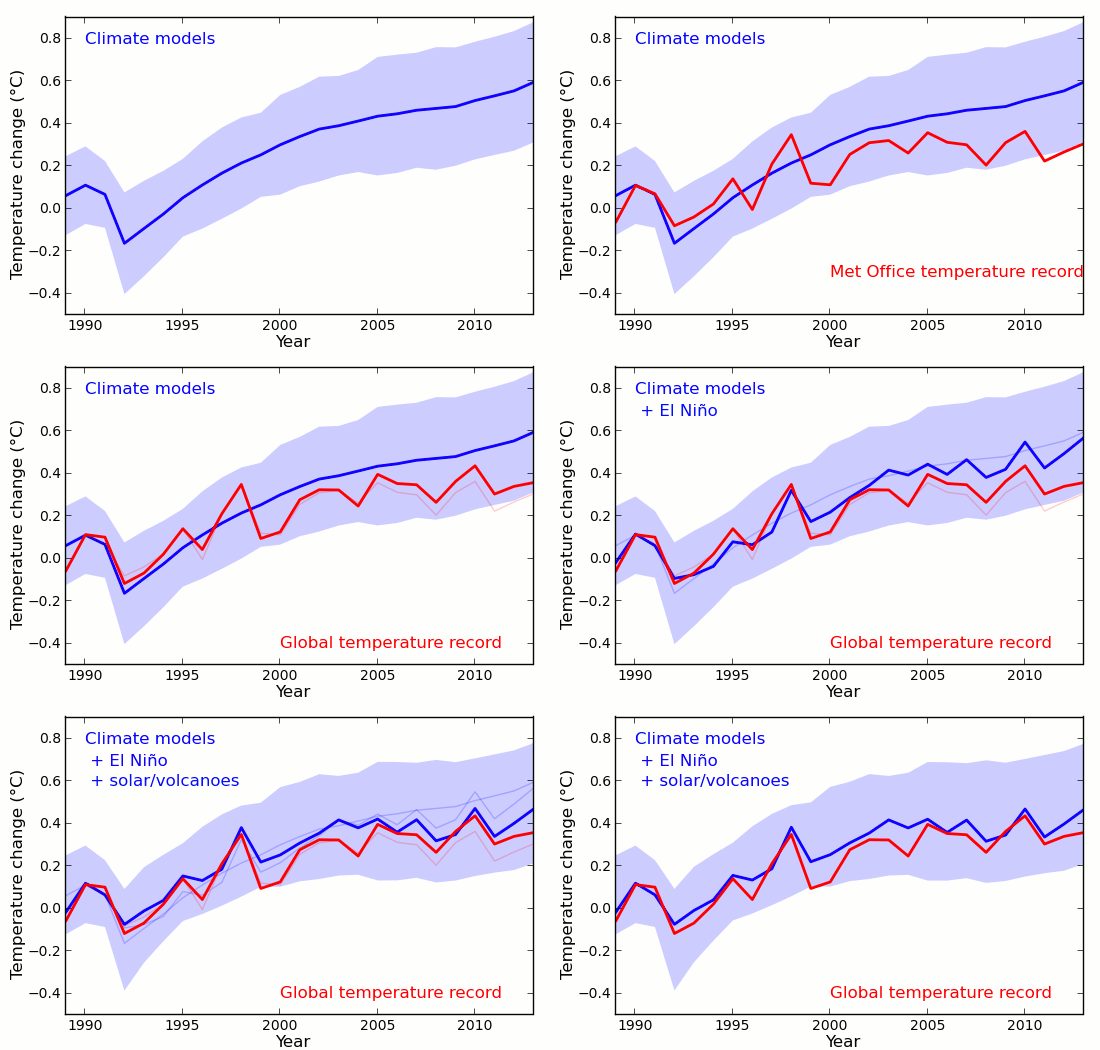
What you did, was to link without understanding. All you did was cherry pick one paper published in Nature, out of the dozens they have, that sounded like it confirmed your beliefs based on the title. Which is what a lot of deniers did, without undestanding what the paper is actualyl saying. That paper is about one data set, specifically the HadCRUT4 set. One of the major factors in that papers conclusions is El Nino/La Nina events that have both amplified and dampened temperatures in relation to expectations.If you'd even bvothered to read the provided links you'd have seen that they actually deal specifically with the data set that that paper is about. And they talk about that dataset's relation to both models and actual observations. in other words, i already addressed your concerns, but you dont know that because you didnt bother to actually read before linking something that you dont understand. So you didnt see statements that address the issues raised in that paper, such as:
Climate models, however, cannot predict the timing and intensity of La Niña and El Niño, natural cycles that greatly affect global temperature in the short-term by dictating the amount of heat available at the ocean surface.
By failing to account for these and other factors, the CMIP5 collection of climate models erroneously simulate more warming of Earth's surface than would be expected.
When the input into the climate models is adjusted to take into consideration both the warming and cooling influences on the climate that actually occurred, the models demonstrate remarkable agreement with the observed surface warming in the last 16 years.You missed another Nature article ( http://dx.doi.org/10.1038/ncli... ) that partially address the concerns in the one you linked, and is about better addressing El Nino/La Nina events.
You also didnt see this handy GIF, which clearly illustrates the situation, and that the models are still within the expected envelope: http://skepticalscience.com//p...
That paper you linked wasnt an indictment of global warming or the models.
It was a climate scientist saying to his fellows "hey guys, we under/overestimated a few things, this is what we need to tweak in the models, especially in regards to El Nino/La Nina".This isnt a definititive process, it is an iteritive one. And as time goes on, the tweaks get smaller and smaller, and the conformance between observations and expectations gets closer and closer. But some things cannot be accurately predicted yet, specifically El Nino and La Nina events which have a very large impact on observations and carry a significant impact on global weather and climate. It appeared for a bit that an El Nino was building for this year, though it never materialized, which would have dramatically altered global observations, making various places hotter, cooler, wetter, or drier than normal. These events cause short term spikes (higher highs, lower lows) in observations, but are not themselves invalidations of either observations or models.
-
Data & Software Citation.
The top 100 most cited papers are actually a motley crew of methods, data resources and software tools that through usability, practicality and a little bit of luck have propelled them to the top of an enormous corpus of scientific literature.
The article itself never mention 'data resources' that I saw, but there's a problem in many fields that the standards are to cite the 'first results' paper for that data
There are similar issues with software citation -- everyone's citing the announcement of the existing of the software, but how can you track who might've relied on a buggy version to let them know that they may need to re-run their analysis? I'm not as active in this field, but the arguments remain the same (giving proper attribution, documenting everything to make it reproducible, etc.). See the 2013 Knepley et.al paper, "Accurately Citing Software and Algorithms used in Publications" and the work of the Software Sustainability Institute (which also covers topics on writing better research software, as was alluded to in the article)
It's probably also work mentioning that our current ways of tracking 'importance' of papers are flawed. See the Altmetrics Manifesto for a collection of links to efforts to come up with other metrics and CiTO, the Citation Typing Ontology to enable a way to classify why something was cited (it might be for criticism; in most of the cases in the article, it would be "uses method in", which not all disciples feel needs to be cited).
-
Re:Not always about the money...
Nice to see breakthrough research like this coming from a single-payer healthcare system like the UK. When people start saying that the only places that can afford groundbreaking medical research are the ones where the "customers" pay a fortune, it'll be good to be able to point them to things like this.
According to http://www.bbc.co.uk/news/heal...
"The lack of financial incentive for the pharmaceutical industry could help explain why it has taken so long for the research to get this far. Using a patient's own cells to heal them means there is no profit for the pharmaceutical industry."
But I'm not sure where the funding did come from, some at least came from the Polish government. The scientist mentioned in the BBC article works at UCL (University College London), which has a large NHS teaching/research hospital (UCLH), but it won't necessarily be 100% NHS funding for this work. I think this is the paper: http://dx.doi.org/10.3727/0963... .
I can't find a single place "advertising" all the research the NHS funds. Here's a couple of sites: http://www.uclh.nhs.uk/researc... http://www.imperial.nhs.uk/res...
-
Re:Not news: GWAS Often Fail
I counted 445 authors on this publication. The author list is so long that they had to put it in the back pages.
When I was an undergrad, I remember the discovery of the top quark having a billion of authors. I counted and it had only 436 authors, http://dx.doi.org/10.1103%2FPh...
The top quark author list motivated me to get out of high energy physics and into biophysics. I am sure there are papers out there with even longer author lists, but I am always glad to see significant papers with shorter lists as well.
-
Re:please no
Not sure what you mean by few references...All these were on that page.
http://www.grida.no/publicatio...
http://dx.doi.org/10.1038/ncli...
http://www.weatherzone.com.au/...
http://pubs.giss.nasa.gov/docs...
http://www.sciencemag.org/cgi/...
http://www.copenhagendiagnosis...
http://www.iac.ethz.ch/people/...
http://www.aip.org/history/cli...
http://www.aip.org/history/cli...
http://www.giss.nasa.gov/resea...
http://www.realclimate.org/ind...
http://www.realclimate.org/ind...
http://web.archive.org/web/201...As for Dyson...two imporat words you dont find in his biography are "climate scientist".
In fact, he rather quite well falls into the science trope of the phsycist who insits on talking about things outside his realm of expertise.
(There's even an XKCD for that, though I am missing the link atm) -
Re:When the cat's absent, the mice rejoice
1) There is not a lot of evidence that most people who share this material are actually involved in harming children in any way.
18 years for trading child pornography?
I'll come out and say it, these laws are wrong. We have a higher incarceration rate than anyplace else in the world, rivaling Russia and China. Do you want to send those rates up even further?
I agree that child sexual exploitation is wrong. I think child pornography should be used as evidence for prosecuting the underlying crime. I can accept a reasonable criminal punishment for distributing child pornography, if that's the only way to send a message that our society strongly condemns child sexual exploitation. It seems that prosecuting people for having child pornography on their computers does more harm than good overall. I'm not convinced that prosecuting people at six degrees of separation from the underlying crime should be a crime itself. And I'm also not convinced that possessing child pornography created outside the U.S. should be a crime within the U.S. (Our bombs blow children to pieces in our many wars, which I think is a greater harm than their being sexually abused.) We don't prosecute web sites like bestgore.com that show beheadings and rapes.
But 18 years for trading child pornography is way out of bounds. That's the sentence we should give to somebody who originally abused the children to create the pornography, not someone at several steps removed who winds up with the images of it.
I think child pornography prosecutions are like traffic tickets. It's a lot easier for a cop to sit on his ass eating donuts in front of a computer monitor than it is to go out and prosecute actual sex crimes. And it would take a large shift in budget from uneducated cowboy cops to social workers, criminologists and social scientists who actually understand child sexual abuse and how to stop it.
http://www.sciencedaily.com/re...
Child abuse rises with income inequality
February 11, 2014
Summary: As the Great Recession deepened and income inequality became more pronounced, county-by-county rates of child maltreatment -- from sexual, physical and emotional abuse to traumatic brain injuries and death -- worsened, according to a nationwide study.http://www.bmj.com/content/347...
Research: Preventing sexual abusers of children from reoffending: systematic review of medical and psychological interventions
BMJ 2013; 347 doi: http://dx.doi.org/10.1136/bmj.... (Published 9 August 2013)http://www.miamiherald.com/201...
Florida spurns $50 million for child-abuse prevention -
Re:Nice rendering. Would it've killed them to
the original article has a human next to the fossil for scaling. and it's open access apparently http://dx.doi.org/10.1038/srep... (the link is in the sciencemag.org "story").
-
Re:keep calm everyone....
Except that Ebola can actually survive out of his host and stay infectious at ambient temperature for a few days.
-
Epigenetics
Epigenetics also affected people in the Dutch famine of 1944 (paper, http link to paper). The children of mothers that were in the famine were smaller than average, and those children, too.
-
Re:headed in the wrong direction
It is the common view of the scientific community that no amount of ionizing radiation is safe.
That is incorrect. It is one of several common views. Argument from consensus is not scientific, especially when the consensus doesn't actually exist.
Here is a relative new review: http://dx.doi.org/10.1259/bjr/...
This is a fallacy. The threshold should be set on the estimated benefits of a higher threshold vs the estimated harm from the additional radiation. The background radiation has nothing to with it.
I agree. But a high natural background radiation indicates that the estimated harm is likely very overstated.
No, you didn't get it. I will try with a car analogy: There are about 30000 fatal accidents with motor cycles per year in the US. This does not mean that the harm (16 deaths total or so) from GM's ignition key issue was overstated. The harm was huge relative to the minor cost savings. The other deaths are simply irrelevant to this consideration.
-
More information
Here is a paper covering this chip, and a press release about the chip.
-
Re:Well.
I'm pretty sure the interesting metric is the fracture toughness.
Interestingly enough there is a NIST page on it:
http://www.ceramics.nist.gov/s...which ranges from 1.89 to 4.45 MPam1/2
and a nice paper on anealed borosilicate glass fracture toughness:
http://dx.doi.org/10.1016/j.ph...
which ranges from 1.5 to 1.7 MPam1/2 depending on loading.
Of course Gorilla glass might have slightly higher values. -
Re:The Long Road Home
You might be surprised. I can't find non-paywalled versions (fuck you, Elsevier); but don't underestimate what even eukaryotes can survive, and select extremophilic bacteria are even tougher.
-
Re:The Long Road Home
You might be surprised. I can't find non-paywalled versions (fuck you, Elsevier); but don't underestimate what even eukaryotes can survive, and select extremophilic bacteria are even tougher.
-
Re:No confirmationIt sounds like this is actually sort of the confirmation.
Last year, another telescope in Antarctica — the South Pole Telescope (SPT) — became the first observatory to detect a B-mode polarization in the CMB (see Nature http://doi.org/rwt; 2013). That signal, however, was over angular scales of less than one degree (about twice the apparent size of the Moon in the sky), and was attributed to how galaxies in the foreground curve the space through which the CMB travels (D. Hanson et al. Phys. Rev. Lett. 111, 141301; 2013). But the signal from primordial gravitational waves is expected to peak at angular scales between one and five degrees...
Furthermore, data taken with a newer, more sensitive polarization experiment, the Keck array, which the team finished installing at the South Pole in 2012 and will continue operating for two more years, showed the same characteristics. “To see this same signal emerge from two other, different telescopes was for us very convincing,” says Kovac.Nature
So it's not just one experiment, there are multiple other readings that support it, though I guess a complete experiment duplication is not yet complete. That nature article mentions that the SPT is a competitor to BICEP2, which published the findings, and they were literally a few meters away at the south pole. So I'd assume that SPT and maybe some other competitor is most of the way to confirming the findings, enough that they were confident in publishing.
That said, I'm totally not a physicist. It just sounds like this isn't a single experiment. -
Not the only group to have achieved this
-
Not the only group to have achieved this
-
Not for airline altitudes
The majority of the dose at airline altitudes is from neutrons (55%), with only a small component from photons (gammas are photons) - 5%. This is, of course, on average. I do not think anywhere in the preprint they claim to be able to measure anything but photons. Therefore, a cell phone will not do a great job of monitoring your radiation dose at airline altitudes.
However, there is a tool being developed by NASA which does a real-time calculation of your radiation dose along an airline trajectory. Check out NAIRAS
References:
Cosmic Radiation @ skybrary
NAIRAS aircraft radiation model development, dose climatology, and initial validation -
Re:Mission accomplished
One interesting fact about Antarctica is that the sea ice essentially melts out completely every year so there is no carry over from one year to the next like there is in the Arctic.
I have to admit I was a bit wrong on this. I've been saying that for a while and decided to check on it. I downloaded the monthly mean sea ice extent and area from the NSIDC*. The data covered from November 1978 to November 2013. The Antarctic sea ice minimum monthly extent always occurs in February and is around 3 million miles^2 varying mostly from about 2.5-3.5. The Antarctic sea ice maximum always occurs in September and is around 19 M mi^2 varying mostly from about 18.5-19.25 except it was a record 19.77 last September.
So I was wrong that it melts out completely but it drops around 85% every year. In my defense that may be valid for some values of "essentially melts out completely". ) The remaining sea ice is mainly in the Weddell Sea (about half of it according to the Mk. 1 eyeball) which is protected from the prevailing currents and winds by the Antarctic Peninsula and along the Western Antarctic coast which is further south than most of the continent. One other interesting thing I discovered was that the sea ice extent drops precipitously from November to January every year from around 16.5 M mi^2 to around 5 M mi^2.
I could do the area too but I've already spent too long on this research so I'll leave it there but it was fun.
* Data cite: Fetterer, F., K. Knowles, W. Meier, and M. Savoie. 2002, updated 2009. Sea Ice Index. [indicate subset used]. Boulder, Colorado USA: National Snow and Ice Data Center. http://dx.doi.org/10.7265/N5QJ7F7W.
-
Re:No.
I don't know how much of girls liking dolls, and boys liking building blocks is due to genes or culture, but your blanket statement that demonlapin's statement is false, is itself false. We known it isn't entirely cultural because primate studies show that our closest non-human relatives also display this tendency. However it seems less that females like certain things, and males like certain things, but that males tend to like certain things to the exclusion of others, and females don't have as much exclusive preference.
Additionally, in girls with with a disorder that increases androgen production to be more like boys, toy preference also shifts, despite social pressures.
-
Re:No.
I don't know how much of girls liking dolls, and boys liking building blocks is due to genes or culture, but your blanket statement that demonlapin's statement is false, is itself false. We known it isn't entirely cultural because primate studies show that our closest non-human relatives also display this tendency. However it seems less that females like certain things, and males like certain things, but that males tend to like certain things to the exclusion of others, and females don't have as much exclusive preference.
Additionally, in girls with with a disorder that increases androgen production to be more like boys, toy preference also shifts, despite social pressures.
-
Re:"We have established what you are, madam. ..."
There really isn't any way of knowing. The possibility of a weakness with the elliptic curve cryptography is only suspected, suggested, not proven.
Wrong.
Weaknesses have already been academically shown. Both the fact that it's remarkably slow (for the quality of the produced pseudorandom bitstream) and the fact that it displays backdoor-like properties has been shown elsewhere. Contrast that with DES which, although there were suspicions that the design of its S-boxes might have had ulterior motives (which, again, is a FAIR assumption whenever the design guidelines of cryptographic primitives is not transparent), has never been actually proven to actually contain backdoor-like properties (unlike Dual_EC_DRBG).
And, well... I'm not even taking into account the Snowden leaks that strongly suggest that NSA has been subverting standards and coercing companies to weaken their cryptographic algorithms (like this one by Reuters).
Good 'ol Bruce has said that there is nothing in the Snowden leaks to prove that the actual crypto algorithms have been weakened. As far as anyone knows all that NSA has done is try to spread the use of it, which may be because they think that it is better.
[citation needed] on that one. Besides, "good ol' Bruce" has been, from the start, one of the people that kept warning against the use of Dual_EC_DRBG. Why use a slow and inefficient PRNG that has known biases (and possible number-theoretical backdoors), when you can use something more extensively tested (i dunno... Salsa20 or whatever).
Look, either Dual_EC_DRBG is a decent and secure PRNG, within reasonable parameters of computational complexity, or it's not. If it is, why the fuck is NSA paying security companies to adopt it? If it's that good, it should stand on its own and surely people will naturally adopt it (similarly to what happened with DES).
The fact that NSA has paid RSA to give priority to this PRNG is HIGHLY suspect, to put it mildly.
In a way this is no different than the fixes they made to make DES proof against differential cryptanalysis. Everyone suspected that NSA had weakened DES when in fact they made it stronger, but it took 15-20 years for people to see that.
Back then, people _suspected_ that DES might contain a backdoor. Today, we _know_ that Dual_EC_DRBG contains backdoor-like properties: it's not simply a suspicion. Do you understand the difference, or do you prefer to keep invoking this flawed comparison?
Since you like talking about DES, shouldn't you also refer how the US gov, back then, artificially forced DES key length to be ridiculously low, to the point where the keyspace could be directly bruteforced? Oh, let's not talk about that small detail...
For all we know the elliptic stuff only looks like it might be weak, but it may be perfectly fine and strong, but it may have been chosen since the form looks weak as a troll against anyone that would try to crack it. Square the circle, you can do it!
Hello? Are you paying attention? Dual_EC_DRBG has been SHOWN (not suspected) to display biases and to be particularly slow for the quality of its output bitstream (AND display backdoor-like properties). It's not optimal or transparent, and it's certainly NOT "fine and strong": it's shit.
A five-year-old could make a better PRNG using any vaguely-decent stream cipher, block cipher in counter mode or cryptographically-secure ha
-
Re:Research Data and Metadata degradation over tim
Second URL should be: http://dx.doi.org/10.1890/1051-0761(1997)007%5B0330:NMFTES%5D2.0.CO;2
-
Re:Makes 'em Feel Good
Forgot the link to the study I got that information from:
Li, Y., & Jin, L. (2011). Environmental release of mercury from broken compact fluorescent lamps.
Environmental Engineering Science, 28(10), 687–691. http://dx.doi.org/10.1089/ees.2011.0027Follow for PDF of complete article:
http://online.liebertpub.com/doi/pdf/10.1089/ees.2011.0027 -
Re:it's only an hypothesis
J.P.G.L. Frias, P. Sobral, A.M. Ferreira, Organic pollutants in microplastics from two beaches of the Portuguese coast, Marine Pollution Bulletin, Volume 60, Issue 11, November 2010, Pages 1988-1992, ISSN 0025-326X, http://dx.doi.org/10.1016/j.marpolbul.2010.07.030.
(http://www.sciencedirect.com/science/article/pii/S0025326X1000336X)
Keywords: Microplastics; PAHs; PCBs; DDTs; Plastic pellets; PortugalOrganic pollutants in microplastics from two beaches of the Portuguese coast
I apologise for referring you to a paywall, but this journal article does show that "chemicals could transfer from plastic when they are eaten by animals and accumulate in their bodies and reduce important functions that maintain their health."
-
Re: p-value
OK, but what was the p value?
They didn't give a p value.
I don't know if you can get the paper free but here it is.
http://dx.doi.org/10.1016/j.fct.2012.08.005
Long term toxicity of a Roundup herbicide and a Roundup-tolerant genetically modied maize -
Make peer review better
Disclosure: I'm the co-founder of Publons.com
Really good post. I think you've hit on the key issue, which is that peer review can be done better.
One problem is that peer review probably is done well in a lot of cases; we only hear about it when the system breaks down. From that perspective the most obvious solution is to start focusing on peer review and giving reviewers credit for the times where they do a good job. One way we're doing that is by assigning DOIs to post-publication reviews that the community decide are a valuable contribution to science. This turns reviews into citable, indexable publications in their own right. (See e.g., http://dx.doi.org/10.14322/publons.r38)
-
DNA Data Storage
Last year George Church and colleagues published a paper in Science describing data storage using DNA (Church, Gao, and Kosuri. 2012. Next-Generation Digital Information Storage in DNA. Science 337: 1628. doi:10.1126/science.1226355) . While perhaps not lasting billions of years, given that we've been able to read DNA from creatures that existed millenia ago (whose DNA was definitely stored in non-ideal conditions), DNA data storage could potentially preserve data for very long periods of time.
-
Re:informercial
Where are the published results on real-world data sets?
-
Re:Still better than sensors
Animal scent is based on vibrations in molecules that dock to receptors in the nose. This allows detection of very low concentrations of molecules. Similar systems can now be created artificially.
There is no compelling evidence that scent (animal or our own) is based upon "vibrations", although such theories do exist. Instead, it seem that odorant molecules bind to receptors in the nose in an analogous way to that by other ligand/receptor pairs, such as neurotransmitters to neurotransmitter receptors. The difference seems to be the most odorant receptors types bind to a range of different odorants. An animal such as s rat has hundreds of different classes of odorant receptor, each of which binds to different sub-sets of odors and so sees the world through a different lens. We think it's by comparing the activities of these different classes that odor discrimination is achieved.
-
Re:Still better than sensors
The goal is to detect the presence of low amounts of certain molecules related to criminal activity. There is no need to detect scents. So the question is: why are there no cheap and portable detectors that find low concentrations of molecules in the air? Animal scent is based on vibrations in molecules that dock to receptors in the nose. This allows detection of very low concentrations of molecules. Similar systems can now be created artificially.
-
One reply
Slashdotter here, who disbelieves evolution.
As for "evolution is incontrovertible" argument...
- "Entropy and Evolution" http://dx.doi.org/10.5048/BIO-C.2013.2 (Published)
- "A Second Look at the Second Law”, http://www.math.utep.edu/Faculty/sewell/AML_3497.pdf (Accepted, but withheld from publication “not because of any errors or
technical problems found by the reviewers or editors, but because the Editor-In-Chief subsequently concluded that the content was more philosophical
than mathematical,” according to the apology later published in the related journal.)- Generations past have accepted the sun as been the day's source of light, and the moon the night's. Are their identical sizes (identical as far as our eyes are concerned) a massive coincidence? Or evidence of design.
- If you saw a exponential decay curve (i.e. a long tail curve), with the tail quite apparently truncated at some point, would you assume an event likely caused the truncation?
One such curve is 'number of trees' (Y axis) versus 'tree-rings per tree' (X axis). The truncation is around 4800 tree-rings (X axis) - the number of rings in the oldest trees. If you allow for some trees adding more a ring a year (they do, but very rarely), this roughly coincides with the Biblical date for Noah's flood (4350 years ago), when the then-exant forest of the world would have been destroyed.
Another coincidence?
-
Re:Ok....
Nobody seems to be able to decide what the heck glass is.
Actually the Nature article on the pitch drop states:
"Scientists used to believe glass to be a slow-moving liquid as well — in part because old church window panes are thicker at the bottom — but it is now considered a solid."
and points to this as a reference. Zhao, J., Simon, S. L. & McKenna, G. B. Nature CommunicationsNature is a fairly reputable journal so I think I'll go with glass as a solid for the time being.
The issue regarding the windows panes appears to be that the differing thicknesses from one side of the window to the other is because of the manufacturing method. Also they put the thicker side at the bottom in order to prevent breakage because they weren't idiots.
-
Re:You're testing wrong
The paper that comes to my mind when I read your post is:
Soon, C. S.; Brass, M.; Heinze, H.-J. & Haynes, J.-D. (2008). Unconscious determinants of free decisions in the human brain. Nature Neuroscience, 11, 5, 543-545, doi:10.1038/nn.2112 (article paywalled but a quick google provides an alternative link to the article PDF).
I've a small collection of references for scientific "mind reading" studies I've gathered over the years, so if it's not the one you're thinking of, give me some more details and I might be able to dig it up for you.
-
Re:and the other way around
I would love to see physicists stop writing garbage like this which is completely ignorant of the literature it purports to analyse. There are so many problems with the basic data gathering here that I don't know where to even start. They seem to think that literature research and argument on the Táin stopped somewhere in the 1960's and they seem to think that using a known modern editorial admixture is the same as the original text.
-
Re:hypocrisy
There are animals, such as the puffer fish, where parts are edible but other parts are poisonous. Many people have died from incorrectly prepared fugu
The toxin in puffer fish/fugu (and the other species that contain tetrodotoxin) probably isn't produced by those animals, but by a bacteria or plankton in their diet. Possibly with some processing by the host animal, but almost certainly not synthesized by the animal. More likely just concentrated in a highly specific biological filter.
-
Re:Got it backwardsThis work seems to be based on this high-profile paper from 2002:
Ravikanth Pappu, Ben Recht, Jason Taylor, Neil Gershenfeld Physical One-Way Functions Science 2002, 297 (5589), 2026-2030, doi: 10.1126/science.1074376Abstract: Modern cryptographic practice rests on the use of one-way functions, which are easy to evaluate but difficult to invert. Unfortunately, commonly used one-way functions are either based on unproven conjectures or have known vulnerabilities. We show that instead of relying on number theory, the mesoscopic physics of coherent transport through a disordered medium can be used to allocate and authenticate unique identifiers by physically reducing the medium's microstructure to a fixed-length string of binary digits. These physical one-way functions are inexpensive to fabricate, prohibitively difficult to duplicate, admit no compact mathematical representation, and are intrinsically tamper-resistant. We provide an authentication protocol based on the enormous address space that is a principal characteristic of physical one-way functions.
Basically, they create a slab of epoxy with a bunch of glass micro-spheres randomly distributed within it. When you shine light through it, the multiple refractions/scattering events lead to a complicated path for the various light beams, which interfere to generate a complicated light-speckle pattern on the other side. This multiple-scattering process is of course deterministic, but in practice it is so complicated that it is not feasible to reverse-engineer the internal structure of such a material. (In fact, the method exploits coherent scattering, and because the light-detector can only measure the amplitude (and not the phase) of the scattered light, the problem is formally 'ill-posed': there is no way to invert the coherent scattering data to obtain the material structure. Instead such problems can only be approximately solved with iterative processes; this can be made arbitrarily difficult by increasing the number of scattering entities (glass beads in this case)...) This is analogous to mathematical one-way functions: in principle you can crack them, but it takes an infeasible amount of time.
Ultimately the 'randomness' (uniqueness of a slab) comes from the inital preparation of the slab: you're basically 'freezing in' the random Brownian motion of the micro-particles. Thermal noise is a pretty robust source of randomness.
These slabs are neat in the sense that you can use them to generate multiple pads. A different illumination condition (incident angle, or light pattern) generates a new one-time-pad (see the paper for a discussion of 'how different' the illumination condition needs to be in order to yield a uncorrelated/unique one-time-pad), so one idea is for people to carry a single physical token and use it to generate different OTPs for different communications channels they care about.
These schemes are not without their downsides, of course, but it's a neat idea to use a physical structure (rather than mathematical function) to generate pseudo-random numbers. (Thes slabs don't require a battery to maintain their state; one could image secure ways of generating two identical slabs at fabrication time, and then giving them to the two parties; etc.) -
Re:why are snowflakes symmetric?
I think it's because (snowflakes being quite small) all sides experience nearly identical conditions of temperature, humidity, whatever-else-affects-crystal-growth at nearly identical times.
I'm a cloud physicist and you, sir, are correct, identifying not only the reason for the symmetry (uniform conditions across the crystal over relevant time scales) but also the two controlling factors of temperature and humidity (well, humidity above saturation). Well done. Let me buy you a virtual beer.
The diversity of shapes is what's really cool. As far as I know (and this isn't my area) we have a phenomonology for habit (we know what shapes are most likely at a given temperature and humidity, for example) but we don't have a good theory to explain why that's so.
-
Re:Full article hidden inside pay-wall
Thanks, but he was referring to the Nature article itself, i.e. the scientific publication: "Embryology of Early Jurassic dinosaur from China with evidence of preserved organic remains".
-
agreed ...
He has no idea what he's talking about, as he only sees the problems at the surface.
But there are some folks who have given better suggestions that are actually involved in the publication process. Take for instance Jason Priem and Brad Hemminger's article last year, "Decoupling the Scholarly Journal" (note -- which actually *was* peer reviewed, unlike someone using Slashdot as editorial / soapbox.)
For those not familiar with the authors, Priem is one of the people behind the Altmetrics Manifesto, which argues for other way to measure the value of scientific articles other than h-index and impact factor. Unfortunately, a lot of tenure & promotion committees look at those as being their all important measure.
There *are* folks working on the issue
But we've got it now where the publishers are paying the societies for the right to publish their journals
-
Re:Funny that this questions comes up now
Contrary to your claims, the seminal paper on decoherence by Joos and Zeh is from 1985, so this even predates Weinberg's nonlinear QM paper by several years. I'm not claiming that we understand everything about decoherence and the quantum-to-classical transition, but it is extremely unlikely that the gaps in our knowledge can be filled by looking at exotic extensions to QM not backed by any experimental findings, no matter how mathematically appealing they might look in the first place.
-
Re:Is he OK w/ Monsanto's lawsuits?
Science has shown that CURRENT commercial GMO crops are dangerous.
Then you can cite come scientific papers that shows then.
Here is a paper for you to read.
The conculsion isThe aim of crop breeding is to apply selection aimed at specific characteristics, such as improving nutritional quality and yield. The major source of natural variation and of breeding programmes is the natural molecular mechanisms of DNA exchange and repair. These mechanisms are the same for all crops, irrespective of whether the DNA has been specifically modified by genetic engineering techniques or has been altered via conventional crossing of different varieties. In addition to the introduction of selected characteristics (intended effects), unintended effects may also occur. There is no indication that unintended effects are more likely to occur in GM crops than in conventionally bred crops. Unintended effects may have positive, negative, or indeed no consequences on the agronomical vigour or safety profile of the crop. The same field selection processes apply to both conventional and GM breeding. This selection process takes many years and removes major unintended effects.
The introduction of crops produced by novel tech- nologies, such as genetic engineering methods, onto the market place is regulated under the Novel Foods Reg- ulation (EC 258/97). A thorough pre-market safety assessment is required. This is not a requirement for the introduction of new seed varieties bred by conventional breeding, although unintended effects may also be pre- sent in these crops. The safety of conventionally bred crops is taken for granted based on a history of safe use. However, some cases (extremely rare) have been repor- ted where unintended effects have given rise to safety concerns. These were identified after the crop had already entered the market. Characterisation of GM crops is a legal requirement, and is part of the safety assessment. GM crops are therefore better characterised than conventionally bred crops, including knowledge on the site and nature of the genetic modification. GM crop characterisation currently includes compositional ana- lysis of pre-selected nutrients and toxins, while a com- parison is made relative to the composition of conventional crops. Criticisms of this current strategy are that it is open to bias and will never pick up unex- pected unintended effects. Profiling techniques may help address these potential limitations.
Profiling techniques such as genomics, proteomics, and metabolomics provide a ‘global’ overview of gene expres- sion and chemical composition within the crop, be it GM or non-GM. These techniques aim to be unbiased with regard to the choice of genes, proteins, and meta- bolites profiled. Methodologies are still rapidly developing; they are not yet (and may never be) comprehensive. All current profiling approaches are based on comparison of GM materials with selected controls in self-contained experiments. The data generated have a great potential to increase our knowledge of plant physiology and meta- bolic networks, and will also improve targeted analyses. This provides advantages for all types of breeding pro- grammes. Vast quantities of data can be generated from these methods; however, subsequent interpretation of the data is at present limiting. To date, there is a lack of data on which to determine the useful contribution of these techniques to GM crop safety assessments.
Unintended effects do not automatically infer health hazards. Ideally, only those parameters that fall outside the range of natural variation would be considered fur- ther in safety assessment. However, there is a lack of information on the natural variation within and between given plant cultivars for all the parameters that may now be measured. Safety assessment is simplified if the identification and safety significance of differences is known. A ma
-
Dissertation on elevator dispatching
I just read about someone who did his dissertation on elevator dispatching algorithms here. The full dissertation is here: Heuristics in dynamic scheduling: a practical framework with a case study in elevator dispatching.