Slashdot Mirror
Domain: ed.gov
Stories and comments across the archive that link to ed.gov.
Comments · 681
-
Re:Is it that bad?
I am talking about the financial aid program for undergrads:
http://studentaid.ed.gov/PORTALSWebApp/students/english/SmartGrants.jsp
You probably confuse this with SMART fellowship program for grad students:
-
'Gainful Employment' rules already in US
For-profit colleges whose programs do not lead to student earnings adequate to repay student loans risk having their access to Federal funds cut off, according to a June 2, 2011 press release: Obama Administration Announces New Steps to Protect Students from Ineffective Career College Programs http://www.ed.gov/news/press-releases/gainful-employment-regulations
-
Re:Stealth rockets
We may not have the best healthcare, education, economy, spaceflight resources, elderly care, poverty rates
We do have the best healthcare — overall, despite recent attempts to damage it — you just can't trust outfits like WHO to compare it, because in their openly-Socialist opinion, the worst thing you could say about a healthcare system, is that it is "not free"... Our public school education does suck, but not for lack of money — per-pupil costs of public schools quadrupled since 1962 (inflation adjusted). Our elderly care is superb (judging by the three families of grandparents in my family), and our poverty rate is zero (yes, there are people, who are poor relatively to the rest of Americans, but in absolute terms the poorest New Yorker is better off than an average North Korean). "Spaceflight" -- beyond its military applications -- is really not government's business.
we have all of the time, energy, and funding in the world when it comes to bombs
Yes, maintaining military is the government's constitutional obligation and responsibility.
-
Re:Robots will replace blue collar labor
The money dedicated to educating children in a classroom isn't large. It isn't growing.
The data doesn't support your statement:
http://www2.ed.gov/about/overview/fed/10facts/edlite-chart.html
(1) We spend more than most other developed nations, and way more than some countries getting better results.
(2) Since the 1960s the amount spent per student has tripled.There are indeed many problems to solve in the US Education system. Insufficient total money spent on education is not one of them.
-
Re:Need to model science after sports.
I don't disagree with you in principle, but the fact is that major sports programs BRING MONEY INTO THE SCHOOL.
Put it another way, "sports" were the original reality-programming and appeal to the widest possible demographic. According to http://ope.ed.gov/athletics/dataFiles/EADA%202009-2010.zip, U of TX football program brought in USD 90 million in 09-10.
This is in purely declared, traceable revenue. How much "other" income is available, in terms of the patronage of multimillion-dollar athletes? I know a local Div 3 football school (ie no athletic scholarships for football) whose team just went and played in Mexico at an NCAA-sanctioned exhibition game. A single alumnus paid for EVERYTHING, plane tix, hotels, food, not to mention probably coach per diems, etc. That alumnus is probably good for some other donations on a regular basis, no?
And as to your suggestion, it's already there: I graduated from High School in 1986 and was in the first year of a program where HS students could take college courses. I was done with 2/3 of my 1st year college credits when I actually started college.
-
He is right
F'ing computers indeed.
http://news.yahoo.com/ap-exclusive-cia-following-twitter-facebook-081055316.html
http://www.cpj.org/reports/2011/05/the-10-tools-of-online-oppressors.php
If what the Judge said is true that she is retaliating for a loss of financial support she sounds like a spoiled tool.
Blackmail your own family? Whip her again.
-
Re:Illegal Search
So what? The Supreme Court has ruled that even International Law can't be applied unless it has been duplicated in Federal Law. International Law is given the same weight as the Constitution. Ergo, nothing in the Constitution can be regarded as provably enforceable unless also Federal Law - the Supreme Court ruling can be used to selectively exempt anything that isn't duplicated. That's what makes the ruling so horribly dangerous. (The Law of Unintended Consequences, however, doesn't need to be on statute books and doesn't need a federal agency to apply it - although most agencies do a superb job if it anyways.)
In other words, the fact that it's nominally an illegal search doesn't mean that the Supreme Court will say it is. It's why exceptions are such horribly dangerous things. If the law is flawed, replace it. Putting in exemptions - particularly for political purposes - can be extended forever and are unlikely to ever get repealed. And political exemptions are never going to be politics the way YOU like it, no matter what it is that you happen to like.
The TSA and the Supreme Court rulings - however frightening and un-Constitutional - are merely symptoms. A fever will kill but a fever isn't a disease. The diseases, in this case, are fear, ignorance, insularism and superstition. Fighting for rights is no more than aspirin (and complaining about rights is no more than baby aspirin at best) - important but no antibiotic. If you want to cure the diseases, not merely mask them in the hopes they'll go away, you need superior education (a wonderful vaccine that is being withdrawn from many areas for being "expensive") and superior culture (the best antibiotic is to not have society imagine we're somehow neolithic pig farmers - the popular remedies that worked in 1776 BC barely worked in 1776 AD and certainly don't work today.)
Education is going to be the tough one. 2011 saw a budget of $23.75 billion for mandatory spending. (If you want universal quality, mandatory matters and discretionary does not.) That covers 19.7 million college/university students, around 55.5 million students K-12 and somewhere around 97 million from there on up to college. That's around 172 million students, so about $13.8K per student. The actual cost, as claimed by that highly reputable source of dubious numbers Wikipedia puts the actual cost per student per year at about twice that. (The University cost is the one that matters, because the student:staff ratio is usually saner, facilities are usually closer to being on-par, textbooks are almost decent and bake sales aren't used to cover over the cracks. If all K-18 schools were of high calibre, they would cost about the same per year per student as a University.)
The idea that Congress might actually cover the cost of inflation is laughable enough. That they'd do that and THEN double the total is absolutely hysterical. That the States (busy ordering textbooks that include Intelligent Design, flat Earths and fake moonlanding claims, no doubt) would then use the money "intelligently" and design a credible education system from the ground up is a joke of almost lethal proportions. They're way too busy warding off the evil eye with chicken blood and sacrificial heavy metal albums.
(University standards aren't perfect - far from it, way too much parroting and way too little skill building - but you've got to start somewhere. You can get 40%+ just from a mix of rote memorization and test-taking skills in most University exams, never having to understand a damn thing. I'd like to see that reduced to an absolute ceiling of 10%, but let's be honest - if there's absolutely not a chance in hell of even getting UP to sub-par but to
-
Re:Illegal Search
So what? The Supreme Court has ruled that even International Law can't be applied unless it has been duplicated in Federal Law. International Law is given the same weight as the Constitution. Ergo, nothing in the Constitution can be regarded as provably enforceable unless also Federal Law - the Supreme Court ruling can be used to selectively exempt anything that isn't duplicated. That's what makes the ruling so horribly dangerous. (The Law of Unintended Consequences, however, doesn't need to be on statute books and doesn't need a federal agency to apply it - although most agencies do a superb job if it anyways.)
In other words, the fact that it's nominally an illegal search doesn't mean that the Supreme Court will say it is. It's why exceptions are such horribly dangerous things. If the law is flawed, replace it. Putting in exemptions - particularly for political purposes - can be extended forever and are unlikely to ever get repealed. And political exemptions are never going to be politics the way YOU like it, no matter what it is that you happen to like.
The TSA and the Supreme Court rulings - however frightening and un-Constitutional - are merely symptoms. A fever will kill but a fever isn't a disease. The diseases, in this case, are fear, ignorance, insularism and superstition. Fighting for rights is no more than aspirin (and complaining about rights is no more than baby aspirin at best) - important but no antibiotic. If you want to cure the diseases, not merely mask them in the hopes they'll go away, you need superior education (a wonderful vaccine that is being withdrawn from many areas for being "expensive") and superior culture (the best antibiotic is to not have society imagine we're somehow neolithic pig farmers - the popular remedies that worked in 1776 BC barely worked in 1776 AD and certainly don't work today.)
Education is going to be the tough one. 2011 saw a budget of $23.75 billion for mandatory spending. (If you want universal quality, mandatory matters and discretionary does not.) That covers 19.7 million college/university students, around 55.5 million students K-12 and somewhere around 97 million from there on up to college. That's around 172 million students, so about $13.8K per student. The actual cost, as claimed by that highly reputable source of dubious numbers Wikipedia puts the actual cost per student per year at about twice that. (The University cost is the one that matters, because the student:staff ratio is usually saner, facilities are usually closer to being on-par, textbooks are almost decent and bake sales aren't used to cover over the cracks. If all K-18 schools were of high calibre, they would cost about the same per year per student as a University.)
The idea that Congress might actually cover the cost of inflation is laughable enough. That they'd do that and THEN double the total is absolutely hysterical. That the States (busy ordering textbooks that include Intelligent Design, flat Earths and fake moonlanding claims, no doubt) would then use the money "intelligently" and design a credible education system from the ground up is a joke of almost lethal proportions. They're way too busy warding off the evil eye with chicken blood and sacrificial heavy metal albums.
(University standards aren't perfect - far from it, way too much parroting and way too little skill building - but you've got to start somewhere. You can get 40%+ just from a mix of rote memorization and test-taking skills in most University exams, never having to understand a damn thing. I'd like to see that reduced to an absolute ceiling of 10%, but let's be honest - if there's absolutely not a chance in hell of even getting UP to sub-par but to
-
Re:Illegal Search
So what? The Supreme Court has ruled that even International Law can't be applied unless it has been duplicated in Federal Law. International Law is given the same weight as the Constitution. Ergo, nothing in the Constitution can be regarded as provably enforceable unless also Federal Law - the Supreme Court ruling can be used to selectively exempt anything that isn't duplicated. That's what makes the ruling so horribly dangerous. (The Law of Unintended Consequences, however, doesn't need to be on statute books and doesn't need a federal agency to apply it - although most agencies do a superb job if it anyways.)
In other words, the fact that it's nominally an illegal search doesn't mean that the Supreme Court will say it is. It's why exceptions are such horribly dangerous things. If the law is flawed, replace it. Putting in exemptions - particularly for political purposes - can be extended forever and are unlikely to ever get repealed. And political exemptions are never going to be politics the way YOU like it, no matter what it is that you happen to like.
The TSA and the Supreme Court rulings - however frightening and un-Constitutional - are merely symptoms. A fever will kill but a fever isn't a disease. The diseases, in this case, are fear, ignorance, insularism and superstition. Fighting for rights is no more than aspirin (and complaining about rights is no more than baby aspirin at best) - important but no antibiotic. If you want to cure the diseases, not merely mask them in the hopes they'll go away, you need superior education (a wonderful vaccine that is being withdrawn from many areas for being "expensive") and superior culture (the best antibiotic is to not have society imagine we're somehow neolithic pig farmers - the popular remedies that worked in 1776 BC barely worked in 1776 AD and certainly don't work today.)
Education is going to be the tough one. 2011 saw a budget of $23.75 billion for mandatory spending. (If you want universal quality, mandatory matters and discretionary does not.) That covers 19.7 million college/university students, around 55.5 million students K-12 and somewhere around 97 million from there on up to college. That's around 172 million students, so about $13.8K per student. The actual cost, as claimed by that highly reputable source of dubious numbers Wikipedia puts the actual cost per student per year at about twice that. (The University cost is the one that matters, because the student:staff ratio is usually saner, facilities are usually closer to being on-par, textbooks are almost decent and bake sales aren't used to cover over the cracks. If all K-18 schools were of high calibre, they would cost about the same per year per student as a University.)
The idea that Congress might actually cover the cost of inflation is laughable enough. That they'd do that and THEN double the total is absolutely hysterical. That the States (busy ordering textbooks that include Intelligent Design, flat Earths and fake moonlanding claims, no doubt) would then use the money "intelligently" and design a credible education system from the ground up is a joke of almost lethal proportions. They're way too busy warding off the evil eye with chicken blood and sacrificial heavy metal albums.
(University standards aren't perfect - far from it, way too much parroting and way too little skill building - but you've got to start somewhere. You can get 40%+ just from a mix of rote memorization and test-taking skills in most University exams, never having to understand a damn thing. I'd like to see that reduced to an absolute ceiling of 10%, but let's be honest - if there's absolutely not a chance in hell of even getting UP to sub-par but to
-
Re:Illegal Search
So what? The Supreme Court has ruled that even International Law can't be applied unless it has been duplicated in Federal Law. International Law is given the same weight as the Constitution. Ergo, nothing in the Constitution can be regarded as provably enforceable unless also Federal Law - the Supreme Court ruling can be used to selectively exempt anything that isn't duplicated. That's what makes the ruling so horribly dangerous. (The Law of Unintended Consequences, however, doesn't need to be on statute books and doesn't need a federal agency to apply it - although most agencies do a superb job if it anyways.)
In other words, the fact that it's nominally an illegal search doesn't mean that the Supreme Court will say it is. It's why exceptions are such horribly dangerous things. If the law is flawed, replace it. Putting in exemptions - particularly for political purposes - can be extended forever and are unlikely to ever get repealed. And political exemptions are never going to be politics the way YOU like it, no matter what it is that you happen to like.
The TSA and the Supreme Court rulings - however frightening and un-Constitutional - are merely symptoms. A fever will kill but a fever isn't a disease. The diseases, in this case, are fear, ignorance, insularism and superstition. Fighting for rights is no more than aspirin (and complaining about rights is no more than baby aspirin at best) - important but no antibiotic. If you want to cure the diseases, not merely mask them in the hopes they'll go away, you need superior education (a wonderful vaccine that is being withdrawn from many areas for being "expensive") and superior culture (the best antibiotic is to not have society imagine we're somehow neolithic pig farmers - the popular remedies that worked in 1776 BC barely worked in 1776 AD and certainly don't work today.)
Education is going to be the tough one. 2011 saw a budget of $23.75 billion for mandatory spending. (If you want universal quality, mandatory matters and discretionary does not.) That covers 19.7 million college/university students, around 55.5 million students K-12 and somewhere around 97 million from there on up to college. That's around 172 million students, so about $13.8K per student. The actual cost, as claimed by that highly reputable source of dubious numbers Wikipedia puts the actual cost per student per year at about twice that. (The University cost is the one that matters, because the student:staff ratio is usually saner, facilities are usually closer to being on-par, textbooks are almost decent and bake sales aren't used to cover over the cracks. If all K-18 schools were of high calibre, they would cost about the same per year per student as a University.)
The idea that Congress might actually cover the cost of inflation is laughable enough. That they'd do that and THEN double the total is absolutely hysterical. That the States (busy ordering textbooks that include Intelligent Design, flat Earths and fake moonlanding claims, no doubt) would then use the money "intelligently" and design a credible education system from the ground up is a joke of almost lethal proportions. They're way too busy warding off the evil eye with chicken blood and sacrificial heavy metal albums.
(University standards aren't perfect - far from it, way too much parroting and way too little skill building - but you've got to start somewhere. You can get 40%+ just from a mix of rote memorization and test-taking skills in most University exams, never having to understand a damn thing. I'd like to see that reduced to an absolute ceiling of 10%, but let's be honest - if there's absolutely not a chance in hell of even getting UP to sub-par but to
-
Re:Subsidies inflate pricing.
More than supply and demand? Here's some data from the Department of Education on enrollment statistics (http://nces.ed.gov/programs/digest/2010menu_tables.asp), specifically looking at http://nces.ed.gov/programs/digest/d10/tables/dt10_275.asp:
In 1976-77, there were 1536 private (not-for-profit) and 1455 public colleges and universities, for a total of 2991. In 2009-10, there were 1624 and 1672, yielding 3296. This produces a total increase of 10.2%.
In the same years, student enrollment at private (not-for-profit) and public institutions went from 10,967,775 (2,314,298 + 8,653,477) to 18,575,725 (3,765,083 + 14,810,642). That is a total increase in student population of 69.4%.
In other words, the growth in demand (students enrolled) has significantly outpaced the growth in supply (institutions). That's going to have a far greater impact on the cost of going to college than subsidies (which are arguably small as a percentage of the total cost of education).
(To be fair and thorough, I really should also look up the change in the number of faculty, but I just don't have the time or motivation to do so.)
-
Re:Ron Paul should give away his money
Bullshit! That anecdote is no more grounded in reality than Reagan's mysterious welfare queen who collected 500 checks a week (who he never identified, which is a crime). Save your blatant and ridiculous propaganda for the people who already agree with you.
Look, these are liberals reporting the fraud:
And even the government, who is made to look bad, is the one who commissioned the report:
-
Re:"Free" money
Very insightful stuff! GP's advice worked well for my parents' generation (my dad went to community college for a few years, worked a bunch of jobs and then transferred to an in-state school and got a degree without debt) but there are *LOTS* of people in my generation for whom that simply wasn't possible. I, for example, got a scholarship that covered my entire tuition at a state university my freshman year. However, due to cutbacks, the tuition at my university kept rising, but my scholarship stayed the same. What covered an entire year's worth of tuition my freshman year did not even cover a single semester by the time I was a senior. The only reason I didn't have to take out loans was because of help from my parents, federal grants, and the fact that I was working.
On the other hand, I had a very intelligent friend who did every bit as well as me in high school and got the same scholarship, but her parents did not have as much money as mine did. When the tuition hike hit, she had to choose between going into debt or giving up school. She worked pretty much full time the entire time she was in school, first at a fast food restaurant and later as a cartographer for the city government (she was a geography major), but it simply wasn't possible for her to cover the cost of living and pay for school.
My point is that just because some people use student loans foolishly, it definitely doesn't mean that all of even most of the people taking out loans are doing so to spend lavish amounts of money on frivolous things. The only reason why I'm not in debt and she is is because of the amount of money that my parents make and frankly I think that's wrong. My friend is every bit as smart as I am and more hard working to boot, but some how she got the short end of the stick.
PS For all of the people who might suggest that my friend should have taken fewer classes and worked more, just keep in mind that at most universities, after a certain number of credit hours (at my uni it was 7) the cost is the same, which means you can actually do worse by doing that.
-
Re:Yes, they do. But wrong solution.
Private colleges 30 years ago were cheaper than public ones are today. So that's not the whole story.
-
34 hours per week at min wage pays for school
Psst, I am GP
Been there, done that. The article you originally cited offered that link when they stated $11,034 as tuition. Notice they misquoted that figure as tuition rather than tuition+room+board. Perhaps that is the source of your misunderstanding.
The second column (in state public institution and required fees) is without room and board, which for for years is 11338 for 2006-2007 school year. The first column is with room and board, and comes out to 19232. I must have typo'd the original number, sorry about that.
Actually you are having the "typo" right now. Originally you quoted the tuition+room+board *public* university figures, now you are quoting all universities and including private into the mix. Note that your original claim was specifically about public schools. If you scroll down to the public section you will find the number is $14,203.
Why 14K rather than 11K, well you have also moved from the all institutions column to the university only column. This ignores the other 4 year schools, colleges presumably, and the 2 year schools. If you look at the all institutions column you will find the exact number you had quoted previously. You did not previously quote the second tuition only group.
So the only thing you can really claim is that 2 years schools should not be included. So lets rerun the number with that figure from the tuition+room+board all-4-year public institution column: $12,805.
7.35 * 40 * 20 = 5880
12805 - 5880 = 6925
6925 / 7.35 = 942.17
942.17 / 30 = 31.41
31.41 * 1.0765 = 33.81
Quite doable (approx 5 hours mon-fri and 8 on sat). Note this includes one day off a week and two weeks vacation per year. Again I found up to 30 not a hardship while earning a BS in Computer Science. I'd say 34 hours at a job may be diligent hard work but I don't think we are in hardship territory.
Note again that we discarded 2 year schools. I accepted this for the sake of argument but in reality I think doing so is a bit disingenuous. In reality a person who is going to have a hard time paying for a 4 year school may very well, or should, do their general ed classes at the 2 year as much as possible. Here in California the community colleges are excellent at making all the general ed type classes meet the transfer requirements of all the California state colleges and universities. Going this route would allow a student to graduate some number of quarters earlier and/or knock 4 units of coursework off many quarters. -
Re:24 hours per week at min wage pays for school
Psst, I am GP
-
Re:You think the housing collapse was bad
Your experience may be different depending on your state. Those are the numbers provided by the US government as the average across public 4 year universities. You're correct that there are some states where schools charge less (as mentioned, George is free for in state resident students), but there are also states which charge far more (Texas). Here is the source from NCES, it ends at 2007, where it was a little over $11000 without, and $19232 with room and board. The average has probbaly gone up a few thousand dollars since. Source of numbers: http://nces.ed.gov/programs/digest/d07/tables/dt07_320.asp
-
Re:You think the housing collapse was bad
It depends on your state - those tuition numbers are based on the national average, I don't think NCES breaks it down by state, and I think it depends very heavily on where you live. In Texas it costs roughly triple the national average (according to the folks who I know who went there on the GI bill). Source: http://nces.ed.gov/programs/digest/d07/tables/dt07_320.asp
-
who cares?
How about worrying about the other end of the spectrum? How can we ensure that the 8-9% of US high school dropouts (wow, is it that low?) become productive, fulfilled members of society?
http://nces.ed.gov/fastfacts/display.asp?id=16
Worrying about the 0.001% at the top-end seems like misplaced attention.
-
Re:Education
Since when was school funding cut? It's raising exponetially in K-12.. http://www2.ed.gov/about/overview/fed/10facts/edlite-chart.html
-
Re:Creative commons!
I did this for my PhD (in 2009) too and my school (University of Minnesota) didn't blink over the copyright being CC at all. I also agree with Danah that you should try to make it as available as possible. Even with a CC license it's important that people be able to find it so they can use it. Luckily in my field there is a clearinghouse (ERIC) which will host theses, papers, and articles and distribute them indefinitely. I also allowed the University Archives to post it online. Interestingly, ProQuest later submitted the copy I sent to them to the same database (of course they didn't submit the full text, just a reference link to there site where you can buy it).
Your institution and department don't have any claim to your work (unless they are directly paying for it, but even so giving up the rights to it would be rather unusual) and should not be telling you how you can and cannot copyright it. Worst case you just re-release it after the fact with whatever license you want. Academia is the last place that closed licenses belong!
If you're interested you can see what I did at: http://eric.ed.gov/ERICWebPortal/detail?accno=ED505597 -
We have research data showing otherwise
The same arguments that IT education does not work and that there are no compelling solutions are made over and over. This simply is NOT TRUE anymore. If I may be so bold as to plug our own research supported by the US National Science Foundation: the data shows that with the right combination of computational thinking tools, curriculum and pedagogical approaches 1) there is huge IT interest by women 2) this can be done in just about all the schools successfully and 3) there is even early evidence of transfer between game design and STEM (science, technology, engineering, math) of IT skills. We have research data from thousands of students in various communities ranging from inner city schools, remote rural to Native American communities: http://www.eric.ed.gov/PDFS/ED520742.pdf more papers here: http://www.cs.colorado.edu/~ralex/papers/
-
Re:MOD PARENT UP
I can see how it your worldview might be slightly askew by your choice of vocabulary. Schoolhouses? Yeah, we had those...in 1850.
And yes, I have data to backup my claim that it is a myth that our administrative costs keep raising and are now dire:
http://nces.ed.gov/programs/coe/figures/figure-tot-2.asp
Notice the flat line for the cost of administration since 1989.
An administrator making $200K? Oh the horror! I know my city (pop. 1.5 million) has a Superintendent who makes $120K (which is just a bit more than I make--a tech educator), but she is in charge of over 90,000 students and 20,000 employees. The budget is nearly $1B. $120k seems a bit low, if you ask me, considering I am in charge of 5 people and have an annual budget in the thousands.
-
Re:Thank the Republicans and the TEA Party
The federal government does contribute in certain ways to public schools ESEA, school lunch programs, etc. http://www2.ed.gov/about/overview/fed/10facts/index.html
-
Re:In the end, it doesn't matter.
People who don't see what "good" music and art are to a well rounded education are fucking morons like you.
If anything, dump the intramural sports crap that leads to glorifying the inbred gaptoothed moron jocks over those who have the brainpower and spend the time to excel in intellectual subjects.
-
Re:Thank the Republicans and the TEA Party
Thank the Republicans and the TEA Party. Taxes are the lowest they have been since the 50s on the upper classes, but these people have been fighting tooth and nail to cut budgets even further.
Of course, you know that schools are almost entirely paid for by state and local taxes. According to the wiki:
The federal government supplies around 8.5% of the public school system funds, according to a 2005 report by the National Center for Education Statistics.
As a homeowner, I guaran-fucking-tee that the property taxes which provide the majority of school funding are not the lowest they've been since, well, ever, either in terms of rates or revenue. Meanwhile, the Department of Education says that per-pupil expenditures have increased from $2,808 in 1961 to $10,441 in 2007, adjusted for inflation. If the Republicans' nefarious goal is to cut budgets, they've done a shitty job of it.
-
Re:Wow...
Not only that, but how much extra will it cost parents who need to pay for care for younger children who would otherwise be in school. We know some parents like to treat schools as babysitters, but in any case, now they will really need one. Guess they maybe shouldn't have complained about a slight tax increase to pay for their kids education.
Dude, you so nailed it. My school district decided that teachers needed more time during the week for training, so they changed the school schedule. Now class lets out at 3:15, except for Tuesdays when it lets out at 2:00. I can't tell you how happy I am to have to leave work early in the middle of the week.
I know teachers aren't babysitters, but in a very tangible way the school systems themselves are. The law says parents have to take their kids there at set times every weekday, and that leads to things like employers scheduling shifts around school hours. I know lots of couples who arrange their work schedules so that one parent drops their kid off on the way to work, then the other parent picks the kid up on their way home. So now that everyone's calendar is designed around this government-imposed schedule, they change it on a whim and then get pissy when parents complain about the new inconvenience?
Want to really cut costs? Fire half the administrators. The Dept. of Education says average per-pupil spending is over $10,000, and average class size is 20 pupils. If you can't run a school for $200,000 per classroom - while giving teachers the good salaries they've earned - then you're incompetent and shouldn't be running it.
-
Re:Wow...
Not only that, but how much extra will it cost parents who need to pay for care for younger children who would otherwise be in school. We know some parents like to treat schools as babysitters, but in any case, now they will really need one. Guess they maybe shouldn't have complained about a slight tax increase to pay for their kids education.
Dude, you so nailed it. My school district decided that teachers needed more time during the week for training, so they changed the school schedule. Now class lets out at 3:15, except for Tuesdays when it lets out at 2:00. I can't tell you how happy I am to have to leave work early in the middle of the week.
I know teachers aren't babysitters, but in a very tangible way the school systems themselves are. The law says parents have to take their kids there at set times every weekday, and that leads to things like employers scheduling shifts around school hours. I know lots of couples who arrange their work schedules so that one parent drops their kid off on the way to work, then the other parent picks the kid up on their way home. So now that everyone's calendar is designed around this government-imposed schedule, they change it on a whim and then get pissy when parents complain about the new inconvenience?
Want to really cut costs? Fire half the administrators. The Dept. of Education says average per-pupil spending is over $10,000, and average class size is 20 pupils. If you can't run a school for $200,000 per classroom - while giving teachers the good salaries they've earned - then you're incompetent and shouldn't be running it.
-
Re:Thank the Republicans and the TEA Party
In 1961 we spent $2808 in inflation adjusted dollars per student, in 2008 we spent $10,441... has our educational quality gone up 5x since then?
-
Re:No wonder private schools are booming...
That's true in the USA only if you count "literacy" as being able to sound out words without a functional understanding or ability to make simple inferences.
If you discount those who have limited understanding of anything past basic English, and a lack of ability to answer more than basic questions about any text utilizing moderately complex language, the rate falls to about 70%.
-
Re:About the budgets, people forget
They're pretty close to raw numbers, and I try not to take things out of context, those numbers are straight from the horses mouth and also extrapolated from 3rd party analysis:
http://www.whitehouse.gov/omb/budget/Overview/
http://www.whitehouse.gov/omb/budget
http://budget.house.gov/fy2012budget/
http://www2.ed.gov/about/overview/budget/budget12/index.html
http://www.whitehouse.gov/files/documents/budget_2012.pdf
http://en.wikipedia.org/wiki/2012_United_States_federal_budget
If you find any one sided political lies or gross and blatant misrepresentations, I will gladly adjust accordingly. -
Re:O'RLY?
Speaking of school shootings, if you read the US Secret Service report put together after Columbine, the #1 and #2 factors for attacks like this are VIOLENT BOOKS (27%) and VIOLENT MOVIES (24%) with video games third (12%).
And calling himself a "conservative Christian" is a crock - he can say he is Jesus for all I care, I'd like to see him justify "Thou Shall not Kill" and "Thou Shall not Steal" in front of God. Of course, in the Bible God is a bit of a hypocrite, smiting all the firstborn in Egypt, not to mention his murderous rampages elsewhere in the Bible (mostly Old Testament, but Revelation gets in a couple shots, too - but I guess if you are the creator, it is ok to kill - it is only bad if you're a minion).
-
Re:Goes to prove the point . . .
Money might be a good start. Even in schools where this $5 Billion reaches, they still expect to pay teachers poverty wages.
No, money is not a good start. We're already drowning the education system in money. The U.S. spends over $10,000 per student per year on public education. It's just among the highest of the OECD countries. So a single teacher teaching a class of 25 kids (which is low these days) represents more than a quarter million dollars per year.
The problem isn't that we aren't spending enough money on education. The problem is that only a tiny amount of what we do spend is trickling down to the teachers and the classroom. The vast majority is being absorbed by bureaucracy and administration. That's what needs to be reformed. But they're the ones who control where education money gets spent, making it very difficult to reform them. They absorb increases in education funding, while passing down cuts to the teachers. -
Re:Homeschool?
I got 70% from this paper [ncspe.org], which cites the 2003 NHES.
Well that's weird, because the 2003 NHES results are right here, and they give the figure as 30 percent, down from 33 percent in the earlier survey (the figure being the number of parents who reported religious instruction as being the most important reason for home schooling). In fact, the report you cite repeats the same data; it then goes on to claim that 70 percent of home schooled children come from "very religious families," but it doesn't explain the methodology used to derive that category. I'd love to know how they correlate the two data points.
-
Re:Homeschool?
The Department of Education's statistics disagree:
From 2003 to 2007, the percentage of students whose parents reported homeschooling to provide religious or moral instruction increased from 72 percent to 83 percent.
http://nces.ed.gov/pubs2009/2009030.pdf
Which is strange because they cite the exact same phrasing "religious or moral instruction".
In either case, the number is significant.
-
Re:What does it say about our society...
Yet the median public-school teacher salary is significantly higher than the median private-school teacher salary ($49,600 versus $36,300 in 2007-2008): http://nces.ed.gov/fastfacts/display.asp?id=55 [ed.gov]
If we continue to throw education under the corporate-model bus, then we can only expect teacher salaries to go even further down from here (and likewise, further expansion of the salary and power for the administrative/manager/PHB caste).
A huge number of people want to do the same job. This drives down the price. You know going in that the job isn't going to pay as much as other jobs. If money matters... DO ONE OF THOSE OTHER JOBS. If you are content doing something you like for lower pay, then, um, do that. Everyone makes decisions when they go to college. Everyone with half of a brain balances the happiness of a potential career with the pay. Why should the people who picked a "fun" career knowing full well what the pay is suddenly be entitled to more money while every other asshole has to slog along in their jobs they don't like for whatever pay they can get for it?
The solutions are simple.
If the complaint is that our current teachers are too dumb and we need higher quality teachers, then do things that let you weed out idiots. Let teachers be fired easily, like in any other job. Make their pay merit based. Make it so that the demand for a teacher is actually tied to their pay, and then demand better quality teachers. As you weed the massively overstocked supply of teachers of the less capable, the salary of those left will rise.
If the complaint is that the quality of teachers is fine, but they are unhappy, then we need to do a better job spelling out to perspective teachers what their salary is going to be so that they can do what everyone else does, and choose something that will make them happy. Give them more information so that they can decide if the fun of teaching outweighs their more modest salary. If it doesn't, kindly point them to a field that makes more money or that requires more work to get a degree.
The only thing that pointing out that private school teachers make less money than public school teachers does is suggest that taxpayers are subsidizing an oversupply of poor quality teachers. We are paying college kids to get a degree in education by offering them up a pile of everyone else's money, only to dump them into a field where there are such an over abundance of teachers that a private school can offer 25% less salary and still get their needs met. The only thing that using tax payer money to give teachers even more money is going to do is increase the over supply problem further.
-
Re:What does it say about our society...
"Public school teacher salaries are typically directly linked with seniority, as negotiated by the union with the government (whose re-reelection the union pays for), thus they are pretty unlinked with standard market forces. The income of teachers in years 1-3 significantly bring down the median."
Yet the median public-school teacher salary is significantly higher than the median private-school teacher salary ($49,600 versus $36,300 in 2007-2008): http://nces.ed.gov/fastfacts/display.asp?id=55
If we continue to throw education under the corporate-model bus, then we can only expect teacher salaries to go even further down from here (and likewise, further expansion of the salary and power for the administrative/manager/PHB caste).
-
Re:This is just the tip of the iceberg, John.
Our schools are receiving less and less money
Not true. Inflation-adjusted, per-pupil spending has been vastly increased since the 1960s (when we were getting much better results.)
We're not getting what we pay for.-jcr
-
Re:Want to play a game, America?
We spend about $10,000 per student each year on public education. The stats I'm seeing for average class size is between 25-30, so we're spending more than a quarter million dollars per teacher each year. The problem with education isn't that we aren't funding it enough. The problem is that most of the money is being spent on stuff other than teaching kids, and never makes it to the teachers/classrooms.
-
Re:"irrelevant to the world beyond academia"
It seems that you think that retirement should be disproportionately increased as lifespans increase with no regard for the sort of pressure that places on society. Your view is unconsidered and emotionally-driven. Are you paying no attention to the social consequences of how generations in retirement *right now* are draining unforeseen resources due to their own increased lifespans?
Further your consideration of mandatory education is more blind acceptance than factual. I have already said that diplomas are near worthless, and I can back that up. According to the Dept. of Education's own statistics, high school and equivalent graduates only make ~$7500 more a year than those who do not graduate. Whereas people with bachelors degrees make wholly ~$20000 more than high school or equivalent graduates. I maintain that the reason for this more-than-doubling of value is as much or moreso scarcity as it is any inherent gain from the education itself. Mandating undergraduate degrees would, absolutely, drive down median incomes for those with degrees as now everybody and their dog would have them. Further it would necessarily require inflation and the lowering of standards because most of the people who don't pursue undergraduate degrees are generally either too lazy or incompetent. With all of the copious grants and scholarships available from public and private sources both, there are few who validly are prevented from that education for want of money. It is almost always talent or will, and forcing those with neither talent nor will through a process judged by similar "retention" standards as secondary education will completely tarnish if not effectively erase the value of the certification of undergraduate degrees. -
Re:Want to see the future - look at education
Innovation and discovery comes from people with inquisitive minds - minds that have been nurtured by a well rounded education system; one that encourages critical thinking, experimentation, and a good understanding of what scientific knowledge we have already. Now look at what is happening in the US - a drastic cutback in public education, "teaching to the test", and in many areas, official dismissal of science and scientific discoveries. Quite a few school districts are actively pushing creationism against evolution, dismissing global climate change, and many "non-essential" curriculum activities.
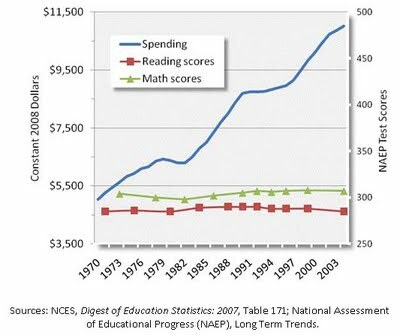
Plenty of misinformation here. First of all, start by looking at this graph from NAEP (NCES, Digest of Education Statistics: 2007, Table 171.).
http://assets.podomatic.net/mymedia/thumb/1226777/460%3E_2921611.jpg?1272811726Or this chart:
http://nces.ed.gov/programs/digest/d07/tables/dt07_171.aspPer-pupil spending has *doubled* (in constant dollars) since the 1970s, and funding is *ten times as high* as during the 1930s (still, in constant dollars), and we haven't shown the slightest gain in test scores since then. So... shut the fuck up about "drastic cutbacks in public education". Seriously.
If you want to bash on people for their anti-scientific behaviors, you should start by looking in the mirror.
-
Re:Are these efforts worthwhile?
Its not politically correct nor a popular notion, but massive technology and societal improvements are the direct result of war.
Certainly depends on the war.
What massive technological improvements did we see as a result of the 6 day war?
And I hate to break it to you, but a war is between the armies of two or more countries. What the US is engaged in in Afghanistan and Iraq are not wars anymore - they are police actions.
But please, do enlighten the curious amongst us - what civilian technological advancements have we seen as a result of the situation in Afghanistan and Iraq? I'll even let you use the first Gulf War, if you can think of anything other than improvements in GPS and autonomous navigation.
Now, it IS true that in the "good old days", both World War I and II brought some rather massive technological improvements, but the main reasons for that was the time they lasted and the amount of rapid evolution needed to keep up against the other sides.
Now, why can't we have similar improvements without war? We probably could, but that will never happen because of one thing - money. When we have an enemy that is on the brink of destroying us, we don't really care if we get paid on time. Or get paid. Keep us fed and clothed, and we'll work 16 hours a day pumping out new weapons and technology.
Let's put the money part into perspective.
In 2004 there were 2,630,000 first-time freshmen college students enrolled.
Let's set tuition at a REALLY high average cost of 100,000 dollars/year - TWICE that of Yale's most expensive program.
It would cost 263 billion dollars a year to give these student a 100,000 dollar college education. The US Defense Department budget was 689 billion dollars in 2010.
To be honest, I was expecting this to be a very different result. I seriously thought that the tuition for these freshmen would have been a LOT higher than the defense budget.
The question is - what would the US be able to achieve, as a nation, if they were to divert 263 billion dollars a year from its defense budget to pay for kids wanting to go to college? Sure, it'd have to drop the actions in Iraq and Afghanistan, which only cover some 150 billion dollars in the 2011 budget, so it'd have to pull another 120 billion from elsewhere in its budget. But would it really be that much less safe, if it reduced its budget from 661 billion to 398 billion? That would still put it a 3.98 times of what China spends in second place.
But seriously - can you look at these costs and still claim that you can never get any kind of similar boosts to technology and society, if you were willing to pump the same amount of money into education?
If we go with Yale's most expensive program (50k USD/year) and expect every freshman to complete and graduate a four year degree, we're looking at yearly costs of 526 billion USD. That'd still leave the Defense Department with 163 billion USD, which is STILL more than the second place spender.
-
Re:Why is there an elephant standing in your room?
In the USA there is a battle cry to reduce wages... Damned greedy teachers teaching for a super rich salary of $52,000 a year... OMG you can buy gold plated Mazaratis for that kind of coin!
Not gonna comment on the rest, but low teacher salaries are just the public education system trying to spin their atrocious performance the best way they can. Currently the U.S. spends about $10,000 per student on public education, which is among the highest in the world and up nearly 4-fold since the 1960s in inflation-adjusted dollars. So a teacher in charge of a class of 25 students actually represents an expenditure of a quarter million dollars every year. The problem is most of that money is being squandered on administration, rather than in the classroom. It's incredibly difficult to fix this problem when any attempt to address it is immediately characterized as an attack on underpaid teachers, whose salaries represent less than 20% of expenditure.
-
The real reason music is down - smartphones
If you're on the phone, or playing a game, you don't need music. (Or cigarettes. Phone usage has made a big dent in young people smoking.) Music competes with Farmville and Angry Birds now.
-
Re:The Land of the Free
The advisory also links to the Education Departments advisory letter about the first amendment. Exerpt: "OCR has received inquiries regarding whether OCR's regulations are intended to restrict speech activities that are protected under the First Amendment. I want to assure you in the clearest possible terms that OCR's regulations are not intended to restrict the exercise of any expressive activities protected under the U.S. Constitution. OCR has consistently maintained that the statutes that it enforces are intended to protect students from invidious discrimination, not to regulate the content of speech. " It can be found here: http://www2.ed.gov/about/offices/list/ocr/firstamend.html
-
Consider the Source and Read the Guidelines
Oh for crying out loud. This is what passes for news at lame wannabe Tucker Carlson's attempt to mimic Politico? The guidance letter was published in October 2010 and you can read it here: http://www2.ed.gov/about/offices/list/ocr/letters/colleague-201010.html
-
Re:The Land of the Free
Before the hysteria reaches epic proportions, the advisory itself can be found here (pdf). It's a pretty quick read, only 10 pages, and sadly enough lacks any mention of enforcing rules outside of school, forced indoctrination, political correctness, or secret Muslim plots. TFA however makes for some nice slanted coverage, if anyone is looking for a chuckle I encourage you to read it.
Oh yeah, kids have limited consitutional rights - especially in education. -
Re:Enjoy.
Any individual businessperson doesn't need long term stability. If you can grab enough money in the here and now, then you've won for life. This is why things like high quality education are the first to die - they cost lots of money and don't give any return for society for decades.
It's worth noting that this argument holds for everyone, not just business people. I still note that a business person has stake in a viable functioning society today than anyone else.
It is also worth noting that there's evidence that businesses aren't the reason for the death of high quality education in the US. If it were, then a decline in funding would be, IMHO the first symptom rather than a very recent one. Instead, we see a long term decline (since the 60s and 70s) in the quality of education both at the K-12 level and college level combined with a general increase in funding.
My view is that government action (particularly, the indiscriminate flooding of the university system with student loans and financial aid), increased bureaucracy of schools, and ideological poisoning of teacher's education has done more than amoral businesses to damage the US educational system. -
Re:Short answer: No
Mod this to +1 million
The most efficient method is going to transferable community college for two years + finishing up the last two years at your local state university system = bachelor's degree for the minimum capital outlay. You can do the math yourself if you want, the data sets are available (public & private colleges etc) at nces.ed.gov and (salaries) at bls.gov
As someone mentioned above, education pays - whether it pays you back depends on how much money you spent to get that fancy diploma and what your resulting salary is.
-
FERPA
Next thing you know, the feds be enforcing FERPA.