Slashdot Mirror
Domain: elections.ca
Stories and comments across the archive that link to elections.ca.
Comments · 152
-
Canadian paper ballots are amazing
The ballots we use up here (and the system we use to count and track them) are amazing.
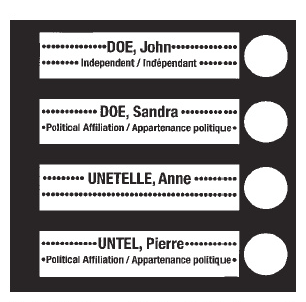
The voter goes to a table where the ballots are handed out by elections officials. The ballot has the candidate's names in alphabetical order and a removable counterfoil that has a serial number that matches against the book that the ballot was torn from. The official puts their initials on the ballot and hands it to the voter. The voter goes behind the screen and marks the ballot and folds it. The counterfoil and initials are still visible.
The voter hands the ballot back to the offical who checks both the signature and the serial number on the counterfoil (this ensures the voter has returned the ballot they got). The counterfoil is then removed and now the ballot is completely anonymous. The voter then gets the ballot back and she places it in the ballot box in front of the official.
When it comes time to count the votes, the elections officials count all of the ballots in the presence of other non-partisan officials as well as the candidates themselves or their representatives -- a vote isn't recorded until everyone has seen and verified the ballot. Once everything is counted and verified (does the number of ballots counted match the number given out and returned by voters, etc) the tally is made on paper and the ballots themselves are sealed up and passed up the chain. They are kept for 7 days in case a recount is needed.
The great thing about this system is that it scales to any population size since the ballots are counted right there at the polling station, box by box and verified on the spot.
It's certainly not perfect and there are some opportunities for tampering but nothing even in the same universe as the kind of wide-spread hacking that can occur with electronic systems.
more detail:
-
Canadian paper ballots are amazing
The ballots we use up here (and the system we use to count and track them) are amazing.
The voter goes to a table where the ballots are handed out by elections officials. The ballot has the candidate's names in alphabetical order and a removable counterfoil that has a serial number that matches against the book that the ballot was torn from. The official puts their initials on the ballot and hands it to the voter. The voter goes behind the screen and marks the ballot and folds it. The counterfoil and initials are still visible.
The voter hands the ballot back to the offical who checks both the signature and the serial number on the counterfoil (this ensures the voter has returned the ballot they got). The counterfoil is then removed and now the ballot is completely anonymous. The voter then gets the ballot back and she places it in the ballot box in front of the official.
When it comes time to count the votes, the elections officials count all of the ballots in the presence of other non-partisan officials as well as the candidates themselves or their representatives -- a vote isn't recorded until everyone has seen and verified the ballot. Once everything is counted and verified (does the number of ballots counted match the number given out and returned by voters, etc) the tally is made on paper and the ballots themselves are sealed up and passed up the chain. They are kept for 7 days in case a recount is needed.
The great thing about this system is that it scales to any population size since the ballots are counted right there at the polling station, box by box and verified on the spot.
It's certainly not perfect and there are some opportunities for tampering but nothing even in the same universe as the kind of wide-spread hacking that can occur with electronic systems.
more detail:
-
Advertising in Canada
Ideally, elections should be closer to Canada, where there is no advertising permitted so candidates have to stand on their own merits.
Not sure where you heard that, but we definitely have election advertising in Canada. The main difference to the USA is that in Canada you can only run election advertising in the 37 days prior to the election (which helps limit the never-ending election cycle where candidates are in determinant campaign mode) and no advertising on the actual day of the election (which may be the cause of your confusion).
-
Re:Oregon Vote By Mail - Hands Down The Best Syste
Until you get that one house with 83 ballots - all with different names - mailed to it. Or you get those Democratic elected officials "finding" more votes after the election and you count them anyway, overturning a Gubernatorial election... And of course - no way to prove who actually cast the ballot because there is ZERO identification required (you know, like Canada , Germany, the Netherlands, the UK, and most of the rest of the world requires).
-
Re:Amazing Disconnect
No other nation but the U.S. has such laughable weak authentication around voting.
Come to Canada. The list of acceptable ID is very long:
-
Re:Some hacker, he's not found anything real
1. Minority voters are disproportionately unlikely to have an existing photo ID (say, a driver's license.)
2. Once enacted, states with Voter ID laws have a habit of erecting roadblocks to make it harder to get them if you live in areas with high minority populations. For example, closing offices that issue driver's licenses.
3. If you've never had ID, it can be - depending on your situation - difficult to meet the criteria for obtaining ID, requiring the gathering of paperwork that most people don't actually keep, and in some cases is - in practice - impossible to obtain.Really? Just going to say it, people who are against voter ID are insane, in the worst case I'd call you anti-democratic. Even us people in "liberal Canada" and those "ultra liberal" people in Norway, Germany and Denmark have mandatory requirements for voter ID. FYI, voter ID doesn't mean picture ID either. So stop pulling bullshit out of your ass. Seriously, get your fucking shit in order and stop blocking it. If you don't even have two items listed in the accepted section that we use in Canada, you don't fucking exist, and know zero people. Since you can file for an affirmation under oath from a friend. Voter ID isn't racist, it's fundamental to a secure democracy. Hell you can't get really can't government benefits of in the US without some form of ID.
You're basically pro-voter fraud as long as you keep pushing this BS. There are multiple cases of it happening.
We already have to register to vote in the U.S.
-
Re:Some hacker, he's not found anything real
1. Minority voters are disproportionately unlikely to have an existing photo ID (say, a driver's license.)
2. Once enacted, states with Voter ID laws have a habit of erecting roadblocks to make it harder to get them if you live in areas with high minority populations. For example, closing offices that issue driver's licenses.
3. If you've never had ID, it can be - depending on your situation - difficult to meet the criteria for obtaining ID, requiring the gathering of paperwork that most people don't actually keep, and in some cases is - in practice - impossible to obtain.Really? Just going to say it, people who are against voter ID are insane, in the worst case I'd call you anti-democratic. Even us people in "liberal Canada" and those "ultra liberal" people in Norway, Germany and Denmark have mandatory requirements for voter ID. FYI, voter ID doesn't mean picture ID either. So stop pulling bullshit out of your ass. Seriously, get your fucking shit in order and stop blocking it. If you don't even have two items listed in the accepted section that we use in Canada, you don't fucking exist, and know zero people. Since you can file for an affirmation under oath from a friend. Voter ID isn't racist, it's fundamental to a secure democracy. Hell you can't get really can't government benefits of in the US without some form of ID.
You're basically pro-voter fraud as long as you keep pushing this BS. There are multiple cases of it happening.
-
Alphabetical?
That's odd, but I'm Canadian and for some reason I would have sworn the names on each ballot were randomized. Really they should be for fairness. It turns out I'm wrong (no big surprise) - they are alphabetical. I wonder if that fact influences elections at all.
-
Re:In Canada...
We have three major political parties in Canada and I wonder if the volunteers represent each of the parties to ensure no cheating. I'll ask at our next election in October.
No. The volunteers are actually temporary paid employees of Elections Canada. The positions are described here, along with the criteria for application. During the count after the polls close, each candidate or a designated representative can act as a scrutineer (officially Candidates Representative), who watches the counting process (actually, they are usually expected to be at the polling station all day to verify that the polling is being run fairly).
Elections Canada has a guide for Candidate Representatives here. If you think you want to become a Candidate Representative, get in contact with one of your local candidates committees, volunteer to do some simple tasks during the campaign, and when the time comes close, offer to be a Candidates Representative. I'm not aware of a riding that has only one polling station, and scrutineers are needed for all of them. You can even be a scrutineer for the advanced polls, and even for polling in long term care facilities where you follow a polling clerk from bed to bed to verify that the process is being followed correctly.
Yaz
-
Re:In Canada...
We have three major political parties in Canada and I wonder if the volunteers represent each of the parties to ensure no cheating. I'll ask at our next election in October.
No. The volunteers are actually temporary paid employees of Elections Canada. The positions are described here, along with the criteria for application. During the count after the polls close, each candidate or a designated representative can act as a scrutineer (officially Candidates Representative), who watches the counting process (actually, they are usually expected to be at the polling station all day to verify that the polling is being run fairly).
Elections Canada has a guide for Candidate Representatives here. If you think you want to become a Candidate Representative, get in contact with one of your local candidates committees, volunteer to do some simple tasks during the campaign, and when the time comes close, offer to be a Candidates Representative. I'm not aware of a riding that has only one polling station, and scrutineers are needed for all of them. You can even be a scrutineer for the advanced polls, and even for polling in long term care facilities where you follow a polling clerk from bed to bed to verify that the process is being followed correctly.
Yaz
-
Re:Paper trail
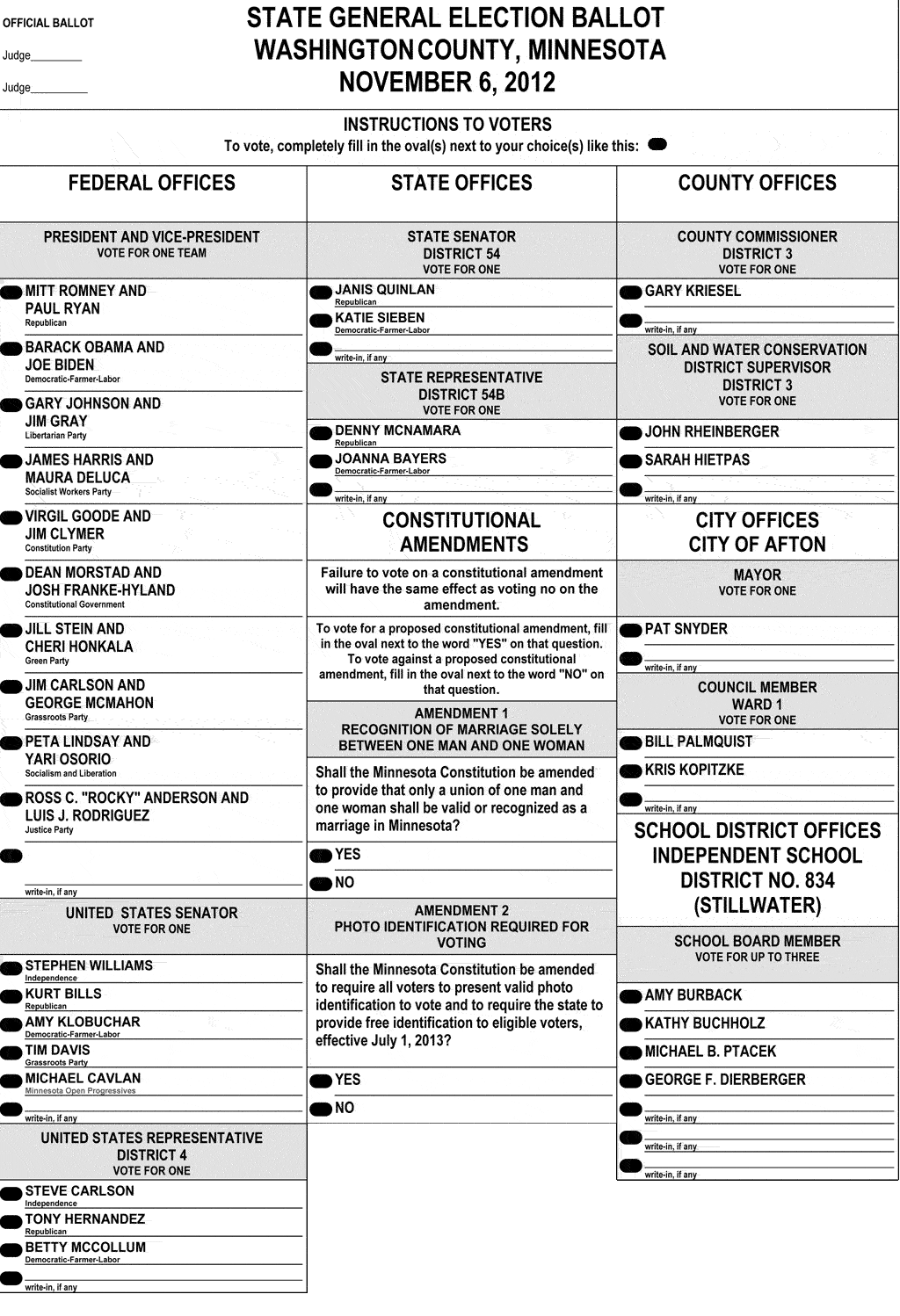
I love the Canadian paper voting method and I hope it never changes. However, there are some differences between the Canadian System and the US system. In Canada, we usually only have one thing on the ballot. Either it's a federal election and you vote for your MP. If it's a provincial election you vote for your MPP. If it's a municipal election, there maybe be three things you can vote for, like mayor, city councillor, and school board trustee. But that's about as complicated as it gets. Compare the US election ballot with a Canadian election ballot. You could see why they might want to use a computer so they can lay things out a little more clearly. Ask one question per screen and it becomes a little less daunting. However, I think that if they are going to use computers to make the voting easier, it should really just be used to enter and print out your ballot, which is then deposited into the ballot box and counted manually.
Really though, I don't think computers should be used at all. I've heard too many stories of polling locations not having enough machines and people having to wait hours in line to vote. The greatest part about the Canadian system is that It's never taken me more than 10 minutes to vote, and I've never had to travel more than 10 minutes to vote. I usually just stop by on my way home from work. I once lived in a highrise apartment that had it's own polling station. They basically have one in every school. It's so effortless. And yet we still don't have enough people voting. -
Re:America, land of the free...Agreed. Up here there was a bit of a furor (mostly by the "usual suspects") when our supreme court ruled that ALL prisoners had the right to vote, but it quickly died down.
In its decision in Sauvé v. Canada (Chief Electoral Officer) in 2002, the Supreme Court of Canada ruled that prisoners serving terms of more than two years could not be disqualified from voting, stating that legislation infringing on prisoners' right to vote was not a reasonable limit of that right
So ballot boxes in all prisons on election day is now seen as normal. Anything that makes inmates feel like they have a positive connection to greater society is a good thing.
-
Re:Even simpler, #2 pencils and a scanning tool
Handwritten voting can work, but what do they do when the voter is physically unable to hold a pencil? Or, for that matter, if they're illiterate?
http://www.elections.ca/content.aspx?section=vot&lang=e
http://www.elections.ca/content.aspx?section=vot&dir=spe&document=index&lang=e
There are always a way to vote, even in special cases. Even if you are in prison, you can vote in Canada.
-
Re:Even simpler, #2 pencils and a scanning tool
Handwritten voting can work, but what do they do when the voter is physically unable to hold a pencil? Or, for that matter, if they're illiterate?
http://www.elections.ca/content.aspx?section=vot&lang=e
http://www.elections.ca/content.aspx?section=vot&dir=spe&document=index&lang=e
There are always a way to vote, even in special cases. Even if you are in prison, you can vote in Canada.
-
Re:GA- not allowed to vote due to id problems
I
I hope they are keeping count of the number of people who wanted to vote but were unable to do so due to identification issues.
I'll confess, I'm not in the USA, I'm in Canada, but here we usually get a paper registration card by mail with our name and address on it. It is sent to each address based on information that we voluntarily provide to the elections agency by checking a box on our tax return when it gets filed. This forms a list that gets checked as each person in a district votes. If we've recently moved, and therefore the list isn't up-to-date, you can bring some indication that you actually do reside in the location you've claimed. This would be some combination of government-issued ID (of almost any kind -- the list is quite long), plus something like a utility bill that shows your current address. Worst case, if you have none of those, you swear an oath and get your neighbour who does have appropriate ID to swear on the spot that you really are who you say you are and do reside at such-and-such an address. It all gets written down, you vote, and if there is any question about the validity, then it gets sorted out later. Up to and including, of course, the possibility you'll get charged with a crime if you've lied about anything. It's not hard to qualify, and yet voter fraud, while it does exist, seems to be a very very rare occurrence.
Are other people on slashdot running into this obstacle? How many people aren't even bothering to try to vote because they figure there will be ID problems? What the hell are you people doing down there to your democracy?
-
Re:Perfect
If you are telling me with a straight face that millions of ballots are counted with no mistakes, I have a bridge to sell you.
What's important to remember is that you're not counting millions of ballots. You ("You" being the scrutineer or poll worker) are counting the ballots from a particular polling station - a couple hundred ballots. Each polling station is reported separately and then tallied up.
You can go to the Elections Canada website and see the poll-by-poll results for each riding.
Is it 100% perfect? Unlikely. But the margin of victory is generally high enough that there would have to be actual corruption to change the result. Recounts are automatic if the margin of victory is within 1/1000 of the votes cast (i.e. within 40 votes if 40,000 cast).
Now, there is a court case pending in a close riding where some irregularities have been found, and the number of bad ballots is larger than the margin of victory. I'm hopeful the judge will order a by-election.
As for ballot complexity, we do generally only vote for one or two things at once. I think the most complex are municipal elections, where I vote for mayor, alderman, and school trustee on one ballot. We use big paper, clear markings, and helpful staff to explain what's going on.
-
Re:10x the population
US citizens f. ex. who don't drive usually have none,
Do they also have no health card, no social insurance number, no birth certificate and no library card? Because any of those would be a good start. If you can't come up with any ID at all, all it takes is a sworn oath from someone else on the same polling division and you're in.
I'm willing to accept that US Citizens usually won't have health care, don't use SINs, are reluctant to show their long form birth certificates and have no use for libraries, but how hard can it be to find a neighbour who knows you?
-
Re:10x the population
10x the votes to count, but maybe it would be worth it. If you can mark an X, you're my kind of people.
It works fine in the GTA(Greater Toronto Area). The population there is around 7.8m people. We just use more polling areas to make sure everything is accountable. The same reason why we have a voter ID system in place, because it bloody well works. Remember where it says "oath in front of an election officer, with them swearing for one person" Perjury in Canada can land you upto 14 years in jail. And the judge will throw the book at you. Perjury is a serious crime here.
-
distributed operations- hand count details
We get away with hand counting because any one poll (vote collection point) is less than a thousand people. Each riding is many polls.
See Elections Canada for Details: what happens after a vote -
http://www.elections.ca/content.aspx?section=vot&dir=bkg&document=ec90565&lang=eFollowing the close of a polling station, the deputy returning officer in an electoral district counts the votes, in the presence of the poll clerk, and any candidates or their representatives who are present, or, if none are present, in the presence of at least two electors. Before the count, the deputy returning officer must, in the following order:
* count the number of electors who voted and enter the number in the poll book
* count the spoiled ballots, place them in the envelope provided for that purpose, indicate the number of spoiled ballots on the envelope and seal it
* count the unused ballots, place them in the envelope provided for that purpose, indicate their number on the envelope and seal the envelope
* ensure that all ballots provided are accounted for
The deputy returning officer then empties the contents of the ballot box onto a table to proceed with the count.
During the count, the deputy returning officer examines each ballot, shows it to each person present and asks the poll clerk to tally the vote in favour of the candidate for whom the vote was cast. The poll clerk (along with any of the candidates or their representatives who also wish to do so) keeps a tally of the votes for each candidate.
-
Re:This is basically how US elections work
In Canada it's a requirement to have ID to vote.
Nope. Federally, and in at least some (and possibly all) cases, provincially, you can be vouched for by another elector without yourself showing ID (and until this past election, federally, you didn't have to show ID unless challenged). (For Quebec, for example, see ss. 335.1, 335.2 and 337.)
And it's to stop flagrant voter fraud that runs amok like you have in the US now.
We didn't have flagrant voter fraud when we didn't require ID to vote federally (until 2011). There's also no evidence of flagrant voter fraud in the US.
Here's how it works here: At tax time you are given the option to give your personal information to elections canada via your taxes.
You are also welcome not to. You still retain the right to vote, and the government can get your info from other ways (including provincial election agencies, who get it from medicare and driver's licence data, among other sources). You can also register on election day, federally, and during the election before election day, at any level.
This information is passed to the provincial branch of elections canada.
More often than not, it's passed the other way. And there is no provincial branch of Elections Canada: Elections Canada is an independent body set up by (the federal) Parliament, while the provincial agencies are set up by the provinces. They are completely independent.
If you weren't of age at the time, you can be enrolled when the next election comes along(very rare but it happens).
Actually, this is incredibly common: most people get a card in the mail six months before they turn 18 telling them they will be automatically added to the permanent electoral list, regardless of whether they've ever filed taxes. In fact, I can't think of anyone who wasn't automatically added at 18.
When you show up at the polling station, you show government issued ID. Or two current bills(last 30 days), showing that you live in that district.
Or you get vouched for. If you don't have ID, you have to swear an oath that you are who you say you are and live where you say you do, and someone who lives near you (in your same polling subdivision) has to make the same oath, and they need to show proper ID. You also have to state your name and address out loud for the deputy returning officer, poll clerk and any candidate representatives to hear. That's it. It's faster if you have ID (and the bills don't even have to be within 30 days; the ID can even be expired, in some cases), but it's not required.
Everyone has ID of some form up here. There are also a few other things you can use.
That's generally true, because all citizens have medicare (and nearly everyone gets the card, though it's not a requirement, actually) (citizens who take up residence elsewhere lose their medicare benefits at some point, but they also eventually (usually) lose their right to vote, though the timeframes don't perfectly overlap). In the US, many people do not have medicare. Many do not have driver's licences. And many don't have other government IDs. And the governments often charge for them. This is nothing but a poll tax in another name, which is unconstitutional, but not every judge agrees with this. If you don't give free IDs to all citizens, you shouldn't require them to be able to vote.
Once that happens, your name is stricken from the voter register and the ballot is used up.
Yup, which is how it works in the US too.
No
-
Re:This is basically how US elections work
You're mistaken if you think photo ID is required in Canada. According to the actual Canadian government you can get buy with non-photo ID and a bill, or even skip ID completely as long as your buddy with ID will vouch for you:
http://www.elections.ca/content.aspx?section=vot&dir=ids&document=index&lang=eAs for the US Election system, remember that a) it's basically unchanged since anonymous voting was invented the early 19th century, partly because b) the only people who actually pay attention to it are partisan hacks, but also because it works pretty well most of the time.. Both sets of hacks know that, all other things being equal, the left-wing hacks are better off if more people vote. Therefore the right-wing hacks try to arrange things to make it impossible to vote, and the left-wingers try to make it easy.
As for the meat of the argument, as a left-wing hack I (surprise surprise) oppose ID requirements. Stealing an election one vote at a time is just something that doesn't happen, so forcing people to buy ID (as almost all these laws do -- there's no option to use your free, government issued health card and a phone bill) hurts my pet causes and solves no problems.
-
Re:Probably unlikely
Let's just stick with democracy and its processes, what ya say? I *like* peaceful democracy, I *like* not having a soldier on every corner during elections; it's something worth keeping.
The root problem here is that that 24.2% of Canadians can give a single party a "majority" (39.2% of 61.1% turnout) government. This false majority, coupled with a political system in which all three federal parties view themselves as pursuing a leadership role (rather than a representative role) in Canadian society, is creating a distance between our MPs & us.
What we need is proportional representation. The system we have in place, now, worked well for a different kind of Canada, when we were a groups of small cities, many tiny towns, and no real way to communicate or interact economically (with any efficiency). But we are primarily urban now, many of our "pocket" economies have grown and overlapped with adjacent economies. The general economy is probably sustainable on its own, and we are all wired (financially and socially) from coast to coast to coast.
The current system is a leader's system, necessarily. It is a nation-building style of nation management. But, like oligarchic media control, its time has come and gone. We need a system of government that reflects our democratic inclinations. The nation is built, and a nation-building style of government is not the most suitable form of government for us, any more. I suggest we revise our government with proportional representation, paralleling Swedish or Dutch systems. These systems are not likely to be as efficient as an "easy majority", but they (to me) look like a more pure form of democracy, more capable of representing the views & ideals of those who bother to vote.
The only parties who are going to hold my attention, in the next election, are going to be those who declare their *absolute* intention to implement proportional representation. I don't care how fringe they are, if they're the only ones committed to it, they get my vote. If there was a party running in the next federal election, whose sole purpose (their entire platform) was to simply implement proportional representation, and then quit & call another election, I'd vote for them in a heartbeat.
So, c'mon man, just tuck your guns away and save them for the apocalypse; there are other, non-violent ways to approach this.
-
Re:Just protecting their assets
Proposing things to and supporting politicians with same views as you is not bribery. If they were bribing the police to bust you, then you would have a case. But it's not the same, and also, you are allowed to do the same.
Actually, in Canada it is bribery. Our Elections act is quite clear on that point. It's illegal for a candidate or party to accept funding from an entity who is not a citizen of the country (and unlike the US, corporations are not citizens). Additionally, there is a limit to how much an individual can give, per year, to a given candidate/party.
Violating the elections act can get a candidate's election results invalidated, and carries significant fines, in the case of a corporation giving money to a candidate. Lest you think that they'll find some way to hide the funding, their finances must be submitted to the elections officer, there is a limit to how much can be spent on elections, and their financial returns are a matter of public record, and can be searched by anybody.
-
Re:Just protecting their assets
Proposing things to and supporting politicians with same views as you is not bribery. If they were bribing the police to bust you, then you would have a case. But it's not the same, and also, you are allowed to do the same.
Actually, in Canada it is bribery. Our Elections act is quite clear on that point. It's illegal for a candidate or party to accept funding from an entity who is not a citizen of the country (and unlike the US, corporations are not citizens). Additionally, there is a limit to how much an individual can give, per year, to a given candidate/party.
Violating the elections act can get a candidate's election results invalidated, and carries significant fines, in the case of a corporation giving money to a candidate. Lest you think that they'll find some way to hide the funding, their finances must be submitted to the elections officer, there is a limit to how much can be spent on elections, and their financial returns are a matter of public record, and can be searched by anybody.
-
Re:Just protecting their assets
Proposing things to and supporting politicians with same views as you is not bribery. If they were bribing the police to bust you, then you would have a case. But it's not the same, and also, you are allowed to do the same.
Actually, in Canada it is bribery. Our Elections act is quite clear on that point. It's illegal for a candidate or party to accept funding from an entity who is not a citizen of the country (and unlike the US, corporations are not citizens). Additionally, there is a limit to how much an individual can give, per year, to a given candidate/party.
Violating the elections act can get a candidate's election results invalidated, and carries significant fines, in the case of a corporation giving money to a candidate. Lest you think that they'll find some way to hide the funding, their finances must be submitted to the elections officer, there is a limit to how much can be spent on elections, and their financial returns are a matter of public record, and can be searched by anybody.
-
Re:Just protecting their assets
Proposing things to and supporting politicians with same views as you is not bribery. If they were bribing the police to bust you, then you would have a case. But it's not the same, and also, you are allowed to do the same.
Actually, in Canada it is bribery. Our Elections act is quite clear on that point. It's illegal for a candidate or party to accept funding from an entity who is not a citizen of the country (and unlike the US, corporations are not citizens). Additionally, there is a limit to how much an individual can give, per year, to a given candidate/party.
Violating the elections act can get a candidate's election results invalidated, and carries significant fines, in the case of a corporation giving money to a candidate. Lest you think that they'll find some way to hide the funding, their finances must be submitted to the elections officer, there is a limit to how much can be spent on elections, and their financial returns are a matter of public record, and can be searched by anybody.
-
Re:Just protecting their assets
Proposing things to and supporting politicians with same views as you is not bribery. If they were bribing the police to bust you, then you would have a case. But it's not the same, and also, you are allowed to do the same.
Actually, in Canada it is bribery. Our Elections act is quite clear on that point. It's illegal for a candidate or party to accept funding from an entity who is not a citizen of the country (and unlike the US, corporations are not citizens). Additionally, there is a limit to how much an individual can give, per year, to a given candidate/party.
Violating the elections act can get a candidate's election results invalidated, and carries significant fines, in the case of a corporation giving money to a candidate. Lest you think that they'll find some way to hide the funding, their finances must be submitted to the elections officer, there is a limit to how much can be spent on elections, and their financial returns are a matter of public record, and can be searched by anybody.
-
Re:Thank you, Europe
There isn't really anything that people in Canada can do. Our weird political system has given someone with less than 50% of the popular support a *majority government*. That means we have a fascist party in government with no effective means to control them.
It is way more ridiculous. Let me crunch the numbers for you:
The popular support for the Conservatives was 39.62% with a 61.4% voter turnout.
Which means that LESS THAN 25% OF ELIGIBLE CANADIANS VOTED FOR THEM. That's right, less than a quarter , not countingHowever, if we consider all Canadians, not just the electors on the list, out of 31,612,897 people, 5,832,401 voted Conservative. That's right boys and girls, the whole of 18.45% .
And this gave us a majority government that, contrary to the US, has no checks nor balances.
Fun, eh?
-
Re:Political systems worldwide.
"Why is there no political system anywhere where the campaigns are funded by a flat levy"
Actually, this isn't quite true. Canada much of the way to such a system, where corporate political donations are banned, union political donations are banned, and any other kind of organizational donations are banned. Yes, you read that right. They're all gone. Only person donations are allowed, and that is limited to ~$1100/year per candidate or per party (you can donate to all of them if you want, each to that maximum -- formula here). There are various other limits. In exchange for such significant limitations the politicians get ~$1.75 per vote to the relevant party per year. Both these numbers are inflation-adjusted, which is why I'm saying "about". They get updated from time-to-time. This strikes a good balance between allowing personal donations, but not multi-million-dollar ones, and it keeps those donations strictly at the personal/citizen level rather than the organizational realm. The money-per-vote part is a bit difficult to swallow (taxpayers *paying* politicians), but I regard it as a fair trade to get corporate and huge donations completely out of the system, and total costs are ~$73 million, of which ~20% are from personal donations rather than taxes (those of you in the USA can laugh at the number -- we run a much cheaper political system in Canada). Another thing I like is that even if the party/candidate I prefer loses, they get money from my choice. Same for everyone else's choices.
Of course, our recently-elected majority government wants to remove the "money per vote"/"flat levy" part because they happen to be better at getting private donations than the other parties (i.e. it's to their political advantage rather than the goal of leveling the playing field, which is a very sleazy/undemocratic thing to do).
Anyway, Canada has managed to get something close to what you describe. There are some loopholes and tricks that still manage to corrupt it, but it is better than what existed before.
-
Re:Capitalism isn't in itself flawed...
In Canada only personal contributions to politicians are allowed and they are capped at a very low amount (approx $2200). http://www.elections.ca/content.aspx?section=pol&document=index&dir=lim&lang=e
It is entirely possible for bribery to occur in an illegal way (and there are many scandals like that) but the legal influencing of politicians is limited. This does seem to help, and the goal is not perfection, just improvement.
-
Re:How?
There are legal limits for political contributions in Canada. There is a fixed dollar amount per calender year (1,100), plus only individuals can make contributions. These limits are in place to prevent the corrupt legislation purchasing seen in other countries.
It's not that businesses don't have rights in Canada (they do), but Canada holds individuals in a much higher regard.
-
Re:Might help...
Let me guess. You went a few hours before the poll ended on the day of the election? Or in the middle of rush hour (many people try to vote on the way home from work)? It took me all of 20 minutes on the morning of election day in a major city. And if you say "But I have work", employers are legally required to give you up to 3 consecutive hours to vote on election day, with only a few exceptions (basically if you work in the transportation sector).
Alternatively, that was one screwed-up polling station and you should write to Elections Canada to complain.
-
Re:Ugh..
Why should I chill out? The fact that a giant separatist parasite exists as a national party disgusts me. I don't care how many other redeeming qualities they have, or who they're representing. The people of Quebec can have their grievances heard, in turn, just like every other province.
Or at least that's how a democracy is supposed to work. I'm not sure what the fuck we're running now.
People in Quebec get to vote for a party they feel represents their interests, just like people in every other province. If the people voting for them thought that the other parties were worth anything, then maybe they would vote for them. As it is most people I speak to just seem to want to vote for the party that is the least terrible, and that is with a bar set dishearteningly low. Remember, nothing is stopping any other province from have their own Bloc, and indeed the western provinces do, though they don't seem to get any votes that seem to register - then again the conservative government seems to represent more of Alberta's interests than anyone else's.
Here is a list of registered political parties in Canada:
http://www.elections.ca/content.aspx?section=pol&dir=par&document=index&lang=e
-
Re:I'm gonna vote Pirate Party this time around.
I plan to do the same. I think I'm even fortunate enough to have someone running in my riding, so they'll definitely get my vote.
Yeah, turns out the party leader's in my riding (Edmonton Centre) and they're having some sort of everyone-welcome planning meeting this weekend. I think I'll go and see how it is.
Anyway, their candidates: https://www.pirateparty.ca/about/candidates
Which has a link to a handy check-what-riding-I'm-in tool: http://www.elections.ca/scripts/pss/FindED.aspx?L=e -
Use your brain.
While I think it's good the bill died.. as a canadian I'm a little pissed that we're having another expensive election.
Expensive election? Give me a break. I'm hearing numbers like 200 million dollars to run an election for the whole country.
In 2008 there were 23,677,639 registered voters in Canada. If the number of registered voters remained the same (hint: it has likely increased!), that puts the cost per registered voter at about $8.50.
I don't know about you, but I would pay $8.50 to have a say in my democracy any day.
The media in Canada has gone into "nobody wants an election, waaaah waaah" mode for each of the past four elections. I'm a Canadian, and just about everyone I know wants an election. Everywhere I turn online though, someone is bitching about how nobody wants one.
I know that the media is largely run by conservative businesspeople, but this broad-based attempt at reducing the duties of citizenship to an inconvenience is sickening.
Stop complaining and vote responsibly. It's all we have. We've had lots of elections in the past 7 years, and that's because the government is weak and Canadians are divided. It's a good thing we keep getting to weigh in.
-
Re:It's legal for foreign money to be spent lobbyi
The U.S should adopt election laws like the ones we have up here in Canada. Take a look at the Federal Accountability Act.
Here are some key points:
- Corporations, trade unions, associations and groups can no longer make political contributions.
- You can make a political donation to registered political entities only if you are a citizen or permanent resident of Canada.
- You can donate a maximum of $1100 to each party or candidate every year.
- You can no longer make a cash contribution of more than $20 to registered political entities. Also, all contributions over $20 must be receipted and reported.
- If you are running as a nomination contestant or a candidate, you can make an additional contribution up to $1,000 in total per election from your own funds to your own campaign.
- Candidates cannot accept any gift that might influence them as eventual members of Parliament.
-
Re:Go Canada and the EU
"The problem is those two parties have all the money for running real political campaigns."
You could try something that probably wouldn't be allowed in the U.S. (see below), but which has been tried with some success in Canada: ban corporate and organizational donations entirely and limit personal donations per person per year. You can gasp at such a radical suggestion, but we've actually done it. I'm not saying that the change has been a glowing success here in Canada (the politicians still try to find ways around it), but it has changed the financial influence aspect significantly here.
The problem in the U.S., of course, is that there is already well-established case precedent that would probably make such a law unconstitutional there. As difficult as it would be, maybe you could amend the constitution or find a way to still allow it to be constitutional, because there isn't much question that money can undermine almost any democratic system, even one as vibrant at the U.S. In any case, reforming campaign finance laws in a MAJOR way might be a way for you guys to try to improve the situation. Get the scads of corporate and union money out of the system, force candidates to actually get support from individual constituents en masse, and force the personal contributions to be made on an even playing field (rather than having multi-millionaires having disproportionate influence), and things could change for the better for everyone. We all know that a democracy is one person one vote, and that's fair. But it isn't fair if Joe millionaire or Company X has a representative in their pocket thanks to huge donations while regular citizens have only their one vote and maybe a few dollars.
-
Re:Right of free speech + right of association
Corporate and union political advertising is legal in Canada.
Under the Canada Elections Act, a corporation or union that may be a third party political advertiser. If they spend over $500, they must register with Elections Canada and include a copy of the resolution passed by its governing body authorizing it to spend money on election advertising.
A third party may spend a total of $150,000 on election advertising. It cannot spend more than $3,000 on advertising to promote or oppose the election of one or more candidates in a given electoral district.
More info here.
-
Re:Right of free speech + right of association
I think you numbers are out of date.
The individual limit for Canadian federal parties is $1100 and $0 for corporations/unions.
One difference between the US and Canada is that while Canada has the right to freedom of expression in the constitution, it also says "The Canadian Charter of Rights and Freedoms guarantees the rights and freedoms set out in it subject only to such reasonable limits prescribed by law as can be demonstrably justified in a free and democratic society." This weakens our rights somewhat compared to the US, but avoids problems like this.
-
Re:Money = Speech so they say
http://slashdot.org/comments.pl?sid=1518208&cid=30841250
I outlined the Canadian method there. If you want more information, start here -
Re:Money = Speech so they say
Hi there, I'm from Canada. You might remember us from previous political threads such as "Canada's healthcare isn't that bad." and "Dude, 1812 was almost 200 years ago. We have nukes now."
We have national funding for our political parties. In order to prevent, let's say, the "BSTFF (Beardo Should Totally get Federal Funding)" party from forming and pocketing a whack o' cash, you get a certain amount from every vote that's cast your way. I'm not going to bother looking it up, but it's about $1.50 per vote. So if you get a million votes, you'd get $1.5M. We had 13.8 million voters last election. 37%, or just over 5 million, voted for the Conservative party. (So that's about $7.5 million from Elections Canada.)
We also have campaign contributions and you can claim those on your income taxes. However, there are limits and those are enforced via jail time. Rather than cut-and-paste, here they are. In short, you can only contribute $1,100 per year and companies / corporations / trade unions / etc cannot make them.
Now, this is where it gets interesting, is that we have spending limits on campaigns. Third-party limits are just under $200k total, across all electoral districts. It's just under $4k for each district. The parties themselves can spend a total of about $20 million for the bigger parties. http://www.sfu.ca/~aheard/elections/laws.html
That's not all. Each party has a certain amount of media time alloted to it. It works out to 396 minutes per broadcaster in total, with allocations given out based on some formula locked in Ottawa somewhere.
http://www.sfu.ca/~aheard/elections/laws.htmlAll in all, our system works out reasonably well as long as you've got people in Parliament who are willing to work together. We don't right now, so government shut itself down for 2 months.
-
Re:Disgusting...
In a country that shows a 30% voter turnout (at best), that makes 6.9 million voters. Historically, over 500000 canadians joined the protest against the last attempt to bring laws like this. Thats a 7% swing in the vote towards the party that will stand up against this type of law making. Thats enough to win an election in Canada.
Ummm, no. Have you been smoking the BC bud? There has never been a Federal election with a 30% turnout.
The turnout for the last Canadian Federal election was 58.8%.
-
Re:Good
We passed this type of legislation in Canada a couple of years ago. Amongst other things, it limits campaign contributions to citizens and permanent residents to a maximum of $1000/year (inflation adjusted). I'm not sure if it restricts your donations to the candidates fighting to represent you, or whether you can donate to anyone across the country, but $1000 is the limit.
-
Re:We need to get rid of the industry middle men
They are criminal organizations, but who can successfully sue them? Plus, if they can write the laws through "campaign contributions" then they are no longer "criminals" even if their activities are highly immoral and exploitive.
Buying laws through "campaign contributions" is significantly more difficult for them to do in Canada... up here, it is illegal for a corporation (either privately owned, publicly owned, or foreign owned) to give *any* campaign contributions, or other contributions, to a political party, candidate, or electoral district association. There is also a maximum on an individual's personal contributions: they cannot exceed about $1100/year (it gets adjusted every year for inflation/deflation, and is currently just over $1100). Additionally, any contributions exceeding $20 are a matter of public record. They can't get around it by donating goods/services in liew of cash, either, as the equivalent cash value of the goods/services donated are counted against that $1100.
Breaking those rules is Election Fraud, and the bare minimum penalty for a politician being found guilty of Election Fraud would be that they lose their position in parliament and are barred from ever voting or running for office again. They could, potentially, go to jail. And if it were a party that's guilty of it, they could be de-listed as an official party and lose their access to public funding for their campaigns.
References:
Relevant section of the Canada Elections Act
Online financial reports for contributions, searchable by the general public. As a matter of public record, you can also request older records by calling the phone number provided on that page.Obligatory disclaimer:
I no longer work for that department, but I used to work for Elections Canada, and it was my job to know the Elections Act inside and out in order to be able to answer questions like this. -
Re:We need to get rid of the industry middle men
They are criminal organizations, but who can successfully sue them? Plus, if they can write the laws through "campaign contributions" then they are no longer "criminals" even if their activities are highly immoral and exploitive.
Buying laws through "campaign contributions" is significantly more difficult for them to do in Canada... up here, it is illegal for a corporation (either privately owned, publicly owned, or foreign owned) to give *any* campaign contributions, or other contributions, to a political party, candidate, or electoral district association. There is also a maximum on an individual's personal contributions: they cannot exceed about $1100/year (it gets adjusted every year for inflation/deflation, and is currently just over $1100). Additionally, any contributions exceeding $20 are a matter of public record. They can't get around it by donating goods/services in liew of cash, either, as the equivalent cash value of the goods/services donated are counted against that $1100.
Breaking those rules is Election Fraud, and the bare minimum penalty for a politician being found guilty of Election Fraud would be that they lose their position in parliament and are barred from ever voting or running for office again. They could, potentially, go to jail. And if it were a party that's guilty of it, they could be de-listed as an official party and lose their access to public funding for their campaigns.
References:
Relevant section of the Canada Elections Act
Online financial reports for contributions, searchable by the general public. As a matter of public record, you can also request older records by calling the phone number provided on that page.Obligatory disclaimer:
I no longer work for that department, but I used to work for Elections Canada, and it was my job to know the Elections Act inside and out in order to be able to answer questions like this. -
But I can't verify the system... so it's useless
I don't care if you have a provably correct system (in the sense of a formal mathematical proof AND a code audit AND a hardware audit) because I cannot verify that that is the system I am indeed interacting with! On the other hand with paper and pencil I can easily verify that my vote was recorded correctly (did I make an X in the circle I wanted?
-
Re:Democratic?
There's also the matter of people that have to work on election day, one of my co-workers is stuck working a full twelve hour shift and would have a huge amount of trouble voting if not for absentee voting.
Aren't businesses required by law to give employees several hours off during elections? that sounds like a pretty unfair system if people can be kept from voting by employment obligations.
in Canada:
All employees who are qualified electors, that is, those who are 18 years of age or older and Canadian citizens on polling day, are entitled to three consecutive hours on polling day for the purpose of casting their ballots.
Employers cannot impose a penalty or deduct pay from an employee for the time off the employer is required to provide for voting. An employee must be paid what he or she would have earned during the time allowed off for voting.
http://www.elections.ca/content.asp?section=faq&document=faqvoting#voting26 -
Re:Paper ballots
Well, I'm being retarded. Our candidates are still local and the printing is too. The design of our ballots being dead simple and unchanging probably saves us a pile of cash.
Here's the law on the matter in case it interests anybody.
-
Re:Why?
http://www.elections.ca/home.asp
Most countries in Europe and the Anglosphere have similar organizations.
-
Re:Seriously..