Slashdot Mirror
Domain: eyetap.org
Stories and comments across the archive that link to eyetap.org.
Comments · 84
-
Re:Not too good for his health...
If you actually read information on the eyetap device, you'll find that the aremac project and image that "appears to be spatially aligned, and appears at with the same focus as the real world scene." In other words (as is written in the AP article), it can make it seem that images are projected onto real-world objects, rather than appearing to be at a fixed distance. I think this minimizes the vision problems that might occur.
-
Why not use a PDA?According to this, the current design uses a PC104 100MHz 486 board with all sorts of hacked-up components (4 lithium batteries at like $600 alone). But plenty of PDA's are available at 400MHz or better with decent power consumption, etc.
Seems to me that that'd be a better place to start. Rewire the LCD output to go to his glasses-screen, find CF modules for things like the video cam, GPS, WiFi, and what-have-you, and you're good. The only big issue I see is the storage space, which, with an IBM microdrive, is probably limited to 5GB or so.
-
Seriously, Wouldn't this be a _lot_ easier?
Steve Mann and others developed a system called gunroll that can align and stitch video frames. When frames overlap, it ups the resolution. Makes me think a basic pan and scan of Bryce canyon taking only, say, one minute would produce an even larger image than this one, without manual blends.
see : their paper and see this image which adds resolution as they have discovered : scroll down to the swimming pool
If anyone knows more about Steve Mann's work or got his software to work for the Rest Of Us (tm) please post a reply here! (Steve's C software can be got off the web, google for it.)
Adam.
Arenchagunnarooda? Nahdinwanna. -
Re:State of computer goggles
Olympus Iglasses are one, but try this site and scroll down to 'Displays (Commercial)'
-
Re:parallel vs. serial
Here's another good reason:
You'll eventually blow your parallel port if you don't go "backwords". Blow as in it stops working. That's no fun.
If you want a pretty decent source to all of what was brought up here, go to http://eyetap.org/ece385/lab1.htm. It's a course taught by everyone's favourite cyborg, Steve Mann.
-
Too big :[
Umm... still a little too big for wearcomp
-
this isn't new....
at all. We did this in one of our labs with the self-titled cyborg, Dr.Steve Mann, at University of Toronto. It was lab 5... you can see for yourself. The class websites are at....
http://eyetap.org/ece385/
http://wearcam.org/ece385/
if you know a little about device drivers, then this isn't very hard... -
Re:Undetectable device preferable
Did somebody say sunglasses?
Professor Mann has had sunglass-mounted gear for years (well, except for the battery pack, HD, and other controllers), and they eventually -
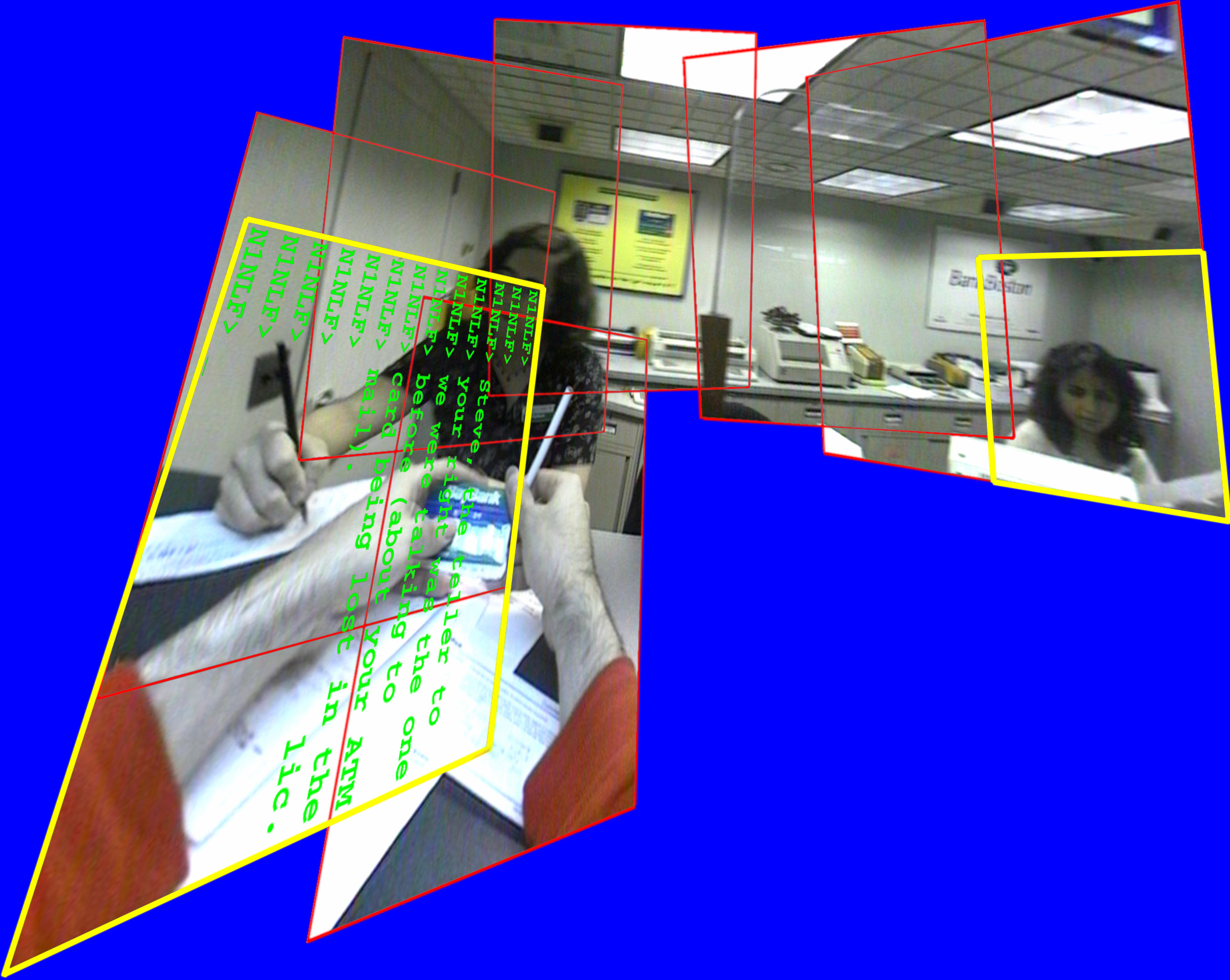
More examplesSome more pictures from Video Orbits:
- ``Claire'' image sequence. Paul Hubel aims a hand-held video camera at his wife.
- An ``environment map'' of the Media Lab's ``computer garden''.
- Outdoor scene with people, close-up (Alan Alda interviewing me for Sci.Am "FRONTIERS").
Ready the Slashdoting!
-
More examplesSome more pictures from Video Orbits:
- ``Claire'' image sequence. Paul Hubel aims a hand-held video camera at his wife.
- An ``environment map'' of the Media Lab's ``computer garden''.
- Outdoor scene with people, close-up (Alan Alda interviewing me for Sci.Am "FRONTIERS").
Ready the Slashdoting!
-
More examplesSome more pictures from Video Orbits:
- ``Claire'' image sequence. Paul Hubel aims a hand-held video camera at his wife.
- An ``environment map'' of the Media Lab's ``computer garden''.
- Outdoor scene with people, close-up (Alan Alda interviewing me for Sci.Am "FRONTIERS").
Ready the Slashdoting!
-
Not much new with Dobelle, but look at Eyetap
...this is actually nothing particularly special, since all the technologies are relatively well-known (among the right circles), and mostly invented by Dr. Steve Mann of the University of Toronto. According to Steve, what the patient actually perceives is more akin to contrast resolution, rather than anything that the visually unimpaired would call "sight".
What is perhaps more interesting, and more widely useful is the Eyetap technology itself. Essentially, Eyetap uses the camera and wearble computer to drive a small laser that mediates reality directly into the eye. For people who are not blind, but profoundly visually impaired, this technology may be a godsend.
Beam me up, Geordi LaForge! -
Not much new with Dobelle, but look at Eyetap
...this is actually nothing particularly special, since all the technologies are relatively well-known (among the right circles), and mostly invented by Dr. Steve Mann of the University of Toronto. According to Steve, what the patient actually perceives is more akin to contrast resolution, rather than anything that the visually unimpaired would call "sight".
What is perhaps more interesting, and more widely useful is the Eyetap technology itself. Essentially, Eyetap uses the camera and wearble computer to drive a small laser that mediates reality directly into the eye. For people who are not blind, but profoundly visually impaired, this technology may be a godsend.
Beam me up, Geordi LaForge! -
Think Security First!Wireless 802.11b is riddled with insecurities. In addition to various improprieties within WEP (see attached), 802.11b access association scheme is inherantly insecure. The University of Maryland Study found that "while the current access points provide several security mechanisms,[their] work combined with the work of others show that ALL of these mechanisms are completely in-effective." The mechanisms they are referring to are
- WEP (Wired Equivalent Protocol)
- Open Systems Authentication
- Shared Key Authentication
- Access Control Lists (MAC Address Lists)
- Closed Network Access Control (LUCENTS Proprietary Access Control)
- WEP has known vulnerabilities allowing someone to decrypt information in real-time after capturing about a days worth of traffic.
- Open Systems Authenticationhas "shown that the authentication management frames are sent in the clear even when WEP is enabled."
- Shared Key Authenitication has shown that it is rudimentary to capture the Initialization Vector since it is sent in the clear as part of a WEP frame.
- Standard Access Control Lists are easily circumvented by an attacker sniffing the network for a valid MAC and thus reprogramming their network card to an appropriate value to gain access to the network.
- The proprietary Closed Network Access Control list that LUCENT (and others)touts as "a system that will not send the network identification (SSID) as a broadcast, thereby mandating that someone KNOW the SSID before they can associate to the network," is inherently flawed since:
- The most effective strategy would be to put your wireless access points into aIPSEC enabled DMZ, and have your wireless users tunnel into your network using a VPN. If your corporation doesn't already have a VPN infrastructure in place, it's going to cost you some money to implement. Even if you do have a VPN in place, and all of your clients already have the VPN software, there's going to be an extra effort associated with setting up a VLAN for your DMZ. But this solution adds a layer of encryption and authentication that could make a wireless network suitable for sensitive data.
- Consider using an additional level of authentication, such as RADIUS, before you permit an association with your access points. While it's not part of the 802.11b standard, a number of companies are optionally including some provision for RADIUS authentication. Orinoco access points, for example, can enforce RADIUS authentication of MAC addresses to an external RADIUS server. Intermec access points include a built-in RADIUS server for up to 128 MAC addresses.( EAP (Extensible Authentication Protocol) is used to allow wireless clients to authenticate to RADIUS servers using a single sign-on. )
- At an absolute minimum, even with it's vulnerabilities, you should enable WEP. Whether you implement 64-bit or 128-bit doesn't really matter too much, as it's not the encryption scheme that's determining how long it takes to crack it, but the number of possible Initialization Vectors. WEP is only a low barrier to entry, but it will keep out many of the casual hackers because there are so many other wireless networks that are wide open and easier targets.
University of Maryland Study: http://www.cs.umd.edu/~waa/wireless.pdf
Fluhrer, Mantin and Shamir Study: http://www.eyetap.org/~rguerra/toronto2001/rc4_ks
a proc.pdfAT&T Labs and Rice University Study: http://www.cs.rice.edu/~astubble/wep/wep_attack.h
t ml -
Re:resources
Great page! I especially liked the page about augmented reality. Steve Mann is truely a cyborg... how long will it be until you see people like him everywhere? Perhaps only a few years...
-
the Mann
And not a single mention of Steve Mann.
Understood that his electronics are non-invasive, but still his projects are the cutting edge in human/machine amalgamation. -
Warwick's an idiot...
He's been a media doll for years. He's no damn cyborg, and even if he is, Steve Mann got him beat as the first.
Steve Mann is the man, or part-man I should say. Hope he recovers from his airline experience. -
Re:Airport Regulations
So as stated here he could have just walked away, requested a laywer, got a private flight, or driven to another airport.
Correct. However, the man is a known jackass who gets his kicks confronting people. I assume (but cannot be sure) that he never offered to back down. Based on what I know / have read about the man, he saw this as an opportunity to "be right"
And he got bitchslapped. Good for the screeners. -
Re:Living as a cyborg
Jeez, I wonder what his wife thinks of all this?
Steve Mann is married, and the answer to your question is in this interview (well, his version of itMann met Betty in 1984. At the time, his then-crude wearable system required him to "metallicize" his hair with a special silvery paint so it would conduct electricity. He admits his circle of friends at that time had gotten a little small, with many people put off by his technological persona.
There is hope for us all"When I first met the person who was later to become my wife, I had already committed myself to being a cyborg, having modified myself into that way of existence," Mann recalls. "But she accepted me for what I was at a time when I was probably the only one on the planet living this kind of life."
Sig: What Happened To The Censorware Project (censorware.org)
-
eyetap.org
Given that he accessed everything through his wearable, and that his HUD was quarter VGA (240x180?), he probably designed his site for that medium, which explains the big text and scarcity of graphics. Add that to the fact that he probably wrote the code for his site on his wearable, and this is what you get.
Try using lynx to visit the site, and tell us if it still seems confusing. -
All about eyetap
If you want to find out how Mann's unique headgear works and why it is so much better than Xybernaut's, then visit http://about.eyetap.org/
I designed the about.eyetap site as part of my ECE1766 coursework at the University Of Toronto btw, but I already received my course grade, so this isn't a shameless plug
Also here is an article from the UofT newspaper about the ECE1766 course. -
All about eyetap
If you want to find out how Mann's unique headgear works and why it is so much better than Xybernaut's then visit http://about.eyetap.org/
I designed the about.eyetap site as part of my ECE1766 coursework at the University Of Toronto btw, but I already received my course grade, so this isn't a shameless plug -
12V is King
All you need is a 12V motorcycle battery.
-
Yes, I have heard of Steve Mann
I've had an eye (pardon the pun) on his work for years. I always wondered if I'd be able to build a wearable and use it on a daily basis; now that I'm working in
http://www.wearcam.org is (or at least, was) a good place to start looking for information on his projects. (Look here for an interesting screen shot of his view of the world, text interface and all.) There's also http://eyetap.org- a site actually described on wearcam as "a more organized and more desktop computer friendly site". Mann's older sites are not very "prettified" with nice tables and formatting; they're a fairly random pile of information, which probably woul;dn't look bad in a text-only browser, like what he'd have been using -
Re:Question
Does it work with NetStumbler?
Yes. 801.11b and 802.11a are physical layer protocols. Toms hardware has more details, but basically they operate in different frequency bands but once you get to link layer the differences begin to dissolve. by the time you get to network layer, it's the same protocol. which means it has all the same security holes outlined by the recent paper on the subject and exploitable by airsnort.
So yes, you can use NetStumbler to steal more bandwidth now. Whether or not someone will figure out how to solve the solved problem of mutual authentication for the wireless community remains to be seen. -
You rock.So, wearable output has an apparently decent solution. Now for input. Have you looked at doing something like this? Or perhaps offer a Twiddler with your other parts for sale?
I like the Xybernaut's design, yet it's price is beyond my means (and I'm usually an early adopter of geek chic). If you could offer just a few more components for sale, or a construction service, that's competitive with the big guys, I think you could make a decent living. As a previous poster mentioned, Ebay works.
-
CNET radio interview
CNET radio did an interview with Dr. Mann about
the SeatSale Exhibit.
There's a OGG version of it at
http://www.eyetap.org/seatsale/seatsale_cnet.ogg
and more information and links at
http://www.eyetap.org/seatsale -
CNET radio interview
CNET radio did an interview with Dr. Mann about
the SeatSale Exhibit.
There's a OGG version of it at
http://www.eyetap.org/seatsale/seatsale_cnet.ogg
and more information and links at
http://www.eyetap.org/seatsale -
Re:RC4, 1337 d00dz, blonde bombs
RC4's "goodness" is very dependent on how it is used. Many of the attacks on WEP would work as well regardless of the stream cypher used; the problem was the poor implementation (e.g. the integrity check, weak key generation, small IV space). See, e.g. (In)Security of the WEP algorithm.
The "Weaknesses in the Key Scheduling Algorithm for RC4" paper (PDF or Postscript) also describes significant attacks on RC4. However, RC4 can be used in other ways; example would be to use RC4 output bytes as successive keys to a block algorithm (e.g. DES, or multiple DES with a separate key for each); there are other ways to use a stream cypher output in more secure ways.
-
Seen it before.
Steve Mann has been using a system like this for years with his wearable computer systems. It creates what he's termed "mediated reality", which is just a cute term to describe the overlay of data onto reality as opposed to full virtual reality. It's pretty impressive, and fairly intimidating at first when you think about shining a laser directly into your eye.
The other form of mediated reality (and more commonly used as he only has a couple laser eyetaps) is similar to the standard LCD concept. Except, instead of displaying the data on an LCD screen that blocks out reality, the data is overlayed on a image of reality. The light rays that are reflected on the eye are colinear with what would normally be seen, so minimal distortion occurs.
It's pretty cool to see this sort of thing coming to market.
-
Who to look for
I am not who you're looking for, but I definitely am in close contact with these types of people. You are looking for Computer Engineers of a very specific flavour.. namely, the ones who should've taken math
In my school, there is a program in the Engineering Department that is called Engineering Science... These guys have the math background of a math minor, with an engineering specialty. Some inevitably specialise in Software Eng, but they are _expensive_ and are hotly contended for in the job market.
There is one guy - recent graduate - I know who is a math wiz and writes solver programs for one of my engineering professors when he finishes work in the evening. He works for some consulting firm.
My advice is, look for Computer Engineering or Applied Physics or CS graduates with a background in Digital Signal Processing (math) who have scored some extracurricular lab time hacking. There is a club of these guys which meets on Friday nights with the said professor to put together some really cool software and hardware while mixing in a pleasant (though not extreme) dose of math. We mostly try to get new multimedia hardware to work with Linux - few have the background to advance the math aspect, because it requires function estimation modelling on a graduate level.
This is the page you might want to look at to see where these guys hang out
Janimal -
Re:Smell my vapors...
That looks an awful lot like a flat display behind a curved plastic shield. Notice that the top part of the display is much deeper than the bottom.
Also suggesting non-vaporousness is this page, which includes a photo of an apparently real person using one. -
Re:Here are some others...
might want to check out the M1 or M2 at tekgear.
it was rated the best display of 1999 i think the url is here. I got mine for $250 as an "imperfect" model, but i don't see any problems with it. -
Microprocessor Systems @ TorontoThe Microprocessor Systems course ( ECE 385) at the University of Toronto uses Linux as the base OS. Although this isn't an OS course per se -- it's a hardware course -- students still write device drivers that talk to ISA cards that they build. More details can be found at the course and lab web-pages.
As for security (students requiring root on the boxes and all), we handled this by putting all the boxes behind a switch and requiring the use of ssh for all communications. Students caught doing anything stupid (like DoS attacks) can get expelled; FWIW, we didn't catch any.