Slashdot Mirror
Domain: federalreserve.gov
Stories and comments across the archive that link to federalreserve.gov.
Comments · 304
-
Re:Plenty of low-wage jobs to go around...
Well, I have no great love for CNN, but I liked the look of this article. Let's see, there's a Forbes link on millenial underemployment, let's skip that one just in case. Hmm, there's an article on Monster with... no date? hmm, can't cite that. Here's one from time which says 46% of Americans Say They Are Underemployed, that's a fun idea. The federal reserve's estimate is "fairly close to the trend derived from CPS data, but at a much higher level".
IOW, the direction of trend is accurate, but the numbers are bullshit. Like always
-
Re:When it stops moving, subsidize it...
Back at you.
Not at all, I'm not relying on that page at all, to put it expressly, I don't believe in it.
But I do recognize that there are folks with a vested interest in making sure their version of their story is believed. And that's why you believe it, isn't it?
Or do you not realize the signals you're sending?
This was a good opportunity to offer a citation, but, for some reason, you didn't do it...
Oh, that's ok, you could have ASKED.
Oh wait, you went and got off on your own, without even paying attention to what I said or even asking first. And I do note you cut off two of the other issues I brought up. Well, actually, you cut of my own statement in the middle. That says a good bit. I suggest not doing that, if you don't want to create the impression of being deliberately misleading.
If you're going to be confrontational, at least be right, but you're not even right.
Maybe, that's because you are just lazy. Maybe, you knew to be posting an untruth and hoped, I would not call your lie. Fail. Here is a 2010 paper citing the following mortgage-failure numbers for 2007-2009: 790 per 10000 loans for Blacks, 769 for Latinos, 452 for Non-Hispanic Whites.
Which doesn't address what I said at all. I didn't make a distinction along racial lines, I said "that failure rates for those loans were not any higher than other loans (even commercial loans)" which refers to a different aspect of the problem. Perhaps you didn't understand what I meant by those loans? For that, you'll want to look at other documents.. But then, you should have asked first.
If you want to talk about racial policies, there is much of interest there, but hmm, no, I wasn't saying what you think I was, so I guess we should address that first, before moving on.
Can you admit you weren't even arguing with what I said, but over something else? If not, then stop here, and we'll go over it again.
(And seriously, the Center for Responsible Lending? That's a cringe-worthy name. Never trust somebody with a name like that, whether Honest Bob, the Committee of Public Safety, or the Democratic People's Republic of Korea)
The minorities, whom the Democratic demagogues, supposedly, tried to help, suffered the most from the "help". As usual.
Hmm, I'm not seeing an argument for the suffering being caused here, let alone it being increased by those actions, let alone the harming actions being from Democrats. In fact, I'd say the most harmful actions would be from financial institutions who you can read about.
It was blatantly stupid too. Racist or not, banks want to make money. Issuing loans is how banks make money. It would take a David Duke-like hard-core racism for a loan officer to lower his own bonus/commissions and reject a qualified loan-application on the basis of race.
Oh no, you don't need to think of David Duke as hard-core. He's slick, but not hard-core at all. He's smarmy enough to be a bank officer though, and he'd have all the sound and justifiable reasoning lined up to validate his actions. And no, they'd worry about losing their bonuses, or being sent to Duluth instead, because the bosses wouldn't like it. Same reason they don't rep
-
Re:With the USD valued far below ZERO
This is why Zimbabwe dollars don't have value too. This is why as I said above and got modded 0,Insightful so far
No, the reason you got modded to 0 is because you do not seem to understand that there are actual practical reasons for why fiat money is used: namely that the global economy is of such size, that we don't have anywhere close to enough precious metals to produce coins or representative bills for all trade to be conducted, that way. Like, just as a rough estimate: according to wiki's 2011 numbers there's about 62500 tons of gold currently held as investments and by reserves. At the same time, there's about 1,46 trillion american dollars in circulation
At the current prices of gold, even if ALL of those 62500 tons would be either melted into coins or held in storage to be used as a gold-standard, the value would not cover that of all the dollars in circulation. And that's just the US dollars, the global money reserves combined are about 42 times larger than the amount of US dollars in circulation, so that should give you a ballpark understanding of why we don't use precious metals for currency anymore: there simply aren't enough of them, they're a finite resource and they have other functional uses in industry.
When subprime mortage crisis, Lehman Brothers fail, etc hit. Banks shut their mother fucking doors on your face. You call them, nobody answers. That is called...
wait for it
Fractional Reserve Banking
Fractional reserve banking doesn't mean if the bank goes your money goes with it. Countries have deposit insurances to deal with this risk. Even if your bank crashes and burns tomorrow the money you have will not be gone with it, your fund are insured up to 100 000 dollars. Of course, stocks and investments are not covered by this because those are at your own risk, Banks fail all the time, and deposits are backed by deposit insurers all the time. In 2010 alone the US lost about 157 banks, and the Federal Deposit Insurance Corporation paid out about 97 billion to the customers of those banks.
Moreover, Lehman Brothers & al were investment banks not consumer banks, nobody had their deposits lost because these institutions fell. Investors who made risky decisions lost some money, but that's how the market operates
Who ripped you off though? Jesuit CIA, Jewish media, and homosexuals. There you go wise guy.
Ah, there it is, I knew the illuminatus gay-jewish-conspiracy side would enter into this sooner or later, since the 'FIAT MONEY HAS NO VALUE OH MY GOD' -card is usually played by people who aren't exactly the sharpest tools in the shed (such as yourself). Wrap the tinfoil tighter, the gays are coming to steal your money and guns with the ancient Chinese invention called paper money!
-
Re:Federal Reserve
Lol. Not even close.
The "Federal" Reserve is a *private* bank whose purpose is entirely self-serving
A common misconception. The Federal Reserve is an independent entity of the federal government, similar to the USPS: See "Who owns the Fed": http://www.federalreserve.gov/...
Despite the image that the Federal Reserve promotes, it operates without oversight. It has *never* been audited, and in truth it answers only to the international banking cartel. The US is at its mercy, not the other way around. We serve it. Both presidents of the USA and the ABA have admitted *on record* that the Federal Reserve exerts power and control over the government and is in fact *responsible* for orchestrating depressions in the economy to enrich their own coffers.
-
Re:Federal Reserve
Lol. Not even close.
The "Federal" Reserve is a *private* bank whose purpose is entirely self-serving
A common misconception. The Federal Reserve is an independent entity of the federal government, similar to the USPS: See "Who owns the Fed": http://www.federalreserve.gov/...
-
Re:Lies
Do you have a source for those numbers? I was looking for something and could only find this: https://www.federalreserve.gov...
This is titled: "H.8 Assets and Liabilities of Commercial Banks in the United States". Then I clicked "preview" and saw a column labelled "Cash assets, all commercial banks, not seasonally adjusted". The value for 2016-05-11 was about $2.5 billion.
I do not see a division by Mx numbers. If you are kind enough to show me how you find your numbers, I would be grateful.
-
Representative sample?
-
Representative sample?
-
But why target 2% inflation?
Yes, under some circumstances government must inflate the money supply to prevent deflation, and under other circumstances government must tighten the money supply to prevent inflation. I get that.
However, the Fed actively targets 2% annual inflation, and I don't really buy their explanation. When sellers have to go around marking up their prices by, on average, 2% per year, that doesn't seem like a productive use of their time and effort.
-
Florid prose
Politics is not the motivation behind basic income. Note how there are words to appeal to both left and right oriented political factions. That is the florid prose that covers the reason for the program.
This is the helicopter money that Bernanke spoke about, packaged in politically palatable language.
-
Re:Remember Trump and SandersI'm sorry, but you are mistaken. The money supply does in fact include deposits, and more. I chose not to delve into that for the sake of brevity.
From the Federal Reserve: http://www.federalreserve.gov/...
There are several standard measures of the money supply, including the monetary base, M1, and M2. The monetary base is defined as the sum of currency in circulation and reserve balances (deposits held by banks and other depository institutions in their accounts at the Federal Reserve). M1 is defined as the sum of currency held by the public and transaction deposits at depository institutions (which are financial institutions that obtain their funds mainly through deposits from the public, such as commercial banks, savings and loan associations, savings banks, and credit unions). M2 is defined as M1 plus savings deposits, small-denomination time deposits (those issued in amounts of less than $100,000), and retail money market mutual fund shares.
-
$1.38 trillion CASH.
$1.38 trillion CASH.
$18.24 trillion is DEBT.
http://www.federalreserve.gov/...
http://www.moneymeters.org/ -
Re:Law of Diminishing Marginal Utility
Better solution than the government employing people: government supplies a basic income, at zero taxpayer cost, funded by the Fed on its balance sheet.
Then hold challenges to stimulate disruptive innovation. The best ideas can be turned over to business, which can do what what it does best: incrementally innovate.
Standards of living will rise faster than the market alone can do it.
The unlikely potential of unexpected inflation can be addressed at the outset by implementing and indexation scheme. Amend Section 2A of the Federal Reserve Act to replace everything after "maintain" with "purchasing power." The Fed can maintain purchasing power by automatically, seamlessly, and immediately increasing all incomes pari passu with prices. Thus purchasing power does not decrease. Denote debit cards in units of purchasing power, and inflation disappears.
-
Re: Just go to Germany!
"a mass of young people that have a sense of self entitlement where they suddenly believe others will pick up the costs for them"
I'm reminded of William Dudley's words in the Federal Open Market Committee's transcript for September 16, 2008, page 11:
CHAIRMAN BERNANKE. Bill, if we were going to take action today, what would you recommend in terms of counterparties? Should we say an unlimited amount? Should we specify an amount? Can we leave the time open? What are your recommendations on all those dimensions?
MR. DUDLEY. Certainly you want to make it pretty broad. You want to make it to the Bank of England, Switzerland, the ECB, the Bank of Japan, potentially Canada. I would leave it to their discretion if they would like to participate. I would make the offer to them; and if they want to participate, then we should be willing to do that. In terms of size, I think it is really important that you don't create notions of capacity limits because the market then can always try to test those. Either the numbers have to be very, very large, or it should be open ended. I would suggest that open ended is better because then you really do provide a backstop for the entire market. As we've seen with the PDCF, if you provide a suitably broad backstop, oftentimes you don't even actually need to use it to any great degree. So I think that should be the strategy here.
Thus, the Fed is willing to provide unlimited liquidity to banks, backstop them to get them out of problems they created for themselves; but we should come down hard on the poor because "self entitlement"?
-
Re: Good for greece
Very very wrong. The Fed's balance sheet is presented in this report and the $1.7 trillion of "Mortgage backed securities" on page 4 (page 12 of the pdf) is referring to so-called "conforming" mortgages backed by the US Government agencies (e.g. Fannie Mae and Freddie Mac). These are not the "toxic" mortgages issued between 2005-2007 to "sanitation engineers" in Riverside, California who claimed to make $150,000 and got mortgages of $500,000 on a run down shack, but rather, loans of about $230,000 to borrowers who can fully document income.
If you are referring to the true bailout programs such as Maiden Lane note that those were much smaller and have almost entirely wound down at this point. -
Re:sigh...
If you don't borrow to buy, you are doing it wrong. Borrow $400k for a $400k house, paying $28k in interest, $10k in carrying cost, and charging $3k for rent. Though, I used unfavorable rent, and a high carrying cost, so I'm sure you'll take exception at the rental price. The numbers aren't far off for many places. A $300k house in Anchorage will rent for $2300 per month.
Google says 280K in interest, not 28K @ 3.92% interest over 30 years. Just Google "interest calculator", and Google displays their built-in interest calculator.
If interest rates ever normalize - even go to 5%, interest jumps to 373K - about the price of the house.
The goal with a rental is to break-even cashflow. The market will go up 100% in 7-15 years, and you will make 2-5% above inflation with more "guarantee" than any other investment with those returns.
How much people can borrow determines how much they pay for real estate, for the most part. And there's evidence we're at peak debt now. There are two measures - the absolute amount of debt, and how much people have to pay to service their debt. That second measure, the debt service ratio / financial obligation ratio, put out by the central bank, is paradoxically at historical lows. Credit low interest rates for that I suppose, or it's just flat out inaccurate, as the About link admits it's difficult to measure.
There's also competition with big all cash investors, though they're down to around 36% of purchases at this point, which drives up prices.
You can speculate on a 100% increase in the next 7-15 years, but that's a rearward looking indicator and the central bank and government have already done a tremendous amount of intervention already, between the bailouts and quantitative easing (lowering interest rates plus buying mortgages and government debt with printed money). Will it continue? Who knows, I'd say it's a 50-50 shot, provided the distortions they're introducing (namely that low interest rates spark asset bubbles) don't break something.
-
Re:sigh...
If you don't borrow to buy, you are doing it wrong. Borrow $400k for a $400k house, paying $28k in interest, $10k in carrying cost, and charging $3k for rent. Though, I used unfavorable rent, and a high carrying cost, so I'm sure you'll take exception at the rental price. The numbers aren't far off for many places. A $300k house in Anchorage will rent for $2300 per month.
Google says 280K in interest, not 28K @ 3.92% interest over 30 years. Just Google "interest calculator", and Google displays their built-in interest calculator.
If interest rates ever normalize - even go to 5%, interest jumps to 373K - about the price of the house.
The goal with a rental is to break-even cashflow. The market will go up 100% in 7-15 years, and you will make 2-5% above inflation with more "guarantee" than any other investment with those returns.
How much people can borrow determines how much they pay for real estate, for the most part. And there's evidence we're at peak debt now. There are two measures - the absolute amount of debt, and how much people have to pay to service their debt. That second measure, the debt service ratio / financial obligation ratio, put out by the central bank, is paradoxically at historical lows. Credit low interest rates for that I suppose, or it's just flat out inaccurate, as the About link admits it's difficult to measure.
There's also competition with big all cash investors, though they're down to around 36% of purchases at this point, which drives up prices.
You can speculate on a 100% increase in the next 7-15 years, but that's a rearward looking indicator and the central bank and government have already done a tremendous amount of intervention already, between the bailouts and quantitative easing (lowering interest rates plus buying mortgages and government debt with printed money). Will it continue? Who knows, I'd say it's a 50-50 shot, provided the distortions they're introducing (namely that low interest rates spark asset bubbles) don't break something.
-
Re: silly reasons not to
Not after a single use. The US $5 note has a lifespan of about 5 years. Cut that in half and you just doubled the cost of having a $5 bill. I was just pointing out how stupid the "you are going to replace it anyway" argument was.
-
Re:The Middle Class is the Bedrock of Society
money flows uphill.
debt flows downhill.
http://www.federalreserve.gov/... -
Re:Cash
I read leading counterfeit bills are $10. $100 attract attention, $1 not worth time counterfeiting, but the $10 bill is good candidate because Treasury Dept is always changing the colors so nobody really keeps track on what an authentic bill looks like.
The Treasury Dept in 1998 said $20 get 5x the number of counterfeits as $10 but $100 has 3x the value of counterfeit notes. Source, page 53
I wouldn't imagine the numbers have changed that much since than. I had always heard that $20s are the most frequently faked since everyone carries them so they are very common, and it's the highest denomination without being uncommon (like the $50 and $100).
-
Re:Worse than that...
Well, what I guess the MMTs call "high powered money" is the monetary base increases caused by Fed open-market purchases of bad commercial and mortgage paper in exchange for "reserves". This is what I was talking about above, and what's detailed here. Of course so little of this has made its way into the money supply, which is what you'd call the money creation by banks, I'm presuming, due to the banks realizing they're still overleveraged and preferring the 25 basis points the Fed is paying them for the excess reserves on account...
-
Re:Yet another fiat currency
Now that so many people have mobile phones it makes perfect sense to print less banknotes and use phones as digital wallets.
Perfect sense to the currency issuers and banks, who stand to save on costs associated with the production, transportation and security of physical cash, but less so to the actual users themselves. There are still numerous situations where using physical cash is still superior to digital wallets such as-
Ease of use- there is literally nothing simpler than me handing you the money, you handing me the goods. No fiddling with passwords and praying that the authenticating servers are online. Or worrying about batteries going flat in mobile phones.
Secure medium of storage- Paper money stored properly can last for on average 15 years. I have doubts whether any electronic wallet are as long lasting, not to mention the associated difficulties of maintaining your device, the apps or encountering the horror of corrupted wallets.
Easily divisible- Say my kid needs 10 bucks to buy ice-cream. I peel off a bill and hand it to him. You can't do that with an electronic wallet AFAIK.
My point being that at least in the near future, I see physical cash still playing a major part in our lives.
-
Re:Political/Moral
Fed funds and repo markets. The way the private sector borrows everyday to meet cash commitments. Borrowing is the life blood of the private sector.
In House of Cards by Cohan, he describes a Bear Stearns executive characterizing the daily repo desk activity as "dialing for dollars." This is how much of the financial sector survives, by rolling over overnight loans, or "kicking the can down the road."
-
Re:only winners are
Look I realize you are a clueless idiot. So this reply isn't for you. It's for everyone else who looks at this thread and thinks, well isn't 3% better than 70%?
First, there's what should be the nail in this coffin. People like dywolf define as a success, nay an unequivocal success, a business that just happens not to go bankrupt in five years after receiving one of these very ample loan guarantees (this part, "section 1705" started in 2009 due to passage of the American Recovery and Reinvestment Act in that year). It's "one of the most successful loan programs the government has ever run" to use dywolf's words.
Imagine if a sports team defined as an "unequivocal success" and "one of the most successful seasons we've ever had" merely because 97% of their team showed up for preseason practice with maybe one or two games actually played by the point they start to brag. And as long as 89% of the team sticks around through the end of the season, whether or not they ever win any games, then they'll meet expectations too.
The expectations are absurdly low.
Second, he conflates different loan guarantee programs. Solyndra and Tesla weren't in the same program and Tesla's loan wasn't a loan guarantee, but rather a low interest loan. This point is a bit pedantic, but I just want to point out yet another symptom of dywolf's ignorance in this matter.
Third, the cited, biggest success of this "program", Tesla is massively subsidized by both the federal government and the state of California. I believe the subsidies are large enough to make the difference between a successful company and also-ran.
There was an earlier discussion of a major "bond manager" of Tesla stating that the company should drop auto manufacture altogether and go full bore into car batteries. At the time, it didn't make sense why someone would suggest that. That now strikes me as further evidence that Tesla doesn't actually make cars that would be profitable on their own.
I don't think Tesla is unusual in being heavily subsidized, but rather that is a typical feature of the businesses which picked up these sorts of loans.
Moving on, dywolf and several others have conflated the loan guarantee program with a variety of risky business activities such as venture capital, leveraged buyouts, or growth equity, spinning some bullshit about how "conservative" the investments were (from the link "an actual 5% loss rate is exceptionally conservative").
Note what they don't compare this program to - actual private lending. An actual 3% loss over five years is bad. While those levels were being hit by banks during the real estate crisis and subsequent recession, that resulted in banks collapsing, not bankers high-fiving each other over the unequivocal success of their lending programs.
Why should we consider VC-level risk appropriate for what should be mundane industrial project lending? Venture capitalists have more or less the same universal strategy. They put small amounts of money (and often technical or business expertise lacking by the founders of the startup) into a startup. The startup proves itself by meeting whatever goals have been set. Then those that survive to that point may get funded further by the VC or by other investors. Every such investment is graduated. They don't dump half a billion dollars in and hope the business works out.
This strategy of dumping huge sums in and building huge projects is completely alien to how the private world does investments in new, untried things.
Then there's my fifth point, there's absolutely -
Re: History
At least 5%. The Fed wants it to be closer to 8% so we donâ(TM)t have another financial crisis. See Basel III to understand. True, the banks only have to deposit that with the Fed but that fraction still adds up to the trillions.
No, that hasn't been true since 1990. You may be thinking of "transaction accounts" (checking accounts and some weird stuff) - the M1 less the M0, but that's a really small part of the M2, and the reserve requirements there don't add up to much.
There are 2 trillion now in excess reserves only because the Fed pays interest, starting in 2008. In 2007 the total reserve amount was trivial by comparison.
The Fed could raise the requiements above 0 at any time of course, which is why the experiment isn't reckless.
O.K. What does that give us? Banks would no longer need 3t at the reserves â" they would need 3t in the bank vaults. That just shifts the problem.
No, if the requirements were 0 that cash would be nowhere, used in some safe investment that pays 1% instead of the 2% the Fed pays (not actually sure of the Fed amount, but it's more than short treasuries pay). Cash put into savings and CDs is just a loan to the bank in modern finance, the banks don't keep that money anywhere - it's not your money, it's the bank's, and the bank invests it or loans it out.
US Money (M2) is balanced upon the smaller supply of currency with a value of about 3t. We currently have gold with a value of 240b, which leaves us a gap of~2.7t. Filling that gap would be interesting
Interesting, but irrelevant. There's just not a believable scenario where everyone with large time deposits (mostly institutional accounts) withdraws that money and stores big piles of cash in a back room of the business. That's not what cash is for. The money might be withdrawn by one person and spent or invested, but you only need enough cash for the transactions in flight, that for some reason aren't done electronically. I routinely withdraw larges sums from my checking account, but the money is quite quickly spent to buy investments, or recently a car (and in no case was physical currency involved). And of course the dealership didn't have that money idle, it went on as purchases, investments, and salaries and so on.
Talking about physical currency, or even numbers sitting in checking accounts, backing the M2 just makes no sense. Time deposits may move from bank to bank, or from savings to investment, but it's odd indeed when they move from savings to just idling somewhere as cash or a checking balance - M2 just doesn't become M1.
-
Re:HP LaserJet 4M+
Well, the Federal reserve disagrees with you. Many banks still use MICR readers to sort and route checks, so not having that on your checks could very well slow down processing of those checks.
http://www.federalreserve.gov/...
The extra cost for MICR toner is so negligible anyway, why wouldn't you make your checks as compatible as possible? The only real issue, as I mentioned, is that you can't get MICR toner carts for all printers, so you have to pick a printer with the availability of MICR replacement carts in mind (unless you want to fill your own carts).
-
Re:I don't think it's technology
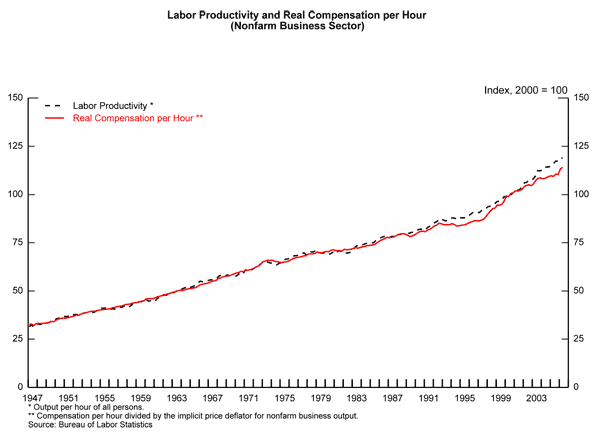
On the other hand we have had 30 years of increasing real compensation per hour. More compensation is going into pre-tax benefits rather than wages.
-
Re:Makers and takers
Anyone who thinks the fed "creates [money] out of thin air" and as a consequence is able to "raise revenue without increasing taxes or borrowing it" has undoubtedly received their economic education from a single source, namely youtube.com
Great point. Sadly, the rest devolved into another goofy anti-fed diatribe, from a different angle.
You may have noticed that inflation is actually at a historic low right now. So based on this external data, it doesn't really look like the money supply is being artificially increased right now, does it?
Well, that's because it isn't. What the Fed is doing to stimulate things right now is twofold: It is allowing banks to borrow money from it at almost no interest, and it is "buying" its own treasury securities to get them out of the market. There is no extra new cash flowing around the USA right now, and if the government wanted to do that, it would have to be the Treasury Department doing it, not the Fed.
So why the "printing money" meme? The cynic in my says its because the phrase tests well for Right-Wingers when they use it, and the truth is so complicated there's little danger of the fib going corrected.
-
Re:Porn must have gone free...
Such a high price would have implied the size of the entire Bitcoin economy was worth 1.47e15 dollars.
For comparison, that would be about 140 times more dollars than there are.
Scroll down, look for the M2 number. (More recent data, with less explanation)
-
Re:Math, do it.
the US has over 90 trillion dollars. There's plenty of money to spend if only we can get it into the right hands.
-
Re:UHH
Adding $100 to circulation makes little difference, because there is over 10 billion times that amount of currency in circulation. So you would expect, of course, prices to go up by around one ten-billionth, much less than noticeable.
The problem is if the government decides to manufacture tons of money. Let's go high for the sake of making a point, say $500 million trillion. So now the government can pay all its bills and then give everyone a billion dollars and we're all happy and rich, right?
Well, if I'm rich, I'm not going to work any more. I don't need no stinkin' job. I'm going to take my billions and grab a few mansions and some awesome cars and tech and maybe an island, right after I get my last Big Mac at Mickey D's.
I pull up to the drive-thru, but nobody is there. Oh, wait, everyone's a billionnaire and doesn't need to work. But who's going to satisfy my cravings for two pieces of meat in thick buns with secret sauce? And then it dawns on me... if I can't get a Big Mac, I can't get a gourmet meal. I can't go into a Best Buy. I can't find a realtor to sell me those mansions. Crap, well this sucks.
But surely everyone has a price, right? I have a lot of money, someone will make me a Big Mac for a million dollars, I'm sure of it. Well, ok, someone takes me up on the offer. And I suppose someone will take time away from their rich lives to be my realtor for 100 million dollars. And the guys down at the local TV store will work for a few million an hour. And it turns out, my billions are draining quickly this way... I guess I need to go back to work, so long as I can make a few million an hour myself.
This is hyperinflation. This is what happens when the government adds money to the economy. Of course, this isn't all that great. Now the $50,000 savings account our family has been working our lives toward is practically worthless, and those who have saved nothing in life, or haven't even attempted to find a job, have as much as we do.
So we can't just pump hundreds of trillions into the economy. If and when the decision is made to manufacture more currency, it will be in much smaller amounts. But the same economic principles hold, just in proportion to the total amount of money in circulation.
-
Re:Nuke hystyeria
"almost 100% loss of manufacturing capacity and so also jobs"
Incorrect. US manufacturing capacity has increased greatly in the past few decades, not decreased.
However, it has also become much more automated, so it employs less people.
-
Re:And this
Again, that's just wrong. A bank with $1,000 in deposits via a CD can loan out precisely $1,000. There are no reserve requirements on CDs. There is also no borrowing of additional funds from the Fed (in the normal course of business for a healthy bank, although the "overnight window" is there for panics).
In fact, the Fed money loaning is the opposite of what you've stated. Banks voluntarily deposit money with the Fed in excess of reserves to get a decent interest rate, and currently there are $1.7 T in excess reserves - an insane amount, and no one really knows what effect it's having on the economy.
The ratio you talk about is not a bank with $1,000 somehow able to loan out $10,000. It's the net effect of the fractional reserve banking system on the money supply.
-
Re:Explain "Private"
Because it is wholly owned by a consortium of private banks, and not subject to government audits?
No, because none of that is true. No one really "owns" the Fed.. The private banks are more like members than owners, government appointees have all the decision making power. Also, all the Fed banks are subject to audits by the GAO and independent entities.
-
Re:A century ago, Progressives
But in the end, yes, you do need to explain how there isn't a fixed amount of US dollars because you can look at the federal reserve and see a specific number in circulation.
http://www.federalreserve.gov/faqs/currency_12773.htm [federalreserve.gov]Hah, ha. Yes, there is a fixed amount at any given time in the sense that when driving down the highway at 60mph, I am at a fixed point at any given time. It's just that at the next point in time, the fixed point (amount) has changed.
Sure the government can and regularly does print new money (about $500 million a day, but most of it is to replace old money) but when new money is added to the system, it is effectively slightly lowering the value of all other dollars.
So you agree with me that the amount of money in circulation is changing all the time.
Suppose tomorrow, I trip over a brick of gold which no one has ever seen before. This wasn't wealth "added" to the economy, that new brick actually caused every other bit of gold to lose value by some incredibly small amount.
Here you are trivially substituting gold for money, which works because the intrinsic value of gold is less than people will pay for it because of its use as a medium of exchange. But your argument is flawed because it assumes that the value of GDP never changes. If GDP increases, money can be printed without the purchasing power of a single dollar dropping an amount equivalent to the fractional growth of dollars. Essentially, your argument is circular.
-
Re:A century ago, Progressives
First let me clarify. When i say " there is a fixed amount of US dollars at any point in time", I am talking about the whole world economy. Sure I could take tons of Yuan (if I had it) and convert it to US dollars, but that's not adding to the economy, that's just shifting piles around.
But in the end, yes, you do need to explain how there isn't a fixed amount of US dollars because you can look at the federal reserve and see a specific number in circulation.
http://www.federalreserve.gov/faqs/currency_12773.htm
which states: "There was approximately $1.22 trillion in circulation as of October 23, 2013, of which $1.17 trillion was in Federal Reserve notes."
That plus, whatever I could convert from other currencies is the **effective amount of US dollars in the world** which is certainly, a specific, measurable, quantity.
Sure the government can and regularly does print new money (about $500 million a day, but most of it is to replace old money) but when new money is added to the system, it is effectively slightly lowering the value of all other dollars.
Think of it this way.
Suppose tomorrow, I trip over a brick of gold which no one has ever seen before. This wasn't wealth "added" to the economy, that new brick actually caused every other bit of gold to lose value by some incredibly small amount. This is trivially true, and I'll show why. Let's take the example further. Let's say that I wave a magic wand and now "find" a few hundred thousand tons of gold instead. The value of gold would noticeably go down as I try to exchange it for goods, services, or money, because... gold would suddenly be less are.
-
Re:Deep down..
Small problem; wealth inequity in this country has never been this bad, not by a long shot. We've had a middle class since the post-industrial labor reforms of the 1930s. Prior to that, it was a clusterfuck as we moved from an agricultural to industrial society, which is to be expected. However, we don't have one anymore; we have the poor, and the super rich.
I suppose that depends on how you define "poor" and "super-rich." Somewhere around 40% of families have net worth between 50-500k. ( http://www.federalreserve.gov/pubs/oss/oss2/papers/concentration.2001.10.pdf ) That's a nice little nest egg, but it's not really "fuck you" money. Somewhere around 30% have net worth under $10k, and 7% under 0. These numbers have been pretty consistent since 1990. Families >$1M grew from 5% in 1989 to 7% in 2001 before falling back to 4% in 2009, but a million net worth isn't Larry Ellison rich. It isn't even Jamie Dimon rich.
One thing people tend to overlook in these wealth disparity studies is the effect of age and demographics. When you're young, you're poor: your income is low, you have big expenses like marriage, kids, and maybe a house. Get up around 50-60, and your income shows the effect of promotions, your kids move out on their own, and your own medical expenses haven't yet exploded. People save in those last few years before retirement, and that just happens to be how old the Baby Boomers are right now.
-
Re:Obama should agree to delay the individual mand
The Fed often gets "first dibs" at auctions because of their role in managing the money supply
The Federal Reserve Act says that they have to buy them on the open market. Are you saying they have a "more open" market? That would contravene the purposes of the Act, but not surprise me.
http://www.federalreserve.gov/faqs/money_12851.htm
They say that there's a line to buy them, but if the market actions are open, then the Fed would not be able to grab 90% of there really was such a line. I tend to trust the numbers more than the claims, but if the market is cooked, then that's different.
http://www.bloomberg.com/news/2012-12-03/treasury-scarcity-to-grow-as-fed-buys-90-of-new-bonds.html
-
Re:federal reserve corporation's 0% interest rates
The Federal Funds Rate is at 0.08% Of course the target rate is zero to
-
Re:All that, and yet ...
It costs 18.03 cents to mint those dollar coins, but only 5.4 cents to print a one dollar bill. So why exactly would they want to get rid of the paper bill?
Because coins can last for decades, whereas paper money has to be continually replaced. I'm sure I read somewhere that the Bank of England heats the building by burning old money, which is replaced by new notes.
-
Re:All that, and yet ...
The government would *love* to be able to discontinue those bills, and replace them with coins.
It costs 18.03 cents to mint those dollar coins, but only 5.4 cents to print a one dollar bill. So why exactly would they want to get rid of the paper bill?
-
Re:Because of FED
Keep an eye on the excess reserves, of course. When that money, which is MYSTERIOUSLY equivalent to the QE printings by the Fed which have increased the monetary base to triple its size as of 2007, starts to be lent, inflation will be very bad indeed. You must of course differentiate between money supply and monetary base. Take a look at question 17: http://www.federalreserve.gov/releases/h3/h3_technical_qa.htm
-
Re:Rather obvious isn't it?
With 21million BTCs dividable into 100million satoshis each I think the world will have plenty of artificial bits to spread around.
Really?
There are about 1.18 trillion paper/coin USD in circulation. Let's estimate that 60-75% is held outside the US nowadays (this is a difficult number to calculate so it is basically an educated guess). There are about 350 million people in the US, so we have roughly (1.18 trillion *100*0.4) / 350million or 135,000 physical currency units per person ($1350.00). This seems low, but this represents physical currency, not money in bank accounts.
Now compare to bitcoin. If we assume 1 billion ("the world will have plenty") people use it, then we have (21 million * 100 million)
But wait, shouldn't we compare apples to apples? Let's include ALL USD, including all USD that are electronic. That's the M2 indicator, which is currently around $10trillion. If we assume that 1 billion people all over the world are sharing USD currency, that comes out to 1,000,000 currency units per person. So the Satoshi has only about double the curency units per person (assuming 1 billion people) that the USD has. BUT the US creates more money, and Bitcoin "loses" money over time (it is deleted, forgotten, hard drive crash, etc).
Bitcoin as it currently stands is the IPv4 of currency. If it becomes popular, I can easily imagine not having enough divisible units to go around. -
Re:Rather obvious isn't it?
With 21million BTCs dividable into 100million satoshis each I think the world will have plenty of artificial bits to spread around.
Really?
There are about 1.18 trillion paper/coin USD in circulation. Let's estimate that 60-75% is held outside the US nowadays (this is a difficult number to calculate so it is basically an educated guess). There are about 350 million people in the US, so we have roughly (1.18 trillion *100*0.4) / 350million or 135,000 physical currency units per person ($1350.00). This seems low, but this represents physical currency, not money in bank accounts.
Now compare to bitcoin. If we assume 1 billion ("the world will have plenty") people use it, then we have (21 million * 100 million)
But wait, shouldn't we compare apples to apples? Let's include ALL USD, including all USD that are electronic. That's the M2 indicator, which is currently around $10trillion. If we assume that 1 billion people all over the world are sharing USD currency, that comes out to 1,000,000 currency units per person. So the Satoshi has only about double the curency units per person (assuming 1 billion people) that the USD has. BUT the US creates more money, and Bitcoin "loses" money over time (it is deleted, forgotten, hard drive crash, etc).
Bitcoin as it currently stands is the IPv4 of currency. If it becomes popular, I can easily imagine not having enough divisible units to go around. -
Short-sightedness of the market
If capitalism doesn't provide a profit motive to develop alternative forms of energy, government should.
We can create money to fund research into ideas that the free market doesn't immediately reward. The Fed creates money now; but it goes to the banks at 0%, who want to buy T-bills even if they only pay 2% or 3%; but the austerity-pushing Republicans want to limit the sale of T-bills. So the banks sit on the money instead*, and get interest on it if they store it with the Fed.
Instead, give the Fed's created money directly to people, in the form of a basic income. Encourage individuals to innovate on their own or through ad hoc collaborations facilitated to an unprecedented degree by the internet. (Note that the market was too short-sighted to fund the creation of the internet; AT & T felt the internet threatened their business model of telephones, for example.) In this age of MOOCs we can educate ourselves about energy and work on hypotheses that business won't pursue because they are too driven by the requirement that they show a profit on next quarter's shareholder report.
---
* See http://www.federalreserve.gov/releases/h3/current/. Current reserves are at or near all time highs.
-
Re:Why is this getting pushed out in the press?
But there are 2.457 trillion USD, right now: http://www.federalreserve.gov/releases/H6/Current/
So if bitcoin were worth as much as the total USD in circulation, and the same amount of electricity percentage wise was used, it would use :(2.457 Trillion USD in circulation) * 1000* 1000 * 1000 * 1000 / (11027500 total mined bitcoins) / (100 USD per bitcoin) * (982 / 24 megawatts) =
2.457 * 1000* 1000 * 1000 * 1000 / 11027500To put that in perspective, according to wikipedia: http://en.wikipedia.org/wiki/Electricity_sector_of_the_United_States
the total generative capacity for the USA is 1050 Gigawatts.So if Bitcoin ever became as big as the USD, we'd need 10% USA's worth of power generation to support it 24/7, and given current average prices of 0.15 kilowatt hours, it would cost (91165 megawatts) * 1000 * 0.15 (kilowatt hours) * 24 (hours) = 91165 * 1000 * 0.15 * 24 = 328.2 Million dollars per day or 120 Billion dollars per year. (and miners would be making a revenue of 24*6*25 * 2.457 * 1000* 1000 * 1000 * 1000 / 11027500 = 802 Million dollars a day. I know that the bankers are stealing money from us, but still...)
-
Re:Latex outside academia
This gets built from LaTeX.
-
Re:What do you mean by 2030?
Until you take out the food industry we do not get an accurate picture.
All food production counts for only 8.75% of the industrial production total (source).
You might be happier to look at New Orders for Durable Goods (DGORDER).
-
Re:Headers
You file a complaint with the FTC after they've received a fair number of complaints...
The FTC will sue "AT&T" for "unfair or deceptive trade practices"
-
Easy Fix...
Who wrote this summary? A QR code is just a data.
Just make your system NOT go to the public internet. The QR code could just be the serial number of the note. Hell you don't even need to use a QR code.
Example: http://intranet.federalreserve.gov/verify?n=12345
Problem solved. No virus.