Slashdot Mirror
Domain: fefe.de
Stories and comments across the archive that link to fefe.de.
Comments · 171
-
Re:Slashdotted already?
Uptime has little to do with performance. While likely the problem is due to stupid site design (slashdotting a PHP'd dynamic page will kill any OS), Linux performs generally better (much better in the case of 2.6) than OpenBSD and FreeBSD, and similarly to FreeBSD. BSD's dominance of the uptime charts is irrelevent (as well as inaccurate, because Netcraft can't detect Linux systems with >497 days uptime).
-
Re:DeadSea should stand up for his work.You say they stripped information. That's not a GPL violation.
I've also seen the notice on your site before and thought you seemed reasonable. It is hard to believe that you could post something so stupid. What about this crucial part of the GPL:
1. You may copy and distribute verbatim copies of the Program's source code as you receive it, in any medium, provided that you conspicuously and appropriately publish on each copy an appropriate copyright notice and disclaimer of warranty; keep intact all the notices that refer to this License and to the absence of any warranty; and give any other recipients of the Program a copy of this License along with the Program.
It is so obviously not OK to just distribute Java bytecode. Get a clue!
- Brian -
Re:Let's be honest
Enough reasons to change DJBDNS. Just to pick an example: IPv6 support?
DJB has some problems with his attitude and other things, which make it hard for him to understand IPv6. That's why other people have to distribute patches to add essential features like this.
Actually, just do a quick search on Google and see that there are many people who have patches for DJBDNS. DJB is too afraid to release new versions with these fixes because that could make people think that his programs aren't that good after all...
(Hope I'm not too offtopic/trolling here. -
DeadSea should stand up for his work.Fefe, you just wrote one of the most insulting posts I've seen in a long time and it's inemical to free software in general. You crap on DeadSea's work and the whole idea of software freedom. To add insult to injury, because DeadSea complains of being violated, you compare him to the lowest scum on Earth: Microsoft, SCO and junk patent advocates. Your troll is so excellently crafted, it's obvious that you know what you are doing, so what follows is for peopole who might not understand your methods.
You reveal the root of your contempt, and it's resulting ridicule right here:
1. Java can be trivially decompiled, so I don't see how this can be regarded as "closed source" with a straight face.
It's obvious that you don't understand or have forgoten software freedom and have a very bad elitist atitude. The point of the GPL is that the others can read and understand code that you write or modify. The GPL demands distribution in HUMAN READABLE form, complete with all of the original notes. While you might think yourself above the need for comments, that's beside the point. The GPL does not require you to pander, it simply asks you to pass on what you recieved. Stripping information is a clear violation of the spirit and letter of the GPL.
Your second insult should be aimed at the violators:
2. Your library does not look like rocket science to me.
If it was so easy, why was the code appropriated? When the company appropriated the code, why did they bother to strip information from it? Someone so uber-leet as yourself would never sink so low, would you? Real men like might not mind putting in long hours reinventing the wheel, but I do. When you use someone else's code, the least you can do is honor the license it's under.
Your final comments are the most insulting of all:
you only make yourself look bad and give SCO and Microsoft ammunition on why free software people are communists and morally corrupt people.
What a stupid blast. Just try reverse engineering something from Microsoft and distributing it. The answer you get will be most unreasonable. It's surprising indeed that someone from Germany would call someone a Communist, especially someone who would so fiercly advocates software freedom.
What could be more helpful to closed source than to convince free software writers to keep quiet about GPL violations? The losers obviously can't keep up. If we are silent and just let people have their way when our code is "stolen" we might as well take orders about software development straight from Redmond. It would be better to hand over your copright to anyone else.
-
Re:Question
Baaahhhh haaaaaaa haaaaaa haaaaa.
FreeBSD has about 350 active developers. The Linux Kernel alone would have that many.
Linux is more stable than FreeBSD for servers or anything else.
Most Linux drivers are nicer.
Linux is more secure.
Oh no! It scales better, does it? Oh damn, I guess you must be right. Hey everybody, FreeBSD scales better than Linux. This guy really showed me a thing or two.
What?
You're a moron? -
Re:Linux 2.6.1 vs. FreeBSD 5.2
It was.
BTW; The guy who did them has updated them. According with the new results, Netbsd *beats* freebsd 5.x: http://bulk.fefe.de/scalability/ -
Re:Linux 2.6.1 vs. FreeBSD 5.2
You're probably talking about this benchmark.
Some comments from his conclusion include:
FreeBSD 5.1 has very impressive performance and scalability. I foolishly assumed all BSDs to play in the same league performance-wise, because they all share a lot of code and can incorporate each other's code freely. I was wrong. FreeBSD has by far the best performance of the BSDs and it comes close to Linux 2.6. If you run another BSD on x86, you should switch to FreeBSD!
and
Linux 2.4 is not too bad, but it scales badly for mmap and fork.
I personally believe that it's fair to compare FreeBSD 5.X to Linux 2.4.X because a complete operating system based on -CURRENT has been available for download for a year now (FreeBSD 5.0), leading it substantial stability. It'll be some time before RedHat ships with 2.6.X by default.
As the -CURRENT branch will become the -STABLE branch in the next few months (shortly before 5.3 is released) and this will create 6.X (the new -CURRENT), the timing is fairly close to when distributions that include kernel 2.6.X start to appear.
-
Re:Curious
Try 1999-2001. The Linux 2.6 kernel has extremely good performance, the 2.4 series less so. Check out THIS benchmark for one set of figures. There are others. In some, the 2.4 kernel performs better than FreeBSD. In most others it doesn't fare as well.
-
Benchmarks?The only benchmarks run were comparing OpenSSL computation in native UnixWare mode versus Linux Kernel Personality (LKP) mode. This is an extremely poor test and shows that the reviewer doesn't know what he's talking about.
LKP is basicly system call emulation like that which is available in FreeBSD. This has NOTHING to do with pure user-space number crunching required of crypto computations! This kind of test would only show the most eggregrarious scheduling or interrupt handler errors in providing the LKP functionality. This wouldn't (shouldn't?) even show up any compiler differences between UnixWare's cc and GCC since OpenSSL is heavily assembly optimzed on x86.
These numbers arn't even compared to running under a real Linux kernel, which would be the most logical course of action given the reviewer's incomplete understanding.
But regardless, with comments like the following, it becomes painfully obvious the reviewer knows little about this:
The Linux kernel version number piqued my interest, because of the recent kernel vulnerability responsible for the compromise of some Debian project servers. I'm not sure if the same kernel exploit would work in the LKP, but it'd be an interesting test.
If anything, benchmarking system calls should have been done. Something along the lines of these tests.
The reviewer makes his bias very plain with passages such as:
I want to be as objective as possible, but I'd be a fool to think such a review could possibly avoid the controversy and raw emotions surrounding the company offering the product I've chosen to evaluate.
This combined with the lack of objective and useful benchmarks makes this article little more than a piece of cheerleading propoganda.
-molo -
Re:What does FreeBSD have over Linux?
Practical solutions?
It is things like having had 'accept filters' for a long time, that make it possible to wait for a complete http request before spendign any timeslices on the http server that needs to handle it, and thus preventing many context switches for example.
This is another fine example of overengineered FreeBSD rubbish given a fancy name, bandied about for the next 4 and a half years, and used to prove their operating system is superior to Linux in a smiley face comparison. Have a look at this page: they are missing out on a lot of the basics. How about their non-existant SMP scalability? Linux is being run right now on systems with FIVE HUNDRED CPUs.
It is being able to reliably verify which uid is generating an outgoing packet in the standard ip filtering software for example.
Umm, Linux can do this in case you didn't know.
I do want them for my webserver and mailserver and such tho, there they improve control, security and performance quite a bit.
Post some benchmarks. Please refute me. -
Re:Time for better security.
Benchmarking BSD and Linux
OpenBSD 3.4 was a real stinker in these tests. The installation routine sucks, the disk performance sucks, the kernel was unstable, and in the network scalability department it was even outperformed by it's father, NetBSD. OpenBSD also gets points deducted for the sabotage they did to their IPv6 stack. If you are using OpenBSD, you should move away now. -
Re:Ack
Frankly, that's a product of the driver not a result of chip design or flaws. Further, all Windows (NDIS?) drivers I've had to work with have had the option called "Locally Administered Address" where you can force a custom MAC address.
If you take a look at most ethernet drivers, you'll notice that most drivers need to read a MAC address out of a serial eeprom. This address is then configured into the ethernet chip so it can receive appropriate unicast frames and is used by the driver when constructing ethernet frame headers for transmission.
Further, regarding just how "junky" the Realtek stuff is, I refer you to this page: http://www.fefe.de/linuxeth/realtek.txt which states quite clearly and specifically why the realtek card is "junk."
For the record, I can spoof the MAC address on my 3Com 3C905's, Intel EEPro100 and Broadcom Tigon 3. -
Re:and so, torvaldes finally admits it
Haha really? Thats funny! That means you and your hard ass possie got schooled by a bunch of queers? Ha ha ha! Why even bother getting out of bed, eh?
-
Re:Honest Question
Actually my friend, as you'll see from pages like this, it actually often spends much less time in the kernel. One major slowdown always present is the tenfold increase in timer interrupts. As you can see from the web page I referred to though, this doesn't always result in a net slowdown.
-
Re:BSD
-
Re:OT: Thinknig about trying BSD
cons:
generally slower, less scalable in terms of algorithms and how parellel the kernel is than Linux.
It is considered more stable than Linux by its proponents, but no studies have indicated one way or the other. -
Open Source Alternative...Can someone think of any reason to use this one here instead of fefe's fnord http web server?
Web server: fnord (by Felix von Leitner)
Tutorial:
To setup fnord to provide https, you need an up and running plain http fnord.
Be aware that there are two methods on how to setup fnord using SSL. One is to use ucspi-ssl, or to use a patched version of ucspi-tcp. The patch can be found here. These two methods are a bit different. Specifics for each variant are marked in simple braces. For Example: (ucspi-ssl) or (patches ucspi-tcp)
-
Re:What?
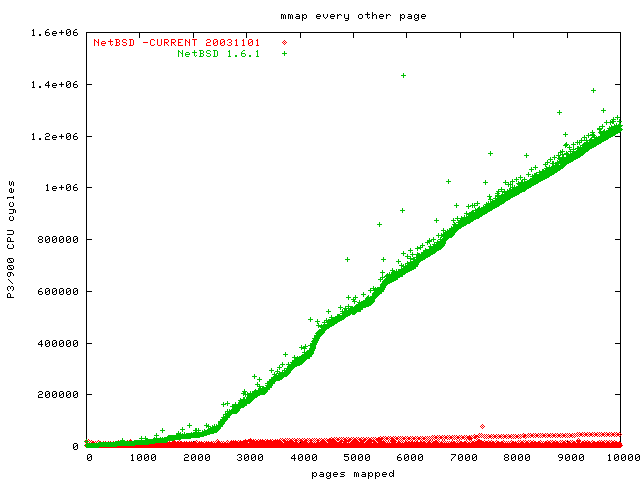
RTFA - specifically the graph of the mmap benchmark in question. Note that for the most part the red line goes straight across. But there are a few data points that follow a O(n) graph above that (what the author called a shadow). So the interpretation is that the typical case is O(1), but occasionally it has a worst-case performance of O(n). Plus, the factor of the O(n) case is much lower than the previous version.
-
OpenBSD benchmarkedRecently there has been some benchmarks comparing OpenBSD to other software. Unfortunately OpenBSD had its hair mussed by the operating systems performance test suite. On the bright side, if you don't know your shortcomings, you can't fix 'em. In the long term this stumble will be a plus because now at least now we know what needs fixing.
Fefe has written a very interesting article about the current state of art in system performance and how OpenBSD stacks up. Plenty of good insights there for the technically savvy reader. Sad to say, this latest release of OpenBSD 3.4 has not yet addressed the problems, but future releases will hopefully be in a better postion to deal with these shortcomings.
-
OpenBSD has worst reputation...
OpenBSD has worst reputation... when it comes to streamlining. Fefe has written an interesting article about BSDs' and Linux' responsiveness in various situations...
-
Linux Kern 2.4 vs 2.6 vs FreeBSD
-
Re:BSD developers together
You don't seem to think its too far fetched that a bunch of homos can come up with an OS that fucks FreeBSD in the anus... well, now that I put it like that, I don't think its too far fetched either!
-
Re:Is it Free ??
Really? here are some benchmarks with FreeBSD 4 now included. It appears that FreeBSD sucks
-
Re:Benchmarks?
Hey that fefe guy just did some FreeBSD 4.9 benchmarks at the bottom of this page. FreeBSD 4.9 is pretty much the same as FreeBSD 5. Wonder what all those FreeBSD zealots think of that?
-
Re:BSD?
-
Don't miss to notice the recursion...
Topic of this paper is
"Scalable Network Programming
Or: The Quest For A Good Web Server (That Survives Slashdot)"
What a coincidence!
By the way, fnord web server has at least once survived one slashdotting-event. 4 seconds of googleing result in this comment which should have let to a stream of visitors.
I hope fefe will publish the numbers of visitors and the behavior of its web server as soon as possible.
-
Don't miss to notice the recursion...
Topic of this paper is
"Scalable Network Programming
Or: The Quest For A Good Web Server (That Survives Slashdot)"
What a coincidence!
By the way, fnord web server has at least once survived one slashdotting-event. 4 seconds of googleing result in this comment which should have let to a stream of visitors.
I hope fefe will publish the numbers of visitors and the behavior of its web server as soon as possible.
-
Slashdotted - Link Here
-
Re:Stallman declined to be interviewed ...
-
Re:Sounds like a good reason to use djbdns instead
>Is there a way to install and run it without having to install the rest of his daemon management stuff?
Yup.
HTH! -
Re:That's a joke, right?
My desktop environment is fvwm and rxvt. I installed KDE 3.1.4 and 3.2 alpha and GNOME 2.4 to know what I'm ranting about.
Now that that's out of the way, I invite you to read this PDF to learn why I say that glibc is slow. -
Replacing the Aging "Wheel" Device
Apparently freedesktop.org has devolved from a desktop standards initiative to a home of pointless wheel-reinvention. Here's a list of the projects listed above, followed by their existing, more mature counterparts:
Init Replacements: simpleinit, minit, jinit, runit, daemontools, serel. Progeny also has their own system based on Gooch's need/provide architecture.
D-BUS: CORBA
HAL: Discover -
That's a joke, right?
It's "faster", because it's "python based"?!
The standard Linux init system is based on sysvinit and is slow precisely _because_ it is interpreted (it's basically a ton of shell scripts). The other reason why it's so slow is because glibc is slow and the init system starts several hundred processes during the init process. Just log in on a freshly restarted Linux system and type "echo $$" in a shell prompt to see how many programs were run before you logged in. On my minit based notebook, the number is below 20. On my minit based server, it's still below 30.
minit takes less than one second to initialize the whole server system, on an aging 466 MHz Celeron box, right from the point where the kernel starts init up to the login prompt. And the server does file sharing, cvs serving, rsync serving, runs a mail server and sshd.
In fact, because minit does not even depend on glibc, minit can probably initialize a small system in less time than it takes to even load python and glibc on this init system.
Fast and python based, give me a break. And the freedesktop people should keep their bloat to themselves, if you ask me. With the notable exception of KDE, all the gui systems on Linux have gotten progressively slower and more bloated over the years. KDE has also become slower, but less drastically, so it can be excused IMHO. But Gtk? Give me a break! Even starting the gnome theme engine takes 5 seconds on my 2 GHz Athlon XP! -
Re:wrong assumptions abound
Of course, the C library is written mostly in C (including printf and the C string functions), so that makes it hard to argue that C is not insecure.
In fact, the problem is that K&R didn't know how to properly design a secure standard for the programming language C. Just because the standard C library is flawed security-wise, it doesn't mean that other libraries are flawed, too. A good example for a compact library implementing an API that makes it easier to write secure applications (especially when it's about string handling) is libowfat. Of course, programmers still have to think, but libowfat makes it easier for them to e.g. compute buffer sizes. -
New boot system
The traditionaly Sys V init is archaic, crude, and disgusting. What, 6 hardcoded numeric runlevels? Wow, how useful is that. And I love ordering my startup scripts with two digit integers.
*nix needs a major boot/shutdown system upgrade. I have migrated to minit, but that is primarily for low memory usage. It allows a rudimentary mechanism for specifying dependencies, but is geared mostly to be minimalistic. This 2003, I think we can come up with something better than Sys V init.
Features of a next gen boot/shutdown service manager:
* uses real dependency traversal on startup and shutdown (maybe using a small theorem prover like CML2, or maybe something like make)
* allows configuration of arbitrary and unlimited sets of services, which can be named by arbitrary string literals - no longer chained to 7 numeric choices. e.g. "roaming laptop", "docked server", "minimal services", etc.
* built-in service start/stop/restart/status/enable/disable tools, and standard service API with bindings for various languages (what, native services? imagine that...we do so for Windows NT+, e.g. apache) as well as Plain Old Shell Scripts. So every freakin' flavor/distro of *nix doesn't have its own fscking way to start/stop/enable/disable services.
A lot of the garbage that goes on during startup (have you looked at the standard redhat scripts?) mounting drives and file systems, setting network and hardware parameters, etc., could probably use being standardized also, and either pulled into drivers or services or something, in a standardized fashion. Ideally all these APIs could be exposed both through command line tools, but also through desktop-integrated GUI tools, so that modifications don't entail digging up some ad hoc script on disk and modifying it and hoping you remember what the fuck you did a year ago in some system script. -
That's exactly what I wrote minit for
See www.fefe.de/minit/ for info about the project.
It's a tiny statically linked init that besides offering make-like dependencies to load services in parallel also offers ways to avoid spawning a thousand shell and utility processes in the boot process.
On my notebook, it takes less than a second from the start of init to a login prompt. In fact the latency is so small that I have never used the APM or ACPI suspend mode any more, I just turn the notebook off and on again. That's actually faster than the BIOS suspend-to-disk feature.
minit also has other benefits over standard init: you can ask init for the PID of services like sshd without PID files and thus even on read-only media like a CD-ROM without initial RAM disk or shmfs.
It's Linux only, though. And you need the diet libc for full effect (52k memory footprint for init on my desktop, including shared read-only pages). -
My slides
Yes, but it's in German: http://www.fefe.de/linuxtag2003/
-
Re:We already know.....
Oh yes. I'm sure that a IBM nic is soo much more different than the 30$ nic shrinkwrapped in walmart. Just IBM had their name on it, so it's suddenly 50$ more.
Oh right, because everyone knows that all ethernet cards are identical in terms of performance and quality.
I sure hope no one here has been taking any of your advice on enterprise servers seriously. Do you honestly believe that Fortune 500 companies pay for these hideously expensive service contracts with Dell et. al just for kicks? Hell, if they hired you they wouldn't need service contracts--a 24 hour Walmart could support the entire operation! Jesus, what are they thinking anyway? -
Apache 2.1 is still in development
Remember 2.0? It became "stable" in 2.0.twentysomething, iirc.
So this company is competing a development state open source software against "stabele" commercial software - and it's almost the same (did they ever hear about "Standardfehler" - how do you call them: Standard deviation?)
Actually, this "result" is an advertisement for Apache, if any.
P.S.
One http-server I'd trust is fnord. Last time it was featured on -
Whey, what an ego!
No wonder he didn't get a job.
The point about GPL is that you can't get ripped off. If they rip you off, you can force them to release their derivative work also as GPL. If he chose the wrong license, he got what he deserved.
I put my embedded work under GPL and actually managed to get some funding. If it's GPL, people have to talk to you to use it commercially, you know? That's the beauty of GPL.
Anyway, I can't say I found LRP to be as great as this guy actually thinks it is. And this childish "look what you missed" bullshit is not going to get him anywhere either. The world is full of companies who are not making any money, Caldera and Lineo being two very good examples he cites himself. Don't expect them to pay you if they don't have to.
So far, almost every company that hired has tried to rip me off in the end. That's how it goes. So choose wisely, chose GPL.
BTW: A new init system? Got one of those as well... I even wrote my own libc. And you know what? People are helping with the projects, in fact, many people are helping me with the projects. Feel free to look at all the names in the dietlibc CHANGES file! I think it's how you treat people that makes them help you. If your code is readable and you treat people well, they will help. You won't get big front page articles on Wired, but you'll create a damn good project, people will know your name. And you will get invited, too! Meet me at Linuxtag 2003! -
Whey, what an ego!
No wonder he didn't get a job.
The point about GPL is that you can't get ripped off. If they rip you off, you can force them to release their derivative work also as GPL. If he chose the wrong license, he got what he deserved.
I put my embedded work under GPL and actually managed to get some funding. If it's GPL, people have to talk to you to use it commercially, you know? That's the beauty of GPL.
Anyway, I can't say I found LRP to be as great as this guy actually thinks it is. And this childish "look what you missed" bullshit is not going to get him anywhere either. The world is full of companies who are not making any money, Caldera and Lineo being two very good examples he cites himself. Don't expect them to pay you if they don't have to.
So far, almost every company that hired has tried to rip me off in the end. That's how it goes. So choose wisely, chose GPL.
BTW: A new init system? Got one of those as well... I even wrote my own libc. And you know what? People are helping with the projects, in fact, many people are helping me with the projects. Feel free to look at all the names in the dietlibc CHANGES file! I think it's how you treat people that makes them help you. If your code is readable and you treat people well, they will help. You won't get big front page articles on Wired, but you'll create a damn good project, people will know your name. And you will get invited, too! Meet me at Linuxtag 2003! -
Re:anything is better than sendmail
Just my brain quircks I guess. Well, on some systems I have
-
Re:Exim's design is bad for security
Seems someone doesn't know the difference between a "security model" and a buffer overrun...
Yeah, a security model is what you implement to make sure buffer overruns don't matter. In qmail, for example, the security model has the smtp daemon run with just enough permissions to write incoming mails in the incoming queue.
you may wish to read about queue groups and multiple queues
You really believe this marketing crap, do you? Wohoo, "queue groups", I bet it's almost as great and innovative a feature as thread pools.
using LDAP already puts the administrator in the awkward position of requiring unsupported 3rd-party patches
Actually, no. Not at all. I implemented a qmail with all-virtual LDAP users and did not have to touch the qmail source code once. I did not even have to replace or overwrite any binaries.
qmail is modular enough that you can specify other delivery and the password authentication modules, in my case LDAP speaking onces. That's it. Partial sources are here.
Get your facts straight next time, FUDster. -
Acme doesn't know what he's talking about
If you don't measure performance, don't speculate how bad it is. Servers running out of TCP servers such as inetd or tcpserver can be quite fast. See fnord scalability and fnord speed.
-
Acme doesn't know what he's talking about
If you don't measure performance, don't speculate how bad it is. Servers running out of TCP servers such as inetd or tcpserver can be quite fast. See fnord scalability and fnord speed.
-
ROTFL
Yeah, right, like you log in to a public free Itanic server to run some benchmark and expect to be a) the only user of that machine and b) that nobody logs in and skews your numbers while the benchmark runs.
Besides, Itanic is a horrible performer in day to day tasks. I compiled my libc project on a 900 MHz Itanic II and it was outperformed by a factor of four by my 900 MHz Pentium 2 notebook.
I'm talking about the compilation speed here. Transcoding MPEG-2 to MPEG-4 is also a lot slower, a German university group did some Itanic assembly optimizations to learn about the architecture, and their code was still much slower than an Athlon XP+ 2000.
In short: forget about Itanic. The architecture is doomed. -
They chose AAC because it's already in QuickTime
And it's more efficient than MP3.
Their encoder is not particularly good, and AAC is covered by a ton of patents, so there probably are other reasons why they chose it.
For anyone else but Apple I see no reason to use AAC when you can have Ogg Vorbis.
PS: Shameless plug: I wrote a vorbis patch to add SSE support for enhanced encoder and decoder speed. It also contains some 3dnow! optimization for you K6 users, decoder only. -
mutt and mutt
If only more people could be this mature.I heard there is an editor called Mutt editor...?
Both programs sound similar but have no connection whatsoever. Additionally, both authors know of the other project and have no problems with the name similarity.The "problem domains" here are very different: one is a browser, the other is a database. With careful communication (the hallmark of a good computer scientist) there would be no problem. Pity that Aunt Maggie would tend to confuse them.
-
Re:Floating point
Both gcc and icc generate code that is not too bad. I don't do Windows, so I wouldn't know MS C. Do they even have a native compiler for ia64? The point is: even if you hand-optimize the code for ia64, it still sucks in comparison to other current architectures. If you consider how many Athlons you could have bought for the money, you don't even want to finish that calculation.
I you understand German, feel free to read a few slides I did recently about the subject. -
Re:fnord!
URL should be http://www.fefe.de/fnord/
(trailing slash)