Slashdot Mirror
Domain: ffii.org
Stories and comments across the archive that link to ffii.org.
Comments · 1,131
-
Re:Anti-patent lobbyists for SW are broader than O
I agree, and a good example of that can be seen here.
-
political parties and their position towards swpateurope is not only the UK:
from the analysis of the vote in september it can be seen that:
leftwing parties (communist, sozialists, trotzkists) from the GUE/NGL fraction and/or the EL (european left) and the european greens voted completly against software patens and against IP enforcement directive, etc..
all other parties where split.. usually social democrats where worse then peoplesparty..
liberals where split: some liberals where totaly pro software patents others totaly against..
so my recomendation:
vote for levtwing parties: communists, etc.. or vote vor greens. (the only thing that speaks against greens that they did not manage to change the vote of germany in the council of ministers (voted pro software patens) even thought the greens are in the government coalitions in germany...
-
Check your candidates
-
Thank you Al Qaeda!I remind you that the Spanish people threw out their corrupt government after Al Qaeda bombed the Madrid train, and that corrupt government blamed their favorite targets, the Basque,...
Thanks Al Qaeda for your help against software oppression!
-
Re:Prior Art?
Prior art does matter!
http://www4.law.cornell.edu/uscode/35/102.html
" A person shall be entitled to a patent unless -
(a) the invention was known or used by others in this country,http://www4.law.cornell.edu/uscode/35/103.html
Section 103 further states that differences from a prior art must not be trivial in order for a patent to be granted.http://swpat.ffii.org/analysis/shield/index.en.ht
m l
The FFII asserts that the "[free/opensource software] community has a certain chance of leveraging prior art to its advantage" when it comes to defending oneself from software patents.- David
-
Re:Follows the trend
Eight Hundred Million Australian Dollars fine? Gadzooks, have even the EUrocrats given up all faith in the stumble-bum of international currencies?
But seriously folks, the Fine which has been levied has only been done at an early stage, despite some of the premature celebrations. Microsoft will appeal, there will be massive depositions and written submissions etc. and the matter will hang around the EU's 'ahem' Competition Authority like a pair of concrete shoes for a few years.
Finally, after $SUITABLE years have elapsed, the European Council of Ministers, probably Employment Council or some such, will reduce the Fine to some EUR10m or thereabouts, after a closed-door unreportable meeting - following years of extensive lobbying of the Governments in question by Microsoft. That's how things are done in Europe, secretly, without public consultation or justification. See the recent whitewashing of the EU parliament's vote in relation to software patents as an example.
-
There is something rotten in the state of Denmark!
ObOntopic: software patents lead to Outsourcing. Indeed, rather than run the risk of being sued for patent infringment, software companies will prefer to outsource their actual development to places (such as India) where there are no software patents yet, rather than do it in their homecountry, and expose themselves to potentially expensive patent litigiation.
That being said, if you happen to be Danish, please carefully watch the following clip:There is something rotten in the State of Denmark
Ok, no matter what the issue is: please consider your national pride, your national dignity! Do you really value representatives that let themselves be shoved around, and give an easy yes, rather than defending your country's best interests?
But the good news is, there is still a way out. Yes, changing your vote now may be viewed as an admission that you (you're representative) screwed up, or didn't know the subject matter. But it also shows courage and the willingness to correct errors once they become known.
Ok, as a Luxembourg I must admit that I sit in a glasshouse here. I hereby encourage my countrypeople to do something about it, and contact our ministry of economy about the matter, and encourage them to review their vote.
Remember: we are only two votes short of winning, and every country, no matter how small can make a difference, be it Denmark, Luxembourg, or even Malta!
-
There is something rotten in the state of Denmark!
ObOntopic: software patents lead to Outsourcing. Indeed, rather than run the risk of being sued for patent infringment, software companies will prefer to outsource their actual development to places (such as India) where there are no software patents yet, rather than do it in their homecountry, and expose themselves to potentially expensive patent litigiation.
That being said, if you happen to be Danish, please carefully watch the following clip:There is something rotten in the State of Denmark
Ok, no matter what the issue is: please consider your national pride, your national dignity! Do you really value representatives that let themselves be shoved around, and give an easy yes, rather than defending your country's best interests?
But the good news is, there is still a way out. Yes, changing your vote now may be viewed as an admission that you (you're representative) screwed up, or didn't know the subject matter. But it also shows courage and the willingness to correct errors once they become known.
Ok, as a Luxembourg I must admit that I sit in a glasshouse here. I hereby encourage my countrypeople to do something about it, and contact our ministry of economy about the matter, and encourage them to review their vote.
Remember: we are only two votes short of winning, and every country, no matter how small can make a difference, be it Denmark, Luxembourg, or even Malta!
-
Eise Metzleschjong äus dem Wirtschaftsminist&Protestéiert géint d'Softwarepatenter! Mier sin am Moment an énger Situatioun wou Lëtzebuerg tatsächléch een Ënnerscheed maache kann!
Mier hun am Ministerrot 35 Stëmmen géint d'Softwarepatenter, an d'fehlen eis der jhust nach zwou fier éng Sperrminoritéit vu 37.
An Lëtzebuerg huet justement 2 Stëmmen!
Tel.: 478-4101
-
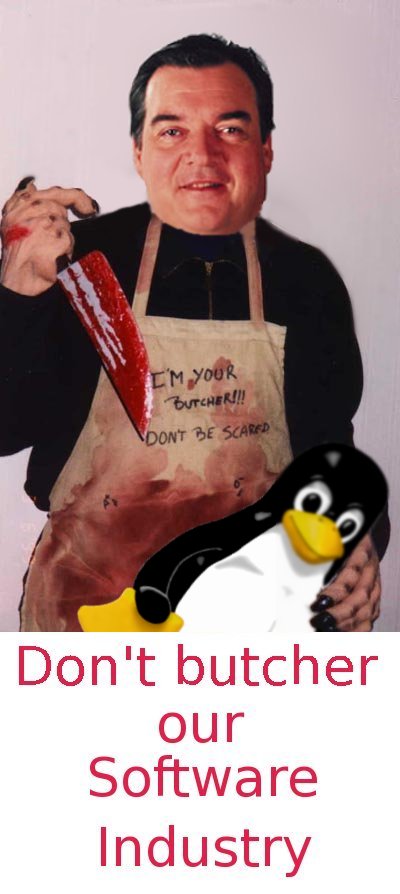
as daat nët eise Metzleschjong?As daat nët eise Metzleschjong op där Photo?
Mol éng Kéier wou Lëtzebuerg eppes maache kann (t'fehlen jhust zwou Stëmmen fier d'SoftwarePatenter ze blocken... souvill Stëmmen wéi Lëtzebuerg huet...) an dann verpenne mer et och nach!
-
Re:Good news / bad newsThe algorithm isn't dumb at all, but that's not the issue.
The patent is dumb because it is a software patent. There are several very good reasons why you should fight software patents.
-
Software Patents in EuropeToday is the last day that European ministers can still make up their mind about the highly controversial European patent directvie. In theory, the vote already happened last Tuesday, but some countries, such as Poland have changed after having realized that they've had the wool pulled over their eyes...
Result: today, we're just two votes short of blocking the controversial software patent directive.
We're now at a stage were even the smallest European countries can make a difference! If any small country, who so far has voted yes, changes its vote into no or abstain, we can send back the proposal to COREP, and prevent the worst from happening.
-
Software Patents in EuropeToday is the last day that European ministers can still make up their mind about the highly controversial European patent directvie. In theory, the vote already happened last Tuesday, but some countries, such as Poland have changed after having realized that they've had the wool pulled over their eyes...
Result: today, we're just two votes short of blocking the controversial software patent directive.
We're now at a stage were even the smallest European countries can make a difference! If any small country, who so far has voted yes, changes its vote into no or abstain, we can send back the proposal to COREP, and prevent the worst from happening.
-
Luxembourg can make a difference!We're only 2 votes short of winning!
Participate, and phone Metzleschjong today, and ask him to change his yes into a no, or at least an abstentation. If Poland can do it, so can Luxembourg!
+352 54 24 14 (home) or +352 478-4101 (at work, at the ministry of pubs)
-
Re:Hey I have a better idea
Have you seen this: http://webshop.ffii.org/?
-
Re:I was part of the Dutch FFII delegation
-
Re:Think about righteous patents for once
I'm not sure these patents are a lot saner than the US ones though.
-
Re:First Patent
There are already lots (about 30,000) of software patents in the EU. They were kind of illegal but now they may become effective...
-
Re:Think about righteous patents for once
Please give one example of an illegal patent.
Here's more than 20. They're only legalising software patents now, and yet the EPO has already granted more than 30,000 of those. Which is exactly one of the arguments they are using to justify this action. -
Re:Think about righteous patents for onceI think they issue patents for obviously stupid stuff, but that's not really the big problem: who cares if infinite compression is patented, given that we know you cannot do it anyway?
It's much more of a problem that obvious things are patented -- for example, a LOT of webshop features that you would think obvious have been the subject of patents that have been issued by the European Patent Office.
The point of the directive, as the EU parliament made it, was to outlaw all software patents. The point of the directive as the council made it (and the ones who actually wrote it are the patent office officials) is to allow all those patents in practice.
-
Bolkestein
Well, alongside Darl, this should put one of the leading forces for European software patents, Frits Bolkestein, right on the Axis of Evil of the software industry...
-
Re:Pretty easy
Read this
-
Re:Pretty easy
Someone mod parent down. It is a wild counter-factual rant.
German law and german courts stand in consistant opposition to software patents. Refference.
organisation and calculation programs for computing machines used for disposition tasks, during whose execution a computing machine of known structure is used in the prescribed way, are not patentable. This is the first and most often quoted of a series of decisions of the BGH's 10th Civil Senate, which explain why computer-implementable rules of organisation and calculation (programs for computers) are not technical inventions
The German system states that inventions are about controllable forces of nature. Exactly what we need to fix broken patent law.
- -
This sort of legal definition
This sort of legal definition.
-
Perspective: Germany is 10 of 126 votes: 37 neededin the competetiveness council. According to Nice treaty, 37 votes are needed to stop the Council Proposal as is. (Whereas the Parliament Proposal limited software patentability, the Council Proposal allows patentability and needs to be fixed).
As you can see on a newswiki in addition to the abstentions of Belgium (5 votes), Luxembourg (2 votes), there are some positive statements from some eg Italian, Slovenian, Spanish etc politicians too, but it is very much in your interest keep the in touch with your government today and on Monday too (Discussion/Voting in the Council scheduled for Tue 18 May; calculate for some time for transmission of your local govt's opinion to Brussels representative!). More help (including pointer to irc) here.
-
Perspective: Germany is 10 of 126 votes: 37 neededin the competetiveness council. According to Nice treaty, 37 votes are needed to stop the Council Proposal as is. (Whereas the Parliament Proposal limited software patentability, the Council Proposal allows patentability and needs to be fixed).
As you can see on a newswiki in addition to the abstentions of Belgium (5 votes), Luxembourg (2 votes), there are some positive statements from some eg Italian, Slovenian, Spanish etc politicians too, but it is very much in your interest keep the in touch with your government today and on Monday too (Discussion/Voting in the Council scheduled for Tue 18 May; calculate for some time for transmission of your local govt's opinion to Brussels representative!). More help (including pointer to irc) here.
-
Perspective: Germany is 10 of 126 votes: 37 neededin the competetiveness council. According to Nice treaty, 37 votes are needed to stop the Council Proposal as is. (Whereas the Parliament Proposal limited software patentability, the Council Proposal allows patentability and needs to be fixed).
As you can see on a newswiki in addition to the abstentions of Belgium (5 votes), Luxembourg (2 votes), there are some positive statements from some eg Italian, Slovenian, Spanish etc politicians too, but it is very much in your interest keep the in touch with your government today and on Monday too (Discussion/Voting in the Council scheduled for Tue 18 May; calculate for some time for transmission of your local govt's opinion to Brussels representative!). More help (including pointer to irc) here.
-
Perspective: Germany is 10 of 126 votes: 37 neededin the competetiveness council. According to Nice treaty, 37 votes are needed to stop the Council Proposal as is. (Whereas the Parliament Proposal limited software patentability, the Council Proposal allows patentability and needs to be fixed).
As you can see on a newswiki in addition to the abstentions of Belgium (5 votes), Luxembourg (2 votes), there are some positive statements from some eg Italian, Slovenian, Spanish etc politicians too, but it is very much in your interest keep the in touch with your government today and on Monday too (Discussion/Voting in the Council scheduled for Tue 18 May; calculate for some time for transmission of your local govt's opinion to Brussels representative!). More help (including pointer to irc) here.
-
Re:bullshit - there is already a patent law in eur
But it is currently not possible to patent trivia things!
That is incorrect. Just look at this patented webshop.Remember that one of the most important patents - the mpeg layer 3 better known as mp3 - is from Germany, from the Frauenhofer Institute. And they were already able to protect their discovery with an european patent.
With several European Patents actually. This is the basic one:Digital coding process for transmitting and/or storing acoustic signals, specifically music signals, comprising the following steps:
As you can see, this is a patent not just on mp3 compression, but on any audio compression scheme which iteratively tries to compress an audio sample until it fits in a pre-determined number of bits.- N samples of the acoustic signal are converted into M spectral coefficients;
- said M spectral coefficients are subjected to quantisation at a first level;
- after coding by means of an entropic encoder the number of bits required to represent all the quantized spectral coefficients is checked;
- when the required number of bits does not correspond to a specified number of bits quantization and coding are repeated in subsequent steps, each at a modified quantization level, until the number of bits required for representation reaches the specified number of bits, and
- additionally to the data bits the required quantization level is transmitted and/or stored.
The problem with these European software patents is that they are currently in general not enforceable in a court. The reason is that the European Patent Convention forbids software patents. The European Patent Office is an independent institution however, which gets its funding from granting patents, so it creatively reinterpreted that convention. That does not change the law nor the opinion of the courts, however (except for the UK).
You're right however that we have strong copyright laws, and that simply copying other people's code is not allowed (unless they agree, like in case of GPL'd code), not even if it's just a few lines.
-
Re:Wakeup Call
What they said is the same they always said: "We will not vote for it." -- which means they are planning to abstain, not vote against it.
That is correct. But it's almost as good. We have to break the qualified majority in the Council, and Germany has 10 votes of the 36 we need to do that.So do not misunderestimate the German BMJ.
But this is plain wrong. We have a leaked copy of an internal Council document. Look at the footnotes. Germany was at that point in time (3rd May) one of the few that insisted on article 2 of the European Parliament. This article defines "computer-implemented invention" and "technical contribution" so that a "computer-implemented algorithm to do anything" can never fulfill either definition.They are are among the hardest hardliners.
-
Re:Existence alone is bad enough"Well, let's look at the industry. For the 30 years before 1981, not a lot happened."
By what measure? Are you trying to imply that there was little academic research? Is it instead the case that as you said - the industry was simply smaller then? Is it really likely that the I.T. industry would not have exploded anyway?
"It's seems to me, anyway, that this is pretty good evidence for patents encouraging innovation."
Of course it is not. It is mere correlation.
"Impossible to tell, but there is certainly some evidence it wouldn't have been as big as it was."
Where? - There is plenty of evidence to the contrary here
If you are right then perhaps you can explain why other creative industries have flourished without the need for patentability of their techniques, methods and ideas? The movie industry for example...
-
Re:Did ANYONE RTFA???
With regard to patents, in particular, no one *ever* has an obligation to refrain from making, using or selling technology that *may* practice patent claims solely because someone somewhere has taken a patent, claims to have a patent, or even publishes a license. Only the demand that you in particular take a license or cease infringing triggers theoretical liability under US patent law. Whether there can be liability for damages for the period before such notification is another question, legitimately of importance to those who commercially distribute free software, but not ordinarily of significance to those who develop only, or who distribute non-commercially.
In other words, you can code something using the patented "technology" (they aren't even patenting that, only their share part of some ideas they had to fix a protocol!) until Cisco wants to stop it.Moreover, patents are not global, only local. To say that we cannot *develop* under GPL because a patent exists in country X, and a license has been published there to which those making, using, or selling in country X *might* be asked to subscribe would go much too far. That situation certainly does not prevent development elsewhere, and distribution under GPL can certainly proceed."
FreeS/WAN wasn't in 2.4 kernel because of the possibility of legal problems in some countries (just one example), so why would this be different?Well, of course, USA has software patents and unfortunatly Europe is going the same way, but Africa hasn't yet!
It's the best I can do. Why? Why the hell is he going to patent it in the first place? Isn't he against software patents as he claimed to? Is he being pressed to do this? By who?
-
There may be method to this madnessIt appears that Mr. Barr at least feels he has a good reason for applying for the patent. If you read the statement he made before the FTC during their hearing on "Competition and Intellectual Property Law and Policy in the Knowledge-Based Economy" he argues against the current patent system. However, he also explains why Cisco, under his direction, applies for so many patents:
"It makes more business sense to assume that, despite the fact that we do not copy other company's products, and despite the fact that we do not derive solutions to problems from the patent literature, we will be accused of patent infringement. The only practical response to this problem of unintentional and sometimes unavoidable patent infringement is to file hundreds of patents each year ourselves, so that we can have something to bring to the table in cross-licensing negotiations. In other words, the only rational response to the large number of patents in our field is to contribute to it."
He goes on to make some very interesting arguments saying...
"The patent system does not exist to protect the rights of inventors, or any particular interest group. It doesn't exist to protect what we now call "intellectual property", as if it were protectable for its own sake. The patent system exists to protect the progress of science and the useful arts. If the patent system fails to do that in certain areas, then the costs and negative effects of the patent monopoly cannot be justified. Where the patent system enables true innovation, true progress, where it enables companies to bring new products to consumers in circumstances where they otherwise would not do it, or where it disseminates knowledge that others need and want, then it's working."
So, Cisco appears to be doing this as a matter to protect their own ability to use this fix, not to prevent other from using it. That would seem to fit with his explanation posted earlier...
"That's not what it says, or what I mean to say. It says that nobody has to pay anything, or even ask for a license, unless they want to assert patents against Cisco."
You can read Mr. Barr's full statement before the FTC online (ironically enough) at
Freedom for a Free Information Infrastucture -
Re:Robert Barr?Worst than that... And curious too: this is the same Rober Barr then the one who claims being against software patents!
Check FFII...
-
Re:Seems Unlikely
IBM allows anyone to license any and/or all of its patents. All you have to do is give them a call and they will be more than happy to work out an agreement with you.
Indeed, they'll be very happy to take anywhere from 1% to 5% of the retail price of your product in exchange for a license.The large patent portfolio is more of a defensive measure - if IBM is sued, it's more than likely that they can countersue with a few choice patent violations.
If that were the case, then why are they lobbying so hard to get software patents legalised in the EU, and not lobbying at all to get them banished from the US (and on the contrary, blocking studies that could show there is a problem with swpats)? You don't need defensive software patents if no-one can have any. -
Re:Seems Unlikely
IBM allows anyone to license any and/or all of its patents. All you have to do is give them a call and they will be more than happy to work out an agreement with you.
Indeed, they'll be very happy to take anywhere from 1% to 5% of the retail price of your product in exchange for a license.The large patent portfolio is more of a defensive measure - if IBM is sued, it's more than likely that they can countersue with a few choice patent violations.
If that were the case, then why are they lobbying so hard to get software patents legalised in the EU, and not lobbying at all to get them banished from the US (and on the contrary, blocking studies that could show there is a problem with swpats)? You don't need defensive software patents if no-one can have any. -
Re:Seems Unlikely
IBM allows anyone to license any and/or all of its patents. All you have to do is give them a call and they will be more than happy to work out an agreement with you.
Indeed, they'll be very happy to take anywhere from 1% to 5% of the retail price of your product in exchange for a license.The large patent portfolio is more of a defensive measure - if IBM is sued, it's more than likely that they can countersue with a few choice patent violations.
If that were the case, then why are they lobbying so hard to get software patents legalised in the EU, and not lobbying at all to get them banished from the US (and on the contrary, blocking studies that could show there is a problem with swpats)? You don't need defensive software patents if no-one can have any. -
Re:What he is smoking is...
But taking another toke from it myself before coughing and hurling, as I'm opposed to broad/silly/etc. (software) patents myself :
You can't have patents without broad/silly/... ones. And software patents by their very nature are bound to have a much higher percentage of broad/trivial ones. See e.g. this post of mine and this page by FFII.The first problem is that although there's a level playing field in the EU, there isn't in the US which means there isn't a level playing field for large multinationals situating in both areas.
It's indeed annoying for multinationals that the law isn't the same everywhere. That doesn't mean you should import a bad law to somewhere else however, but kill the bad law.The second issue of EU companies patenting stuff in the US is valid and something grandparent probably didn't keep in mind. Paranoia may strike and cause concern that US companies may be favored by the USPTO, however.
I don't think so. There have already been Eolas-like cases involving European companies before, e.g. AllVoice. It's nothing new.On the third issue, the simple thinking is this
I still fail to see where the disadvantage is. Whether an EU or US company wants to patent something in the US, the chances that this thing is already patented there are equal, and the fact that others are "patenting up the wazoo" in the US is equal as well.
EU > EU ; no patenting
US > EU ; no patenting
EU > US ; patenting, but there's a good chance the patent's already held
US > US ; patenting up the wazoo
I.e. there's a disadvantage to the 'EU' company, and it's this disadvantage that *some* legislators want to iron out. Unfortunately they're using a steamroller instead of a velvet ironThe only thing that's different, is that US companies already have this problem immediately in their home country, while a European company's home base is currently a safe haven. I honestly still fail to see how introducing software patents in Europe would help European companies.
-
Re:How would this work?
Regarding "no secrets", in addition to the etymological derivation of "patent" (Latin for open) and its secondary definition (obvious; plain), I believe the original purpose of patents was to promote progress by discouraging secrets and thus encouraging the sharing of ideas.
The sharing of how inventions work, not of mere ideas. Have a look at this presentation, especially slides 4 till 6.However, your basic idea is indeed correct: they're supposed to promote the sharing of information, in return for a monopoly on the concrete application of this information (i.e., on building inventions based on whatever is described). The problem with software patents, is that the application of this information still is information (a computer program). So you are getting a monopoly on the information itself, not on some concrete and physical thing/process.
It's as if a patented engine would result in a prohibition for anyone else to write and sell technical manuals on how to construct such an engine, because if the reader follows those instructions, he would be violating the patent. So the patent is not promoting the spreading of information, but inhibiting it.
Traditionally, the physical invention is on the monopoly side and information on the disclosure side, but with software patents both are pure information. As such, you indeed end up with patents on ideas (information) instead of on inventions. The result is that you get much more broad monopolies, where the advantage of disclosure no longer weighs up to the disadvantages of the granted monopolies.
It really isn't a problem of the patent offices, it's simply the patent principle and patent law which aren't fit to protect advances in logical reasonings. Especially read the discussion between the programmer and the UK Patent Office Deputy on that page (first point).
-
Re:Cut the xenophobic crap...
If you'd invoke them, it would probably on a state level: after all, you are challenging the validity of other laws. For example regarding TRIPs, only a state can file complaints regarding breaches, and that must be done that the WTO. So we'd have to find a nation willing to do that. And I'm not sure which state would be willing to do that, as it would result in a head-on collision with the US.
Then again, recently a country (forgot which one) successfully won such a complaint against the US regarding online gambling, so it's definitely not impossible. I don't know who and where one can complain about infringements to the Berne convention.
The whole "TRIPs requires software patents" fallacy is covered in great detail by FFII. -
Re:Patents on Software...uhoh
Or if Adobe patents the photo editing tool.
You silly rabbit. "Photo editing tool?" Adobe already patented cookies and tabbed windows. No need to imagine the worst, it's already here, breathing heavily around the corner. And just about everything IS patented.
-
Re:What might work
Read the past materials and news provided by FFII. Some of the politicians (ie. EU Parliament) were clueless this time last year, but the public reactions have forced them to get up to date. As for those EU politicians that have an interest in this whole software patents (ie. the Council of Ministers), trust me, they already know very well what they're doing.
Think it's just a concidence that this vote happens at a time Ireland holds the EU Presidency? As the article on FFII says, Ireland is one of the biggest software exporters in Europe, it's a software haven to US software companies due to a pantent revenue tax of 0%, and its Presidency is sponsored by Microsoft.
At this point no European can invoke cluelessness on this matter unless they've been in a coma for the last year or so. It's come down to a show of force from the part of those with lots of money and influence. This is not about the sheer stupidity of the fact anymore. The big dogs have found a juicy way to rake in the dough and they're gonna make it happen. Short of having much larger numbers than what we've seen in the previous calls for action get out into the street now, they're gonna get their way.
-
Re:Patnets aren't bad, but the Patent Offices....
The problem with software patents is *NOT* the concept of patents, but the inability of governments to effectively administer the systems. here are some of the issues:
Please read this page, especially the discussion between the Deputy Director of the UK Patent Office and a programmer to see why that assumption is incorrect. There are however also some practical programs, as you point out:Hard to do prior art: I see patents all the time for which I know prior art existed in the 70's. The problem is that it is difficult or impossible to find the prior art references.
This is one of the reasons the patent system is unfit for software. It starts from assumptions which are untrue in that field.What can be patented: We've had the US Patent office grant a huge number of stupid "business process patents" and patents on all kinds of silly and obvious stuff. it is clear that they don't have any sense and even less software knowledge or expertise.
This is addressed on the earlier referenced page. It is very hard to prove that even the most trivial algorithm does not contain anything new or a (very small) inventive step. Patent law does not contain any way to distinguish between a "small" and a "big" inventive step. Novelty and inventive step are simply filters intended to take out most "bad" patents. They know they can't catch them all, but with those rules they have determined they can catch enough to make the patent system have a positive effect on the whole (whether or not this is the case, is another discussion; I don't know).Anyway, those filters don't work nearly as well for advances in the abstract (maths, business methods, rules for organisation and presentation of information,
To sum it up: patents are an archaic tool totally unfit to protect abstract knowledge, and were never intended to do that in the first place. If we think copyright is not enough protection, then we will have to devise a new "sui generis" ("one of its own kind") protection for software which is specifically adapted to it (just like there is one for chip design, which are not protected by copyright -deemed not creative enough- nor by patents -not inventive enough).
-
Software Patents storm in Europe
We europeans have luck because the European Parlament decided against software patents. Now this is in jeopardy.
The patent officials in the Commission and Council are abusing the legislative process of the EU. Their convoluted and misleading Patent Newspeak, negotiated in intransparent backroom dealings, is an insult to the European Parliament, the European Economic and Social Committee, the Committee of Regions and the innumerable experts and concerned citizens who have engaged in serious investigations on this directive project. It is unacceptable that the Council is throwing away all their hard work without any substantial justification whatsoever.
One to blame is the Irish Presidence, Sponsored by Microsoft.
FFII web site with more info about software patents.
Soon there will be ellections for the European Parlament, take care of what you vote and if you have the ocasion, ask the politians about this issue. -
Educating your legislators may help!
Denmark was one of the countries that showed some resistance to the
Irish proposal. Now, three weeks ago, most people in the Danish
government and ministries seemed unaware of the negative impacts of
software patents on interoperability. However, an effort by many to
educate the legislators seems to have helped.
That said, as a leaked(?) document
with the current proposed patent directive shows, Denmark
unfortunately has proposed RAND licensing for interoperability-related
patents (see the footnotes on page 10.)
We Danes will need to work on fixing that mistake. Hopefully other
Europeans will try to get their government to change their vote.
According to FFII, only ONE country needs to change its mind to shift
the balance of power in the EU council! -
Re:Good or bad
Trully innovative software patent (innovative algorithm) are not necessarly bad. The problem with the situation in the US is that obvious stuff is being patented (and not just software).
Without backup, that's like saying patents on truly innovative story lines are not necessarily bad. And what is your definition of a "truly innovative algorithm"?Further, please also read this page, especially the first section (A problem of law, not of patent examination). The "newness" and "inventive step" conditions of patent law are completely unfit for software. Using patents for software is like using jet engines to power your bike. Sure, you may be able to get it to work, but it's a very dangerous and destructive combination, and there are much better solutions available.
-
Re:How would this work?Even incredibly complex data structures shouldn't be patentable. If they were, for example, Microsoft could patent Office formats and nobody else could write compatible software.
Not that I am a supporter of software patents, but the new proposal has a safeguard against this:
The provisions of this Directive are without prejudice to the application of Articles 81 and 82 of the Treaty, in particular where a dominant supplier refuses to allow the use of a patented technique which is needed for the sole purpose of ensuring conversion of the conventions used in two different computer systems or networks so as to allow communication and exchange of data content between them.
-
Re:How would this work?No: patents were designed for physical industry, and they should stay that way. That was also the view of the EuroParl:
2d. "industry" in the sense of patent law means "automated production of material goods"
-
Re:I'll probably get modded down for this but...
"Hopefully, the EU and the US can learn from past mistakes and create a system that rewards innovation while not stifiling competetion."
Don't count on it. -
not happy? Then SIGN THE PETITION!
Read how you can help here...
http://swpat.ffii.org/group/todo/index.en.html
Sign a petition here...
http://petition.eurolinux.org/index_html?LANG=en
When I signed the number of signatures was 322888, A MILLION ARE NEEDED!!!!
Best Regards,
#322889