Slashdot Mirror
Domain: fivethirtyeight.com
Stories and comments across the archive that link to fivethirtyeight.com.
Stories · 33
-
America's Nuclear Reactors Can't Survive Without Government Handouts (fivethirtyeight.com)
Slashdot reader Socguy shares an article from FiveThirtyEight: There are 99 nuclear reactors producing electricity in the United States today. Collectively, they're responsible for producing about 20% of the electricity we use each year. But those reactors are, to put it delicately, of a certain age. The average age of a nuclear power plant in this country is 38 years old (compared with 24 years old for a natural gas power plant). Some are shutting down. New ones aren't being built. And the ones still operational can't compete with other sources of power on price... without some type of public assistance, the nuclear industry is likely headed toward oblivion....
[I]t's the cost of upkeep that's prohibitive. Things do fall apart -- especially things exposed to radiation on a daily basis. Maintenance and repair, upgrades and rejuvenation all take a lot of capital investment. And right now, that means spending lots of money on power plants that aren't especially profitable... Combine age and economic misfortune, and you get shuttered power plants. Twelve nuclear reactors have closed in the past 22 years. Another dozen have formally announced plans to close by 2025.
A professor of engineering and public policy at Carnegie Mellon University points out that nuclear power is America's single largest source of carbon emissions-free electricity -- though since 1996, only one new plant has opened in America, and at least 10 other new reactor projects have been canceled in the past decade.
The article also describes two more Illinois reactors that avoided closure only after the state legislature offered new subsidies. "But as long as natural gas is cheap, the industry can't do without the handouts." -
Are We Living in a World Where You Can't Opt Out of Data Sharing? (fivethirtyeight.com)
Long-time Slashdot reader Mr_Blank quotes the senior science writer at FiveThirtyEight on a new type of privacy violation: It's what happens when one person's voluntary disclosure of personal information exposes the personal information of others who had no say in the matter. Your choices didn't cause the breach. Your choices can't prevent it, either. Welcome to a world where you can't opt out of sharing, even if you didn't opt in... We all saw this in action in the recent Cambridge Analytica scandal. The "privacy of the commons" is how the 270,000 Facebook users who actually downloaded the "thisisyourdigitallife" app turned into as many as 87 million users whose data ended up in the hands of a political marketing firm.
Much of the narrative surrounding that scandal has focused on what individuals should be doing to protect themselves. But that idea that privacy is all about your individual decisions is part of the problem, said Julie Cohen, a technology and law professor at Georgetown University. "There's a lot of burden being put on individuals to have an understanding and mastery of something that's so complex that it would be impossible for them to do what they need to do," she said...
[E]xperts say these examples show that we need to think about online privacy less as a personal issue and more as a systemic one. Our digital commons is set up to encourage companies and governments to violate your privacy. If you live in a swamp and an alligator attacks you, do you blame yourself for being a slow swimmer? Or do you blame the swamp for forcing you to hang out with alligators? There isn't yet a clear answer for what the U.S. should do. Almost all of our privacy law and policy is framed around the idea of privacy as a personal choice, Cohen said. The result: very little regulation addressing what data can be collected, how it should be protected, or what can be done with it. -
Two Stars Collided And Solved Half of Astronomy's Problems. Now What? (fivethirtyeight.com)
"It's hard to overstate the enormous leap forward that astronomy took on August 17, 2017," reports an article shared by schwit1: On that day, astronomers bore witness to the titanic collision of two neutron stars, the densest things in the universe besides black holes. In the collision's wake, astronomers answered multiple major questions that have dominated their field for a generation. They solved the origin of gamma-ray bursts, mysterious jets of hardcore radiation that could potentially roast Earth. They glimpsed the forging of heavy metals, like gold and platinum. They measured the rate at which the expansion of the universe is accelerating. They caught light at the same time as gravitational waves, confirmation that waves move at the speed of light. And there was more, and there is much more yet to come from this discovery... "Now it's a question of, do we have the right instrumentation for doing all the follow-up work?" said Edo Berger, an astronomer at Harvard who studies explosive cosmic events. "Do we have the right telescopes? What's going to happen when we have not just one event, but one a month, or one a week -- how do we deal with that flood...?"
The August 17 gravitational wave gave astronomers a glimpse at an entirely different universe. For most of history, they've studied stars and galaxies, which seem static and unchanging from the vantage point of human timescales... But GW170817 revealed a universe alive, pulsating with creation and destruction on human timescales... [T]he event itself unfolded in less than three human-designated weeks. This faster timescale is "pushing the way astronomy is done," Berger said... In space, the Fermi space telescope glimpsed a burst of gamma radiation. Within an hour, astronomers made six independent discoveries of a bright, fast-fading flash: A new phenomenon called a kilonova... Nine days later, X-rays streamed in, and after 16 days, radio waves arrived, too. Each type of information tells astronomers something different. Richard O'Shaughnessy, an astronomer at the Rochester Institute of Technology, describes the discovery as a "Rosetta stone for astronomy."
"What this has done is provide one event that unites all these different threads of astronomy at once," he said. "Like, all our dreams have come true, and they came true now..." Thanks to the August 17 event, astronomers now know what to look for. Soon, they will be able to sift through an embarrassment of neutron-star mergers and other phenomena... And they are talking about how to turn their eyes to the sky, at a moment's notice, the next time the universe throws something big their way. "It's a wonderful time, it's a terrifying time," O'Shaughnessy said. "I can't really capture the wonder and the horror and glee and happiness." -
Should The Government Fix Slow Internet Access? (fivethirtyeight.com)
An anonymous reader quotes a story from Nate Silver's FiveThirtyEight site about "the worst internet in America": FiveThirtyEight analyzed every county's broadband usage using data from researchers at the University of Iowa and Arizona State University and found that Saguache, Colorado was at the bottom. Only 5.6 percent of adults were estimated to have broadband... It has some of the worst internet in the country. That's in part because of the mountains and the isolation they bring... Its population of 6,300 is spread across 3,169 square miles 7,800 feet above sea level, but on land that is mostly flat, so you can almost see the full scope of two mountain ranges as you drive the county's highway...
But Saguache isn't alone in lacking broadband. According to the Federal Communications Commission, 39 percent of rural Americans -- 23 million people -- don't have access. In Pew surveys, those who live in rural areas were about twice as likely not to use the internet as urban or suburban Americans.
In Saguache County download speeds of 12 Mbps (with an upload speed of 2 Mbps) cost $90 a month, and the article points out that when it comes to providing broadband, "small companies and cooperatives are going it more or less alone, without much help yet from the federal government." But that raises an inevitable question. Should the federal government be subsidizing rural internet access? -
Fidget Spinners Are Over (fivethirtyeight.com)
Walt Hickey, writing for Five Thirty Eight: The toy craze that has swept the nation -- cheaply manufactured fidget spinners of dubious metallic constitution -- is probably on the way out, with the high-water mark of fidget obsession appearing to be about a month behind us and the interest in the glorified ball bearings plateauing or declining. [...] Even if there's a long tail on this trend, it's very likely that peak fidget spinner is behind us. The kind of content now doing well on YouTube is either fidget-adjacent stunt videos or videos that have taken a particularly weird turn. This doesn't mean the ball-bearing business is doomed, just maybe don't go long on the spinner industrial complex or quit your job to live off a fidget-related Kickstarter idea at this point. -
Americans' Shift To The Suburbs Sped Up Last Year (fivethirtyeight.com)
Jed Kolko, writing for FiveThirtyEight: The suburbanization of America marches on. Population growth in big cities slowed for the fifth-straight year in 2016, according to new census data, while population growth accelerated in the more sprawling counties that surround them. The Census Bureau on Thursday released population estimates for every one of the more than 3,000 counties in the U.S. I grouped those counties into six categories: urban centers of large metropolitan areas; their densely populated suburbs; their lightly populated suburbs; midsize metros; smaller metro areas; and rural counties, which are outside metro areas entirely. The fastest growth was in those lower-density suburbs. Those counties grew by 1.3 percent in 2016, the fastest rate since 2008, when the housing bust put an end to rapid homebuilding in these areas. In the South and West, growth in large-metro lower-density suburbs topped 2 percent in 2016, led by counties such as Kendall and Comal north of San Antonio; Hays near Austin; and Forsyth, north of Atlanta. -
Slashdot Asks: Should The US Abolish The Electoral College?
Last night as votes were still being counted, statistician and editor-in-chief for FiveThirtyEight Nate Silver pointed out that while Donald Trump has been elected president of the United States, "it's possible, perhaps even likely, that [Hillary Clinton] will eventually win the popular vote as more votes come in from California." We now know that she has indeed won the popular vote by a slim margin. American journalist Carl Bialik adds via Silver's blog: Hillary Clinton could still conceivably win the election -- or she could lose the national popular vote. But since both outcomes look unlikely, we should start preparing ourselves for the possibility of the second split between the national popular vote and the electoral vote in the last five presidential elections. A coalition of 11 sates with 165 electoral votes between them has agreed to an interstate compact that, once signed by states with a combined 270 or more electoral votes, would bind their electors to vote for the winner of the national popular vote -- in effect ending the Electoral College. New York just joined this week. It wasn't enough to affect this election, but maybe today's result will spur more states to join. The results of this election echo the 2000 results, where Democrat Al Gore narrowly won the popular vote, but George W. Bush won the White House. It brings into question whether or not the Electoral College should be abolished in favor of the popular vote. As a refresher, the Electoral College is comprised of electors that cast their votes for president. Each state has a set number of electors that is based on the state's population -- the candidate who wins the state's popular vote gets those electors. Technically, on Election Day, the American people are electing the electors who elect the president. The New York Times has a lengthy article describing how the Electoral College works, which you can view here. -
Super Mario 'Speed Runners' Are Setting New World Records (fivethirtyeight.com)
Virginia software engineer Brad Myers has played Super Mario 22,000 times, and just set a new speed record earlier this month -- 4 minutes and 56.878 seconds. An anonymous Slashdot reader summarizes a new article at FiveThirtyEight: "In this 31-year-old video game, there is a full-on, high-speed assault on Bowser's castle under way right now..." writes Oliver Roeder, describing a collaborative community of both theorists and experimentalists "who test the theories in game after callus-creating game... 'Everything in my run, so many people contributed so much knowledge at various points in the game's history,' Myers told me. 'Now someone can come along and use that as their starting point.'"
Online broadcasts form a kind of peer-review system, with an ever-expanding canon of tricks -- for example, intentionally bumping into objects for a slight increase in speed. But the success rate for the maneuver is estimated at 3%, meaning speed runners spend most of their time stating over. "On average, about 1 out of 1,000 times does a record-setting campaign continue beyond its halfway point..." -
Men Are Sabotaging The Online Reviews Of TV Shows Aimed At Women (fivethirtyeight.com)
FiveThirtyEight has an interesting article today which accuses men of sabotaging the online reviews of TV shows aimed at women. The publication cites an example of "Sex and the City", a show which apparently won plenty of awards and ran for many years on TV, getting hammered by males on IMDb. Compared to women, who amounted to 60% of the people who rated the show with an average of 8.1, men gave it a 5.8 rating. It's not an isolated case, FiveThirtyEight says, citing several other instances where the male audience has downvoted shows aimed at women audience. From the article: The shows with the largest proportion of male raters are mostly sports, video game web series, science fiction and cartoons. The programs with the highest proportion of female voters are -- at least the American ones -- mostly from The CW and Freeform, the new name of the network previously called ABC Family. This list is pretty hilarious. Beyond the top 25, shown in the table above, male-dominated shows of note include: "Blue Mountain State" (92 percent male), "Batman: Beyond" (91 percent), "Batman: The Animated Series" (90 percent), "The Shield" (90 percent), "Ballers" (90 percent), "Justice League" (90 percent), and "The League" (88 percent). "Star Trek: Enterprise" is the most male-heavy of the various official live-action Trek enterprises, while "Battlestar Galactica" still managed to grab 15 percent of its ratings from women, which is somewhat shocking. For women, other skewed programming includes "Private Practice" (71 percent female), "Gossip Girl" and "Gilmore Girls" (67 percent each), "Grey's Anatomy" (60 percent), "Scandal" (60 percent), and "One Tree Hill" (59 percent). -
Crossword Database Analysis Spots What Looks Like Plagiarism
Seattle software developer Saul Pwanson has a hobby of developing crossword puzzles, but another related hobby, too: analyzing the way that existing puzzles have been constructed. He created a database that aggregates puzzles that have appeared in various publications, including, crucially, the New York Times and USA Today, and sorts them based on similarities. Puzzles that have a greater percentage of the same black squares, or the same letters in identical positions, are ranked as more similar. Crosswords often re-use answers; puzzle-solvers are used to encountering some of the usual glue words that connect parts of the grid. As 538 reports, though, Pwanson noticed something odd in the data: Many of the puzzles that appeared in USA Today and affiliated publications, listed under various creators' names but all published under Timothy Parker as editor, were highly similar to each other, differing in as little as four answer words. These Pwanson classifies as "shoddy" -- they seem to be about as different as test responses based on a passed-around answer sheet. These seem to shortchange readers expecting original works, but may represent no real copyright problem, since Universal Uclick holds the copyright to them all. Perhaps puzzle enthusiasts aren't surprised that a publishing syndicate economizes on crosswords with slight variations, or that horoscopes are sometimes recycled.
However, another tranche of puzzles Pwanson calls "shady": these are puzzles that bear such strong resemblance in their central clues and answers to puzzles that have appeared in the New York Times that it's very hard to accept Parker's claim that the overlap is coincidental. In one example given, for instance, the answers "Drive Up the Wall," "Get On One's Nerves," and "Rub the Wrong Way" appeared in the same order and the same position in a Parker-edited puzzle that appeared in USA Today in June 2010 as they had in a Will Shortz-edited puzzle published nine years before in the New York Times. -
Why You Should Be Suspicious of Online Movie Ratings (fivethirtyeight.com)
An anonymous reader writes: Statistical news blog fivethirtyeight.com noticed some odd discrepancies in online movie ratings, which caused them to do some investigating. They found it was generally a bad idea to rely on such ratings, particularly from sites like Fandango. "When I focused on movies that had 308 or more user reviews, none of the 209 films had below a 3-star rating. Seventy-eight percent had a rating of 4 stars or higher." Further, "In a normal rounding system, a site would round to the nearest half-star — up or down. In the case of Ted 2 [which was displaying 4.5 stars], then, we'd expect the rating to be rounded down to 4 stars. But Fandango rounded the 'ratingValue' [4.1] up. I pulled the number of stars listed on the page of each film in our sample of 437 (with at least one user review), as well as the ratingValue listed on the page's source. And I found that Fandango doesn't round a rating down when we'd mathematically expect that ... Fandango.com's rounding methodology, even if it was just an innocent bug, is a good example of why you should be skeptical of online movie ratings, especially from companies selling you tickets." -
The Crowdfunded Board Game Renaissance
An anonymous reader writes: FiveThirtyEight has an article about the surging popularity of new board games, which is being boosted by campaigns on crowdfunding sites like Kickstarter and Indiegogo. Since Kickstarter came online in 2009, board games and card games have accrued $196 million in pledges, 93% of which went to successful projects. That's even better than video games have done, at $179 million and 85%. For an industry whose yearly sales don't tend to break $1 billion, those are impressive numbers. The article attempts to explain their success: "Designers show up, explain their game idea on a Web page, often with photos and a video, and ask for pledges. That lets a designer learn, in real time, what the demand for his game is. ... Second, they are democratizing tools. Internet crowdfunding has done the same thing for game designers that blogging platforms did for writers: turned them into publishers." -
The French Scrabble Champ Does Not Speak French
HughPickens.com writes: On July 20, Nigel Richards won the French-language world Scrabble championship. Richards does not speak a word of French. "He doesn't speak French at all, he just learnt the words," says Liz Fagerlund. "He won't know what they mean, wouldn't be able to carry out a conversation in French I wouldn't think." Richards reportedly memorized an entire French dictionary in the two months leading up to the competition. For living-room players, Scrabble is a test of vocabularies but for world-class players, it's about cold memorization and mathematical probabilities which is why top player are often computer programmers or mathematicians, not poets or novelists. Think of the dictionary as a giant rulebook of valid text strings not as a compendium of the beauty and complexity of the English language. A good competitive player will have memorized a sizeable chunk of the 83,667 words that are two letters to eight letters long. Great players will know a lot of the 29,150 nine-letter words as well.
To the uninitiated, a scrabble game played by top players looks like they had played in Martian. Here's a taste: In a single game in last year's Nationals, Richards played the following words: zarf (a metal holder for a coffee cup), waddy (to strike with a thick club), hulloed (to hallo, to shout), sajous (a capuchin, a monkey), qi (the vital force in Chinese thought), flyboats (a small, fast boat), trigo (wheat) and threaper (one that threaps, disputes). Richards has a photographic memory and is known for his uncanny gift for constructing impossible words by stringing his letters through tiles already on the board. "He is probably the best Scrabble player in the world at this point," says John D. Williams, Jr.. "He's got the entire dictionary memorized. He's pretty much a Scrabble machine, if such a thing exists." So, really, how does he do it? As Richards said in an interview posted on YouTube, "I'm not sure there is a secret. It's just a matter of learning the words." All 178,691 of them. -
Marvel Tweaks Their Superhero Film Formula With Ant-Man
An anonymous reader writes: Over the past decade, Marvel has been rolling out superhero film after superhero film. They've found a successful formula, and each of the last half-dozen films has brought in over a half-billion dollars in ticket revenue. Today they added to the franchise with Ant-Man, based on a superhero who can shrink himself to the size of an ant (while maintaining normal strength), and control insects. But where the spate of Avengers-related movies only occasionally interjected humor into their world-preserving plots, Ant-Man focuses more on being funny and simply entertaining. Reviews are generally positive, but not overwhelmingly so — Rotten Tomatoes has it at 79%, with a 91% audience score while Metacritic has it at 64/100, with an 8.4/10 user score. The LA Times calls it "playful." Vox has good and bad to say about Ant-Man, but notes that its failings are very common to Marvel's other films. Salon says, "...in its medium-stupid and mismanaged fashion it's not so awful." Wired posted the obligatory physics of Ant-Man article, as did FiveThirtyEight. -
The Gap Between What The Public Thinks And What Scientists Know
First time accepted submitter burtosis writes Despite similar views about the overall place of science in America, the general public and scientists often see science-related issues through a different lens, according to a new pair of surveys by the Pew Research Center in collaboration with the American Association for the Advancement of Science (AAAS). From FiveThirtyEight: "The surveys found broad support for government to spend money on science, but that doesn't mean the public supports the conclusions that scientists draw. The biggest gap between scientists and the public came on issues that may elicit fear: the safety of genetically modified (or GMO) foods (37 percent of the public said GMOs were safe, compared to 88 percent of scientists) and the use of pesticides in agriculture (28 percent of the public said foods grown with pesticides were safe to eat, versus 68 percent of scientists). There was also disagreement over the cause of climate change (50 percent of the public said it is mostly due to human activity, compared to 87 percent of scientists). Here’s a full list, via Pew Research Center, of the scientific issues the survey asked about." -
SOTU: Community Colleges, Employers To Train Workers For High-Paying Coding Jobs
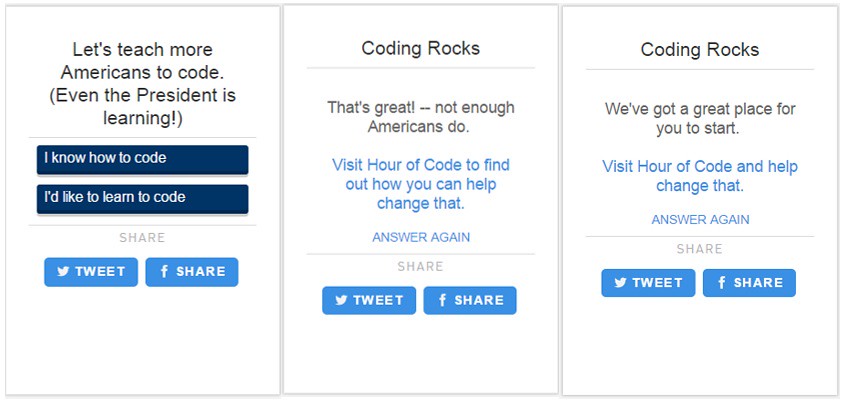
theodp writes: Coding got a couple of shout-outs from the White House in Tuesday's State of the Union Address. "Thanks to Vice President Biden's great work to update our job training system," said President Obama (YouTube), "we're connecting community colleges with local employers to train workers to fill high-paying jobs like coding, and nursing, and robotics." And among the so-called "boats" in the new "River of Content" that the White House social media folks came up with to enhance the State of the Union is a card intended to be shared on Twitter & Facebook which reads, "Let's teach more Americans to code. (Even the President is learning!)." President Obama briefly addressed human spaceflight, saying, "I want Americans to win the race for the kinds of discoveries that unleash new jobs – converting sunlight into liquid fuel; creating revolutionary prosthetics, so that a veteran who gave his arms for his country can play catch with his kid; pushing out into the Solar System not just to visit, but to stay." He also called once more for action on climate change. Politifact has an annotated version of the transcript for more background information on Obama's statements, and FiveThirtyEight has a similar cheat sheet. -
Aircraft Responsible For 2.5% of Global Carbon Dioxide Emissions
jIyajbe writes: Christie Aschwanden of FiveThirtyEight.com reports that the world's aircraft are responsible for roughly 2.5% of global carbon dioxide emissions. The industry as a whole puts out more CO2 than most countries, and emissions are expected to grow significantly over the next few decades. She writes, "Planes don't just release carbon dioxide, they also emit nitrogen oxides, sulfur oxides and black carbon, as well as water vapor that can form heat-trapping clouds... These emissions take place in the upper troposphere, where their effects are magnified. When this so-called radiative forcing effect is taken into account, aviation emissions produce about 2.7 times the warming effects of CO2 alone." A related article breaks down how much each airline pollutes, relative to the others. Alaska, Spirit, and Frontier are tied for the highest fuel efficiency score, while American beats out Allegiant Air and Sun Country for the lowest spot. -
Aircraft Responsible For 2.5% of Global Carbon Dioxide Emissions
jIyajbe writes: Christie Aschwanden of FiveThirtyEight.com reports that the world's aircraft are responsible for roughly 2.5% of global carbon dioxide emissions. The industry as a whole puts out more CO2 than most countries, and emissions are expected to grow significantly over the next few decades. She writes, "Planes don't just release carbon dioxide, they also emit nitrogen oxides, sulfur oxides and black carbon, as well as water vapor that can form heat-trapping clouds... These emissions take place in the upper troposphere, where their effects are magnified. When this so-called radiative forcing effect is taken into account, aviation emissions produce about 2.7 times the warming effects of CO2 alone." A related article breaks down how much each airline pollutes, relative to the others. Alaska, Spirit, and Frontier are tied for the highest fuel efficiency score, while American beats out Allegiant Air and Sun Country for the lowest spot. -
Designing the Best Board Game
An anonymous reader writes: Twilight Struggle tops BoardGameGeek's ranking of user-rated board games, handily beating classics like Puerto Rico, Settlers of the Catan, and Risk. FiveThirtyEight has an article about the game's design, and how certain design choices can affect enjoyment. Quoting: "Gupta has a few theories about why his game has done so well. For one, it's a two-player game — the Americans vs. the Soviets. Two-player games are attractive for a couple of reasons. First, by definition, half the players win. People like winning, and are likely to replay and rate highly a game they think they have a chance to win. ... The data offers some evidence for Gupta's hypothesis. Games that support three players rate highest, with an average of 6.58. But two-player games are a close second, with an average rating of 6.55. Next closest are five-player games, which average 6.39. ... The shortest games are the lowest rated, on average. But players don't favor length without bounds. Three hours seems to be right around the point of diminishing marginal returns. Another key to the game's success is its mix of luck and skill." What design elements do you particularly enjoy or hate in board games? -
Ars: Final Hobbit Movie Is 'Soulless End' To 'Flawed' Trilogy
An anonymous reader writes: The final chapter to Peter Jackson's series of films based on The Hobbit debuted last week, and the reviews haven't been kind. Ars Technica just posted theirs, and it highlights all the problems with Battle of the Five Armies, a two-hour and twenty-four minute film based on only 72 pages of the book. Quoting: "The battles in Battle of the Five Armies are deadly boring, bereft of suspense, excessively padded, and predictable to the point of being contemptuous of the audience. Suspense is attempted mostly by a series of last-minute saves and switches. ... There are other problems. Everyone in this movie takes themselves way too seriously, which makes them even harder to sympathize with. Peter Jackson leans way too hard on voice modulation to make characters seem menacing or powerful. The movie's tone is still way out of step with the book's tone. ... There's one big thing that doomed these movies from the outset — the fiscally smart but artistically bankrupt decision to make a single, shortish children's novel into three feature-length prequel films." Other review titles: "Peter Jackson Must Be Stopped," "The Phantom Menace of Middle Earth," and "Lots of Fighting, Not Much Hobbit." -
Linking Drought and Climate Change: Difficult To Do
Geoffrey.landis writes An article about the current California drought on 538 points out that even though global climate warming may exacerbate droughts, it's nearly impossible to attribute any particular drought to climate warming: "The complex, dynamic nature of our atmosphere and oceans makes it extremely difficult to link any particular weather event to climate change. That's because of the intermingling of natural variations with human-caused ones." They also cite a Nature editorial pointing out the same thing about extreme weather. -
What To Do If Police Try To Search Your Phone Without a Warrant
blottsie writes: The Supreme Court ruled this week that it is illegal for police to search your phone without a warrant. But just because that's the new rule doesn't mean all 7.5 million law enforcement officers in the U.S. will abide by it. This guide, put together with the help of the EFF and ACLU, explains what to do if a police officer tries to search your phone without a warrant. Of course, that doesn't mean they don't have other ways of getting your data. -
Why You Shouldn't Use Spreadsheets For Important Work
An anonymous reader writes "Computer science professor Daniel Lemire explains why spreadsheets shouldn't be used for important work, especially where dedicated software could do a better job. His post comes in response to evaluations of a new economics tome by Thomas Piketty, a book that is likely to be influential for years to come. Lemire writes, 'Unfortunately, like too many people, Piketty used spreadsheets instead of writing sane software. On the plus side, he published his code ... on the negative side, it appears that Piketty's code contains mistakes, fudging and other problems. ... Simply put, spreadsheets are good for quick and dirty work, but they are not designed for serious and reliable work. ... Spreadsheets make code review difficult. The code is hidden away in dozens if not hundreds of little cells If you are not reviewing your code carefully and if you make it difficult for others to review it, how do expect it to be reliable?'" -
Job Automation and the Minimum Wage Debate
An anonymous reader writes "An article at FiveThirtyEight looks at the likelihood of various occupations being replaced by automation. It mentions President Obama's proposed increase to the federal minimum wage, saying big leaps in automation could reshape that debate. '[The wage increase] from $7.25 to $10.10 per hour could make it worthwhile for employers to adopt emerging technologies to do the work of their low-wage workers. But can a robot really do a janitor's job? Can software fully replace a fast-food worker? Economists have long considered these low-skilled, non-routine jobs as less vulnerable to technological replacement, but until now, quantitative estimates of a job's vulnerability have been missing from the debate.' Many minimum-wage jobs are reportedly at high risk, including restaurant workers, cashiers, and telemarketers. A study rated the probability of computerization within 20 years (PDF): 92% for retail salespeople, 97% for cashiers, and 94% for waitstaff. There are other jobs with a high likelihood, but they employ fewer people and generally have a higher pay rate: tax preparers (99%), freight workers (99%), and legal secretaries (98%)." -
Nate Silver's New Site Stirs Climate Controversy
First time accepted submitter taiwanjohn (103839) writes "One of the first articles on Nate Silver's highly anticipated data-driven news site used flawed data to make its conclusions, according to some of the nation's top climate scientists. Silver's FiveThirtyEight published its first article about climate change on Wednesday, entitled 'Disasters Cost More Than Ever — But Not Because of Climate Change.' But climate scientists are condemning the article and its author, Roger Pielke Jr., saying he ignored critical data to produce a 'deeply misleading' result. The crux of Pielke's article is this: Extreme weather events are costing us more and more money, but that is not because climate change is making extreme weather more frequent or intense. The reason we are losing more money, rather, is because we have more money to lose. Pielke came to this conclusion by measuring rising disaster damage costs alongside the rising global Gross Domestic Product. He also cited a U.N. climate report, along with his own research, to assert that extreme weather events have not been increasing in frequency or intensity." -
Nate Silver's FiveThirtyEight Relaunches As Data Journalism Website
Hugh Pickens DOT Com writes "After a parting of ways with the New York Times after calling 50 out of 50 states right in the 2012 elections, Nate Silver has relaunched FiveThirtyEight as a website dedicated to data journalism under the auspices of ESPN. Silver has expanded his staff from two full-time journalists to 20 and instead of focusing on politics exclusively FiveThirtyEight's coverage will span five major subject areas — politics, economics, science, life and sports. According to Silver, his team has a broad set of skills and experience in methods that fall under the rubric of data journalism including statistical analysis, data visualization, computer programming and data-literate reporting. 'One of our roles will be to critique incautious uses of statistics when they arise elsewhere in news coverage. At other times, we'll explore ways that consumers can use data to their advantage and level the playing field against corporations and governments.' The site has launched with a variety of stories including 'Many Signs Pointed to Crimea Independence Vote — But Polls Didn't,' 'Building a Bracket Is Hard This Year, But We'll Help You Play the Odds,' 'Toilet Seat Covers: To Use or Not to Use,' and 'Three Rules to Make Sure Economic Data Aren't Bunk.'
The story that caught my eye was 'This Winter Wasn't the Coldest, But It Was One of the Most Miserable' with some good data visualization that showed that although average temperature may not have set records in the Northeast Corridor this winter, the intensity of the cold when it did hit was impressive. According to Matt Lanza although most statistics cite the winter of 1978-79 as the coldest in U.S. history, the winter of 2013-14 brought a rare combination of miseries that many of us hadn't seen in years, and some had never seen. It was colder than usual, it was extremely cold more often than usual, and it snowed more than usual in more places than usual. Traditionally, big snow winters occur in a couple regions. The East Coast might have great snows, while the Midwest is quiet. Snowfall this winter didn't discriminate; it blanketed just about everybody (outside the dry West and icier Mid-South). Look how many cities had not just a little more, but way more, than their normal snowfall." -
Nate Silver's FiveThirtyEight Relaunches As Data Journalism Website
Hugh Pickens DOT Com writes "After a parting of ways with the New York Times after calling 50 out of 50 states right in the 2012 elections, Nate Silver has relaunched FiveThirtyEight as a website dedicated to data journalism under the auspices of ESPN. Silver has expanded his staff from two full-time journalists to 20 and instead of focusing on politics exclusively FiveThirtyEight's coverage will span five major subject areas — politics, economics, science, life and sports. According to Silver, his team has a broad set of skills and experience in methods that fall under the rubric of data journalism including statistical analysis, data visualization, computer programming and data-literate reporting. 'One of our roles will be to critique incautious uses of statistics when they arise elsewhere in news coverage. At other times, we'll explore ways that consumers can use data to their advantage and level the playing field against corporations and governments.' The site has launched with a variety of stories including 'Many Signs Pointed to Crimea Independence Vote — But Polls Didn't,' 'Building a Bracket Is Hard This Year, But We'll Help You Play the Odds,' 'Toilet Seat Covers: To Use or Not to Use,' and 'Three Rules to Make Sure Economic Data Aren't Bunk.'
The story that caught my eye was 'This Winter Wasn't the Coldest, But It Was One of the Most Miserable' with some good data visualization that showed that although average temperature may not have set records in the Northeast Corridor this winter, the intensity of the cold when it did hit was impressive. According to Matt Lanza although most statistics cite the winter of 1978-79 as the coldest in U.S. history, the winter of 2013-14 brought a rare combination of miseries that many of us hadn't seen in years, and some had never seen. It was colder than usual, it was extremely cold more often than usual, and it snowed more than usual in more places than usual. Traditionally, big snow winters occur in a couple regions. The East Coast might have great snows, while the Midwest is quiet. Snowfall this winter didn't discriminate; it blanketed just about everybody (outside the dry West and icier Mid-South). Look how many cities had not just a little more, but way more, than their normal snowfall." -
Nate Silver's FiveThirtyEight Relaunches As Data Journalism Website
Hugh Pickens DOT Com writes "After a parting of ways with the New York Times after calling 50 out of 50 states right in the 2012 elections, Nate Silver has relaunched FiveThirtyEight as a website dedicated to data journalism under the auspices of ESPN. Silver has expanded his staff from two full-time journalists to 20 and instead of focusing on politics exclusively FiveThirtyEight's coverage will span five major subject areas — politics, economics, science, life and sports. According to Silver, his team has a broad set of skills and experience in methods that fall under the rubric of data journalism including statistical analysis, data visualization, computer programming and data-literate reporting. 'One of our roles will be to critique incautious uses of statistics when they arise elsewhere in news coverage. At other times, we'll explore ways that consumers can use data to their advantage and level the playing field against corporations and governments.' The site has launched with a variety of stories including 'Many Signs Pointed to Crimea Independence Vote — But Polls Didn't,' 'Building a Bracket Is Hard This Year, But We'll Help You Play the Odds,' 'Toilet Seat Covers: To Use or Not to Use,' and 'Three Rules to Make Sure Economic Data Aren't Bunk.'
The story that caught my eye was 'This Winter Wasn't the Coldest, But It Was One of the Most Miserable' with some good data visualization that showed that although average temperature may not have set records in the Northeast Corridor this winter, the intensity of the cold when it did hit was impressive. According to Matt Lanza although most statistics cite the winter of 1978-79 as the coldest in U.S. history, the winter of 2013-14 brought a rare combination of miseries that many of us hadn't seen in years, and some had never seen. It was colder than usual, it was extremely cold more often than usual, and it snowed more than usual in more places than usual. Traditionally, big snow winters occur in a couple regions. The East Coast might have great snows, while the Midwest is quiet. Snowfall this winter didn't discriminate; it blanketed just about everybody (outside the dry West and icier Mid-South). Look how many cities had not just a little more, but way more, than their normal snowfall." -
Nate Silver's FiveThirtyEight Relaunches As Data Journalism Website
Hugh Pickens DOT Com writes "After a parting of ways with the New York Times after calling 50 out of 50 states right in the 2012 elections, Nate Silver has relaunched FiveThirtyEight as a website dedicated to data journalism under the auspices of ESPN. Silver has expanded his staff from two full-time journalists to 20 and instead of focusing on politics exclusively FiveThirtyEight's coverage will span five major subject areas — politics, economics, science, life and sports. According to Silver, his team has a broad set of skills and experience in methods that fall under the rubric of data journalism including statistical analysis, data visualization, computer programming and data-literate reporting. 'One of our roles will be to critique incautious uses of statistics when they arise elsewhere in news coverage. At other times, we'll explore ways that consumers can use data to their advantage and level the playing field against corporations and governments.' The site has launched with a variety of stories including 'Many Signs Pointed to Crimea Independence Vote — But Polls Didn't,' 'Building a Bracket Is Hard This Year, But We'll Help You Play the Odds,' 'Toilet Seat Covers: To Use or Not to Use,' and 'Three Rules to Make Sure Economic Data Aren't Bunk.'
The story that caught my eye was 'This Winter Wasn't the Coldest, But It Was One of the Most Miserable' with some good data visualization that showed that although average temperature may not have set records in the Northeast Corridor this winter, the intensity of the cold when it did hit was impressive. According to Matt Lanza although most statistics cite the winter of 1978-79 as the coldest in U.S. history, the winter of 2013-14 brought a rare combination of miseries that many of us hadn't seen in years, and some had never seen. It was colder than usual, it was extremely cold more often than usual, and it snowed more than usual in more places than usual. Traditionally, big snow winters occur in a couple regions. The East Coast might have great snows, while the Midwest is quiet. Snowfall this winter didn't discriminate; it blanketed just about everybody (outside the dry West and icier Mid-South). Look how many cities had not just a little more, but way more, than their normal snowfall." -
The Art of Elections Forecasting
ideonexus writes "Years ago Nate Silver of FiveThirtyEight.com, a blog seeking to educate the public about elections forecasting, established his model as one of the most accurate in existence, rising from a fairly unknown statistician working in baseball to one of the most respected names in election forecasting. In this article he describes all the factors that go into his predictions. A fascinating overview of the process of modeling a chaotic system." -
The South Carolina Primary and Voting Machine Fraud
cSeattleGameboy writes "South Carolina sure knows how to pick 'em. Alvin Greene is a broke, unemployed guy who is facing a felony obscenity charge. He made no campaign appearances and raised no money, but he is the brand new Democratic Senate nominee from South Carolina. Tom Schaller at FiveThirtyEight.com does a detailed analysis of how a guy like this wins a primary race, and many of the signs point to voting machine fraud. There seem to have been irregularities on all sides. 'Dr. Mebane performed second-digit Benford's law tests on the precinct returns from the Senate race. ... If votes are added or subtracted from a candidate's total, possibly due to error or fraud, Mebane's test will detect a deviation from this distribution. Results... showed that Rawl's Election Day vote totals depart from the expected distribution at 90% confidence. In other words, the observed vote pattern for Rawl could be expected to occur only about 10% of the time by chance. ... An unusual, non-random pattern in the precinct-level results suggests tampering, or at least machine malfunction, perhaps at the highest level. And Mebane is perhaps the leading expert on this very subject. Along with the anomalies between absentee ballot v. election day ballots..., something smells here.' Techdirt.com points out that South Carolina uses ES&S voting machines, which have had strings of problems before; and they have no audit trail." -
Math Indicates Pollster Is Forging Results
An anonymous reader writes "Nate Silver suggests the political pollster Strategic Vision is 'cooking the books. And whoever is doing so is doing a pretty sloppy job.' Silver crunched five years worth of their polling data, and found their reported results followed a suspicious pattern which traditionally suggests fraud. The five-year distribution of the numbers 'is not random. It's not close to random.' The polling firm had already been reprimanded by the American Association for Public Opinion Research for failing to disclose their methodology, though the firm argues they did comply with the organization's request. Their response to Silver's accusation? 'We have a call in to our attorney on this and fully intend to take action that will vindicate us.'" -
How To Import Raw Political Data For Crunching
Ed Pegg writes "For those that want to get their fingers stained red and blue with actual political data, resources beyond 538 and pollster can be accessed. In a blog item for Wolfram Research, Jeff Hamrick gives step by step details for how to import raw data from Mason-Dixon, Rasmussen, and Quinnipiac. Then he uses Mathematica to analyze the political data." Related: Slashdot developer Pudge presented at OSCON in July his own approach to gathering Washington-state polling data for analysis [PDF].