Slashdot Mirror
Domain: fnal.gov
Stories and comments across the archive that link to fnal.gov.
Stories · 47
-
Scientists May Have Discovered a New Fundamental Particle: Sterile Neutrino (theregister.co.uk)
Artem Tashkinov writes: It needs more sigmas, but Fermilab boffins in America are carefully speculating that they may have seen evidence of a new fundamental particle: the sterile neutrino. The suggestion follows tests conducted by the MiniBooNE (Mini Booster Neutrino Experiment) instrument, located near Chicago. Its mission is to detect neutrino mass through their oscillations. In the Standard Model of physics, neutrinos, like all particles, are initially assumed to be massless, but some observations, like neutrino oscillation, suggest there's mass there. The experiment that possibly detected sterile neutrinos collected 15 years of data from its commissioning in 2002, and the results have only now reached pre-press outlet arXiv.
Over 15 years, MiniBooNE detected a few hundred more electron neutrinos than were predicted in Standard Model theory. The extra particles suggests there is a fourth, heavier flavor. The findings bring the MiniBooNE team tantalizingly close to a "result" -- it's a 4.8 sigma result, when "discovery" demands 5 sigma. -
White House Expected To Announce Big Computer Science Push
theodp writes: Politico reports that the White House is talking to groups about a push for computer science education in the coming weeks, possibly in mid-January, which could involve commitments from outside groups or companies. Code.org CEO Hadi Partovi recently credited a 2013 push from the White House for inspiring Code.org to dream up and team up with Big Tech on the wildly-successful Hour of Code, an event that brought teachers, schools, computer scientist volunteers, and other organizations together with the goal of bringing hands-on CS learning to 10 million K-12 students. Coincidentally, the Hour of Code event bears more than a passing similarity to the less-successful and now-abandoned National Lab Day (school flyer), an annual event announced by President Obama in 2009 that brought teachers, schools, computer scientist volunteers, and other organizations together with the goal of bringing hands-on STEM learning to 10 million K-12 students. -
A Fermilab First: Detecting Oscillating Neutrinos
An announcement at last week's American Physical Society's Division of Particles and Fields conference revealed that Fermilab's NOvA experiment has for the first time observed oscillating neutrinos, which have long been predicted but -- as a case even more special than observing neutrinos in general, not an easy task -- never before detected. The research team fired trillions of of muon neutrinos from an accelerator at the Fermilab, outside Chicago. The neutrinos travel 500 miles through Earth's crust to a detector at Ash River, Minnesota. There, scientists were able to filter through millions of cosmic ray strikes and hone in on neutrino interactions. The arriving neutrinos featured some electron neutrinos, suggesting they had oscillated along their path through Earth. "Basically, it shows that we know what we're doing," said Patricia Vahle, associate professor of physics at the College of William & Mary. -
Fermilab Begins Testing Holographic Universe Theory
Back in 2009, researchers theorized that space could be a hologram. Four years ago, Fermilab proposed testing the theory, and the experiment is finally going online. Jason Koebler writes Operating with cutting-edge technology out of a trailer in rural Illinois, government researchers started today on a set of experiments that they say will help them determine whether or not you and me and everything that exists are living in a two-dimensional holographic universe. In a paper explaining the theory, Craig Hogan, director of the Department of Energy's Fermilab Center for Particle Astrophysics writes that "some properties of space and time that seem fundamental, including localization [where things are], may actually emerge only as a macroscopic approximation from the flow of information in a quantum system." In other words, the location of places in space may constantly fluctuate ever so slightly, which would suggest we're living in a hologram. -
Physics Forum At Fermilab Bans Powerpoint
Hugh Pickens DOT Com writes "Amanda Solliday reports at Symmetry that six months ago, organizers of a biweekly forum on Large Hadron Collider physics at Fermilab banned PowerPoint presentations in favor of old-fashioned, chalkboard-style talks. 'Without slides, the participants go further off-script, with more interaction and curiosity,' says Andrew Askew. 'We wanted to draw out the importance of the audience.' In one recent meeting, physics professor John Paul Chou of Rutgers University presented to a full room holding a single page of handwritten notes and a marker. The talk became more dialogue than monologue as members of the audience, freed from their usual need to follow a series of information-stuffed slides flying by at top speed, managed to interrupt with questions and comments. Elliot Hughes, a Rutgers University doctoral student and a participant in the forum, says the ban on slides has encouraged the physicists to connect with their audience. 'Frequently, in physics, presenters design slides for people who didn't even listen to the talk in the first place,' says Hughes. 'In my experience, the best talks could not possibly be fully understood without the speaker.'" -
Transporting a 15-Meter-Wide, 600-Ton Magnet Cross Country
necro81 writes "Although its Tevatron particle accelerator has gone dark, Fermi Laboratory outside Chicago is still doing physics. A new experiment, called muon g-2 will investigate quantum mechanical behavior of the electron's heavier sibling: the muon. Fermi needs a large ring chamber to store the muons it produces and investigates, and it just so happens that Brookhaven National Laboratory outside NYC has one to spare. But how do you transport a delicate, 15-m diameter, 600-ton superconducting magnet halfway across the country? Very carefully." -
New Director Chosen At Fermilab
An anonymous reader writes "It appears that Fermilab has chosen a a new director. They refuse to release the name of the new director, only referring to him as 'The Doctor'. Citing their primary reasons for choosing him: 'It was his extensive experience, as well as his vague yet somehow still impressive educational background, that tipped the scales in the Doctor's favor, members of the committee said. This despite the fact that none of the members could determine with any certainty exactly what the new lab director's doctorate is in. "After facing down Daleks, Cybermen and the Master, I can't think of anyone more qualified to take on a congressional budget committee," outgoing director Pier Oddonesaid said. "I think the Doctor is a perfect choice."'" -
Tour of the Deep Underground Science and Engineering Lab
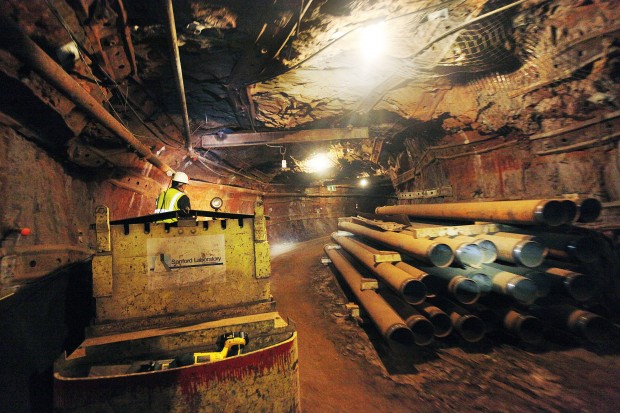
lukej writes "Over eleven years ago, the possibility of using the retired Homestake Mine as an underground science laboratory was first proposed. Today the local newspaper gives a science-filled tour of that facility, along with a short photo tour, and decent descriptions of some of the experiments it hosts (Majorana, LUX, Long Baseline Neutrino Experiment). Some fairly interesting deep, dirty, and real physical science!" -
Precise W Boson Mass Measurement Helps Lead the Way To the Higgs Boson
New submitter SchrodingerZ writes "'The world's most precise measurement of the mass of the W Boson, one of nature's elementary particles, has been achieved by scientists from the CDF and DZero collaborations at the Department of Energy's Fermi National Accelerator Laboratory.' This new number (80387 +- 17 MeV/c^2) puts more constraint on the mass of the theorized Higgs Boson, which is theorized to give mass to all other things, supporting the standard model. 'Scientists employ two techniques to find the hiding place of the Higgs particle: the direct production of Higgs particles and precision measurements of other particles and forces that could be influenced by the existence of a Higgs particle.'" -
The Recycling of the Tevatron
ananyo writes with an excerpt from an article in Nature about the decomissioning of the Tevatron: "It is a 4,000-tonne edifice that stands three stories high, chock full of particle detectors, power supplies, electronics and photomultiplier tubes, all layered like a giant onion around a cylindrical magnet. During 26 years of operation at the Fermi National Accelerator Laboratory in Batavia, Illinois, this behemoth, the Collider Detector at Fermilab (CDF), helped to find the top quark and chased the Higgs boson. But since the lab's flagship particle collider, the Tevatron, was switched off in September 2011, the detector has been surplus stock — and it is now slowly being cannibalized for parts." Currently other projects are taking small bits and pieces of the Tevatron, but another Fermilab project, ORKA, wants to gut the collider to study kaon decay. -
Data Review Brings Major Setback In Higgs Boson Hunt
Velcroman1 writes "The quest for the elusive Higgs boson seemed over in April, when an unexpected result from an atom smasher seemed to herald the discovery of the famous particle — the last unproven piece of the physics puzzle and one of the great mysteries scientists face today. Scientists with the Tevatron particle accelerator at Chicago's Fermilab facility just released the results of a months-long effort by the lab's brightest minds to confirm the finding. What did they find? Nothing. 'We do not see the signal,' said Dmitri Denisov, staff scientist at Fermilab. 'If it existed, we would see it. But when we look at our data, we basically see nothing.'" -
Fermilab Confirms Evidence of 4th Flavor Neutrino
eldavojohn writes "We've only had evidence for three kinds of neutrinos so far, but a recent test at Fermilab involving an antineutrino beam has reinforced a Michigan researcher's earlier experiment suggesting a fourth flavor. What's really odd about this is that a prior neutrino test (carried out as part of project MiniBooNE) did not result in indications of such strange oscillations. According to the researcher, 'The simplest explanation involves adding new neutrino-like particles, or sterile neutrinos, which do not have the normal weak interactions.' But this could also be an unknown or misunderstood effect. A Los Alamos National Laboratory scientist added that an explanation of this strange anomaly could result in understanding 'matter asymmetry of the universe, or why the universe is primarily composed of matter, rather than antimatter.' The results are published in the Physical Review Letters." -
Matter-Antimatter Bias Seen In Fermilab Collisions
ubermiester writes "The New York Times is reporting that scientists at Fermilab have found evidence of a very small (about 1%) average difference between the amount of matter/antimatter produced in a series of particle collisions. Quoting: '[T]he team, known as the DZero collaboration, found that the fireballs produced pairs of ... muons ... slightly more often than they produced pairs of anti-muons. So the miniature universe inside the accelerator went from being neutral to being about 1 percent more matter than antimatter.' This finding invites theorists to explain why there is so much more matter than antimatter in the universe, when the Standard Model suggests that there should be equal amounts of each." Here is the paper as submitted to Physical Review (PDF). The DZero team is looking forward to getting detailed data from the LHC once it ramps up operationally. -
Fermilab Detects "Doubly Strange" Particle
DynaSoar writes "While its cousin/competitor site, the Large Hadron Collider at CERN, remains offline, Fermilab's Digital Hadron Calorimeter continues to produce significant results. Recently Fermilab announced discovery of the Omega-sub-b baryon, a 'doubly-strange' particle. This baryon, containing two strange quarks and one bottom quark, has six times the mass of a proton. 'The Omega-sub-b is the latest entry in the "periodic table of baryons." Baryons are particles formed of three quarks, the most common examples being the proton and neutron. ... The observation of this "doubly strange" particle, predicted by the Standard Model, is significant because it strengthens physicists' confidence in their understanding of how quarks form matter. In addition, it conflicts with a 2008 result announced by CDF's sister experiment, DZero. In August 2008, the DZero experiment announced its own observation of the Omega-sub-b based on a smaller sample of Tevatron data. This result contradicted some predictions of the Standard Model, suggesting a "new physics." The new result leads to the possibility that the prior results are not accurate.'" -
AT&T Dropping Usenet Netnews; Low-Cost Alternatives?
franknagy writes "This announcement message has appeared in all the news groups on the AT&T/SBC News Server: 'Please note that on or around July 15, 2009, AT&T will no longer be offering access to the Usenet netnews service. If you wish to continue reading Usenet newsgroups, access is available through third-party vendors.' So what free or low-cost alternatives are available for Netnews and the NNTP services for clients?" -
New Neutrino Detector Being Built In Minnesota
lithis writes "NOvA, a new neutrino detector, is being built in northern Minnesota. MPR has information on the project's funding and the International Falls Daily Journal talks about the environmental issues. This detector will complement the MINOS neutrino detector in the Soudan Underground Laboratory." -
New Neutrino Detector Being Built In Minnesota
lithis writes "NOvA, a new neutrino detector, is being built in northern Minnesota. MPR has information on the project's funding and the International Falls Daily Journal talks about the environmental issues. This detector will complement the MINOS neutrino detector in the Soudan Underground Laboratory." -
Higgs Territory Continues To Shrink
PhysicsDavid writes "Announced this morning by Fermilab, the possible territory for the Higgs boson has shrunk even further. Combined results from the CDF and DZero experiments at the Tevatron have ruled out the existence of the Higgs with a mass between 160 and 170 GeV/c^2 with 95% confidence. At 90% confidence the Higgs is ruled out between about 157 and 185 GeV/c^2. Here is Fermilab's press release. If the Higgs is to be found at the lighter end of the currently allowed range of 114 GeV/c^2 to 185 GeV/c^2, its detection will be harder than at the heavier end due to the kinds of signals that the Large Hadron Collider and the Tevatron will see. Some physicists think that a lighter Higgs will be easier to spot at the Tevatron as the background processes which obscure the faint signal are not as prevalent in those experiments." -
"Cascade B" Particle Discovered At Fermilab
pnotequalsnp writes to note that physicists at Fermilab have discovered a new heavy particle called the Cascade B. This is the first particle ever seen that is made up of quarks representing all three quark families. A team of 610 physicists from 88 institutions reported the discovery in a paper submitted to Physical Review Letters last week. This must be the discovery that triggered rumors that the Higgs had been found. -
MacGyver Physics
counterfriction writes "This month's issue of Symmetry, a magazine jointly published by SLAC and Fermilab, is featuring an article that points out the sometimes extemporaneous and unconventional solutions physicists have come up with in (and out of) the laboratory. From the article: 'Leon Lederman ... used a pocket knife, tape, and items on anyone's grocery list to confirm that interactions involving the weak force do now show perfect mirror symmetry, or parity, as scientists had long assumed.'" -
Neutrino Experiment Restores Standard Model Symmetry
perturbed1 writes "A Fermilab press release announced that MiniBooNE's latest results have salvaged the Standard Model of particle physics. The experiment ruled out the simple neutrino oscillation interpretation of the 1990s LSND experiment. Neutrinos have a tiny amount of mass, required by their oscillations, as observed in solar, atmospheric, and reactor neutrino experiments. Combining this mass with the LSND experiment's results required the presence of a fourth but 'sterile' neutrino, breaking the 3-fold symmetry of particle families in the standard model." Nice to see some good news out of Fermilab after the CERN debacle. -
Neutrino Experiment Restores Standard Model Symmetry
perturbed1 writes "A Fermilab press release announced that MiniBooNE's latest results have salvaged the Standard Model of particle physics. The experiment ruled out the simple neutrino oscillation interpretation of the 1990s LSND experiment. Neutrinos have a tiny amount of mass, required by their oscillations, as observed in solar, atmospheric, and reactor neutrino experiments. Combining this mass with the LSND experiment's results required the presence of a fourth but 'sterile' neutrino, breaking the 3-fold symmetry of particle families in the standard model." Nice to see some good news out of Fermilab after the CERN debacle. -
Serious Magnet Failure at CERN's New Accelerator
GrepNut writes "CERN is reporting that the giant magnets that steer the particle beam in the new and highly anticipated Large Hadron Collider have just failed catastrophically in a stress test, apparently due to a design oversight. It doesn't help that the magnets were designed and built by CERN's US competitor Fermilab." While safety precautions were followed, and no one was injured nor were any rifts in the space-time continuum opened, it's still a rather large setback for the project. -
PostgreSQL vs. MySQL comparison
prostoalex writes "Ever find yourself wondering which open source database is the best tool for the job? Well, wonder no more, and let your tax dollars do the work in the form of Fermi National Accelerator Laboratory publishing this unbiased review of MySQL vs. PostgreSQL. After reading it, however, it seems that MySQL ranks the same or better on most of the accounts." My poor sleepy eyes misread the date of posting on here; caveat that this is more then 15 months old. -
Mesons Flip Between Matter and Antimatter
steve writes "A team of over 700 physicists at Fermilab's Tevatron accelerator have observed the B-sub-s meson oscillating between matter and antimatter states at 3 trillion times a second. From the Fermilab press release: 'Immediately after the Big Bang some 13 billion years ago, equal amounts of matter and antimatter formed. Much of it quickly acted to annihilate the other, but for little-understood reasons, a bit more matter than antimatter survived, providing the universe with the planets, stars and galaxies visible today.' The Standard Model predicted the oscillation, and Fermilab has been working for 19 years to confirm it. The announcement is good press for Fermilab, which is pushing Congress to build a new 18-mile-long International Linear Collider." -
Is SETI a Security Risk?
Dotnaught writes "Richard Carrigan, a particle physicist at the US Fermi National Accelerator Laboratory in Illinois, fears the Search for Extra-Terrestrial Intelligence (SETI) may be putting the earth at risk. As reported in the Guardian, Carrigan frets that alien radio signals could pose a security risk. The report cites a 2003 paper entitled "Do potential Seti signals need to be decontaminated?" but Carrigan's website has more details. Basically, he's calling for isolation of SETI computers and additional security measures. He writes, "To paraphrase Cocconi and Morrison for the possibility of a malevolent SETI signal ...the probability of a contaminated SETI signal is difficult to estimate; but if we never consider it the chance of infection is not zero."" Frankly, I'm more worried about some phishing malcontent then I am about the Grays, but maybe that's just me. -
Fermilab Reports Dark Energy Not Needed
An anonymous reader writes "A Fermilab press release reports that the expansion of the universe may be explainable without the need for dark energy or a cosmological constant. Apparently, ripples from inflation in the early universe may account for the observed expansion rate of the universe." -
Fermilab Antimatter Lab to Hold Limited Tours
chigun writes "Fermilab is shutting down its normal operations for maintenance for 9 weeks and during this time will be conducting tours of its facilities. The fact that they are the only people capable of producing antimatter is pretty cool as well." -
SELEX at Fermilab Discovers New Particle
sellthesedownfalls writes "Scientists at the Department of Energy's Fermi National Accelerator Laboratory will announce on Friday, June 18 the observation of an unexpected new member of a family of subatomic particles called 'heavy-light' mesons. The new meson, a combination of a strange quark and a charm antiquark, is the heaviest ever observed in this family, and it behaves in surprising ways -- it apparently breaks the rules on decaying into other particles. See the Fermilab Press Release." -
Fermilab Builds 500-Megapixel Camera
heyitsme writes "Fermilab, a U.S. Department of Energy research lab, is part of a collaboration on an experiment to measure the properties of dark energy. The Dark Energy Survey would measure the history of the expansion rate of the universe more precisely than ever before, using the largest camera ever built with Charge Coupled Devices (CCD). The 500 megapixel Dark Energy Camera (DECam) would be placed on an existing 4-meter telescope located in north-central Chile at the National Optical Astronomy Observatory's Cerro Tololo Inter-American Observatory. The DECam together with the CTIO 4-meter telescope will allow for a survey of 15 percent of the sky to light levels faint enough to measure the colors of galaxies at redshift one." -
Fermilab Builds 500-Megapixel Camera
heyitsme writes "Fermilab, a U.S. Department of Energy research lab, is part of a collaboration on an experiment to measure the properties of dark energy. The Dark Energy Survey would measure the history of the expansion rate of the universe more precisely than ever before, using the largest camera ever built with Charge Coupled Devices (CCD). The 500 megapixel Dark Energy Camera (DECam) would be placed on an existing 4-meter telescope located in north-central Chile at the National Optical Astronomy Observatory's Cerro Tololo Inter-American Observatory. The DECam together with the CTIO 4-meter telescope will allow for a survey of 15 percent of the sky to light levels faint enough to measure the colors of galaxies at redshift one." -
Fermi Lab Compromised by Pirate
tttonyyy writes "The US Department of Energy sounded a full scale alert after machines were compromised at the Fermi National Accelerator Laboratory, according to this BBC article. It turns out that the hacker was a student using the machines to download and store music and movies." -
Do Neutrinos Have Mass?
amyjigglypuff writes "MINOS, a joint project between Fermi National Accelerator Laboratory and the University of Minnesota, is going to attempt to uncover the mysteries of the neutrino. Scientists plan to study the mass of neutrinos, whether they are stable or oscillate, and their electromagnetic structure. If they are found to have mass, it could prove that neutrinos are responsible for the cosmic "dark matter" that has baffled scientists for decades. Here is a link for scientists and a summary for the general public." -
Sloan Digital Sky Survey
Swannie writes: "There's a story in today's Chicago Tribune about a joint project that Fermi Lab is taking on with Rensselaer Polytechnic Institute in New York. The goal is to produce a 3D map of the universe using a really big digital camera, and a really creative way to add "depth" to the image. The article has some decent technical details for a newspaper, including a pretty picture." Update: 03/12 15:44 GMT by M : The blurb is in error. A particular scientist from Rensselaer is mentioned in the article, but Rensselaer isn't part of the project as an institution. -
Tevatron Powers Up
TikkaMassala writes: "It seems the most powerful particle accelerator in the world has been fired up and accelerating particles. Maybe Tevatron will find the Higgs boson? Only time will tell. Due to its size and power, great things are expected from this PA. Check it out at the BBC. Fermilab's website is here." -
Tevatron Beams Turn On At FermiLab
skwang writes: "This press release at Fermi National Accerator Labratory (FermiLab) announces the start of "Collider Run II." FermiLab collides protons and anti-protons in order to study high-energy phyisics (HEP). One of the labs goals is to find the Higgs Boson, an elementary particle that couples with mass. More information about Run II Physics can be found at the FermiLab Web site or at the detector Web Sites: D-Zero (D0) and Collider Detector at FermiLab(CDF)" -
Tevatron Beams Turn On At FermiLab
skwang writes: "This press release at Fermi National Accerator Labratory (FermiLab) announces the start of "Collider Run II." FermiLab collides protons and anti-protons in order to study high-energy phyisics (HEP). One of the labs goals is to find the Higgs Boson, an elementary particle that couples with mass. More information about Run II Physics can be found at the FermiLab Web site or at the detector Web Sites: D-Zero (D0) and Collider Detector at FermiLab(CDF)" -
Tevatron Beams Turn On At FermiLab
skwang writes: "This press release at Fermi National Accerator Labratory (FermiLab) announces the start of "Collider Run II." FermiLab collides protons and anti-protons in order to study high-energy phyisics (HEP). One of the labs goals is to find the Higgs Boson, an elementary particle that couples with mass. More information about Run II Physics can be found at the FermiLab Web site or at the detector Web Sites: D-Zero (D0) and Collider Detector at FermiLab(CDF)" -
Tevatron Beams Turn On At FermiLab
skwang writes: "This press release at Fermi National Accerator Labratory (FermiLab) announces the start of "Collider Run II." FermiLab collides protons and anti-protons in order to study high-energy phyisics (HEP). One of the labs goals is to find the Higgs Boson, an elementary particle that couples with mass. More information about Run II Physics can be found at the FermiLab Web site or at the detector Web Sites: D-Zero (D0) and Collider Detector at FermiLab(CDF)" -
First Direct Evidence Of Tau Neutrino
leb writes: "An international collaboration of scientists at the Department of Energy's Fermi National Accelerator Laboratory will announce on Friday, July 21, the first direct evidence for the subatomic particle called the tau neutrino, the third kind of neutrino known to particle physicists. This site has extensive coverage of the event with pictures and related material. The new direct evidence for the tau neutrino is far from closing the chapter on neutrino physics. Scientists are eager to learn whether neutrinos have mass, a result that would put a crack in the Standard Model, leading to major changes in our picture of the evolution of the universe." The site has some great explanatory diagrams to boot. -
Interview: Dr. Leon Lederman Answers
This week's interview with Nobel Prize-winning physicist Leon M. Lederman was conducted verbally, in person, by Slashdot reader Rich Wellner, who transcribed everything you'll read below. A lot of work! (Thanks, Rich.) The questions he asked were the creme de la creme of those you submitted Monday.This interview with Dr. Leon Lederman was conducted on the morning of 1/12/00 in the Art Gallery at Fermilab. Dr. Lederman was quite gracious despite a couple of technical problems with the camcorder used to capture it, and I want to again thank him for taking time out of his schedule to talk with us. -[rw2 AKA Rich Wellner]
1) What's around the corner?
by BuckoA century ago it was noted that, "...except for just a few little problems with the hydrogen spectrum, all of physics had been solved."
In your opinion, what are the outstanding problems that are likely to be solved in the foreseeable future?
Dr. Lederman:
Let's stick to physics ok? :)
In physics, there is a feeling of optimism that the problem we've been beating our heads against for the last 20 years or so, the generic problem of the Higgs, might be solved. We proposed the Superconducting Super Collider. The motivating feature was to expose the Higgs or confront the Higgs phenomena with experimental data. We knew from what the Higgs was supposed to do that the energy of the Super Collider would certainly confront that issue. In other words the Higgs would be a failed hypothesis if it didn't show up the energies of that Texas machine. Well, the Texas machine is not being built.
On the other hand, the data that is being accumulated in the interim, for the last five years or so, excites the theorists into thinking that the Higgs might be a lower mass particle. That we don't need that huge machine to begin to confront it. The Higgs may be a placeholder for a class of particles that might go up in mass quite a ways, but at least the lowest mass particles are now believed to not be that heavy. They might even be found at Fermilab in Run II, the next run of the large detectors, or at the machine to be completed in Europe, the Large Hadron Collider. It's supposed to start operating in 2006 so give it another three or four years after that. These are all foreseeable future things.
Higgs is also coupled with ideas of supersymmetry and supersymmetry gives us a plethora of new particles to play with [he chuckles here, as SUSY, by some theories, would introduce hundreds of new particles]. There again, the lowest mass particles may well be in Run II at Fermilab or in the new European machine. It may be fair to say that by 2020 or so if the European machine and the Fermilab machine fail to find supersymmetry that the theory may be dead because the energies then will be high enough to produce the lowest mass supersymmetry particles.
If that's true then that's a big shake up, because, although I don't know enough about the implications of strings, I think that the string theory itself might be in trouble because it does tend to predict the supersymetric particles. No masses, no real numbers, but that would be a shake up of the theory.
There are a lot of interesting things that will happen in the foreseeable future of particle physics.
Now, I know it's hard to believe, but there's physics that isn't particle physics. Some of it is even interesting! :)
For me the more interesting thing is in the complexity of say condensed matter physics and the other fields that it borders, including material science and some pieces of chemistry, is covered by the word emergence. Some complexity experts believe that out of complexity will emerge new laws of physics that can't be reduced to quarks and leptons.
We treat that with a great deal of skepticism. We don't know though, and that would be an interesting thing to see. That would be a first time in science that a theory can't be reduced.
The curious thing about particle physics, this is Steve Wienberg's argument, is you can start with any subject. Why is the sky blue? Why are the clouds white? Why? Why? Why? There's Dennis the Menace in the front row asking all these questions. You continue to ask why. You say why is the cloud white? Because it reflects all colors. Why does it reflect all colors? You get down to a discussion of spectrum and ultimately the questions will end up at the properties of quarks and leptons. All arrows point to quarks and leptons, for any question in any science if you keep asking why. If you ask what is the meaning of love, then it will be a little more difficult, but with enough hand waving you can get down to quarks and leptons.
Unfortunately we can't go the other way. Maybe philosophically that's not quite around the corner. That might not be foreseeable, but someday we might be able to go the other way. We have no clue now as to how to explain a virus starting with quarks and leptons, in fact we can't even explain the curious properties of the carbon atom. Bucky Balls or a girl's best friend. We couldn't have predicted a diamond from knowing everything that we know about carbon. On the other hand once you have a diamond you can reduce that to the proper behavior of quarks and leptons.
Technology of course is open ended, but we'll stay with science.
2) Big $ Projects
by t-moneyProf. Lederman, I am a Ph.D. student in plasma physics, a subfield of physics that has many large scale (both in physical and budgetary size) experimental projects. High Energy experiments tend to be even bigger and require more manpower. I see this having two negative effects: (1) More money means more politics, and (2) experimental physics seems much harder to do in a university campus setting. My question(s) -- what is your forecast of the political status of scientific research and where do you think government research money will go in the future?
Dr. Lederman:
These are reasonable questions. I think that first of all we need to have a better picture of the history.
The history of shared facilities probably began with astronomers. astronomers needed big telescopes and, most of the time, a campus couldn't afford a big telescope, so those were community objects in a sense. Philanthropy and government combined to build these huge telescopes. The astronomers, who were mostly academic, would teach their courses and have to go off to Palomar, or wherever the big telescope was, for their few nights of observations. Another discipline that needed cooperation was oceanography. You can't have an oceanographic row boat. You need a big ship, fully equipped with all the stuff you need to explore the depths of the ocean. Again, shared facilities. Geologists and oceanographers would get their time on the ship, they would get their time off from teaching, go on the ship and get their observations done and reduce the data back at the university.
Particle physics came into this in the 50s. Just after WWII most large universities built their own accelerators, with the help of the government, but they were their own experiments. Those were the good old days. You could teach a class, walk across campus to the laboratory, and run the accelerator for a certain length of time. Usually you and a graduate student would operate the machine.
Then something happened when universities collaborated to build a machine out on Long Island. That was the beginnings of consortia of universities getting together to build machines and share the facilities. That's been going on for 50 years, this idea of sharing expensive facilities. It has it's sociological drawbacks, it has some advantages also.
Fermilab is sort of a frontier of that subject where 80 some odd universities manage Fermilab for the world scientific community. You know you have the flags out there and you go to the playground and you hear the kids playing in a hundred different languages. That itself is an advantage. When the lab opened in '72 the first foreign group that came were Soviets. The came with their equipment and their families and they did one of the first experiments at Fermilab. They lived here and their kids went to school in Batavia and West Chicago. I think they went home different people from when they came, so there are those advantages.
Aside from modest things like world peace, there are other benefits to this. If you go to a large group there are benefits to communication between people of different upbringing. You see the guy from Georgia Tech interacting with the guy from Harvard, so those cultures merge. In addition you have the foreign cultures coming and getting along, so we know each other a lot better. Then you have the virtue that because it's a large group you can afford to have engineers and technicians full time and therefore relieve the physicist from the drudgery of all these technical things. This, of course, also has a dark side because the technical things are useful.
Big science is really growing. There was a report a few years ago from the chemists, sort of a global overview of chemistry, and it showed a graph of shared facilities. Very expensive mass spectrographs or die lasers are in these facilities and the shared facility curve was zooming up. As science gets more sophisticated, as the problems get harder, we tend to collaborate more and share facilities. That's a given. That's going to go on forever. Look at the way universities kick in to Fermilab, it's not as easy as it used to be. Although technology is now allowing people to spend more time on campus. These days you can run a shift from your office, or you can certainly be available to debug that part of the apparatus that only you know about.
There were other hard things like, I'm scheduled to run in January so what I'll do is double teach the semester before so that I'm off in January. Of course, the accelerator is unreliable so if it doesn't work in January, then you have this confusion, but we live with that. Academic life for people involved with high energy physics, astronomy or oceanography or even if you're a social scientist, an area expert, being away from campus is part of the life. If you're an expert on Lower Slobovenia you have to spend a year there once in a while.
Group meetings can be done by video conferencing and we do a lot of that now and that will increase. That's the good news. Countries are going to be involved in research. All we have to do is look at our booming economy and see how much of it is a result of research that was done within the last fifty years. An enormous amount of it. We know that life on this planet is going to involve increasing amounts of technology which is driven by science. It's all an interactive thing, the more technology you have the better science you can do, the better the science you can do the better technology you generate. It's a non-linear curve and developing countries all over the world have gotten the message that science is the way to join the 'have' countries. That's a major problem because we want them to so they can be better customers, and b) take care of themselves better and provide less in the way of grist for mill of the disgruntled who raise a lot of the trouble.
I think science will continue, we'll have to adjust to lives that are a little bit unpredictable, but I think that we may return to an epoch where you can stay on campus a lot longer and still be collaborative. Collaborations will be the answer, big money projects require the national and international collaboration. Perhaps if the SSC had been international in construction it wouldn't have been canceled. That's a big if, but that's one of the lessons we learned. We'll never do that again alone.
3) What will happen to journals?
by OtterAs a biologist, I've been interested to see how rapidly the physics community has embraced new methods of publication. (The WWW being one example.) In the next 20-30 years, do you think that paper journals with online archives will persist as the standard in most sciences or will online-only journals reach the same level of prominence?
Dr. Lederman:
Oh gosh, that's a hard question. We've been predicting the end of books and paper for a long time. In fact the use of paper is increasing. There's more paper around than ever before and you can still go to a bookstore and fondle a book, hold it to your cheek and say how nice, I'm never going to get rid of you, I'm never going to read you from a screen because I want a copy of you. Even if I never touch it, every time I go by the book shelf I look at that rosy red book I think, gee that was fun to read that.
I think in that sense history shows us to be very conservative. I think there will be a lot of online stuff, preprints were the predecessors to the online materials and they were gobbled up immediately by the web. Now we don't have to wait weeks for the preprints. If someone has an idea worth disseminating it's immediately disseminated. The big problem is we don't have these 'Good Housekeeping Seal of Approvals'. I've often thought someone could make a lot of money, I'm throwing this out there for the would-be millionaires or billionaires, in quality assurance. What would save people a lot of time would be a little code. For $10 a year you get access to this code that will tell you this is worth reading. You're an entrepreneur and you hire 100 graduate students on all fields. They may get things wrong, but so what, a few mistakes won't hurt anything. That's what we need though, is something to prune all the material. Now it's done by the network, oh there's Joe and Joe's a good guy, I'm going to read his stuff. That comes from the graduate students sitting in classes with fellow graduate students and then they fan out and you have that connection for life. So, be nice to that guy sitting next to you in class because he's going to be your colleague for the rest of your life.
4) Physics on a shoestring budget
by MAXOMENOSSo...now that Congress has more or less gutted funding for pure science, how can we change the way we do Physics to make up the difference? Could the next Physics breakthrough be done in someone's garage, for example? If this is the case, what advice do you have to offer those who want to conduct (experimental) physics research on a shoestring budget?
Dr. Lederman:
Well, first of all I don't think 20 billion dollars a year is gutted. The basic research budgets sort of squeak through. Again the increases weren't nearly enough to make up for what we need every year, which is inflation at a few percent a year, but more than that it's complexity. Every year the problems get harder, because we solved the easy ones last year. That complexity factor needs to be folded in if you want to keep research at a constant level. I think that whole thing might be somewhere between 5 and 10% a year, some number like that. I don't know what happened this year.
Of course we have the phenomena in the U.S. of the National Institutes for Health. Everyone wants to be healthy, especially congressmen. I'm not saying congress is sick... I guess I am saying congress is sick :) The NIH has been very well managed though, so that they are getting the bulk of the increase. Their budgets have zoomed up. I'm not against that, I think that's fine. I think it's money well spent. I just don't like to see the physical sciences suffering, and they are suffering. Both relatively and absolutely, so we have a fight on our hands to keep the physical sciences budgets growing. It's not a catastrophe though. The high energy budget is up 4% or something like that. It's not what we need, but we can live with that.
The shoestring idea is an interesting one, and I'm not saying that you can't have bright ideas that are possible to check with a moderate amount of equipment, but the shoestring is going to be pretty elaborate, like the table top experiments. If you look at table top experiments, which are often cited as being warmer and fuzzier and more intimate than the huge experiments that are done at particle physics labs or astronomical labs, small science is an enviable thing and I think there ought to be funds available to support good ideas. Good is determined in the usual way, by peer review. In the garage and shoestring is kind of an exaggeration and I would say not very possible. Table top experiments, if the table is reinforced with some i-beams :), can do lots of good physics with small, but also moderately expensive, apparatus. The quintessential small field is condensed matter physics, but condensed matter physics is thriving from these synchrotron light sources and a synchrotron light source is a three or four hundred million dollar device which produces x-rays of enormous intensity. Those are tremendous facilities, but they give you an insight into materials that you couldn't get any other way. Without that i think the field would be crippled.
The tendency is towards bigness because, like i said, we solved the easy problems last year and the harder problems require more equipment, but I'm extremely enthusiastic to keep individual initiatives alive and encouraged. In the big experiments the people that are participating are in small groups. A typical high energy group might be a professor, two or three assistant profs, 4-5 post docs and some grad student beasts of burden. That group will encourage all kinds of initiatives within the group and then when that group sits in this huge hall in a group meeting with one of these huge detectors which have 500 collaborators then it's up to the professor to push the grad student who had the idea and say, ok now it's your turn, get up, raise your hand, tell them what you told me.
Even though these publications have hundreds of names there are 20-30 professors in the group who know the students very well and that compensates for the fact that the publication doesn't advertise your virtues. I think if we can adopt Christmas card technologies we should make the people who had the good ideas have their names flash on and off. :)
Oh yeah, one last question: Cubs fan or Sox fan?
Cubs of course.
5) Propulsion Physics
by aibrahimI am a member of the contributor network for NASA's Breakthrough Propulsion Physics Program. The objective of the program is to create new propulsion and energy technologies that would allow mankind to reasonably travel within the solar system and to nearby stars.
Given the staggering problems, what sources of propulsion and energy do you envision that might realistically allow humanity to travel within the solar system with relative ease ?
What solutions do you see for radioactive shielding on such trips? Do you think we will always be bound to using massive shields, or will we become able to use some sort of electromagnetic barrier?
Dr. Lederman:
This is the typical question that's over my salary level. I'm not expert on these things. :)
My own feeling would be pessimistic, but I would tune in my mind on Star Trek and see what ideas they've had. They've been working at this for a long time. Of course antimatter propulsion comes to mind. I think NASA and the military have paid real money to look at antimatter propulsion.
Fermilab is probably the most prolific source of antimatter right now. We have a machine that makes hot and cold running anti-matter and if that machine were made one hundred times more efficient, we made 100x as many anti-protons as we do now, then it would take a at least a few thousand years to make a milligram of anti-matter. We shouldn't hold our breath. No one can predict some huge breakthrough on how to make more antimatter more rapidly and so on, but it doesn't look very promising as a thing to look into. I wouldn't recommend an all out crash program.
Everything else that's dramatic in this business is so speculative that it doesn't call for crash programs. There was a big flap about magnetic poles once. Some of the defense industries took out patents on ideas regarding the usefulness of a magnetic pole for propulsion. You know, it's a little like holding a fish out in front of a horse so the horse chases the fish and pulls the sled.
It doesn't look as if there's anything other than the kinds of things people are working on now. As far as radioactivity, that will be a problem for long term exposures in space and I don't see a solution to that except a burden on the mass that you have to transport.
Unless we can understand the human genome and convert ourselves into small insects for the duration, but you have to remember that if you make a tiny mistake in the DNA, you stay an insect. Or worse. :-)
6) Physics and social responsibility
by pqSir: Every physicist seems to have their own personal stance on social responsibility, ranging from "We have none or very little" (a shallow reading of Feynman) to "It is our duty to educate the (possibly uninterested) layperson about our discoveries, and their potential for good and evil."
Where do you place yourself on this continuum? Do you feel that science is inherently agnostic, and we should go ahead and use it in any way we can, since if we don't, someone else will? Or do you believe that scientists have a moral and ethical responsibility to think through the consequences of their research? What do you feel about the collision between public funding of science, the increasing apathy and ignorance of the general public, and the expectation of a return on investment in basic sciences?
Dr. Lederman:
Here I weigh in strongly on ethical and moral responsibility. I think it's clear that science, by itself, is value free. Almost any scientific idea that has any applications at all can be applied for the benefit or to the detriment of the human condition.
It's interesting that we've just lived through a century in which the driving force for research has been, well, you can call it greed and fear. Greed in the sense that much of it was commercial. Fear in the sense that a lot of it was defense. So, defense and commercialism were the main funders of research. Somehow in spite of that there was enough support for what we like to call curiosity driven research. Research which scientists wanted to do because they must know the answers to the questions, so we had probably the most scientific century in history.
The end of the century we were very much aware, it's almost more than a symbolic result of some ancient Roman calendar maker who decided that this is the year 2000, we're at an epoch were technology is growing so rapidly and the effect of the technology is changing human behavior and human characteristics that social responsibility I think is becoming increasingly essential. That means that, as the question implied, I think a much more universal public understanding of science is important. That doesn't mean public appreciation, I think with understanding you're taking your chances. It may be that when the public really understands science they'll say we have too much of it or we don't have the right kind or they'll impose criteria. Nevertheless I think that it's crucial that the popular knowledge of science must increase.
Look at the problems we're facing. Population, that's the number one problem. Can we support 10 billion people and what kind of quality of life can we ensure without destroying the environment? Which is the second problem. There's the environment and population. You can't, I think, ameliorate the bad effects of population and maintain environmental quality without a popular consensus. People have to vote on this and it usually means giving up something. We may have a carbon tax so that we don't have rampant global warming and uncontrollable changes in our climate. Well, people have to pay the tax. They'll pay the tax, I think, if they understand the reasons for it. That again involves a social responsibility. I think that not only should scientists bring to attention the implications of the science that they do, but it's more that the scientists contribute to this public understanding.
How do you do that? Well, by writing books, by getting on television, by influencing the instruments of our culture. Movies, television, print media, radio. All of these things have an influence and scientists ought to tithe their time. 10% of your time ought to be going into the classroom, because schools are another way to get popular understanding of science.
So far our schools are doing a terrible job of graduating science literate people from high school who will then be part of this democratic process. Sweeping democracy is a good thing, but the democratic option must be accompanied by some knowledge of the issues. Some grasp. I like to use the phrase science savvy. Like a street savvy person knows how to negotiate a dangerous street. We have a dangerous world and we need science savvy, we need a sense of science. I'm there to educate even the "uninterested lay persons" about our discoveries and their potential for good and evil. Well said.
7) Is science a rational career choice?
by HydrophobePhysics once meant everything to me, but now I'm doing the "greed is good" thing on the Internet.
Many others followed the same path. There's a vast physics diaspora out there. Among many others, consider Dr. Stephen Schutz, MIT graduate and Princeton physics Ph.D. who recently sold his online greeting card company to Excite for nearly a billion dollars.
On the other hand, I know a couple of folks who foolishly persisted in their dreams of a science career well past the age of employability (late 30s), and now they're shipwrecked and facing reality. It seems they have a lot in common with failed actors, musicians, and athletes who didn't make the big leagues. When did scientists become "starving artists?"
Is there any hope of reversing the tremendous attrition rate of potential scientists? In good conscience, should we even be encouraging young people to pursue science careers given their dim career prospects?
Do you share this pessimism, and what changes do you see in the decades to come, for better or for worse?
Dr. Lederman:
Ok. Let's look at this. I think unemployment among scientists, in this country, has been very low. Usually hovering around 2%. Which is sort of unmeasurable. That doesn't tell the whole story I realize, because when you measure career possibilities it's not only whether you don't have a job at all, it's what fraction of the people have jobs which are not up to what their hopes and dreams and ambitions were. That's a harder number to come by, I don't know if we know that.
Once upon a time being a scientist was a rare thing. There weren't many scientists. We didn't need many scientists in some sense. There was an equilibrium of some kind. A young person, captured by the drama and romance of science, said, I want to be a scientist, and nothing could turn him off. If you read the biographies of great scientists you see this. They had to do this, no matter what. They never expected to make a living at it, just somehow to survive.
I remember, in fact you don't have to go back that far, in spite of the color here [motioning towards his wavy white hair], when I was in college. It was the great depression and in the great depression we didn't think we'd get jobs. We used to say, what are you going to be unemployed in? What is your major? I'm going to be unemployed in Chemistry. I'm going to be unemployed in English Literature, it's more fun.
Then came the war and full employment for scientists and more or less we've been on that kick, with some interesting deviations. In the 70's there was a period when research funds were drying up. The governments budgets were down because of the Viet Nam business. The industry was uninterested in science for a while. That lead to some unemployment, but it didn't last very long.
Four years ago we had another bump in which, again for various reasons, the budget was tight, universities were restricting themselves, they were losing money. Harvard was afraid that they would go broke by 4422. :) But other universities were more seriously in arrears so there was some retrenchment. I was trying to get unemployed scientists to become teachers. There's a huge teacher shortage. In other words, what happens is that if you are well trained in science there are all kinds of fall back positions.
Physicists can become computer scientists or they can go to wall streeet. There's a big demand for physicists on wall street. Not just for cleaning and cooking, but for actually using first order differential equations to track money flows and things like that. Many fall back positions which have to do with a technological society that we live in. Some of them are interesting, some may no be so interesting. Not every person who wants to be a scientist will be a professor at Harvard. I'm not sure everyone wants to be a professor at Harvard.
There are all sorts of intermediate activities which are satisfying for scientists. I don't seem very many of them starving. I see a better than nine out of ten chances of ending up in science, if your qualified. Now you know there are people who want be scientists but they don't have the right thing, whether it's the ability to work hard, dedication, imagination, analytical abilities. I didn't get good grades in college. They were ok, but they weren't very spectacular. I wanted to be a scientist because the people I loved most, my friends, were scientists and I wanted to hang out with them. Much to my own surprise some of my abilities that didn't show up in class work were valuable in science. So, I think it's a rational career choice. I think you have much better than even chance at making it in being a scientist in the various categories that we use science in this country.
For the next 10-20 years there is going to be a terrible shortage of teachers, including most severely science teachers. Teaching is a wonderful thing. I love teaching. I think teaching can be as rewarding an activity as anything you can think of which you can be involved with in science. You're learning all the time. If your not learning you're probably not doing it right.
8) Lack of skepticism in American society
by DastWhile having an open mind is one of the most important personality qualities of a scientist, what has happened to skepticism in American society? These days it seems that, for most Americans, anything shrouded in scientific-sounding jargon is probably true, even when absolutely no supporting evidence is given. We believe such unsupported claims as aliens abducting and sexually molesting people, where evidence is replaced by the sheer emotional power of the stories. Why has scientific sounding jargon and emotional testimony become a replacement for hard data? And more importantly, what can we do about it? How can we teach people to be skeptical and to demand hard evidence for claims?
Dr. Lederman:
Very good. This goes back to six and social responsibility. Again, I think it's a failure of our educational system. A deep failure of our educational system. In part, it has to do with this explosion of technology.
The Internet, as an example of what the explosion of technology has done, is produce a certain amount of alienation. People are either techies, they're technically proficient, or they're not. When they're not, they see all these things passing by them. Computer? You know the guy who can't turn on the computer because he doesn't know where the switch is. It's almost that bad. Then you're turned off by that.
Yet people need a belief system. They'll go to someone who assures them. They'll go to Rush Limbaugh. Someone who has no doubts about what he's telling you being the unvarnished truth. They'll feel comfortable with that. The contrast is that if you are scientifically literate, then you're taught to be skeptical, to have doubts. People don't want to have doubts, they want secure systems. That's why I think one of the biggest dangers to civilization is the growth of radical fundamentalism. No doubts. If you don't believe what I say then I'm going to cut off your fingers, or your hand.
There's a big problem in our educational system. I think that requires a deep change in the system and a change in the system is hard to get. One of my favorites is the high school science curriculum. We're teaching it in the same order we did a hundred years ago. If a time traveler comes to us he'll be very comfortable in American high schools. They will take biology in 9th grade, chemistry in 10th grade, physics in 11th grade. It's just the wrong order and it's stupid to be in this wrong order. Yet our school systems are so rigid and so intertwined. It's not just the teacher in the classroom. It's the teacher in the classroom, it's the parents of the kids, the union of the teacher, the school administrators and the legislature and pretty soon you have a system that's so interlocked that it takes nuclear energy to make changes. We have to apply our energies in some judicious way. We have to graduate high school kids that are comfortable with science, so that they can be intelligent citizens. So they won't be taken in be the charlatans and TV evangelists that assure them that their sister was raped by an alien.
I notice that UFOs are big in China now, which will be an interesting problem for the Chinese. I'm glad that they aren't bothering us.
There's so many of these belief systems you know. Astrology for example. Fortunately, I'm a Sagittarius and Sagittarius' don't believe in astrology. :)
9) GUT
by speekEvery pop book on Physics I've read for the past 20 years (sorry, I studied accounting in College) states that we are on the verge of a breakthrough that will allow an understanding of the Grand Unified Theory of Everything [GUT]. Say a GUT is found and verified (as much as possible). What technological breakthroughs would come in the 20 years following such a discovery, that were directly attributable to it? In other words, for everyday people, what are we likely to see as a benefit down the road from a successful GUT?
Dr. Lederman:
Sounds like a question we get from congressmen all the time. :-)
The honest answer is, at the moment, the glamorous Grand Unified Theory is superstrings. That's a hot subject and according to the people who have the mathematical sophistication to appreciate superstrings, it's a beautiful theory. It has no experimental implications right now, so it's not a proven theory. One can imagine that some kid, now in junior high school, not turned off by a poor teacher, will eventually find a way to manipulate the basic idea of superstring and derive from that the standard model of particles and therefore it will have experimental consequences. There are plenty of experiments around the world in which we live. We've been waiting for this theory now for 400 years and when it comes we'll say Hallelujah!
Now, having found this theory, will this have implications of a technological nature which will influence the great unwashed public?
It's hard to see that. All you can do is, in some sense, cite history. Newton was working on this very abstract thing called gravity. I think he would have been surprised more than anybody as to the great implications of his theory. It changed the way people live on this planet. Including the creation of subjects like mechanical engineering, structural engineering, civil engineering and terrestrial mechanics. The whole structure of the solar system and other solar systems.
The same thing happened with Faraday. I mean where did you electricity in 1820? Ball lighting maybe. And yet, Faraday said, it may be as useful as a newborn baby. Which was very profound. Of course, he also predicted that the government would tax it, and 50 years after Faraday the English government put a tax on electricity.
The history of fundamental breakthroughs is universally a history in which there have been profound technological consequences. If Faraday had to compete with Napoleon for a spot on the six o'clock news he wouldn't have had a chance. Yet the invention of electricity was more profound than all the Napoleons, Genghis Khans and Kings of England rolled into one. You can make the same statement up through the very abstract problems that Planck and later Schroedinger, Bohr and Heisenberg were dealing with when data came out of the atom. Out of that came the quantum theory. According to my congressional testimony that accounts for 62.3% of the GNP. :-) If you don't believe me, go check it. I'm confident you won't be able to. :-)
So, who knows. The curious thing is that 20th century physics rests on two pillars. Two is an unstable number, I know, but we have two pillars. Quantum theory, the theory of the atom and smaller, and relativity, the theory of the cosmos and larger. These two theories are independent most of the time, but where they overlap they are incompatible.
Where do they overlap? The only overlap in our imagination when we think about where the universe began and the big bang. In the big bang the huge vastness of the cosmos was compressed into a space the size of an atom, so you have to use quantum theory and relativity and they are incompatible. Superstrings is a way of substituting these two theories so that we have a viable theory which separates the early universe from when the universe expanded and separated into the big things and the little things.
Will it have implications for our everyday life? Even though it's hard to imagine, my guess is yes. It may have, we can't predict for sure, profound implications for everyday life. but technology is changing our lives so rapidly that I don't think we need new sources.
10) patents
by BadERADr. Lederman, What are your thoughts on patents? Particularly, what do you think of the practice of patenting genetic discoveries? Is this not analogous to, and just as ridiculous as, patenting a newly found particle?
Dr. Lederman:
I think all patents are bad... Unless they are mine. :)
Patents of discoveries aren't a good thing. They prevent people from doing more research that expands on the discovery. Think what would have happened if Rutherford had patented the nucleus, or the device used to detect the nucleus. In general they slow further growth on the subject in which they were given.
If they are to exist, they should at least be shorter in duration. Maybe five years or so. The problem is that the tendency seems towards making them last even longer. Companies are able to lobby for the rule changes that benefit them and this leaves the debate on the subject fairly one sided.
11)IMSA +13 years
by [Xorian]While perhaps not everyone here is aware of it, I remember your involvement with the early history of the Illinois Mathematics and Science Academy.
[For those who don't know, IMSA is a state-wide, residential magnet school for grades 10-12, with less than 1000 total students. It requires an application, recommendations, and the SAT to gain admittance. While math and science take a prominent place in its name, it also has excellent humanities and social studies programs. The idea was to provide a better educational environment for gifted high school students.]
IMSA, which first opened in 1986, is now halfway through it's thirteenth year. It was an experiment when it was first created. Over the years, it has changed and adapted on a number of levels. Now it's more a fixture of the Illinois educational system.
Certainly, improving the education of future generations is as important and controversial a topic today as it was then. Do you feel that the IMSA experiment was a success? Would you now advocate starting more programs like it in other states? Would you say that, over its 13 year history, the institution has maintained the correct focus, or have they perhaps lost sight of their original goals in order to ensure their own survival and continued funding?
Dr. Lederman:
First of all let me say that there are now 13 similar schools around the country. Which is characterized by being concerned with the gifted kids, as well as you can define giftedness, and giving them very special experiences. I think the IMSA experiment is successful.
It's still early to say because what you would like to see out of this is what they are doing when they are 30 and 40 years old. The first class is just getting to 30 now. Indications are very positive.
About 60% of these kids stay in some scientific field, if we accept medicine as a scientific field, which I do. The rest go into everything. All kinds of things, politics, teaching, Peace Corps. We got a $500,000 gift from one of our students who has something to do with the founding of Netscape. None of them were involved with the recent AOL merger though. So they are involved with all kinds of things.
Now would they have been involved anyway? That's a harder question to answer. The only reliable data you can get, I think, is to ask them, was your high school experience meaningful to you? I meet these kids all over the country and they say, hey, you don't remember but I was IMSA graduate from the third class, and rather uniformly the have an extremely positive opinion of their IMSA life. Some say that it prepared them better for graduate school than for college.
There is a lot of reliance on self learning, very strong emphasis on what you might call the inquiry method. Kids are naturally scientists and in science the IMSA kids are gifted so they are good scientists. They do research. They get experience with research all over the place. I feel positive about it. I'd like to see one of these in every state. In Illinois we have no trouble filling 200 seats in each class. We could probably, without suffering standards, be 50% larger. Maybe not twice as large and that's a medium size state of 10 million or so. I think I could see at least one school like this in most states. In states like California and New York you could have two of them. In fact, New York has the Bronx high school of science.
Taking care of giftedness is a very wise investment because there is no question that society will be paid back for this little extra investment in a small number of kids. One of these kids, there's no question about it statistically, will cure some incredible disease. We don't know which one it is, so we have to treat them all as if they are the one. When you yell at a kid you have to remember that he may be the one to cure, say, senility (said the smiling gray haired gentleman :).
--------------
Scheduled next week: Corel President/CEO Michael Cowpland.
-
Interview: Physicist Leon M. Lederman
This week's star interview guest is Leon M. Lederman, who has received more science and physics-oriented awards than we have room to list here, up to and including a Nobel Prize. The opportunity to quiz a scientist of Prof. Lederman's stature doesn't come along every day. Please use it wisely! (Special thanks go to Slashdot reader Rich Wellner, who arranged this interview.) -
Manyfold Universe Theory
Geek-from-parallel-Universe writes "In the HEP preprints database a preprint ">appeared in which the authors propose that a world is a brane folded many times in extra sub-millimiter spatial dimensions. We see other folds only through gravity as a dark matter because light must go around the folds. If this is true then I am waiting for Star Trek-like devices: 'portable submillimeter wormhole generator' and 'personal parallel universe transmitter' to appear on the market. :-)" -
Linus at Fermilab: A report of the event
Dan Yocum (Hi Dan!) writes "Well, since Comdex is over and there isn't much threat of me getting whacked by their mob, I guess I can point people to a report of the "Linus at Fermilab" event, written up by Steven Adlerif they're interested. A pretty complete transcript of the event is included. The event was pretty technical and the report was written by a nuclear physicist, but it's still a pretty good read. " Update: 04/26 11:14 by H :Steve sent an update to let people take a look at his Comdex 99 update. -
Regarding Linus at Fermilab Today
Dan Yocum wrote in to let us know what's going on with Linus and Fermi today. As the updates says below, the speech is not open to the public-click below for more information.As you know, the talk is not open to the general public, otherwise I would have posted the info far and wide. This is at the request of the Comdex officials. It is only by their generosity that Linus and his family have been able to come to the Chicagoland area. They don't want people to go to the Fermi talk and skip his keynote at Comdex. This is a philosophy I must appreciate and respect. Therefore it is only for Fermi staff, family and friends.
For those of you who do not know, Linus' keynote is at 10:30 on Monday morning at Comdex, and is free to those who have registered (which is free if you do it via the net, see the Comdex Site for more details). There will also be a reception and LUG meetings which will be free later in the afternoon.
And as you all know there will be a CLC meeting on Tuesday at 5:30PM in room N133 at McCormick Place, which is open to everyone, i.e., no Comdex pass is necessary to attend. The CLC is the Chicago Linux Consortium and this is our first meeting.
Back to Linus at Fermilab: this remains to be a non-public talk, so don't think that just because you saw it on Slashdot, you're allowed to come to the talk.
I have talked to the AALUG members and Simon has talked to the CLUG people: the same information that was passed along to those people stands today.
Thank you for your support and consideration in this matter, and please re-post this message freely.
Dan "
-
Linus at Fermi National Accelerator Lab
A regular reader wrote in with this bit: "Linus Torvalds will be the speaker at Fermilab in Batavia, IL, 30 miles west of Chicago, on Sunday, April 18, at 5:30 pm. He will talk on Penguins & Computer Chips with a special introduction by John maddog Hall. Fermilab is open to the public during the day. " Wish I could be there :) Anyway, I remember reading something about Fermilab building a big cluster with Red Hat. Anyone care to refresh my memory? Update: 04/18 01:31 by H : Note: This is not open to the public. The lab is, but the speech is not...so, put your keys back on the counter, and think jealous thoughts. -
Linus at Fermi National Accelerator Lab
A regular reader wrote in with this bit: "Linus Torvalds will be the speaker at Fermilab in Batavia, IL, 30 miles west of Chicago, on Sunday, April 18, at 5:30 pm. He will talk on Penguins & Computer Chips with a special introduction by John maddog Hall. Fermilab is open to the public during the day. " Wish I could be there :) Anyway, I remember reading something about Fermilab building a big cluster with Red Hat. Anyone care to refresh my memory? Update: 04/18 01:31 by H : Note: This is not open to the public. The lab is, but the speech is not...so, put your keys back on the counter, and think jealous thoughts.