Slashdot Mirror
Domain: github.io
Stories and comments across the archive that link to github.io.
Stories · 89
-
Apache Web Server Bug Grants Root Access On Shared Hosting Environments (zdnet.com)
An anonymous reader quotes a report from ZDNet: This week, the Apache Software Foundation has patched a severe vulnerability in the Apache (httpd) web server project that could --under certain circumstances-- allow rogue server scripts to execute code with root privileges and take over the underlying server. The vulnerability, tracked as CVE-2019-0211, affects Apache web server releases for Unix systems only, from 2.4.17 to 2.4.38, and was fixed this week with the release of version 2.4.39. According to the Apache team, less-privileged Apache child processes (such as CGI scripts) can execute malicious code with the privileges of the parent process. Because on most Unix systems Apache httpd runs under the root user, any threat actor who has planted a malicious CGI script on an Apache server can use CVE-2019-0211 to take over the underlying system running the Apache httpd process, and inherently control the entire machine.
"First of all, it is a LOCAL vulnerability, which means you need to have some kind of access to the server," Charles Fol, the security researcher who discovered this vulnerability told ZDNet in an interview yesterday. This means that attackers either have to register accounts with shared hosting providers or compromise existing accounts. Once this happens, the attacker only needs to upload a malicious CGI script through their rented/compromised server's control panel to take control of the hosting provider's server to plant malware or steal data from other customers who have data stored on the same machine. "The web hoster has total access to the server through the 'root' account. If one of the users successfully exploits the vulnerability I reported, he/she will get full access to the server, just like the web hoster," Fol said. "This implies read/write/delete any file/database of the other clients." -
Americans Want To Regulate AI But Don't Trust Anyone To Do It (technologyreview.com)
An anonymous reader shares a report: In 2018, several high-profile controversies involving AI served as a wake-up call for technologists, policymakers, and the public. The technology may have brought us welcome advances in many fields, but it can also fail catastrophically when built shoddily or applied carelessly. It's hardly a surprise, then, that Americans have mixed support for the continued development of AI and overwhelmingly agree that it should be regulated, according to a new study from the Center for the Governance of AI and Oxford University's Future of Humanity Institute. These are important lessons for policymakers and technologists to consider in the discussion on how best to advance and regulate AI, says Allan Dafoe, director of the center and coauthor of the report. "There isn't currently a consensus in favor of developing advanced AI, or that it's going to be good for humanity," he says. "That kind of perception could lead to the development of AI being perceived as illegitimate or cause political backlashes against the development of AI." -
Microsoft Says Edge is Still More Power Efficient than Chrome and Firefox (neowin.net)
An anonymous reader quotes Neowin: Every time Microsoft releases a Windows 10 feature update, it runs some efficiency tests to prove that its Edge browser is significantly faster than the competition, which includes Mozilla Firefox and Google Chrome. Then the company posts the detailed results on its Windows blog and YouTube channel, boasting about the power efficiency of its browser. Even though the company still has run battery tests, it has remained strangely silent about them, posting about it on GitHub only. While many thought that Microsoft's silence on the matter was due to Edge finally losing to the competition, it appears that this is not the case.
As spotted by Paul Thurrott, Microsoft has indeed run efficiency tests for Edge in Windows 10 version 1809, pitting it against the likes of Firefox and Chrome. Through these tests, the company has concluded that Edge lasts 24% longer than Chrome and a massive 94% longer than Firefox on average.
"While Edge appears to have won these efficiency tests easily as well, it is likely that the company did not decide to promote this achievement -- as it has always done previously -- because of the planned abandonment of EdgeHTML in favor of Chromium," the article concludes.
"It will be very interesting to see if Microsoft Edge is able to maintain its battery advantage once the switch to Chromium is complete." -
Is Visual Basic .NET More Popular Than JavaScript? (zdnet.com)
Microsoft's Visual Basic .NET now ranks above JavaScript, PHP, SQL on TIOBE's index of programming language popularity, which ZDNet notes is "the highest it's ever been since [TIIOBE] started tracking the Microsoft language in 2001." Tiobe analysts said it was "very surprising" that Visual Basic .Net is now the fifth most popular language, only behind C++, Python, C, and Java. It's even ahead of JavaScript, which currently lies in seventh place, down from sixth a year ago. C# meanwhile fell from fifth spot a year ago to sixth this month. The language index still reckons Visual Basic .Net will "sooner or later go into decline", but concedes it's popular for dedicated office applications in small and medium enterprises, and is probably still used by many developers because it's easy to learn.
TIOBE's methodology "basically...comes down to counting hits for the search query +"<language> programming," TIOBE explains on its web page -- though its results don't always agree with other analysts.
InfoWorld points out that on this month's PyPL Popularity of Programming Language index, which analyzes how often language tutorials are searched for on Google, VB.NET "doesn't even register Visual Basic.Net or Visual Basic among its Top 10 languages" -- and JavaScript comes in third, behind only Python and Java. -
Rust 1.31 Released As 'Rust 2018' In Major Push For Backwards Compatibility (rust-lang.org)
"The Rust programming language team has announced the first major edition of Rust since 1.0 was released in 2015," reports SD Times -- specifically, Rust 1.31, the first edition of "Rust 2018," described by Rust's developers as "the culmination of feature stabilization."
An anonymous reader writes: The Rust team is working hard to maintain backwards compatibility, for example with the way they're handling the ongoing addition of an async/await feature. "Even though the feature hasn't landed yet, the keywords are now reserved," notes the Rust Team. "All of the breaking changes needed for the next three years of development (like adding new keywords) are being made in one go, in Rust 1.31." The keyword "try" has now also been reserved, but "Almost all of the new features are 100% compatible with Rust as it is. They don't require any breaking changes... New versions of the compiler will continue to support "Rust 2015 mode", which is what you get by default... [Y]ou could think of Rust 2018 as the specifier in Cargo.toml that you use to enable the handful of features that require breaking changes."
The Rust language's blog adds, "Your 2018 project can use 2015 dependencies, and a 2015 project can use 2018 dependencies. This ensures that we don't split the ecosystem, and all of these new things are opt-in, preserving compatibility for existing code. Furthermore, when you do choose to migrate Rust 2015 code to Rust 2018, the changes can be made automatically, via cargo fix." Tooling improvements include faster and smarter "incremental" compilation (along with better IDE support), plus the addition of function-like and attribute-like (procedural) macros. There's also a rustfmt tool which can automatically reformat your code's style "like clang format does for C++ and Prettier does for JavaScript," plus an optional diagnostics linter named clippy, and automated code fixes via rustfix. There's even upgrades to Rust's module system and other path clarity improvements.
But this is only the beginning, SD Times reports: With the release of Rust 2018, the team is now starting to look at Rust's future. The team is asking developers to reflect on what they liked, didn't like or hoped to see in Rust during the last year, and propose any goals or directions for the upcoming year. -
Uber Joins Linux Foundation Cementing Commitment To Open Source Tools (techcrunch.com)
At the 2018 Uber Open Summit, Uber announced it was joining the Linux Foundation as a Gold Member, making a firm commitment to using and contributing to open source tools. TechCrunch reports: Uber CTO Thuan Pham sees the Linux Foundation as a place for companies like his to nurture and develop open source projects. "Open source technology is the backbone of many of Uber's core services and as we continue to mature, these solutions will become ever more important," he said in a blog post announcing the partnership. "Uber has made significant investments in shared software development and community collaboration through open source over the years, including contributing the popular open source project Jaeger, a distributed tracing system, to the Linux Foundation's Cloud Native Computing Foundation in 2017," an Uber spokesperson told TechCrunch. As the report mentions, it took the ride-hailing service a long time for them to join the Linux Foundation. "Uber has been long known for making use of open source in its core tools working on over 320 open source projects and repositories from 1500 contributors involving over 70,000 commits, according to data provided by the company," reports TechCrunch. -
Python Displaces C++ In TIOBE Index Top 3 (infoworld.com)
InfoWorld described the move as a "breakthrough": As expected, Python has climbed into the Top 3 of the Tiobe index of language popularity, achieving that milestone for the first time ever in the September 2018 edition of the index. With a rating of 7.653 percent, Python placed third behind first-place Java, which had a rating of 17.436 percent, and second-place C, rated at 15.447. Python displaced C++, which finished third last month and took fourth place this month, with a rating of 7.394 percent...
Python also has been scoring high in two other language rankings:
- The PyPL Popularity of Programming Language index, where it ranked No. 1 this month, as it has done before, and has had the most growth in the past five years.
- The RedMonk Programming Language Rankings, where Python again placed third.
Tiobe notes that Python's arrival in the top 3 "really took a long time," since it first entered their chart at the beginning of the 1990s. But today, "It is already the first choice at universities (for all kinds of subjects for which programming is demanded) and is now also conquering the industrial world." In February Tiobe also added a new programming language to their index: SQL. (Since "SQL appears to be Turing complete.")
"Other interesting moves this month are: Rust jumps from #36 to #31, Groovy from #44 to #34 and Julia from #50 to #39." -
How Linux's Kernel Developers 'Make C Less Dangerous' (hpe.com)
Hewlett-Packard's Enterprise blog summarizes a talk by Linux kernel developer Kees Cook at the North America edition of the 2018 Linux Security Summit. Its title? "Making C Less Dangerous." "C is a fancy assembler. It's almost machine code," said Cook, speaking to an audience of several hundred peers, who understood and appreciated the application speed resulting from C... Over time, Cook and the people he worked with discovered numerous native C problems. To deal with these weaknesses, the Kernel Self Protection Project has worked slowly and steadily on protecting the Linux kernel from attack. In the process, it has worked to remove troublesome code from Linux....
With its operational baggage and weak standard libraries, C contains a great deal of undefined behavior. Cook cited -- and agreed with -- Raph Levien's blog post "With Undefined Behavior, Anything Is Possible." Cook gave concrete examples. "What are the contents of 'uninitialized' variables? Whatever was in memory from before! Void pointers have no type, yet we can call typed functions through them? Sure! Assembly doesn't care: Everything can be an address to call! Why does memcpy() have no 'max destination length' argument? Just do what I say; memory areas are all the same!" Some of these idiosyncracies are relatively easy to deal with. Cook commented, "Linus [Torvalds] likes the idea of always initializing local variables. So, you should 'just do it....'"
The long-term solution? More security-savvy open source developers... While at times, the idea of coming up with a Linux C dialect has been attractive, that's not going to happen. The real issue behind the problem of dangerous code is "people don't want to do the work to clean up code -- not just bad code, but C itself," he said. As with all open source projects, "we need more dedicated developers, reviewers, testers, and backporters."
LWN.net has its own run-down of Cook's talk, as well as a link to a PDF file of his slides.
"Sound good," posted one of their commenters, "though ultimately I'd like kernel devs to adopt Rust as their main Linux kernel development language. Beats the crap out of C and C++ combined." -
New Richter-Like Scale Is Here To Measure Alien Signals (theguardian.com)
An anonymous reader quotes a report from The Guardian: Scientists have now created their own Richter-like scale [for measuring alien signals] to explain whether a finding is a damp squib or has truly seismic implications. The new scale allows scientists to rate interesting signals detected in searches for extraterrestrial intelligence from 0 to 10, where 0 is nothing to get excited about and 10 is equivalent to "an alien space probe orbiting the Earth or an alien shaking your hand," said Duncan Forgan, who worked on the project, at the University of St Andrews Centre for Exoplanet Science. Known as Rio 2.0, the scale is a proposed upgrade of an existing Rio scale that is already used by the alien-hunting community. It assigns scores to Seti ("search for extraterrestrial intelligence") signals by taking into account both the potential implications of the signal and the likelihood that it is genuine, rather than down to natural or human-made phenomena. Under the proposals, scientists could issue their own Rio scale number for any interesting signals they detect, but so could fellow academics who review their work for publication. The rating system is also being made available to the public. The scientists detailed the new Rio scale in the International Journal of Astrobiology. -
Critical Bug Last Year Allowed Bypassing Authentication On HPE ILO4 Servers With 29 'A' Characters (bleepingcomputer.com)
Public exploit code has been published for a severe vulnerability which last year affected Hewlett Packard Integrated Lights-Out 4 (HP iLO 4), a tool for remotely managing the company's servers.
HPE "silently released" patches last August, an anonymous reader reports, adding "details only emerged this spring after researchers started presenting their work at security conferences." The vulnerability is an authentication bypass that allows attackers access to HP iLO consoles. Researchers say this access can later be used to extract cleartext passwords, execute malicious code, and even replace iLO firmware. But besides being a remotely exploitable flaw, this vulnerability is also as easy as it gets when it comes to exploitation, requiring a cURL request and 29 letter "A" characters, as below:
curl -H "Connection: AAAAAAAAAAAAAAAAAAAAAAAAAAAAA"
Because of its simplicity and remote exploitation factor, the vulnerability — tracked as CVE-2017-12542 — received a severity score of 9.8 out of 10. -
Dropbox Open Sources DivANS: a Compression Algorithm In Rust Compiled To WASM (dropbox.com)
Slashdot reader danielrh writes: DivANS is a new compression algorithm developed at Dropbox that can be denser than Brotli, 7zip or zstd at the cost of compression and decompression speed. The code uses some of the new vector intrinsics in Rust and is multithreaded. It has a demo running in the browser.
One of the new ideas is that it has an Intermediate Representation, like a compiler, and that lets developers mashup different compression algorithms and build compression optimizers that run over the IR. The project is looking for community involvement and experimentation. -
Why Humans Learn Faster Than AI (technologyreview.com)
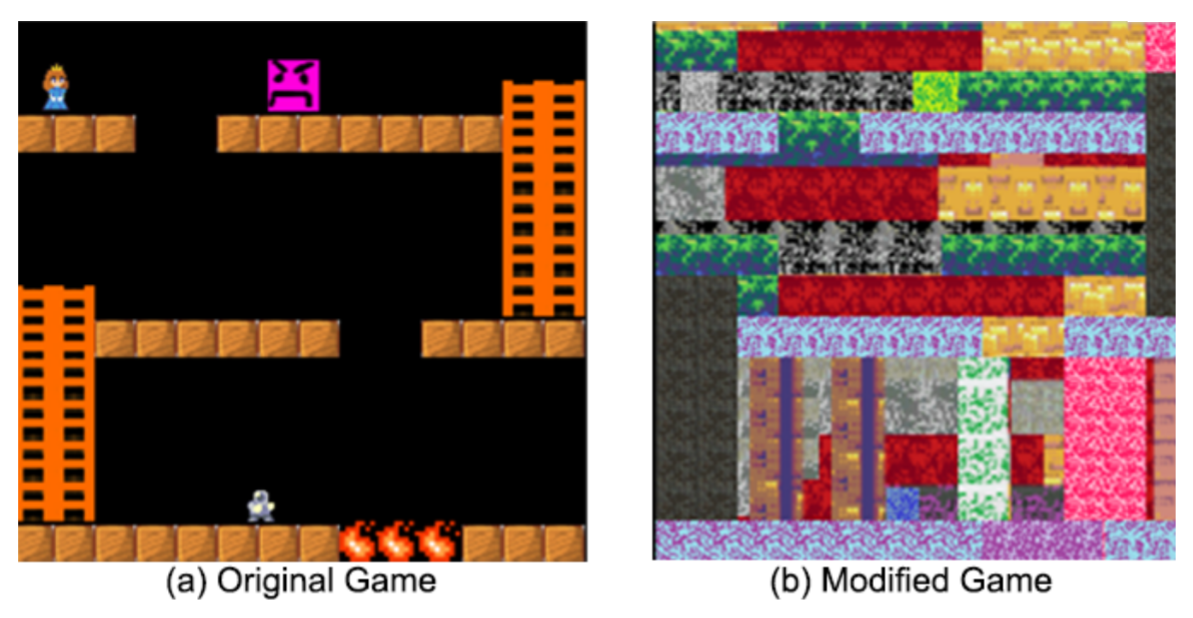
What is it about human learning that allows us to perform so well with relatively little experience? MIT Technology Review: Today we get an answer of sorts thanks to the work of Rachit Dubey and colleagues at the University of California, Berkeley. They have studied the way humans interact with video games to find out what kind of prior knowledge we rely on to make sense of them. It turns out that humans use a wealth of background knowledge whenever we take on a new game. And this makes the games significantly easier to play. But faced with games that make no use of this knowledge, humans flounder, whereas machines plod along in exactly the same way. Take a look at the computer game shown here. This game is based on a classic called Montezuma's Revenge, originally released for the Atari 8-bit computer in 1984. There is no manual and no instructions; you aren't even told which "sprite" you control. And you get feedback only if you successfully finish the game.
Would you be able to do so? How long would it take? You can try it at this website. In all likelihood, the game will take you about a minute, and in the process you'll probably make about 3,000 keyboard actions. That's what Dubey and co found when they gave the game to 40 workers from Amazon's crowdsourcing site Mechanical Turk, who were offered $1 to finish it. "This is not overly surprising as one could easily guess that the game's goal is to move the robot sprite towards the princess by stepping on the brick-like objects and using ladders to reach the higher platforms while avoiding the angry pink and the fire objects," the researchers say. By contrast, the game is hard for machines: many standard deep-learning algorithms couldn't solve it at all, because there is no way for an algorithm to evaluate progress inside the game when feedback comes only from finishing. -
High School Computer Science: Look Ma, No Textbooks!
theodp writes: Computer Science Teacher Alfred Thompson wonders how other high school CS teachers use textbooks. "It's not a conversation I hear much about," he writes. Indeed, many teachers apparently don't rely on CS textbooks much at all. In fact, the highly-touted new AP Computer Science Principles (AP CSP) course does not require a CS textbook for students (sample College Board AP CSP syllabus), albeit to the chagrin of some. Some of the bigger providers of AP CSP curriculum -- e.g., BJC and Code.org, both of whom partner with Microsoft TEALS -- don't require a traditional CS textbook. But with teachers being recruited to teach Computer Science even if they don't have a CS background, should students learning CS have a textbook? Or is the high AP exam pass rate enjoyed by AP CSP students proof that no-more-books works? -
C Programming Language 'Has Completed a Comeback' (infoworld.com)
InfoWorld reports that "the once-declining C language" has "completed a comeback" -- citing its rise to second place in the Tiobe Index of language popularity, the biggest rise of any language in 2017. An anonymous reader quotes their report: Although the language only grew 1.69 percentage points in its rating year over year in the January index, that was enough beat out runners-up Python (1.21 percent gain) and Erlang (0.98 percent gain). Just five months ago, C was at its lowest-ever rating, at 6.477 percent; this month, its rating is 11.07 percent, once again putting it in second place behind Java (14.215 percent) -- although Java dropped 3.05 percent compared to January 2017. C's revival is possibly being fueled by its popularity in manufacturing and industry, including the automotive market, Tiobe believes...
But promising languages such as Julia, Hack, Rust, and Kotlin were not able to reach the top 20 or even the top 30, Tiobe pointed out. "Becoming part of the top 10 or even the top 20 requires a large ecosystem of communities and evangelists including conferences," said Paul Jansen, Tiobe managing director and compiler of the index. "This is not something that can be developed in one year's time."
For 2017 Tiobe also reports that after Java and C, the most popular programming languages were C++, Python, C#, JavaScript, Visual Basic .Net, R, PHP, and Perl.
The rival Pypl Popularity of Programming Language index calculates that the most popular languages are Java, Python, PHP, JavaScript, C#, C++, C, R, Objective-C, and Swift. -
HP Laptops Found To Have Hidden Keylogger (bbc.com)
Hidden software that can record every letter typed on a computer keyboard has been discovered pre-installed on hundreds of HP laptop models, BBC reported on Monday citing the findings of a security researcher. From the report: Security researcher Michael Myng found the keylogging code in software drivers preinstalled on HP laptops to make the keyboard work. HP said more than 460 models of laptop were affected by the "potential security vulnerability." It has issued a software patch for its customers to remove the keylogger. The issue affects laptops in the EliteBook, ProBook, Pavilion and Envy ranges, among others. HP has issued a full list of affected devices, dating back to 2012. Mr Myng discovered the keylogger while inspecting Synaptics Touchpad software, to figure out how to control the keyboard backlight on an HP laptop. He said the keylogger was disabled by default, but an attacker with access to the computer could have enabled it to record what a user was typing. According to HP, it was originally built into the Synaptics software to help debug errors. It acknowledged that could lead to "loss of confidentiality" but it said neither Synaptics nor HP had access to customer data as a result of the flaw. -
Firefox To Get a Better Password Manager (bleepingcomputer.com)
Catalin Cimpanu, reporting for BleepingComputer: Mozilla engineers have started work on a project named Lockbox that they describe as "a work-in-progress extension [...] to improve upon Firefox's built-in password management." Mozilla released the new extension for employee-use only at first, but users can install it by going to this or this links. Lockbox revamps Firefox's antiquated password management utility with a new user interface (UI). A new Firefox UI button is also included, in case users want to add a shortcut in their browser's main interface to open Lockbox without going through all the menu options. Support for a master password is included, helping users secure their passwords from unauthorized access by co-workers, family members, or others. -
Browsers Will Store Credit Card Details Similar To How They Save Passwords (bleepingcomputer.com)
An anonymous reader quotes a report from Bleeping Computer: A new W3C standard is slowly creeping into current browser implementations, a standard that will simplify the way people make payments online. Called the Payment Request API, this new standard relies on users entering and storing payment card details inside browsers, just like they currently do with passwords. The API is also a godsend for the security and e-commerce industry since it spares store owners from having to store payment card data on their servers. This means less regulation and no more fears that an online store might expose card data when getting hacked. By moving the storage of payment card details in the browser, the responsibility of keeping these details safe is moved to the browser and the user. Browsers that support the Payment Request API include Google Chrome, who first added support for it in Chrome for Android 53 in August 2016, and added desktop support last month with the release of Chrome 61. Microsoft Edge also supports the Payment Request API since September 2016, but the feature requires that users register a Microsoft Wallet account before using it. Firefox and Safari are still working on supporting the API, and so are browser implementations from Facebook and Samsung, both eager to provide a simpler payment mechanism than the one in use today. -
postmarketOS Pursues A Linux-Based, LTS OS For Android Phones (liliputing.com)
An anonymous reader quotes Liliputing: Buy an iPhone and you might get 4-5 years of official software updates. Android phones typically get 1-3 years of updates... if they get any updates at all. But there are ways to breathe new life into some older Android phones. If you can unlock the bootloader, you may be able to install a custom ROM like LineageOS and get unofficial software updates for a few more years. The folks behind postmarketOS want to go even further: they're developing a Linux-based alternative to Android with the goal of providing up to 10 years of support for old smartphones...
Right now postmarketOS is a touch-friendly operating system based on Alpine Linux that runs on a handful of devices including the Samsung Galaxy Nexus, Google Nexus 4, 5, and 7 (2012), and several other Samsung, HTC, LG, Motorola, and Sony smartphones. There are also ports for some non-Android phones such as the Nokia N900 and work-in-progress builds for the BlackBerry Bolt Touch 9900 and Jolla Phone. Note that when I say the operating system runs on those devices, I basically mean it boots. Some phones only have network access via a USB cable, for instance. None of the devices can actually be used to make phone calls. But here's the cool thing: the developers are hoping to create a single kernel that works with all supported devices, which means that postmarketOS would work a lot like a desktop operating system, allowing you to install the same OS on any smartphone with the proper hardware.
One postmarketOS developer complains that Android's architecture "is based on forking (one might as well say copy-pasting) the entire code-base for each and every device and Android version. And then working on that independent, basically instantly incompatible version. Especially adding device-specific drivers plays an important role... Here is the solution: Bend an existing Linux distribution to run on smartphones. Apply all necessary changes as small patches and upstream them, where it makes sense." -
postmarketOS Pursues A Linux-Based, LTS OS For Android Phones (liliputing.com)
An anonymous reader quotes Liliputing: Buy an iPhone and you might get 4-5 years of official software updates. Android phones typically get 1-3 years of updates... if they get any updates at all. But there are ways to breathe new life into some older Android phones. If you can unlock the bootloader, you may be able to install a custom ROM like LineageOS and get unofficial software updates for a few more years. The folks behind postmarketOS want to go even further: they're developing a Linux-based alternative to Android with the goal of providing up to 10 years of support for old smartphones...
Right now postmarketOS is a touch-friendly operating system based on Alpine Linux that runs on a handful of devices including the Samsung Galaxy Nexus, Google Nexus 4, 5, and 7 (2012), and several other Samsung, HTC, LG, Motorola, and Sony smartphones. There are also ports for some non-Android phones such as the Nokia N900 and work-in-progress builds for the BlackBerry Bolt Touch 9900 and Jolla Phone. Note that when I say the operating system runs on those devices, I basically mean it boots. Some phones only have network access via a USB cable, for instance. None of the devices can actually be used to make phone calls. But here's the cool thing: the developers are hoping to create a single kernel that works with all supported devices, which means that postmarketOS would work a lot like a desktop operating system, allowing you to install the same OS on any smartphone with the proper hardware.
One postmarketOS developer complains that Android's architecture "is based on forking (one might as well say copy-pasting) the entire code-base for each and every device and Android version. And then working on that independent, basically instantly incompatible version. Especially adding device-specific drivers plays an important role... Here is the solution: Bend an existing Linux distribution to run on smartphones. Apply all necessary changes as small patches and upstream them, where it makes sense." -
Google and ProPublica Team Up To Build a National Hate Crime Database (techcrunch.com)
In partnership with ProPublica, Google News Lab is launching a new tool to track hate crimes across America. The "Documenting Hate News Index" is being powered by machine learning to track reported hate crimes across all 50 states, collecting data from February 2017 onward. TechCrunch reports: Data visualization studio Pitch Interactive helped craft the index, which collects Google News results and filters them through Google's natural language analysis to extract geographic and contextual information. Because they are not catalogued in any kind of formal national database, a fact that inspired the creation of the index to begin with, Google calls the project a "starting point" for the documentation and study of hate crimes. While the FBI is legally required to document hate crimes at the federal level, state and local authorities often fail to report their own incidents, making the data incomplete at best.
The initiative is a data-rich new arm of the Documenting Hate project which collects and verifies hate incidents reported by both individual contributors and by news organizations. The Hate News Index will keep an eye out for false positives (casual uses of the word "hate" for example), striking a responsible balance between machine learning and human curation on a very sensitive subject. Hate events will be mapped onto a calendar in the user interface, though users can also use a keyword search or browse through algorithmic suggestions. For anyone who'd like to take the data in a new direction, Google will open sourced its data set, making it available through GitHub. -
Google Researchers Made An Algorithm To Delete Watermarks From Photos (venturebeat.com)
"Researchers at Google have found a vulnerability in the way watermarks are used by stock imagery sites like Adobe Stock that makes it possible to remove the opaque stamp used to protect copyright," writes Khari Johnson via VentureBeat. "The consistent nature in which the watermarks are placed on photos can be exploited using an algorithm trained to recognize and automatically remove watermarks." From the report: Changing the position or opacity of a watermark do not impact the algorithm's ability to remove watermarks from images with copyright protection. Randomization, the researchers say, is required to keep images from being stolen. In results presented at the Computer Vision and Pattern Recognition conference last month, subtle modifications to each watermark can make it harder to remove watermarks. With these warped watermarks, attempts to get rid of watermarks with an algorithm or photo editing software leaves noticeable marks, rendering an image useless. "As often done with vulnerabilities discovered in operating systems, applications or protocols, we want to disclose this vulnerability and propose solutions in order to help the photography and stock image communities adapt and better protect its copyrighted content and creations," research scientists Tali Dekel and Michael Rubenstein wrote in a blog post today. "From our experiments much of the world's stock imagery is currently susceptible to this circumvention." You can learn more about the different types of randomization that can be done to combat watermark removal and see more example images in Google's blog post. The full report and research is available via the project's GitHub page. -
NSA Opens GitHub Account, Lists 32 Projects Developed By the Agency (thehackernews.com)
An anonymous reader quotes a report from The Hacker News: The National Security Agency (NSA) -- the United States intelligence agency which is known for its secrecy and working in the dark -- has finally joined GitHub and launched an official GitHub page. GitHub is an online service designed for sharing code amongst programmers and open source community, and so far, the NSA is sharing 32 different projects as part of the NSA Technology Transfer Program (TTP), while some of these are "coming soon." "The NSA Technology Transfer Program (TTP) works with agency innovators who wish to use this collaborative model for transferring their technology to the commercial marketplace," the agency wrote on the program's page. "OSS invites the cooperative development of technology, encouraging broad use and adoption. The public benefits by adopting, enhancing, adapting, or commercializing the software. The government benefits from the open source community's enhancements to the technology." Many of the projects the agency listed are years old that have been available on the Internet for some time. For example, SELinux (Security-Enhanced Linux) has been part of the Linux kernel for years. -
Ask Slashdot: Will Python Become The Dominant Programming Language?
An anonymous reader shares their thoughts on language popuarity: In the PYPL index, which is based on Google searches and is supposed to be forward looking, the trend is unmistakable. Python is rising fast and Java and others are declining. Combine this with the fact that Python is now the most widely taught language in the universities. In fields such as data science and machine learning, Python is already dominating. "Python where you can, C++ where you must" enterprises are following suit too, especially in data science but for everything else from web development to general purpose computing...
People who complain that you can't build large scale systems without a compiler likely over-rely on the latter and are slaves to IDEs. If you write good unit tests and enforce Test Driven Development, the compiler becomes un-necessary and gets in the way. You are forced to provide too much information to it (also known as boilerplate) and can't quickly refactor code, which is necessary for quick iterations.
The original submission ends with a question: "Is Python going to dominate in the future?" Slashdot readers should have some interesting opinions on this. So leave your own thoughts in the comments. Will Python become the dominant programming language? -
New IoT Malware Targets 100,000 IP Cameras Via Known Flaw (csoonline.com)
Researcher Pierre Kim has found a new malware, called Persirai, that has been infecting over 100,000 Chinese-made, internet-connected cameras. According to Trend Micro, the malware has been active since last month and works by exploiting flaws in the cameras that Kim reported back in March. CSO Online reports: At least 1,250 camera models produced by a Chinese manufacturer possess the bugs, the researcher went on to claim. Over a month later in April, Trend Micro noticed a new malware that spreads by exploiting the same products via the recently disclosed flaws. The security firm estimates that about 120,000 cameras are vulnerable to the malware, based on Shodan, a search engine for internet-connected hardware. The Persirai malware is infecting the cameras to form a botnet, or an army of enslaved computers. These botnets can launch DDoS attacks, which can overwhelm websites with internet traffic, forcing them offline. Once Persirai infects, it'll also block anyone else from exploiting the same vulnerabilities on the device. Security firm Qihoo 360 has also noticed the malware and estimated finding 43,621 devices in China infected with it. Interestingly, Persirai borrows some computer code from a notorious malware known as Mirai, which has also been infecting IoT devices, such as DVRs, internet routers, and CCTV cameras, but by guessing the passwords protecting them. -
Nearly 200,000 Wi-Fi Cameras Are Open To Hacking (bleepingcomputer.com)
An anonymous reader quotes a report from BleepingComputer: What started as an analysis of a simple security flaw in a random wireless IP camera turned into seven vulnerabilities that affect over 1,250 camera models and expose nearly 200,000 cameras to hacking. The flaws affect a generically named product called Wireless IP Camera (P2P) WIFICAM, manufactured by a (currently unnamed) Chinese company, who sells it as a white-label product to several other camera vendors. Security researcher Pierre Kim says the firmware produced by this Chinese vendor comes with several flaws, which have all made their way down the line into the products of other companies that bought the white-label (unbranded) camera. In total, nearly 1,250 camera models based on the original camera are affected. At the heart of many of these issues is the GoAhead web server, which allows camera owners to manage their device via a web-based dashboard. According to Kim, the cameras are affected by a total of seven security flaws. Yesterday, Kim said that around 185,000 vulnerable cameras could be easily identified via Shodan. Today, the same query yields 198,500 vulnerable cameras. Proof-of-concept exploit code for each of the seven flaws is available on Kim's blog, along with a list of all the 1,250+ vulnerable camera models. -
Browser Autofill Profiles Can Be Abused For Phishing Attacks (bleepingcomputer.com)
An anonymous reader quotes Bleeping Computer: Browser autofill profiles are a reliable phishing vector that allow attackers to collect information from users via hidden form fields, which the browser automatically fills with preset personal information and which the user unknowingly sends to the attacker when he submits a form... Finnish web developer Viljami Kuosmanen has published a demo on GitHub... A user looking at this page will only see a Name and Email input field, along with a Submit button. Unless the user looks at the page's source code, he won't know that the form also contains six more fields named Phone, Organization, Address, Postal Code, City, and Country. If the user has an autofill profile set up in his browser, if he decides to autofill the two visible fields, the six hidden fields will be filled in as well, since they're part of the same form, even if invisible to the user's eye.
Browsers that support autofill profiles are Google Chrome, Safari, and Opera. Browsers like Edge, Vivaldi, and Firefox don't support this feature, but Mozilla is currently working on a similar feature. -
Google's Go Language Surges In Popularity (infoworld.com)
2016 saw a big spike in the popularity of Go, attributed to the rising importance of Docker and Kubernetes. An anonymous Slashdot reader quotes InfoWorld: Ranked 65th a year ago in the Tiobe Index of language popularity, it has climbed to 16th this month and is on track to become Tiobe's Programming Language of the Year, a designation awarded to the language with the biggest jump in the index...which gauges popularity based on a formula assessing searches on languages in popular search engines...
Elsewhere in the index, Java again came in first place, with an 18.799 rating while C, still in second place, nonetheless continued its precipitous drop, to 9.835% (it had been 16.185% a year ago). In third was C++ (5.797%) followed by C# (4.367%), Python (3.775%), JavaScript (2.751%), PHP (2.741%), Visual Basic .Net (2.66%), and Perl (2.495%).
The article also cites an alternate set of rankings. "In the PyPL index, the top 10 were: Java, with a share of 23.4%, followed by Python (13.6%), PHP (9.9%), C# (8.8%), JavaScript (7.6%), C++ (6.9%), C (6.9%), Objective-C (4.5%), R (3.3%), and Swift (3.1%)." -
Which Programming Language Is Most Popular - The Final Answer? (zdnet.com)
An anonymous Slashdot reader writes: Following a common technique among political pollsters, a technology columnist combined the results from various measures of programming language popularity for a more definitive answer about the most important languages to study. He used IEEE Spectrum's interactive list of the top programming languages, which lets you adjust the weight given to the number of job listings and number or open source projects, then combined it with the TIOBE Index (which is based on search engine results), and the PYPL Index, which checks the number of tutorials for each programming language on Google.
The results? "The top cluster contains Java, C, Python, and C++. Without a doubt, you should attain familiarity with these four languages." He points out they're not tied to a specific programming platform, unlike languages in the second cluster -- JavaScript, C#, PHP, and Swift -- while the last two languages in the top 10 were Objective-C and R. "The C-family of languages still dominates. Java, C++, C, C#, and even Objective-C are all C-based languages. If you're only going to learn one language, you should pick one of those." But his ultimate advice is to "learn multiple languages and multiple frameworks... Programming is not just an intellectual exercise. You have to actually make stuff." -
W3C Set To Publish HTML 5.1, Work Already Started On HTML 5.2 (softpedia.com)
An anonymous reader quotes a report from Softpedia: Members of the World Wide Web Consortium (W3C) are getting ready to launch the HTML 5.1 specification and have already started work on the upcoming HTML 5.2 version since mid-August. The HTML 5.1 standard has been promoted from a "Release Candidate" to a "Proposed Recommendation," the last step before it becomes a "W3C Recommendation," and officially replaces HTML 5 as the current HTML standard. As a Proposed Recommendation, HTML 5.1 is practically locked against major changes, and outside small tweaks here and there, we are currently looking at a 99.99 percent version of the upcoming HTML 5.1 standard. The vote to promote HTML 5.1 from RC to PR was approved in unanimity, a clear sign that major browser makers have reached a general consensus on what the standard should look like, and what they should be implementing in their browsers in upcoming versions. You can read more on HTML 5.1 here, the changes and support table here, and the HTML 5.2 specification draft here. -
Microsoft Reproduces Google's Battery Life Test To Show Edge Beats Chrome (venturebeat.com)
Earlier this year, Microsoft said that its Edge browser was more power efficient than Google's Chrome, a claim that Google refuted with its own findings. But the debate isn't over. An anonymous reader writes: Microsoft is at it again -- touting Edge as the most battery-efficient browser on Windows 10. The company has rerun its battery tests from the previous quarter using the latest versions of the major browsers, open-sourced its lab test on GitHub, and published the full methodology. But this time, Microsoft says it also replicated one of Google's tests to show that Edge lasts longer than Chrome, Firefox, and Opera. -
Group Wants To Shut Down Tor For a Day On September 1 (softpedia.com)
An anonymous reader writes: An internal group at the Tor Project is calling for a full 24-hour shutdown of the Tor network to protest the way the Tor Project dealt with the Jake Applebaum sexual misconduct accusations, and because of recent rumors it might be letting former government agents in its ranks. Two Tor members, also node operators, have shut down their servers as well, because of the same reason. They explained their motivations here and here.
"The protesters have made 16 demands," according to the article, six related to related to supposed infiltration of Tor by government agents, and 10 regarding the Appelbaum ruling and investigation -- including "asking all Tor employees that participated in this investigation to leave" and "the persons behind the JacobAppelbaum.net and the @JakeMustDie and @VictimsOfJake Twitter accounts to come forward and their identities made public." -
Google Developers Create API For Direct USB Access Via Web Pages (softpedia.com)
An anonymous reader writes: Two Google developers have uploaded an unofficial (for now) draft to the World Wide Web Consortium's Web Incubator Community Group (W3C WICG) that describes a method of interconnecting USB-capable devices to Web pages. The API, called WebUSB, allows device manufacturers to provide special "registry and landing pages" where they can host JavaScript SDKs for their USB-capable devices. Site owners can load these SDKs as iframes inside their websites, and allow a site to access and relay commands (via the iframe to the browser's WebUSB API) to the actual device. To protect privacy and security, the WebUSB API also comes with a CORS-like system that prompts users for access to their devices to avoid abuse and Web-based fingerprinting. The system is also backward compatible with devices created before the standard's approval (if it gets approved). -
Quanta LTE Router May Be Most Unsecure Router Ever Made (softpedia.com)
An anonymous reader writes: LTE routers made by Quanta Computer Incorporated, a Taiwanese hardware manufacturer, are plagued by over twenty major security flaws ranging from backdoor accounts to remote code execution bugs, from hardcoded SSH keys to undocumented diagnostics pages, and from weak WPS PINs to network eavesdropping functions. As the researcher explains: "A personal point of view: at best, the vulnerabilities are due to incompetence; at worst, it is a deliberate act of security sabotage from the vendor." The vendor has not fixed any of these issues even after almost four months. -
Major Browsers Add Experimental Support For WebAssembly (thestack.com)
An anonymous reader writes: Four major web browsers have announced support for the near-native compiling technology WebAssembly, and collaborated to bring an initial common game demo of Angry Bots, running via Unity and WebAssembly, to experimental builds of Chrome, Firefox, Microsoft Edge and, shortly, Safari. WebAssembly was launched last year in a joint project between Microsoft, Mozilla, Apple and Google as a potentially more efficient route to assembly-level performance than asm.js, which is in itself a low-level subset of JavaScript. -
An Inside Look At How Netflix Builds Code (sdtimes.com)
mmoorebz writes: Netflix is known as a place to binge watch television, but behind the scenes, there's a lot that goes on before everyone's favorite show can be streamed. The first step to deploying an application or service is building. Netflix created Nebula, a set of plugins for the Gradle build system, that "help with the heavy-lifting around building applications," said the engineers. Once the code has been built and tested locally using Nebula, the team pushes the updated source code to a Git repository. Every deployment at Neflix begins with the creation of an Amazon Machine Image, and to generate them from source, Netflix created what it calls "the Bakery." It exposes an API that facilitates the creation of AMIs globally, according to the blog. When it comes time to deploy and after the "baking" is complete, teams will use Spinnaker to manage multi-region deployments, canary releases, and red/black deployments. Netflix is continuing to look at the developer experience and determine how it can improve. -
LinkedIn Is Open Sourcing Their Testing Frameworks (github.io)
destinyland writes: LinkedIn is open sourcing their testing frameworks, and sharing details of their revamped development process after their latest app required a year and over 250 engineers. Their new paradigm? "Release three times per day, with no more than three hours between when code is committed and when that code is available to members," according to a senior engineer on LinkedIn's blog. This requires a three-hour pipeline where everything is automated, from committing code to releasing it into production, along with automated analyses and testing. "Holding ourselves to this constraint ensures we won't revert to using manual validation to certify our releases." -
Finally Calculated: All the Legal Positions In a 19x19 Game of Go (github.io)
Reader John Tromp points to an explanation posted at GitHub of a computational challenge Tromp coordinated that makes a nice companion to the recent discovery of a 22 million-digit Mersenne prime. A distributed effort using pooled computers from two centers at Princeton, and more contributed from the HP Helion cloud, after "many hiccups and a few catastrophes" calculated the number of legal positions in a 19x19 game of Go. Simple as Go board layout is, the permutations allowed by the rules are anything but simple to calculate: "For running an L19 job, a beefy server with 15TB of fast scratch diskspace, 8 to 16 cores, and 192GB of RAM, is recommended. Expect a few months of running time." More: Large numbers have a way of popping up in the game of Go. Few people believe that a tiny 2x2 Go board allows for more than a few hundred games. Yet 2x2 games number not in the hundreds, nor in the thousands, nor even in the millions. They number in the hundreds of billions! 386356909593 to be precise. Things only get crazier as you go up in boardsize. A lower bound of 10^{10^48} on the number of 19x19 games, as proved in our paper, was recently improved to a googolplex. (For anyone who wants to double check his work, Tromp has posted as open source the software used.) -
Finally Calculated: All the Legal Positions In a 19x19 Game of Go (github.io)
Reader John Tromp points to an explanation posted at GitHub of a computational challenge Tromp coordinated that makes a nice companion to the recent discovery of a 22 million-digit Mersenne prime. A distributed effort using pooled computers from two centers at Princeton, and more contributed from the HP Helion cloud, after "many hiccups and a few catastrophes" calculated the number of legal positions in a 19x19 game of Go. Simple as Go board layout is, the permutations allowed by the rules are anything but simple to calculate: "For running an L19 job, a beefy server with 15TB of fast scratch diskspace, 8 to 16 cores, and 192GB of RAM, is recommended. Expect a few months of running time." More: Large numbers have a way of popping up in the game of Go. Few people believe that a tiny 2x2 Go board allows for more than a few hundred games. Yet 2x2 games number not in the hundreds, nor in the thousands, nor even in the millions. They number in the hundreds of billions! 386356909593 to be precise. Things only get crazier as you go up in boardsize. A lower bound of 10^{10^48} on the number of 19x19 games, as proved in our paper, was recently improved to a googolplex. (For anyone who wants to double check his work, Tromp has posted as open source the software used.) -
Microsoft Asks Node.js To Allow ChakraCore (Edge) Alongside Google's V8 Engine (softpedia.com)
campuscodi writes: Microsoft has submitted an official pull request to the Node.js project, through which it's asking the project's maintainers to enable support for ChakraCore, the JavaScript engine packed inside Microsoft's Edge browser, as an alternative to Node's built-in V8 engine, developed by Google. Earlier in December 2015, Microsoft open-sourced ChakraCore. Microsoft has also been one of the biggest companies to adopt Node.js early on, and is also part of the Node.js Foundation's Board o Directors. The main reason to add ChakraCore support in Node.js will help the IoT version of Windows 10 to run JS apps on IoT devices, just like Samsung is also thinking about. -
Microsoft Asks Node.js To Allow ChakraCore (Edge) Alongside Google's V8 Engine (softpedia.com)
campuscodi writes: Microsoft has submitted an official pull request to the Node.js project, through which it's asking the project's maintainers to enable support for ChakraCore, the JavaScript engine packed inside Microsoft's Edge browser, as an alternative to Node's built-in V8 engine, developed by Google. Earlier in December 2015, Microsoft open-sourced ChakraCore. Microsoft has also been one of the biggest companies to adopt Node.js early on, and is also part of the Node.js Foundation's Board o Directors. The main reason to add ChakraCore support in Node.js will help the IoT version of Windows 10 to run JS apps on IoT devices, just like Samsung is also thinking about. -
Hackers Get Linux Running On a PlayStation 4 (engadget.com)
An anonymous reader writes: Two years after the PlayStation 4 was released, and two weeks after it was jailbroken, a group of hackers has now successfully installed Linux on it. "...it appears that the fail0verflow team utilized a WebKit bug similar to the one recently documented by GitHub user CTurt and then took things up a notch. CTurt's workaround focuses on the PlayStation 4's Webkit browser, which is tricked into freeing processes from the core of the console's operating system by an improvised webpage. The PS4 is powered by Sony's Orbis OS, which is based on a Unix-like software called FreeBSD. With a route into the console's system, fail0verflow then identified weaknesses in the PlayStation 4's GPU. It specifically called out engineers from semiconductor company Marvell, accusing them of 'smoking some real good stuff' when they designed the PlayStation 4's southbridge chip." -
Verizon Creates Minecraft Mod To Let Players Video Chat On an In-Game Smartphone
Deathspawner writes: There's never a lack of stuff to be impressed by in Minecraft, but rarely does that impressive stuff involve a corporation. Recently, Verizon teamed up with some prolific Minecraft streamers to design a mod that takes interactivity to a new level. After building an in-game smartphone and cellular tower, the gamer is not only able to browse the Web on the device, but also video call, all in a humorously low resolution. Verizon has created a GitHub page to explain how the magic is done. -
Python Is On the Rise, While PHP Falls (dice.com)
Nerval's Lobster writes: While this month's lists of the top programming languages uniformly put Java in the top spot, that's not the only detail of interest to developers. Which language has gained the most users over the past five years? And which are tottering on the edge of obsolescence? According to PYPL, which pulls its raw data for analysis from Google Trends, Python has grown the most over the past five years—up 5 percent since roughly 2010. Over the same period, PHP also declined by 5 percent. Since PYPL looks at how often language tutorials are searched on Google, its data is a good indicator of how many developers are (or aren't) learning a language, presumably because they see it as valuable to their careers. Just because PYPL shows PHP losing market-share over the long term doesn't mean that language is in danger of imminent collapse; over the past year or so, the PHP community has concentrated on making the language more pleasant to use, whether by improving features such as package management, or boosting overall performance. Plus, PHP is still used on hundreds of millions of websites, according to data from Netcraft. Indeed, if there's any language on these analysts' lists that risks doom, it's Objective-C, the primary language used for programming iOS and Mac OS X apps, and its growing obsolescence is by design. -
Netflix Open Sources Sleepy Puppy XSS Hunter
msm1267 writes: Netflix has released a tool it calls Sleepy Puppy. The tool injects cross-site scripting payloads into a target app that may not be vulnerable, but could be stored in a database and tracks the payload if it's reflected to a secondary application that makes use of the data in the same field. "We were looking for a way to provide coverage on applications that come from different origins or may not be publicly accessible," said co-developer Scott Behrens, a senior application security engineer at Netflix. "We also wanted to observe where stored data gets reflected back, and how data that may be stored publicly could also be reflected in a large number of internal applications." Sleepy Puppy is available on Netflix's Github repository and is one of a slew of security tools its engineers have released to open source. -
Open Source, Collaborative Rich-Text, Web-Based Editor Almost Available
johanneswilm writes: Open source web-based editors such as CKEditor and TinyMCE have been available for more than a decade, and some closed source collaborative editors such as Google Docs have been available since 2007. Creating open source, collaborative, rich-text, web-based editors has proven difficult due to lack of standardization of the lower-level browser features. Now Marijn Haverbeke, the developer behind the popular CodeMirror has started such an editor, called Prosemirror, financed through a crowd-funding campaign. Meanwhile the W3C has installed a task force to rapidly standardize and fix the features needed in browsers to easily create richtext and semantic editors. -
Microsoft Releases Windows 10 IoT Core For Small, Embedded Devices
An anonymous reader writes: One of the more interesting aspects of Microsoft's Windows 10 push is their desire to see it running on hobbyist hardware platforms. Today they released Windows 10 IoT Core for the Raspberry Pi 2 and the MinnowBoard Max. They say, "Windows 10 IoT Core is a new edition for Windows targeted towards small, embedded devices that may or may not have screens. For devices with screens, Windows 10 IoT Core does not have a Windows shell experience; instead you can write a Universal Windows app that is the interface and "personality" for your device." Microsoft has posted a list of release notes for this version, calling out improved support for Python and Node.js, significantly improved GPIO performance, and more electronics support for breakout boards. Under a heading cheekily named 'Developers, Developer, Developers,' they lay out their plan for language support and provide a code sample. -
Using HTML5 To Hide Malware
New submitter Jordan13 writes: SecurityWeek reports on the findings of a group of Italian researchers about web malware. They developed three new obfuscation techniques that can be used to obfuscate exploits like the one usually leveraged in drive-by download malware attacks. These techniques use some functionalities of the HTML5 standard, and can be leveraged through the various JavaScript-based HTML5 APIs. The research also contains recommendations about some of the steps that can be taken to counter these obfuscation techniques. -
Chrome 44 Launches With Tweaks To Push Messaging and Notifications
An anonymous reader writes: Google has launched Chrome 44 for Windows, Mac, and Linux with new developer tools. Aside from a host of security fixes, this release focuses mainly on developer features. The API for push notifications was updated to match the specification, a new implementation of multi-column layout was added, and they've extended support for Unicode escapes in strings. The full changelog notes a number of performance improvements as well. -
Chrome 44 Launches With Tweaks To Push Messaging and Notifications
An anonymous reader writes: Google has launched Chrome 44 for Windows, Mac, and Linux with new developer tools. Aside from a host of security fixes, this release focuses mainly on developer features. The API for push notifications was updated to match the specification, a new implementation of multi-column layout was added, and they've extended support for Unicode escapes in strings. The full changelog notes a number of performance improvements as well. -
ELIoT, Distributed Programming For the Internet of Things
descubes writes: ELIoT (Extensible Language for the Internet of Things) is a new programming language designed to facilitate distributed programming. A code sample with less than 20 lines of code looks like a single program, but really runs on three different computers to collect temperature measurements and report when they differ. ELIoT transforms a simple sensor API into a rich, remotely-programmable API, giving your application the opportunity to optimize energy usage and minimize network traffic.
Using fewer resources than Bash, and capable of serving hundreds of clients easily on a Raspberry Pi, ELIoT transparently sends program fragments around, but also the data they need to function, e.g. variable values or function definitions. This is possible because, like in Lisp, programs are data. ELIoT has no keywords, and program constructs such as loops or if-then-else are defined in the library rather than in the language. This makes the language very flexible and extensible, so that you can adapt it to the needs of your application.
The project is still very young (published last week), and is looking for talented developers interested in distributed programming, programming languages or language design.