Slashdot Mirror
Domain: githubusercontent.com
Stories and comments across the archive that link to githubusercontent.com.
Comments · 32
-
Re:Scale down
Or send a spaceship up there to do the job of firing on the debris. Here's a simulation.
-
Re:What's that?
-
Homebrew is nice, but Cask is even nicer
Homebrew was already a very nice way to install GNU and other open source stuff. But Cask is an extension that scripts the installation of packaged software:
https://caskroom.io/Plus, if you install the mas command-line utility to install App Store stuff, this makes it easy to completely script the installation of a Mac. The following shell script installs a fresh new Mac for me:
#!/bin/sh
export HOMEBREW_CASK_OPTS="--appdir=/Applications"# install homebrew
ruby -e "$(curl -fsSL https://raw.githubusercontent....)"
brew doctor
brew tap caskroom/cask
brew install \
imagemagick \
watch \
par2 \
wget \
ffmpeg \
youtube-dl \
vim# some apps
brew cask install \
firefox \
istat-menus \
google-chrome \
iterm2 \
hammerspoonmas install 123456 # Break Reminder (2.3.0)
mas install 234567 # The Unarchiver (4.0.0)
mas install 345678 # 1Password (6.8.8)Note that for mas to work, you'll have to log into the App Store first, then kick off the above script.
-
Re:Google HTML?
That's 80kb of minified javascript. To hell with that.
And it's worse even than that. Go to an amp page, and look at what that javascript contains.
this.preconnect.url("https://facebook.com", a);
Similar stuff for instagram, and twitter, and youtube, and vimeo. And take a look at some of the un-minified code for their advertising component of AMP.
No. Thank. You.
http://shayarisms.mobi/dosti-shayari/
-
Re:Google HTML?
That's 80kb of minified javascript. To hell with that.
And it's worse even than that. Go to an amp page, and look at what that javascript contains.
this.preconnect.url("https://facebook.com", a);
Similar stuff for instagram, and twitter, and youtube, and vimeo. And take a look at some of the un-minified code for their advertising component of AMP.
No. Thank. You.
-
What A Friend We Have In ANSI
From that day long ago when you first heard someone describe their website as an >>>EXPERIENCE<<<
Ironically this comes on the heels of bandwidth and compression techniques that really could have blown us away with triple-to-ten-throughput back in the slow modem and PPP turnaround delay days. I mean, we could have been swimming in text like the Matrix! Instead of the Matrix's goofy nonsense KanjiGreekWhatsits dribbling down from the top of the screen,
IMAGINE a whole generation of children who might have had grown up NOT with the thumb twaddling tile-scrolley Instagram twiddle-screen tiny web page mush and over-resolution JPGs... but with an actual Matrix style of text presentation. They might have learned to read multiple streams in parallel (up/down or lleft/right) with crisp bright text illuminated in the same ANSI color palette that Jesus used.
And when these ANSI text character sprites began to float in a 3D field, now you're talking. Things could recede in Z with axis-flopping
Look Ma! It's a rectangle with a talking head! Let's watch it and listen to what it has to say... even though I can read three times as quickly.
AND OF COURSE I'm only generalizing on method when I talk ANSI (though I'm serious about the reduced color palette). By all means make this Matrix-style text sprite environment support Unicode and the world's scripts and symbols. And expandable tiles that represent visual zoomable image and video -- but my rub is those tiles MUST reduce to the size of characters so they join the text stream, not disrupt it. And if you clamor for EMOJIs that's backwards and stupid. Emojis are tools of Big Brother, who's just waiting in the wings for people to express themselves in pictorial symbols so Big Brother can change the symbols overnight.
-
Re:Ad Blockers
An arstechnica commenter mentioned NoCoin which is a standalone extension.
https://arstechnica.com/inform...https://github.com/keraf/NoCoi...
You can also take the URL they curate and then import it into your adblocker of choice.
-
Vulnerable to Spectre Attack
This machine is also vulnerable to Spectre attacks. You can test it out yourself by downloading https://gist.githubusercontent... and then doing "gcc spectre.c -o spectre" and then running "spectre". You have a $4,999 paperweight.
-
Re:Ignoring God's gift of coal is a sin!FBAG Fight Back Against Goolag/Google (and fakebook, scamazon, microsoft, etc)
Use ublock origin, ublock protector.
- Install WebRTC Leak Prevent extension.
- Install the Privacy Badger extension to block tracking cookies.
Also consider using a hosts file like this:
https://raw.githubusercontent....
Block ads, block adwords, block AMP, block google ad services. Helps block the mechanisms Google uses to make money.
DDG !g - On Duck Duck Go, you can search google using "!g" without giving them hits.
DNS - Stop Google DNS Snooping: Note using 8.8.8.8 and 8.8.4.4 for DNS servers gives Google EVERYTHING so DONT use those. I run a local DNS and blacklist those IPs.
PI-HOLE: Consider running PI-HOLE and use DNS for your whole house to protect and defend the TRUTH. https://pi-hole.net/
Make sure your pi-hole uses norton DNS with DNSSEC enabled.
BRAVE is a chrome based browser which puts advertisers in touch with you directly bypassing trash. Many of the same extensions work so you can ad them in just as you did in Chrome.
Demonetize and take down the revenue streams for the bad companies.
Time for Google to Go, because its so 1984 War is peace. Freedom is slavery. Ignorance is strength.
-
API/ABI fixesWelcome another round of API/ABI breakage: even the latest beta NVIDIA drivers 381.09 are not compatible with this kernel. Here's a dirty hack/patch to resolve the incompatibility.
VMWare Workstation/Player 12.5.5 also needs some love.
VirtualBox has already been made compatible. Thanks, Oracle for keeping it up to date.
Lastly, a human readable changelog is always where you expect to find it: https://kernelnewbies.org/Linux_4.11.
-
FUD Article
The entire bloat on disk is about 5MiB in size. For an OS around 20GiB, that is less than 0.1% bloat from this issue. It is also only an issue with a small handful of files (we're talking like 5-10 files total, a bunch of which are just SxS copies of explorer.exe)
This should have just been reported as a simple bug in explorer.exe, not turned into a witch hunt claiming to be THE BLOAT of Windows. This is next to nothing overall.
Source: The guy uploaded his entire scan dump: https://gist.githubusercontent...
-
Programmers don't have to be socially awkward.
I get what you're saying from an economics or job perspective, but the truth is that programmers don't have to be socially awkward. In fact, many of the greatest programmers are very outgoing and socially adept. Here's a good example of what I mean. He's confident. He's likely talking to an audience. He's sharing his thoughts. He expresses his individuality through his winter hat being worn indoors, through his choice of shirt, through his style of glasses, and through his arm tattoos. He's clean-shaven, and doesn't sport a huge belly. He's somebody you could hang around with, but he can also get the job done when it needs to be done. He's the kind of man you'd want your daughter to date and eventually marry. He's got the aura of a proud breadwinner, supporting his family and dependents. He's a real programmer.
-
Let's look at photos of real software developers.
Instead of speculating about what software developers might look like, let's look at some actual photographs of actual software developers.
The Rust programming language contributors list is a good place to start.
Although not every developer has uploaded a photograph, many of them have.
Let's look at some examples.
This is what an actual software developer looks like.
This is what an actual software developer looks like.
This is what an actual software developer looks like.
This is what an actual software developer looks like.
Those are what actual software developers look like.
-
Let's look at photos of real software developers.
Instead of speculating about what software developers might look like, let's look at some actual photographs of actual software developers.
The Rust programming language contributors list is a good place to start.
Although not every developer has uploaded a photograph, many of them have.
Let's look at some examples.
This is what an actual software developer looks like.
This is what an actual software developer looks like.
This is what an actual software developer looks like.
This is what an actual software developer looks like.
Those are what actual software developers look like.
-
Let's look at photos of real software developers.
Instead of speculating about what software developers might look like, let's look at some actual photographs of actual software developers.
The Rust programming language contributors list is a good place to start.
Although not every developer has uploaded a photograph, many of them have.
Let's look at some examples.
This is what an actual software developer looks like.
This is what an actual software developer looks like.
This is what an actual software developer looks like.
This is what an actual software developer looks like.
Those are what actual software developers look like.
-
Let's look at photos of real software developers.
Instead of speculating about what software developers might look like, let's look at some actual photographs of actual software developers.
The Rust programming language contributors list is a good place to start.
Although not every developer has uploaded a photograph, many of them have.
Let's look at some examples.
This is what an actual software developer looks like.
This is what an actual software developer looks like.
This is what an actual software developer looks like.
This is what an actual software developer looks like.
Those are what actual software developers look like.
-
Re:The User is responsible for open sourse softwar
Much like pretty much every open source license the one here is no different. It's open source, you have the freedom to do whatever you like with it, but you are the one who assumes responsibility for it too.
Copyright (c) 2016, Comma.ai, Inc.
Permission is hereby granted, free of charge, to any person obtaining a copy of this software and associated documentation files (the "Software"), to deal in the Software without restriction, including without limitation the rights to use, copy, modify, merge, publish, distribute, sublicense, and/or sell copies of the Software, and to permit persons to whom the Software is furnished to do so, subject to the following conditions:
The above copyright notice and this permission notice shall be included in all copies or substantial portions of the Software.
THE SOFTWARE IS PROVIDED "AS IS", WITHOUT WARRANTY OF ANY KIND, EXPRESS OR IMPLIED, INCLUDING BUT NOT LIMITED TO THE WARRANTIES OF MERCHANTABILITY, FITNESS FOR A PARTICULAR PURPOSE AND NONINFRINGEMENT. IN NO EVENT SHALL THE AUTHORS OR COPYRIGHT HOLDERS BE LIABLE FOR ANY CLAIM, DAMAGES OR OTHER LIABILITY, WHETHER IN AN ACTION OF CONTRACT, TORT OR OTHERWISE, ARISING FROM, OUT OF OR IN CONNECTION WITH THE SOFTWARE OR THE USE OR OTHER DEALINGS IN THE SOFTWARE.https://raw.githubusercontent.com/commaai/openpilot/master/LICENSE.openpilot
-
To the devs
After reducing all this dropbox grandstanding filler and chest thumping (is that corporate policy or something? this is certainly not the first time), it all boils down to:
You took frequency space transformed H264 (pre-cabac) and wrote better range coder for it.
Yes/No?
Still pretty impressive, but for the love of god, please use succinct _technical_ descriptions. - https://raw.githubusercontent.... - is god awful, as it just describes general operation of a range coder.
Beating jpeg entropy coding is not that impressive, as thats just huffman which really awful. CABAC is better, but still decade behind behind top of the line research (I suppose you're encode.ru regulars). -
Re:From TFA: bit-exact or not?
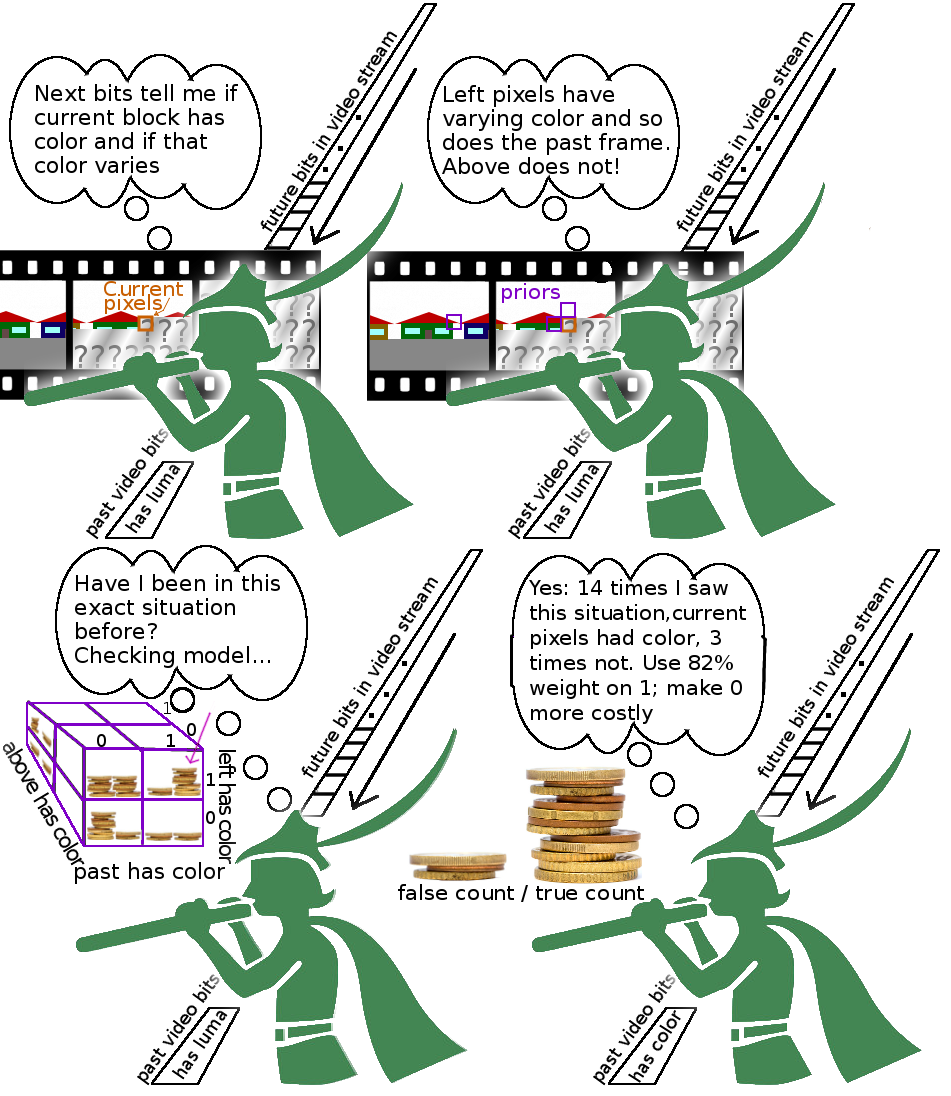
I'm the author of the algorithm and it's bit-exact. It has no quality loss. I just committed a description of the algorithm
https://raw.githubusercontent....
It is bit exact and lossless: you can get the exact bits of the file back
It seems to be redundant, even...!
-
Re:No description
Link to a layman's description of the algorithm here: https://raw.githubusercontent.... It's bit exact and lossless. We haven't done comprehensive studies, but on the included test files it gets 13% compression on H.264 movies. Similarly the not-committed, but similar JPEG algorithm gets 22% on a comprehensive sample set of photos from a variety of devices.
-
Re:From TFA: bit-exact or not?
I'm the author of the algorithm and it's bit-exact. It has no quality loss. I just committed a description of the algorithm https://raw.githubusercontent.... It is bit exact and lossless: you can get the exact bits of the file back
-
Re:Can we get some confirmation of this?
I can provide you with this english link. This has not been reported in english speaking media yet, sorry for not having something better but this is breaking news yet. https://gist.githubusercontent...
-
A browser can be a text editor and dev environment
Try this: http://rawgit.com/pdfernhout/P...
You can enter the below short JavaScript script in the text box, and then push the "View Below" button to create a new div for the window which will pop up the alert as part of displaying itself.
<script>
alert("hello");
</script>If you enter a Data ID for the text and a User ID for yourself (can be almost anything) and click "Store" you will store that text in the web browser's local storage.
I wrote that about a year ago. It works under Firefox on Mac OS 10.6. It may not work as well elsewhere; for example Firefox under Win7 didn't work for some reasons when I tried it yesterday (but probably a minor error to fix). I do not know how it will perform on most mobile systems, but again, in theory, it should work or otherwise be relatively easy to fix. Here is the source code with more information:
https://github.com/pdfernhout/...You can also enter any HTML you want there, like to create buttons or divs or anything you want. Examples can be loaded by imported the text below into the editor using "Import and Merge" and then you can click "List all IDs" and select an item like "polar clock" to view it below (that example is a graphical clock, written by someone else using D3):
https://raw.githubusercontent....A different approach to doing something like that if you are willing to host a NodeJS server somewhere is this other code I wrote:
https://github.com/pdfernhout/...However, if you go that route, there are quite a few web services that support remote coding through the browser on hosted platforms. For example, "Cloud 9":
https://c9.io/ -
Re:I'm a Java developer
With the open sourcing of
Yes
Was the entire
The entire *server* stack - i.e. everything you need to run a
Doesn't
No. You have *always* been able to just self-host the ASP.NET bits. However, MS have taken it a step further and completely separated out the bits of the pipeline so that you can pick and choose. For a long time there have been plugins for Apache httpd and others that would allow you to run Mono. Those will work fine regardless of whether ASP.NET is provided by Mono or MS. Kremel mentioned above, but you can use any other way. ASP.NET vNext is "pluggable".
How will you run a
curl -sSL https://raw.githubusercontent.... | sh && source ~/.kre/kvm/kvm.sh
In the Java world, the entire platform and runtimes are open source.
In the
Microsoft grants patent licenses for anyone who wants to create implementations of the specifications, and Microsoft *specifically* does not require paid testing suites and they do NOT assert that using the APIs constitutes copyright infringement.
And now for some reflections on the differences: Microsofts stack - especially with the latest
With C# 5.0 (and the equivalent VB.NET) async became an integrated feature of the language. This is not about smart synchronization primitives, multithreading or similar "low level" concepts. This is aboy having a language that effortlessly allows a programmer to express a sequential problem in a way that allow asynchronous processing all the way down to the system level where overlapped IO will be used. Without invading the way the solution is expressed.
This is huge. I am aware of only one other ecosystem that does something similar: node.js. Python has the capability, but there's no ecosystem built around it where the capability is the default way to design libraries and APIs.
In terms of enabling and supporting async programming style, C#,
Java only recently acquired the ability to process web requests asynchronously (yielding the thread to process other requests) - but the language and APIs make it exceedingly hard to leverage this capability for anything useful. If you look up articles for how to do async in Java you will notice a strange t
-
Beware: MS no-sue promise can turn on you
Mono developer Miguel de Icaza has pledged to continue to add Microsoft's code to Mono saying "Like we did in the past with
But is that wise? To your point, the Free Software Foundation's reaction to Microsoft's similar 2009 action point to exactly how changing ownership of patents render Microsoft's Patent Promise not to sue useless. This very promise could become the basis for a patent trap. In 2009 Microsoft's promise not to sue was called a "Community Promise" but today's
Looking back at that essay from 2009, we see the FSF warn us (emphasis mine):
The Community Promise does not give you any rights to exercise the patented claims. It only says that Microsoft will not sue you over claims in patents that it owns or controls. If Microsoft sells one of those patents, there's nothing stopping the buyer from suing everyone who uses the software.
Falling into this trap will directly adversely affect your ability to run, share, and modify covered software. The FSF points to a practical way out as well:
The Solution: A Comprehensive Patent License
If Microsoft genuinely wants to reassure free software users that it does not intend to sue them for using Mono, it should grant the public an irrevocable patent license for all of its patents that Mono actually exercises. That would neatly avoid all of the existing problems with the Community Promise: it's broad enough in scope that we don't have to figure out what's covered by the specification or strictly necessary to implement it. And it would still be in force even if Microsoft sold the patents.
This isn't an unreasonable request, either. GPLv3 requires distributors to provide a similar license when they convey modified versions of covered software, and plenty of companies large and small have had no problem doing that. Certainly one with Microsoft's resources should be able to manage this, too. If they're unsure how to go about it, they should get in touch with us; we'd be happy to work with them to make sure it's satisfactory.
Until that happens, free software developers still should not write software that depends on Mono. C# implementations can still be attacked by Microsoft's patents: the Community Promise is designed to give the company several outs if it wants them. We don't want to see developers' hard work lost to the community if we lose the ability to use Mono, and until we eliminate software patents altogether, using another language is the best way to prevent that from happening.
I find it no accident that the built-to-be-business-friendly "open source" language is all over this announcement including the aforementioned blog post from a prominent endorser, while the wise warnings of falling into a patent trap come from the FSF who consistently looks out for all computer user's software freedoms—software freedom being the very thing that "open source" was designed never to bring to mind (see source 1, source 2 for the history and rationale on this point).
-
Beware: MS no-sue promise can turn on you
Mono developer Miguel de Icaza has pledged to continue to add Microsoft's code to Mono saying "Like we did in the past with
But is that wise? To your point, the Free Software Foundation's reaction to Microsoft's similar 2009 action point to exactly how changing ownership of patents render Microsoft's Patent Promise not to sue useless. This very promise could become the basis for a patent trap. In 2009 Microsoft's promise not to sue was called a "Community Promise" but today's
Looking back at that essay from 2009, we see the FSF warn us (emphasis mine):
The Community Promise does not give you any rights to exercise the patented claims. It only says that Microsoft will not sue you over claims in patents that it owns or controls. If Microsoft sells one of those patents, there's nothing stopping the buyer from suing everyone who uses the software.
Falling into this trap will directly adversely affect your ability to run, share, and modify covered software. The FSF points to a practical way out as well:
The Solution: A Comprehensive Patent License
If Microsoft genuinely wants to reassure free software users that it does not intend to sue them for using Mono, it should grant the public an irrevocable patent license for all of its patents that Mono actually exercises. That would neatly avoid all of the existing problems with the Community Promise: it's broad enough in scope that we don't have to figure out what's covered by the specification or strictly necessary to implement it. And it would still be in force even if Microsoft sold the patents.
This isn't an unreasonable request, either. GPLv3 requires distributors to provide a similar license when they convey modified versions of covered software, and plenty of companies large and small have had no problem doing that. Certainly one with Microsoft's resources should be able to manage this, too. If they're unsure how to go about it, they should get in touch with us; we'd be happy to work with them to make sure it's satisfactory.
Until that happens, free software developers still should not write software that depends on Mono. C# implementations can still be attacked by Microsoft's patents: the Community Promise is designed to give the company several outs if it wants them. We don't want to see developers' hard work lost to the community if we lose the ability to use Mono, and until we eliminate software patents altogether, using another language is the best way to prevent that from happening.
I find it no accident that the built-to-be-business-friendly "open source" language is all over this announcement including the aforementioned blog post from a prominent endorser, while the wise warnings of falling into a patent trap come from the FSF who consistently looks out for all computer user's software freedoms—software freedom being the very thing that "open source" was designed never to bring to mind (see source 1, source 2 for the history and rationale on this point).
-
Re:Smalltalk made new keyword creation easy in 198
So does this mean that Tao3D is call-by-value by default, and this explicitly breaks it to (effectively) call-by-value, rather than leaving the programmer to hack around with statics or constants and individual copies of arguments?
The locally function is conceptually equivalent to running its argument surrounding it with graphics state save/restore code. That's about it. So you can't deduce anything about call-by-value from it.
Now, to address your question in short, XL uses call-by-reference, and lazily evaluates the arguments as required to perform the call. Cases where you need to evaluate include: having to check against a type that is not "tree", comparing against a pattern, comparing for identity between arguments. For more details, see section 3.3. "Evaluation" of https://raw.githubusercontent..... You can also explicitly evaluate something with 'do'. In the 'if-then-else' definition given elsewhere, there is a 'do' for the bodies, to force evaluation of only that argument to if-then-else corresponding to the condition. If the condition is true, you only evaluate the true clause. If it's false, you only evaluate the false clause.
-
Re:Lol...ruby -e "$(curl -fsSL https://raw.githubusercontent....)"
I mean, not as nice as Linux package management.. but it works.
-
Re:Q: Why Are Scientists Still Using FORTRAN in 20
Well, we live in a somewhat different world today, given that suitable HW for that is virtually everywhere. But just to be clear, I'm not suggesting anyone should adopt APL's "syntax". It's more about the array language design principles. Syntax-wise, I'd personally like something along the lines of Nile, with math operators where suitable, and with some type inference and general "in-language intelligence" thrown into the mix to make it concise. I realize that depriving people of their beloved imperative loops might seem cruel, but designing the language in a way that would make obvious coding styles easily executed on vector machines seems a bit saner to me than allowing people to write random loops and then either hope that the vectorizer will sort it out (they're still very finicky about their input) or provide people with examples what they should and shouldn't be writing if they want it to run fast.
-
Re:wow
https://raw.githubusercontent....
proof that music is just a bunch of numbers.. and you cant copyright, trademark, or patent, a number.
-
wow
https://raw.githubusercontent....
proof that music is just a bunch of numbers.. and you cant copyright, trademark, or patent, a number.
-
I just used "Caret" to write a JavaScript app
https://chrome.google.com/webs...
I just wrote a completely open ended HTML5/CSS/JavaScript app on my Samsung $250 Chromebook using the regular user mode and "Caret". I saved versions of the files on the Chromebook and ran them locally from Chrome. The app I wrote uses IndexedDB for local storage of snippets of HTML (which can include JavaScript). The app is intended to support boostrapping a better app by supporting experiments with HTML5/CSS/JavaScript. You can edit text and have it included as a section of HTML on the page. From start to finish (well, it's not really "done") I wrote it on the Chromebook.
I just put the code up on GitHub as an example for you (again using only the Chromebook) :
https://github.com/pdfernhout/...You can try a demo version here which will store data in your browser: http://rawgithub.com/pdfernhou...
Here is a direct link to the bootstrap.json content to paste in as a start: https://raw.githubusercontent....
See the GitHub repo for basic instructions on how to use it.
Granted, to do C compiling I'd need some tool that converted C to JavaScript in a special way, but more and more such tools exists.
https://github.com/kripken/ems...
http://www.infoq.com/research/...So, more and more things are possible with Chromebooks or similar devices.