Slashdot Mirror
Domain: gnu.org
Stories and comments across the archive that link to gnu.org.
Comments · 13,360
-
Re:Stallman's FUD
Maybe. But if you read the interview where he called us all modern day communists, he explicitly mentions the patent system. I don't think it's unreasonable to interpret it the way RMS did. Bill Gates was kind of vague and ambigous, but that's what happens when you use confusing expressions like IP.
-
Two ironies here
I've tended to consider it ironic on the few occasions when Gates and RMS have indirectly traded barbs...Namely because the two men actually have far more in common IMHO than I suspect either of them would be comfortable to admit. I'm reminded here of a scene from Spiderman when the Green Goblin tells Spidey, "You and I are not so different."
Both men are ideologues, and both, I believe, are megalomaniacs, despite my anticipation that Stallman in particular would strenuously deny such an accusation. But as ESR has said, Stallman wants to be the figurehead of the entire FOSS movement. His flowery speech at times aside, let there be no misconceptions about it...the man *does* advocate a heirarchy, and most especially he advocates himself as the leader of it.
The other irony is that Stallman himself is guilty of exactly the same kind of hypocrisy with which he accuses Gates here...Namely, with regards to the LGPL. Stallman at one point criticised the XFree86 group for using a BSD-like license, calling them sellouts who were doing such in order to ensure that X gained popularity...and he then turned around later and did exactly the same thing with the creation of the LGPL. He actually cites software popularity as part of the reason for the creation of the LGPL. He might not remember this particular inconsistency...I, however, do.
I am not for one moment trying to lump both Stallman and Gates into the same *moral* category here...or not completely, anywayz. Stallman has done a lot of good...I'm aware of that. However, what I think a lot of *other* people need to be aware of is that he still isn't the being of light they think he is, by any stretch of the imagination. He might be different from Gates morally and ideologically in many ways...but the main things that the two do have in common is that contrary to popular belief, both are guided by their ego, and, to a greater or lesser degree, the desire to dominate others. That might sound paradoxical when said about Stallman in particular...but do some research on the man, have a good long think about it, and see what you come up with...you might be very surprised. For the purposes of Linux users, Stallman can definitely be considered an ally...but personally I think "friend" would be too strong a word. The man has his own agenda...and not one that necessarily coincides with everyone else's best interests. -
I totally agree (was Re:Total FUD)
While I don't speak for the Wikimedia Foundation Board of Trustees, I am a regular follower and poster of the events on the Wikimedia Foundation mailing list where this proposal has taken on a bit of urgancy.
The main point that needs to be looked at is the fact that Wikipedia has been experiencing some absolutely explosive growth in demand from people both trying to add articles, as well as people simply accessing it, like numerous cross-links to Wikipedia mentioned in various
The current proposed budget for maintaining the servers is on the order of $130,000 and all of that comes from voluntary donations of the community. (BTW, please give some $$$ if you are a regular user of Wikipedia).
Google has quietly given an offer to not only co-locate some Wikimedia servers at their facilities, but also to pay for the servers themselves as part of the general Google server farm.
From what I've seen, nothing in the proposal is to have Google "take over" the Google content. Just like Google uses data in the Open Directory Project for their google website directory, they are free to use the content of Wikipedia as long as they comply with the terms of the Gnu Free Documentation License.
This is not a way to "lock up" the content, but rather a way to browse Wikipedia in a way where you can be assured that the bandwidth is available to view the content. Basically, a mirror of the Wikipedia project. This is not even a new idea.
I would imagine that the fine points of negotiation right now are that links to add content would be folded back into the main-line Wikipedia database. This is just like the Open Directory Project has been doing for a number of years, so the preceedence is definitely there, even for Google. I don't deny that there is a valid business rationale for Google to host Wikipedia, but don't read more into it than is there: Google offering to host Wikipedia content.
John Dvorak absolutely does not speak for the Wikimedia Foundation, or even as a member of the community in general, and his comments are just to inflame issues from an otherwise uninterested technology journalist just trying to improve the sales of the publications he works for. Having been through similar publicity flare-ups in the past with other "open source" groups, Mr. Dvorak is not showing behavior consistant with even mediocre journalists that would at least contact members of the community he is reporting about. He is just doing raw speculation and that is it.
This article is disingenuous and I hope that Dvorak gets taken to task for the comments that he has made. I also hope that people like him don't kill the good-faith proposal that frankly the Wikipedia could really use, nor "poison" the water of other potential offers to help out in relieving the crushing bandwidth needs of the Wikipedia and other related projects. It is articles like this that give journalists an awful name and destroy what is left of credibility to their profession. -
Re:YRO?
Software patents intefere with the right to use software.
Stallman's speech The Danger of Software Patents provides an excellent explanation of this. I read this speech for the first time yesterday and think it is one of his best ones.
-
Re:"should public domain information be free?"(2) commercial software deprives people of vital rights - ie, they are evil.
If you want to get Stalmanistic you should say "proprietary" or "non-free"
http://www.gnu.org/philosophy/words-to-avoid.html# Commercial
BTW, withoug RMS, there would BE NO FOSS movement. He is the heart and soul of it. Were he to die, it would be utterly co-opted by commercial forces.
I tend to agree with the first sentence, he developed the GPL and promulgated copyleft etc.
But I really hope you don't mean the last sentence
You're say in when he dies so will FOSS?
What will happen to the GPL? Or will that become irrelevant?
What about http://www.debian.org/social_contract etc? -
Re:"should public domain information be free?"Your misinterpretation of Richard Stallman's beliefs:
commercial software deprives people of vital rights - ie, they are evil
Richard Stallman's own words:
``Free software'' does not mean ``non-commercial''. A free program must be available for commercial use, commercial development, and commercial distribution. Commercial development of free software is no longer unusual; such free commercial software is very important.
You stand corrected, and might want to review Richard Stallman's definition of Free software.
FOSS = Free Open Source Software. Free as in Freedom to modify and redistribute software and open source being self-defining. Free software by itself denotes the same thing, using the term FOSS is just being redundant so people realize you don't simple mean free (as in price) software. -
illegal debuggers
Debuggers, illegal? Stallman called that one in his dystopian short story The Right to Read
-
Re:Prove mono is suitable for commercial developme
I don't misunderstand you at all. I challenge your very narrow definition of "cross-platform." It seems like your definition requires a guarantee that all future versions of mono will always have complete feature parity with
By your definition, Java is not cross platform because Sun's JVM doesn't support GCJ's CNI.
-Mark -
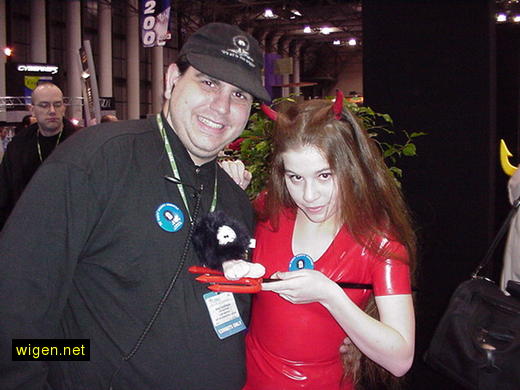
I'd rather get help from Ceren...
IMPORTANT UPDATE: Please show your support for Ceren in this poll of Geek Babes!
Is it any wonder people think Linux users are a bunch of flaming homosexuals when its fronted by obviously gay losers like these?! BSD has a mascot who leaves us in no doubt that this is the OS for real men! If Linux had more hot chicks and gorgeous babes then maybe it would be able to compete with BSD! Hell this girl should be a model!
Linux is a joke as long as it continues to lack sexy girls like her! I mean just look at this girl! Doesn't she excite you? I know this little hottie puts me in need of a cold shower! This guy looks like he is about to cream his pants standing next to such a fox. As you can see, no man can resist this sexy little minx. Don't you wish the guy in this pic was you? Are you telling me you wouldn't like to get your hands on this ass?! Wouldn't this just make your Christmas?! Yes doctor, this uber babe definitely gets my pulse racing! Oh how I envy the lucky girl in this shot! Linux has nothing that can possibly compete. Come on, you must admit she is better than an overweight penguin or a gay looking goat! Wouldn't this be more liklely to influence your choice of OS?
With sexy chicks like the lovely Ceren you could have people queuing up to buy open source products. Could you really refuse to buy a copy of BSD if she told you to? Personally I know I would give my right arm to get this close to such a divine beauty!
Don't be a fag! Join the campaign for more cute open source babes today!
$Id: ceren.html,v 9.0 2004/08/01 16:01:34 ceren_rocks Exp $ -
Re:Linspire= future of desktop linux
Heck they even have a itunes "clone" they sell. called lsongs. (l for linux/ songs = tunes, get it ).
Who would pay for Linux songs when you can get them for free -
int b[0] when you mean int* b is a *bad* habit
In gcc declaring an array of 0 length does not allocate space for the pointer! It's basically an inline memory pointer. Given:
struct {
int a;
int b[0];
} test;
Assuming a 4 byte int and the object is at address 0. (yes, yes, NULL pointer and all that rot)
sizeof(test) = 4
&test.a = 0x0
&test.b[0] = 0x4
&test.b[1] = 0x8
One use is to allocate the memory yourself and then use the struct to map that memory. The sizeof() would give you the header size. Then (sizeof(header) + allocated data storage) is the total size to alloc.
See: Zero Length (gcc)
IMO, it is a very bad habit to use "type name[0]" when you mean "type* name".
Doing what you claim (sorry, you're AC) is the "Microsoft way" will cause memory corruption in GCC. -
Re:DMCA and encryption.
If you're not using encryption to protect your copyright...
You don't have to do anything to "protect" your copyright. -
IP?
How is "IP" television new? I thought all television was copyrighted from the moment of broadcast.
-
Re:Why?In general GNU/Linux and Linux are the same thing. Adding the GNU/ prefix is mostly for emphasis on certain ideals and a project that set out to make it all possible a long time ago.
But the pieces only work with each other, not with other applications. There's no interoperability between, say, the piece of Evolution that stores your address book and your chat program.
Well, the GNOME suite of applications do interoperate to a point, although I do admit that this interoperation may not be on par with iLife. Across different desktops the situation isn't as good currently but it *is* improving. On the other hand, for other operating systems there *are no different desktops and accompanying software suites*
That's fine and all, but it's kind of like being the only person in town with a Home telephone when everybody else has switched to Bell. There's nobody to talk to.
Your mileage may vary but all my friends use Jabber so using another network would be lonely for me. There are millions of Jabber users, more than there are ICQ users today.
Okay, well, you've obviously got some criteria which would seem strange and silly to me. Because the Web site is so incredibly disorganized I can't find the list of features; the only thing I can find quickly is a set of screen shots
What do you find so hard to look at? Let me be more specific. I like having the album covers (automatically fetched from amazon), the automatically displayed lists of favourite songs, other songs from the currently playing album, other albums from the same artist and the eyecandy that can't be seen in screenshots. AmaroK has this and more cool stuff. iTunes seems like a pretty standard database music player in comparison. And lacks Ogg Vorbis as I said.
What does "flamebait" mean? Let me clarify so you don't misunderstand me: Looking at Linux, you'd think that it was created in 1979. It's based on very, VERY old ideas. Programs have bad user interfaces and don't work together. Major pieces of the puzzle are simply missing: There's no way to assemble movies into a DVD for example. It's like Linux was created back before we had DVDs, and never caught up. For that matter, it's like it was created back before we had human user interfaces, and never caught up.
Flamebait is an opinion that's needlessly harsh and unaccounted for. I'm quite fond of the GNOME UI work although I can't say that for KDE myself and GNOME does really work to create a good UI experience. They have UI Guidelines and have conducted usability studies. Apple is very good in this respect too, there's no denying that, but GNOME does a very good job too in my opinion. GNOME 2.x actually feels as well thought out as Apple's UIs in my opinion and that's a huge compliment.
It's simply not true that there aren't tools for creating DVDs by the way. Try picking up a recent issue of LJ for a tutorial or do a bit of research online. I doubt you can name many tasks that would be impossible on a free software operating system today and what's more, many of these things cost a bundle on a non-free platform.
You're being unnecessarily harsh on Linux and give little to back such bashing. What exactly does in your opinion make it bad or are you unhappy with my rebuttals? GNU/Linux is always in active development and always will be just like every piece of supported software. There are still some rough edges, quite possibly less than Apple has left in OS X but OS X certainly isn't perfect either, I hear that for example Mail.app and the OS X installer in 10.3 (for which there wasn't supposed to be a need at all when OS X came out) are less than perfect and I don't like the way
-
Re:Why?Is it such an absurd concept for you that some people might actually prefer GNU/Linux to OS X for whatever reason? You can't really get *every* Linux application installed so easily under OS X. At minimum, software installation is easier and the apps tend to integrate better on a Linux desktop.
Seriously, could someone explain to me why similar remarks about Windows aren't modded up on stories about x86 hardware? What about all the other proprietary UNIX-like operating systems in addition to OS X. Why doesn't every Linux story have a modded up comment about HP-UX, Solaris, Irix and others asking "why use Linux?". What's so special about OS X? Sure, it's a nice OS but in no way is it equal or better than Linux in every possible aspect and for everyone.
Linux has many things going for it that OS X does not. And even if it didn't, some people would use it just for the freedom. I personally have an iBook running Ubuntu and my sister is dual booting Fedora & OS X. I also have a friend using debian exclusively on his iBook for many years.
-
Re:This is exactly what you get with the *AA cultu
Read it while you have the right to.
-
Re:Sad truth is that Linux is dying
Richard Stallman says
Actually we encourage people who redistribute free software to charge as much as they wish or can.
-
Re:A two-minute awk lesson
You're welcome. Thanks for the flowers!
I think Arnold Robbins' latest O'Reilly covers the differences between awk, nawk, mawk, oawk, and gawk - I know the author of mawk wrote the introduction.
I've heard that mawk is pretty good, but I don't think it has the network socket interface or the fixed-field processing feature of GNU awk yet. I could be wrong.
As for the ugly string concatenation syntax, I agree with you - but for a different reason! I dislike the way languages like shell and perl want to translate variables within quotes, I prefer explicit concatenation (i.e. I will use print 'total is ' . $total . "\n"; in perl rather than print "total is $total\n";) even though it's longer to type. Awk's use of the space - a so-called "invisible" character - for string concatenation is even more annoying, and it's the reason for the mostly when people say awk has "mostly elegant syntax".
It seemed like a good idea at the time. --Brian Kernighan -
Re:Anonymous P2P
Don't forget the venerable Freenet: http://www.freenetproject.org/ and GNUnet http://www.gnu.org/software/gnunet/ Entropy is dead though, and it's crypto was never really proven.
-
Re:Firefox good, Amazon evil?
The ongoing boycott of Amazon ended nearly 2 1/2 years ago.
-
Another reason
to stop using proprietary software. There are a lot of amazing free software game projects that need our support (like e.g. WorldForge) that not only allow but in fact encourage hacking. Proprietary crap is good for uneducated people who want to have a one-size-fits-all black box. For thinking people who want to learn by tinkering, free software is the way to go.
-
Re:What I'm waiting for someone to figure out
How's that different than any other software?
Erm... It would be legal in this case.... that's all
see section 1. of the GPL -
Re:Interoperability
Oh yeah, that's a great reason! I'm sure that Bill is terrified of RMS!
I'm sure he really is! -
Re:Cellection?Autovectorization is planned for GCC 4.0.
-
Re:"Determine the outcome?"
Mozilla and its derivatives can't "lose" the next browser war per se, because they're open source and protected by the GPL.
Nitpick: not by the GPL, but by the Mozilla Public License. The two are similar, but not compatible. And the MPL is less readable... (source: cliking About Mozilla in my current browser, and http://www.gnu.org/philosophy/license-list.html)
-
API mattersWhat about an open library, cross-platform, multimedia oriented, along the line of SUN's mediaLib ? Would SUN allow freely the re-use of their API ?
I'm looking for such a library, with GPL/LGPL compatible license. The API has to be in C, to maximise audience. For many projects, C++ is not an option.
Primary use will be DSP work in GNU Radio project, but multimedia extensions could prove useful anywhere in GUI's to audio/video app, etc.
I would take any pointers to such an already existing API/project, or be ready to start a new one, if other people interested in.
-
Re:Open Source Hardware
While I don't think companies are particularly eager to end planned obsolecence (Please, won't somebody think of the Profits!), some groups are making open source hardware. The GNU Radio project http://www.gnu.org/software/gnuradio/ makes wholly software-configurable radios. Nifty things for ham radio operators such as myself.
-
Re:Hello world of todayIt's true, 380K (WTF Mate?) vs 83K in '93. Still, whatever happened to just good old
#include <stdio.h>
?
main()
{
for(;;)
{
printf ("Hello World!\n");
}
} -
Re:Is TrollTech trolling?Actually, you are mistaken. The code belongs to the corporation, not the employees, and the corporation can forbid the employees from distributing the GPL'd code they are making and using. Don't take my word for it, read the words straight from the mouth of the FSF.
So, here's the definitive answer: A company can take TrollTech's GPL'd QT, develop internal applications for free, and never give the source to anybody. If an employee distributes a copy, they are doing so without a license and the rights given by the GPL are void; so the company can't be caught in a situation where they are forced to suddenly open up their application after accidental distribution.
It sucks, but that's the GPL as it stands. I think this is a HUGE loophole in the GPL, and it should definitely be closed in GPL v3. The code should always be licensed to individuals, never corporations.
TrollTech is taking a big gamble here; probably they are being pushed into this by the projects out there working to port QT/X11 to Windows for KDE ports. It was only a matter of time, really. I think that they will see an unfortunately large revenue drop as a result of this. But on the bright side, KDE 4 will probably be ported to Windows in short order.
-
Re:Free?
free (as in beer) as long as you release any software that you develop with it under the GPL
I suppose the answer is yes, but actually "free as in beer" plus "release
See http://www.gnu.org/philosophy/free-sw.html
-
Autovectorization being add in GCC 4.0
For those that don't already know is that autovectorization is being worked on for GCC by folks from IBM and others.
GCC vectorizatoin project (site seem offline atm) but the abstract from a recent GCC summit is up.
Autovectorization Talk (google html view of pdf) -
Re:Darwin
> I wonder how feasible it would be to put GNUstep
>on top of Darwin/X11? Has anybody tried this?
yes lot of GNUstep developpers use MacOX + X11 + GNUstep
check this doc -
Re:What's not-free about Linux?
Why is HURD somehow superior in free-ness?
Like every GNU project, the HURD is © FSF, not © Linus and 100000 random nicknames from around the world, which means that in the case of GPL violation the violator can actually be sued. In the case of work of many people, you need majority to sue for copyright infringement and that means that the GPL in Linux is unenforcable in practice. Good luck hunting the majority of Linux developers and bringing them to the court! For GNU projects you only need FSF lawyers present in court. -
Re:misinformation?
Now then, for extra credit, which struggling operating system might be called "the McClellan OS"
Hurd -
Re:Is it Too Much To Ask
You must be thinking of Emacs.
-
Finally
As someone who have been suggesting it for years, I am really glad that they have finally made the store. This is a much better way to support a project like this, because people are generally more likely to buy cool merchandise (like on Amazon) than to send money not getting anything in return (like lobbying). I hope a portion of the revenus stream will go towards the development of Debian GNU/NetBSD because there is a lot of platforms I want to have Debian on, and it doesn't seem that Linux--or even HURD--will be nearly as portable as NetBSD any time soon, and as a long-time GNU supporter I must admit that I say it with a great deal of jealousy and at least an equal amount of admiration. For those who are not familiar with NetBSD's exceptional portability, or those who think that their pathetic operating system (Micro$oft) is portable because it supports Intel and AMD, here is a list of platforms that a really portable operating system should support: acorn26, acorn32, algor, alpha, amd64, amiga, amigappc, arc, atari, bebox, cats, cesfic, cobalt, dreamcast, evbarm, evbmips, evbppc, walnut, evbsh3, evbsh5, hp300, hp700, hpcarm, hpcmips, hpcsh, i386, iyonix, luna68k, mac68k, macppc, mipsco, mmeye, mvme68k, mvmeppc, netwinder, news68k, newsmips, next68k, ofppc, pc532, playstation2, pmax, pmppc, prep, sandpoint, sbmips, sgimips, sh3, sh3eb,
-
Re:Still playing with that '90s OSes?
To the flame bait here, I can only say:
Tum podex carmen extulit horridulum!
A general remark:
The most important lack of MS-windows IMHO, is not the technical flaws or the great lack of advanced features, but rather that it is not free for all to change the source code, give changes to a friend, or even sell an enhanced specialised version. Even though it wouldn't harm you to burn a copy of the software, in many countries it is not even legal to let your friends copy the software verbatim. In other words, even if you paid a lot of money for the software, you are not allowed to do much with it. Often the license doesn't even allow you to install the program on more than one computer at a time.Some may argue that this point is void, because they don't care about the law, and copy the software illegally, as there is little or no effective copy protection in existence today. Even if you do not consider this point flawed in its design, as I do, you still risk punishment and it seems very likely that copy protection will improve in the future.
Microsoft Windows lacks to be what the GNU Project has chosen to call "Free Software", which unfortunately due to a flaw in the English language let you believe that it is focused on no price.
GNU/HURD, GNU/Linux, OpenBSD and others are already "Free Software", which means you have a lot of freedom to do pretty much what you want with it. Some of the software, however, has a licence that restricts you from reducing this freedom for other people.
The reason Microsoft hates the "GPL", is that they want to make more money by restricting the freedom for people. The GPL does not allow them to do this. In this way, I find the GPL superior to many other licenses.
For this reason, many will argue that Microsoft and similar companies are evil. The point is however, that they make money acting the way they do. The only way this can change, is if they stop making money this way, or if they begin to make less money this way. One way to stop that, is to stop using their products, a thing I find very easy to do.
If you want to study what "Free Software" really is, and maybe find out why we are so many feels that it a wonderful thing, I guess the GNU Project web server is a good starting point.
-
Re:Still playing with that '90s OSes?
To the flame bait here, I can only say:
Tum podex carmen extulit horridulum!
A general remark:
The most important lack of MS-windows IMHO, is not the technical flaws or the great lack of advanced features, but rather that it is not free for all to change the source code, give changes to a friend, or even sell an enhanced specialised version. Even though it wouldn't harm you to burn a copy of the software, in many countries it is not even legal to let your friends copy the software verbatim. In other words, even if you paid a lot of money for the software, you are not allowed to do much with it. Often the license doesn't even allow you to install the program on more than one computer at a time.Some may argue that this point is void, because they don't care about the law, and copy the software illegally, as there is little or no effective copy protection in existence today. Even if you do not consider this point flawed in its design, as I do, you still risk punishment and it seems very likely that copy protection will improve in the future.
Microsoft Windows lacks to be what the GNU Project has chosen to call "Free Software", which unfortunately due to a flaw in the English language let you believe that it is focused on no price.
GNU/HURD, GNU/Linux, OpenBSD and others are already "Free Software", which means you have a lot of freedom to do pretty much what you want with it. Some of the software, however, has a licence that restricts you from reducing this freedom for other people.
The reason Microsoft hates the "GPL", is that they want to make more money by restricting the freedom for people. The GPL does not allow them to do this. In this way, I find the GPL superior to many other licenses.
For this reason, many will argue that Microsoft and similar companies are evil. The point is however, that they make money acting the way they do. The only way this can change, is if they stop making money this way, or if they begin to make less money this way. One way to stop that, is to stop using their products, a thing I find very easy to do.
If you want to study what "Free Software" really is, and maybe find out why we are so many feels that it a wonderful thing, I guess the GNU Project web server is a good starting point.
-
Boring
Longhorn will be the first release of Windows authored completely after Microsoft began their Trusted Computing Initiative and released
This really starts to get boring. I have already written about it countless times only to get completely ignored every time I dare to point out that the emperor is naked.
I find it truly amusing that people who say that there are other advantages than only Digital Restrictions Management of using "trusted" computing and Palladium-like platforms usually talk with great enthusiasm and excitement about the new and innovative security features that have already been implemented in the 1970s for crying out loud, only better and with no strings attached. All TCPA zealots are usually completely ignorant of the existance of such operating systems as KeyKOS or EROS with formal proofs of correctness for God's sake and without all of the silliness of "trusted" computing.
And no, this is not only my opinion that we don't need DRM to get security. I am not the only one who says that everything that TCPA can possibly do to security can also be done in software, with the only exception of DRM, and in fact it has already been done, decades ago. I am not really surprised at all why it is completely ignored by the TCPA and TCI pushing industry. I am only outraged that there are so many naïve people who once again will gladly do anything no matter how dumb it is, if only their good uncle Bill Gates says that it's good for them.
Please, people, if you want to learn about real systems security, then read some old papers by Jerome Saltzer, Michael Schroeder, Norman Hardy and Jonathan Shapiro. If you want to learn about cryptography, read texts by Bruce Schneier. Microsoft is not a reliable source of knowledge in that field.
People always ask me where are the real innovations in systems security and I always say them that they are in the seventies, and have been being ingnored since then by major software vendors because people don't demand using them. This story and this thread is a great example: "Yeah, this version of Windows may suck, but still I am looking forward to buy the next one."
This will dramatically lessen the exploitation potential of code flaws in the Windows application libraries. Microsoft has to maintain support for legacy application, but that doesn't mean they can't get a fresh start on the underlying code, and doesn't mean that existing Microsoft applications can't be converted to managed code as well.
Wait, I've already heard it... In 1995, 1998, 2000, 2003... Oh, you mean that this time they really mean it?
-
Re:This will depend on copyright law
You are missing something fundamental. The first step in you USING the app, is it getting DISTRIBUTED to you in the first place. Therefore GPL and COPYRIGHT cover your use, even if no terms specifically apply to the way you use it.
Uh, that really makes no sense. Receiving != using. The GPL covers the distribution/receiving part, but the using part has nothing to do with the GPL (GPLv2, anyway). If you add clauses to the GPL that govern use, then the GPL is no longer just a license to distribute: it's also a EULA, which falls into the realm of contract law.
Read section 5 of the GPL:You are not required to accept this License, since you have not signed it. However, nothing else grants you permission to modify or distribute the Program or its derivative works. These actions are prohibited by law if you do not accept this License. Therefore, by modifying or distributing the Program (or any work based on the Program), you indicate your acceptance of this License to do so, and all its terms and conditions for copying, distributing or modifying the Program or works based on it.
It specifically states that you don't have to accept the GPL to use the software. You only have to if you intend to mod & distribute.IF you make a change to the GPL (or a new license) covering how the software may be used, it is just as binding as the GPL, because you do not have the right to RECIEVE (part of DISTRIBUTION) the app without the licence granting you that right.
I'm not saying it's not binding, I'm just saying that it ceases to be solely the copyright-bound distribution license that it is, and becomes a EULA, which is governed by contract law. If that's what the FSF wants to do to the GPL, that's fine, but in that case, I'll stick with v2, thanks.That is why DRM and things, are legal, even though annoying
Wrong again. DRM, in and of itself, has nothing to do with copyright. DRM is a copy-prevention device. The copyright holder has used his/her rights under copyright to distribute it, and has put technological countermeasures in place to prevent unauthorised copying. Essentially, DRM exists because the media companies don't trust copyright; or rather, they don't trust people to obey it. The *ability* to put DRM on a work has nothing to do with copyright. If there were no copyright laws, they could still put DRM on it: it just wouldn't be a crime (or even a tort) to circumvent it (assuming the lack of a DMCA-type law) and distribute the "cracked" copy. Now, of course, you can get into EULAs, which depend on contract law, which, again, aren't directly related to copyright. Such a EULA could say "I'm giving this to you, under contract, with the agreement that you won't give this to anyone else." That's essentially a "physical NDA".
It's a mess, yeah. But please try to separate the terms and actions involved before making wild assertions that frankly make no sense. -
Re:Gaming or 3-D
I think you have misunderstood the GPL. There is nothing to prevent someone from creating a commercial product intended to run on Linux. Only programs that actually contain GPL code have to be released under the GPL. There are proprietary drivers that run on Linux, for example. There are many commercial software packages that also run on Linux. The GPL has absolutely no effect on commercialized production of games, except, perhaps, if the developers have the same misunderstanding of the GPL you seem to have. Here is a link http://www.gnu.org/copyleft/gpl.html
-
Re:More interested in development
It doesn't seem you understand RMS and his theory of freeness.
From the site: "Free software is a matter of the users' freedom to run, copy, distribute, study, change and improve the software."
Using your argument, the supplier would have to product not decent software - but perfect, unimprovable software that met every concievable need, both now and in the future. Something that cannot happen.
So, now that we have eliminated one side of your EITHER/OR and we are left with RMS (and everyone else involved with free software) hacking. Thank God.
As a parting shot, can you tell me who the userbase is for a OS that - just this week - started working to the point it warrants a mention on Slashdot? Maybe they should change the name to HNL (Hurd's Not Linux) so that it can help people that are confused on that point.
-
Re:Swing not the real stumbling block
Another solution is to use SWT for the GUI and GCJ to compile your apps to native code. It does take away a little from the 'write once, run anywhere' philosophy, but it removes the dependency of a JVM and you can simply have different builds (from the same code) for any architecture you wish to support. They also have CNI which is similar to JNI.
-
Re:Hopefully good will come out of this-Poly-grip.
A answer by fsf on exactly this issue can be found here.
The issue is derivative works. The FSF holds that linking a program to a GPL'd library makes the program a derivative work with respect to copyright law. This is not a matter the FSF gets to decide - the question of whether a work is a derivative of another is generally decided on a case-by-case basis in the courts, and there is no precedent on this yet.
As the FSF notes:
What constitutes combining two parts into one program? This is a legal question, which ultimately judges will decide. We believe that a proper criterion depends both on the mechanism of communication (exec, pipes, rpc, function calls within a shared address space, etc.) and the semantics of the communication (what kinds of information are interchanged).
If the modules are included in the same executable file, they are definitely combined in one program. If modules are designed to run linked together in a shared address space, that almost surely means combining them into one program.
By contrast, pipes, sockets and command-line arguments are communication mechanisms normally used between two separate programs. So when they are used for communication, the modules normally are separate programs. But if the semantics of the communication are intimate enough, exchanging complex internal data structures, that too could be a basis to consider the two parts as combined into a larger program.
(I'm not 100% convinced about their shared address space assertation.)
-
Re:I can't see this helping...
So a license that allows people to modify source code of a program isn't modifiable. So it doesn't conform to it's own beliefs of open/modifiable standards.
Licences are not software, and so require different handling.
I am cetainly free to licence my software under the GPL + additional conditions that I name, in effect making my total licence a modified GPL.
I can even create a new licence ("Tom's Public License") based on the terms of GPL with my changes. But because licences are a very different sort of entity than software, I can't "modify" the GPL and still call it the GPL, any more than I can modify Moby Dick and still call it Moby Dick. The problem is pretty obvious: "Oh, so I can only distribute this work under the GPL? Fine. I'll use this version of the GPL put out by Microsoft. Ha-ha!"
-
Re:Hopefully good will come out of this-Poly-grip.
This isn't true. You can link BSD-licensed or other similarly GPL-compatible code to GPL'ed libraries to your heart's content.
A answer by fsf on exactly this issue can be found here. An elloboration on GPL compatibility can be found here.
GPL is a one way street. If you modify the source (including linking to a GPL (note: not the LGPL), you have one choice about how you can license the redistribution of your work, i.e. the GPL.
Now, discussing the Linux kernel, opinions are not in any way varied by the copyright _owners_. As illustrated by Linus. If you want a different opinion then the actual owner of the copyrights, you need to talk to a lawyer and accept the risk associated with copyright violation.
I hope this clears up any misconceptions you may have. happy coding! -
Re:Hopefully good will come out of this-Poly-grip.
This isn't true. You can link BSD-licensed or other similarly GPL-compatible code to GPL'ed libraries to your heart's content.
A answer by fsf on exactly this issue can be found here. An elloboration on GPL compatibility can be found here.
GPL is a one way street. If you modify the source (including linking to a GPL (note: not the LGPL), you have one choice about how you can license the redistribution of your work, i.e. the GPL.
Now, discussing the Linux kernel, opinions are not in any way varied by the copyright _owners_. As illustrated by Linus. If you want a different opinion then the actual owner of the copyrights, you need to talk to a lawyer and accept the risk associated with copyright violation.
I hope this clears up any misconceptions you may have. happy coding! -
Re:Future versions of the GPL
The GPL FAQ addresses this pretty well. Key point - If each program lacked the indirect pointer, we would be forced to discuss the change at length with numerous copyright holders, which would be a virtual impossibility.
Without the clause large project could never change their licensing terms b/c their are two many copyright holders. If GPL v2 was found to be legally weak the entire project and all its derivative works would be tainted by that weakness. -
Reframing GPL authorship to move away from freedom
We ought to have discussion about the GNU General Public License (GPL) v3. The GPLv2 is an important license, the most widely used free software license. We should have critical discussions to help make the GPLv3 better, and of course defining "better" requires understanding the goals of the license.
But there's a profound unfairness in the two articles linked to here. They are filed in the "Linux & Open Source" section on the eWeek website, and not by accident. The GPL was initially written well before either the Linux kernel or the open source movement began and it was written to serve the purpose of furthering software freedom (an issue the open source movement does not want to talk about because it gets in the way of making their pitch to business, this movement's main audience, on "solid pragmatic grounds rather than ideological tub-thumping", as their FAQ says. This name-calling is starkly less insightful than the analysis the Free Software Foundation offers about the open source movement). So, there is simple miscrediting going on here, but it's also ironic that is no "GNU/Linux & Free Software" section at this website. Such a section would be far more accurate for describing stories about the most widely used and most important free software license.
When version 3 of the GNU GPL is released, it will be the first version to come out that had a chance of being edited by someone involved in the open source movement. As far as I can tell, nobody from the open source movement has had a hand in revising any version of the GPL. The GPL was written by people from the FSF (and the listed author is the FSF). Yet the GPL is routinely cited as an open source license by proponents of that movement, essentially taking credit for work that nobody in that movement did.
The Linux kernel is but one program in a complete GNU/Linux system. It's ironic that this license is so pivotal to the development of the GNU/Linux OS but GNU can't get just a share of the credit.
Of the two men featured in articles which are linked to in this Slashdot thread, one is an authority on the GPL and a co-author of the GPL, the other is someone who exhibits no significant insight into how the free software community came to be or what the GPL is here to accomplish. I'm grateful that Linus Torvalds began the Linux kernel and continues to work on the most widely used fork of that kernel, but this is not about the technical inner workings of the Linux kernel, where Linus Torvalds is unquestionably an authority on the matter. Torvalds is no authority on the GPL or software freedom in general. If you point your friends to these two articles, please don't give Moglen and Torvalds equal billing here. Equal billing would either diminish the attention we should pay to Moglen's comments on this matter or give Torvald's comments more attention than he deserves on this topic.
-
Reframing GPL authorship to move away from freedom
We ought to have discussion about the GNU General Public License (GPL) v3. The GPLv2 is an important license, the most widely used free software license. We should have critical discussions to help make the GPLv3 better, and of course defining "better" requires understanding the goals of the license.
But there's a profound unfairness in the two articles linked to here. They are filed in the "Linux & Open Source" section on the eWeek website, and not by accident. The GPL was initially written well before either the Linux kernel or the open source movement began and it was written to serve the purpose of furthering software freedom (an issue the open source movement does not want to talk about because it gets in the way of making their pitch to business, this movement's main audience, on "solid pragmatic grounds rather than ideological tub-thumping", as their FAQ says. This name-calling is starkly less insightful than the analysis the Free Software Foundation offers about the open source movement). So, there is simple miscrediting going on here, but it's also ironic that is no "GNU/Linux & Free Software" section at this website. Such a section would be far more accurate for describing stories about the most widely used and most important free software license.
When version 3 of the GNU GPL is released, it will be the first version to come out that had a chance of being edited by someone involved in the open source movement. As far as I can tell, nobody from the open source movement has had a hand in revising any version of the GPL. The GPL was written by people from the FSF (and the listed author is the FSF). Yet the GPL is routinely cited as an open source license by proponents of that movement, essentially taking credit for work that nobody in that movement did.
The Linux kernel is but one program in a complete GNU/Linux system. It's ironic that this license is so pivotal to the development of the GNU/Linux OS but GNU can't get just a share of the credit.
Of the two men featured in articles which are linked to in this Slashdot thread, one is an authority on the GPL and a co-author of the GPL, the other is someone who exhibits no significant insight into how the free software community came to be or what the GPL is here to accomplish. I'm grateful that Linus Torvalds began the Linux kernel and continues to work on the most widely used fork of that kernel, but this is not about the technical inner workings of the Linux kernel, where Linus Torvalds is unquestionably an authority on the matter. Torvalds is no authority on the GPL or software freedom in general. If you point your friends to these two articles, please don't give Moglen and Torvalds equal billing here. Equal billing would either diminish the attention we should pay to Moglen's comments on this matter or give Torvald's comments more attention than he deserves on this topic.