Slashdot Mirror
Domain: gnu.org
Stories and comments across the archive that link to gnu.org.
Comments · 13,360
-
Re:What is the issue?Taken from a usenet post by Paul Cannon from linux.debian.legal on 2004-01-30:
The new license has a reworded disclaimer, and a numbered list of terms instead of the terms simply being stated. It goes farther than the old one in specifying that the conditions apply to binary distributions as well as source.
The change that causes problems is the addition of the third condition:
"3. The end-user documentation included with the redistribution, if any, must include the following acknowledgment: "This product includes software developed by The XFree86 Project, Inc (http://www.xfree86.org/) and its contributors", in the same place and form as other third-party acknowledgments. Alternately, this acknowledgment may appear in the software itself, in the same form and location as other such third-party acknowledgments."
Several posters on slashdot and elsewhere have mentioned the similarity between this and the old, obnoxious BSD "advertising clause":
"3. All advertising materials mentioning features or use of this software must display the following acknowledgement:
This product includes software developed by the University of California, Berkeley and its contributors."
The FSF is quite clear (see here and here) in that they do not consider licenses with the advertising clause to be compatible with the GPL. In addition, the same reasons they give appear to apply also to the clause added by the XFree86 folks. That is, one cannot distribute something under the GPL with added restrictions like the one above quoted. -
Re:What is the issue?Taken from a usenet post by Paul Cannon from linux.debian.legal on 2004-01-30:
The new license has a reworded disclaimer, and a numbered list of terms instead of the terms simply being stated. It goes farther than the old one in specifying that the conditions apply to binary distributions as well as source.
The change that causes problems is the addition of the third condition:
"3. The end-user documentation included with the redistribution, if any, must include the following acknowledgment: "This product includes software developed by The XFree86 Project, Inc (http://www.xfree86.org/) and its contributors", in the same place and form as other third-party acknowledgments. Alternately, this acknowledgment may appear in the software itself, in the same form and location as other such third-party acknowledgments."
Several posters on slashdot and elsewhere have mentioned the similarity between this and the old, obnoxious BSD "advertising clause":
"3. All advertising materials mentioning features or use of this software must display the following acknowledgement:
This product includes software developed by the University of California, Berkeley and its contributors."
The FSF is quite clear (see here and here) in that they do not consider licenses with the advertising clause to be compatible with the GPL. In addition, the same reasons they give appear to apply also to the clause added by the XFree86 folks. That is, one cannot distribute something under the GPL with added restrictions like the one above quoted. -
Re:What is the issue?
Among other things, it is not compatible with the GPL. That means that would be a GPL violation if a distribution chooses to supply GPL software linked with xlibs.
Lots of desktop apps are affected.
See the incompatibility with the GNU GPL and more practical problems -
Re:What is the issue?
Among other things, it is not compatible with the GPL. That means that would be a GPL violation if a distribution chooses to supply GPL software linked with xlibs.
Lots of desktop apps are affected.
See the incompatibility with the GNU GPL and more practical problems -
Re:It's only a matter of time..
I saw some researchers (I think they were from Italy, not sure) present an early implementation of their algorithm to look for similar images to the one you select.
Content-based image retrieval isn't that new. Check out GIFT. It should even be possible on a grand scale, given Google's resources (hardware and know-how). However, personally I don't think finding similar images is that useful. I never had the necessity to find similar images. At least not the kind of similarity retrieved by those tools: similar in the sense of "another image containing a dog catching a frisbee" doesn't work, because a second matching image could have totally different characteristics from the first one.
Searching with keywords I do find useful. But it's a long time until image understanding will really work, I'm afraid. Until then, Google's approach (keywords in the file name and text near the image) must suffice. -
btw, what's compatible or not...ohh, yeah, mabye, I should have added this link too (read the first two points, and rather focus on the second point...)
"The GPL permits such a combination provided it is released under the GNU GPL. The other license is compatible with the GPL if it permits this too. "
ssooo, wwhat? A GPL-compatible license, is compatible with the GPL, if it permits the GPL to come out as the favored license over the two?
More over, I'm really not starting to see what's this fuss about Xfree v1.1 license not beeing compatible with the GPL
And I really can't see how it can't/couldn't be 100% compatible with the GPL (in full sense, that the GPL would coume out as the favoured license, and xfree's license more of a sub-license *of somesort, one has to abide by in addition to the GPL*)
-
Re:These claims sound weak...>because it's GPl-incompatible.
as RML, pointed out before me in this post, it doesn't seem to be that the xfree license is GPL-incompatible, but rather the GPL is xfree-incompatible.
as, xfree don't care a dime, if you link to their libs, on the otherhand GPL is more restrictive... *and I quote*... "more to the point, people wanting to use XFree86 libraries in GPL software. That is a problem"
(also read the follow-up to 'stwrtpj', by RML) "Oh yes it does, read this. If you link to a GPL library, your program must be GPL."
-
Re:Simple solution.OK, I suppose the word advertising put me on the wrong track. Requiring end-user documentation to include
This product includes software developed by The XFree86 Project, Inc (http://www.xfree86.org/) and its contributors
obviously introdcudes practical problems similar to the old BSD advertising clause. -
Re:Please explain
It's the return of the advertising clause.
For an explanation look here -
Re:Perhaps I'm Missing Something...
It's only a problem if they wish to statically link such GPL software. In all other cases, all they are linking to is the X11R6 API. There is no problem with GPL programs linking to Sun's proprietary OpenWindows, so why would there by linking with XFree86's Free Software implementation?
You might want to read the GPL FAQ, particularly this question. Linking a GPL program to a non-GPL library, even dynamically, is problematic; you can only do it safely by using a version of the GPL modified with a "special exception" clause. Remember that the GPL, unlike the LGPL, doesn't make a distinction between static and dynamic linking. -
Re:Perhaps I'm Missing Something...
It's only a problem if they wish to statically link such GPL software. In all other cases, all they are linking to is the X11R6 API. There is no problem with GPL programs linking to Sun's proprietary OpenWindows, so why would there by linking with XFree86's Free Software implementation?
You might want to read the GPL FAQ, particularly this question. Linking a GPL program to a non-GPL library, even dynamically, is problematic; you can only do it safely by using a version of the GPL modified with a "special exception" clause. Remember that the GPL, unlike the LGPL, doesn't make a distinction between static and dynamic linking. -
Re:Perhaps I'm Missing Something...
Even the GPL does not claim that linking to GPL'ed libraries makes your program GPL...
Wrong. The Free Software Foundation make exactly that claim: see the GPL FAQ here.
Correct. However, since a GPL program cannot use libraries that are not under a GPL-compatible license, you would not be able to link to these libraries from a GPL program. -
Re:Perhaps I'm Missing Something...
Even the GPL does not claim that linking to GPL'ed libraries makes your program GPL
Oh yes it does, read this. If you link to a GPL library, your program must be GPL.
The situation in this case is the opposite - using a non-GPL-compatible library in a GPL program. Doing that requires a special exception, which means that all the existing GPL programs can't link to non-GPL-compatible XFree86 libraries. Even if you put an exception in your license, you can't also link to a GPL library unless that library also has the exception.
so I don't think linking to Xfree86-licensed libraries makes your program XFree86-licensed.
This is not the problem. The problem is that the libraries are XFree86-licensed, and the GPL won't allow you to use them in a GPL program if they contain the documentation clause. The XFree86 license doesn't care about linking, but the GPL does. -
Re:Perhaps I'm Missing Something...
Even the GPL does not claim that linking to GPL'ed libraries makes your program GPL
Oh yes it does, read this. If you link to a GPL library, your program must be GPL.
The situation in this case is the opposite - using a non-GPL-compatible library in a GPL program. Doing that requires a special exception, which means that all the existing GPL programs can't link to non-GPL-compatible XFree86 libraries. Even if you put an exception in your license, you can't also link to a GPL library unless that library also has the exception.
so I don't think linking to Xfree86-licensed libraries makes your program XFree86-licensed.
This is not the problem. The problem is that the libraries are XFree86-licensed, and the GPL won't allow you to use them in a GPL program if they contain the documentation clause. The XFree86 license doesn't care about linking, but the GPL does. -
Re:Enter the GNU
Your understanding is incorrect: see what the FSF have to say about it.
-
Re:Why does Mandrake have a problem with this?
There is a no advertising without written permission clause. This is incompatible with the GPL
Funny, that's been in the original X11 license for a while now, and the modified BSD license, on the same page. Both of which are listed as compatible with the GPL.
the amount of work it would take to get written consent from *every* developer to put "has XFree86 4.4" on a box or on a webpage is so much a pain in the ass it's quite insane that they even added that clause.
You can write it on the box just fine, as long as you don't make it a point to differentiate your product. In any case, it's fairly trivial to just NOT WRITE IT ON THE BOX if that becomes a problem. -
Re:The X Windows Trap
So basically the theory goes like this:
1. Adopt a completely free licensed product which has no restrictions on how it gets used (eg: BSD license)
2. Work on and improve this product.
3. See that the work put into it has been adapted into third-party commercial applications, and that those third parties are contributing back even though they don't have to.
4. Arbitrarily decide that the free license doesn't have enough end-use restrictions, and change the license to a more restrictive version (GPL) which imposes control on how the product is used, despite this control being lambasted in the GNU Manifesto (RMS said: "Control over the use of one's ideas really constitutes control over other people's lives; and it is usually used to make their lives more difficult.")
5. Shaft everybody else by changing the rules of the game halfway through and exploiting their contributions to further your social software agenda.
Of course, Richard M. Stalin would have everybody praising the virtues of giving everything away and working for the pure social contribution of it all. Read the manifesto... it's a roadmap for software communism. -
Re:Business plan
Sounds suspiciously like the average Open Source product:
1. Release the source code to your projects
2. Read the GNU Manifesto and revel in your contribution to society
3. Wait for people to look at code and publish found holes, getting free QA resulting in major savings
4. Create Patch before major damages
5. Thank person who found hole
6.
7. No PROFIT! -
Wrong! GPL covers redistribution, not use
The GPL is a license to use copyrighted works.
Dude, I think you're trying to understand/explain the GPL, but doing a bad job of it.Part 0 of the GPL says:
Activities other than copying, distribution and modification are not covered by this License; they are outside its scope. The act of running the Program is not restricted, and the output from the Program is covered only if its contents constitute a work based on the Program (independent of having been made by running the Program). Whether that is true depends on what the Program does.
If you're going to discuss what it says, it'd be really nice if you'd actually read it. OTOH, perhaps you're just an effective troll. -
Re:If you really want Java to be freeThe Open Source implementations of Java are coming along well, and could catch up with a little help.
But not if you're tainted as a developer -- ie: if you've ever seen the source to Sun's JDK or even cracked open the source jar from the JDK, you're tainted. The last thing any of the open source projects needs is tainted developers. Sadly, I am tainted. Back in 1997 I made the mistake of registering for and receiving a source copy of the Sun JDK (long since lost to a hard drive crash). So no matter how much I want to contribute to the GNU Classpath project, the most I can do is write test cases.
-
Re:This time for SURE, Rocky!
Why not ask Richard Stallman? His GNU Manifesto, the basis for the GNU project, seems to believe that social contribution is the ultimate form of reward and that high paying jobs should be banned because people shouldn't have to work in order to survive. If you use GNU software, you are implicitly promoting and furthering the goals of this philosophy. Isn't it great to support communism still in this modern day and age?
-
Re:Why use Linux at all when there's Mac OS X?And you're using semantics to back up a losing argument. I said, "essentially free". But to play your game, take a look around, speech ain't exactly free lately either.
I think that your problem (besides the obvious lack of an ability to debate in a rational manner) is that you are confused about what the word "free" means in this context. Thus, "free as in speech" is to explain that "free, in this context, means as it does in ''free speech''".
The fact that you have such trouble with English could be seen as a detriment. But you might simply more familiar with another language. This list has "free software" translated into many languages. Some of these languages use a different word for "free as in freedom" vs "free as in without monetary cost".
-
Re:Why ?
Then IBM should use the money to improve Access Database support in OO.o - or someone has to do it. This current proposal is simply enlarging the DRM control of MS.
Right now we can tell our governments not to use MS Word doc format because it's only available to certain systems. If IBM port MS Office, governments will find it harder to understand the issues involved.
The Enemy isn't MS, it's unfree software. IBM's proposal is not a contribution. -
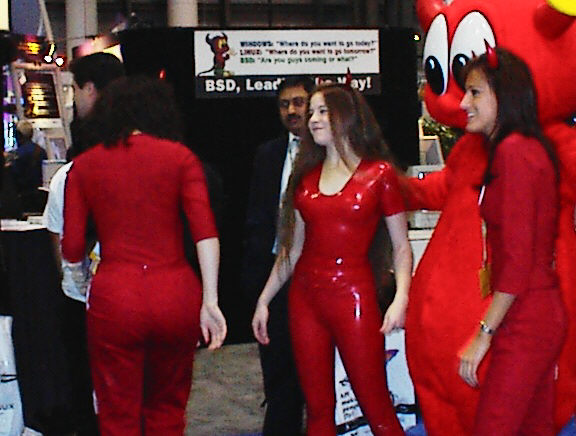
BSD claims patent on hot babes!
Is it any wonder people think Linux users are a bunch of flaming homosexuals when its fronted by obviously gay losers like these?! BSD has a mascot who leaves us in no doubt that this is the OS for real men! If Linux had more hot chicks and gorgeous babes then maybe it would be able to compete with BSD!
Linux is a joke as long as it continues to lack sexy girls like her! I mean just look at this girl! Doesn't she excite you? I know this little hottie puts me in need of a cold shower! This guy looks like he is about to cream his pants standing next to such a fox. As you can see, no man can resist this sexy little minx. I mean are you telling me you wouldn't like to get your hands on this ass?! Linux has nothing that can possibly compete. Come on, you must admit she is better than an overweight penguin or a gay looking goat!
With sexy chicks like the lovely Ceren you could have people queuing up to buy open source products. Could you really refuse to buy a copy of BSD if she told you to? Don't you wish you could get one of these? Personally I know I would give my right arm to get this close to such a divine beauty!
Don't be a fag! Join the campaign for more cute open source babes today! -
Re:Sounds like a corny idea in the first place
But I can't combine it with BSDed code.
True.
Or any other open code license.
Not at all true. There are a number of GPL-compatable licenses.
So by your logic, since the GPL is a propriety license now and impeeds my and the code's freedom, I'm free to include/distribute it as BSDed or public domain software, yes?
I don't know whose logic that is, but it's certaintly not mine. I didn't say that at all. Not even close. That's what the poster I was responding to said, and I pointed out that "That's completely incomparable.". -
Creator?
I think they should last for as long as the creator chooses to let them last.
<nitpick> You can find most opinions of the creator in religious texts. For example, I don't see anything in the text of the Christian Bible that would make me think "thou shalt not steal" has anything to do with copyright. Do you know of any opinions about copyright in the text of the Quran? Or in the Talmud (a Jewish supplement to the Old Testament)? </nitpick> I'll guess that instead of "creator" you meant "author or inventor", the terms that the law uses.
I think they should last for as long as the author or inventor chooses to let them last.
But what if the author is a corporation? If you'd just abolish corporate authorship, what happens when the author dies? If Johann Gutenberg, who invented a movable-type printing press, had stated in his will that he wanted his estate to hold a perpetual patent on printing presses, would you have granted such a patent?
The causal relationship exists because of congress?
Only copyright laws create a connection between creation of a work and a monopoly on reproducing that work. Only legislatures enact copyright laws, and said legislatures have every right to un-enact them. Remember that copyright as we know it didn't exist until the early 1700s with the Statute of Anne.
If you work for a living, you prove the causal relationship between creating (working) or whatever it is you aren't doing for free.
For one thing, there exist business models that do not rely on an author's ability to restrict others from building on his work. But even with the typical royalty model, what money can it make an author to prohibit a given use at any price?
-
Re:It is hard to take financial advice
Stupidly like that make the Open source community look like a bunch of lunatics
And how would this be any different? Given that the very reason the GNU "movement" exists is to adapt a communist approach to software, lunacy is the only way to describe it. -
Grub KNOPPIX Netboot HOWTO(I was going to post my menu.lst, but I can't find my disk! I'll post a reply to this with my menu.lst when I find my disk.)
Well, I can't find the stupid disk. Okay, I'll reconstruct it as best as I can--without testing--from memory, documentation and peeking at KNOPPIX's startup settings:
My menu.lst looked something like this:default=0
timeout=5
title KNOPPIX netboot
dhcp
ifconfig --server=10.0.0.5
root (nd)
kernel
initrd
That nodhcp in the kernel parameters doesn't look right; I cut and pasted that from KNOPPIX's pxelinux.cfg/default file, so you may need to axe that for Grub, but try it this way first. Also, I think noprompt and noeject are parameters I threw in there to try to avoid the CD eject prompt, but those cheat codes don't seem to work for the KNOPPIX netboot init script. (They do for a local boot.) The rest of the parameters were scoped either from KNOPPIX's
I don't recall how KNOPPIX's tftp server is set up; you may need to add a
The magic is in the dhcp, ifconfig and root (nd) lines. See the network section of the Grub manual for details, but basically dhcp grabs an IP and (nd) is network device. Since I didn't put the tftp server location in my DHCP server config I had to add the line ifconfig --server=10.0.0.5 to specify it.
nfsdir= is used by the KNOPPIX init script to find the
To do this, first download the source. Grub uses etherboot's drivers (included with Grub source), and it seems like I had better luck with either of Grub 0.93 or 0.92, but I may be getting confused with another project I did so both may be good. 0.94 is new since I last looked. unpack it and look atroot (fd0)
Grub should find stage1, stage2 and menu.lst and install stage1 in the boot sector.
setup (fd0)
Come to think of it, etherboot may be able to specify a tftp server during compile time, and it definitely can be written to a floppy disk. However I like Grub for its versatility. And Grub can be compiled for support for multiple network cards; I'm not sure if an etherboot *.lzdsk can do that. I can also modify all Grub parameters at runtime, and I'm farily sure I can't do that with etherboot. (/me checks rom-o-matic.net) Doesn't look like etherboot can hardcode a tftpserver or even specify an IP address if necessary. Grub can at runtime. -
Grub KNOPPIX Netboot HOWTO(I was going to post my menu.lst, but I can't find my disk! I'll post a reply to this with my menu.lst when I find my disk.)
Well, I can't find the stupid disk. Okay, I'll reconstruct it as best as I can--without testing--from memory, documentation and peeking at KNOPPIX's startup settings:
My menu.lst looked something like this:default=0
timeout=5
title KNOPPIX netboot
dhcp
ifconfig --server=10.0.0.5
root (nd)
kernel
initrd
That nodhcp in the kernel parameters doesn't look right; I cut and pasted that from KNOPPIX's pxelinux.cfg/default file, so you may need to axe that for Grub, but try it this way first. Also, I think noprompt and noeject are parameters I threw in there to try to avoid the CD eject prompt, but those cheat codes don't seem to work for the KNOPPIX netboot init script. (They do for a local boot.) The rest of the parameters were scoped either from KNOPPIX's
I don't recall how KNOPPIX's tftp server is set up; you may need to add a
The magic is in the dhcp, ifconfig and root (nd) lines. See the network section of the Grub manual for details, but basically dhcp grabs an IP and (nd) is network device. Since I didn't put the tftp server location in my DHCP server config I had to add the line ifconfig --server=10.0.0.5 to specify it.
nfsdir= is used by the KNOPPIX init script to find the
To do this, first download the source. Grub uses etherboot's drivers (included with Grub source), and it seems like I had better luck with either of Grub 0.93 or 0.92, but I may be getting confused with another project I did so both may be good. 0.94 is new since I last looked. unpack it and look atroot (fd0)
Grub should find stage1, stage2 and menu.lst and install stage1 in the boot sector.
setup (fd0)
Come to think of it, etherboot may be able to specify a tftp server during compile time, and it definitely can be written to a floppy disk. However I like Grub for its versatility. And Grub can be compiled for support for multiple network cards; I'm not sure if an etherboot *.lzdsk can do that. I can also modify all Grub parameters at runtime, and I'm farily sure I can't do that with etherboot. (/me checks rom-o-matic.net) Doesn't look like etherboot can hardcode a tftpserver or even specify an IP address if necessary. Grub can at runtime. -
Re:catch-up
No, my point is, to play catch-up, the acceleration must be boosted much more than the current level, which IMHO is not fast enoough to even play catch-up.
Swing and AWT has been planned way before and there are developments IIRC 3 years ago and only now it produces at least something real. Back then it's still Java 1.3 and they tried to get full Java 1.2 compatibility... until now. Of course there are parts of JDK 1.3 and 1.4 that have been added as well, but look at the status page and get a picture of how dire the situation is. I'm not saying that GCJ developers are not hardworking enough, though.
Of course I'd like to see many addition that GCJ offer such as native compilation and others, but until it's truly usable fast enough, the relative progress seems to be a downward spiral and thus making the great-grand parent post ("give GCJ hippie" thing) a moot.
-
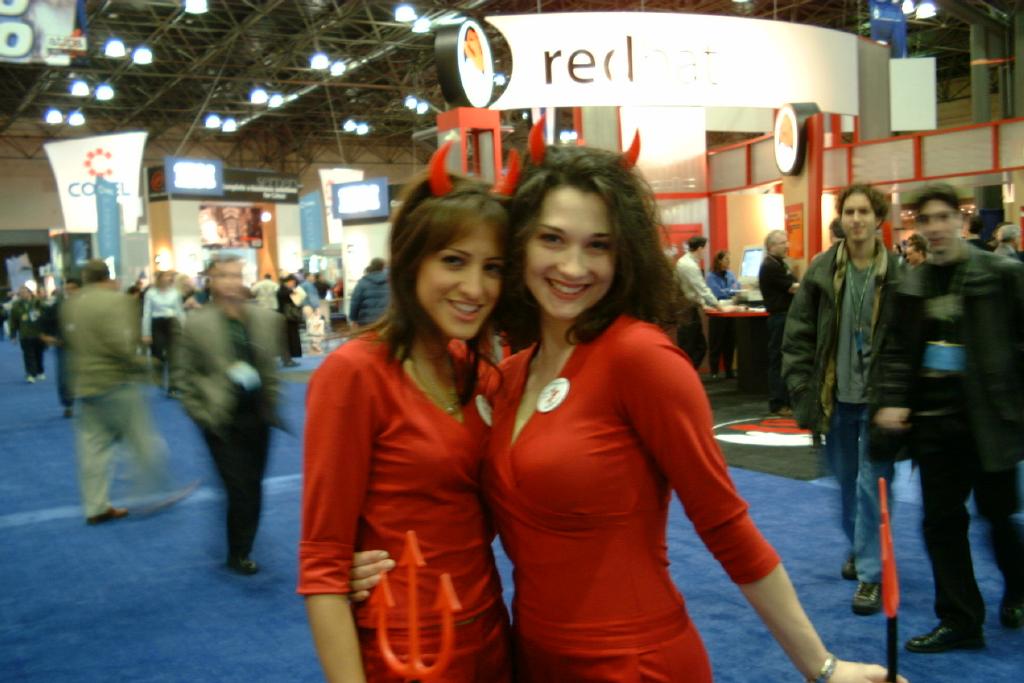
Ceren, be my valentine!
Is it any wonder people think Linux users are a bunch of flaming homosexuals when its fronted by obviously gay losers like these?! BSD has a mascot who leaves us in no doubt that this is the OS for real men! If Linux had more hot chicks and gorgeous babes then maybe it would be able to compete with BSD! Hell this girl should be a model!
Linux is a joke as long as it continues to lack sexy girls like her! I mean just look at this girl! Doesn't she excite you? I know this little hottie puts me in need of a cold shower! This guy looks like he is about to cream his pants standing next to such a fox. As you can see, no man can resist this sexy little minx. I mean are you telling me you wouldn't like to get your hands on this ass?! Wouldn't this just make your Christmas?! Yes doctor, this uber babe definitely gets my pulse racing! Oh how I envy the lucky girl in this shot! Linux has nothing that can possibly compete. Come on, you must admit she is better than an overweight penguin or a gay looking goat! Wouldn't this be more liklely to influence your choice of OS?
With sexy chicks like the lovely Ceren you could have people queuing up to buy open source products. Could you really refuse to buy a copy of BSD if she told you to? Don't you wish you could get one of these? Personally I know I would give my right arm to get this close to such a divine beauty!
Don't be a fag! Join the campaign for more cute open source babes today! -
Re:We dont need your stinkin javaWait till you see what happens if you are truely Free to mix and match all that goodness! Sun and Microsoft would never allow something like combining Java and C#. But that is precisely what thos GNU-heads have been doing!
IBM has been much nicer with Eclipse. And You can now combine that, with GNU Classpath and IKVM.NET to bring you Java Eclipse on Mono
Amazing! And of course you can just use java as a as a normal language with GCC (gcj). We even have native eclipse! Super fast, no slow bytecode interpreter needed.
Go away Sun with you proprietary closed non-free java! We don't need you anymore.
-
Re:We dont need your stinkin javaWait till you see what happens if you are truely Free to mix and match all that goodness! Sun and Microsoft would never allow something like combining Java and C#. But that is precisely what thos GNU-heads have been doing!
IBM has been much nicer with Eclipse. And You can now combine that, with GNU Classpath and IKVM.NET to bring you Java Eclipse on Mono
Amazing! And of course you can just use java as a as a normal language with GCC (gcj). We even have native eclipse! Super fast, no slow bytecode interpreter needed.
Go away Sun with you proprietary closed non-free java! We don't need you anymore.
-
Getting there.
-
We dont need your stinkin java
-
Ceren, be my valentine!
Is it any wonder people think Linux users are a bunch of flaming homosexuals when its fronted by obviously gay losers like these?! BSD has a mascot who leaves us in no doubt that this is the OS for real men! If Linux had more hot chicks and gorgeous babes then maybe it would be able to compete with BSD! Hell this girl should be a model!
Linux is a joke as long as it continues to lack sexy girls like her! I mean just look at this girl! Doesn't she excite you? I know this little hottie puts me in need of a cold shower! This guy looks like he is about to cream his pants standing next to such a fox. As you can see, no man can resist this sexy little minx. I mean are you telling me you wouldn't like to get your hands on this ass?! Wouldn't this just make your Christmas?! Yes doctor, this uber babe definitely gets my pulse racing! Oh how I envy the lucky girl in this shot! Linux has nothing that can possibly compete. Come on, you must admit she is better than an overweight penguin or a gay looking goat! Wouldn't this be more liklely to influence your choice of OS?
With sexy chicks like the lovely Ceren you could have people queuing up to buy open source products. Could you really refuse to buy a copy of BSD if she told you to? Don't you wish you could get one of these? Personally I know I would give my right arm to get this close to such a divine beauty!
Don't be a fag! Join the campaign for more cute open source babes today! -
GNU is not open source, it's free software.
I realize you were only kidding, but GNU has nothing to do with the open source movement. GNU was started over a decade before the open source movement began. The start of the GNU project marks the beginning of the free software movement. The free software movement and the open source movement are different movements within the same community and, ironically (emphasis mine):
"Open source advocates do contribute to our community, when they work on free software packages, but our community is older than that movement, and owes its existence to the idealism that movement rejects. It was built by the free software movement, so it is the free software community."
This quote was from an article RMS posted to the GCC mailing list.
-
GNU is not open source, it's free software.
I realize you were only kidding, but GNU has nothing to do with the open source movement. GNU was started over a decade before the open source movement began. The start of the GNU project marks the beginning of the free software movement. The free software movement and the open source movement are different movements within the same community and, ironically (emphasis mine):
"Open source advocates do contribute to our community, when they work on free software packages, but our community is older than that movement, and owes its existence to the idealism that movement rejects. It was built by the free software movement, so it is the free software community."
This quote was from an article RMS posted to the GCC mailing list.
-
Ceren, be my valentine!
Is it any wonder people think Linux users are a bunch of flaming homosexuals when its fronted by obviously gay losers like these?! BSD has a mascot who leaves us in no doubt that this is the OS for real men! If Linux had more hot chicks and gorgeous babes then maybe it would be able to compete with BSD!
Linux is a joke as long as it continues to lack sexy girls like her! I mean just look at this girl! Doesn't she excite you? I know this little hottie puts me in need of a cold shower! This guy looks like he is about to cream his pants standing next to such a fox. As you can see, no man can resist this sexy little minx. I mean are you telling me you wouldn't like to get your hands on this ass?! Linux has nothing that can possibly compete. Come on, you must admit she is better than an overweight penguin or a gay looking goat!
With sexy chicks like the lovely Ceren you could have people queuing up to buy open source products. Could you really refuse to buy a copy of BSD if she told you to? Don't you wish you could get one of these? Personally I know I would give my right arm to get this close to such a divine beauty!
Don't be a fag! Join the campaign for more cute open source babes today! -
Open Source and Free Software
It is important to observe that OS is different from FS. I think that the main idea behind Open Cola relies in the Free Software, since this movement cares more about Freedom (inside the software environment and outisde of it too).
Please check http://www.gnu.org/philosophy/free-software-for-fr eedom.html for more information. -
Ceren, be my valentine!
Is it any wonder people think Linux users are a bunch of flaming homosexuals when its fronted by obviously gay losers like these?! BSD has a mascot who leaves us in no doubt that this is the OS for real men! If Linux had more hot chicks and gorgeous babes then maybe it would be able to compete with BSD!
Linux is a joke as long as it continues to lack sexy girls like her! I mean just look at this girl! Doesn't she excite you? I know this little hottie puts me in need of a cold shower! This guy looks like he is about to cream his pants standing next to such a fox. As you can see, no man can resist this sexy little minx. I mean are you telling me you wouldn't like to get your hands on this ass?! Linux has nothing that can possibly compete. Come on, you must admit she is better than an overweight penguin or a gay looking goat!
With sexy chicks like the lovely Ceren you could have people queuing up to buy open source products. Could you really refuse to buy a copy of BSD if she told you to? Don't you wish you could get one of these? Personally I know I would give my right arm to get this close to such a divine beauty!
Don't be a fag! Join the campaign for more cute open source babes today! -
GNU Radio Gets Shoved Into High Gear...
I predict the FCC (Federal Corrupt Commission) will violently shove GNU Radio development into high gear by trying to regulate our freedom to communicate.
http://www.gnu.org/software/gnuradio/gnuradio.htm
l -
No and Yes
Despite the fact that this guy doesn't seem to understand or appreciate Mono and dotGnu acheivements, I still pretty much agree with his conclusions.
Let's look at Java. How many professional/hobby/academic Java developers use Sun's SDK?
How many use Gnu classpath with some other VM?
Have you ever downloaded an app or library that was developed and tested under SableVM/Gnu-classpath but not Sun's SDK? -
GNU Classpath for applets?
It's more because GNU Classpath doesn't support Swing yet - as per the status - and its users are J2EE types who don't do AWT/Swing. I think Red Hat is supporting server-side Java for its commercial products.
-
Re:Now? Improve emulators!
GPL exists as a response to copyrights, but it depends on copylefts, which is quite opposite to copyrights.
From GPL:
We protect your rights with two steps: (1) copyright the software, and (2) offer you this license which gives you legal permission to copy, distribute and/or modify the software.
The GPL depends on copyright, not copyleft. The GPL does, however, create/enforce copyleft. -
Re:The dirty room and the clean room
Nothing you read on Slashdot is legal advice. Trust it only as far as you would trust information provided by a paralegal, and probably not even that far. If you want legal advice about a copyright issue, find an attorney licensed to practice in your jurisdiction, preferably one who specializes in copyright law.
So, if someone downloads the code, and describes it, in plain english,or in a haiku to the Wine team, that would be ok?
For the most part, copying ideas does not infringe (17 USC 102). You should still see an attorney though.
I volunteer...just because I like the idea of the "dirty" room
Yes, you could participate in the dirty-room side of a reverse engineering project, but you'd need to submit to a Federally accredited brainwashing before you could ever write free software again.
-
Re:If there are software awards...
-
Re:Why is this newsworthy?is this news because you would normally assume Apple to be parasitic and not give back to anyone?
Considering that Konqueror is GPL'd and KHTML is LGPL'd, it would be fruitless for Apple to even consider being parasitic. You're seeing the GPL family of licenses at work, where proprietary and open source companies mutually benefit one another. Everyone wins, specially the users.
= 9J =
-
Re:license agreements useless
IANAL, but that would seem to violate any reading of the GPL I can imagine.
Totally correct. The GPL is misquoted on Slashdot all the time, usually by well meaning but uninformed people.
Everyone who hasn't done it yet, please go to GNU's License Page and just bookmark it now. Read it later, fine, but go and read it. The GPL is actually interesting reading (for a legal document, that is). But the GPL is not a license to do what you want. It is actually quite restrictive. For the rest of you, this is my impressions of the licenses, which will no doubt be picked to pieces by people who claim to be more of an expert. Your milage may vary.
PD=Public Domain, Do anything you want, call it your own, sell it, change it, secret it away, whatever. There are NO copyrights on the code. PDing code means giving up all ownership.
BSD =2 kinds, basically do almost anything you want, but give proper credit. Code is copyrighted but distribution is not restricted.
GPL= Do what you want, but you MUST share the code if you distribute the binaries. If you don't distribute the binaries, you can die with all your secret code and its legal. If you accidently distribute binaries, but don't want to distrubute source, you have to recall all the binaries. Code is copyrighted, and much is donated to the FSF, consolidating enforcement.
If you write code, you can release it under two or more different licenses (but not PD and any other). Mysql does this, releases main code GPL and also issues private licenses so companies willing to pay can modify it without releasing their changes if they distribute it. This is a legitimate way an open source company can make money and we all benefit from the Free code.
You can never "unGPL" code. If version 1.0 was ever GPL, it will always be GPL. If you want to make 1.1 proprietary, you can, but I can take 1.0 and fork the code into a new project and you can never take that away once it is granted. If I make changes to GPL code and rerelease it, it has to be released as GPL licensed.
You can not restrict anyone's use of GPL programs. If I want to use it to run a nuclear plant, guide chemical filled missles, run a day care center, or run the seti@home client, no one, including the copyright holder, can limit me. This would include for profit and non profit uses.
If I use GPL code to make my program, I can never take away your right to have the source if I give/sell you the binaries. If you want to take my 1.1 code, and fork it and call it something else and release it as version 2.0, or 1.0, I can't stop you.
If I make a GPL program or derivitive, and the only person I ever distributed it to is Taco, then I am only obligated to distribute the source code or make it available to Taco. I don't have to put the source on the CD, I just have to make the source reasonably accessible to anyone I distribute the binaries to. (email, ftp site, web site, buy the cd for $5 media charge).
If I want to sell your GPL software as a package with or without support, I may. I may charge any fee I wish without paying any royalies. If I sell Taco a copy of "GNU/FooTastiC 2.0" for $1 million dollars, he can give it away to anyone for free, including the source, and I can't restrict his ability to do so. Nor can the copyright holder.
The GPL (and LGPL for libraries) are good licenses for most projects. It protects individual users more than the author/copyright holder in many ways, but guarantees that the author can not take away your right to use the software for any reason. I also think there is a place for proprietary software, including proprietary applicationss on top of a GPL operating system.
This concludes our GPL primer -
Keep it simple
I would suggest designing for the minimum browser, as many people may be connecting using modems, carrier pigeons, or other low bandwidth connections. The FSF homepage is a good example.