Slashdot Mirror
Domain: gnustep.org
Stories and comments across the archive that link to gnustep.org.
Comments · 601
-
Becoming less and less likelyBack when OSX was in beta, I listened to a lot of this x86 port speculation. It was a lot more believeable back then. You see OpenStep (the predecessor to OSX beta) was already cross platform. They had even made a version of Rhapsody that installed as a layer into windows.
Apple has a long history of writing (or collaborating on) uber-cool System Software and abandoning it (anyone else remember PINK? or how about OpenDoc?).
It looks a bit different with Darwin for x86 though. As long as Apple keeps to its word and publishes changes to Darwin, the x86 version will track the cnages made to the PPC version (even if it is a bit behind sometimes).
If you head over to http://www.gnustep.org/ you will then find out about a very active GNU project to duplicate OpenStep 4.4 (the last version before the purchase by Apple). It is almost complete, and if you look through their roadmap, you will see that they plan to track the cnages forst to Rhapsody and then work toward the OSX changes.
What does all this really mean?
Well, right now, it is possible to load up Darwin (or linux) and make sure you have all the GNUstep libraries installed, then you would be able to head over to http://www.omnigroup.com/ or http://www.stone.com/ and grab the old versions of OmniWeb and Create for OpenStep x86 and you can compile them yourselves!
If you are interested in recreating the NeXT experience, why not go whole hog and load up the linux distro called Simply GNUstep (which only includes GNUstep tools and GUI stuffs wherever possible).
What would all this really give you?
Right now, all you would get is outdated versions of OpenStep applications (most
If Apple did a port of its own, you would probably be able to run all Cocoa apps but not apps that are Classic or Carbon (because those depend upon parts of Old MacOS.
In fact, that was the reason why I believed the x86 rumors back in the days of beta. Most apps were Carbon and Classic. An x86 version back then would have servered as an advertizement and not a complete threat to Apple's hardware business.
I would look to Apple playing with other more exotic chipsets and not x86. They need low power consumption, faster chips, not x86 compatibility. It's too bad that AMD Hammer Macs or SPARC Macs never materialized.
Something like them may happen (especially since projects like PearPC have gotten better at emulating the PPC chipset) but look to Apple to move up the food chain toward Workstation Hardware and across the chain toward advanced Embedded Chips (maybe adding Cell Phone or some such function to its iPod) and not down.
The eMac or something like it will continue to be the bottom of its line. At $699 including a well-built monitor, its a pretty good value actually.
-
Re:What we really needI know of things being done the other way around -- check out Psi.
I would not think that Coca -> Qt port would be that easy, considering that Objective C (Cocoa) is *not* C++ (Qt), nor is it a straight-through conversion of one into another.
It would have been nice had GNUStep been more on par with Cocoa for GUI apps -- then one could recompile Adium or Fire on any Linux or BSD (or anything else that GNUStep would run on).
-
Re:Trouble is...
-
They always forget GNUstep
http://www.gnustep.org/ try the live cd if your distro doesn't ship it or you're just too lazy to compile, http://www.linuks.mine.nu/gnustep/
-
Re:Cocoa on top of Mono?
Even better would be finishing up the GNUStep project.
-jcr -
Re:Why not?
indeed. however, gnustep is free and can be run atop most unixes and even cygwin
-
Re:Just copy Core Audio and be done with it
I think CoreAudio could very easily be implemented on top of Jack because the APIs are similarish (well, at least as far as being callback based and realtime capable).
CoreAudio would be more worthwhile than DirectSound because OS X apps are more Unixy than Windows apps and the OpenSTEP/Cocoa stuff for the GUI is mostly implemented by GNUStep. OS X is way closer to GNU/Linux than Windows and I'm betting it would be tons easier getting an OS X Cocoa app working on GNU/Linux than a Windows app.
I don't really see the need for proprietary sound packages on GNU/Linux; I'm a card carrying member of the Free Software Foundation though so my opinions are a bit different from most.
-
Why they always forget GNUstep ?
-
Re:maybe they should come at it a different way
"Step" sounds good to me. We could call it OpenStep, or GNUStep. Maybe Apple will have something with a compatible API - let's call it NeXTSTEP, they'd probably buy it from somewhere else - and ship it on top of their Unix-like OS!
Brilliant! -
GNUStep
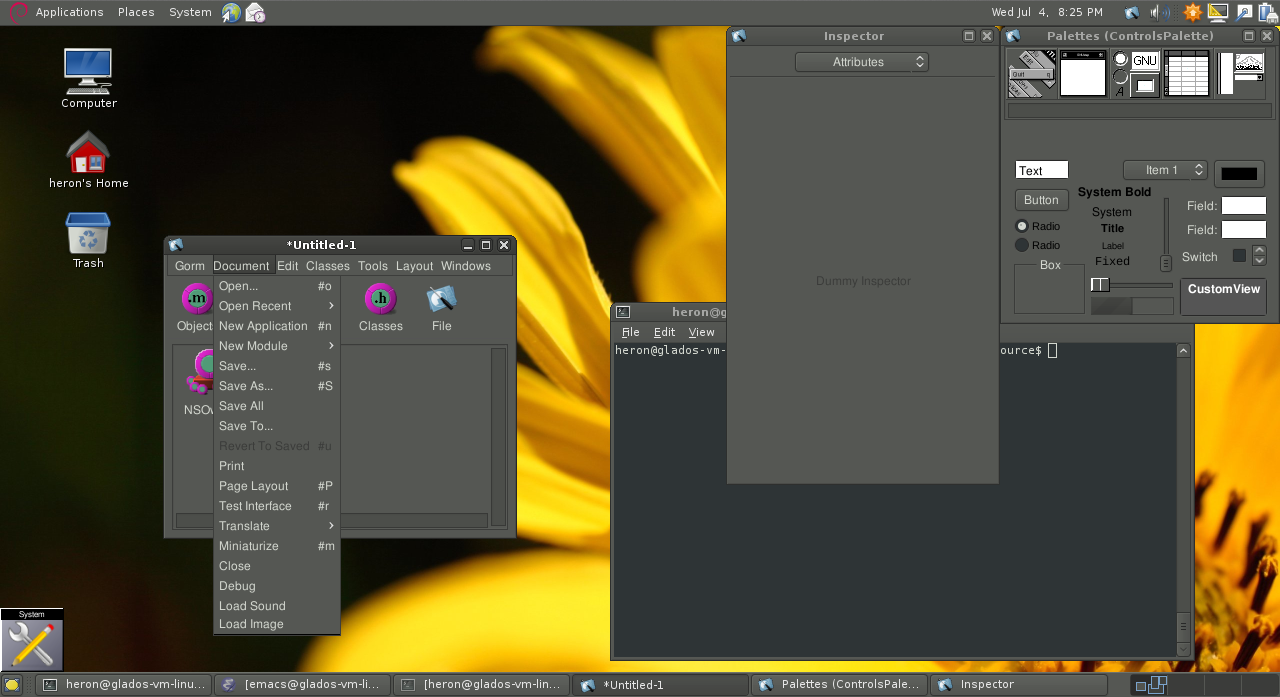
Of course, if you want to have Cocoa on your PC, you can. It's called GNUStep. It's not 100% complete, and currently very ugly (theming is about to take off, though!), but it has a number of advantages over OS X:
- GNUStep runs on a variety of platforms, including GNU/Linux and Microsoft Windows.
- GNUStep is far less resource hungry than OS X.
- Applications developed for GNUStep are trivial to port to OS X - mainly the menu layout needs to be changed.
The developer tools for GNUStep are really nice, and strikingly similar to Apple's. GNUStep still needs a lot of work, but it's come a long way. -
Re:Cool!
Some FreeNeXTSTEP would rock too!
It isn't quite an OS, but GNUStep comes closest to being a FreeNeXTSTEP...
-
ObjC in GCC; Openstep API in GNUstep
As a downside though, I'm not sure how well supported it is on non-OS-X platforms.
The GCC source code distribution includes an Objective-C front end. Are these platforms enough for you? Sure, you don't get the Cocoa/Openstep libraries everywhere, but the GNUstep team is working on that.
-
Re:Cocoa or Carbon? Daddy or Chips?But: Cocoa seems heavily oriented towards Objective C. It seems possible to mix C++ and Obj-C in an app, but how feasible is it for me to implement a version of my lib that exposes a C++ interface, yet uses Cocoa/ObjC internally? And even if it works, would it be full of nasty hacks?
I wouldn't do it. Objective-C++ is really intended for making calls to C++ libraries from Objective-C code. The languages are just too different to be very robust for the kind of thing you want to do. I understand that templates cause great difficulty, for example.
Please note that such insight does not include "You should just use Objective C for everything", just to warn you in advance.
My advice: just use Objective-C.
Objective C might be absolutely wonderful, but as all I ever hear about it is this fantastic new (sic) idea called MVC, it's hard to tell
Heh, you probably got hold of one of those "introductions to Objective-C" that was written by NeXT marketing back in 1988. One of the things Apple did was to take the old NeXT documents, replace all instances of 'NeXT' with 'Apple' and slap them up on their website. They've been steadily updating and replacing them but there's still a lot of old cruft in there. Briefly, Objective-C is Smalltalk grafted onto ANSI C. You get dynamic binding and typing and all that good jazz, while still having fast native-compiled code. If it helps to place the concepts, Java was heavily modeled on Objective-C.
If I'm going to learn/use a different language, I'd rather try something really portable like Python. Objective C still seems like an 'oddball' language to me, that's only used on Macs.
Actually, it is portable. The language itself is supported by GCC. And GNUstep is an LGPL'd implementation of the Foundation and ApplicationKit frameworks which runs on UNIX and Windows systems.
-
Re:Where's the project builder?
but where exactly is the project builder clone
Project Center
- Scott -
for those of you that like openstep & linux
Here's an openstep workalike for linux, they even have "Project Builder" and "Interface Builder".
GNUStep project
useful for getting your feet wet with Objective-C (pretty good) and the *step frameworks. -
Same for GnuStep it seems...
[I]n the beginning of the first edition's Java chapter, Hillegass basically says this about programming Cocoa using Java: "DON'T."
I was browsing the second edition at a bookstore (I own the first edition), and the the Java chapter seems to be replaced with a chapter on GnuStep. Maybe I'm reading it wrong, but it seems he basically has the same advice, saying something about GnuStep being announced 10 years ago and still not at a 1.0 version, and also being both difficult to install and a bit buggy.
I think he puts these chapters in his book only to answer the question, "I wonder what Hillegass thinks about coding in such-and-such."
-
GNUstep links
For those interested, here are GNUstep links:
Official GNUstep web site
'Live' wiki pages
Or you can talk directly to the GNUstep people at
the GNUstep IRC channel #gnustep at irc.freenode.net -
GNUstep links
For those interested, here are GNUstep links:
Official GNUstep web site
'Live' wiki pages
Or you can talk directly to the GNUstep people at
the GNUstep IRC channel #gnustep at irc.freenode.net -
Re:Apple frameworks on Linux would be excellent...the post I was replying to never mentioned that he was doing GPL development...
Er, he said he was looking at GNUstep (which is L-GPL'd), and that his one reservation was that he wanted a "straight recompile." What he didn't say was his one reservation was that GNUstep was free, and he was actually hoping to spend around $1500....
wxWidgets, by comparison, uses the L-GPL (and actually grants additional rights). Much closer in spirit to GNUstep, which he mentioned.
-
Re:C'mon now...
actually its done already, its called GNUSTEP . If only the interface got an improvemnt. It woudl be really nice if we got nice modern look like KDE or GNOME.. then there could be Linux/OSX cross platform
-
Equivalent of Wine for Carbon API apps?
Mac OS is still rather expensive. Not only does an entry-level eMac computer cost hundreds of USD more than the equivalent eMachines computer, but Apple chooses to refuse to license the special firmware to get competing PowerPC architecture machines to boot Mac OS. To estimate the cost of a Mac OS license, you need to estimate not only the cost of the boxed OS upgrade but also the cost of a bootloader capable of starting Mac OS on third-party hardware. Or do you know of an independent Carbon API implementation to match the independent OpenStep API implementation and independent Win32 API implementation?
-
Re:GNUStep
Because the calculator sucks.
Asahh, don't shoot! I was only kidding! -
GNUStep
Maybe I'm on a fruitbreak or something, but why not pick up GNUstep and enhance that? That way you get some semblance of source compatibility with Mac OSX Cocoa apps. Why follow Microsoft's example? It has always ended in tears in the past.
-
Source compatible clone of Mac Cocoa
Just try to build a compatible system if you doubt me.
Easy. With this I can recompile many Cocoa apps from source code to run on free operating systems, because both Cocoa and GNUstep implement the OPENSTEP specification.
Or did you mean binary compatible? Yes, I understand that disproportionately many Mac users work in a niche (such as color dead-tree publishing) that requires a patented process (such as PANTONE color matching), but many applications that don't require patented processes have a free alternative, and it probably wouldn't take too much work to maintain a GNUstep port of a free Cocoa app.
-
Re:We need a new toolkit...
I agree, but here's what I want:
EASE OF PROGRAMMING.
All the existing toolkits have APIs that are daunting to say the least.*cough*GNUstep*cough*
-
Re:Someone should tell AppleBut the Windows taskbar is clearly inferior. But it was better in 1995 than anything equivalent that the Mac had to offer until OS X came out. It took Apple four or five years to catch on to this.
Apple didn't really "catch on" to anything. They acquired the Dock concept from the same place they acquired almost everything else in OS X: OPENSTEP/Mach. Buying NeXT was the best decision anybody at Apple ever made. What's kind of interesting is that the Windows 95 look was heavily based on NeXTSTEP. Microsoft actually paid NeXT to use some of the 3D GUI concepts that had been part of NeXTSTEP since 1989. What a pity they didn't borrow the APIs as well.
-
Re:Someone should tell AppleWith OSX, I think there is finally room for the technically savvy users to do something more with their Macintosh systems than to just run programs from Apple and other software vendors.
Yes, Cocoa and Objective-C kick ass. (And you can do cross-platform Cocoa with GNUstep.) Unfortunately, there's still a stigma held over from the pre-OS X days. Whenever somebody mentions the Mac around our CS professors, all I hear are jokes.
-
Use the old NeXTStep port!
just linking an app against winelib is much more cost-effective than having to buy new hardware and port it to some Mac-API.
Kill several birds with one stone. If Corel are keen to port to Linux and OS X, which share a *nix backend, they could do worse than use GNUStep
I believe there once was a version of WordPerfect for NeXT/OpenStep, so dig up the old code, Corel!
As when they made enhancements to wine, they would bring GNUStep into prominence as a toolkit viable for commercial-grade apps.
-
You've just proved his point!
I think you've just proved the point of the article!
It's possible to get so bogged down in the philosophy that the higher level goal is missed. Sure having multiple vendors is nice, but all the options in the world don't matter if none of them are the one I want to use.
If there was only PC vendor who sold machines that could run run Linux and all the rest ran Windows 3.1, which would you buy?
Cocoa isn't portable directly, but why do you think that is? It uses things like Quartz that don't have an obvious counterpart on other platforms.. If you really want cross-platform, then use something like Qt or Java. GNUstep implements OpenStep (which is what Cocoa is based on).
major incompatibilities with glibc and bsd based systems
Huh?
As mentioned, aptitude, innovation and hard-work is what we need.. not another wheel..
The difference between open source efforts and Mac OS X isn't hard work, it's philosophy. Apple treats a computer as a whole and complete thing in and of itself. That's how the user thinks of it.
Best Regards,
- Scott -
Re:GTK is out, then?
-
Re:GTK is out, then?
Miguel,
I tend to agree that the existing toolkits leave a lot to be desired. But, what I would really like to know is what direction you (and others in the know) see toolkits going in?
Are we looking more towards things like gnustep or Y Windows?
Should we be looking to take the best aspects of each of these toolkits and create something new? (and if so, what do you see being included?) -
Re:I think
All they ask is that someone give them a first-class GUI toolkit at no cost, and with no strings attached! Is that so much to ask?
Sounds reasonable to me. -
Re:Qt is not my favorite toolkit
You're more likely posting it anonymously because you are a troll, no ?
Disclaimer: I'm not a fan of C++, yet I know its advantages and if I want to use it for a project -- or not. Qt is actually a rather nice GUI framework (thanks to signals/slots !), with in fact many similarities to the NeXSTEP framework. Qt got nice characteristics: it's mature, cross-platform, and it's quite easy to write applications for it.
Your #1 comment isn't that relevant with Qt -- it could be with other OO toolkits. Your #2 is half-true; yes, students tends to make design errors -- after all, they ARE students ! But OO gaves you a much better design when you had practiced a bit, I really don't know anybody that could argue the contrary. #3
In any cases, for the record, my preference won't go to C++/Qt -- NO. But simply to Objective-C/OpenStep, that is, either GNUstep implementation (crossplatform) or Cocoa implementation (Apple, OSX, directly from NeXT).
Yet, Qt is a good toolkit, and depending of the work/platform, it could be my choice (well... at least until GNUstep catch up on win32... which could be not that far !) -
Re:open source challenges??
Open source, bad? HOW DARE YOU!!!11one!!!!
Then open source developers have MS stomped as well, if they were smart enough to chose GNUstep. It uses the same methods for localization that Apple's Cocoa apps do.
-
cocoa tied to one hardware vendor?
Are you familiar at all with GNUstep? It's another implementation of the NeXTStep (I'm sure I got the caps all wrong there.) framework. They're keeping up with Apple's Cocoa pretty well. I think they've even made some headway on the ObjectiveC++ part.
-
If there was any sanity...
...in the open source community, we'd see more effort going into GNUstep.
Works with everything we have today? Check, there's compatibility with KDE and GNOME applications as well as Motif, with window style hints too.
High level language support? Check, Objective-C provides Smalltalk-like object orientation, and automatic memory management is available. There are also bindings to Ruby and Java. You can even build Java applications with native quality look and feel.
Compatible with what programmers know today? Yup, Objective-C is a slight superset of C, so almost any programmer can get to grips with it in a weekend. (Speaking as someone who did.)
Good class libraries? Yes, modeled on NeXT's excellent work, the same foundation used to build OS X. I've written Cocoa code, it's the most painless class library I've encountered. (Yes, I write Java too and have written C++.)
Cross platform? Yes again, programs are portable between GNUstep and Cocoa without too much work--see GNUmail for an example. Non-GUI programs even port to Windows without major effort, allegedly.
Good developer tools? Again, yes. Excellent developer tools on OS X. Doubtless the free tools on Linux could use some work, but that shouldn't be too hard. We can even build them using the OS X tools if necessary.
Pretty UI? Well, I think it looks OK. Not as nice as Aqua, but it's functional.
Mature? Well, the Objective-C compiler is GCC, Apple use it for their developer tools and push back improvements, the class library design has been refined over the course of 10+ years.
Think about it, people. We could unify the Linux and Apple developer communities. All work towards one common goal. Get 10%+ desktop market share for OpenStep/OS X/GNUstep in no time.
Hell, get GNUstep up to scratch and you'd probably see developers porting their commercial applications from OS X to Linux. Wouldn't you like to see products from Adobe, Macromedia, maybe even Apple available to run on your Linux desktop?
Think about all the problems that have been solved by NeXT and Apple. Application packaging? Solved, applications are bundles of files that you can just drag-drop wherever you want to keep them, and they work.
But no, the GNOME crowd will shun a tried and tested, open source, native code solution that works today and is backed by the single biggest vendor of UNIX desktops, in favor of cloning an untested patented bytecode-based Microsoft solution. Gates and co must be laughing.
But hey, go GNOME. Let's reinvent those wheels. Maybe your next set won't be square. -
If there was any sanity...
...in the open source community, we'd see more effort going into GNUstep.
Works with everything we have today? Check, there's compatibility with KDE and GNOME applications as well as Motif, with window style hints too.
High level language support? Check, Objective-C provides Smalltalk-like object orientation, and automatic memory management is available. There are also bindings to Ruby and Java. You can even build Java applications with native quality look and feel.
Compatible with what programmers know today? Yup, Objective-C is a slight superset of C, so almost any programmer can get to grips with it in a weekend. (Speaking as someone who did.)
Good class libraries? Yes, modeled on NeXT's excellent work, the same foundation used to build OS X. I've written Cocoa code, it's the most painless class library I've encountered. (Yes, I write Java too and have written C++.)
Cross platform? Yes again, programs are portable between GNUstep and Cocoa without too much work--see GNUmail for an example. Non-GUI programs even port to Windows without major effort, allegedly.
Good developer tools? Again, yes. Excellent developer tools on OS X. Doubtless the free tools on Linux could use some work, but that shouldn't be too hard. We can even build them using the OS X tools if necessary.
Pretty UI? Well, I think it looks OK. Not as nice as Aqua, but it's functional.
Mature? Well, the Objective-C compiler is GCC, Apple use it for their developer tools and push back improvements, the class library design has been refined over the course of 10+ years.
Think about it, people. We could unify the Linux and Apple developer communities. All work towards one common goal. Get 10%+ desktop market share for OpenStep/OS X/GNUstep in no time.
Hell, get GNUstep up to scratch and you'd probably see developers porting their commercial applications from OS X to Linux. Wouldn't you like to see products from Adobe, Macromedia, maybe even Apple available to run on your Linux desktop?
Think about all the problems that have been solved by NeXT and Apple. Application packaging? Solved, applications are bundles of files that you can just drag-drop wherever you want to keep them, and they work.
But no, the GNOME crowd will shun a tried and tested, open source, native code solution that works today and is backed by the single biggest vendor of UNIX desktops, in favor of cloning an untested patented bytecode-based Microsoft solution. Gates and co must be laughing.
But hey, go GNOME. Let's reinvent those wheels. Maybe your next set won't be square. -
Re:What about C++?
I know its compilable on other platforms, its just not used by any signifigant numbers of developers on other platforms.
GNUstep is there and is ported on many platforms: all kinds of Unix variants (Linux, *BSD, Solaris etc.), Windows and even Mac OS X.
It is very stable (actually for quite a long time now), OpenStep Foundation is implemented 100%, but just AppKit (graphical stuff) is missing some things.
And of course the stuff that was added in Cocoa and was not part in the OpenStep specification is also added in GNUstep when possible.
BTW, we always look for developers (both for GNUstep and for apps that run on GNUstep)! -
Yes, C *is* dead...
It has been replaced by Objective-C. Mono my ass.
-
Re:If I wanted MS .Net, I'd run MS...
-
Question:
How long before iTunes is running under GNUstep? That way we can have it under Linux, too!
-
Confused Author
One thing in particular that can be confusing to Linux developers about OS X is its overlay of two distinct directory organizations -- the traditional
That second hierarchy actually comes from NeXTSTEP, where it was called
Secondly there's a very conscious and IMHO good reason to farm off the NeXTish stuff into a different hierarchy - that is that it's a different system. All of the files in
The OPENSTEP-derived APIs, the Aqua GUI, Cocoa applications etc. are orthogonal to UNIX. They just happen to be running on a UNIX system (unless you're using Yellow Box for Windows NT). Keeping them in their own hierarchies so that they don't intrude on or get confused with UNIX stuff is a good idea.There is an anti-case-study: GNUstep does indeed put all of its files into the UNIX hierarchy, but it still partitions them into separate subdirectories, namely
-
Re:Why ?Not really: Cocoa is simply a newer version of NextStep, which has a more open analogue: GNUStep.
Anyway, Microsoft Office X for the Mac uses the Carbon API, which is a remnant of the OS X precursors like OS 9...
-
Re:Why ?
They use Carbon which isn't portable really to *nix. Had they used Cocoa GNUStep would have been an option.
-
Re:KDE and Gnome *do* run side-by-side
It seems to me, people overestimating their own ability isn't the fault of the interface. I agree its a dilemma, but not as bad as not offering the advanced interface at all. If GNOME takes the KISS principle too far they are just going to drive the power users to another alternative. Perhaps that has already happened.
GNOME does have an "Advanced Interface". It's called gconf-editor. Galeon's UI, for instance, has a certain number of preferences, but in gconf-editor you can set many more. In any event, I don't think GNOME wants power users, as the companies supporting GNOME are aiming at the corporate market where everything is basic and locked down. When GNOME changed its direction towards corporate users, I, thinking myself a power user, moved to a desktop based mainly on GNUstep, which doesn't treat its users like morons or corporate drones.
-
Re:OSX is not open source
Here is where you may find the source for the core operating system. You can install it on some PCs if it makes you happy and you may do so at no extra cost and you may do so legally. While their graphical programs and libraries are proprietary, their programming interface is an open standard. They've also contributed to the Objective-C interface of the GNU compiler collection. While I don't deny Apple has done some pretty nasty things, your statement about how Apple is more closed than Microsoft and SCO combined is a silly ignorant rant.
-
Re:cocoa apps?
Wouldn't that require a reverse engineered implementation of apple's APIs?
Well, Cocoa is really just a newer release of OpenStep, so the guts of it aren't anything altogether new or super secret. Actually it looks like the Zaurus thing is mostly a port of GNUstep, so it's not even entirely new stuff.
Personally, I'd be more intrested on being able to run OS X apps on desktop intel linux
You can sort of do that already. Obviously, you would want to avoid Mac-specific things in your program, but there should still be plenty of common ground.
-
Re:Linux on the desktopI'd personally prefer a NeXTSTEP or IRIX desktop
So what do you think of GNUstep?
-
Re:Next step - better apps
-
Re:winder if a new DE will come out of this
there'll be someone who re-invents the wheel again
With any luck, a round one this time instead of suffering with the two (main) horribly clunky desktop choices offered to Linux users now. If you really think KDE or GNOME are usable, you just haven't been around. If IBM had a clue, they'd push for more GNUstep development, which would actually give us all a shot at running some quality apps (commercially coming over from the Mac camp, of course) on Linux. A lot of things on Linux are nice, but making usable apps is simply not an itch that developers have scratched in free software.