Slashdot Mirror
Domain: google.com
Stories and comments across the archive that link to google.com.
Stories · 3,747
-
Tesla Logged $713 Million In Revenue In Q1 and Built 7,535 Cars
cartechboy (2660665) writes "Tesla just announced its first-quarter earnings and the numbers are interesting. It logged revenue of $713 million on deliveries of 6,457 Model S electric cars. It's worth noting that's basically the number of vehicles it said it would sell in the quarter, but that number is slightly down from the prior quarter. It built a total of 7,535 Model S cars in the quarter as it built inventory as shipments began to China where sales just started last month. Net orders in North America grew 10 percent, and production for the second quarter is expected to increase to 8,500-9,000 Model S cars. Tesla expects to deliver 35,000 cars during the 2014 calendar year. Musk told analysts that China's enthusiastic and that government support is crucial. The Model X is delayed until spring of 2015 with production-design prototypes being ready in the fourth quarter. Tesla hopes to possibly break ground as early as next month on its gigafactory, though the location has yet to be announced. Of course, the stock market is already reacting to these numbers and is currently down nearly 3 percent in after hours trading." -
Google Announces "Classroom"
theodp (442580) writes "Meet your new 'Room Mom', kids! On Tuesday, Google announced a preview of Classroom, a new, free tool in the Google Apps for Education suite. From the announcement: 'With Classroom, you'll be able to: [1] Create and collect assignments: Classroom weaves together Google Docs, Drive and Gmail to help teachers create and collect assignments paperlessly. They can quickly see who has or hasn't completed the work, and provide direct, real-time feedback to individual students. [2] Improve class communications: Teachers can make announcements, ask questions and comment with students in real time—improving communication inside and outside of class. [3] Stay organized: Classroom automatically creates Drive folders for each assignment and for each student. Students can easily see what's due on their Assignments page.'
Addressing privacy concerns, Google reassures teachers, 'We know that protecting your students' privacy is critical. Like the rest of our Apps for Education services, Classroom contains no ads, never uses your content or student data for advertising purposes, and is free for schools.' After the recent torpedoing of Bill Gates' $100M inBloom initiative, Google might want to have a privacy pitch ready for parents, too!" -
Computer Game Reveals 'Space-Time' Neurons In the Eye
sciencehabit (1205606) writes news that the EyeWire project from MIT has yielded some exciting results. "You open the overstuffed kitchen cabinet and a drinking glass tumbles out. With a ninjalike reflex, you snatch it before it shatters on the floor, as if the movement of the object were being tracked before the information even reached your brain. According to one idea of how the circuitry of the eye processes visual data, that is literally what happens. Now, a deep anatomical study of a mouse retina — carried out by 120,000 members of the public — is bringing scientists a step closer to confirming the hypothesis." The paper (paywalled), and a gallery of screenshots of the game. -
Google Shifts Editing From Drive to Docs and Sheets In 'Confusing' Switch
GottaBeMobile offers a better explanation than many other reports of a recent Google upgrade (some users would say more of a lateral move) that makes offline document creation and editing a first-class option for users of Google's office apps, but removes editing capabilities from Google Drive per se. Instead of creating or editing documents directly through Drive, users will instead be able to do this (including offline) with a dedicated app called Docs and Sheets. The article explains a few ways in which the new configuration is confusing, including this one: "Splitting out the editing functionality from Google Drive into the new Apps certainly seems odd given that fundamentally there are no new or different editing features offered in the new Google Docs and Google Sheets standalone Apps. Some users won’t appreciate having to download the new stand alone Apps to replace previous functionality, especially limited functionality." -
Some Users Find Swype Keyboard App Makes 4000+ Location Requests Per Day
New submitter postglock (917809) writes "Swype is a popular third-party keyboard for Android phones (and also available for Windows phones and other platforms). It's currently the second-most-popular paid keyboard in Google Play (behind SwiftKey), and the 17th highest of all paid apps. Recently, users have discovered that it's been accessing location data extremely frequently, making almost 4000 requests per day, or 2.5 requests per minute. The developers claim that this is to facilitate implementation of 'regional dialects,' but cannot explain why such frequent polling is required, or why this still occurs if the regional function is disabled. Some custom ROMs such as Cyanogenmod can block this tracking, but most users would be unaware that such tracking is even occurring." Readers in the linked thread don't all seem to see the same thing; if you are a Swype user, do you see thousands of location requests, none, or something in between? -
Book Review: Designing With the Mind In Mind
benrothke (2577567) writes "Neurologists and brain scientists are in agreement that in truth, we know very little about how the brain works. With that, in the just released second edition of Designing with the Mind in Mind, a Simple Guide to Understanding User Interface Design Guidelines, author Jeff Johnson provides a fascinating introduction on the fundamentals of perceptual and cognitive psychology for effective user interface (UI) design and creation." Keep reading for the rest of Ben's review. Designing with the Mind in Mind, a Simple Guide to Understanding User Interface Design Guidelines author Jeff Johnson pages 240 publisher Morgan Kaufmann rating 9/10 reviewer Ben Rothke ISBN 978-0124079144 summary Excellent reference on the integration of user interface design and the mind Johnson heads up a consulting firm that specialized in evaluating and designing UI and brings significant experience to every chapter. He writes that following user-interface design guidelines is not as straightforward as something like following a cooking recipe; even though people often compare the two. Design rules often describe goals rather than actions, as they are purposefully very general to make them broadly applicable. The downside to that is that it means that their exact meaning and applicability to specific design situations is open to interpretation.
With that, the book provides an exceptional foundation on how to ensure effective usability is successfully implemented. The book spends a long time detailing how users make decisions and choices.
What's really good about the book is that Johnson provides ample details about the topic, but doesn't reduce it to so just a set of rules or mind-numbing (and thusly unreadable) checklists. His synopsis of the topics provides the reader with a broad understanding of the topic and what they need to do in order to ensure effective UI design is executed.
While the focus in the book is heaving on general and cognitive psychology, the book is written for the reader who is a novice in the area, and stays quite practical, without getting in the vague theoretical areas.
The book provides scores of examples of how people relate to an interface, and how to design accordingly. One of many fascinating examples is when the author details the notion of attentional blink. After we see or hear something, either in real-life or on a monitor, for a very brief amount of time following the recognition, between .15 and .45 of a second; we are nearly deaf and blind to other visual stimuli, even though our eyes and ears stay functional. Researchers call this attentional blink and it is thought to be caused by the brain's perceptual and attentional mechanism being briefly fully occupied with processing the first recognition.
What this means for a UI designer is that attentional blink can cause the user to miss information or events if things appear in rapid succession. The book then goes on to describe techniques in which to create an effective UI to deal with the effects of attentional blink. And he does this for scores of other similar issues.
Another fascinating example is around visual hierarchy, which lets people focus on the relevant information. The book notes that one of the most important goals in arranging information presentations is to provide a visual hierarchy, an arrangement that breaks the information into distinct sections, labels each section prominently, and presents the sections and subsections as a hierarchy.
The book details the myriad areas which are crucial for an effective interface. Chapters 4 and 5 provide significant detail about the importance of color for effective visual representation.
As the title suggests, the book takes a deep approach to the neuroscience and psychology in UI design. Other chapters include topics on human vision, sound, task, cognition, memory and more.
As to memory, chapter details issues around the working memory of a user. He gives numerous examples of error boxes and help screens that work and are epic failures, and how to do it right. The classic example he provides is a 4-step Windows XP wireless error message. If the user were to follow the directions, the instructions would close after step 1.
Each chapter provides numerous implications of proper and improper design, and provides the needed recommendations. While the topics may sound dry, Johnson writes in an engaging and often humorous style.
The book clearly and empirically shows how effective UI design makes all the difference on how users interact with an application or web site. The book will certainly be an important reference to software designers, web designers, web application designers and those interested in HCI, and usability.
For the designers that can't understand why their users are frustrated, they can understand why here. For designers that really want to know what is going on in their users minds, one is hard pressed to find a better reference than this.
As the subtitle of the book is Simple Guide to Understanding User Interface Design Guidelines, the book is an invaluable resource for those serious about effective UI design.
Reviewed by Ben Rothke.
You can purchase Designing with the Mind in Mind, a Simple Guide to Understanding User Interface Design Guidelines from amazon.com. Slashdot welcomes readers' book reviews (sci-fi included) -- to see your own review here, read the book review guidelines, then visit the submission page. -
Google Plus Now Minus Chief Vic Gundotra
JG0LD (2616363) writes "Vic Gundotra, the man behind Google Plus and one of Google's most prominent executives, announced today that he will leave the company 'effective immediately.' Gundotra made the announcement, appropriately enough, in a lengthy Google Plus post, praising his co-workers and saying that he is 'excited about what's next.' However, he did not further outline his future plans, saying that 'this isn't the day to talk about that.'" -
Skilled Manual Labor Critical To US STEM Dominance
Doofus writes: "The Wall Street Journal has an eye-catching headline: Welders Make $150,000? Bring Back Shop Class. Quoting: 'According to the 2011 Skills Gap Survey by the Manufacturing Institute, about 600,000 manufacturing jobs are unfilled nationally because employers can't find qualified workers. To help produce a new generation of welders, pipe-fitters, electricians, carpenters, machinists and other skilled tradesmen, high schools should introduce students to the pleasure and pride they can take in making and building things in shop class. American employers are so yearning to motivate young people to work in manufacturing and the skilled trades that many are willing to pay to train and recruit future laborers. CEO Karen Wright of Ariel Corp. in Mount Vernon, Ohio, recently announced that the manufacturer of gas compressors is donating $1 million to the Knox County Career Center to update the center's computer-integrated manufacturing equipment, so students can train on the same machines used in Ariel's operations.' How many of us liked shop? How many young people should be training for skilled manufacturing and service jobs rather than getting history or political science degrees?" -
The Science Behind Powdered Alcohol
Daniel_Stuckey (2647775) writes "Last week, the US Alcohol and Tobacco Tax and Trade Bureau approved Palcohol, a powdered alcohol product that you can either use to turn water into a presumably not-that-delicious marg or to snort if you don't care too much about your brain cells. It's the first time a powdered alcohol product has been approved for sale in the US, but not the first time someone has devised one, and such products have been available in parts of Europe for a few years now. Now you may be wondering, as I was, how the heck do you go about powdering alcohol? As you might expect, there's quite a bit of chemistry involved, but the process doesn't seem overly difficult; we've known how to do it since the early 1970s, when researchers at the General Foods Corporation (now a subsidiary of Kraft) applied for a patent for an 'alcohol-containing powder.'" It turns out the labels were issued in error, so don't expect it to be available soon. But it does appear to be a real thing that someone is trying to have approved. -
Bill Gates Patents Detecting, Responding To "Glassholes"
theodp (442580) writes "As Google Glass goes on sale [ed: or rather, went on sale] to the general public, GeekWire reports that Bill Gates has already snagged one patent for 'detecting and responding to an intruding camera' and has another in the works. The invention proposes to equip computer and device displays with technology for detecting and responding to any cameras in the vicinity by editing or blurring the content on the screen, or alerting the user to the presence of the camera. Gates and Nathan Myhrvold are among the 16 co-inventors of the so-called Unauthorized Viewer Detection System and Method, which the patent application notes is useful 'while a user is taking public transportation, where intruding cameras are likely to be present.' So, is Bill's patent muse none other than NYC subway rider Sergey Brin?" A more cynical interpretation: closing the analog hole. Vaguely related, mpicpp pointed out that Google filed a patent for cameras embedded in contact lenses. -
The Best Parking Apps You've Never Heard Of and Why You Haven't
Bennett Haselton writes "If you read no further, use either the BestParking or ParkMe app to search all nearby parking garages for the cheapest spot, based on the time you're arriving and leaving. I'm interested in the question of why so few people know about these apps, how is it that they've been partially crowded out by other 'parking apps' that are much less useful, and why our marketplace for ideas and intellectual properly is still so inefficient." Read below to see what Bennett has to say.I casually asked a couple of my friends in Seattle -- where street parking is often unavailable, and parking garages vary widely in price -- if they'd ever heard of an app that would let them find the cheapest available parking garage, based on the time they wanted to enter and the time they planned on leaving. (Street parking is usually cheaper if you can find it, but the app would be useful for times that you can't find any.) Most of my friends said that they'd never heard of such an app, but they'd definitely use one if it existed. I also looked up parking apps on Google but the small subset that I randomly tried out, didn't do what I needed. So I thought about writing a "Somebody-with-more-time-than-me-should-go-and-do-this-thing" article, similar to the ride-swapping piece, when one of my friends casually mentioned the BestParking app.
Well, I tried it and it worked. (Lest I be accused of undue favoritism, ParkMe does the same thing just as well, although I didn't find it until later.) In both apps, you bring up a map centered on your current location, or scroll the map to where you plan on looking for parking later. You enter the time that you'll be entering and leaving, and the app shows a map with each parking garage represented by an icon showing the dollar amount that it will cost to park for that time. Without these apps, comparing rates is an annoyingly complex process to do by hand, in a crowded city like Seattle with many garages with different rates (and different times when their "evening rates" kick in -- usually 5 PM, but ranging from 4 to 7 PM), but the apps factor all of that in to give you the cheapest garage for the given time range. You can tap the individual garage icons for more information (if you plan on returning by 11 PM but you're not sure, you'd probably prefer a 24-hour garage instead of one that locks up at midnight). Also, if you're sitting at your computer and you already know the neighborhood where you'll be parking later, you can do the same search on each of their websites. (Although if you are on your phone, please don't do this from a moving car, duh. In Seattle there are plenty of 3-minute spots where you can pull over and do a search.)
So, I've been quite happy with both apps -- but I thought it was interesting that almost none of my friends had ever heard of them. I threw a quick survey up on Amazon's Mechanical Turk website, which I've used before for crowdsourced surveys and other experiments. I polled 50 people, offering them 25 cents apiece to answer these questions:
Would you use these apps? Section A: Parking garage app
Suppose a website and/or smartphone app existed where you could specify a neighborhood of a city, and enter a start and end time for when you wanted to park, and the app would automatically find the cheapest parking garage for that time range (assuming its too hard to find street parking).
1. Are you aware of any such apps/websites that already exist? If yes, whats the name of the app? (No need to do a web search -- only answer "Yes" if you already know of such an app or website.)
2. Would you use such an app/website if it existed? (Or, if youre aware of such an app that already exists, do you use it?)
Yes/No Section B: Spare room rental app
Suppose a website and/or smartphone app existed where you could list a room in your house as a temporary rental, and visitors to your city could rent it out for a single night, or more.
3. Are you aware of any such apps/websites that already exist? If yes, whats the name of the app? (No need to do a web search -- only answer "Yes" if you already know of such an app or website.)
4. Would you use such an app/website if it existed? (Or, if youre aware of such an app that already exists, do you use it?)
Yes/No
The second section, about a spare room rental app, was thrown in as a control in the experiment -- I knew the answer to that question (AirBnB), and I thought a large portion of the survey-takers would too, so I wanted to make sure they weren't just filling out the survey with blow-off answers to get the 25 cents as fast as possible.
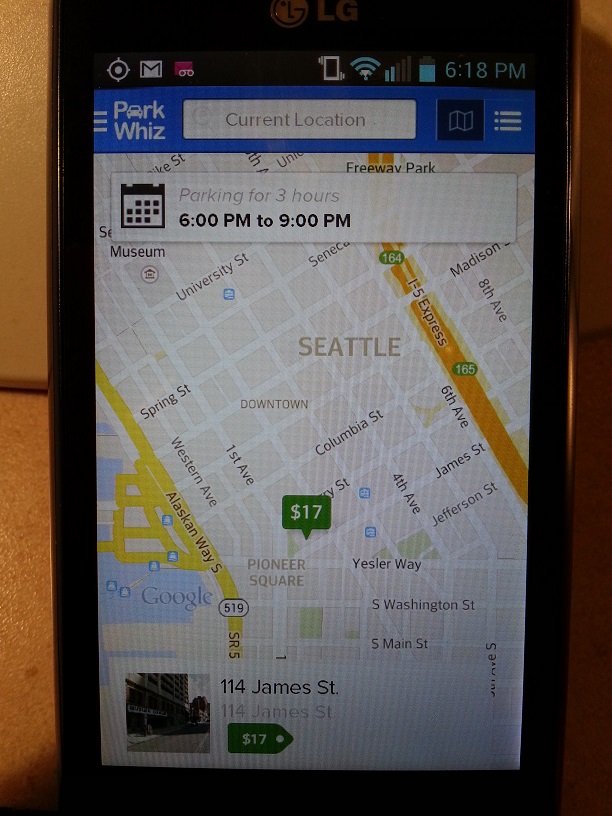
Of the 50 people who filled out the survey, 14 of them said they had heard of using AirBnB, Couchsurfing, or Craigslist for the purpose of renting out a room or finding one to rent (almost all of them mentioned AirBnB specifically). But of the same 50 respondents, only two of them mentioned any parking apps that they had heard of, and only one of them mentioned one of the two that I'd found which actually worked. (The other person mentioned an app called ParkWhiz, which, when I tested it out, only displayed one $17 parking garage in a neighborhood where I know of several $5 garages, which BestParking and ParkMe did list correctly.)
This seems to confirm the anecdotal evidence from my survey of my Seattle friends -- there is a great deficiency in awareness of these apps, relative to how useful people would find them if they knew about them.
So how is it that people are finding -- or not finding -- these apps? In a Google search for "parking app", the first result was an ad for ParkWhiz. BestParking and ParkMe did show up in the results, but so did another one called Parker, as well as a Mashable article by Kate Freeman listing "7 City Parking Apps to Save You Time, Money and Gas". Of the apps listed in the article, the only city-specific one that worked in Seattle (PrimoSpot) has been discontinued, and of the non-city-specific ones, only Parker is still around. (The article doesn't even mention BestParking or ParkMe, although I don't know if they existed when it was written.) Finally, a friend in my survey told me about an app called Parkopedia, which has over 100,000 downloads on Google Play (the same as BestParking, and more than ParkMe).
So even if it did occur to you to look for a parking-garage-finding app, the problem is that if you randomly picked one of the five most popular parking apps (BestParking, Parker, ParkMe, Parkopedia, and ParkWhiz), you might accidentally pick one of the three out of five that is a fail:
-
ParkWhiz, as noted above, only showed one $17 garage in a neighborhood full of other, cheaper garages.
-
Both ParkMe and Parkopedia display their results as a map with an icon marking each parking garage -- but with no price information. Simply having a map of parking garage locations isn't too useful, since you could get that by searching Google Maps for "parking" anyway. In both apps, you can click on parking garage icons to bring up a window showing their rates, but in Parker most of the listed garages just said "Contact facility for current rates". Parkopedia did usually display the rates for different garages -- but it's a pain to click on each of a dozen parking garage icons looking for the cheapest one. A typical area of downtown Seattle will have one garage where you can park for $5 for the evening, surrounded by garages where parking costs $10 or more, but Parkopedia doesn't make it easy to find it. And neither app lets you specify a start and end time for your parking so that you can find the cheapest garage for that time range.
So it seems odd that according to the Google Play store, Parkopedia has more downloads than ParkMe (100,000+ vs 50,000+), even though ParkMe seems a lot more useful. Meanwhile ParkWhiz, the one that found only one overpriced parking garage in a neighborhood full of cheaper ones, has fewer downloads but a slightly higher star rating in the app store than ParkMe. Of course in my parking-app survey of friends and Mechanical Turk users, the far-and-a-way winner was simply not knowing that any of these apps existed at all.
And here's why it matters to you even if you ride a granola-powered bike to work: I think this is a confirming instance of what I've been arguing for years, that the marketplace for ideas, inventions, and intellectual property is far less efficient than most people think it is. Every day a huge amount of human capital is squandered by people trying to jostle their competitors out of Google search results, or even just trying to raise the capital to advertise their products to people who would find them extremely useful, but will never find out about it if the venture capitalists don't come through with the money to advertise it. All of that is time and effort that could have instead gone towards making the products better.
I've suggested an algorithm based on "random-sample voting" as an antidote to some of these market inefficiencies, such as stopping people from buying votes on Digg, promoting the best ideas on Obama's "We The People" petition website, or even deciding whether J.K. Rowling is the world's greatest author or just lucky. Basically, in each scenario, the competing entities -- whether apps, or songs, or ideas for improving U.S. government policy -- would be rated by a sufficiently large random sample of qualified raters. ("Qualified raters" might mean economists in the case of the White House policy-petition website, or it might mean music consumers in the case of an algorithm to find the best new songs.) Each entity would receive an average rating from those raters, and then the entities with the highest average rating would be the ones promoted to the widest audience (at the top of Google search results, for example). It sounds deceptively simple, but it's far less amenable to "gaming the system", because you can't rope in your friends to vote for your app, or pay voters to rate you highly on Digg. The only way to win in this system is to make your song, idea, or app, the best that it can be -- which means your human capital is being channeled productively, instead of being wasted hiring an SEO company to try and knock your competition out of the top spot on Google.
If competition between parking apps worked this way, then all the current users of Parker, ParkWhiz and Parkopedia, would switch to BestParking and ParkMe, saving themselves a lot of hassle in the process, and those second-rate apps would have never even gotten on the ground unless they got their act together and implemented the same features. More broadly, if competition in the marketplace of ideas worked this way, then there wouldn't be so many users who really wish they could have an app like this, without realizing that the apps exist!
One striking thing about looking at a map of downtown parking garages, is how wildly the rates vary from each other, with $15 garages situated right next to the $5 ones. In theory, in a competitive marketplace, such rates should stabilize around a single price, for goods that are roughly comparable. But the $10 lots do still manage to get some customers who don't know any better, because it's just not practical to criss-cross a grid of several dozen city blocks looking for the cheapest garage. BestParking and ParkMe help people deal with this inefficient marketplace. So it's ironic that they're being held back by a marketplace for ideas that operates just as inefficiently in its own way.
-
-
The Best Parking Apps You've Never Heard Of and Why You Haven't
Bennett Haselton writes "If you read no further, use either the BestParking or ParkMe app to search all nearby parking garages for the cheapest spot, based on the time you're arriving and leaving. I'm interested in the question of why so few people know about these apps, how is it that they've been partially crowded out by other 'parking apps' that are much less useful, and why our marketplace for ideas and intellectual properly is still so inefficient." Read below to see what Bennett has to say.I casually asked a couple of my friends in Seattle -- where street parking is often unavailable, and parking garages vary widely in price -- if they'd ever heard of an app that would let them find the cheapest available parking garage, based on the time they wanted to enter and the time they planned on leaving. (Street parking is usually cheaper if you can find it, but the app would be useful for times that you can't find any.) Most of my friends said that they'd never heard of such an app, but they'd definitely use one if it existed. I also looked up parking apps on Google but the small subset that I randomly tried out, didn't do what I needed. So I thought about writing a "Somebody-with-more-time-than-me-should-go-and-do-this-thing" article, similar to the ride-swapping piece, when one of my friends casually mentioned the BestParking app.
Well, I tried it and it worked. (Lest I be accused of undue favoritism, ParkMe does the same thing just as well, although I didn't find it until later.) In both apps, you bring up a map centered on your current location, or scroll the map to where you plan on looking for parking later. You enter the time that you'll be entering and leaving, and the app shows a map with each parking garage represented by an icon showing the dollar amount that it will cost to park for that time. Without these apps, comparing rates is an annoyingly complex process to do by hand, in a crowded city like Seattle with many garages with different rates (and different times when their "evening rates" kick in -- usually 5 PM, but ranging from 4 to 7 PM), but the apps factor all of that in to give you the cheapest garage for the given time range. You can tap the individual garage icons for more information (if you plan on returning by 11 PM but you're not sure, you'd probably prefer a 24-hour garage instead of one that locks up at midnight). Also, if you're sitting at your computer and you already know the neighborhood where you'll be parking later, you can do the same search on each of their websites. (Although if you are on your phone, please don't do this from a moving car, duh. In Seattle there are plenty of 3-minute spots where you can pull over and do a search.)
So, I've been quite happy with both apps -- but I thought it was interesting that almost none of my friends had ever heard of them. I threw a quick survey up on Amazon's Mechanical Turk website, which I've used before for crowdsourced surveys and other experiments. I polled 50 people, offering them 25 cents apiece to answer these questions:
Would you use these apps? Section A: Parking garage app
Suppose a website and/or smartphone app existed where you could specify a neighborhood of a city, and enter a start and end time for when you wanted to park, and the app would automatically find the cheapest parking garage for that time range (assuming its too hard to find street parking).
1. Are you aware of any such apps/websites that already exist? If yes, whats the name of the app? (No need to do a web search -- only answer "Yes" if you already know of such an app or website.)
2. Would you use such an app/website if it existed? (Or, if youre aware of such an app that already exists, do you use it?)
Yes/No Section B: Spare room rental app
Suppose a website and/or smartphone app existed where you could list a room in your house as a temporary rental, and visitors to your city could rent it out for a single night, or more.
3. Are you aware of any such apps/websites that already exist? If yes, whats the name of the app? (No need to do a web search -- only answer "Yes" if you already know of such an app or website.)
4. Would you use such an app/website if it existed? (Or, if youre aware of such an app that already exists, do you use it?)
Yes/No
The second section, about a spare room rental app, was thrown in as a control in the experiment -- I knew the answer to that question (AirBnB), and I thought a large portion of the survey-takers would too, so I wanted to make sure they weren't just filling out the survey with blow-off answers to get the 25 cents as fast as possible.
Of the 50 people who filled out the survey, 14 of them said they had heard of using AirBnB, Couchsurfing, or Craigslist for the purpose of renting out a room or finding one to rent (almost all of them mentioned AirBnB specifically). But of the same 50 respondents, only two of them mentioned any parking apps that they had heard of, and only one of them mentioned one of the two that I'd found which actually worked. (The other person mentioned an app called ParkWhiz, which, when I tested it out, only displayed one $17 parking garage in a neighborhood where I know of several $5 garages, which BestParking and ParkMe did list correctly.)
This seems to confirm the anecdotal evidence from my survey of my Seattle friends -- there is a great deficiency in awareness of these apps, relative to how useful people would find them if they knew about them.
So how is it that people are finding -- or not finding -- these apps? In a Google search for "parking app", the first result was an ad for ParkWhiz. BestParking and ParkMe did show up in the results, but so did another one called Parker, as well as a Mashable article by Kate Freeman listing "7 City Parking Apps to Save You Time, Money and Gas". Of the apps listed in the article, the only city-specific one that worked in Seattle (PrimoSpot) has been discontinued, and of the non-city-specific ones, only Parker is still around. (The article doesn't even mention BestParking or ParkMe, although I don't know if they existed when it was written.) Finally, a friend in my survey told me about an app called Parkopedia, which has over 100,000 downloads on Google Play (the same as BestParking, and more than ParkMe).
So even if it did occur to you to look for a parking-garage-finding app, the problem is that if you randomly picked one of the five most popular parking apps (BestParking, Parker, ParkMe, Parkopedia, and ParkWhiz), you might accidentally pick one of the three out of five that is a fail:
-
ParkWhiz, as noted above, only showed one $17 garage in a neighborhood full of other, cheaper garages.
-
Both ParkMe and Parkopedia display their results as a map with an icon marking each parking garage -- but with no price information. Simply having a map of parking garage locations isn't too useful, since you could get that by searching Google Maps for "parking" anyway. In both apps, you can click on parking garage icons to bring up a window showing their rates, but in Parker most of the listed garages just said "Contact facility for current rates". Parkopedia did usually display the rates for different garages -- but it's a pain to click on each of a dozen parking garage icons looking for the cheapest one. A typical area of downtown Seattle will have one garage where you can park for $5 for the evening, surrounded by garages where parking costs $10 or more, but Parkopedia doesn't make it easy to find it. And neither app lets you specify a start and end time for your parking so that you can find the cheapest garage for that time range.
So it seems odd that according to the Google Play store, Parkopedia has more downloads than ParkMe (100,000+ vs 50,000+), even though ParkMe seems a lot more useful. Meanwhile ParkWhiz, the one that found only one overpriced parking garage in a neighborhood full of cheaper ones, has fewer downloads but a slightly higher star rating in the app store than ParkMe. Of course in my parking-app survey of friends and Mechanical Turk users, the far-and-a-way winner was simply not knowing that any of these apps existed at all.
And here's why it matters to you even if you ride a granola-powered bike to work: I think this is a confirming instance of what I've been arguing for years, that the marketplace for ideas, inventions, and intellectual property is far less efficient than most people think it is. Every day a huge amount of human capital is squandered by people trying to jostle their competitors out of Google search results, or even just trying to raise the capital to advertise their products to people who would find them extremely useful, but will never find out about it if the venture capitalists don't come through with the money to advertise it. All of that is time and effort that could have instead gone towards making the products better.
I've suggested an algorithm based on "random-sample voting" as an antidote to some of these market inefficiencies, such as stopping people from buying votes on Digg, promoting the best ideas on Obama's "We The People" petition website, or even deciding whether J.K. Rowling is the world's greatest author or just lucky. Basically, in each scenario, the competing entities -- whether apps, or songs, or ideas for improving U.S. government policy -- would be rated by a sufficiently large random sample of qualified raters. ("Qualified raters" might mean economists in the case of the White House policy-petition website, or it might mean music consumers in the case of an algorithm to find the best new songs.) Each entity would receive an average rating from those raters, and then the entities with the highest average rating would be the ones promoted to the widest audience (at the top of Google search results, for example). It sounds deceptively simple, but it's far less amenable to "gaming the system", because you can't rope in your friends to vote for your app, or pay voters to rate you highly on Digg. The only way to win in this system is to make your song, idea, or app, the best that it can be -- which means your human capital is being channeled productively, instead of being wasted hiring an SEO company to try and knock your competition out of the top spot on Google.
If competition between parking apps worked this way, then all the current users of Parker, ParkWhiz and Parkopedia, would switch to BestParking and ParkMe, saving themselves a lot of hassle in the process, and those second-rate apps would have never even gotten on the ground unless they got their act together and implemented the same features. More broadly, if competition in the marketplace of ideas worked this way, then there wouldn't be so many users who really wish they could have an app like this, without realizing that the apps exist!
One striking thing about looking at a map of downtown parking garages, is how wildly the rates vary from each other, with $15 garages situated right next to the $5 ones. In theory, in a competitive marketplace, such rates should stabilize around a single price, for goods that are roughly comparable. But the $10 lots do still manage to get some customers who don't know any better, because it's just not practical to criss-cross a grid of several dozen city blocks looking for the cheapest garage. BestParking and ParkMe help people deal with this inefficient marketplace. So it's ironic that they're being held back by a marketplace for ideas that operates just as inefficiently in its own way.
-
-
The Best Parking Apps You've Never Heard Of and Why You Haven't
Bennett Haselton writes "If you read no further, use either the BestParking or ParkMe app to search all nearby parking garages for the cheapest spot, based on the time you're arriving and leaving. I'm interested in the question of why so few people know about these apps, how is it that they've been partially crowded out by other 'parking apps' that are much less useful, and why our marketplace for ideas and intellectual properly is still so inefficient." Read below to see what Bennett has to say.I casually asked a couple of my friends in Seattle -- where street parking is often unavailable, and parking garages vary widely in price -- if they'd ever heard of an app that would let them find the cheapest available parking garage, based on the time they wanted to enter and the time they planned on leaving. (Street parking is usually cheaper if you can find it, but the app would be useful for times that you can't find any.) Most of my friends said that they'd never heard of such an app, but they'd definitely use one if it existed. I also looked up parking apps on Google but the small subset that I randomly tried out, didn't do what I needed. So I thought about writing a "Somebody-with-more-time-than-me-should-go-and-do-this-thing" article, similar to the ride-swapping piece, when one of my friends casually mentioned the BestParking app.
Well, I tried it and it worked. (Lest I be accused of undue favoritism, ParkMe does the same thing just as well, although I didn't find it until later.) In both apps, you bring up a map centered on your current location, or scroll the map to where you plan on looking for parking later. You enter the time that you'll be entering and leaving, and the app shows a map with each parking garage represented by an icon showing the dollar amount that it will cost to park for that time. Without these apps, comparing rates is an annoyingly complex process to do by hand, in a crowded city like Seattle with many garages with different rates (and different times when their "evening rates" kick in -- usually 5 PM, but ranging from 4 to 7 PM), but the apps factor all of that in to give you the cheapest garage for the given time range. You can tap the individual garage icons for more information (if you plan on returning by 11 PM but you're not sure, you'd probably prefer a 24-hour garage instead of one that locks up at midnight). Also, if you're sitting at your computer and you already know the neighborhood where you'll be parking later, you can do the same search on each of their websites. (Although if you are on your phone, please don't do this from a moving car, duh. In Seattle there are plenty of 3-minute spots where you can pull over and do a search.)
So, I've been quite happy with both apps -- but I thought it was interesting that almost none of my friends had ever heard of them. I threw a quick survey up on Amazon's Mechanical Turk website, which I've used before for crowdsourced surveys and other experiments. I polled 50 people, offering them 25 cents apiece to answer these questions:
Would you use these apps? Section A: Parking garage app
Suppose a website and/or smartphone app existed where you could specify a neighborhood of a city, and enter a start and end time for when you wanted to park, and the app would automatically find the cheapest parking garage for that time range (assuming its too hard to find street parking).
1. Are you aware of any such apps/websites that already exist? If yes, whats the name of the app? (No need to do a web search -- only answer "Yes" if you already know of such an app or website.)
2. Would you use such an app/website if it existed? (Or, if youre aware of such an app that already exists, do you use it?)
Yes/No Section B: Spare room rental app
Suppose a website and/or smartphone app existed where you could list a room in your house as a temporary rental, and visitors to your city could rent it out for a single night, or more.
3. Are you aware of any such apps/websites that already exist? If yes, whats the name of the app? (No need to do a web search -- only answer "Yes" if you already know of such an app or website.)
4. Would you use such an app/website if it existed? (Or, if youre aware of such an app that already exists, do you use it?)
Yes/No
The second section, about a spare room rental app, was thrown in as a control in the experiment -- I knew the answer to that question (AirBnB), and I thought a large portion of the survey-takers would too, so I wanted to make sure they weren't just filling out the survey with blow-off answers to get the 25 cents as fast as possible.
Of the 50 people who filled out the survey, 14 of them said they had heard of using AirBnB, Couchsurfing, or Craigslist for the purpose of renting out a room or finding one to rent (almost all of them mentioned AirBnB specifically). But of the same 50 respondents, only two of them mentioned any parking apps that they had heard of, and only one of them mentioned one of the two that I'd found which actually worked. (The other person mentioned an app called ParkWhiz, which, when I tested it out, only displayed one $17 parking garage in a neighborhood where I know of several $5 garages, which BestParking and ParkMe did list correctly.)
This seems to confirm the anecdotal evidence from my survey of my Seattle friends -- there is a great deficiency in awareness of these apps, relative to how useful people would find them if they knew about them.
So how is it that people are finding -- or not finding -- these apps? In a Google search for "parking app", the first result was an ad for ParkWhiz. BestParking and ParkMe did show up in the results, but so did another one called Parker, as well as a Mashable article by Kate Freeman listing "7 City Parking Apps to Save You Time, Money and Gas". Of the apps listed in the article, the only city-specific one that worked in Seattle (PrimoSpot) has been discontinued, and of the non-city-specific ones, only Parker is still around. (The article doesn't even mention BestParking or ParkMe, although I don't know if they existed when it was written.) Finally, a friend in my survey told me about an app called Parkopedia, which has over 100,000 downloads on Google Play (the same as BestParking, and more than ParkMe).
So even if it did occur to you to look for a parking-garage-finding app, the problem is that if you randomly picked one of the five most popular parking apps (BestParking, Parker, ParkMe, Parkopedia, and ParkWhiz), you might accidentally pick one of the three out of five that is a fail:
-
ParkWhiz, as noted above, only showed one $17 garage in a neighborhood full of other, cheaper garages.
-
Both ParkMe and Parkopedia display their results as a map with an icon marking each parking garage -- but with no price information. Simply having a map of parking garage locations isn't too useful, since you could get that by searching Google Maps for "parking" anyway. In both apps, you can click on parking garage icons to bring up a window showing their rates, but in Parker most of the listed garages just said "Contact facility for current rates". Parkopedia did usually display the rates for different garages -- but it's a pain to click on each of a dozen parking garage icons looking for the cheapest one. A typical area of downtown Seattle will have one garage where you can park for $5 for the evening, surrounded by garages where parking costs $10 or more, but Parkopedia doesn't make it easy to find it. And neither app lets you specify a start and end time for your parking so that you can find the cheapest garage for that time range.
So it seems odd that according to the Google Play store, Parkopedia has more downloads than ParkMe (100,000+ vs 50,000+), even though ParkMe seems a lot more useful. Meanwhile ParkWhiz, the one that found only one overpriced parking garage in a neighborhood full of cheaper ones, has fewer downloads but a slightly higher star rating in the app store than ParkMe. Of course in my parking-app survey of friends and Mechanical Turk users, the far-and-a-way winner was simply not knowing that any of these apps existed at all.
And here's why it matters to you even if you ride a granola-powered bike to work: I think this is a confirming instance of what I've been arguing for years, that the marketplace for ideas, inventions, and intellectual property is far less efficient than most people think it is. Every day a huge amount of human capital is squandered by people trying to jostle their competitors out of Google search results, or even just trying to raise the capital to advertise their products to people who would find them extremely useful, but will never find out about it if the venture capitalists don't come through with the money to advertise it. All of that is time and effort that could have instead gone towards making the products better.
I've suggested an algorithm based on "random-sample voting" as an antidote to some of these market inefficiencies, such as stopping people from buying votes on Digg, promoting the best ideas on Obama's "We The People" petition website, or even deciding whether J.K. Rowling is the world's greatest author or just lucky. Basically, in each scenario, the competing entities -- whether apps, or songs, or ideas for improving U.S. government policy -- would be rated by a sufficiently large random sample of qualified raters. ("Qualified raters" might mean economists in the case of the White House policy-petition website, or it might mean music consumers in the case of an algorithm to find the best new songs.) Each entity would receive an average rating from those raters, and then the entities with the highest average rating would be the ones promoted to the widest audience (at the top of Google search results, for example). It sounds deceptively simple, but it's far less amenable to "gaming the system", because you can't rope in your friends to vote for your app, or pay voters to rate you highly on Digg. The only way to win in this system is to make your song, idea, or app, the best that it can be -- which means your human capital is being channeled productively, instead of being wasted hiring an SEO company to try and knock your competition out of the top spot on Google.
If competition between parking apps worked this way, then all the current users of Parker, ParkWhiz and Parkopedia, would switch to BestParking and ParkMe, saving themselves a lot of hassle in the process, and those second-rate apps would have never even gotten on the ground unless they got their act together and implemented the same features. More broadly, if competition in the marketplace of ideas worked this way, then there wouldn't be so many users who really wish they could have an app like this, without realizing that the apps exist!
One striking thing about looking at a map of downtown parking garages, is how wildly the rates vary from each other, with $15 garages situated right next to the $5 ones. In theory, in a competitive marketplace, such rates should stabilize around a single price, for goods that are roughly comparable. But the $10 lots do still manage to get some customers who don't know any better, because it's just not practical to criss-cross a grid of several dozen city blocks looking for the cheapest garage. BestParking and ParkMe help people deal with this inefficient marketplace. So it's ironic that they're being held back by a marketplace for ideas that operates just as inefficiently in its own way.
-
-
The Best Parking Apps You've Never Heard Of and Why You Haven't
Bennett Haselton writes "If you read no further, use either the BestParking or ParkMe app to search all nearby parking garages for the cheapest spot, based on the time you're arriving and leaving. I'm interested in the question of why so few people know about these apps, how is it that they've been partially crowded out by other 'parking apps' that are much less useful, and why our marketplace for ideas and intellectual properly is still so inefficient." Read below to see what Bennett has to say.I casually asked a couple of my friends in Seattle -- where street parking is often unavailable, and parking garages vary widely in price -- if they'd ever heard of an app that would let them find the cheapest available parking garage, based on the time they wanted to enter and the time they planned on leaving. (Street parking is usually cheaper if you can find it, but the app would be useful for times that you can't find any.) Most of my friends said that they'd never heard of such an app, but they'd definitely use one if it existed. I also looked up parking apps on Google but the small subset that I randomly tried out, didn't do what I needed. So I thought about writing a "Somebody-with-more-time-than-me-should-go-and-do-this-thing" article, similar to the ride-swapping piece, when one of my friends casually mentioned the BestParking app.
Well, I tried it and it worked. (Lest I be accused of undue favoritism, ParkMe does the same thing just as well, although I didn't find it until later.) In both apps, you bring up a map centered on your current location, or scroll the map to where you plan on looking for parking later. You enter the time that you'll be entering and leaving, and the app shows a map with each parking garage represented by an icon showing the dollar amount that it will cost to park for that time. Without these apps, comparing rates is an annoyingly complex process to do by hand, in a crowded city like Seattle with many garages with different rates (and different times when their "evening rates" kick in -- usually 5 PM, but ranging from 4 to 7 PM), but the apps factor all of that in to give you the cheapest garage for the given time range. You can tap the individual garage icons for more information (if you plan on returning by 11 PM but you're not sure, you'd probably prefer a 24-hour garage instead of one that locks up at midnight). Also, if you're sitting at your computer and you already know the neighborhood where you'll be parking later, you can do the same search on each of their websites. (Although if you are on your phone, please don't do this from a moving car, duh. In Seattle there are plenty of 3-minute spots where you can pull over and do a search.)
So, I've been quite happy with both apps -- but I thought it was interesting that almost none of my friends had ever heard of them. I threw a quick survey up on Amazon's Mechanical Turk website, which I've used before for crowdsourced surveys and other experiments. I polled 50 people, offering them 25 cents apiece to answer these questions:
Would you use these apps? Section A: Parking garage app
Suppose a website and/or smartphone app existed where you could specify a neighborhood of a city, and enter a start and end time for when you wanted to park, and the app would automatically find the cheapest parking garage for that time range (assuming its too hard to find street parking).
1. Are you aware of any such apps/websites that already exist? If yes, whats the name of the app? (No need to do a web search -- only answer "Yes" if you already know of such an app or website.)
2. Would you use such an app/website if it existed? (Or, if youre aware of such an app that already exists, do you use it?)
Yes/No Section B: Spare room rental app
Suppose a website and/or smartphone app existed where you could list a room in your house as a temporary rental, and visitors to your city could rent it out for a single night, or more.
3. Are you aware of any such apps/websites that already exist? If yes, whats the name of the app? (No need to do a web search -- only answer "Yes" if you already know of such an app or website.)
4. Would you use such an app/website if it existed? (Or, if youre aware of such an app that already exists, do you use it?)
Yes/No
The second section, about a spare room rental app, was thrown in as a control in the experiment -- I knew the answer to that question (AirBnB), and I thought a large portion of the survey-takers would too, so I wanted to make sure they weren't just filling out the survey with blow-off answers to get the 25 cents as fast as possible.
Of the 50 people who filled out the survey, 14 of them said they had heard of using AirBnB, Couchsurfing, or Craigslist for the purpose of renting out a room or finding one to rent (almost all of them mentioned AirBnB specifically). But of the same 50 respondents, only two of them mentioned any parking apps that they had heard of, and only one of them mentioned one of the two that I'd found which actually worked. (The other person mentioned an app called ParkWhiz, which, when I tested it out, only displayed one $17 parking garage in a neighborhood where I know of several $5 garages, which BestParking and ParkMe did list correctly.)
This seems to confirm the anecdotal evidence from my survey of my Seattle friends -- there is a great deficiency in awareness of these apps, relative to how useful people would find them if they knew about them.
So how is it that people are finding -- or not finding -- these apps? In a Google search for "parking app", the first result was an ad for ParkWhiz. BestParking and ParkMe did show up in the results, but so did another one called Parker, as well as a Mashable article by Kate Freeman listing "7 City Parking Apps to Save You Time, Money and Gas". Of the apps listed in the article, the only city-specific one that worked in Seattle (PrimoSpot) has been discontinued, and of the non-city-specific ones, only Parker is still around. (The article doesn't even mention BestParking or ParkMe, although I don't know if they existed when it was written.) Finally, a friend in my survey told me about an app called Parkopedia, which has over 100,000 downloads on Google Play (the same as BestParking, and more than ParkMe).
So even if it did occur to you to look for a parking-garage-finding app, the problem is that if you randomly picked one of the five most popular parking apps (BestParking, Parker, ParkMe, Parkopedia, and ParkWhiz), you might accidentally pick one of the three out of five that is a fail:
-
ParkWhiz, as noted above, only showed one $17 garage in a neighborhood full of other, cheaper garages.
-
Both ParkMe and Parkopedia display their results as a map with an icon marking each parking garage -- but with no price information. Simply having a map of parking garage locations isn't too useful, since you could get that by searching Google Maps for "parking" anyway. In both apps, you can click on parking garage icons to bring up a window showing their rates, but in Parker most of the listed garages just said "Contact facility for current rates". Parkopedia did usually display the rates for different garages -- but it's a pain to click on each of a dozen parking garage icons looking for the cheapest one. A typical area of downtown Seattle will have one garage where you can park for $5 for the evening, surrounded by garages where parking costs $10 or more, but Parkopedia doesn't make it easy to find it. And neither app lets you specify a start and end time for your parking so that you can find the cheapest garage for that time range.
So it seems odd that according to the Google Play store, Parkopedia has more downloads than ParkMe (100,000+ vs 50,000+), even though ParkMe seems a lot more useful. Meanwhile ParkWhiz, the one that found only one overpriced parking garage in a neighborhood full of cheaper ones, has fewer downloads but a slightly higher star rating in the app store than ParkMe. Of course in my parking-app survey of friends and Mechanical Turk users, the far-and-a-way winner was simply not knowing that any of these apps existed at all.
And here's why it matters to you even if you ride a granola-powered bike to work: I think this is a confirming instance of what I've been arguing for years, that the marketplace for ideas, inventions, and intellectual property is far less efficient than most people think it is. Every day a huge amount of human capital is squandered by people trying to jostle their competitors out of Google search results, or even just trying to raise the capital to advertise their products to people who would find them extremely useful, but will never find out about it if the venture capitalists don't come through with the money to advertise it. All of that is time and effort that could have instead gone towards making the products better.
I've suggested an algorithm based on "random-sample voting" as an antidote to some of these market inefficiencies, such as stopping people from buying votes on Digg, promoting the best ideas on Obama's "We The People" petition website, or even deciding whether J.K. Rowling is the world's greatest author or just lucky. Basically, in each scenario, the competing entities -- whether apps, or songs, or ideas for improving U.S. government policy -- would be rated by a sufficiently large random sample of qualified raters. ("Qualified raters" might mean economists in the case of the White House policy-petition website, or it might mean music consumers in the case of an algorithm to find the best new songs.) Each entity would receive an average rating from those raters, and then the entities with the highest average rating would be the ones promoted to the widest audience (at the top of Google search results, for example). It sounds deceptively simple, but it's far less amenable to "gaming the system", because you can't rope in your friends to vote for your app, or pay voters to rate you highly on Digg. The only way to win in this system is to make your song, idea, or app, the best that it can be -- which means your human capital is being channeled productively, instead of being wasted hiring an SEO company to try and knock your competition out of the top spot on Google.
If competition between parking apps worked this way, then all the current users of Parker, ParkWhiz and Parkopedia, would switch to BestParking and ParkMe, saving themselves a lot of hassle in the process, and those second-rate apps would have never even gotten on the ground unless they got their act together and implemented the same features. More broadly, if competition in the marketplace of ideas worked this way, then there wouldn't be so many users who really wish they could have an app like this, without realizing that the apps exist!
One striking thing about looking at a map of downtown parking garages, is how wildly the rates vary from each other, with $15 garages situated right next to the $5 ones. In theory, in a competitive marketplace, such rates should stabilize around a single price, for goods that are roughly comparable. But the $10 lots do still manage to get some customers who don't know any better, because it's just not practical to criss-cross a grid of several dozen city blocks looking for the cheapest garage. BestParking and ParkMe help people deal with this inefficient marketplace. So it's ironic that they're being held back by a marketplace for ideas that operates just as inefficiently in its own way.
-
-
The Best Parking Apps You've Never Heard Of and Why You Haven't
Bennett Haselton writes "If you read no further, use either the BestParking or ParkMe app to search all nearby parking garages for the cheapest spot, based on the time you're arriving and leaving. I'm interested in the question of why so few people know about these apps, how is it that they've been partially crowded out by other 'parking apps' that are much less useful, and why our marketplace for ideas and intellectual properly is still so inefficient." Read below to see what Bennett has to say.I casually asked a couple of my friends in Seattle -- where street parking is often unavailable, and parking garages vary widely in price -- if they'd ever heard of an app that would let them find the cheapest available parking garage, based on the time they wanted to enter and the time they planned on leaving. (Street parking is usually cheaper if you can find it, but the app would be useful for times that you can't find any.) Most of my friends said that they'd never heard of such an app, but they'd definitely use one if it existed. I also looked up parking apps on Google but the small subset that I randomly tried out, didn't do what I needed. So I thought about writing a "Somebody-with-more-time-than-me-should-go-and-do-this-thing" article, similar to the ride-swapping piece, when one of my friends casually mentioned the BestParking app.
Well, I tried it and it worked. (Lest I be accused of undue favoritism, ParkMe does the same thing just as well, although I didn't find it until later.) In both apps, you bring up a map centered on your current location, or scroll the map to where you plan on looking for parking later. You enter the time that you'll be entering and leaving, and the app shows a map with each parking garage represented by an icon showing the dollar amount that it will cost to park for that time. Without these apps, comparing rates is an annoyingly complex process to do by hand, in a crowded city like Seattle with many garages with different rates (and different times when their "evening rates" kick in -- usually 5 PM, but ranging from 4 to 7 PM), but the apps factor all of that in to give you the cheapest garage for the given time range. You can tap the individual garage icons for more information (if you plan on returning by 11 PM but you're not sure, you'd probably prefer a 24-hour garage instead of one that locks up at midnight). Also, if you're sitting at your computer and you already know the neighborhood where you'll be parking later, you can do the same search on each of their websites. (Although if you are on your phone, please don't do this from a moving car, duh. In Seattle there are plenty of 3-minute spots where you can pull over and do a search.)
So, I've been quite happy with both apps -- but I thought it was interesting that almost none of my friends had ever heard of them. I threw a quick survey up on Amazon's Mechanical Turk website, which I've used before for crowdsourced surveys and other experiments. I polled 50 people, offering them 25 cents apiece to answer these questions:
Would you use these apps? Section A: Parking garage app
Suppose a website and/or smartphone app existed where you could specify a neighborhood of a city, and enter a start and end time for when you wanted to park, and the app would automatically find the cheapest parking garage for that time range (assuming its too hard to find street parking).
1. Are you aware of any such apps/websites that already exist? If yes, whats the name of the app? (No need to do a web search -- only answer "Yes" if you already know of such an app or website.)
2. Would you use such an app/website if it existed? (Or, if youre aware of such an app that already exists, do you use it?)
Yes/No Section B: Spare room rental app
Suppose a website and/or smartphone app existed where you could list a room in your house as a temporary rental, and visitors to your city could rent it out for a single night, or more.
3. Are you aware of any such apps/websites that already exist? If yes, whats the name of the app? (No need to do a web search -- only answer "Yes" if you already know of such an app or website.)
4. Would you use such an app/website if it existed? (Or, if youre aware of such an app that already exists, do you use it?)
Yes/No
The second section, about a spare room rental app, was thrown in as a control in the experiment -- I knew the answer to that question (AirBnB), and I thought a large portion of the survey-takers would too, so I wanted to make sure they weren't just filling out the survey with blow-off answers to get the 25 cents as fast as possible.
Of the 50 people who filled out the survey, 14 of them said they had heard of using AirBnB, Couchsurfing, or Craigslist for the purpose of renting out a room or finding one to rent (almost all of them mentioned AirBnB specifically). But of the same 50 respondents, only two of them mentioned any parking apps that they had heard of, and only one of them mentioned one of the two that I'd found which actually worked. (The other person mentioned an app called ParkWhiz, which, when I tested it out, only displayed one $17 parking garage in a neighborhood where I know of several $5 garages, which BestParking and ParkMe did list correctly.)
This seems to confirm the anecdotal evidence from my survey of my Seattle friends -- there is a great deficiency in awareness of these apps, relative to how useful people would find them if they knew about them.
So how is it that people are finding -- or not finding -- these apps? In a Google search for "parking app", the first result was an ad for ParkWhiz. BestParking and ParkMe did show up in the results, but so did another one called Parker, as well as a Mashable article by Kate Freeman listing "7 City Parking Apps to Save You Time, Money and Gas". Of the apps listed in the article, the only city-specific one that worked in Seattle (PrimoSpot) has been discontinued, and of the non-city-specific ones, only Parker is still around. (The article doesn't even mention BestParking or ParkMe, although I don't know if they existed when it was written.) Finally, a friend in my survey told me about an app called Parkopedia, which has over 100,000 downloads on Google Play (the same as BestParking, and more than ParkMe).
So even if it did occur to you to look for a parking-garage-finding app, the problem is that if you randomly picked one of the five most popular parking apps (BestParking, Parker, ParkMe, Parkopedia, and ParkWhiz), you might accidentally pick one of the three out of five that is a fail:
-
ParkWhiz, as noted above, only showed one $17 garage in a neighborhood full of other, cheaper garages.
-
Both ParkMe and Parkopedia display their results as a map with an icon marking each parking garage -- but with no price information. Simply having a map of parking garage locations isn't too useful, since you could get that by searching Google Maps for "parking" anyway. In both apps, you can click on parking garage icons to bring up a window showing their rates, but in Parker most of the listed garages just said "Contact facility for current rates". Parkopedia did usually display the rates for different garages -- but it's a pain to click on each of a dozen parking garage icons looking for the cheapest one. A typical area of downtown Seattle will have one garage where you can park for $5 for the evening, surrounded by garages where parking costs $10 or more, but Parkopedia doesn't make it easy to find it. And neither app lets you specify a start and end time for your parking so that you can find the cheapest garage for that time range.
So it seems odd that according to the Google Play store, Parkopedia has more downloads than ParkMe (100,000+ vs 50,000+), even though ParkMe seems a lot more useful. Meanwhile ParkWhiz, the one that found only one overpriced parking garage in a neighborhood full of cheaper ones, has fewer downloads but a slightly higher star rating in the app store than ParkMe. Of course in my parking-app survey of friends and Mechanical Turk users, the far-and-a-way winner was simply not knowing that any of these apps existed at all.
And here's why it matters to you even if you ride a granola-powered bike to work: I think this is a confirming instance of what I've been arguing for years, that the marketplace for ideas, inventions, and intellectual property is far less efficient than most people think it is. Every day a huge amount of human capital is squandered by people trying to jostle their competitors out of Google search results, or even just trying to raise the capital to advertise their products to people who would find them extremely useful, but will never find out about it if the venture capitalists don't come through with the money to advertise it. All of that is time and effort that could have instead gone towards making the products better.
I've suggested an algorithm based on "random-sample voting" as an antidote to some of these market inefficiencies, such as stopping people from buying votes on Digg, promoting the best ideas on Obama's "We The People" petition website, or even deciding whether J.K. Rowling is the world's greatest author or just lucky. Basically, in each scenario, the competing entities -- whether apps, or songs, or ideas for improving U.S. government policy -- would be rated by a sufficiently large random sample of qualified raters. ("Qualified raters" might mean economists in the case of the White House policy-petition website, or it might mean music consumers in the case of an algorithm to find the best new songs.) Each entity would receive an average rating from those raters, and then the entities with the highest average rating would be the ones promoted to the widest audience (at the top of Google search results, for example). It sounds deceptively simple, but it's far less amenable to "gaming the system", because you can't rope in your friends to vote for your app, or pay voters to rate you highly on Digg. The only way to win in this system is to make your song, idea, or app, the best that it can be -- which means your human capital is being channeled productively, instead of being wasted hiring an SEO company to try and knock your competition out of the top spot on Google.
If competition between parking apps worked this way, then all the current users of Parker, ParkWhiz and Parkopedia, would switch to BestParking and ParkMe, saving themselves a lot of hassle in the process, and those second-rate apps would have never even gotten on the ground unless they got their act together and implemented the same features. More broadly, if competition in the marketplace of ideas worked this way, then there wouldn't be so many users who really wish they could have an app like this, without realizing that the apps exist!
One striking thing about looking at a map of downtown parking garages, is how wildly the rates vary from each other, with $15 garages situated right next to the $5 ones. In theory, in a competitive marketplace, such rates should stabilize around a single price, for goods that are roughly comparable. But the $10 lots do still manage to get some customers who don't know any better, because it's just not practical to criss-cross a grid of several dozen city blocks looking for the cheapest garage. BestParking and ParkMe help people deal with this inefficient marketplace. So it's ironic that they're being held back by a marketplace for ideas that operates just as inefficiently in its own way.
-
-
Google Chrome 34 Is Out: Responsive Images, Supervised Users
An anonymous reader writes "Google today released Chrome version 34 for Windows, Mac, and Linux. The new version includes support for responsive images, an unprefixed version of the Web Audio API, and importing supervised users. You can update to the latest release now using the browser's built-in silent updater, or download it directly from google.com/chrome." -
Facebook and Google's Race To Zero
theodp (442580) writes "As Facebook and Google battle to bring the Internet to remote locations, Alicia Levine takes an interesting look at the dual strategy of Zero Rating and Consolidated Use employed by Google's FreeZone and Facebook's 0.facebook.com, websites which offer free access to certain Google and Facebook services via partnerships with mobile operators around the world. By reducing the cost to the user to zero, Levine explains, the tech giants not only get the chance to capture billions of new eyeballs to view ads in emerging markets, they also get the chance to effectively become "The Internet" in those markets. "If I told you that Facebook's strategy was to become the next Prodigy or AOL, you'd take me for crazy," writes Levine. "But, to a certain degree, that's exactly what they're trying to do. In places where zero-rating for Facebook or Google is the key to accessing the Internet, they are the Internet. And people have started to do every normal activity we would do on the Internet through those two portals because it costs them zero. This is consolidated use. If Facebook is my free pass to the Internet, I'm going to try to do every activity possible via Facebook so that it's free." The race to zero presents more than just a business opportunity, adds Levine — it also presents a chance for tech companies to improve lives. And if Google and Facebook fall short on that count, well, at least there's still Wikipedia Zero." -
CryptoPhone Sales Jump To 100,000+, Even at $3500
An anonymous reader writes "Since Edward Snowden started making NSA files public last year, GSMK has seen a jump in sales. There are more than 100,000 CryptoPhones in use today. How secure they really are will be determined in the future. But I'm sure that some government agencies, not just in the U.S., are very interested in getting a list of users." For the price the company's charging for a modified Galaxy S3, it had better be as secure as they claim; otherwise, the free and open source RedPhone from Moxie Marlinspike's Whisper Systems seems like something to think about first. -
European Parliament Votes For Net Neutrality, Forbids Mobile Roaming Costs
First time accepted submitter TBerben (1061176) writes "The European Parliament has voted to accept the telecommunications reform bill. This bill simultaneously forbids mobile providers from charging roaming costs as of December 15, 2015 and guarantees net neutrality. Previous versions of the bill contained a much weaker definition of net neutrality, offering exemptions for 'specialized services,' but this was superseded in an amendment (original link, in Dutch) submitted by Dutch MEP Marietje Schaake (liberal fraction). Note that the legislation is not yet definitive: the Council of Ministers still has the deciding vote, but they are expected to follow the EP's vote." -
Book Review: How I Discovered World War II's Greatest Spy
benrothke (2577567) writes "When it comes to documenting the history of cryptography, David Kahn is singularly one of the finest, if not the finest writers in that domain. For anyone with an interest in the topic, Kahn's works are read in detail and anticipated. His first book was written almost 50 years ago: The Codebreakers – The Story of Secret Writing; which was a comprehensive overview on the history of cryptography. Other titles of his include Seizing the Enigma: The Race to Break the German U-Boats Codes, 1939-1943. The Codebreakers was so good and so groundbreaking, that some in the US intelligence community wanted the book banned. They did not bear a grudge, as Kahn became an NSA scholar-in-residence in the mid 1990's. With such a pedigree, many were looking forward, including myself, to his latest book How I Discovered World War IIs Greatest Spy and Other Stories of Intelligence and Code. While the entire book is fascinating, it is somewhat disingenuous, in that there is no new material in it. Many of the articles are decades old, and some go back to the late 1970's. From the book description and cover, one would get the impression that this is an all new work. But it is not until ones reads the preface, that it is detailed that the book is simple an assemblage of collected articles." Keep reading for the rest of Ben's review. How I Discovered World War IIs Greatest Spy and Other Stories of Intelligence and Code author David Kahn pages 469 publisher Auerbach Publications rating 8/10 reviewer Ben Rothke ISBN 978-1466561991 summary Very good collection of a large number of excellent articles from David Kahn For those that are long-time fans of Kahn, there is nothing new in the book. For those that want a wide-ranging overview of intelligence, espionage and codebreaking, the book does provide that.
The book gets its title from a 2007 article in which Kahn tracked down whom he felt was the greatest spy of World War 2. That was none other than Hans-Thilo Schmidt, who sold information about the Enigma cipher machine to the French. That information made its way to Marian Rejewski of Poland, which lead to the ability of the Polish military to read many Enigma-enciphered communications.
An interesting question Kahn deals with is the old conspiracy theory that President Franklin Roosevelt and many in is administration knew about the impending attack on Pearl Harbor. He writes that the theory is flawed for numerous reasons. Kahn notes that the attack on Pearl Harbor succeeded because of Japan's total secrecy about the attack. Even the Japanese ambassador's in Washington, D.C., whose messages the US was reading were never told of the attack.
Chapter 4 from 1984 is particularly interesting which deals with how the US viewed Germany and Japan in 1941. Kahn writes that part of the reason the US did not anticipate a Japanese attack was due to racist attitudes. The book notes that many Americans viewed the Japanese as a bucktoothed and bespectacled nation.
Chapter 10 Why Germany's intelligence failed in World War II, is one of the most interesting chapters in the book. It is from Kahn's 1978 book Hitlers Spies: German Military Intelligence In World War II.
In the Allies vs. the Axis, the Allies were far from perfect. Battles at Norway, Arnhem and the Bulge were met with huge losses. But overall, the Allies enjoyed significant success in their intelligence, much of it due to their superiority in verbal intelligence because of their far better code-breaking. Kahn writes that the Germans in contrast, were glaringly inferior.
Kahn writes that there were five basic factors that led to the failure of the Germans, namely: unjustified arrogance, which caused them to lose touch with reality; aggression, which led to a neglect of intelligence; a power struggle within the officer corps, which made many generals hostile to intelligence; the authority structure of the Nazi state, which gravely impaired its intelligence, and anti-Semitism, which deprived German intelligence of many brains.
The Germans negative attitude towards intelligence went all the way back to World War I, when in 1914 the German Army was so certain of success that many units left their intelligence officers behind. Jump to 1941 and Hitler invaded Russia with no real intelligence preparation. This arrogance, which broke Germany's contact with reality, also prevented intelligence from seeking to resume that contact.
Other interesting stories in the book include how the US spied on the Vatican in WW2, the great spy capers between the US and Soviets, and more.
For those that want a broad overview of the recent history of cryptography, spying and military intelligence, How I Discovered World War IIs Greatest Spy and Other Stories of Intelligence and Code, is an enjoyable, albeit somewhat disjointed summary of the topic.
The best part of the book is its broad scope. With topics from Edward Bell and his Zimmermann Telegram memoranda, cryptology and the origins of spread spectrum, to Nothing Sacred: The Allied Solution of Vatican Codes in World War II and a historical theory of intelligence, the book provides a macro view of the subject. The down side is that this comes at the cost of the 30 chapters being from almost as many different books and articles, over the course of almost 40 years.
For those that are avid readers of David Kahn, of which there are many, this title will not be anything new. For those that have read some of Kahn's other works and are looking for more, How I Discovered World War IIs Greatest Spy will be an enjoyable read.
Reviewed by Ben Rothke.
You can purchase How I Discovered World War IIs Greatest Spy and Other Stories of Intelligence and Code from amazon.com. Slashdot welcomes readers' book reviews (sci-fi included) -- to see your own review here, read the book review guidelines, then visit the submission page. -
China Prosecuted Internet Policeman In Paid Deletion Cases
hackingbear writes: "In China, censorship is not just about politics; it's also a vibrant business. Police in Beijing have detained at least ten people, including employees at web giant Baidu and a web censor working at the Beijing Municipal Public Security Bureau (cached version), over allegations that they deleted defamatory online posts about companies and government enterprises in return for money, the Beijing News reports. The case was first surfaced when Baidu noticed and reported several of its workers' illegal activities. From 2010 to 2012, Gu, an ex-Baidu employee, is believed to have deleted over 2,000 posts on Baidu, 500 on news site Sohu and 20 posts on qianlong.com, with over 2 million yuan ($322,000) reportedly changing hands. While Gu can delete negative Internet posts for topics ranging from environmental issues to product quality problems on behalf of companies, he could not delete posts relating to his government clients. So he paid and asked Liu, a Beijing Municipal Public Security Bureau web censor, to issue official orders to the web sites to remove the posts (Google translation of Chinese original). Liu was found to have accepted 770,000 yuan ($124,000) from Gu for deleting posts. He also received 150,000 yuan ($24,000) from other sources." -
In Israel, Class-Action Plaintiff Requests Waze Source Code Under GPL
jonklinger (1166633) writes "A class action lawsuit was brought against Waze (a community-based traffic and navigation app), claiming that their source code and map data were licensed to Waze by the community under the GPL. The plaintiff, Roey Gorodish, requests a copy of the recent source code and map data. This is (as far as I know) the first ever GPL class action suit, too bad it will be quashed by bad facts later as I see it." Google seems to do a credible translation of this source article. -
Google Glass Signs Deal With Ray Ban's Parent Company
sfcrazy (1542989) writes with news that fancier Google Glasswear is coming soon "Google has signed a deal with The Luxottica Group, the world's largest eyewear company (controlling 80% of the eyewear market). Luxottica owns Ray-Ban, Oakley, Vogue-Eyewear, Persol, Oliver Peoples, Alain Mikli, and Arnette. The deal shows how serious Google is about Glass, contrary to the skepticism raised by high-profiled users like Robert Scoble who spelled doom for the device." -
Google Glass Signs Deal With Ray Ban's Parent Company
sfcrazy (1542989) writes with news that fancier Google Glasswear is coming soon "Google has signed a deal with The Luxottica Group, the world's largest eyewear company (controlling 80% of the eyewear market). Luxottica owns Ray-Ban, Oakley, Vogue-Eyewear, Persol, Oliver Peoples, Alain Mikli, and Arnette. The deal shows how serious Google is about Glass, contrary to the skepticism raised by high-profiled users like Robert Scoble who spelled doom for the device." -
Google Now Arrives In Chrome For Windows and Mac
An anonymous reader writes "Google today announced Google Now is coming to the Chrome stable channel for Windows and Mac 'starting today and rolling out over the next few weeks.' This means Google Now notifications will finally be available to desktop and laptop Chrome users, in addition to Android and iOS users. To turn the feature on, all you need to do is sign in to Chrome with the same Google Account you're using for Google Now on mobile. If you use Google Now on multiple devices, you will need to manage your location settings for each device independently (change Location Reporting on Android and iOS)." -
Google Now Arrives In Chrome For Windows and Mac
An anonymous reader writes "Google today announced Google Now is coming to the Chrome stable channel for Windows and Mac 'starting today and rolling out over the next few weeks.' This means Google Now notifications will finally be available to desktop and laptop Chrome users, in addition to Android and iOS users. To turn the feature on, all you need to do is sign in to Chrome with the same Google Account you're using for Google Now on mobile. If you use Google Now on multiple devices, you will need to manage your location settings for each device independently (change Location Reporting on Android and iOS)." -
Google Tries To Defuse Glass "Myths"
As reported by Beta News, Google has tried to answer some of the criticism that its Glass head-mounted system has inspired with a blog post outlining and explaining what it calls 10 "myths" about the system. Google's explanation probably won't change many minds, but in just a few years the need to defend head-worn input/output devices might seem quaint and backwards. -
Don't Help Your Kids With Their Homework
Hugh Pickens DOT Com (2995471) writes "Dana Goldstein writes in The Atlantic that while one of the central tenets of raising kids in America is that parents should be actively involved in their children's education — meeting with teachers, volunteering at school, and helping with homework — few parents stop to ask whether they're worth the effort. Case in point: In the largest-ever study of how parental involvement affects academic achievement researchers combed through nearly three decades' worth of longitudinal surveys of American parents and tracked 63 different measures of parental participation in kids' academic lives, from helping them with homework, to talking with them about college plans, to volunteering at their schools. What they found surprised them. Most measurable forms of parental involvement seem to yield few academic dividends for kids, or even to backfire — regardless of a parent's race, class, or level of education. Once kids enter middle school, parental help with homework can actually bring test scores down, an effect Robinson says could be caused by the fact that many parents may have forgotten, or never truly understood, the material their children learn in school. 'As kids get older—we're talking about K-12 education — parents' abilities to help with homework are declining,' says Keith Robinson. 'Even though they may be active in helping, they may either not remember the material their kids are studying now, or in some cases never learned it themselves, but they're still offering advice. And that means poor quality homework.'" (More, below.) Hugh Pickens continues: "The study did find a handful of parental behaviors that made a difference in their children's education such as reading aloud to young kids (PDF) (fewer than half of whom are read to daily) and talking with teenagers about college plans. 'The most consistent, positive parental involvement activity is talking to your kids about their post-high school plans, and this one stood out because it was, pretty much for every racial, ethnic and socio-economic group, positively related to a number of academic outcomes—such as attendance and marks,' concludes Robinson. 'What this might be hinting at is the psychological component that comes from kids internalizing your message: school is important. '" -
Google's Project Tango Headed To International Space Station
itwbennett (1594911) writes "A pair of Google's Project Tango phones, the prototype smartphone packed with sensors so it can learn and sense the world around it, is heading to the International Space Station on the upcoming Orbital 2 mission where they will be used to help develop autonomous flying robots. Work on the robots is already going on at NASA's Ames Research Center in Silicon Valley, and this week the space agency let a small group of reporters visit its lab and see some of the research." -
Firefox 28 Arrives With VP9 Video Decoding, HTML5 Volume Controls
An anonymous reader writes "Mozilla today officially launched Firefox 28 for Windows, Mac, Linux, and Android. Additions include VP9 video decoding, Web notifications on OS X, and volume controls for HTML5 video and audio. Firefox 28 has been released over on Firefox.com and all existing users should be able to upgrade to it automatically. The full release notes are available. As always, the Android version is trickling out slowly on Google Play (Android release notes)." Mozilla also announced tools to bring the Unity game engine to WebGL and asm.js. -
Microsoft Releases Free Edition of OneNote
yakatz writes "Microsoft announced that OneNote, including the full desktop program, will be free for anyone who wants to use the program. A version of the program for Mac also appeared in the app store yesterday. This means that a native edition of OneNote is available for most platforms (including iPad, iPhone and Android, but not Linux or Blackberry). Microsoft will continue to offer a paid version of OneNote with 'business-oriented' features (including SharePoint support, version history and Outlook integration). The partial rebranding of OneNote also includes some new tools like a program specifically designed to make it easier to take a picture of a whiteboard.
Is this a signal that Microsoft decided that they need to compete with Apple by making their productivity applications free?" (Over at WineHQ, they're looking for a maintainer for their page on OneNote. Anyone running it on a Free operating system? What are your favorite alternatives that are "libre" free, rather than only gratis?) -
Brazil Blocks Foreign Mobile Phones
First time accepted submitter fabrica64 writes "The Brazilian government has today started blocking mobile phones not sold in Brazil (Portuguese-language original), i.e. not having paid sales taxes here. The blocking is based on IMEI, and if you come to Brazil for the World Cup in June and think of buying a Brazilian SIM card to call locally at lower rates, then it won't work because your mobile's IMEI will be blacklisted as not sold in Brazil. This is not a joke, it's true!" -
St. Patrick's Day, March Madness, and Steve Jobs' Liver
Many Americans are probably rubbing their temples and wandering around with a bit of a post-St. Patrick's day hangover. Reader theodp writes with a sobering statistical consequence of traditional heavy-drinking holidays: "Keep in mind that this time of year has traditionally been very good to those awaiting organ transplants, including the late Steve Jobs, as Walter Isaacson explained in Jobs: 'By late February 2009 Jobs had secured a place on the Tennessee list (as well as the one in California), and the nervous waiting began. He was declining rapidly by the first week in March, and the waiting time was projected to be twenty-one days. 'It was dreadful,' Powell recalled. 'It didn't look like we would make it in time.' Every day became more excruciating. He moved up to third on the list by mid-March, then second, and finally first. But then days went by. The awful reality was that upcoming events like St. Patrick's Day and March Madness (Memphis was in the 2009 tournament and was a regional site) offered a greater likelihood of getting a donor because the drinking causes a spike in car accidents. Indeed, on the weekend of March 21, 2009, a young man in his mid-twenties was killed in a car crash, and his organs were made available.'" -
Google To Replace GTK+ With Its Own Aura In Chrome
sfcrazy writes "Google's Chromium team is working on an alternative of Gtk+ for the browser, called Aura. Elliot Glaysher, a Google developer explains, 'We aim to launch the Aura graphics stack on Linux in M35. Aura is a cross-platform graphics system, and the Aura frontend will replace the current GTK+ frontend.' The Free Software community is debating: is Google trying to do Canonical? Couldn't Google just switch to Qt, which is becoming an industry standard?" -
New Mozilla Encoder Improves JPEG Compression
jlp2097 writes "As reported by Heise, Mozilla has introduced a new JPEG encoder (German [Google-translated to English]) called mozjpeg. Mozjpeg promises to be a 'production-quality JPEG encoder that improves compression while maintaining compatibility with the vast majority of deployed decoders.' The Mozilla Research blog states that Mozjpeg is based on libjpeg-turbo with functionality added from jpgcrush. They claim an average of 2-6% of additional compression for files encoded with libjpeg and 10% additional compression for a sample of 1500 jpegs from Wikipedia — while maintaining the same image quality." -
Canonical Ports Chromium To The Mir Display Server
An anonymous reader writes "Months after Intel ported the Chromium open-source web browser to Wayland, Chromium is now running on Ubuntu's Mir. The Mir display server port ended up being based on Wayland's Chromium code for interfacing with Google's Ozone abstraction framework. The Ubuntu developer responsible for this work makes claims that they will be trying to better collaborate with Wayland developers over this code." Grab the code hot off the press. -
Paraguayan ccTLD Hacked, Google.com.py Redirected, Internal Database Leaked
MrJones writes "Last February 20th, hackers supposedly from Iran accessed and modified (English) the www.NIC.py database, redirecting www.google.com.py to another site. The hackers posted the whole NIC.py database containing full names, national ID numbers, street addresses, phone numbers, and more of registrants. This is not the first time (English) that NIC.py, managed by the 2 most respectful Computer Science Universities of Paraguay, was hacked. Since the entire database was released, local white hat hackers were able to calculate how much money NIC.py was making annually (English) by charging $44 US per .py domain. The local CS community are urging the NIC.py administrators to do all whats possible to protect the .py domain names since the hack was done by exploiting a simple remote code execution vulnerability. If they can modify google.com.py, just imagine what they can do to banks and financial institutions. Maybe Google can helps us." -
Paraguayan ccTLD Hacked, Google.com.py Redirected, Internal Database Leaked
MrJones writes "Last February 20th, hackers supposedly from Iran accessed and modified (English) the www.NIC.py database, redirecting www.google.com.py to another site. The hackers posted the whole NIC.py database containing full names, national ID numbers, street addresses, phone numbers, and more of registrants. This is not the first time (English) that NIC.py, managed by the 2 most respectful Computer Science Universities of Paraguay, was hacked. Since the entire database was released, local white hat hackers were able to calculate how much money NIC.py was making annually (English) by charging $44 US per .py domain. The local CS community are urging the NIC.py administrators to do all whats possible to protect the .py domain names since the hack was done by exploiting a simple remote code execution vulnerability. If they can modify google.com.py, just imagine what they can do to banks and financial institutions. Maybe Google can helps us." -
Paraguayan ccTLD Hacked, Google.com.py Redirected, Internal Database Leaked
MrJones writes "Last February 20th, hackers supposedly from Iran accessed and modified (English) the www.NIC.py database, redirecting www.google.com.py to another site. The hackers posted the whole NIC.py database containing full names, national ID numbers, street addresses, phone numbers, and more of registrants. This is not the first time (English) that NIC.py, managed by the 2 most respectful Computer Science Universities of Paraguay, was hacked. Since the entire database was released, local white hat hackers were able to calculate how much money NIC.py was making annually (English) by charging $44 US per .py domain. The local CS community are urging the NIC.py administrators to do all whats possible to protect the .py domain names since the hack was done by exploiting a simple remote code execution vulnerability. If they can modify google.com.py, just imagine what they can do to banks and financial institutions. Maybe Google can helps us." -
Chrome 33 Nixes Option To Fall Back To Old 'New Tab' Page
An anonymous reader writes "On Friday, Chrome 33 was shipped out the everyone on the stable channel. Among other things, it removes the developer flag to disable the "Instant Extended API", which powers an updated New Tab page. The new New Tab page receieved a large amount of backlash from users, particularly due to strange behavior when Google wasn't set as the default search engine. It also moves the apps section to a separate page and puts the button to reopen recently closed tabs in the Chrome menu. With the option to disable this change removed, there has been tremendous backlash on Google Chrome's official forum. The official suggestion from Google as well as OMG! Chrome is to try some New Tab page changing extensions, such as Replace New Tab, Modern New Tab Page, or iChrome." -
Chrome 33 Nixes Option To Fall Back To Old 'New Tab' Page
An anonymous reader writes "On Friday, Chrome 33 was shipped out the everyone on the stable channel. Among other things, it removes the developer flag to disable the "Instant Extended API", which powers an updated New Tab page. The new New Tab page receieved a large amount of backlash from users, particularly due to strange behavior when Google wasn't set as the default search engine. It also moves the apps section to a separate page and puts the button to reopen recently closed tabs in the Chrome menu. With the option to disable this change removed, there has been tremendous backlash on Google Chrome's official forum. The official suggestion from Google as well as OMG! Chrome is to try some New Tab page changing extensions, such as Replace New Tab, Modern New Tab Page, or iChrome." -
Chrome 33 Nixes Option To Fall Back To Old 'New Tab' Page
An anonymous reader writes "On Friday, Chrome 33 was shipped out the everyone on the stable channel. Among other things, it removes the developer flag to disable the "Instant Extended API", which powers an updated New Tab page. The new New Tab page receieved a large amount of backlash from users, particularly due to strange behavior when Google wasn't set as the default search engine. It also moves the apps section to a separate page and puts the button to reopen recently closed tabs in the Chrome menu. With the option to disable this change removed, there has been tremendous backlash on Google Chrome's official forum. The official suggestion from Google as well as OMG! Chrome is to try some New Tab page changing extensions, such as Replace New Tab, Modern New Tab Page, or iChrome." -
Chrome 33 Nixes Option To Fall Back To Old 'New Tab' Page
An anonymous reader writes "On Friday, Chrome 33 was shipped out the everyone on the stable channel. Among other things, it removes the developer flag to disable the "Instant Extended API", which powers an updated New Tab page. The new New Tab page receieved a large amount of backlash from users, particularly due to strange behavior when Google wasn't set as the default search engine. It also moves the apps section to a separate page and puts the button to reopen recently closed tabs in the Chrome menu. With the option to disable this change removed, there has been tremendous backlash on Google Chrome's official forum. The official suggestion from Google as well as OMG! Chrome is to try some New Tab page changing extensions, such as Replace New Tab, Modern New Tab Page, or iChrome." -
Chrome 33 Nixes Option To Fall Back To Old 'New Tab' Page
An anonymous reader writes "On Friday, Chrome 33 was shipped out the everyone on the stable channel. Among other things, it removes the developer flag to disable the "Instant Extended API", which powers an updated New Tab page. The new New Tab page receieved a large amount of backlash from users, particularly due to strange behavior when Google wasn't set as the default search engine. It also moves the apps section to a separate page and puts the button to reopen recently closed tabs in the Chrome menu. With the option to disable this change removed, there has been tremendous backlash on Google Chrome's official forum. The official suggestion from Google as well as OMG! Chrome is to try some New Tab page changing extensions, such as Replace New Tab, Modern New Tab Page, or iChrome." -
Is Google Making the Digital Divide Worse?
theodp writes "As Google Fiber forges ahead into new metro areas, Michael Brick reports on worries the fiber project will create a permanent underclass. Building the next generation of information economy infrastructure around current demand, experts say, will deny poor people the physical wiring needed to gain access while the privileged digerati advance at hyperspeed. 'The fiber service deployment means multiplicity of the digital divide, multidimensionality of the digital divide,' says Eun-A Park of the Univ. of New Haven. 'You can see it in Google's trial in Kansas City.' Speed matters, explains Google, 'because a world with universal access and 100 times faster internet could mean 100 times the learning.' Without universal access, as is the case in KC due to pricing that's out of the reach of many of the city's poor, one presumes the outcome could be 100x the learning divide. Another case of the unintended consequences of good intentions?" -
Is Google Making the Digital Divide Worse?
theodp writes "As Google Fiber forges ahead into new metro areas, Michael Brick reports on worries the fiber project will create a permanent underclass. Building the next generation of information economy infrastructure around current demand, experts say, will deny poor people the physical wiring needed to gain access while the privileged digerati advance at hyperspeed. 'The fiber service deployment means multiplicity of the digital divide, multidimensionality of the digital divide,' says Eun-A Park of the Univ. of New Haven. 'You can see it in Google's trial in Kansas City.' Speed matters, explains Google, 'because a world with universal access and 100 times faster internet could mean 100 times the learning.' Without universal access, as is the case in KC due to pricing that's out of the reach of many of the city's poor, one presumes the outcome could be 100x the learning divide. Another case of the unintended consequences of good intentions?" -
Is Google Making the Digital Divide Worse?
theodp writes "As Google Fiber forges ahead into new metro areas, Michael Brick reports on worries the fiber project will create a permanent underclass. Building the next generation of information economy infrastructure around current demand, experts say, will deny poor people the physical wiring needed to gain access while the privileged digerati advance at hyperspeed. 'The fiber service deployment means multiplicity of the digital divide, multidimensionality of the digital divide,' says Eun-A Park of the Univ. of New Haven. 'You can see it in Google's trial in Kansas City.' Speed matters, explains Google, 'because a world with universal access and 100 times faster internet could mean 100 times the learning.' Without universal access, as is the case in KC due to pricing that's out of the reach of many of the city's poor, one presumes the outcome could be 100x the learning divide. Another case of the unintended consequences of good intentions?" -
Louis Suarez-Potts Talks About Making Money with FOSS (Video)
Louis Suarez-Potts has been community manager for OpenOffice since it was sponsored by Sun Microsystems. He's still working with OpenOffice now that it's under the Apache Foundation umbrella. He also has a business going, along with several other long-time Free and Open Source boosters, called Age of Peers. They say it's "a collective forum for consultants, practitioners and boutique agencies, to collaborate on a bigger picture. We mix these ingredients in an organization built to foster collaboration, and harness creative cooperation into powerful new ideas." The company is focused on Open Source developers and companies, and often doesn't charge startups or individual developers for their services. They will be doing a live Google Hangout interview on March 5 that might give you some ideas about how to start, manage, and market an Open Source project -- even if you have no money to spend, which many people who have good ideas do not, at least when they get started. (Alternate video URL) -
Google's Project Tango Seeks To Map a 3D World
Nerval's Lobster writes "Google's Advanced Technology and Projects Group is working on a new initiative, Project Tango, which could allow developers to quickly map objects and interiors in 3D. At the heart of Project Tango is a prototype smartphone with a 5-inch screen, packed with hardware and software optimized to take 3D measurements of the surrounding environment. The associated development APIs can feed tons of positioning and orientation data to Android applications written in Java, C/C++, and the Unity Game Engine. In addition to a 'standard' 4-megapixel camera, the device features a motion-tracking camera and an aperture for integrated depth sensing; integrated into the circuitry are two computer-vision processors. Google claims it only has 200 developer units in stock, and it's willing to give them to independent developers who can submit a detailed idea for a project involving 3D mapping of some sort. The deadline for unit distribution is March 14, 2014. In theory, developers could use ultra-portable 3D mapping to create better maps, visualizations, and games. ('What if you could search for a product and see where the exact shelf is located in a super-store?' Google's Website asks at one point.) The bigger question is what Google intends to do with the technology if it proves effective. Google Maps with super-detailed interiors, anyone?" -
Ask Slashdot: Should I Get Google Glass?
lunatick writes "I put in my application for Google Glass as a joke. I never figured I would be selected. Well in less than one week I got my invite to buy Google Glass. My main hold back is the $1500 price tag for a device that just seems to be a camera and navigation aid. Does anyone in the /. community have Google Glass and can they give some advice to the rest of us considering it?"