Slashdot Mirror
Domain: google.is
Stories and comments across the archive that link to google.is.
Comments · 117
-
Re:No rain?
Could have been large impact-driven vaporization events that temporarily create a denser, water-rich atmosphere, perhaps? I haven't read the full study, so I'm not sure what they're positing. Water does need a certain minimum pressure to be able exist as a liquid at all. Hygroscopic salts at high concentrations can let it exist as a liquid at much lower pressures, though I'm not sure how you'd sustain huge brine-filled rivers for billions of years; you'd expect the source of said salts to be quickly exhausted by such flows.
Personally I'm more curious about Venus's rivers, like Baltis Vallis, the longest riverbed in the solar system. We don't even know what fluid carved them, let alone where it came from or where it went. Theories cover everything from liquid sulfur to supercritical CO2, but most likely is that it's thermal erosion by rare (by Earth standards) types of low-temperature lavas, such as carbonatites or similar.
(Love carbonatites... look like crude oil during the day, glow maroon in the dark, flow like water, and rapidly oxidize to bright white after cooling. Also tend to be very rich in valuable minerals)
-
Re:No rain?
Could have been large impact-driven vaporization events that temporarily create a denser, water-rich atmosphere, perhaps? I haven't read the full study, so I'm not sure what they're positing. Water does need a certain minimum pressure to be able exist as a liquid at all. Hygroscopic salts at high concentrations can let it exist as a liquid at much lower pressures, though I'm not sure how you'd sustain huge brine-filled rivers for billions of years; you'd expect the source of said salts to be quickly exhausted by such flows.
Personally I'm more curious about Venus's rivers, like Baltis Vallis, the longest riverbed in the solar system. We don't even know what fluid carved them, let alone where it came from or where it went. Theories cover everything from liquid sulfur to supercritical CO2, but most likely is that it's thermal erosion by rare (by Earth standards) types of low-temperature lavas, such as carbonatites or similar.
(Love carbonatites... look like crude oil during the day, glow maroon in the dark, flow like water, and rapidly oxidize to bright white after cooling. Also tend to be very rich in valuable minerals)
-
Re:The hype and the ad don't add up.
The site says:
Granted, you have to see it in person to know for sure. But to look at the pictures, 7 people would be a huge squeeze.Were the people doing test rides in on the conspiracy?
Furniture? A foot stool maybe.
66 cubic feet / 1900 litres / 1,9 cubic meters with the rear seats down. A little less than a RAV4.
I think what throws people off is that it's almost the exact same shape as the 3, just scaled up (it shares 76% of its hardware with the 3 for ease of production - hence the similarity).
Sorry you say, surfboards go on the roof, but that curved hatchback ain't got no place to put a roof rack.
Off road? Sure, if pulling into your drive is off road. For that wilderness adventure, you can drive on your lawn.
Actually, you're right in this one. While it has more clearance than the 3 (Model 3 = 5,5" / 14cm), as well as AWD, I wouldn't recommend offroading in it. Again, it's built basically the same as the 3, which is not designed for offroading.
Of course, all crossover makers try to present them as being capable of going offroad, even though they know that their main market is suburban housewives.
Low center of gravity, as they claim, means your butt won't clear a sidewalk curb let alone rock and rubble mountain trails
That's not how it works. An EV with a 14" / 36cm ground clearance would still have a lower centre of gravity than an ICE vehicle with a 4" / 10cm ground clearance. It's because the battery pack is under the floor, versus the engine in an ICE whose centre of mass is closer to the vertical centre of the vehicle. EVs act like weebles.
Want to try a rainy wash?, wear your swim trunks and snorkel.
I have no clue what you're talking about. Do you think EVs can't take water? If so, think again.
"And when you’re on the road, it’s easy to plug in along the way—at any public station or with the Tesla charging network. We currently have over 12,000 Superchargers worldwide, with six new locations opening every week."
Six new locations a week?
Let's do the math.
6x50 weeks = 300 chargers per year.
At that rate, 12,000 units means they have invested 40 years in infrastructure build out, but we know that that is not the case.Your math is wrong, but your misunderstanding is understandable. Chargers != locations. This should clear things up. (chargers = stalls, locations = supercharger stations)
-
Re:Cutting Emissions
Are there still people here who believe in this "long tailpipe" nonsense?
Start reading. Or, if you just want a cheat sheet for the US: here and here.
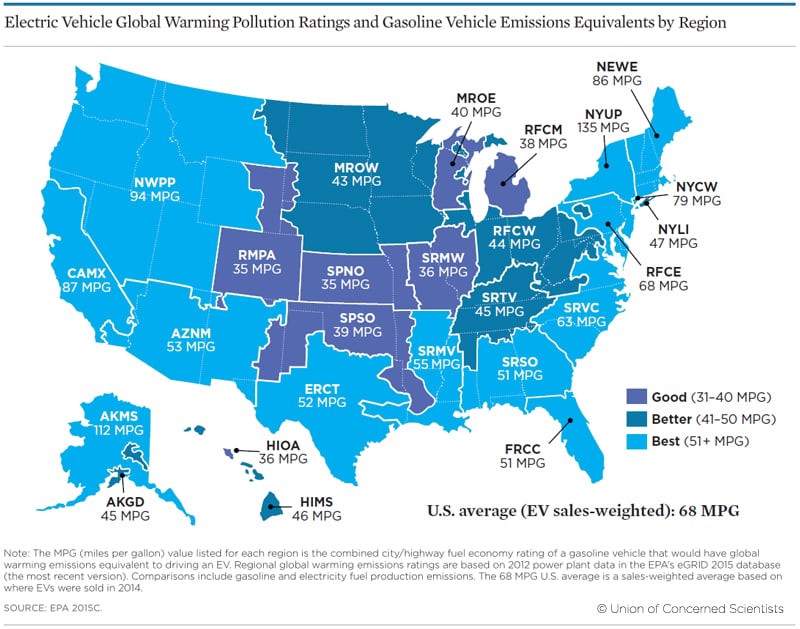
Here's where the US grid has been heading. Here's where it's going. So note that using, say, 2012 data above actually downplays the improvements of EVs vs. ICEs. Same story with the energy used in battery manufacture (which has been falling in almost direct correspondence to battery prices)
If I was wrong in my assumption that you're an American (most people who ask this question turn out to be), let me know where you're from and I'll give you data appropriate to your location. For example, major EU countries.
-
Re:Predictable Reaction to News
Softbank was not trying to buy Tesla, not last year, not last month.
There is not even speculation of indication of interest from Apple.
Yeah, keep telling yourself that.
Google did not buy Tesla when it was allegedly offered to them for $5G, it ain't paying 10x that today.
It was precisely the other way around. Musk terminated the deal when Tesla had its first profitable quarter and no longer needed the cash. And it was for $6B at an $11B valuation, and that was when Tesla was a far smaller company.
The Saudis already indicated that they're not interested in holding more than what they already bought
Ref?
The rest of your rant is not even a speculation
For the record, what about "the rest" (written below) do you find "deranged"?
* The Norwegian sovereign wealth fund (companies like Tesla are right up their alley, and Norway has the highest per-capita ownership of Teslas in the world)
* China (various) (lately seems to throw money at pretty much anything that moves, particularly if it has a plug, and it was already announced that Tesla was working with local Chinese investors concerning Gigafactory 3) -
Re: It's a trick. Get an axe.
No nasa uses the correct terms retard.
There is rough, high and ultra high vacuum. Every single retarded hyper loop concept uses the exact same rough vacuum. Achieving and maintaining rough is cost prohibitive making every retarded hyper loop concept unfeasable.
-
Re: It's a trick. Get an axe.
-
Re: More room for manual assembly?
Is teh Google too hard for you?
-
Re:Arbitrary Intrusions
-
Re:Arbitrary Intrusions
-
Re:of course
they call it Autonomous mode. Sorry
Well, maybe they're calling it that somewhere not on Tesla's website? Let's see... Yep, found an entry:
“For Reporting Year 2017, Tesla did not test any vehicles on public roads in California in autonomous mode, as defined by California law.”.
-
Re:Yeah, and?
Yes, because internal combustion engines are made from fairy dust, and petroleum appears out of thin air.
People who complain about the horrors of lithium mining simply demonstrate that they have no clue how lithium is actually produced. The majority of the world's lithium supply is produced from salar brine. Look at it. The horror. The horror, right? They pump brine up to the surface into ponds, let it dry out to deposit unwanted salts (leaving a lithium-rich concentrate), then send that for refining. On many salars, the entire salar floods annually, wiping out the evaporation ponds, which they have to rebuild. Nature literally reclaims the "mine" annually. Its hard to picture a less environmentally impacting resource production process.
The remainder of lithium is produced from spodumene. Spodumene mines are listed as having no particular environmental impacts associated with them apart from the general impacts of hard-rock mining; the largest impact risk is listed as suspended solids in waterways - aka, silt from the rock crushers. Which is a risk from anything that crushes rock.
Do I even need to mention that there's not actually that much lithium in lithium-ion batteries, or that - as large boxes full of useful minerals - recycling rates will be nearly 100%?
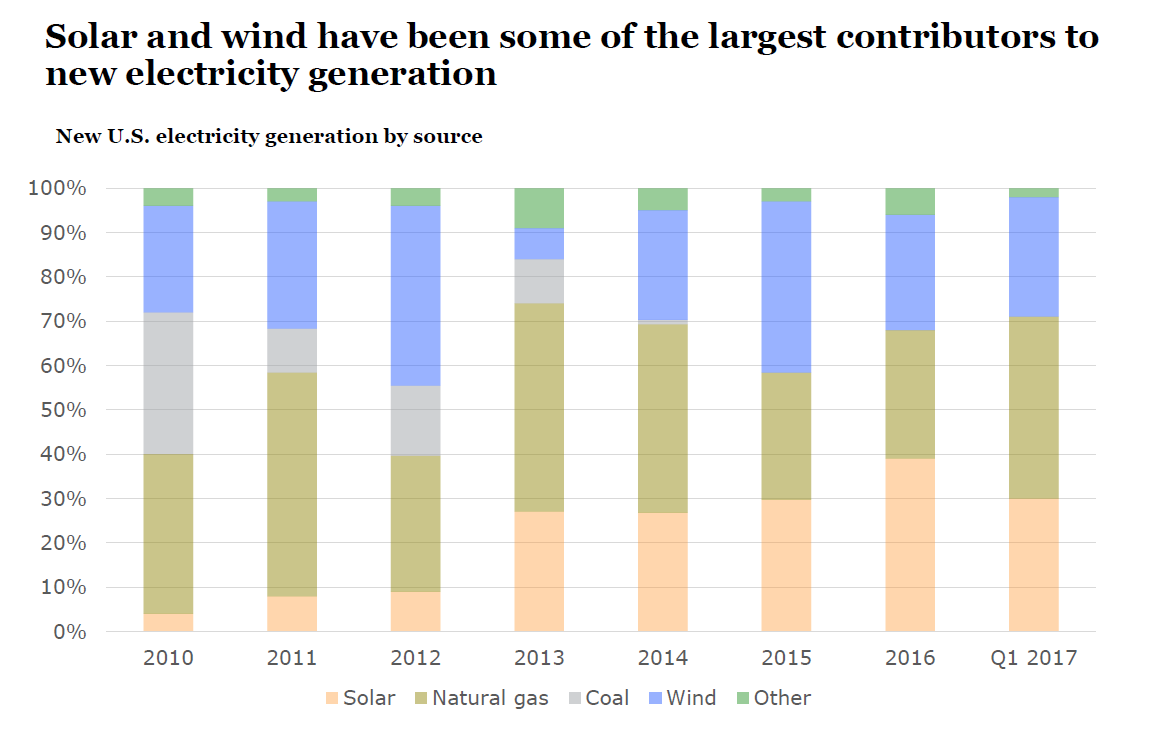
And coal is in the progress of being replaced with solar and wind, whether you like that or not. In China, in the EU, and in the US. Some places have some other types of power that are also on the rise - for example, in the US it's "wind, solar, and natural gas" - but coal is in a death spiral everywhere.
-
Re:"violence to advance their cause"
Almost everything you think you know about Antifa is due to trolling. There are extensive troll campaigns out there involving fake Antifa accounts. Each tries to outdo each other with the most outrageous thing they can say to make gullible right wingers take them seriously.
"Antifa" has no ideology except hatred of Nazis and those espousing similar ideologies (general white supremecists). It is not a "group". It has no "leaders". No little black book. Nothing except "hates and will actively oppose Nazis and other white supremecists", and random people who are of that view describe themselves with the term Antifa. Not all people who identify as "Antifa" support violence as a means to counter Nazi activity (there's been a widespread "Is it okay to punch a Nazi?" debate since Richard Spencer was punched on camera). Of those who would answer that with "Yes", there's a further subset known as "Black Bloc"; which again is not an ideology but more of a style (dressing in black and actively physically engaging when Nazis and aligned groups come to town). The "Don't punch a Nazi" crowd thinks of them as counterproductive. Black Bloc style protesting existed before "Antifa"; before the most recent flareup, it was most commonly associated in the US with WTO protests.
To reiterate: Black Bloc does engage in violence - although you might have been misled about "innocent victims". To pick an example: the most famous viral video of Black Bloc actions was this attack. Who is that poor innocent victim? Why, that's Keith Campbell, known on Twitter as "PatriotWarriorMedia". He's involved in R.A.M. ("Rise Above Movement"), a group built specifically around active training to engage in street brawls with perceived leftists. Rather than all black, their hide-their-face approach is black skeleton masks.
What did Campbell have to say about that protest where he got beaten up beforehand? Why let's look!: "Fuck Antifa! Let them come to Berkeley on August 27th so we can kick their asses AGAIN! @1776RealNews @ProudBoysCA @BasedCops"
How did that work out for you, Keith?
Anyway, this is all secondary to my main point, which was to make you aware of the fact that the vast majority of "Antifa" accounts are just trolling to try to dupe gullible right wingers. My personal take on the whole thing? Black Bloc protesters and R.A.M. deserve each other, and both can go F* themselves as far as I'm concerned.
I get people not seeing it at first glance but they clearly are under the umbrella of larger groups and the major political parties use direct action groups as a blunt tool despite the individual members often not being aware of it. They do have leaders they just look like some loose affiliated collection of dudes from the outside. I know people who have been involved on both the extreme left and right in Europe, mainly the left but a few on the right. On a local level like the independent groups identifying as blackbloc are coordinated by someone, although not exactly a formal leader by any stretch. However these groups answer to someone who is a coordinater with some semblance of structure and order (despite the ones I knew mainly being a mess they sort of work) and they themselves interface with a mid
-
Re:"violence to advance their cause"
Seriously, google antifa troll campaign. It isn't that hard.
They're fishing for gullible right-wingers. Amusing how well it works.
-
Re:"violence to advance their cause"
Almost everything you think you know about Antifa is due to trolling. There are extensive troll campaigns out there involving fake Antifa accounts. Each tries to outdo each other with the most outrageous thing they can say to make gullible right wingers take them seriously.
"Antifa" has no ideology except hatred of Nazis and those espousing similar ideologies (general white supremecists). It is not a "group". It has no "leaders". No little black book. Nothing except "hates and will actively oppose Nazis and other white supremecists", and random people who are of that view describe themselves with the term Antifa. Not all people who identify as "Antifa" support violence as a means to counter Nazi activity (there's been a widespread "Is it okay to punch a Nazi?" debate since Richard Spencer was punched on camera). Of those who would answer that with "Yes", there's a further subset known as "Black Bloc"; which again is not an ideology but more of a style (dressing in black and actively physically engaging when Nazis and aligned groups come to town). The "Don't punch a Nazi" crowd thinks of them as counterproductive. Black Bloc style protesting existed before "Antifa"; before the most recent flareup, it was most commonly associated in the US with WTO protests.
To reiterate: Black Bloc does engage in violence - although you might have been misled about "innocent victims". To pick an example: the most famous viral video of Black Bloc actions was this attack. Who is that poor innocent victim? Why, that's Keith Campbell, known on Twitter as "PatriotWarriorMedia". He's involved in R.A.M. ("Rise Above Movement"), a group built specifically around active training to engage in street brawls with perceived leftists. Rather than all black, their hide-their-face approach is black skeleton masks.
What did Campbell have to say about that protest where he got beaten up beforehand? Why let's look!: "Fuck Antifa! Let them come to Berkeley on August 27th so we can kick their asses AGAIN! @1776RealNews @ProudBoysCA @BasedCops"
How did that work out for you, Keith?
Anyway, this is all secondary to my main point, which was to make you aware of the fact that the vast majority of "Antifa" accounts are just trolling to try to dupe gullible right wingers. My personal take on the whole thing? Black Bloc protesters and R.A.M. deserve each other, and both can go F* themselves as far as I'm concerned.
-
Re:"Was incredibly hard to balance aesthetics...
Actually, when your goal is to make space travel mass market, making things aesthetically appealing is a key aspect. Musk's goal is not and never has been $25m trips to space for the select few; he wants to make space travel a common occurrence.
As for "solid spacesuit", I assume you mean like the NASA AX series, which are built more like atmospheric diving suits than traditional space suits. And the answer is the same reason why NASA doesn't use them - while mobility in them is superb, they're significantly heavier. About the only place in the solar system where it makes sense to use them at present (in combination with insulation and either a heat-absorbing material (akin to Venera) or a heat pump with cooling channels, and a bellows balloon) is the surface of Venus. A more popular research topic is hybrid pressure / hard suits, where you have certain parts rigid (such as the torso) and others inflated.
Well, here's the answer to the question I wanted to ask.
Still, I'm surprised that so much energy was put on aesthetic. I mean, how could you make a freaking "space/flight suit" unaesthetic? Even the original NASA space suit is so cool that people bring it at hockey games.
-
Re:"Was incredibly hard to balance aesthetics...
Actually, when your goal is to make space travel mass market, making things aesthetically appealing is a key aspect. Musk's goal is not and never has been $25m trips to space for the select few; he wants to make space travel a common occurrence.
As for "solid spacesuit", I assume you mean like the NASA AX series, which are built more like atmospheric diving suits than traditional space suits. And the answer is the same reason why NASA doesn't use them - while mobility in them is superb, they're significantly heavier. About the only place in the solar system where it makes sense to use them at present (in combination with insulation and either a heat-absorbing material (akin to Venera) or a heat pump with cooling channels, and a bellows balloon) is the surface of Venus. A more popular research topic is hybrid pressure / hard suits, where you have certain parts rigid (such as the torso) and others inflated.
Well, here's the answer to the question I wanted to ask.
Still, I'm surprised that so much energy was put on aesthetic. I mean, how could you make a freaking "space/flight suit" unaesthetic? Even the original NASA space suit is so cool that people bring it at hockey games.
-
Re:"Was incredibly hard to balance aesthetics...
Actually, when your goal is to make space travel mass market, making things aesthetically appealing is a key aspect. Musk's goal is not and never has been $25m trips to space for the select few; he wants to make space travel a common occurrence.
As for "solid spacesuit", I assume you mean like the NASA AX series, which are built more like atmospheric diving suits than traditional space suits. And the answer is the same reason why NASA doesn't use them - while mobility in them is superb, they're significantly heavier. About the only place in the solar system where it makes sense to use them at present (in combination with insulation and either a heat-absorbing material (akin to Venera) or a heat pump with cooling channels, and a bellows balloon) is the surface of Venus. A more popular research topic is hybrid pressure / hard suits, where you have certain parts rigid (such as the torso) and others inflated.
-
Re:"Was incredibly hard to balance aesthetics...
Actually, when your goal is to make space travel mass market, making things aesthetically appealing is a key aspect. Musk's goal is not and never has been $25m trips to space for the select few; he wants to make space travel a common occurrence.
As for "solid spacesuit", I assume you mean like the NASA AX series, which are built more like atmospheric diving suits than traditional space suits. And the answer is the same reason why NASA doesn't use them - while mobility in them is superb, they're significantly heavier. About the only place in the solar system where it makes sense to use them at present (in combination with insulation and either a heat-absorbing material (akin to Venera) or a heat pump with cooling channels, and a bellows balloon) is the surface of Venus. A more popular research topic is hybrid pressure / hard suits, where you have certain parts rigid (such as the torso) and others inflated.
-
Re:Too little, too late
"Shithole" might be an exageration, but I don't want to eat lunch or hang around at either a gas station or an EV charging station (likely the same place anyway).
They're not "likely the same place", and that's a key part of your misunderstanding. Superchargers are not sited based on "is there a gas station here", they're sited based on "what is there to do and eat around here".
Here, let's pick a stereotypical boring "drive through" state and check out superchargers in it - say, Nebraska. Lets examine all of the superchargers along I-80, from west to east:
Sidney Supercharger
Best Western Plus Sidney Lodge
Charging: 8 Superchargers, available 24/7
Wifi: Best Western Plus Sidney Lodge
Restrooms: Best Western Plus Sidney Lodge, Perkins Restaurant & Bakery, Applebee's
Restaurants: Perkins Restaurant & Bakery, Applebee's
Lodging: Best Western Plus Sidney LodgeOgallala Supercharger
Lonesome Dove Lodge and Cabins
Charging: 8 Superchargers, available 24/7
Wifi: Lonesome Dove Lodge and Cabins, McDonald's
Restrooms: Lonesome Dove Lodge and Cabins, Margarita's
Restaurants: Margarita's, McDonald's, Golden Spur Steakhouse-Saloon
Lodging: Lonesome Dove Lodge and CabinsGothenburg Supercharger
Nebraska Barn and Grill
Charging: 8 Superchargers, available 24/7
Wifi: Comfort Suites
Restrooms: Nebraska Barn and Grill
Restaurants: Nebraska Barn and Grill, Pizza Hut
Lodging: Comfort SuitesGrand Island Supercharger
Bosselman Travel Center
Charging: 8 Superchargers, available 24/7
Wifi: Bosselman Travel Center
Restrooms: Bosselman Travel Center
Restaurants: Max's Thunder Road Grill, Little Caesars, Subway
Shopping: Bosselman Travel CenterLincoln, NE Supercharger
Lincoln #3 Hy-Vee
Charging: 8 Superchargers, available 24/7
Wifi: Hy-Vee, Sleep Inn & Suites University
Restrooms: Hy-Vee
Restaurants: Hy-Vee Market Grille, Hy-Vee Chinese Express, Hy-Vee Bakery, Starbucks Coffee
Shopping: Hy-Vee
Lodging: Sleep Inn & Suites UniversityMy, what shitholes. And this is in Nebraska of all places, not exactly luxurious territory. You don't need to stop at all of them of course - they averag
-
Re:Too little, too late
"Shithole" might be an exageration, but I don't want to eat lunch or hang around at either a gas station or an EV charging station (likely the same place anyway).
They're not "likely the same place", and that's a key part of your misunderstanding. Superchargers are not sited based on "is there a gas station here", they're sited based on "what is there to do and eat around here".
Here, let's pick a stereotypical boring "drive through" state and check out superchargers in it - say, Nebraska. Lets examine all of the superchargers along I-80, from west to east:
Sidney Supercharger
Best Western Plus Sidney Lodge
Charging: 8 Superchargers, available 24/7
Wifi: Best Western Plus Sidney Lodge
Restrooms: Best Western Plus Sidney Lodge, Perkins Restaurant & Bakery, Applebee's
Restaurants: Perkins Restaurant & Bakery, Applebee's
Lodging: Best Western Plus Sidney LodgeOgallala Supercharger
Lonesome Dove Lodge and Cabins
Charging: 8 Superchargers, available 24/7
Wifi: Lonesome Dove Lodge and Cabins, McDonald's
Restrooms: Lonesome Dove Lodge and Cabins, Margarita's
Restaurants: Margarita's, McDonald's, Golden Spur Steakhouse-Saloon
Lodging: Lonesome Dove Lodge and CabinsGothenburg Supercharger
Nebraska Barn and Grill
Charging: 8 Superchargers, available 24/7
Wifi: Comfort Suites
Restrooms: Nebraska Barn and Grill
Restaurants: Nebraska Barn and Grill, Pizza Hut
Lodging: Comfort SuitesGrand Island Supercharger
Bosselman Travel Center
Charging: 8 Superchargers, available 24/7
Wifi: Bosselman Travel Center
Restrooms: Bosselman Travel Center
Restaurants: Max's Thunder Road Grill, Little Caesars, Subway
Shopping: Bosselman Travel CenterLincoln, NE Supercharger
Lincoln #3 Hy-Vee
Charging: 8 Superchargers, available 24/7
Wifi: Hy-Vee, Sleep Inn & Suites University
Restrooms: Hy-Vee
Restaurants: Hy-Vee Market Grille, Hy-Vee Chinese Express, Hy-Vee Bakery, Starbucks Coffee
Shopping: Hy-Vee
Lodging: Sleep Inn & Suites UniversityMy, what shitholes. And this is in Nebraska of all places, not exactly luxurious territory. You don't need to stop at all of them of course - they averag
-
Re:Too little, too late
"Shithole" might be an exageration, but I don't want to eat lunch or hang around at either a gas station or an EV charging station (likely the same place anyway).
They're not "likely the same place", and that's a key part of your misunderstanding. Superchargers are not sited based on "is there a gas station here", they're sited based on "what is there to do and eat around here".
Here, let's pick a stereotypical boring "drive through" state and check out superchargers in it - say, Nebraska. Lets examine all of the superchargers along I-80, from west to east:
Sidney Supercharger
Best Western Plus Sidney Lodge
Charging: 8 Superchargers, available 24/7
Wifi: Best Western Plus Sidney Lodge
Restrooms: Best Western Plus Sidney Lodge, Perkins Restaurant & Bakery, Applebee's
Restaurants: Perkins Restaurant & Bakery, Applebee's
Lodging: Best Western Plus Sidney LodgeOgallala Supercharger
Lonesome Dove Lodge and Cabins
Charging: 8 Superchargers, available 24/7
Wifi: Lonesome Dove Lodge and Cabins, McDonald's
Restrooms: Lonesome Dove Lodge and Cabins, Margarita's
Restaurants: Margarita's, McDonald's, Golden Spur Steakhouse-Saloon
Lodging: Lonesome Dove Lodge and CabinsGothenburg Supercharger
Nebraska Barn and Grill
Charging: 8 Superchargers, available 24/7
Wifi: Comfort Suites
Restrooms: Nebraska Barn and Grill
Restaurants: Nebraska Barn and Grill, Pizza Hut
Lodging: Comfort SuitesGrand Island Supercharger
Bosselman Travel Center
Charging: 8 Superchargers, available 24/7
Wifi: Bosselman Travel Center
Restrooms: Bosselman Travel Center
Restaurants: Max's Thunder Road Grill, Little Caesars, Subway
Shopping: Bosselman Travel CenterLincoln, NE Supercharger
Lincoln #3 Hy-Vee
Charging: 8 Superchargers, available 24/7
Wifi: Hy-Vee, Sleep Inn & Suites University
Restrooms: Hy-Vee
Restaurants: Hy-Vee Market Grille, Hy-Vee Chinese Express, Hy-Vee Bakery, Starbucks Coffee
Shopping: Hy-Vee
Lodging: Sleep Inn & Suites UniversityMy, what shitholes. And this is in Nebraska of all places, not exactly luxurious territory. You don't need to stop at all of them of course - they averag
-
Re:Too little, too late
"Shithole" might be an exageration, but I don't want to eat lunch or hang around at either a gas station or an EV charging station (likely the same place anyway).
They're not "likely the same place", and that's a key part of your misunderstanding. Superchargers are not sited based on "is there a gas station here", they're sited based on "what is there to do and eat around here".
Here, let's pick a stereotypical boring "drive through" state and check out superchargers in it - say, Nebraska. Lets examine all of the superchargers along I-80, from west to east:
Sidney Supercharger
Best Western Plus Sidney Lodge
Charging: 8 Superchargers, available 24/7
Wifi: Best Western Plus Sidney Lodge
Restrooms: Best Western Plus Sidney Lodge, Perkins Restaurant & Bakery, Applebee's
Restaurants: Perkins Restaurant & Bakery, Applebee's
Lodging: Best Western Plus Sidney LodgeOgallala Supercharger
Lonesome Dove Lodge and Cabins
Charging: 8 Superchargers, available 24/7
Wifi: Lonesome Dove Lodge and Cabins, McDonald's
Restrooms: Lonesome Dove Lodge and Cabins, Margarita's
Restaurants: Margarita's, McDonald's, Golden Spur Steakhouse-Saloon
Lodging: Lonesome Dove Lodge and CabinsGothenburg Supercharger
Nebraska Barn and Grill
Charging: 8 Superchargers, available 24/7
Wifi: Comfort Suites
Restrooms: Nebraska Barn and Grill
Restaurants: Nebraska Barn and Grill, Pizza Hut
Lodging: Comfort SuitesGrand Island Supercharger
Bosselman Travel Center
Charging: 8 Superchargers, available 24/7
Wifi: Bosselman Travel Center
Restrooms: Bosselman Travel Center
Restaurants: Max's Thunder Road Grill, Little Caesars, Subway
Shopping: Bosselman Travel CenterLincoln, NE Supercharger
Lincoln #3 Hy-Vee
Charging: 8 Superchargers, available 24/7
Wifi: Hy-Vee, Sleep Inn & Suites University
Restrooms: Hy-Vee
Restaurants: Hy-Vee Market Grille, Hy-Vee Chinese Express, Hy-Vee Bakery, Starbucks Coffee
Shopping: Hy-Vee
Lodging: Sleep Inn & Suites UniversityMy, what shitholes. And this is in Nebraska of all places, not exactly luxurious territory. You don't need to stop at all of them of course - they averag
-
Re:Too little, too late
"Shithole" might be an exageration, but I don't want to eat lunch or hang around at either a gas station or an EV charging station (likely the same place anyway).
They're not "likely the same place", and that's a key part of your misunderstanding. Superchargers are not sited based on "is there a gas station here", they're sited based on "what is there to do and eat around here".
Here, let's pick a stereotypical boring "drive through" state and check out superchargers in it - say, Nebraska. Lets examine all of the superchargers along I-80, from west to east:
Sidney Supercharger
Best Western Plus Sidney Lodge
Charging: 8 Superchargers, available 24/7
Wifi: Best Western Plus Sidney Lodge
Restrooms: Best Western Plus Sidney Lodge, Perkins Restaurant & Bakery, Applebee's
Restaurants: Perkins Restaurant & Bakery, Applebee's
Lodging: Best Western Plus Sidney LodgeOgallala Supercharger
Lonesome Dove Lodge and Cabins
Charging: 8 Superchargers, available 24/7
Wifi: Lonesome Dove Lodge and Cabins, McDonald's
Restrooms: Lonesome Dove Lodge and Cabins, Margarita's
Restaurants: Margarita's, McDonald's, Golden Spur Steakhouse-Saloon
Lodging: Lonesome Dove Lodge and CabinsGothenburg Supercharger
Nebraska Barn and Grill
Charging: 8 Superchargers, available 24/7
Wifi: Comfort Suites
Restrooms: Nebraska Barn and Grill
Restaurants: Nebraska Barn and Grill, Pizza Hut
Lodging: Comfort SuitesGrand Island Supercharger
Bosselman Travel Center
Charging: 8 Superchargers, available 24/7
Wifi: Bosselman Travel Center
Restrooms: Bosselman Travel Center
Restaurants: Max's Thunder Road Grill, Little Caesars, Subway
Shopping: Bosselman Travel CenterLincoln, NE Supercharger
Lincoln #3 Hy-Vee
Charging: 8 Superchargers, available 24/7
Wifi: Hy-Vee, Sleep Inn & Suites University
Restrooms: Hy-Vee
Restaurants: Hy-Vee Market Grille, Hy-Vee Chinese Express, Hy-Vee Bakery, Starbucks Coffee
Shopping: Hy-Vee
Lodging: Sleep Inn & Suites UniversityMy, what shitholes. And this is in Nebraska of all places, not exactly luxurious territory. You don't need to stop at all of them of course - they averag
-
Re:Too little, too late
It's funny when you get a response that's like the person didn't even read your post or just skimmed over it.
While there is some lithium produced from hard rock mining, as I distinctly pointed out to you, most lithium is produced from salars, which is probably the most environmentally-nondestructive means of "mining" imaginable. I showed you pictures, but it appears you never clicked the link. By contrast, while you write that you "can" dig pits for steel, that's not accurate - you must dig pits to get at iron ore. They look like this. Perhaps worse is the effect of smelting.
Recycling batteries is not a "joke" - I literally just gave you research showing that in mass production, precisely the opposite is true. Asserting that it's wrong doesn't make it so. In mass production, battery prices are limited by raw materials costs; producers are raw materials constrained. Recycling becomes an important part of the supply chain. And in case you're curious how recycling works: batteries are crushed in controlled conditions. The electrolyte is extracted with supercritical CO2 and distilled. The crushed batteries are ground, then gravimetrically separated. The recovered material can then be recycled directly, or more commonly, sent off for re-smelting (the cathodes are quite similar to natural nickel-cobalt ores). The quantity to be smelted is vastly less than the quantity of steel smelted for a car.
While we are on the subject of end of life of batteries lets consider the environmental effects of disposing carbon fiber.
I'm not sure why we should because not many EVs use carbon fiber - but if you want to. Carbon fibre is disposed of like plastic - either landfills or incineration. All cars make extensive use of plastic parts, so this shouldn't be particularly shocking. Additionally, CF is sometimes ground up and used as fill in new plastics - it only slightly increases their mechanical properties, but some manufacturers like using it because it increases their sales value to say that they have carbon fibre in their part (for example, laptops with "carbon fibre" moulding).
Concerning fire, you don't need to resort to hyperbole - here's what happens if you try to burn one of Tesla's battery packs (that's a powerwall, but it's the same basic technology). They're quite resistant to fire - certainly much more than gasoline. There have only been two Tesla battery packs to catch fire by "puncture", and it wasn't so much "puncture" as being deeply gashed down their length by metal road debris. Since Tesla responded by installing a debris shield, there have been no more such incidents.
Far more of the (few) fires that have occured in Teslas have been from other areas of the vehicle, not the battery pack. And they often don't even manage to burn the battery pack - even if the rest of the vehicle is gutted. As of 2014, there had been well over a billion electric miles driven. For gasoline cars, there is an average of 90 fires per billion miles driven. For the EVs, passing their first billion? Six fires. Zero deaths. Zero injuries.
-
Re:Too little, too late
It's funny when you get a response that's like the person didn't even read your post or just skimmed over it.
While there is some lithium produced from hard rock mining, as I distinctly pointed out to you, most lithium is produced from salars, which is probably the most environmentally-nondestructive means of "mining" imaginable. I showed you pictures, but it appears you never clicked the link. By contrast, while you write that you "can" dig pits for steel, that's not accurate - you must dig pits to get at iron ore. They look like this. Perhaps worse is the effect of smelting.
Recycling batteries is not a "joke" - I literally just gave you research showing that in mass production, precisely the opposite is true. Asserting that it's wrong doesn't make it so. In mass production, battery prices are limited by raw materials costs; producers are raw materials constrained. Recycling becomes an important part of the supply chain. And in case you're curious how recycling works: batteries are crushed in controlled conditions. The electrolyte is extracted with supercritical CO2 and distilled. The crushed batteries are ground, then gravimetrically separated. The recovered material can then be recycled directly, or more commonly, sent off for re-smelting (the cathodes are quite similar to natural nickel-cobalt ores). The quantity to be smelted is vastly less than the quantity of steel smelted for a car.
While we are on the subject of end of life of batteries lets consider the environmental effects of disposing carbon fiber.
I'm not sure why we should because not many EVs use carbon fiber - but if you want to. Carbon fibre is disposed of like plastic - either landfills or incineration. All cars make extensive use of plastic parts, so this shouldn't be particularly shocking. Additionally, CF is sometimes ground up and used as fill in new plastics - it only slightly increases their mechanical properties, but some manufacturers like using it because it increases their sales value to say that they have carbon fibre in their part (for example, laptops with "carbon fibre" moulding).
Concerning fire, you don't need to resort to hyperbole - here's what happens if you try to burn one of Tesla's battery packs (that's a powerwall, but it's the same basic technology). They're quite resistant to fire - certainly much more than gasoline. There have only been two Tesla battery packs to catch fire by "puncture", and it wasn't so much "puncture" as being deeply gashed down their length by metal road debris. Since Tesla responded by installing a debris shield, there have been no more such incidents.
Far more of the (few) fires that have occured in Teslas have been from other areas of the vehicle, not the battery pack. And they often don't even manage to burn the battery pack - even if the rest of the vehicle is gutted. As of 2014, there had been well over a billion electric miles driven. For gasoline cars, there is an average of 90 fires per billion miles driven. For the EVs, passing their first billion? Six fires. Zero deaths. Zero injuries.
-
Re:The shorts are loose
anti sell? that's a new.
Only to people who are not paying attention is that "a new".
so tell me again why did they repay their another loan in record time and then pursue this presumably more expensive loan?
For one, by repaying early they avoided letting the US government cash out on $300m worth of stock options. For two, it deprived people like you of a cudgel to say "See, they're dependent on the government". Not like it stopped you, or not like people like you ever bring that up about companies like Chrysler that never repaid part of their loans.
You know, by the way, you don't need to ask these things, you can just look them up for yourself.
the reason why this is sort of interesting is that they're seeking money this way and that is usually not a very good sign for a company like this in a situation like this.
So you think that stockholders should want to be diluted rather than pay interest, in a company undergoing a rapid expansion? Praytell why?
it just isn't. it's a sign that the usual lenders/investors have put on a squeeze on how much they are willing to dump money
Ah, yes, because you can just put $1,5 billion dollars on your credit card.
if you had been touting ford as an industrial genius in 1901,
Given that Ford Motor Company wasn't even founded until 1903, that's a stupid comparison.
In your analogy, 1901 is 2001 (Tesla was founded in 2003). Ford's prototype car Sweepstakes is AC Propulsion's tzero. The equivalent on Ford's timeline to the present is the middle of 1917. And ironically, in 1917 Ford was just starting on the River Rouge complex, the Gigafactory of its day.
And as for your long "bank" screed, I don't even know which bank you're talking about. Tesla Motors as received investments from numerous sources (including banks) over the years. Tesla's starting capital was provided by Elon Musk and Mark Tarpenning out of their personal assets (Musk's from the sale of Paypal); the Series B funding round added in Valor Equity Partners. Wait a minute, is it Paypal that you're trying to say is a "bank that is not a bank" in your screed?
-
Re:Chevy Bolt
Has been out for awhile and nobody is buying it. What's better about the Model 3?
Lol, okay, let's go down the list. Bolt vs. Model 3. Just the base models (Model 3 is much more upgradeable)
MSRP: $37500 vs $35000
0-60: 6,5s vs. 5,6s
Top speed: 90mph vs. 130mph
Handling: Read for yourself (start at "What's blanching...")
EPA range: 238mi vs. 220mi
Max charge speed: 90mph vs. 260mph
Fast charge network: Poor (single stall, poorly monitored, big holes) vs. excellent (4-8+ stalls, widespread distribution on almost all major interstates)
Dealership experience: Famously hard sell and uneducated about EVs, vs. almost humorously soft-sell, behaving instead like museum curators who just want to talk about their exhibit
Automatic crash avoidance: Optional extra vs. standard
Climate control: Single vs. dual zone
Track record for safety: less-than-stellar vs. outright-insulted-if-they-score-less-than-perfect-in-any-test. And this.
Standard warranty: 3yrs / 36k mi vs. 4yrs / 50k mi (both have the same battery warranty, 8 yrs / 100k mi)
Company dedication: Makes EVs as a side project to their main business vs. fully invested in EVs.
Efficiency: heavier & higher drag vs. lighter and lower drag
Styling: Come on, is there any contest? Even remotely? Bolt vs. Model 3. The interior difference is even worse, with the Bolt being your typical econobox interior (yet at a nearly $40k price point).
Depreciation of past models: Terrible vs. LowI could keep going. I mean, there's just no contest. Unless you're seriously in a rush, or you think Musk is the devil, I can't imagine why anyone would pick the Bolt over the Model 3.
-
Re:Chevy Bolt
Has been out for awhile and nobody is buying it. What's better about the Model 3?
Lol, okay, let's go down the list. Bolt vs. Model 3. Just the base models (Model 3 is much more upgradeable)
MSRP: $37500 vs $35000
0-60: 6,5s vs. 5,6s
Top speed: 90mph vs. 130mph
Handling: Read for yourself (start at "What's blanching...")
EPA range: 238mi vs. 220mi
Max charge speed: 90mph vs. 260mph
Fast charge network: Poor (single stall, poorly monitored, big holes) vs. excellent (4-8+ stalls, widespread distribution on almost all major interstates)
Dealership experience: Famously hard sell and uneducated about EVs, vs. almost humorously soft-sell, behaving instead like museum curators who just want to talk about their exhibit
Automatic crash avoidance: Optional extra vs. standard
Climate control: Single vs. dual zone
Track record for safety: less-than-stellar vs. outright-insulted-if-they-score-less-than-perfect-in-any-test. And this.
Standard warranty: 3yrs / 36k mi vs. 4yrs / 50k mi (both have the same battery warranty, 8 yrs / 100k mi)
Company dedication: Makes EVs as a side project to their main business vs. fully invested in EVs.
Efficiency: heavier & higher drag vs. lighter and lower drag
Styling: Come on, is there any contest? Even remotely? Bolt vs. Model 3. The interior difference is even worse, with the Bolt being your typical econobox interior (yet at a nearly $40k price point).
Depreciation of past models: Terrible vs. LowI could keep going. I mean, there's just no contest. Unless you're seriously in a rush, or you think Musk is the devil, I can't imagine why anyone would pick the Bolt over the Model 3.
-
Re:electric cars look slippery, which is very cool
One may note that what the average person thinks "looks aerodynamic" often doesn't correspond to what actually is aerodynamic. The Saturn Sky sure "looks" aerodynamic (top up), but its drag coefficient is 0.42. The Dodge Viper is even worse, at 0.45, and the Ford Mustang ranges from 0.44-0.48. Meanwhile, the definitely not-sleek looking Ford Escape has a drag coefficient of 0.29. The SUV has a much larger cross-sectional area, of course, but that's beside the point -cross-sectional area is useful, but a high drag coefficient is not. Well, with one exception: a number of "sporty" cars get deliberately bad drag coefficients by being designed to create downforce (for an ideal streamlined shape you want no net lift); a Formula 1 car can have a drag coefficient of over 1.0, deliberately, in order to get as much downforce as possible to maximize its grip on the road. But for the most part, when a mass-market car has a bad drag coefficient, it's to play to people's style preferences, not for any functional reason.
-
Re:electric cars look slippery, which is very cool
One may note that what the average person thinks "looks aerodynamic" often doesn't correspond to what actually is aerodynamic. The Saturn Sky sure "looks" aerodynamic (top up), but its drag coefficient is 0.42. The Dodge Viper is even worse, at 0.45, and the Ford Mustang ranges from 0.44-0.48. Meanwhile, the definitely not-sleek looking Ford Escape has a drag coefficient of 0.29. The SUV has a much larger cross-sectional area, of course, but that's beside the point -cross-sectional area is useful, but a high drag coefficient is not. Well, with one exception: a number of "sporty" cars get deliberately bad drag coefficients by being designed to create downforce (for an ideal streamlined shape you want no net lift); a Formula 1 car can have a drag coefficient of over 1.0, deliberately, in order to get as much downforce as possible to maximize its grip on the road. But for the most part, when a mass-market car has a bad drag coefficient, it's to play to people's style preferences, not for any functional reason.
-
Re:electric cars look slippery, which is very cool
One may note that what the average person thinks "looks aerodynamic" often doesn't correspond to what actually is aerodynamic. The Saturn Sky sure "looks" aerodynamic (top up), but its drag coefficient is 0.42. The Dodge Viper is even worse, at 0.45, and the Ford Mustang ranges from 0.44-0.48. Meanwhile, the definitely not-sleek looking Ford Escape has a drag coefficient of 0.29. The SUV has a much larger cross-sectional area, of course, but that's beside the point -cross-sectional area is useful, but a high drag coefficient is not. Well, with one exception: a number of "sporty" cars get deliberately bad drag coefficients by being designed to create downforce (for an ideal streamlined shape you want no net lift); a Formula 1 car can have a drag coefficient of over 1.0, deliberately, in order to get as much downforce as possible to maximize its grip on the road. But for the most part, when a mass-market car has a bad drag coefficient, it's to play to people's style preferences, not for any functional reason.
-
Re:electric cars look slippery, which is very cool
One may note that what the average person thinks "looks aerodynamic" often doesn't correspond to what actually is aerodynamic. The Saturn Sky sure "looks" aerodynamic (top up), but its drag coefficient is 0.42. The Dodge Viper is even worse, at 0.45, and the Ford Mustang ranges from 0.44-0.48. Meanwhile, the definitely not-sleek looking Ford Escape has a drag coefficient of 0.29. The SUV has a much larger cross-sectional area, of course, but that's beside the point -cross-sectional area is useful, but a high drag coefficient is not. Well, with one exception: a number of "sporty" cars get deliberately bad drag coefficients by being designed to create downforce (for an ideal streamlined shape you want no net lift); a Formula 1 car can have a drag coefficient of over 1.0, deliberately, in order to get as much downforce as possible to maximize its grip on the road. But for the most part, when a mass-market car has a bad drag coefficient, it's to play to people's style preferences, not for any functional reason.
-
Re:electric cars look slippery, which is very cool
Parent makes the right response. Aerodynamics doesn't care what you think of how it looks; it is what it is. If you want to know what the extreme end of aerodynamic streamlining looks like, the Aptera 2e was a pretty close example to maximizing it for a road vehicle. There's various decisions one can make about how they'd like their internal area laid out, and this affects the particulars of the optimal shape, but in general: front end like a deformed egg, all surfaces highly smooth with as few panel gaps as possible, air intakes as small as possible, steady transition from hood to windshield, wiper hidden, mirrors small and streamlined (or ideally, absent and replaced with cameras), maximum diameter reached relatively quickly (no fat front end pretending there's a huge engine inside) followed by a long gradual taper; taper ends at a line or point (line usually allows for a better use of internal space), wheels small and shrouded, exposed all struts shaped as airfoils, and as little exposed hardware as possible. Cabin air ejected through whatever flat rear surfaces you have can help reduce the wake. Where you can't taper to a line or point (aka, you want to have a space that's both tall and wide behind the front seats for additional passengers), an abrupt cutoff (kammback-style) is better than a steep taper; if your taper is too steep, you get flow separation, and you start dragging a low pressure wake from that point. Deliberate vortex generation at the point of expected flow separation can help reduce the size of the wake; this is often done with overhangs, vortex-generating spikes, or in some unusual cases, golfball-like dimples. Higher driving speeds, as well as crosswinds, require a shallower tapering angle to avoid flow separation; concerning crosswinds, a bit of a lateral taper can help as well.
Once you get into extreme streamlining, however, you have to become more of a niggler for details. A traditional exposed set of windshield wiper would double the drag of an Aptera-like vehicle, for example. If you let snow and ice accumulate on the vehicle, you've totaled the drag coefficient. On the upside, those smooth curves and slick composite surfaces help resist accumulation. A funny thing with the Aptera was that if the vehicle was out in the rain or you sprayed it with a hose, almost all of the water ran off the same point, in the bottom centre of the vehicle.
-
Re:Wait in line
of course musk keeps saying that somehow hyperloop would be cheaper
You know, you could actually RTFM (in this case, TFM = Hyperloop Alpha) rather than being bewildered as to why.
The short of it: it's basically a pipeline, so you start with base pipeline costs for the given diameter. Compared to a pipeline:
Advantages:
* Far lower mass loadings
* Does not carry things that could "leak" and contaminate the ground (much easier environmental permitting, less NIMBY)
* Simpler thermal management
* Much lower pumping requirements (just to head this off: it's a mild vacuum, not a hard vacuum. The energy required (and pump sizes) to pump fluids through a pipeline is far more than is required to simply maintain a mild vacuum)
* Usually periodic branch pointsDisadvantages:
* Far greater straightness requirements
* Requires an internal orbital polisher
* Periodic emergency exitsBoth share infrastructure requirements at their endpoints, just of different kinds, both require a leak detection process, both require regular sensors, both require earthquake protection, etc. In general, however, pipeline construction is not very expensive, even at large diameters, relative to rail construction. The ready-made pipe segments are brought to the site and an orbital welder connects them together.
Versus rail, Hyperloop offers far lower peak mass loadings. This is because (and feel free to do the math yourself, I have) in both cases, the "track" - whether continuously-welded steel rails or orbital-welded pipe, is well lighter than the vehicles on them, but Hyperloop vehicles - being small with frequent launches rather than heavy with infrequent launches - provide far lower mass loadings. The cost of elevating a structure is directly proportional to its peak mass loadings, and hence the order of magnitude lower peak mass loadings translates to an order of magnitude lower elevation cost, as well as smaller cross section pylons which are easier to locate in tight spaces.
This in turn enables the practical location of it in road medians (with proper crash barriers as needed), if you have government buy-in to the concept. Hyperloop Alpha assumes that you will. I have to concur, it's hugely to the advantage of the government to do so, as the government has to spend huge amounts of public money building transportation infrastructure regardless. Road medians are already permitted for far more onerous environmental and noise conditions (road traffic) than Hyperloop would provide, which should make permitting much easier; the only new thing you're introducing is visual, which you have to introduce for any transportation system construction.
Due to the straightness requirements, the system cannot just stay within road medians. Varying bend radii depending on the speed planned for the segment require various deviations from medians. This requires private land acquisition - budgeted at typical rail rates for private land acquisition - and various tall pylons and/or short tunnel segments (budgeted at typical pipeline tunneling rates) where the landscape dictates it in order to maximize curve radii. And yes, they are typical rates, I've crosschecked the numbers in the document, and encourage you to as well.
Now as for the rest as to why it's so much cheaper than rail, they do cheat on that. There's three main ways. The first is simple: it doesn't carry as many people as California's HSR (it's roughly halfway between HSR and air travel on a logarithmic scale in terms of passenger capacity). That's not really a cheat on the per-passenger cost, but it is a cheat on th
-
Re:Trump 2020!
That glow radiating from his skin ever since he placed his hands upon the orb still seems kind of creepy. Ever since the Invocation opened up the Portals to the Deep, things just haven't felt the same.
-
Re: Becaue you aren't offering to do the work.
That's unfair. Blender did undergo some big changes, but they were more than justified. It's not like they're just continuously changing it, or that the changes weren't warranted. I think Blender is a better tool today because of their changes.
I have much more of an issue with GIMP. Pushing forth changes that the vast majority of the userbase hated (and railed against on the forum), and got a big "FU, if you don't like it, use another tool" response from the developers. Comments on the "can only save XCF through the save menu, changes to other formats pester you about "unsaved changes" even if you do export" design change were over 10:1 against. The brush size slider is a mess. Text editing is broken in about ten different ways, from it forgetting what font size you're typing in to not rendering full text deletion in some cases. The general quality has gone way downhill. Meanwhile, things that have supposedly been "in the works" for years, like higher bit-depth colour, seem further away than ever. Even if I didn't want to export to a higher bit depth, if I want to do a gaussian blur on a high-res image I need to do a combination of dithers and blurs because of the loss of precision at 8 bits per channel.
Facebook is the classic example of terrible product evolution (particularly Messenger... have these people never heard of the concept of screen real estate?). I'd also like to zing Google for Google Maps. Today it's way slower, they took the very convenient full-length zoom bar out (and only put the tiny one in after user complaints), buttons with similar functionality are scattered out (e.g. satellite is on the bottom left, but landscape hidden in the menu top left), photo integration is terrible (no longer shows photos where they actually are, but in a giant "bar" on the bottom of the screen, opened by an ambiguous icon that looks like three different buttons, with lines that point to the map seemingly at random), make you zoom in twice as far to see the same amount of map information (ex. road labels), added icons to the upper right that have no connection to Maps at all just for "product consistency", and so on. And it's 2017, why is their landscape option still so terrible? Even little local companies' map services have vastly superior landscapes.
-
Re: Industrial accident
I wrote where I am. Hint..
That said, lox has the same root word. It was even the English word through Old English (læx) until "salmon" (a word from Latin (salmonem) of unknown origin) took over. That actually happened with a lot of "food-related" terms, with Latin-origin terms (via French) replacing Germanic/Norse-origin terms - but usually the animal itself kept the Germanic/Norse. For example, you have cow (proto-germanic *kwon, Norse kýr/kú) but the food is beef (Latin bovem); swine (proto-Germanic swinan, Norse svín) and pig (unknown origin), but the food is pork (Latin porcus); lamb (proto-Germanic lambaz, Norse lamb), ewe (proto-Germanic *awi, Norse ær), sheep (West Germanic *skæpan), but the food is mutton (Latin multonem); etc. I guess food has always sounded fancier if you write it in French
-
Re:Appeal to authority
how about getting some science of your own to discount it.
If you want to learn about shock tubes (what is being described), start reading.
Namely, for the dozenth time in this thread
You have not replied to a single other post I've written.
why does Conservation of Energy not apply to the Hyperloop
It does. Why would you think otherwise?
. Understanding of course the amount of energy required to bring a massive single structure to a near perfect vacuum.
First off, read the damn document before debating it online. The fact that you don't know that Hyperloop is distinctly not a hard vacuum, and that more to the point would not work in "near perfect vacuum" - one of the most basic aspects of the design - points out that you have no business whatsoever pontificating about the topic.
Secondly, evacuating 2.2m cubic meters at sea level takes a minimum of 223 GJ. Operating on the pessimistic assumption that the tube has to be pressure normalized once annually and zero energy is recovered in the process, divided by six million passenger-trips per year, is 37kJ, or 10,3Wh (note: *not* kWh, just Wh), or about 0.05 cents at industrial rates.
Now, of course, you don't get the thermodynamic minimum. But you were explicitly talking about conservation of energy, so that's the number you were looking for. And if you want to be fair and factor in other energy losses, you also have to factor in that the assumption that you have to empty the tube annually (with zero energy recovery) is unfair on the pessimistic side.
And if you want to know what real-world maintenance level pumping to maintain vacuums is like, LHC requires 170kW for 9000m, or about 19W/m - which in the case of Hyperloop equates to 41,8MW. If this were applied to Hyperloop, that would be a per-passenger cost of 220MJ, or 61kWh, or $30 at industrial power rates. Except that LHC is a hard vacuum, which is orders of magnitude harder to maintain than a mild vacuum like Hyperloop; one of the primary design principles of Hyperloop was avoiding hard vacuum specifically for that reason. Hyperloop's vacuum level is four orders of magnitude higher density than the LHC's cryomagnet insulation volume (we won't even bother discussing the incredibly low beamline vacuum). A simple linear interpolation would suggest a Hyperloop maintenance power of 0.0019W/m, or 4180W, or a per-passenger consumption of 22kJ, aka 0.006kWh.
I'm sorry, let's back up, what was all this ranting you were doing about the conservation of energy?
As to your claim about rail cars, they do have to test for partial vacuums.
I don't know what forums you're used to where you can just make up things and have people believe you, but that doesn't fly here. Tank cars are only tested to a fixed positive pressure. Here's the procedure, spelled out in US law. Here's a table of the pressures for different types of tank cars. DOT-111 cars are for storing nonpressurized liquids, and are thus only tested to the minimum test pressure of 100 PSI, aka 6.9 bar. They are not designed to survive a vacuum (although they do if not heavily compromised - which in the Mythbusters
-
Re:Appeal to authority
how about getting some science of your own to discount it.
If you want to learn about shock tubes (what is being described), start reading.
Namely, for the dozenth time in this thread
You have not replied to a single other post I've written.
why does Conservation of Energy not apply to the Hyperloop
It does. Why would you think otherwise?
. Understanding of course the amount of energy required to bring a massive single structure to a near perfect vacuum.
First off, read the damn document before debating it online. The fact that you don't know that Hyperloop is distinctly not a hard vacuum, and that more to the point would not work in "near perfect vacuum" - one of the most basic aspects of the design - points out that you have no business whatsoever pontificating about the topic.
Secondly, evacuating 2.2m cubic meters at sea level takes a minimum of 223 GJ. Operating on the pessimistic assumption that the tube has to be pressure normalized once annually and zero energy is recovered in the process, divided by six million passenger-trips per year, is 37kJ, or 10,3Wh (note: *not* kWh, just Wh), or about 0.05 cents at industrial rates.
Now, of course, you don't get the thermodynamic minimum. But you were explicitly talking about conservation of energy, so that's the number you were looking for. And if you want to be fair and factor in other energy losses, you also have to factor in that the assumption that you have to empty the tube annually (with zero energy recovery) is unfair on the pessimistic side.
And if you want to know what real-world maintenance level pumping to maintain vacuums is like, LHC requires 170kW for 9000m, or about 19W/m - which in the case of Hyperloop equates to 41,8MW. If this were applied to Hyperloop, that would be a per-passenger cost of 220MJ, or 61kWh, or $30 at industrial power rates. Except that LHC is a hard vacuum, which is orders of magnitude harder to maintain than a mild vacuum like Hyperloop; one of the primary design principles of Hyperloop was avoiding hard vacuum specifically for that reason. Hyperloop's vacuum level is four orders of magnitude higher density than the LHC's cryomagnet insulation volume (we won't even bother discussing the incredibly low beamline vacuum). A simple linear interpolation would suggest a Hyperloop maintenance power of 0.0019W/m, or 4180W, or a per-passenger consumption of 22kJ, aka 0.006kWh.
I'm sorry, let's back up, what was all this ranting you were doing about the conservation of energy?
As to your claim about rail cars, they do have to test for partial vacuums.
I don't know what forums you're used to where you can just make up things and have people believe you, but that doesn't fly here. Tank cars are only tested to a fixed positive pressure. Here's the procedure, spelled out in US law. Here's a table of the pressures for different types of tank cars. DOT-111 cars are for storing nonpressurized liquids, and are thus only tested to the minimum test pressure of 100 PSI, aka 6.9 bar. They are not designed to survive a vacuum (although they do if not heavily compromised - which in the Mythbusters
-
Re:Ahead of his time
Yes, but nuclear weapons were not. Don't get me wrong, people were speculating about harnessing the energy of the atom for weapons. H. G. Wells coined the term "atomic bomb" in 1914 in "The World Set Free", but they were like ordinary bombs that continued exploding for days. Heinlein wrote about the development of a nuclear weapon to end World War II 1940 ("Solution Unsatisfactory"), but it was about a dirty bomb. If you have anything from before 1925(*) that's so accurate of a description of what nuclear weapons actually were, I'd like to see it. He got the minimum size wrong, but apart from that, that's pretty prophetic.
(*) - That quote was published in 1929 and written in 1925.
BTW, the autopilot invented in 1914 was just a self-leveling system with a compass - it wouldn't be anywhere near accurate enough for guiding flying weapons. Flying weapons "by wireless or other rays", aka remote controlled (passive or active) aircraft is an entirely different thing. Something that actually was done in World War II, but a decade and a half after Churchill wrote that.
This doesn't make him some sort of Nostradamus, but it does mean that he was paying close attention to the technological developments of his time and thinking over their implications with an analytic mind.
-
Re:Only in America...
It is not the definition used. "Glass fiber" refers to fibers of silicon dioxide plus various additives to lower the melting point. "Basalt fiber" refers to fiber made from basalt, without additives. These terms aren't up for debate; that's what they actually mean. That's how they're actually used. I don't give a rat's arse if basalt fiber is "a glass" from a chemical standpoint; if you go place an order on glass fiber, it will never, ever be made from basalt. If you find a place that is melting down basalt and blowing it into fibers, they will never, ever call it glass fiber. They will always call it basalt fiber. They don't even look similar. Without added colorants, glass fiber in its native state is pearly white. Basalt fiber in its native state looks like brass, even tarnished brass.
Please stop misusing terminology. I'm building a freaking house from the stuff, I know what I'm talking about.
And it makes a serious practical difference, too. Not just due to the higher temperature. Or the viscosity difference. Or the difference between a multiple-material source-insensitive fiber (glass fiber) versus a single-material source-sensitive fiber (basalt). Molten basalt is also optically opaque, meaning that it's harder to heat all the way through - even with traditional gas burners, let alone a solar concentrator. So while glass usually undergoes a quick melt, the basalt in basalt fiber manufacture usually undergoes a slow, multi-hour melt to ensure even melting. The fibers are also more abrasive to the bushings than glass fiber. The resulting product is stronger than glass fiber in most measures, more UV and radiation resistant, maintains its properties over a broader temperature range, and a bunch of other differences.
-
Re:Only in America...
It is not the definition used. "Glass fiber" refers to fibers of silicon dioxide plus various additives to lower the melting point. "Basalt fiber" refers to fiber made from basalt, without additives. These terms aren't up for debate; that's what they actually mean. That's how they're actually used. I don't give a rat's arse if basalt fiber is "a glass" from a chemical standpoint; if you go place an order on glass fiber, it will never, ever be made from basalt. If you find a place that is melting down basalt and blowing it into fibers, they will never, ever call it glass fiber. They will always call it basalt fiber. They don't even look similar. Without added colorants, glass fiber in its native state is pearly white. Basalt fiber in its native state looks like brass, even tarnished brass.
Please stop misusing terminology. I'm building a freaking house from the stuff, I know what I'm talking about.
And it makes a serious practical difference, too. Not just due to the higher temperature. Or the viscosity difference. Or the difference between a multiple-material source-insensitive fiber (glass fiber) versus a single-material source-sensitive fiber (basalt). Molten basalt is also optically opaque, meaning that it's harder to heat all the way through - even with traditional gas burners, let alone a solar concentrator. So while glass usually undergoes a quick melt, the basalt in basalt fiber manufacture usually undergoes a slow, multi-hour melt to ensure even melting. The fibers are also more abrasive to the bushings than glass fiber. The resulting product is stronger than glass fiber in most measures, more UV and radiation resistant, maintains its properties over a broader temperature range, and a bunch of other differences.
-
Re:Great for 10% of the population
China has a much greater population density, and to get from the interior to the coast you have to pass the infamously rugged Taihang Mountains.
Europe HVDC extensively too, and largely undersea, which is much harder than building overland lines.
Overland HVDC lines are a fraction of the challenge of building an overland AC grid, namely because you use far fewer total lines (they're just much higher power), and thus don't need to acquire and permit nearly as much land. The cost per km of installed HVDC grid is surprisingly low. It's the substations that are expensive.
-
Re:Future human habbitation
Shallow = low overburden
Translation: "Words mean whatever I want them to mean and I can change their context afterwards to fit my agenda!"
No, words mean what words mean. When you're talking about mining, "shallow" means "low overburden". If you're talking about thickness of a deposit, you refer to... wait for it.... "thickness".
It's not my fault if you want to misuse terminology.
I do every day, from even lower concentrations of water and higher concentrations of sand & rock. It's this thing called a "well"
The water that comes up from your well is 15-50% sand, dust, etc? You need a new well. And probably should have yourself checked out at a hospital.
I think you're confusing liquid water trapped in the pore space of strata, with permafrost, a roughly uniform mixture of loose particles bonded together by ice.
-
Re:Future human habbitation
Shallow = low overburden
Translation: "Words mean whatever I want them to mean and I can change their context afterwards to fit my agenda!"
No, words mean what words mean. When you're talking about mining, "shallow" means "low overburden". If you're talking about thickness of a deposit, you refer to... wait for it.... "thickness".
It's not my fault if you want to misuse terminology.
I do every day, from even lower concentrations of water and higher concentrations of sand & rock. It's this thing called a "well"
The water that comes up from your well is 15-50% sand, dust, etc? You need a new well. And probably should have yourself checked out at a hospital.
I think you're confusing liquid water trapped in the pore space of strata, with permafrost, a roughly uniform mixture of loose particles bonded together by ice.
-
Re:The priesthood has spoken
Both seem pretty transparent
it still feels warm
so I'd suspect
I'd venture a guess that what does matter
Do you honestly think that this is an appropriate foundation for a view on a scientific topic that makes you feel qualified to override the view of actual experts in the field? Seem? Feels? Suspect? Venture a guess?
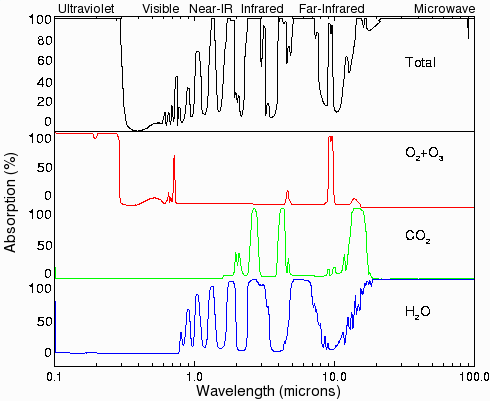
Look, I'm going to take you at face value here and try to explain this simply: you don't "guess" at measurements of light absorption based on how something "feels". You measure it. Soda-lime glass (aka, window glass) is very transparent in the visible spectrum, poorly in near-IR, and virtually opaque to thermal IR. CO2, likewise, is almost entirely transparent to visible light, but strongly absorbs in various parts of the IR spectrum. The reason that sunlight feels warm through glass is because a large portion of the sun's energy is in the form of visible light - and indoors you don't have as significant heat loss mechanisms (convective or radiative) as outdoors.
Now, note on the above graph that there are other atmospheric absorbers. Indeed, the most potent IR absorber in Earth's atmosphere is not carbon dioxide but water vapour. However, water rapidly cycles into and out of the atmosphere; it is thus a feedback mechanism, not a forcing mechanism. You could remove every last bit of water vapour from Earth's atmosphere, and two weeks later the vast majority of it would be back. And vice versa for overloading it. To force climate you need gases which do not cycle rapidly out of the system. CO2 and methane are the most prominent of these.
Now, it's true that the "greenhouse" analogy has limited benefit because you're dealing with different scenarios, and you're correct to suspect that a key difference is convection. Planets like Earth lose heat virtually exclusively to radiation. As mentioned, Earth would be far cooler if not for the so-called "greenhouse effect" - if I recall correctly, Earth's equilibrium temperature is 255K - that is, the temperature that you calculate if you consider only Earth's albedo (reflectiveness), emissivity and the incoming sunlight, balancing the rate of blackbody radiation with incoming energy. And a key thing to note when discussing this is that what we really care about is the temperature at the surface - a planetary greenhouse effect actually lowers the temperature in the upper stratosphere.
Radiative heat transfer is a balance between heat received and heat given off. A planet without an atmosphere, at night, exchanges radiation with the cosmic microwave background, which means "essentially zero radiation returns". The more IR-absorptive of an atmosphere present, however, the more it starts exchanging with the atmosphere, and at an increasingly low altitude. So you're not just giving up IR, but also getting it back. This raises the temperature; this increases up to the point where the outbound and inbound radiation rates are equal; that forms your new equilibrium.
In a physical greenhouse, this effect occurs as well, but in most scenarios it's dominated by convection losses. However, there are better "gardening analogies" - the most notable being IR-blocking floating row covers. Such floating row covers are often used to extend the length of time before a field succumbs to frost; they do not block convection, but rather radiative exchange. Many night frosts occur on clear nights, when the ambient t
-
Re:California needs to desalinate
ok, I uploaded some pictures of some non-farmed regions of the central valley so you can see:
Summer. The ground is typically dry all summer, but some trees have the endurance to survive until the rainy season.
Winter. The ground is typically wet all winter.
Winter orchard that hasn't been watered for four months. It might have been mowed, though. The ground will usually be mud all winter long from winter rains, and not dry out until April or May. Sometimes it freezes, then the ground is hard, but it thaws when the sun comes out.
Near Shasta more trees are able to survive, but the summer dryness still kills the grass. My hypothesis is they're more likely to get summer rains, making life tolerable for more species of trees, but not often enough for grass.
Owen's valley is a different place than the central valley. During the rainy season, it is too cold for anything to grow, and in the summer it is dry; so overall plants have it harder. Also, a lot of the pictures in your link are of Owens Lake, which is fairly toxic. The water all goes to the Los Angeles district. They're like a giant sponge, soaking up water from the western united states, and always trying to get more. There used to be farms in Owens valley, and if you drive near Manzanar, there is a plaque that says before LA took it, the water would flood the area two feet deep in the springtime, but who knows if that is true.
Incidentally, Owen's Valley can still be quite beautiful. -
Re:California needs to desalinate
The Sacramento Valley is the one part of the Central Valley which isn't arid if not outright desert. Most of the Central Valley used to be scrub - more specifically, "desert grassland" on the south end, "prairie savanna" in the middle and extending up to the Sacramento Valley, where it became lusher. South of the Sacramento Valley, the Central Valley's precipitation level is similar to that of the Owens Valley which, having had its water diverted coastward, has little irrigation. So if you want to see what most of the Central Valley used to look like, take a look at the Owens Valley today: scrub, interrupted with broader life where water intrudes.
-
Re:I say BS
Wow, unreferenced rant someone added at the bottom - clearly you've got me there!
Try googling those quotes. The first one is only people quoting Wikipedia. The second one, I downloaded the paper and the conclusion says just the opposite ("A huge interest expressed by the scientific community in the development of Li-air battery is the demand of modern automotive industry. We have identified four major areas. If properly addressed, this technology may enter the commercial phase in the near future." (immediately after going into a wide range of papers on dealing with each of these four topics))


.png)