Slashdot Mirror
Domain: historylink.org
Stories and comments across the archive that link to historylink.org.
Comments · 30
-
Not a new problem
High up front capital costs have been a primary problem for nuclear power generation for most of its existence. The Washington Public Power Supply System lead to a massive multibillion dollar municipal bond default in the 1980s.
It takes a lot of time and money to build traditional nuclear power plants, so if the financial and political system shifts underneath a potential plant builder then they can go bust with a partially built plant and nothing to show for it. The financial risk is huge and has already been painfully realized in the past. -
Chicken Little
It's a good thing Chicken Little didn't get paid for clicks. I'm sure that more than the sky would have been falling.
So what about the Boeing collapse of the early 70's? http://www.historylink.org/Fil...
What about Seattle being named "Most Livable City" in the early 90's after which the Californication occurred?
The lack of perspective and knowledge from journalists does more damage than anything Amazon could ever do.
-
Last one to leave... turn out the lights
Not a bad time to mention the other side of the coin: Will the last person to Seattle- Turn out the lights.
-
Good for them, we had to bit the bullet
In this area we had 5 reactors being built, one day they just called a halt to them. I had a friend who was studying to be a reactor operator who was told to go home, you haven't a job anymore, just one of the thousands told the same thing.
In January 1982, the WPPSS board stopped construction on Plants 4 and 5 when total cost for all the plants was projected to exceed $24 billion. Because these plants generated no power and brought in no money, the system was forced to default on $2.25 billion in bonds. This meant that the member utilities, and ultimately the rate payers, were obligated to pay back the borrowed money. In some small towns where unemployment due to the recession was already high, this amounted to more than $12,000 per customer. http://www.historylink.org/Fil...
At the time the largest default in the U.S.
-
Re:Sure.
I'd have been about 8½, and I recognized it and WvB (better image, another image). I was one of those space-nerds who watched all of the Apollo landings, and was almost 11 when Armstrong & Aldrin landed on the Moon. The only one I lost interest in was Apollo 13, not because of its drama, but because it didn't land on the Moon.
-
Re:PRIVACY? OFF THE TABLE!
You are now safe from the threat we created for you.
But still not safe.
America will gladly take the tattered bits of the constitution and pulp them over what is realistically a tiny threat. But when lax zoning laws coupled with almost zero oversight (e.g. holding 1350x as much ammonium nitrate onsite and not reporting it or being inspected) lead to an industrial disaster (*) in which more people were injured and killed almost concurrently with Boston
Or pick any random refinery explosion, which often kill workers and are often due to aged equipment not being replaced (**).
Now, I don't think industrial accidents should warrant pulping the constitution, but the response we take in such instances should at least be instructive -- there is the potential for criminal and civil charges all of which will take place in the context of a trial conducted under the normal rules of evidence and procedure pertinent to the type of proceeding.
But when many fewer people are hurt or injured by a bomb, we go on a self-destructive freeforall.
(*) http://www.nytimes.com/2013/04/25/us/texas-fertilizer-plant-fell-through-cracks-of-regulatory-oversight.html?pagewanted=all&_r=0
(**) http://www.historylink.org/index.cfm?DisplayPage=output.cfm&file_id=9717 -
Re:Contained Hydro
Yes, but those irrigation canals don't have water year round. The water is too managed, someone owns each cubic foot of it. Better the wind farms in Eburg or up on Ryegrass to provide year round power, and even those seem mostly idle the times I drive by. I'd say go for Whoops 3. Another plant at the end of SR24 would do more for the area power than any hydro source could. All the infrastructure is there. Just manage the construction a bit better.
On a personal note, irrigation canals scare the shit out of me. Too many people getting killed in them (and those that try to rescue them.)
-
Re:In fairness, companies are leaving Cali in drov
This is a reversal of a trend in the 1960's. It was so bad that there was a billboard that I remember there..
Will the last person leaving Seattle, turn out the lights?
Do a Google search for "Will the last person leaving" and you will find it in the top hits.
On April 16, 1971, real-estate agents Bob McDonald and Jim Youngren put the words, "Will the last person leaving SEATTLE -- Turn out the lights" on a billboard at S 167th Street and Pacific Highway S near Sea-Tac International Airport. The two realtors, who work for Henry Broderick, Inc., put up the billboard as a humorous response to pessimism generated by the national aerospace industry's nosedive, known locally as the Boeing Bust.
This page includes a photo of the billboard. Looks like California is the next to get the billboard.
http://www.historylink.org/index.cfm?DisplayPage=output.cfm&file_id=1287Seattle has tried not to repeat losing major businesses leave.
-
Re:It worked so well in California...
WPPSS still exists. It is now called Energy Northwest. On the Energy Northwest Wikipedia page is this link that gives a short explanation of what happened.
-
I beg to differIt didn't work for us in the 30's.
I wonder.
In 1930 Redmond's population was 430.
1930 Census: Population of Seattle tops 365,000 and that of King County tops 460,000 in 1930
In Seattle Boeing introduces the 247 in 1933. Eddie Bauer, the goose down parka in 1936.
The parka is a little closer to the truth about the Pacific Northwest in the thirties.
It was far from being an industrial power. Far from being an agricultural power.
So what drives the change?
The only answer that makes sense is government spending. Military spending. Water and Power. The Grand Coulee Dam.
The Grand Coulee alone represents a ten year investment in infrastructure.
Government can think and act beyond the next quarter. It is the borrower and the lender of last resort, the employer of last resort.
-
Re:Republicans are Flat-Earth Economists
How is money to Amtrak going to produce jobs?
Build new trains. Keeps the steelworkers employed, improves our transit... you know. Smart investment.
How does extending unemployment benefits create jobs?
It doesn't. But it keeps the people unemployeed from moving into one of these. Or fuckem, right?
ACORN
Ah yes, ACORN, the freeper boogy man. Booh!!! ACORN!!! BOOO!!!
I'll agree about birth control though. Even though the number is small compared to everything else--politically it was a stupid, stupid, stupid thing to put into a bill like this. Why provide ammo.
-
Re:simpler explanation
It's really quite simple: Teenagers buy most video games. Teenagers don't have investments and mortgages that tanked nor are they good at saving instead of spending.
Teenagers have not bought the most video games in quite a long time. In fact, the average age is 30 with 65% of game players over the age of 18. If the video game industry were to see a drop in buyers over the age of 18, they would suffer just as greatly as the rest of the economy.
I know the entertainment aspect may seem like too easy of an answer, but the historical data does support it.
During the beginning of the Great Depression, one of the most popular forms of entertainment was dancing. It usually only cost a few cents to get into a dance hall. Once there, the dancer could remain for most of the night. This was so economical that it led to a new form of sport: Marathon Dancing.
At first this extreme form of dancing was done to achieve new records. Then the dance halls started to get in on the act, and began promoting competitions. Soon, dancers would be on the floor for months at a time, with only 15 minute breaks every hour or so. (Yes, 24x7 on the floor. They slept like wolves at best!) These long marathons gave dance halls the opportunity to encourage or stage situations worthy of a soap-opera. Fights broke out, relationships came and went, people struggled not to lose their cool over the grinding months, and even weddings were performed on the floor!
The public just ate this stuff up. They spent their nickels to visit these dance halls for entertainment. If they were hungry enough, they might even try their hand at a marathon. While the lack of sleep was a killer, dance halls regularly served 12 meals a day! Quite a difference from standing in a bread line for a meager meal.
Eventually, dance was replaced with another non-stop form of entertainment: Movies.
You know the stereotype of the Bell Boy with his flashlight leading people into the dark theater? Well, there's good reason for that. Back during the depression, the movies never stopped! For a mere nickel you could visit the movies and watch for hours before it looped back to something you had seen before. News reels, Comedies, Cartoons, Features, etc. It was a true potpourri of entertainment. And since there was no television to compete, visiting the theater was one of the best ways of keeping abreast of the latest news and entertainment.
Speaking of television, yet another form of entertainment took a bite out of the market during the Depression. Radio saw a surge in public life. From comedy, to the original soap operas, to FDR's Fireside Chats, to Late Breaking News, to Orson Wells' War of The Worlds broadcast, radio was an incredible escape from the ugliness of everyday life. And every family who could manage to scrape together enough money had one.
I won't bore you with further details, but such a trend for escapist entertainment is seen throughout modern history. The worse things get, the more we turn to outlets for escape. With television on the decline, I see absolutely no reason why consumers would not find value in Video Games. They are the newest and hottest form of escapist medium. Eventually they too will be replaced by a new medium, but for now it's reasonably safe to bet on video games during any period of strong economic downturn.
-
Re:And let's stick to flea bites, shall we?
For the first time since the War of 1812, the US Mainland was hit in war.
You might want to check your history facts. Santa Barbara was shelled by a Japanese submarine in February 1942. A few months later, another Japanese submarine shelled Fort Stevens at the mouth of the Columbia River in Oregon. Both of these locations are on the U.S. mainland and both were hit "in war." Furthermore, Oregon happens to be the only location on the U.S. mainland to suffer a deaths from the otherwise ineffectual Japanese "balloon bombs." Mainland attack, since the War of 1812, with a fatality no less.
Now for the rest of your post, I happen to agree that the terrorism threat is waaaay overblown. However, I also think that the long-term threat of radical Islam is a real threat that should not be so easily dismissed. There is a war going on, but it's a war on cultural/religious diversity.
-
Re:hmmm
I may not be an electrician but I do know that water and electricity don't mix and you can't effectively/safely beam the power in wirelessly so you gotta run a biiiiig cord with a lotttt of amps running through it through the ocean.
Properly done, the work well together and last for years.
"Finally, in 1951, the Bonneville Power Administration laid a submarine power cable from Anacortes to the San Juan Islands and Lime Kiln Lighthouse was converted to electricity. "
http://www.historylink.org/essays/output.cfm?file_id=7704
"The proposed transmission lines would cross the international border beneath the Strait of Juan de Fuca, linking Vancouver Island, British Columbia, with the Olympic Peninsula in Washington State.
The Feasibility Study has indicated that without additional upgrades made to the regional system, and following the construction of the first project (550 megawatts), approximately 400 MW of transmission capacity could be available on a "south to north" routing from the Olympic Peninsula to Vancouver Island on a "pre-contingency" basis."
http://findarticles.com/p/articles/mi_m0EIN/is_2005_April_6/ai_n13558803
They do sometimes fail, but protection circuits simply power down the faulted section with no major impact.
"Recently, when one of the existing 30-year-old submarine cables failed, BPA decided to replace it. This was considered the preferred investment option, because the existing "wet design" cable had reached it's design life and because of the problems involved in repairing a cable sited in deep water."
http://tdworld.com/mag/power_underwater_cables_cross/
Note, most of the rest of the cables are over 30 years old. There is even a 115KV cable.
"Cable No. 4, a 115-kV, three-core, low-pressure fluid-filled cable with a single layer of PE-insulated galvanized armor wires and cathodic protection rated 150 MVA, was installed in 1982. Polarization cells were installed in 1985, and this cable has afforded fault-free service for more that 20 years." -
Re:Government should pay
Why isn't the government providing the tools the military needs.
Because this isn't about military procurement - the story is only partly about evolving military tactics (if there is a real need for these items, any self-respecting logistician would do whatever it takes to get them into the hands of their unit).
Mostly it's about people on the home front trying to feel like they are contributing. In that sense it has more in common with the campaign to knit socks in WWI or recycling in WWII. -
Re:Safety
I dont know about nuke, but USS Lexington ( CV2 )
powered Tacoma in 1929 for about a month.
here
She had a turbo electric drive, so she could generate a lot of power. -
Sigh. Let's get Google to remember for usHere are some freeway protests:
"On May 5, 1970, over 1,000 protestors came together on I-5, blocking southbound lanes, to speak out against the US's invasion of Cambodia, and the death of four Kent State antiwar protestors, shot by members of the National Guard." - http://www.historylink.org/essays/output.cfm?file
_ id=2271March 2, 2003: Peace activists took to the streets by the thousands yesterday in cities from Olympia to Bellingham as well as several locations in Seattle. Spurred by the first salvos in Iraq that pierced the uncertainty about what for months has been a potential war, yesterday's rallies had a decidedly more aggressive tenor than those just a few days earlier.
2 1.shtmlNovember 30, 1999: WTO - http://www.urban75.com/Action/seattle.html
April 30, 2004: LOS ANGELES -- Independent truckers protested mounting diesel fuel prices Friday by abandoning trucks in rush-hour traffic on one of the region's busiest freeways and staging rallies at two of the largest ports on the West Coast. - http://www.nbc4.tv/traffic/3255276/detail.html
March 27, 2006: LOS ANGELES -- More than 36,000 students from throughout Los Angeles County skipped classes and marched through streets and on various freeways Monday to protest an immigration bill being debated in Congress. - http://www.nbc4.tv/news/8289535/detail.html
Find more here: http://www.google.com/search?q=freeway+protest
Now which issue was it that you deem unworthy? Was it one of these? Your advice to protestors to be forgettable seems unlikely to bring attention to their cause -- something that was achieved by the disruptive, dangerous and memorable protests above. With the exception of the truckers opposed to $2.50/gal gas, the protesters seem to achieved both national attention and lasting results: Seattle is certainly never going to host the WTO again. Congress is working on the immigration law as I type this. We all know how Cambodia worked out (a sad story, that. By getting their way the nonviolent protestors indirectly killed about 1/4th of all Cambodian men, women and children. A heavy burden for people of conscience. *). Perhaps you could offer something more helpful. Are you by chance a protest organizer? Do you have a history of success in nonviolent promotion of social change? If so, the organization is almost certainly eager to have your contribution.
* - The Khmer Rouge regime is remembered mainly for the deaths of an estimated 1.7 million people (from an estimated 1972 population of 7.1 million), through execution, starvation and forced labor. - http://en.wikipedia.org/wiki/Khmer_Rouge
I think my point is that protestors should be tolerated as much as possible, but they should be reminded be careful which causes they take up.
-
Re:Stamped with an "X" on top ?
So don't look for a stamped "X", chances are all your caps have them
You mean like all those pits mysteriously appear on your windshield?
http://www.washington.historylink.org/output.cfm?f ile_id=5136 -
Re:Pressure from oil interests?
GM had nothing to do with Seattle's original light rail system dying it was never economically feasble from the beginning, and cars were just the nail in the coffin:
http://www.historylink.org/essays/output.cfm?file_ id=2707
All that said, it probably would have been worth subsidizing all of this time just to have the right-of-ways now. -
Re:good
Uhh, on the bad urban planning award. Seattle has:
1. They already had light rail (Trolley system), and removed it. In fact, I bet at some point it is going to cost money to move the equipment that is under the street. See this image of the counter balance, for example.
2. Due to the fire and sewage problems, Seattle actually raised ground level of downtown up one story to bury their problems. For a period of time, store fronts were underground, and people used ladders to reach them!
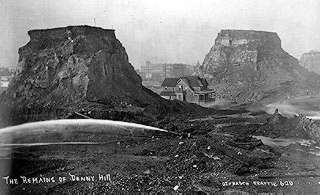
3. Seattle actually spent money bulldozing a large hill (See this pic of the denny regrade)
4. Traffic continues to be a problem.
etc, etc.
-Sean (OutdoorDB - The Outdoor Wiki) -
Re:Remember...Windshield pitting..
This combination of factors, added to the simple fact that for the first time people actually looked "at" their windshields instead of "through" them, caused the hubbub. No vandals. No atomic fallout. No sand-fleas. No cosmic rays. No electronic oscillations. Just a bunch of window dings that were there from the start.
-
Yeah, But Can It
. . . do a barrel roll?
-
Re:Give a man a fish...
The answer is E) none of the above. Chairman Bill is a hypocrite who donates a few hundred million dollars, which he won't miss because he deducts it from his income tax, at the same time he gets tens of billions dollars from his illegal monopoly
You really have no clue; first, Bill Gates donated over 25 billion dollars, not "a few hundred million". Second, the amount deductible from taxes is only 30% of the individual's income or 20% in the case of securities (as were most of Gates's donations). And even if he'd be able to deduct all of it, he'd still only save the part of it that's taxable for his income level, which is probably 35%. You have to be pretty silly to say he's giving away 100 dolars to save 35. -
Re:A lesson from history
Another fairly spectacular example is the collapse of Husky Stadium in Seattle in 1987 while it was under construction. Another is the sinking of the Mercer Island bridge, and the sinking of half of the Hood Canal bridge.
Gee, some things just aren't built that well out here in the Seattle area, are they? Or maybe it's the weather... -
Seattle and public transit
Just remember Seattle is know for its exceedingly poor city planning. For example,
1. Seattle used to have a trolley system, not unlike the street cars in san francisco. After a moment of genius urban planning it was removed. Click here for pictures.
2. Seattle couldn't agree on how to build a subway system, so they built a bus *tunnel* through downtown. Just to make it seem like they could intelligently plan for the future, they added tracks for a street car like metro system. They are still unused. (Last year they decided not to make the tunnel exclusive to light rail)
3. Seattle used to have another hill near downtown. They didn't like it so in 1897 they actually leveled half of it. It wasn't until the 1930's that they actually decided to remove it all. Here is an informative link with pictures.
4. Seattle's history of poor public planning also took place downtown. After fires and horrible sewage problems, they decided to put the sewage at street level and move the entire street up on story! For an entire neighborhood!
So Seattle, the town that actually raised its street level, lowered its hills, removed its light rail system only to have it cost in the *billions* to replace it, and when they try to replace it, it is only a bunch of unused tracks, is now spending 1.4 billion on a monorail. No one rides the monorail now, and they think that making it longer is going to change that? Hmm, did anyone tell them monorails are ugly?
-Sean
-Sean -
Re:Blobs? Pits? Same old story?
Should have used a link to a more in-depth article, but I tend to forget that other people don't spend as much time on skeptic websites as I do and wouldn't recognize the story immediatly. This probably can be explained by my not having a life.
Anyway, here is a quote from the article above that puts things in perspective:
"Nevertheless, conventional wisdom lay with the scientists. Further investigation by the City of Seattle Police Department showed that most dings pitted older car windshields. In cases where auto lots were involved, brand new cars were unpitted, whereas used older cars showed signs of pitting. Police found rare instances of "copycat" vandalism, but most of the cases had a simple explanation: The pits had been there all along, but no one had noticed them until now."
So there you have it. -
Re:$40 billion?
No way, he just gives his layer(s) sexual favors.
He's married to a wonderful woman, who just happens to be the mother of The Beast.
Now let's look into Bill's other supported funds...
Killing baby Indians (not American). I guess he's sick of those H1B visas?
A snapshot history of what their foundation is for, among others: "population control programs".
In nearly all their documents, the Bill and Milinda Gates foundation mentions their support for the "global community". Another writer uses those words a whole lot in his religious fiction series.
Now don't get me wrong, I don't think Bill is the antichrist. I think he's just a little imp.
</IANAF> -
Worse than Pearl Harbor
This attack is probably much worse than Pearl Harbor. According to this page at historylink.org there were 2403 deaths, and 1178 wounded in the Pearl Harbor attack. Pearl Harbor mobilized the nation for over four years; of course there was a clear enemy to respond to. How in hell do we respond to this day of infamy?
-
Re:Bernoulli EffectNobody flies 747's upside down because the plane is not designed to do stunts - I don't know what its negative G rating is but I do know it's only rated for 2.5G's positive G's (most aerobatic planes are rated for +/-12 - some properly trained humans can tolerate up to +9 for short periods, and some of the big roller coasters pull +2 G's now). If it's only rated for something like -1.2G's, flight upside down only leaves you with
Those big jets do fly upside down though.
-
_ALL_ the Webcams and Shoutcasts
These should be better in the AM. Reply with new streams and webcams, please.
Cameras
http://www.historylink.org/gazette/g azette.htm
http://www/ cctv117a.htm
http://209.20.207.37/index.html
http://www.spaceneedle.com/view/livecam
http://www.seattleinsider.com/news/ cameras.html
Audio
http://128.95.10.82:8000/
ht tp://tm.intervu.net/template/smirror/ivtemplates/a pbonline/scannerlive_sea.asx
http://www.shoutcast.com/sbin/ shoutcast-playlist.pls?rn=6416&addr=209.201.3.17:8 000&file=filename.plsrtsp://kgw.solidweb