Slashdot Mirror
Domain: hubblesite.org
Stories and comments across the archive that link to hubblesite.org.
Comments · 269
-
Re:ooooooh! It "passed" a "test" !
Not to mention the "spherical aberration" that required the installation of corrective lenses. http://hubblesite.org/the_telescope/nuts_.and._bolts/optics/costar/
-
Re:Hubble? I don't think so
-
Re:Not the big deal people make out of it ...I've got a $20 12 mW 523 nm laser pointer on my dining room table (for some stargazing when the weather clears). In 8 seconds it will emit about 0.1 Joules which will be about 2.5 * 10E17 photons. If the man in the center has a similar $20 laser, he will illuminate a circle with a 600 million mile circumference and there will be 4 * 10E8 photons per mile, or 6 * 10E8 photons per km, or 600 photons per mm. So while it is true that:
there is no magic laser that reflects back the same intensity no matter how fast it gets swept across a surface.
you would be hard pressed to find a telescope that could resolve the photons from a puny $20 laser in this thought experiment. For example the Hubble Telescope has significantly less resolution at a distance of just one mile:
Hubble's keen vision (0.085 arc seconds.) is equivalent to standing at the U.S. Capitol and seeing the date on a quarter a mile away at the Washington monument.
The only remarkable thing needed would be the screen with a 93 million mile radius. Maybe Larry Niven could offer a suggestion.
-
Hubble NewsCenter link
The corresponding Hubble NewsCenter article includes more details and more, larger images.
-
It's not that big...
That is simply awesome looking. But... only 2345x2039? The original maxed out at 6200x6200. What gives?
-
It's not that big...
That is simply awesome looking. But... only 2345x2039? The original maxed out at 6200x6200. What gives?
-
Re:How big?
There's an annotated image here, which inexplicably has a scale in light years/parsecs. I mean, it must be talking about at a particular depth, maybe the dust cloud the Hubble imaged? The arc-minutes/seconds scale, at least, makes perfect sense.
-
Re:BIG SIZE
Posted already, but in case you missed it: http://hubblesite.org/newscenter/archive/releases/2009/28/image/b/warn/
-
larger versions of image available here
You can download much larger versions of this image from the following link:
http://hubblesite.org/newscenter/archive/releases/2009/28/image/b/warn/
I'm downloading the 50 MB TIFF at the moment.
-
Re:Where the shit are the images?
Don't feed the trolls, but I'm the author of this worst submission ever.
First link is to text-only release from NASA, link at end goes to NASA Hubble page, http://www.nasa.gov/hubble
Last link is to HubbleSite, All 52 release images. Site still has server issues it seems, but nasa.gov link works smoothly.
-
Re:Colors in photographs
First, thanks for the link to the faq.
Now onto the quote you provide,"There are no "natural color" cameras aboard the Hubble and never have been. The optical cameras on board have all been digital CCD cameras, which take images as grayscale pixels." My question is why is NASA using a sensor with greyscale pixels? Both CCD and CMOS sensors use color filter arrays to capture color information. There was also the technology Silicon Film created. Using CMOS tech they created a sensor that could capture the 3 primary colors at each pixel site. Silicon Film closed operations and went out of business, but I'm surprised someone else didn't buy it's patents and release their own products using them.
Perhaps you know something I don't that makes the Silicon Film tech unusable, but I don't see why NASA couldn't use color filters.
Falcon
-
Re:Would like to see the improvement
If anyone finds a link to side-by-side images from the old and new cameras, please post it!
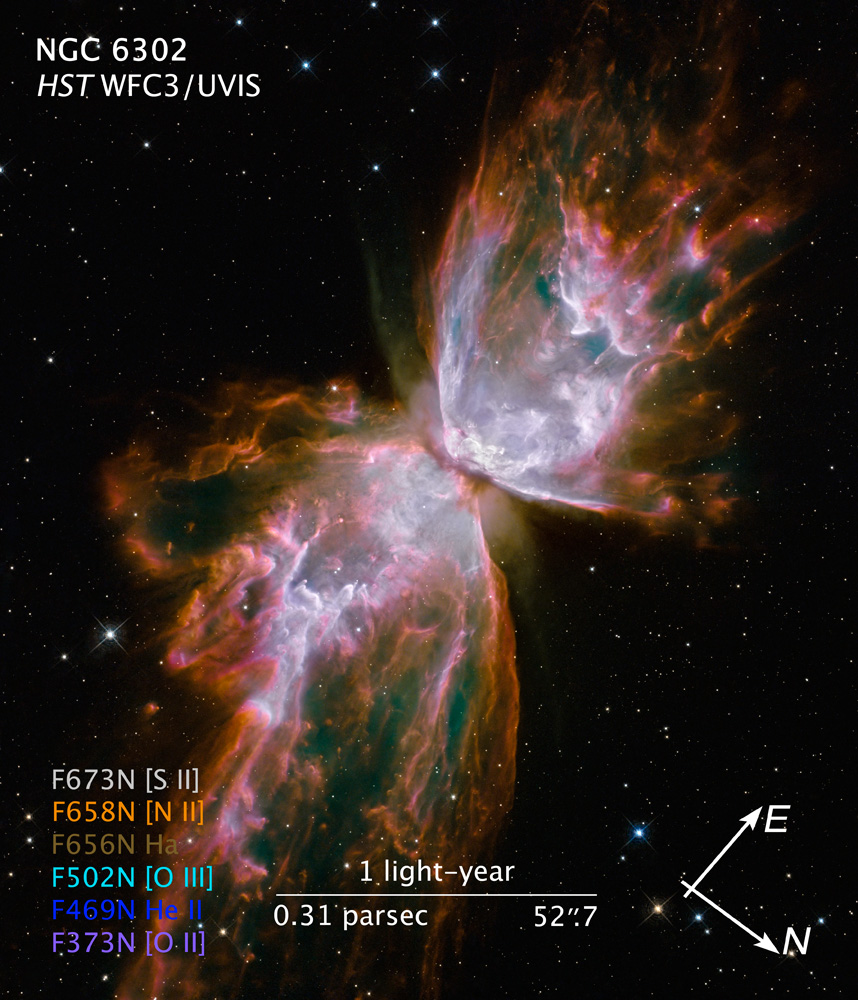
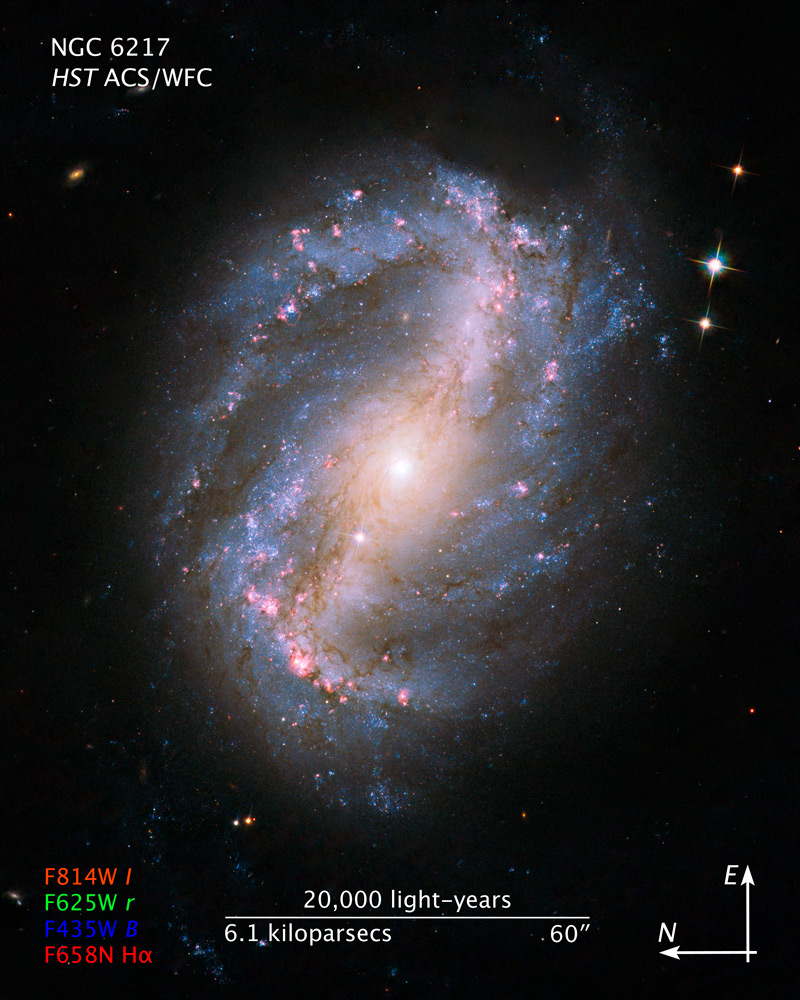
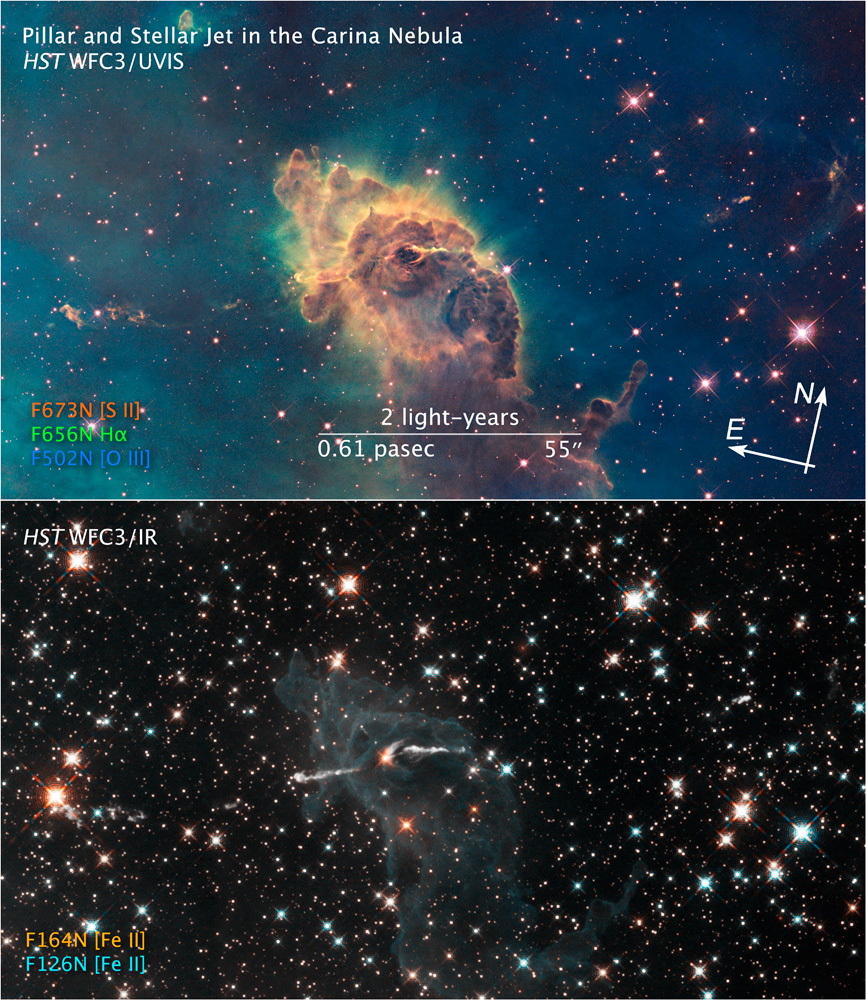
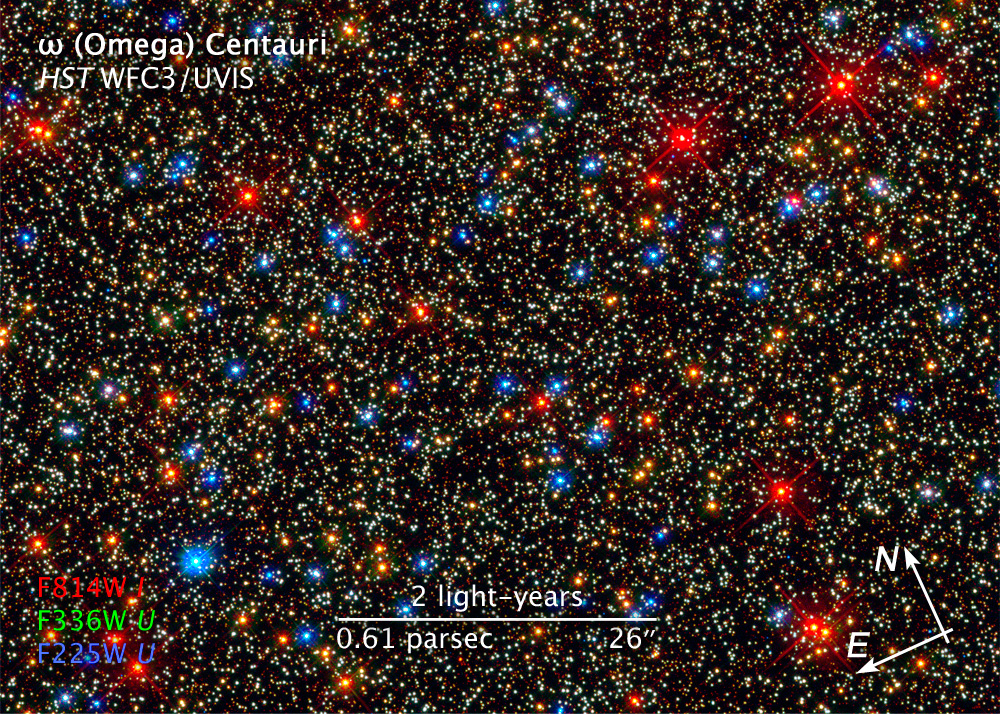
I'll give it a shot. (note: on some of these I'm using MAST's archive since the main NASA site seems to be down and I am not linking you to full resolution photos as well as seeming to be at different ranges)
Old (2007) Image of NGC 6302 compare with new image of NGC 6302
Old (2004 not HST, ground observatory can't find HST image) Image of NGC 6217 compare with new image of NGC 6217
Old (2007) Image of Carina Nebula compare with new image of Carina Nebula
Old (1998 land observatory) Images (2000 HST) of Stephen's Quintet compare with new image of Stephen's Quintet
Old (2008) Omega Centauri compare with new Omega Centauri
Old (2005) Supernova Remnant LMC N132D compare with new Supernova Remnant LMC N132D
Hopefully that gives you an idea, most of those old images are Hubble but I threw in some ground based observatory ones so that you can get an idea of what Hubble's been doing for us for 15 years. -
Re:Colors in photographs
I bet we've got a really smart person out there that knows the answer for this, for sure. I asked my professor and they really danced around and didn't give a straight answer (it was a community college). What about these brilliant colors we always see in the photographs? Are they touched up (I've read and NASA insists, "no, they're not")? Are they extrapolations based on the inferred composition of the gases in a nebula, for example? Or is it honest to goodness, if we were parked in a space ship a few million miles away, exactly what our eyes would register?
Your answer is on the FAQ in one of the linked sites here:
There are no "natural color" cameras aboard the Hubble and never have been. The optical cameras on board have all been digital CCD cameras, which take images as grayscale pixels.
Sometimes the color is as natural as possible. However, the color given to the images is not just "artistic embellishment." The images are, indeed, downloaded as black and white, and color is added for a number of different reasons -- for example, to show the dispersion detail of chemical elements and highlight features so subdued that the human eye cannot see them.
For more information, read The Meaning of Color on HubbleSite, which explains in detail how color is added to images.
-
Re:Colors in photographs
I bet we've got a really smart person out there that knows the answer for this, for sure. I asked my professor and they really danced around and didn't give a straight answer (it was a community college). What about these brilliant colors we always see in the photographs? Are they touched up (I've read and NASA insists, "no, they're not")? Are they extrapolations based on the inferred composition of the gases in a nebula, for example? Or is it honest to goodness, if we were parked in a space ship a few million miles away, exactly what our eyes would register?
Your answer is on the FAQ in one of the linked sites here:
There are no "natural color" cameras aboard the Hubble and never have been. The optical cameras on board have all been digital CCD cameras, which take images as grayscale pixels.
Sometimes the color is as natural as possible. However, the color given to the images is not just "artistic embellishment." The images are, indeed, downloaded as black and white, and color is added for a number of different reasons -- for example, to show the dispersion detail of chemical elements and highlight features so subdued that the human eye cannot see them.
For more information, read The Meaning of Color on HubbleSite, which explains in detail how color is added to images.
-
original Hubble press release
Here's the Hubble press release and the paper.
-
original Hubble press release
Here's the Hubble press release and the paper.
-
Re:It will be intresting for sure
I do not think he was trolling. I did some fact checking just now and it does indeed seem that the research was done on the Directors discretionary time. From http://hubblesite.org/newscenter/archive/releases/1996/01/text/
"The landmark research was carried out under Williams' direction, and using a significant fraction of his own director's discretionary time on the Space Telescope. He decided to conduct the Hubble Deep Field program to use Space Telescope's exquisite resolution and high sensitivity to push back the very limits of time and space."
Furthermore, I can see how you might interpret the above posters comments about "nothing being there" as trolling as well, however, I think you saw it only due to your seemingly aggressive nature. When I read his words, I saw the words "nothing known to be interesting" since everyone knows that the universe is supposedly homogenous on a large scale.
*shrug* I do not think it is wise to assume so quickly that people are trolling.
-
It will be intresting for sure
As for all the new discoverys i'm sure these new telescopes will find, i'm curious if they will do the same thing with these as they did with the hubble, by pointing it at a "black" region of space and leaving it there for a while gathering exposures, only to discover that the region wasn't "black" at all, it was completely filled with all sorts of different galaxies, and this was only a small point in space they were looking.
Here is the link for the Hubble info in case you're intrested.
http://hubblesite.org/newscenter/archive/releases/1996/01/text/
-
But why wait 25 days?
Showing one image a day for 25 days is a great way to generate repeat traffic for your blog and increase page views, especially if your blog is picked up by Slashdot!
Or you could skip the middle man and go directly to the source and get as many beautiful HST images as you want... right now.
-
Re:how f*cking cool is that picture ?
Ollabelle, take a look here for some larger images, including a TIFF which should be scalable to your desktop size.
-
Re:CPU Constrained?
I'm pretty sure you got it right
http://hubblesite.org/the_telescope/nuts_.and._bolts/instruments/wfpc2/index.php CCDs are electronic circuits composed of light-sensitive picture elements (pixels), tiny cells that, placed together, resemble a screen-door mesh. Each of the four CCDs contains 640,000 pixels. The light collected by each pixel is translated into a number. These numbers (all 2,560,000 of them) are sent to ground-based computers, which convert them into an image.
Doesn't sound like the 486 is even breaking a sweat. Now considering this is slashdot, free as in er, free and all that, I would have opted for a "handful of these:" But that would make me feel WAY to old -
Re:Dark Matter, mystery solved, heard it here firs
Who said anything about the nature of dark matter? It is detectable in astronomy only by its gravity so the best we can say is that it has mass, doesn't emit light and interacts feebly at best by any force other than gravity. What I claim is that there's good evidence that there is unseen mass out there other than boring things like cold gas and brown dwarfs.
a link to one of the prettier pictures of mass distribution, and another link showing a collision between galaxy clusters in which most visible matter collided and slowed, but which gravitational lensing shows that most of the invisible mass of the galaxies continued on its path unaffected by the collision. -
It's galaxies all the way down ...
-
Re:Oops, Oort.
It is interesting that the "knots" seen in the Helix Nebulae are likely to be super-comets (Sedna sized bodies ablating under the bright glare of the dying central star), so if you want to get a look at an Oort cloud, here is a good one.
Interesting. Looks like a bloodshot blue eye staring at me!
-
Re:Oops, Oort.
Just to make you paranoid, the sum of the mass of oort cloud objects is far more than the mass of the sun and all the planets
Not supposed to be. The mass in the Oort cloud can be estimated by assuming some sort of mass function (i.e., a distributon of number, and thus total mass, with the mass of the object. Unless there a some unknown big objects out there, the total mass is order one Earth mass to maybe 100 Earth masses. And, there have been negative searches in the IR for very large (Jupiter size and larger) objects, so it's almost certainly nowhere near as large as 1 solar mass.
It is interesting that the "knots" seen in the Helix Nebulae are likely to be super-comets (Sedna sized bodies ablating under the bright glare of the dying central star), so if you want to get a look at an Oort cloud, here is a good one.
-
Gene Ray was right after all!
No—it can't be true! The Hubble has managed to photograph the Time Cube! The joke really is on us...
-
That's Quite a Stretch...
to make the Hubble look relatively inexpensive. Space research is expensive and no "apples to asteroids (~TM)" comparisons will change that. Compare the annual cost of supporting Hubble to the annual expenditures on dog food in the US and it will look like a tremendous bargain.
Space exploration will never garner adequate support because it's cheaper than the sum of all SMS plans. It will gain support by demonstrating its value: both scientific and in public relations. IMHO, Hubble.org has done more to advance the cause of space than any asinine comparison, such as this.
-
Its actually all been done before.
At least by 1990, NASA, DOD and Fairchild/Orbital used to run a system called "Multi Mission Modular Satellite".
So what have they done? For 4 million they built a prototype that will never work in space? Notice that when they were added to some other project the total real project price was $80M - and I'm not so sure that includes launch vehicle (ie the rocket).
Back in the day, the radio receiver (arguably the most critical part of a satellite) was $2 million all by itself. It had to be radiation hardened (cosmic rays) and work flawlessly for 5+ years. If something really went wrong, the receiver would send the pulses that actually re-booted or reset the other on board computers.
Also satellites that have instruments, like the hubble, need to point very precisely at stars - the instruments to do this are very expensive, the controls that orient the satellites are relatively cheap - but you have to buy extra (redundancy).
Imagine this, the Hubble Space Telescope has to point at a spot in space for long time - once for 1 million seconds ( Hubble Site ) During that period of time, the solar arrays, antennas etc. couldn't move because even the ultra smooth stepper motors they use would have shaken the spacecraft enough to blur the image.
That being said, there are 100s, if not 1000s of neat little projects that potentially save NASA money - like using standard Internet protocols to talk to spacecraft (tweak the timeouts a bit) - which would mean ground stations would use pretty much standard router hardware vs. custom stuff. It good to see some of these ideas get the exposure they deserve.
However, most satellites are designed with requirements for the instrumentation. The rest of the satellite is designed around those requirements. Unless you have a very flexible design in your spacecraft bus, the scientific part of the mission might be compromised.
So this lander might work - how many g's on impact? (err... landing). What is the success chance? Do I take my $50million instrument and put it on a $10 million lander that has a 30% chance of success? Or do I build a $20 million lander that has an 80% chance? or a $30 Million that has 95% chance? If I pick wrong, I'm sure that I will not get another $100 million to fly the mission again. Perhaps a lifetime of research goes down the toilet...
-
Re:Omega Centauri appears almost as large...
My God.... it's full of stars. http://hubblesite.org/newscenter/archive/releases/2001/33/image/a/format/large_web/
-
Re:Do they cut it in half and count the rings?Since c is most likely a constant we can say: something that is x light years away is y years old (actually, x = y for most cases, I think.). How do we measure the distance between our galaxy and another? No rocket science (but [theoretical] astrophysics):
http://hubblesite.org/reference_desk/faq/answer.php.id=45&cat=galaxies
Though I have no idea how exactly they did it this time. That's just the general procedure. According to TFA that's just an estimation and the exact age of the galaxy is yet to be determined; that's what those new telescopes would be useful for.
What's even more interesting though: The astronomers used a relatively nearby massive cluster of galaxies known as Abell 1689, roughly 2.2 billion light-years away, to magnify the light from the more distant galaxy directly behind it. This natural telescope is called a gravitational lens. Remember: when you're glancing through space, you're not only taking a look at the 3 space dimensions, but the 4th, time, actually starts playing a role. The sun could explode right now and we would only notice it in about 8 minutes... -
Image copyrights - addendumI said: yet at least some of the images used have copyrights of their own On further investigation, it seems that only one of the images^ whose sources I have been able to find has a copyright (there are some - such as the one on page 1 - that I have so far been unable to source).
However, several have usage statements.
For example, the Comet Linear image, from the STScI: "it is requested that in any subsequent use of this work NASA and STScI be given appropriate acknowledgement." (http://hubblesite.org/copyright/)
And the Comet NEAT image, from SOHO: "It is requested, however, that any such use properly attributes the source of the images or data" (http://sohowww.nascom.nasa.gov/data/summary/copyright.html).
^ The image of asteroid Itokawa, from JAXA, has this: "When using materials, JAXA should be credited as the source. (Unless noted otherwise, the copyrights of the materials in the Photo Archives belong to JAXA.)" (http://jda.jaxa.jp/jda/service_e.html) -
depends
Hopefully, it will look at least this cool.
Entirely depends on your point of view. Literally. -
Link to better site [Hubble] with more images
The original story, with images etc. is at
http://hubblesite.org/newscenter/archive/releases/2008/04
Of course, this site lacks the amusing comments in the OP's linked site. -
Re:Awesome!
the colourings aren't necessarily for artistic license, they are actually there to describe internal structure or, as other people have noted non-visible electromagnetic spectra. its all explained here http://hubblesite.org/gallery/behind_the_pictures/
-
Re:Awesome!You may appreciate this then: http://hubblesite.org/gallery/behind_the_pictures/meaning_of_color/index.php
From the site: Taking color pictures with the Hubble Space Telescope is much more complex than taking color pictures with a traditional camera. For one thing, Hubble doesn't use color film -- in fact, it doesn't use film at all. Rather, its cameras record light from the universe with special electronic detectors. These detectors produce images of the cosmos not in color, but in shades of black and white.
Finished color images are actually combinations of two or more black-and-white exposures to which color has been added during image processing.
The colors in Hubble images, which are assigned for various reasons, aren't always what we'd see if we were able to visit the imaged objects in a spacecraft. We often use color as a tool, whether it is to enhance an object's detail or to visualize what ordinarily could never be seen by the human eye -
Re:No anomalies detected
That would indirectly suggest that in this galaxy there was no sufficiently advanced life that would detect, and try to protect itself, or stop, said "death ray".
Um, dude? That "death ray" has a significant scale relative to the size of a galaxy, all of it traveling at (x-rays, gamma rays) or close to (electrons) the speed of light. For one any species caught in its path wouldn't see it until it hit them, and two even if they knew about the beam it isn't clear that they could do anything about it except hide underground for thousands of years or bug out to another part of the galaxy, which itself would require faster-than-light travel. To actually redirect or shield themselves from the beam at a degree that would be visible in our telescopes would require technology on a scale that we can't even dream of.
I find it highly odd that you would be skeptical of the existence of life arising elsewhere in the universe (which while we have no idea what exactly it takes, we know is possible because it has happened at least once), because of the apparent lack of faster than light travel (which according to our current theories is impossible) or even more miraculous feats of what amount to complete science fiction. We can't say that it could ever even be theoretically possible to be "sufficiently advanced" to pull off what you propose, much less if humanity could ever attain it.
Have you seen the Hubble Deep Field? That's an extremely narrow view of the sky, and it's completely stuffed with galaxies. And because this one particular galaxy has not, as far as we can tell, birthed a civilization with Q-like powers, you're questioning whether there could be life anywhere else out there at all? That's literally the oddest form of skepticism I've ever heard.
Unless this is just dead-pan humor. I'll admit that I have problems detecting it when done with subtlety. -
Re:re
A screenshot of Saturn's rings? Don't you think that's a little redundant?
There already are some very nice pictures of the real Saturn.
Here's a wonderful look of the rings from above. -
Re:Lovely
...and while the astronomers fiddle with gear you and I can only dream of having access to, take your camera and a tripod outside, and with no more than a portrait lens, you can take shots like these.
Disclaimer: I have a masters in Astronomy but I've never worked in the field. I did the degree "for fun", because I never got the opportunity to study in highschool, and because I wanted to know how we know what we know about the universe. I'm very much an amateur in every respect.
Defintely worth fiddling with camera gear, but at some point if you're taking your own shots you're going to want to use a telescope. Starting with binoculars is definitely the best way. Moving to a dobsonian for viewing (but terrible for photography) is a good next step. (Don't buy anything with a small aperture unless all you're interested in is moon and planets). Next good step would be a Newtonian on EQ mount or SCT. It gets very expensive very quickly. I pretty much gave up on astrophotography. (I live in a large city and when I do get away far enough, I'm usually exhausted from the drive, and there are other priorities (family). Also a 10" scope takes up a hell of a lot of room even in a station wagon).
An alternative to the above is to get hold of sky survey data that's already available and captured by the pro images. There's a lot out there that gets released usually after a year (to give the professional scientists time to work with it). Hubble data, Chandra X-Ray data, SOHO images. It's not all pretty composite colour pictures - you often have to learn to manipulate the images with image software or with more complex data there's specialized software that's not always for the faint of heart (often free, often Linux based). "Amateurs" have done amazing things with some of the images and data. In astronomy there is an "image" (FITS) file format that is actually more than just a simple JPEG etc. You have a background in photography so while it's not strictly RAW data in the sense that it's not coming straight off a sensor, you can think of this format as containing more information the way RAW contains more than JPEG (stuff like calibration information). More information here.
http://en.wikipedia.org/wiki/FITS
http://heasarc.gsfc.nasa.gov/docs/heasarc/fits.html
Please understand I'm not trying to discourage you from backyard astronomy. I just thought you might be interested in this too. These days the guys that take the images/capture data and the guys that analyse them are not always the same. ie. you often have technicians that specialise in running the machines.
Here are some links for you:
FITS data from lots of missions/instruments
http://heasarc.gsfc.nasa.gov/docs/archive.html
Digitized Sky Survey
http://archive.eso.org/dss/dss
http://archive.stsci.edu/cgi-bin/dss_form
Hubble
http://hubblesite.org/
SOHO
http://sohowww.nascom.nasa.gov/
Chandra
http://chandra.harvard.edu/
http://chandra.harvard.edu/resources/
If you want more detail and are prepared to try to work out science speak, you can get access to draft papers on:
http://arxiv.org/
Look under astrophysics
I don't have time to go into any more. Hope you're interested. -
Re:Wonder and amazement
The Hubble telescope can't really take pictures of Earth because it is moving too fast. I could be wrong, but maybe the Hubble can't take pictures of the moon for the same reason.
-
Re:Not convinced by TFAFixing your knowledge:
- The Earth rotates in 24h
- Hubble orbits in 90 min
so Hubble cannot peer "hours at a time", but ground telescopes can. Hubble can actually produce millon-second-long exposures. That's 400 orbits, but stacking 21 minute exposures. -
link
-
Let's see it beat Hubble at:
I would think that before the scientists claim victory over Hubble, let's see their camera best some of Hubble's best work:
http://hubblesite.org/
There's a number of excellent Hubble images of just about everything in our solar system to the most distant galaxies.
I would put my money on Hubble, for two reasons.
First, the averaging algorithm is not without its flaws. They make the assumption that by averaging out a bunch of images, you eliminate distortion. For this to work, you have to assume that the probability of a particular pixel being in the right spot is higher as the distortion would essentially be random, and that could theoretically not be the case. If the distortion is completely random, then, averaging a set of images would essentially lose the pixel that is being pushed around its "real" spot by the atmosphere, and you can actually see that, as the corrected images still look muddy compared to their HST or even adaptive optic counterparts.
Secondly, the atmosphere doesn't just distort light, it also filters it. You can use averaging to remove distortion "noise", but, there's really no way to ascertain what information was removed by the atmosphere.
The bottom line is, yes, you can get some pretty good results with averaging software, but, if you have money to spend, the best images are going to be space based, and its still going to cost a billion dollars. Given the promise the heavens hold for the advance of human understanding, let alone essentially infinite resources, one only hopes that policy makers will not be mislead by the outrageous claim that one can get the best images from the ground. You can't. HST should not be thought of as an aberration made obsolete by adaptative optics or the low budget averaging. Low budget averaging and adaptive optics really need to be thought of as getting by until we can put larger, and better visible wavelength telescopes into space.
Imagine what a space based Mt. Palomar sized mirror could do, if in space! -
Re:Expanding Universe?
Wrong scale. On the macroscopic scale - the same scale where the universe looks the same in all directions - everything is moving away from everything else. On smaller scales, of course, this isn't the case*. To see the "everything expanding" universe and the "everything homogenous" universe, you need to lower the granularity of your observations to the point that this sort of localized clustering isn't measurable. A good start would be to take Hubble's Ultra Deep Field image as your basic unit of observation (and that's still only 0.000008% of the area of the sky). In that image, only five of the objects visible (the ones with lens flare crosses) are stars, every other object is a galaxy. You can see the homogeneity of the universe in that image. Four of those galaxies colliding - even the four largest that are visible - wouldn't change the overall character of the image at all.
*Well, this may or may not be the case, depending on how well I understand the expansion of space. If the apparently-faster-than-light expansion of the early universe is, in fact, due to a combination of things flying apart and the space between them expanding, it's reasonable to think that space is still expanding. In which case, literally everything is moving apart from everything else, from the neutrons and protons in your average nucleus to galactic clusters. But I may be misunderstanding the expansion of space. -
Re:You'll be dead anyway. Here's why
Actually, the helium abundance is nearly the same now as it was before stars first started to form. And, the rate of star formation is dropping fairly rapidly: http://hubblesite.org/newscenter/archive/releases
/ 1996/37/. Only a small fraction of the available hydrogen is incoporated into stars and the reason is that as galaxies and the universe evolve, it becomes more difficult to form stars. Systems that have low rotation, the more massive systems, have virial temperatures that are too high to allow the condensation of molecular clouds so that star formation is cut off. Even without galaxy-galaxy inteactions, a huge spur for star formation and a means of transforming rotationaly supported systems into non-rotationally supported systems, galaxies will evolve into more spherical shapes and have less star formation. There is little danger of running out of hydrogen but the circumstances where the hydrogen can form new stars will become rarer and rarer.
--
Get solar energy while it's hot: http://mdsolar.blogspot.com/2007/01/slashdot-users -selling-solar.html -
Hubble image of nebula
I was looking for a nice desktop image and happened to come upon this panorama of Carina Nebula. This supernova is clearly visible(not fake colored x-ray) in the image, it is about 1/4 from the left side and in the middle of the picture just left of the big blob of dust. Curiously it has some sort of crosshairs on it, probably an optical illusion but nontheless interesting.
-
Re:how you see dark matter
Yep. It gives me the shivers, sometimes.
Have you ever seen the Hubble Deep Field image, though? I've been using that as my wallpaper for a while now; a jpeg named "the galaxies like dust".
It's amazing. -
Re:I'm biased, but...
Earth telescopes with optical resolving power comparable to Hubble have to use adaptive optics of some sort. Because adaptive optics requires a guide star of some sort — to measure the deformation caused by Earth's atmosphere and physically re-shape the mirror to cancel that deformation — you can't just point the telescope in any direction you choose. There has to be a bright star in the field of view for the adaptive optics to measure. Artificial guide stars, which use lasers that are reflected back to the ground by the atmosphere, help the problem somewhat but aren't as good as the real thing, since they don't penetrate the entire atmosphere.
The use of a guide star also means that the telescope is only useful for a very narrow field of view. The only deformation measured is what's between the guide star and the telescope, so the wider your angle is, the fuzzier the picture gets, and the longer your exposure time is, the worse the problem gets. It's simply impossible to take photos like the Hubble Ultra Deep Field with a ground-based telescope: even if we had lots of bright guide stars to measure the deformation over the entire field of view, there's no physical shape the mirror can be in that will cancel out deformation in multiple directions at the same time. It's just not possible.
-
Re:Looks like my wallpaper won't be changing for a
I know. These images suck from the Spitzer Infrared Space Telescope.
There is absolutely no way that we can extrapolate any color from those images. -
Misleading. You will still have great wallpapers
Actually, although the Advanced Camera for Surveys produces some of the deepest and highest resolution images, especially of distant objects, it is the wide-field planetary camera that produces a lot of the most memorable images, such as the "Pillars of Creation" in the Eagle Nebula.
Hubblesite.org has a good layman's description of the instruments on the Hubble.
Also, we're still getting many fine images of the planets, stars, galaxies, and nebulae around us from the Spitzer and the multitude of ground-based scopes that make great backgrounds. And don't forget the fantastic Mars rovers or Cassini. -
Re:Global warming and the holocaust deniers.
Well, you are fine right up until a and b...
See, we have a control, another planet that is very similar to ours in terms of planetary scale and it's ice caps are melting too.
http://www.planetary.org/image/flammarion_MarsTerr esduCiel.jpg
current:
http://hubblesite.org/newscenter/archive/releases/ 1997/09
Go back farther to Huygen's observations in the 17th century and they are smaller again. Seems to be reacting to something OTHER than human interaction.
Thus, you observation about Sun cycles makes a lot more sense as the root cause.
So, if humans are making it worse, and likely they are, then if we try and fight the cycle we may tip it too much in the OTHER direction?