Slashdot Mirror
Domain: ic.ac.uk
Stories and comments across the archive that link to ic.ac.uk.
Comments · 477
-
Asteroid estimator
https://impact.ese.ic.ac.uk/Im...
So, you get a crater roughly the right size in that sort of rock if it is 2.5 km in diameter. You get 0.85 megatonnes equivalent energy, which is next to nothing. No significant global effect.
-
Bad software is our friend!
Per TWX's post, https://news.slashdot.org/comm..., we need to make software that requires a large amount of effort to maintain. Here are some suggestions:
1) information horde. No one should know exactly what you are up to. Extra credit if you can fool yourself
2) if unit tests fail, change the unit tests. Or just short circuit them to always pass.
3) write unmaintainable code. https://www.doc.ic.ac.uk/~susa...
4) Always use obsolete libraries and frameworks, except when you use libraries in alpha or beta release.
5) QA? We don't need no stinking QA, we're agile
6) Always suggest to marketing that you can deliver and that is is easy "in concept".
7) Always hire the least experienced people as possible, if that's not possible always hire those with the most Aspbergers and autism symptoms.
8) be open to change requests. neglect to vett them and don't include anyone who actually can request changes; e.g. managers, product owners, scrum masters etc.
9) Embrace SAFe
10) Call more meetings.
11) Mmmmmm... donuts. Only serve donuts at the meeting. You want a maximum sugar high in the meeting, followed by a crash after the return to their cube. Extra points for only serving decaf in those meeting, and make sure the work "decaf" does not appear anywhere.
12) When playing "planning poker", ensure you are the most optimistic person in sprint planning. A "2" is your friend. Argue for it and when asked state that there are new frameworks available. This is a good time to use frameworks in alpha or beta release. Alternately be the most pessimistic. Which is a good time to argue for obsolete frameworks as they are "stable".
13) Make sure user stories' titles do not match the bodies and the description in the bodies are vague and contradictory.
14) Make sure you have 10 tests in the build pipeline. Only 10. And make sure they pass. You want evidence that you have test automation in the build pipeline.
15) Embrace the latest fads. Always.
16) Dev + Ops = DevOps so make sure management understands that Dev can do Ops. After all we're "Agile aren't we?
And of course deny you have read this post.
-
Re:What if?
I found the relative velocity through the JPL small body database - a very slow 8 km/sec. Looking at the orbital diagram, it was more like the Earth passing the asteroid rather than the other way around!
Purdue's impact calculator has it at a 51 kiloton explosion, versus 541 kilotons for a projectile the size of the Chelyabinsk meteorite
Now who's welcome?
-
Re:I don't get it
'cos getting water into LEO is going to be so easy.
A fair enough point. Of course, getting water from the asteroid belt isn't likely to be free either. But if only there were some other reason for learning how to move overgrown dirty snowballs around in space
(No, it's not certain that the Chicxulub impactor did for the non-avian dinosaurs - see signature ; I've been following Gerta Keller's work for over a decade - but it sure as hell wasn't a good day for anyone on the planet. Really, knowing - by having done it - how to move multi-kilometre natural objects around in space would be a damned useful skill for a species with a desire to see the distant future. If you're American, you could spend an educational day wandering around in the desert 20-odd miles W of Winslow, Arizona picking lumps of nickel-iron out of the ground and waiting for the 10 megaton energy release. Actually, at 10 megatons, it wouldn't matter much if you walked around in the desert, or sat in a diner in Winslow. Bad hair day, either way.)
-
How to write unmaintainable C code
An oldie, but goodie unmaintain
Of course, doing the opposite is the tongue-in-cheek point.
-
Re:Asteroid Orbit
>> 165 feet wide
Oops, that's one 7 megaton blast. I think we can live with that, considering an event like that naturally occurs somewhere on earth once every 1000 years and it would probably land in an unpopulated area.
For your own "oops I nudged an asteroid" math, may I suggest:
http://impact.ese.ic.ac.uk/cgi... -
Re:The odds are very low...
A 10 km rock hitting Earth tomorrow would not wipe out the human race. Assuming iron meteorite hitting at a 90 degree angle at 17 km a second in deep ocean is 1.45 x 10⁸ MegaTons TNT. On the other side of the world the initial impact excepting the tsunami is hardly noticeable and even tsunami is only about 350 feet high.
Things would be bad with the majority of the human race dead but we're pretty resilient. The odds of any 10 km object hitting over the next year is about 200 million to one (actually less as there aren't as many around as there used to be).
Consider a big comet, 100 kms across made of ice, hitting at 90 degrees and 50 km/s, odds are one hasn't hit the Earth since initial formation. Energy is 1.63 x 10¹¹ MegaTons TNT. You'd feel it on the other side of the world (in less then an hour), might even break windows. The shock wave (arriving about 12 hours later at 350 mph) will collapse most everything. There will be survivors, especially anyone in bomb shelters. Half an hour later the 1700 ft tsunami will arrive and wipe out everything remotely close to the coast. At this point there are still survivors and a chance that some will survive the following wild weather.
It takes a pretty good sized asteroid/comet hitting just right to wipe out humanity.
Numbers taken from the Earth impact calculator at http://impact.ese.ic.ac.uk/Imp... -
Re:The odds are very low...
Something tells me this wasn't an extinction level event.
Using the impact calculator, the only way I can get significant damage would be by using a solid iridium asteroid, impacting the Earth at 70 km/s and at a 90 degree entry point. But the damage would be very localized and only slight to no damage at 50 km from impact.
-
Re:What plan?
We send spacecraft on comparable missions all the time. And it doesn't really take a spectacularly large payload to destroy (yes, destroy) an asteroid a few hundred meters in diameter. 1/2-kilometer-wide Itokawa could be blown into tiny bits which would not recoalesce, via a 0,5-1,0 megatonne nuclear warhead, a typical size in modern nuclear arsenals (in addition, the little pieces would be pushed out of their current orbit).
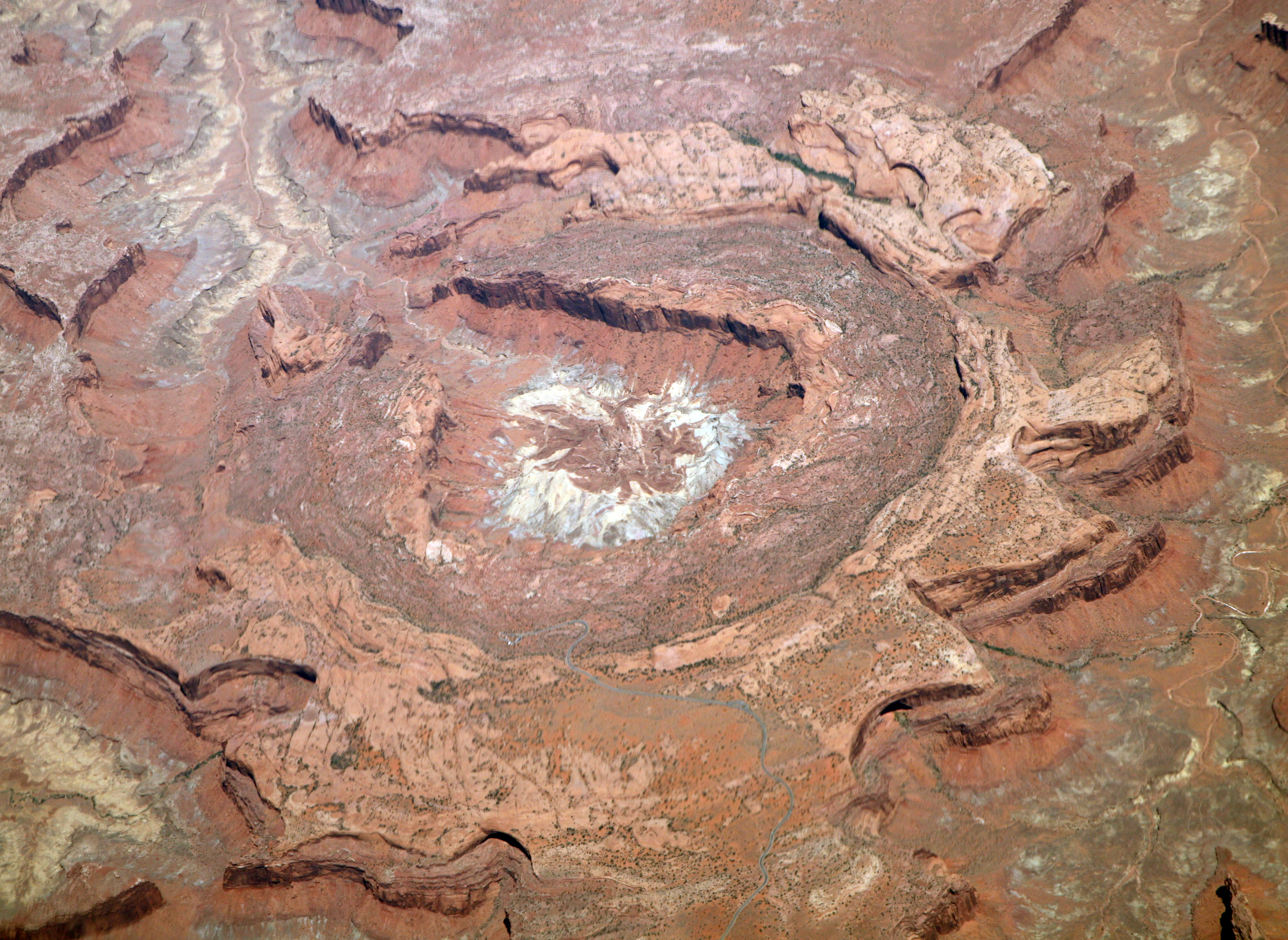
I know it's a common misconception that "nuking" an asteroid would simply create a few large fragments that would hit Earth with even more devastation, but that's not backed by simulation data. And anyway, even if it didn't blow the asteroid to tiny bits (which simulations say it would) and even if it didn't push the remaining pieces off trajectory (which they say it does), anything that spreads an Earth impact out over a larger period of time is a good thing - it means the higher percentage of the energy that's absorbed high in the atmosphere rather than reaching the surface (less ejecta, lower ocean waves, a broader (weaker) distribution of the heat pulse, etc), the weaker the shockwaves, the weaker the total heat at any given point in time, and the more time for Earth to radiate away any imparted energy or precipitate out any ejecta cloud. If the choice is between 15 Chelyabink-sized impactor (most of which will strike places where they won't even be witnessed) or one Meteor Crater-sized impactor (same total mass), pick the Chelyabinsk ones. 50 10-megatonne meteor crater impactors or one 500-megatonne Upheaval Dome impactor? Pick the former. The asteroid impacts calculator shows the former generating a negligible fireball and 270mph wind burst at 2km distance, while the latter creates the same winds 25km away (156 times the area) and a fireball that even 25km away is 50 times brighter than the sun, hot enough to instantly set most materials on fire.
But that's all irrelevant because, quite simply, simulations show that nuclear weapons do work against asteroids.
What we need is enough detection lead time to be able to launch a nuclear strike a few months before the impact date (to give time for the debris to disperse). There is no need to "land" or "drill" for the warhead. There is no pressure wave; instead, an immense burst of X-rays is absorbed through the outer skin of the asteroid on the side of the explosion, causing it to vaporize (unevenly) from within, especially near the ground zero point, and creating powerful shockwaves throughout its body. In addition to ripping it apart, the vaporized material and higher energy ejecta flies off, predominantly on the side where the explosion was detonated, acting a broad planar thruster.
-
Re:Actually 13/8 times the energy
Yes, the stop (and sbottom) squark is a prime target too.
But it will come again a little later than the gluino. The reason is that we have excluded the gluino in most scenarios already wel beyond 1.2TeV, while the stop squark is unlimited above ~700GeV (and that's assuming ideal decays).
Now, with the increase in energy, the heavier is the particle, the higher the increase in production probability. This is visualised in the following (M_X being the "mass" of the produced system, in this case twice the gluino or stop mass, since they come in paris; and the solid line being the most relevant here for strong production):
http://www.hep.ph.ic.ac.uk/~ws...
For a gluino at the limit of what we could exclude until now, a ~ fifteenfold increase in production probability is expected, while for stops it will be more a factor 6 or 7.
A final argument why stops take a little longer is that the main backgrounds (top quark pairs, mainly) are looking quite similar even in the easier decay modes, while many of the possible gluino decays lead to signals that have a tiny background (like four-top final states). -
Re:I believe...
The impact force of a large asteroid would be much larger, but no worse than a near miss with an ICBM warhead would be
Que? The impact force from a small asteroid impact is equivalent to a large nuke. The 20m Russian Chelyabinsk impact was about half a megaton equivalent.
A large asteroid would outstrip the effects of the entire global nuclear arsenal all detonated at the same time on a single site. Asteroids can punch through the ocean crust.
-
Re:60 feet... means what?
I think this was already answered in various posts in the comments for the last Slashdot discussion. There were comments like:
Even if it was quite dense rock and managed to hit at 90 degrees, it would still mostly break up in the air and you would get a spray of fragments over a couple hundred meters not strong enough to create any large crater. Even the 90 degree case in both shallow and deep water will not create tsunami more than a meter high.
The total kinetic energy of the thing in space is a couple of megatons, a lot of which is lost upon hitting the atmosphere before even breaking up. You're not going to get devastation orders of magnitude larger than a large nuclear weapon under worst case scenario. And if it comes in at something less than a 90 degree angle, you could end up with something like the Chelyabinsk meteor, since this is nearly the same size and a bit faster.
You can check things like this for yourself using an impact effects calculator from Imperial College, which agrees with the quoted comment.
As far as the linked crater in the parent post, that would have been for a meteor with 15 times the volume of this one, and as it was a nickel-iron meteorite, it would be about as dense as it gets, so this one wouldn't be denser. Although the newly discovered one may be going from 50-100% faster depending on which estimate of the speed you use for the one that made the crater.
-
Re:A more efficient grid would do wonders...
No, HVDC is good enough. You don't need 99% efficiency at 10x the cost of 90% efficiency. It's just not worth it. Besides, I doubt the efficiency of superconductors with their associated refrigeration would be competitive with HVDC anyway, or why else is it that HVDC is the market leader for long haul transmission right now?
I agree, HVDC can be made to work above or (preferably) below ground with a suitable amount of aluminum cross section and/or heat sink. There are some interesting calculations for 5-288GW transmission lines in this paper Faulkner [2005]: Electric Pipelines for North American Power Grid Efficiency Security which I use as a reference for raw capacity and conductor size. But Faulkner's 1-4 million VDC dream is unlikely in an age where practical Voltage Source Converters operate at ~345kV.
Faulkner is a hero of mine, we seem to share a feeling of urgency about re-structuring the grid to HVDC. His firm is desperately trying to make trench-friendly passively cooled HVDC 'elpipe' a reality, which sadly, is not gaining traction. In the supposed richest and cleverest country on Earth it grieves me to read this,
- [from his website] " How do we acquire customers? This is the hard part. Though I am convinced that high capacity underground power transmission is absolutely required for us to move to a clean energy future, there is zero chance that a utility in North America or Europe will be a first adopter. We are looking to several places that need to innovate, and are less risk averse than the US (Brazil, India, China for example). There is no chance of a quick success, nor is there any other viable option that can deliver high transmission capacity underground, passively cooled; this will be a long term investment. But I see no other viable alternative for building a supergrid. Why do I continue to pursue such a difficult area as Long Distance Power Transmission? If not me, then who? The utilities believe in change that is so incremental that it cannot possibly deliver the degree of innovation that is needed to address global warming. They continue to build primarily high voltage AC lines, and point-to-point HVDC lines, when what is clearly needed is a change to multi-terminal HVDC systems (like the Atlantic Wind Connection), but arranged in loops to be self-redundant. The major suppliers to the utilities are nearly as risk averse as the utilities themselves. Utility mantras include such things as "underground is ten times as expensive as overhead lines" which is not true. Change will come, and it will be disruptive. Must we accept the self-fulfilling prophesies that keep us stuck?"
Forgive me... but will someone please give this man some fucking money?
There is a proposal afoot to build an HVDC submarine ring around the UK. A ring structure is the way to go -- with several overlapping rings across North America. They provide fault tolerance and (I've read recently somewhere) it would simplify load management if sources would design for and 'push' towards loads in a particular direction. Ring HVDC also optimizes plant design.
Tres Amigas SuperStation aims to bridge the North American East/West/Texas interconnects with superconducting HVDC at 5GW (scalable to 30GW). Their business model seems ENRONian with the twist they they'd actually own some unique infrastructure and not just leech-suck from others'. But is this project just a proving ground for superconductors? I wonder how the non-superconductor options would work out.
___
Please see Thorium -
Re:Reminds me of RAM Doubler
Implementing that (more or less) was the main piece of coursework [pdf] for my (2nd year) C programming course. I wonder if they still do that...
-
By no threat I'm guessing they mean
That even if it hit earth it'd only send down some fragments that would only do damage if it actually hit you. (I mean they mention it was smaller than that Russian a little bit ago and that didn't really do much to the earth.) Actually here's a calculator that will let you put in some numbers. (Which pretty much agrees it'd only be a big deal if one of the fragments actually hit you directly.) http://impact.ese.ic.ac.uk/ImpactEffects/
-
Re:Gravity is a poor tractor beam
the 10km asteroid could crash a big enough crater to hit the earth magma
Do you know the impact stimulator? http://impact.ese.ic.ac.uk/ImpactEffects/
Plugging in 1 and 10km asteroids, impacting crystalline rock at 25km/s (middle velocity) (full parameters in this link : http://impact.ese.ic.ac.uk/cgi-bin/crater.cgi?dist=1000&distanceUnits=1&diam=10&diameterUnits=2&pdens=&pdens_select=1500&vel=25&velocityUnits=1&theta=90&wdepth=&wdepthUnits=1&tdens=2750 )... the transient craters would be 3km and 23km respectively. The latter would expose the mantle - temporarily. But within a matter of minutes to hours, collapse of the crater walls and fallback of ejecta would cover it up again.
In contrast, at my specimen range (1000km from ground zero), the 1km impactor I wouldn't see the fireball, while the 10km impactor I'd probably be burned to death with radiant heat like a gas burner on full, 10cm from my skin, for nearly a half-hour.
It's not a detailed calculation, but it's reasonable.
-
Re:Gravity is a poor tractor beam
the 10km asteroid could crash a big enough crater to hit the earth magma
Do you know the impact stimulator? http://impact.ese.ic.ac.uk/ImpactEffects/
Plugging in 1 and 10km asteroids, impacting crystalline rock at 25km/s (middle velocity) (full parameters in this link : http://impact.ese.ic.ac.uk/cgi-bin/crater.cgi?dist=1000&distanceUnits=1&diam=10&diameterUnits=2&pdens=&pdens_select=1500&vel=25&velocityUnits=1&theta=90&wdepth=&wdepthUnits=1&tdens=2750 )... the transient craters would be 3km and 23km respectively. The latter would expose the mantle - temporarily. But within a matter of minutes to hours, collapse of the crater walls and fallback of ejecta would cover it up again.
In contrast, at my specimen range (1000km from ground zero), the 1km impactor I wouldn't see the fireball, while the 10km impactor I'd probably be burned to death with radiant heat like a gas burner on full, 10cm from my skin, for nearly a half-hour.
It's not a detailed calculation, but it's reasonable.
-
Re:No chance of striking Earth
-
Re:What could possibly go wrong?
Perhaps not, but it could still cause a lot of damage
Not really. 7 meters is a *lot* less than 100 meters when we're talking about asteroid impacts. It would break up in the atmosphere.
Here's a more detailed look at what would happen, I'll highlight the relevant parts:
* Energy before atmospheric entry: 1.63 x 10¹³ Joules = 0.39 x 10⁻² MegaTons TNT
* The average interval between impacts of this size somewhere on Earth is 1.9 years
* The projectile begins to breakup at an altitude of 65500 meters = 215000 ft
* The projectile bursts into a cloud of fragments at an altitude of 41400 meters = 136000 ft
* No crater is formed, although large fragments may strike the surface.
* The air blast at this location [1 km away from the impact point] would not be noticed. (The overpressure is less than 1 Pa). -
do the math yourself
-
Re:Um, no.
I was under the impression that so-called "hydrogen bombs" typically rely on three+ stages: a conventional KE explosive component (stage 1) to force an explosive fission chain reaction in a sub-critical heavy-element component (stage 2), which in turn is used to force an explosive fusion chain reaction in a light-element component (stage 3), which is used to further boost the efficiency of the fissioning component. More or less.
A multiple-kilometers-wide iron-nickel asteroid impacting a solid planet at multiple-kilometres-per-second speed? I was imagining that was in the ballpark, but alright:
https://en.wikipedia.org/wiki/Popigai_Astroblem - "either an 8 km (5.0 mi) diameter chondrite asteroid, or a 5 km (3.1 mi) diameter stony asteroid"
http://impact.ese.ic.ac.uk/ - "Welcome to the Earth Impact Effects Program"We'll start with the most conservative choice: a 5 km stony asteroid travelling at a minimal 11 km/s. KE before atmospheric entry is 1.19 x 10^22 Joules = 2.84 x 10^6 MegaTons TNT. So almost three billion megatons of "conventional" force. Mind you, that results in an estimated crater only 33.6km across rather than the 90km of the actual Popigai crater.
Now, that's spread over a significant surface area, which (we'll wildly assume) is a circle: pi*r*r, or about 19634954 m^2. So a "mere" 14.4 tons of TNT per square centimetre. Is that enough for fission or fusion reactions in materials "caught in the middle" to occur? Given wikipedia lists the 4MT Mk-21 as weighing 6.8t and being 3.8m by 1.4m, I'd guess easily enough for fission and even for fusion too.
Please feel free to correct me, this is totally napkin math.
-
Re:No need to deflect it
http://impact.ese.ic.ac.uk/ImpactEffects/
http://simulator.down2earth.eu/I'm not sure if it's 50m (I'm not the one making that claim), but you can pick the chunk size you want and work out how much damage it will do. Do also work out how many chunks you will get from your chosen source asteroid.
Being nuked by thousands of small nukes is also quite damaging (a 1000 km diameter asteroid should be able to produce a few thousand 50km diameter chunks).
-
Re:not about destroying
I assume everyone here has played around with the Earth Impact Effects Program?
-
Re:A bad idea that "sounds good".
Not really: using http://impact.ese.ic.ac.uk/ImpactEffects/ ,
assuming 2.46m sphere, 8g/cc, 17km/s, vertical impact (worst case), -
- the asteroid breaks up at 10km above the surface. Medium-sized chunks will be going in the low hundreds of miles per hour when they hit, a few may be going faster. Over 80% of the 9TJ of energy will go into the blast wave, yet measured 1meter from impact the blast from the airburst will only be = 0.1mph wind, 26dB sound, 0.0002bar overpressure. Basically you are only in danger if one of the bits at least the size of a baby's fist actually hits you on the head. Nothing like the danger of, say, a jet falling on your house. -
Re:A bad idea that "sounds good".
500 tons is the weight of the international space station. The trillions of dollars of damage it will cause when it comes crashing down at the end of its life will only be because it cost so much to put up there. The chances of it causing even millions of dollars of damage is actually pretty slim.
Now IANAE, but I figure an asteroid that weighs 500 tons is only 10m across, based on the standard models. According to this calculator, that size asteroid hits the earth already about once a decade.
Fear of technology like this is of course, way overblown.
-
Re:What does football stadium sized entail?
there's an app for that.
or a website: http://impact.ese.ic.ac.uk/ImpactEffects/
-
Re:Even if it did hit
-
Re:I will be doing one thing about it.
True, but the remaining variables are the composition and how much actually makes it down to the surface.
Lets use some numbers in the calculator from the quick Google search:
http://impact.ese.ic.ac.uk/ImpactEffects/
- We are hit with 140 meters perfect sphere of dense stone
- Speed of projectile is 17 km/s (Calculator states that it is the typical speed for asteroid impace)
- Entry angle of 45% (Again based on the caluculator stated most likely)
- Rock lands into 1000 meter depth water. Random figureResults:
1 km awayReading the descriptions, it honestly doesn't sound like such a calamity. At 100 km distance it is hardly felt.
-
Re:I will be doing one thing about it.
True, but the remaining variables are the composition and how much actually makes it down to the surface.
Lets use some numbers in the calculator from the quick Google search:
http://impact.ese.ic.ac.uk/ImpactEffects/
- We are hit with 140 meters perfect sphere of dense stone
- Speed of projectile is 17 km/s (Calculator states that it is the typical speed for asteroid impace)
- Entry angle of 45% (Again based on the caluculator stated most likely)
- Rock lands into 1000 meter depth water. Random figureResults:
1 km awayReading the descriptions, it honestly doesn't sound like such a calamity. At 100 km distance it is hardly felt.
-
Re:I will be doing one thing about it.
True, but the remaining variables are the composition and how much actually makes it down to the surface.
Lets use some numbers in the calculator from the quick Google search:
http://impact.ese.ic.ac.uk/ImpactEffects/
- We are hit with 140 meters perfect sphere of dense stone
- Speed of projectile is 17 km/s (Calculator states that it is the typical speed for asteroid impace)
- Entry angle of 45% (Again based on the caluculator stated most likely)
- Rock lands into 1000 meter depth water. Random figureResults:
1 km awayReading the descriptions, it honestly doesn't sound like such a calamity. At 100 km distance it is hardly felt.
-
Re:I will be doing one thing about it.
True, but the remaining variables are the composition and how much actually makes it down to the surface.
Lets use some numbers in the calculator from the quick Google search:
http://impact.ese.ic.ac.uk/ImpactEffects/
- We are hit with 140 meters perfect sphere of dense stone
- Speed of projectile is 17 km/s (Calculator states that it is the typical speed for asteroid impace)
- Entry angle of 45% (Again based on the caluculator stated most likely)
- Rock lands into 1000 meter depth water. Random figureResults:
1 km awayReading the descriptions, it honestly doesn't sound like such a calamity. At 100 km distance it is hardly felt.
-
Here we go again
History isn’t encouraging, given heroin’s original use was as a safe cure for morphine addiction.
-
Re:Why not here?
Carbon is the backbone of the molecules in ours, and every living thing on the planets, bodies
In *ours* and every living thing that evolved from primitive carbon-based organism on *Earth*'s bodies. We're not talking about life on Earth. We're talking about xenobiology. You're arguing from a dataset of precisely one element. The question is not what is life on Earth like, but whether all life must be like it is on Earth.
My argument is a lot less like substituting a line of code into a program of a different language, and more like me saying if you hook up your mouse, monitor and hard drive to a tree stump, it's not going to work the same as if you'd hooked them up to your computer.
That's not your argument at all. If you think silicon-based compounds are as "computationally" inert as a tree stump is to a computer, read this for a random example for just one class of silicon compounds. Silicon compounds are just as capable of complex reactions as carbon. The problem is that they're not really compatible with carbon-based life; very different optimum environments. For the most part, it's either one or the other.
but the chemistry just is not there
Name one class of life-essential reactions that you don't think a silicon/silicone/silanol/etc equivalent could exist for.
-
Re:There was a pretty insightful comment
The problem is of people envisioning silicon-based life in a manner that's too similar to carbon-based life. Silicon life, if ever found, is essentially guaranteed to not have any long Si-Si-Si-.... chains; they're not stable. The silicon equivalent in terms of stability is Si-O-Si-O-Si-O... etc (silicone). Silicon also has some fascinating complex chemistry in the form of silanols, which can form membranes, catalysts, and all sorts of other fascinating stuff... so long as they don't get too hot or in too acidic or basic of a chemical environment.
-
Re:Wasted effort?
What does thermodynamics have to do with anything, apart from a first-principles perspective?
Look at the sort of reactions silanols undergo, for an example of non-carbon-based complexity. The thing is, even if another form of life *could* form on Earth, it'd be immediately out-competed by established carbon-based life.
-
Re:China, don't get ahead of yourself.
I'd suggest you actually look up a real impact calculator before you start to spout off silly drivel and way overestimating the impact damage of a meteor like you are suggesting here.
A typical 10 meter asteroid wouldn't even make it to the ground, even if it was essentially a solid chunk of iron. If you were standing somewhere within 100 km of the impact site (or what would be the impact site) you would definitely hear the shock wave of the thing hitting the atmosphere, and if you were at ground zero you would hear a boom about as loud as a truck horn going off near you or roughly equivalent to heavy traffic noises.
There would most definitely be chunks of this meteor which make landfall, but the sonic boom and other factors would significantly absorb the energy of impact where these minor chunks would not do nearly so much damage. They might knock out a windshield of a car or perhaps even plow through the roof of a house (it has happened in the not too distant past), but it would be very localized danger that even a direct hit by a meteor would be survivable by somebody on the ground doing something like watching television at ground zero. It would be worth calling paramedics to help out the "victims".
I'm not saying that the danger from incoming rocks needs to be completely ignored, but at least speak from authority and realize that our atmosphere does a pretty good job of protecting us from "small stuff", where a 10m diameter rock is still one of the small ones. I've personally been a witness to a meteor which made a sonic boom as it went over my head, which I saw during one of the Perseids several years ago while on a camping trip in a remote part of eastern Nevada. Or perhaps that was something from Area 51 for those who are really paranoid, and if so that was one impressive weapon test as it exploded like some fireworks on the 4th of July.
-
Re:Evolving to FPGA
All the early MPEG 4 accelerators I saw were implemented in FPGAs. Of course much of that was encoders instead of decoders, since that is the harder problem. Now you can buy cheap mpeg 4 asic/ip core accelerators. Those are still going to be much more energy efficient than using the array of general cores on a GPU.
As for implementing GPU pipelines on FPGAs, it has been done: http://hackaday.com/2008/05/21/open-graphics-card-available-for-preorder/ I'm sure I've seen other research projects or maybe just people screwing around and implementing GPU pipelines "because we can". Its also a convenient solution for educational purposes. But no, if you want to make an efficient GPU for general use, it does not make sense to map GPU logic onto the FPGA fabric. You would loose on the order of an order of magnitude in clock speed, and doing it that way you completely toss away the positive benefits of the FPGA architecture.
I think you might have a skewed impression of how complex mpeg4 encoding and decoding is, and how much area it consumes. Also in the comparison of FPGA logic cells and "gates" in a GPU is a bit faulty. In terms of raw transistor count the largest FPGAs tend to be a little ahead. That "million" or so logic elements in a FPGA does not translate to simple logic gates or transistors. The logic cells are multiple input lookup tables that are used to evaluate arbitrary boolean functions. How many traditional gates can you replace with a single 4 input lookup table? What about an 8 input LUT? The answer does depend on the logic you are mapping, but its almost never a 1:1 mapping.
Also FPGAs do have ram, fixed logic cores (dsp blocks/multipliers, etc), and even conventional processor cores. While its true that however big the array, someone will have a problem that won't fit, you can put an awful lot on a modern FPGA.
As for your final thought about fixed silicon. Not necessarily, look at this fellow's research: http://cas.ee.ic.ac.uk/people/nachiket/ He goes into why CPUs and GPUs are slow for running SPICE circuit simulations. Despite running at a fraction of the clock speed, his FPGA implementation completes the simulations faster and consumes much less power than the CPU or GPU. True a fixed logic accelerator specifically designed to implement the algorithm would be faster, but how many special purpose fixed accelerators do you want to put on your chip? What if the implementation can benefit from dynamically adapting to the current problem? Sometimes it really is more efficient to provide reconfigurable logic and load in the best implementation you have for each problem. Dynamic hardware acceleration is likely one of the reasons intel is producing Atom-FPGA combos. There are ongoing research projects examining the benefits for mobile computing devices. Transistors are cheap, but people want to use cell phones for all sorts of strange things, and there's always something new on the horizon.
-
Re:Ideal IDE
Seriously though, I think this has to be a very introductory course for CS students with zero programming experience or a light course for non CS students.
I would have thought the latter. It has some very basic stuff.
My university started with Haskell (course page inc. lecture notes). I think part of the intention was to trip up all the know-it-alls, who (of course) didn't know as much as they thought. The notes dive straight in to dealing with basic types, functions, etc.
Javascript is a functional language, but that's not how most people use it, and I don't think you could teach a course using it this way. When I was in third (fourth?) year I was an assistant for the first-year Haskell lab work, and for the first few hours some of the students who'd done a little programming would try and write something imperative-ish in Haskell; before they realised they needed to think in a different way.
I remember my first job interview. "Give me a book and a couple weeks" was the answer to "We think you'll be a good fit, but what other languages can you program in."
My first interview went like that all the way through. I hadn't heard of any of the stuff they used (except Java), but assumed it wouldn't be a problem. Although instead of the book I was given a small, real project to "learn" on... which got deployed, but has no reported bugs. (It was pretty simple, although it looked shiny and new compared to everything else, so I got way too much credit. Or else I'm too modest, who knows.)
-
Re:Cars? Houses? Pets? People?
First of all, it is so small that it wouldn't even hit the earth, so the entire analogy is goofy.
If the asteroid did strike, it would probably explode in the upper atmosphere — a fine spectacle, but harmless.
An asteroid would have to be thousands of feet to create a nuclear winter. I'm sure it could be reasonably smaller and still destroy all life on Earth. The one that may have wiped out the dinosaurs was apparently about 42,000 feet. Whatever it was that hit Tunguska is suspected to have been a couple hundred feet. The asteroids expected to pass near earth this century We have one about 1,000 feet coming in 2029 that (if it hit) would be 65,000 times more powerful than the nuke dropped on Hiroshima.
Worrying about something so small as this is just silly and, frankly, anything that won't wipe out an entire city is fairly insignificant, as far as I'm concerned. I'm thinking about the real threats out there that we couldn't give a shit about, because our society is more concerned with having a pothole filled than a disaster averted (or they're all too busy eagerly hoping for Armageddon, so their goofy prophecies can be "fulfilled").
I punched in what numbers I could find on this object and if it were to hit the earth, it would be "barely audible" even within one mile (5dB). The object has to be significantly larger to even form a crater of any kind. All you'll end up with are small fragments that hit all over an area. I suck at math, but I suspect that with as little of the Earth that is actual land mass and then the even smaller percentage of that which is populated, the odds of even one fragment hitting a populated area are extremely small. It's not like a 25ft or 50ft object is going to hit and burst into fragments directly over a metro area. (I mean, possible, sure, but extremely unlikely).
Here, you can punch in numbers on this and other objects hitting earth, yourself: http://impact.ese.ic.ac.uk/ImpactEffects/
I only really played around with porous and dense objects hitting earth; not a body of water. The couple quick checks I did on it hitting water (depending on depth, of course) show that it would have to hit really close to shore (within a few miles) to have any real impact on the shoreline.
-
Re:8000 miles = Close shave
Pretty close
Fortunately even if it does hit, it's only 8-18 meters across. According to the asteroid impact effect calculator, that'd be 720 KT of TNT when hitting the ground (assuming standard parameters, 18 meters and an iron asteroid). Tough if it were to hit you, but small chance of that. Calculator is here: http://impact.ese.ic.ac.uk/ImpactEffects/
-
Re:Better article
I suggest reading the original paper. The theoretical machinery used is 4D and fully (spacetime) relativistic. If you can't cope with the physics literature, the press releases are more complete than the mangled stuff in the press (but the New Scientist isn't bad at all: http://www.newscientist.com/article/dn19727-how-to-cloak-a-crime-in-a-beam-of-light.html) Press release (Imperial) : http://www3.imperial.ac.uk/newsandeventspggrp/imperialcollege/newssummary/news_16-11-2010-9-5-43 Press Release (IoP): http://www.iop.org/news/nov10/page_45311.html . Regarding the chicken analogy, see http://www.qols.ph.ic.ac.uk/~kinsle/files/STcloak/
-
Re:What would an impact look like?
On TV you see lots of computer sims but none look realistic to me. Would there be a light covering the sky so bright you couldn't see it or would it traverse the atmosphere so quick it wouldn't have time to heat up and you really would see this huge space rock impact. And what would the explosion look like? WOuld it be a fireball initially or would you simply see billions of tons or rock being launched into orbit?
A very useful source of information is the Asteroid Impact Effects on-line program: http://impact.ese.ic.ac.uk/ImpactEffects/
Taking their upper size estimate (12 km) and average impact parameters (17 km/sec, 45 degree angle of entry) this would light up brilliantly at around 120 km altitude and get brighter all the way down its 10 second transit to the Earth. However you would probably not want to be anywhere you could actually see its entry. At a distance of 1250 km you would just see it light up on entry on the horizon, and thereafter the glow would be indirect until impact. THEN - part of the fireball which appear ~5 times larger and brighter than the Sun would rise above the horizon and irradiate you for about half an hour. This would be quite uncomfortable - a first degree thermal burn would develop after several seconds, but you get roasted for a hundred times longer than that, or until the fine ejecta thrown into space comes down and starts blocking your light after 10 minutes of so. And an hour after the impact a 12 psi blast wave with tornado-speed 335 mph winds would hit. This would likely be fatal.
-
Re:There are more organizations that should
Organisation A uses 10.x.x.x internally, and NAT.
Organisation B uses 10.x.x.x internally, and NAT.University C uses 123.456.x.x internally and externally.
Small college D uses 210.789.x.x internally and externally.What happens when A merges with B?
What happens when C merges with D?(My old university has several IP ranges, the
-
Re:Not so small ...
No, a 20m rock wouldn't do much of anything:
-
Check the effects!
-
Re:An asteroid 100km across? Err , I don't think s
Are you sure about that? Because, this shows us as being pretty well hosed, even in perfect conditions: minimum velocity, angle, and density, maximum distance from impact. Maybe not sterilized, but still stone (and probably ice) aged or worse. A 100 km wide vaguely spherical object displaces a hell of a lot of fluid and rock, even at low impact velocities.
-
Re:An asteroid 100km across? Err , I don't think s
a 100km dense rock asteroid would sterilize the earth's surface. It would vaporize 343000 cubic miles of crust in less than a second.
Peak Overpressure: 6.89e+07 Pa = 689 bars = 9780 psi at 500km from impact. Actually at 500km from impact you'd be in the crater since it would be 520 miles in size. If it were possible to not be incinerated instantly, the pressure would probably cause you to explode as it dissipated. The wind would be 14900 mph
At 5000km from impact, you'd get hit with wind doing 978mph and get subjected to 54psi air pressure 4 hours after impact. This would kill you. Your body would be buried under 5.1 feet of ejecta
This is assuming a "Dense Rock" asteroid hitting the earth at a 45 degree angle, at 17000kph, which is the typical impact velocity. 11.8 RS earthquake would result over the entire earth. This is off the scale. It's nearly a quadrillion tons of seismic energy. It would split the earth. You would be launched high enough into the air to kill you from the impact when you came back down, if the acceleration didn't kill you. A nickel/iron one would be much worse.
The earth would most likely be an asteroid belt right now from this size of an impact at 45 degrees. It would survive an oblique impact, but the earth would get another moon and it would be an extinction event. The orbit would certainly be affected and the tides would change.
Yea it would be very messy and kill just about all multicellular animals. People would become extinct. There would be nowhere to hide on the earth's surface.
-
spartan
Spartan is a very good program for molecular visualization. It will calculate ground state energies, electrostatic surface areas, and orbital energies. It is a very useful supplement when you are talking about lowest energy conformations and bonding. It's a bit expensive, though, even for educational use. Most departments I have been to have one or two dedicated copies that the students have to share. There are some alternatives listed here,
http://www.ch.ic.ac.uk/local/organic/mod/software.html
Most of them involve getting something like Cambridgesoft's Chem3D and using it as a frontend for GAMESS or Guassian. Both are also very good programs....
If you're looking for something more low-key, any kind of kinetics experiment usually involves some sort of regression analysis. It's a good opportunity to teach them something like R or Matlab. And SciFinder scholar is also a good program for doing database searches for compounds and reactions reported in the literature. Despite some of the other replies you have had already, it is important to know what tools are available and be familiar with them if you are interested in any kind of future in research. It also helps ground you in the fundamental concepts you learn in a textbook, but probably don't get much chance to apply otherwise.
-
Re:Most professors guilty?
I've never seen powerpoint slides come with a student's copy of the book.
Here's one example I know of. (Although since Jeff Magee was the lecturer when I took the course I was still seeing slides written by the lecturer.)
-
Re:Most professors guilty?
None of the lecturers I had ever simply read from a book -- I remember only one lecturer that based the course around what was in a book.
The main CS lecture theatres at my university had two projectors, two computers (one Linux, one Windows), a VGA cable for a laptop, and a hi-resolution camera pointed at a white desk which you could write on (or put papers on). Each projector could be set to any input. There was also a whiteboard.
The best lecturers (like this guy) set one projector to some slides, handed out copies of notes based on the slides before the lecture so no one had to spend time copying stuff, and set the other projector to the camera for explaining stuff and going through example problems (or to the other computer, if demonstrating the problem with real code was better). They would get the class to solve problems as we went through the lecture.