Slashdot Mirror
Domain: lessig.org
Stories and comments across the archive that link to lessig.org.
Comments · 268
-
Switchfoot's own faultI blame switchfoot. They should have known that Sony would not be looking out for the band or the fans. Sony's only care is turning a profit. Restricting rights is all part of the deal when signing a major record label. The fans are stupid too for financially supporting companies that restrict their rights. I do not blame sony at all. Sony is in the business of being a massive turd to both artists and fans. They did their job. If switchfoot or it's fans don't want to be associated with turds then switchfoot shouldn't have signed up with a company that is in the business of being a turd.
I think everyone should watch this:
http://lessig.org/freeculture/ -
Watchout!The topic is not new to Slashdot. I think it's wonderful that there are other means to provide with broadband to people, but I think the alternative proposed by Lessig that the spectrum must be returned as a public utility to the citizens should provide with all the band we need. There's really a big discussion by "media" and "providers" companys at all fronts with many goverments to easy the way for this technology, proved that using phone-company's cables is hard, expensive and over-regulated. Many businesses see this as a really big oportunity, and once again keep things private-owned for the sake of business owners.
Aside from this theme, there's the interference: power lines act as antennas that amplify and increase (by air) the frecuencies the BPL modems use. And this is bad for radio comunications, notably amatteur operators.
As mentioned before on Slashdot, Japan's JARL has stopped any implementation of the technology if they could not come with an answer to the interference, and USA's ARRL it's threatening even with legal action, as a nice article they've made stats.
To give you an example of the amplitude of the problem, here in Mexico the technology is seen as a means to compete with the largest provider (some say a monopoly) by smaller companys, they've been granted capital by Google, Goldman Sachs and Hearst Corporation, and they talked with goverment officials (disclaimer: I'm one of them) to get sympathy (on competitive grounds and consumer's benefit), and my side has stated clear that we're not going to support BPL if there's a disruption in HAM's radio comunications.
Ladies and gentlemen: this is a HUGE, and we must wellcome anything that increases competitive business, lowers prices and amplify the reach of broadband access to the Internet, but keeps things as important as Amateur Radio working...
-
Professor of Law, runs a mile.
Lawrence Lessig is professor of law at Stanford University.
http://www.law.stanford.edu/faculty/lessig/
http://www.lessig.org/
If the Public Domain is going to die can't we just water it.
http://www.google.com/search?q=define%3Apublic+dom ain -
WTFLessig is a law professor at Stanford. He has been before the Supreme Court arguing a case involving copyright law. So, he is actually a rather gifted lawyer. You can confirm this by Googling for 'Lessig' and go to the first hit. Click on Bio, and you are at http://www.lessig.org/bio/short/ Keep your quarter, you are the one who needs to buy a clue.
BTW its not 'her kid
-
Re:Making a Big Deal of NothingMore info from http://www.lessig.org/blog/archives/000774.shtml
There's a wonderfully careful analysis of various CC issues at burningbird. Thank you. One point to clarify, however. CC licenses are, at this moment, at least, permanent, in the sense that the term is as long as copyright runs (and we'll see whether that's permanent or not soon enough). That issue was a tough one for us (I, of course, favor "limited terms"), and we're eager for feedback on that issue.
But just because you can't revoke a particular license doesn't mean you can't revoke the offer. If, for example, you offer content under a CC license for a month, and then change your mind, you can stop offering the content under that license. Anyone who accepted your offer while it was valid, of course, has a deal. But no one after you withdraw the offer can accept anymore.
-
Yet another reason to support the EFF
Intellectual property law ideally should strike a balance between rewarding producers of intellectual property and allowing society to benefit from innovation. Through the efforts of lobbyists, the system has become skewed to benefit technological incumbents, at the expense of the public good.
While a market based means of rewarding producers of intellectual property is essential, its primary goal must be to maximize benefit to society. Intellectual property protection comes with a cost. Protection is an artificial legal monopoly. It is an economic fact that monopolies are anticompetitive, restrict the functioning of the free market, and result in higher costs to consumers and lost opportunity for businesses.
The 20 year duration of a "utility" patent is an eternity in the world of technology. The video cassette, for example, ran its entire course from invention to obsolescence in about 20 years. In software, this cycle is more like 5 years. The 20 year period is entirely inappropriate for software.
The United States granted patentability to software and business methods. The result has been the granting of absurd patents, such as the "one-click" patent awarded to Amazon. There are numerous examples of equally absurd patents for software that are as obvious to a software engineer as the "one-click" idea is obvious to anyone who's ever used a mouse. Billions have been wasted on meritless lawsuits like the SCO lawsuit against IBM. An entire industry of "patent terrorists" has evolved which produce nothing but IP lawsuits. Clearly this is not furthering innovation.
Sadly, the US congress is so controlled by corporate lobbyists that the plain and simple best interest of the public loses out to the narrow, but well financed interests of intellectual property holders. It's nice to see that the EU parliament is not quite so corrupted, yet.
I refer you to Stanford professor Lawrence Lessig and Berkeley professor Stephen M. Maurer for more information on this issue.
http://www.lessig.org/
http://violet.berkeley.edu/~gspp/people/affiliates
For those so inclined, consider supporting the EFF:
http://www.eff.org/
-
What Lawrence Lessig thinks
-
A summary of Slashdot comments:
Group 1: MORE LIKE EMBRACE AND BSOD AM I RITE?
Group 2: RSS is XML and therefore works using magic! It's not like there were eight thousand different conflicting RSS standards before!
A Vanishingly Small Number Of Voices Of Fucking Reason: You know, they released the spec for extensions under a ShareAlike Creative Commons license. They might as well have done it under the god-damned GPL. This is PROGRESS, you imbeciles. -
Good News!
Now, I'm no MS apologist (look back at my comments) but this is actually good news because Microsoft has decided to release the specs under a Creative Commons "Attribution, Share-Alike" liscense: one of the more generous liscensing plans released by the Creative Commons.
Larry Lesig has more at his blog.
I can't vouch for Microsoft's reasons for doing this, other than speculate that they are trying to respond to the old criticism that "embrace and extend" really means "steal and lock away". If Microsoft really is trying to be more open in it's communiction protocols, I can't help but see that as a good thing. They are free to extend all they want as long as they do not use their dominant market position to force those extensions on their customers to unfairly place burdens on their competitors.
-
Good News!
Now, I'm no MS apologist (look back at my comments) but this is actually good news because Microsoft has decided to release the specs under a Creative Commons "Attribution, Share-Alike" liscense: one of the more generous liscensing plans released by the Creative Commons.
Larry Lesig has more at his blog.
I can't vouch for Microsoft's reasons for doing this, other than speculate that they are trying to respond to the old criticism that "embrace and extend" really means "steal and lock away". If Microsoft really is trying to be more open in it's communiction protocols, I can't help but see that as a good thing. They are free to extend all they want as long as they do not use their dominant market position to force those extensions on their customers to unfairly place burdens on their competitors.
-
Re:Look
s anyone really surprised that the Bush administration has done nothing significant right in the War on Terror?
Filthy liar! Here's just one thing that the Department of Homeland Security has done to protect the homeland from terrorist threats. And you can bet that there are a million more stories just like that one! -
Re:Already have that for patents
My point was that similar fees might be helpful in the copyright field - see also The Eric Eldred proposal
In 2004, IBM received 3,248 U.S. patents from the USPTO. IBM has over 25,000 active US patents. In 2.5 years, on the year 2004 patents alone they will have to pay $2,923,200 in maintence fees. Sure, they can afford it, but if they are not using their patents it is cheaper to let the patents lapse. Cheaper enough to have one of their lawyers decide to cut, say, the least used 10 percent. I wonder how many of their patents IBM actually does keep for their full lifetime. Since they seem to be generating 3000+ and have been for a while, you would figure they should have 60,000+ patents active. But they claim only 25,000+. Anyone from IBM IPAL reading and care to comment?
I can tell you personally that patent maintence fees made at least one person decide to let a non-performing patent lapse. I wish the fees were a little smaller (mine comes right out of my pocket), but at least they are serving their purpose. -
Re:true
Not necessarily. I don't see any reason why i2 couldn't be used to develop secure, anonymous, and impervious to lawsuit P2P networks, a lá freenet (but maybe with a more "gnutellish" interface). But then, architectural issues aside, I'm sure that no publicly funded research is undertaken for the sole purpose of copyright infringement. Here's hoping that there is other stuff on that hub that (legally) justifies its existence.
On a related note, anyone who hasn't read Lawrence Lessig's "Free Culture" and has strong oppinions on the topic of filesharing and copyrights owes it to themselves to read this wonderful book. It really gives alot of background to the debate, and puts to rest alot of myths that the major copyright owners would have you buy into. More info at Lessig.org.
-
Re:Have we forgotten our Eldred v. Ashcroft alread
I still don't understand that retroactive extension. Did Congress not even discuss it? Lessig makes a pretty good argument against it in Free Culture.
Actually.. I wonder.. Does the US Congress keep transcripts dating back to then? More usefully to me, does it keep them online? It might be an interesting read on a rainy weekend. -
If copyright were still as the founding fathers
intended - Star Wars would be public domain this year (1977 + 14, plus another 14 assuming renewal).
Instead Star Wars is slated to be public domain in the year 2071 (I read last night that copyright is 94 years).
Sometimes we focus so much on the bad of patents that we can tend to forget the loss to our culture that now stems from insane copyright law.
The numbers come from my reading of Larry Lessig's book (which you get for free, btw, when you become an associate member of the FSF). Imagine how many wonderful movies could be made if things were as they were originally inteded! -
Re:Borders
-
Re:Borders
-
Re:Extremely high suckiness coefficient
They are just beaurocrats from head to toe. It's more important to get that piece of paper done already so they can move over to the next stuff that needs to be dealt with. They don't care what's on that paper, it just needs to get away and disappear from their sight.
Lawrence Lessig blogged a similar take on the subject.
--Bud
-
Re:LESSIG did a good one!
... Please, it's Lessig . Aside from its (numerous) superficial flaws, the post is babbling and nearly incoherent--who the hell modded this thing up?
-
Lessig vs. Lessig (or, CC vs. remix compulsory)Back during the hype over Danger Mouse's Grey Album, I noted this from the Creative Commons:
"We work to offer creators a best-of-both-worlds way to protect their works while encouraging certain uses of them -- to declare 'some rights reserved.'"
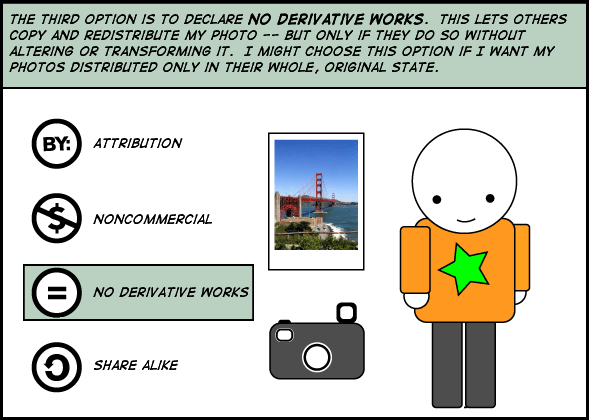
Among the rights an artist may choose to reserve when configuring their Creative Commons license is "No Derivative Works," explained in cartoon here.
Indeed, the Creative Commons' leading example musician is Roger McGuinn who: "chose the Creative Commons license that maximizes a combination of free distribution with artistic control and integrity." -- note that Roger McGuinn chose "No Derivative Works."
However, Larry Lessig would take that right away, from a post to his blog:
"Should the law give DJ Danger Mouse the right to remix without permission? I think so, though I understand how others find the matter a bit more grey."
"Should the law give DJ Danger Mouse a compulsory right to remix? That is, the right, conditioned upon his paying a small fee per sale? Again, I think so, and again, you might find this a bit less grey."
So, what exactly does Creative Commons mean by "some rights reserved" -- would it perhaps be more accurate if they said: "some rights reserved until we can change the laws to take those rights away"?
-
Larry says...
1.) This legislation is despicable.
2.) Don't take my word for it. Listen to Prof. Lessig's first podcast for a thoroughly considered explanation of why this is not in our best interest.
-
Re:They aren't doing it for free...
Er.. do you even know who Lawrence Lessig is?
-
More on the trip from Lawrence Lessig's blog
-
More on the trip from Lawrence Lessig's blog
-
Re:Pro-business myth
This Boucher?
I'm too lazy to see if that is him doing a 180 on the issue. -
Re:That's fucking stupid
compensation for airplanes which fly over my house which is legal
Aaah, yes. See p. 70 of Free Culture: Free Society (Lessig, 2004-03-01, Penguin). -
Re:Curious tone
I don't believe that P2P and fair use are compatible concepts, I've seen nothing that suggests that giving copies to other people is legal fair use.
I suspect you mean that you consider P2P and "fair use" incompatible in the context of the article, which might make some sense.
But if you are making a more general statement, I'd recommend familiarizing yourself with the ongoing discourse about copyright. Good starting places might be Creative Commons or the writings of Lawrence Lessig.
P2P is only a distribution technology. Fair use, copyright, licensing, etc. are legal concepts, and other issues entirely. They can be as compatible or incompatible as we (society) want them to be. -
Are people serious about this being a problem?
I just participated in a rather heated discussion over on Larry Lessig's blog about how the perception about gratis / libre software is that the word "free" is associated with it, and "free" has two distinct (though not necessarily contradictory) meanings.
Lots of people still hear "free software" and expect that there's no such thing as a free lunch. Now, having been a participant in the open source community for a while now, indeed, it's not a free lunch exactly. Users are asked to comment, provide feedback, and report errors.
But that's a far cry from using a security nightmare of a browser or paying $400 for that productivity suite, isn't it?
No one in my curosry search of the thread has mentioned Ubuntu, which is currently distributing free packages of their software. I've installed it on my box and love it dearly, already. Many friends have been impressed with what they've seen as well.
Interestingly, on the Live CD that comes with the x86 package, there's also an autorun setup for Windows. If you pop the disc in while running Windows, it presents you with the opportunity to install some of the best F/OSS around:
-Firefox
-Thunderbird
-The Gimp
-Audacity
-OO.o
-A couple other programs I don't recall ATM
My budding computer geek brother has never been willing to adopt Linux (saying things like "there are too damn many flavors," etc.). However, now that he's had a chance to use the programs I use every day, he's also beginning to see why maybe I like my system.
IMHO, porting quality F/OSS to Windows is a great way to show people that libre doesn't mean gratis, and gratis doesn't mean cheap. It's important we as a community educate others about the way the community can develop software and GUIs and all this wonderful tech -- but do it in terms that help them understand the big picture at the same time. -
Re:A population that old?
- Think of Bishop's (or Furr's) revenue!
- Think of the support for low speed limits!
- Think of Florida's electoral influence (if it didn't sink into the ocean)!
-
Larry Lessig
I nominate Larry Lessig.
Yeah, yeah, I'll try to survive the reality whiplash. -
Re:DisappointedIt would appear that a large fraction of US voters trust one or the other, believe that the speeches will actually correlate with future performance, and generally trust their gut feelings about the candidates' "character" and "values."
Large, but not all of us. I trust Kerry about as far as the Secret Service guarding him would let me kick him, and think he's lying through his hat making promises to get himself elected.
On the other hand, that latter is a plus in my book. I think he'll flip flop to whatever makes sense to him at the time he decides, rather than sticking blindly to campaign promises and policies with disregard to evolving situations. Bush, in my opinion, has been a Geopolitical, Environmental, and Fiscal disaster. And to seal my vote, the libertarians nominated a nut job so far out that I can't support him in good concience-- ruining my previous perfect Libertarian voting record.
Kerry sucks. But we're still (barely) at the "Ballot Box" stage to defend liberty, and so he's the lizard I'm voting for.
-
sure
-
Re:Ban on Sampling in Political Speech
You're quoting from "page 2", which was actually a counterpoint article by Lawrence Lessig. Hillary Rosen didn't write this.
-
Another (Longer) Article...
About a week ago Lawrence Lessig mentioned a new book called Promises to Keep . The book, written by Prof. William Fisher, chronicles a bit of entertainment industry history and the various "alternatives we face for protecting copyright in a digital age" (to use Lessig's phrase).
Chapter Six is freely available (66-page PDF), and in that chapter an alternative compensation system proposed by Fisher (not entirely unlike Von Lohmann's from the main article) is outlined in excruciating detail. This detail includes specific cost and savings estimates.
What makes Fisher's proposal interesting is that he also includes a mechanism to allow derivative works to be created, and for both deriving and derived authors to be compensated.
- Neil Wehneman -
Re:5th amendment
The constitution never implied patents (or copyrights) were a property right any more than slaves on the plantation were. This property propaganda is a bunch of crap made up by lawyers and the RIAA, and has absolutely no solid foundation in common law or constitutional law at all.
I suggest you talk to one of the biggest proponents of copyright reform, Lawrence Lessig, who states that "copyrighted material is, by definintion, private property", in his blog. Alternatively, you could back up your supposition (which I think is nonsensical, but hey, I wouldn't mind being wrong on this one).
Indeed, there is a plethora of common law dating back to the 1700's in England on copyright, in particular, defining it as property (Lockean natural law; the Blackstonian legal distinction was usurped by the common law).
You are unwittingly correct that it is "made up by lawyers"; it is a constructive property, just as corporations are constructive people, with effectively the same rights and liabilities therein. Unfortunately, you fail to establish any distinction between constructed and "real" property, in a society under rule of law.
In fact the constitution clearly states that copyrights and patents are a government mandated monopoly that is to be short term - genuine rights don't have an expiration date.
What's a "genuine" right? Your property rights effectively end, thanks to perpetuities legislation, ~81 years after you die (save trusts & fancy legal wrangling with big money), to prevent "ruling from the grave", so to speak. This makes your existing property rights no less tangible or "genuine", does it? Indeed, copy-rights in some jurisdictions vastly outlive real property rights.
There are transient rights, such as freedom of association, free speech, and the like, but I suspect these end when you die, though they may be vicariously preserved (to no personal avail, I imagine). I am left wondering what rights you are talking about.
Bear in mind that we are talking about "just compensation" for the government depriving you of rights to copyright or patent (or trademark) profit and enjoyment. In essence, this is legally analogous to depriving you of real property rights. Analogy to transient rights is superfluous; this is property, whether constructed by lawyers or not, it is recognized by courts of competent jurisdiction. That right can be taken away by government, but constitutionally the government must compensate the owners. -
Re:5th amendmentI'm not sure if your statement is directed at patents in particular. But at least in terms of copyright, it is incorrect. For all the intents and purposes of my 5th amendment argument, however, I believe patent protection is analogous, given that constructive legal property, ala. patents, trademarks and copyrights are, in good standing, equivalent to actual property.
And there's no "property" taken from the inventor in violation of the 5th ammendment.
Quoth the Raven:copyrighted material is, by definintion, private property, and to argue that an individual is taking from the public by extending his copyright requires a dyslexic misreading of the literal meaning of the amendment. the 5th amendment argument is better used by those who support an extended copyright than by those who wish to shorten it.
Taken from the blog of Lawrence Lessig, , one of the world's most prominent intellectual property lawyers.
I'm not sure what you are referring to with "natural rights"; natural persons and artificial persons (ie. corporations) are equally entitled to the constitutional provisions, just as constructive property rights are equally as applicable as common law or other rights (not sure what you mean by "natural rights", so
Incidentally, even if Congress constructs a right, they must compensate for taking it away again, pursuant to the last statement of the 5th amendment. This is not equivalent to not granting it in the first place; at some point the law granted rights which, when removed, may require "just compensation" for things such as lost profits. -
Rick Boucher
There is no bigger geek rockstar in the House than my representative, Rep. Rick Boucher (VA-09). The guy advocates the protection of Fair Use, a Digital Milennium Consumers' Rights Act, opposes the DOJ's anti-P2P work, proposed a great anti-spam act in 2003 (it didn't pass; that crappy CAN-SPAM did, instead), he sponsored the Digital Media Consumers' Rights Act, and he testifies before various House committees all the time, representing, effectively, Slashdot.
Hell, Boucher guest blogged for Larry Lessig a few weeks ago, and the stuff that he wrote about is like a Slashdotter's wet dream.
He doesn't talk about these things in his campaign literature -- much of the very-rural, poor population of southwest Virginia just wouldn't care. Read over his campaign website and you'll find more about the tobacco buyout, healthcare and tourism than technology.
And everybody else in the House sucks.
-Waldo Jaquith -
Everyone RTFO
Read The Fine Opinion. (courtesy of Larry Lessig)
-
Link to the opinion
-
Lawrence Lessig - lessig.org
Lawrence Lessig has a blog.
-
All over!
I go all over for my political blogging...
For crazy news from the Left, I like DailyKos; it's most blog-o-riffic.
For crazy news from the Right, even though it isn't really a blog, Drudge Report.
In dealing with legal / technical slants on political issues, it's hard to top Larry Lessig's blog.
I like To Be Determined, becuase it's my blog
And finally, for a news for nerds and stuff that matters , it's hard to top Slashdot! -
Re:One Question:
He's probably right:
http://www.lessig.org/blog/archives/002153.shtml -
Richard Posner has been blogging about IP
Judge Richard Posner, a good writer, has been blogging about IP and fair use at Lessig Blog. The series of entries are very informative and give a good background to IP.
-
Re:Lawyers Profit!
It's all about price fixing in the end. And it's legal. Don't you just love it?
To quote Larry Lessig...
Note to citizens: We're permitted to change the law.
- Neil Wehneman -
Spectrum as Property (or not)
I posted this in the last spectrum topic, but it's perhaps even more applicable to this discussion.
- Neil Wehneman
*****
Lawrence Lessig spends a not insignificant amount of time on the concept of spectrum in 2001's The Future of Ideas.
Quoting him from page 233 (emphasis in original)...
"Here again, an idea about property is doing all the work - but this time the idea is at its most attenuated. We don't yet have a full property regime for allocating and controlling spectrum. Yet we are still being driven to embrace this single view. We are racing to deny the opportunity for balance, pushed (as we always are) by those who have the least to gain from a world of balance. The possibility of a commons at the physical layer is ignored; even the chance to experiment with the commons is denied. Instead, policy makers on the Right and the Left race to embrace a system of perfect control.
So strong is this idea of property, so unbalanced is our understanding of its tradition, that we embrace it fully, without limitation, even when it doesn't yet exist, and even when the asset being assigned a property right is not - like the wires of AT&T's cable or the creative genius behind Disney's Mickey Mouse - something anyone has created. We are racing to assign property rights in the air, because we can't imagine that balance could do better."
Buy it new, buy it used, or get it from the library. But if you have interest in spectrum you should definitely read this book. -
The Future of Ideas
Lawrence Lessig spends a not insignificant amount of time on the concept of spectrum in 2001's The Future of Ideas.
Quoting him from page 233 (emphasis in original)...
"Here again, an idea about property is doing all the work - but this time the idea is at its most attenuated. We don't yet have a full property regime for allocating and controlling spectrum. Yet we are still being driven to embrace this single view. We are racing to deny the opportunity for balance, pushed (as we always are) by those who have the least to gain from a world of balance. The possibility of a commons at the physical layer is ignored; even the chance to experiment with the commons is denied. Instead, policy makers on the Right and the Left race to embrace a system of perfect control.
So strong is this idea of property, so unbalanced is our understanding of its tradition, that we embrace it fully, without limitation, even when it doesn't yet exist, and even when the asset being assigned a property right is not - like the wires of AT&T's cable or the creative genius behind Disney's Mickey Mouse - something anyone has created. We are racing to assign property rights in the air, because we can't imagine that balance could do better."
Buy it new, buy it used, or get it from the library. But if you have interest in spectrum you should definitely read this book.
- Neil Wehneman -
Re:In other news....
Disney also suggests copyright be extended to an indefinite amount of time.
It's this kind of stuff that should make all of us look up and see what's going on. We are facing a serious cultural dilemma, as a people. Our "intellectual property" system is creating a climate that allows works to disappear forever, and creates no legal alternative.
Corporations "own" the works, and the works remain "protected" by copyright. Meanwhile, works that are not economically viable to be "sold" by the "owners" simply become unavailable, however the "protection" of copyright makes it illegal for individuals to simply reproduce these works themselves. Today it's acetate films rotting in vaults, and books that have "fallen out of print" on acidic paper. Tomorrow it will be video and audio "locked up" in encryption algorithms that may well be trivilly easy to break, but are legally protected.
Corporations are doing what corporations are supposed to do-- returning value for shareholders. We can debate globaliation and corporatization and the like all day long-- but not here. The change needs to come by way of changes to "intellectual property" law. Laws are made for the good of society, not for the good of corporations, per se. As a society, we all need to become informed about these issues and work to address them. It may not be glamorous, but it's necessary.
I know there are people who agree with me, but I have no idea how to get the idea out to the public, where the real changes can happen.
Licensing your own work with trendy licenses like Creative Commons or GPL isn't the answer. Violating current "intellectual property" law to show "civil disobedience" isn't the answer. Doing nothing most certainly isn't the answer. The answer is to get the average person involved.
I fear that most people are already too far gone. Most poor bastards don't have enough independent thought left to even think that it's possible to question a notion like "A creator should receive economic compensation every time their work is copied". People simply think that the current system is "just the way it is", and their hobbled minds aren't flexible enough to even comprehend that things could be different.
The message I'd love to get out to the street is this: When you download an MP3 or a movie, you're not hurting the artists or creators-- you're hurting their PUBLISHER. When you buy a CD or software, you're not helping the artists or creators, you're helping the PUBLISHER. Publishers are a scourge upon us-- a plague of leeches. If we can get the public behind new models of economic compensation (or old ones-- live music has been around for millenia), we can break the publisher's grip on our "intellectual property" system, and start to have a reasonable hope of preserving a record of our culture.
-
Re:Well
Lawrence Lessig explains it well (and with examples) on his blog entry about it.
I'll attempt to do an executive summary though. The video will probably not be considered a parody because it does not make fun of the song itself, it just uses the song in its parodying of George Bush and John Kerry. -
Re:What I find really scary...I was pleased to see someone else post this idea to slashdot. Great minds think alike!
I posted something earlier to slashdot quite a while back on this, inspired vaguely if I recall correctly from another person's slashdot sig comment (which I could not track down again -- but was something like, "if IP is so valuable, why isn't it taxed?"). Can't seem to find my older posts -- I guess slashdot loses links to them as they get rolled together into archives?
I later posted to Lessig's blog on it in Jan 2003, where it was discussed some such as here The essential post there is: "Copyrights should be taxed annually at 3% of a self-assessed buyout value, similar to real estate, to make up for the external costs copyrights impose on society. Watch Disney squirm as they are forced to argue the mouse is like a piece of real estate but they should not pay property tax on it. We might see an immediate increase in the public domain as rights holders decide not to pay the tax for some works and those works immediately move into the PD as a consequence. Other works that are self-assessed at low amounts to avoid taxes might be bought into the public domain by individuals paying the assessed amount directly to the rights holders. If implemented internationally, developing nations might make a tidy sum by such taxes for defending specific copyrights while at the same time having immediate access to all other materials for which rights holders decide not to pay the tax for that country. The tax payments by default reinstitute the notion of formal registration, making it easy to find rights holders and the current status of previously copyrighted works. This is an Aikido approach -- rather than oppose the strong force, redirect it for your benefit. With looming defecits, this gives the US government a new revenue stream."
I think Lessig is trying to do a good job, but in my opinion, he proposes half measures which receive only lukewarm support (and strong opposition).
I also have a long essay on what the US could do to reform itself financially, including a copyright tax: http://www.kurtz-fernhout.com/oscomak/AchievingAS
t arTrekSociety.html -
Re:What I find really scary...
Like most of my better ideas, I can't claim it for my own. As far as I know, the first person to propose it is Lessig.