Slashdot Mirror
Domain: mashable.com
Stories and comments across the archive that link to mashable.com.
Stories · 272
-
Google Logo Changes Again, Hinting RT Search?
siliconbits writes "The Google homepage is sporting a new logo that changes color as you type, and it is likely a big hint as to what the company will announce at its search event on Wednesday. When you arrive on the search giant homepage today, you will be greeted with a gray Google doodle." -
iPhone App In App Store Limbo Open Sourced
recoiledsnake writes "The author of iPhone prototyping tool Briefs has decided to open source it after the App store submission has been in limbo for over three months. The app had got into trouble for what Apple believes is being able to run interpreted code, though the author denies it, saying all the compiling happens on the Mac. While Rob stays civil, his co-worker blasts Apple for not even rejecting the app. Three months is nothing compared to Google Voice for the iPhone though, which is still being studied further by Apple after more than a year." -
Apple Wants To Share Your Location With Others
Farhood sends in this snip from the LA Times: "In an updated version of its privacy policy, the company added a paragraph noting that once users agree, Apple and unspecified 'partners and licensees' may collect and store user location data. When users attempt to download apps or media from the iTunes store, they are prompted to agree to the new terms and conditions. Until they agree, they cannot download anything through the store. The company says the data is anonymous and does not personally identify users. Analysts have shown, however, that large, specific data sets can be used to identify people based on behavior patterns." Mashable and The Consumerist have picked up on this collection and sharing of "precise location data, including the real-time geographic location of your Apple computer or device." -
Blippy Exposes Credit Card Numbers Through Simple Google Search
An anonymous reader writes "In an unfortunate data breach, social media site Blippy has left credit card numbers in clear text, searchable via a simple Google query. The results show the amount spent on a transaction, the location, and the full card number. As of this submission, the issue still hasn't been resolved." The company's co-founder, Philip Kaplan, told the NY Times, "... when people link their credit cards to Blippy, merchants pass along their raw transaction data – including some credit card numbers – and the site scrubs that information to present just the merchant and the dollar amount spent. But several months ago, when Blippy was being publicly tested, that raw transaction data was present in the site's HTML code, where it was retrieved by Google. Mr. Kaplan said that early on, Blippy started disguising the raw transaction data behind the scenes, but it did not know about the breach until today." -
Google Awarded Broad Patent For Location-Based Advertising
Mashable has a report of a patent that just issued (6-1/2 years after filing) — apparently Google now has a lock on location-based advertising. It's not clear that the search company intends to assert the patent against any other companies (such as emerging rival Apple), but it's useful as leverage. Here is the patent. Update: 03/02 14:34 GMT by S : Reader butlerm noted that the incorrect patent was linked. It now points to the correct URL. -
Google Acquires Online Image Editing Tool Picnik
Many different sources are writing to tell us about Google's acquisition of online image editing tool Picnik. "And all this leads us to today’s exciting news: we’ve just been acquired by Google! What does this mean for Picnik? It means we can think BIG. Google processes petabytes of data every day, and with their worldwide infrastructure and world-class team, it is truly the best home we could have found. Under the Google roof we’ll reach more people than ever before, impacting more lives and making more photos more awesome. What does this mean for you Picnikers? Nothing is changing right away, but Picnik now has more potential than ever before. The team that built Picnik from the grass up will continue making advanced and powerful photo-editing easier, more intuitive and more fun, so stay tuned to hear about all the cool new stuff we’re working on." -
Improving Education Through Social Gaming
A piece up at Mashable explores how some schools and universities are finding success at integrating social gaming into their education curriculum. Various game-related programs are getting assistance these days from sources like the government and the Bill & Melinda Gates Foundation. "For the less well-to-do educator, the Federation of American Scientists has developed a first-person shooter-inspired cellular biology curriculum. Gamers explore the fully-interactive 3D world of an ill patient and assist the immune system in fighting back a bacterial infection. Dr. Melanie Ann Stegman has been evaluating the educational impacts of the game and is optimistic about her preliminary findings. 'The amount of detail about proteins, chemical signals and gene regulation that these 15-year-olds were devouring was amazing. Their questions were insightful. I felt like I was having a discussion with scientist colleagues,' said Stegman. Perhaps more importantly, the video game excites students about science. Motivating more youngsters to adopt a science-related career track has became a major education initiative of the Obama administration. So desperate to find a solution that motivates students to become scientists, the government has even enlisted Darpa, the Department of Defense’s 'mad scientist' research organization, to figure out a solution." -
German Government Advises Public To Stop Using IE
An anonymous reader writes "After McAfee's disclosure of an IE 0-day vulnerability this week that had been used in Operation Aurora, the hack and stealing of data from Google, Adobe and about 3 dozen other major companies, the German government has advised the public to switch to alternative browsers (untranslated statement). Given that the exploit has now been made public and the patch from Microsoft is still nowhere to be seen, how long will it be before other governments follow suit?" -
App Store Piracy Losses Estimated At $459 Million
An anonymous reader passes along this quote from a report at 24/7 Wall St.: "There have been over 3 billion downloads since the inception of the App Store. Assuming the proportion of those that are paid apps falls in the middle of the Bernstein estimate, 17% or 510 million of these were paid applications. Based on our review of current information, paid applications have a piracy rate of around 75%. That supports the figure that for every paid download, there have been 3 pirated downloads. That puts the number of pirate downloads at 1.53 billion. If the average price of a paid application is $3, that is $4.59 billion dollars in losses split between Apple and the application developers. That is, of course, assuming that all of those pirates would have made purchases had the application not been available to them for free. This is almost certainly not the case. A fair estimate of the proportion of people who would have used the App Store if they did not use pirated applications is about 10%. This estimate yields about $459 million in lost revenue for Apple and application developers." A response posted at Mashable takes issue with some of the figures, particularly the 75% piracy rate. While such rates have been seen with game apps, it's unclear whether non-game apps suffer the same fate. -
Yes, Google Does De-List Pages; But When?
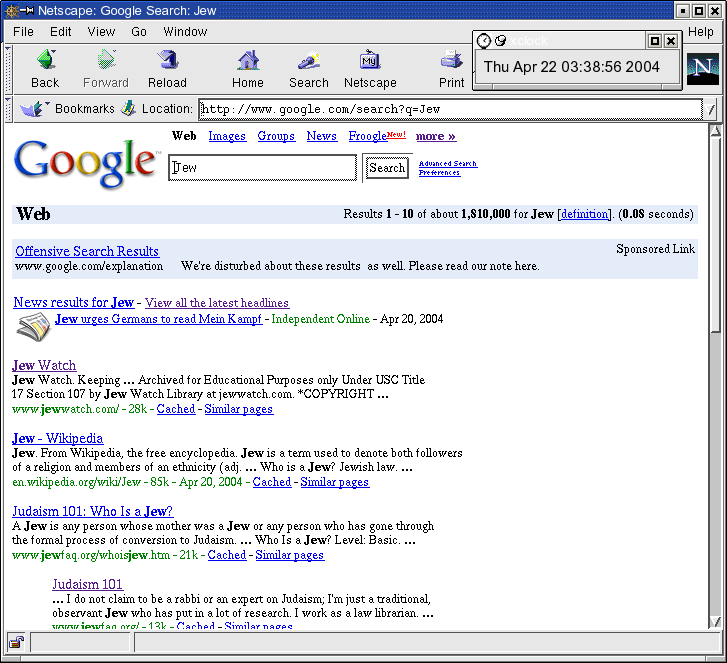
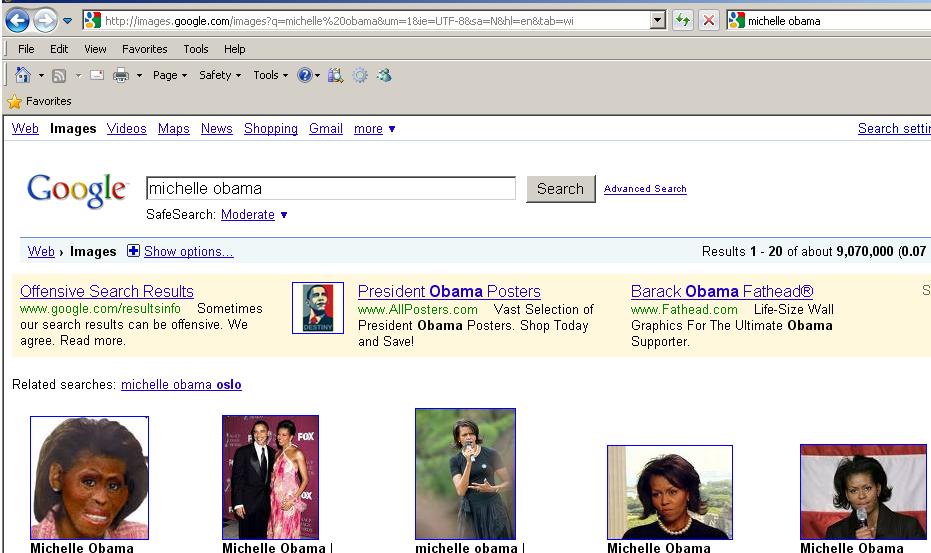
Frequent Slashdot contributor Bennett Haselton writes "Google finds itself inserting a disclaimer once again above some offensive search results. But the disclaimer still leads many to believe (incorrectly) that Google doesn't tamper with search results even in cases of 'harmful' or 'offensive' material. We know that Google has in fact de-listed some pages at the request of offended parties. What is their real policy on the issue?" Read on for Bennet's essay.In 2004, when Google users discovered that the top search result for the word "Jew" was the anti-semitic site Jew Watch, Google ran a disclaimer in the space usually reserved for ads, explaining that their results only reflected the reality of link counts on the Web, and that they did not endorse any Web sites which appeared at the top of their listings. Now the disclaimer has been dusted off again, as the top result on Google Images for "Michelle Obama" is a picture of a monkey's face with Michelle's hairdo. (Ironically, it looks as if the original image would have fallen out of the rankings, if it hadn't been for a follow-up blog post about the controversy, which itself now comes up as the first result.)
I first heard about the controversy from Dennis Prager's column in which he takes a New York Times columnist to task, because the columnist complained about "racially offensive images of the first couple" that come up in Google searches. Prager was unable to find any examples from Googling "first couple" or "Michelle and Barack Obama pictures," so he concluded that the NYT columnist "wildly exaggerated, if not made up" his claims. I tried Google Image searches for "first couple," "Barack Obama," and some other terms, and I couldn't find anything controversial either. However, it only took 10 seconds to enter "first couple google images controversy" on the regular Google Web search and find multiple blog posts explaining what all the fuss was about. Back to Google 101 for Dennis.
Many of the blog posts refer to Google's disclaimer about not tampering with search results. Those on one side are urging Google to make an exception and "fix" the results, while others sagely observe that Google just reflects reality, it doesn't create it.
All of this punditry is starting from a premise that's wrong. Google has actually removed pages from their search results — not because the pages were illegal or because the webmasters were search engine spamming, but because of the page's "offensive" content. In the "Chester's Guide" incident, a councilman in Chester, England discovered that one of the search results for "chester guide" was a satirical page titled "Chester's guide to picking up little girls." Although the page itself was obviously just someone's idea of sick humor, a Chester city councilman (who admitted that he hadn't looked at the page, saying that the title told him everything he needed to know) urged Google to remove the page from their index. Google at first refused, but later manually blacklisted the page to prevent it from appearing in their search results.
Whether or not you think this was the right decision, probably depends on what you think is the purpose of Google. If Google's purpose is to return the most useful results, then it made sense to remove the link, as Danny Sullivan of Search Engine Watch argued at the time, since it almost certainly was not a useful result for people searching for "Chester Guide." On the other hand, if the primary purpose of Google is to reflect the reality of what pages on the Web feature certain words most prominently (combined with all the other factors that Google weighs, of course), then the results shouldn't be altered.
But more people should at least realize that it happened. The Google disclaimer doesn't precisely say that they never blacklist pages or modify search results ("Google reserves the right to address such requests individually"), but it seems to give most people the impression that that's the case. According to that crudest of Googling techniques for which novice searchers are so frequently lampooned, there appear to be about 400 times as many stories on the Web about the Google "Jew Watch" controversy (where Google stood their ground) as there are stores about the "Chester's Guide" incident (where Google caved).
And Google-number-three Matt Cutts posted on his blog back in March explaining why Google does not remove "offensive" pages from search results; over a hundred comments followed, debating the pros and cons of the position, but none of them mentioned the Chester incident or any other case where Google actually had removed pages except as a result of a court order. One isolated comment from "Anonymous" said:
This is not quite true. I know of at least one web site that was de-listed for containing illegal content and/or promoting illegal activity.
which may or may not have been a reference to the Chester Guide incident. And that was it.
Is this a lot of hay to be making over something that happened years ago? Well, for one thing, I doubt if it happened just once. Consider that the Chester Guide incident involved a public declaration of outrage by a city council, and a public statement from Google, and still hardly anyone knows that it ever happened. If other incidents occurred without those high-profile elements, it would be even harder to discover them now. We'll probably never know how many such incidents took place, unless someone sues Google (maybe the owner of a blacklisted website, or maybe the victim of a RipOffReport hatchet job wondering why that site hadn't been blacklisted long ago), subpoenas Google for a list of cases where pages were de-indexed, and publishes the list if it's not sealed by a court order.
But whether it was one time or a handful, consider that political candidates like Arnold Schwarzenegger and Al Franken got asked during their campaigns about things they did 20 years earlier, and it's fair to ask a candidate about their past, because it's the same person standing in front of you now. Why did you do that? Have you stopped? Why?
And in the big scheme of things, Google is probably more powerful than a single US senator or the governor of California. So, can't we ask? What are their real rules about page removal? Have those rules changed since the Chester's Guide controversy? Can they even tell us what their rules are, or do they consider it a trade secret?
It is well known, of course, that Google censors some results in their search engines branded for different markets like China and even in liberal democracies like Germany. But nobody would call that a slippery slope towards censorship in the US version of Google, because the censorship in the Chinese and German versions is done at the behest of the governments there. On the other hand, Google does admit that they will de-index pages which include credit card numbers or social security numbers (which are all too easy to find on the Web). This might not seem like a controversial position, but even this act of voluntary self-censorship may be dipping their toe in the water further than it seems. Most people do consider their credit card information more private than their home address. But surely there are people like J.D. Salinger who less about the privacy of their credit card number (which is easily changeable) than their home address (which isn't). If someone finds Salinger's address and posts it on the Web, should Salinger be able to demand that Google de-index the page? Why should Google cater to the majority who want to keep their credit card number secret, but not to the minority who care more about keeping their address secret? Another commenter on Matt Cutts's blog post asked:
"hi. I have a question. My mom 'googled' herself and it shows some of her medical problems. She wants/needs these pages removed from search engines."
Again, why shouldn't that be considered at least as private as a credit card number?
And finally, even Google's decision to display an "offensive results" disclaimer, for some results but not for others, raises the same "Where do you draw the line?" questions as the issue of page removal. The Michelle Obama monkey picture gets a disclaimer. But search for 'george w bush' and the first row includes a photoshopped (I think!) image of Bush flipping off the press. Does that warrant a disclaimer as well? (Maybe that's considered less unfair because, even though the picture is fake, it does depict something that actually happened.) The first image result for "bristol palin" is a photo of her engaged in underage drinking — a real photo, but probably unfair to call it the single most relevant photo of her on the Web.
So while Google might consider credit cards and social security numbers and search engine spam to be on one side of a "bright line," and everything else is served up without alteration, I think the line is blurrier than that, for at least those three reasons: (a) credit cards and SSNs are less private than some other that things that Google serves up anyway; (b) Google has unambiguously removed some content that fell outside that bright line, as in the Chester's guide incident, and (c) they make other "slippery slope" judgment calls about search results all the time (as in the question of when to show the disclaimer). So I hope that Google someday comes out with a more complete answer to the question. What is their real policy on what they will remove? The Chester's guide incident — would they do that sort of thing if the same situation came up today, or have their rules changed? If they want to go really deep, then is there a general set of principles from which their rules follow — explaining why, for example, they treat credit card numbers as more private than sensitive medical information? (Google did not respond to my request for comment, either through official channels or the unofficial back channels of friends who work there.)
I hope Google gives an answer some day. Even just to say, "It's a classified internal policy and that's all we're going to tell you." But once and for all, the answer is not "Google doesn't remove content just because it's 'offensive' or 'harmful.'"
Meanwhile, a modest suggestion about the disclaimer displayed above the search results: Put it where people will actually see it, in a separate line below the ads, but above the search results. Right now the link to the disclaimer is displayed as one of three ads across the top, and people don't look at the ads. But hey, people do buy ads, so if you push the disclaimer down a bit where people will read it, you also free up space for 50% more ad revenue!
-
Farmville, Social Gaming, and Addiction
MarkN writes "Facebook has been trumpeting the fact that Farmville, the most popular game on its site, has more users than Twitter, with 69 million playing over a month and 26 million playing each day. Combined with Facebook's announcement that they have hit 350 million users, that means one out of every five people on Facebook is playing Farmville. Gamasutra has a post taking a critical analysis of Farmville, its deceptively slow level grind, how a number of gameplay features end up as simply decorative since they aren't balanced with the benefits of raising crops, and discussing why Farmville succeeds so well in virally spreading itself and addicting people." -
Farmville, Social Gaming, and Addiction
MarkN writes "Facebook has been trumpeting the fact that Farmville, the most popular game on its site, has more users than Twitter, with 69 million playing over a month and 26 million playing each day. Combined with Facebook's announcement that they have hit 350 million users, that means one out of every five people on Facebook is playing Farmville. Gamasutra has a post taking a critical analysis of Farmville, its deceptively slow level grind, how a number of gameplay features end up as simply decorative since they aren't balanced with the benefits of raising crops, and discussing why Farmville succeeds so well in virally spreading itself and addicting people." -
No Social Media In These College Stadiums
RawJoe writes "Today, the Southeastern Conference (SEC) is expected to release a final version of its new media policy that, at the moment, can best be described as a ban on all social media usage at SEC games. Earlier this month, the conference informed its schools of the new policy, which says that ticketed fans can't 'produce or disseminate (or aid in producing or disseminating) any material or information about the Event, including, but not limited to, any account, description, picture, video, audio, reproduction or other information concerning the Event.' Translated, that means no Twitter, Facebook, YouTube, TwitPic, or any other service that could in any way compete with authorized media coverage of the event. In the case of the SEC, authorized media coverage rights belong to CBS, who has a $3B deal with the conference over the next 15 years, according to The St Petersburg Times." Good luck with that. To quote Clay Shirky, "The idea that people can't capture their own lived experience is a losing proposition." -
Google Previews New Search Infrastructure
Google has announced a "developer preview" of a new search infrastructure, though one wouldn't have to be a developer to try it out. Google is asking for feedback on how the search results in the new regime stack up against the old. Matt Cutts has posted a mini FAQ. Some early testing indicates that the new search may be faster in some cases, and return more relevant results, than the old one. Those who attempt to game Google search for a living will be scrambling henceforth. Has anyone identified the new crawler bot in log files? -
Real-World Consequences of Social Networking Posts
gbulmash sends in a classic Streisand Effect story of a Chicago landlord suing a tenant over a tweet complaining of mold in her apartment. The landlord claims that the tweet caused $50,000 damage to their reputation. If it didn't, then the fallout from their own ill-advised lawsuit surely will. The woman's Twitter account is now gone (possibly on advice of counsel), but the tweet that started it all lives on. And in a similar vein, reader levicivita notes a firing over a political comment on a Facebook page. "Lee Landor, who had been the deputy press secretary to Manhattan Borough President Scott M. Stringer since May, posted comments on her Facebook page criticizing Mr. Gates [Harvard scholar Henry Louis Gates Jr.] and the president, whom she referred to at one point as 'O-dumb-a.' ... The borough president has accepted Ms. Landor's resignation, effective immediately." -
AT&T Blocks Part of 4chan
holdenkarau writes "Several news sources (Mashable, The Inquistr, etc.) are reporting that AT&T is blocking img.4chan.org in the southern United States. That server is used for the infamous /b/ board (the home of anonymous). TechCrunch calls the decision to block 4chan 'stupid,' noting that they may have 'opened perhaps the most vindictive, messy can of worms.' The Inquisitr suggests that 'The global internet censorship debate landed in the home of the free.' moot (who runs 4chan) asks users to call AT&T, while some others suggest more drastic action (like cutting AT&T fiber)." Update: 07/27 09:23 GMT by T : Readers' comments below suggest that a) the purpose of the block was to curtail the effects of a serious DDoS attack and b) that the block has now been lifted, at least for some regions. -
ImageShack Hacked, Security Groups Threatened
revjtanton writes "Last night a group calling themselves 'Anti-Sec' hacked ImageShack, one of the largest image hosting sites on the web, and replaced many of the site's hosted pictures with one of their own, which detailed their manifesto. The group's grievance is against full-disclosure of exploits, an issue that was debated recently after a presentation on an ATM exploit was canceled. Anti-Sec simply wants the practice within security circles to end, and they've promised to cause 'mayhem and destruction' if it doesn't. These people are taking direct aim against a sector of the IT industry that is already armed to fight the ... but they also already know that. It should be interesting to see how this plays out." -
The Pirate Bay Comes To Facebook
NewYorkCountryLawyer writes "According to a report I just read in Mashable, Pirate Bay is coming to Facebook. Writer Ben Parr says that The Pirate Bay site now includes links under torrents to 'Share on Facebook.' Once posted to a profile, the Facebook member's friends can click the link on Facebook to begin the download right away, provided he or she already has a torrenting client installed. I just hope people do not use this feature to download copyrighted materials which are not authorized to be downloaded, or at least not materials copyrighted to litigation-happy RIAA Big 4 record labels. No doubt, if their song files were downloaded through this method, the record companies would sit back for awhile, derive profit from the promotional excitement generated for their dying industry, and then — armed with Facebook's data — sue the pants off all the hapless Facebook users who fell for it." -
Last.fm To Start Charging International Users
tdobson writes "The popular online radio service Last.fm has announced that users outside of the UK, USA and Germany will need to start paying 3 Euros (about $4.40 USD/£2.80 GBP) per month to continue streaming music on their service. Last.fm doesn't offer much of a reason as to the change, other than writing on their blog that '[t]here will be a 30 track free trial, and we hope this will convince people to subscribe and keep listening to the radio.' Already, there appears to be quite a backlash in responses so far, amongst subscribers and non-subscribers of all nationalities — has this killed Last.fm's appeal, globally?" -
YouTube Muting, Removing Videos Involving Warner Music
notseamus writes "In the past few days, YouTube has started muting videos uploaded by users that use 'unauthorized copyrighted music' in response to Warner Music's threat over royalties, and so far appears to target only Warner Music related videos. Ars Technica also reports that after three DMCA notices YouTube will remove a user account, even when it appears to be fair use. Kevin Lee has had video essays — which he believes are fair use — removed from YouTube, and his account disabled before he could file a counter notice." -
Prince, Village People to Sue The Pirate Bay
castrox writes to tell us that The Pirate Bay's legal concerns are continuing to grow. Prince and the Village People are planning to sue the popular torrent site with the help of the Web Sheriff law firm. John Giacobbi of Web Sheriff has also asked Swedish band ABBA to join the cause. The suit is seeking "millions of dollars" in damages, although it's still uncertain to whom the charges will be directed. The likely targets are the four Pirate Bay founders who were indicted a few weeks ago on charges of breaking copyright law. Prince has taken investigative action against The Pirate Bay in the past. -
Sony's Grouper Picks On Searchles TV
pradeepe writes "Sony's Grouper, a video sharing site, has sent Searchles, a social search engine, a cease and desist letter over Grouper videos being streamed through Searchles TV, "the Internet's first video player that empowers users to mashup videos back-to-back with one player using multiple sources like MySpace, YouTube, Google Video, Blip.tv or Grouper." Grouper claims that Searchles has "effectively stripped away Grouper's extensive copyright protection system, including the 'Flag as Inappropriate' button and the link that appears on every single page of the Grouper website to allow copyright owners to report allegedly infringing material, in accordance with the terms of the Digital Millennium Copyright Act." It's interesting to note that Grouper itself is being sued for copyright infringement."