Slashdot Mirror
Domain: mises.org
Stories and comments across the archive that link to mises.org.
Comments · 1,424
-
Re:Unconstitutional? At what level?
Ok, so why not the 2nd and 4th? If the SCOTUS believe that the Fourteenth Amendment allows for full Incorporation, why haven't they fully incorporated it?
Just because some recent rulings seem to fall towards the belief that we now live with the BoR fully Incorporated does not mean that they are fully Incorporated. It's a sham to make that belief.
For the simple-minded who refuse to accept that there is no Incorporation, nor will there ever be, here are some resources by Constitutional scholars:
The Fourteenth Amendment and the Bill of Rights (PDF!!) Berger, Raoul
Fourteenth Amendment and Selective Incorporation Links, Jim Allison
The Truth about the Fourteenth Amendment, Thomas DiLorenzo
States Rights Traditions that Nobody Knows, Thomas WoodsGoogle Raoul Berger, he has numerous articles and books on the matter as well.
-
Re:Free Competition in Currency Act of 2007
Continue my thought experiment, then, into the future so far that each atom of gold is worth, say, a galaxy class starship. But what if I want to exchange my pocket change for gold? I guess I just get a quark or two shaved off of a gold bar?
LOL... indeed, this is a problem I have considered, but that's a looooong way off.
There's another reason not to worry about it: even taking into account population growth and a vast increase in the amount of gold and silver mined over the past 700 years, the "value" of gold and silver in terms of what a particular amount buys has remained relatively stable over that period.
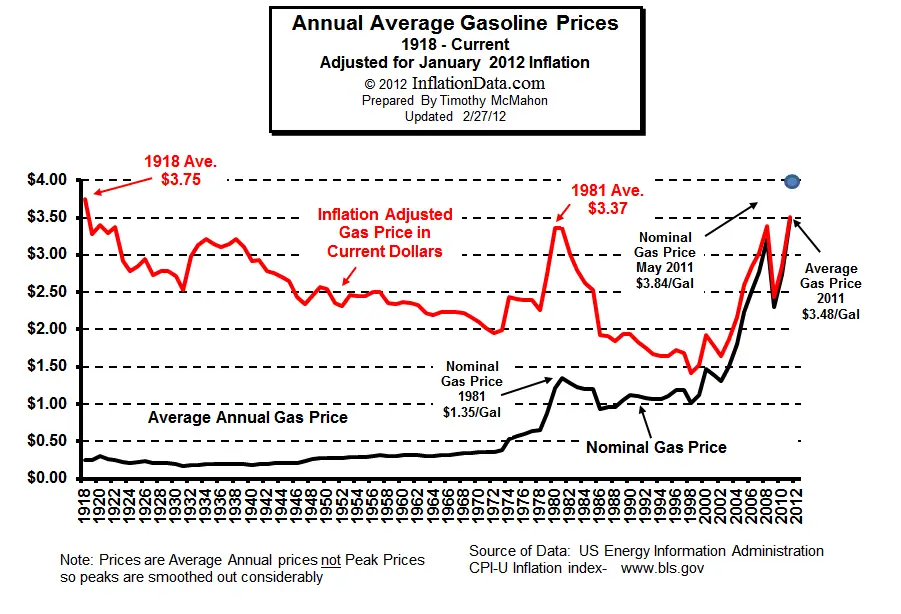
For example, see the following graph, paying particular attention to the nominal price/gallon of gasoline:
http://www.inflationdata.com/inflation/images/charts/Oil/Inflation_adjusted_gasoline_price.jpg
Until the 70's, gasoline was stable between $0.25 and $0.35/gallon. When Nixon withdrew from the Bretton Woods accord in 1971, closing the gold exchange window, oil suddenly became more expensive and never looked back.
Here's a graph of some measure of consumer prices. I have no idea how accurate this is, but I'm most interested in its demonstration of how stable prices were for a long time, until the final gold backing for the dollar was removed:
http://www.financialsense.com/editorials/hodges/2006/images/0106_1.gif
Anyway, there's a lifetime of reading out there about money. The best way to start IMO is to read Murray Rothbard's "What Has Government Done to our Money?", available for free.
-
Re:Damn, was an easy way to buy gold...
I think you're seeing history inverted. I look at the 20th century, and I see cycles an interminable sequence of booms and busts mixed with inflationary and hyperinflationary phases. I look at the 19th century, and I see customer and other prices with almost perfect stability, so much that anyone could save money for bad times by simply storing it in their houses, rather than at some bank, as is required now.
You also talk about liquidity, but it was precisely the artificial liquidity created during Woodrow Wilson's government, by way of cheap loans at below market rates, that created the boom of bad investments that imploded in 1929. And then it was the New Deal that, by providing even more cheap loans and thus creating more (useless) liquidity, that extended what would have been self-correcting recession, into a full blown, decade-long depression.
I suggest you search for "1929" and "gold standard" at classic liberal sites such as the Mises Institute one. People usually accuse them of not using measurements as any good scientific method requires, but whenever I read them what I find the most are historical analyzes. These two search terms alone provide plenty of evidence, and good data.
-
government
Yup, and the voting public seem to fall for it every single time. Either by not caring, or by caring yet not having the attention span to remember about it when they are in the polling booth.
Some have an even shorter attention and or memory span than that. It was government meddling that caused the health care problems to begin with. During WWII the US government passed price and wage control laws. Employers weren't allowed to offer employees more by law. However government saw how this harmed businesses so the let employers offer fringe benefits such as health insurance to their employees, and gave them tax breaks for doing it. Those tax breaks are still on the books so there is no free market in health care and insurance. If government gave those same tax breaks to people who bought their own insurance then you could have a freer market. If they wanted they could join a health care coop. Or buy private insurance. They'd be able to open a health savings account which they could then use to pay normal medical expenses while buying catastrophic coverage to pay catastrophic expenses like cancer.
Falcon
-
Re:YouTube not bahaving?
The Internet is not a public resource, and never has been. Same with broadcast spectra.
Originally the airwaves were homesteaded. If a person had setup a transmitter and broadcast on a frequency nobody in the area of broadcast used they had the legal right to use it. If someone came along and started using the same frequency or interfered with their broadcast they could sue in court and the court would uphold their right to use that frequency. It was only after congress passed the Radio Act of 1912 government started controlling the airwaves though the Radio Act of 1927 had a bigger influence, it created the Federal Radio Commission then the Federal Communications Commission replaced the FRC in 1934.
Falcon -
Re:Good for him ...
Murray Rothbard actually had great insight on this topic. His argument was that the availability of capital is the critical factor in technological progress, and not the generation of new ideas, which there are plenty of.
Not to say that coming up with ideas in useless, indeed we'd be nowhere without them either. But so many good ideas like this one sit idle and never materialise because priorities of investors focus elsewhere. -
I thought of this book immediately
Thinking As A Science by Henry Hazlitt. So I thought I would just throw it in with the other posts
-
Re:It's even funnierThe irony of it was that it was the mother of all crises of _overproduction_.
I know a very prominent economist -- one with no stake in the business of government -- that disagrees wholeheartedly with you.
Not everything government teaches you in school is true. And certainly, not everything the media (which government is now deeply engrained in) tells you is true. With respect to American history, much of it is very heavily distorted. This should be no surprise, after all: control of public knowledge is one of the prerequisites of a super-power government. You can only grow the business of government so far without it. -
Re:Things that make you go "hmm..."
Yes, darn that Ron Paul for not advocating that the federal government override the homosexual conduct laws in Saudi Arabia.
Wait, wait, before you mod me down, there's a point here. You have to look at *why* Paul supports laws like that. It's not because he wants to ban homosexuality, but because he wants to enforce a strict federalism: the states get to determine their own laws, with federal authority on very little. The theory is that the best long-term approach to ensuring freedom is *not* to have uniformity of laws, but to make it easy for people to "hop borders" to live in a jurisdiction with laws more to their liking. And to do that, you'd want to restrict what laws the central government can override, even when you don't like the laws it wants to override.
In other words, just as disliking laws against homosexuality does not suffice as a reason to intervene in Saudi Arabia, it doesn't suffice to "intervene" in Texas.
I by and large favor federalism over "intervene to stop anti-libertarian laws". The reason is that my vision of libertarianism not "It would be AWESOME if EVERYONE were allowed to do this list of things
So, in summary, there *is* recourse -- the fact that decentralization makes it hard for any one government to get too oppressive with its laws. Is it easier to flee your state or your country?
For background, here's a blog post from a libertarian arguing the federalist position. -
Re:Bush
ALL money based on an arbitrary valuation is inflationary.
What are you talking about? The value of money, like all goods, is based on supply and demand. There is nothing "arbitrary" about supply and demand. Second, money is not inherently inflationary. During most of the 1800's, prices generally fell, just as we would expect with a relatively fixed money supply and an ever-increasing supply of goods.
In fact, banks were collapsing left and right throughout the 1800's when we were solidly on a gold standard.
Fractional reserve banks will often collapse under a "gold standard", because fractional reserve banks, by definition, issue claims that are not backed by any metal. Sadly, people have always blamed a fixed money supply for their economic woes, instead of accepting that money, like all goods, is scarce. Thus, bank runs were "fixed" in the 1900's, not by abolishing fractional reserve banking, but by preventing people from reclaiming their own property. But, just because bank runs are gone, that does not mean we have finally obtained that mythical "free lunch". In modern times, prices always increase, because the money supply constantly increases, and every "boom" created by the federal reserve is always followed by a "bust".
I can't explain everything in this one post, however. If you want to know more, click here. -
Re:heh, well ibm helped nazis too, so why notOn this vein, there is nothing communist about China anymore, it's a National Socialist system. Just like with the NSDAP (Nazi party), the "socialism" is there only in name. actually, some people think that they are not that different
-
This is a terrible law with deadly consequences
The main consequence of this law will be more uninsured people and needless deaths. See "Genetic Discrimination Saves Lives
-
Physical property and I"P" are INCOMPATIBLE.I'm an anarcho-capitalist, and a huge supporter of property rights, both physical and intellectual. Then you're misguided at best.
Physical property and intellectual "property" rights are incompatible. You simply can't successfully have both - the one necessarily undermines the other, as Stephan Kinsella laid out. See http://www.stephankinsella.com/ip/, particularly "Against Intellectual Property" [PDF].
Since the choice is ultimately between physical property rights and intellectual "property" rights (and of course I already think the latter are rather suspect for a number of other reasons) I simply choose physical property rights.
When people say "but I'P' is valuable!" I say - of course it is, each EU or US patent granted steals value from literally hundreds of millions of people's physical property rights. A patent lets you usurp the value of everyone's physical property - A patent, by definition, says "you can no longer make your physical property into this particular form without my permission".
An I"P" system is death of a thousand cuts to the physical property system. "Anarcho-capitalists" who think they can support both should get a clue. -
Re:Take an Economics course
Geolibertarianism is just despotism (i.e. what we have now) on a global scale. Who will collect the taxes? From what warrant does the right to collect taxes (i.e. engage in the violent robbery of others) issue? It cannot be justified using the rules of logic or justice. What you call Geolibertarianism is just a euphemism for a global communist state. Why tax only land and not other forms of property such as oxygen, carbon dioxide, nitrogen, water, timber, beef, etc?
I have seen people misunderstand geolibertarianism before, but generally not on such a scale. Quoth Wikipedia, "Communism is a socioeconomic structure that promotes the establishment of a classless, stateless society based on common ownership of the means of production." Geolibertarianism explicitly states that of the three classical factors of production (land, labor, and capital), labor and capital should remain untaxed.
And you are incorrect on your latter point -- to a Georgist, "land" includes that part of the natural universe which is not created by mankind and which is (typically) inelastically supplied. Taxes on air pollution would be considered Georgist, since the atmosphere was not created by mankind and is inelastically supplied.
Libertarianism (as defined by For A New Liberty) is an absolute belief in the rights of the individual. You cannot be a libertarian and be for the existence of government or taxes. They are mutually exclusive concepts.
That is the definition of anarchism.
The refutations of geolibertarianism by real libertarians (as opposed to National Socialists masquerading as "libertarians") are legion and I am not going to type them all here.
I suggest you start here: http://mises.org./
The refutations of Murray Rothbard's critique are legion as well, and I recommend this as a starting point: http://members.aol.com/_ht_a/tma68/geo-faq.htm
(As much as I generally dislike links to AOL, the FAQ is well done, and there are links to other sites as well.) -
Re:Take an Economics course
There are many Communist traps being laid by intellectuals under the name of "libertarianism" on behalf of the fascist state. Geolibertarianism (an oxymron), libertarian-socialism (another oxymoron), minarchism seem to be the most popular.
Geolibertarianism is just despotism (i.e. what we have now) on a global scale. Who will collect the taxes? From what warrant does the right to collect taxes (i.e. engage in the violent robbery of others) issue? It cannot be justified using the rules of logic or justice. What you call Geolibertarianism is just a euphemism for a global communist state. Why tax only land and not other forms of property such as oxygen, carbon dioxide, nitrogen, water, timber, beef, etc?
Libertarianism (as defined by For A New Liberty) is an absolute belief in the rights of the individual. You cannot be a libertarian and be for the existence of government or taxes. They are mutually exclusive concepts.
There are no logical ethical grounds on which you can stand and claim that government has a right to exist or that someone else has a right to engage in armed robbery of another persons property.
The refutations of geolibertarianism by real libertarians (as opposed to National Socialists masquerading as "libertarians") are legion and I am not going to type them all here.
I suggest you start here: http://mises.org./ -
Re:Back To Reality
Fraud is any act of deception or trickery, which may or may not be crime depending on the circumstances. There are two definitions of the word "crime" in my vocabulary:
1. Crime (ethical): that is any aggressive invasion of another person's liberty or personal property.
2. Crime (legalistic): Any action prohibited by government legislation.
The second definition is the one generally meant by the masses when they use the word crime. This is the definition installed by the mass-media and the public education system since it serves the purpose of giving the fascist state a license to do what ever it wants. This logical fallacy is generally referred to as "legalism" and amounts to anyone being able to commit any atrocity that they want provided that they do it under the labels of "law" and "government".
Consider the following:
An individual living in 1940s Germany is Jewish. When entering a town, he provides false paperwork to the soldiers so that they will not shoot him on the spot. This individual has committed an act of fraud (deception) and also committed a legal crime by violating the documented anti-social compulsions (i.e. laws) of the National Socialists. He has not however, committed an ethical crime. On the contrary, since he is undermining the worst crime ever committed against the human race (government), we can say that ethically, his act of fraud is an example of absolute heroism.
The defendant in this case however has violated her contract with MySpace and infringed on their personal property (an ethical crime), also since the contract was violated, she has forcefully entered the computer system, since her license to use the system was revoked the moment she violated the terms of service. A good analogy would be inviting someone over to your property and then having them refuse to leave when you ask them or break in later after they violated your rules of the house.
For more information you can go here:
http://en.wikipedia.org/wiki/The_Ethics_of_Liberty
Free Audio book:
http://www.mises.org/media.aspx?action=category&ID=95 -
Re:It's some Ayn Rand follower
No, Stephen Kinsella is not a follower of Ayn Rand. In fact, I think he gets a great deal of pleasure out of mocking them:
http://blog.mises.org/archives/004065.asp
This column, An Unnatural Disaster: A Hurricane Exposes the Man-Made Disaster of the Welfare State by capital-O Objectivist Robert Tracinski makes some insightful points, if you can get past the giggle-inducing Objectivist stock-phrases like "sense of life".
http://www.lewrockwell.com/blog/lewrw/archives/010779.html
I've noted before Randians' bizarre practice of "officially" "breaking" with one another (other comments on this).
Now some Objectivists who actually have a sense of humor have made up an "Official Solo Schism Form Letter". Funny stuff. The letter is lampooning Objectivist nobody Diana Mertz Hsieh, who felt compelled to Officially, Publicly Break with a former Objectivist friend, the brilliant Chris Sciabarra (who is a decent, sincere, honest person who did not deserve to be treated like this), and to justify it by printing his private correspondence to her and a set of charges to any normal person would appear very bizarre (strange for a Randian, eh?).
...
Update: Just came across the latest Official Objectivist Denunciation: Andrew Bernstein of the Ayn Rand Institute has apparently been pestered into apologizing for having =gasp= published a short piece in the "Journal of Ayn Rand Studies". Bernstein's apology states "I deeply regret my thoughtless decision to contribute to this journal, and hereby irrevocably repudiate any and all association with it."
Well, then, Dr. Bernstein--it's official--and more than that, irrevocable! Thanks for letting us know!
He goes on: "To all who are sincerely concerned with Objectivism, I apologize, and recommend a complete repudiation and boycott of this journal and of any and all of Mr. Sciabarra's work."
Okay! I hereby repudiate and boycott Sciabarra.
And now I take it back! ha ha, I forgot to make it irrevocable!
-
Re:New generation of privacy concerns
...all of it is based on the concept that YOU OWN YOURSELF!
"The real foundation of the natural right to property is not rights over things, but self-ownership." (caution: pdf) twisty turny interesting read.
Maybe some day we'll live in Jefferson's utopia. But now we live in a world run by lawless pirates. Which may have led to some peoples' perverted definition of property and resulting "hate". So the "social programs" may be the baby steps that lead us all to said utopia. I also remember reading the the ultimate goal of communism was for the government to whither away and die. Leading to true anarchism. It just may have to go down that way. I, for one, am perfectly willing to take from those who enable the pirates. -
Re:1929
Please read this, if you can put your pro-government bias aside long enough to stand it. And try to understand that government has a deeply vested interest in having you believe that economic catastrophe is never caused by centralization of power, but always the lack of it.
At the root of it all, when all the eggs are in one basket -- meaning that when the entire economy can be influenced, even controlled, by a one single central agency -- how could this not hold more inherent risk than a system where economic power is decentralized and distributed among many competing groups? That's just plain common sense. -
Re:Us Version already in place
---Let's consider "suspicious" activity of person-vs-person. If I walk down the street normal and non-descript in every way except I was patting the top of my head continously. If addressed by a passer-by I respond "bleek blork bleesums boo" and start hopping. Most people would consider this "suspicious" and more than likely call upon the government to send someone to investigate. This is a reasonable infringement of my privacy for the common good.
That's exactly why I don't support "suspicious" activity. Any activity out of the ordinary (no matter how strange, but non-violent) could be construed as suspicious to somebody. The police should be summoned in cases of breaking the law, not some strange behavior. This example shows this rather well.
---Now a second case of person-vs-collective. Same situation, but now in a work environment where I am employed. More than likely I will be escorted to the personnel department for a evaluation. The business/corporation is assuming the powers of the police, and in fact have far more powers than any reasonable government has. They don't need to accord me a trial. I have very little possibilities to appeal. They can pass judgment immediately and unilaterally. Again my absolute personal rights have been infringed upon, but now for the private good of a limited group.
In an at-will state (as I am in), they can fire you for any reason. However, for the company not to pay unemployment, they must show cause.
I tend to agree with this, because onerous laws that restrict hirings and firings lead to the situations we have in France. However, this leads to whether we should even allow companies, and under what laws and restrictions. A major question concerning corporate charter is if they should be required to uphold US constitutional restrictions: the US government allowed the charter to take place, so they should be bound by the same, should they not?
---Now a third case. Government has its own classification of suspicious activities and wants to collect information on this - say thru a transit card, or the use of credit cards, phone records, email, bank statements. Some would stand up and say "For shame! This invades my privacy, and will not be!" when in reality this give-and-take of privacy takes place on all levels, and by far the government has the *least* powers to intrude on privacy.
From what I see, those are documents. The fourth amendment on the Bill of Rights states that one will be secure in their persons, houses, papers, and effects. Though argued, I see that "papers" represents private information, and should be secured against the government UNLESS due process is made. Simply put: go get a judge to sign off.
Also, taken from a more modern viewpoint: these papers have your unique information. Copyright can be applied to your unique information, and thus, infringes upon the 5th amendment of the Bill of Rights. If one had copyright "intellectual property" used against you without permission stated in Title 17, it would be in violation of the "deprived of life, liberty, or property without due process" clause.
Time and time again, information has been stated that it is intellectual property. Then, why do we citizens not have the constitutional protections for our data security? The corporations wish it for themselves.
---The irony in this is that in the first case, people are already appealing to the government for protection against an non-threating suspicious activity, and in the second case the government doesn't even have a role (the business *is* a repressive totalitarian government).
To most any question, if the government is the answer, it was probably a bad question. In cases in which certain peoples are demanding help from the government, and ceding power to the government, let them get what they deserve.
---What you are advocating in your answer seems to be mob-justice or mafia enforcement. I'd rather the simple answer "Why not let the government pe -
Genetic Discrimination Saves Lives
-
Re:Capital expects returns.
Then, when the customer has no choice due to many possible reasons for any serious amount of time, then no matter how free your market is in theory (someone 'could' enter the market in theory even if it is very difficult), it ends up being an effectively non free market.
Ah, now I got your point. Yes, in principle, as a borderline hypothetical case, this makes sense.For that simple reason an unregulated market will always carry a risk of becomming an effectively non free market, hence . .
But this does not. You don't offer any proof for this assertion. Besides, libertarian thinkers have dealt extensively with this hypothesis, a.k.a. the "natural monopoly theory". Have you perchance studied their arguments before dismissing them as if they didn't exist? Or, worse, as if they didn't matter just because of who wrote them?Your definition predetermines that the only way to achieve a free market is libertarian political ideas, and that makes yours absolutely unusable for any discussion, it is only usable for advocating libertarian political ideas, and hence it is a politically motivated definition.
You saying so without fully demonstrating it doesn't make it true. What if it's the other way around, and political movements just happened to arise from a well constructed theoretical framework? Historically the marginalist theory, including it's definition of free market, has been developed over a period spanning four or five VERY different economic systems, from late 14th century feudalism to the last decades of the 19th century. And even so, it only spawned a clear political movement in the early 20th century. Such historical oversimplifications and ad homines are all but warranted. -
Re:Capital expects returns.
Then, when the customer has no choice due to many possible reasons for any serious amount of time, then no matter how free your market is in theory (someone 'could' enter the market in theory even if it is very difficult), it ends up being an effectively non free market.
Ah, now I got your point. Yes, in principle, as a borderline hypothetical case, this makes sense.For that simple reason an unregulated market will always carry a risk of becomming an effectively non free market, hence . .
But this does not. You don't offer any proof for this assertion. Besides, libertarian thinkers have dealt extensively with this hypothesis, a.k.a. the "natural monopoly theory". Have you perchance studied their arguments before dismissing them as if they didn't exist? Or, worse, as if they didn't matter just because of who wrote them?Your definition predetermines that the only way to achieve a free market is libertarian political ideas, and that makes yours absolutely unusable for any discussion, it is only usable for advocating libertarian political ideas, and hence it is a politically motivated definition.
You saying so without fully demonstrating it doesn't make it true. What if it's the other way around, and political movements just happened to arise from a well constructed theoretical framework? Historically the marginalist theory, including it's definition of free market, has been developed over a period spanning four or five VERY different economic systems, from late 14th century feudalism to the last decades of the 19th century. And even so, it only spawned a clear political movement in the early 20th century. Such historical oversimplifications and ad homines are all but warranted. -
Re:Thank goodness
This is a very poor understanding of the Austrian method. What it actually does is to provide some very broad concepts which constitute what me might call a "metatheoretic framework". This framework, called "praxeology", is in turn used to develop theories about specific economic phenomena. And these theories can be falsified.
So, for example, using this Austrian methodology, the leading theorist of the school, Ludwig von Mises (who in fact gave the thing its name, "praxeology"), made an extensive list of very specific predictions on what would happen in any strongly planned economy that followed Marx' system, writing them in his book Socialism (available for download, so you can confirm for yourself). Note that this was just a few years after the 1917 Russian Revolution, before Lenin had had time to barely start implementing his projects, and without any factual feedback on what was happening in Russia. So, 70 years later, when the iron curtain fell and Western observers could go into the USSR and see things for themselves, not through Soviet propaganda, what did they find? That every single prediction made by Mises was fulfilled. He didn't miss the mark on any of them. As a result, one can say with confidence that the Austrian theory on the effects of socialist planning is, as far as we know, correct. Or, at least, "falsifiable, actually tested, and so far not yet falsified", to put it in a more popperian way.
But what about praxeology itself? Why can't it be falsified? Simply put, because it isn't a theory, nor is it meant to be taken as one. It's a tool. Roughly speaking, you could say that it serves, in Austrian theories, the same purpose served by mathematics in Physics. Can you falsify mathematics? No, because one does not "test" mathematics, one "uses" it to construct tests. Does it causes Physics theories to not be scientific? Of course not, because these theories (that in turn use mathematics) are testable. The same applies to praxeology. And let's not forget that both praxeology and mathematics have the same metatheoretical basis, logics, which for the same reason is never "tested", only "used".
Now, the problem in the text you linked is this: both its author and the person whom he mentions aren't talking about the precise same thing, and since neither know the correct way to clarify the discussion, each understands what the other is saying under the wrong assumption. So, both would profit a lot from studying some philosophy of science, as it helps to understand the differences between theories and metatheories. After all, if you take a metatheory as if it were a theory, as they both do, you end up talking nonsense, no matter whether you're "for" or "against" it. -
Re:How do you propose to take care of the blacks?
The initial sibling comment has shown your claims regarding Lew Rockwell are obviously false.
Ron Paul is the "Distinguished Counselor" of the Ludwig von Mises Institute. They publish his latest book - forward by Lew Rockwell.
Ron Paul also openly associates himself with their of the John Birch Society and thinks its ridiculous that someone would think its bad that he would.
Clearly you aren't interested in the truth, just in backing your guy. I linked several times to news sources. You then criticize my sources and link Judicial Watch of all places as a source when the first adjective it uses to describe itself is by political ideology ("conservative"). Even your second mentioned site identifies judicialwatch as "a conservative legal group that dogged the Clintons through the 1990s with a stream of document demands and related lawsuits" not a reliable source of facts. -
not typical of RP, written by staffer?
I don't think these answers were written by RP; compare to his overview of Mises and Austrian Economics below or to his recent speech on economics in Seattle. He is very thorough, these "answers" are anything but. Perhaps he was consulted briefly by a staffer but wasn't told or didn't realize the size of the Slashdot audience (which is actually a bit surprising, but then again as much as he loves the Internet he isn't a geek). I think he would have personally answered the questions if he knew his answers were going to be read by several million readers world-wide (or whatever the Slashdot audience is).
Also worth mentioning is that Ron Paul is not pro-legislation. Much of the questions asked assume the introduction of some type of program or legislation (it seems), but that is not what RP is about. He is about getting rid of shit that doesn't belong. He has said on numerous occasions that he "would never use executive orders to legislate, but would use executive orders to cancel-out bad [pre-existing] executive orders".
Mises and Austrian Economics: A Personal View [PDF]:
http://www.mises.org/books/paulmises.pdfRon Paul on economics (Seattle, Jan 31 2008, six parts ~ 50 minutes -- several versions on YouTube this one seems the best):
part 1
part 2
part 3
part 4
part 5
part 6Official YouTube site (plenty of stuff here):
http://www.youtube.com/user/RonPaul2008dotcomOfficial Website:
http://www.ronpaul2008.com -
Re:It all comes down to $$$
Your reply is in line to what I'd have replied to the OP, but I find it interesting that it goes contrary to what you say in your linked journal article. There you criticize libertarian economics (wrongly, IMHO, because the evils you attribute to capitalism are in fact produced by state interference in the market), while in this message you used libertarian arguments.
I'd suggest you visit www.mises.org, search and read some articles on the subjects you mentioned in your journal (such as on what happened in the 1920's and in the 1980's), then download and start reading some of the fundamental libertarian books, such as Ludwig von Mises' seminal Human Action. I bet you'll change your mind on a number of subjects, even if not in all of them. -
Re:It all comes down to $$$
Your reply is in line to what I'd have replied to the OP, but I find it interesting that it goes contrary to what you say in your linked journal article. There you criticize libertarian economics (wrongly, IMHO, because the evils you attribute to capitalism are in fact produced by state interference in the market), while in this message you used libertarian arguments.
I'd suggest you visit www.mises.org, search and read some articles on the subjects you mentioned in your journal (such as on what happened in the 1920's and in the 1980's), then download and start reading some of the fundamental libertarian books, such as Ludwig von Mises' seminal Human Action. I bet you'll change your mind on a number of subjects, even if not in all of them. -
Re:Effective by design
On the subject of interesting articles, I love this one from 2004, by Mises Institute editor Jeffrey Tucker, where he explains why they allow everyone to download for free books which are under copyright, some of which they even had to pay the current copyright owners to be allowed to put online for free. In short: they understood that a book online is in fact an advertisement for the printed book, since most people prefer to have the real thing instead of reading on a CRT or LCD. Sure, he recognizes many people who download will never, ever, purchase printed copies. But then, who cares? The important thing is that the aggregate number of purchasers increase, what, to the amazement of the copyright owners to whom they paid for the right, in fact happened, with all of them seeing increased sales of the books available online. In any case, more people reading libertarian books means more libertarians on the long run. Thus, from all perspectives a win-win situation.
I strongly recommend reading the full text. It's really worth it. -
Re:Effective by designIf copyright isn't essential for commercial production of such works, then the government shouldn't be wasting resources doing policing for it. It wasn't necessary for *this* work. It would exist with or without copyright. Copyright was, however, necessary for many other life-enriching works.
I also don't like the "wasting resources policing". Ideally, rights enforcement should be self-funding. Offenders should pay enforcement costs. To the extent that they don't, that's a criticism of the quality of rights enforcement, not the validity of the rights. Except the fundamental distinction that a piece of physical property can only be used by a limited number of people at a time (whether an apple, piece of land, or house), whereas imaginary property can be used by the whole world at once, without any strain on the original "owner". It's senseless to try to make the latter behave like the former, when its limitless nature is a prime asset. The problem with that argument is that you can say, just the same, that the electromagnetic spectrum can be "used" by the entire world, limitlessly, at once. That is, everyone can simultaneously transmit along frequency X. No information will be transmitted, but hey, they're blasting waves, right?
I've seen this exact debate with IP opponents before, and the rest of the argument goes something like this:
"But that's not *really* using the spectrum because it doesn't transmit information, and information transmission is the relevant aspect of EM frequency use."
"So why isn't 'exclusive publishing' the relevant aspect of intellectual property use? My production of an intellectual work may very well be useless to me unless I can have exclusion rights for it. You may dislike the existence of these rights, but they meet the same 'scarcity' threshold you required of the EM spectrum." -
Re:Prove it
Can you cite a source for this claim and not just 1 anecdote?
Here you go. You could probably get a lot more from reading the other "Prime Palavers" and the slashdot articles discussing those, but my hunch is that you won't bother.
If you'd like to prove my hunch wrong, there's also a few more people out there with the same experience as Baen. -
Re:Discounting the price of a book?
I couldn't agree more. You're basically echoing the sentiments of Murray Rothbard, one of the preeminent free market economists of our time.
http://www.mises.org/rothbard/ethics.pdf -
Re:well..
Yes, interesting stuff indeed...
Perhaps there really is more mobility in Europe. Maybe it's because the corporate state is more entrenched over here. I tend to think more and more that corporations who are the most successful in lobbying the state for benefits that their competitors do not get end up stifling that mobility. But the question of mobility doesn't solve everything either. It doesn't answer whether the poor here are better off than the poor there.
The health insurance situation is a very tough one here. I often point people to this article to begin understanding why health care has gotten so out of control. Again it has to do with an obvious lack of competition and the leading providers being entrenched in the state.
Perhaps rising education costs can also be attributed to much higher demand due to government subsidies. The idea of having free markets in education have been kicking around for some time as you will see here: http://www.schoolchoices.org/roo/fm.htm
I'm convinced that education is in a such deplorable condition in this country precisely because of just how much the state has managed to get control of it. The homeschool movement and private vouchers seem to be the best weapon we have against the crushing weight of public education...
I have a hard time attributing the concentration of wealth to unregulated capitalism because we have hardly had that, despite popular belief. It seems easy to complain about how much wealth individuals have accumulated while not realizing the extent to which the state aggregates wealth to itself and gives it to politically well-connected contractors, defense orgs and the like. If corporations try to corrupt the state's simple regulation of contracts, perhaps the best thing to ultimately do is get rid of the state all together. If that's ultimately impossible, then we should try to approach that goal as much as we can. When it comes down to it, companies are beholden to consumers. If they don't provide services that people need they will cease to exist.
I would hope envy is the least important reason, because it seems to fall flat upon any examination. The common theme here seems to be that the power of the state is used by corporations to abuse people. The goal then, should be to limit state power as much as possible (if not completely) and let people decide which goods are most important to them. The more regulating power the state has, the more scales are tipped in favor of corporate interests. It seems foolish to say that a much larger state apparatus wouldn't be as easily corrupted as the one we have now.
BTW - I graduated from BYU in 2002. The mountains are probably the only thing I miss about Utah, hehe... -
Re:Not every candidate
Ron Paul wrote a book when he was on the U. S. Gold Commission, which was appointed by Reagan the last time that the dollar crashed against gold. He deals with how to transition back to lawful money in some detail in that book, but in a nutshell, to get off the fiat money you would first repeal the legal tender laws and allow people to transact business with whatever currency they choose, while requiring that the government continue to accept the fiat currency for payment of taxes and levies (that is, it remains good for something).
-jcr -
Re:Fixed that for you...
...but in the meantime, they've made their money. In essence, the Lone Ranger rides in after the girl has already been run over by the train, and then chases down Snidely Whiplash (I'm blending kids' TV, so sue me) and tells him not to do that again or it might cost him. Markets work best where there is transparency, and this type of collusion is a blatant deception to the customer. As the parties involved have no incentive for competition, these types of deals will continue. Why argue over bread crumbs when we all can have a loaf?
But that is the beauty of a market economy unrestrained by regulations that actually PREVENT competition from fixing short term flaws such as collusion or monopolistic tendencies. Yes, in the short run one individual or a group of individuals may make a large amount of money. Yet overall, in a relatively unregulated market, other individuals are able to compete, especially if they are more efficient at providing that particular good or service in the long run. People think that one company can buy all the competitors, but it doesn't happen. Standard Oil, the socialists "go-to" monopoly, actually tried this, but overall they had to continuously LOWER their prices as their new competition was more efficient. If you plot the price of fuel from Standard Oil over their "worst" years that they bought up competition, their price went lower and lower. As they lowered their prices "monopolistically," new competition would go EVEN LOWER. Standard Oil couldn't compete, so they bought the competition to learn the ways to be even cheaper. Then they'd lower prices again (good for consumers), and new competition would find an even cheaper way to provide fuel. Eventually, Standard Oil's sheer size made them uncompetitive, and they lost a lot of market share before Congress took a peek at their practices.
Collusion is a VERY big deal, though maybe you don't think it affects you (though it does). Collusion is what allowed Enron to happen. If you allow it to go unpunished, it spreads. Why are CDs still so expensive after 20+ years? The media costs next to nothing, there's minimal problems with breakage, and shrinkage protection is substantially better due to inexpensive technology. Either we have collusion, or an example of the market taking an exceptionally long time to fix the problem. (Has it?)
Err, no. Enron did NOT happen because of market forces. Enron happened for one reason: government got itself involved, keeping market forces OUT of Enron's way. Seriously, that's why Enron happened - the people who promised to protect you ended up just protecting their own profits. William L. Anderson covers the Myths about Enron quite nicely, so I don't have to repeat it all. If we kept the State out of the energy situation, the market forces of competition would help consumers almost instantly.
Maybe it's not your life that's affected; you may have a decent paying job, but it does affect those at the bottom. In this case, it's printer ink, which is a small enough expense for most people. Imagine, however, if it was like this for everything. Imagine all the grocery stores in town decided to set minimum prices, and then used their influence on the zoning board to prevent other grocers from opening. Eventually the monopoly would probably be broken, but in the meantime, you've paid the price, and you will never get that money back from the market.
Let's repeat this exact poster's quote again, but let's look at the guilty party:
Maybe it's not your life that's affected; you may have a decent paying job, but it does affect those at the bottom. In this case, it's printer ink, which is a small enough expense for most people. Imagine, however, if it was like this for everything. Imagine all the grocery stores in town decided to set minimum prices, and then used their influence on the zoning board to prevent other grocers from opening. Eventually the monopoly would probably be broken, but in the m -
Re:OLPC is tanking
Sigh. I shouldn't reply, but I think you may have misrepresented my position there: even entertaining your "deserve to be compensated" idea, that certainly does not lead inevitably/uniquely to copyright monopoly laws in particular - a very wide range of taxation, prize and grant schemes could apply (and are currently seen out in the real world, even) without restriction on copying, and that's apart from the obvious enough point that, hey, the work of writing a book can be the chargeable service,people can be paid for that directly, seeing as that's where the "work" lies anyway: Patronage/commissioned artistic production has worked and works today, producing many great artworks -and remember, the internet makes micropayments for funding by large groups quite feasible. Yes, some such efforts fail (e.g. Stephen King's last attempt IIRC) and some succeed - but that is right and proper and expected in a functioning market.
You're right that we're unlikely to agree, of course, but to say that it's "because" we disagree on whether people "deserve to be compensated" is wrong - I'd say whether or not people "deserve to be compensated", they don't deserve a copyright monopoly in particular.
You might benefit from exposure to some Austrian School literature. -
Re:I don't for a minute believe this was unofficia
-
Re:I don't for a minute believe this was unofficia
It would be a difficult transition, but if correctly handled (which I have no confidence it would be, by interests vested in seeing it fail), it would be well worth it. Fiat money http://en.wikipedia.org/wiki/Fiat_currency is a completely nuts system.
see: "What Has Government Done to Our Money?" http://www.mises.org/media.aspx?action=category&ID=92 -
Re:OLPC is tankingIf you're referring to the redistribution of physical copies, then there's nothing wrong with that. No, I'm taking about the making and redistribution of arbitrary further physical copies by third parties. As far as I'm concerned, that's the right of every holder of physical property - to shape it how they see fit (well, actually that's a simplification - I don't necessarily disagree with attribution rights - i.e. I'd consider plagiarism fraudulent, or at the very least tacky. But I disagree with any right to restrict redistribution of properly attributed copies). If it happens to convey information to some interpreter that is "copyrighted", by some mimicry of the shape of another piece of physical property, so be it.
Stephan Kinsella's expressed arguments in this essay are pretty close to my views (though he writes far more eloquently). I'm not going to comment further on the matter in this thread; I suggest you just check that essay out. What copyright is supposed to prevent, and justly so [sic], is unauthorized copying for a reasonable amount of time, so that the author can profit from their work "Their work" is the physical copies they created, and I don't mind them profitting from the sale of them, charging for the service of creation of them, etc. I do not grant any reality to "their work" in the abstract, even if muddle-brained american lawyers do. (Well, that's a simplification too. There are tantalising hints from the developing field quantum computation that quantum information itself has some sort of physical reality - but if anything quantum information is even less compatible with mere human notions of ownership than classical information and/or the approximations we consider macroscopic physical objects)
As far as I'm concerned, physical property law over the physical substrates of "information" is pretty much all that's necessary for just dealings with [classical] information - if I wanted to obtain undisclosed and properly protected secret information from you, I'd have to violate your physical property rights to obtain it. If authors release their initial copy for too low a price, well, that was their choice and their problem. It was their choice to sink their costs into the creation of the work, and I don't think it's fair for others to bear it. The world doesn't owe me a living doing what I want to do, nor them doing what they might want to do. -
Re:competiton on the airwaves
Without an FCC, how does 99.66667 become "yours" that someone is infringing upon?
Ever hear of Homesteading? Before the Federal Radio Commission, the predecessor to the FCC, was created courts in the US were recognizing rights to frequencies someone had homesteaded, started broadcasting on. In other words if a person, party, started broadcasting on a given frequency then another party started broadcasting on the same frequency the first party could sue the second party for interfering and the court would uphold the first party's right to use that frequency without interference. No FCC or other agency, commission in this case, was needed. Just allow civil courts handle it.
This is especially true if we had two stations in the same city
With the number of frequencies available all one broadcaster would have to do is shift the frequency used. Where one of them could prove they were using that frequency first the court could require the second one of move to another frequency. And it's no technological feat to use another. I was able to easily change the frequency of the first radio I built, back in the 1970s, of course it didn't have much of a range of frequencies it could pick up but it was a simply radio with a wire coiled around a roll taken from a used roll of paper.
Falcon -
Re:Beware health insurance implications
What do you mean, ignoring history? Libertarians don't ignore history; we realize that history illustrates our theories about States, that they cause massive war and destruction.
Or are you talking about past deeds whereby some current property possessors aren't legitimate owners, because they obtained their property by theft, or by getting the government to steal it from someone else and give it to them (e.g., Donald Trump)? We needn't ignore that; once you can prove that someone's possession was ill-gotten -- that they stole it -- you can take it from them. However, as they say, possession is 9/10ths of the law, and absent evidence to the contrary, we presume that the current possessor is the legitimate owner.
You might be interested in checking out Murray Rothbard's For a New Liberty: http://www.mises.org/rothbard/newliberty.asp -
The Spectrum Should Be Private Property
-
modern american doctors are tools
... of the 'medical-pharmaceutical-industrial complex'. They just don't realize how their medical eduction was co-opted by said complex in the late 19th/early 20th centuries.
See 100 Years of Medical Robbery, the follow-up Real Medical Freedom, How Medical Boards Nationalized Health Care, and How The Cost-Plus System Evolved.
See my post on k5 for preview quotes for all but the last article: links on how healthcare became screwed up
anonymous 'cause I just spent a bunch of mod points. -
modern american doctors are tools
... of the 'medical-pharmaceutical-industrial complex'. They just don't realize how their medical eduction was co-opted by said complex in the late 19th/early 20th centuries.
See 100 Years of Medical Robbery, the follow-up Real Medical Freedom, How Medical Boards Nationalized Health Care, and How The Cost-Plus System Evolved.
See my post on k5 for preview quotes for all but the last article: links on how healthcare became screwed up
anonymous 'cause I just spent a bunch of mod points. -
modern american doctors are tools
... of the 'medical-pharmaceutical-industrial complex'. They just don't realize how their medical eduction was co-opted by said complex in the late 19th/early 20th centuries.
See 100 Years of Medical Robbery, the follow-up Real Medical Freedom, How Medical Boards Nationalized Health Care, and How The Cost-Plus System Evolved.
See my post on k5 for preview quotes for all but the last article: links on how healthcare became screwed up
anonymous 'cause I just spent a bunch of mod points. -
Re:Teddy Roosevelt would be proud
Which makes sense, else you'd have power lines from a hundred different companies running through your neighborhood, which more or less used to be the case. In the early days, you had dozens of power companies supplying different electrical needs, using different equipment and voltages and whatnot. The same was true for early phone companies, but it was even worse. So regulation and the formation of a natural monopoly made sense in order to ensure efficient and widespread delivery of power.
You might be interested in reading "The Myth of Natural Monopoly" by Thomas Di Lorenzo: http://www.mises.org/journals/rae/pdf/RAE9_2_3.pdf Personally, I wouldn't mind having a few different providers running cable into my house. I seriously doubt it would really be all that inconvenient. And the added competition could only have the effect of decreasing prices and increasing quality of service. It never makes sense to artificially limit competition when there is no need. And I would say my link demonstrates that there wasn't a need. The following paragraph from the link you posted is very telling:Early industry leaders began to think that if the franchise granting process and the rates charged by utilities were overseen by a nonpartisan state agency instead of a city council, financing might be easier and cheaper to obtain.
So the main goal of the providers in pushing for state regulation was to make money easier. I don't appreciate people using my tax dollars to line their pockets. -
Re:Dirty deal?
As much as I hate to be one to cast doubt on how dirty this deal really is, or (gasp) defend MS on slashdot... is bribery really all that wrong? See here a classic defense of bribery:
http://www.mises.org/rothbard/ethics/seventeen.asp
Of course, as far as I'm concerned, MS wouldn't exist without the protection of the US Government's bogus patent system. I would probably worry more about that than bribery.
-
Re:Socialist propaganda
No, I wasn't making a joke. It's funny how those used to the current mixed-market socialist system have bought into the myth that there can be no functional alternative to what we have now. It's not surprising though, when you consider that public education was specifically designed to indoctrinate children.
Anyway, as I've said elsewhere on this thread, you should have a read of Human Action and Liberalism.
-
Re:Socialist propaganda
No, I wasn't making a joke. It's funny how those used to the current mixed-market socialist system have bought into the myth that there can be no functional alternative to what we have now. It's not surprising though, when you consider that public education was specifically designed to indoctrinate children.
Anyway, as I've said elsewhere on this thread, you should have a read of Human Action and Liberalism.
-
Re:Socialist propaganda
No, I wasn't making a joke. It's funny how those used to the current mixed-market socialist system have bought into the myth that there can be no functional alternative to what we have now. It's not surprising though, when you consider that public education was specifically designed to indoctrinate children.
Anyway, as I've said elsewhere on this thread, you should have a read of Human Action and Liberalism.