Slashdot Mirror
Domain: mlive.com
Stories and comments across the archive that link to mlive.com.
Stories · 29
-
Planet Fitness Evacuated After WiFi Network Named 'Remote Detonator' Causes Scare (windsorstar.com)
An anonymous reader quotes a report from Windsor Star: A Michigan gym patron looking for a Wi-Fi connection found one named "remote detonator," prompting an evacuation and precautionary search of the facility by a bomb-sniffing dog. The Saginaw News reports nothing was found in the search Sunday at Planet Fitness in Saginaw Township, about 85 miles (140 kilometers) northwest of Detroit. Saginaw Township police Chief Donald Pussehl says the patron brought the Wi-Fi connection's name to the attention of a manager, who evacuated the building and called police. The gym was closed for about three hours as police responded. Pussehl says there's "no crime or threat," so no charges are expected. He notes people often have odd names for WiFi connections. Planet Fitness says the manager was following company procedure for when there's suspicion about a safety issue. -
Church Elder/'Jeopardy' Champion Charged With Computer Crimes (mlive.com)
Stephanie Jass, a record-setting, seven-time winner on Jeopardy, has been charged with two felonies for accessing the email accounts of two executives at the college where she worked as an assistant professor. An anonymous reader quotes MLive: Jass was able to access the accounts because of an April 24 issue with the college email system, hosted by Google. Frank Hribar, vice president for enrollment and student affairs, said there was network outage caused by loss of power. On April 25, users received a text message with a generic, standard passcode: "Please attempt to login to Gmail using this password. You should be prompted to change password after login..." Not everyone, however, was prompted to do so. Some did make the change using a tutorial. Some received an error and were unable to create a new password, the timeline states. Others did not alter the password at all. The method "worked just fine, had there not been manipulation of the system," said Hribar...
Jass, 47, of Tecumseh was charged in December with unauthorized access to a computer, program or network, and using a computer to commit a crime, both felonies... On May 5, the college deactivated Jass' email account and access to all other college software. The locks to her office door were changed and her desktop computer was confiscated, according to the timeline.
The police report "indicates Jass accessed emails while using an internet network at First Presbyterian Church of Tecumseh, where she served as an elder." -
PayPal's 'Policy Update' Includes Price Hikes (paypal.com)
"Buying and selling items on the internet is about to get a bit more expensive if you use PayPal to transfer money," reports MLive, noting that some of PayPal's fees will be increasing on March 29. Slashdot reader turbotalon also complains PayPal is disguising news of the price hikes as a "policy update". Roughly one quarter of the "policy changes" are rate hikes, yet their emailed summary glosses over the rate hike, focussing instead on a few of the "policy changes" with one sentence at the end about "changing some of the fees we charge". Additionally, they have added a "non-discouragement clause" for sellers that provides:
"In representations to your customers or in public communications, you agree not to mischaracterize PayPal as a payment method. At all of your points of sale (in whatever form), you agree not to try to dissuade or inhibit your customers from using PayPal; and, if you enable your customers to pay you with PayPal, you agree to treat PayPal's payment mark at least at par with other payment methods offered." -
Do Tax Breaks For Data Centers Make Sense? (datacenterfrontier.com)
1sockchuck writes: Does it make sense for state to offer tax incentives to lure huge data center projects? After an extended debate, legislators in Michigan have approved tax breaks for a $5 billion data center in Grand Rapids. The project from Switch, which previously built the SuperNAP in Las Vegas, brought the debate into stark relief due to the size of the project — an estimated 2 million square feet of data center space. States competing for projects often find themselves in a bind, since the highly-automated facilities create a limited number of permanent jobs, but many states already offer juicy incentives. Michigan ultimately sought a middle path, tying the tax breaks to job creation goals. If the data center jobs don't materialize, the breaks disappear. -
Flint, Michigan Declares State of Emergency Over Lead In Children's Blood (washingtonpost.com)
schwit1 writes: The Hurley Medical Center in Flint, Michigan released a study in September that confirmed what many Flint parents had feared for over a year: The proportion of infants and children with above-average levels of lead in their blood has nearly doubled since the city switched from the Detroit water system to using the Flint River as its water source, in 2014. "City officials have also said the use of corrosive Flint River water also damaged Flint's water infrastructure after state regulators never required the river water be treated to make it less corrosive." FEMA is now supplying bottled water to the city. -
Flint, Michigan Declares State of Emergency Over Lead In Children's Blood (washingtonpost.com)
schwit1 writes: The Hurley Medical Center in Flint, Michigan released a study in September that confirmed what many Flint parents had feared for over a year: The proportion of infants and children with above-average levels of lead in their blood has nearly doubled since the city switched from the Detroit water system to using the Flint River as its water source, in 2014. "City officials have also said the use of corrosive Flint River water also damaged Flint's water infrastructure after state regulators never required the river water be treated to make it less corrosive." FEMA is now supplying bottled water to the city. -
Time To Remove 'Philosophical' Exemption From Vaccine Requirements?
An anonymous reader writes: Michigan has a problem. Over the past decade, the number of unvaccinated kindergartners has spiked. "Nearly half of the state's population lives in counties with kindergarten vaccination rates below the level needed for "herd immunity," the public health concept that when at least 93 percent of people are vaccinated, their immunity protects the vulnerable and prevents the most contagious diseases from spreading." Surprise, surprise, the state is now in the midst of a whooping cough outbreak. How do these kids get into public schools without being vaccinated? Well, Michigan is among the 19 U.S. states that allow "philosophical" objections to the vaccine requirements for schoolchildren. (And one of the 46 states allowing religious exemption.) A new editorial is now calling for an end to the "philosophical" exemption.
The article says, "Those who choose not to be vaccinated and who choose not to vaccinate their children allow a breeding ground for diseases to grow and spread to others. They put healthy, vaccinated adults at risk because no vaccine is 100 percent effective. They especially put the most vulnerable at risk — infants too young to be vaccinated, the elderly, people with medical conditions that prevent vaccination, and those undergoing cancer treatments or whose immune systems have been weakened." They also encourage tightening the restrictions on religious and medical waivers so that people don't just check a different box on the exemption form to get the same result. "They are free to continue believing vaccines are harmful, even as the entire medical and scientific communities try in vain to tell them otherwise. But they should not be free to endanger the lives of everyone else with their views." -
Time To Remove 'Philosophical' Exemption From Vaccine Requirements?
An anonymous reader writes: Michigan has a problem. Over the past decade, the number of unvaccinated kindergartners has spiked. "Nearly half of the state's population lives in counties with kindergarten vaccination rates below the level needed for "herd immunity," the public health concept that when at least 93 percent of people are vaccinated, their immunity protects the vulnerable and prevents the most contagious diseases from spreading." Surprise, surprise, the state is now in the midst of a whooping cough outbreak. How do these kids get into public schools without being vaccinated? Well, Michigan is among the 19 U.S. states that allow "philosophical" objections to the vaccine requirements for schoolchildren. (And one of the 46 states allowing religious exemption.) A new editorial is now calling for an end to the "philosophical" exemption.
The article says, "Those who choose not to be vaccinated and who choose not to vaccinate their children allow a breeding ground for diseases to grow and spread to others. They put healthy, vaccinated adults at risk because no vaccine is 100 percent effective. They especially put the most vulnerable at risk — infants too young to be vaccinated, the elderly, people with medical conditions that prevent vaccination, and those undergoing cancer treatments or whose immune systems have been weakened." They also encourage tightening the restrictions on religious and medical waivers so that people don't just check a different box on the exemption form to get the same result. "They are free to continue believing vaccines are harmful, even as the entire medical and scientific communities try in vain to tell them otherwise. But they should not be free to endanger the lives of everyone else with their views." -
Time To Remove 'Philosophical' Exemption From Vaccine Requirements?
An anonymous reader writes: Michigan has a problem. Over the past decade, the number of unvaccinated kindergartners has spiked. "Nearly half of the state's population lives in counties with kindergarten vaccination rates below the level needed for "herd immunity," the public health concept that when at least 93 percent of people are vaccinated, their immunity protects the vulnerable and prevents the most contagious diseases from spreading." Surprise, surprise, the state is now in the midst of a whooping cough outbreak. How do these kids get into public schools without being vaccinated? Well, Michigan is among the 19 U.S. states that allow "philosophical" objections to the vaccine requirements for schoolchildren. (And one of the 46 states allowing religious exemption.) A new editorial is now calling for an end to the "philosophical" exemption.
The article says, "Those who choose not to be vaccinated and who choose not to vaccinate their children allow a breeding ground for diseases to grow and spread to others. They put healthy, vaccinated adults at risk because no vaccine is 100 percent effective. They especially put the most vulnerable at risk — infants too young to be vaccinated, the elderly, people with medical conditions that prevent vaccination, and those undergoing cancer treatments or whose immune systems have been weakened." They also encourage tightening the restrictions on religious and medical waivers so that people don't just check a different box on the exemption form to get the same result. "They are free to continue believing vaccines are harmful, even as the entire medical and scientific communities try in vain to tell them otherwise. But they should not be free to endanger the lives of everyone else with their views." -
Another Election, Another Slew of Voting Machine Glitches
An anonymous reader writes: As Election Day in the U.S. starts to wind down, reports from around the country highlight another round of technological failures at the polls. In Virginia, the machines are casting votes for the wrong candidates. In North Carolina, polling sites received the wrong set of thumb drives, delaying voters for hours. In Michigan, software glitches turned voters away in the early morning, including a city mayor. A county in Indiana saw five of its polling sites spend hours trying to get the machines to boot correctly. And in Connecticut, an as-yet-unspecified computer glitch caused a judge to keep the polls open for extra time. When are we going to get this right? -
University of Michigan Solar Car Wins Fifth Straight National Title
An anonymous reader writes For the fifth consecutive year, the solar car team from the University of Michigan has won the American Solar Car Challenge. The event is an eight-day, 1,700-mile race with a total of 23 participating teams. The Umich victory comes in spite of a 20-30 minute delay when they had problems with the motor at the very beginning of the race. "They made the time up when team strategists decided to push the car to the speed limit while the sun was shining bright, rather than hold back to conserve energy." Footage of the race and daily updates on the car's performance are available from the team's website, as are the specs of the car itself. Notably, the current iteration of the car weighs only 320 pounds, a full 200 pounds lighter than the previous version. -
GM Names and Fires Engineers Involved In Faulty Ignition Switch
An anonymous reader writes 'Thirteen people have died because of faulty ignition switches in General Motors vehicles. The company has recalled 2.6 million cars, paid a $35 million fine, and set up a fund to compensate the victims. Now, an internal investigation into the incident has shown that the company was aware of the problem since 2002. 15 employees have been fired over what CEO Mary Barra calls "misconduct and incompetence." The report singles out Ray DeGiorgio, an engineer who allegedly approved a part that did not meet specifications and misled coworkers who were investigating complaints. "He actually changed the ignition switch to solve the problem in later model years of the Cobalt, but failed to document it, told no one, and claimed to remember nothing about the change."
"There's no evidence anyone else knew the switch was out-of-spec at the time, the report says; neither did DeGiorgio tell anyone when issues with the part were brought to his attention multiple times. When one engineer specifically asked DeGiorgio in 2004 whether the switch met torque specifications, DeGiorgio didn't respond. Evidence the investigators gathered showed that he started two e-mails but never sent them. ... Instead, DeGiorgio was consumed by a problem in which cars with the switch were failing to start in cold weather, something the report says was "a personal embarrassment to DeGiorgio.'"' -
Conservation Communities Takes Root Across US
Hugh Pickens DOT Com writes "Kate Murphy reports at the NYT about a growing number of so-called agrihoods, residential developments where a working farm is the central feature, in the same way that other communities may cluster around a golf course, pool or fitness center. At least a dozen projects across the country are thriving, enlisting thousands of home buyers who crave access to open space, verdant fields and fresh food. 'I hear from developers all the time about this,' says Ed McMahon. 'They've figured out that unlike a golf course, which costs millions to build and millions to maintain, they can provide green space that actually earns a profit.'
Agritopia, outside Phoenix, has sixteen acres of certified organic farmland, with row crops (artichokes to zucchini), fruit trees (citrus, nectarine, peach, apple, olive and date) and livestock (chickens and sheep). Fences gripped by grapevines and blackberry bushes separate the farm from the community's 452 single-family homes, each with a wide front porch and sidewalks close enough to encourage conversation. The hub of neighborhood life is a small square overlooking the farm, with a coffeehouse, farm-to-table restaurant and honor-system farm stand. The square is also where residents line up on Wednesday evenings to claim their bulging boxes of just-harvested produce, eggs and honey, which come with a $100-a-month membership in the community-supported agriculture, or CSA, program.
'Wednesday is the highlight of my week,' says Ben Wyffels. 'To be able to walk down the street with my kids and get fresh, healthy food is amazing.' Because the Agritopia farm is self-sustaining, no fees are charged to support it, other than the cost of buying produce at the farm stand or joining the CSA. Agritopia was among the first agrihoods — like Serenbe in Chattahoochee Hills, Ga.; Prairie Crossing in Grayslake, Ill.; South Village in South Burlington, Vt.; and Hidden Springs in Boise, Idaho. 'The interest is so great, we're kind of terrified trying to catch up with all the calls,' says Quint Redmond adding that in addition to developers, he hears from homeowners' associations and golf course operators who want to transform their costly-to-maintain green spaces into revenue-generating farms. Driving the demand, Redmond says, are the local-food movement and the aspirations of many Americans to be gentlemen (or gentlewomen) farmers. 'Everybody wants to be Thomas Jefferson these days.'" The city of Detroit is planning a 26.9-acre urban farm project on one of its vacant high school properties. Produce from the project will be included in meals for students in the district and later to the larger community. -
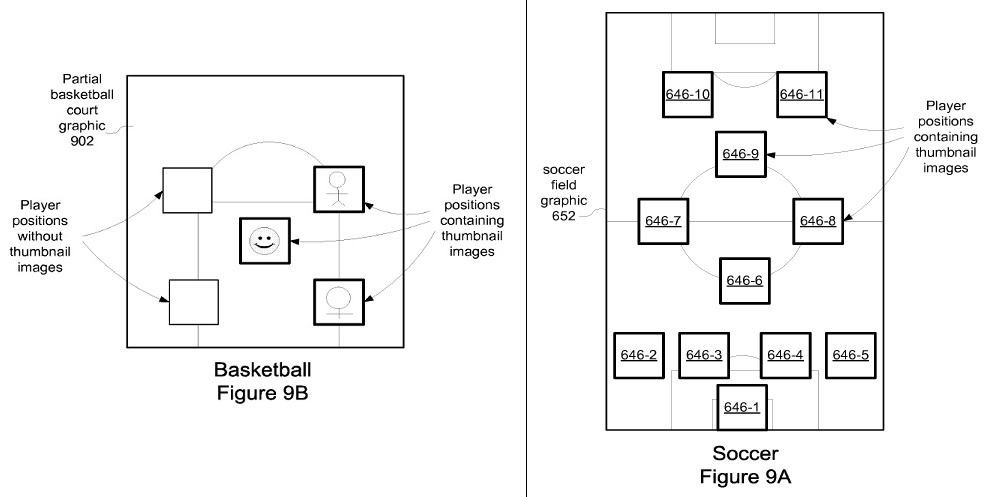
Google Patents Displaying Athletes On Sports Fields
theodp writes "Just about anyone that's familiar with sports has seen position and depth charts, in which athletes are portrayed on the athletic fields their sport is played on. But that didn't stop Google from asking for — and the USPTO granting — a patent on displaying pictures of athletes on the fields on which their sport is played, or in legal-speak, its Method, System, and Graphical User Interface for Personalized Online Sports Team Charts. 'One aspect of the invention,' explains Google, 'involves a graphical user interface on a computer that includes a graphic of an athletic playing field or a portion thereof, and a plurality of player positions on the athletic field. At least some of the player positions contain thumbnail images selected by a first user. The thumbnail images provide links to corresponding profiles in an online social network.' Six Googlers, including Orkut Buyukkokten, were credited as inventors in the 2007 patent application." -
Michigan Makes It Illegal To Ask For Employees' Facebook Logins
An anonymous reader writes "Michigan joins Maryland as a state where employers may not ask employees or job applicants to divulge login information for Facebook and other social media sites. From the article: 'Under the law, employers cannot discipline employees or decline to hire job applicants because they do not give them access information, including user names, passwords, login information, or "other security information that protects access to a personal internet account," according to the bill. Universities and schools cannot discipline or fail to admit students if they do not give similar information.' There is one exception, however: 'However, accounts owned by a company or educational institution, such as e-mail, can be requested.'" -
Musician Jailed Over Prank YouTube Video
An anonymous reader writes "Evan Emory, a 21-year-old aspiring musician, edited together video of him singing a G-rated song to a bunch of giggling school kids with video of him singing a song with sexually explicit lyrics, and posted it on YouTube. For this stupid joke, done many times by professional comedians (all NSFW, obviously), and admittedly done without getting permission from the children shown 'hearing' him sing naughty words, he was arrested and could face 20 years in prison as a sex offender. On the pretext of looking for 'souvenirs' of child sexual abuse, his house has been searched by police, and the Muskegon County (Michigan) Prosecutor has insinuated (with no further evidence) that Emory actually wants to have sex with children and claims he 'victimized every single child in that classroom.' Emory insists he had no such intention." -
Michigan Governor Wants 'Open Source' Economic Model
An anonymous reader writes "Incoming Michigan governor Rick Synder spoke in Kalamazoo, MI today and says he wants to use an 'open-source economic development model' to help repair the battered down state. Perhaps during his time as president of Gateway he saw a benefit to the open source model, but can it really be successfully applied as an economic model?" -
Dog Eats Man's Toe and Saves His Life
Have you ever been so drunk that you passed out and your dog ate your toe? I haven't either, but luckily for Michigander Jerry Douthett, he has. It turns out Jerry has type 2 diabetes and a wound on his toe had becoming dangerously infected. After a night of drinking Jerry passed out in his chair and the family dog Kiko decided to do a little doggy doctoring. From the article: "'The toe was gone,' said Douthett. 'He ate it. I mean, he must have eaten it, because we couldn't find it anywhere else in the house. I look down, there's blood all over, and my toe is gone.' [Douthett's wife] Rosee, 40, rushed her husband to the hospital where she's a gerontology nurse — Spectrum Health's Blodgett Campus. Kiko had gnawed to a point below the nail-line. When tests revealed an infection to the bone, doctors amputated what was left of the toe." -
Man Amasses 27 College Degrees
Michael Nicholson really likes school. I mean he likes it in the same way Steve Jobs Likes turtlenecks and my unemployed uncle likes Larry The Cable Guy. The 67-year-old Kalamazoo man has amassed 27 college degrees since 1963, and he says he's not done yet. It started with a bachelor's degree in religious education at William Tyndale College in Detroit, which led to a master's degree in theology at Dallas Theological Seminary. Since then, he has earned two associate's degrees, 19 master's degrees, three specialist's degrees and one doctoral degree. Michael is currently working on two more master's degrees and is a shoe-in to lead this year's beer-pong team to the national finals. -
Is 'Corporate Citizen' an Oxymoron?
theodp writes "Citing expert testimony from a recent House Science Subcommittee hearing on Globalizing Jobs and Technology, The Economic Populist challenges the conventional wisdom that maximizing profits should be a corporation's only responsibility, suggesting it's time for the US to align its corporations to the interests of the nation instead of vice versa. Harvard's Bruce Scott warns that today's global economy is much like the US in the later 19th century, when states competed for funds generated by corporations and thus raced to the bottom as they granted generous terms to unregulated firms. Sound familiar, Pennsylvania? How about you, Michigan?" -
The DIY Tank
Will Foster, a Kettering University student, has built his own half sized Panzer tank. It took Will 2 years and around $10,000 to build his mini-tank and he says the process has been "a lot of trial and error...I'd buy a $200 part that didn't work, then go to a $300 part that didn't work before finding a $50 part that did." The tank is about as big as a small car, and can reach speeds of around 20 mph with its three-cylinder diesel engine. It runs on treads, has a cannon powered by compressed air from a scuba tank and parks wherever the hell it wants. -
Beer at the Barbershop
A barber in Grand Rapids Michigan who had been forced to stop offering beer after authorities told him he was breaking the law, hopes to convince lawmakers to change their minds. He feels that a beer with your haircut is simply old-fashioned service. When will the Nanny State learn that nothing goes as well with a foamy mug of beer as straight razors, scissors and loose hair. -
IBM Sets Supercomputer Speed Record
T.Hobbes writes "IBM's BlueGene/L has set a new speed record at 36.01 TFlops, beating the Earth Simulator's 35.86 TFlops, according to internal IBM testing. 'This is notable because of the fixation everyone has had on the Earth Simulator,' said Dave Turek, I.B.M.'s vice president for the high-performance computing division. The AP story is here; the NY Times' story is here." -
Article about HavenCo
Brian Stretch writes "This article published in the Ann Arbor (Michigan) News about HavenCo might interest the /. crowd. Didn't know Sean Hastings was a local boy. Community High grads come up with the weirdest stuff..." Not much news here if you read our previous stories about HavenCo and Sealand, but does include a few words about HavenCo's future plans... -
At the Library: a Briefly Vocal Minority
Our readers from a year ago may remember the series we did examining the attempt to force censorware into Holland's libraries. (Holland, Michigan is the home of the Slashdot Geek Compound, such as it is.) In February, voters rejected that attempt. But to quote Poltergeist II, "they're ba-ack." Thanks to a new Michigan law, all of our libraries have to address the question of minors and the internet -- and blocking software is, to many, the natural solution. I went to the Holland library's open board meeting on Tuesday night; here's what's up.By the way, if you're wondering why you should care about Holland, Michigan: this is going to happen at your local library -- and other public institutions -- soon. It probably has already happened at your local schools. The Holland area is fairly conservative, so it's been at the forefront, but the issue will work its way around the country (and in fact the world) in due time.
Before I describe what happened at the board meeting Tuesday evening, I should put the meeting itself into context.
A small but vocal minority has been pushing for library filters since late last year. At that time, the effort was begun by the American Family Association, with the Family Research Council and a local group stepping in to do the heavy lifting.
The FRC is still playing the dominant role. In fact, Tuesday night, the AFA representative actively distanced the organization from the issue, probably because it has earned its reputation as an extremist group.
Since February, the push has been for communication with the library board: "community input" has been big. Since all board meetings legally must be open to the public anyway, it's never been entirely clear to me what the problem was. The board did form a committee, which met on several occasions with filtering supporters -- the few who showed up -- and educated themselves about their options.
But the pro-filter crowd and the media have been attacking the library for not doing more to engage the community in dialogue. In one recent headline, the city's Mayor, formerly anti-filter, was described as "ripping [the library board's lack of] public input." Ouch.
In fact, the FRC representative Tuesday night apologized at length for the pressure tactics -- even though, in most of the media reports I've seen, her comments were relatively mild.
Just a week ago, she was quoted as saying she:
"...doesn't think a Sept. 12 forum will be sufficient to solicit public input, with attendance limited to 200 people and less than two hours set aside for public comment.
"She said those restrictions will limit the amount of input the board can receive."
That's been the concern all these months; that's what's been keeping the library board awake worrying. Every board meeting has been completely open to the public, and the only issue was how many people the fire marshal would allow in, and how long the community would be allowed to outpour its concerns.
In fact, when the meeting started -- the one and only meeting that's been publicized as a forum for the airing of Holland's views -- fewer than 45 people showed.
Some more trickled in, some trickled back out later after less than two hours of public comment. A total of just over 60 people showed up, about half of whom spoke (excluding the boardmembers and the media, including the toddlers, not that the toddlers did much of the speaking).
The Family Research Council's representative saved her statements for late in the meeting, telling her group's supporters how important it was that they came out, and to hang in there because they were only at the halfway point. Her closing comments were encouragement to those supporters: "we're getting closer and closer, glory God, we will not quit until we get this thing right ... c'mon you people, there's two more hours, get up here and talk for yourselves."
As if that was the signal to wind things down, only a few more people stood to speak. There was a period of questions, which took a while because the lawyer fielded most of them, and then the meeting adjourned almost an hour ahead of schedule.
Three thousand people in the Holland area get the FRC's newsletters; roughly 1% bothered to come.
Why the lack of interest?
Part of the reason, to be sure, is that Holland is sick of the issue; they went through a long campaign early this year.
But another part is that blocking software is not nearly as popular as the vocal minority would have us believe. An AP article "Most parents shun net filters" suggests that just one parent in three uses censorware.
And even that seems large, to some. The latest issue of the American Family Association Journal has an article titled "Low percentage of Christians using Internet filtering shows ignorance of the dangers." They claim that "Seven out of 10 Christians have Internet access -- but only one out of 10 has filtered Internet access."
(Keep in mind, too, that when the AFA says "Christians," they mean conservative Christians, presumably more likely to use censorware.)
Parents simply have better choices when it comes to protecting their children. Education and communication are the most effective tools (the only effective ones, I would argue, in many cases). And they're cheaper too: at least, a library in Hudsonville, near Holland, recently spent $20,000 on card-based censorware (not including maintenance fees) for four computers. The city of Grand Rapids, Michigan, just voted to spend $85,000.
And it takes a sneaky kid about ten seconds to completely bypass the $20,000 system. I know; I did it myself, and spent a while browsing a completely unfiltered internet.
But it's political pressure that installs such systems, not necessarily actual demand. Holland's library has taken a great deal of heat for not holding meetings which only a tiny fraction of the community seems interested in. Of course it's easy to use hindsight, but it's my guess that holding the meetings earlier and more often would have taken the lid off the child-size pressure cooker; everyone would have felt better. That's something to consider for the next community faced with this issue.
And speaking of demand, only about 100 patrons at Hudsonville have signed up for the internet cards. The system was installed under pressure from local conservative organizations; others, like that in Grand Rapids, will be installed thanks to a new Michigan law.
That law, Public Act 212, takes effect in our fair state on October1 and in effect, according to the Holland library's lawyer, makes it illegal for minors to use the internet. It demands that terminals for those 17 and under be "restricted from receiving" material "harmful to minors" (that's the underage equivalent of illegal obscenity). No software can guarantee such a restriction, of course, unless it executes the shutdown command.
In fact, it was recommended that the adults' terminals be not only shielded for privacy, but placed so that no minor might walk by and catch a glimpse of something harmful.
So the line seems pretty clearly drawn. How it will play out in reality remains to be seen.
You've probably figured out by now that I'm opposed to blocking software. Before the end of the month, I'll look at what alternatives a library might adopt -- too late for Michigan libraries, but perhaps not too late for yours. There are many choices to be made between the simplistic extremes of "filters" and "nofilters," some of which protect our right to free expression more than others.
Unfortunately, you won't see such alternatives in the traditional media. When filter supporter Tish Fackler pulled out her air filters, she gave a little laugh and said "looks like I'm going to be on TV tonight." Then she held up her meaningless props and delivered the soundbite that was on TV that night. I'll try to keep it a little more real than that.
-
At the Library: a Briefly Vocal Minority
Our readers from a year ago may remember the series we did examining the attempt to force censorware into Holland's libraries. (Holland, Michigan is the home of the Slashdot Geek Compound, such as it is.) In February, voters rejected that attempt. But to quote Poltergeist II, "they're ba-ack." Thanks to a new Michigan law, all of our libraries have to address the question of minors and the internet -- and blocking software is, to many, the natural solution. I went to the Holland library's open board meeting on Tuesday night; here's what's up.By the way, if you're wondering why you should care about Holland, Michigan: this is going to happen at your local library -- and other public institutions -- soon. It probably has already happened at your local schools. The Holland area is fairly conservative, so it's been at the forefront, but the issue will work its way around the country (and in fact the world) in due time.
Before I describe what happened at the board meeting Tuesday evening, I should put the meeting itself into context.
A small but vocal minority has been pushing for library filters since late last year. At that time, the effort was begun by the American Family Association, with the Family Research Council and a local group stepping in to do the heavy lifting.
The FRC is still playing the dominant role. In fact, Tuesday night, the AFA representative actively distanced the organization from the issue, probably because it has earned its reputation as an extremist group.
Since February, the push has been for communication with the library board: "community input" has been big. Since all board meetings legally must be open to the public anyway, it's never been entirely clear to me what the problem was. The board did form a committee, which met on several occasions with filtering supporters -- the few who showed up -- and educated themselves about their options.
But the pro-filter crowd and the media have been attacking the library for not doing more to engage the community in dialogue. In one recent headline, the city's Mayor, formerly anti-filter, was described as "ripping [the library board's lack of] public input." Ouch.
In fact, the FRC representative Tuesday night apologized at length for the pressure tactics -- even though, in most of the media reports I've seen, her comments were relatively mild.
Just a week ago, she was quoted as saying she:
"...doesn't think a Sept. 12 forum will be sufficient to solicit public input, with attendance limited to 200 people and less than two hours set aside for public comment.
"She said those restrictions will limit the amount of input the board can receive."
That's been the concern all these months; that's what's been keeping the library board awake worrying. Every board meeting has been completely open to the public, and the only issue was how many people the fire marshal would allow in, and how long the community would be allowed to outpour its concerns.
In fact, when the meeting started -- the one and only meeting that's been publicized as a forum for the airing of Holland's views -- fewer than 45 people showed.
Some more trickled in, some trickled back out later after less than two hours of public comment. A total of just over 60 people showed up, about half of whom spoke (excluding the boardmembers and the media, including the toddlers, not that the toddlers did much of the speaking).
The Family Research Council's representative saved her statements for late in the meeting, telling her group's supporters how important it was that they came out, and to hang in there because they were only at the halfway point. Her closing comments were encouragement to those supporters: "we're getting closer and closer, glory God, we will not quit until we get this thing right ... c'mon you people, there's two more hours, get up here and talk for yourselves."
As if that was the signal to wind things down, only a few more people stood to speak. There was a period of questions, which took a while because the lawyer fielded most of them, and then the meeting adjourned almost an hour ahead of schedule.
Three thousand people in the Holland area get the FRC's newsletters; roughly 1% bothered to come.
Why the lack of interest?
Part of the reason, to be sure, is that Holland is sick of the issue; they went through a long campaign early this year.
But another part is that blocking software is not nearly as popular as the vocal minority would have us believe. An AP article "Most parents shun net filters" suggests that just one parent in three uses censorware.
And even that seems large, to some. The latest issue of the American Family Association Journal has an article titled "Low percentage of Christians using Internet filtering shows ignorance of the dangers." They claim that "Seven out of 10 Christians have Internet access -- but only one out of 10 has filtered Internet access."
(Keep in mind, too, that when the AFA says "Christians," they mean conservative Christians, presumably more likely to use censorware.)
Parents simply have better choices when it comes to protecting their children. Education and communication are the most effective tools (the only effective ones, I would argue, in many cases). And they're cheaper too: at least, a library in Hudsonville, near Holland, recently spent $20,000 on card-based censorware (not including maintenance fees) for four computers. The city of Grand Rapids, Michigan, just voted to spend $85,000.
And it takes a sneaky kid about ten seconds to completely bypass the $20,000 system. I know; I did it myself, and spent a while browsing a completely unfiltered internet.
But it's political pressure that installs such systems, not necessarily actual demand. Holland's library has taken a great deal of heat for not holding meetings which only a tiny fraction of the community seems interested in. Of course it's easy to use hindsight, but it's my guess that holding the meetings earlier and more often would have taken the lid off the child-size pressure cooker; everyone would have felt better. That's something to consider for the next community faced with this issue.
And speaking of demand, only about 100 patrons at Hudsonville have signed up for the internet cards. The system was installed under pressure from local conservative organizations; others, like that in Grand Rapids, will be installed thanks to a new Michigan law.
That law, Public Act 212, takes effect in our fair state on October1 and in effect, according to the Holland library's lawyer, makes it illegal for minors to use the internet. It demands that terminals for those 17 and under be "restricted from receiving" material "harmful to minors" (that's the underage equivalent of illegal obscenity). No software can guarantee such a restriction, of course, unless it executes the shutdown command.
In fact, it was recommended that the adults' terminals be not only shielded for privacy, but placed so that no minor might walk by and catch a glimpse of something harmful.
So the line seems pretty clearly drawn. How it will play out in reality remains to be seen.
You've probably figured out by now that I'm opposed to blocking software. Before the end of the month, I'll look at what alternatives a library might adopt -- too late for Michigan libraries, but perhaps not too late for yours. There are many choices to be made between the simplistic extremes of "filters" and "nofilters," some of which protect our right to free expression more than others.
Unfortunately, you won't see such alternatives in the traditional media. When filter supporter Tish Fackler pulled out her air filters, she gave a little laugh and said "looks like I'm going to be on TV tonight." Then she held up her meaningless props and delivered the soundbite that was on TV that night. I'll try to keep it a little more real than that.
-
Lightning Crashes, An Old Freedom Dies (Updated)
Last week, I gave a presentation on SurfWatch, and blocking software in general, in downtown Holland, Mich. Preparing for it was an interesting experience, mostly in annoyance, hard work, and dealing with getting seriously sick two days before. Read on for the story of recovering, preparing, talking, giving away $100, a bolt of lightning, and why nothing anyone does is going to stop fundamentalists from bringing issues like this to America's ballots.I'm not a public speaker, and I hadn't stood before an audience in quite a while. The feedback I'd gotten from my first presentation on SurfWatch was that I talked too fast and too much. At the time, I'd wanted to communicate as much as possible of what the Censorware Project had learned over the last two years, in a half hour. An impossible task, and I shouldn't have tried.
But I felt I could do better, so I wanted to try again. That's the effort that ended up becoming Thursday's presentation.
My main problem is that the subject is complicated. Many computer professionals have this problem when trying to communicate computer-related ideas to nonprofessionals. If these things were simple, we wouldn't need computers. But trying to get across too much information in a half hour didn't work.
The other thing I'd tried that didn't work was borrowing the computers of the Family Research Council. The FRC had two computers set up, one filtered and one not, run by two volunteers. I'd thought it would be a clever coup to use their own computers to show their software failing.
But it wasn't impressive for one reason: when I showed an innocent Web site blocked, all that showed up was the "Blocked by SurfWatch" screen. I was using the FRC's filtered computer and their other one was turned off. Nobody had any idea that valuable information was being blocked, except me.
Kind of the way the censorship works in the library. But not an effective demo.
For my second go at it, I rented a ballroom in downtown Holland, advertised it in the paper, and brought my own computers. I purchased SurfWatch and installed it on one of them. And I spent some time thinking over which issues were important enough to hit and which were just too technical to mention.
Setting up was great fun, if by "fun" I mean wrestling with a network under a deadline. The 10baseT jack didn't seem to be connected, one of the extension cords didn't work, a projector wouldn't turn on, and finally I was faced with Windows' endless dialog boxes of options just to use DHCP. But it all worked out with time to spare.
I began my talk by explaining out why I was there and why blocking software was wrong. Currently, Holland's opposition to the software is being waged largely on political issues: chiefly, the fact that three-fourths of library taxpayers cannot vote on the ballot. To many, what the blocking software actually does is a non-issue.
But these are mere procedural concerns. Every community is going to have to face the core problem squarely, sooner or later; it might as well be now. So I began my talk by laying out, from the beginning, my belief that blocking software inherently violates the First Amendment.
After talking about some of the myths put forth in the community's debate, my next step was to display some pornography on the big screens. The local Family Research Council has been trotting out a presentation that focuses on some of the most graphic stuff available on the web: bestiality, fisting, etc. I'd decided to try not offending my audience quite as much. I chose some milder Web pages, mostly softcore, though several of the sites I chose also contained harder material.
And, of course, unlike the Family Research Council's, my demonstration showed the pornography appearing on both screens: filtered and un-.
I think I'll not reveal here which porn sites I showed. I want to see how long SurfWatch goes without finding them. So far it's been about two weeks, but of course revealing them here would get them blocked immediately for PR purposes.
I will say that I chose six sites that all begin with the letter "A". This was to make the point that there is plenty of unblocked pornography - there being 25 other letters in the alphabet. As if to make my point, a Tennessee paper ran that same day a story about a schoolteacher who was fired for accessing over a hundred porn sites - right through the school's "filter."
After all, if the software fails only a tiny fraction of the time, it still allows through - dozens? hundreds? thousands? - of porn sites. How many porn sites does the average person need? What's the point in blocking 99% of it, if the remaining sites are more than enough to keep anyone busy?
The next step in my talk was the flip side: showing protected Web pages unfairly blocked. Finding a plethora of wrongly-blocked pages was easy. SurfWatch uses URL keyword blocking, so, for example, the complete text of the classic book Of Human Bondage is blocked because of "bondage" in the URL. The hard part was narrowing the list down to 10 to demonstrate.
(If you're interested, here are the ten blocked pages I used: 1, 2, 3, 4, 5, 6, 7, 8, 9, 10.)
Next, I pointed out that these sorts of errors were not often corrected. What data there is suggests that most errors go unfixed. In our analysis of Web logs in the State of Utah, we found about 300 wrongly blocked sites, of which only six were overridden. Also, in the Family Research Council's $7,000 canned demo, they tried to show how easy it was to fix errors by unblocking The Onion. Since they couldn't even do their prepared site correctly (they left graphics.theonion.com blocked), how could the staff be expected to do the job on real sites, in a busy library?
I explained that the errors I'd found were intrinsic to blocking software, because of the growth of the Web. In my first talk, I spent 10 minutes talking about exponential growth; this time, I just gave the impressive figure that, during just the course of my talk, a million Web pages were created or changed. Much quicker and I'm sure it made the same point.
There seemed to be concern, in Holland, that pornography just "popsup" at any time, for no reason. I debunked that myth by pointing out that typos almost never lead to offensive Web sites. I read this quote from the Supreme Court's ruling on the Communications Decency Act, where they affirmed a lower court's conclusions:
"Communications over the Internet do not 'invade' an individual's home or appear on one's computer screen unbidden. Users seldom encounter content 'by accident.' ... Almost all sexually explicit images are preceded by warnings as to the content. Even the Government's witness ... testified that the 'odds are slim' that a user would come across a sexually explicit site by accident."
All the incidents of "verified pornography" in the Holland press seem to boil down to the same two cases over and over. In the first, a woman was reading Hotmail and, when she was done, closed the browser window. Behind it was porn that another user had left up as a prank.
There are programs that can be run between users' sessions to shut down Netscape and clear its history - my local library is using one with much success - so blocking software isn't necessary to solve this problem. I've explained this to the woman, but she continues to use her incident as an argument for blocking software.
The second incident involved a teenage girl. It seems she was at the library computer and stumbled across naked women purely by accident while doing an innocent search for chocolate chip cookie recipes. Interestingly, she didn't report this to her mother, apparently out of embarrassment, until weeks later. I'd like to speak with her as well but the local pro-filtering groups refuse to put her in touch with me.
I haven't been able to replicate this event, and neither have other people who have tried. And I know a lot about search engines. Now, I'm not saying it didn't happen. Maybe it was a misunderstanding.
What I did in my speech was hold up a $100 bill and offer it to the first person who could show me how it was done. I'll make the same offer to Slashdot readers. Let's see whether this is an urban legend or not. See the bottom of this story for the rules.
I spoke briefly about the legal issues. The Holland area has been hearing suggestions that it will be legally safer to use blocking software. In fact, though the case law is by no means definitive, the experiences of Livermore and Loudoun point toward the opposite conclusion.
Next was the fun part, where I brought up some quotes from the two organizations pushing filters in Holland to illustrate the folly of relying on unaccountable third parties for censorship. In a 1996 legal brief, the Family Research Council had mentioned Cyber Patrol by name as a product that families and libraries "should make use of." But just two years later, in a bulletin called "Filtering Out Decency," they were warning parents away from using the same software.
Why? Because Cyber Patrol had stuck to its guidelines for what constituted hate speech. They had reviewed the American Family Association, the other organization pushing filters in Holland, and found them to be espousing intolerance of homosexuals. The entire AFA site now found itself censored, by the same type of software it had been pushing. In a bulletin called "Filtering Out Morality," the AFA warned parents to think twice before using any blocking software:
"In a secularist culture, both filtering software and federal regulations may well be used to filter out Christianity along with other undesirable elements.
"Another kind of software simply informs parents what sites their children have visited. Instead of making it impossible for children to see certain sites, this approach puts parental discipline at the center. Children, realizing that their parents are looking over their shoulders, are thus taught to internalize the restraints and to develop a conscience of their own.
"As Christians get involved in these debates - before they get filtered altogether - they should keep in mind the warning of the great Puritan poet John Milton ... 'If it come to prohibiting, there is not aught more likely to be prohibited than truth itself.'"
Teaching children to develop a moral conscience of their own? There's a radical idea. Why did it take censorship backfiring before anyone thought of that?
I wrapped things up by talking for a bit about the importance of teaching these moral lessons to children. The children of today are growing up in the 21st century. The Internet will be available to them on every street corner and desk, and mostly unfiltered. What they need is not a temporary and leaky set of blinders strapped on. They need to be given an ethical foundation and the self-reliance to make good decisions about their own lives.
Somewhere in there I called up the AFA's Web site and showed that their discussion about pornography was blocked by SurfWatch as if it were pornography. That got a chuckle from the audience and made the point: it isn't just one product that backfires. The very product that has been pushed in their community blocks the very organization that has spent $35,000 pushing it.
As I wrote in an earlier article, I'm not sure any of this will make any difference to most people. For most, the issue is and will always be pornography: to be against pornography is to support filters.
And the opposition to sexually explicit material is, at heart, an emotional one. It's a primal one. Sex and fear are two of the gut instincts that we humans carry with us from our earliest days.
The day after my talk, the Holland Sentinel carried a powerfulinterview with the man who is behind the city's ballot initiative. IrvBos is the head of the Holland Area Family Association, a branch of the American Family Association.
It seems his aversion to pornography began when he was a boy, in a dramatic incident. At the age of 12, he found a book by the side of the road - a book with stories about "pretty graphic things," a book that the young boy secreted away in his parents' barn.
When "lightning struck the barn, burning it to the ground," it must have been a frightening demonstration of God's power to the guilty child, the child who associated that barn with sneaking behind his parents' back to do evil things, to read evil words.
I think I put together a pretty good presentation Thursday night, but it couldn't have compared to a bolt from the sky striking down a house of evil - like "Sodom and Gomorra," according to Mr.Bos's recollections.
That's hard to top. I can talk about the Internet equivalents of electrons and lightning rods all I want. But I don't think anyone can get through to people who believe this battle to be an epic one, a battle of good and evil. There is something primal there.
We'll see Tuesday night how the vote comes out.
Rules for the $100 offer are as follows. Find a search result URL that shows naked people, for a search on "chocolate chip cookies" or "chocolate chip cookie recipes." I'll accept any variant that an inexperienced Web-surfer might search for. Your result must appear on one of the first five pages of results returned (typically the first 50 results). I'll accept any major search engine. Send me the exact query you used; I will only accept queries I can verify to work as claimed. You aren't allowed to put up a cookie page, submit it, then change its content; to prevent this, you have until 11:59PMEST, Wednesday the 23rd. Only the first person gets the money; order is determined by timestamp of Received: headers at my server. I'll mail you a check or donate it to your favorite charity. This offer is made by me personally, not Slashdot, Andover.net, or VALinux. Notify me at jamie@mccarthy.org.
Update: 02/22 9:30 PM EST by J : I'm getting a lot of submissions that underscore the importance of properly spelling queries. Since I said I'd allow variants, I'll allow these and pick the most reasonable-sounding to give the $100 to. Some of the better ones so far: "chocchipcooky," "chocolateecipe," and the amusing "chocolatecoochie." If you can't beat those, don't bother emailing me.
But what I'm really looking for is a search engine result that looks innocent - that a 16-year-old girl might click on without suspecting pornography at the other end. See the CNN story:
"She typed in 'Chocolate Chip Cookies,' hit the search button and immediately there appeared before her eyes a picture of a nude woman."
The issue is whether pornography appears unexpectedly, from clicking on an innocent-looking link. If no one finds one of those, the other Slashdot authors and I will just decide on the most reasonable-sounding of the other submissions (first entries win ties).
-
Lightning Crashes, An Old Freedom Dies (Updated)
Last week, I gave a presentation on SurfWatch, and blocking software in general, in downtown Holland, Mich. Preparing for it was an interesting experience, mostly in annoyance, hard work, and dealing with getting seriously sick two days before. Read on for the story of recovering, preparing, talking, giving away $100, a bolt of lightning, and why nothing anyone does is going to stop fundamentalists from bringing issues like this to America's ballots.I'm not a public speaker, and I hadn't stood before an audience in quite a while. The feedback I'd gotten from my first presentation on SurfWatch was that I talked too fast and too much. At the time, I'd wanted to communicate as much as possible of what the Censorware Project had learned over the last two years, in a half hour. An impossible task, and I shouldn't have tried.
But I felt I could do better, so I wanted to try again. That's the effort that ended up becoming Thursday's presentation.
My main problem is that the subject is complicated. Many computer professionals have this problem when trying to communicate computer-related ideas to nonprofessionals. If these things were simple, we wouldn't need computers. But trying to get across too much information in a half hour didn't work.
The other thing I'd tried that didn't work was borrowing the computers of the Family Research Council. The FRC had two computers set up, one filtered and one not, run by two volunteers. I'd thought it would be a clever coup to use their own computers to show their software failing.
But it wasn't impressive for one reason: when I showed an innocent Web site blocked, all that showed up was the "Blocked by SurfWatch" screen. I was using the FRC's filtered computer and their other one was turned off. Nobody had any idea that valuable information was being blocked, except me.
Kind of the way the censorship works in the library. But not an effective demo.
For my second go at it, I rented a ballroom in downtown Holland, advertised it in the paper, and brought my own computers. I purchased SurfWatch and installed it on one of them. And I spent some time thinking over which issues were important enough to hit and which were just too technical to mention.
Setting up was great fun, if by "fun" I mean wrestling with a network under a deadline. The 10baseT jack didn't seem to be connected, one of the extension cords didn't work, a projector wouldn't turn on, and finally I was faced with Windows' endless dialog boxes of options just to use DHCP. But it all worked out with time to spare.
I began my talk by explaining out why I was there and why blocking software was wrong. Currently, Holland's opposition to the software is being waged largely on political issues: chiefly, the fact that three-fourths of library taxpayers cannot vote on the ballot. To many, what the blocking software actually does is a non-issue.
But these are mere procedural concerns. Every community is going to have to face the core problem squarely, sooner or later; it might as well be now. So I began my talk by laying out, from the beginning, my belief that blocking software inherently violates the First Amendment.
After talking about some of the myths put forth in the community's debate, my next step was to display some pornography on the big screens. The local Family Research Council has been trotting out a presentation that focuses on some of the most graphic stuff available on the web: bestiality, fisting, etc. I'd decided to try not offending my audience quite as much. I chose some milder Web pages, mostly softcore, though several of the sites I chose also contained harder material.
And, of course, unlike the Family Research Council's, my demonstration showed the pornography appearing on both screens: filtered and un-.
I think I'll not reveal here which porn sites I showed. I want to see how long SurfWatch goes without finding them. So far it's been about two weeks, but of course revealing them here would get them blocked immediately for PR purposes.
I will say that I chose six sites that all begin with the letter "A". This was to make the point that there is plenty of unblocked pornography - there being 25 other letters in the alphabet. As if to make my point, a Tennessee paper ran that same day a story about a schoolteacher who was fired for accessing over a hundred porn sites - right through the school's "filter."
After all, if the software fails only a tiny fraction of the time, it still allows through - dozens? hundreds? thousands? - of porn sites. How many porn sites does the average person need? What's the point in blocking 99% of it, if the remaining sites are more than enough to keep anyone busy?
The next step in my talk was the flip side: showing protected Web pages unfairly blocked. Finding a plethora of wrongly-blocked pages was easy. SurfWatch uses URL keyword blocking, so, for example, the complete text of the classic book Of Human Bondage is blocked because of "bondage" in the URL. The hard part was narrowing the list down to 10 to demonstrate.
(If you're interested, here are the ten blocked pages I used: 1, 2, 3, 4, 5, 6, 7, 8, 9, 10.)
Next, I pointed out that these sorts of errors were not often corrected. What data there is suggests that most errors go unfixed. In our analysis of Web logs in the State of Utah, we found about 300 wrongly blocked sites, of which only six were overridden. Also, in the Family Research Council's $7,000 canned demo, they tried to show how easy it was to fix errors by unblocking The Onion. Since they couldn't even do their prepared site correctly (they left graphics.theonion.com blocked), how could the staff be expected to do the job on real sites, in a busy library?
I explained that the errors I'd found were intrinsic to blocking software, because of the growth of the Web. In my first talk, I spent 10 minutes talking about exponential growth; this time, I just gave the impressive figure that, during just the course of my talk, a million Web pages were created or changed. Much quicker and I'm sure it made the same point.
There seemed to be concern, in Holland, that pornography just "popsup" at any time, for no reason. I debunked that myth by pointing out that typos almost never lead to offensive Web sites. I read this quote from the Supreme Court's ruling on the Communications Decency Act, where they affirmed a lower court's conclusions:
"Communications over the Internet do not 'invade' an individual's home or appear on one's computer screen unbidden. Users seldom encounter content 'by accident.' ... Almost all sexually explicit images are preceded by warnings as to the content. Even the Government's witness ... testified that the 'odds are slim' that a user would come across a sexually explicit site by accident."
All the incidents of "verified pornography" in the Holland press seem to boil down to the same two cases over and over. In the first, a woman was reading Hotmail and, when she was done, closed the browser window. Behind it was porn that another user had left up as a prank.
There are programs that can be run between users' sessions to shut down Netscape and clear its history - my local library is using one with much success - so blocking software isn't necessary to solve this problem. I've explained this to the woman, but she continues to use her incident as an argument for blocking software.
The second incident involved a teenage girl. It seems she was at the library computer and stumbled across naked women purely by accident while doing an innocent search for chocolate chip cookie recipes. Interestingly, she didn't report this to her mother, apparently out of embarrassment, until weeks later. I'd like to speak with her as well but the local pro-filtering groups refuse to put her in touch with me.
I haven't been able to replicate this event, and neither have other people who have tried. And I know a lot about search engines. Now, I'm not saying it didn't happen. Maybe it was a misunderstanding.
What I did in my speech was hold up a $100 bill and offer it to the first person who could show me how it was done. I'll make the same offer to Slashdot readers. Let's see whether this is an urban legend or not. See the bottom of this story for the rules.
I spoke briefly about the legal issues. The Holland area has been hearing suggestions that it will be legally safer to use blocking software. In fact, though the case law is by no means definitive, the experiences of Livermore and Loudoun point toward the opposite conclusion.
Next was the fun part, where I brought up some quotes from the two organizations pushing filters in Holland to illustrate the folly of relying on unaccountable third parties for censorship. In a 1996 legal brief, the Family Research Council had mentioned Cyber Patrol by name as a product that families and libraries "should make use of." But just two years later, in a bulletin called "Filtering Out Decency," they were warning parents away from using the same software.
Why? Because Cyber Patrol had stuck to its guidelines for what constituted hate speech. They had reviewed the American Family Association, the other organization pushing filters in Holland, and found them to be espousing intolerance of homosexuals. The entire AFA site now found itself censored, by the same type of software it had been pushing. In a bulletin called "Filtering Out Morality," the AFA warned parents to think twice before using any blocking software:
"In a secularist culture, both filtering software and federal regulations may well be used to filter out Christianity along with other undesirable elements.
"Another kind of software simply informs parents what sites their children have visited. Instead of making it impossible for children to see certain sites, this approach puts parental discipline at the center. Children, realizing that their parents are looking over their shoulders, are thus taught to internalize the restraints and to develop a conscience of their own.
"As Christians get involved in these debates - before they get filtered altogether - they should keep in mind the warning of the great Puritan poet John Milton ... 'If it come to prohibiting, there is not aught more likely to be prohibited than truth itself.'"
Teaching children to develop a moral conscience of their own? There's a radical idea. Why did it take censorship backfiring before anyone thought of that?
I wrapped things up by talking for a bit about the importance of teaching these moral lessons to children. The children of today are growing up in the 21st century. The Internet will be available to them on every street corner and desk, and mostly unfiltered. What they need is not a temporary and leaky set of blinders strapped on. They need to be given an ethical foundation and the self-reliance to make good decisions about their own lives.
Somewhere in there I called up the AFA's Web site and showed that their discussion about pornography was blocked by SurfWatch as if it were pornography. That got a chuckle from the audience and made the point: it isn't just one product that backfires. The very product that has been pushed in their community blocks the very organization that has spent $35,000 pushing it.
As I wrote in an earlier article, I'm not sure any of this will make any difference to most people. For most, the issue is and will always be pornography: to be against pornography is to support filters.
And the opposition to sexually explicit material is, at heart, an emotional one. It's a primal one. Sex and fear are two of the gut instincts that we humans carry with us from our earliest days.
The day after my talk, the Holland Sentinel carried a powerfulinterview with the man who is behind the city's ballot initiative. IrvBos is the head of the Holland Area Family Association, a branch of the American Family Association.
It seems his aversion to pornography began when he was a boy, in a dramatic incident. At the age of 12, he found a book by the side of the road - a book with stories about "pretty graphic things," a book that the young boy secreted away in his parents' barn.
When "lightning struck the barn, burning it to the ground," it must have been a frightening demonstration of God's power to the guilty child, the child who associated that barn with sneaking behind his parents' back to do evil things, to read evil words.
I think I put together a pretty good presentation Thursday night, but it couldn't have compared to a bolt from the sky striking down a house of evil - like "Sodom and Gomorra," according to Mr.Bos's recollections.
That's hard to top. I can talk about the Internet equivalents of electrons and lightning rods all I want. But I don't think anyone can get through to people who believe this battle to be an epic one, a battle of good and evil. There is something primal there.
We'll see Tuesday night how the vote comes out.
Rules for the $100 offer are as follows. Find a search result URL that shows naked people, for a search on "chocolate chip cookies" or "chocolate chip cookie recipes." I'll accept any variant that an inexperienced Web-surfer might search for. Your result must appear on one of the first five pages of results returned (typically the first 50 results). I'll accept any major search engine. Send me the exact query you used; I will only accept queries I can verify to work as claimed. You aren't allowed to put up a cookie page, submit it, then change its content; to prevent this, you have until 11:59PMEST, Wednesday the 23rd. Only the first person gets the money; order is determined by timestamp of Received: headers at my server. I'll mail you a check or donate it to your favorite charity. This offer is made by me personally, not Slashdot, Andover.net, or VALinux. Notify me at jamie@mccarthy.org.
Update: 02/22 9:30 PM EST by J : I'm getting a lot of submissions that underscore the importance of properly spelling queries. Since I said I'd allow variants, I'll allow these and pick the most reasonable-sounding to give the $100 to. Some of the better ones so far: "chocchipcooky," "chocolateecipe," and the amusing "chocolatecoochie." If you can't beat those, don't bother emailing me.
But what I'm really looking for is a search engine result that looks innocent - that a 16-year-old girl might click on without suspecting pornography at the other end. See the CNN story:
"She typed in 'Chocolate Chip Cookies,' hit the search button and immediately there appeared before her eyes a picture of a nude woman."
The issue is whether pornography appears unexpectedly, from clicking on an innocent-looking link. If no one finds one of those, the other Slashdot authors and I will just decide on the most reasonable-sounding of the other submissions (first entries win ties).
-
Lightning Crashes, An Old Freedom Dies (Updated)
Last week, I gave a presentation on SurfWatch, and blocking software in general, in downtown Holland, Mich. Preparing for it was an interesting experience, mostly in annoyance, hard work, and dealing with getting seriously sick two days before. Read on for the story of recovering, preparing, talking, giving away $100, a bolt of lightning, and why nothing anyone does is going to stop fundamentalists from bringing issues like this to America's ballots.I'm not a public speaker, and I hadn't stood before an audience in quite a while. The feedback I'd gotten from my first presentation on SurfWatch was that I talked too fast and too much. At the time, I'd wanted to communicate as much as possible of what the Censorware Project had learned over the last two years, in a half hour. An impossible task, and I shouldn't have tried.
But I felt I could do better, so I wanted to try again. That's the effort that ended up becoming Thursday's presentation.
My main problem is that the subject is complicated. Many computer professionals have this problem when trying to communicate computer-related ideas to nonprofessionals. If these things were simple, we wouldn't need computers. But trying to get across too much information in a half hour didn't work.
The other thing I'd tried that didn't work was borrowing the computers of the Family Research Council. The FRC had two computers set up, one filtered and one not, run by two volunteers. I'd thought it would be a clever coup to use their own computers to show their software failing.
But it wasn't impressive for one reason: when I showed an innocent Web site blocked, all that showed up was the "Blocked by SurfWatch" screen. I was using the FRC's filtered computer and their other one was turned off. Nobody had any idea that valuable information was being blocked, except me.
Kind of the way the censorship works in the library. But not an effective demo.
For my second go at it, I rented a ballroom in downtown Holland, advertised it in the paper, and brought my own computers. I purchased SurfWatch and installed it on one of them. And I spent some time thinking over which issues were important enough to hit and which were just too technical to mention.
Setting up was great fun, if by "fun" I mean wrestling with a network under a deadline. The 10baseT jack didn't seem to be connected, one of the extension cords didn't work, a projector wouldn't turn on, and finally I was faced with Windows' endless dialog boxes of options just to use DHCP. But it all worked out with time to spare.
I began my talk by explaining out why I was there and why blocking software was wrong. Currently, Holland's opposition to the software is being waged largely on political issues: chiefly, the fact that three-fourths of library taxpayers cannot vote on the ballot. To many, what the blocking software actually does is a non-issue.
But these are mere procedural concerns. Every community is going to have to face the core problem squarely, sooner or later; it might as well be now. So I began my talk by laying out, from the beginning, my belief that blocking software inherently violates the First Amendment.
After talking about some of the myths put forth in the community's debate, my next step was to display some pornography on the big screens. The local Family Research Council has been trotting out a presentation that focuses on some of the most graphic stuff available on the web: bestiality, fisting, etc. I'd decided to try not offending my audience quite as much. I chose some milder Web pages, mostly softcore, though several of the sites I chose also contained harder material.
And, of course, unlike the Family Research Council's, my demonstration showed the pornography appearing on both screens: filtered and un-.
I think I'll not reveal here which porn sites I showed. I want to see how long SurfWatch goes without finding them. So far it's been about two weeks, but of course revealing them here would get them blocked immediately for PR purposes.
I will say that I chose six sites that all begin with the letter "A". This was to make the point that there is plenty of unblocked pornography - there being 25 other letters in the alphabet. As if to make my point, a Tennessee paper ran that same day a story about a schoolteacher who was fired for accessing over a hundred porn sites - right through the school's "filter."
After all, if the software fails only a tiny fraction of the time, it still allows through - dozens? hundreds? thousands? - of porn sites. How many porn sites does the average person need? What's the point in blocking 99% of it, if the remaining sites are more than enough to keep anyone busy?
The next step in my talk was the flip side: showing protected Web pages unfairly blocked. Finding a plethora of wrongly-blocked pages was easy. SurfWatch uses URL keyword blocking, so, for example, the complete text of the classic book Of Human Bondage is blocked because of "bondage" in the URL. The hard part was narrowing the list down to 10 to demonstrate.
(If you're interested, here are the ten blocked pages I used: 1, 2, 3, 4, 5, 6, 7, 8, 9, 10.)
Next, I pointed out that these sorts of errors were not often corrected. What data there is suggests that most errors go unfixed. In our analysis of Web logs in the State of Utah, we found about 300 wrongly blocked sites, of which only six were overridden. Also, in the Family Research Council's $7,000 canned demo, they tried to show how easy it was to fix errors by unblocking The Onion. Since they couldn't even do their prepared site correctly (they left graphics.theonion.com blocked), how could the staff be expected to do the job on real sites, in a busy library?
I explained that the errors I'd found were intrinsic to blocking software, because of the growth of the Web. In my first talk, I spent 10 minutes talking about exponential growth; this time, I just gave the impressive figure that, during just the course of my talk, a million Web pages were created or changed. Much quicker and I'm sure it made the same point.
There seemed to be concern, in Holland, that pornography just "popsup" at any time, for no reason. I debunked that myth by pointing out that typos almost never lead to offensive Web sites. I read this quote from the Supreme Court's ruling on the Communications Decency Act, where they affirmed a lower court's conclusions:
"Communications over the Internet do not 'invade' an individual's home or appear on one's computer screen unbidden. Users seldom encounter content 'by accident.' ... Almost all sexually explicit images are preceded by warnings as to the content. Even the Government's witness ... testified that the 'odds are slim' that a user would come across a sexually explicit site by accident."
All the incidents of "verified pornography" in the Holland press seem to boil down to the same two cases over and over. In the first, a woman was reading Hotmail and, when she was done, closed the browser window. Behind it was porn that another user had left up as a prank.
There are programs that can be run between users' sessions to shut down Netscape and clear its history - my local library is using one with much success - so blocking software isn't necessary to solve this problem. I've explained this to the woman, but she continues to use her incident as an argument for blocking software.
The second incident involved a teenage girl. It seems she was at the library computer and stumbled across naked women purely by accident while doing an innocent search for chocolate chip cookie recipes. Interestingly, she didn't report this to her mother, apparently out of embarrassment, until weeks later. I'd like to speak with her as well but the local pro-filtering groups refuse to put her in touch with me.
I haven't been able to replicate this event, and neither have other people who have tried. And I know a lot about search engines. Now, I'm not saying it didn't happen. Maybe it was a misunderstanding.
What I did in my speech was hold up a $100 bill and offer it to the first person who could show me how it was done. I'll make the same offer to Slashdot readers. Let's see whether this is an urban legend or not. See the bottom of this story for the rules.
I spoke briefly about the legal issues. The Holland area has been hearing suggestions that it will be legally safer to use blocking software. In fact, though the case law is by no means definitive, the experiences of Livermore and Loudoun point toward the opposite conclusion.
Next was the fun part, where I brought up some quotes from the two organizations pushing filters in Holland to illustrate the folly of relying on unaccountable third parties for censorship. In a 1996 legal brief, the Family Research Council had mentioned Cyber Patrol by name as a product that families and libraries "should make use of." But just two years later, in a bulletin called "Filtering Out Decency," they were warning parents away from using the same software.
Why? Because Cyber Patrol had stuck to its guidelines for what constituted hate speech. They had reviewed the American Family Association, the other organization pushing filters in Holland, and found them to be espousing intolerance of homosexuals. The entire AFA site now found itself censored, by the same type of software it had been pushing. In a bulletin called "Filtering Out Morality," the AFA warned parents to think twice before using any blocking software:
"In a secularist culture, both filtering software and federal regulations may well be used to filter out Christianity along with other undesirable elements.
"Another kind of software simply informs parents what sites their children have visited. Instead of making it impossible for children to see certain sites, this approach puts parental discipline at the center. Children, realizing that their parents are looking over their shoulders, are thus taught to internalize the restraints and to develop a conscience of their own.
"As Christians get involved in these debates - before they get filtered altogether - they should keep in mind the warning of the great Puritan poet John Milton ... 'If it come to prohibiting, there is not aught more likely to be prohibited than truth itself.'"
Teaching children to develop a moral conscience of their own? There's a radical idea. Why did it take censorship backfiring before anyone thought of that?
I wrapped things up by talking for a bit about the importance of teaching these moral lessons to children. The children of today are growing up in the 21st century. The Internet will be available to them on every street corner and desk, and mostly unfiltered. What they need is not a temporary and leaky set of blinders strapped on. They need to be given an ethical foundation and the self-reliance to make good decisions about their own lives.
Somewhere in there I called up the AFA's Web site and showed that their discussion about pornography was blocked by SurfWatch as if it were pornography. That got a chuckle from the audience and made the point: it isn't just one product that backfires. The very product that has been pushed in their community blocks the very organization that has spent $35,000 pushing it.
As I wrote in an earlier article, I'm not sure any of this will make any difference to most people. For most, the issue is and will always be pornography: to be against pornography is to support filters.
And the opposition to sexually explicit material is, at heart, an emotional one. It's a primal one. Sex and fear are two of the gut instincts that we humans carry with us from our earliest days.
The day after my talk, the Holland Sentinel carried a powerfulinterview with the man who is behind the city's ballot initiative. IrvBos is the head of the Holland Area Family Association, a branch of the American Family Association.
It seems his aversion to pornography began when he was a boy, in a dramatic incident. At the age of 12, he found a book by the side of the road - a book with stories about "pretty graphic things," a book that the young boy secreted away in his parents' barn.
When "lightning struck the barn, burning it to the ground," it must have been a frightening demonstration of God's power to the guilty child, the child who associated that barn with sneaking behind his parents' back to do evil things, to read evil words.
I think I put together a pretty good presentation Thursday night, but it couldn't have compared to a bolt from the sky striking down a house of evil - like "Sodom and Gomorra," according to Mr.Bos's recollections.
That's hard to top. I can talk about the Internet equivalents of electrons and lightning rods all I want. But I don't think anyone can get through to people who believe this battle to be an epic one, a battle of good and evil. There is something primal there.
We'll see Tuesday night how the vote comes out.
Rules for the $100 offer are as follows. Find a search result URL that shows naked people, for a search on "chocolate chip cookies" or "chocolate chip cookie recipes." I'll accept any variant that an inexperienced Web-surfer might search for. Your result must appear on one of the first five pages of results returned (typically the first 50 results). I'll accept any major search engine. Send me the exact query you used; I will only accept queries I can verify to work as claimed. You aren't allowed to put up a cookie page, submit it, then change its content; to prevent this, you have until 11:59PMEST, Wednesday the 23rd. Only the first person gets the money; order is determined by timestamp of Received: headers at my server. I'll mail you a check or donate it to your favorite charity. This offer is made by me personally, not Slashdot, Andover.net, or VALinux. Notify me at jamie@mccarthy.org.
Update: 02/22 9:30 PM EST by J : I'm getting a lot of submissions that underscore the importance of properly spelling queries. Since I said I'd allow variants, I'll allow these and pick the most reasonable-sounding to give the $100 to. Some of the better ones so far: "chocchipcooky," "chocolateecipe," and the amusing "chocolatecoochie." If you can't beat those, don't bother emailing me.
But what I'm really looking for is a search engine result that looks innocent - that a 16-year-old girl might click on without suspecting pornography at the other end. See the CNN story:
"She typed in 'Chocolate Chip Cookies,' hit the search button and immediately there appeared before her eyes a picture of a nude woman."
The issue is whether pornography appears unexpectedly, from clicking on an innocent-looking link. If no one finds one of those, the other Slashdot authors and I will just decide on the most reasonable-sounding of the other submissions (first entries win ties).