Slashdot Mirror
Domain: monorails.org
Stories and comments across the archive that link to monorails.org.
Comments · 38
-
Re: Me neither
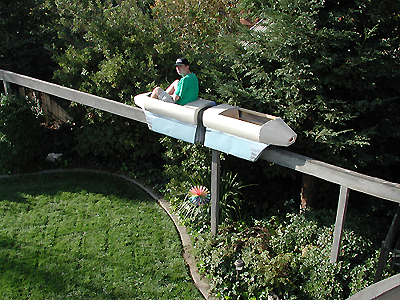
AC or not, that sure seems like it's very likely to be a photo of you. The page it's hosted on has a profile of you that is a damn good match: http://www.monorails.org/tmspa...
I'd be surprised if they posted a photo of someone else, but who knows.kinda weird... if you do a google search by image, using that image, one of the 23 results is Dwight from the office: with his police drawing of himself: https://pbs.twimg.com/media/CE...
-
Re:We've had an increase in gas prices...
I'm all for multi-modal. (second one down) Although I do have issues with at-grade rail in a metro area.
It just gets at me a bit when people want to raise the gas tax to extreme heights to fund mass transit. Some people don't realize how many services and goods they receive depend upon local trucks, vans and cars. In Washington State we tax by the gallon. The state DOT is hurting because now that cars get better mileage and more people are on transit, they are getting less tax money for the roads. Their solution is more tolls, which transit doesn't pay. The cost for transit needs to come from all people, not just those driving. Everyone benefits from a good road system, even if they bike, bus, or walk everywhere. In fact, it is just those roads that allow the downtown hipsters to work and live downtown. The roads bring civilization to them.
Do we have too many long-haul trucks on the road when those shipments could be better transported by rail? Yes. Does Seattle's current mayor's solution of more bike lanes in a city of hills, rain and an aging population help that much? No. Maybe because I live in an area that is a major port I see cargo transport as more in need of solutions. But I'm also out on the road during the working day and see a lot of service vans running around. Those are the "living wage" (barely) jobs that would take the biggest hit from high gas taxes. If you think a plumber costs a lot now, try it with $10/gal gas. Organic local eggs and veggies don't get to the store on a bike.
-
Re:Why?
If we had the monoral, I would say yes. One reason I moved out of the RTA was because of light rail.
check out http://monorails.org/
-
Yet another reason to rebuild our rail system.I agree that air travel is pretty screwed up. But afaic, for trips of a thousand miles or less we would be far better off focusing our attention on our equally fubared rail system. You want cheap, efficient transit, a system that goes straight from downtown to downtown? Join NARP, call your congress critter to not just increase funding but have their policy geeks pay more attention to rail, and damnit, if you're serious about being a geek, get into this stuff yourself. At this point we would gain more from having more folks get into designing better rail systems than yet one more programmer responding to yet another project call on Freshmeat. Get together with some friends and build your own monorail system. It's cheaper than most Burning Man projects and a far more effective way to freak the mundanes for years to come.
Amtrak has their head up their butt. But there are a hell of a lot of other transit systems out there. And they're all dealing with swiftly increasing demand. It's past time that we shone the spotlight on them.
-
Re:Um, that all depends on the usage...One big energy saving (and life saving) feature PRT (and monorails) have is that they are grade seperated. This is where most LRT fails.
-
WRONG
just disneyland alone has 2.5 miles that has ran since 1959. We are talking a train that runs every couple of minutes day in and day out. How many total miles has been traveled? a lot more than say Denver or Seattle or Houston. Yet, they have numerous accidents. Why? not due to distance, but due to mixing with traffic as well as sitting ON the rail. Most monorails (including all of disney's wrap the rail. It would literally have to have the rail dropped or hit a bomb to be derailed. EACH Disneyworld trains travel nearly 70K MILES each year. That means that each of these trains travel more than all of the denver RTD combined (up till the new extension, then it will take several of these trains to beat denver's total). And these are just 2 of disney's lines. It does not take into acocunt the lines that are opened in other countries which run far more miles.
-
Re:If BPL mucks w radio, it's not FCC prob
Yea Will, but it covers almost the whole HF spectrum. And
Now get back to http://monorails.org/ -
Maglev to the airportIt's been done in China.
Now, if people start acting more rationally about "terrorist threats" we might have shorter security-lines as well. Machine-readable passports and electronic tickets also help get through to a flight faster.
-
Look upDon't forget to leave space for monorails!
Seriously, once in a while I draw diagrams of things like this in my spare time, but having five or ten different services running the entire length of a 700-mile corridor does sound like colossal boondoggle. It also sounds like an invitation to terrorist attack.
A 4,000-mile road would have to cover a longer path; say from the Hudson Bay to Acapulco, going through Mexico City, Houston, Chicago and Milwaukee on the way.
-
Re:Why?
Monorail beamway has a significantly smaller footprint and blocks less sky than traditional elevated two-rail guideway. See pages 14/15 and 38/39 of this PDF for some pictures. Sorry, a quick google search did not return any web pages with pics.
If you compare it with at-grade two-rail, then the advantage is that an elevated monorail has no road crossings. Of course, this is true of any elevated transit system.
Note that the small beam makes monorail evacuations more difficult than elevated light-rail evacuation. For light rail, people can just walk to one end of the train and step out onto the guideway. The Las Vegas monorail system installed emergency walkways between the beams. Riders step out of the side train doors onto the walkway. Disney World does not have emergency walkways and evacuates to the roof of the train. You then walk across the top of the train to one end and shimmy down the windscreen to the beam, and then walk the beam. (The beam is 26 or 28 inches wide). No WDW monorail has ever been evacuated, although there was a train fire years ago in an old Mark IV train.
-
Re:Why?
True enough. I checked the monorails.org website and they've got a very complete list (slanted their way, of course) of the benefits of monorails over other forms of mass transit.
Monorails vs other forms -
Don't like the LVMonorail? Build your own!
Just like Kim Pedersen. Wired did a nice story on him a few months ago and now he's started the Monorail Society.
Cool! -
Re:If I'm Not Mistaken
-
Impractical Fantasy? Japan, Britain, Germany...
Impractical fantasy? Japan, Germany, Britain and many others all have them... Certainly not impractical nor a fantasy; more likely mismanagement of funds?
-
Re:Preplanning
I believe they state Jan 2004 per this page.
-
Re:Mono-Rails are cute...Monorails can handle a lot of people, reasonably quickly. It's true that they can't handle quite the same volume as a fully-packed subway, but a monorail line can handle as much traffic as a lane of a freeway. What's more, with maglev technology it is currently possible to reach speeds of 250 miles/hour, something that cars won't be able to do without major changes to the roads.
As far as I can see, no one has mentioned the Monorail Society's webpages yet.
-
Re:PreplanningBuilding monorails without interfering with traffic is not too hard. The pylons usually take the longest to install as the rails are constructed off site. Also, construction is a lot faster than compared with light rail and highway projects since they don't require the ripping up of roads.
You can check out some pics of the Las Vegas Monorail under construction here
-
Re:Seattle and public transit
GM more or less bought out the trolley system in Seattle, as well as several other cities in the US. Story
The Seattle Center monorail, as it stands, turns a profit every year and attacts over 2.5 million riders a year. Not bad for a line that's only 1 mile long. And no, not all of those riders are tourists. A lot of people park at the Seattle Center and ride the monorail into downtown for work on a daily basis. -
Backyard maglevI made a Maglev train in my backyard.
Check it out here
If it's down, then it's probably been slashdotted.
-
Re:Links
Monorails might have gotten more press if the LA County Supervisors had accepted Alweg's offer, back in 1963, to build a turnkey monorail transit system that would initially serve the San Fernando Valley, the Wilshire corridor, the San Bernardino corridor and downtown Los Angeles (see LA's Worst Transit Decision on the Monorail Society's website). But the decision was made not to implement anything, so today they've got a boondoggle of a 'subway' system.
-
Re:Not just a Disney idea.
The old trains running between MGM and Bally's were Ex-Disney Mk. IV's. The new trains are brand new Bombardier M-VI's and are the latest revision of the Disney design, including fully automated operation (no driver).
for more info check out: www.monorails.org
Austin -
Non-gimmick monorailsMy problem with monorails in general is that they are usually poorely implimented, they cost more then electric light rail, and above all - I've never seen one anywhere in the world where it was more then just a gimic used to attract tourists.
There are plenty of "real" high-capacity monorails, especially in Japan: Tokyo, Chiba, Tama, Osaka and Kitakyushu are the biggies, with more under construction even right now (eg. a new system in Naha, Okinawa). Malaysia is also investing heavily in monorails. See monorails.org for details.
Cheers,
-j. -
Re:Built by Bombardier Transportation SystemsAnother interesting link...
Here's an image of a Bombardier engineer giving a similar monorail a quick test run. Note the prototype's innovative energy-efficient air conditioning. The prototype doesn't have quite as much seating capacity as they expect in the final vehicle, but you get the general idea.
-
Oh, lord.Monorails again.
Sheesh. If monorails were really so good, they would be all over the place. But 200 years (okay, 198) years after Richard Trevithick invented the steam locomotive (btw, the , birail systems are quite prevalent throughout the known universe).
Must be their inherent simplicity and stability, no? If you really look around, there aren't really much monorails...
-
Re:thank you, everyone who posts without reading
here.
-
Links
A few cool mockups, and some more detailed maps.
http://www.monorails.org/tMspages/LasVegas.html
http://www.lvnvmonorail.com/ -
thank you, everyone who posts without readingFirst responses to the idea of a monorail almost always assume that it's a toy, but that mentality is only really present in the US, thanks to, of course, Disney. But stop and think about how many visitors their durable monorail systems carry, and those were designed decades ago. Modern monorails carry millions of passengers a day, mostly in Japan, where monorail technology has progressed in leaps and bounds.
So try to realise that this is real, effective transit, where it is desperately needed. Try to lay off the monorail jokes, and go visit The Monorail Society for more info.
-
Monorails in modern transitMonorails don't really have any place in modern transit. They don't really save any space advantage(the limiting factor is the width of the cars, not of the track) and they aren't any more efficient than your everyday lightrail or subway or whatever else you feel like building. In addition, they tend to be less efficient, and also less stable in turns and such.
The friendly folks at the Monorail Society might disagree with you on that. Monorails are an efficient solution for crowded cities, since they can be built in the air, and as (by definition) the car is wider than the track they use less space than light rail. Their speed and capacity are more than sufficient for most applications, and they cost a lot less than building subways. This is why there has been a bit of a monorail renaissance lately, with cities as diverse as Las Vegas, Chiba, Kuala Lumpur and Okinawa (Naha) building monorail systems.
Cheers,
-j. -
Re:Not a replacement for carsLarge cities can very much build this kind of infrastructure (the El in Chicago, umpteen monorail projects in Japan and elsewhere.
And as the article mentions, this kind of light weight guideway is less expensive to build than light rail (which itself, of course, is a lot less expensive than heavy rail/subway systems).
That means that you can build a big enough packet-switched transit network to compete with car use.
-
Re:Switching
Monorail.org has a nice page on how monorails switch.The short summary. Yes, it is possible using various techniques (flexible/segmented sections of monorail beam, beam replacement, etc.).
The page also explains that the "monorails can't switch" myth was due to a particularly bad and bulky implementation at Wuppertal, and that the myth has since been perpetuated by various shady sources such as Microsoft Encarta.
Monorail switches are *STILL* more complex than "normal" bi-rail switches. Their moving parts are such an important proportion of the total infrastructure that their mechanism will always be more onerous, complex, slow-moving and cumbersome than bi-rail switches.
This has profound impacts on many aspects, who all eventually touch safety:
- It takes longer to turn a switch.
A mainline bi-rail switch can be turned and secured in less than 30 seconds. - Monorail switches are quite bulky and complex, has they often
have to move
the whole track
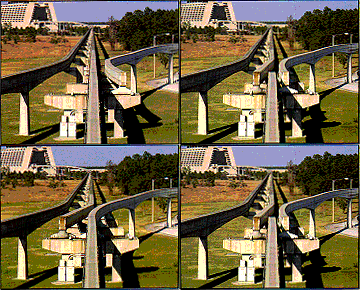
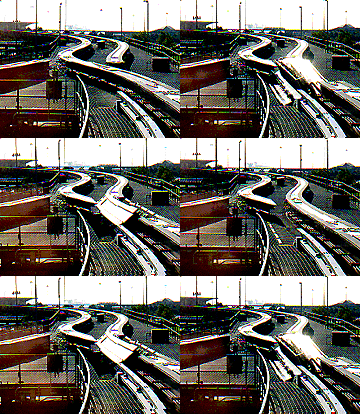
about (isn't that funny that those two pictures are taken
from the "switch myth"
page of the monorail.org
website???)
Birail switches mechanisms are wholly contained within the track cross section, and their actuating mechanism be very unobtrusive. - Since monorail switches have to move the whole track about,
the length of the switches is necessarly restricted to practicability,
and this has a direct bearing on the speed they can be negociated
in reverse position (the shorter they are, the slower you have
to go through).
The French Train à Grande Vitesse switches can be taken as fast as 150 miles per hour in reverse position. - Derailments on monorail will very often send the whole train
flying through the air, crashing below.
Birail derailments can be as benign as a wheel on the ground that can be re-railed within minutes by the train crew using a re-railer frog (the yellow Y-shaped tool near the rear of the engine - sorry, that's the best I could find in 10 minutes on Google). And birail viaduct tracks are required to have guard rails inside the track anyway to prevent derailed cars to leave the track. - Signalling systems must take account of this by having a longer safety margin where a train can be brought to a safe stop in case a switch doesn't turn properly.
- This means a greater distance between trains and thus a lower capacity for each track.
- By being more complex, switches are more expensive. In turn, there will be less switches on the network, making it less efficient and more difficult to go around a problem (like a disabled train).
- The single-beam track may seem sleek and more efficient than a heavy viaduct, but you *NEED* to have a way of quickly evacuating a train in case of emergency. So you will need a catwalk that is parallel to the tracks, the structure of which will destroy much of the sleekness of the beam track.
- It takes longer to turn a switch.
-
Re:Switching
Monorail.org has a nice page on how monorails switch.The short summary. Yes, it is possible using various techniques (flexible/segmented sections of monorail beam, beam replacement, etc.).
The page also explains that the "monorails can't switch" myth was due to a particularly bad and bulky implementation at Wuppertal, and that the myth has since been perpetuated by various shady sources such as Microsoft Encarta.
Monorail switches are *STILL* more complex than "normal" bi-rail switches. Their moving parts are such an important proportion of the total infrastructure that their mechanism will always be more onerous, complex, slow-moving and cumbersome than bi-rail switches.
This has profound impacts on many aspects, who all eventually touch safety:
- It takes longer to turn a switch.
A mainline bi-rail switch can be turned and secured in less than 30 seconds. - Monorail switches are quite bulky and complex, has they often
have to move
the whole track
about (isn't that funny that those two pictures are taken
from the "switch myth"
page of the monorail.org
website???)
Birail switches mechanisms are wholly contained within the track cross section, and their actuating mechanism be very unobtrusive. - Since monorail switches have to move the whole track about,
the length of the switches is necessarly restricted to practicability,
and this has a direct bearing on the speed they can be negociated
in reverse position (the shorter they are, the slower you have
to go through).
The French Train à Grande Vitesse switches can be taken as fast as 150 miles per hour in reverse position. - Derailments on monorail will very often send the whole train
flying through the air, crashing below.
Birail derailments can be as benign as a wheel on the ground that can be re-railed within minutes by the train crew using a re-railer frog (the yellow Y-shaped tool near the rear of the engine - sorry, that's the best I could find in 10 minutes on Google). And birail viaduct tracks are required to have guard rails inside the track anyway to prevent derailed cars to leave the track. - Signalling systems must take account of this by having a longer safety margin where a train can be brought to a safe stop in case a switch doesn't turn properly.
- This means a greater distance between trains and thus a lower capacity for each track.
- By being more complex, switches are more expensive. In turn, there will be less switches on the network, making it less efficient and more difficult to go around a problem (like a disabled train).
- The single-beam track may seem sleek and more efficient than a heavy viaduct, but you *NEED* to have a way of quickly evacuating a train in case of emergency. So you will need a catwalk that is parallel to the tracks, the structure of which will destroy much of the sleekness of the beam track.
- It takes longer to turn a switch.
-
Re:Switching
Monorail.org has a nice page on how monorails switch.The short summary. Yes, it is possible using various techniques (flexible/segmented sections of monorail beam, beam replacement, etc.).
The page also explains that the "monorails can't switch" myth was due to a particularly bad and bulky implementation at Wuppertal, and that the myth has since been perpetuated by various shady sources such as Microsoft Encarta.
Monorail switches are *STILL* more complex than "normal" bi-rail switches. Their moving parts are such an important proportion of the total infrastructure that their mechanism will always be more onerous, complex, slow-moving and cumbersome than bi-rail switches.
This has profound impacts on many aspects, who all eventually touch safety:
- It takes longer to turn a switch.
A mainline bi-rail switch can be turned and secured in less than 30 seconds. - Monorail switches are quite bulky and complex, has they often
have to move
the whole track
about (isn't that funny that those two pictures are taken
from the "switch myth"
page of the monorail.org
website???)
Birail switches mechanisms are wholly contained within the track cross section, and their actuating mechanism be very unobtrusive. - Since monorail switches have to move the whole track about,
the length of the switches is necessarly restricted to practicability,
and this has a direct bearing on the speed they can be negociated
in reverse position (the shorter they are, the slower you have
to go through).
The French Train à Grande Vitesse switches can be taken as fast as 150 miles per hour in reverse position. - Derailments on monorail will very often send the whole train
flying through the air, crashing below.
Birail derailments can be as benign as a wheel on the ground that can be re-railed within minutes by the train crew using a re-railer frog (the yellow Y-shaped tool near the rear of the engine - sorry, that's the best I could find in 10 minutes on Google). And birail viaduct tracks are required to have guard rails inside the track anyway to prevent derailed cars to leave the track. - Signalling systems must take account of this by having a longer safety margin where a train can be brought to a safe stop in case a switch doesn't turn properly.
- This means a greater distance between trains and thus a lower capacity for each track.
- By being more complex, switches are more expensive. In turn, there will be less switches on the network, making it less efficient and more difficult to go around a problem (like a disabled train).
- The single-beam track may seem sleek and more efficient than a heavy viaduct, but you *NEED* to have a way of quickly evacuating a train in case of emergency. So you will need a catwalk that is parallel to the tracks, the structure of which will destroy much of the sleekness of the beam track.
- It takes longer to turn a switch.
-
Re:Switching
Monorail.org has a nice page on how monorails switch.The short summary. Yes, it is possible using various techniques (flexible/segmented sections of monorail beam, beam replacement, etc.).
The page also explains that the "monorails can't switch" myth was due to a particularly bad and bulky implementation at Wuppertal, and that the myth has since been perpetuated by various shady sources such as Microsoft Encarta.
Monorail switches are *STILL* more complex than "normal" bi-rail switches. Their moving parts are such an important proportion of the total infrastructure that their mechanism will always be more onerous, complex, slow-moving and cumbersome than bi-rail switches.
This has profound impacts on many aspects, who all eventually touch safety:
- It takes longer to turn a switch.
A mainline bi-rail switch can be turned and secured in less than 30 seconds. - Monorail switches are quite bulky and complex, has they often
have to move
the whole track
about (isn't that funny that those two pictures are taken
from the "switch myth"
page of the monorail.org
website???)
Birail switches mechanisms are wholly contained within the track cross section, and their actuating mechanism be very unobtrusive. - Since monorail switches have to move the whole track about,
the length of the switches is necessarly restricted to practicability,
and this has a direct bearing on the speed they can be negociated
in reverse position (the shorter they are, the slower you have
to go through).
The French Train à Grande Vitesse switches can be taken as fast as 150 miles per hour in reverse position. - Derailments on monorail will very often send the whole train
flying through the air, crashing below.
Birail derailments can be as benign as a wheel on the ground that can be re-railed within minutes by the train crew using a re-railer frog (the yellow Y-shaped tool near the rear of the engine - sorry, that's the best I could find in 10 minutes on Google). And birail viaduct tracks are required to have guard rails inside the track anyway to prevent derailed cars to leave the track. - Signalling systems must take account of this by having a longer safety margin where a train can be brought to a safe stop in case a switch doesn't turn properly.
- This means a greater distance between trains and thus a lower capacity for each track.
- By being more complex, switches are more expensive. In turn, there will be less switches on the network, making it less efficient and more difficult to go around a problem (like a disabled train).
- The single-beam track may seem sleek and more efficient than a heavy viaduct, but you *NEED* to have a way of quickly evacuating a train in case of emergency. So you will need a catwalk that is parallel to the tracks, the structure of which will destroy much of the sleekness of the beam track.
- It takes longer to turn a switch.
-
Re:SwitchingMonorail.org has a nice page on how monorails switch.
The short summary. Yes, it is possible using various techniques (flexible/segmented sections of monorail beam, beam replacement, etc.).
The page also explains that the "monorails can't switch" myth was due to a particularly bad and bulky implementation at Wuppertal, and that the myth has since been perpetuated by various shady sources such as Microsoft Encarta.
-
Re:SwitchingMonorail.org has a nice page on how monorails switch.
The short summary. Yes, it is possible using various techniques (flexible/segmented sections of monorail beam, beam replacement, etc.).
The page also explains that the "monorails can't switch" myth was due to a particularly bad and bulky implementation at Wuppertal, and that the myth has since been perpetuated by various shady sources such as Microsoft Encarta.
-
Trollys didn't die!
Trollys didn't die, they are now called Light Rail. If you want to know why they are a bad thing, look at this page on the Monorail site. They deserved to die. Trollys/light rail has killed, and keeps killing people every year. The only safe transit is off-grade transit.
--
Joe Hamelin -
Yawn. Old hat.
Yawn... Old hat. Can't you slashdotters have a look at history? Otherwise, you'll be condemned at repeating it... badly.
First, a brief word about ekranoplanes (a.k.a. Wing-In-Ground effect). Here is an actual picture of such a beast in flight (Gerry Anderson fans will be delighted by this one). They have been around for almost 40 years, having been devellopped in the defunct Soviet Union . You may look at this page for historic information, as well as pictures of enormous ekranoplanes as well as the 400 ton Lun ICBM launcher . For those who worry about greenhouse gas emissions, there is also a pedal-powered WIG !!! Oh, yes, those craft are already covered by a Canadian regulation, proof that they've been around long enough to rouse the attention of regulators...
Now, about trains. Nothing really new, there either.
In the 1960's, french engineer Jean Bertin (1917-1975) pursued the développement of his ill-fated Aérotrain , which, 30 years before the recently-canned german Transrapid maglev, almost reached the realization stage (both in a commuter rail line betwen Paris and the western sububurb of Cergy, and a line between Lyon and Grenoble for the 1968 winter Olympic games). Bertin's Aérotrains ran on a single inverted T concrete rail, and used a cushion of air for sustentation. An early prototype, the Aérotrain expérimental 02 (which looks like it was inspired by this), reached the speed of 400 km/h in 1966 and 422 km/h in 1969 (not an impressive achievement, since at that time, the rail speed record was achieved in 1955, when an ordinary locomotive pulling four totally normal cars reached the speed of 331 km/h on a perfectly standard railroad line). More pictures are available here.
Despite that, Jean Bertin built more prototypes, and a 20 km long rail line (which still runs accross the countryside, completely abandoned) on which a much bigger "train", which ran not much faster than today's TGVs do (note that the record certificate is issued by the Fédération Aéronautique Internationale , and not the Union Internationale des Chemins de Fer
Bertin's Aérotrain technology almost got selected in place of the current TGV, but at the last minute, State support was withdrawn from the Société Bertin. The Aérotrain (and any other newfangled guided transportation system such as maglevs and monorails - we're in the real world, here, not in Disneyland) suffered most from gross incompatibility with existing rail lines (necessary to enter the core of cities) and an extremely heavy implementation of switches, which precludes their widespread use and thus reduces the flexibility of their rail networks.
Jean Bertin never recovered from the shock of losing State support; he died a few months later, despite having built a prosperous engineering company which still thrives in high-technologies.
Throughout the Aérotrain's history, the French National Railroads (SNCF)'s attitude was extremely interesting. Despite all the media hoopla that surrounded the Aérotrain and the political interest, it did not say anything at all. Not a single word either for or against the Aérotrain was uttered in official french railroad circles. But during that time, the SNCF worked hard at perfecting what is seen today as the epitome of high-speed travel technology, the TGV.
So, it is quite safe to say that this oldfangled flying "train" will certainly not fly very far, because the theorical speed limit of ground travel, the speed of sound, is within reach of conventionnal steel-wheel-on-steel-rail technology, which without much pain, ran at 515,3 km/h on May 18th 1990 (gee! Almost 10 years ago!!!).
(What is the speed of sound at 20C at sea level anyway???)
--
-
Yawn. Old hat.
Yawn... Old hat. Can't you slashdotters have a look at history? Otherwise, you'll be condemned at repeating it... badly.
First, a brief word about ekranoplanes (a.k.a. Wing-In-Ground effect). Here is an actual picture of such a beast in flight (Gerry Anderson fans will be delighted by this one). They have been around for almost 40 years, having been devellopped in the defunct Soviet Union . You may look at this page for historic information, as well as pictures of enormous ekranoplanes as well as the 400 ton Lun ICBM launcher . For those who worry about greenhouse gas emissions, there is also a pedal-powered WIG !!! Oh, yes, those craft are already covered by a Canadian regulation, proof that they've been around long enough to rouse the attention of regulators...
Now, about trains. Nothing really new, there either.
In the 1960's, french engineer Jean Bertin (1917-1975) pursued the développement of his ill-fated Aérotrain , which, 30 years before the recently-canned german Transrapid maglev, almost reached the realization stage (both in a commuter rail line betwen Paris and the western sububurb of Cergy, and a line between Lyon and Grenoble for the 1968 winter Olympic games). Bertin's Aérotrains ran on a single inverted T concrete rail, and used a cushion of air for sustentation. An early prototype, the Aérotrain expérimental 02 (which looks like it was inspired by this), reached the speed of 400 km/h in 1966 and 422 km/h in 1969 (not an impressive achievement, since at that time, the rail speed record was achieved in 1955, when an ordinary locomotive pulling four totally normal cars reached the speed of 331 km/h on a perfectly standard railroad line). More pictures are available here.
Despite that, Jean Bertin built more prototypes, and a 20 km long rail line (which still runs accross the countryside, completely abandoned) on which a much bigger "train", which ran not much faster than today's TGVs do (note that the record certificate is issued by the Fédération Aéronautique Internationale , and not the Union Internationale des Chemins de Fer
Bertin's Aérotrain technology almost got selected in place of the current TGV, but at the last minute, State support was withdrawn from the Société Bertin. The Aérotrain (and any other newfangled guided transportation system such as maglevs and monorails - we're in the real world, here, not in Disneyland) suffered most from gross incompatibility with existing rail lines (necessary to enter the core of cities) and an extremely heavy implementation of switches, which precludes their widespread use and thus reduces the flexibility of their rail networks.
Jean Bertin never recovered from the shock of losing State support; he died a few months later, despite having built a prosperous engineering company which still thrives in high-technologies.
Throughout the Aérotrain's history, the French National Railroads (SNCF)'s attitude was extremely interesting. Despite all the media hoopla that surrounded the Aérotrain and the political interest, it did not say anything at all. Not a single word either for or against the Aérotrain was uttered in official french railroad circles. But during that time, the SNCF worked hard at perfecting what is seen today as the epitome of high-speed travel technology, the TGV.
So, it is quite safe to say that this oldfangled flying "train" will certainly not fly very far, because the theorical speed limit of ground travel, the speed of sound, is within reach of conventionnal steel-wheel-on-steel-rail technology, which without much pain, ran at 515,3 km/h on May 18th 1990 (gee! Almost 10 years ago!!!).
(What is the speed of sound at 20C at sea level anyway???)
--