Slashdot Mirror
Domain: msha.gov
Stories and comments across the archive that link to msha.gov.
Comments · 23
-
Re:Blame the green lobby
Compare the actual physical damage done by dumping 110 million tons of coal ash into our back yards vs a few lobbyists sitting around chatting about nuclear power with congressional staffers over expensive lattes.
Interview the people who lived near Fukushima Daiichi and Chernobyl for a human perspective on nuclear power. Maybe concentrate on the survivors, as the dead tell no tales.Yes, let's compare nuclear and coal.
Per Wikipedia there were fewer than 10,000 deaths from Chernobyl.
Per the US Dept of Labor2016 was the first year with fewer than 100,000 coal miner deaths in the US. The peak 100 years ago was nearly 1 million per year.
So, yeah, lets compare 10,000 deaths from nuclear power to 10,000,000 deaths just from coal mining alone. I just can't believe how irrational people are about this topic.
-
Re:But they signed a meaningless piece of paper!
Jesus Mary and Joseph...
I didn't realize I was defending a doctoral thesis here..
deaths from coal mining: https://arlweb.msha.gov/stats/...
non-mining deaths from coal: http://www.catf.us/resources/p...
Air pollution and health, from the lancet: https://www.sciencedirect.com/...
deaths attributable to AGW, so much here I'm not going to pick one: google scholar link, knock yourself out.. https://scholar.google.com/sch...
deaths attributable to Chernobyl: https://en.wikipedia.org/wiki/.... I think you will find the numbers of the last link, are a tad smaller than the numbers in the first ones.
Now, would their be anything else, how was this morning's bowel movement, do you need me to go over your bum with a wet-wipe??? -
Re:And why not?
I'm not sure where you get that coal kills millions under 'normal opererations', but I do know that coal mining kills on the order of thousands per year, almost all of which is in China.
Quoting the whole of the 20th century for US coal mining deaths is misleading. To quote MSHA, "Total deaths in all types of U.S. mining, which had averaged 1,500 or more per year during earlier decades, decreased on average during the 1990s to under 100 per year, and reached historic lows of 35 total deaths in 2009 and 2012. "[1]
This wasn't by chance; regulators, companies, and miners made safety a high priority and their efforts have been successful in greatly reducing the fatality rate.
Safety is improving in China, too, with CPC claims 2014 saw the death rate dropped below 1,000 for the first time since the 1980s.[2]
Note that Uranium mining was hazerdous in the past, too, but safety efforts there have reduced the health risks. [3]
[1] http://www.msha.gov/MSHAINFO/F...
[2] http://www.mining.com/china-cl...
[3] https://en.wikipedia.org/wiki/... -
Re:Aliens
Simple industrial ( mining ) accident. I wonder of they have their own version of OSHA.
And by OSHA, you mean MSHA.
-
Re:Sure, to lower paying jobs
Yeh, it sure will be great to see kids under corporate management, free from the awful dysfunction of an incompetent, indifferent bureaucracy full of power-hungry sociopaths trying to make themselves look good, without regard to the quality of their product.
After all, corporations have always treated children very well indeed.
-
Re:It was a good launch
Surprisingly, if failure is measured in terms of human deaths, fairly high failure rates are tolerable in many branches of engineering. It was assumed that about 5 people would die in the construction of a tall sky scraper. Now, with massive changes in safety, it is possible to build a sky scraper with no deaths. However, injuries still happen.
Similarly, mining regularly kills people. They have reduced their deaths per year from several thousand (1907) to averaging 6/year (2001-2005). See government records for details.
Manufacturing regularly hurts people, with occasional fatal accidents. Same with forestry.
Space travel is relatively safe compared to some of the shit jobs out there, particularly in places with lax safety records, like China. It helps that the average astronaut trainee doesn't actually make it into space.
-
Re:Hmmm... Let's see...
IANAME, but, from what I know:
Some mines use electric powered equipment, but many don't. Ventilation, if designed right and maintained well, means diesel equipment can be OK. Coal mines are special cases, because of the danger of (undesired) explosions, but hard-rock mines have no danger as far as that goes.
Electrics are better in terms of maintenance, AFAIK, mean a cheaper ventilation setup, and avoid a whole category of risk for the workers, so they do seem like a very good choice.
The problem is with design and maintenance, though.
Design often suffers because the engineers involved lack a real understanding of and appreciation for the problem of ventilation.
Maintenance is a headache, because the tubing gets torn apart all the time - there's no easy way around this, given that the tubing and heavy equipment are sharing the same confined space (this is an especially dramatic example). The tubing, therefore, needs to be regularly repaired. It's the responsibility of the engineers and management to make sure that happens, but the workers bear some responsibility, too. Lack of appreciation of the danger along with bonuses paid by the tonne of ore broken mean miners can be just as willing as management to overlook safety issues.
The real key, I think, is
- good design, at the outset and as the mine grows; and
- a strong safety cultureA mine with those two characteristics - and there are a lot of them - will do fine. If either one is missing, there will be trouble. There's no getting around the fact that underground is a dangerous environment, and only a rigourous attention to safety will make mines safe. Good news, though: that has been happening.
-
Re:guilty eh?
48 in 2009? I wouldn't complain. It's in the same ballpark as mining deaths in the same year (34). I think that in most police manuals there's a section about use of force, and sending a SWAT-like group after a guy who is not known to be dangerous is preposterous.
-
Re:Not much and nothing?
I never said, nor implied that coal ash was more radioactive than spent nuclear fuel. That said, over the lifetime of burning coal, there is much more radiation released to the environment. And directly into the atmosphere. And... oh wait, many fewer people regularly die working for nuclear fuel. There are 70 or so people who die each year in mining accidents, as well as 12,000 or so injured, and as coal is the main thing that is mined, it's the main cause of those deaths and injuries.
The article you cite as a source is sloppy journalism at best, and just like you, completely ignores reality. He complains that the author of the article he's criticizing says you get more radiation from fly ash than from shielded nuclear waste, and how that's not far. The problem is that THAT IS REALITY. That's how things are done, right now, this very instant. So coal ash most certainly DOES emit more radiation than nuclear waste, because it's not shielded, it's just dumped. Period, end of story. And that's just the fly ash... what about the shit that's pumped into the atmosphere? Repeat after me, "clean coal is a myth."
It's not propaganda if you disagree with it. It's still a fact. I have yet to meet anyone who can tell my how coal is better than nuclear power using ANY kind of actual science, statistics or research. The word "nuclear" should not scare you. It should scare you less than "coal" or "oil shale" or many other forms of traditional energy. If it doesn't, you have a serious disconnect with facts and an irrational fear of high-energy particles, most likely based on ignorance.
-
Call me when this accident...
... kills as many people as the coal-mining industry did in its best year to date (2005).
-
Re:So much for the safety of nuclear energy
Actually, there is pretty good data on the deaths directly associated with coal mining at least. See here. This data only goes back to the 30s when most of the miners had already unionized in the U.S. That's significant because on the top of their list when striking were things like an 8 hour work day, and being paid to construct safety equipment. The status quo was that miners only got paid for tons of coal and didn't get paid to create construction equipment. All told, in excess of 100k people have died directly due to coal mining accidents.
Oh, by the way, since you went off on the "anti-nuclear hippies", I'd just like to point out an example of a conservative lifestyle choice leading to deaths: in 2007 there were 613 accidental gun deaths and ~18,000 injured, and if you keep a gun in your home, you are four times as likely to shoot yourself or your family than use it in self defense. The point is that people act irrationally sometimes, not just liberals or conservatives. -
Re:Good move...
there is zero chance you'll be able to come up with a convincing case for one oil rig being less dangerous to workers than any practical size of wind farm
The grandparent post is definitely talking out his ass, but it's an interesting question, so I ran the numbers myself.
No question more people die mining coal than running wind power, but since coal is a much bigger industry, I think the fairest comparison is number of accidental deaths per unit electricity produced.
US coal mine deaths, 2005-2009: 30/year
http://www.msha.gov/stats/charts/coal2009yearend.asp
US coal energy produced, 2008: 22.4 quads (or exajoules)
Heat -> Electricity efficiency factor: 30%https://publicaffairs.llnl.gov/news/energy/energy.html
US energy from coal: 6.7 exajoules/year
Worldwide wind power deaths, 2000-2006: At least 15, avg 2.7/year
http://www.windaction.org/documents/1318Worldwide wind power installed capacity, avg 2001-2006: 40,000 MW
http://www.wwindea.org/home/index.phpAverage capacity factor for wind plants: 25%
Estimated world wind energy output, 2001-2006 avg: 0.32 exajoules/year
Bottom line:
US Coal mining deaths per exajoule electricity produced: 4.5
World wind power deaths per exajoule electricity produced: at least 8.4Surprised? I sure was! I expect the wind power number to drop dramatically as the industry develops, of course.
-
Re:Oh, my God. Oh, God, no!
There was a pretty steady decline in US coal mining deaths until they plateaued around 2000. They might be heading down again now though. http://www.msha.gov/stats/centurystats/coalstats.asp The Mine Safety and Health Administration does try to learn from past accidents but coal mining remains an unsafe occupation. Things may also get worse as Appalachian coal declines in quality and mining gets more technically challenging or a shift to western open pit mining may help out.
-
Re:extinction of zinc?
I agree with a lot of what you said up there, but I feel I must quibble with your touting Chinese efficiency of coal mining. One of the reasons they move so much rock is because labor is a seemingly disposable resource for them. Last year China had 3,786 coal mining fatalities in 2007 (down 20% link). In the US there were 66 total mining fatalities in the US (34 in Coal mining link). Otherwise, good post.
-
Nuclear Plants a danger?
Ah yes, people died so Nuclear energy is dangerous! Talk about FUD, Lets see how safe how great COAL mining is!
Stats are here for coal mining in the US alone. You get around 30 people dying AND 2000+ injuries (or 5% of the work force) is involved in something harmful to their health EVERY YEAR.So WTF is dangerous about Nuclear power plants now?
-
Re:To be expected, of course, but...
Yeah, extreme accidents like the 56 deaths from Chernobyl totally outweigh non-nuclear events such as the Bhopal chemical spill which killed a mere 3,800 people. Heck, it outweighs the average US death rate from coal mining of 45 a year.
In order to have a chernobyl style event in a modern, properly designed reactor*, more than 12 major systems have to simultaneously fail. Heck, 3MI, which was built before Chernobyl, was a better design.
*Chernobyl was more flawed than the Galaxy class's warp core -
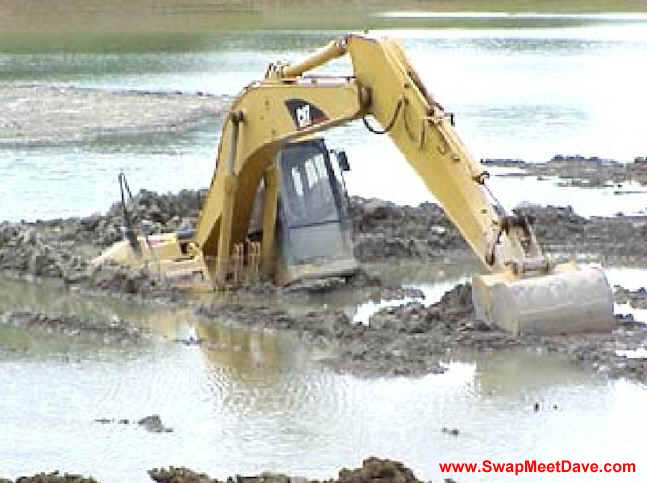
Take Revenge on the Almighty BackhoeAll you need is a lot of mud and water...
http://www.swapmeetdave.com/Humor/Insurance/Backh
o eA.jpg
http://www.msha.gov/fatals/1999/fatalgif/ftl99m21. gif -
Re:FailsafesThere are several different mechanical brake types used in elevators. Some use no cables, others use a separate cable which is dedicated only to the braking system, and is in no way related or dependent on tension from the lifting cables.
Here's a quick googled link for just one of the systems that uses an independent cable system: http://www.msha.gov/S&HINFO/TECHRPT/HOIST/PAPER5.
H TM. That's just one type, there are several others. -
Re:Meltdown proof? Hah!
the number of civilians killed in nuclear accidents at power plants is... zero.
Define U.S. Nuclear Reactors.
Define "civilians"? You first.
You want to add operators too? Fine. We'll add these 3 deaths in from 30 years ago and then compare to the 30 or so people who die every year just in coal mine accidents. Do you still want to pursue this line?
-
Re:No matter..
Guess what dude. S*it happens. Steam turbines in coal or gas power plants blow up. Heck, steam boilers blow up. People get lung problems from coal dust. Gas blows up. Dams burst. Windmills kill birds. The question is: is nuclear power better than the alternatives, i.e. do the benefits outweight the faults or not. Versus fossil fuels the answer seems to be a definite yes. Cleaner air, has sources in stable countries, etc.
-
Made up statistic
for each coal plant in the US one coal-miner is killed each year in an accident
Only 30 people died in Coal Mining Accidents last year. There are 1586 Electrical plants that use coal. That's one death for every 53 plants.
It only took about 1 min using google to find this data, next time please research your fantastic claims.
http://www.msha.gov/stats/charts/coaldaily.asp -
Re:You're missing the point there
Whether you consider nuclear power or coal burning safer depends on your values.
- Coal-burning has killed tens of thousands, but they're poor, uneducated rural miners. Screw 'em!
- But nuclear power could kill us wealthy, college-educated urbanites. It's "Evil"!
Try this experiment on your local anti-nuclear activist:
- Get them to tell you all about Three Mile Island, the worst civilian nuclear accident in the United States (where no one died). Let them really gush.
- Then ask them about, say, the disaster at the Willow Creek coal mine last month (collapse/fire/explosion with two killed, eight hospitalized). Expect a blank look.
So are you really anti-nuclear to save human life or, more precisely, to save elite techie yuppie lives in exchange for the deaths of faceless mine workers?
"Let's use wind and solar and flower power!" is a bogus cop-out. For a couple decades, nuclear and coal are the main, available options. Pick one.
And give the Mine Safety and Health Administration a careful scrutiny before you go on and on about the dangers of nuclear power.
-
Re:You're missing the point there
Whether you consider nuclear power or coal burning safer depends on your values.
- Coal-burning has killed tens of thousands, but they're poor, uneducated rural miners. Screw 'em!
- But nuclear power could kill us wealthy, college-educated urbanites. It's "Evil"!
Try this experiment on your local anti-nuclear activist:
- Get them to tell you all about Three Mile Island, the worst civilian nuclear accident in the United States (where no one died). Let them really gush.
- Then ask them about, say, the disaster at the Willow Creek coal mine last month (collapse/fire/explosion with two killed, eight hospitalized). Expect a blank look.
So are you really anti-nuclear to save human life or, more precisely, to save elite techie yuppie lives in exchange for the deaths of faceless mine workers?
"Let's use wind and solar and flower power!" is a bogus cop-out. For a couple decades, nuclear and coal are the main, available options. Pick one.
And give the Mine Safety and Health Administration a careful scrutiny before you go on and on about the dangers of nuclear power.