Slashdot Mirror
Domain: msss.com
Stories and comments across the archive that link to msss.com.
Comments · 139
-
Settle questions
such as whether there are volcanoes active today on the surface of Venus
A non-question. Venus is much more volcanically active than earth. It is covered with volcanoes and lava flows. We have seen their morphological and thermal signatures by the thousands. Move on, for goodness sake. Say you want to explore Venusian volcanoes. Like the recent "discovery" of H2O seeps on Mars. Nothing new. They were noticed 16 years ago!. The recent results just added to the evidence.
-
Re:So, when are we going to send tunnel-bots?
There are lots of these to investigate: http://www.msss.com/mars_image...
-
Re:So, when are we going to send tunnel-bots?
Orders of magnitude more difficult to reach, far more difficult terrain to rover, far narrower communications windows...
Orders of magnitude more difficult to reach? I doubt that.
Some of these canyons are very wide, with large flat bottoms, but you don't even have to go for the worst canyons
just the most interesting ones. http://www.msss.com/mars_image...
The radar directed skycrane mechanism used for Curiosity, with a little more fuel could probably drop in much tighter quarters that they've been willing to try so far.We've got enough orbiters that the communications windows are also less of a problem.
I think the rovers need bigger diameter wheels. It would reduce wheel wear and wheel loading, and allow traversing much more cluttered ground, and perhaps steeper slopes. -
It doesn't run Crysis
Screw atmospheric gasses. The Mars Science Laboratory will take hours (yes, hours) of true color (yes, color, no blurry black-and-white shit) real-time (yes, real-time, no silly little frame sequences) HD (yes, high-friggin-definition) stereoscopic (yes, stereoscopic, aka 3D) video on Mars. Didn't come in your pants yet? That's why they leave the camera on during atmospheric descent, baby!
-
Re:Noachian Period?
Oh yeah. This page at Malin Space Science Systems has a nice explanation of how the crater densities work to determine the age.
-
NASA geeks need a how-to guide at last?
Here is how you can beat the ban of humans on Mars:
Just go lobby the Congress into believing that the arid, Afghanistan-looking planet is a socialist state that painted itself all red, supplies illegal immigrants and exports products that could cause severe health problems. You don't even need to suggest it is in development of nuclear weaponry, once Mars gets the attention, any journalist looking for quick fame will release a "breaking news" that our spy satellites have found bomb testing sites. Not to mention the famous "they'll follow us home" scenario study with countless versions of simulations that can be slipped into the appendix section.
Then in no time you will see some 250,000 men up on the planet automatically without NASA having to spend/ask for a dime. -
Re:Here's data you missed in your links..
http://www.msss.com/mars_images/moc/CO2_Science_r
e l/
Your list like many list only one side of the data. None of the links are to any data supporting influences other than human caused theories. Is there any way humans and their activity is causing global climate change on Mars also? How much of our change is from humans and how much is from the Sun?
Here on Slashdot with the scientific community, I was hoping for a full data set instead of lists of polarized data sets.
Be fair, don't omit data that does not support your theory. It is part of the equasion and part of the overall picture. Don't leave relevant data out. -
There are already many images available
My professor that I am working under has been studying images here for the past few years. Whatever you might gain from these other images is not likely to be that much more than what was already publicly available. I personally haven't been doing any work on these, as I am just coding a side project for him, but from what he's told me, its not very useful to have these images without any kind of elevation model, using stereographic cameras or lasers and such (from a structural geology point of view).
-
Not a new result
This is not news worthy in the least. It has been several years since groundwater seeps have been observed by the MOC camera on Mars Global Surveyor.
-
They're not dust or sand...
because these look nothing like known dry dust flows on Mars.
http://www.msss.com/mars_images/moc/2006/12/06/gul lies/not_dust/index.html
Just look at the pictures of dry dust flows, and you'll have to say that these most definitely are not sand gullies.
True, they haven't figured out what causes "light" sand streaks, either. But those light sand streaks don't seem to change be formed within a few years, which makes this remarkable in its own way for being the first known "light" streak formed recently.
I'm skeptical to say that this is the "smoking gun" for liquid water on Mars they'd like to make us think, but it sure looks like evidence of something very *liquid* very *recently*. -
Re:INNACURATE! This is Hype!
True. Alternatives are *possible*. However, the trick is, the deposits do look different from other, known deposits produced by dust avalanches elsewhere on Mars, and, furthermore, the erosive channel systems above the deposits look consistent with a water interpretation and seepage from underground, rather than a "dry debris flow" interpretation (e.g., the channels converge at the top in tributary systems and meander towards the bottom on lower slopes, which is more characteristic of fluids than dry flows).
Here's the NASA press release with some pictures. There are many more pictures at the Malin Space Science Systems web site (they're the ones that ran the MGS until it was lost a few weeks ago). Also at the same time as the "possible water" press release, they were releasing information on recent cratering -- i.e. craters formed within the last few years. The published article is supposed to be in the Dec. 8 issue of Science, but it isn't released yet and you'll probably need a subscription to read it when it is. -
Re:I call shenanigans
Implicit in your assumption is that a mission is operated solely by NASA civil service employees, which is a handy assumption for your flip answer, but meanwhile, back in the real world, that's not the case. I'll grant that the people who will be affected have some warning, but I guarantee you Griffin and Co. are already planning on where to reallocate the extended mission money if and when they declare MGS dead. That money doesn't all go to NASA facilities. The science operations for the Mars Orbiter Camera goes to a small company and the Thermal Emission Spectrometer money goes to Arizona State's Mars Space Flight Facility, a place I worked for 4 years and personally witnessed several people get laid off in early '06 because of NASA reallocation for the new manned program and to pay for hurricane damages to NASA facilities.
Yeah, I'm sure the people who got laid off worked something out, and the people who will get laid off will work something out, too. You can continue to choose to "call shenanigans" all you want, but you asked a question, I answered, you didn't like the answer and decided to wave it away with flippant handwaving. This has effects on real people and your "rational ignorance" becomes willful ignorance if you choose to continue to deny it.
-
happy snaps in-orbit.
mr2cents - it's been done before and while the timing is no doubt a bitch, it's quite possible.
linky
One Mars Orbiter Takes First Photos of Other Orbiters
Photographs from NASA's Mars Global Surveyor spacecraft released today are the first pictures of any spacecraft orbiting Mars ever taken by another spacecraft orbiting Mars.
The new images of the European Space Agency's Mars Express and NASA's Mars Odyssey are available on the Internet from NASA at http://www.nasa.gov/vision/universe/solarsystem/mg s-images.html and from Malin Space Science Systems, the San Diego company that built and operates the camera, at http://www.msss.com/mars_images/moc/2005/05/19/ind ex.html .
Of course, if all they see is a smear of debris, well I guess they know they won't be getting any more data. -
Re:Impressive resolution
Am I thinking of the same hardware as you? I'm talking about the MRO Mars Color Imager...
Here -
Free data
And if anyone has ever stumbled upon the big online archive of the Mars Global Surveyor images, they would be amazed at the sheer amount of raw image data that is available.
Or here. I agree. The NASA missions are very open about releasing raw data. It is something to be proud of.
-
Not the only face on mars!
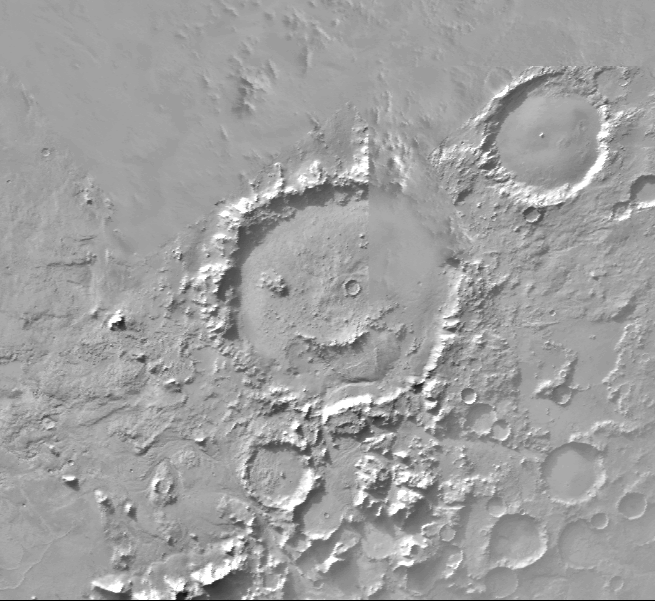
What about the "other" face on mars-- the happy crater! It's much more clearly a face than that pesky cydonian mesa. http://www.msss.com/education/happy_face/happy_fa
c e.html -
Re:well
While I'm always up for an opportunity to bolster my sense of baseless, nationalistic superiority, NASA's had some strings of bad luck, too.
The Loss of Mars Observer. Oops.
Whatever Happened to the Mars Polar Lander? Double Oops.
NASA's metric confusion caused Mars orbiter loss. Durh...
Space exploration -- even just putting stuff into orbit -- is a risky proposition at the best of times. Any agency pushing the envelope of what they've done before is bound to have some failures, but this is sometimes the price you pay for eventual success. -
"Happy Face" way better than "The Face"Since Kynn told me to check out the "so-called face" on Mars, I was much obliged.
Unfortunately, after sorting through the list of stories and finding #116 (The Face on Mars) and #118 (The So-Called Face on Mars), I could only make out the mound when looking in infrared. Also confusing is that two different locations are given (40.68N, 9.54W & 40.75N, 9.46W with the latter looking to be the correct location).
The level of detail you can see is not very high so you really shouldn't check out the face; just visit one of the above websites.
Instead of that boring face, check out The Happy Face Crater (#117 in the list of stories). Now that is one content crater. Put that image in tie-dye relief colors, screen it on a t-shirt and you've got one product that will sell to millions of hippies world-wide.
Let me see, if I know my European history, here's the business model
1. Send explorer, make him bring back maps with everything named in my language. Check.
2. Identify resources.
3. Send less friendly "traders" to said foreign land & requisition land from natives by asking chiefs to sign "treaties" in a language they don't understand (legalese).
4. Make sure the rest of the world doesn't know what you're doing. Masks of philanthropy or the spread of some major religion work the best.
5. Do not forget that manpower is a resource and is yours for the taking. The best kind of manpower is free manpower.
6. Sap land of all resources (Profit!).
7. Discard
When I looked at the map, I didn't see any dividing lines or (most importantly) flags. Does anyone want to visit Mars to open trade and represent king eldavojohn?
I'm reminded of a Cecil Rhodes Quote:"I would annex the planets if I could."
-
"Happy Face" way better than "The Face"Since Kynn told me to check out the "so-called face" on Mars, I was much obliged.
Unfortunately, after sorting through the list of stories and finding #116 (The Face on Mars) and #118 (The So-Called Face on Mars), I could only make out the mound when looking in infrared. Also confusing is that two different locations are given (40.68N, 9.54W & 40.75N, 9.46W with the latter looking to be the correct location).
The level of detail you can see is not very high so you really shouldn't check out the face; just visit one of the above websites.
Instead of that boring face, check out The Happy Face Crater (#117 in the list of stories). Now that is one content crater. Put that image in tie-dye relief colors, screen it on a t-shirt and you've got one product that will sell to millions of hippies world-wide.
Let me see, if I know my European history, here's the business model
1. Send explorer, make him bring back maps with everything named in my language. Check.
2. Identify resources.
3. Send less friendly "traders" to said foreign land & requisition land from natives by asking chiefs to sign "treaties" in a language they don't understand (legalese).
4. Make sure the rest of the world doesn't know what you're doing. Masks of philanthropy or the spread of some major religion work the best.
5. Do not forget that manpower is a resource and is yours for the taking. The best kind of manpower is free manpower.
6. Sap land of all resources (Profit!).
7. Discard
When I looked at the map, I didn't see any dividing lines or (most importantly) flags. Does anyone want to visit Mars to open trade and represent king eldavojohn?
I'm reminded of a Cecil Rhodes Quote:"I would annex the planets if I could."
-
most powerful camera?
Why is the new camera with a resolution of 1 metre better than the current camera on Mars Global Surveyor, which is able to deliver some images with a resolution of 50 cm? See here for example pictures with this resolution.
-
Definitely Not The Crash Site
It looks more like the face on Mars.
-
Funny you should mention Mars"Like thing else in the solar system"?
This stuff looks a great deal like features found all over Mars, just enormously more concentrated, and steeper. (Notice particularly the flat-bottomed craters on hillsides and on the right side of the image.) Of course the mechanisms normally proposed for the Martian features ("collapse pits") are inconceivable applied to identical features on Hyperion. That doesn't reduce the objective similarity, of course, but it makes those mechanisms much less plausible for the Martian features.
The notion that the straight lines on Tethys are fault lines is nothing short of ludicrous. Any fractures it has (a) would have no reason to be straight, and (b) wouldn't selectively attract meteorite craters centered along them. Carving by oblique impacts is even worse; butter would not slice out that cleanly, they wouldn't follow up and down hills with occasional wide/deep spots, and there's still the problem of round craters preferentially centered on them.
The only plausible source of geometrically straight lines on a body like this is geometric: rotation past an external reference.
The electromagnetic environment around Saturn is certainly busy enough to make electric arcing a mechanism worth investigating. That would explain the craters along the lines -- each records a spike of current flow -- and the oddly-shaped excavation at the end. The length of each line, coupled with the (approximate) rotation rate, reveals the duration of the arcing, the rate of excavation, and (thereby) the approximate current involved.
-
Funny you should mention Mars"Like thing else in the solar system"?
This stuff looks a great deal like features found all over Mars, just enormously more concentrated, and steeper. (Notice particularly the flat-bottomed craters on hillsides and on the right side of the image.) Of course the mechanisms normally proposed for the Martian features ("collapse pits") are inconceivable applied to identical features on Hyperion. That doesn't reduce the objective similarity, of course, but it makes those mechanisms much less plausible for the Martian features.
The notion that the straight lines on Tethys are fault lines is nothing short of ludicrous. Any fractures it has (a) would have no reason to be straight, and (b) wouldn't selectively attract meteorite craters centered along them. Carving by oblique impacts is even worse; butter would not slice out that cleanly, they wouldn't follow up and down hills with occasional wide/deep spots, and there's still the problem of round craters preferentially centered on them.
The only plausible source of geometrically straight lines on a body like this is geometric: rotation past an external reference.
The electromagnetic environment around Saturn is certainly busy enough to make electric arcing a mechanism worth investigating. That would explain the craters along the lines -- each records a spike of current flow -- and the oddly-shaped excavation at the end. The length of each line, coupled with the (approximate) rotation rate, reveals the duration of the arcing, the rate of excavation, and (thereby) the approximate current involved.
-
Funny you should mention Mars"Like thing else in the solar system"?
This stuff looks a great deal like features found all over Mars, just enormously more concentrated, and steeper. (Notice particularly the flat-bottomed craters on hillsides and on the right side of the image.) Of course the mechanisms normally proposed for the Martian features ("collapse pits") are inconceivable applied to identical features on Hyperion. That doesn't reduce the objective similarity, of course, but it makes those mechanisms much less plausible for the Martian features.
The notion that the straight lines on Tethys are fault lines is nothing short of ludicrous. Any fractures it has (a) would have no reason to be straight, and (b) wouldn't selectively attract meteorite craters centered along them. Carving by oblique impacts is even worse; butter would not slice out that cleanly, they wouldn't follow up and down hills with occasional wide/deep spots, and there's still the problem of round craters preferentially centered on them.
The only plausible source of geometrically straight lines on a body like this is geometric: rotation past an external reference.
The electromagnetic environment around Saturn is certainly busy enough to make electric arcing a mechanism worth investigating. That would explain the craters along the lines -- each records a spike of current flow -- and the oddly-shaped excavation at the end. The length of each line, coupled with the (approximate) rotation rate, reveals the duration of the arcing, the rate of excavation, and (thereby) the approximate current involved.
-
Re:Nasa?
Malin Space Science Systems http://www.msss.com/ is the company that runs the cameras on MGS, among other Mars probes. The MGS uses VxWorks, a specialized OS for robotic craft, which I believe runs on both *nix and Windows. I think VxWorks is OSS, although I also think some companies use customized versions. The specs for MGS http:///http://mars.jpl.nasa.gov/mgs//scsys/cdhsi
n fo.html> indicate two 1750A and one 8086 processors, which are probably running VxWorks in a Unix-like environment. The 1750A is a military standard processor (exceedingly old now, but rugged). Check out that specs page; very interesting. In safe mode, MGS uses 20K PROM for the Command/Data subsystem! Since Malin website indicates jobs for Unix/C programmers, I'm assuming that their stuff is running in VxWorks in a Unix-like environment, probably a BSD varaiant. BTW, the Mars rovers use a PPC 601-like chip that runs at a screaming 20 mHz. -
Could they land here?
http://www.msss.com/moc_gallery/m07_m12/maps/M08/
M 0804688.gif
I'd really like to see those bushes at higher resolution... -
To answer your question....
I dont know. I find it frustrating that the article provides just about no details. However, I did a quick Google search, and came up with this:
http://www.msss.com/mars_images/moc/june2000/
And:
http://www.space.com/scienceastronomy/solarsystem
/ mars_ice_signs_010614.htmlThe first page is dated in the year 2000! I wonder if this is really news after all! The second page is dated 2001. It states basically the same thing as the article the submitter linked to, however it says how long ago "recent" is--10,000,000 years!!
-
Re:how did we miss that before?
This feature has been imaged before.
-
Re:how did we miss that before?
We've seen such things before, and we've known that water ice exists at the poles. I'm fairly sure this crater has been the subject of a peer-reviewed paper in the past, but I haven't done a complete search of the literature, and I'm not sure the HRSC people have either. MGS MOC saw this crater as early as 2000 (and possibly early).
http://www.msss.com/moc_gallery/e01_e06/images/E03 /E0302478.html
http://www.msss.com/moc_gallery/m19_m23/images/M23 /M2301915.html
http://www.msss.com/moc_gallery/m19_m23/images/M20 /M2001204.html
http://www.msss.com/moc_gallery/e01_e06/images/E02 /E0200677.html
(there are more, but I don't feel like posting all of them. .
http://adsabs.harvard.edu/cgi-bin/nph-bib_query?bi bcode=1976Sci...194.1341K&db_key=AST&data_type=HTM L&format=
http://www.sciencemag.org/cgi/reprint/1080497v1.pd f
http://scholar.google.com/scholar?q=water+ice+mart ian+crater&ie=UTF-8&oe=UTF-8&hl=en&btnG=Search -
Re:how did we miss that before?
We've seen such things before, and we've known that water ice exists at the poles. I'm fairly sure this crater has been the subject of a peer-reviewed paper in the past, but I haven't done a complete search of the literature, and I'm not sure the HRSC people have either. MGS MOC saw this crater as early as 2000 (and possibly early).
http://www.msss.com/moc_gallery/e01_e06/images/E03 /E0302478.html
http://www.msss.com/moc_gallery/m19_m23/images/M23 /M2301915.html
http://www.msss.com/moc_gallery/m19_m23/images/M20 /M2001204.html
http://www.msss.com/moc_gallery/e01_e06/images/E02 /E0200677.html
(there are more, but I don't feel like posting all of them. .
http://adsabs.harvard.edu/cgi-bin/nph-bib_query?bi bcode=1976Sci...194.1341K&db_key=AST&data_type=HTM L&format=
http://www.sciencemag.org/cgi/reprint/1080497v1.pd f
http://scholar.google.com/scholar?q=water+ice+mart ian+crater&ie=UTF-8&oe=UTF-8&hl=en&btnG=Search -
Re:how did we miss that before?
We've seen such things before, and we've known that water ice exists at the poles. I'm fairly sure this crater has been the subject of a peer-reviewed paper in the past, but I haven't done a complete search of the literature, and I'm not sure the HRSC people have either. MGS MOC saw this crater as early as 2000 (and possibly early).
http://www.msss.com/moc_gallery/e01_e06/images/E03 /E0302478.html
http://www.msss.com/moc_gallery/m19_m23/images/M23 /M2301915.html
http://www.msss.com/moc_gallery/m19_m23/images/M20 /M2001204.html
http://www.msss.com/moc_gallery/e01_e06/images/E02 /E0200677.html
(there are more, but I don't feel like posting all of them. .
http://adsabs.harvard.edu/cgi-bin/nph-bib_query?bi bcode=1976Sci...194.1341K&db_key=AST&data_type=HTM L&format=
http://www.sciencemag.org/cgi/reprint/1080497v1.pd f
http://scholar.google.com/scholar?q=water+ice+mart ian+crater&ie=UTF-8&oe=UTF-8&hl=en&btnG=Search -
Re:how did we miss that before?
We've seen such things before, and we've known that water ice exists at the poles. I'm fairly sure this crater has been the subject of a peer-reviewed paper in the past, but I haven't done a complete search of the literature, and I'm not sure the HRSC people have either. MGS MOC saw this crater as early as 2000 (and possibly early).
http://www.msss.com/moc_gallery/e01_e06/images/E03 /E0302478.html
http://www.msss.com/moc_gallery/m19_m23/images/M23 /M2301915.html
http://www.msss.com/moc_gallery/m19_m23/images/M20 /M2001204.html
http://www.msss.com/moc_gallery/e01_e06/images/E02 /E0200677.html
(there are more, but I don't feel like posting all of them. .
http://adsabs.harvard.edu/cgi-bin/nph-bib_query?bi bcode=1976Sci...194.1341K&db_key=AST&data_type=HTM L&format=
http://www.sciencemag.org/cgi/reprint/1080497v1.pd f
http://scholar.google.com/scholar?q=water+ice+mart ian+crater&ie=UTF-8&oe=UTF-8&hl=en&btnG=Search -
Re:Could Dust Devils be...
(and the Beagle probably has been found)
Nope, at least not convincingly. The Mars Orbiter Camera (MOC) found a dark spot near the predicted Beagle landing site, but further imaging showed that spot to be a small impact crater with wind-blown sediment on its floor, which is not consistent with an impact as recent as late 2003.
From the MSSS link: Based on the MGS MOC imaging campaign and subsequent analyses, no incontrovertible evidence of the Beagle 2 lander was found within the areas imaged by MOC.
-
More details
More details are available for Malin Space Science Systems. Additional photos, diagrams, and the like. Including an image of the Mars Express orbiter.
-
A little off topic: Opportunity Rover
http://www.msss.com/mars_images/moc/2005/01/24/in
d ex.html
Here's a cool picture of the Opportunity rover as imaged from orbit.
Like many geeks, I love this space exploration stuff! -
Re:Just like Americans.
not. It also took a picture of Mars Express.
-
Re:Voyager
Pretty awesome for the sheer mathematical probabilites involved
Satellite visiblity calculations are pretty simple. Let the position of MGS be a vector a in Mars centric coordinates. Let the position of Mars Odyssey be a vector b. b - a is the desired camera direction. Not such a big deal. To take the picture all you require is that this vector does not intersect the Martian surface. That is probably a little rare for low orbiting satellites. Since the positions versus time of both satellites are known with great precision, this isn't really a big deal. It is a fun experiment. MSSS seems to enjoy doing this kind of thing lately.
-
Re:Do I have this right? Parachute still white?
But the parachute that has been laying around for the last 5+ years is still in one piece, just as it fell, and is as white as can be...
From msss.com (where some images of the "wreck" can be seen):
"Shortly after the loss of Mars Polar Lander (MPL), the Mars Global Surveyor MOC was employed to acquire dozens of 1.5 m/pixel images of the landing uncertainty ellipses, looking for any evidence of the lander and its fate..."
These are not new images, just new finds on old images. -
Direct link to data and photos at Malin Space
Here is the direct link to the Malin Space Science Systems page with the data and images.
In addition to MPL, they have found Viking 2.
http://www.msss.com/mars_images/moc/2005/05/05/ind ex.htmlCool stuff.
-
Radar Sounding
AFAIK, all the "water" finds on Mars have been indirect - albeit very convincing - evidence of surface water in the past.
Radar sounding will produce no more direct evidence of water/ice than this or this. Radar just adds another plodding data point to something that has already been established, by NASA by the way.
-
Re:Provocative Pictures from MOCMany of which are "enchanced", with originals a bit hard to find.
Huh? Every picture there is linked to its original MOC picture by clicking on the MOC numbers in the description of the photo. He even gives lat/longs for each feature.
Here's the first, second, thinrd, fourth, fifth, sixth, seventh, eighth, ninth a, and ninth b images all linked to the original image on Malin Space Systems Servers. Malin is the contractor that runs the Mars orbital program for NASA. You can't get any more original than a link to the actual MSSS image which he did. And the "enhancements" seem to be limited to brightness/contrast changes only.
-
Re:Provocative Pictures from MOCMany of which are "enchanced", with originals a bit hard to find.
Huh? Every picture there is linked to its original MOC picture by clicking on the MOC numbers in the description of the photo. He even gives lat/longs for each feature.
Here's the first, second, thinrd, fourth, fifth, sixth, seventh, eighth, ninth a, and ninth b images all linked to the original image on Malin Space Systems Servers. Malin is the contractor that runs the Mars orbital program for NASA. You can't get any more original than a link to the actual MSSS image which he did. And the "enhancements" seem to be limited to brightness/contrast changes only.
-
Re:Provocative Pictures from MOCMany of which are "enchanced", with originals a bit hard to find.
Huh? Every picture there is linked to its original MOC picture by clicking on the MOC numbers in the description of the photo. He even gives lat/longs for each feature.
Here's the first, second, thinrd, fourth, fifth, sixth, seventh, eighth, ninth a, and ninth b images all linked to the original image on Malin Space Systems Servers. Malin is the contractor that runs the Mars orbital program for NASA. You can't get any more original than a link to the actual MSSS image which he did. And the "enhancements" seem to be limited to brightness/contrast changes only.
-
Re:Provocative Pictures from MOCMany of which are "enchanced", with originals a bit hard to find.
Huh? Every picture there is linked to its original MOC picture by clicking on the MOC numbers in the description of the photo. He even gives lat/longs for each feature.
Here's the first, second, thinrd, fourth, fifth, sixth, seventh, eighth, ninth a, and ninth b images all linked to the original image on Malin Space Systems Servers. Malin is the contractor that runs the Mars orbital program for NASA. You can't get any more original than a link to the actual MSSS image which he did. And the "enhancements" seem to be limited to brightness/contrast changes only.
-
Re:Provocative Pictures from MOCMany of which are "enchanced", with originals a bit hard to find.
Huh? Every picture there is linked to its original MOC picture by clicking on the MOC numbers in the description of the photo. He even gives lat/longs for each feature.
Here's the first, second, thinrd, fourth, fifth, sixth, seventh, eighth, ninth a, and ninth b images all linked to the original image on Malin Space Systems Servers. Malin is the contractor that runs the Mars orbital program for NASA. You can't get any more original than a link to the actual MSSS image which he did. And the "enhancements" seem to be limited to brightness/contrast changes only.
-
Re:Provocative Pictures from MOCMany of which are "enchanced", with originals a bit hard to find.
Huh? Every picture there is linked to its original MOC picture by clicking on the MOC numbers in the description of the photo. He even gives lat/longs for each feature.
Here's the first, second, thinrd, fourth, fifth, sixth, seventh, eighth, ninth a, and ninth b images all linked to the original image on Malin Space Systems Servers. Malin is the contractor that runs the Mars orbital program for NASA. You can't get any more original than a link to the actual MSSS image which he did. And the "enhancements" seem to be limited to brightness/contrast changes only.
-
Re:Provocative Pictures from MOCMany of which are "enchanced", with originals a bit hard to find.
Huh? Every picture there is linked to its original MOC picture by clicking on the MOC numbers in the description of the photo. He even gives lat/longs for each feature.
Here's the first, second, thinrd, fourth, fifth, sixth, seventh, eighth, ninth a, and ninth b images all linked to the original image on Malin Space Systems Servers. Malin is the contractor that runs the Mars orbital program for NASA. You can't get any more original than a link to the actual MSSS image which he did. And the "enhancements" seem to be limited to brightness/contrast changes only.
-
Re:Provocative Pictures from MOCMany of which are "enchanced", with originals a bit hard to find.
Huh? Every picture there is linked to its original MOC picture by clicking on the MOC numbers in the description of the photo. He even gives lat/longs for each feature.
Here's the first, second, thinrd, fourth, fifth, sixth, seventh, eighth, ninth a, and ninth b images all linked to the original image on Malin Space Systems Servers. Malin is the contractor that runs the Mars orbital program for NASA. You can't get any more original than a link to the actual MSSS image which he did. And the "enhancements" seem to be limited to brightness/contrast changes only.
-
Re:Provocative Pictures from MOCMany of which are "enchanced", with originals a bit hard to find.
Huh? Every picture there is linked to its original MOC picture by clicking on the MOC numbers in the description of the photo. He even gives lat/longs for each feature.
Here's the first, second, thinrd, fourth, fifth, sixth, seventh, eighth, ninth a, and ninth b images all linked to the original image on Malin Space Systems Servers. Malin is the contractor that runs the Mars orbital program for NASA. You can't get any more original than a link to the actual MSSS image which he did. And the "enhancements" seem to be limited to brightness/contrast changes only.
-
Re:Provocative Pictures from MOCMany of which are "enchanced", with originals a bit hard to find.
Huh? Every picture there is linked to its original MOC picture by clicking on the MOC numbers in the description of the photo. He even gives lat/longs for each feature.
Here's the first, second, thinrd, fourth, fifth, sixth, seventh, eighth, ninth a, and ninth b images all linked to the original image on Malin Space Systems Servers. Malin is the contractor that runs the Mars orbital program for NASA. You can't get any more original than a link to the actual MSSS image which he did. And the "enhancements" seem to be limited to brightness/contrast changes only.