Slashdot Mirror
Domain: nasa.gov
Stories and comments across the archive that link to nasa.gov.
Comments · 16,365
-
The exact area?
Are you saying that when NASA posted the numbers that they stated were corrected due to the anomaly reported by McIntyre, they got it wrong a second time? If so, I'd like to see some evidence of that.Then what did NASA post on their web-site when they claimed to be posting the corrected numbers?
Obviously, it was incorrect numbers. But they thought it was correct because the formula they used was borked.The russians recently placed a flag in the sea floor of the north pole. It took them several attempts because the ice was so thick and blocked them on numerous occasions. In the 50's our subs were navigating that exact area with little problem.
That exact same area? Then why didn't we know about the ridge that was recently discovered there? Top secret?
Antarctica is gaining hight faster then it is losing diameter.
No, despite the fact that you'll hear this reported on many right-wing blog sites, it's not. Antarctica is losing ice mass — unless you think that the NASA satellite people are in cahoots with Hansen... -
Re:Huh.Hey, why not ask a climatologist (or six)? That's an excellent paper. If you've heard the "skeptic" canard along the lines of "but the temperature in teh historical proxy records starts rising before the CO2 starts to increase" -- which is completely correct - please take the trouble to read and understand the description of the albedo-flip feedback cycle. That's right, this means that things are much worse than the IPCC thinks.
No, wait, he's a crank. He works for that hotbed of liberal tree-huggers, NASA!
Here's the National Snow and Ice Data Center's latest map of Arctic sea-ice extent (w/e 10th September 2007), showing the average extent from 1980-2000 at this time of year. (context and the latest data will be here tomorrow..) This will be updating tomorrow (Monday) afternoon with the latest week's data. Normally sea-ice reaches it's minimum extent at the end of September, so we're not at the bottom of the 2007 season yet.
Final one for the depressingly high number of skeptic loonies and ignoramuses who always come out of the wordwork on these stories: are you really saying that George Bush and Arnold Schwartzenegger are both suckers who have fallen for bad silence peddled by some sort of environmentalist illuminati? really? Cos even Dubya has now officially accepted the basic, uncontroversial amongst actual scientists, IPCC-version models are accurate (and this is anthropogenic warming caused by greenhouse gas emissions). You did know that didn't you?
What do you know, that Dubya doesn't?
-
TranslationWell yes and no. I mean, the fact is: Google's existence and success required Microsoft to have been successful previously to create the platform that allowed them to go on and connect people to their search servers. Translation: There were no other operating systems before us. Networking did not exist. Microsoft is GOD. Everything that happens from this point on only happens because we allowed it, we are the original creator, the original thought vector of computing itself. We are the beginning & the end--the Alpha & the Omega! *eyes roll back up into head as lightening strikes in the background* Now, Microsoft's business is not to control the platform per se, but in fact to allow it to be exploited by the world's developers. The fact that we have it out there gives us a good business, but in some ways it doesn't give us an advantage over any of the other developers in terms of being able to utilise it. Translation: Microsoft maintains a symbiosis with malware developers. Alongside that, we give away free software to universities so that students use it. Then we charge hundreds of dollars for an individual to program the
--
I think this article should have been filed under "It's Funny, Laugh" as the notion that Microsoft 'laid the foundation' for anything is humorous. Did this man ever stop and consider that technology and advancements in networking or bandwidth made Google possible? That the early Google founders themselves may have had something to do with their fate? This was more of a marketing pitch than an interview.
I think someone should point out to this man that simply because Microsoft became successful doesn't mean that another technology wouldn't have risen to fill the same gap.
Like my father always told me, there ain't no shame in being humble. I think Microsoft is forgetting that humility is a virtue & if they continue to talk like they're the savior of man then they're never going to fix the flaws that plague them. This is the classic example of business tactics & marketing trumping technology & progress. -
Apollo Lightcraft?
-
Just getting there...Launch vehicle: The Minotaur V (not yet in production as far as I know), essentially refurbished and upgraded ICBM, should be able to deliver a 100kg or so payload into lunar orbit. DoD has thousands of Minotaurs that are scheduled for retirement. It is possible for a government agency (don't know about private enterprise) to request repurpose of one of these Minotaurs. Cost? One off - maybe $20M each. Buy in bulk - I've heard $7M each. This is not including launch services which also run into multiple $M.
Probably the most economical way for a competitor to get to the moon will be to go as a secondary payload with another mission - sharing the same launcher. In most cases, this would be to Earth orbit (low) and a translunar injection stage will be needed to get to lunar orbit insertion (LOI). Still going to cost multiple $M.
Better yet --- catch a ride with somebody else who is going to the moon. Who? China, India, Europe -- all have announced lunar orbiting missions to be launched in the next several years. It is too late to team up with India on their first mission. China maybe? NASA is deciding whether to send a science mission to lunar orbit (two are already in the works for launch in Oct 2008: LRO http://lro.gsfc.nasa.gov/ and LCROSS http://lcross.arc.nasa.gov/ ). LCROSS is a secondary payload for LRO and has a budget of under $100M. It won't exactly land... let's call it a "sporty" landing.
The next NASA mission could use a Delta IV; if so, there will be plenty of room within the fairing on the next mission for a secondary payload (if the mission is approved). That could be a "free" delivery to lunar orbit.
Putting a spacecraft on the surface with not less than 5kg useful payload is possible, but a rover (especially one with the capabilities required by the prize) will likely be quite a bit heavier, and more costly.
I know of one team that thinks they can do such a mission - including the launcher - for under $100M. Maybe $75M on a good day. Most in NASA would say $120M would be cutting it very tight
Where will the money come from? How about sponsorship from a few companies who would like to be associated with a lunar mission? Pick any 10 at $10M each and you are on your way.
-
Just getting there...Launch vehicle: The Minotaur V (not yet in production as far as I know), essentially refurbished and upgraded ICBM, should be able to deliver a 100kg or so payload into lunar orbit. DoD has thousands of Minotaurs that are scheduled for retirement. It is possible for a government agency (don't know about private enterprise) to request repurpose of one of these Minotaurs. Cost? One off - maybe $20M each. Buy in bulk - I've heard $7M each. This is not including launch services which also run into multiple $M.
Probably the most economical way for a competitor to get to the moon will be to go as a secondary payload with another mission - sharing the same launcher. In most cases, this would be to Earth orbit (low) and a translunar injection stage will be needed to get to lunar orbit insertion (LOI). Still going to cost multiple $M.
Better yet --- catch a ride with somebody else who is going to the moon. Who? China, India, Europe -- all have announced lunar orbiting missions to be launched in the next several years. It is too late to team up with India on their first mission. China maybe? NASA is deciding whether to send a science mission to lunar orbit (two are already in the works for launch in Oct 2008: LRO http://lro.gsfc.nasa.gov/ and LCROSS http://lcross.arc.nasa.gov/ ). LCROSS is a secondary payload for LRO and has a budget of under $100M. It won't exactly land... let's call it a "sporty" landing.
The next NASA mission could use a Delta IV; if so, there will be plenty of room within the fairing on the next mission for a secondary payload (if the mission is approved). That could be a "free" delivery to lunar orbit.
Putting a spacecraft on the surface with not less than 5kg useful payload is possible, but a rover (especially one with the capabilities required by the prize) will likely be quite a bit heavier, and more costly.
I know of one team that thinks they can do such a mission - including the launcher - for under $100M. Maybe $75M on a good day. Most in NASA would say $120M would be cutting it very tight
Where will the money come from? How about sponsorship from a few companies who would like to be associated with a lunar mission? Pick any 10 at $10M each and you are on your way.
-
The "Prius of Space"
Meanwhile, it's old-fashioned ion engines for an asteroid mission scheduled for launch later this month, Dawn, which NASA has now taken to calling "The Prius of Space."
-
The "Prius of Space"
Meanwhile, it's old-fashioned ion engines for an asteroid mission scheduled for launch later this month, Dawn, which NASA has now taken to calling "The Prius of Space."
-
Re:Easy, they don't pay
Surveyor was pretty big (here's a picture of Pete Conrad standing beside Surveyor 3), and the Soviet Lunokhod was similarly sized (including the lander, picture of the rover here). Modern robotics technology and the lesser mission requirements (Lunakhod drove for miles and survived several lunar nights) makes for a smaller spacecraft.
That said, yes, getting to LEO is more than half the problem. -
Re:A colosal waste
The Apollo program has paid for itself at least a hundred times over, in direct economic benefits, by creating entire new industries, and spawning more new technology than you can imagine, much of which is used in every day life.
http://www.ethicalatheist.com/docs/benefits_of_space_program.html
http://www.thespaceplace.com/nasa/spinoffs.html
http://techtran.msfc.nasa.gov/at_home.html
http://www.fas.org/news/usa/2000/usa-001012.htm
http://www.look-to-the-skies.com/space_program_spinoffs.htm
http://www.cnn.com/HEALTH/9811/02/space.medical/index.html
And on and on and on. -
Re:Ridiculous.
Oh, crabshit.
It's not a sign of being "important" or "special." It simply means they can afford it.
People with more money buy more expensive stuff. They merely have a larger budget than most.
I would FAR rather have them spend their money than hoard it. They are supporting industry.
When a wealthy person buys a private plane they create many jobs; development research, manufacturing, pilots...
My boss owns two, stored in hangars at our local municipal airport. Thousands of dollars a month go to the hangar space. His secretary makes a phone call and the plane is prepped, fueled, inspected, and ready to taxi out on the runway by the time he makes it to the airport. Thousands more a month go to his personal pilot.
You do the same thing with your automobile on a smaller scale.
As an aside, I wonder if this agreement was made easier by Google's existing relationship with NASA: here -
Re:Ridge Flyover GIF(shameless selflink)
That's pretty sweet. Thanks for sharing.
May I recommend that you submit your animation to the Astronomy Picture of the Day site? No guarantee it will be accepted, but I think in a higher resolution it would be worthy of posting. I'd slow it down a bit first and try to adjust the timing of the frames so they replicate the actual motion of Cassini better.
About APOD submissions
APOD -
Re:Ridge Flyover GIF(shameless selflink)
That's pretty sweet. Thanks for sharing.
May I recommend that you submit your animation to the Astronomy Picture of the Day site? No guarantee it will be accepted, but I think in a higher resolution it would be worthy of posting. I'd slow it down a bit first and try to adjust the timing of the frames so they replicate the actual motion of Cassini better.
About APOD submissions
APOD -
Re:Larry's had that for a while
Apparently the NASA Gulfstream-II is used to train pilots to land the shuttle. The Gulfstream III is described here.
The Gulfstream V's payload with maximum fuel is 726 kg. Considering that its range is 12,000 km, it will probably prove versatile enough, at least for short duration flights. -
Re:Larry's had that for a while
NASA's got enough planes
NASA doesn't have all that many planes
Alabama:1
California: 17
Florida:5
Ohio: 6
Texas: 41
Virginia: 8
Many of those are small fighter jets, so if NASA needs a way to transport dozens of scientists at a time to high altitude, its options are somewhat limited. The Gulfstream V can transport 14-19 people to 51,000 feet, the Boeing 767 presumably can carry a few more, albeit to a lower altitude. I wonder if either aircraft is configured to allow for a substantial scientific payload, though. -
Other way around....
Dark patches over a white surface? If you ask me, it looks like the other way around -- take a look:
http://saturn.jpl.nasa.gov/multimedia/images/raw/casJPGFullS33/N00092126.jpg
Doesn't it look like the white is covering the black and slowly un-covering it due to craters forming? -
Evil Face on Iapetus !
-
Evil Face on Iapetus !
-
Re:amazing photos
One side of Iapetus is dark, the other as bright as snow. As Iapetus moves in its orbit around Saturn, the dark side faces forward, and many scientists think that the moon swept up the dark material, which might originally have come from another moon. There are some more great shots on another Planetary Society blog entry, and of course on the Cassini raw images feed from NASA.
-
Ridge.
Here you can see part of the ridge that goes around Iapetus: http://saturn.jpl.nasa.gov/multimedia/images/raw/raw-images-details.cfm?feiImageID=126186 and http://saturn.jpl.nasa.gov/multimedia/images/raw/raw-images-details.cfm?feiImageID=126346
-
Ridge.
Here you can see part of the ridge that goes around Iapetus: http://saturn.jpl.nasa.gov/multimedia/images/raw/raw-images-details.cfm?feiImageID=126186 and http://saturn.jpl.nasa.gov/multimedia/images/raw/raw-images-details.cfm?feiImageID=126346
-
Re:communications
I think their antenna is a wee bit larger
-
Re:Who comes up with the names for these features?
Yummy names?
From NASA's Rover Update http://marsrovers.jpl.nasa.gov/mission/status.html:
"In recent months, rover handlers have been naming local features and targets around Home Plate for deceased members of the All-American Girls Professional Baseball League. Because Home Plate is bowl-shaped, scientists have decided to name features on top of Home Plate after things served in bowls. Stay tuned for upcoming yummy descriptions!"
Yum. I can hardly wait. -
Who comes up with the names for these features?
So Opportunity is finally descending into Duck Bay, the gentlest slope on the edge of the crater. What other bays were being considered? Check out this map. Apparently, the alternatives were named "Bottomless Bay", "Bay of Toil", and "Valley Without Peril". Who comes up with these names, and how can I apply for that job?
-
Re:A=A if you ignore B
Adjusted for inflation, NASA's funding is about half what it was in 1966. And about 50% greater than the trough in the late 70's. The current budget is over 16 billion USD this year. That's a lot of money. We can whine about how underfunded NASA is. But until they start spending their money better, it's not going to change. About a quarter of that is spent on the Shuttle and ISS. Namely, an obselete launch vehicle with huge overhead and an underperforming research station in LEO that would be underperforming even if it were complete and fully manned.
My take is that unless NASA (and US Congress) makes major changes in how it does things, then any funding throws good money after bad. For starters, I believe NASA should use US commercial launch vehicles (Delta IV heavy, Atlas V heavy, Falcon 9, Minotaur, etc) rather than develope its own. Nix the Shuttle, Ares 1, and discontinue the ISS construction. There might be a use for the ISS in orbit though maintenance is rather pricy (over a billion a year in USD last I heard). Expand NASA's unmanned part. I grant that there's certain things that become easier to do with heavy launch vehicles (eg, Ares V) so it might be worthwhile to develope such a vehicle. Personally, I doubt that is necessary. If NASA were to encourage investment in US commercial launch ("seek and encourage, to the maximum extent possible, the fullest commercial use of space" is Congress's first stated directive for NASA) rather than sabotage it.
NASA could run a real space program on its current funding. The money it squanders on various make work projects (eg, all those potential shuttle replacements that never happened), the pointless manned space projects (the Shuttle and ISS), and the expensive R&D on a rocket that can be provided by the commercial world (the Ares 1) could buy a lot of commercial launches. -
Re:A=A if you ignore B
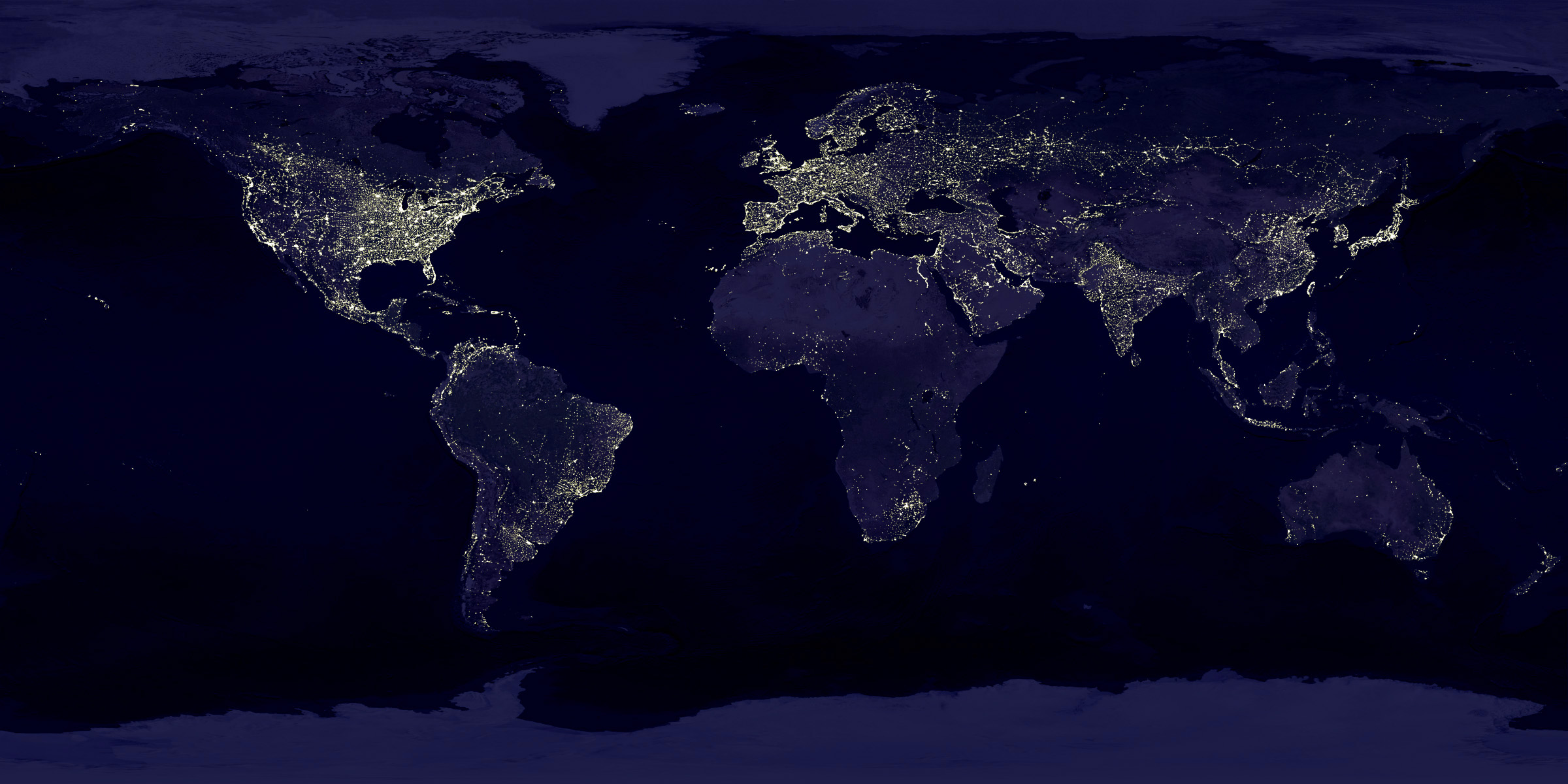
You can actually see the SSE units around the Great Lakes!!! http://nssdc.gsfc.nasa.gov/planetary/image/earth_night.jpg
-
Re:350C for Silicon?confirmed. here's the nasa SiC main page. http://www.grc.nasa.gov/WWW/SiC/
not sure where they pulled that number from. 350F is ~175C. That's about right. harsh applications, certain silicon devices can go a bit above 150. maybe with heavy doping a bit higher. my guess is they meant F on the site.
-
Re:An ideaIn space, you'd be correct though. If you could get the plane up to 50+K feet, that might be close enough to space to make it work, and yet close enough to Earth to have some atmosphere to fly in? Perhaps aerotowing with another plane could get it up to altitude, then let the solar panels and motors take over, as they'd produce more power up there?
Helios came pretty close to 100K feet. Our `Polar flyer' would be a lot less efficient, as the solar cells would have to be on a second, rotatable by almost 90 degrees, wing, adding lift and drag, and you'd have to always fly at approximately right angles to the sun, but if your goal was to make a plane that could stay aloft for many days, and didn't care that it only worked in certain places, it might be doable.But as mentioned, down closer to the Earth, the atmospheric losses would be a killer up near the poles.
-
Re:Budget too small
...Meade DSI color camera... Then you are better than me as I've never been able to get anything out of that thing. But then I tried to use it in what were not the easiest settings to say the least. And you are right about the patience bit, it's just easier to just read the magazines or hop to the APOD. -
Non-conventional sky observing
While others have posted on the impossibility of setting up a quality astrophotography rig for $1000, it might be worth focusing instead on what this guy CAN do with $1000.
I would like to hear suggestions from others, but here are some example of what I'm thinking about: Time-lapse photos of meteor showers. Timing of occultation events (e.g. when the moon just grazes a star, giving information about the contours of the lunar surface). Searching for new comets. Observation (indirect, of course!) of sunspots and solar flares. Quirky efforts like year-long time lapse photos to illustrate the analemma, e.g.: http://antwrp.gsfc.nasa.gov/apod/ap020709.html
Man-made objects can be a lot of fun, too. Photos of the silhouette of the ISS, if one is lucky enough to be in the correct position as it passes in front of the sun or moon. Heck, just watching satellites fly overhead, especially Iridium satellites as they flare, and the ISS when the shuttle's docked (with the combination being about as bright as Venus these days), and the heavens-above.com website is a big help with all that.
I recommend browsing through previous Astronomy Pictures of the Day ( http://antwrp.gsfc.nasa.gov/apod/ ) to get some ideas. A lot of it is professional astrophotography but some of it is the work of dedicated amateurs, some of whom didn't have >$1000 rigs. -
Non-conventional sky observing
While others have posted on the impossibility of setting up a quality astrophotography rig for $1000, it might be worth focusing instead on what this guy CAN do with $1000.
I would like to hear suggestions from others, but here are some example of what I'm thinking about: Time-lapse photos of meteor showers. Timing of occultation events (e.g. when the moon just grazes a star, giving information about the contours of the lunar surface). Searching for new comets. Observation (indirect, of course!) of sunspots and solar flares. Quirky efforts like year-long time lapse photos to illustrate the analemma, e.g.: http://antwrp.gsfc.nasa.gov/apod/ap020709.html
Man-made objects can be a lot of fun, too. Photos of the silhouette of the ISS, if one is lucky enough to be in the correct position as it passes in front of the sun or moon. Heck, just watching satellites fly overhead, especially Iridium satellites as they flare, and the ISS when the shuttle's docked (with the combination being about as bright as Venus these days), and the heavens-above.com website is a big help with all that.
I recommend browsing through previous Astronomy Pictures of the Day ( http://antwrp.gsfc.nasa.gov/apod/ ) to get some ideas. A lot of it is professional astrophotography but some of it is the work of dedicated amateurs, some of whom didn't have >$1000 rigs. -
better spent money
For $1000 you are much better off buying a good laptop and visiting http://antwrp.gsfc.nasa.gov/apod/ everyday.
You can also check out porn sites that are much more interesting to look at.
I have had 3 good quality hobby level telescopes - a 6" Newton, and 2 8" cassys, one manual, one computer (goto). In looking back at my experiences, the first one was the only one that really gave me any pleasure, as I bought it for and observed Haley's comet. Everything else was disappointing. Astrophotography is out of the reach of hobbyist. Sure you can take some pictures, but the only thing you get out of them is the fact that you took them. They are nothing to look at compared to what is abundantly available elsewhere. The costs for equipment to get a decent picture is easily over $8k.
There is a certain enjoyment from doing it yourself and learning about the technology, but you can get that from many other hobbies as well. If you decide to proceed and spend your hard saved $1000, just be sure your expectations are set appropriately. -
Helios was coolerHelios was way cooler. It was headed for continuous flight several years ago. Unfortunately it met an untimely end. I think NASA should rebuild it and continue the work. Some of the, um, pundits, on this thread don't seem to have the faintest about how it could work, but it is an awesome concept: solar panels collect all day, generating enough power to fly and to charge the hydrogen fuel cells, which power the craft all night. And it can fly high enough to be above the weather, so the sunshine will be consistent. Wicked.
-
Polar Photography
Semi-off-topic, but Webcam #1 at the north pole reminded me: on Friday the Astronomy Picture of the Day posted a multiple-exposure image of last month's lunar eclipse as seen from the south pole. Not an IT-specific wonder, but still seriously impressive, when you think about it, that we've actually got people near the south pole who are in a position to take photos like this.
And hey, for once I can use the term "polar opposite" and know that it's literally true! -
Re:Wrong it is not 4.22 years.
NASA gives a value between 10,000 and 170,000 years. (And calls the 10 million estimate as erroneous.)
-
Let them read the real thing
One issue is getting real material that is technical in nature. One very extensive source is
http://ntrs.nasa.gov/search.jsp
Some of those reports are approaching 100 yrs old. Some are quite readable. Some of them hurt my head. There are reports on engines, mufflers, wing design, flutter characteristics, ergonomics...
The point is that it's all real. Was all leading edge material at one time, and is all interesting to someone. At least to me, this gives the material more significance. -
Re:We still have no clue how to do strong AI
AI looked so close in the 1960s, once it was realized that you could get a computer to do mathematical logic. All that was necessary was to express the real world in predicate calculus and prove theorems. After all, that's how logicians and philosophers all the way back to Aristotle said thinking worked. Well, no. We understand now that setting up the problem in a formal way is the hard part. That's the part that takes intelligence. Crunching out a solution by theorem proving is easily mechanized, but not too helpful. That formalism is too brittle, because it deals in absolutes.
Theorem proving is increasingly usable for software verification ( http://research.microsoft.com/specsharp/, http://research.microsoft.com/projects/z3/, http://ase.arc.nasa.gov/projects/certifiableSyn/, etc.), and mathematics ( http://www.math.pitt.edu/~thales/flyspeck/, http://en.wikipedia.org/wiki/Robbins_algebra, http://en.wikipedia.org/wiki/Four_color_theorem, http://mmlquery.mizar.org/mmlquery/fillin.php?fill edfilename=mml-facts.mqt&argument=number+102, http://ea.unicyb.kiev.ua/sad.en.html). So much for Aristotle (and Leibniz, Babbage, Turing, von Neumann, -
This may help
Those who were looking for dark skies: http://veimages.gsfc.nasa.gov/1438/earth_lights_l
r g.jpg -
Well, there is an upside
While lights at night may make the sky harder to see the effect will be very pretty for any visiting aliens.
In fact this story has inspired me to go and set up xplanet again to provide an ever-changing desktop background. -
Re:There is another, heavier, water.
Look at http://www2.jpl.nasa.gov/galileo/messenger/oldmes
s /RTG.html and: http://en.wikipedia.org/wiki/Plutonium to learn that the Voyagers used Radioisotope Thermoelectric Generators which used plutonium-238 - which is an aplha-emitter.
No tritium or "betavoltics". And anyways: tritium's half-life = 12.3 years; PU-238 = 87.7 years. It's senseless to use a short-life material for a spacecraft. -
Li-Ion Re:Batteries
Why yes, they ARE Lithium Ion batteries.
http://solarsystem.nasa.gov/scitech/display.cfm?ST _ID=252
"The Mars Exploration Rover mission is the first major NASA planetary exploration mission to use the advanced lightweight rechargeable lithium-ion batteries, which are three to four times lighter than their nickel counterparts. In addition, the battery can last five times as long as the planned 90-day primary mission." -
mars solar time
Shame on me, but this is the first time I visited the mars rover website. It struck me as slightly odd that NASA researchers call the Martian Solar Day the sol.
Anyway, for those similarly bemused and/or further intrigued, here is the explanation of Mars Solar Time as Adopted by the Mars24 Sunclock -
Re:Next?
-
It runs and runs and runs...
-
Re:The Problems with Tycho as an Impact Crater
No experimental explosion at any scale has ever produced anything comparable to the well-defined 1500-kilometer "rays" of Tycho.
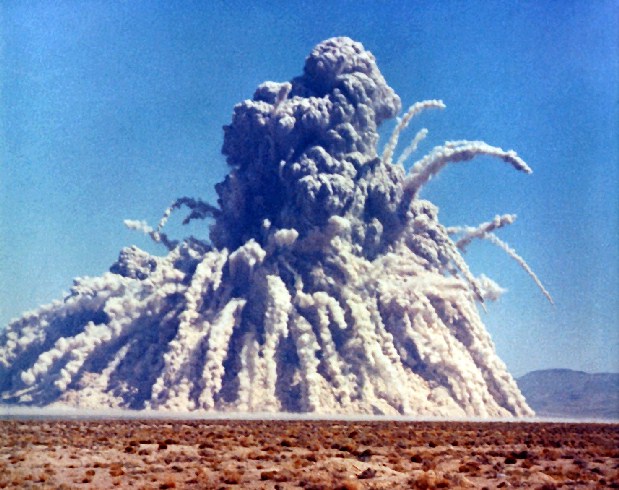
With a plastic tub, a marble, and a dollar's worth of white flour and cocoa powder one can quite easily create a replica of Tycho's rays. Even better examples are the man-made impact craters on the moon at the bottom of this page. One in particular, created by an Apollo 14 rocket stage, shows not only rays but also a central peak.I also find this picture of the Sedan nuclear test quite telling. A nuclear explosion releases a large amount of energy in a small area much like an impact. Notice the arching columns of debris, each of which seems to have a unique shape and trajectory. It is quite easy to see how these would form rays as they collapse on the ground, and some seem to come from slightly off-center from the chaotic cloud of the explosion.
-
Re:The Problems with Tycho as an Impact Crater
No experimental explosion at any scale has ever produced anything comparable to the well-defined 1500-kilometer "rays" of Tycho.
With a plastic tub, a marble, and a dollar's worth of white flour and cocoa powder one can quite easily create a replica of Tycho's rays. Even better examples are the man-made impact craters on the moon at the bottom of this page. One in particular, created by an Apollo 14 rocket stage, shows not only rays but also a central peak.I also find this picture of the Sedan nuclear test quite telling. A nuclear explosion releases a large amount of energy in a small area much like an impact. Notice the arching columns of debris, each of which seems to have a unique shape and trajectory. It is quite easy to see how these would form rays as they collapse on the ground, and some seem to come from slightly off-center from the chaotic cloud of the explosion.
-
Re:The Problems with Tycho as an Impact Crater
No experimental explosion at any scale has ever produced anything comparable to the well-defined 1500-kilometer "rays" of Tycho.
With a plastic tub, a marble, and a dollar's worth of white flour and cocoa powder one can quite easily create a replica of Tycho's rays. Even better examples are the man-made impact craters on the moon at the bottom of this page. One in particular, created by an Apollo 14 rocket stage, shows not only rays but also a central peak.I also find this picture of the Sedan nuclear test quite telling. A nuclear explosion releases a large amount of energy in a small area much like an impact. Notice the arching columns of debris, each of which seems to have a unique shape and trajectory. It is quite easy to see how these would form rays as they collapse on the ground, and some seem to come from slightly off-center from the chaotic cloud of the explosion.
-
Re:Turn Off Javascript
DSN also means Deep Space Network", the communications facility that supports interplanetary spacecraft missions.
-
Lucky Imaging
First post, huh.
This technique is often used by amateur astrophotographers using newer CCD cameras and even webcams. Astronomy Picture Of the Day http://antwrp.gsfc.nasa.gov/apod/astropix.html is a great site to see this stuff. I haven't checked Googles pictures, but I am sure that there would be a number of them there, too.
The quality of some of these photos is amazing.
davel -
Re:What a Radio System
I worked at a Deep Space Network Station (Goldstone) in the mid-70s, and then at the DSN headquarters (doing radio astronomy)at JPL in Pasadena, CA, from 1978-1993. BanjoBob is right to be amazed by the technology of that time, primitive though it might seem compared to what we have today. A few details: 1. As I remember it, the computers that served as the "Telemetry & Command Processors" were SDS-930 16-bit minis. They were so reliable that I remember going an entire year at the Goldstone DSS-12 station without either of them failing! The machine that decoded the telemetry and fed it to the TCP was an Interdata-4. It was also very reliable. However, the software that was doing the decoding occasionally got lost, and would go to its highest memory address and crash there. The address was "FFFF" in hex, so, of course, when that happened, you were "FFFFed"! 2. The big dishes then were 64-meters across, big enough to play frisbee inside them, which I did once, and VERY carefully. Those antennas are now 70-meters across. The first-stage amplifiers were both extremely high gain (about 45-dB at 8.5-GHz), and cooled to an extremely low temperature with liquid-Helium, so the whole receiver behaved as if its physical temperature was about 11*-Kelvin. So, the receivers contributed very little noise of their own to obscure the weak signal. Thus, these antennas were and are among the most sensitive on Earth. As I remember it, for the data rate currently being used by the Voyages, the sensitivity of the antennas was about -176-dBm, or about 176-dB less than one milliwatt of received power! With the improvements since then, it's likely about 3-4-dB better than that. If you'd like to read more, just click on over to: http://deepspace.jpl.nasa.gov/technology/95_20/95
- 20.pdf