Slashdot Mirror
Domain: nasa.gov
Stories and comments across the archive that link to nasa.gov.
Comments · 16,365
-
Yesterday's News, but how about comet SWAN?
Read all about it before the Lidle crash took the top spots on Google News. It's interesting, but really, Jupiter is always up to something with that turbulent atmosphere. Streams of spots have appeared in the past and vanished again. This will probably hang around for a bit and then go the way of other spots.
Meanwhile, there's Comet C/2006 M4 (SWAN), which is near it's peak magnitude, visible just after sunset which is my primary viewing target this weekend. It's going to be around until early December, but at declining magnitudes.
Ob ISR Post:
In Soviet Russia little reds spot YOU!
you hear the ghost of Bill Goodwin ellaborating on swan, the new white floating comet
-
**sigh**
there is a repair mission in the works to keep Hubble alive till 2013.
the James Webb Space Telescope is slated to enter operations in 2013. Some parts are under construction already.
-
**sigh**
there is a repair mission in the works to keep Hubble alive till 2013.
the James Webb Space Telescope is slated to enter operations in 2013. Some parts are under construction already.
-
Re:Move Along
Here's a quick link to some other studies: http://earthobservatory.nasa.gov/Study/Paleoclima
t ology_Evidence/ -
Re:i wouldn't worry,
Not to mention that the lack of a global magnetic field allows erosion of Mars' atmosphere. Without something to prevent that, the planning of a longterm terraforming solution on the red planet is a waste of time.
-
There are black holes (and stop karma whoring)
Your arguments were wrong the first time you posted them, as you would know if you read the responses to them.
I will repost my response:
The black hole will not form in any finite time since time there just stopped!
This is wrong. There is a finite set of events at which the horizon forms; we can just never see it form. See this FAQ.
For the observer falling towards the "hole", time in the rest of the universe just speeds up. In a matter of minutes the universe will age billions of years,
This is also wrong. A similar misconception is described in this FAQ.
Yes, I know many scientists disagree with me. Just think for yourself for a minute.
Ah, the old "if you disagree with my crackpot theory you must be a closed-minded conformist" argument.
Have you ever bothered to investigate whey "many scientists disagree with you"? -
There are black holes (and stop karma whoring)
Your arguments were wrong the first time you posted them, as you would know if you read the responses to them.
I will repost my response:
The black hole will not form in any finite time since time there just stopped!
This is wrong. There is a finite set of events at which the horizon forms; we can just never see it form. See this FAQ.
For the observer falling towards the "hole", time in the rest of the universe just speeds up. In a matter of minutes the universe will age billions of years,
This is also wrong. A similar misconception is described in this FAQ.
Yes, I know many scientists disagree with me. Just think for yourself for a minute.
Ah, the old "if you disagree with my crackpot theory you must be a closed-minded conformist" argument.
Have you ever bothered to investigate whey "many scientists disagree with you"? -
Whiney Liberal Comment
It's always nice to see national space agencies working together, it almost gives me hope that the world might one day be united in space exploration."
More bullshit whiney rhetoric from the left.
Apollo-Soyuz http://en.wikipedia.org/wiki/Apollo-Soyuz
Shuttle-Mir http://spaceflight.nasa.gov/history/shuttle-mir/
NASA/ESA Hubble Space Telescope http://eu.spaceref.com/
NASA/Brazilian Space Agency http://asia.spaceref.com/news/viewpr.html?pid=1257 -
Re:Better than Nothing
I am curious,... what is the basis for you assumption that "the rest is just talk?" Does Carnegie-Mellon have some special insight that NASA does not about what its real strategic goals are? Do you have a different version of NASA's budget than the one Congress has? There seem to be a lot of "Space Enthusiasts" on slashdot that have strong opinions about the US Space Program who oddly don't know the current state of said program. If you have any serious questions about CEV or the rest of the Cx architecture... why not post them here and have them answered by someone who may actually be working on the program... if you'd rather just blather on about the admistration, why don't you save it for a more appropriate forum like DU or DailyKos?
-
Re:Better than Nothing
I am curious,... what is the basis for you assumption that "the rest is just talk?" Does Carnegie-Mellon have some special insight that NASA does not about what its real strategic goals are? Do you have a different version of NASA's budget than the one Congress has? There seem to be a lot of "Space Enthusiasts" on slashdot that have strong opinions about the US Space Program who oddly don't know the current state of said program. If you have any serious questions about CEV or the rest of the Cx architecture... why not post them here and have them answered by someone who may actually be working on the program... if you'd rather just blather on about the admistration, why don't you save it for a more appropriate forum like DU or DailyKos?
-
Re:Gyroscopic stabilizers
To date, only one VTVL rocket vehicle has demonstrated fully autonomous takeoff, hover, and landing (John Carmack's vehicle over at Armadillo Aerospace).
I'm not sure they've actually conducted a fullly autonomous test. According to their web site, they've only done very limited tethered tests.
However, I know the Delta Clipper (DC-X) and it's follow on (DC-XA) had several sucuessful tests, fully autonomous. But even they had a bunch of development issues that eventually lead to the programs cancellation.
Bill -
Re:Gyroscopic stabilizers
To date, only one VTVL rocket vehicle has demonstrated fully autonomous takeoff, hover, and landing (John Carmack's vehicle over at Armadillo Aerospace).
What about the DC-XA? Was that not fully autonomous? -
Re:Fearmongering is not the way to do this.
>From strident predictions of an "immanent ice age" to "we're all gonna fry!" within the space of a few decades
Someone took the time to assemble a bibliography of climate change literature from the 70s with reference to predictions of cooling. In the scientific literature, as contrasted with Newsweek, the closest thing was a paper that pointed out the current interglacial could end in a few thousand years, or maybe even a few hundred. The overwhelming bulk reached the totally accurate conclusion that they didn't know enough to make a prediction.
The hard data on solar output from satellite measurements goes back fifteen years and is kinda-sorta constant over that period. Much earlier, and you're relying on horribly indirect proxy measurements like radionuclides. There are a lot of uncertainties about trends in solar output, although some climatologists think it could account for 10-30% of the temperature rise we've seen. -
There are black holes
The black hole will not form in any finite time since time there just stopped!
This is wrong. There is a finite set of events at which the horizon forms; we can just never see it form. See this FAQ.
For the observer falling towards the "hole", time in the rest of the universe just speeds up. In a matter of minutes the universe will age billions of years,
This is also wrong. A similar misconception is described in this FAQ. -
There are black holes
The black hole will not form in any finite time since time there just stopped!
This is wrong. There is a finite set of events at which the horizon forms; we can just never see it form. See this FAQ.
For the observer falling towards the "hole", time in the rest of the universe just speeds up. In a matter of minutes the universe will age billions of years,
This is also wrong. A similar misconception is described in this FAQ. -
We Live in a (semi-)Active Galaxy
Hate to break it to you, but there's a >million solar mass black hole at the center of our galaxy. We're not considered an "Active Galaxy" only because it is on a diet.
-
more imprressive photo at Rover site
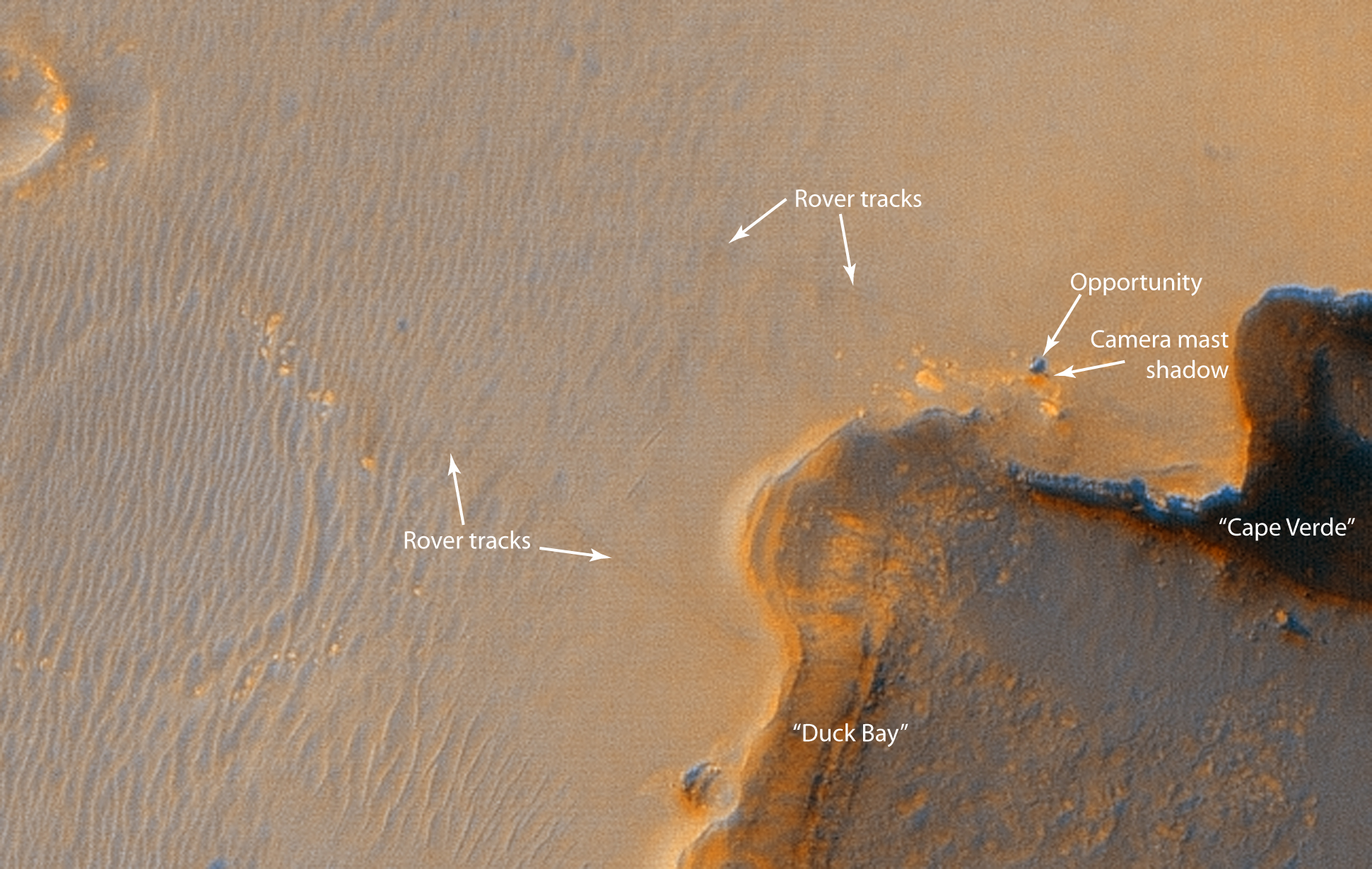
Here you can see detail on the Rover such a camera pole and its shadow. We are talking about a five foot item.
I've seen people on the ground in Google Earth photos when the contrast is good. So this is about the same resolution. -
Re:Full View
-
Re:"be the end of our manned space program"
By our, do you mean mine as well? If so, when do I get to go into our space?
According to NASA (PDF warning), the requested operating budget is US$1,811,300,000.I am being 100% serious; I want to know when I will be able to go into space.
My tax dollars help pay for the program.
According to the CIA Factbook there are 298,444,215 people in the US.
Doing the math says you pay US$6.07 a year for the space program.
If you can get yourself into space for that amount, let me know how it turns out.
-
A Better Image IMO
-
Re:Impressive resolution
-
Full View
-
Re:Billions of *Jupiter sized* gas giants
Also, our solar system has only 4 rocky planets, not 5. We do have a lot of rocky moons and dwarf planets, though.
As far as geology and 'looking for life' goes moons are valid planets. Titan sure has the look and feel of a 'planet'. Luna and IO are the only 'rocky' moons I can think of, most of the others seem to be made of some rocks and lots of frozen gases and water. They would mostly vaporize if brought in close (earth like orbit) and be too small to hold onto that vapor. Rock is ok but I think to have rock, water and atmosphere would improve lifes chances, water being the only one actually required.
Now when will be the day we can detect large water oceans around some of these distant planets, that's the ticket! Just having that implies the other two (rocks and gas).
-
Re:Productivity?Tackhead wrote:
This is government work. Nothing's being produced, only consumed.
Not all government work is non-productive. Most government agencies have some hand in assisting citizens and businesses in their productive endeavors, either by providing regulatory and legal infrastructure (the Dept. of Agriculture and the FDA inspect for food safety, the NIST provides consistant weights and measures for use in all sorts of commercial transactions, the judiciary provides the means of enforcing contracts, etc.) or by producing actual goods and services (the Library of Congress publishes books on tape and in braile for the deaf and the blind, the Army Corps of Engineers builds all sorts of public works and many agencies perform a fair amount of basic research that, eventually, winds up in the public sector via technology transfer).
I know that the Libertarian party-line, so popular on slashdot and with technologists in general, is that government is nothing but a leech on the ass of an otherwise productive capitalist society and should be restricted to funding a militia, but the facts simply don't bear this out. Any large organization will have an alarming amount of bureaucratic waste, and most governments may have a little more than most private sector entities, but governemnts can, and in some cases do, do more than generate paper and hot air. -
Re:Hurricane season
Not Global Warming - Global Climate Change!
Get with the program...
That way no matter what happpens, the research scientists (and politicians) are going to right, and we know how important that is.
Did I hear that the Ozone Hole got bigger this year even with CFCs being outlawed?
http://www.allheadlinenews.com/articles/7005070041
Revised estimates are that ozone levels won't be back to "normal" over Antartica until 2065.
The reason the hole appears to have grown to a record size this season was unusually *cold* tempereratures in the stratosphere this winter (winter in the Southern Hemisphere, that is). Surely a cold stratosphere is proof of the existance of man made global warming!
http://www.ghcc.msfc.nasa.gov/MSU/msusci.html
Now this information puts forth the idea that cooler strophosphere temperatures are *due* to ozone depletion, not caused by it... and that CO2 levels are also responsible. Ignore the two big red spikes when major volcanic eruptions occurred. Data points like that are not relevant to computing average values or trends - they just tend to make computer models produce strange predictions.
Or try this reasearch:
http://www.eurekalert.org/pub_releases/2004-11/uow -std112904.php
That the esimates in the models were off by 40 to 70% of what would happen to the temperature of the trophosphere because of "contamination" of the data from the strophosphere data.
Can I go back to eating my transfats now? -
Artificial Skin; Animal-Like Robots?
These whiskers tie in with existing research into artificial skin that can "feel." This 2005 NASA article describes mecha-skin that uses IR sensors to detect touch. Japanese researchers (2005) reported having a type that senses temperature and pressure through actual touching.
The skin research should be useful both for robotics and for replacement parts for humans, as an alternative to the clunky biological hand transplants that have been carried out. (I think I'd rather have a Luke Skywalker robot hand than a mismatched corpse's!) These artificial hand researchers will probably be interested as well, because having a prosthesis that can be sensed as well as controlled is necessary for it to be as good as the original. The big issue is how easy it will be to get these touch signals into the human nervous system in a useful way. For robots, the data can be built into existing software for making maps of a robot's surroundings. I picture a robot rat running a maze with a set of these whiskers. Won't whiskers serve as a low-energy-cost alternative to sonar and other sensing systems?
The odd thing is that here, the research is not into copying human abilities, but those of (nonhuman) animals. I wrote a silly article arguing that future robots will be made to resemble animals, not humans, and Charles Van Doren (in A History of Knowledge) predicted "warm and fuzzy" robotics. Is that where we're headed? -
Re:"Moon is a Harsh Mistress" anybody??
How real is that? Has any of the space shuttle or ISS experiments involved pushing a rat out of the air lock?
Probably not, as this had already been investigated to help design earlier space suits:
http://ntrs.nasa.gov/archive/nasa/casi.ntrs.nasa.g ov/19690004637_1969004637.pdf -
Re:"Moon is a Harsh Mistress" anybody??
Peak for shuttle launch is 3Gs, and for Apollo reentry, exceeded 7Gs (source paper with cited sources). For a launch abort on the Apollo design, stress would have exceeded 16Gs, and this was deemed uncomfortable, but survivable (albeit with an assumed inability to operate controls during the process). (source LBJ Space Center.)
So limiting it to 2Gs of total stress is very arbitrary and unnecessary.
-
Re:Lost in space
Space burials (presumably of cremated remains). At $200 each (plus cremation) I am sure they could sell a few thousand of these per year.
If USAF (as proposed owners of this facility) have any sense at all (which I'll grant is a dubious assertion) they won't be doing this. The last thing we want to put in orbit is a few tens of thousands of small, densely packed projectiles that serve no useful purpose. It'd be a nightmare to track them all.
Of course, the real purpose behind such a launcher is to place the raw materials into space that could be used by a later manned mission. Note that Gerard K. O'Neills groundbreaking study of the economical feasibility of orbital habitats was based on an assumed launch cost of $200/kg. -
Re:More about the author -he's not just a VCFirst of all, that page never mentions that the 'success' was a result of using any particular programming language.
True - you have to go beyond the press release for details like that. Here you go. Among other things:* They debugged the system during flight by essentially dropping into a Lisp prompt. They could have patched it that way, too, but chose not to after analyzing the problem and determining that it wouldn't have interfered with the planned tests.
* I don't know if this is mentioned in the paper above, but Garret has said elsewhere that the development environment and the flying system were different implementations of Common Lisp (Franz Allegro on ground workstations, Harlequin Lispworks on ground prototype and flying hardware). They had no cross-platform or cross-implementation problems due to this - they did have some problems interfacing Lispworks to the underlying VxWorks, but no more than you might expect interfacing any high-level language to C.
So they had buggy spaceflight software (bad synchronization) resulting in forgetting to turn an engine off and still managed to call it a success?
Everything on that spacecraft was a prototype - that's what the mission was for. To NASA, "success" for this mission meant "the spacecraft met all of its planned objectives, despite the harsh environment and limited resources". This mission was during NASA's big "faster, cheaper, better" push, and we know how that ultimately turned out (in an impact crater on Mars, among other places). -
More about the author -he's not just a VC
The author was indeed responsible for this comparison between Lisp and Java which will be in line with your "real academic/Lisp-lover" crack.
Please note that he was also responsible for this paper describing a Lisp-based system that successfully flew a NASA spacecraft. He knows exactly how difficult it is to make things work from an engineering standpoint.
In terms of writing software that deals with real-world problems, Ron Garret is a lot closer to the Paul Graham end of the spectrum than he is to the pointy-headed academic end. -
"35 milliseconds?" Nonsense.
The article says "According to Ford, Armstrong spoke, 'One small step for a man
I just checked the video (first one I found... I'm sure there are some that don't have Mahler music in the background, and it takes him a good three seconds to make the statement.
With pure bullshit like that, how can I trust anything else the article says?
The official transcript confirms the mistake, and the lengthy Snopes article (with an embellished recording indicates that Armstrong himself acknowledged and regretted the error. He flubbed his line, and encyclopedias that quote him with as "That's one small step for [a] man" are doing so for courtesy, not historical accuracy.
As so why some of us are so bothered by the whole issue... it is very disturbing to see a perfectly plain, perfectly simple bit of history being distorted within one's own lifetime. I listened to that broadcast as it occurred. There was no static. It took everyone a moment to absorb the fact that he'd obviously made a mistake, and quitely likely some people "heard" what they expected to hear.
If we can see history distorted in a case like this where the only thing at stake is very mild embarrassment to Mr. Armstrong, it certainly makes me feel that we can't trust history in cases where anyone has anything important to gain from distortion. -
Re:Tranquility baseBecause that's how it works. Go look at a LM some time. See the contact probes? See how close the engines are to the ground (and the lack of a small crater from those 45,000N engines)? And the Lunar Module Structures Handout (pdf), p. 6, uses the word IMPACT. (Moon gravity is 1/6th Earth's, so "dropping" the lander a few feet really isn't a problem.)
From the Apollo 11 logs:When the 68-inch probes beneath three of the spacecraft's four footpads touch down, flashing a light on the instrument panel, Armstrong shuts off the ship's engine.
(I've not been able to find any of the docs on how to actually land a LM. I'm sure someone has scaned them.) -
Re:Tranquility baseBecause that's how it works. Go look at a LM some time. See the contact probes? See how close the engines are to the ground (and the lack of a small crater from those 45,000N engines)? And the Lunar Module Structures Handout (pdf), p. 6, uses the word IMPACT. (Moon gravity is 1/6th Earth's, so "dropping" the lander a few feet really isn't a problem.)
From the Apollo 11 logs:When the 68-inch probes beneath three of the spacecraft's four footpads touch down, flashing a light on the instrument panel, Armstrong shuts off the ship's engine.
(I've not been able to find any of the docs on how to actually land a LM. I'm sure someone has scaned them.) -
Re:Tranquility baseBecause that's how it works. Go look at a LM some time. See the contact probes? See how close the engines are to the ground (and the lack of a small crater from those 45,000N engines)? And the Lunar Module Structures Handout (pdf), p. 6, uses the word IMPACT. (Moon gravity is 1/6th Earth's, so "dropping" the lander a few feet really isn't a problem.)
From the Apollo 11 logs:When the 68-inch probes beneath three of the spacecraft's four footpads touch down, flashing a light on the instrument panel, Armstrong shuts off the ship's engine.
(I've not been able to find any of the docs on how to actually land a LM. I'm sure someone has scaned them.) -
Re:Tranquility baseBecause that's how it works. Go look at a LM some time. See the contact probes? See how close the engines are to the ground (and the lack of a small crater from those 45,000N engines)? And the Lunar Module Structures Handout (pdf), p. 6, uses the word IMPACT. (Moon gravity is 1/6th Earth's, so "dropping" the lander a few feet really isn't a problem.)
From the Apollo 11 logs:When the 68-inch probes beneath three of the spacecraft's four footpads touch down, flashing a light on the instrument panel, Armstrong shuts off the ship's engine.
(I've not been able to find any of the docs on how to actually land a LM. I'm sure someone has scaned them.) -
Already There
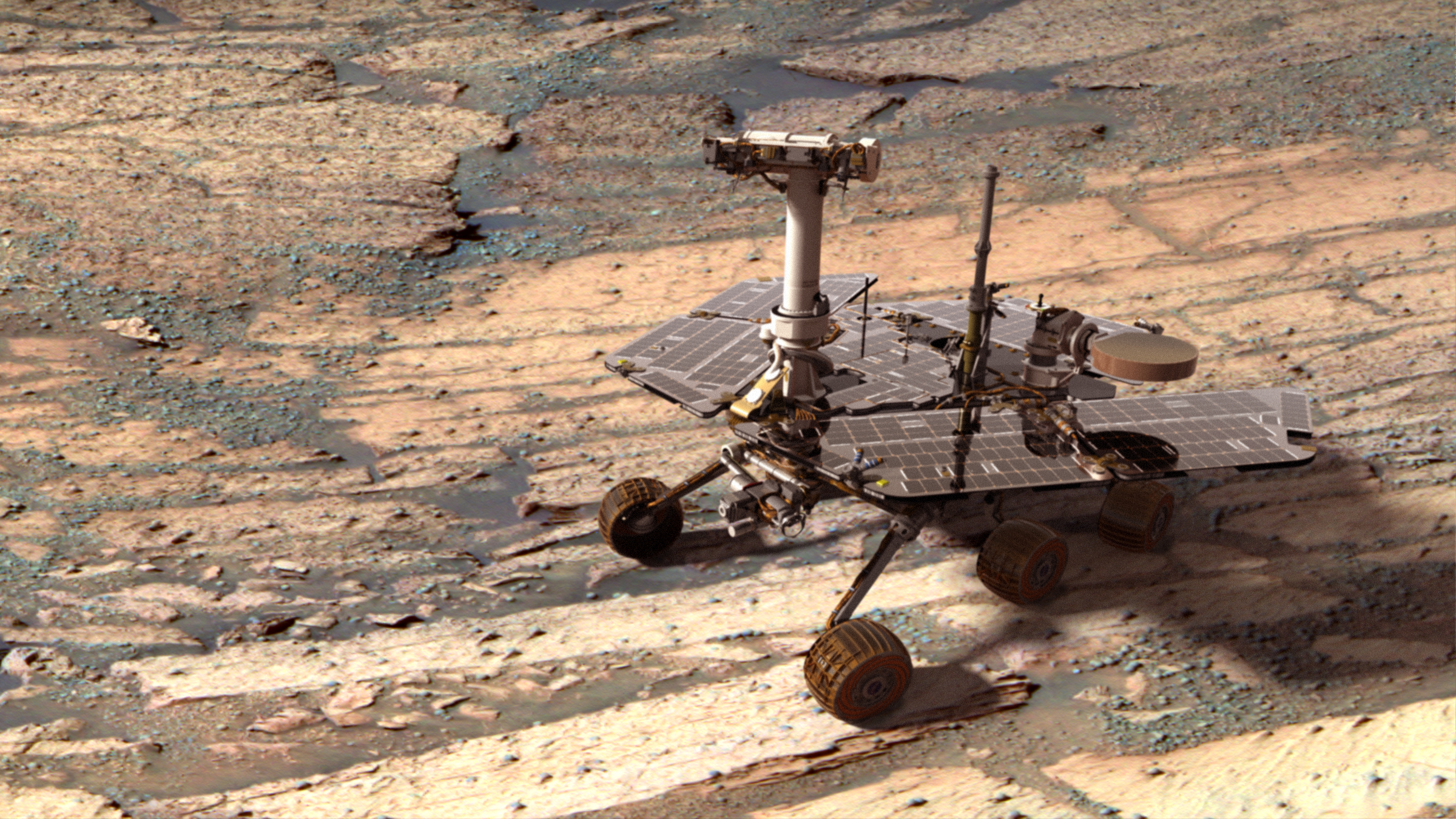
I would just like to point out that nuclear power sources are already there. The Mars Rovers, Spirit, and Opportunity contain radio-isotope heaters to stave off the chilly days and nights of the red planet. Granted, this is a much smaller power source (and the only energy being recovered is heat), but I would like to point out that sending nuclear power sources out is nothing new.
http://marsrovers.jpl.nasa.gov/technology/is_sever e_environments.html -
Re:Score one for NASAI had to laugh when I went to the Mission page. They have the Mission days listed in Sols, as well as the Sols Past Warranty!
This mission has been such a great success. I think it has fallen off the radar of most people who don't realize that they are still out there. NASA needs some better PR to capitalize on great science. NASA needs credit where credit is due, not for the ISS, but for true exploration.
-
Re:Only a bit
Actually "our" universe is much smaller: http://universe.nasa.gov/press/images/cosmos_perc
e nt_comp.jpg. Us "lighties" are really a minority since dark matter (recently proven to exist) and dark energy dominate.
P.S.: In Hawking radiation the effect of more matter than antimatter is also observed. -
I doubt they could make it work. Wanna Bet?
We have been hitting mirrors left on the moon by apollo astronauts since 1969.
http://www.signonsandiego.com/news/science/2006071 3-9999-lz1c13laser.html
http://sunearth.gsfc.nasa.gov/eclipse/SEhelp/Apoll oLaser.html
Thats 239,000 miles hitting an 18 inch square target. -
Lasers?
Blah blah blah, atmosphere this and that. Lets get off of our one track minds and develope other means of solving problems. So, the atmosphere is in your way. Do it the American way and blast the atmosphere out of the picture. We already have blur correction to deal with turbulance. I know I've seen Lasers used to litteraly create a hole in the atmosphere. I must admit I wasn't able to quickly find any articles on lasers used this way, however it may not be some magical Harry Potter crap as much as a more simple approach of simply blasting it out of the way. Blur correction http://apod.nasa.gov/apod/ap050207.html http://www.afrlhorizons.com/Briefs/Sept01/DE0108.
h tml -
Re:This time, its the Americans...
Should've quit with your first 2 sentences -- instead you had to go on one of your usual misinformed rants.
"shuttle exploded" -- not what happened (http://caib.nasa.gov/)
"space station, would not have been a reality if it were not for Russian participation" -- not true at all. The US has essenitally funded all Russian participation in the project. The only reason we brought them on board was to keep them from selling their services to the Chinese. Additionally, we lose about 20000 lbs of lift capability each launch to the station because we put it in an orbit that the Russians could get to also. Would've been cheaper to do it all ourselves. -
Re:Anyone doing Zero Gravity Copulation research?
Considering that astronauts Mark Lee and Jan Davis were married and on a Shuttle flight together. I'm sure it's happened.
-
Re:Not Really the First
Actually the resolution is better than that - more like 30-60 cm per pixel. But that doesn't mean you can resolve an object that small - you need more than one pixel to be able to determine an object's size...
Oh, and the MOC on Mars Global Surveyor gets the credit for the first "super close-up" pictures of Mars from orbit... approaching 10 years in orbit. -
Re:Not Really the First
Actually the resolution is better than that - more like 30-60 cm per pixel. But that doesn't mean you can resolve an object that small - you need more than one pixel to be able to determine an object's size...
Oh, and the MOC on Mars Global Surveyor gets the credit for the first "super close-up" pictures of Mars from orbit... approaching 10 years in orbit. -
You'd think they were building killer cyborgs...Thanks for that link. I had never read it before.
I found one claim in there particularly interesting:We shouldn't forget despite all this that Windows Vista remains the largest concerted software project in human history. The types of software management issues being dealt with by Windows leaders are hard problems, problems that no other company has solved successfully. The solutions to these challenges are certainly not trivial.
I wonder...why is that, exactly? Why is Vista such a massive project?
It's a serious question. I mean, it's not like they're building HAL-9000 here. It's an OS. A microcomputer OS. Which really, as far as I can tell, doesn't do a whole lot more than a bunch of other OSes that are on the market already. What does it do that's so much more complex, fundamentally, than what OS X does? Or Linux? Or any number of other OSes? Why, exactly, is it such a freaking huge project?
If the size estimates I'm reading are accurate, at 50 MLOC, Vista is still smaller than OS X at 80 MLOC (comparisons to Linux are tougher because when someone says "Debian has 160 MLOC," it's not clear if that's just the base system or including all the applications or what). Admittedly, OS X borrowed a lot of code from NeXT, but Microsoft has a lot of code they could steal from previous Windows versions and other projects. If they chose not to, then that was a conscious management decision on their part.
If this guy's characterization of Vista development is true, they have more problems than a slipped schedule; they need to be asking why the damn thing has turned into that much of an epic project in the first place. This is not like IBM building the S/360 here; they're not wandering that far off into uncharted, never-before-attempted territory, based on every description of Vista I've ever seen or heard of. Yet they're making it that much of an effort, either by choice or mismanagement.
Vista, Linux, OS X: it does the same thing. Ultimately, they're both ways of managing the filesystem and the computer's hardware resources, and presenting those resources to programs in a standard manner on one end, and presenting a GUI to the user on the other. Sure, they're different ways of doing things, but they're all solutions to the same basic problem. It's even the same hardware resources and architecture that they're supposed to manage -- it's not as though the premise of each is that different.
Frankly if what that article says is true, Vista might have a second, more dubious distinction: the most wasted effort ever spent on a project since the Russians built that expensive lawn ornament.
If this guy did see the source code and was able to reverse engineer it, Microsoft ought to offer him a job. Apparently, they need the help. -
Re:Start with the jokes
Here a nice hi-res picture of Cydonia that was posted yesterday to Astronomy Picture of the Day website. http://antwrp.gsfc.nasa.gov/apod/ap060926.html
-
Re:Oh, it could get worse.
While there have been reports of attempts by individuals to circumvent the ban, e.g. by smuggling CFCs from undeveloped to developed nations, the overall level of compliance has been high. In consequence, the Montreal Protocol has often been called the most successful international environmental agreement to date.
Unfortunately, the hydrochlorofluorocarbons, or HCFCs, and hydrofluorocarbons, or HFCs, are now thought to contribute to anthropogenic global warming. On a molecule-for-molecule bases, these compounds are up to 10,000 times more potent greenhouse gases than carbon dioxide, and their increased use significantly increases the danger that human activity will change the climate [2]. The Montreal Protocol currently calls for a complete phase-out of HCFCs by 2030, but does not place any restriction on HFCs.
Well the fact is we don't really have "global" cooperation those "undeveloped" countries include quite rich countries that use a lot of air conditioning (ie.Kuwait, Quatar etc) and my friend who is from India says they still use freon. It's second hand so I can't verify the that. But I was in kuwait and I had a hard time getting the proper gas for our HVAC systems. While freon was plentiful. But part of my point is the cure could be worse than the disease.
The reason is that while we can say that it's warmer with certainty, the effects of that warming is unknown. And anyone that says they know exactly what a 1-3 degree increase in global temperature will do is talking out their arse. Global climate is extremely complex, you have so many variables and nobody has a good model to explain everything. We had been in a comparatively cool period of earths climate history. It has been described as a 'mini ice age' so nobody knows what the effect of us suddenly changing would be. We only know that yes we contribute to the climate, with billions of people on this planet changing the environment in numerous ways deforestation, polution etc. It is inevitable that we would have a negative impact. But until we set a side politics and money and do serious discussion and study we will never ever know. Al Gore running around promoting a movie that is built on extremely weak science is not helping. It only polarizes the argument. Both factions become entrenched which causes reactions such as this one Hyperbole will not get us anywhere.
What is truly amazing is to watch how the atmosphere reacts to events such as when Saddam set all of Kuwaits oil wells on fire and in 2002 we had some very intense solar storms. I did some NO volume emmission rate contour plots during the April storm periods. The NO VER increased dramatically and then leveled and went back to normal levels. It was very interesting to watch the Earth handle a sudden massive change in energy bombarding the atmosphere.
I work for Nasa's Earth Observatory System
-
Re:Anyone doing Zero Gravity Copulation research?
No they were together in space. At the very least for this photo: http://nix.larc.nasa.gov/info;jsessionid=knxt0w7k
d f4m?id=STS047-12-002&orgid=8 -
Re:Google
actually we'll probably see it on http://worldwind.arc.nasa.gov/ NASA's World Wind pretty quick.