Slashdot Mirror
Domain: nasa.gov
Stories and comments across the archive that link to nasa.gov.
Comments · 16,365
-
Re:That may be true!
OMG, you're right! It's not even the most evil, pernicious or destructive of the greenhouse gases. We must sign an international treaty immediately to stop this incredible threat to the earth.
After much research (mid-post), I have discovered that the threat is much more far reaching than mere climate change. We must do something now!
In Pasta we trust, RAmen.
-
Re:Wouldn't it shake things up if...Averaged out, it is cooler than Venus, but the maximum temperature is much higher.
NASA doesn't think so, and I'd much rather trust them. In fact, according to them the _average_ temperature on Venus is higher than the _maximum_ surfact temperature on Mercury
-
Re:Record set in 1933
could you quote the source?
Sure. My source is the NASA GISS Surface Temperature Analysis data, you can review it here. Pay attention to the arctic band, the column here marked 64N-90N. For each year, the number indicates the deviation from an arbitrary baseline, in this case that baseline is set by the average temperature from 1951-1980. The unit of deviation is
The data starts when systematic measurement began, in 1880, considerably below our baseline. It continues downward, reaching the lowest dip in 1887 at -184. (I think in the broader term we were already in a warming trend there, the end of the little ice age I mentioned, but in the very short term there at the beginning of the data it is getting colder.) Although, of course, there's considerable variation year to year, after 1887 you'll see generally a mild trend toward warming, up until there's a very sharp drop in temperature in the second decade of the 20th century, reaching another trough in 1918. After that, you have a very sharp rising trend which reaches its peak in 1938. That was the warmest year on record so far. Then there's another cooling phase, down to a new trough in 66 - after which you get a flat line (I don't mean the temperature stayed the same - it fluctuates every year, but if you draw the graph you'll see it's fluctuating around without a real trend up or down) until around 1980 when the current warming trend begins.
None of the readings so far have matched that of 1938, and the slope of the current trend is quite a bit gentler than that of the warming period from 1888 to 1938 as well.
-
Stating the obvious, but...
... amazing how much bulk lifts off from Earth, and how little returns (see the video here). Can anyone explain why we shouldn't invest all this money into basic science research that might result in better propulsion, stronger & lighter materials, and similar useful advancements? Personally I think it's a shame that the US is cutting so much research funding and linking grants to military and national security needs in our effort to pay for wars, hurricanes, moon shots, debt servicing, and the like. Seems like nanotech, nuclear fusion research, and even the Superconducting Supercollider would make much better investments with much more potential ROI than upgrading 40-year old solid rocket tech and going to the moon again.
-
Re:Back to where they begun?
Russians never fully embraced their shuttles (Buran, http://liftoff.msfc.nasa.gov/rsa/buran.html [nasa.gov] ) despite it posessing payload and operational capacities superior to those of US Shuttle...
Of course, the Russian engineers had to earn their pay, er or something like that, somehow, since any monkey could just copy stolen NASA designs...
[ducks] -
Re:Global warming issue
Where did you pull that figure out of?
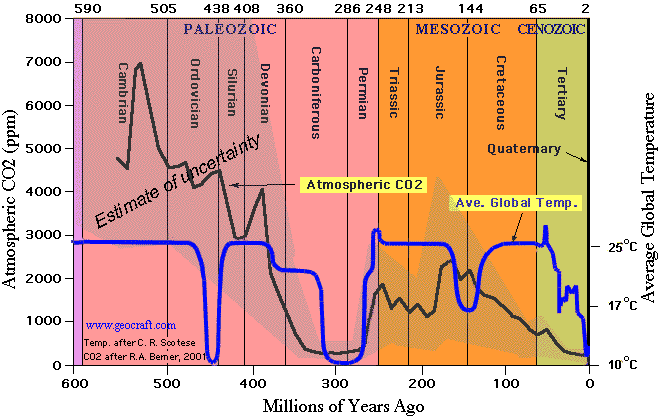
Here is a graph showing CO2 levels and global temperatures over the past 600 million years. The peak is at 7000 ppm, at which time the earth's average temperate was 22 deg. C (71.6 degr. F)
Todays's CO2 concentration is 379 ppm, and todays average global temperature is about 15 deg. C (53 deg. F).
The way I see it, at times the Earth has been a lot hotter on average in the past than it is now. We look to be heading into a warming period. That may be great news for North Dakotans who want mild winters, but not so great for people who already live in hot and humid climates, especially if they are Caucasian. Right now, I live in Florida and there are days where the sun feels like it's burning through my skin when I'm outside for just a few minutes.
Oh, and then there's the small mater of Hurricanes. Who knows how strong they were 100 million years ago. -
Re:Good Design
Here is a dierct link to the QuickTime movie of a lunar exploration.
-
Re:controversial?Read this link
"Hurricanes form over tropical waters (between 8 and 20 latitude) in areas of high humidity, light winds, and warm sea surface temperatures (typically 26.5C [80F] or greater). These conditions usually prevail in the summer and early fall months of the tropical North Atlantic and North Pacific Oceans and for this reason, hurricane "season" in the northern hemisphere runs from June through November."
The air temp is going to be cooler, but you need to have the right formation conditions. -
Re:Only controversial if you're in denial
Anthropogenic Global warming is a reality.
From The American Association for the Advancement of Science's Journal Science
"Human activities
Global Warming causes sea-surface temperatures to rise.
From NASA:
""There has been a strong warming trend over the past 30 years, a trend that has been shown to be due primarily to increasing greenhouse gases in the atmosphere"
Special Multimedia Bonus Goodness!
Sea-surface energy fuel hurricanes
From Nasa:
"Hurricane winds are sustained by the heat energy of the ocean, so the ocean is cooled as the hurricane passes and the energy is extracted to power the winds.
PROFIT! -
Re:Only controversial if you're in denial
Anthropogenic Global warming is a reality.
From The American Association for the Advancement of Science's Journal Science
"Human activities
Global Warming causes sea-surface temperatures to rise.
From NASA:
""There has been a strong warming trend over the past 30 years, a trend that has been shown to be due primarily to increasing greenhouse gases in the atmosphere"
Special Multimedia Bonus Goodness!
Sea-surface energy fuel hurricanes
From Nasa:
"Hurricane winds are sustained by the heat energy of the ocean, so the ocean is cooled as the hurricane passes and the energy is extracted to power the winds.
PROFIT! -
Re:Only controversial if you're in denial
Anthropogenic Global warming is a reality.
From The American Association for the Advancement of Science's Journal Science
"Human activities
Global Warming causes sea-surface temperatures to rise.
From NASA:
""There has been a strong warming trend over the past 30 years, a trend that has been shown to be due primarily to increasing greenhouse gases in the atmosphere"
Special Multimedia Bonus Goodness!
Sea-surface energy fuel hurricanes
From Nasa:
"Hurricane winds are sustained by the heat energy of the ocean, so the ocean is cooled as the hurricane passes and the energy is extracted to power the winds.
PROFIT! -
Re:Questions
here is a good example of some very mature software that still has bugs. and it's very small. the problem with knowing the number of bugs in a piece of software is the assumption that you've found them all.
-
Videos
The quicktime video is here . Fair warning, 26 MB. Couldn't figure out the one from within flash. Anybody?
-
Re:Doubtful
Watch NASA tv when human space flight people are on talking about the new vehicle they often cite that it can be seen as a stopgap measure until commericial space flight can take care of the ISS.
-
Saturn V flash demoThis is also worth looking at:
http://spaceflight.nasa.gov/history/apollo/apollo
_ mission.html(Sorry about not being able to link it with a _blank window of the proper size. If that's a problem, go to spaceflight.nasa.gov and it's currently linked in the bottom right corner of the main page.)
I had never known what that tower thingy on top of the Saturn V stack was. It was a small rocket to launch the Command Module off of the rest of the rocket in case of an emergency before reaching Earth orbit. And it's a part of the new design as well.
-
Re:Aceleration profile
You could probably human-rate it without too much effort, given that the major components are all shuttle-derived and therefore already human-rated.
I wonder what the acceleration profile would be
The shuttle was a fairly gentle ride (3 g's max), but earlier human-rated boosters had higher peak g loads, so you got some wiggle room. Anyway, to quote from NASA's factsheet:
"Although primarily designed to carry cargo, this system can be human-rated to carry crew into orbit. " -
Re:SSME complications
The fact sheet that accompanied the announcement, here, explictly states they'll be using the J2-S. Astronautix.com notes that "It was estimated by ATK Thiokol in 2005 that restarting the J-2S program, including engine fabrication, design and reliability verification, certification, and production, would require four years." Looks like the ghost of the S-IVB (America's favourite stage!) will live on yet...
-
Back to where they begun?
I must say, it is interesting to notice that NASA has, in fact, finally opted to return to the old, well-tried capsule approach, as opposed to reusable reentry vehicles such as Shuttle. Especially when one takes into consideration the significant amount of resistance NASA experts have been offering to the idea for years and years, despite the poor cost-to-results ratio of Shuttles and, apparently, high(er) risks involved in Shuttle flights as compared to capsule flights.
Perhaps it is a bit of me that loves rubbing it in to american 'rocket scientists', but it might be interesting to notice that Russians never fully embraced their shuttles (Buran, http://liftoff.msfc.nasa.gov/rsa/buran.html ) despite it posessing payload and operational capacities superior to those of US Shuttle... -
Good DesignFYI, there's a promotional video of the new rockets here. (flash required)
The video and other information make several things quite clear:- There will be two boosters, a Heavy Lifter Vehicle (HLV) and a smaller "man rated" booster for the crew capsule.
- Both rockets will be based on Space Shuttle technology.
- The CEV rocket appears to be a three stage deal. First stage is an SRB booster. Second stage is a single SSME (Space Shuttle Main Engine). Third stage is a smaller booster for navigation. (It's unclear from what I've seen what type of rocket this will be and what type of fuel it will use.) The ET (external tank) will be inline in the stack. i.e. From bottom to top: SRB, SSME, ET, Nav Booster, Crew Capsule.
- There appears to be an Apollo age escape tower on the crew capsule. This doubles as a docking port.
- The HLV is five (!) SSMEs fueled by a large ET directly above. The cargo area is inlined above this, with a protective shell and nav rocket. Two SRBs are attached to the side of the rocket. Now the SRBs replace the F-1 engines used in the Saturn V first stage. The SSMEs replace the J-2 engines used in the Saturn V second and third stages. The modern engines are each twice as powerful as their S-V counterparts. One big change from the Sat-V is that ALL engines fire on launch. This gives a total thrust (using the numbers from the Space Shuttle) of (2x3,300,00lbf) + (5x400,000lbf) = 8,600,000 pounds of force! In comparison, the first stage of the Sat-V put out 7,500,000. However, this rocket will continue to put out 2,000,000 pounds of force until orbit is reached. In comparison, the second stage of the S-V put out exactly half that! In other words, this rocket will likely be significantly more powerful than the Saturn V.
- The mission plan given is basically the same one used on Apollo. We use big booster to light up millions of tonnes of mass, then bring back a mere 20 or so tonnes from the moon. The only difference is that the crew capsule and the lunar lander will be launched separately. Kind of pathetic, but we need to walk before we can run. And the HLV NASA is building is the PERFECT tool for getting space tugs and moon bases in place.
- The crew capsule will do its job of getting people up, but far less expensive than today.
- I'm a bit disappointed in the crew capsule. With all the experience we have with winged craft, I was hoping they'd take up Lockheed's capsule design and fit it with a full carbon-carbon heat shield that would never have to be replaced.
- The inline configuration of the small rocket ensures that debris from the rocket (such as foam) could never strike any heat shielding on the CEV.
- Screw the ISS. With this HLV booster, we could put a brand new space station whereever the hell we want it in just two to three launches! ROCK!
Overall, this looks like good technology to me. Anyone who thinks NASA is taking a step back (except for the capsule configuration, I agree with you there) needs to pull his head out of his rear. This design will be inexpensive (NASA is merely redirecting the shuttle buget plus a little extra), reuse existing components/industry, will be more powerful than any rocket ever designed, and will finally give us back the ability to put USEFUL stuff into space. Good job, NASA!
P.S. On the capsule (again), I'm surprised they didn't even consider the Big Gemini design. The BG would have been a very large capsule (more crew than the Shuttle!) with a parawing for smooth touchdowns on Earth. - There will be two boosters, a Heavy Lifter Vehicle (HLV) and a smaller "man rated" booster for the crew capsule.
-
Good DesignFYI, there's a promotional video of the new rockets here. (flash required)
The video and other information make several things quite clear:- There will be two boosters, a Heavy Lifter Vehicle (HLV) and a smaller "man rated" booster for the crew capsule.
- Both rockets will be based on Space Shuttle technology.
- The CEV rocket appears to be a three stage deal. First stage is an SRB booster. Second stage is a single SSME (Space Shuttle Main Engine). Third stage is a smaller booster for navigation. (It's unclear from what I've seen what type of rocket this will be and what type of fuel it will use.) The ET (external tank) will be inline in the stack. i.e. From bottom to top: SRB, SSME, ET, Nav Booster, Crew Capsule.
- There appears to be an Apollo age escape tower on the crew capsule. This doubles as a docking port.
- The HLV is five (!) SSMEs fueled by a large ET directly above. The cargo area is inlined above this, with a protective shell and nav rocket. Two SRBs are attached to the side of the rocket. Now the SRBs replace the F-1 engines used in the Saturn V first stage. The SSMEs replace the J-2 engines used in the Saturn V second and third stages. The modern engines are each twice as powerful as their S-V counterparts. One big change from the Sat-V is that ALL engines fire on launch. This gives a total thrust (using the numbers from the Space Shuttle) of (2x3,300,00lbf) + (5x400,000lbf) = 8,600,000 pounds of force! In comparison, the first stage of the Sat-V put out 7,500,000. However, this rocket will continue to put out 2,000,000 pounds of force until orbit is reached. In comparison, the second stage of the S-V put out exactly half that! In other words, this rocket will likely be significantly more powerful than the Saturn V.
- The mission plan given is basically the same one used on Apollo. We use big booster to light up millions of tonnes of mass, then bring back a mere 20 or so tonnes from the moon. The only difference is that the crew capsule and the lunar lander will be launched separately. Kind of pathetic, but we need to walk before we can run. And the HLV NASA is building is the PERFECT tool for getting space tugs and moon bases in place.
- The crew capsule will do its job of getting people up, but far less expensive than today.
- I'm a bit disappointed in the crew capsule. With all the experience we have with winged craft, I was hoping they'd take up Lockheed's capsule design and fit it with a full carbon-carbon heat shield that would never have to be replaced.
- The inline configuration of the small rocket ensures that debris from the rocket (such as foam) could never strike any heat shielding on the CEV.
- Screw the ISS. With this HLV booster, we could put a brand new space station whereever the hell we want it in just two to three launches! ROCK!
Overall, this looks like good technology to me. Anyone who thinks NASA is taking a step back (except for the capsule configuration, I agree with you there) needs to pull his head out of his rear. This design will be inexpensive (NASA is merely redirecting the shuttle buget plus a little extra), reuse existing components/industry, will be more powerful than any rocket ever designed, and will finally give us back the ability to put USEFUL stuff into space. Good job, NASA!
P.S. On the capsule (again), I'm surprised they didn't even consider the Big Gemini design. The BG would have been a very large capsule (more crew than the Shuttle!) with a parawing for smooth touchdowns on Earth. - There will be two boosters, a Heavy Lifter Vehicle (HLV) and a smaller "man rated" booster for the crew capsule.
-
Re:Obligatory Comments
Yes it's currently impractical, as it was when Tesla tried over a hundred years ago.
However The next X-Prizes seem to be based around the sace elevator and one of the categories is building a power transmission unit as you describe as "Star Trek beamed talk".
http://www.nasa.gov/home/hqnews/2005/mar/HQ_m05083 _Centennial_prizes.html
So the guys at NASA think it's the best plan - if you have a better one and some numbers then I'm sure they'd love to hear. -
World Wind also helps to find thins
NASA World Wind helps solve 3,000 year old mystery of ancient Ithaca, the island home of Homer's Odysseus http://worldwind.arc.nasa.gov/odysseus.html
-
Re:Modern technologyThese tables shouls be what you're looking for.
This first table shows the Apollo Budget over its entire lifespan, including, at the bottom, the percentage Apollo made of the entire NASA budget:
Apollo BudgetMake sure you convert the numbers given into 2005 dollars:
InflationThis link give the entire budgeting report from last year for NASA. About halfway down, you'll find Figure 1-1 : the second graph has the numbers calculated in terms of 2005 dollars. While these numbers don't explicitly separate manned spaceflight from robotic missions, there's a table near the bottom that does.
Current BudgetTo answer your question, at the height of Apollo, NASA was running at $26 billion 2005 dollars, while today they're running at about $16 billion. We have launches on a regular basis, and are monitoring not only the new stuff (like Cassini around Saturn), but also the stuff launched in the 60's (like certain Moon experiments, the Voyager satellites, etc). In short, NASA is *far* more efficient now than they could possibly have been back then. We're doing much more science for far less money.
-
Re:Doom and GloomI don't know why you're not looking forward to it. I mean, what are you, a professional ice breaker?
Plus, let's not forget that the antarctic ice mass is increasing. So we're all concerned about the ice that is already floating melting while ice is building up around areas where it doesn't float. Hardly a doom and gloom sceinerio, unless you're pro-flooding.
-
Re:Myths and Ice Age
It would be odd if pumping millions of tons of CO2 into the atmosphere had no effect, wouldn't it?
Not if the planet's capacity for absorbing said CO2 is significantly in excess of your "millions of tons" figure.
To put it in perspective, in 1997 the United States produced 5.4 billion tons of CO2 emissions, most of it from fossil fuel burning (I would use more current figures, but the first Google link was to the DoE and all they had was 1997 data).
However, according to an Oak Ridge National Laboratories study, roughtly 97% of all global-warming gasses in our atmosphere are produced naturally, largely by volcanic activity. So, to say that we (as humans burning fossil fuels) are adding to global warming is entirely correct. But to say that we're contributing noticeably to the overall global warming of the planet is absolutely ludicrous. You overestimate our ability to alter our climate and you underestimate the planet's ability to deal with our puny, pitiful emissions compared to its own.
Further, in order to blame global warming (or "climate change" if you prefer the currently popular buzzword) entirely on human factors, you have to totally discount anything else...like, say, a thermonuclear fusion reactor 1.4 million kilometers in diameter operating right next door to Earth, namely our sun. It goes through semi-regular cycles of increased activity and decreased activity, altering its output significantly.
We just happen to be in the latter stages of a warming trend in the sun. However, these things are not exact, and nobody really knows how long the warming trend will go and how much warmer things will be. However, NASA studies predict that the current solar maxima might be an unusually high one. Indeed, the number of solar flare warnings dispersed in the last decade has increased quite a bit over the prior one.
However, we are having an impact. In a few decades we will have doubled the amount of CO2 in the atmosphere - that is a major change.
I'd love to see your source for this data. I've posted mine from the Department of Energy, Oak Ridge, and NASA. One can only hope you've got sources of a similar caliber, otherwise your arguments are looking rather weak. -
Re:Climate Change Objections, Simplified
Please take a look at the first three graphs on this page from a NASA website:
http://vathena.arc.nasa.gov/curric/land/global/cli mchng.html
Can you really look at this information, then confidently declare that human actions are the main determinant of climate change? -
Re:The Electric Universe theories predicted this
Whatever their failings, the Electric Universe people have the best astronomical picture gallery [thunderbolts.info] on the web.
ummmm, that's arguable. Check out APOD. -
Re:Cause of the spokes?
The wikipedia article says that the spokes are viewed in the B ring. Here says that the B inner edge has a density of 20 - 100 gm/cm2. So my question is, could the ring's ice particles be ionized by collissional processes, like the ice particles in a cumulonimbus clouds?
Another question... which travels faster around saturn, the spokes or the ring's particles?
And thanks for your informative post, glad to see anything different than +5 Funnies...
-
Re:9 years vs 13 ???> The same thing we would get by doing it in the first place.
>
> ABSOLUETLY NOTHINGSay it again, y'all!
Uh-huh
War, huh, yeah
What is it good for
Absolutely nothing
Say it aga...
Er... *heh*
Dammit, make me feel old, why don't you?...
(Not to mention curmudgeonly---need I mention the economic benefits from the spin-offs of NASA's last lunar program, or the potential for a quantum leap forward in our space program based on building from low-gravity-well lunar-sourced materials, or how this is a stepping stone to the resource-rich asteroid belt, or how the tectonically-stable, light-shielded dark side of the moon would be a spectacular place for large telescopes capable of doing research that no Earth-based 'scope could hope to, or...There are good reasons to do this; it's just not clear whether there are good reasons to do this quickly.)
-
Re:9 years vs 13 ???> The same thing we would get by doing it in the first place.
>
> ABSOLUETLY NOTHINGSay it again, y'all!
Uh-huh
War, huh, yeah
What is it good for
Absolutely nothing
Say it aga...
Er... *heh*
Dammit, make me feel old, why don't you?...
(Not to mention curmudgeonly---need I mention the economic benefits from the spin-offs of NASA's last lunar program, or the potential for a quantum leap forward in our space program based on building from low-gravity-well lunar-sourced materials, or how this is a stepping stone to the resource-rich asteroid belt, or how the tectonically-stable, light-shielded dark side of the moon would be a spectacular place for large telescopes capable of doing research that no Earth-based 'scope could hope to, or...There are good reasons to do this; it's just not clear whether there are good reasons to do this quickly.)
-
Re:New window
I basically open the browser once a day, and then deal with the tabs after that. So my homepage is set to http://antwrp.gsfc.nasa.gov/apod/ because I like the pics, and then go elsewhere from then
-
Re:Say it with me now...Because there's still many questions left to answer, and apparently, there seems to be some pretty interesting stuff up there.
Remember, oil isn't everything. Neither is science, but it's still important enough to spend money on.
-
Re:Katrina kills this, I predict
It's not as hard as you think. NASA's 2006 budget is $16 billion dollars. That money is already in the congressional budget. Now NASA can use their next 12 years of funds to fly to the moon (PLEASE!) or they can send the Space Shuttle up and down, up and down, up and down, (sensing a pattern yet?) up and down, up and down, up and down, up and...
Well, you get the idea. -
Props for NASA
So where are the props for NASA? Everyone is so quick to knock them when they have difficulty, but I see little praise for their missions of great success.
NASA does have its problems. The administrator is working to get the agency out from under the shuttle and space station. But there are lots of other programs worthy of accolades. http://www.nasa.gov/missions/timeline/current/curr ent_missions.html
So lets hoist a mug to the men and women of the NASA SWIFT program! May your craft fly right, and the GRBs be bright! -
Re:Asteroids full of life?
Hayabusa includes the Minerva hopper - gravity on asteroids is so slight that you can get around on springs - no rockets or NASA rovers required. That's the key - that's why planetary exploration makes so little sense - when you can get to an asteroid and mine it - and return for a small fraction of the delta-V required to get back from the moon, or Mars.
-
Re:ants?
-
Here's a better comparison
-
So, how many galaxies are there?
Im not sure the quote implied that there should be millions of civilazations solely in our galaxy. So if we asume the estimated number of 125 billion galaxies is somewhat correct, we are not that far off from millions of civilaztions using these calculations.
-
Re:Science is great @ confusion97%? How did you reach that calculation?
Pluto is 2274 km in diameter. You can get the estimate of the diameter of 2003 UB313 by:
- Getting the distances from Earth and the Sun.
- Getting the magnitudes from the discoverer's paper.
- Using these equations.
Or, you could just look on the discoverer's page and get 97%.
You already know the brown marble is bigger by
No, I claim that by knowing the distance, albedo, and brightness of the marbles, we can calculate their size. When we measure these quantities and run them through the equations, the brown marble will be shown to be bigger.
Furthermore, if I move that polished white marble up next to the brown one, it gets brighter, right?
Yes, due to the inverse square law.
So by your definition, that polished marble will GROW bigger in diameter.
No, it appears brighter due to the fact that it's closer.
What I'm trying to convey to you is that there is NOT a 1:1 relation between reflectivity and size.
I didn't make that claim.
Maybe if you could provide a link to how these guys actually measure these distances and sizes WITHOUT actually being able to take a tape measure to them (or send a probe)
OMG, are you for real? Did you even try to Google it?
-
Hubble
The hubble issue really saddens me. I really enjoy going to the daily space picture page that nasa has, and a lot of the pictures there come from the hubble hertidge. Hubble has made so many great breakthoughs that if it cant be repaired, then replace it with something that is easier to maintain and is better.
Space picture of the day:
http://antwrp.gsfc.nasa.gov/apod/archivepix.html -
Re:NASA needs to fix this
Strange, I was under the impression that none of those individuals that were planning on paying the russians to take them on a mission ever made it into space... As for the GP... I dont see NASA doing anything BUT research, I dont know what he's reading about... While I'm sure a lot of their funds go into the shuttle program, I'm sure that it isnt a majority of their funds. Just look at AMES research center and JPL. http://worldwind.arc.nasa.gov/
-
Re:Science is great @ confusionOK, lets review the facts.
Place a marble which is polished clear white, 1 inch in diameter, and 2 feet behind a brown marble 1.1 inches in diameter, and just stand 30 ft across a dark room and shine a light at it. Tell me which one reflects more light back.
The amount of light reflected is proportional to the product of the diameter of the marble and its reflectivity, and inversely proportional to the square of the distance from the light source. The amount of light received by the observer is proportional to the amount of light reflected and inversely proportional to the square of the distance from the observer.Looking across the room, we note how much light we observe and multiply that by the square of the distance between us and the marbles. That gives us the amount of light being reflected. Then we multiply that number by the square of the distance between the marbles and the light source. That gives us the product of the diameter of the marble and its reflectivity. Reflectivity is always between 0 and 1, giving us a minimum diameter for the marble.
This leaves the question of how we can figure out those distances. For the marbles, it's easy. For objects in the solar system, you have to observe them for a while and calculate their orbits. Once Kepler figured out his laws of planetary motion (around 1600), it took very little time for him to figure out the relative locations of every object in the solar system; the only thing that he lacked was a scale. He didn't know, for example, if the moon was small and nearby or large and distant, and so everything was expressed in relation to Earth's distance from the Sun. However, if you can make three observations of an object orbiting a known object (like the Sun) then you can calculate its orbit and thus its distance (in A.U.) at any given time. Then in 1672, Cassini used a technique called parallax to measure the distance to Mars and all of the other numbers fell into place, without the need for space probes or really big tape measures.
See http://spaceplace.nasa.gov/en/kids/phonedrmarc/20
0 2_november.shtml for more details. -
Re:.sig
Although you are right that there are such people I doubt it is the case here; some simply get modded down because they're stupid.
A woman being stupid is no different from a man being stupid, it's still stupid, and thinking it is not sexist. And just how are we meant to be sure the poster was a woman? Trust the posters name? Who cares? It might just as well be a pimply teenage loser getting his kicks out of trolling people.
Yes I think the grandparent was stupid to the point of being a troll, there are female astronauts and unless one lives in a cave one should know that. Guess who was Commander for the last shuttle flight? STS-114 Commander Eileen Collins http://www.nasa.gov/returntoflight/multimedia/ell
i ngton_field_gallery.html and she didn't get the job because she was a woman, she got it because she's the best - and that's an example not an exception (read the page and you'll see another female crew member on the same STS-114 flight: Mission Specialist Wendy Lawrence).Oh that's right maybe she doesn't count as she publicly states that she thinks the sex issue (the fact that she is a woman) is totally irrelevant! How that must hurt for those who love to play the subject to their own ends and like to pretend that women like these don't exist: http://www.astronautix.com/articles/womspace.htm
(start sarcasm) Oh my god! They're not even all white! How is that even possible? (end sarcasm)
1 mission, 2 women one of which is the Commander + grandparents trollish whine = a fair mod down.
-
Google Mars in 2010ish
They could do it now with the images on file from US, ESA, and Soviet spacecraft but for the zoom-way-in effect we all love we'll have to wait for the Mars Reconnaissance Observer to build up some data. Details here: http://marsprogram.jpl.nasa.gov/mro/
-
Mars, shmars
I'd like to see this happen sooner. Even if there is life on Mars, it's probably only at the microbial level. However, on Europa, there could be bigger things swimming around in the ocean under the ice.
-
Re:Formation of a City-Sized Crater?
Several people have mentioned the effects of slamming an impactor with a lot of kinetic energy inot a target, so I won't comment further on that issue.
However, I do have issues with the phrase "city-sized crater" as used in the article. The comet has dimensions of only 5 km by 7 km (as seen from the point of view of the impactor), so the crater can't be any bigger than that. The actual crater is probably much smaller. For example, this image shows that the impact, while spectacular, hadn't disrupted the entire comet. Given those measurements, "city-sized" seems to be a bit of an exageration to me.
-
Re:Formation of a City-Sized Crater?
Several people have mentioned the effects of slamming an impactor with a lot of kinetic energy inot a target, so I won't comment further on that issue.
However, I do have issues with the phrase "city-sized crater" as used in the article. The comet has dimensions of only 5 km by 7 km (as seen from the point of view of the impactor), so the crater can't be any bigger than that. The actual crater is probably much smaller. For example, this image shows that the impact, while spectacular, hadn't disrupted the entire comet. Given those measurements, "city-sized" seems to be a bit of an exageration to me.
-
New X5 Flare
The current space weatherwith x-ray data and forecast. I haven't looked at SOHO images yet, so I can't say whether the CME is Earth-directed or not, or even if there is one.
-
bugs
First of all they should stop calling the mistakes"bugs". There are not "bugs" there, these are mistakes.
Actually at one there were bugs. I don't recall the year, sometime in the '50s if I recall right, but a piece of hardware developed problems. Nobody could figure it out until the hardware was opened up and techs found a real live, er dead, bug had caused a shortcircuit. After that saying there was a "bug" caught on whenever there was a problem.
Chances are that if there is immediate disclosure, the users will have a chance to stop using the product until a patch is available. Every day until the patch is issued they should just bill the software company. That would be a great incentive to test well, code carefully and fix the problems faster.
And it would cause many who program on their own or volunteer on FOSS projects to stop because of being concerned about being sued. It could very well also drive businesses out of business. Then again maybe if the US shut down NASA after the Apollo 13 accident, we wouldn't be where we are. If people aren't willing to take risk maybe they should find a cave somewhere. I do agree with disclosure though. Give people the info and let them make a choice.
Falcon -
Being alert for a Solar Flare HOWTO
- Download & install gkrellm
- Download & install Gkrellkam plugin (it's for getting images from webcams).
-
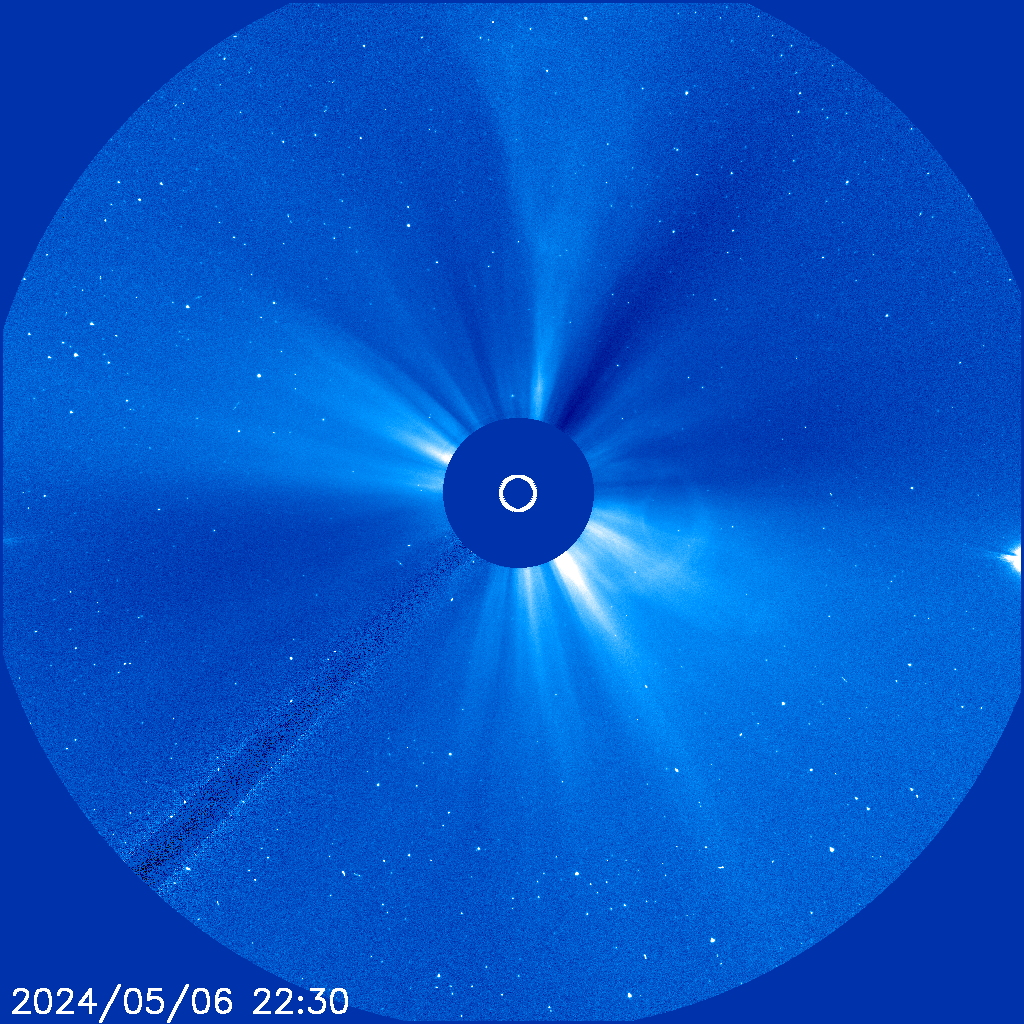
Set up the gkrellkam plugin to get the image from http://sohowww.nascom.nasa.gov/data/realtime/c3/1
0 24/latest.gif, which is a LASCO instrument at SOHO (which we are turning into the world's most expensive webcam IMHO). - Also, set the number of second per update at 3600, so your image will update every hour (I don't know exactly the update times at soho website, I think 1 hour is ok)
- Stay alert for some twisted structure like this
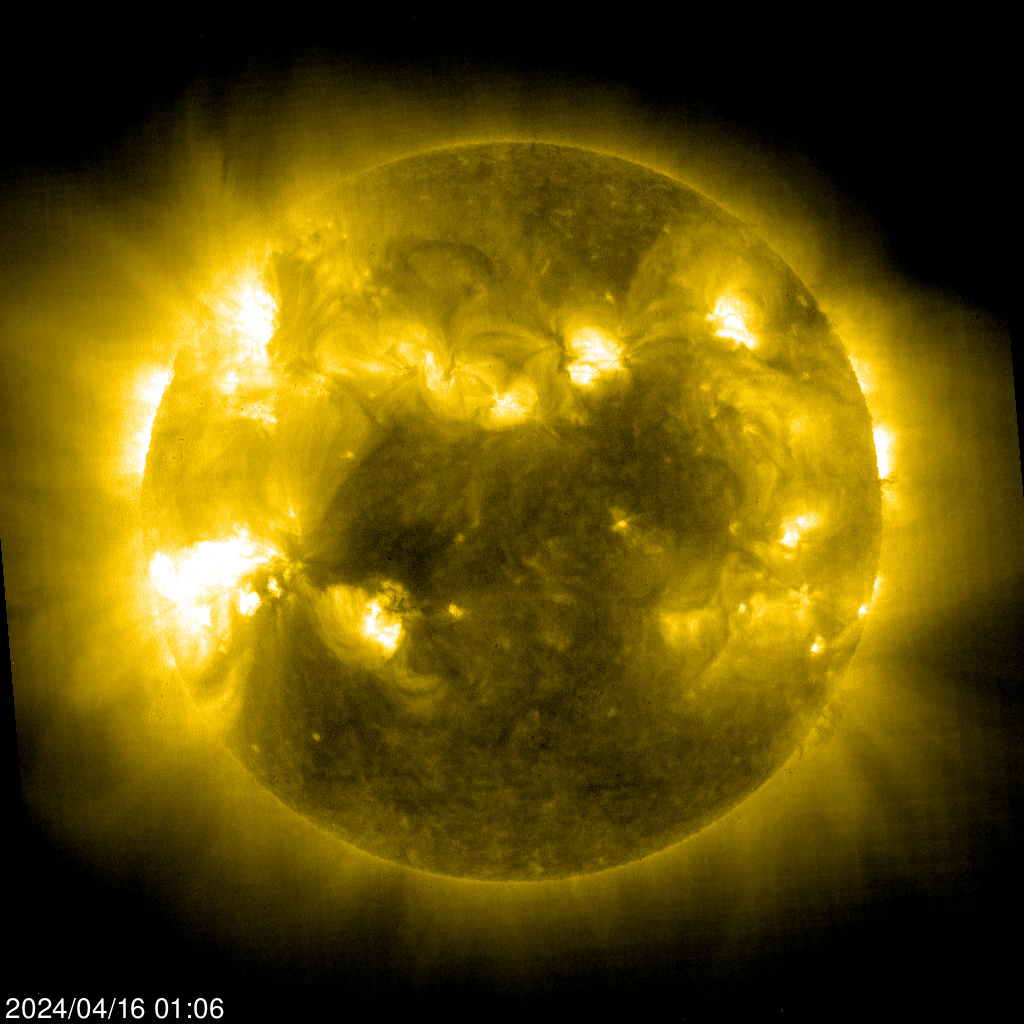
I have four gkrellkam panels, one for watching sunspots, another for coronal holes (currently in "bake-out"), another for the auroral oval and the above one. The links for those images are:
Auroral oval (replace "pmapS.gif" to "pmapN.gif" for the northern hemisphere)
Take a look to the SOHO website (lastest images->near realtime images) for more images... sadly the SOHO now is in a kind of blind point, so many of them are marked as "CCD Bakeout". Maybe it will be back online in a few weeks.
Of course you can use gkrellkam for a lot of other purposes, like getting weather satellite images... oh, and getting images from a ordinary webcam