Slashdot Mirror
Domain: nasa.gov
Stories and comments across the archive that link to nasa.gov.
Comments · 16,365
-
Re:Uh, that's not how they detect planets
I don't think that extrasolar planets are detected by occlusion of starlight.
In fact... They are. (IIRC it was one of the first methods proposed to search for extrasolar planets, because brightness can easily be measured, while precise angular position is a Hard Problem.)
Google on planet detection by occultation. Also, this links page has numerous links, and is part of the website for the NASA Kepler mission. (A probe designed to search for extrasolar planets via occultation.) -
Re:Uh, that's not how they detect planets
I don't think that extrasolar planets are detected by occlusion of starlight.
In fact... They are. (IIRC it was one of the first methods proposed to search for extrasolar planets, because brightness can easily be measured, while precise angular position is a Hard Problem.)
Google on planet detection by occultation. Also, this links page has numerous links, and is part of the website for the NASA Kepler mission. (A probe designed to search for extrasolar planets via occultation.) -
Re:Uh, yes it is
Here is a hokey animation for you to watch. As far as I know, the occlusion method has never actually succeeded at discovering a planet, but it has been used to learn more about planets discovered through other means.
-
NASA Science
Just fresh out of the NASA news: NASA science podcasts: http://science.nasa.gov/headlines/y2005/21mar_pod
c ast.htm?list68870 -
It's a lack of decent software!
When I was at school (couple of years ago), the educational software there was pretty useless.
So for lessons, if we went on the computers, we'd just Google the lesson's content for a few minutes or use the crappy programs they had, then get bored and chat.
I think computers are getting there in education - for example, there's NASA's World Wind which will make geography lessons actually interesting, especially given that as I was leaving my old school they were installing laptops for every pupil in at least one room for each subject.
So, computers are really more of a disctraction at the moment, but they're making progress - we just need a few more "killer apps" which genuinly interest the kids. -
Why not make your own?
There is a lot of good information available @ http://science.nasa.gov/. They have stories on various subjects with mp3 versions available for download. OTOH, as a visually impaired engineer I rely on audio geek information. Find a tutorial or other geek information online (and there is a lot of it) and convert it to audio. For Windoze there is a free text to speech reader available @ http://www.naturalreaders.com/. This software allows a document (.doc,
-
Re:Blackholes is another problemThe light that passes near a black hole is bent, but in most cases that light then becomes more spread out and too dim to see. Suppose you and a buddy are standing outside staring up the Sun. Your buddy has a photoelectric cell and points it at the Sun, then powers a lightbulb with that. Basically, the light reaching your buddy is being taken and spread out in all directions by the lightbulb. Now which is brighter? Both spots are receiving the same amount of light, but only a fraction of the light reaching your buddy is sent your way.
Same thing happens in general with black holes- if Star A emits light towards the black hole, that light is scattered in many directions and becomes much (and by much, I mean ALOT) dimmer than the light that reaches you directly from Star A. But what I say here only applies in most cases. If the black hole is lined up just right with an object, then you can get very observable images (but it doesn't even need to be a black hole to do this; e.g. Galaxy Clusters).
But the biggest problem with "observing" black holes is that the large ones (most of the ones near the centers of galaxies) tend to be surrounding by large amounts of material, such as hydrogen clouds, that block any light coming close enough to be strongly bent by the black hole anyways. Not all that bad; those clouds of gasses tend to become very energetic and bright due to the large gravity, so they themselves are easy to see (so we can observe black holes indirectly by observing this bright gas around them).
Hope that answers your questions.
-
Is this a robot?
Enough with the remote control toys. This pushes the tecnological envelope. Autonomuous drones:
http://www.nasa.gov/centers/dryden/research/X45A/ -
Re:international?
Why the fuck are there so many insecure americans these days? Get a grip, relax. USA is still the only superpower we have.
And about the internationality of this mission...
It was terribly hard to find, I know.
-
Who knows...?
Perhaps Phobos' whacking great craters were made by outgassing too? If they were done by impacts, thees leetle moon, she's a history.
-
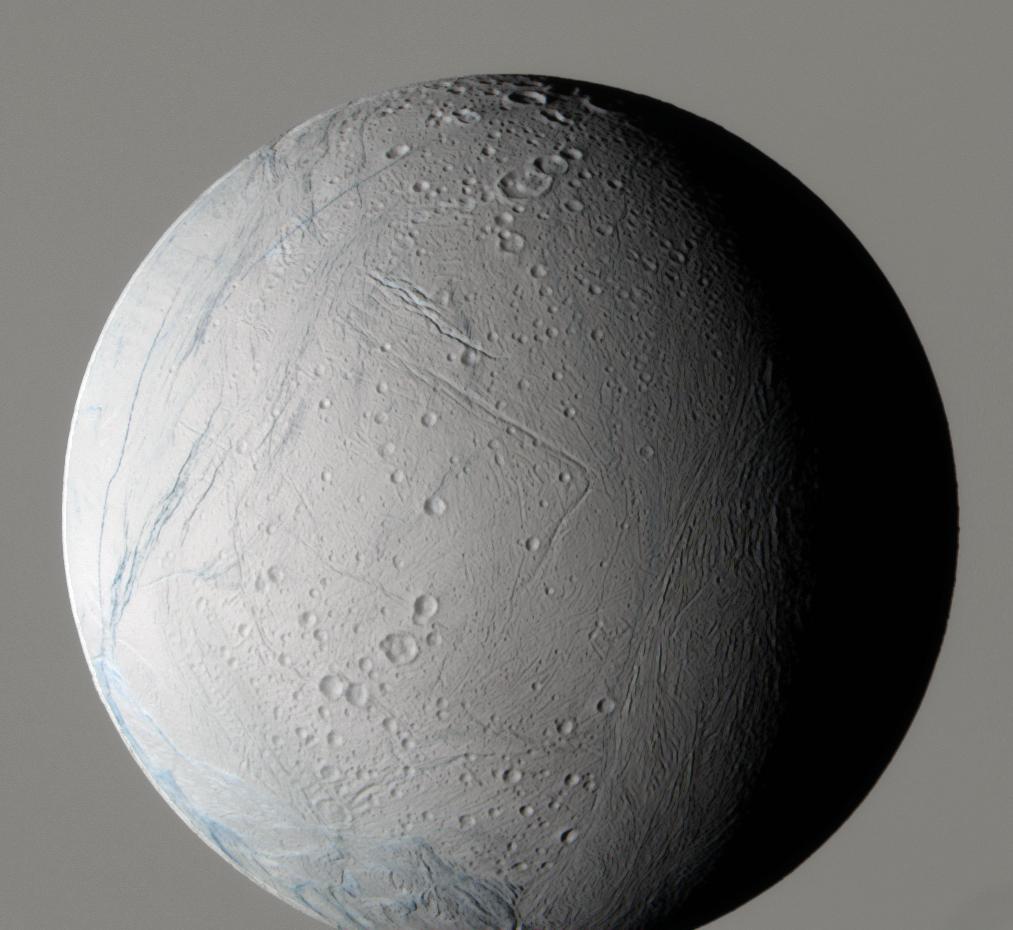
Great picture
Amazing, a small moon orbiting Saturn that would fit in the state of Arizona, and we have pictures of this quality!
-
Re:All your base are belong to us?
That's no moon! It's a space station! (that's the other side.)
-
Re:Worth Remembering Mikulski's Motives
More semantic games, whoopie. What a surprise. At least this one's shorter. A few things first, though.
a) I can't help but notice you have chosen not to cite any instances of my referring to altitude as the sole factor needed to obtain orbit. Too bad, photos of my eating my hat would have been really entertaining.
b) I also can't help but notice that for somebody doing some complaining about how unfair the English language is to NASA and the military, there's still no entry in the wiki for the word "operational", by you or anyone else. If you're so convinced the word means what you (or NASA) think it means, why don't you start a wiki entry instead of telling me how wrong I am for not psychically intuiting the context in which you were using it?
c) your assumption that manned spaceflight was not an intended purpose of the X-15 is simply incorrect. Here are links to two NASA pages, one entitled "Hypersonic research at the edge of space" and the other entitled "transiting from air to space" (which states, among many other interesting things which you apparently haven't read, that "To simulate accurately the reentry profile of a returning winged spacecraft, the X-15 had to fly at angles of attack of at least 17"). The fact that NASA says this in the titles of it's documents as well as in the contents indicate clearly that it was the intended purpose of the X-15 to fly as fast and as high as possible, up to and including spaceflight, and to gather as much information about those flights as possible. The following line is a direct quote from the official NASA X-15 research results: "Not only has it doubled the speed of piloted flight; it has prepared the way for non-orbiting flight into space." Still don't think this speaks to purpose? Here's another direct quote: "In the third, and current, phase the X-15 airplanes are being used more as research tools than research craft. This new role includes carrying scientific experiments above the atmosphere-shrouded Earth into regions no satellite or rocket can usefully explore." You're wrong about America's approach to manned spaceflight prior to Sputnik (my favorite line: "Indeed, winged spaceflight has a long theoretical tradition that dates back well before Sputnik, the world's first artificial satellite, was ever launched in 1957") and you're wrong about the X-15. Period. And I dare you to cite one single link that will prove me wrong.
The rest of this post will deal exclusively with your semantic games.
"I said "lead to manned spaceflight". You said "acheived spaceflight". Not the same thing."
At the moment at which space flight was achieved, and there were previous steps that had been taken, as a part of the program, before that moment without which spaceflight wouldn't have taken place, those previous steps in the program led to spaceflight, whether you admit it or not. You appear to be saying that the fact that the X-15 achieved spaceflight was accidental, since you are saying it wasn't the purpose for the program or any of it's flights (when in reality it was a significant part of both).
"What do so-called communities have to do this?"
Well, seeing as how you were the one who said, and once again I quote verbatim from a post you made, "The terms experimental, developmental and operational have specific meanings within NASA and the defense community", why don't you tell me, since you were the one who thought that the use of the word "operational" in a beaurocratic context as applied to systems design was somehow germane to a semantic diversion that you started, and I used the word "community" only in response to your post?
"What you think or anyone else in -
Re:Worth Remembering Mikulski's Motives
More semantic games, whoopie. What a surprise. At least this one's shorter. A few things first, though.
a) I can't help but notice you have chosen not to cite any instances of my referring to altitude as the sole factor needed to obtain orbit. Too bad, photos of my eating my hat would have been really entertaining.
b) I also can't help but notice that for somebody doing some complaining about how unfair the English language is to NASA and the military, there's still no entry in the wiki for the word "operational", by you or anyone else. If you're so convinced the word means what you (or NASA) think it means, why don't you start a wiki entry instead of telling me how wrong I am for not psychically intuiting the context in which you were using it?
c) your assumption that manned spaceflight was not an intended purpose of the X-15 is simply incorrect. Here are links to two NASA pages, one entitled "Hypersonic research at the edge of space" and the other entitled "transiting from air to space" (which states, among many other interesting things which you apparently haven't read, that "To simulate accurately the reentry profile of a returning winged spacecraft, the X-15 had to fly at angles of attack of at least 17"). The fact that NASA says this in the titles of it's documents as well as in the contents indicate clearly that it was the intended purpose of the X-15 to fly as fast and as high as possible, up to and including spaceflight, and to gather as much information about those flights as possible. The following line is a direct quote from the official NASA X-15 research results: "Not only has it doubled the speed of piloted flight; it has prepared the way for non-orbiting flight into space." Still don't think this speaks to purpose? Here's another direct quote: "In the third, and current, phase the X-15 airplanes are being used more as research tools than research craft. This new role includes carrying scientific experiments above the atmosphere-shrouded Earth into regions no satellite or rocket can usefully explore." You're wrong about America's approach to manned spaceflight prior to Sputnik (my favorite line: "Indeed, winged spaceflight has a long theoretical tradition that dates back well before Sputnik, the world's first artificial satellite, was ever launched in 1957") and you're wrong about the X-15. Period. And I dare you to cite one single link that will prove me wrong.
The rest of this post will deal exclusively with your semantic games.
"I said "lead to manned spaceflight". You said "acheived spaceflight". Not the same thing."
At the moment at which space flight was achieved, and there were previous steps that had been taken, as a part of the program, before that moment without which spaceflight wouldn't have taken place, those previous steps in the program led to spaceflight, whether you admit it or not. You appear to be saying that the fact that the X-15 achieved spaceflight was accidental, since you are saying it wasn't the purpose for the program or any of it's flights (when in reality it was a significant part of both).
"What do so-called communities have to do this?"
Well, seeing as how you were the one who said, and once again I quote verbatim from a post you made, "The terms experimental, developmental and operational have specific meanings within NASA and the defense community", why don't you tell me, since you were the one who thought that the use of the word "operational" in a beaurocratic context as applied to systems design was somehow germane to a semantic diversion that you started, and I used the word "community" only in response to your post?
"What you think or anyone else in -
Re:Worth Remembering Mikulski's Motives
More semantic games, whoopie. What a surprise. At least this one's shorter. A few things first, though.
a) I can't help but notice you have chosen not to cite any instances of my referring to altitude as the sole factor needed to obtain orbit. Too bad, photos of my eating my hat would have been really entertaining.
b) I also can't help but notice that for somebody doing some complaining about how unfair the English language is to NASA and the military, there's still no entry in the wiki for the word "operational", by you or anyone else. If you're so convinced the word means what you (or NASA) think it means, why don't you start a wiki entry instead of telling me how wrong I am for not psychically intuiting the context in which you were using it?
c) your assumption that manned spaceflight was not an intended purpose of the X-15 is simply incorrect. Here are links to two NASA pages, one entitled "Hypersonic research at the edge of space" and the other entitled "transiting from air to space" (which states, among many other interesting things which you apparently haven't read, that "To simulate accurately the reentry profile of a returning winged spacecraft, the X-15 had to fly at angles of attack of at least 17"). The fact that NASA says this in the titles of it's documents as well as in the contents indicate clearly that it was the intended purpose of the X-15 to fly as fast and as high as possible, up to and including spaceflight, and to gather as much information about those flights as possible. The following line is a direct quote from the official NASA X-15 research results: "Not only has it doubled the speed of piloted flight; it has prepared the way for non-orbiting flight into space." Still don't think this speaks to purpose? Here's another direct quote: "In the third, and current, phase the X-15 airplanes are being used more as research tools than research craft. This new role includes carrying scientific experiments above the atmosphere-shrouded Earth into regions no satellite or rocket can usefully explore." You're wrong about America's approach to manned spaceflight prior to Sputnik (my favorite line: "Indeed, winged spaceflight has a long theoretical tradition that dates back well before Sputnik, the world's first artificial satellite, was ever launched in 1957") and you're wrong about the X-15. Period. And I dare you to cite one single link that will prove me wrong.
The rest of this post will deal exclusively with your semantic games.
"I said "lead to manned spaceflight". You said "acheived spaceflight". Not the same thing."
At the moment at which space flight was achieved, and there were previous steps that had been taken, as a part of the program, before that moment without which spaceflight wouldn't have taken place, those previous steps in the program led to spaceflight, whether you admit it or not. You appear to be saying that the fact that the X-15 achieved spaceflight was accidental, since you are saying it wasn't the purpose for the program or any of it's flights (when in reality it was a significant part of both).
"What do so-called communities have to do this?"
Well, seeing as how you were the one who said, and once again I quote verbatim from a post you made, "The terms experimental, developmental and operational have specific meanings within NASA and the defense community", why don't you tell me, since you were the one who thought that the use of the word "operational" in a beaurocratic context as applied to systems design was somehow germane to a semantic diversion that you started, and I used the word "community" only in response to your post?
"What you think or anyone else in -
Re:Worth Remembering Mikulski's Motives
More semantic games, whoopie. What a surprise. At least this one's shorter. A few things first, though.
a) I can't help but notice you have chosen not to cite any instances of my referring to altitude as the sole factor needed to obtain orbit. Too bad, photos of my eating my hat would have been really entertaining.
b) I also can't help but notice that for somebody doing some complaining about how unfair the English language is to NASA and the military, there's still no entry in the wiki for the word "operational", by you or anyone else. If you're so convinced the word means what you (or NASA) think it means, why don't you start a wiki entry instead of telling me how wrong I am for not psychically intuiting the context in which you were using it?
c) your assumption that manned spaceflight was not an intended purpose of the X-15 is simply incorrect. Here are links to two NASA pages, one entitled "Hypersonic research at the edge of space" and the other entitled "transiting from air to space" (which states, among many other interesting things which you apparently haven't read, that "To simulate accurately the reentry profile of a returning winged spacecraft, the X-15 had to fly at angles of attack of at least 17"). The fact that NASA says this in the titles of it's documents as well as in the contents indicate clearly that it was the intended purpose of the X-15 to fly as fast and as high as possible, up to and including spaceflight, and to gather as much information about those flights as possible. The following line is a direct quote from the official NASA X-15 research results: "Not only has it doubled the speed of piloted flight; it has prepared the way for non-orbiting flight into space." Still don't think this speaks to purpose? Here's another direct quote: "In the third, and current, phase the X-15 airplanes are being used more as research tools than research craft. This new role includes carrying scientific experiments above the atmosphere-shrouded Earth into regions no satellite or rocket can usefully explore." You're wrong about America's approach to manned spaceflight prior to Sputnik (my favorite line: "Indeed, winged spaceflight has a long theoretical tradition that dates back well before Sputnik, the world's first artificial satellite, was ever launched in 1957") and you're wrong about the X-15. Period. And I dare you to cite one single link that will prove me wrong.
The rest of this post will deal exclusively with your semantic games.
"I said "lead to manned spaceflight". You said "acheived spaceflight". Not the same thing."
At the moment at which space flight was achieved, and there were previous steps that had been taken, as a part of the program, before that moment without which spaceflight wouldn't have taken place, those previous steps in the program led to spaceflight, whether you admit it or not. You appear to be saying that the fact that the X-15 achieved spaceflight was accidental, since you are saying it wasn't the purpose for the program or any of it's flights (when in reality it was a significant part of both).
"What do so-called communities have to do this?"
Well, seeing as how you were the one who said, and once again I quote verbatim from a post you made, "The terms experimental, developmental and operational have specific meanings within NASA and the defense community", why don't you tell me, since you were the one who thought that the use of the word "operational" in a beaurocratic context as applied to systems design was somehow germane to a semantic diversion that you started, and I used the word "community" only in response to your post?
"What you think or anyone else in -
Re:international?From the NASA article
"The Cassini-Huygens mission is a cooperative project of NASA, the European Space Agency and the Italian Space Agency. The Jet Propulsion Laboratory, a division of the California Institute of Technology in Pasadena, manages the Cassini-Huygens mission for NASA's Science Mission Directorate, Washington, D.C. The Cassini orbiter was designed, developed and assembled at JPL."
-
All your base are belong to us?
The Mercury News reports that the international Cassini spacecraft has discovered that Saturn's moon Enceladus has a significant atmosphere, NASA said Wednesday.
Not only that, but I bet there's an entire rebel base there as well!
NASA should better send down a probe there to check it out. -
Re:Where's the article?
It's right here. Why that page wasn't linked to in the first place is beyond me.
-
Re:Tell that to Google...
Actually, linux scales, and not just on clusters. Some people, like say, the NASA guys, run it on 512 simultaneous processors, people also runs it four, eight, 32 or whatever, and all with the same kernel, not a cluster but a big computer. And of course it musr run estable.
Actually, some of those Enterprises (like cisco or dell) don't have a server OS to say "our option is better, that's why you shouldn't use linux". Why should Dell tell you what you need to run? Linux is the fatest growing server platform, so they should shut up their mouth and working on better linux support if they want to remain profitable.
The one contenders there are Microsoft and Sun. We know that windows don't runs more than 64 cpus so they also should shut their mouth up and work on that. Then there's Sun, who have a real OS, but thinks that Linux is "no loss" for them, despite of having lost lots of customers to Red Hat's hands. -
Doesn't Scale?
This One seems ok...
-
Re:Thank You . . .
While I get a kick out of most of these missions, I'm *really* waiting for the next Titan mission. I want to see a nuclear powered helicopter or cryogenic-temperature blimp (two proposals thusfar) patrolling around Titan; it'd be able to visit pretty much the entire moon. Huygens definitely was a "pose 5 new questions for every one it answered" mission. And if anything, Titan now looks even more like Primordial-Earth-In-Deep-Freeze than ever before.
There were some concept studies done of an "Aerover" blimp for Titan exploration a few years back. I suspect we'll soon seen those ideas thrown around again.
Post-Cassini Exploration of Titan: Science Rationale and Mission Concepts (compares helicopters, blimps, etc.)
Titan orbiter Aerover mission
http://www.jpl.nasa.gov/news/features.cfm?feature= 499
http://www.nasatech.com/Briefs/Mar03/NPO20609.html
http://www.space.com/scienceastronomy/solarsystem/ titan_blimp_020212.html -
Re:Take this with a pinch of salt
Some of us want an OS that can run on 128 simultaneous processors as well as one or four or twelve all with the same kernel. Not a cluster. One big computer.
That's fine. Some people, like say, the NASA guys, want an OS that can run on 512 simultaneous processors as well as one or four, or eigth, or 32, or whatever, they want it stable and all with the same kernel. Not a cluster. One big computer. A really big one. -
Re:Understanding risk (suicide pills)
Well, if this is the case somebody should inform Jim Lovell about it.
http://www.hq.nasa.gov/office/pao/History/SP-350/c h-13-1.html -
CAVEs are NOT that expensive
I interned with a group at NASA Langley which is working to use mostly off the shelf components to build a portable cave. They already have a more than working prototype, or did when I was there 2 years ago. Unfortunatly I do not remember prices, but I know for sure this was maxing at around $30,000. I don't have time to go hunting now, but here is a good jumping point: http://develop.larc.nasa.gov/projects/ Just google for nasa develop and cave
-
Re:AnimationCalling it an "animation" is stretching it pretty far. The second frame isn't even on-register with the first one, so it's really just a pair of "with" and "without" snapshots.
I used to work on MER, and I discussed this issue with Daniel Crotty (the man who made the animation featured here), and it was decided that:- Good coregistration was too difficult with the available information. I've written coregistration code before, for the CAHV linearized images, however there are serious problems when using the CAHVOR or CAHVORE model images (Navcam is CAHVOR). This is because not only is the distortion in the model nonlinear, but it depends on the distance of the point from the camera - something that we can only approximate using a planar surface model. My suggestion for coregistration, given the current information, would be to do feature matching to generate a set of "equivilent" points in each image plane, and create a function which, given a relative position and orientation, would generate rays from each matching point. A nonlinear optimization algorithm (perhaps simplex method solver) would then iterate until it found a relative position/orientation that minimized the mean square distance between "equivilent" rays. I believe this is similar to how much motion tracking software works. This is, however, quite difficult to do without a preprogrammed software package designed to do this. After this the second image would still have to be projected on to the planar model of Mars, which is also nontrivial.
- From a purely scientific point of view, "proper" coregistration is almost entirely unnecessary. Because of the fact that the phenomenon is so far away, the far field effect takes care of almost all of the error. There is a two dimensional coregistration method that could be used for this purpose (Alex Hayes, Cornell '03, described it in his honors thesis) using multiple fourier transforms, one in linear space (for shifts), and one in radial/logarithmic space (for rotations and scaling).
Anyways I think the current image serves the public just fine. The file is so large because it was created in GIMP, which does not seem to support LZW compression of GIF images for a legal (?) reason. (I thought the patent expired...)
As for it not being an animation... how many frames do you need for something to be an animation?
Cheers,
Justin Wick -
That was amazingly cool.wow, that's really neat.
Kind of reminds me of the Mars Rovers' Autonomous Rover Navigation (QT video)...
-
Re:Windsock
Will the next batch of rovers be equipped with windsocks, to measure the direction of the wind?
Pathfinder had windsocks. -
Re:Windsock
Pathfinder had something I liked to call the wind chimes. They didn't move about much, I'm guessing because that lander was so close to the ground and the landscape was quite rocky.
Here's an animation here and some info. -
Re:A backup Soyuz could rescue crew"there is a common docking collar now used on all manned vehicles, russian or american."
There are a few things wrong with your statement. First, although generally true that they use the same collar for docking to the ISS, the generic "all manned vehicles" isn't true. NASA has a variety of interfaces, including the Common Berthing Mechanism (CBM) and Manual Berthing Mechanism (MBM) used on the ISS, but these are generally for berthing, not docking. Still, the CBM is an alternate docking mechanism (see for instance Section 5.1.5 of the Alternate Access to Station (AAS) Systems Concept of a Logistics Resupply Service to the ISS). The Russian interface is the Androgynous Peripheral Attachment System (APAS) as part of the Androgynous Peripheral Docking System(APDS). There are two parts to the APDS, passive and active. To convert from the NASA CBM interface to APAS, the ISS has three Pressurized Mating Adaptors (PMA1, 2, and 3). PMA1 has an active APDS because it connects the NASA Node 1 (Unity) to the Russian FGB module, and so isn't used for docking. PMA2 and PMA3 have passive APDS because they are used for docking. (See Section 1.1 of the Procurement Document for the APDS referenced above.)
Since both vehicles dock to the ISS, the shuttle does have an APAS adapter known as the Orbital Docking System (ODS). This is the 'L' shaped connector that attaches to the port at the front of the shuttle bay. It is only attached in missions to the ISS, and the APAS interface is only used for docking to the ISS. It isn't inherently true that all docking operations will be done using an APAS. However, since the only docking currently taking place is with the ISS, this is currently functionally true. It is only an ISS policy, however. The ODS is not installed on Hubble missions.
Furthermore, both the Soyuz and shuttle ODS have the active APDS side (again, see for instance Section 1.1 of the Procurement Document for the APDS above). Neither has the passive side because they are the ones doing the docking. In addition to this, approach and docking to the passive APDS is accomplished using docking cues (targets). (See, for example, Section 5.1.7.3.4.2 of the Interface Definition Document (IDD) for International Space Station (ISS) Visiting Vehicles (VVs). Neither the shuttle ODS nor Soyuz have these docking cues, again because they are the ones doing the docking.
So, I stand by my assertion that it is not as simple as you say. This method needs to be planned ahead with the right adaptors and docking systems developed and carried with them, probably flown on a Detailed Test Objective (DTO) flight, certified and validated. Again, such a system takes years of development.
As far as the orbit, it isn't clear that the Soyuz module or launch rocket are designed to go as far as Hubble. For instance, it appears that the Soyuz used for ISS mission and crew descent is only designed to descend from up to 460 km. The Hubble is at an altutude of about 600 km. So, if you have a reference on your assertion that "The Soyuz can easily reach the Hubble orbit", please forward it. Even better would be one that says it can descend from there. (Reaching it is useless as a rescue vehicle if it can't descend.)
It's not like NASA just missed the idea of using Soyuz, and you amazingly came up with the solution they're looking for. They are very smart you know. You also don't seem to realize that many of us who read Slashdot work for or with NASA (the geek ratio is quite high), so we often have the inside scoop or at least knowledge of what's involved.
-
Web sites of interest
Griffin is currently the head of the Space Department at the Johns Hopkins University Applied Physics Laboratory. Previously, he was at In-Q-Tel, Orbital Sciences Corporation, NASA and the Strategic Defense Initiative Organization.
-
OK, but...
-
OK, but...
-
Re:Worth Remembering Mikulski's Motives
" Apollo 18, 19, and 20 were Skylab missions, no? Apollo 21 was Apollo-Soyuz in '75?"
nope.
"Imagine if we lost almost 2% of our airline flights."
Right, but the people getting on these airline flights aren't test pilots who understand and have accepted the risk. Going into space, not to mention to the moon, is fundamentally different from flying in an airplane and entails more risk simply because we don't do it as much. If we had as many moon missions as commercial flights I'm sure the safety record would be much better. -
Wrong
First of all, NASA almost never builds straight replacement instruments. They are always focused on something new. JWST will not replace Hubble by any means. In fact, if both were up at the same time (sustained, not about-to-be-junk), the amount of additional science able to come from their complementary instrumentation should be reason alone to keep Hubble strong until it launches.
Astronomy in the ultraviolet is all but mothballed for a decade if one of the instruments (Cosmic Origins Spectrograph, COS) slated for installation in Hubble does not make it to orbit somehow. The only functioning instrument right now is GALEX, an imaging experiment.
However, when we obtain spectra, the ultraviolet, more than any other waveband, gives us tremendous direct information about the atomic composition of many astronomical objects. (Molecules are best studied in the radio part of the spectrum. Solid particles [e.g. dust] in the infrared).
JWST will not fill this gap. It will be a great loss and put a halt to a wealth of knowledge gained from ultraviolet spectroscopy that began about three decades ago. -
Re:There is a better option
I think the "better option" that most astrophysicists are looking forward to is the James Webb Telescope. It's a primarily IR-telescope, but in terms of its mission statement it will largely replace what Hubble is doing now. Hubble has already survived longer than originally intended (due to many well-executed repair missions). More years could be squeezed out of Hubble with more repair missions, but if what you want is a brand-new telescope, the James Webb Telescope will keep astronomers busy for many years.
-
Who knows?
Maybe he did call him and maybe he didn't. But what we know for sure is that Junior is the guy who gave O'Keefe his current position. I'll leave it as an exercise for the reader to ascertain why Junior promotes certain people. I personaly find it hard to believe Junior would recommend someone who didn't share his views - and these decisions most likely reflect those views. Regardless Junior definitely gets to share the blame at least indirectly for putting this guy in charge.
-
Re:*sigh* Figures.
At that distance Voyager must use lot's of power to pump out science data at a very slow rate. Like less than 10 bits per sec.
It appears you're full of crap. From http://voyager.jpl.nasa.gov/science/thirty.html:
DTR operations also have to be terminated when the downlink telecom performance will no longer support the minimum DTR playback data rate of 1.4 kbps.
This page suggests that's scheduled for 2010-2012. I also see references to the telemetry data being beamed back at 160 bps. -
No contact at all with Pioneer since 2003
Sadly that hasn't been true for a while.
That BBC News article was written way back in 2001. In 2002 NASA stopped receiving recognisable telemetry data and in February 2003 there was no signal at all from the spacecraft (there was only a very weak signal in the January 2003 session).
See the Pioneer 10 home page for the details.
Chris -
Re:4 million?
Why shut it down when you could give it to someone else? I'm sure there is another country, company, or group who would be willing to take control of these space craft and gather data if NASA is now bored with the operation.
First find another organisation with the required antennas. I think Voyager II is far enough away to need 34 or 72 metre dishes. For twenty four hour coverage you'll need three spread across the globe. The good news is that networking them together should be cheaper now, than when NASA originally built the Deep Space Network. Then you'll need to equip and man those groundstations.
FWIW, the European Space Agency has one 34 metre dish at New Norcia with another being built at Cebreros near Madrid.
-
Re:Why $4.2 million?
Operating the Deep Space Network (DSN) costs about 257 million dollars per year.
NASA 'Science, Astronautics, and Exploration' Budget details -
Re:Weeeeellll...What planet are you on?
Here is NASAs budget. Try reading it sometime.
From the budget:
- 5.5 Billion is dedicated to Science including the James Webb Telescope, Keck Interferometer, Large Binocular Telescope Interferometer, , Terrestrial Planet Finder, Stratospheric Observatory For Infrared Astronomy (SOFIA), Gamma-ray Large Area Space Telescope (GLAST), SWIFT, Widefield Infrared Survey Explorer, Gravity Probe-B, RXTE, FUSE, Chandra, XMM, HETE-2, WMAP, INTEGRAL, CHIPS, GALEX, Spitzer, Astro-E2, LISA, Constellation-X, STEREO, SOLAR-B and many more but I am getting bored looking this stuff up for you.
- 2.7 Billion for Exploration Systems including CEV and Prometheus
- 906 Million for traditional aeronautics
- The remaining 6.7 Billion is to support the ISS, Shuttle and infrastructure.
<sarcasm>But yeah, you are right... Bush threw everything at Pie-in-the sky stuff...</sarcasm>
-
Re:Weeeeellll...What planet are you on?
Here is NASAs budget. Try reading it sometime.
From the budget:
- 5.5 Billion is dedicated to Science including the James Webb Telescope, Keck Interferometer, Large Binocular Telescope Interferometer, , Terrestrial Planet Finder, Stratospheric Observatory For Infrared Astronomy (SOFIA), Gamma-ray Large Area Space Telescope (GLAST), SWIFT, Widefield Infrared Survey Explorer, Gravity Probe-B, RXTE, FUSE, Chandra, XMM, HETE-2, WMAP, INTEGRAL, CHIPS, GALEX, Spitzer, Astro-E2, LISA, Constellation-X, STEREO, SOLAR-B and many more but I am getting bored looking this stuff up for you.
- 2.7 Billion for Exploration Systems including CEV and Prometheus
- 906 Million for traditional aeronautics
- The remaining 6.7 Billion is to support the ISS, Shuttle and infrastructure.
<sarcasm>But yeah, you are right... Bush threw everything at Pie-in-the sky stuff...</sarcasm>
-
Re:Weeeeellll...What planet are you on?
Here is NASAs budget. Try reading it sometime.
From the budget:
- 5.5 Billion is dedicated to Science including the James Webb Telescope, Keck Interferometer, Large Binocular Telescope Interferometer, , Terrestrial Planet Finder, Stratospheric Observatory For Infrared Astronomy (SOFIA), Gamma-ray Large Area Space Telescope (GLAST), SWIFT, Widefield Infrared Survey Explorer, Gravity Probe-B, RXTE, FUSE, Chandra, XMM, HETE-2, WMAP, INTEGRAL, CHIPS, GALEX, Spitzer, Astro-E2, LISA, Constellation-X, STEREO, SOLAR-B and many more but I am getting bored looking this stuff up for you.
- 2.7 Billion for Exploration Systems including CEV and Prometheus
- 906 Million for traditional aeronautics
- The remaining 6.7 Billion is to support the ISS, Shuttle and infrastructure.
<sarcasm>But yeah, you are right... Bush threw everything at Pie-in-the sky stuff...</sarcasm>
-
Re:Weeeeellll...What planet are you on?
Here is NASAs budget. Try reading it sometime.
From the budget:
- 5.5 Billion is dedicated to Science including the James Webb Telescope, Keck Interferometer, Large Binocular Telescope Interferometer, , Terrestrial Planet Finder, Stratospheric Observatory For Infrared Astronomy (SOFIA), Gamma-ray Large Area Space Telescope (GLAST), SWIFT, Widefield Infrared Survey Explorer, Gravity Probe-B, RXTE, FUSE, Chandra, XMM, HETE-2, WMAP, INTEGRAL, CHIPS, GALEX, Spitzer, Astro-E2, LISA, Constellation-X, STEREO, SOLAR-B and many more but I am getting bored looking this stuff up for you.
- 2.7 Billion for Exploration Systems including CEV and Prometheus
- 906 Million for traditional aeronautics
- The remaining 6.7 Billion is to support the ISS, Shuttle and infrastructure.
<sarcasm>But yeah, you are right... Bush threw everything at Pie-in-the sky stuff...</sarcasm>
-
Re:Weeeeellll...What planet are you on?
Here is NASAs budget. Try reading it sometime.
From the budget:
- 5.5 Billion is dedicated to Science including the James Webb Telescope, Keck Interferometer, Large Binocular Telescope Interferometer, , Terrestrial Planet Finder, Stratospheric Observatory For Infrared Astronomy (SOFIA), Gamma-ray Large Area Space Telescope (GLAST), SWIFT, Widefield Infrared Survey Explorer, Gravity Probe-B, RXTE, FUSE, Chandra, XMM, HETE-2, WMAP, INTEGRAL, CHIPS, GALEX, Spitzer, Astro-E2, LISA, Constellation-X, STEREO, SOLAR-B and many more but I am getting bored looking this stuff up for you.
- 2.7 Billion for Exploration Systems including CEV and Prometheus
- 906 Million for traditional aeronautics
- The remaining 6.7 Billion is to support the ISS, Shuttle and infrastructure.
<sarcasm>But yeah, you are right... Bush threw everything at Pie-in-the sky stuff...</sarcasm>
-
Re:Weeeeellll...What planet are you on?
Here is NASAs budget. Try reading it sometime.
From the budget:
- 5.5 Billion is dedicated to Science including the James Webb Telescope, Keck Interferometer, Large Binocular Telescope Interferometer, , Terrestrial Planet Finder, Stratospheric Observatory For Infrared Astronomy (SOFIA), Gamma-ray Large Area Space Telescope (GLAST), SWIFT, Widefield Infrared Survey Explorer, Gravity Probe-B, RXTE, FUSE, Chandra, XMM, HETE-2, WMAP, INTEGRAL, CHIPS, GALEX, Spitzer, Astro-E2, LISA, Constellation-X, STEREO, SOLAR-B and many more but I am getting bored looking this stuff up for you.
- 2.7 Billion for Exploration Systems including CEV and Prometheus
- 906 Million for traditional aeronautics
- The remaining 6.7 Billion is to support the ISS, Shuttle and infrastructure.
<sarcasm>But yeah, you are right... Bush threw everything at Pie-in-the sky stuff...</sarcasm>
-
Re:How come$4.2 million dollars to analyse incoming data? You could employ 80 PhD astrophysicists for a year for that much.
When I saw the figure I thought 4.2 million is quite cheap.
You are assuming 80 astrophysicists would make $52k annually. This is a very naive assumption because it entirely ignores administrative overhead that must always be included with salaries.
A rough rule of thumb is that a person costs about 2x their salary, to pay for utilities, housekeeping, human resources, etc. So a $50k salaried employee will cost roughly $100k. That would leave only 40 astrophysicists in your example.
Secondly, communication with Voyager occurs through the Deep Space Network, which has a slew of technicians and scientists that operate it. Voyager might spend about half to 3/4 of its budget paying for time on the Deep Space Network, even though they probably only communicate with Voyager a few hours (or tens of hours) annually. I believe most of Voyagers instruments are turned off because the RTG is winding down. IIRC, the bulk of the science down w/ Voyager now is tracking it's slowdown through the heliopause, by carefully monitoring the Doppler shift of its transmissions.
So $4.2 million will run out quite quickly. And I would guess they'd have maybe 10 scientists working on it nowadays, not 40. And these ten might only be part time too. But the bulk of it's expenditures would probably be on the Deep Space Network.
-
Re:How come
The article doesn't break it down, but I'd guess that part of it goes to the Deep Space Network.
-
Re:Question...
Why fake it?
http://deepimpact.jpl.nasa.gov/