Slashdot Mirror
Domain: nasa.gov
Stories and comments across the archive that link to nasa.gov.
Comments · 16,365
-
Re:Repent, Sinners!
planes do NOT fall out of the sky during a total air traffic control outage
That is complete crap. There were 3 near misses that required evasive maneuvers during this latest outage. They regress to pencil and paper when the radar goes down, not the freakin radios - The skies are getting to crowded to allow long radio outages.
And I am sure that if you check the NASA ASRS (Aviation Safety Reporting System, where pilots can report incidents without fear of retribution by the FAA or others) later, you will find that there were many dangerous mid air situations during and caused by that outage. (I believe that an outage in Oakland would have been worse since they handle a busier/more dangerous area of airspace, including trans-Pacific traffic, IIRC) -
don't underestimate the importance of this!
TNG baby... we're getting closer to two of the Coolest Technologies Ever. Replicators and the Holodeck -
Replicator:
Today, we know how to create microchip circuits and experimental nanometer-scale objects by "drawing" them on a surface with a beam of atoms. We can also suspend single atoms or small numbers of atoms within a trap made of electromagnetic fields, and experiment on them. That's as close as the replicator is to reality. Making solid matter from a pattern as the replicator appears to do, is pretty far beyond present physics.
science of star trek -
Re:What about the life we sent?
That'll be where Planetary Protection comes into play.
-
atmosphere
The only problem with terraforming mars is the lack of magnetic field and its weak gravity. The weak gravity allows the atmosphere to escape http://zebu.uoregon.edu/~soper/Mars/atmosphere.ht
m l and the lack of magnetic field allows the solar wind to blow the rest of the atmosphere away. http://science.nasa.gov/headlines/y2001/ast31jan_1 -
Re:How old is the hubble ?
There is already an other space telescope on the way, it's called JWST. Of course it has a very high price, but isn't understanding the origins of the universe worth it?
I will always ask myself where the original matter is from and why was it there in the first place.
-
Re:$30M for more insect robots? Sounds like pork.
-
history repeating
We'll first need our secret agencies to produce images of trucks and foreigners, so we can prove they have weapons of mass destruction.
Until now, it did not really work out. -
Boring...
Wonder how boring the 6-9 month travel would be? Though new rocket technology could make it less so and more achievable. But we'd have to take this guy so he can visit the Mars Starbucks...
-
Re:not that complicated
You google for "digits of e" and select the second result.
-
Re:Discover also has an analysis...
This interview is debatably pro-Kerry. It appears to me that Kerry is merely finding Bush's "weak" points, then trying to "exploit" them. For instance, when the media attacks Bush's views on Global Warming, Kerry will decide it is in his best interest to voice that he will take action against emissions supposedly relating to global warming.
However, global warming is NOT occuring, at least in the "magnitude" that everyone is worried about. It is, technically, a lie by the uninformed media.
This "global warming" that everyone is worried about? It's really a variation in the earth's temperature of around 2 degrees over the last century and a half!
This article has more about it, as well as this chart:
This image here demonstrates a bit more clearly what I wish to say:[Image taken from this article here.]
Yes, that has data taken over only the last 25 years, but I assure you, the data sames relatively the same ever since scientists have started estimating the global temperature.
In addition, we see that the graph shows temperatures rising, yes, but then going way down the very next year, then bouncing back up! That is not how I would classify global warming!!!
Here is yet another graph, this one with data over the last century!
While the last graph was taken from an article that thinks global warming IS occuring, it provides no real data for their argument. And also, their chart directly contradicts their hypothesis!
So, to recap: Global warming is a lie. To blame Bush for not taking action against global warming is to blame him for not needlessly restricting industries actions.
[I realize that Mycroft and others have said similar in their replies, however, my reply contains charts, articles and other arguements, so I posted it anyway.]- Yolego
-
Re:Discover also has an analysis...
This interview is debatably pro-Kerry. It appears to me that Kerry is merely finding Bush's "weak" points, then trying to "exploit" them. For instance, when the media attacks Bush's views on Global Warming, Kerry will decide it is in his best interest to voice that he will take action against emissions supposedly relating to global warming.
However, global warming is NOT occuring, at least in the "magnitude" that everyone is worried about. It is, technically, a lie by the uninformed media.
This "global warming" that everyone is worried about? It's really a variation in the earth's temperature of around 2 degrees over the last century and a half!
This article has more about it, as well as this chart:
This image here demonstrates a bit more clearly what I wish to say:[Image taken from this article here.]
Yes, that has data taken over only the last 25 years, but I assure you, the data sames relatively the same ever since scientists have started estimating the global temperature.
In addition, we see that the graph shows temperatures rising, yes, but then going way down the very next year, then bouncing back up! That is not how I would classify global warming!!!
Here is yet another graph, this one with data over the last century!
While the last graph was taken from an article that thinks global warming IS occuring, it provides no real data for their argument. And also, their chart directly contradicts their hypothesis!
So, to recap: Global warming is a lie. To blame Bush for not taking action against global warming is to blame him for not needlessly restricting industries actions.
[I realize that Mycroft and others have said similar in their replies, however, my reply contains charts, articles and other arguements, so I posted it anyway.]- Yolego
-
Re:Redundant equipment
They have a backup unit
-
To sell Cycles!! (Really, to improve animation)
Of course, if you have a monitor that can be updated faster, you'll need a faster CPU to process the data.
Seriously, there are advantages for animation and 3D. Faster frame updates can provide higher virtual resolution, as each successive fram matches slightly different edge locations for objects. (That's badly put, sorry.) Higher frame rates can also improve the visual smoothness of rapidly moving objects. If you film a person moving their eyes rapidly, you'll see that they don't move smoothly - they jerk through the motion, stopping every few milliseconds to catch a frame. The higher your frame rate, the more likely your scene is to be "correct" for the eye location at that moment. Intuitively, we've all experienced the jerkiness of movies when things are moving fast. It can be disruptive to the experience.
The advantage of higher frame rates was demonstrated with the first cheap 3D head-mounted display Virtual Reality system (to my knowledge) was built by Dr. Michael McGreevy, at NASA's Ames Research Center at Moffett Field near San Jose CA. (See this 1989 paper, this 1993 overview, and McGreevy's 1989 talk.) He used two Citizen 2" handheld TV monitors with only 128x128 resolution, IIRC. Because of the small number of pixels for which to process data, his system was able to update the 3D display data at high frame rates.
He had an interesting and surprising discovery. Our eyes have a small "jitter" - they move back and forth a very small amount, quickly (I don't recall why). He found that his system updated so fast that it altered the display as the eyes jittered. The result was a virtual (perceived) resolution higher than 128x128 would be expected to provide. I think this was in a Scientific American article in about 1988. -
To sell Cycles!! (Really, to improve animation)
Of course, if you have a monitor that can be updated faster, you'll need a faster CPU to process the data.
Seriously, there are advantages for animation and 3D. Faster frame updates can provide higher virtual resolution, as each successive fram matches slightly different edge locations for objects. (That's badly put, sorry.) Higher frame rates can also improve the visual smoothness of rapidly moving objects. If you film a person moving their eyes rapidly, you'll see that they don't move smoothly - they jerk through the motion, stopping every few milliseconds to catch a frame. The higher your frame rate, the more likely your scene is to be "correct" for the eye location at that moment. Intuitively, we've all experienced the jerkiness of movies when things are moving fast. It can be disruptive to the experience.
The advantage of higher frame rates was demonstrated with the first cheap 3D head-mounted display Virtual Reality system (to my knowledge) was built by Dr. Michael McGreevy, at NASA's Ames Research Center at Moffett Field near San Jose CA. (See this 1989 paper, this 1993 overview, and McGreevy's 1989 talk.) He used two Citizen 2" handheld TV monitors with only 128x128 resolution, IIRC. Because of the small number of pixels for which to process data, his system was able to update the 3D display data at high frame rates.
He had an interesting and surprising discovery. Our eyes have a small "jitter" - they move back and forth a very small amount, quickly (I don't recall why). He found that his system updated so fast that it altered the display as the eyes jittered. The result was a virtual (perceived) resolution higher than 128x128 would be expected to provide. I think this was in a Scientific American article in about 1988. -
To sell Cycles!! (Really, to improve animation)
Of course, if you have a monitor that can be updated faster, you'll need a faster CPU to process the data.
Seriously, there are advantages for animation and 3D. Faster frame updates can provide higher virtual resolution, as each successive fram matches slightly different edge locations for objects. (That's badly put, sorry.) Higher frame rates can also improve the visual smoothness of rapidly moving objects. If you film a person moving their eyes rapidly, you'll see that they don't move smoothly - they jerk through the motion, stopping every few milliseconds to catch a frame. The higher your frame rate, the more likely your scene is to be "correct" for the eye location at that moment. Intuitively, we've all experienced the jerkiness of movies when things are moving fast. It can be disruptive to the experience.
The advantage of higher frame rates was demonstrated with the first cheap 3D head-mounted display Virtual Reality system (to my knowledge) was built by Dr. Michael McGreevy, at NASA's Ames Research Center at Moffett Field near San Jose CA. (See this 1989 paper, this 1993 overview, and McGreevy's 1989 talk.) He used two Citizen 2" handheld TV monitors with only 128x128 resolution, IIRC. Because of the small number of pixels for which to process data, his system was able to update the 3D display data at high frame rates.
He had an interesting and surprising discovery. Our eyes have a small "jitter" - they move back and forth a very small amount, quickly (I don't recall why). He found that his system updated so fast that it altered the display as the eyes jittered. The result was a virtual (perceived) resolution higher than 128x128 would be expected to provide. I think this was in a Scientific American article in about 1988. -
To sell Cycles!! (Really, to improve animation)
Of course, if you have a monitor that can be updated faster, you'll need a faster CPU to process the data.
Seriously, there are advantages for animation and 3D. Faster frame updates can provide higher virtual resolution, as each successive fram matches slightly different edge locations for objects. (That's badly put, sorry.) Higher frame rates can also improve the visual smoothness of rapidly moving objects. If you film a person moving their eyes rapidly, you'll see that they don't move smoothly - they jerk through the motion, stopping every few milliseconds to catch a frame. The higher your frame rate, the more likely your scene is to be "correct" for the eye location at that moment. Intuitively, we've all experienced the jerkiness of movies when things are moving fast. It can be disruptive to the experience.
The advantage of higher frame rates was demonstrated with the first cheap 3D head-mounted display Virtual Reality system (to my knowledge) was built by Dr. Michael McGreevy, at NASA's Ames Research Center at Moffett Field near San Jose CA. (See this 1989 paper, this 1993 overview, and McGreevy's 1989 talk.) He used two Citizen 2" handheld TV monitors with only 128x128 resolution, IIRC. Because of the small number of pixels for which to process data, his system was able to update the 3D display data at high frame rates.
He had an interesting and surprising discovery. Our eyes have a small "jitter" - they move back and forth a very small amount, quickly (I don't recall why). He found that his system updated so fast that it altered the display as the eyes jittered. The result was a virtual (perceived) resolution higher than 128x128 would be expected to provide. I think this was in a Scientific American article in about 1988. -
Been there, done that...for free
Well, not exactly for free. I put a crapload of effort into it.
I got to fly in the the Weightless Wonder (aka V**** C****) as part of a collegiate student program this past April. All told, we flew 30 micro-g parabolas, 1 lunar parabola, and 1 martian parabola. Let me say this: roller coasters, jumping cars over hills, even piloting gliders do not come close to comparing. Even when piloting an aircraft, you don't have the ability to get up and move around...there's that darn steering part to take care of.
For $3000, if the track record and maintenence records are clean, I would definitely do it again (granted I plan ahead for this as simply an expensive vacation). Especially since I won't have to be preoccupied with any experiments.
Might I suggest: anyone who is in a science-based major in college should try to come up with an experiment that would yield "intriguing" results when flown in microgravity. Remember, each trial must last a maximum of 25 seconds. And the more hands-off (and more automated), the better...that just means more fun for you. -
Re:*Ahem*
Einstein's Theory of *General* Relativity includes the Principle of Equivalence, namely,
There is no physical way of distinguishing between a UNIFORM gravitational field from a UNIFORM linear acceleration.
Since there is no way to distinguish between the gravitational field being uniformly *zero* and a uniform acceleration of *zero*, there is no distinguishable difference between your "Zero G Force" (F=ma ---> F=0 a = 0) and "Zero Gravity" (F = 0 because Gmm/r^2 = 0).
Now, the nit to pick that leads to the term "microgravity" is that the gravitational field in Earth orbit is not uniform over a finite region; there are (minute) tidal effects, anisotropies, spacecraft vibration, drag at low earth orbit, etc., all of which are, in principle, detectable, and some of which could not be produced except by a non-uniform gravitational field, although determining that might be beyond a particular experimental error.
Note, in passing, that NASA uses the "Zero Gravity" term to describe it's Earth-based drop facilities. -
No new signals from Pioneer..
As far as I understand, there have not been signals recieved from Pioneer-10 since Jan 2003..
http://nssdc.gsfc.nasa.gov/nmc/tmp/1972-012A.html
So, has a new signal been recieved, or is this just new analysis of old data? -
You can't call it thatI was on a SOAR team, where Nasa allows university students to fly experiments on the KC-135. There is much research done on them, but much of it is sidelined to PR. The PR folks make most the decisions on the plane. They know lack of safety is not only bad for them and the plane, but for budget and PR. When FOD can kill an $80K+ engine, they make damn sure there are few chances for it to do so. That's why you can't bring your own tools anywhere on Elington field (same place W was "based" in Texas Air National Guard).
When I went nearly half the experimenters got quite sick. The smart groups made the experiments automated and spend the time doing flying kicks and walking up walls. Or, of course, Vomiting. Nasa hates the name Vomit Comet, but everyone calls it that. A problem was the camera people would come up to you on the plane while you were frantically working to make your project work due to some bug you missed before hand. When they come you are suppose to smile and wave and say hi to folks at home that will get shown the video. This is rather bad for a serious project that has 10k+ invested in it for plane tickets and hotel rooms.
For some great photos of flights try http://zerog.jsc.nasa.gov/2004SpringCollegeCampai
g n/viewer.cgi -
Vomit Comet
I'm actually sitting only 300 yards away from NASA's KC-135, affectionately known as the Vomit Comet. This is the aircraft that NASA uses to do micro-gravity research. (ie. zero-g flights with experiments in tow.) I've had the opportunity to fly on the thing but turned it down. (Yeah I'm a big chicken. A big green-in-the-face chicken in fact.)
Reckon I won't be spending $3000 to do what I could have done for free....
-
Old newsAccording to the Pioneer's home page:
A discussion of this phenomenon appears in the 4 October 1999 issue of Newsweek magazine (See also the December 1998 issue of Scientific American.) The mystery of the tiny unexplained acceleration towards the sun in the motion of the Pioneer 10, Pioneer 11 and Ulysses spacecraft remains unexplained.
-
crash pic from nasa (yes, it's real)
-
Clean room procedures?
OK, maybe one of you lab rats can answer this but...
Call me irresponsible, but this guy went to all the effort to cover himself, then he leans over WITHOUT A MASK to work on a plate full of DUST!
-
Another Successful Failure?
I thought it was Stardust (sun is a star) or Data?
http://liftoff.msfc.nasa.gov/Academy/History/APOLL O-13/mission-report.html/ -
Re:Some electromagnetic effect?
How much do we know about the magnetic fields in deep space?
Enough, I'd say, to exclude it as a source of this force, since a magnetometer was one of the most obvious (at least the boom it's extending from is the longest) features of those two pioneer spacecraft. There's a pretty good description of them in the book PIONEER ODYSSEY available from.
Two three-rod trusses, 120 degrees apart, project from two sides of the equipment compartment. At their ends, nuclear electric power generators are held about 3 meters (10 feet) from the center of the spacecraft. A third boom, 120 degrees from the other two, projects from the experiment compartment and positions a magnetometer sensor about 6.6 meters (21-1/2 feet) from the center of the spacecraft. All three booms are extended after launch.
Also, Zinho is correct in pointing out that a magnetic field can accelerate a non-ferrous, non-polarized material, but it has to be a changing magnetic field, since the effect is based on currents induced into the object.by the same magnetic field. -
Cheating
You dont need to break lightspeed. You could cheat.
See this page for:
Worm Holes
Alcubierre's "Warp Drive"
Negative mass propulsion
Millis's hypothetical "Space Drives"
WarpDrives -
Swarm intelligence?
This sounds like a good application for swarm intelligence.
-
To answer that...
... take a look at NASA's Blue Marble, Globe at night pictures. A picture says a thousand words so they say.
-
NASA
Here's a link to some information about the newly photographed planet from NASA
-
Re:*Earth* is gonna have a ring...Earth is going to have a ring of space crap around it in a few years...
It already does (go to the the J-Track 3D section).
-
Re:Rain Fade
my understanding is that they will do it in the same way that they get away with using the little dishes, pumping a huge amount of power out.
It's a satellite. Powered by solar cells. As much as they'd probably love to pump a `huge amount of power out', they don't have a huge amount of power to pump with. According to this link, the solar cells (which are huge!) of this satellite put out 4.3 kW of power. Which is a lot, but I imagine that's peak power, and the satellite cannot be in the sun all the time, so it's got to charge batteries for night time use, and it's transmitters are not 100% efficientAll in all, I doubt it can put out 1000 watts of RF power 24/7. Compare that to your local FM station that probably broadcasts with 100,000 watts and only serves an area with an 60 mile or so radius. At high frequencies, you don't need a large dish for high gain (doubling the frequency generally doubles the gain), so the little dishes do the job.
Still, that's pretty impressive. 4.3 kW of power for a satellite? And the new ones are likely to be even bigger. (For comparison, Voyager broadcasts with 13 watts of power. Of course, it's power source is probably nuclear.)
With 4.3 kW of power coming in at peak (and never mind that solar cells aren't very efficient, so there's several times that amount of heat being collected by the solar cells), I wonder how they keep it cool. In space, you can't just tack on a big fan
-
Re:Not far enough out
Sorry for being redundant (but so is your post - there appears to be many similarly misinformed "astronomers" on
According to our current understanding of Astrophysics, the Sun will not be going supernova.
This Wikipedia article seems to indicate the sun would need to be >12 solar masses to form a Type II Supernova (with Type 1 only being possible with a companion star).
This page from NASA's website claims the lower limit is 8 solar masses.
Point is, we don't need to worry about the sun going supernova. In fact, it would be more interesting to wonder what the nearest star capable of supernova is. It would still be irrelevant though. -
Re:Worse pictures than from mars...
Keep in mind that photo was a quick grab from a telephoto television camera. Take a look at this photo if you want to see something of a little better quality, and even that was a quick camera shot by the chase helicopter with a hand-held digital camera.
The optics on the Mars Rover were of a much higher quality, so the comparison isn't really all that accurate. It is too bad that some photographer from Associated Press or Newsweek wern't on the PR helicopter to take a really good still photo of the incident. -
Re:Velocity at Impact Question for you Engineers..
Enjoy the magic of terminal velocity.
-
Re:Failure timeline
miracles they performed in getting Men to and from the moon several times without a single fatality.
I guess you're not counting the three men who died on the launch pad in the Apollo 1 tragedy...
-
Worse pictures than from mars...
I find it disturbing that the official picture of the crater is worse than what we get from mars.
Actually this looks like the pictures of the rebel alliance hideout the empire got from the Hoth probe.
-
Re:I think someone is overreactingThis is the act in question.
It begins:
"The Congress finds and declares the following:
.
1. The continuous collection and utilization of land remote sensing data from space are of major benefit in studying and understanding human impacts on the global environment, in managing the Earth's natural resources, in carrying out national security functions, and in planning and conducting many other activities of scientific, economic, and social importance."
Also interesting:
"15. Development of the remote sensing market and the provision of commercial value-added services based on remote sensing data should remain exclusively the function of the private sector."
. -
Re:Unreal
Weather satellites are owned and operated by the government, not commerical operators. They will likely remain available. And yes, satellites provide information that land-based weather radar can not. (how many radar stations are there in the middle of the Atlantic?) Of course, the NASA is trying to kill TRMM, the only satellite-based weather radar, but that's another story.
-
Re:Pictures of it happening?
They just got a quicktime link on the main NASA page This page also has a really good photo right on the front that shows the crater and the remains of the probe. It may just be an illusion, but it looks like it may even be a steroscopic photo. I think that is just the mud that got kicked up.
-
Spacecraft tumbling -- old mistake?The reports that the re-entry vehicle was seen to be tumbling rather than spinning properly makes me wonder if sloppy thinking about rigid body kinematics came into play yet again? Spinning objects often behave in tricky, counterintuitive ways, and even in a mission of this scale it would not be too surprising to find that the spacecraft tumbled when the engineers intended it to spin smoothly.
If true, it would not be the first time -- by a long shot -- that the strange behavior of spinning objects caused trouble for a spacecraft. Some of the early three-axis-stabilized satellites were made into inadvertent spinners after their launch stabilization spin made them flip upside down (so that their de-spin rockets made them go faster instead of slowing them down!). SOHO was nearly lost in 1998, in part because rotational precession rotated the craft so that the solar panels were in long-term twilight.
Here's hoping there's something left for the team to analyze. Three years in space plus ten years of planning and lobbying is a long time to wait. -
Wrong mission -- Genesis doesn't use aerogel> I hope something survived. The aerogel > should have survived
Wrong mission. You are thinking of Stardust, which will return samples from a comet.
Genesis allowed solar wind particles to slam into polished slabs of metal; some of the particles stick and can be recovered afterwards.
-
Those pictures on cnn...
... of the crash scene look vaguely familiar.
Oh yeah...
-
Possible Cause...According to NASA's NSSDC master catalog:
There was some concern that the sample return capsule battery would fail, jeopardizing the re-entry. The battery was overheating, but ground tests have shown that the battery should be unaffected by the amount of heating it has endured, and should operate to deploy the parachute on reentry.
http://nssdc.gsfc.nasa.gov/database/MasterCatalog
? sc=2001-034A -
I'm sad now...
Man, that was a great thing we coulda had. I hope something survived. The aerogel should have survived (I think that the fracture strength is enough to survive 100mph impact, if they put it in a safe spot in the capsule, someone with engineering know-how look at the numbers).
At least this foley didn't kill anyone, or hurt any property to my knowledge. Hope we still get some data. If not at least we have a crater. -
I'm sad now...
Man, that was a great thing we coulda had. I hope something survived. The aerogel should have survived (I think that the fracture strength is enough to survive 100mph impact, if they put it in a safe spot in the capsule, someone with engineering know-how look at the numbers).
At least this foley didn't kill anyone, or hurt any property to my knowledge. Hope we still get some data. If not at least we have a crater. -
Possible CauseAccording to NASA's NSSDC master catalog:
There was some concern that the sample return capsule battery would fail, jeopardizing the re-entry. The battery was overheating, but ground tests have shown that the battery should be unaffected by the amount of heating it has endured, and should operate to deploy the parachute on reentry.
http://nssdc.gsfc.nasa.gov/database/MasterCatalog
? sc=2001-034A -
Re:What is he going to do about the player?
There is a really wierd thing with real website. They have a different website depending og whenewer you are located in europa or usa.
There are people surfing the web from Europa ???!!!
Wow, and here I was thinking that a latency of a 500 milliseconds was bad, a latency of 1.8 million milliseconds must make surfing the web just unbearable. You'd better not even attempt a game of Unreal Tournament with that net connection... -
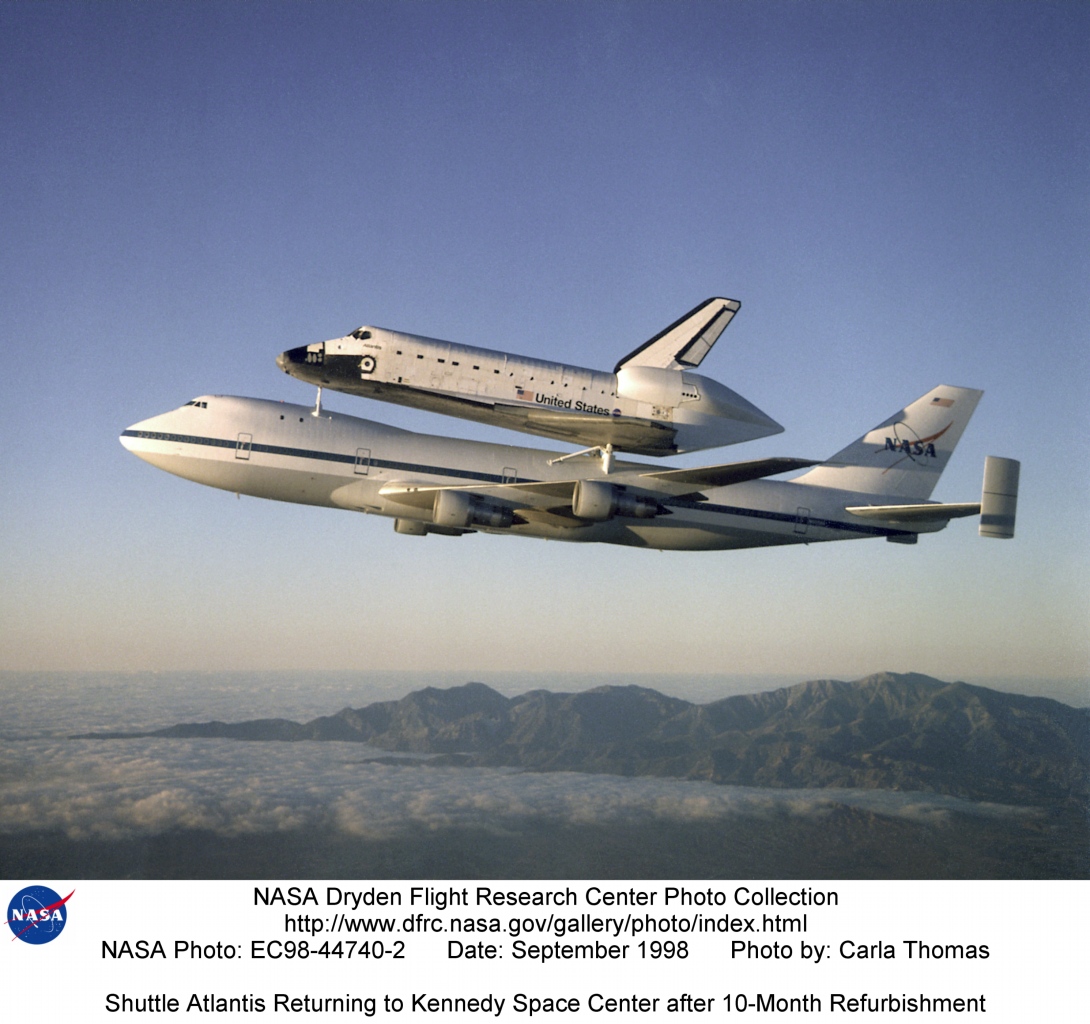
more info about 747 ferry aircraftsHere's some pictures and info about the 747 ferry aircrafts.
- Shuttle Ferry (picture is dated Sept. 1998 direct link to picture another direct link
- Shuttle being carted on top of the 747??
- In flight photo
- Search for similar images on google.
- Shuttle Ferry (picture is dated Sept. 1998 direct link to picture another direct link
-
more info about 747 ferry aircraftsHere's some pictures and info about the 747 ferry aircrafts.
- Shuttle Ferry (picture is dated Sept. 1998 direct link to picture another direct link
- Shuttle being carted on top of the 747??
- In flight photo
- Search for similar images on google.
- Shuttle Ferry (picture is dated Sept. 1998 direct link to picture another direct link