Slashdot Mirror
Domain: nasa.gov
Stories and comments across the archive that link to nasa.gov.
Comments · 16,365
-
Re:More NAVSTAR GPS information
Not true. The USSR has had GLONASS aloft for a very long time now.
And with the fall of the Soviet Union, you can buy GLONASS receivers all over the world now. (Some specialized surveying gear compares GPS/GLONASS signals, for example.) -
No way. Unfortunately. Way too much drag
This blimp needs air for bouyant lift, so you are inevitably going to be in the atmosphere. Ion engines, unfortunately, only work in a vacuum. And even if they did work at that altitude, the drag would so high that they wouldn't accelerate the ship at all.
If the ship was, say, 50 ft wide and had a rediculously low drag coefficient of
where
rho is density (about 1.7x10^-5 slugs/ft^3)
Cd is
V^2 is velocity squared. At 5000 fps, that's 2.5x10^7
A is area, 50 ft
This yeilds a drag of a little more than 100 lbf.
The most powerful ion engine is Nasa's new HiPEP that has a thrust of about 1/10th of a pound.
Now, I'm a big fan of JP Aerospace, and wish them all the luck in the world. Their program of launching sounding rockets from high-altitude balloon platforms was quite exciting. Hypersonic blimps, though, are just not going to happen.
Thad -
Re:NOT a dollar/ton
Well around 10,000 miles so around 16,093 km, for all you science types and Europeans.
-
Re:Where are they going?
-
Mars is less harsh than moon, not other way around
This is cool and all but the article is a bit misleading about the demands of a Moon suit as opposed to a Mars suit.
- Radiation. Mars has little to no magnetosphere but it does have some atmosphere. This provides some protection that the Moon does not. Also, the Moon is much closer to the sun so the levels of radiation from it are higher. There are also little baby north and south poles around the planet. Landing in one of those will provide a bit more protection.
- Temperature. The Moon has much higher and lower temperatures to worry about than Mars
- Sandstorms. True, the Moon doesn't have these but with the low gravity, thin atmosphere and fact that they won't be sleeping in hammocks, explorers/settlers should be able to handle them as long as they wear something thicker than a windbreaker.
In short, Mars suits have fewer extremes to deal with than Moon suits. The article exhibits some FUD about Mars. -
Mars is less harsh than moon, not other way around
This is cool and all but the article is a bit misleading about the demands of a Moon suit as opposed to a Mars suit.
- Radiation. Mars has little to no magnetosphere but it does have some atmosphere. This provides some protection that the Moon does not. Also, the Moon is much closer to the sun so the levels of radiation from it are higher. There are also little baby north and south poles around the planet. Landing in one of those will provide a bit more protection.
- Temperature. The Moon has much higher and lower temperatures to worry about than Mars
- Sandstorms. True, the Moon doesn't have these but with the low gravity, thin atmosphere and fact that they won't be sleeping in hammocks, explorers/settlers should be able to handle them as long as they wear something thicker than a windbreaker.
In short, Mars suits have fewer extremes to deal with than Moon suits. The article exhibits some FUD about Mars. -
Experience is just as important as funding
I'm not so sure that funding is the sole source of ESA's woes. Of course, when you're only budgeting 1/30th the amount as your competitors, things aren't always going to work out.
But consider the fact that ESA was founded in 1975 (May 30, 1975, to be exact. We're almost at the anniversary...) By this time, the USA had already tested numerous rockets, put men into space, and had landed men on the moon six years prior. The orbiter was already in development and the first "space shuttle" would be deployed less than a year later.
ESA has a lot of catching up to do, even now. I don't doubt that NASA and ESA share a lot of data, but for the time being, NASA has a great deal of experience over any competing space agency. Funding is not the only problem that ESA will have to overcome before it can be seen as NASA's contemporary.
--
Rate Naked People (Not work-safe) -
Re:big, fat clue:
I think you don't understand solar sails.
The "sailing" effect of a solar sail is due to the Photoelectric Effect, the only real theory by Einstein that got him a Nobel Prize. Relativity was considered so radical and (at the time) unprovable that it was in a league of its own. BTW, this theory has absolutely nothing to do with Relativity... it was just another idea that Einstein played around with. Yes, this is the theory behind what makes photovoltaic cells work as well.
Getting back to solar sailing: Photons (not solar wind) hit the solar sails and raw energy from the photons in sunlight is directly converted into knetic energy that pushes the sail away from the sun. If anything, the solar wind actually increases drag to slow the craft down, but the photoelectric effect more than compensates for that issue. This isn't a contradiction of physics and Thomas Gold has been debunked.
A practical example of this effect and how it has already been used was with the launch of the Echo series of satellites. (More information can also be found here) Besides the ISS, these are the largest man-made objects ever to be launched into space, and that was back in 1960 & 1964. While these web pages say that they re-entered the Earth's atmosphere, my understanding was that they were pushed out of Earth orbit by solar forces, due to their low mass/area ratio. Certainly there were some significant effects on their orbits from solar activity, and this was carefully studied. -
Re:big, fat clue:
I think you don't understand solar sails.
The "sailing" effect of a solar sail is due to the Photoelectric Effect, the only real theory by Einstein that got him a Nobel Prize. Relativity was considered so radical and (at the time) unprovable that it was in a league of its own. BTW, this theory has absolutely nothing to do with Relativity... it was just another idea that Einstein played around with. Yes, this is the theory behind what makes photovoltaic cells work as well.
Getting back to solar sailing: Photons (not solar wind) hit the solar sails and raw energy from the photons in sunlight is directly converted into knetic energy that pushes the sail away from the sun. If anything, the solar wind actually increases drag to slow the craft down, but the photoelectric effect more than compensates for that issue. This isn't a contradiction of physics and Thomas Gold has been debunked.
A practical example of this effect and how it has already been used was with the launch of the Echo series of satellites. (More information can also be found here) Besides the ISS, these are the largest man-made objects ever to be launched into space, and that was back in 1960 & 1964. While these web pages say that they re-entered the Earth's atmosphere, my understanding was that they were pushed out of Earth orbit by solar forces, due to their low mass/area ratio. Certainly there were some significant effects on their orbits from solar activity, and this was carefully studied. -
Re:Ideas
Here are a few references to increasing solar cell output with Fresnel lenses. Enjoy!
-
I love Earth flybys...
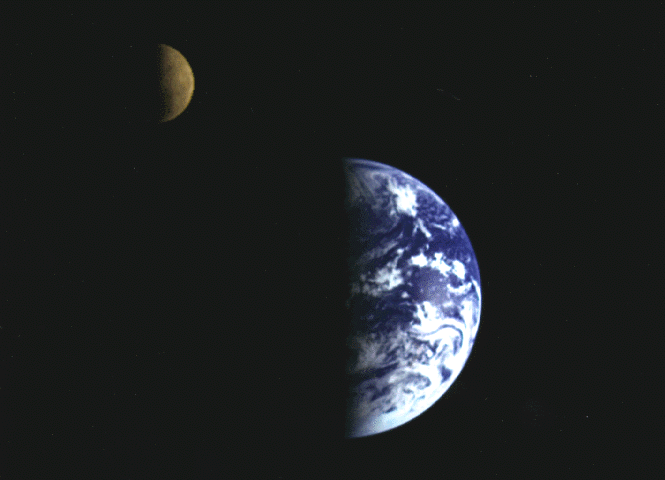
Check out this awesome photo of the Moon and Earth together, taken by Galileo more than a decade ago during its Earth flyby.
-
Re:no, not in this decade.
Well if you're going to the 60s look up univac documentation. They traditionally had 6-bit bytes[nasa.gov].
-
Re:Does this mean...
... that we'll eventually see the big bang?
Nope. In the very early Universe, all the matter was so hot that it was completely ionised. That is, there were lots of protons flying about and lots of electrons, just doing there own thing. It turns out, that light interacts very strongly with free electrons, so any light that was around at this early stage (such as from the big bang...) would've bounced around so much that it no longer carried any useful information about earlier times. Kind of like trying to see what the moon looks like through a really dense cloud.
Incidently, once the Universe cooled enough, light was able to pass through it. The light that started at this time is the oldest in the Universe and is what we now see as the Cosmic Microwave Backgound - far from being useless, this tells us huge amounts about the early Universe.
NASA's WMAP Mission site has a very good explanation. -
Re:Summary of technique
I can't answer your questions, but the WMAP experiment has given us (I believe) best values for the cosmological parameters you're concerned about to date (the results are from 2003). If you look at the summary pdf you'll see that they've determined "dark energy" to be about 73% of the total current energy density of the universe. Note that this is not the same as dark matter, which (broadly) is simply matter that isn't emitting enough light for us to see, and can include white dwarfs, black holes, neutron stars, neutrinos, etc., as well as other forms of matter we aren't presently aware of. Dark energy is more mysterious; the best explanation for it at the moment is the cosmological constant, but even this isn't much of an explanation -- it's just a parameter in an equation. Other attempts at explaining it, e.g. by "vacuum fluctuations" from quantum field theory, have to my knowledge failed spectacularly.
-
Re:Dakr Matter
Consider for a moment that Einstein might have been wrong? Since we can't actually study anything at the speed of light properly, it's all down to the calculations and even great minds might make errors.
On the contrary. A number of experiments have, in fact, demonstrated that both special and general relativity are almost certainly valid. More here.
Sean
-
My favorite Abell object
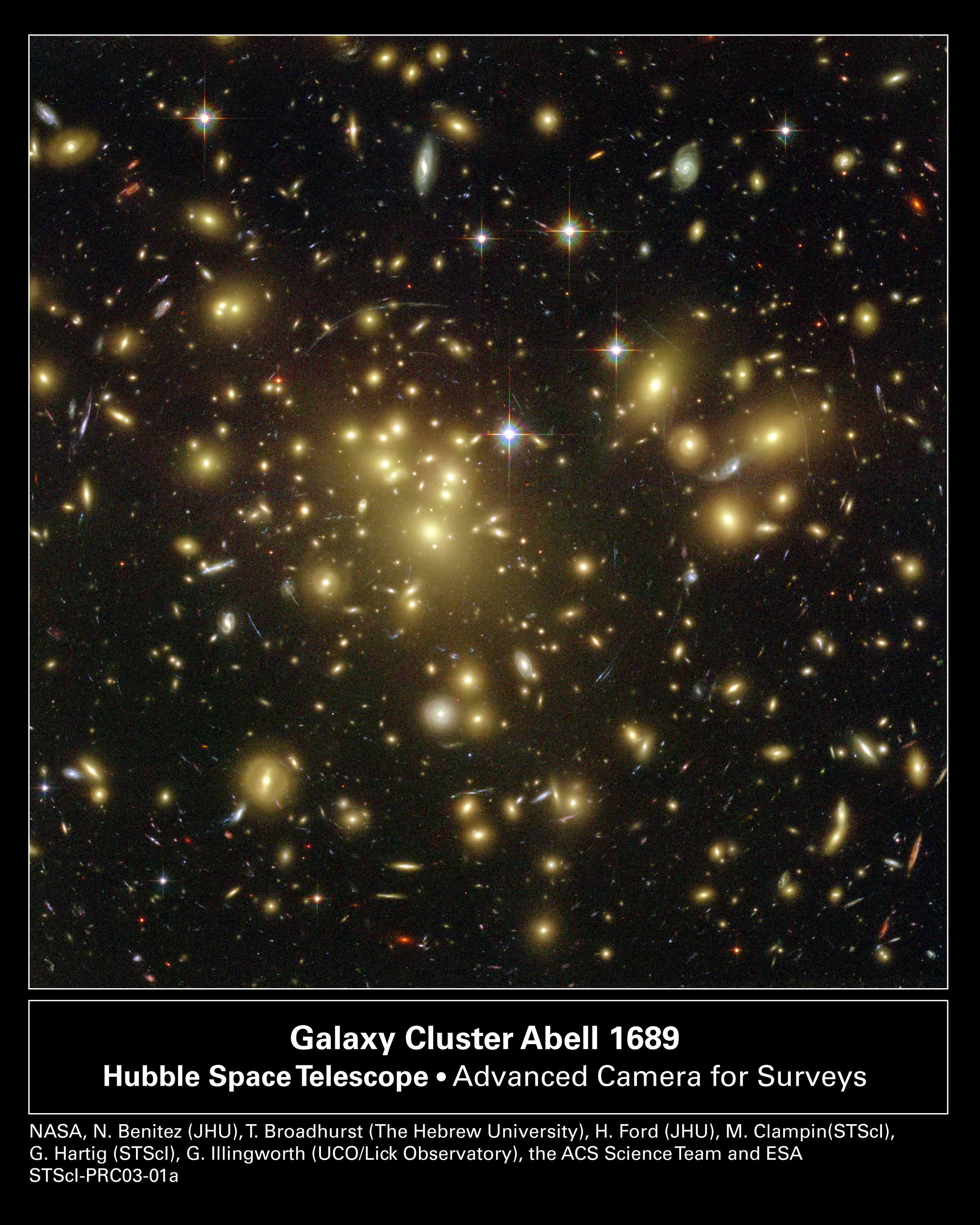
is 1689. You can see an awesome picture of it HERE. It's about two billion light years away and one of the most massive objects in the Universe. It's so massive that those blue arcs in the picture are actually galaxies that are being visually warped by the gravity lensing. The amount of matter required to warp space that much is about 99 percent more than we can see in that image.
-
Re:Why not oscillation rather than expansion?
- The article itself refers to the recent observations by Chandra which show that the expansion of the universe is accelerating, and that this acceleration started about 6 billion years ago after a period of decelerating.
- The Hubble Space Telescope has made observations of supernovae which show that the expansion of the universe is accelerating unexpectedly.
The whole point of the article was to show that the Chandra observations of galaxy clusters agreed with previous observations of supernovae that the expansion of the universe is accelerating.
There is no evidence at all for oscillation. It is an interesting idea, but it is simply not supported by any facts at all.
By the way, here is the part of your comment I was responding to:
Why are they ignoring the obvious (at least to me) possiblity that the universe oscillates around some optimal size. Imagine the universe as a rubber ball. Squeeze the ball and let it go. Every particle inside will immediately start moving away from the others at an accelerated pace, continuing to accelerate until passing the rest boundary, when it will start slowing down.
-
Re:Why a launch window?By the way... for those interested, I highly recommend JPL's introduction to the Basics of Space Flight. It starts off very simple but by the time you get to the end you'll have a reasonable knowledge of the various concepts and systems involved in satellites and space probes.
Freefall is also an excellent source of information
-
You're all wrong
-
You're all wrong
-
Re:space station? ugh.
The Mariner 10 probe did a flyby of Mercury in 1975 and mapped 40-45% of the planet's surface.
The MESSANGER probe will launch in June and is expected to arrive in 2011. -
Re:space station? ugh.
The Mariner 10 probe did a flyby of Mercury in 1975 and mapped 40-45% of the planet's surface.
The MESSANGER probe will launch in June and is expected to arrive in 2011. -
Maybe we can get an amateur probe to investigate..
If they can put a ham radio into space, maybe someone will build an amateur Mars probe. We definely need someone to investigate this new face on Mars.
Is Opportunty watching Late Night when NASA isn't watching? -
Re:Define Space
Just straight up and down. In other words they made a sounding rocket. huzzah. welcome to the 1940's.
-
Whatever happened...
...to the idea of colonizing space itself? O'Neill habitats and that whole thing. It seems to me to be a much better idea than colonizing other planets: why would you want to go back down into the gravity well once you've gotten out of there? And why would you want to live somewhere where you're stuck with whatever gravity the planet gives you?
Okay, so there's the small matter of building the things, but still. I want my grandkids to grow up with lakes and forests overhead.
At least someone at NASA seems to think it's still a good idea.
-
Re:Bradbury's Dreams are bustNobody is rushing to grab them because it costs too much to get into orbit. Not in terms of technology, but in terms of fuel and infrastructure. If someone developed a way to put things in orbit for, say, $500 per pound (instead of $40,000 per pound), companies wouldn't be so hesitant to get up there.
And to say that the resources are beyond the means of the worlds largest corporations is false. Zubrin has estimated that it would cost $50 billion to send four people to Mars five times over 10 years. Bill Gates is worth $47 billion dollars. If he and the other billionaires donated the same amount, we'd be there already.
The only way launch costs are going to come down is if NASA or the ESA or Russia or China (or all of them) work together to bring the costs down, and quickly. Mass production of a general purpose launch vehicle capable of lifting 100 tons to LEO for a cost of $100,000,000 per launch would bring the price per pound to under $500. Companies would then be able to finance exploratory robotic missions and experiments in harvesting ET materials. And NASA could make a profit on these launches, allowing it to fund its own research.
Instead, NASA is content to dabble in LEO, risking astronauts lives to do zero-gravity experiments in Good Ol' Bricks-n-Wings at a cost of $1.2 billion per launch. All while perpetuating the notion that because space flight is risky, ordinary people shouldn't do it, and even astronauts aren't brave enough to risk their actually lives exploring space.
-
Skycar will never happen.
Even if Moller can ever get this thing working (very, very doubtful based on the man and the machine's history thus far), the physics involved in a purely vectored-thrust/powered lift flying machine, make it the potentially most dangerous and unstable aircraft you can ever have. Unless all thrust generating and vectoring parts are always working perfectly 100% of the time, the machine will be completely uncontrollable. Think of Neil Armstrong's experience with the "flying bedstead" here. Heck, even a helicopter has a quasi-failsafe mode (autorotation) for landing under some semblence of the pilot still being under control of the aircraft in case of loss of power. As an experienced pilot, I certainly would not want to see the sky polluted with these deathtraps.
-
Re:yet another reason to get rid of nasa
I believe the article meant NASA's budget is 86 billion over a 5 year period. It doesn't state that in very clear language, but this document, from NASA states the agency's FY 2004 budget is roughly 15.5 billion rather clearly.
-
Put the general ledger on the web
The GAO should make NASA put their general ledger on the web. Their summary data is so obfusicated that it doesn't make any sense, but the transaction list of payments might be subject to analysis.
-
Water sampling is getting easier every dayJudging from the combination of drought in the west and the rate that water is being drawn from sources around the country, water sampling will soon consist of wading out and scooping up some muddy water. Hell, the problem may go away entirely:
-
Re:Does anyone know?
I can't answer your question definitively, because searchs for the "Highest Altitude Plane" on Google tends to return the X-15, which would (in my view) be a booster rocket, not a plane to piggy-back on.
Helios seems designed to max out at about 100,000 ft.(Helios Site - 3rd paragraph)
The highest balloon flight was 113,740 ft. (assuming this site is up-to-date - 3rd paragraph).
JP Project's
The price of jet fuel vs. the price of helium is a good issue to raise. I'd have to do some research to compare them. It would take me a while to figure out reasonable estimates for each (which is an example why I want to read someone elses analysis rather than do the work myself
It also seems that a balloon launch with a parachute backup is a safer system than a jet airplane. Less working parts to malfunction, and easily understood principles. -
Re:Rocket Planes and Politics
-
Re:Rocket Planes and Politics
-
Re:geezNearly 38 miles
Not quite. LEO is not just an altitude--it's a speed. You've got to get up to around 5 miles per second, too. While it's pretty impressive for a privately-funded vehicle, it's a long shot from LEO. For those that are interested, here's an orbital speed calculator from NASA. Unfortunately, it doesn't work for altitudes below 185 kilometers (since it says they're unstable). But the speeds near the surface are pretty close to one another anyway.
-
Re:Some else of interestCool pic and short writeup of contrails (Earth Observatory) "over the southeastern United States during the morning of January 29, 2004".
-l
-
Space Shuttle data + free mapping softwareGolden opportunity to try and load some of this non-threatening geospatial data with our very own free software GIS. Model your neighborhood in 3D with high resolution Space Shuttle topography radar mission (STRM) elevation data!
http://www2.jpl.nasa.gov/srtm/
http://grass.ibiblio.orgSTRM is new, so get the CVS version if you want access to the latest auto-load & clean scripts. View with NVIZ.
cool stuff.
-
Inspiration
NASA's single most important goal is that of inspiring the next generation of scientists, engineers, and explorers. I believe that TPF will certainly achieve this goal, should it find other planets like earth (life or not!)
When I saw this image a few years ago on APOD, I was awestruck... I'd seen star maps before, but not one that included Sol. It was amazing, because suddenly the sky was no longer an infinitely far away billboard of beautiful sites... it was a place just like any other (albeit a bit difficult to get to). On the map you can see the closest stars are really so close compared to everything else... makes me think we might send interstellar probes in my lifetime.
I believe that if TPF succedes, the next generation will think of other stars the same way they think of the Sun... as places where worlds are.
For that reason alone, I hope TPF is the tremendous success it seems it could be!
Anonymous Divinity -
Re:Non-Landing of the moon? Is that pseudo science
"I have major doubts about the landing of the moon... a space physics course points out there is some heavy radioation belt between the moon and earth
I don't expect you to listen to rational discussion because your mis-informed mind is made up.
NASA has addressed this question time and again.
As others have said there are three elements to radiation exposure
1- Type of radiation
2- Duration of exposure
3- Intensity of exposure.
At some point in a typical lifespan you will probibly be exposed to all types, known and unknown, all of them will get a chance to kill you, none of them will do so instantly.
If you insist on disputing fact join the flat world society and avoid computers because everyone knows that the radiation from them will kill you, make you sterile (a moot point if your dead), and ruin your marriage (sterile, dead and divorced, the ultimate ubergeek). -
Re:Hubble!"because the shuttle is too dangerous and we can't be bothered to go up and move Hubble out of the decaying orbit"
Go look at the astronaut biographies and tell us the names of those you are willing to have die to service Hubble. What is the basis of your decisions and are you placing importance upon their skills or whether they are married?
-
Re:Not that interesting (?)
This is great. It could be the first visual evidence of an extrasolar planet. Keep in mind that there are still people who disbelieve the moon-landing, that the earth is round, etc.
I know that there was some digital processing done on these images, but there really is some truth to "seeing is believing" (except for some "news" on the internet). Besides, this is the first attempt. Think of how many great discoveries started out as "not that interesting." -
NASA's female astronaut crewFound here
What science needs is more Page 3 girls.
The one in the middle's not bad, nor the one on the far right.
-T
-
Re:The sad truth
-
Any cunning linguists out there ?
Who can decode the ancient Greek message ?
Or is it Russian ? -
Re:Is it just me...
I know the parent is marked as a troll but if you look at this image (WARNING: 26.7mb image) parts of the rocks and sand (notice the wavy ones near the middle) look a bit rendered and not natural, though it's porbably due to some software enhancing to make the image look better (it's already passed through a filter to give it color, it might as well be touched up even more) or maybe my eyes playing tricks on me.
-
Re:Better Panorama
I think the production quality went downhill compared to that of apollo 60's era soundstage
-
Re:Why not just call up Rutan?
I agree that this doesn't seem like a viable long-term solution. The article didn't go into much specifics, but it seems like a waste if they are indeed just modifying the existing technology. After the Columbia accident, everyone seemed to agree that the shuttle was outdated and needed to be replace with newer technology. One can only hope that the ESA's prototype is going to be a change from the traditional shuttle.
-
Re:Quick NASA needs more funding
Come on Dubya, you can't let those smelly europeans beat us in space travel! on another note, I believe russia actaully had a functioning space shuttle in the 80's, but the scraped it when the cold war ended.
Actually, shuttle Buran, as it was called, was technologically more advanced than contemporary American Space Shuttles. It sported, among other things, remote controlled landings. Shuttle Phoenix seems to go one step further and allow for automatic landings. -
interesting formations
.. at the bottom of the crater. ( seen here, 2M file). Is it created by wind? Or maybe water? Something like that can be seen at the bottom of a shallow round body of water on Earth.
-
For those of you not aware
a summary of the Mars Rover mission can be found here
-
Better Panorama
A much better (and much larger) version of the panorama has been available at the NASA site for days.