Slashdot Mirror


Chandra Provides Support For Dark Energy

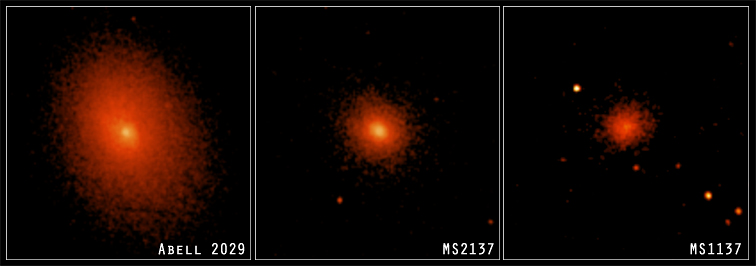
starannihilator writes "The Chandra X-Ray Observatory has provided new evidence supporting the existence of dark energy, the force causing the acceleration of universal expansion. The new findings support the theory that the universe will expand forever, provided there is enough dark matter. CNN and Newsday are running the story, originally reported by NASA. Chandra's site has some good images and information on the three galaxies clusters studied (Abell 2029, MS2137.3-2353, and MS1137.5+6625)."
350 comments

  1. Dark matters by Allen+Zadr · · Score: 5, Funny

    I am eagerly awaiting the next annoncement where someone again finds evidence to refute the dark matter claims. It seems like the science; "Dark Matter is like this" - "No, it can't be, actually it's like that". Is not going to end soon.

    Join me. Come to the dark side, and together, we will expand the universe.

    --
    Kinetic stupidity has a new brand leader: Allen Zadr.
    1. Re:Dark matters by Mz6 · · Score: 1, Insightful
      No kidding...

      Why can't scientists just make up their minds already?

      First it's not expanding, now it is... Oh well now it's slowing down again, and now expanding agian.

      I also see no end in sight...

      --
      Hmmm.
    2. Re:Dark matters by eviloverlordx · · Score: 2, Funny

      Do not underestimate the power of the dark, uh, energy?

      --
      'Loose' is when your pants are three sizes too big. 'Lose' is when you misuse 'loose'.
    3. Re:Dark matters by Allen+Zadr · · Score: 2, Informative
      Thank you for getting my point. Just following the /. stories since February... Now, with this story, it's back again.
      --
      Kinetic stupidity has a new brand leader: Allen Zadr.
    4. Re:Dark matters by Jim+Starx · · Score: 4, Funny

      God made the universes expansion a sine wave just to piss scientists off.....

      --
      The darkness... controls the music. The music... controls the soul.
    5. Re:Dark matters by Anonymous Coward · · Score: 1, Insightful

      Seperate paths with conclusions you could make with that data put on them, ultimatly you'd want them all to be explained by a single theory. Or in other words, all the good measurements need to be accounted for. Incidentally, we know there is some dark matter out there, afterall anything that's pretty dark as in doesn't shine or doesn't reflect much light is dark matter. Just how much, well that's what they're arguing over.

      Quickshot

    6. Re:Dark matters by Too+Much+Noise · · Score: 4, Insightful

      It's not that simple. Cosmology is now in a position pretty much similar to that of a butterfly trying to understand the passing of seasons. Moreover, as the name says, "dark" matter/energy is undetectable directly (at least, so far) - and it's quite challenging to figure out a 'simple' theory for something that not only you can't observe directly, but the indirect observations are difficult and not always very accurate.

      Anyway, since it's not very likely that the knowledge of dark matter will have a significant impact on the daily life anytime soon, relax and enjoy the (slow-moving) show.

    7. Re:Dark matters by sjwaste · · Score: 3, Informative

      As others have said, accelerating expansion means that objects very distant are moving away from us faster than closer objects are moving away from us. If you have time for some interesting reading, I'd recommend a title called Atom which is very readable and is a good primer on theory from the big bang to present time. It won't answer many questions about dark energy, but if anything, it'll give you a good idea of what we know in very readable terms and most likely get you to want to read more :) It was my first book on the subject, and it certainly had that effect. Note that I'm no physicist, just a curious reader.

    8. Re:Dark matters by hazem · · Score: 4, Insightful

      Why can't scientists just make up their minds already?

      Because if they did, they'd be theologians, not scientists.

    9. Re:Dark matters by ArsonSmith · · Score: 4, Insightful

      I think it is common for people to make up something that helps fill gaps in science. sometimes it turns out right many times it turns out wrong. many times this happens such as space ether.

      When we can't explain something we are sometimes better off makeing something up that fills the gap until we can find the more correct answer. There is no such thing as exact science. Only reproduceable observation which eventually becomes accepted fact. Although there is no reason for it to always stay fact if someone says, "Hey, I tried to do the experiment and used this method to test it and I got a diffrent observation!" Well, now it's time to re think that scientific fact.

      What happens typically is that the person is downplayed as doing something wrong, adding some new variable to the mix, or something that would throw off the observation in some way. Politics in science is as complicated and painful as anywhere.

      --
      Paying taxes to buy civilization is like paying a hooker to buy love.
    10. Re:Dark matters by sjwaste · · Score: 1

      Whoops, this is in the wrong thread. Doh!

    11. Re:Dark matters by Anonymous Coward · · Score: 4, Funny

      I knew this thread would end up at Hitler or Religion. Thanks for not picking Hitler.

    12. Re:Dark matters by NanoGator · · Score: 2, Insightful

      "Why can't scientists just make up their minds already?"

      Because, by their very nature, they need proof?

      --
      "Derp de derp."
    13. Re:Dark matters by Anonymous Coward · · Score: 0

      and trying to force godwins law doesn't invoke it

    14. Re:Dark matters by Dashing+Leech · · Score: 3, Funny
      God made the universes expansion a sine wave just to piss scientists off.....

      Actually, a step function would more annoying to scientists -- no trends to follow. Plus it would be more consistent with religious beliefs, particularly if there is a step down function coming up.

    15. Re:Dark matters by Rostin · · Score: 2, Funny

      Don't read much theology, do you?

    16. Re:Dark matters by Anonymous Coward · · Score: 1, Insightful

      You mean like anthropomorphising the weather into a Sun God until you collect enough evidence to create a farmer's almanac?

      Sounds like its quite a bit the opposite of science.

    17. Re:Dark matters by Psymunn · · Score: 1

      Cosmology, you do makeup? Sorry, my roomate was an astronomy major, i had to use that (that's right he could tell fortunes).

      --
      The Neo-Bohemian Techno-Socialist
    18. Re:Dark matters by Christopher+Thomas · · Score: 4, Informative

      I am eagerly awaiting the next annoncement where someone again finds evidence to refute the dark matter claims. It seems like the science; "Dark Matter is like this" - "No, it can't be, actually it's like that".

      The only articles I've seen that make statements like that are the commentaries on the commentaries on the dumbed-down press releases on the actual publications.

      What's actually been happening is more along the lines of:

      "There's a discrepency between galactic models and observations. What did we get wrong in the model/what needs to be added?"

      "Maybe A? B? C? D?" "Let's try to test them and see."

      "Not A, not D, but maybe B, maybe C." "What kind of B or C? B1? B2? B3?" "Let's try to test them and see."

      "Our models only work if we have B _and_ C, and we've ruled out C1 and C2, but C3 still works."

      "What kind of C3?"

      "New observations show a new effect in addition to the old one. How do we explain it?"

      "Maybe E? Maybe F?"

      [Etc.]

      This is a process of examining many possible explanations, and weeding out the ones that don't work until we have reasonable confidence that the ones left _do_ work.

      We've gone from "galactic rotation doesn't match models based on stars alone, what could be causing this?" to "we know that there's about X amount of normal matter we aren't seeing, Y amount of abnormal matter that we aren't seeing, and that the properties of the abnormal matter fall somewhere in this range (that's wide but being narrowed)". There's surprisingly little backtracking. Tests that detect or fail to produce evidence for dark matter of various types all help to increase our understanding of what dark matter's actual properties are.

      As for dark energy, if anything, it would be surprising if something like it _didn't_ exist. We already knew that a scalar field with similar properties was likely present in the early universe, and several models proposed universes where the _absence_ of the field was only a local effect. Even relativity contained a similar type of effect that was set to zero a priori as opposed to forced to zero through a mechanism inherent in the model.

      We're still sifting through the myriad of possibilities, but we certainly are learning something each step of the way.

    19. Re:Dark matters by Genady · · Score: 1

      I think it is common for people to make up something that helps fill gaps in science. sometimes it turns out right many times it turns out wrong.

      What like the Cosmological Constant?

      --


      What if it is just turtles all the way down?
    20. Re:Dark matters by Allen+Zadr · · Score: 3, Interesting
      I, for one, have learned a lot from this article and many, many informative posts within it.

      So does anybody have a good,cheap,quick (pick two) primer on Quantum Physics? Something that can explain what we do know, along with the outstanding issues that we don't know?

      --
      Kinetic stupidity has a new brand leader: Allen Zadr.
    21. Re:Dark matters by R2.0 · · Score: 1

      Actually, theologians argue all the time. But thanks anyway for the gratuitous shot at religion.

      The people you are really thinking about are engineers. Scientists try to answer the whys and hows, engineers answer the question "Now that we know what it is, what the hell do we do with it?"

      And now, to combine the topics:
      scientists:engineers::theologians:ministe rs

      --
      "As God is my witness, I thought turkeys could fly." A. Carlson
    22. Re:Dark matters by Anonymous Coward · · Score: 0

      Butterflies don't live long enough to experience the passing of seasons.

      Bad analogy.

    23. Re:Dark matters by Anonymous Coward · · Score: 0

      You dont know how close to the truth you are.
      How did you get this idea tho?

    24. Re:Dark matters by Jim+Starx · · Score: 1

      its a little thing i like to call a joke....

      --
      The darkness... controls the music. The music... controls the soul.
    25. Re:Dark matters by shadowbearer · · Score: 1

      I always hated those Step Up, Step Down tests. So damned hard, and you're exhausted at the end; then they want you to *work* even! Sheese, what a cruel universe...

      SB

      --
      It's old. The more humans I meet, the more I like my cats. At least they are honest.
    26. Re:Dark matters by Christopher+Thomas · · Score: 2, Informative

      So does anybody have a good,cheap,quick (pick two) primer on Quantum Physics? Something that can explain what we do know, along with the outstanding issues that we don't know?

      Not offhand, but a couple of good places to look would be to check the various online bookstores for quantum mechanics textbooks to see what are recent/available and get good reviews, and course pages at various universities to see what textbooks they use and what online resources they have available. Expect to pay $100 or so for a good textbook on any given topic.

      There are a number of online physics tutorials that should cover some of it, but I'm afraid I don't know where they are.

      Thinks like wikipedia and everything2 have at least an overview, but detail will be quite spotty.

      Good luck :).

  2. Hmm that name sounds familiar by Nuclear+Elephant · · Score: 4, Funny

    I dated a girl named Chanda once. Dark energy is a good way to describe her.

    1. Re:Hmm that name sounds familiar by Nuclear+Elephant · · Score: 1

      well, I meant Chandra - if I had spelled it right, it would've been +2 Funny.

    2. Re:Hmm that name sounds familiar by Anonymous Coward · · Score: 0

      What's one letter among atomic powered pachyderms?

    3. Re:Hmm that name sounds familiar by Anonymous Coward · · Score: 0


      Yeah, she got married and then she "expanded".

    4. Re:Hmm that name sounds familiar by The+Lynxpro · · Score: 1

      "I dated a girl named Chanda once. Dark energy is a good way to describe her."

      Gary Condit, is that what you are doing with your free time these days...posting on Slashdot? I didn't think ex-politicos hang out here... :)

      --
      "Right now, somewhere in this world, Scott Baio is plowing a woman he doesn't love," - Peter Griffin, *Family Guy*
    5. Re:Hmm that name sounds familiar by Anonymous Coward · · Score: 0

      +4 Offtopic

  3. MS at it again by sheeny · · Score: 0, Offtopic

    Are those last two patented by Microsoft?

    1. Re:MS at it again by Anonymous Coward · · Score: 0

      no, if that were the case it would be .ENERGY written in the dark

  4. Dakr Matter by Mz6 · · Score: 4, Interesting

    Maybe someone can explain... But when the CNN article states that the universe is "accelerating", does that mean it's really accelerating? I thought it was decided that the universe's expansion was expanding at the speed of light. So, I would assume that by accelerating they mean growing bigger and not actually accelerating faster than the speed of light. Unless, this Dark Matter is something that can bend the known laws of physics and travel faster than the speed of light?

    --
    Hmmm.
    1. Re:Dakr Matter by Jim+Starx · · Score: 2, Interesting

      The universe can't be expanding at the speed of light. Releativity states that the speed of light is as fast as it gets. So if we were all going the speed of light away from the center of the universe there would be no headroom in the velocity for movement in any other direction. That would mean planet orbits, even walking down the street in a certain direction would be impossible.

      --
      The darkness... controls the music. The music... controls the soul.
    2. Re:Dakr Matter by savagedome · · Score: 0, Troll

      bend the known laws of physics and travel faster than the speed of light?

      A particle cannot *accelerate* past the speed of light. A particle, like photon, can travel faster than the speed of light as they are already traveling at the speed of light to begin with. Speed of light is the acceleration barrier.

    3. Re:Dakr Matter by wwest4 · · Score: 3, Informative

      > I thought it was decided that the universe's expansion was expanding at the
      > speed of light

      I don't think the acceleration in on the order of c^2, if that's what you mean. What they mean is that due to acceleration, some space (the stuff that's furthest away) is expanding at close to c.

    4. Re:Dakr Matter by llamaguy · · Score: 3, Insightful

      Consider for a moment that Einstein might have been wrong? Since we can't actually study anything at the speed of light properly, it's all down to the calculations and even great minds might make errors. So, you never know...

      --
      HAH! I just wasted a second of your life making you read this, but I wasted a minute of mine thinking it up. DAMN.
    5. Re:Dakr Matter by barawn · · Score: 4, Informative

      Releativity states that the speed of light is as fast as it gets. ... for matter. Relativity makes no such claims as to the speed limit of space itself.

      There are quite a number of valid GR metrics which describe space which expands faster than the speed of light, and in fact, it's thought that it did expand faster than the speed of light during the inflationary period.

      Those same metrics are the basis of the Alcubierre metric, one of many ways to generate faster-than-light travel without multiply-connected spacetimes (wormholes). Like most "violate the speed of light" metrics, it requires negative energy density matter, though variations on the metric allow for very tiny amounts of negative energy matter to generate it.

    6. Re:Dakr Matter by Jim+Starx · · Score: 1

      What's the diffrence?

      --
      The darkness... controls the music. The music... controls the soul.
    7. Re:Dakr Matter by Saluton_Mondo · · Score: 1

      More distant objects are moving away from us more rapidly than the local ones... i.e. objects further away appear redder because of the redshift: that is, the wavelength of radiation from a body appears longer (redder) that its restframe emission because it is travelling with some velocity away from us.

      --

      Batman: "Slake your thirst. You'll have worse than a parched sensation when we're through with you!"
    8. Re:Dakr Matter by cruachan · · Score: 2, Informative

      The speed of light is only a restriction upon the velocity of matter/energy within space-time. There is no such restriction upon the expansion or movement of space-time itself. If you think about it in the usual 'rubber sheet' model then this is equivalent to saying that particles on the surface of the sheet can only travel up to c, but that the sheet itself can change without such restrictions.

      This is effectively how the Alcubierre warp drive works.

    9. Re:Dakr Matter by the_2nd_coming · · Score: 2, Informative

      the Universe can expand FASTER than the speed of light. Relativity says matter and energy can not travel faster than the speed of light through space-time, but when talking about dark energy and the expansion of the universe, we are talking about the expanding of space between galaxies, so the galaxies, relative the their local space are not traveling near the speed of light, but relative to inter galactic space, they are.

      --


      I am the Alpha and the Omega-3
    10. Re:Dakr Matter by Betelgeuse · · Score: 4, Informative

      Yes. The universe is accelerating in its expansion. To say that the universe is expanding "at the speed of light" isn't quite right in a couple of ways. First off, if we look at objects nearby, they are moving away from us at some (quite reasonable) finite speed (i.e. the nearby Virgo Cluster is moving only at ~1000 km/s). Secondly, the somewhat more subtle point is that we generally talk about velocites not exceeding the speed of light; however, this is motion THROUGH space. The expansion of the universe (expansion OF space) doesn't necessarily need to follow this rule. . .

      I should also point out that "Dark Matter" and "Dark Energy" are COMPLETELY DIFFERENT THINGS (as far as we know). Astronomers have just named them both "Dark" because they don't know what they are. They both also affect the expansion of the universe, but dark matter is slowing down the expansion of the universe (presumably via gravity) and dark energy is accelerating the expansion of the universe (by some yet-unknown force). Dark Matter is weird, but at least it seems to sortta obey the rules of the universe (i.e. gravity); dark energy is completely unlike anything we've seen before.

      --
      I couldn't tell if you were experimenting with poor-man's cryogenics or looking for the orange sherbet.
    11. Re:Dakr Matter by CodeMonkey4Hire · · Score: 3, Informative

      (1) the universe is not expanding at the speed of light (I think that it is less)
      (2) the space-time fabric of the universe is not an object anyway, so FTL rules do not apply

      It is actually possible for 2 objects to move apart faster than the speed of light even though neither is moving FTL compared to the other. This statement seems to be nonsensical, until you realize that the expansion is a 4D effect. Think of the galaxies (in 2D) as though they were on the surface of a balloon (2D). Now imagine the balloon getting larger (3D effect) at the same time that galaxies are moving farther apart. Now use that analogy with 1 higher dimension. The 2 effects are independent, but both contribute to increasing distance between galazies. As my physics professor once said "Everywhere is getting farther apart."

      BTW, this is why the wavelength of the cosmic radiation is getting longer. The cosmic radiation is actually getting stretched (along with everything else) along with the universe. So while the frequency & energy stay the same, the cosmic radiation gets "red-shifted." And since they can surmise the starting wavelength (from Hydrogen energy levels), they can make predictions based on that too.

      --

      Let's go Hurricanes!!! 2006 Stanley Cup Champions!!!
    12. Re:Dakr Matter by Jim+Starx · · Score: 2, Interesting

      Very true.... but if einstien is wrong that breaks open a whole can of somethin. Consider all the observations that are based on einstein's theories. Possibly even these observations.... definitly something to think about.... preferably by someone smarter then me...

      --
      The darkness... controls the music. The music... controls the soul.
    13. Re:Dakr Matter by barawn · · Score: 4, Interesting

      Speed of light is the acceleration barrier.

      This isn't even strictly true. You can violate global speed-of-light travel times without violating local speed-of-light travel times by making space itself move - see the inflationary period, or the Alcubierre metric for more info.

      You can imagine it as a speed limit placed on people walking, but there is no such speed limit on moving walkways (like in airports).

      And the problem with particles traveling faster than light (tachyonic) is the fact that as they *lose* energy, they go faster, which makes them lose more energy, so they spiral out to infinite speed. Tachyonic modes are unstable, so a theory containing them typically undergoes tachyonic condensation (spontaneous symmetry breaking) and the tachyons gain a positive mass squared.

    14. Re:Dakr Matter by wwest4 · · Score: 1

      > A particle, like photon, can travel faster than the speed of light as they are
      > already traveling at the speed of light to begin with.

      I've never heard of the possibility for a photon to travel faster than c, where c is speed of light in vacuum. What is the basis for this? Also, does a photon ever really accelerate anyway? Do bosons and fermions really have the same relativistic physics?

    15. Re:Dakr Matter by CodeMonkey4Hire · · Score: 1

      Actually, photons can not travel faster than the speed of light - they are light. Although theorectically possible, we have never detected any particle that can travel FTL. However, we have already named them tachyons.

      --

      Let's go Hurricanes!!! 2006 Stanley Cup Champions!!!
    16. Re:Dakr Matter by Anonymous Coward · · Score: 1, Interesting

      Not true, it takes an infinit amount of energy to accelerate to the speed of ligth, to accelerate any faster, even if a particle started at the speed of light, would still require an infinite amount of energy.

    17. Re:Dakr Matter by llamaguy · · Score: 1

      Consider all the observations that are based on einstein's theories Point, but everything has several explanations depending on how you look at it. If something falls over, did a sudden gust of wind knock it over or did a supernatural power? Both are equally possible within the phase space, but only one solution. People would've actually believed that it was the work of a ghost for a while, but now (most) of us reckon that it was a gust of wind. The same principle applies to scientific observations. Course, I'm not saying that Einstein was wrong or not, I'm saying there is the possibility he was.

      --
      HAH! I just wasted a second of your life making you read this, but I wasted a minute of mine thinking it up. DAMN.
    18. Re:Dakr Matter by CodeMonkey4Hire · · Score: 2, Insightful

      Hell, Newton was "wrong," but it wasn't the end of the world. In fact, the corrections to his theories led to some amazing discoveries. I would imagine that any theories that "prove" Einstein wrong will lead to some amazing technology themselves. Of course such speculation leads to... Science Fiction (I am not saying it would be wrong - remember that flying to the moon used to be scifi).

      --

      Let's go Hurricanes!!! 2006 Stanley Cup Champions!!!
    19. Re:Dakr Matter by S3D · · Score: 2, Informative

      First, dont't mistake Dark matter and Dark Energy. They are completly different beast, and have only in common (is it true ? no one know) that both are in the number of biggest(together with quantum gravity) misteries of modern physics. Dark matter is a problem of mass distribution in tha galaxies. Dark Energy is a reason why universe expansion accelerating. From the formal point of view it's no more than a constant in the equations of General Relativity. And I think you are right, it's not "real" acceleration, it's expantion - the volume of the universes increase. Take a baloon and mark several points on it. Now blow baloon and distance between points increase. That is like the universe expansion. And it can be in some sence be faster then speed of light (that is the distance between points invrease faster than light travel from one to another) without contradiction to General Relayivity I think, becase points are not really moving - only distance between them increase (but I'm not a physisists, so I can be wrong here)

    20. Re:Dakr Matter by freshtonic · · Score: 1

      Actually, red-shifting can be explained without resorting to space-time being stretched. But space-time stretching *will* contribute to a red-shift. Objects flying apart at significant fractions of C will exhibit redshift when observing one object from the other regardless of whether the space in between is 'getting bigger'. My head hurts.

    21. Re:Dakr Matter by celeritas_2 · · Score: 1

      If you really want to know read Brian Greene's new book of which I have forgotten the name. The Universe expanding is like blowing up a baloon, put two dots anywhere on the baloon and as you blow it up they get farther apart, but not accelerating or moving vs the baloon. Space is the Baboon....er....baloon

      --
      -- Checking emails and kicking cheats `till the day I die.
    22. Re:Dakr Matter by CodeMonkey4Hire · · Score: 1

      I'm sorry. I didn't mean to imply that this is the cause of red-shift. As you pointed out there is another explanation for redshift, the Doppler effect (for the benefit of those who need it - probably not you freshtonic). This is what usually redshifts/blueshifts light that is traveling from a far away star/galaxy. That effect is like a train whistle approaching/receding or like a person riding in a car throwing something forward or backward. Of course the analogy fails slightly since light is always traveling the exact same speed, only its frequency (color) changes.

      I was just trying to show the similarity between the 2 ideas. One is due to a traveling source and/or observer, the other is due to an expanding medium.

      --

      Let's go Hurricanes!!! 2006 Stanley Cup Champions!!!
    23. Re:Dakr Matter by sindarin2001 · · Score: 2, Insightful

      Not only that, but I daresay there is no "correct" theory. Genius after genius creates a model that describes an ever increasingly complex universe, and then a new odd discovery throws a monkey wrench into the theory. The theory isn't really wrong, it's just no longer all-encompassing like we previously thought.

      That said, sometimes a theory can be just plain wrong.

    24. Re:Dakr Matter by melgeroth · · Score: 1

      Yes, the red shift occurs because we detect a longer wavelength, since the object is moving away from us and so the wavelength appears to be 'streched' or longer (red is a low wavelength), just as the frequency appears to be lower. If the object had been moving towards us, the doppler effect would have shifted the wavelength up.

    25. Re:Dakr Matter by bobhagopian · · Score: 3, Informative

      I think a more accurate answer is in order (not to malign the other posts, as they all contain bits of the complete answer). Accelerating means that the outer boundary of Universe ("horizon") is moving away from us at an ever increasing rate. The components of the Universe also accelerate away at a proportional rate. It does not simply mean that the Universe is growing bigger (although that is true). It means that it's growing bigger at an increasing rate. The Universe is *not* expanding at the speed of light. The speed of light does not pose a real barrier to the expansion of the horizon (in fact, it is believed that the Universe underwent a period of faster than light inflation early on), but it DOES place an upper limit on the speed at which components of the universe can move away. In other words, the speed of light applies only to objects, not imaginary boundaries. As an example, one can think of shining a laser pointer at a distant wall and moving your wrist quickly; the laser point can easily exceed the speed of light, since the point is not a physical object. But no matter how hard you throw the laser pointer itself, you'll never exceed the speed of light. When you ask whether dark matter (actually, dark matter isn't special at all, usually just normal matter that's hard to detect; you mean "dark energy") can bend the laws of physics, you've fallen into the same trap that countless others have. Popular accounts seem to really harp on the exoticness of dark matter, but never mention how "normal" it can be. Dark energy is just an energy field that exerts a pressure on the constituents of the Universe, just as a gas would exert a pressure on the walls of its container. This is one of the most trusted explanations for why the Universe is accelerating.

    26. Re:Dakr Matter by Alexis+Brooke · · Score: 1

      It's been theorized that space itself is expanding along a fourth, hyperspatial dimension. This would mean there is no "center" of the universe. Think of the galaxies as dots on the surface of a balloon, and the balloon being blown up. Everything moves away from everything else, but there is no real center you can point to.

      As far as studies of dark matter and energy go, I think the most important thing is to determine if the universe is, as has been recently found, expanding at an accellerating rate, and if it is, how to stop it. If space expands infinitely, it will eventually lead to the heat death of the universe, in which everything is the same temperature, and no more work can be done, leaving all of existence a barren soup of quarks and photons for all eternity.

      Either that, or we need to find out how to create a new universe and then find a way to travel inside it to start over.

      --
      This is a special excite .sig
      This
    27. Re:Dakr Matter by nine-times · · Score: 5, Informative

      No offense, but that's not how relativity works. The thoery of Relativity posits that all measurements are taken from some frame of reference, and it is impossible for an object to go faster than light for any frame of reference.

      So, if I'm on a spaceship going 99.9999999% the speed of light from the frame of reference of the earth. However, from the frame of reference of my spaceship, I'm stationary. Now, I can run as fast as I want in any direction, I can even sit in the back of my space ship with a super-powerful gun that shoots bullets at 99.9999999% the speed of light, and fire a couple rounds towards the front of the ship. From the frame of reference in the ship, the bullets will travel at 99.9999999% the speed of light, even when the ship is travelling at 99.9999999% the speed of light in reference to the earth.

      But here is where it gets wierd: an observer on earth will not measure the speed of the bullets to be travelling 199.9999996% (99.9999999%x2) the speed of light, they will be measuring the bullet to be travelling just over 99.9999999% the speed of light.

      This is because, from the viewpoint of someone on earth, the space ship will be very short, which means even if it still traverses the length of the ship in the same amount of time as it does from the viewpoint of me on the spaceship, it will not have travelled the same distance, which (since v=d/t) means the bullet didn't travel as fast relative to the spaceship (from the viewpoint of earth) as it did from the viewpoint of someone on the spaceship.

      Additionally, from the viewpoint of Earth, time is travelling more slowly on the spaceship, which enhances the effect even more.

      It's confusing if you don't have a handle on it, but none the less, this is how the theory of relativity works.

    28. Re:Dakr Matter by nine-times · · Score: 1

      An additional objection to your post: Space expanding and the objects within space moving away from each other are two different things. If space is expanding, then two stationary objects, over time, can find the distance between them growing, without either one, technically, moving away from each other. Again, a confusing issue if you don't have a good handle on it.

    29. Re:Dakr Matter by Anonymous Coward · · Score: 0

      No worries, CodeMonkey4Hire! This is a very intriguing topic and weird physics is something I take a personal interest in, but I am no astrophysicist, or even a physicist. I studied computer science and only a few attended physics lectures for fun, thus skipping all of the boring old classical physics ;-) (Gimmme more of that relativity stuff and quantum theory and highly theoretical stuff) I took no exams, however so whatever I say really has about as much weight as empty space so no need to apologise :-)

    30. Re:Dakr Matter by Alexis+Brooke · · Score: 3, Informative

      A photon cannot travel faster than light, because it is light. All massless particles that traval at c are called luxons; these include photons, gluons, W and Z particles, and hypothetical gravitons. Anything that travels slower than c (basically all ordinary matter) is a tardyon, and has positive mass. Hypothetical particles that travel faster than light and have negative mass are tachyons. As tardyons accellerate, they gain mass and time slows down for them. As you approach c, mass increases and time slows exponentially, until, at c, mass becomes infinite and time stops. This is why nothing that travels slower than light can reach it.

      --
      This is a special excite .sig
      This
    31. Re:Dakr Matter by Mr.+Slippery · · Score: 2, Informative
      I've never heard of the possibility for a photon to travel faster than c, where c is speed of light in vacuum.

      Photons travel at (or below, depending on the medium) c. However, there's nothing in special relativity to prevent there being particles that always travel faster than c; these purely theoretical particles have been dubbed tachyons, and they are something of a science fiction staple.

      --
      Tom Swiss | the infamous tms | my blog
      You cannot wash away blood with blood
    32. Re:Dakr Matter by Anonymous Coward · · Score: 0

      Be careful what you ask for. I got a BS in physics and by the end of Quantum, you feel pretty roughed up. The math is so deep (I hope that you never see such integrals) that it leaves you dizzy. I had to drink beer while doing my homework to keep sane. Thank God that I one of my roommates was in my class. She helped me get through (I helped her too I think - I made the drinks!). Too bad I couldn't drink during exams....

    33. Re:Dakr Matter by Anonymous Coward · · Score: 0

      If all of space expands in all directions at any speed, the net result is zero. How do you define speed (distance/time) when you are defining 'expanding distance'... Do you see the paradox? How do you define time? Isn't time defined by how long it takes something to travel a distance, i.e it's speed?

      They are intertwined, hence spacetime and not space & time. If space 'expands', so does time in a way, and it balances out to zero.

      So you could say everything is moving at speed c in all directions. That would be it's rest mass/energy.

      When the object moves, it's actually 'slowing down expansion' in on direction. It's not quite c, so it 'moves' (expansion effect) in that direction. You could say this is way strange things happen near speed c because you are starting to approach a divide by zero in the 'expansion'.

    34. Re:Dakr Matter by Dashing+Leech · · Score: 2, Informative
      It's been theorized that space itself is expanding along a fourth, hyperspatial dimension. This would mean there is no "center" of the universe. Think of the galaxies as dots on the surface of a balloon, and the balloon being blown up. Everything moves away from everything else, but there is no real center you can point to.

      Yes, and that 4th dimension would be called time. The "center" of the balloon would be the equivalent of the big bang, but as you say there is no "center" in the normal dimensions, i.e., no center of the balloon surface and no center of the 3D universe at any given time.

    35. Re:Dakr Matter by Anonymous Coward · · Score: 0

      Nothing can overtake light in its own reference frame*. There is no restriction on the relative speeds of two distant objects.

      Hubble expansion of the universe is generally way faster than light.

      Mike

      *- This applies only to linear motion, not angular motion. If your computer has a CRT, the electron beam is rastering across the screen faster than light. Go out tonight and look at the moon. Now rotate your body in a circle taking about two seconds. The moon will orbit your head at about 4 times the speed of light.

    36. Re:Dakr Matter by PingPongBoy · · Score: 1

      Then stars are within walking distance. -rimshot-

      We are manipulators of matter. We try to study the theory of everything by smashing particles. Have any effects of collisions on space itself been considered? The big bang is hypothesized to be the cause of the inflation of space is it not?

      --
      Know your pads. One time pad: good for cryptography. Two timing pad: where to take your mistress.
    37. Re:Dakr Matter by Jim+Starx · · Score: 1

      I don't suppose you have a link that expands on that? I'm really interested in this stuff and that's the first time I've ever heard it explained in common sense language.

      --
      The darkness... controls the music. The music... controls the soul.
    38. Re:Dakr Matter by sabernet · · Score: 1

      yer forgetting two things about universal expension and standard theory(I know, ST sucks, but it's what we have to go on) St allows tunnelling which could transport energy from one universe to the next(or destroy it), although the probability of such would be extraneously infinitesimally small[but we are dealing in trillions of years]. Also, 'Brane theory says that our universe may indeed be "colliding" with teh branes of other Universes, also providing additional energy. I don't know, the Universe is too symmetrical and elegant to die off of something as stupid as entropy:P

    39. Re:Dakr Matter by nine-times · · Score: 4, Informative

      I don't, but "Brief history of Time" by Hawking or "The Elegant Universe" by Green have pretty good explanations of relativity.

      Actually, I'd recommend trying a book written by Einstein called "Relativity". I've also heard it referred to as "the short book" because apparently he wrote two, one in laymen's terms, and one filled with math/equations. If you really want to go hard-core, you can read his original papers, but takes a bit of work to get through, and it helps if you have a big physics background and are familiar with Maxwell. "Relativity" isn't too hard to understand, though. Plus, it's generally true that you'll never get such a dead-on explanation of a theory as when you get an explanation from the guy who came up with it. I've met a lot of modern physicists whose grasp on Relativity has been corrupted by hearing poor explanations. No risk of that if you go to the source (Einstein).

    40. Re:Dakr Matter by Anonymous Coward · · Score: 0

      Yeah! that would be disastrous! If some idiot tries to test the theory...it could be the end of all!

    41. Re:Dakr Matter by sean.peters · · Score: 1
      Consider for a moment that Einstein might have been wrong? Since we can't actually study anything at the speed of light properly, it's all down to the calculations and even great minds might make errors.

      On the contrary. A number of experiments have, in fact, demonstrated that both special and general relativity are almost certainly valid. More here.

      Sean

    42. Re:Dakr Matter by sean.peters · · Score: 1

      Others have pointed out some problems with your statement... I'd like to add another. The universe has no center.

      Sean

    43. Re:Dakr Matter by Anonymous Coward · · Score: 0

      W's & Z's have rest masses in the 80-90 GeV range. They can't travel at c. Also, the idea of "gaining mass" is a potentially misleading one. Invariant mass is just that - invariant. Energy & momentum can increase, but the difference of their squares ( = m^2)is a constant.

    44. Re:Dakr Matter by egomaniac · · Score: 1

      There are quite a number of valid GR metrics which describe space which expands faster than the speed of light, and in fact, it's thought that it did expand faster than the speed of light during the inflationary period.

      I would take this one step further and state that we know one of the following things is true:

      A) Faster-than-light expansion of the distance between two objects is possible

      -or-

      B) The Big Bang theory is completely and utterly wrong

      We know that one of those two facts is true, with 100% confidence. How can I be so sure?

      Well, think about the starting condition for the big bang: all of the matter in the universe crammed into a small space. Now, think about how much gravity the ENTIRE UNIVERSE has. Even if every particle in the universe were flying away from the center at 99.9999999% the speed of light, the gravity would be so unbelievably strong that the universe would near-instantaneously re-collapse into the biggest black hole imaginable. Remember, light itself, the fastest thing in the universe, can't escape from a black hole weighing a measly 10 solar masses. Surely a mass of 10 billion trillion solar masses would somewhat more difficult to get away from.

      Yet, here we are. So obviously either A) the matter somehow moved faster than the speed of light (which is the Inflationary Period -- technically, matter was still limited to the speed of light relative to space, but space itself was expanding at many times the speed of light), or B) the Big Bang theory is completely wrong.

      --
      ZFS: because love is never having to say fsck
    45. Re:Dakr Matter by Anonymous Coward · · Score: 0
      You can violate global speed-of-light travel times without violating local speed-of-light travel times by making space itself move
      Out of curiosity, how does one measure the motion of space? Or how does one even define that? With respect to what are you going to measure that motion?
    46. Re:Dakr Matter by myowntrueself · · Score: 1

      Maybe you can answer something thats been puzzling me about those Alcubierre warp drives.

      What happens when you hit something?

      Suppose that some large, solid object were to impinge on the leading edge of the warp field, penetrate the field and come into contact with the hull of the vessel?

      So far as I can tell, anything within the field is effectively in freefall.

      Then there are massive tidal effects at the leading and trailing edges of the field.

      I'm wondering because I've assumed that any interstellar travel that actually crosses the space between the stars would have to plough through large amounts of crap (theres your oort cloud, then theres that of your destination and of any other stars whose clouds happen to extend across your route. And so forth).

      --
      In the free world the media isn't government run; the government is media run.
    47. Re:Dakr Matter by cruachan · · Score: 1

      No idea, but as generating the large spatial distortions required for the drive to work needs controlled manipulation of large amounts of exotic matter/energy I think it's not an unreasonable assumption that by the time Alcubierre drive becomes *just* and engineering problem then sorting out a way to handle collsions will be a relatively trivial aspect of this.

    48. Re:Dakr Matter by zhenlin · · Score: 1

      Tachyons have imaginary mass, I thought?

    49. Re:Dakr Matter by StuckInSyrup · · Score: 1

      simple policeman logic:

      and what if two ships travel at the 99,9999% speed of light towards each other?

      then someone on ship 1. measures the speed on ship 2.(supposed this is possible somehow).

      --
      Ni.
    50. Re:Dakr Matter by barawn · · Score: 1

      Out of curiosity, how does one measure the motion of space? Or how does one even define that? With respect to what are you going to measure that motion?

      With respect to space that's not moving. It's precisely the same as measuring the curvature of space, it's just curvature in time as well.

      What will result is two paths that have wildly different proper times to take them, based on the path you take. You can equate this to travelling near a star, rather than traveling just a few parsecs away - travelling near a star will take you longer, because the space there is stretched.

      See Alcubierre's first paper for a bit more detail. The metric is actually quite simple - the dynamics (and stress-energy tensor that causes it) are not.

    51. Re:Dakr Matter by barawn · · Score: 1

      Well, think about the starting condition for the big bang: all of the matter in the universe crammed into a small space. Now, think about how much gravity the ENTIRE UNIVERSE has. Even if every particle in the universe were flying away from the center at 99.9999999% the speed of light, the gravity would be so unbelievably strong that the universe would near-instantaneously re-collapse into the biggest black hole imaginable. Remember, light itself, the fastest thing in the universe, can't escape from a black hole weighing a measly 10 solar masses. Surely a mass of 10 billion trillion solar masses would somewhat more difficult to get away from.

      This isn't true. The energy that a particle contains has no upper bound, even if its velocity does. Its velocity is simply asymptotic to c.

      Just because there was a particle of matter smaller than an atomic nucleus containing all the matter in the Universe now doesn't mean it would collapse into a black hole - because space itself was only that big. The metric for the Universe was certainly extremely complicated!

      There have been theories which did not require inflation, but which allowed for a Big Bang. I think one or two are still around (but I don't pay that much attention to fringe cosmology).

    52. Re:Dakr Matter by nine-times · · Score: 1

      Well, really, this isn't much different from my example with the spaceship and the super-powerful-gun.

      The first thing to recognize is that when you talk about two spaceships approaching each other, each going 99.9999% the speed of light, you are assuming a third "stationary" frame of reference. So let's say you are sitting in space, "stationary", and you have two spaceships heading straight at you from opposing directions that you measure to be travelling at a constant speed of 99.9999% the speed of light. Now, what a man in spaceship 1 will take his measurements, and find that he is stationary, you are travelling toward him at 99.9999% the speed of light, and spaceship 2 is travelling toward him at just over 99.9999% the speed of light. A man in spaceship 2 will take his measurements, and find that he is stationary, you are travelling toward him at 99.9999% the speed of light, and spaceship 1 is travelling toward him at just over 99.9999% the speed of light.

      And here's the best part: you have 3 people measuring what's going on, each person gets different measurements for the speeds of the 3 objects relative to one another, and no one's measurements are more correct than the other two.

    53. Re:Dakr Matter by JCholewa · · Score: 1

      > The thoery of Relativity posits that all measurements are taken from some frame of
      > reference, and it is impossible for an object to go faster than light for any frame of reference.

      No. Well, at least, slightly no. It is impossible for an object to accelerate to (and hence accelerate from below to above) the speed of light. This is different from it being impossible for an object to have a velocity greater than c. The only caveat is that the object has to have *always* had been travelling at a velocity greater than c.

      This seems confusing because the measured momentum and energy from you as an observer of this superluminal object would be imaginary numbers. But that doesn't mean that the rest mass needs to be anything other than normal.

      But that's just semantics on my part. The rest of your post seems groovy enough at a first glance. :)

      --
      -JC
      http://www.jc-news.com/parse.cgi?coding/main
      http://www.jc-news.com/coding/SFi/
      http://www.jc-news.com/coding/freedom/

    54. Re:Dakr Matter by egomaniac · · Score: 2, Interesting

      This isn't true. The energy that a particle contains has no upper bound, even if its velocity does. Its velocity is simply asymptotic to c.

      True, but irrelevant. Within the Swartzchild radius, nothing can escape a black hole's gravity. Period. Doesn't matter if it is travelling at 99% the speed of light or 99.999999999999999999999999999% the speed of light relative to the black hole, it still can't escape.

      The entire universe crammed into a small space would have one hell of a Swartzchild radius, and nothing within this radius could escape unless it were moving faster than the speed of light. Therefore, all Big Bang theories that I am familiar with introduce the notion that space itself was expanding, effectively allowing matter to move (relative to other matter) faster than the speed of light and therefore escape the gravitational pull at the center. Without (effective) faster-than-light travel, how could the universe ever have expanded with that sort of gravity present?

      I admit that I am not a cosmologist, but I certainly thought that this was the reasoning behind the theory of inflation.

      --
      ZFS: because love is never having to say fsck
    55. Re:Dakr Matter by FussionMan · · Score: 1

      Just wanted to make a comment regarding the laser pointer example. No matter how distant the wall and how fast you move your wrist the point will not move faster than light, because the beam is traveling at light speed. Just imagine holding a water hose and moving it as fast as you can with your wrist. The water stream will start to zig-zag, the same will happen with the beam.

    56. Re:Dakr Matter by Anonymous Coward · · Score: 0

      The previous post is just completely incorrect. Oscilloscopes use this trick all the time. Consider the following example: place screen A ten light-years west of you, and place screen B ten light-years east of you. Turn the laser pointer on when it faces A, and over the course of the next second, rotate the point so that it faces screen B. Now fast forward ten years. The first stream of photons will strike screen A. Just one second later, photons will strike screen B, which is located 20 light-years away. This results in an apparent speed of 20 light-years/s, or about 630 million times the speed of light. The key insight is that the photons which strike screen A aren't the same ones that strike screen B.

    57. Re:Dakr Matter by barawn · · Score: 1

      The entire universe crammed into a small space would have one hell of a Swartzchild radius, and nothing within this radius could escape unless it were moving faster than the speed of light. Therefore, all Big Bang theories that I am familiar with introduce the notion that space itself was expanding, effectively allowing matter to move (relative to other matter) faster than the speed of light and therefore escape the gravitational pull at the center. Without (effective) faster-than-light travel, how could the universe ever have expanded with that sort of gravity present?


      The Schwarzschild metric assumes that the boundary conditions are flat space, at infinity. In the early universe, this is not true.

      More importantly, nothing did escape the Schwarzschild radius of the Universe at the time (there was nowhere for it to go, anyway). The space inside it expanded, pushing matter along with it (well, kindof - the space inbetween matter expanded, so it might've 'seemed' like a push).

      The Universe didn't have to expand faster than the speed of light. It probably did, but there were theories out there that worked without it.

      I admit that I am not a cosmologist, but I certainly thought that this was the reasoning behind the theory of inflation.

      Main reasoning nowadays is that it's the only way you can flatten out the Universe. Inflation pushes omega to equal 1, which is what we see.

    58. Re:Dakr Matter by myowntrueself · · Score: 1

      My question wasn't so much practical as theoretical.

      Its an interesting thought experiment though; if this travelling spacewarp encounters an object which enters the warp field, does that object continue to move relative to the ship generating the field?

      --
      In the free world the media isn't government run; the government is media run.
  5. Pretty good pics by Chuck+Chunder · · Score: 1, Funny

    Considering they are pics of things between 1 billion and 6 billion light years away.

    If only the goatse guy was that far from the camera in that photo.....

    --
    Boffoonery - downloadable Comedy Benefit for Bletchley Park
  6. Nibbles? by leinhos · · Score: 0, Offtopic

    Does this mean that there's a little creature with a voracious appetite pooping in space?

  7. perspective problem by WormholeFiend · · Score: 5, Funny

    how do we know if something outside the universe isnt affecting it.

    I'd like to think we live on an electron in orbit around the proton of a molecule as part of a giant coffee mug -- our universe is expanding due to some even bigger geek having just poured hot coffee in our universal mug.

    It's "dark" cuz that's how this geek likes his coffee.

    1. Re:perspective problem by Hussman32 · · Score: 2, Interesting

      A guy I know that works at SLAC as an astrophysicist theorized it's not something that's expanding the universe, it's nothing. He was referring to a possible 'vacuum of space' that is pulling the matter and energy into the...uh, nothingness I guess.

      Apparently the astrophysics bunch had evidence about the expanding universe already, I think this helps corroborate other evidence.

      But I guess we'll never know for sure until it happens, so I guess we'll have to wait and see.

      --
      "Who are you?" "No one of consequence." "I must know." "Get used to disappointment."
    2. Re:perspective problem by WormholeFiend · · Score: 3, Funny

      So your friend theorizes that we live in a universe about nothing?

      Is he related to Jerry Seinfeld?

    3. Re:perspective problem by Marvin_OScribbley · · Score: 1

      Unfortunately, its a lot more likely that we live on an electron in orbit around a hydrogen atom that is part of a dust cloud in some obscure nearly empty out of the way place...

      --
      I'm not a journalist, but I play one on slashdot
    4. Re:perspective problem by gunnk · · Score: 1

      A guy I know that works at SLAC as an astrophysicist theorized it's not something that's expanding the universe, it's nothing. He was referring to a possible 'vacuum of space' that is pulling the matter and energy into the...uh, nothingness I guess.

      It's an interesting thought, but it assumes that something exists outside the universe which acts on the universe. If something interacts with our universe then it is PART of our universe. All interaction is mediated by some exchange: photons, gravitons, etc. If the particles in question can move from "here" to "there" and back again, then the place in question is INSIDE the universe.

      Also, the idea that it is a pressure gradient at work is contrary to the evidence. The rate of expansion is INCREASING. If this is a pressure gradient of some form it would be DECREASING over time. It's just like an aerosol can: when it's full the contents spray very quickly, but as it gets close to empty the velocity of the emitted contents diminishes.

      --
      Life is short: void the warranty.
    5. Re:perspective problem by daeley · · Score: 1

      (From 'The Maid' Seinfeld episode)

      "What street are you on?"

      "I'm on First and First. How can the same street intersect with itself? I must be at the nexus of the universe!"

      --
      I watched C-beams glitter in the dark near the Tannhauser gate.
    6. Re:perspective problem by Hussman32 · · Score: 1


      I'm guessing the SLAC guy may have used an analogy to simplify it for me, but it was an interesting hypothesis as I understood it.

      It's an interesting thought, but it assumes that something exists outside the universe which acts on the universe. If something interacts with our universe then it is PART of our universe. All interaction is mediated by some exchange: photons, gravitons, etc. If the particles in question can move from "here" to "there" and back again, then the place in question is INSIDE the universe.

      I suppose that's the 'what is the definition of the universe' question. Is it all the matter and energy started from the Big Bang? Or an infinite distance from the origin? I don't have the answer to that (I'm a chemical engineer, not an astrophysicist).

      Also, the idea that it is a pressure gradient at work is contrary to the evidence. The rate of expansion is INCREASING. If this is a pressure gradient of some form it would be DECREASING over time. It's just like an aerosol can: when it's full the contents spray very quickly, but as it gets close to empty the velocity of the emitted contents diminishes.

      I like your analysis, and I'm certainly not an authority in astrophysics, but consider the following: 1) gravity's force decreases with the increase of the square of the distance, where your observation discusses a uniform gravitational field. If gravity's force decreases, that's less force holding the matter together, which may act to increase the velocity 2) an empty aerosol can has atmospheric pressure pushing the contents back into the can; the atmosphere is doing work on the system (the air in the can). A true vacuum can do no work on a system. Also, the matter isn't being throttled through an aperture, so I'm not sure if the assumption of a decreasing pressure drop leading to decreasing velocity is applicable, it depends on the volume of the 'container,' or the boundary of the universe. Also, because the mean free path between molecules increases, this may lead to less chance for collisions and therefore less energy loss.

      --
      "Who are you?" "No one of consequence." "I must know." "Get used to disappointment."
    7. Re:perspective problem by Anonymous Coward · · Score: 0

      Well if the universe continues to expand and we have this 'big rip', one thing will remain: black holes.

      Maybe our protons are leftover black holes from some other universe?

      What if time's steady advance is slowing down instead? That would make further objects move faster as well, as speed = dist/time. We can't tell the difference. That's why it's spacetime and not space & time.

  8. Re:Dark Matter by fr2asbury · · Score: 3, Insightful

    If the universe was expanding at the speed of light. It would look pretty dark out there at night.
    Or at the very least it would be awfully hard to see some of those distant galaxies.

  9. Er, I mean Nibbler. Oh never mind... by leinhos · · Score: 2, Informative
  10. sweet!!! by the_2nd_coming · · Score: 1

    with the existence of dark energy, we can now work at taping the dark energy or the Zero Point Force to get infinite energy!!!

    --


    I am the Alpha and the Omega-3
    1. Re:sweet!!! by Anonymous Coward · · Score: 0

      with the existence of dark energy, we can now work at taping the dark energy or the Zero Point Force to get infinite energy!!!

      That sounds like a lot of effort. Just bypass your meter.

  11. Goofy gravity by ka9dgx · · Score: 4, Interesting
    Dark Matter is a goofy, overly complicated theory to try to explain something obvious. Gravitons don't come from matter, gravitons, like any other particle... PUSH, they don't pull.

    Gravitation is a shadowing effect. (Yes, all the formulae still work, except when you get out towards the edges of space)

    --Mike--

    1. Re:Goofy gravity by Betelgeuse · · Score: 2, Interesting

      Wow. This makes MOND sound like a mainstream theory! :-)

      --
      I couldn't tell if you were experimenting with poor-man's cryogenics or looking for the orange sherbet.
    2. Re:Goofy gravity by Anonymous Coward · · Score: 0

      Could you elaborate on that maybe? Give some links perhaps?

    3. Re:Goofy gravity by CodeMonkey4Hire · · Score: 2, Funny
      <Sarcasm>
      So the Earth's gravitons are pushing at me, and mine at the Earth, so we repel? It must be all the gravitons from space and the atmosphere pushing me down against the Earth then.
      </Sarcasm>
      --

      Let's go Hurricanes!!! 2006 Stanley Cup Champions!!!
    4. Re:Goofy gravity by m1a1 · · Score: 1

      While it's easy to make fun of this particular theory it isn't so far fetched to think that perhaps gravity doesn't work exactly how we think it does. I think the combination or dark matter (on a local scale galaxies aren't behaving how we think they should based on their mass) and dark energy (on a universal scale the galaxies aren't behaving how we think they should based on mass) kind of hints more at an error in our theory than the existence of invisible particles nobody knows about. In fact, when I read papers about dark X I am often reminded of various "old school" scientific ideas such as ether or Ptolemic astronomy. I'm not saying GR is wrong, far from it. But I think it's pretty obvious that we don't have the whole story. Our theory is incomplete.

    5. Re:Goofy gravity by wwest4 · · Score: 1

      googly, googly....

      this idea is based on the concept of "photon holes" in the EM field that travel backwards in time and impart a negative impulse on the body. photon holes are assumed to have just as much physical realness as photons (photon holes == gravitons).

      it seems a lot more elegant than "dark matter" and it has the benefit of making more intuitive sense (if you're comfortable with flipping the time arrow back and forth).

    6. Re:Goofy gravity by wwest4 · · Score: 1

      are there any real physicists who see it this way, or just the quack i found on google?

    7. Re:Goofy gravity by eclectro · · Score: 2, Funny

      So the Earth's gravitons are pushing at me, and mine at the Earth, so we repel? It must be all the gravitons from space and the atmosphere pushing me down against the Earth then.


      This only works for however long the LSD lasts.

      --
      Take the cheese to sickbay, the doctor should see it as soon as possible - B'Elanna Torres, "Learning Curve"
    8. Re:Goofy gravity by Decaff · · Score: 2, Insightful

      If it sounds strange enough, you can probably bet there are real physicists who see it that way...

    9. Re:Goofy gravity by KnacTheMife · · Score: 1

      Considering the ideas discussed and the nature of the theories, how do you determine who are the "real physicists" and who are the "quacks"?

      --
      -- "Someone's gotta go back for a shit-load of dimes."
    10. Re:Goofy gravity by Oligonicella · · Score: 1

      "...it has the benefit of making more intuitive sense (if you're comfortable with flipping the time arrow back and forth)."

      Well, is that all? Just assume one can reverse time? Crap. Neither is "elegant", both are shoddy, primitive attempts at explaining something we cannot (as yet) measure.

    11. Re:Goofy gravity by Christopher+Thomas · · Score: 1
      Considering the ideas discussed and the nature of the theories, how do you determine who are the "real physicists" and who are the "quacks"?

      Useful litmus tests for a Real Theory (or more accurately, model; it only gets to be a theory after being exhaustively tested):
      • Makes predictions that can be tested (at least in principle).

        I.e., there are experimental regimes where this model and the "conventional" model produce different predictions, and we can at least in principle examine these experimental regimes directly or indirectly.

      • Does not cause more problems than it solves.

        There is no shortage of proposed changes to gravity that attempt to explain the discrepancies in galactic rotation, but most of them either still leave problems with galactic rotation, _cause_ discrepancies with other observations, or both. That's one of the reasons why dark matter is still a popular explanation (there is other support for dark matter too).

        Adding more parameteres that have to be set to specific values with no apparent physical cause also counts as "causing problems".

      • Is published in a well-respected and peer reviewed journal.

        This says that other people in the field think it should be at least considered.

      • Is based on the work of other researchers, and is cited as a reference by other researchers.

        This shows even more strongly that other people in the field think it should be considered as a possibility.


      Useful litmus tests for a quack:
      • Includes no references in papers, or only references to their own past work.

      • Tests cosmological principles using tabletop equipment built on a shoestring budget.

        Sometimes this can be done, but usually it can't. When it can be done, there will be examples in mainstream literature of similar experiments, so it's easy to check. A valid paper will cite them already.

      • Exhibits poor knowledge of how existing theories and models work.

        Lots of the "theories" proposed by slashdot posters fall into this category. They explain a perceived flaw in the conventional models that are actually the result of a dumbed-down explanation.

      • Is self-educated/no formal training in the field they're claiming a breakthrough in.

        Sometimes self-educated people can do great things. Usually self-educated researchers just don't understand the field as well as they think they do.

      • Claims that their ideas are being repressed by the scientific community.

        Sometimes this happens. Far more often, though, they're being ignored for good reason.


      I hope this helps.
    12. Re:Goofy gravity by wwest4 · · Score: 1

      > Well, is that all? Just assume one can reverse time? Crap. Neither is "elegant",
      > both are shoddy, primitive attempts at explaining something we cannot (as yet)
      > measure.

      Flipping the time arrows in an equation isn't the same thing as being able to reverse time. This is akin to adding a negative quantity to something - an operation that is mathematically sound but has no real-world analog. Physics abounds with this stuff.

    13. Re:Goofy gravity by Betelgeuse · · Score: 1

      Well, I think this particular theory (i.e. the one suggested by the parent) is more than a little far fetched.

      Despite my (rather snide) comment, I actually really do like the idea of MOND. Something that I have heard pointed out about MOND that I think is an important complaint is that it is NOT an expansion of our current theory of gravity (General Relativity), but rather an expansion on an older theory of gravity (Newtonian Gravity). Until there is a convincing case for a Relativistic MOND, I think I'll reserve judgement. MOND is an intriguing hypothosis, but not a complete theory (yet).

      --
      I couldn't tell if you were experimenting with poor-man's cryogenics or looking for the orange sherbet.
    14. Re:Goofy gravity by div_B · · Score: 1

      >Dark Matter is a goofy, overly complicated >theory to try to explain something obvious. >Gravitons don't come from matter, gravitons, >like any other particle... PUSH, they don't pull Wait a minute, isn't the attraction of two oppositely charged particles mediated by photons? And hey, aren't nucleon's bound to each other by the exchange of other, massive bosons? Are these particles not pulling their source/target fermions together?? Emit a REAL photon, and you will recoil, and when the photon hits something else it will exert a pressure (push) on it (absorption and then spontaneous emission in a random direction results in a net momentum change in the direction that the incoming photon was travelling). Forces are not mediated by REAL bosons, they're mediated by VIRTUAL bosons. It's fairly obvious that by throwing a ball back and forth between two players, the net effect will be that the players are imparted momentum away from each other (repulsion). This is NOT the model of particle exchange that QED and subsequent theories are built on.

    15. Re:Goofy gravity by craXORjack · · Score: 1

      These sound like very good criteria. The funny thing is that when I attempt to apply them to this guy I still don't know what to make of him. Are these respectable journals that he claims to have some of his papers published in? I am curious what you think of this whole deal.

      --
      Liberals call everyone Nazis yet they are the closest thing to it.
  12. I hope there's enough. . . by jafac · · Score: 2, Funny

    Because I've got a kickass deck of Pokemon cards that's centered around Dark Energy. . . that's right, I'm baaaad.

    --

    These are my friends, See how they glisten. See this one shine, how he smiles in the light.
  13. 3000 Gil by stephenisu · · Score: 1, Funny

    12 Dark Crystals, 3000 Gil. Send /tell to Aribaud /obscure reference?

    --
    Sigs? We don't need no stinking sigs!
  14. FYI for all you Hubble nuts by Anonymous Coward · · Score: 0, Insightful

    This telescope is doing the exact same type of science that hubble is. The only difference is there is not some irration emotional attachment to this telescope and there is a much better return on investment for dollars going forward.

  15. Expansion of universe by hcg50a · · Score: 5, Informative
    I thought it was decided that the universe's expansion was expanding at the speed of light.

    No. The expansion of the universe refers to the fact that distant galaxies are moving away from us, and that the farther they are, the faster they are moving. This is expressed by the Hubble constant, which has a value of about 50 km/s/Mpc.

    The acceleration of the expansion is reflected as this "constant" increasing with increasing distance.

    The acceleration is caused by Dark Energy, not Dark Matter.

    Dark Matter is either normal matter or subnuclear matter that makes its presence felt as increased gravity, but is not directly observable.

    Dark Energy is not well understood at all.

    --
    HCG 50a = 2MASX J11170638+5455016
    11h17m06.4s +54d55m02s
    1. Re:Expansion of universe by luna69 · · Score: 2, Informative

      > This is expressed by the Hubble constant,
      > which has a value of about 50 km/s/Mpc.

      Actually, the currently accepted value is around 71 +/- 4 km/s/Mpc, based on WMAP (http://map.gsfc.nasa.gov/) observations.

      --
      No gods, no demons, and no masters. Secular Humanism!
  16. Ptolemy's back! by ogma · · Score: 5, Interesting

    Does anyone else think that the cutting edge of physics is starting to resemble Ptolemy's system of astronomy? With all this 'dark' energy, and 'dark' matter, it's beginning to look like a lot of hand-waving.

    Increasingly complex adjustments (e.g. epicycles) were made to Ptolemy's system to explain the observed motions of the heavenly bodies. Then along comes Copernicus and tells us that we've been looking at it inside out all along, things are simple after all, we just have to adjust our viewpoint.

    I think physics is overdue another Copernicus.

    1. Re:Ptolemy's back! by FlynnMP3 · · Score: 2, Insightful

      While astronomy does need another Copernicus, the times are different today. Most everything cosmologists discuss is theory these days. Only after the mathamatical models provide sufficient backing data, experiements are performed. Namely because these experiements are so costly.

      I do agree all this dark matter seems like hand waving. Part of that is a lack of understanding on my part. But to be fair, even the cosmologists don't even have a handle on what they are talking about.

    2. Re:Ptolemy's back! by Anonymous Coward · · Score: 1, Insightful

      I think physics is overdue another Copernicus.

      Feel free to step up at any time. Certainly many of us in the physics community feel likewise. And there have been many crazy ideas. Unfortunately, the experimental data rules out almost everything proposed so far.

      Mark Twain once remarked: "Everyone talks about the weather but no one ever does anything about it." The same could be said for cosmological theories. Many people complain about the current system, but no one ever offers anything better.

    3. Re:Ptolemy's back! by m1a1 · · Score: 1

      Holy Crap!

      I just suggested this in another thread (before I had read yours). Yes, that's exactly what I think. Epicycles were the first the I thought of when I read about dark matter and dark energy.

    4. Re:Ptolemy's back! by Anonymous Coward · · Score: 2, Informative

      Epicycles was an attempt to provide a describle causative mechanism. Dark Matter, as I understand it, is merely a placeholder for an observed, but non-understood entity.

    5. Re:Ptolemy's back! by Anonymous Coward · · Score: 0

      Each time there's a story on Slashdot that mentions dark energy, a post exactly like yours appear.

      We've heard it before. Almost as many times as "SCO sucks".

    6. Re:Ptolemy's back! by pavon · · Score: 2, Insightful

      On the other hand, the decades of precise mesurements by people like Ptolemy provided the data needed to spark an idea in the mind of Copernicus. Science seems to work that way. You have a wonderful complete theory, then a long period of gathering empirical data which conflicts the theory. During this time many cludges are suggested, but real understanding does not come because there isn't enough data yet. Then you reach a point where all the pieces of the puzzle are finally available and 3 people independently discover the new complete theory.

      I don't think it is a Coperinicus that the world is lacking right now, but rather understanding of the concept in general. This can only be gained by the tedious emperical work which is being done by very smart people who will likely never have the good fortune of ending up in history books simply because they were around at the wrong time.

    7. Re:Ptolemy's back! by Anonymous Coward · · Score: 0

      What astronomy needs is a Zefram Cochrane.

    8. Re:Ptolemy's back! by hcg50a · · Score: 4, Informative
      Does anyone else think that the cutting edge of physics is starting to resemble Ptolemy's system of astronomy?

      You are quite right.

      Here is a synopsis of signs that things are due for a big shakeup:

      • "dark energy" comprises 70% of the matter-energy of the universe, yet we don't have theory for it, and we don't have a clue what it is.

      • The two fundamental theories of physics, General Relativity and the Standard Model of Quantum Mechanics, are fundamentally irreconcilable.

      • There is still no organizing principal for the zoo of fundamental particles.

      • There is still no organizing principal for the zoo of fundamental physical constants.

      The last two are probably not mandatory, but most people feel like any general theory should account for those two things.

      --
      HCG 50a = 2MASX J11170638+5455016
      11h17m06.4s +54d55m02s
    9. Re:Ptolemy's back! by GoofyBoy · · Score: 1

      Saying that one is just a placeholder is just a way of hedging your bets.

      Epicycles weren't wrong, they were just placeholders for Copernicus movement.

      --
      The surprise isn't how often we make bad choices; the surprise is how seldom they defeat us.
    10. Re:Ptolemy's back! by nine-times · · Score: 1

      I don't think it is a Coperinicus that the world is lacking right now, but rather understanding of the concept in general. This can only be gained by the tedious emperical work

      I'm not sure I disagree with you, but I don't think an understanding can be gained by "tedious emperical work". Ideas never come from empericism, which is the mistake a lot of scientists make. Having gross amounts of data to look at can inspire a new idea, and can be used to check a model to see if it might be a valid explanation of the world we live in, but data never generates ideas. You always need a some genious thinker with a fresh perspective.

    11. Re:Ptolemy's back! by Tablizer · · Score: 1

      Holy Crap! I just suggested this in another thread (before I had read yours).

      Yep. You steal the top-ranking messages in a parellel universe, and YOU get the mod points.

    12. Re:Ptolemy's back! by Anonymous Coward · · Score: 1, Insightful

      > Most everything cosmologists discuss is
      > theory these days.

      Well, yes, in the sense that EVERYTHING scientists talk about is theory. Even our descriptions of simple harmonic motion is "theory". But we are, right now, in the beginning of the era of OBSERVATIONAL cosmology - we have begun to verify theory with strongly supportive observation, via multiple methods, multiple teams, etc. No good scientist would ever claim to have the "final solution" to cosmological questions, and we all recognize that Newton (and, thus, Einstein, etc) had descriptions of reality that were CORRECT, but INCOMPLETE.

      But to say that cosmologists are simply engaged in hand-waving & theorizing without any substance is to miss the point. We don't simply invent theories out of thin air - we develop them to explain good evidence, and only when evidence dictates that we must.

    13. Re:Ptolemy's back! by nine-times · · Score: 3, Informative

      Actually, Ptolemy may be one of the great under-appreciated physicists in history. Everyone's always making him out to be the poor fool, but in another view, his work is really astounding.

      Ptolemy had successfully been able to plot the motions of the stars, planets, sun, moon, etc. If I remember correctly he even guages the distances pretty well.

      He had also correctly calculated variables for all the motions, only thought they were different things. What I mean by that is that he had calculated the value that accounts for the rotation of the Earth, he just thought the entire universe was rotating. He had come up with values for the revolution of the sun around the earth and the orbits of the other planets, but called them epicycles. Really, if you track all the planets, you find the center of the epicycles always correspond to the positions of the sun.

      Ptolemy even seems, in places, to recognize the possible theory that the earth is moving, but doesn't like it because he's worried about what effects that will have on other mathematical investigations (e.g. he's mentions throwing a ball into the air, and it comes straight down- not to the side). So, really, all Capernicus had to do was read Ptolemy, say "We'll, Ptolemy recognizes both possibilities and thinks the first possibility is right, but I'm going with option 2." It's not as innovative as people think. Capernicus didn't even discover then means by which planets were held in their orbits- we had to wait for Newton to get any of that.

      Plus, this whole issue gets murkier with the advent of the theory of relativity. People spent years arguing whether the earth goes around the sun or the sun around the earth, only to have Einstein say "Both... neither...it doesn't really matter. It's all an issue of perspective".

    14. Re:Ptolemy's back! by gr8_phk · · Score: 2, Interesting
      BZZZZT! Dark matter has never been observed directly. Observations have been made of motions (?) that could be explained by the presense of matter other than what we can see. Dark matter and energy are not the only possible explanations. The motions haven't been observed directly either, but infered from other things (red shift perhaps) and I think there are some other assumptions baked in there too. The first I read of dark matter, it went something like this:

      The universe is expanding right near the minimum speed to prevent collapse. That seems like a strange coincidence, there must be some reason it's so close. Oh, it's expanding a little too fast for the amount of matter we believe exists. There must be more matter we can't see, lets call it "dark matter". Now that it's expanding faster than the predictions that include dark matter, we must account for this by compensating with "dark energy".

    15. Re:Ptolemy's back! by Anonymous Coward · · Score: 0

      Holy crap!

      I just read what you had written, saw this message and knew that you would respond to it!

    16. Re:Ptolemy's back! by m1a1 · · Score: 1

      Brilliant!

    17. Re:Ptolemy's back! by ca1v1n · · Score: 1

      Remember that until Kepler figured out elliptical orbits, the epicycle theory fit the data better than the Copernican theory. Of course, the epicycle theory simply said what is without any attempt to explain why. Modern cosmologists figure out what is, announce it and mention that they don't know why, and talk with the physicists to try to figure it out. From the perspective of pattern-recognition, the epicycle theory was quite good, so the similarities to that in this case need not be taken as negative signs. Since modern cosmologists are actively working to find an explanation for the pattern, the negative connotation of epicycles, the lack of science, simply doesn't apply.

    18. Re:Ptolemy's back! by Noren · · Score: 2, Informative
      It's possible that Ptolemy had some familiarity with the prior work of Aristarchus, who had postlated a heliocentric model of the solar system centuries before. The book in which he did so has been lost (though it probably existed in Ptolemy's time) but correspondence survives discussing it.

      This model had been rejected by other philosophers at the time, but the meme was out there even then.

    19. Re:Ptolemy's back! by D-Cypell · · Score: 1

      Or to put it another way...

      'Dark matter' and 'Dark energy' are to modern day physists are god, allah, are to those of the religious persuasion...

      An explanation for thing that are not properly understood but explanations that are very difficult to completely disprove even if they seem to be far-fetched.

    20. Re:Ptolemy's back! by Bromrrrrr · · Score: 1

      Actually I don't think you disagree at all. I'll disagree some with you however :)

      Having gross amounts of data to look at can inspire a new idea

      Yes, but you do need the data. I don't think anyone could be such a genius that could just look at the world and figure it all out. You need the hard, tedious work as well.

      Newton was a genius, I think everyone agrees, but he was still wrong on the theory he is most famous for because he didn't have access to the ideas and accumulated data that Einstein did have access to.

      Lots of progress has been made by people wading through endless amounts of tediousness that they happened to be interested in and you're doing them a great disservice by saying that a genius could have figured it out without effort.

      --

      What a rotten party, have we run out of beer or something?
    21. Re:Ptolemy's back! by hcg50a · · Score: 1

      He has certainly been under appreciated since Copernicus.

      See this for more information about him, and this for some similar views.

      --
      HCG 50a = 2MASX J11170638+5455016
      11h17m06.4s +54d55m02s
    22. Re:Ptolemy's back! by Christopher+Thomas · · Score: 1

      BZZZZT! Dark matter has never been observed directly. Observations have been made of motions (?) that could be explained by the presense of matter other than what we can see. Dark matter and energy are not the only possible explanations. The motions haven't been observed directly either, but infered from other things (red shift perhaps) and I think there are some other assumptions baked in there too.

      We've known about the galactic rotation problem for a long time. Dark matter explains it very well (if you assume a more or less uniform halo of matter that we can't see, rotation numbers work out almost exactly right). By coincidence, this turns out to bring the universe a lot closer to the mass needed for a flat universe. By coincidence, models of the early universe require lots of non-EM-interactnig matter to be present in order for the nucleosynthesis period to produce the ratios of elements that we observe. Still circumstantial evidence, but when you have multiple observations pointing towards something, it starts looking more likely.

      We've also seen lensing of distant galaxies due to non-luminous clumps of matter. If I recall correctly, we'd even managed to map the density distribution of these clumps, which ended up being consistent with a dark matter galactic halo.

      Motions of nearby stars are observed by looking at Doppler shifts in spectral lines in them. A radar gun works on the same principle, so we're on pretty secure ground here.

      Believe me, people are looking for gravitational explanations too. They just haven't found a satisfactory one yet.

      The universe is expanding right near the minimum speed to prevent collapse. That seems like a strange coincidence, there must be some reason it's so close.

      The universe we see is very close to being flat (balanced between open and closed). This isn't a "strange" coincindence - this is like being struck by lightning every day at the same time for a year. If the universe was even a little bit off from flatness, this discrepancy would amplify itself. So, there _is_ something that either keeps the universe flat or that forced the early universe to be insanely close to perfectly flat.

      The simplest explanation found so far is that there's more matter present than we're seeing. We know from other sources (nucleosynthesis period and galactic rotation) that there's some additional matter already, which lends support to dark matter as a solution to the flatness problem.

      Dark energy is a whole other story, but that's beyond the scope of this reply. Short version is that it's another variable that was ignored/set to zero early on and that we can now measure well enough that we can no longer pretend it doesn't exist.

    23. Re:Ptolemy's back! by nine-times · · Score: 1

      Actually, we probably semi-agree. I was trying to say that having gross amounts of data does not create a new theory, but never meant to imply that a genius creates a new theory out of a complete state of ignorance.

      I guess what I had in mind was that the "genius" is the guy who looks at the same data everyone else is looking at, and sees something drastically different (and worthwhile).

      I'm not sure which theory you're referring to that Newton was "most famous for" and "wrong", but Newton utterly changed the way people looked at the universe, and it was performed in a way that didn't require any information that hadn't been around for hundreds of years (if not longer).

      When you get down to it, there is only one major piece of knowledge that Einstein used to craft the theory of Relativity that Newton didn't have access to: Light was confirmed to travel at a constant speed for any frame of reference.

      Even that had been suspected, and pretty well proven years before Einstein. But physicists were practically in denial because they couldn't make sense of it. It really took an Einstein, and if you ever read his formulation of relativity, it's pretty clear that his achievement isn't one of better research and taking the next logical step, but of reaching a new perspective on "reality" that had been ignored and avoided for years, largely because of how we "like" to think about things.

      I've even heard an interesting, and somewhat convincing, argument that people should have long suspected they'd run into something like quantum-mechanics, based only on ancient Greek philosophy.

    24. Re:Ptolemy's back! by Galvatron · · Score: 1

      The OP is not explicity insulting Ptolemy's intellect. What he's saying is that it seems like way too much effort is being put into adding more and more exceptions and special cases, just like Ptolemy's increasingly complex epicycles. There's no question that Ptolemy did an incredible job in mapping out the motion of the planets as accurately as he did. Indeed, as you say, with Relativity, one could even argue that he was "right." Likewise, there's no question that modern theoretical physicists are doing an incredible job of refining the Standard Model, measuring predicted quantities of dark matter/energy, and so forth. However, Newtonian orbits are a hell of a lot simpler (and, in the long run, allow for greater degrees of accuracy) than epicycles, the hope is that there's a "grand unified theory" that will be similarly simplified and more accurate.

      --
      "The question of whether a computer can think is no more interesting than that of whether a submarine can swim" -EWD
    25. Re:Ptolemy's back! by Decaff · · Score: 1

      Does anyone else think that the cutting edge of physics is starting to resemble Ptolemy's system of astronomy? With all this 'dark' energy, and 'dark' matter, it's beginning to look like a lot of hand-waving.

      Absolutely right! The problem is that there seems to be a reluctance to say 'We don't have a clue what is going on', and instead this month's latest fashionable theory is proclaimed as what is actually going on.

      Its not just in cosmology.... the handwaving is a problem in many areas of physics:

      1. Quantum Mechanics: Parallel Worlds and Observers collapsing wavefunctions. Talk about combining over-interpreting and excessive imagination.

      2. Particle physics. String theory replaces point particles with.. infinitely thin entities which have length, experience tension, and oscillate in lots and lots of dimensions. This is supposed to be a simplification!

      3. General Relativity. Does not agree with Quantum Mechanics, and has singularities. (Get a clue people - a singularity means your math isn't good enough: it doesn't mean there is a hole in reality).

    26. Re:Ptolemy's back! by nine-times · · Score: 2, Insightful

      I know. I wasn't really disagreeing with the spirit of what the poster was saying when he said, "I think physics is overdue another Copernicus."

      Copernicus is often used as an example of how a revolution of ideas can happen by only a change of perspective, a consolidation of ideas, a new way of seeing things, a return ot basics, or a simplification, and I agree physics need this. Really, science pretty much always needs this in every field.

      But that last statement makes it sound too trite, so I'll be more emphatic about modern physics.[**opinions**] What seems particular about modern physics is a disregard for things that make sense- it's all about equations that come to correct values. We don't need to be talking about anything, so long as we have equations, and equations don't need to mean anything as long as they work out mathematically. So, we end up with with equations that require all sorts of exotic particles, each with 20 different types of "spin", dark matter, dark energy, 200 different dimensions, and no explanation. The physicists that come up with these theories will admit that none of this makes sense to them, and simply say "Maybe the universe doesn't make sense." Most people go along with this, but every major scientific advancement comes when someone looks at the phenomena, looks at other scientists interpretations, and says, "This is stupid! This doesn't make any sense!" and proceeds, right or wrong, to lay out an explanation that makes more sense.[/**opinions**]

      So... I was only making a side comment, that Copernicus is really over-rated as an example of this kind of revolution. He entered a long-existing argument and took a side, and his great achievement was probably being more convincing and more well rememberred than others. Newton, Einstein, and the much under-rated Leibnitz are much more the real deal when it comes to genius changes in perspective. And now I've made more side comments, hopefully interesting ones.

    27. Re:Ptolemy's back! by marco0009 · · Score: 1
      Hello String Theory!

      String theory looks to be a promising candidate in resolving that second problem on your list.
      Here's hoping...

      --
      Physics makes the world go 'round.
    28. Re:Ptolemy's back! by shadowbearer · · Score: 1

      The real advances in astronomy came out of more advanced mathematical structures that could accurately describe observations.

      Who's to say that isn't the case here? Ptolemy, Newton, Einstein, Bohr...??

      SB

      --
      It's old. The more humans I meet, the more I like my cats. At least they are honest.
    29. Re:Ptolemy's back! by Christopher+Thomas · · Score: 1

      "dark energy" comprises 70% of the matter-energy of the universe, yet we don't have theory for it, and we don't have a clue what it is.

      Scalar fields left over from the inflationary period (several scenarios to choose from).

      The cosmological constant, which may or may not be a special case of such a field.

      The two fundamental theories of physics, General Relativity and the Standard Model of Quantum Mechanics, are fundamentally irreconcilable.

      String theory and loop quantum gravity both reconcile them. Consequences are still being worked out, but there have been some fascinating conclusions drawn about black holes.

      There is still no organizing principal for the zoo of fundamental particles.

      Standard model pruned the zoo from hundreds to dozens. Symmetries among the particles reduce the number of unrelated variables even further. String theory makes these symmetries more explicit, but they're there in the standard model without string theory. Hard to get much simpler than "all fundamental particles are vibration modes of the same type of string", though.

      There is still no organizing principal for the zoo of fundamental physical constants.

      Last I heard, there were about 14 that were actually fundamental (could not be derived from others). I wouldn't call that a "zoo". If you take string theory at face value, some of these actually derive from circumstance (the size of various rolled-up dimensions). Indeed, with suggestions that some of the fundamental constants have shifted with time, a circumstantial source looks more plausible.

      Sure, there are shake-ups down the pipe, but to call the current system as glaringly broken as the Ptolemaic model is throwing things a bit far. If anything, the really big shake-ups have already happened (standard model unified particle physics, and string theory and LQG have both made great strides in unifying classical and quantum mechanics). Next main events will be improvements in understanding of whichever unified theory prevails (or both, if they turn out to be equivalent), as opposed to tossing out a lot of what's currently taken as fact. Rather than looking at it as the overturning of the Ptolemaic system, look at it as being analogous to the refinement of the Copernican model into the solar system model we use today.

  17. Everyone knows ... by h4rdc0d3 · · Score: 0, Offtopic

    ... that all Dark Matter comes from the feces of the Nibblonians. Each pound of which weights over ten thousand pounds. Therefore, if there is this much Dark Matter, Dark Energy must exist to cause the expansion of the universe.

  18. I'm pretty sure I have that card... by untwisted · · Score: 1

    Dark matter isn't anything new, I'm pretty sure I've had that magic card since like... Third edition or something. hehehe

    --
    --untwisted
  19. Headline is an Exaggeration by m1a1 · · Score: 4, Insightful

    The headline to this story is an exaggeration. Of course, you can't blame it on the author seeing as the headlines of the major news sources were exaggerations as well.

    So what, we have more evidence the universe is expanding at an accelerating rate. WE ALREADY KNEW THAT! This is just another indication that it's happening. This doesn't "prove" the existence of dark energy. It's still entirely possible (and I would suggest probable) that we just don't know the entire story about gravity. Physicists have gotten gravity wrong before after all.

    1. Re:Headline is an Exaggeration by AkiraBakaBaka · · Score: 1
      Thank you, m1a1! Please stop talking as though we *know* dark matter/energy exist. Pre-supposing the answer to such a grand question only limits your view, and leads to bad science.

      "...has provided new evidence supporting the existence of dark energy, the force causing the acceleration of universal expansion"

      I love the oxymoron.. claiming that dark energy 'is' the force causing expansion, just after saying that we are unsure of whether or not it even exists. Keep an open mind, people!

      --
      Do what thou wilt shall be the whole of the Law.
  20. so if it is expanding what is it expanding into? by Anonymous Coward · · Score: 1, Interesting

    i always hear about the expanding, but what exactly are we expanding into?

  21. My general theory of exansion..... by MrIrwin · · Score: 1
    "The new findings support the theory that the universe will expand forever, provided there is enough dark matter"

    In fact my general theory states that any container will keep expanding as long as you keep stuffing enougth material into it.

    Can I have my Nobel prize now please?

    --

    And if you thought that was boring you obviously havn't read my Journal ;-)

    1. Re:My general theory of exansion..... by sindarin2001 · · Score: 1

      Disproof by counter-example: see my apartment.

    2. Re:My general theory of exansion..... by MrIrwin · · Score: 1
      " Disproof by counter-example: see my apartment."

      No, your apartment was covered by the special exception to the general theory. Basicly it covers the anomolies that occur in female voids.

      --

      And if you thought that was boring you obviously havn't read my Journal ;-)

  22. Dark Energy not Dark Matter by forand · · Score: 4, Interesting

    The original poster has it wrong, more dark matter decreases the expansion of the universe as one would expect, dark energy does the opposite changing the state function of the universe and thus allowing it to expand. IAA astro-physicist

  23. Disappointment by carvalhao · · Score: 3, Funny

    What, no pictures of "dark matter"?! That I'd call an announcement!!

    :)
  24. Chandra == Moon by Anonymous Coward · · Score: 0

    Chandra is the word in many Indian languages for the Moon.

    1. Re:Chandra == Moon by Anonymous Coward · · Score: 0

      Chandra is the word in many Indian languages for the Moon.

      Oh great. They'll even take Neil Armstrong's job for 1/4 the pay.

    2. Re:Chandra == Moon by luna69 · · Score: 3, Informative

      The Chandra instrument is named after Subrahmanyan Chandrasekhar, an astrophysicist from early in the previous century. Not the moon.

      --
      No gods, no demons, and no masters. Secular Humanism!
    3. Re:Chandra == Moon by Anonymous Coward · · Score: 0

      Yes, but Chandra is how the name Chandrasekhar (literally, 'moon peak' in Sanskrit) is usually abbreviated - if you remember Arthur C Clarke's 2010: Odyssey Two.

    4. Re:Chandra == Moon by luna69 · · Score: 1

      Ah, I didn't know. Thanks!

      --
      No gods, no demons, and no masters. Secular Humanism!
  25. the universe was expanding at the speed of light by Allen+Zadr · · Score: 4, Funny
    Don't you get your science from Monty Python movies. It was explained quite succinctly, in the Meaning of Life.

    Whenever life get's you down, Mrs. Brown
    and things seem hard and tough,
    and people are stupid, obnoxious or daft,
    and it feels that you've had quite enough---

    Just remember that your standing on a planet that's evolving,
    revolving at 900 miles per hour.

    It's orbiting at 19 miles per second, so it's reckoned,
    a sun that is the source of all our power.

    The sun, and you and me and all the stars that we can see
    are moving at a million miles a day,
    in an outer spiral arm at 40,000 miles an hour,
    in this galaxy we call the milky way.

    The galaxy itself contains 100 million stars,
    it's 40 thousand light years side-to-side.
    It bulges in the middle 30 thousand light years thick,
    but out by us it's just 3000 light years wide.
    We're 30 thousand light years from galactic central point,
    we go round every two hundred million years
    And our galaxy is only one of millions and billions
    in this amazing and expanding universe.

    Musical interlude

    The Universe itself keeps on expanding and expanding
    in all of the directions it can whizz.
    As fast as it can go, the speed of light, you know
    A million miles a minute and that's the fastest speed there is.
    So remember when your feeling very small and in-secure,
    how amazingly unlikely is your birth.
    And prey that there's intelligent life, somewhere out in space,
    'cause there's bugger-all down here on Earth.

    Attribution for the above lyrics to Eric Idle.

    --
    Kinetic stupidity has a new brand leader: Allen Zadr.
  26. Re:Dark Matter by solarlux · · Score: 1, Informative

    Recall that Hubble's law is v=H*D where v is the velocity a given galaxy is moving away from us and D is its distance from us (and H is Hubble's constant). So closer galaxies are moving more SLOWLY away from us than distant galaxies. And hence, closer galaxies may be moving away slower than c while more distant galaxies may be moving away faster than c.

  27. Re:Dakr[sic] Matter by D-Cypell · · Score: 3, Funny

    I have a particle around here somewhere that I measured to find its precise speed was very slightly faster than c.... I would show it to you as proof but I cant seem to find it anywhere! ;o)

  28. assumption...assumption...assumption by Anonymous Coward · · Score: 2, Insightful

    This proves nothing and provides no evidence. Read the report... everything it states about ratios and measurements involves assumptions. This isn't science. This is a bunch of people with too much time on their hands and not enough real information.

    This isn't science.

    unknown type of material, is POSTULATED to hold clusters together.

    The observed values of the gas fraction depend on the ASSUMED distance to the cluster.

    they are THOUGHT to represent a fair sample of the

    ASSUMING that dark energy is responsible for the acceleration

    The new Chandra results SUGGEST that the dark energy

    1. Re:assumption...assumption...assumption by AstroAndy · · Score: 1
      <sarcasam>
      Yeah, you're right. Lets just ignore all the data from the SCP, CHANDRA etc. It's just a litteral mountain of data. I mean, all the projects have done is pretty much proove proove that Universe's exapnsion rate is for some reason increasing. I mean, its not science at all when have actual data to back up theory... I mean damn, its called Dark Energy, so therefore it has to be bogus, and stupid. Yep. Absolutely.
      </sarcasam>
      It's the line of thought that this lovely AC above puts forth that make me glad that I am going into Astronomy. People like him/her like ignoring such ugly things as "facts" and "evidence". How DARE us scientists investigate facts!!!
  29. Dark Energy was proven before by RoderickMcDougall · · Score: 4, Funny

    That was proved to me years ago when I met my housemates girlfriend. She was positively festering with it. She radiated me with it so much of it that I now have a latent ability to detect dark energy within a 5m radius.

  30. Big Rip vs. Black Holes by ConversantShogun · · Score: 4, Interesting

    I've seen a few references to a theory of a final "big rip," in which everything (even atoms) are torn apart by the expansionistic force.

    Would this apply to black holes, as well? If black holes aren't ripped apart, would they continue to provide areas of gravity strong enough that particles in the vicinity don't undergo the rip?

    --

    --When you buy proprietary software, you don't get better software. What you get is the right to complain about it.
    1. Re:Big Rip vs. Black Holes by Tablizer · · Score: 2, Funny

      I've seen a few references to a theory of a final "big rip," in which everything (even atoms) are torn apart by the expansionistic force.

      Damn! Just before the universe ends, we'll all look like Goatse. Wudda way to go.

    2. Re:Big Rip vs. Black Holes by smatt-man · · Score: 1

      I had one of those once, it left some dark matter in my boxers...

      --

      ---
      Lousy rotten karmic retribution.
    3. Re:Big Rip vs. Black Holes by Christopher+Thomas · · Score: 1

      I've seen a few references to a theory of a final "big rip," in which everything (even atoms) are torn apart by the expansionistic force.

      A black hole is, for practical purposes, a single particle, defined only by the parameters an elementary particle has, and maybe not even all of those (I seem to recall lepton and quark numbers not having to be conserved). This suggests that they would not be torn apart by the kind of expansion you describe.

      On the other hand, it sounds like you're describing a model where the rate of expansion increases to arbitrarily high values. In this scenario, no region outside the hole would be safe (even right next to the horizon).

      I'd take such a model with a grain of salt until strong evidence came up to support it, though.

    4. Re:Big Rip vs. Black Holes by fishicist · · Score: 1

      Blackholes, rather than providing an area strong enough for particles to survive, seem to do the opposite. They're so small, and dense, that the gravitational field varies very quickly as you move away from it.

      This means that, if you were near to the centre of the hole, your feet would be pulled on much harder than your head. If you were close enough, this would rip you in two. Move even closer, and it could rip apart the atoms that made you up.

  31. "Dark matter" != "Dark energy" by Short+Circuit · · Score: 5, Informative

    Uh, dark matter and dark energy aren't the same thing.

    1. Re:"Dark matter" != "Dark energy" by Allen+Zadr · · Score: 2, Interesting
      While, at first, I will admit that I was embarrassed by my own oversight, after reading your links, I'm not sure that they are different.

      While they are defined differently, I would point out that "dark energy" is often attributed to a great deal of the mass of the universe (second sentance from your link).

      And dark matter is defined as this type of mass, but without explicitly mentioning the energy -- Einstein has some theories on that as well -- inherant with any amount of mass.

      I'm not saying that these are the same thing, but I would merely say that this distinction isn't made clear by the Wikipedia.

      I would be highly interested in hearing a better explanation of why these two concepts are distinct.

      --
      Kinetic stupidity has a new brand leader: Allen Zadr.
    2. Re:"Dark matter" != "Dark energy" by rknop · · Score: 4, Informative

      Dark matter and dark energy are different.

      Dark matter is normal matter. "Cold dark matter" has a pressure of 0 (or very low in relativistic terms), just like all regular gas, stars, planets, etc.

      Dark energy is freaky. It has *negative* pressure.

      The two are extremely different things.

      -Rob

    3. Re:"Dark matter" != "Dark energy" by eclectus · · Score: 3, Funny

      Sure they are.... You know...

      (dark)E=(dark)m*c^2

      --
      This signature is a waste of 42 characters
    4. Re:"Dark matter" != "Dark energy" by Mr.+Slippery · · Score: 5, Insightful
      Dark matter is normal matter.

      Depends on which theory of dark matter you subscribe to. I don't think WIMPs could be considered "normal" matter.

      --
      Tom Swiss | the infamous tms | my blog
      You cannot wash away blood with blood
    5. Re:"Dark matter" != "Dark energy" by Dashing+Leech · · Score: 4, Funny
      (dark)E=(dark)m*c^2

      That's not quite right, it should be:

      (dark)E = (dark)m * (dark)c^2

      where (dark)c is the "speed of dark", and we all know the speed of dark is faster than the speed of light. Therefore, (dark)c > (light)c and therefore dark matter holds more (dark) energy than normal matter hold in (light) energy.

    6. Re:"Dark matter" != "Dark energy" by wanerious · · Score: 5, Informative
      "dark energy" usually refers to that energy that seems to be driving the galaxies away from each other at an accelerating rate. Normally, we would think that due to the mass of the universe, the universal expansion would slow down, just as a baseball slows down if I toss it upwards. Strangely, we see a growing "anti-gravity" (I hesitate to use that phrase around here) or repulsive force that seems to be proportional to the volume of the universe. Almost as if each cubic centimeter of space itself carries a small repulsive force acting on all other cubic centimeters. This is also why the acceleration is dominant now --- earlier in the history of the universe, when it was smaller, the repulsive force was also smaller in magnitude. As the universe expands, the quantity of 'dark energy' also increases with the universe's volume and now overwhelms the attractive gravitational force of all the matter.

      Dark matter, on the other hand, is the name confusingly given to a number of unsolved phenomena. By looking at how the outer parts of galaxies rotate, we get a sense of how much matter is in a given galaxy, as well as its distribution. It seems that there is a great deal of matter in the outer regions of galaxies that does not 'glow' like stars do. In addition, by studying how galaxies move in clusters, we strengthen the case for lots of matter existing between galaxies that is invisible to us. The candidates for this dark matter are many and varied, from innumerable Jupiter-sized objects to cold white dwarfs to small black holes. Current observations are undertaken to rule in or out some of these. Even so, standard Big Bang theory predicts an upper limit to the amount of "ordinary" (baryonic) matter present, so it is possible that some of this dark matter might be weird stuff.

    7. Re:"Dark matter" != "Dark energy" by bobbozzo · · Score: 4, Funny

      And how does (Dark)Helmet factor into this?

      --
      Nothing to see here; Move along.
    8. Re:"Dark matter" != "Dark energy" by Allen+Zadr · · Score: 2, Interesting
      I'm really thinking out loud here, but I have some serious questions.

      Photons are normally considered to have zero mass, and to be the smallest possible unit of energy.

      Yet, they are also "negative", are they not? That is, they move away from their source.

      Yet, if a photon will be absorbed by some types of objects, bounce off of others, and simply pass through others - it must have some sort of mass. Where does a photon go when it's energy is spent?

      There must be a near infinate supply of photons that have no energy or are waiting to aquire it. It would seem that these photons - assuming they do have mass, in the same sense that electrons have a larger mass, could explain both, no?

      Again, let me clarify - I do not claim to know something, I am requesting feedback and education.

      --
      Kinetic stupidity has a new brand leader: Allen Zadr.
    9. Re:"Dark matter" != "Dark energy" by Anonymous Coward · · Score: 0

      Yes, but in the case of E, (Dark) is equivelant to (Dork). This indirectly works for the Helmet case above as well.

    10. Re:"Dark matter" != "Dark energy" by Allen+Zadr · · Score: 1
      I hate when I start slightly funny and end up learning something.

      Two questions, since you seem to actually know a thing or two on this subject...

      1) Why could there not be an Exponential effect of gravity? That is to say, what if two massive objects that are near enough to transfer gravitational energy then exponentially magnify their gravitational pull to form a 'super gravity'?

      2) Could the non-mass of individual photons actually have mass, but mass that is so omni-present that is is impossible to detect under usual circumstances, but when dealing in the scale of galaxies the effects are observable?

      I ask these with confidence because I'm sure I'm not the first to ask these questions, and I'm sure someone has already figured out why neither of these scenarios would work.

      --
      Kinetic stupidity has a new brand leader: Allen Zadr.
    11. Re:"Dark matter" != "Dark energy" by drik00 · · Score: 1
      IANAP, however:

      1. Not really, unless the objects themselves were able to combine, the gravitational pull of each one would be separate force. However, these forces could work in aggregate to a certain extent. Think of gravity acting like the curve of a trampoline with a bowling ball in the center. If both bowling balls sat in the middle right next to one another, yes, the trampoline would sag that much more, however, if the two balls were rotating each other, the sag of the trampoline would be separate for each one. There would a bit of an increase, but it all depends on how close the massive bodies were to each other, whether that force would be vastly different.

      2. Could the non-mass of individual photons actually have mass I'm really sorry, and not intending to be rude, but this makes no sense. A photon has no mass, we are pretty sure of that because of that simple fact that anything with any mass at all that travels at the speed of light would acheive an infinite mass. Photons can only travel at the speed of light because they have no mass.

      -J

      --
      Beer, now there's a temporary solution -- Homer Jay S.
    12. Re:"Dark matter" != "Dark energy" by axis-techno-geek · · Score: 2, Funny
      Dark Energy is used to reach Ludicrous speed.

      --
      This is not the sig line you are looking for... -- Old Jedi Sig Line Trick
    13. Re:"Dark matter" != "Dark energy" by wanerious · · Score: 2, Informative
      There certainly could be a number of subtle perturbations to current theories, but they all still must satisfy our most sensitive experimental observations and hide between the error bars. One of the best laboratories for studying gravitational interactions is a binary pulsar system. A few are known. These are extremely compact and massive objects orbiting each other very quickly, so they provide excellent field tests of our theories of gravity. Ordinarily small effects, like the precession of the perhelion of oribiting bodies, are magnified and more easily observed.

      The answer to (1), then, is just that if such an exponential dependence exists, it must have an effect smaller than we've been able to measure. Nothing of the kind has been seen.

      For (2), there are good theoretical reasons for asserting that the *rest* mass of photons is dead, flat, zero. Any photon will have some relativistic mass due to its energy density, but their rest mass must be 0. Also, the current ratio is about 1 billion photons/particle, so on a universal scale, photons would have to have a rest mass on the order of 1 eV to have an effect, since protons have a mass of about 1 billion eV.

    14. Re:"Dark matter" != "Dark energy" by sean.peters · · Score: 5, Informative

      Some responses...

      Photons are normally considered to have zero mass, and to be the smallest possible unit of energy.

      Check... although photons can have almost any energy. Low-frequency photons (think IR) have low energy, and high-frequency photons (think gamma rays) have high energy.

      Yet, they are also "negative", are they not? That is, they move away from their source.

      I have no idea what you're saying here. Photons have no charge and no mass. They are not "negative" in any sense of the word I'm familiar with. One of the fundamental properties of photons is that they are always moving at the speed of light - that's why they move away from their source.

      Yet, if a photon will be absorbed by some types of objects, bounce off of others, and simply pass through others - it must have some sort of mass.

      Why must it? If you begin to study physics seriously, one of the first pre-conceptions you'll have to let go of is that your "common sense" can be trusted to tell you how things behave in the quantum world. Photons have no mass.

      Where does a photon go when it's energy is spent?

      A typical fate for a photon would be for it to be absorbed by an atom. In the process, the photon's energy is put into raising one of the atom's electrons from a lower energy state to a higher energy state.

      There must be a near infinate supply of photons that have no energy or are waiting to aquire it. It would seem that these photons - assuming they do have mass, in the same sense that electrons have a larger mass, could explain both, no?

      No. All photons have a non-zero energy which equals something like h * f, where h = Planck's constant and f = the photon's frequency. I may be off by a factor of 2 pi... it's been a long time since I took Modern Physics!

      Hope this helps.

      Sean

    15. Re:"Dark matter" != "Dark energy" by Allen+Zadr · · Score: 1
      Yes, your post helps immensely.

      You are correct that I am coupling common sense with some thoughts, in an attempt to casually learn something. I thank you (and many others) whom are taking the time to teach.

      To clarify what I was saying with negative (again understanding that I have a huge hole in my head where this knowledge should be)...
      My limited understanding of negative energy is that there is a pushing away (not gravity) that is basically making the innards of the universe catch up to the faster speeds of the outer reaches of the universe. This pushing, to me, seems similar to the generally outer movement of photons from any light source.

      Obviously, if a photon itself has no mass, then it could not have this outward pushing effect, but it also seems that the search is for something that has the same outward push.

      I guess it's time to teach myself Quantum Physics.
      .. At any rate, I'll need to know it for common IT work soon enough. :)

      --
      Kinetic stupidity has a new brand leader: Allen Zadr.
    16. Re:"Dark matter" != "Dark energy" by Hatta · · Score: 1

      2. Could the non-mass of individual photons actually have mass I'm really sorry, and not intending to be rude, but this makes no sense. A photon has no mass, we are pretty sure of that because of that simple fact that anything with any mass at all that travels at the speed of light would acheive an infinite mass. Photons can only travel at the speed of light because they have no mass.

      But since E=mc^2 and E=h(c/lambda) doesn't m=h/(c*lambda)? So a 500nm photon would have a mass of (6.6e-34 kg*m^2/s)/(5e-7m *3e8m/s) = 4.4e-36 kg? Not much, but if you had a mole of blue photons you'd have 2.6e-11kg or .26ng.

      --
      Give me Classic Slashdot or give me death!
    17. Re:"Dark matter" != "Dark energy" by TMB · · Score: 3, Insightful

      E=mc^2 doesn't mean that mass and energy are the same, it means that's the conversion you use when you convert between them. So if you could turn two 500nm photons into two massive particles (you can't turn a single photon into particles because of conservation of momentum), you could create two 4.4x10^-36 kg particles at rest in the center of mass frame.

      It also means that photons do act as a source of gravity, with a strength equal to something with a mass of E/c^2. But in the current universe, their gravitational effect is tiny compared to the gravity of the mass... as a little exercise, try calculating the equivalent rest mass of the entire luminosity of the Milky Way and compare it to the mass of the moon. :-)

      [TMB]

    18. Re:"Dark matter" != "Dark energy" by Canadian_Daemon · · Score: 0

      m =mo/sqrt(1-v^2/c^2), [mass = the mass from a frame of reference where v=0 divided by root of 1 - velocity squared divided by c squared) I am no physicist, ( taking grade 11 physics right now, doing a unit on relativity), but from what I understand, as v aproaches c, m (mass) becomes very large, but when the initial mass (mo) is 0, m = 0/x. Also, if v=c (for photons) sqrt(1-1) =... sqrt(0), so... m=mo/0.
      Also, if photons had mass, since the kinetic energy = 1/2 mv^2 if the velocity was c, m (using the previous equation) would be infinit, and thus the energy required to achieve v=c would be infinit.

      --
      This sig is definitive. Reality is frequently inaccurate.
    19. Re:"Dark matter" != "Dark energy" by shadowbearer · · Score: 1

      50% Informative, 50% Funny

      I'll take Funny for the grandparent post for a karma hit, Alex.

      SB

      --
      It's old. The more humans I meet, the more I like my cats. At least they are honest.
    20. Re:"Dark matter" != "Dark energy" by rknop · · Score: 1

      Dark matter is normal matter.

      Depends on which theory of dark matter you subscribe to. I don't think WIMPs could be considered "normal" matter.

      Really it depends on what you mean by "normal"....

      Compared to dark energy, WIMPs are normal.

      In the extremely simplified model of matter I was talking about, I was only considering one parameter-- the equation of state parameter, or, the ratio of the pressure to the energy denstiy. For normal non-relativistic matter, this is zero. It's also zero for cold dark matter. So, as far as this parameter goes, cold dark matter is just like "normal" matter.

      For radiation or relativistically moving matter, this parameter is 1/3 (their pressure is 1/3 their energy density in the proper relativistic units).

      For dark energy, this parmaeter is something less than -1/3, giving you negative pressure. Vacuum energy-- one possibility (perhaps the leading one) for dark energy has a parmeter of -1.

      -Rob

      (And in case you wonder if I know what I'm talking about, see http://brahms.phy.vanderbilt.edu/deepsearch/hstpap er/)

    21. Re:"Dark matter" != "Dark energy" by Anonymous Coward · · Score: 0

      I'm under the impression that if E =Mc^2 then everything with energy must also have mass.

    22. Re:"Dark matter" != "Dark energy" by sean.peters · · Score: 1

      At this point, I'm reaching the outer limits of my own understanding of the physics of the situation, but here's some further info.

      To clarify what I was saying with negative (again understanding that I have a huge hole in my head where this knowledge should be)... My limited understanding of negative energy is that there is a pushing away (not gravity) that is basically making the innards of the universe catch up to the faster speeds of the outer reaches of the universe. This pushing, to me, seems similar to the generally outer movement of photons from any light source.

      Here, your common sense hasn't failed you - the repulsive force between like charges is, in fact, mediated by photons. Imagine two electrons travelling towards each other. As they get closer, a photon is emitted by one electron and absorbed by the other. Although they are massless, strangely enough, photons have non-zero momentum. So when the first electron emits the photon, it recoils, and when the second one absorbs it, it recoils. Hence the electrons are repelled from each other (this is a rather oversimplified version of what's happening).

      A similar effect may be in play in "negative energy"... but I don't know enough to speculate.

      Sean

  32. But seriously... by Allen+Zadr · · Score: 2, Interesting
    Supposedly, the "edges" of the universe are expanding outward at the speed of light. The rest of the universe is slower, until you meet the - so-called - center which is a virtual stand-still.

    I should point out here that it's also been theorized that the center is in fact pulling things back in - but this is an old theory, that hasn't gotten much press lately.

    The accelleration of the expansion is about the inner layers of the universe accelerating to match (more closely) the speed of the outer edge.

    So, it's not really acceleration beyond the speed of light, but an accelleration of the slower contents within the universe.

    Think of an empty baloon in a centrafuge. The heat will make the baloon expand, and as the spinning keeps moving, the inside air will press harder against the sides - causing more heat and more expansion. The air that's not at the outside is going to "catch up" to the air at the edges.

    Of course, this needs to be adjusted to understand that the "balloon" has no outer bounds, isn't going to pop, and has a near infinate amount of matter inside..

    --
    Kinetic stupidity has a new brand leader: Allen Zadr.
    1. Re:But seriously... by Mr.+Slippery · · Score: 2, Informative
      The rest of the universe is slower, until you meet the - so-called - center which is a virtual stand-still.

      No. There is no "center". Or, alternately, every point is the center.

      It's not like an explosion of an object into space. It's the explosion of space itself.

      --
      Tom Swiss | the infamous tms | my blog
      You cannot wash away blood with blood
    2. Re:But seriously... by Laur · · Score: 1
      and has a near infinate amount of matter inside.

      There is no such thing as "near infinite", there is only infinite and finite. Although there is a very large amount of matter in the universe, it is still a finite amount.

      --
      When you lose something irreplaceable, you don't mourn for the thing you lost, you mourn for yourself. - Harpo Marx
    3. Re:But seriously... by Dashing+Leech · · Score: 2, Informative
      Huh? There's no "edge" or "center". It's like the old points on the surface of a balloon analogy. The surface doesn't have a center or an edge. All points are expanding equally.

      The balloon surface analogy is a 2D example. Yes, there's a center and edge to the balloon, but that's in 3D. The surface doesn't have an edge. Similarly in 4D, the universe can have a center and edge, and does when time is the fourth dimension, but that is measured in time and not in 3D space. In that case, current time is the "edge" and the big bang is the "center". And we're definitely not expanding at the speed of light at the current time.

  33. Welcome to Cosmology Update. by zenmojodaddy · · Score: 3, Funny

    From the Micro$oft school of cosmology. Take something ( a cosmological model ) that barely works, find out there's a yet another problem with it, and patch it ( with blather about dark matter ) in the hope that it works. Then find out that by introducing the patch to fix one problem, you find another ( er... what exactly is dark matter? Anyone? Please? )

    Hey, I rubbished Micro$oft and the whole of modern cosmology in one post. Cool.

    1. Re:Welcome to Cosmology Update. by Christopher+Thomas · · Score: 1

      Then find out that by introducing the patch to fix one problem, you find another ( er... what exactly is dark matter? Anyone? Please? )

      Some of it's ordinary matter that we can't see. This includes clouds of dust and gas that aren't illuminated by nearby stars, and "compact halo objects" like brown dwarfs, cometary bodies, and so forth that aren't tied to a given star.

      Some of it (considerably more) is matter that doesn't interact via EM. Click through my user info to my other posts in this thread for a list of reasons why we think this exists in quantity. Neutrinos are certainly part of this mass - we know they have mass, and they only interact through the weak nuclear force. We know they're produced in great quantity by stars and that they were produced in even greater quantity during the nucleosynthesis period following the big bang. Neutrinos are energetic enough to fall into the "hot dark matter" category, which among other things means they aren't going to be gravitationally bound even by a galaxy.

      We have considerable circumstantial evidence for at least one other type of particle that doesn't interact via EM - the Least-massive Supersymmetric Particle. The standard model of particle physics - which explains a very large variety of observations of the properties of atoms and of the other forces in the universe - is like a puzzle with one piece missing. We haven't found that piece, but we know it's there and we know roughly what shape it is. There are patterns of symmetry between the particles in the standard model, and one of these symmetries ("super-symmetry") predicts the existence of more particles with certain properties. Most of these will be unstable, but the lightest will be stable because it won't have any easy decay paths. This particle's mass isn't known, but we do know that it's quite large (otherwise we would have produced it in other experiments). This particle is a strong candidate for "cold dark matter", matter which moves slowly enough to clump around galaxies.

      In summary, while we don't know everything about dark matter, there _is_ more evidence for it than just idle speculation (detailed in my other posts in this article), and we _do_ know some of its properties.

      Does this help answer your "what exactly is dark matter" question?

  34. Left over matter/energy from another dimmension by Anonymous Coward · · Score: 5, Interesting

    There was some PBS special a little while back that talked about "string theory" of reality and the possibility that the "Big Bang" was actually a big "collision" between this and another dimmension. The "collision" or interaction between the two different dimmensions not only created tremendous energy but also left some material from the other dimmesion in this one, dark matter. That is why the stuff is invisible with no known origin but somehow detectable. Kind of like the Old Ones.

    1. Re:Left over matter/energy from another dimmension by Anonymous Coward · · Score: 0

      If you thought epicycles was bad - check out the math involved in string theory.

    2. Re:Left over matter/energy from another dimmension by khallow · · Score: 1
      The problem here is that string interactions are modeled through perturbative calculations (long long series of possible interactions that don't necessarily converge). That's exactly what epicycles were. There is a difference in that the perturbative nature of string theory is expected though not welcomed while epicycles were increasing complex corrections to a supposedly complete model. Still a nonperturbative construction of general string theory is welcomed. Some work has been along these lines with relatively simple nonperturbative models (ie, the BFSS and IKKT models).

      Another problem is that string theory is background dependent. Ie, the space that the strings propagate in has a definite shape. Loop Quantum Gravity (LQG) seems to complement this approach. Ie, this theory is background independent, but the dynamics of LQG aren't understood. There's some other problems (see link above), but I don't feel qualified to discuss them.

    3. Re:Left over matter/energy from another dimmension by Oligonicella · · Score: 1

      Indeed. And, like the Old Ones, it is all fiction, not science.

  35. Ugh by bo0ork · · Score: 2, Interesting

    The names chosen, Dark Matter and Dark Energy reminds me of the 'ether' that space were filled with. I have a feeling that the current theories will go the way of the ether...

    --
    Does everything include nothing?
  36. Einstein by JaffaKREE · · Score: 2, Funny

    Later, after astronomers found the universe to be expanding, Einstein called the cosmological constant his greatest blunder. But theorists have been taking a new look at it since 1998, when astronomers found evidence of a repulsive counterpart to gravity in studies of distant exploding stars called supernovae.

    Even when he's making stuff up, he's still right... We just don't find out until 80 years later.

  37. The relief by AmoebafromSweden · · Score: 3, Funny

    This is great news!

    >The new findings support the theory that the >universe will expand forever

    I was afraid that the universe would stop expanding and start collapsing and that would kill us all!

    1. Re:The relief by benson+hedges · · Score: 1

      actually, a forever expanding universe will one day be consumed by entropy, making life impossible. so if this is true, it's grave news for life.

      --
      Karma : Soylent Green (Mostly due to eating junk food and mocking religion)
  38. Why not oscillation rather than expansion? by Chemisor · · Score: 3, Insightful

    Why are they ignoring the obvious (at least to me) possiblity that the universe oscillates around some optimal size. Imagine the universe as a rubber ball. Squeeze the ball and let it go. Every particle inside will immediately start moving away from the others at an accelerated pace, continuing to accelerate until passing the rest boundary, when it will start slowing down. What's causing the expansion? How about the reduction of space curvature? Imagine space as a tablecloth (ok, so I'm knee deep in analogies :) on a table with a hole in the middle. Place a heavy pitcher in the middle and the tablecloth will be pulled through the hole, pulling its edges closer together. This is what happens around a star according to general relativity theory. Now, the star is constantly radiating energy and losing mass, so the space is constantly uncurving. Because it is uncurving, it is expanding. When all the stars burn out, space will start collapsing again as energy falls into black holes. Then the black holes coalesce and make the big bang singularity, which explodes for some reason and everything starts all over again.

    1. Re:Why not oscillation rather than expansion? by hcg50a · · Score: 4, Interesting

      Why not? Because observations do not support it. Other than that, it's a fine idea!

      --
      HCG 50a = 2MASX J11170638+5455016
      11h17m06.4s +54d55m02s
    2. Re:Why not oscillation rather than expansion? by RobertFisher · · Score: 2, Interesting

      I am not certain how this got ranked to 5, but it is a common misconception, so allow me to clarify.

      When all the stars burn out, space will start collapsing again as energy falls into black holes.

      No. This is not how gravity, according to general relativity, works. The curvature of spacetime is, roughly speaking, proportional to its local mass/energy content. In fact, converting things into black holes doesn't change the curvature of spacetime to any substantial degree once you are more than a few Schwarzschild radii away -- Newtonian gravity works just fine in the far-field region. Therefore, as massive stars die out and form black holes, their gravitational field is not substantially affected far from them.

      Incidentally, the vast majority of stars will not form black holes, but rather white dwarfs. Just so that you know. ;-)

      We often toss out a question to the Astronomy 1 students tests their knowledge of this principles. What would happen to the Earth's orbit if the sun could be suddenly replaced by a black hole? Most students answer that the Earth would fall in. (Wrongo! Too many scifi movies.) Answer : the orbit is practically unchanged.

      Ponder that, Chemisor. :-)

      --Bob

      --
      Science, like Nature, must also be tamed, with a view turned towards its preservation.
    3. Re:Why not oscillation rather than expansion? by efflux · · Score: 3, Insightful

      I sure hope you have some sort of caveat on that statement... such as "a blackhole *with* an equivalent amount of mass as the sun". Otherwise the question is quite meaningless.

      --
      Do I contradict myself? Very well, then I contradict myself, I am large, I contain multitudes. -- Walt Whitman
    4. Re:Why not oscillation rather than expansion? by Chemisor · · Score: 1

      > converting things into black holes doesn't change the curvature of spacetime to any substantial degree
      > once you are more than a few Schwarzschild radii away

      I wasn't implying that. Look back at the tablecloth analogy. With a small hole, the tablecloth is still flat on the table, but the edges are pulled inward anyway. Away from the hole the space is not stretched, but it is _moved_. So to test this hypothesis you could try to measure if Earth is moving away from the sun as time passes. The effect is probably quite small though.

      > majority of stars will not form black holes, but rather white dwarfs. Just so that you know.

      First, white dwarves burn out too, it just takes longer (~100 billion years). Second, burnt out stars will cruise through the universe and as time passes, it becomes more and more likely that they'll encounter a black hole. They'll orbit, and then eventually fall in if there is enough matter around to slow them down.

      > Most students answer that the Earth would fall in.

      Actually, the Earth will fall in eventually anyway because of collisions with space junk. As the speed decreases, so will the orbit. Replacing the sun with a black hole (of the same mass) will not change this either.

    5. Re:Why not oscillation rather than expansion? by Chemisor · · Score: 1

      > Because observations do not support it.

      Could you please point out the observations that contradict my hypothesis?

    6. Re:Why not oscillation rather than expansion? by WormholeFiend · · Score: 1

      your theory fails to take into account how some galaxies merge together, etc.

      See my Coffee Mug theory ( science.slashdot.org/comments.pl?sid=108143&cid=91 95316 )

      Not only does it explain oscillation between alternating cold and hot / contracting and expanding states of the Universe, but also explains other phenomena, such as what happens when the Big Geek drops a sugar cube or two in the coffee, or, alternatively, some sugar replacement, 2% or homo milk, or even coffee creamer, the next Cosmic-Day.

      And dont get me started about Turkish coffee...

    7. Re:Why not oscillation rather than expansion? by Chemisor · · Score: 1

      > your theory fails to take into account how some galaxies merge together

      No it doesn't. Galaxies merge together when their trajectories cross. My hypothesis (not a theory) does not contradict movement of galaxies, their merging, stars orbiting each other, black holes merging, etc.

    8. Re:Why not oscillation rather than expansion? by hcg50a · · Score: 1
      1. The article itself refers to the recent observations by Chandra which show that the expansion of the universe is accelerating, and that this acceleration started about 6 billion years ago after a period of decelerating.

      2. The Hubble Space Telescope has made observations of supernovae which show that the expansion of the universe is accelerating unexpectedly.

      The whole point of the article was to show that the Chandra observations of galaxy clusters agreed with previous observations of supernovae that the expansion of the universe is accelerating.

      There is no evidence at all for oscillation. It is an interesting idea, but it is simply not supported by any facts at all.

      By the way, here is the part of your comment I was responding to:

      Why are they ignoring the obvious (at least to me) possiblity that the universe oscillates around some optimal size. Imagine the universe as a rubber ball. Squeeze the ball and let it go. Every particle inside will immediately start moving away from the others at an accelerated pace, continuing to accelerate until passing the rest boundary, when it will start slowing down.
      --
      HCG 50a = 2MASX J11170638+5455016
      11h17m06.4s +54d55m02s
    9. Re:Why not oscillation rather than expansion? by Oligonicella · · Score: 1

      You are, however, presuming we *can* make observations of the previous cycle.

    10. Re:Why not oscillation rather than expansion? by hcg50a · · Score: 1
      You are, however, presuming we *can* make observations of the previous cycle.

      No, I'm not. I am asserting that observations (in the current era, of course) do not support anything like cycles, or that the expansion will change to a contraction.

      The observations of the character of the current expansion (including the observations made by Chandra cited in the article) imply that the current expansion will continue forever, and that it is accelerating.

      Obviously we don't know if it will continue forever or not, but there is no viable theory that suggests otherwise.

      By "viable", I mean a theory that does not conflict in a big way with observations.

      --
      HCG 50a = 2MASX J11170638+5455016
      11h17m06.4s +54d55m02s
  39. dark energy and energy conservation by Maimun · · Score: 4, Interesting
    several months ago I posted a question regarding dark energy
    Speaking of dark energy, I wonder whether [suppose it exists indeed] dark energy does not break the law of conservation of energy. Once I attended a public talk by someont from Fermi Lab [sorry, cannot recall the name] who said that dark energy is a constant quantity [a very small number in standard units] per volume of space. So, given that the Universe is expanding and is being pushed more and more this way by the dark energy, the quantity of dark energy goes up and up, right? So, if it has indeed the meaning of energy, there is more and more energy in the Universe, contrary to the law of conservation...

    Sadly, after the mention public talk only very few questions were allowed and I missed the opportunity to ask the expert in person.

    It got moddep up as Interesting +1, but nobody answered. Maybe this time...
    1. Re:dark energy and energy conservation by fnordboy · · Score: 4, Informative

      Just a quick reply to this. I'm a graduate student doing computational astrophysics - in particular, cosmological structure formation (galaxies and such). The law of conservation of energy is only valid in closed systems. If the universe isn't a closed system - if there's something 'outside the universe' which is adding/subtracting energy - then energy doesn't necessarily have to be conserved. Also, there are some cosmologists that believe that energy is not conserved on cosmological scales, so the law of conservation of energy is not valid on all scales. I suppose it's fair to say that as of right now, dark energy appears to result in the non-conservation of energy on very large scales, given our current understanding of particle physics. However, there is almost certainly a lot going on that we don't really understand, so it's an open problem.


      I hope that helps!

    2. Re:dark energy and energy conservation by Maimun · · Score: 1

      thanks!

    3. Re:dark energy and energy conservation by whosiwhatsitnow · · Score: 1

      I had an interesting discussion about this with some of my fellow grad students, except we were talking about where the energy goes from the cosmological redshift.

      It turns out that in general relativity (which as far as we can tell does a bang-up job of describing the large-scale dynamics of the universe), energy is not conserved.

    4. Re:dark energy and energy conservation by Oligonicella · · Score: 1

      So, just change the definition of "universe"?

  40. Matrioshka Brains by Anonymous Coward · · Score: 0

    Ahhh...all the dark matter is probably composed of Matrioshka Brains ;)

  41. Eternal Inflation by Gyan · · Score: 1


    Guth might be right, after all. Automata rules!

  42. maybe a book you'd like reading by sjwaste · · Score: 1

    As others have said, accelerating expansion means that objects very distant are moving away from us faster than closer objects are moving away from us. If you have time for some interesting reading, I'd recommend a title called Atom which is very readable and is a good primer on theory from the big bang to present time. It won't answer many questions about dark energy, but if anything, it'll give you a good idea of what we know in very readable terms and most likely get you to want to read more :) It was my first book on the subject, and it certainly had that effect. Note that I'm no physicist, just a curious reader.

  43. Could we be seeing the vascilation of branes?... by innerweb · · Score: 3, Insightful
    ...I was just wondering if the expansion/contraction might not have something to do with outside forces acting upon the brane (as always, still theory) that our Universe exists in. Think of a piece of rubber sheet with a map of our cosmos on it, then think of it being stretched in different directions, around things, etc. Being stuck in a rather two dimensional viewpoint, we would see contractions and expansions over time, but the time frame may be so great that a very young society (like ours) may not really see the changes.

    It may be possible to have a universe that is expanding and contracting at different times based on variables we have no ability to measure, hence never be able to know which way we are going to go, only where we seem to have gone.

    For some great educational sources for the non-astro-physicist, see The Elegant Universe excellent program (my six and ten year olds understood most of it). A few other articales are at Sky and Telescope and Scientific American

    InnerWeb

    --
    Freud might say that Intelligent Design is religion's ID.
  44. "The Inflationary Universe" by Guth by Anonymous Coward · · Score: 2, Informative

    An interesting read about all of this stuff is "The Inflationary Universe" by Guth. I read it back in an advanced astronomy course in college.

    I imagine a lot of the theories have been proven/disproven by now (published in 1998, I think?), but it was a good read. A little dry in some parts, and somw parts assume that you know a few basics of astronomy/expansion theories, but overall a very good read.


    Give it a shot. :-)

  45. I believe I found one... by qrash · · Score: 1

    here: http://www.davidtownsend.com.au/black.html

    --
    you may find the Higgs in this signature.
  46. Don't you hate... by Orne · · Score: 1

    when you have a really cool joke all worked out, you go to type it into SlashDot, you hit submit, and realize you have a spelling error that completely breaks the joke. Happens to me all the time.

  47. Why you were not modded up. by Anonymous Coward · · Score: 0

    American natve peoples. Not residents of India.

  48. Universal Catapult by deathcloset · · Score: 3, Insightful

    I've always been bothered by the "the universe will expand forever, and it's accelerating" theories.

    Not that I have an a fraction the knowledge or mathematical skills of these scientists; but correct me if I'm wrong.

    Doesn't gravity effecct objects regardless of the distance between them? Meaning to say, that gravity, however weak, will always have this attractive force.

    so, won't this energy causing this accelerating expansion eventually burn up/out?

    couldn't the universe be Like the release of a stretched-out, very long rubber band (played back in slow motion). At first release starting from a velocity of 0 and then accelerating. but after expending it's energy, slowing? heck, then even retracting?

    in other words, what evidence supports that this thing is going to expand at an accelerating rate forever? seems like gravity is going to get a little upset about that eventually.

    1. Re:Universal Catapult by Anonymous Coward · · Score: 1, Insightful

      Right, gravity is always attractive and the more massive the body the stronger the gravitational attraction to it.

      What the theory says is that the amount of mass in the universe is finite, and that this amount of mass is not enough to ever slow down the acceleration that is seen.

    2. Re:Universal Catapult by servognome · · Score: 1

      Even if the energy burns out and the acceleration becomes 0, the universe could still expand forever.
      Since gravity decreases as the square of the distance between objects, if velocity is sufficient, the deceleration due to gravity will not overcome the velocity. In space travel terms its called escape velocity.

      --
      D6 63 0D 70 89 81 BB 8E 7B 7C 5F 5D 54 EA AB 73
    3. Re:Universal Catapult by amwassil · · Score: 2, Funny

      So what you're saying is mean old Mr. Gravity always wins. Too bad I can't put some of that dark energy into my sagging body parts that Mr. Gravity is relentlessly pulling out of shape. Sigh.

    4. Re:Universal Catapult by Surt · · Score: 1

      The main problem with this is that if you give things enough energy, you can overcome gravity forever. The gravity decreases with the square of the distance.

      As a quick example, remember your infinite sums:

      1+1/2+1/4+1/8+1/16+.....
      (suppose the above infinite sum is the total gravity applied over eternity)

      vs

      3
      (suppose this is the initial energy imparted to some mass)

      Which wins, the finite value, 3, or the infinite sum?

      (The infinite sum == 2 if you don't have a mathbook handy).

      --
      "Who is the Journal of Quantum Physics going to believe?" --Stephen Hawking
    5. Re:Universal Catapult by painandgreed · · Score: 3, Informative

      Doesn't gravity effecct objects regardless of the distance between them? Meaning to say, that gravity, however weak, will always have this attractive force.

      so, won't this energy causing this accelerating expansion eventually burn up/out?

      The amount of gravitational energy between two objects is a static amount that can be determined. The amount of energy in kenetic motion can also be determined. As two objects move apart the gravetational potential grows while the speed they are traveling away from eachother decreases. If the kenetic energy is greater than the gravatational energy, then the two objects will continue to move apart. If the gravetational energy is greater than the kenetic energy causing them to separate, then their realative motion away from eachother will slow, stop and then they will begin to come back together. This is basically an explantion of escape velocity that you always hear about in rocket launches.

      A condensed explantion of what would take too long to describe here in full basically says that the average kentic energy that the obejcts in the universe has been determined as well as the average gravatational energy. If the gravetatinal energy was greater then everything would eventually come back together in what is known as a "big crunch", but the kenetic energy is greater and thus the universe will continue to expand.

      Now part of this probelms comes not from actual kenetic energy, but due to that space itself is increasing. So the distance between two objects is increasing proportional to the distance between them. the rate at which this is occuring also seems to be growing. This is the acceleration of the universe you are reading about here. Reasons for this are nt well known, but one theory is that there are something like 11 total dimentions and the other 7 after three spacial and time are shrinking, causing the others to expand. These other seven are already so small that they haven't been detected yet (we're way off in string theory territory here).

      If this acceleration continues to increase, then eventually the rate at which space is expanding might grow so large that it will overcome not only gravity but even the other forces that hold atoms or particles together. This senario where everything is torn apart into component parts is called the "big rip".

    6. Re:Universal Catapult by verin · · Score: 2, Informative

      I am with the other skeptics. The article says they found evidence of the accelerated expansion of the universe. Fine, but this isn't 'evidence of dark energy' any more than a misplaced car is evidence of auto theft.

      As for gravity.. gravity is a force. If not countered by another force, it causes acceleration. In fact, acceleration is caused by the net force on an object. Your weight is the tension caused by the countering forces of gravity, and the molecular bindings of what you're standing/sitting/laying on resisting.

      Now, as for the universe expansion. Objects further away from us are moving away from us, faster, the further they are. Imagine being stuck on the middle of a piece of elastic that is being stretched, and seeing how fast various spots are travelling away from your spot. Due to the quirk of einsteinian space, from each 'edge' of the universe, the other edge seems to be moving away at very close to the speed of light. From the middle, both edges seem to be moving away at near the speed of light. Just not as near. (There is an infinite amount of measurement in 'nearness' to the speed of light. No matter how near you are, you can always get nearer.)

      Now, if gravity is the predominant force, the velocity (near the speed of light) of these far distant objects would be getting farther from the speed of light, slowing down. If there was no predominant force, each spot on the elastic would keep going away from us at that constant speed. And if there was a countervailing force, the speed would keep going up as they left us.

      Now, because scientists are throwing dark energy and dark matter around like so many bad ideas that make good t-shirt designs (anybody remember chaos theory?), I am unsure if they mean that the universe, while slowing down its expansion, will never reach zero and then reverse (ie, it will achieve escape velocity.. no matter how long, even if the expansion slows, will it ever stop). This, to me is not 'accelerated'. Even if there is a countering force that is preventing gravity from being as effective as it can at slowing things down.

      Alternatively, if not only is the universe not going to close, the relative velocities are actually increasing over time, then the universe is going downhill fast. (and faster, and faster)

      As for the people talking about space itself moving, they are misusing concepts that apply only when there is a great amount of mass in one place, like the early universe. Mass has the ability to drag spacetime with it (since spacetime really is a product of mass anyway, remember the rubber sheet idea?) Unless the vast majority of mass in the universe is at the rim, this has no significant affect. (and, in fact, the universe has some pretty decent mass dispersion.. the variation is incredibly, incredibly, minute. Almost every direction you look in has the same amount of mass.)

    7. Re:Universal Catapult by lazyl · · Score: 3, Informative

      in other words, what evidence supports that this thing is going to expand at an accelerating rate forever? seems like gravity is going to get a little upset about that eventually.

      Which is exacly why scientists have postulated the existance of dark energy. You see, you're correct, the effect of gravity does suggest that the universe's expansion should be decelerating. But it's not. All of our observations say that it's accelerating. Most cosmologists would say that's it's pretty much a confirmed fact at this point. The cause of this acceleration is unknown. They're postulaing the existance of this 'dark enery' which exerts some sort of repulsive force.

      Enistien actually came up with the idea first, but for a completely different reason. He didn't call it dark enegry though (I don't think), it was just a variable that he added to his equations to force the overall 'shape' of the universe's space-time to be flat. He later took it out because he thought it was stupid; it was much more logical to assume the universe wasn't flat, in which case it wasn't needed. However modern day measurements of the Cosmic Background Radiation have given very strong evidence that the universe is actually flat. So now they've put the variable back into his equations, and they're working on trying to prove it's existence.

      --
      Aw crap, ninjas!
    8. Re:Universal Catapult by Napalm+Boy · · Score: 1

      Doesn't gravity effecct objects regardless of the distance between them? Meaning to say, that gravity, however weak, will always have this attractive force.

      That's not believed to be true, actually. See this story for details. Generally, the speed of gravity is assumed to be c. If that's true, the gravity of Earth isn't affecting anything we can't see yet.

      (No, I don't mean that gravity doesn't effect things that don't produce/reflect light. You know what I mean.)

      --
      Well, the door was open...
  49. Re:so if it is expanding what is it expanding into by *weasel · · Score: 1

    A larger pair of jeans.

    oh... sorry, I thought you were talking about Americans...

    --
    // "Can't clowns and pirates just -try- to get along?"
  50. Re:Dark Matter by Laur · · Score: 1
    And hence, closer galaxies may be moving away slower than c while more distant galaxies may be moving away faster than c.

    How can anything possibly go faster than c?

    --
    When you lose something irreplaceable, you don't mourn for the thing you lost, you mourn for yourself. - Harpo Marx
  51. Re:Dark Matter by PingPongBoy · · Score: 1

    not necessarily hard to see ...

    if something travels faster than sound away from you but makes loud noise, the noise still reaches you in due time. A shining star moving away from you faster than light will be farther than it appears

    BUT if nothing can move faster than light relative to you and me, is it possible that the light from the distant star is just passing through some stuff that makes the light look like it is from a faster-than-light star? Maybe it's all an illusion

    --
    Know your pads. One time pad: good for cryptography. Two timing pad: where to take your mistress.
  52. Re:Dark Matter by wanerious · · Score: 2, Insightful

    There is no problem with space-time *coordinates* moving with respect to each other faster than c . Consider the old analogy of dots on an expanding balloon. The dots are moving away from each other, yes, but that is a result of the expansion of the *coordinates* of the balloon. The dots are not actually moving about the balloon's surface. When we say that the galaxies are expanding away from each other, it is subtle and important to realize that they are *not* moving through space, but rather that the expansion of space itself is carrying them along.

  53. Not understanding science by Kozar_The_Malignant · · Score: 2, Informative

    >everything it states about ratios and measurements involves assumptions. This isn't science.

    Yes, it is science. There are observations made that are attempting to confirm or disprove predicitons made consistent with their hypotesis. As for your distaste for the choice of language, particularly the weasle words; that's the way scientists write.

    "Recent observations of a massive shockwave, intense gamma, beta, and alpha radiation, together with so far unrepeated visual observations of what is thought to be a very large smoking crater located at what appears to be the former site of the City of Los Angeles are not inconsistent with the suggestion that a large thermonuclear device or some similarly destructive object may possibly have detonated in Southern California. Our research group is meeting to design further field tests of this hypothesis and it is anticipated that a team of sacrificial graduate students will be sent to the site in the reasonably near future for purposes of further data collection."
    --
    Some mornings it's hardly worth chewing through the restraints to get out of bed.
    1. Re:Not understanding science by Anonymous Coward · · Score: 0

      and it is anticipated that a team of sacrificial graduate students will be sent to the site in the reasonably near future for purposes of further data collection

      would those be chinese or indian graduate students?

  54. Does this universe make me look fat? by Libertarian_Geek · · Score: 2, Funny

    No, honey. Dark matter is slimming.... Honest.

    --

    www.facebook.com/DareDefendOurRights

    www.fairtax.org
  55. what it really comes down to is: by amwassil · · Score: 2, Insightful

    ... never was so much inferred from so little.

  56. Age of Aquarius a Flop by Anonymous Coward · · Score: 0

    When the Age of Aquarius first began, the Universe actually started to contract on itself. But then people realized they still didn't like their neighbors. Since then, with increasing rudeness, road rage and the like, everybody hates each other at an accelerating rate, and the universe has stopped contracting and is just starting to grow again. Do you try to be close to people you don't like or do you try to get away from them. Its the same with the whole universe; that's why its flying apart at an accelerating rate.

    Now it's the age of Post-Taurus and what the bull left behind.

  57. I'm glad something is supporting it by exp(pi*sqrt(163)) · · Score: 0, Redundant

    I was worried about it falling down.

    --
    Doesn't it make you feel good to know that our freedoms are protected by politicans, lawyers and journalists.
  58. the anti-photon? by Anonymous Coward · · Score: 0

    I thought the photon was its own antiparticle.

  59. Summary of technique by TMB · · Score: 4, Informative
    I think this press release is the most informative one.

    Here's a quick summary of the technique:

    • clusters are filled with hot gas that emit X-rays with a spectrum indicative of their temperature (typically a million Kelvins or so)
    • the X-ray luminosity depends on the temperature and the gas mass
    • the temperature depends on the total (gas + dark) mass
    • Chandra measures the spectrum which gives you the temperature) and the flux (luminosity / distance^2)
    • therefore you can find the distance given the gas/dark mass ratio
    • because clusters are really big and sample a big fraction of the universe, the gas/dark mass ratio is typical of the universe as a whole... and more importantly, that means that all big clusters have the same gas/dark mass ratio
    • setting the gas/dark mass ratio of all 26 clusters equal gives you the ratio of all of their distances
    • measuring the redshift of the galaxies in the clusters gives you a relationship between the rate of expansion and distance (relative to the nearest cluster, say)
    • when you look at this diagram, you see that as things get farther away, the expansion rate increases... and then if you get really far away, it decreases again. this is exactly consistent with what you expect from the cosmological constant (or any form of dark energy with a similar equation of state)


    [TMB]
    1. Re:Summary of technique by bloosqr · · Score: 2, Informative

      W/ regards to dark mass isn't a more plausible explanation one that just hypothesizes that the x-ray luminosity curves are wrong? The response to this "well there are other things that tell us there is dark mass i.e. i've heard is the "nuclear cycle" tells us how much "regular" mass given the age of the universe is way off. Is not not plausible that something is off in that calculation?

    2. Re:Summary of technique by TMB · · Score: 1

      We understand the physics of brehmsstrahlung (the mechanism by which the X-rays are being emitted) quite well from experiments here on Earth. So it's straightforward to compute a temperature from the X-ray measurements and to understand how that relates to the luminosity.

      What is less well known is whether the clusters are truly relaxed, which is key to relating the temperature and luminosity to the cluster mass (looking at the Chandra images, they certainly look relaxed... but there were clusters that looked relaxed on ROSAT images that Chandra resolved into quite clumpy-looking things). It also assumes that the only energy input into the X-ray emitting gas is gravitational; if supernova feedback or AGN (active galactic nuclei, like quasars and Seyfert galaxies) activity is important then that might change things. So those are the systematics to be worried about. However, there is not a single cluster where the X-ray emitting gas mass is not ~4 times smaller than the gravitational mass, so it's safe to say that a significant fraction of the cluster mass is dark.

      I'm not entirely sure what your second sentence means, and I think you're confusing dark matter and dark energy, but I'm going to take a guess that you're talking about the former discrepancy between the ages of the oldest stars (calculated using calculations of stellar evolution) versus the age of the universe from cosmological observations. It used to be that the stars appeared to be older than the universe. But now that it appears that the universe is accelerating, that discrepancy has gone away - if the universe is accelerating now, that means it was expanding slower earlier and so took longer to expand to its current size.

      As much as you don't want to hear that the current cosmological model has become standard because multiple pieces of evidence all point toward the it, it's true. It wouldn't have become standard otherwise. Dark energy fit the supernova observations, it fit the microwave background observations, it fits these X-ray observations, and it solves the age problem. The main problem now is that we don't know what it is. Hopefully we'll figure that out soon... if not, it will be because some other model will solve all those same problems AND other new ones such as the what-the-hell-is-it problem.

      [TMB]

    3. Re:Summary of technique by bloosqr · · Score: 1
      W/ regards to emissions, are we absolutely positive there aren't any methods by which absorption along the path from the object to us can throw off the measurements? IE in a manner that may even be volume/space dependent so the the "emissions" that give us the temperature are even further off the father away the object is from us.


      W/ regards to the 2nd statement, my understanding is that the "other argument" is something along the lines of we can work out how much baryonic matter is there from looking at (i think) nuclear synthesis and atomic element ratios (He/H) in the current universe. This estimate gives us some value like 0.05 % of the universe is baryonic and the rest of it is "dark matter"


      My problem w/ this second argument for dark matter is that it seems much more plausible to me at least that our nuclear synthesis estimates are wrong or that our assumptions about what the He/H ratio is is wrong than inventing new set of matter that is supposed to be 95% of the universe..


      -avi

    4. Re:Summary of technique by Christopher+Thomas · · Score: 1

      W/ regards to emissions, are we absolutely positive there aren't any methods by which absorption along the path from the object to us can throw off the measurements?

      The short answer is "no". We know what this kind of spectrum looks like, and the measured spectra look exactly right. Absorption makes notches in the spectrum or attenuates parts of it, but doesn't change the overall shape much.

      W/ regards to the 2nd statement, my understanding is that the "other argument" is something along the lines of we can work out how much baryonic matter is there from looking at (i think) nuclear synthesis and atomic element ratios (He/H) in the current universe. This estimate gives us some value like 0.05 % of the universe is baryonic and the rest of it is "dark matter"

      My problem w/ this second argument for dark matter is that it seems much more plausible to me at least that our nuclear synthesis estimates are wrong or that our assumptions about what the He/H ratio is is wrong than inventing new set of matter that is supposed to be 95% of the universe.


      We have great confidence in our models of nuclear interactions, because we've been able to test them directly for quite some time now. The measured ratios of H and He (and Li, which was also produced in the big bang nucleosynthesis period) are consistent in old star populations everywhere we check, and because all we need is light (to take spectral measurements with), we can check out to quite an impressive distance indeed.

      The only variables have to do with the density and temperature and rate of expansion of the early universe. We can place quite strong limits on these by seeing what values are consistent with the resulting universe we see. It turns out that you only get a consistent answer if there's lots of mass that doesn't interact via EM. As this is consistent with other observations that point to a lot of missing mass (galactic rotation and the flatness problem), the conclusion drawn is that non-baryonic dark matter does indeed exist.

      In summary, the case for dark matter comes from many independent observation approaches that are based on well-understood physics. That any given one of them might be wrong is possible, but with them all pointing in the same direction, dark matter looks like the best explanation.

      We already even know what some of it is (neutrinos have mass and don't interact via EM).

    5. Re:Summary of technique by Adramelech · · Score: 1

      I can't answer your questions, but the WMAP experiment has given us (I believe) best values for the cosmological parameters you're concerned about to date (the results are from 2003). If you look at the summary pdf you'll see that they've determined "dark energy" to be about 73% of the total current energy density of the universe. Note that this is not the same as dark matter, which (broadly) is simply matter that isn't emitting enough light for us to see, and can include white dwarfs, black holes, neutron stars, neutrinos, etc., as well as other forms of matter we aren't presently aware of. Dark energy is more mysterious; the best explanation for it at the moment is the cosmological constant, but even this isn't much of an explanation -- it's just a parameter in an equation. Other attempts at explaining it, e.g. by "vacuum fluctuations" from quantum field theory, have to my knowledge failed spectacularly.

    6. Re:Summary of technique by bloosqr · · Score: 1
      btw thanks for responding to this slew of questioning. Its the possibility of broad attenuation that I am wondering about, but lets leave this as an open question then since I have no concrete method to give you broad attenuation.


      W/ regards to our models of interactions and and extrapolations from the big bang to the present day and nuclear synthesis models, the impression I get whenever I see them is that they are vaguely phenomonalogical. They don't seem to me to be the equivalent of say.. maxwells equations but closer to say mathematical biology / population biology models (perhaps this isn't fair). Is it possible that these models may be wrong in some manner to give mostly regular matter or are there spectral techniques to estimate the mass of baryonic matter? That is perhaps its just all "invisible" planet line or brown dwarf (?) like baryonic matter floating around not emitting ( absorbing) radiation because of the vastness of space and thus invisible and "dark?"


      Actually btw since we are talking about H/He ratios since many galaxies, solar systems etc spin. I could imagine some centrifugal motion pushing the H out towards the edges (where we aren't getting the same measurements) That is suppose the H/He ratio was actually higher than we think, would this make things worse or better?


      i got the impression neutrino's mass limit was too low really to be anywhere close to any % within the 95 %

      -avi

    7. Re:Summary of technique by Christopher+Thomas · · Score: 1

      W/ regards to our models of interactions and and extrapolations from the big bang to the present day and nuclear synthesis models, the impression I get whenever I see them is that they are vaguely phenomonalogical. They don't seem to me to be the equivalent of say.. maxwells equations but closer to say mathematical biology / population biology models (perhaps this isn't fair). Is it possible that these models may be wrong in some manner to give mostly regular matter or are there spectral techniques to estimate the mass of baryonic matter? That is perhaps its just all "invisible" planet line or brown dwarf (?) like baryonic matter floating around not emitting ( absorbing) radiation because of the vastness of space and thus invisible and "dark?"

      What we do is look at objects that we can relatively easily observe that we think are a good representation of primordial matter. In practice, this means interstellar gas clouds which haven't yet coalesced into stars, and very old stars of types that have little mixing between inner and outer layers (lots of these in globular clusters). This gives the ratio between elements in a more or less primordial sample of _baryonic_ matter.

      From these ratios and the physics of fusion, we derive estimates for the amount of matter that's not baryonic (in the astronomical sense, not the particle physics sense). Until very recently this wasn't directly observable at all.

      Actually btw since we are talking about H/He ratios since many galaxies, solar systems etc spin. I could imagine some centrifugal motion pushing the H out towards the edges (where we aren't getting the same measurements)

      All of the material is in orbit, with cetripetal and gravitational forces in balance, so you don't get fractioning due to spinning.

      In the solar system, we did get fractioning, but that was due to completely different mechanisms that don't apply to the galaxy (short version is that the sun blew anything light away from it).

      i got the impression neutrino's mass limit was too low really to be anywhere close to any % within the 95 %

      This is correct. It's just one component out of at least two and probably more.

    8. Re:Summary of technique by TMB · · Score: 1
      Its the possibility of broad attenuation that I am wondering about, but lets leave this as an open question then since I have no concrete method to give you broad attenuation.
      Just to follow up on CT's excellent response, it's worth mentioning that there is plenty of evidence for attenuation from dust in the universe, but not for "gray dust"... the attenuation is always wavelength-dependent. In the X-ray region, dust can block a lot of the soft (low-energy) X-rays, but doesn't do much blueward of 1-2 keV. So it's usually relatively easy to spot.

      But even if there were a problem with dust, the amount of dust encountered along the line of sight increases monotonically with distance, so any effect that's due to dust will always have the same sign at all redshifts. What's interesting about this result (and also the newest supernova results), is that they see acceleration out to z~0.5, but deceleration beyond! That's exactly what you expect for a universe with 70% of the energy in a cosmological constant (or other dark energy with a similar equation of state) and inconsistent with any systematic effect (like dust) that anyone's thought up so far. Which doesn't mean that no one will, but for now the more likely interpretation is that the universe is dominated by something like a cosmological constant.

      i got the impression neutrino's mass limit was too low really to be anywhere close to any % within the 95 %
      That's true, but it's only very recently with the detection of two different sets of neutrino oscillations that there's finally a useful upper limit on the density of neutrinos in the universe, where "useful" means "can't be a significant fraction of the dark matter". 5 years ago we didn't know that for sure.

      [TMB]
  60. MNRAS article by TMB · · Score: 2, Informative

    Here's a link to the article, which is accepted to MNRAS.

    [TMB]

  61. The Elegant Universe - bloody awful! by Doctor+Fishboy · · Score: 1
    For some great educational sources for the non-astro-physicist, see The Elegant Universe excellent program

    I watched this program and I thought it was awful. Beautiful graphics, yes, but almost completely void of any informed content whatsoever. String theory is an almost completely untestable theory. It's elegant, I'll grant you that, and it's completely exciting, in that it explains everything whilst unburdened by anything resembling reality, but it is just a very abstract theory. I remember sitting down to watch this program, and I was tremendously disappointed with it. A real shame.

    When I was a young astronomer in Britain, they had a series of programs called "Horizon" which were the American equivalent of the Nova series, and they were excellent, informative programs. I remember being mesmerised by the episodes on the Voyager flybys. Now that was cool!

    In the end, if it inspired your kids to look up at the stars, then it has served it's purpose, and I hope your kids keep their enthusiasm and interest, so I can't argue with that. But why did PBS have to do it with something as useless as bloody String theory?!?

    Feh. I need my coffee and to stop being a grumpy bastard. Sorry.

    Dr Fish

  62. paging george lucas's lawyer by V_drive · · Score: 2, Funny

    provided new evidence supporting the existence of dark energy, the force

    I think Lucas may have a case here...at least to try

    submitted by starannihilator

    Okay, now you're just ASKING for it!

    --
    char *mySig;
  63. Just to ask a cosmologist... by gr8_phk · · Score: 1
    From article: "If so, the ratio of hot gas and dark matter should be the same for every cluster. Using this assumption, the distance scale can be adjusted"

    These clusters differ in age by 7 billion years. Is it really fair to assume the ratio of hot gas and other things is the same? There are so many assumptions in these things that the conclusions are wishful thinking at best.

    Do cosmologists take into account the mass equivalent of all the non-dark energy (light) that is flying around in space? How about the radiation pressure from it? i.e. cassimir (sp?) effect on a galactic scale. Gravity from virtual particle pairs? I'm not saying these things are to blame, but they are all real and sometimes I doubt people even consider them.

    Lastly, how does one calculate (as I read Feyman did) the energy density of free space? Link please. I've always wondered what went into that big number.

    1. Re:Just to ask a cosmologist... by khallow · · Score: 1
      Do cosmologists take into account the mass equivalent of all the non-dark energy (light) that is flying around in space? How about the radiation pressure from it? i.e. cassimir (sp?) effect on a galactic scale. Gravity from virtual particle pairs? I'm not saying these things are to blame, but they are all real and sometimes I doubt people even consider them.

      As I understand it, the items on your list is either considered negligiable on a cosmological scale (photons, casimir effect) or are incorporated into the broad category of "dark energy" (eg, gravity from virtual particle pairs).

      There apparently are multiple conflicting computations of the vacuum energy. For example, see Wheeler, J. A., "Geometrodynamics", Academic Press Inc, 1962. I believe Wheeler and Feynman codeveloped a computation of the vacuum energy (at least they were sited together several times), but I can't find the original source.

      Also, here's a discussion of the Feynman approach culminating in the calculation of the transition from electron-positron pair to a muon antipair.

    2. Re:Just to ask a cosmologist... by TMB · · Score: 1
      These clusters differ in age by 7 billion years. Is it really fair to assume the ratio of hot gas and other things is the same?
      The ratio of baryons to dark matter isn't going to change. The questionable part of the assumptions are whether the clusters are truly relaxed (if not, the X-ray temperature may not match the total mass) and whether there is any additional energy input into the intracluster medium due to supernova feedback (if so, the X-ray temperature may not match the total mass).
      Do cosmologists take into account the mass equivalent of all the non-dark energy (light) that is flying around in space? How about the radiation pressure from it?
      Yes. At very high redshift, the energy density of radiation was higher than of matter... the crossover is around z=45,000 if I remember right. In the low-redshift (read: observable) part of the universe, the gravitational effect of radiation is negligible.
      cassimir (sp?) effect on a galactic scale. Gravity from virtual particle pairs?
      That's the best candidate for dark energy, which is exactly what they're measuring. ;-)
      Lastly, how does one calculate (as I read Feyman did) the energy density of free space? Link please.
      Weinberg, 1989. "The cosmological constant problem", Rev Mod Phys 61, 1 has a good summary.

      [TMB]
    3. Re:Just to ask a cosmologist... by gr8_phk · · Score: 1
      First, thanks for the great reply. One little observation though:

      "The ratio of baryons to dark matter isn't going to change."

      I would agree that the number does not change. The number of observable baryons will change over time as many of them end up inside black holes - which of course would constitue part of the dark matter. Crap, that was considered in there somewhere... Now I need to go back and read it again.

    4. Re:Just to ask a cosmologist... by TMB · · Score: 1
      I would agree that the number does not change. The number of observable baryons will change over time as many of them end up inside black holes - which of course would constitue part of the dark matter.
      The mass of black holes in a cluster is tiny compared to the mass of the X-ray emitting gas, which is the relevant number (that's what you're observing with Chandra).

      Quick calculation: let's see each galaxy in the cluster has a 10^8 solar mass black hole (that's higher than average, but not absurd). There are maybe a thousand galaxies in one of these clusters (though most will be small galaxies that have smaller black holes), so the total black hole mass is no more than 10^11 solar masses. On the other hand, the total mass of the cluster is more like 10^14 solar masses. The baryon fraction is roughly 25%, so the baryonic mass of the cluster is around 2.5 x 10^13 solar masses and the fraction of that in black holes is less than 1%.

      [TMB]
  64. That would not cause any expansion. by Chemisor · · Score: 1

    > our universe is expanding due to some even bigger
    > geek having just poured hot coffee in our universal mug.

    When you add more coffee to a mug, you are not changing the distance between individual molecules. You simply increase their number. If that were happening in the universe, you would see more stars appearing, or flurries of stars floating around. The distances between the stars would not increase, but would rather decrease because there is space between the stars to add more stars, which is not true in the coffee mug where water molecules take up all the space there is. The situation will change a little if the geek poured water into the mug. Then molecules comprising coffee (don't ask me what they are; I have no idea) would move apart by diffusion.

    1. Re:That would not cause any expansion. by swv3752 · · Score: 1

      The mug is expanding because it gets hot. As matter becomes hotter it expands, duh. :P

      --
      Just a Tuna in the Sea of Life
  65. Error by haxor.dk · · Score: 1

    "The new findings support the theory that the universe will expand forever, provided there is enough dark matter. "

    More dark matter = higher gravitational attraction = less expansion.

  66. Re:Dark Matter by solarlux · · Score: 2, Informative
    Quoting Wikipedia:

    However, the observable universe, consisting of all locations that could have affected us since the Big Bang given the finite speed of light, is certainly finite. The edge of the cosmic light horizon is 13.7 billion light years distant. The present distance (comoving distance) to the edge of the observable universe is larger, since the universe has been expanding; it is estimated to be about 50 billion light years
    The reason for this provide in the sibling response.
  67. "Run the slides!" by jav1231 · · Score: 1

    Here we can clearly see Dark Matter, as illustrated by these red blotches!...I mean....uh.....ahemm....nevermind."

  68. s/Enistien/Einstein by lazyl · · Score: 1

    oops

    --
    Aw crap, ninjas!
  69. Not enough time in the day... by LongDivision · · Score: 1

    IMHO the greatest loss in modern thinking is the regularity and linear nature used in regards to time. People did not always uses such arbitrary notions of order for time. If perspective is the great truth, why was Ptolemy so wrong? It is just easier looking at a sun centered solar system. Especially early on. Earth centered is not totally incorrect, just more difficult. Why are we all not taught the theories of a galacticly centered solar system? That would be some fun, but not immidiately usefull for working out realitively local planetary motions. Give me infinite mater (dark, regualr, and unleaded) infinite space (true nothingness runs out of space to fill?) and the only thing I need is the time to exist, time to expand, time to repell or attract or how ever you want to look at energy transfer. Instead of new dark energy, is there not a perspective in regards to time that would more easily allow for the same or similar eneries to act differently? In that case would the universe end instead when we ran out of time to use energy in? "Rookie shut up! Your giving me a headache!" -Church, RedvsBlue.com

  70. Translation by Anonymous Coward · · Score: 0

    Moon gives us insight into darkness.

    Chandra = moon in indian languages.
    Chandra Shekar = one adorned by moon on his self = shiva, the god of destruction.

    why shiva? thats a story for some other day.

  71. Open Source Cosmological Theory by huckamania · · Score: 1

    I think it has become more than apparent that the Universe is stranger than we can think. In space, the farther out we look, the more we find there is to see. It is similar with the sub-atomic world. Well, I'm a pretty strange person and I have decided to post my own strange theory after having read so many other theories that sound like they came from a crack pipe.

    Here is my theory, which I present as an open source scientific theory:

    Our Universe is the creation of two (or more even) multi-dimensional Universes that have impacted. The impact MDUs contained both shared dimensions and distinct dimensions. Upon impact, the shared dimensions released enormous amounts of energy and compacted. The distinct dimensions remained more or less intact. The center of our Universe is the point of impact. Our galaxy and all others are expanding out from the impact point as the MDUs continue to integrate. We are, to put it simply, inside the MDUs which created this Universe and which continue to feed it's growth.

    This theory has some advantages over classical physics. The first advantage deals with the rapid rate of expansion observed in the Universe. The distinct dimensions of the MDUs were not affected by the initial impact. These dimensions continued unabatted and as they are the dimensions we can observe (the ones that survived impact) appear to have come from nowhere (or in this case, from the point of impact).

    The second advantage over classical physics is the explanation for why the Universe continues to expand. Quite simply, the Universe continues to expand because the MDUs are still feeding the process. We don't observe this because we are inside the bubble, so to speak. As the bubble grows, we continue to move away from the center of the Universe.

    The final advantage is that this does not rule out most of classical theory. Obviously it flies in the face of the big bang theory, but only in principle. The fact that our Universe started at a single point (more or less) is a part of both theories. This is true for other theories as well.

    That's it. You can use this theory for any use, including commercial. Just remember where you read it first and cite you source. Thanks for looking.

    1. Re:Open Source Cosmological Theory by Oligonicella · · Score: 1

      It has several disadvantages as well. First, it redefines universe. Second, you have zero evidence for the existence of, much less the interaction with, other "universes". Third, you have zero evidence for the existence of, much less the interaction of, 'shared' and 'distinct' dimensions.

      Other than that, it's brilliant.

    2. Re:Open Source Cosmological Theory by Warlok · · Score: 1
      Our Universe is the creation of two (or more even) multi-dimensional Universes that have impacted...


      Good theory, but you may want to look into string theory before you pass this off as new. What you described is a modification of a part of string theory, where our universe was created by the collision of branes (membranes) in multi-dimensional space.

      --
      ...and you run and you run and you can't stop what's been done...
    3. Re:Open Source Cosmological Theory by Hatta · · Score: 1

      Where's the math? This ain't biology you know.

      --
      Give me Classic Slashdot or give me death!
  72. Re:Serves the Palestinian rabble right by escallywag · · Score: 3, Insightful
    ...God's chosen people. Palestinians are just reaping the results of working against God's will and worshipping pagan gods.

    Heh, and you still wonder why people hate fundamentalist nutters like you. It's weird that fundamentalist muslims and orthodox jews are at each others' throats... You have more in common then you are different

  73. Dark Energy by Anonymous Coward · · Score: 0


    I'm a student at the University of Cosmotology in Berkley, and I think Dark Matter is great!!!

  74. My favorite Abell object by Sevn · · Score: 2, Interesting

    is 1689. You can see an awesome picture of it HERE. It's about two billion light years away and one of the most massive objects in the Universe. It's so massive that those blue arcs in the picture are actually galaxies that are being visually warped by the gravity lensing. The amount of matter required to warp space that much is about 99 percent more than we can see in that image.

    --
    For every annoying gentoo user, are three even more annoying anti-gentoo crybabies. Take Yosh from #Gimp for example.
  75. I can explain it very well: by Chemisor · · Score: 1

    A deceleration period does not contradict my hypothesis. Here's my version of what happened: start with the big bang singularity and explode it. Because all that mass is now gone, space suddenly uncurves and expands outward at the speed of light. All the energy from the explosion is also moving outward in that outward moving space. At first, there is a lot of wraparound and energy density is very high, then it decreases as space expands. At some point it is cool enough for matter to form. Matter is moving outward through expanding space. This matter curves space and begins to slow down space expansion. At the same time gravity starts slowing down the matter's movement through space. This is that deceleration period. At this point space expansion is decelerating and outward velocity of matter is also slowing down. Then stars form and start converting matter into energy, uncurving space. As more and more stars form, space expansion resumes and finally breaks even with the outward movement of matter. This breakeven point apparently occured about 6 billion years ago.

    Here it is. And all without a single reference to some mysterious "dark" stuff, which somebody just pulled out of thin air.

    And here's what happens next: when the big stars burn out, acceleration will decrease dramatically. Both space and matter will still move outward until the slower stars burn out. Then space expansion will stop and contraction will start as black holes consume energy emitted by all those stars. Then things will be pretty static for a while, with black holes flying around here and there. Eventually, gravity will pull them together and merge them into the big bang singularity, at which point everything starts over.

  76. Re:Dark Matter by Dashing+Leech · · Score: 5, Interesting
    Actually, this is an interesting problem, and seems possible. Take the example of two points on a balloon surface. They also follow this "Hubble" equation. To see this imagine three colinear points on the surface (P0, P1, P2) such that P0 and P1 are 10mm apart and P1 and P2 are 10mm apart. Since they are colinear, P0 and P2 are 20mm apart (following the curvature of the surface).

    Now blow the balloon up a little more such that P0 and P1 are 1mm further apart, and thus P1 and P2 are also 1mm further apart (P0 and P2 are 2mm further apart). Then (D=distance, dD=change in distance):

    dD01/D01 = 1mm/10mm=0.1
    dD12/D12 = 1mm/10mm=0.1
    dD02/D02 = 2mm/20mm=0.1

    i.e., dD/D = constant. Since the dD occured over the same time for the two distances, you can also write this as

    (dD/dt)/D = V/D = constant = K
    (This is the Hubble equation, where K=H.)

    So, in theory, you could blow up a balloon such that two points are moving faster than c relative to each other (V=c=D*K). Let's see how to do this. The distance between any two points on the surface is D = r*Q (r=balloon radius, Q = angle between the points in radians which stays constant as the balloon expands). The change in distance over time is

    dD/dt = V = dr/dt*Q.

    The furthest two points can get apart is Q=pi (opposite points on the balloon), hence the fastest relative velocity will be between these points. Let V = c and solve:

    dr/dt = V/Q = c/pi

    In other words, if the radius of the balloon was expanding at a rate of just under 1/3 the speed of light, two points on the balloon would be moving relative to each other at the speed of light. (This would not only take a lot of air, but the rate of air required would go up with the cube of the radius, so you'd want to do this when the radius is very small.)

    Applying this 2D analogy to the 3D universe, it doesn't have to be expanding at the speed of light for two distant points to be moving greater than c relative to each other. But it does have to be expanding above a certain rate to achieve this. If it's expanding slower than this critical rate, no two points can be moving faster than light relative to each other. If it's expanding faster, they can. Since the expansion seems to be accelerating, it seems inevitable that it will happen at some point if it hasn't already.

    We should also be able to figure out if it has already happened or when it will. We know the constant H (from the Hubble equation H = V/D). (It's easy to calculate anyway, given the distance to any star and it's measured relative velocity.) If we know the history of the expansion rate we know how big the universe is, i.e., this furthest distance Dmax between any two points. We can then solve the Hubble equation V = H*Dmax and see if it is less than or greater than c.

    By the way, I don't think this violates relativity, it doesn't say anything about the rate of expansion of the universe. I think this falls into the "warp" concept of traveling faster than the speed of light, i.e., if you can locally expand the universe fast enough, it appears you are moving away faster than the speed of light, and vice-versa if you can contract it fast enough locally it appears that you are approaching faster than the speed of light. I could be wrong about that though.

  77. It's not that difficult to understand by Anonymous Coward · · Score: 0

    Dark Energy = Microsoft

    This is just the rest of the universe trying to get away from having to use M$. If you notice, many of findings seem to point to everything moving away from us (i.e. nothing moving towards us, and nothing stationary in relation to our galaxy's velocity.)

    As singularities are believed by some to exist at the center of galaxies and suck everything in, maybe Bill Gates is just the opposite for the entire universe! Instead of a "black hole", he would be a "anti-black hole" or "a-hole" for short, that pushes everything else away.

  78. What else could power dark suckers? by Anonymous Coward · · Score: 0
    There's no such thing as light, just dark

    Read about dark suckers.

  79. Not moving faster than c by theblacksun · · Score: 2, Informative
    It just doesn't work. lets say you have two ships at point zero. You have a ship moving at .5c from point zero and -.5c (opposite direction) from point zero. The changing distances between these ships isn't c. it's actually .9c because of the transformations needed to go between frames of different velocities (this is relativity).

    Where u and v are the velocities of those spaceships, the formula is something like this:

    u' = (u-v)/(1+uv/c^2)

    --
    Ignorance kills, complacency kills, hatred kills, but usually not the ones guilty of them.
  80. Universe expansion and the observation horizon. by Christopher+Thomas · · Score: 1

    (1) the universe is not expanding at the speed of light (I think that it is less)

    All parts of the universe that we can see are moving slower than light relative to us, because we can't see the parts that are moving faster (this is the "horizon" of the observable universe).

    We can't determine anything for certain about the parts of the universe that have passed our observation horizon, but if the rest of the universe has the same distribution of velocities the observable part does, then the universe is infinite or near-infinite in extent and the parts past the horizon are moving faster than light relative to us.

    As others have pointed out, this can be thought of as being due to motions of space itself, so there is no violation of relativity from relative motion greater than the speed of light. It just means that we can't observe anything past the horizon. The same thing happens at the event horizon of a black hole. One way of thinking of a black hole is to consider space itself to be "sucked in" at the speed of light at the horizon, which is why a photon fired from the horizon will never reach a distant observer despite travelling at C the whole time (ObDisclaimer about this being only one of many possible metrics for describing black holes, and one that can produce misleading conclusions under other circumstances, yadda yadda).

  81. Dark matter != allah by Anonymous Coward · · Score: 0

    Dark matter will only be like allah to physicists when physicists start murdering those that don't agree with their dark matter theories.

    1. Re:Dark matter != allah by Anonymous Coward · · Score: 0

      ...um, and how did Galileo die, again?

    2. Re:Dark matter != allah by Anonymous Coward · · Score: 0
      ...um, and how did Galileo die, again?

      ... he died from old age

    3. Re:Dark matter != allah by Tim+C · · Score: 1

      Galileo was persecuted by the Catholic Church, not the physics community (although I dare say they didn't exactly leap to his defence, either).

  82. black holes go boom and make local Big Bangs? by Anonymous Coward · · Score: 0

    Perhaps the universe is infinite in size and when a black hole gets sufficiently large and in an area of space that is sufficiently empty (too much dark energy) there is a local big bang that fills in that area. The one and only one big bang we talk about is just our local big bang. We don't see all the infinite universe since the really far flung areas of the universe is expanding away from us faster than light travels.

  83. Re: Models by Oligonicella · · Score: 1

    Let us all not forget that the models generated by cosmologists, particle physicists, et.al. have repeatedly been tinkered with when they don't explain events.

    Repeat: "This is just a model."

  84. Dark energy by no+reason+to+be+here · · Score: 2, Insightful

    dark energy is completely unlike anything we've seen before.

    Well, except that Einstein had already predicted it in his original formulation for the theory of relativity.

  85. wrong science by pyrrho · · Score: 1

    It's likely that Einstein's theory is an approximation, a special case of a more complete theory, just as Newton's laws are a special of Einsteins more complete General Relativity.

    So I agree with you on that part.

    But why would you say we can't study the speed of light properly? It's fast... but not too fast to study. If you bounce light off a mirror on the moon, it takes a few seconds to return, so all you need to do with light to study it is give it a very long path. Did you mean something else?

    --

    -pyrrho

  86. Do they teach web design at MSU? by sean.peters · · Score: 1

    That "dark suckers" page makes my personal top-10 list of "Hardest-To-Read Web Sites of All Time".

    This moment of crankiness brought to you by Jakob Nielsen.

    Sean

  87. Re: "Schwartz" = "Dark energy" by spun · · Score: 1

    I thought it was obvious from the name! And dark matter is actually midichlorians.

    --
    - None can love freedom heartily, but good men; the rest love not freedom, but license. -- John Milton
  88. Gary Condit by bumbobway · · Score: 1

    I think Chandra Levy already proved that there is a source of dark energy, which eminates from the house of Gary Condit it Modesto CA ;)

    jg

  89. It's gravity. by rikkus-x · · Score: 1
    "dark energy" comprises 70% of the matter-energy of the universe, yet we don't have theory for it, and we don't have a clue what it is.

    It's gravity. I have a theory for it, but I'm not a respected physicist so I'll keep it to myself so I don't get laughed at.

    Rik

  90. Poorly Constructed Conclusions by DynaSoar · · Score: 1

    If you have a brain tumor, you are likely to have headaches. However, if you have headaches, it is highly likely that It's NOT a tumah!

    Finding corroboration for an observation is not nearly the same as finding support for the explanation devised to explain it. Claiming it does requires circular logic. The real conclusion is at the end of the article; the statement that we just may not yet understand enough about gravity is almost certainly true.

    --
    "I may be synthetic, but I'm not stupid." -- Bishop 341-B
  91. Re: Models by Zcipher · · Score: 1

    "This is just a model."

    *turns to offending Knight.*

    SHHHHHHH!

    On second thought, let's not go to the universe. It is a silly place.

  92. JUST HOW BIG IS IT? by lcsjk · · Score: 1

    Without considering acceleration:
    An expansion speed of 100,000 miles per hour = 877e6 mi/year. (1e6 = 1 times 10^6)
    Speed of light is 186,000 mi/sec =5.9e12 mi/yr =1 light yr.
    Universe is 13 billion years old.
    Expansion at 100,000 mi/hr gives 11.4e18 miles, or about 2 million light years.
    Expansion at 186,000 mi/sec gives 76.3e21 miles, or obviously, 13 billion light years.

    If we are in the middle nearly, we, and the nearest star may not be moving away from each other very fast, but for other bodies, a space ship moving at 100,000 mi/hr may just keep getting further away from its destination instead of closer.

    Try to imagine our universe as we know it expanding at an ever increasing rate, and no matter how fast you go or how far you go, you can never run into anything, not even in a trillion years.
    It gives one reason to pause and consider that somewhere we just might be missing some important ingredient in our understanding of the universe.
    Dark energy? - No big deal!

  93. typo by TMB · · Score: 1

    "let's see" -> "let's say"

  94. Re:Dark Matter by Guppy06 · · Score: 2, Interesting

    "How can anything possibly go faster than c?"

    Tachyons do it all the time. Literally. Just as us tardyons with real rest mass have the speed of light as the upper limit of our velocities and luxons with no rest mass are always moving at the speed of light, tachyons with imaginary rest mass have the speed of light as the lower limit to their velocities.

    Nobody's found any yet, but the math says they should be there and nobody's figured out how to disprove them, either.

  95. Indeed by vandan · · Score: 1

    My Dad has the same idea.

    He wrote to Stephen Hawking and got a response and a lifetime membership to some university physics publication - sorry I'm a bit short on the details.

    Anyway, his theory goes like this:

    Instead of having a single 'big bang' and 'big crunch', there are an infinite number of them. As we move out from the gravitational centre of our big bang, we approach other such 'universes' which have their own centre of a 'big bang'. The gravitational effects of our own centre get smaller, while the gravitational effects of other centres get larger, and the same happens for all other parts of our 'universe'.

    So instead of some mystical dark matter / dark force which is blowing our universe apart, we simply have traditional gravitational forces at work.

    That's what I understood of what he said anyway. He went on for a fair while indeed, and it all sounded coherent.

    I like his theory ( and others ) better than the 'dark matter' / 'dark energy' theories, which remind me of the theory of the 'ether' from not too far in the past. When you have to start dreaming up whole families of exotic particles that have never been encountered before and will cost billions of dollars to research, you have to wonder if:

    a) Your theories need a major reworking
    b) Your motivation isn't entirely scientific

    1. Re:Indeed by Jon+Erikson · · Score: 1
      Hmmm, a pity it's nonsense really. Seeing as the Universe is all of spacetime and gravity is the warping of spacetime you've got a paradox already - what is there "between" these Universes that allows them to gravitationally affect each other? If it's spacetime then it's still part of the Universe - if it isn't then you're not talking about gravity.

      Alternatively he could mean an infinite number of big bangs in this Universe, which brings its own load of problems.

      --

      Jon Erikson, IT guru

    2. Re:Indeed by vandan · · Score: 1

      When I used the word 'universe' I put it in quotations to point out that what we currently think of as our universe is in fact a small cluster of matter in a much bigger universe.

      And what problems does an infinite number of big bangs present?

    3. Re:Indeed by Jon+Erikson · · Score: 1
      If you know about inflationary theory you'd know that our observable Universe is only part of a greater whole anyway - search for the horizon problem.

      An an infinite number of big bangs occuring in one spacetime would give rise to differing expansion rates in different parts of the Universe and at different times. The central assumptions of astrophyics are that the Universe is homogenous (same at every point) and isotropic (same in every direction) and your theory would throw them out. While they are just assumptions they seem to be true - we certainly don't see massive variations in red shifts looking at different parts of the Universe.

      --

      Jon Erikson, IT guru

    4. Re:Indeed by vandan · · Score: 1

      Right. So if our observable universe in only part of a greater whole, what's to say that different parts of the universe don't have differing rates of expansion, and are simply beyond the range of our observation?

    5. Re:Indeed by Jon+Erikson · · Score: 1

      Because if they're outside our range of observation then they're outside the range of any possible gravitational effect...

      --

      Jon Erikson, IT guru

  96. Answer to stupid question??? Anyone? by GooberToo · · Score: 1

    So, does that mean that there exists enough "matter" to possibily offer fuel sources for ships, should man kind ever wonder off that far?

    Ya, I know. Odd question. But I would be curious what the speculation is on this "matter".

  97. Theory churn by nimblebrain · · Score: 1

    *laugh* Gads, it's the Dark X of the Month Club :)

    If I may be philosophical for a minute...

    We have a lot of observations that are pretty close to indisputable: we have spectra from other stars, we have comets visit the inner solar system periodically, there are other planets relatively close nearby. Where a lot of the flux is, is where we attempt to explain how such things got to be, or guess at the meanings or causes of things that we can't directly observe or experiment with.

    It's hard to remember sometimes that the assumptions that go into a set of theories could themselves be wrong, and that the theories can support one another without ever actually proving the assumption correct.

    Some of the most powerful theories are ones that survive new levels of direct experimentation. Take evolution; regardless of the furor it causes in some circles, it has survived from a period of time where nobody knew what "stuff" caused parents and children to look similar, and successive closer looks all the way up to the various Genome Projects have given it actual mechanisms and even experimental techniques.

    The old Greek theory of vision resulting from ray emanations from the eye certainly wouldn't survive the advent of experimental biology, yet in its own time, it was entirely self-consistent (and raytracers behave as though it really were the case :)

    It wasn't all that long ago that some theories we take for granted were still being hammered out. Take solar planetary formation. According to Gamow's One, Two, Three... Infinity, one of the major fights was between collision theory and accretion theory. Accretion theory makes so much sense to us these days - so what was the problem?

    Well, back at the time, folks doing calculations determined mathematically that a planetary disk would not coalesce, but instead remain like the rings of Saturn. One way around this problem had the gaseous elements being removed by infall into the sun, but this caused profound troubles in that the sun would gain way too much angular momentum.

    As it stands, the collision theory (formation from collisions between stars) ended up having more problems, and we ended up with accretion theory, with the lighter elements being blown away by solar wind/radiation pressure. The "Zodiacal Light" is assumed to be the remains of those lighter gases, but of that, we certainly can't be sure.

    We can't be 100% sure of accretion theory, regardless, because we can't take perfect pictures of planetary systems in formation over millions of years. It's a good working guess, though - and as a corollary, it implies that most star systems have planets, which we seem to be finding (collision theory required a very infrequent condition, which would make planets rare).

    Who knows what else out there is ready to be overturned? Gravity? (current assumption: caused by geometry) Velocity of galaxies? (current assumptions: Doppler is the cause of redshift) The Oort cloud (current assumption: there's a near-perfect sphere of comet nuclei that can be disturbed by passing stars enough to send comets our way, but not enough to distort the sphere... amongst other things ;)

    Some cherished scientific beliefs will be overturned in our lifetimes. (Fortunately, of course, this will not stop our electronics and entertainment from working). There's still a hell of a lot more to discover than the "we're nearing the point when we've discovered everything" crew would have us believe.

    ...and that should be an exciting, not a disillusioning, thought.

    --
    Binary geeks can count to 1,023 on their fingers :)
  98. Link to PBS specials graciously available online by Anonymous Coward · · Score: 0
  99. Gravely sitting in bed. by LongDivision · · Score: 1

    Everyone wants gravity. It keeps me in my bed so I can sleep at night. It is a force I know. It tells me which way is up, as long as I don't think to hard about my limited perspective. Dark matter, or "the matter still not found" can account for an over abundance of attracting energy in this universe acting between objects with seen and unseen masses. Why do I need it? Just to keep my position on the behavior of energy and objects already observed in this universe? That is all energy except for dark (undefined) energy which is needed to very ungravitationally repulse :p the big bang universe out in to nowhere where there is nothing else beyond. Also, maybe I just can't measure any of this accurately. Sounds like Flatland. Not that all this isn't fun for the math it provides, but it does sound epicyclic. I am not saying it can't work, but it also looks like an over abundance of math to explain contrary observations all made from one general reference point. We can't even see very well through time. Sub atomic stuff is zoo-y. I mean we haven't even seen that much underwater and we've lived here a while. Is there a problem believing we will need new scientific nomenclature for the greater framing of our known universe? It doesn't seem so. Huckamania just posted a universal refference point that some like to throw numbers at: The collision of multi-dimensional universes that we have named the Big Bang. Doesn't that seem like a more realistic goal as far as mathematics goes? It's better than constantly fine tuning a single universe. Slap a prime or a one on it, and get ready to start all over, defining dimentions and universes. Good or bad as that sounds I just don't believe the math has an end. It's like everyone getting excited to see all the numbers flip on 2000's eve. But math keeps going. You will not run out of concrete things to count. If you do look somewhere else. What is concrete is arbitrary. In math the empty set defines our unit value for one. [0] = 1 It depends on what you want to do. Perspective by its nature broadens. To believe beyond the need for perspective and instead toward the attainment of the final oneness of truth is what leads to things like religion, geonocide, love, and poetries like this sentence. If you want to work at the edge of known timespace you will have to define that which WAS unknowable. Matter that exists multi-dimensionally therefore attracting across dimensions, beguiling it's mass, taking up more time or more space while producing visible effects in this universe. Sounds like there is solid progress to be made there. Then you go on from there. Not as intuitive as finding the earth's circumfrence by measuring the noontime sun, but someone noticed that. At least you won't have to have "dark" anything. I'm going to sleep now. "And here I am, using my legs, LIKE A FOOL" - H. Simpson

  100. Hydrinos/Blacklight Power. by Christopher+Thomas · · Score: 1
    These sound like very good criteria. The funny thing is that when I attempt to apply them to this guy I still don't know what to make of him. Are these respectable journals that he claims to have some of his papers published in? I am curious what you think of this whole deal.

    A google search for "hydrino" brings up a fair bit of commentary on the topic.

    The technical paper reads like crackpot material. He takes great pains to pooh-pooh current interpretations of quantum mechanics of electrons, and restates many times that it's "just a theory based on unprovables". That raises a rather large red flag.

    More importantly, two problems with his scenario crop up:
    • If a lower-energy ground state of hydrogen existed, all hydrogen would already be at that ground state. The fact that we don't observe this (or, indeed, any natually occurring hydrogen in the "hydrino" state) puts the whole concept in question, as the proposed transition is very favourable energetically (so the resulting hydrino would form whenever it could and would be very stable).

    • Much as with cold fusion, this claimed effect has widespread enough practical applications that you'd get a *huge* amount of investment and R&D happening on it if a significant number of people thought it was real or even _might_ be real. The fact that they've failed to convince most of the scientific community raises a red flag.


    I suspect that their proposed changes to quantum mechanics turn out to have very obvious effects on other systems involving electrons (like, say, semiconductors) that are easily shown to not be present, but I don't have the math background to grind through their claims and the materials equations to check this.

    A list of skeptical responses to Blacklight Power's claims can be found at http://www.phact.org/e/blp.htm. As these pages set out to debunk the claims, you can argue that they are biased. However, they do make a good attempt to provide reasonable evidence/demonstration.

    Summary: Almost certainly a quack. May or may not be a scam for investment money.
    1. Re:Hydrinos/Blacklight Power. by craXORjack · · Score: 1

      I thought it sounded like a duck too, but seemed just plausible enough (to this inexpert anyway) to make me check up on it every year or so. On the link you provided there were statements that Mill's work has never been peer-reviewed so that answers some of my questions. Though I have been told by someone who routinely reviews grant proposals that there is a lot of personal bias and political maneuvering in the peer review process, so if someone does come up with a revolutionary theory which turns out to be true they must be tenacious and thick skinned to be vindicated. It sounds like even some of Mill's detractors admit that he may have stumbled across some heretofore unknown phenomenon, just not one explainable by his "hydrino" theory.

      --
      Liberals call everyone Nazis yet they are the closest thing to it.
  101. Exciting physics by mattr · · Score: 1

    This was great news to hear that there is soolid confirmation that we have a lot of physics to learn! As for the quote of another poster..

    *Anyway, since it's not very likely that the knowledge of dark matter will have a significant impact on the daily life anytime soon, relax and enjoy the (slow-moving) show.*

    Some things take an awful long time, cosmological events are one of them. But considering the amount of stuff we don't know that is staring us in the face, I'd be surprised if we didn't get a lot of amazing info a lot sooner than not. Or consider the ratios in the article.. however you add them up we can only see 4% of the universe and 80% or 90% of everything is made of something we are nearly clueless about!

    It means there is a ton of physics we don't know about, and there is probably a lot of dark matter hanging around right here on planet Earth that we are likewise clueless about. With all that material to cover hanging over our heads like a massive midterm exam, it would be stupendously clueless to assume that it will have little to do with us any time soon.

    Also we can assume that the other intelligences we expect to be out there already know all this material and are likewise talking to each other on darkphones at the speed of dark while jetting back and forth in their dark-powered darktaxis. Considering the amount of radiation we've been pumping into space announcing our presence it would be a very good idea to assume it has a lot to do with us here and now, it is right up there after good nutrition and education, and if anything we need more people to pay attention to it.

  102. Re: Butterflies and the seasons by some+guy+I+know · · Score: 1
    Butterflies don't live long enough to experience the passing of seasons.
    So?
    Humans don't live long enough to experience the expansion of the universe.
    Not that we can detect with our unenhanced senses, anyway.
    --
    Those who sacrifice security to condemn liberty deserve to repeat history or something. - Benjamin Santayana
  103. Re:Dark Matter by Nebu · · Score: 1

    From what I've read, Tachyons are "unpleasant" to most scientists, in that they might refute a certain version of String Theory, for example, because it requires the existence of Tachyons to works.

  104. Primers on Quantum Theory by Morosoph · · Score: 1
    Richard Feynman's "QED" is a brilliant Layman's introduction to Quantum Electrodynamics, which is worth reading even if you know a thing or two about Quantum Theory.

    Feynman's "Lectures on Physics Volume III" is an excellent first serious text. He is truly a master of explanation. In fact, read volumes I & II if you have the time (classical mechanics and classical electrodynamics).