Slashdot Mirror
Domain: nasa.gov
Stories and comments across the archive that link to nasa.gov.
Comments · 16,365
-
Not being a smartarse but...
Wouldn't a geologist (I'm not but I did) conclude that earlier pictures showed clear signs of the rocks being sedimentary?
Look at the area below Zugspitze in the picture above and then try and tell me with a straightface that those striated rocks are igneous in origin.
The question is why did they wait so long to announce the fact that there were sedimentary rocks?
Maybe a geologist could tell me whether there are any igneous rock formations that might look sedimentary & they therefore had to do further analysis.
-
What IS that?!
What I'd like to know is, what is that clearly visible, dark, yet shiny object in the foreground in the Meridiani Planium image at 97 degs (the largest image download has azimuth degree marks)?
It can't be the Backshell & Parachute which are at 235 degs. It can't be heat shield either, which is much farther away. And from the image, it clearly is much darker and rises above the surface.
Also interesting is the fact that it lies on one of the bounce marks from the airbags, but none of the other bounce marks have this feature. Its' in line with the distant East Crater (probably by chance), but clearly in the foreground... -
footprints
Is it just me, or does it look like there are footprints in this image? Hmmm....
-
Re:the original Moon project gave back to us
The Soviet Union did the same thing much cheaper and smaller with robots and returned samples to Earth.
-
View the Briefing
If you're fast enough you can go view the briefing live, if not its archived on this web page: Briefing
-
Re:This is HUGE NEWS.
That was supposed to be:
Look harder.
But -
Windows Media
I was eagerly waiting to watch the stream on NasaTV, but the Windows Media version had no sound.... then I did the unthinkable. I clicked the real player stream link. The horror that came after... real player popped open after sucking up the rest of my free resources, popped up a spam window, made sure its little bit of spyware lauched on startup, then wanted me to "register" before I even got to watch... needless to say, I didnt.
What ever happened to MPEG1 as a low-band streaming format? -
Nasa Haters...I think it's worth saying that very few of us would be capable of the high standards that go into the design, fabrication and assembly of these crafts. Quoth Nasa:
"...[Discovery is] assembled from more than 2.5 million parts, 230 miles of wire, 1,060 valves, and 1,440 circuit breakers..."
I for one stand amazed at what Nasa accomplishes every single day. Could they do better? Certainly. Would we do better? Almost certainly not.On a side-note, the reason Nasa is stuck in the proverbial hard-place between multi-billion dollar budgets and missions that nobody cares about is that we've all started over-valuing human-life. It's ridiculous that space exploration all but stopped because of the 2 shuttle disasters. Certainly, the loss of those crews was tragic, but the best way to honor those crews is to relentlessly pursue the dream that they died for, not hamstring ourselves being overly cautious.
Call me old-fashioned, but I still believe there are things more important than one or a dozen human lives. IMO, exploring the universe is one of them.
-
Re:Enough already
OK, now I'm confused. I knew that the length of a Martian day (e.g. zenith to zenith) was longer than an Earth day by around 1/2 hour. But, if Earth's Sidereal Rotation Period is 23.93419 hours, why don't our clocks slip 3.9 minutes per day so that after about 15 days, our clocks say noon when true zenith is about an hour away?
This is what I get for trying to actualy read the sources referenced. Clearly, it's time for me to go back and take an astronomy course or three. -
Re:Enough alreadyso by your reasoning, the baseball on my desk is a planet?
I wrote a cool program in Matlab for a graduate astrodynamics class I took that would plot the planets and their orbits at any time. One thing immediately jumps out at you.... Pluto is not a freakin planet! Any good diagram of the solar system shows to screwed up Pluto is.
For those who hate pictures, here are the orbit elements of the planets in tabular form
First off, note that Pluto has an eccentricity of almost 0.25, that is WAY oblate. Now, someone will probably point out that Mercury is nearly that oblate and we can argue whether Mercury is really a planet also. It probably is, however, it is soooo close to the Sun that it has comparatively zero angular momentum - and remember, that is the job of the planets, to store the bulk of the angular momentum of the solar system as it was formed (you do remember that right?) Anyway, Mercury is so close to the Sun, that its orbit is much more easily perturbed by higher J2 and J3 harmonics of the Sun and you would expect it to have be a little out of plane and eccentric due to multibody effects as well.
Moving on, how about that inclination... 17 degrees. Again, excluding Mercury, the next closest is 3.4 deg and the next closest outer planet is 2.5 deg.
And how bout these data. Check out the rotational period... 153 hrs.. the next closest outer planet is 17 hrs.
Sorry folks, it is a captured Kupiter belt object... move along.
-
Re:Enough alreadyso by your reasoning, the baseball on my desk is a planet?
I wrote a cool program in Matlab for a graduate astrodynamics class I took that would plot the planets and their orbits at any time. One thing immediately jumps out at you.... Pluto is not a freakin planet! Any good diagram of the solar system shows to screwed up Pluto is.
For those who hate pictures, here are the orbit elements of the planets in tabular form
First off, note that Pluto has an eccentricity of almost 0.25, that is WAY oblate. Now, someone will probably point out that Mercury is nearly that oblate and we can argue whether Mercury is really a planet also. It probably is, however, it is soooo close to the Sun that it has comparatively zero angular momentum - and remember, that is the job of the planets, to store the bulk of the angular momentum of the solar system as it was formed (you do remember that right?) Anyway, Mercury is so close to the Sun, that its orbit is much more easily perturbed by higher J2 and J3 harmonics of the Sun and you would expect it to have be a little out of plane and eccentric due to multibody effects as well.
Moving on, how about that inclination... 17 degrees. Again, excluding Mercury, the next closest is 3.4 deg and the next closest outer planet is 2.5 deg.
And how bout these data. Check out the rotational period... 153 hrs.. the next closest outer planet is 17 hrs.
Sorry folks, it is a captured Kupiter belt object... move along.
-
It won't be cheap
Let's consider the cost of a single launch of the Space Shuttle into LEO: $500 million according to a recent issue of Popular Science.
Now let's take into account that the longest Shuttle mission to date was just shy of 17 days.
A Mars mission will last up to three years and will be immeasurably more complex than the week long 1969 Moon landing mission. The article goes on to say that future propulsion technologies promise to halve or third the travel time to Mars, but a mission of even one year in length presents huge technological challenges.
So in order to get to Mars, a transport vechicle for the one to three year mission still must be designed, tested and built. For the first five years of this effort, Predident Bush has ear-marked $12 billion - $2.4 billion / yr or the equivalent of four Shuttle launches. IMHO, it does not sound like a serious proposal.
How much money would it take? Given the track record of NASA and all their various contractors, I doubt $1 trillion is all that far off the mark at all. If it were to take 20 years to get to the point of an actual launch, that would work out to a <sarcasm>mere<\sarcasm> $50 billion / year. -
Re:The trillion dollar figure won't die
I'm pretty sure the price could be estimated rather well, as we do have some experience sending things over to Mars, after all, most of which came in under $1B.
Then there's the Moon missions, can't forget those, the price tag to re-egineer those should be quite easy to determine, and should be a lot less expensive because of major improvements in technology. Combine that with the cost of space station modules for supporting human life over a relatively long timespan, and you can probably come up with a reasonable estimate for a Mars mission.
Personally, assembling the mars ship at a "spacedock" at an appropriate orbit, and then launching it would probably be a lot more efficient and cost effective than ground based launches, not to mention the usefulness of such a "spacedock" in general. Much better investment then the ISS imnsho.
-
Re:Belongs to a museum
I think this telescope of his is of more interest to museums than the one for sale.
-
History of the figure
A little history on this is in order. Imagine wavy vertical lines transporting you back to the past.
The year is 1989 and I'm growing out a mullet. The first president Bush makes an attempt to rejuvenate NASA by setting Mars as a goal. Since he's a politician and not a scientist, he delegates the details to a group to give him a plan and price tag. What he got was the infamous 90-day report. The 90-day report amounted to implementing a Mars exploration plan that included every pet project that NASA had. It involved building giant craft in orbit, sending them to lumbering to Mars, have a crew land for 2 weeks and then go back to Earth. The estimated cost was an insane $450 billion which they comically expected to get. At the time, I was too concerned with getting my hands on a Sega Genesis to care or understand.
NASA had lost their minds and took the presidential initiative to mean that they were getting a blank check for everything they ever wanted to fund. King George the First saw the price and turned them down flat. He wasn't aware that there were any other ways to do it so it was slated to happen in "the future". Since then, there have been several different plans developed to get to Mars on a tight budget and stay there long enough to do some real science and establish a permanent presence.
Wavy lines back to the present. -
from a space-junkologist...
For some real information, check out the NASA space junk site. The NASA Safety Standard is on the mitigation page, and the ORDEM2000 software gives you the estimated debris environment in low-Earth orbit.
Objects with perigee above LEO (about 2000km) won't decay within "human" timescales, but we keep sending up more. -
from a space-junkologist...
For some real information, check out the NASA space junk site. The NASA Safety Standard is on the mitigation page, and the ORDEM2000 software gives you the estimated debris environment in low-Earth orbit.
Objects with perigee above LEO (about 2000km) won't decay within "human" timescales, but we keep sending up more. -
from a space-junkologist...
For some real information, check out the NASA space junk site. The NASA Safety Standard is on the mitigation page, and the ORDEM2000 software gives you the estimated debris environment in low-Earth orbit.
Objects with perigee above LEO (about 2000km) won't decay within "human" timescales, but we keep sending up more. -
from a space-junkologist...
For some real information, check out the NASA space junk site. The NASA Safety Standard is on the mitigation page, and the ORDEM2000 software gives you the estimated debris environment in low-Earth orbit.
Objects with perigee above LEO (about 2000km) won't decay within "human" timescales, but we keep sending up more. -
More About Tombaugh and PlutoHere are some interesting links (and my attempt at KW)
Clyde W. Tombaugh 1906-1997
An Interview with Dr. Tombaugh
Status of Pluto
Image s of Pluto
The New Planet(oid)
Moderate this comment
Negative: Offtopic Flamebait Troll Redundant
Positive: Insightful Interesting Informative Funny -
Where to go from here
I'm not sure of exact performance differences between SRBs and LRBs.
There are many differences. Solid rocket motors have lower specific impulse (thrust*time for a given amount of fuel), cannot be throttled, and require the entire fuel storage area to be a combustion chamber; they make up for this by being relatively simple and have fewer (though more dangerous) failure modes. Liquid motors have typically higher specific impulse, can be designed to be throttled, and mostly use relatively light, low-pressure tankage (some are "pressure fed", but no heavy boosters today use this design). The cost is that they have many more parts to manufacture, more moving parts and more failure modes.Won't this take more time?
The administration has decided to fly Shuttle until the ISS is complete. This seems silly to me; it ought to be a fairly simple matter to build multiple copies of new ISS modules and use some as test payloads (inside a shroud) for a Shuttle-derived heavy-lift booster. Being able to put 5 modules into orbit with one launch would drastically hasten the completion of the ISS.I'm sure the NASA which put Apollo on the moon could have put together a vehicle built from Shuttle engines at least as fast as the Saturn 1B was cobbled together. If it took 4 years to go to first flight, I'd be surprised. (It would not be flying people, so you could risk a lot more on the first flight. Or you could fly a couple modules and use the balance of the mass-budget to loft a few tons of food and some big honkin' tanks of oxygen and water. If a Shuttle got stuck at the ISS after that, they'd have the supplies to wait for a good long time.)
I doubt it. The biggest liquid motor that I know of that is still in production is the Russian RD-180; as used on the Atlas III it has a thrust of 860 klbs. The SRB has 3.3 million pounds of thrust at sea level, so you'd need approximately four RD-180's to replace one SRB and the 660-ton vehicle would need more than 50 of them. This looks like a recipe for death by complexity. Even if you could build F1's again, you would need about 29 of them to loft that 660-ton vehicle. This calls for another solution.(Goodness knows what you'd do for the boosters to get the thing off the ground; clustering so many solid rockets would have a very high probability of failure.)
LRBs possibly?Long ago, someone put forth a proposal for what they called a Big Dumb Booster. The concept was to build tanks out of steel plate, fill them with diesel oil fuel and nitric acid oxidizer, and pressurize them with steam (no turbopumps). The affair would have been built in a shipyard rather than an aerospace factory, launched from the ocean and recovered by impact into the water (I have no idea how it was supposed to avoid damage from this). No turbopumps means no pumps to fail; if I am not mistaken the combination of nitric acid and diesel will self-ignite (or you spike the first slug of fuel with UDMH, I'm not sure which), so you just open the valves and go. The simplicity of the affair makes it look like it would scale very well. If you were seriously going to make a booster to put 660 tons into LEO, this sounds about like the ticket for the first stage; they would be too dumb to fail easily and cheap enough that you could afford to lose (or discard) them regularly.
Doing a quick Google search for "big dumb booster" I found this history which happens to mention the 550-ton-to-orbit Sea Dragon. I can't seem to find any reference to the concept I remember, so I might have it wrong.
-
Re:Kudos to the USAfaik, there are ways to improve the GPS signal, Differential GPS for instance which uses dual receivers. It's reasonably expensive and also has drawbacks, but I wonder why the US military hasn't stopped it by now (didn't they encrypt it for it's accuracy afterall?). Nasa uses it too, with an accuracy of 20cm.
Any ideas?
-
Re:I wish NASA was better at PR..
If you can put up with somewhat grainy picture quality, NASA TV can be watched online.
-
Re:I wish NASA was better at PR..
-
Re:I wish NASA was better at PR..
-
Re:What happened to the Buran?
IIRC, most of the Burans left are chopped up into bits, and two are not even assembled. Anyway, the Buran is as dated as the shuttle, which is the entire point of building a new one... Take a look: Buran, by NASA BTW, the Clipper is being built by Energiya, which also has the Buran launcher to its credit...
-
Can I sue NASA?
I did a quick search for my name and discovered THIS! Can I now sue the bejesus out of NASA?
-
Re:Why does it have to be water?
Start here if you'd like. Short and sweet, and comes with a nice pretty picture. Dig for more if you'd like, it's out there and it's not even hiding. Them little boogers isn't volcanic. And oh yeah, NASA is NOT "asserting that because they are spheres they must have formed in water." Not at all. Not sure where you got that from, but you might as well go ahead and put it back, 'cause it's wrong.
-
Re:Why does it have to be water?
Any geologist know why they could not be volcanic and still be spherical?
I'm not a geologist, but I've read the press release that explained this.The spheres appear uniformly through the strata laid down. Volcanic or meteor sources would be more likely to appear in layers of spheres -- one layer of spheres per erruption or meteor impact.
Secondly, in this picture here, you can see that some of the spheres have merged as they met. If it was volcanic, they would have melted together (and flowed together) rather than merely intersecting. To a geologist, the shape of the merged spheres has "molecular compound formed on-site" written all over it.
-
link - sorry
-
But WILL the demand be less?
I think it is fair to say that we are, for the most part, in agreement. Where we might differ is on the scope/scale of just how drastically the current wave of outsourcing (now affecting IT jobs -- though some would argue that it is an extension of the exodus of manufacturing jobs that took place in the 80s) might affect the economy. Others have said, better than I could, that what we are seeing is the redistribution of certain classes of jobs to other nations. Eventually, massive disparities of wealth between nations will be lessened. Do a little googling and you'll see that the number of air-conditioners and refrigerators in China have exploded in the past twenty years. Much as we saw in Taiwan. Or Japan. (Or South Korea -- and if you really want to see the difference that economic development makes, check out the nighttime light map from NASA and look at the Korean peninsula... economic development has some profound effects that can even be seen from space!)
I'm getting a little off track here but I guess my point is that good intentions are great but economic development is the only way that we know of to lead to things like lights at night and air conditioning and Internet access. The vehicle for this development is the "exporting" of jobs to these countries. I'm optimistic enough to believe that growth isn't a zero-sum game -- a rising tide lifts all boats. As Korea and China and South Korea and India's economies have grown, so has that of the United States. But this takes place over decades. I'm not naive about this. There are unpleasant consequences in the short run. Workers affected by this have to retool, retrain and find new things to do... but up until this point we have managed to do just that. It isn't pleasant to be graduating from college with a degree in an industry which is undergoing this shift and it doesn't make you any less tired as you work a night job waiting tables as you go back to school because your job happens to be one that has been outsourced to a place where someone can do the job for 1/6th as much money as you would require to meet a certain standard of living in the U.S. But, seriously, what is the remedy? Is clean water only for people in the West? Is Internet access something that is good for us but a luxury for the rest of the world? How, exactly, would these economies grow into 21st century economies WITHOUT providing goods and/or services that there is a demand for in the rest of the world? (To say nothing of the fact that this type of growth appears to go hand in hand with a move towards more participatory forms of governments in the nations affected.)
To bring my comment back on topic -- there may or may not be less demand for the trades I mentioned earlier. Unless you are talking about a wholescale economic collapse/worldwide depression, there will always be a strong demand for waiters, bartenders, doctors, nurses, mechanics, construction workers and others. There will also be a demand for the "next big thing" -- but since I don't have a crystal ball, I can't tell you what that is. But that will be out there too. (It might have something to do with alternative methods of producing energy... it sure looks like that will be big in the next 25 to 100 years... but, again, I'm just speculating here.) If there is a global worldwide economic collapse, well, then everything we know about economics for the last 150 years is just WRONG and there are some pretty nasty things to worry about besides just particular types of jobs being outsourced...
Again, I think we are in agreement... I just thought I'd take this thread to the next level since it isn't a black-and-white issue and your responses seem thoughtful enough that I would WELCOME your thoughts on any of the above. -
How are they going to build the sun?
The sun's diameter is 1.4 Gm. A 15-millionth of that is 930 m. A bright white balloon of that size is going to be an architectural attraction on its own merit.
I wonder if they are going to include details like sunspots and coronal mass ejections.
-
Re:Why is everyone suddenly so eager to save Hubbl
Also, the Hubble's replacement, the James Webb Space Telescope isn't quite a replacement for Hubble. It won't be launched until 2012, does not see in quite the same region of the spectrum and will be sitting at L2, well out of the range for servicing.
One of the things that has made the Hubble truely unique is the ability to be serviced. Each service mission has improved the telescope's capabilities tremendously. The Webb, for all its grandure, once it is up, it is up. No serviceing mission to bolt on a new camera, no trips to fix the optics. What we get day 1 is what we get day 100 and day 1000.
In the meantime, we will have at least six years without an optical range space telescope. That's six years of supernovae, six years of gamma ray bursts, six years of star formation, six years of light echos and six years of deep field astronomy that simply WILL NOT HAPPEN.
This is rediculous. Fix the damned telescope. -
Re:Back to grade school for retraining...
Correction - Neptune was farther from Pluto from January 21, 1979 to Feb. 11, 1999 but at this time Pluto is farther from the sun than Neptune.
Of course, there's debate as to whether Pluto-Charon is a planet with a moon, or a double planet...
- Thomas;
-
NASA botched robotic servicing last time
The "Flight Telerobotic Servicer" was supposed to maintain the International Space Station. Didn't work, but total spending was somewhere around $50 million before Congress pulled the plug.
-
Re:Back to grade school for retraining...
Correction - Neptune was farther from Pluto from January 21, 1979 to Feb. 11, 1999 but at this time Pluto is farther from the sun than Neptune.
Of course, there's debate as to whether Pluto-Charon is a planet with a moon, or a double planet...
- Thomas;
-
Until I saw her face....
I didn't used to believe all that, but if those round little things ain't
KIX cereal, then I am a monkey's uncle. -
Re:Well, they could do one thing to help
Until quite recently everyone thought that CMOS was too noisy to generate really first rate pictures, but the Canons are very competitive with CCD-based SLRs.
I'm still waiting for a SLR with a liquid nitrogen-cooled research-grade CCD. -
Re:Mindless /. groupthink
The picture of the fossil [enterprisemission.com] featured on RCH's site recently is one of the most incredible pictures I've ever seen
It looks like part of a rock. There are billions of them on Mars, some of them have really weird patterns... But that's not my issue with that page...
He writes about and shows images of the so-called 'Blueberries'. This picture caught my eye because it's clearly from the Microscopic Imager. Here is the original from NASA's website. This camera cannot see colour, yet in the image there are very blue spheres and the rock has white and yellowish parts. The description of the image is very vague: "a carefully composited color version of this same image, created by another Enterprise associate, Jill England". Carefully composited? How? The Microscopic Imager does have a single orange filter to produce a near-colour image, but there is no way it could produce the kind of colour that picture has. Even so, that filter was not used here. They couldn't have used the colour from a Pancam image as it could never get to exactly the same angle (notice the sphere under the rock is coloured). Here is what the Pancam can see. The only explication I can think of is that the colour in there image is fake.
Second, as has been discussed many many times recently: The colour images are only an approximation of what a human would see. The filters used by both rovers are not suited for making true-colour images. The Pancan image they have here has not had it's colour calibrated. Infact the filters used to take the image are definitly not ideal for making colour images, the one used to produce blue has too high a frequency. Infact, without calibration and using a blue filter closer to what humans can see the spheres actually appear green. Both however are incorrect, as seen in the properly calibrated calibrated image I mentioned above. The spheres actually seem to be a dark grey. -
Re:Mindless /. groupthink
The picture of the fossil [enterprisemission.com] featured on RCH's site recently is one of the most incredible pictures I've ever seen
It looks like part of a rock. There are billions of them on Mars, some of them have really weird patterns... But that's not my issue with that page...
He writes about and shows images of the so-called 'Blueberries'. This picture caught my eye because it's clearly from the Microscopic Imager. Here is the original from NASA's website. This camera cannot see colour, yet in the image there are very blue spheres and the rock has white and yellowish parts. The description of the image is very vague: "a carefully composited color version of this same image, created by another Enterprise associate, Jill England". Carefully composited? How? The Microscopic Imager does have a single orange filter to produce a near-colour image, but there is no way it could produce the kind of colour that picture has. Even so, that filter was not used here. They couldn't have used the colour from a Pancam image as it could never get to exactly the same angle (notice the sphere under the rock is coloured). Here is what the Pancam can see. The only explication I can think of is that the colour in there image is fake.
Second, as has been discussed many many times recently: The colour images are only an approximation of what a human would see. The filters used by both rovers are not suited for making true-colour images. The Pancan image they have here has not had it's colour calibrated. Infact the filters used to take the image are definitly not ideal for making colour images, the one used to produce blue has too high a frequency. Infact, without calibration and using a blue filter closer to what humans can see the spheres actually appear green. Both however are incorrect, as seen in the properly calibrated calibrated image I mentioned above. The spheres actually seem to be a dark grey. -
Re:Mindless /. groupthink
The picture of the fossil [enterprisemission.com] featured on RCH's site recently is one of the most incredible pictures I've ever seen
It looks like part of a rock. There are billions of them on Mars, some of them have really weird patterns... But that's not my issue with that page...
He writes about and shows images of the so-called 'Blueberries'. This picture caught my eye because it's clearly from the Microscopic Imager. Here is the original from NASA's website. This camera cannot see colour, yet in the image there are very blue spheres and the rock has white and yellowish parts. The description of the image is very vague: "a carefully composited color version of this same image, created by another Enterprise associate, Jill England". Carefully composited? How? The Microscopic Imager does have a single orange filter to produce a near-colour image, but there is no way it could produce the kind of colour that picture has. Even so, that filter was not used here. They couldn't have used the colour from a Pancam image as it could never get to exactly the same angle (notice the sphere under the rock is coloured). Here is what the Pancam can see. The only explication I can think of is that the colour in there image is fake.
Second, as has been discussed many many times recently: The colour images are only an approximation of what a human would see. The filters used by both rovers are not suited for making true-colour images. The Pancan image they have here has not had it's colour calibrated. Infact the filters used to take the image are definitly not ideal for making colour images, the one used to produce blue has too high a frequency. Infact, without calibration and using a blue filter closer to what humans can see the spheres actually appear green. Both however are incorrect, as seen in the properly calibrated calibrated image I mentioned above. The spheres actually seem to be a dark grey. -
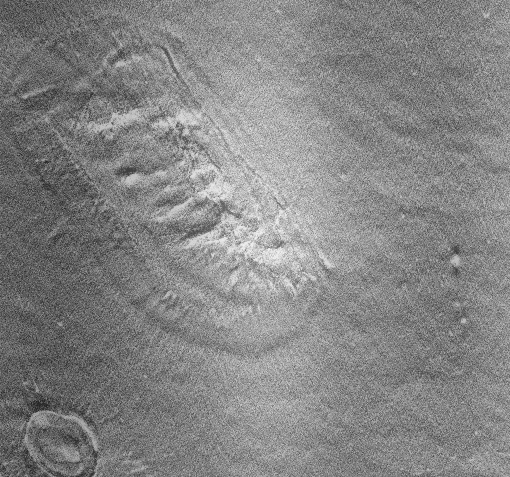
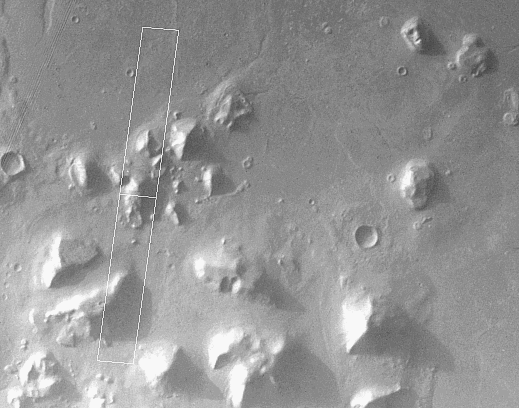
The face was just a mesa
This was proven almost 3 years ago. And the terrain on Mars isn't exactly flat, either.
-
meant 1998, heres links to pictures
-
meant 1998, heres links to pictures
-
what i find unrealistic
=is that no one has really posted any links to the images inquestion in order to provide any sort of balance to this argument. There are more images available of a "city"-like formation a few miles from the city. There's been math done to calculate orientation of the objects in question in relation to each other. Investigate this. don't write it off. Those in control of the flow of information are just afraid of letting every one else know what they may not be ready to know.
-
what i find unrealistic
=is that no one has really posted any links to the images inquestion in order to provide any sort of balance to this argument. There are more images available of a "city"-like formation a few miles from the city. There's been math done to calculate orientation of the objects in question in relation to each other. Investigate this. don't write it off. Those in control of the flow of information are just afraid of letting every one else know what they may not be ready to know.
-
Re:Why bother?
Why bother debunking something so stupid? Just gives the conspiracy theorists more to talk about.
Also, anyone capable of rational thought would not believe such garbage in the first place. Anyone stupid enough to believe something that stupid isn't worth correcting.
NASA spent millions of dollars and sacrificed opportunities to do some real science just to get woo-woos like Hoagland and his followers the image of the Face they'd been demanding as soon as possible. If these people aren't addressed, we'll be having rovers sent to Cydonia to look for pyramids instead of looking for stuff that might actually be there, like signs of past water. -
That's all [insert name here] bullship
That's all [insert name here] bullship. Don't know who to blame but I searched for more data and found several pictures like that.
Like this (don't know exposition time) and this (five minute exposition, march 11).
All have similar streaks, the only difference is the streak on the "UFO" picture seens to be alone and probably move faster (since it's a 15 seconds exposition) or that's just zoom effect. And probably was the first to be photographed, so that's might be the reason it created so much hype between NASA people.
This is what I belive to be the original image, taken from this page.
There is some discussion here but I didn't read it all. -
That's all [insert name here] bullship
That's all [insert name here] bullship. Don't know who to blame but I searched for more data and found several pictures like that.
Like this (don't know exposition time) and this (five minute exposition, march 11).
All have similar streaks, the only difference is the streak on the "UFO" picture seens to be alone and probably move faster (since it's a 15 seconds exposition) or that's just zoom effect. And probably was the first to be photographed, so that's might be the reason it created so much hype between NASA people.
This is what I belive to be the original image, taken from this page.
There is some discussion here but I didn't read it all. -
That's all [insert name here] bullship
That's all [insert name here] bullship. Don't know who to blame but I searched for more data and found several pictures like that.
Like this (don't know exposition time) and this (five minute exposition, march 11).
All have similar streaks, the only difference is the streak on the "UFO" picture seens to be alone and probably move faster (since it's a 15 seconds exposition) or that's just zoom effect. And probably was the first to be photographed, so that's might be the reason it created so much hype between NASA people.
This is what I belive to be the original image, taken from this page.
There is some discussion here but I didn't read it all.



.jpg)


.jpg)