Slashdot Mirror
Domain: nasa.gov
Stories and comments across the archive that link to nasa.gov.
Comments · 16,365
-
comparison of rover ground images
anybody notice the differences between spirit rover 1 landing site and opportunity rover 2 landing site? (high res) anyone care to comment on what the raw images may show? described clockwise from 12 o'clock.
compare the above images with this pathfinder image taken in '97.
spirit image 1:
context
flat, slightly undulating landscape. scattered large rocks. undulations appear to be lighter coloured/different texture.
12 o'clock
flat, slighly undulating granular surface punctuated with small to medium sized rocks scattered evenly. Between the larger rocks smaller fragments appear just beneath the surface causing convex bulging of the surface material. No craters. larger surface features (mountains?) in the distance.
12 o'clock
flat, slighly undulating granular surface punctuated with small to medium sized rocks scattered evenly. Between the larger rocks smaller fragments appear just beneath the surface causing convex bulging of the surface material.
2 o'clock
rocks appear shattered with sharp edges. larger rocks exposed appear untouched by weathering. material on ground has gentle undulations. In some instances the material covers the rocks.
3 o'clock
slight rises in ground material appear from 2 to 7 - facing in the same direction.
5 o'clock
jpl image on rover visible. rocks to immediate left and above appear to be pock marked. In these pock marks appear to be grains of martian surface.
8 o'clock
collections of rocks above and partially hidden in surface. rocks partially hidden show outlines below the surface. compared to 5 there are much less of the larger rocks. looking right to the 6 position just above the largest pock marked rock notice the collection of very small rocks just beneath the surface.
11 o'clock
trio of larger rocks at 12,6 and 9. inside these rocks are smaller rocks. shadows appear from the 5 position. Inside the trio of rocks appear a great many collection of smaller rocks bounded by the other 3. close inspection of the rocks reveal small mounds surrounding them at a short distance.
opportunity image 2:
context:
appears to have landed in a low depression. You can see the a hill on the horizon. The image is taken with the sun at high angle. It is just possible to see what appears to be drag marks against the flat surface. Another image shows the wind swept regular surface devoid of visible small rocks.12 o'clock
we have what looks like undisturbed/slightly ground with smooth texture. resembles wind blow sand. No inidcation of rock deposits on surface. From this image it is difficult to tell what is original surface. However if we look at this image we see that the surface surrounding image is a fine textured regular surface where the only irregular surface is possibly where spirit has come into context.2 o'clock
depression of surface that could be drag marks. area shows both smooth surface as described at 12 and scratch marks that expose small darker objects which could be deeper marks in the disturbed surface or small regular sized objects.
Note scratch mark in top left region crossing the previously created marks suggesting it has been made after the other marks. -
comparison of rover ground images
anybody notice the differences between spirit rover 1 landing site and opportunity rover 2 landing site? (high res) anyone care to comment on what the raw images may show? described clockwise from 12 o'clock.
compare the above images with this pathfinder image taken in '97.
spirit image 1:
context
flat, slightly undulating landscape. scattered large rocks. undulations appear to be lighter coloured/different texture.
12 o'clock
flat, slighly undulating granular surface punctuated with small to medium sized rocks scattered evenly. Between the larger rocks smaller fragments appear just beneath the surface causing convex bulging of the surface material. No craters. larger surface features (mountains?) in the distance.
12 o'clock
flat, slighly undulating granular surface punctuated with small to medium sized rocks scattered evenly. Between the larger rocks smaller fragments appear just beneath the surface causing convex bulging of the surface material.
2 o'clock
rocks appear shattered with sharp edges. larger rocks exposed appear untouched by weathering. material on ground has gentle undulations. In some instances the material covers the rocks.
3 o'clock
slight rises in ground material appear from 2 to 7 - facing in the same direction.
5 o'clock
jpl image on rover visible. rocks to immediate left and above appear to be pock marked. In these pock marks appear to be grains of martian surface.
8 o'clock
collections of rocks above and partially hidden in surface. rocks partially hidden show outlines below the surface. compared to 5 there are much less of the larger rocks. looking right to the 6 position just above the largest pock marked rock notice the collection of very small rocks just beneath the surface.
11 o'clock
trio of larger rocks at 12,6 and 9. inside these rocks are smaller rocks. shadows appear from the 5 position. Inside the trio of rocks appear a great many collection of smaller rocks bounded by the other 3. close inspection of the rocks reveal small mounds surrounding them at a short distance.
opportunity image 2:
context:
appears to have landed in a low depression. You can see the a hill on the horizon. The image is taken with the sun at high angle. It is just possible to see what appears to be drag marks against the flat surface. Another image shows the wind swept regular surface devoid of visible small rocks.12 o'clock
we have what looks like undisturbed/slightly ground with smooth texture. resembles wind blow sand. No inidcation of rock deposits on surface. From this image it is difficult to tell what is original surface. However if we look at this image we see that the surface surrounding image is a fine textured regular surface where the only irregular surface is possibly where spirit has come into context.2 o'clock
depression of surface that could be drag marks. area shows both smooth surface as described at 12 and scratch marks that expose small darker objects which could be deeper marks in the disturbed surface or small regular sized objects.
Note scratch mark in top left region crossing the previously created marks suggesting it has been made after the other marks. -
comparison of rover ground images
anybody notice the differences between spirit rover 1 landing site and opportunity rover 2 landing site? (high res) anyone care to comment on what the raw images may show? described clockwise from 12 o'clock.
compare the above images with this pathfinder image taken in '97.
spirit image 1:
context
flat, slightly undulating landscape. scattered large rocks. undulations appear to be lighter coloured/different texture.
12 o'clock
flat, slighly undulating granular surface punctuated with small to medium sized rocks scattered evenly. Between the larger rocks smaller fragments appear just beneath the surface causing convex bulging of the surface material. No craters. larger surface features (mountains?) in the distance.
12 o'clock
flat, slighly undulating granular surface punctuated with small to medium sized rocks scattered evenly. Between the larger rocks smaller fragments appear just beneath the surface causing convex bulging of the surface material.
2 o'clock
rocks appear shattered with sharp edges. larger rocks exposed appear untouched by weathering. material on ground has gentle undulations. In some instances the material covers the rocks.
3 o'clock
slight rises in ground material appear from 2 to 7 - facing in the same direction.
5 o'clock
jpl image on rover visible. rocks to immediate left and above appear to be pock marked. In these pock marks appear to be grains of martian surface.
8 o'clock
collections of rocks above and partially hidden in surface. rocks partially hidden show outlines below the surface. compared to 5 there are much less of the larger rocks. looking right to the 6 position just above the largest pock marked rock notice the collection of very small rocks just beneath the surface.
11 o'clock
trio of larger rocks at 12,6 and 9. inside these rocks are smaller rocks. shadows appear from the 5 position. Inside the trio of rocks appear a great many collection of smaller rocks bounded by the other 3. close inspection of the rocks reveal small mounds surrounding them at a short distance.
opportunity image 2:
context:
appears to have landed in a low depression. You can see the a hill on the horizon. The image is taken with the sun at high angle. It is just possible to see what appears to be drag marks against the flat surface. Another image shows the wind swept regular surface devoid of visible small rocks.12 o'clock
we have what looks like undisturbed/slightly ground with smooth texture. resembles wind blow sand. No inidcation of rock deposits on surface. From this image it is difficult to tell what is original surface. However if we look at this image we see that the surface surrounding image is a fine textured regular surface where the only irregular surface is possibly where spirit has come into context.2 o'clock
depression of surface that could be drag marks. area shows both smooth surface as described at 12 and scratch marks that expose small darker objects which could be deeper marks in the disturbed surface or small regular sized objects.
Note scratch mark in top left region crossing the previously created marks suggesting it has been made after the other marks. -
comparison of rover ground images
anybody notice the differences between spirit rover 1 landing site and opportunity rover 2 landing site? (high res) anyone care to comment on what the raw images may show? described clockwise from 12 o'clock.
compare the above images with this pathfinder image taken in '97.
spirit image 1:
context
flat, slightly undulating landscape. scattered large rocks. undulations appear to be lighter coloured/different texture.
12 o'clock
flat, slighly undulating granular surface punctuated with small to medium sized rocks scattered evenly. Between the larger rocks smaller fragments appear just beneath the surface causing convex bulging of the surface material. No craters. larger surface features (mountains?) in the distance.
12 o'clock
flat, slighly undulating granular surface punctuated with small to medium sized rocks scattered evenly. Between the larger rocks smaller fragments appear just beneath the surface causing convex bulging of the surface material.
2 o'clock
rocks appear shattered with sharp edges. larger rocks exposed appear untouched by weathering. material on ground has gentle undulations. In some instances the material covers the rocks.
3 o'clock
slight rises in ground material appear from 2 to 7 - facing in the same direction.
5 o'clock
jpl image on rover visible. rocks to immediate left and above appear to be pock marked. In these pock marks appear to be grains of martian surface.
8 o'clock
collections of rocks above and partially hidden in surface. rocks partially hidden show outlines below the surface. compared to 5 there are much less of the larger rocks. looking right to the 6 position just above the largest pock marked rock notice the collection of very small rocks just beneath the surface.
11 o'clock
trio of larger rocks at 12,6 and 9. inside these rocks are smaller rocks. shadows appear from the 5 position. Inside the trio of rocks appear a great many collection of smaller rocks bounded by the other 3. close inspection of the rocks reveal small mounds surrounding them at a short distance.
opportunity image 2:
context:
appears to have landed in a low depression. You can see the a hill on the horizon. The image is taken with the sun at high angle. It is just possible to see what appears to be drag marks against the flat surface. Another image shows the wind swept regular surface devoid of visible small rocks.12 o'clock
we have what looks like undisturbed/slightly ground with smooth texture. resembles wind blow sand. No inidcation of rock deposits on surface. From this image it is difficult to tell what is original surface. However if we look at this image we see that the surface surrounding image is a fine textured regular surface where the only irregular surface is possibly where spirit has come into context.2 o'clock
depression of surface that could be drag marks. area shows both smooth surface as described at 12 and scratch marks that expose small darker objects which could be deeper marks in the disturbed surface or small regular sized objects.
Note scratch mark in top left region crossing the previously created marks suggesting it has been made after the other marks. -
Re:Well done NASA!
And, it would have been impossible to bring back the data in those days withoug sending people, although CCCP did do an unmanned lunar rover.
That's simply not true. There were many robotic laboratory missions, and there were some robotic missions that sent back lunar samples.
But if what you're talking about is large amounts of mars rocks, then it was and still is actually advantageous to use a human to collect them.
The Apollo missions brought back many more moon rocks than the robotic missions (about 400 kg, versus less than 1 kg). But you would have an analogous situation today if you wanted to get rocks from the moon or from Mars. A small sample return is easy for an autonomous lander. But once you start talking 100 kg of rock, a human would actually make things a lot simpler, and you've committed yourself to moving a lot of weight anyway.
The first robotic lunar soft landings:
Surveyor 1 U.S.A. May / Jun 1966 lunar lander first soft-landed robotic laboratory, landed in the Ocean of Storms area, returned high-quality images & selenological data
Luna 13 U.S.S.R. Dec 1966 lunar lander soft landed in the Ocean of Storms area, measured soil density and surface radioactivity
The first robotic lunar sample returns:
Luna 16 U.S.S.R. Sept 1970 lunar sample return first robotic sample return, collected lunar samples in the Sea of Fertility area and returned to Earth on 9/24/70
Luna 20 U.S.S.R. Feb 1972 lunar sample return second robotic sample return, collected samples in the Sea of Crises area and returned to Earth on 2/25/72
Luna 24 U.S.S.R. Aug 1976 lunar sample return third robotic sample return, collected samples in the Sea of Crises area and returned to Earth
It's pretty clear that the US could have accomplished robotic sample returns before Apollo 11 if that had been their intent. The main reason the USSR didn't put a man on the moon was that their equivalent of the Saturn V (the N-1) was expensive and very unreliable. -
Re:Good news?That exactly the reason they won't be going back to Hubble. It has nothing to do with money. NASA Administrator Sean O'Keefe explained it very well in a press conference yesterday (the press conference was supposed to be about the impending landing of Opportunity, but all anyone really asked about was Hubble and Bush's Mars initiative). Anyway, he said that in hindsight, those missions to Hubble were very dangerous in many ways. Far more dangerous than other Shuttle missions. The Columbia Accident Investigation Board recommended that for future Shuttle missions that it needs to be able to dock with ISS in case of an emergency. It simply can't do that on a hubble mission due to the differing orbits.
-S
-
Re:Water on Mars
Seems like all the probes send back the same pictures of rocks...At least opportunity gave us a different view this time.
Images like this are so different from anything seen from the other probes. There is hardly an upright rock anywhere in view. It is also kind of odd that there are not more light-colored flat sets of squarish rocks in the distance, as if the probe just happened to land near the only batch. -
Re:Light story on the solar cellsThere are plenty of techs that were initially planned/researched for space but also help directly back here on Earth, although I'm too lazy to do some quick googling right now.
The one I'm really waiting for is aerogel. Well, waiting for it to be mass-produced and affordable, anyway. It's insulation, weight, and strength are just incredible. (It was previously on Slashdot in the Time's Best Inventions of 2002, and was recently used in the collection of comet dust on the Stardust mission).
Pictures, F.A.Q., and a couple more articles.
And a choice quote from this NYT article, by aerogel's current researcher, Dr. Tsou:
"It's the lowest density of any solid, and it has the highest thermoinsulation properties. Though it would be very expensive, you could take a two- or three-bedroom house, insulate it with aerogel, and you could heat the house with a candle. But eventually the house would become too hot."
And it just looks so cool! -
Re:Light story on the solar cellsThere are plenty of techs that were initially planned/researched for space but also help directly back here on Earth, although I'm too lazy to do some quick googling right now.
The one I'm really waiting for is aerogel. Well, waiting for it to be mass-produced and affordable, anyway. It's insulation, weight, and strength are just incredible. (It was previously on Slashdot in the Time's Best Inventions of 2002, and was recently used in the collection of comet dust on the Stardust mission).
Pictures, F.A.Q., and a couple more articles.
And a choice quote from this NYT article, by aerogel's current researcher, Dr. Tsou:
"It's the lowest density of any solid, and it has the highest thermoinsulation properties. Though it would be very expensive, you could take a two- or three-bedroom house, insulate it with aerogel, and you could heat the house with a candle. But eventually the house would become too hot."
And it just looks so cool! -
Re:Light story on the solar cellsThere are plenty of techs that were initially planned/researched for space but also help directly back here on Earth, although I'm too lazy to do some quick googling right now.
The one I'm really waiting for is aerogel. Well, waiting for it to be mass-produced and affordable, anyway. It's insulation, weight, and strength are just incredible. (It was previously on Slashdot in the Time's Best Inventions of 2002, and was recently used in the collection of comet dust on the Stardust mission).
Pictures, F.A.Q., and a couple more articles.
And a choice quote from this NYT article, by aerogel's current researcher, Dr. Tsou:
"It's the lowest density of any solid, and it has the highest thermoinsulation properties. Though it would be very expensive, you could take a two- or three-bedroom house, insulate it with aerogel, and you could heat the house with a candle. But eventually the house would become too hot."
And it just looks so cool! -
Re:Light story on the solar cellsThere are plenty of techs that were initially planned/researched for space but also help directly back here on Earth, although I'm too lazy to do some quick googling right now.
The one I'm really waiting for is aerogel. Well, waiting for it to be mass-produced and affordable, anyway. It's insulation, weight, and strength are just incredible. (It was previously on Slashdot in the Time's Best Inventions of 2002, and was recently used in the collection of comet dust on the Stardust mission).
Pictures, F.A.Q., and a couple more articles.
And a choice quote from this NYT article, by aerogel's current researcher, Dr. Tsou:
"It's the lowest density of any solid, and it has the highest thermoinsulation properties. Though it would be very expensive, you could take a two- or three-bedroom house, insulate it with aerogel, and you could heat the house with a candle. But eventually the house would become too hot."
And it just looks so cool! -
Re:Light story on the solar cellsThere are plenty of techs that were initially planned/researched for space but also help directly back here on Earth, although I'm too lazy to do some quick googling right now.
The one I'm really waiting for is aerogel. Well, waiting for it to be mass-produced and affordable, anyway. It's insulation, weight, and strength are just incredible. (It was previously on Slashdot in the Time's Best Inventions of 2002, and was recently used in the collection of comet dust on the Stardust mission).
Pictures, F.A.Q., and a couple more articles.
And a choice quote from this NYT article, by aerogel's current researcher, Dr. Tsou:
"It's the lowest density of any solid, and it has the highest thermoinsulation properties. Though it would be very expensive, you could take a two- or three-bedroom house, insulate it with aerogel, and you could heat the house with a candle. But eventually the house would become too hot."
And it just looks so cool! -
Re:Light story on the solar cellsThere are plenty of techs that were initially planned/researched for space but also help directly back here on Earth, although I'm too lazy to do some quick googling right now.
The one I'm really waiting for is aerogel. Well, waiting for it to be mass-produced and affordable, anyway. It's insulation, weight, and strength are just incredible. (It was previously on Slashdot in the Time's Best Inventions of 2002, and was recently used in the collection of comet dust on the Stardust mission).
Pictures, F.A.Q., and a couple more articles.
And a choice quote from this NYT article, by aerogel's current researcher, Dr. Tsou:
"It's the lowest density of any solid, and it has the highest thermoinsulation properties. Though it would be very expensive, you could take a two- or three-bedroom house, insulate it with aerogel, and you could heat the house with a candle. But eventually the house would become too hot."
And it just looks so cool! -
Re:The Martian Rovers' engineers' desktops
Try here.
Interesting that you threatended to use FOIA before actually trying to find out what's already on the web. To sum: they're using VxWorks with a radiation-hardened RAD6000 32-bit RISC chip from BAE systems. I've seen information on the RAM configuration, especially since they began having trouble with the Flash RAM; essentially, they use EEPROM, some Flash, some regular ECC RAM.
Even more here. -
Re:One question
All raw images are black and white - how do they transform them into RGB colour ?
Excellent question, which was answered at least twice in the last threads on the subject,
Anyway, this page is really the best at explaining how it's done, and how you can do it yourself IF the images are saturated evenly by a common reference point.
For example, I'm guessing that these 3 images can be made to resemble "human perceivable" colors quite easily.
this on from the L2 lens (Reddish)
this on from the L5 lens (greens)
this on from the L6 lens (blues)
Please note, that I am not all knowing in the matter, I just followed the explanation from the top linked page.
Murphy(c) -
Re:One question
All raw images are black and white - how do they transform them into RGB colour ?
Excellent question, which was answered at least twice in the last threads on the subject,
Anyway, this page is really the best at explaining how it's done, and how you can do it yourself IF the images are saturated evenly by a common reference point.
For example, I'm guessing that these 3 images can be made to resemble "human perceivable" colors quite easily.
this on from the L2 lens (Reddish)
this on from the L5 lens (greens)
this on from the L6 lens (blues)
Please note, that I am not all knowing in the matter, I just followed the explanation from the top linked page.
Murphy(c) -
Re:One question
All raw images are black and white - how do they transform them into RGB colour ?
Excellent question, which was answered at least twice in the last threads on the subject,
Anyway, this page is really the best at explaining how it's done, and how you can do it yourself IF the images are saturated evenly by a common reference point.
For example, I'm guessing that these 3 images can be made to resemble "human perceivable" colors quite easily.
this on from the L2 lens (Reddish)
this on from the L5 lens (greens)
this on from the L6 lens (blues)
Please note, that I am not all knowing in the matter, I just followed the explanation from the top linked page.
Murphy(c) -
Re:The Martian Rovers' engineers' desktops
If you watch NASA TV, you can usually see what OS is used on many of the computers.
The cameras don't hold back when panning around the JPL control room.
Determining what OSes are used is left as an exercise for the reader. -
Re:Spirit is indeed a software problem
You are indeed wrong. The two rovers are identical (PDF file). And indeed, they are trying to make sure that what happened to Spirit won't happen to Opportunity as well.
-
Great picture...
here. Obviously some kind of Ballmer tribute going on there...
-
Re:That explains the mute Spirit Rover
I'm not sure why this "discovery" of water by Mars Express is getting so much press.
The U.S. Viking craft saw water really clearly back in the 70s, in the form of frost.
There are a number of photos, including this one, and this one.
The Viking 2 lander site was covered with frost for about 100 days per year.
-
Re:Using the images
-
Good News for Water Search
I would think that, given that the landing site was selected for its hematite content, and given the extreme smoothness of the landscape (indicative of erosion of some sort, possibly water-related), this is the best chance yet we've had to discover evidence of former large quantities of water on Mars. Let's all keep our fingers crossed -- imagine what that'd mean for our understanding of the universe, and the chances of the NASA budget going up!
Not to mention, of course, our chances of getting free shrimp. -
Re:Oh wow...
This ain't too profound either, but of course, we have been there before: with Viking (x2), Mars Pathfinder, and of course Spirit.
I agree with the OP and the Nasa hype that Meridiani is damn cool and imho way more interesting than Gusev in terms of what the rover can accomplish (yay, Hematite!). I'm so psyched it got there unharmed...
-
Re:Oh wow...
This ain't too profound either, but of course, we have been there before: with Viking (x2), Mars Pathfinder, and of course Spirit.
I agree with the OP and the Nasa hype that Meridiani is damn cool and imho way more interesting than Gusev in terms of what the rover can accomplish (yay, Hematite!). I'm so psyched it got there unharmed...
-
Links
Maestro is a public version of the science operations tool for the 2003 Mars Exploration Rover mission.
Look at the pictures like the gurus do.
Runs on java and crunches my machine... but man, does it give you that "I-am-a-NASA-engineer" feeling.
If you don't want to install that beast, you can feast your eyes on the Raw Image Gallery
AC
Posting true AC so not to Karma Whore. -
Mars Raw Images
Here is a link to most of the raw pictures beamed back. It's alot of the same thing, but if you just can't get enough of Mars.
Spirit: http://marsrovers.jpl.nasa.gov/gallery/all/spirit. html
Opportunity: http://marsrovers.jpl.nasa.gov/gallery/all/opportu nity.html
There are currently 132 Raw Images from Opportunity. Spirit has beamed back 1,855 Images.
Enjoy. -
Mars Raw Images
Here is a link to most of the raw pictures beamed back. It's alot of the same thing, but if you just can't get enough of Mars.
Spirit: http://marsrovers.jpl.nasa.gov/gallery/all/spirit. html
Opportunity: http://marsrovers.jpl.nasa.gov/gallery/all/opportu nity.html
There are currently 132 Raw Images from Opportunity. Spirit has beamed back 1,855 Images.
Enjoy. -
Re:How Long?
-
Re:Thats a plaent you are talking about
Wrong, spirit's landing site is known to within half a metre: check it out yourself if you don't believe me.
But even with this knowledge, current technologies don't have the landing precision to land near to the rover. Opportunity landed 24 km from the target spot, spirit 13km IIRC. Those are considered very precise landings. And if you would send a rover that could drive 24km say in a few weeks, why bother trying to fix a rover that will only be driving 100m/day (and I'm being optimistic here).
I think it would be cheaper trying to cover the martian soil with lego bricks (if you get a large volume discount:)). -
Re:First Color Photo is up!
You can get more images as soon as they're out here
-
Re:Thanks from NASACongrats on conquering the death planet
mars isn't the "death planet" - that moniker is reserved for venus:
- surface temperature of 480c
- surface pressure of 96x earth's
- clouds of sulfuric acid
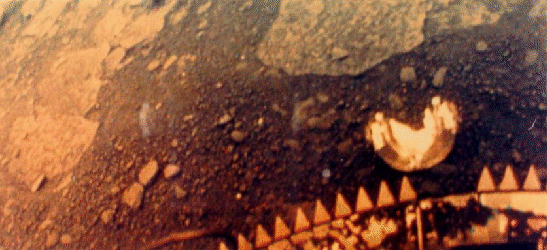
now that's a death planet... and yet the soviets managed to drop a lander on it successfully way back in 1982 and even sent back some pictures
-
Re:Opportunity Pictures
Looks a whole lot different that the Spirit landing site. Notably The ground and this thing off in the distance.
-
Re:Opportunity Pictures
Looks a whole lot different that the Spirit landing site. Notably The ground and this thing off in the distance.
-
Re:I Love thisAlmost every space mission has brought back spectacular new findings, complete surprises and incredible images... Think of Voyager, the amazing pictures of the big planets, Apollo bringing back samples to determine the origin of the Moon, Giotto looking at Halley, Venera bringing back pictures from Venus, and so on...
Still, the MER's are a tremendous achievement, and it is incredible that these days we can see the pictures coming in to a computer in mission control, LIVE on the internet! Woops, gotta go, next briefing is about to start
-
Opportunity Pictures
77 pictures from Opportunity are now available for viewing.
-
A few Spirit links about flight software
I found a few flight software links about the two Mars craft... it's normal that little of this information is put on the web due to ITAR regulations...
PDF of a powerpoint about static analysis of the code
First and second links from GCN magazine.
And here is a chatty JPL page showing the key team members and their personal reflections
Some technical briefs on the science payload can be downloaded here or here
A list of Cornell's scientists and their bios etc is here
Here is an article about another software guy.
A cool technical power point about the computers, only available on google cache, is here
And lastly, a technical comparison of today's rovers against something called Fido.
I simply don't know what I did before Google! -
A few Spirit links about flight software
I found a few flight software links about the two Mars craft... it's normal that little of this information is put on the web due to ITAR regulations...
PDF of a powerpoint about static analysis of the code
First and second links from GCN magazine.
And here is a chatty JPL page showing the key team members and their personal reflections
Some technical briefs on the science payload can be downloaded here or here
A list of Cornell's scientists and their bios etc is here
Here is an article about another software guy.
A cool technical power point about the computers, only available on google cache, is here
And lastly, a technical comparison of today's rovers against something called Fido.
I simply don't know what I did before Google! -
Re:So, this makes what?Take a look at the Chronology of Mars Exploration.
Every country that has sent orbiters/landers/rovers to Mars has had a high number of failures, including the Soviet Union (later Russia), the United States, Japan, and Europe.
Take a look at this quality Wikipedia article on Mars exploration.
-
Re:Hematite
Google told me about this Powerpoint, from the horse's mouth. Apparently, the conceivable mechanisms for hematite formation are:
I) Chemical precipitation - extensive near-surface water
1) Precipitation from ambient, Fe-rich water (oxide iron formations)
2) Precipitation from hydrothermal fluids
3) Low-temperature dissolution and precipitation through mobile groundwater leaching
4) Surface weathering and coatings
II) Thermal oxidation of magnetite-rich lava
I guess it's just that many of the possible mechanisms for hematite formation involve the presence of water. Though I guess thermal oxidation of magnetite in lava doesn't necessarily. Presumably they want to either rule that possibility out or identify whether the hematite in fact indicates recent or distant past presence of liquid water in the area. -
Fresh craterCongrats to JPL, i can't wait till the pictures arrive in a few hours. I am now watching the briefing on NasaTV and it seems they landed some 24 miles downrange from bullseye, probably not because of navigation error, but a due to strong winds. This is still ok for the science, which is aimed mainly at a region of some odd minerals that have something to do with water.
Slightly OT from the Opportunity landing, but has anybody seen the amazing picture made by Mars Global Surveyor? They not only can see Spirit itself from orbit, they also located several bounce marks, the parachute, the backshell and the heatshield! I have to look up the resolution again, but judging from this picture they achieve better than 1 meter after some image processing.
These pictures gave me the following idea (assuming Spirit will get healthy soon): Since the plan was to drive to big crater in the top right of the first image anyhow, why not drive to the impact location of the heatshield. Since this came down without a parachute, it should have dug a pretty deep hole. It is thus possible to study a fresh crater that is only 1 month old!
-
Fresh craterCongrats to JPL, i can't wait till the pictures arrive in a few hours. I am now watching the briefing on NasaTV and it seems they landed some 24 miles downrange from bullseye, probably not because of navigation error, but a due to strong winds. This is still ok for the science, which is aimed mainly at a region of some odd minerals that have something to do with water.
Slightly OT from the Opportunity landing, but has anybody seen the amazing picture made by Mars Global Surveyor? They not only can see Spirit itself from orbit, they also located several bounce marks, the parachute, the backshell and the heatshield! I have to look up the resolution again, but judging from this picture they achieve better than 1 meter after some image processing.
These pictures gave me the following idea (assuming Spirit will get healthy soon): Since the plan was to drive to big crater in the top right of the first image anyhow, why not drive to the impact location of the heatshield. Since this came down without a parachute, it should have dug a pretty deep hole. It is thus possible to study a fresh crater that is only 1 month old!
-
Fresh craterCongrats to JPL, i can't wait till the pictures arrive in a few hours. I am now watching the briefing on NasaTV and it seems they landed some 24 miles downrange from bullseye, probably not because of navigation error, but a due to strong winds. This is still ok for the science, which is aimed mainly at a region of some odd minerals that have something to do with water.
Slightly OT from the Opportunity landing, but has anybody seen the amazing picture made by Mars Global Surveyor? They not only can see Spirit itself from orbit, they also located several bounce marks, the parachute, the backshell and the heatshield! I have to look up the resolution again, but judging from this picture they achieve better than 1 meter after some image processing.
These pictures gave me the following idea (assuming Spirit will get healthy soon): Since the plan was to drive to big crater in the top right of the first image anyhow, why not drive to the impact location of the heatshield. Since this came down without a parachute, it should have dug a pretty deep hole. It is thus possible to study a fresh crater that is only 1 month old!
-
Bouncing
-
Re:We learn from our mistakes...
The Space Shuttle does not use 486s. It uses IBM AP-101s, which are architecturally similar to the IBM 360/370 series of computers. See the Second Generation Computers FAQ.
-
Nasa TV
If you don't get it on cable, you can watch NASA TV here.
-
Opportunity
Opportunity is fast approaching the red planet. It should be an interesting night at JPL. Execellent work guys, good luck.
-
Re:Steal SOME
hell maybe its got nicer rims too
I don't know, the spirit rover has pretty fancy rims. -
Problem Isolated: Bad Flash Ram
The flash ram went bad."
Why does this not surprise me? I'd guess that SanDisk put in the low bid for that part. -
Re:should NASA let Wind River write the code?
"Do you expect NASA to fabricate every component in the spacecraft?"
If we gave them a budget? Yes.
Nasa's fiscal year 2003 budget: $15.1 Billion.
DoD's fiscal year 2003 budget: $396.1 Billion.
The DoD's budget does not include emergency supplementals, such as the $40 billion supplemental in '02, or the $87 billion supplemental requested in '03.