Slashdot Mirror
Domain: nasa.gov
Stories and comments across the archive that link to nasa.gov.
Comments · 16,365
-
Tracking time is difficult
for interplanetary missions. Since planets are in different reference frames and the cruise phase of an interplanetary mission takes a long time, there are relativistic effects in time keeping, though smaller than the differences in planetary rotation, are much more difficult to compute than the simple difference between days and sols.
The standard time used is normally the Barycentric Dynamical Time (or TDB), which is the time measured by a theoretical aomic clock placed at the barycenter of the solar system. Other time systems are used when needed. TDB is within 2 milliseconds of Terrestrial Dynamical Time (TDT, which is a similar time except computed for the Earth/Moon barycenter), which in turn differs from the more familiar UTC only in that TDT does not have leap seconds to account for variations in the angular velocity of Earth.
There is a standard library used in NASA missions called SPICE that handles these conversions between ephemeris times for planetary systems, spacecraft and TDB. It does a whole lot more (positions, speed and orientation of planetary objects and spacecraft, light travel time computations, etc.). The group that publishes this library is also responsible for publishing data files (called kernels, no relation to Unix) to facilitate these operations.
I wouldn't worry too much about time keeping differences. The only reason MER mission ops is concerned with this is because the rovers only operate in the Martian daytime. Time for missions is otherwise tracked using SCLK (spacecraft clock), SCET (space craft ephemeris time), or in TDB.
-
Re:bin laden..
Woah, woah, woah, woah!
Okay, I didn't support the war on Iraq for many reasons, but to claim that Saddam's not a bad guy is just simply ludicrous revisionist history.
Put down the agitprop and step away from the soapbox.
Saddam Hussein's Baathist Party has done several horrible things that have been well-documented. His regime has a history of torture, oppression, and genocide. The Kurds, the Marsh Arabs, and the Shiites have all suffered greatly at his regime's hands for helping us in the Gulf War and for standing up for their own rights. My mother works with an Iraqi Kurd who fled with her husband to America after her husbands brothers were tortured and killed and had their bodies returned to them in mutilated condition because the two of them were reporters trying to expose the abuses of the regime to the international community. Whole towns of Kurds were killed with chemical weapons for their aid of the UN forces in the Gulf War.
Then you have the draining of Iraq's wetlands as punishment to the Marsh Arabs. An entire ecosystem and economic infrastructure has been utterly destroyed, leaving many of the Marsh Arabs without a means of sustenance and without a home. This is in addition to the usual panorama of torture, kidnapping, and execution that faced many dissidents in Iraq.
Oh, and in case all of this doesn't convince you, how about the senseless, retaliatory destruction of the economic lifeblood of Kuwait that poisoned thousands? You know, the blackening of the skies which was visible from space? Then, there's the man's sweetheart sons who reveal how good of a man he was as a father. How about the horrible life story of a man who was forced to act as a body double for Uday?
I don't think that all necessarily justified us getting involved when we have made a policy of ignoring or supporting many other brutal regimes -- especially when close friends of certain of our administration stand to profit mightily -- but saying that there's no evidence that Saddam's a bad guy is farsical. As to his popularity, Saddam didn't just get 90%+ of the vote. He got 100% of the vote on a ballot where he was the ONLY candidate listed. No candidate gets that kind of support in any healthy democracy, and we are right to question anyone who does. -
Re:Mars24?i didn't see this posted anywhere, but here's a link to the mars24 applet if you're interested.
-
What unit is that measured in?
-
Re:Things to Come....3. The Ion Drive (already proven, power being ramped up monthly by orders of magnitude, will open up solar system for exploration, mineral harvesting, golden age begun...)
Ion thrusters actually are rapidly becoming the engine of choice for deep space missions. The only problem with them is that they are low thrust so you can't use it for an application that needs a quick boost. However for planet hopping where you can get away with long burn times and low thrust they're ideal. They're really nice because you can power them off of solar cells, such as with Deep Space 1. Plus they smaller then conventional chemical rockets, and can go faster!
More info here: http://nmp.jpl.nasa.gov/ds1/
Plus they're flight proven. DS1 used the NSTAR 30cm Ion Thruster which had a maximum power input of about 2.3 kW.
http://www.boeing.com/ids/edd/ep.html
Current research at NASA and other institutions is taking Ion Thrusters to power levels up to 30 kW with an Isp up to around 15,000-s. So while not being ramped up by an order of magnitude every few months, they are increasing by an order of magnitude every few years at the current rate. The problem that everyone is running into is the power supply for them. 30kW is a lot of juice, and if you bump that up to 300kW you're in need of a nuclear power plant.
-
Re:Travel timeYou left out "please be sure to arrive at least two hours before your scheduled flight due to security procedures."
That doorstep-to-doorstep time is EXACTLY why Dr. Bruce Holmesof NASA's AGATE research program has predicted the end of hub and spoke airline system and the enpowerment of small aircraft with new tehnologies like "highways in the sky." http://lava.larc.nasa.gov/BROWSE/agate.html
They found that SLOWER planes do much better on flights of 600 miles or less. The current airline system wins for longer trips like coast-to-coast.
My ancient plane goes only 150MPH, but I can be in the on my way in an hour. I will be 150 miles closer to the destination by the time the airliner leaves the gate.
The research suggests that planes can be made safer and easier to fly and require shorter runways, so communities will be encouraged to BUILD airports nearer city centers The Air traffic system would be automated so each plane would "own" a smalller piece of airspace around it and be warned if another aircraft is nearby.
-
Re:Travel timeYou left out "please be sure to arrive at least two hours before your scheduled flight due to security procedures."
That doorstep-to-doorstep time is EXACTLY why Dr. Bruce Holmesof NASA's AGATE research program has predicted the end of hub and spoke airline system and the enpowerment of small aircraft with new tehnologies like "highways in the sky." http://lava.larc.nasa.gov/BROWSE/agate.html
They found that SLOWER planes do much better on flights of 600 miles or less. The current airline system wins for longer trips like coast-to-coast.
My ancient plane goes only 150MPH, but I can be in the on my way in an hour. I will be 150 miles closer to the destination by the time the airliner leaves the gate.
The research suggests that planes can be made safer and easier to fly and require shorter runways, so communities will be encouraged to BUILD airports nearer city centers The Air traffic system would be automated so each plane would "own" a smalller piece of airspace around it and be warned if another aircraft is nearby.
-
Re:Travel timeYou left out "please be sure to arrive at least two hours before your scheduled flight due to security procedures."
That doorstep-to-doorstep time is EXACTLY why Dr. Bruce Holmesof NASA's AGATE research program has predicted the end of hub and spoke airline system and the enpowerment of small aircraft with new tehnologies like "highways in the sky." http://lava.larc.nasa.gov/BROWSE/agate.html
They found that SLOWER planes do much better on flights of 600 miles or less. The current airline system wins for longer trips like coast-to-coast.
My ancient plane goes only 150MPH, but I can be in the on my way in an hour. I will be 150 miles closer to the destination by the time the airliner leaves the gate.
The research suggests that planes can be made safer and easier to fly and require shorter runways, so communities will be encouraged to BUILD airports nearer city centers The Air traffic system would be automated so each plane would "own" a smalller piece of airspace around it and be warned if another aircraft is nearby.
-
Re:Travel timeYou left out "please be sure to arrive at least two hours before your scheduled flight due to security procedures."
That doorstep-to-doorstep time is EXACTLY why Dr. Bruce Holmesof NASA's AGATE research program has predicted the end of hub and spoke airline system and the enpowerment of small aircraft with new tehnologies like "highways in the sky." http://lava.larc.nasa.gov/BROWSE/agate.html
They found that SLOWER planes do much better on flights of 600 miles or less. The current airline system wins for longer trips like coast-to-coast.
My ancient plane goes only 150MPH, but I can be in the on my way in an hour. I will be 150 miles closer to the destination by the time the airliner leaves the gate.
The research suggests that planes can be made safer and easier to fly and require shorter runways, so communities will be encouraged to BUILD airports nearer city centers The Air traffic system would be automated so each plane would "own" a smalller piece of airspace around it and be warned if another aircraft is nearby.
-
Well ...
Atleast its being researched. I know a few of the guys working on the software models for the conflict detection and resolution aspect of the project.
-
HyperSoar and Hyper-X
The only fly in HyperSoar's ointment is that its success is highly dependent upon Hyper-X. Note how similar the designs are.
Additionally, Hyper-X is designed to use the engine block as a heatsink. It will run for a few minutes (which is all it needs to do to get up to speed) and then the engine will melt and the aircraft will splash into the Pacific. I don't think that would be a good thing for a passenger aircraft.
-
Re:Wow! A personal connection
I just found a decent site at JPL here that illustrates the earth's structure nicely, although it appears to have been written for grade schoolers.
Thanks, and please let us know when you find a link to a more simple explanation. -
Wow! A personal connection
It's sort of neat to see a story like this, because Dr. Stevenson was one of my advisors at Caltech. He's a great guy with a cool New Zealand accent and a wide assortment of knowledge about almost everything. But I can shed a little light on this, both because I know him and because I have a geology background.
First, for the credulous, he's semi-joking. The physics of the iron sinking into the core is actually plausible, but his tone when talking about "generating a crack in the crust" is tongue-in-cheek. This would require a much larger nuclear detonation, say, than has ever been tested by anybody. The seismic consequences would be... bad. What's more, we aren't anywhere even close to being able to design probes that could survive such an environment and send messages back.
To dispel a common misconception, the interior of the earth is NOT molten. Omitting some interesting boundary layers, the Earth is composed of the following chunks from the inside out: the inner core (solid iron alloy), the outer core (molten iron alloy), the mantle (solid rock), and the crust (we live on it). If you're curious as to how we know, it's because liquids and solids have dramatically different properties as far as transmitting seismic waves. I just found a decent site at JPL here that illustrates the earth's structure nicely, although it appears to have been written for grade schoolers.
The idea that the mantle is liquid is one of the most widely held misconceptions about major geological concepts. It exhibits ductile deformation, so it flows something like a liquid, with a speed of centimeters or meters per year. Magma, however, results when rock is pushed up into the crust from the mantle - the decrease in pressure lowers the melting temperature. It can also be generated when water seeps into hot rocks - wet rock has a lower melting temperature. It is NOT evidence that the mantle itself is liquid.
So why would this work? A large body of iron would be much denser than mantle rock, and at a hundred million kilograms, the net downward force would be considerable enough to force mantle rock out of the way. I'm too lazy to figure out the physics for this post, but I would imagine this is the content of the Nature article. The interesting question would be, "would ductile deformation occur quickly enough to get the iron down in a reasonable amount of time?" The answer, apparently, is 'yes'. -
Re:Is this considered...No... Flight Linux and I'm not even sure if there wasn't anything before then...
on that page there are links to several actual usages of Linux in space.
-
Re:You already have a HUD
Actually it is head-up display. You only have one head - raunchy jokes aside. Here's a sample pointer. The singular use is also used for Head-Down Displays.
On a safety note, there has been a lot of work on HUDs in automotive settings. Some benefits have been found, but they are accompanied by some rather nasty problems that can appear if the HUD and the imagery is not designed properly. Automotive settings are not the same as aviation due to shorter focal lengths for road scenes, more visual clutter, and higher likelihood of unexepected events. Pilots also tend to be better trained than drivers.
-
Re:Oh, cut out the whining...
I am not a rocket scientist and you are probably not either. I am not bashing the engineers at NASA. They are not the people calling the shots. I am disapointed in the mismanagement and lack of direction. I am sure that there are visionary zelots in NASA but I've also spoken with peoplw who have worked at NASA describing government workers who might as well be working at the DMV.
For all your name calling, I didn't see you list any benifits that the shuttle program has gotten us. if you look at the homepage for the shuttle program, it looks like they don't either unless you count Grammy nods.
A question I would put to you is this: Why isn't NASA fulfilling my dreams of a spacefaring race? Their shoestring budget is $17 billion. With slightly more than that adjusted for inflation we got to the moon in the 60s. Seriously, how has human spacefaring done in the past 30 years? It has regressed. It has not gone anywhere. What difference has it made in the past 30 years. My expectations are not any more zelous than the Apollo program was.
By the way, China called, they said they'd save us a few square miles on Mars. -
Re:Oh, cut out the whining...
I am not a rocket scientist and you are probably not either. I am not bashing the engineers at NASA. They are not the people calling the shots. I am disapointed in the mismanagement and lack of direction. I am sure that there are visionary zelots in NASA but I've also spoken with peoplw who have worked at NASA describing government workers who might as well be working at the DMV.
For all your name calling, I didn't see you list any benifits that the shuttle program has gotten us. if you look at the homepage for the shuttle program, it looks like they don't either unless you count Grammy nods.
A question I would put to you is this: Why isn't NASA fulfilling my dreams of a spacefaring race? Their shoestring budget is $17 billion. With slightly more than that adjusted for inflation we got to the moon in the 60s. Seriously, how has human spacefaring done in the past 30 years? It has regressed. It has not gone anywhere. What difference has it made in the past 30 years. My expectations are not any more zelous than the Apollo program was.
By the way, China called, they said they'd save us a few square miles on Mars. -
Re:fission reactors = heavy
No spare parts? Then how exactly would you shoot such a massive object into space? Imagine, at 300 ft (100 m) this thing is as long as the IIS! And the IIS is the size of a football field. According to this the IIS is 108 x 72 m. At this size, the probe will be be pretty heavy as well.
-
Re:Anyone else hereImmediatly have the image of a large green frog floating around in the weightlessness?
It's not unlikely, given some of the experiments they are doing in space these days. Scroll down towards Snap-crackle-pop
-
Re:Hope Justin is still employed
His
-
Re:$8 Billion???
Why exactly are we modding up comments made by people entirely ignorant of the most successful space missions to date?
See the other post for a bunch more important missions you seem to be unaware of.
-
Re:This talk about Europa makes me wonder
When scientists look for life out side the solar system, why don't they focus on moons of Jupiter like planets instead of finding Earth like planets.
Actually, they have looked for moons around extrasolar planets that eclipse their star. The main example (so far) of the "transiting technique" is HD 209458b, a hot Jupiter in a 3-day period. This transit has been observed using Hubble, with a sensitivity that would allow one to detect Saturn-like rings or moons as small as twice the size of Earth. None were found. More information here.
Of course, a 3-day period planet's moon would still be unable to harbor life as we know it (too hot). But these are the first steps being taken to look for such objects. As more transiting planets are detected, this technique will tell us a lot about moon systems around these planets.
Moons of giant planets in temperate zones may indeed be the key to finding life-sustaining bodies. Our own Moon stabilizes the rotational axis of the Earth, which prevents many extreme climatic changes. Compare this to Mars, which has no large moons (only two small ones) that lead to the same stability. A giant planet would have a similar affect on the dynamics. This is just one example of how a second body (in our case, the Moon) aids the development of life. One can ponder how much the probability of life drops off if such a body does not exist, though I'm not sure anyone has a convincing answer, yet.
We can barely image planets that are twice the size of Jupiter and you are suggesting we should image MOONS!?
So far, scientists have been unable to image any extra-solar planets at all. The planets have been detected indirectly--by looking at the effects of the planet on the star. An overview of these techniques. Astronomers have directly imaged brown dwarfs, which are somewhat like both planets and stars. We can't yet image exoplanets, but we can still learn a lot about them.
Direct imaging of planets may be made with the Keck Interferometer in Nulling Mode (a similar setup is being designed for the LBTI in Arizona, and the European VLTI), or with "Extreme Adaptive Optics", or finally with the Terrestrial Planet Finder. -
Re:This talk about Europa makes me wonder
When scientists look for life out side the solar system, why don't they focus on moons of Jupiter like planets instead of finding Earth like planets.
Actually, they have looked for moons around extrasolar planets that eclipse their star. The main example (so far) of the "transiting technique" is HD 209458b, a hot Jupiter in a 3-day period. This transit has been observed using Hubble, with a sensitivity that would allow one to detect Saturn-like rings or moons as small as twice the size of Earth. None were found. More information here.
Of course, a 3-day period planet's moon would still be unable to harbor life as we know it (too hot). But these are the first steps being taken to look for such objects. As more transiting planets are detected, this technique will tell us a lot about moon systems around these planets.
Moons of giant planets in temperate zones may indeed be the key to finding life-sustaining bodies. Our own Moon stabilizes the rotational axis of the Earth, which prevents many extreme climatic changes. Compare this to Mars, which has no large moons (only two small ones) that lead to the same stability. A giant planet would have a similar affect on the dynamics. This is just one example of how a second body (in our case, the Moon) aids the development of life. One can ponder how much the probability of life drops off if such a body does not exist, though I'm not sure anyone has a convincing answer, yet.
We can barely image planets that are twice the size of Jupiter and you are suggesting we should image MOONS!?
So far, scientists have been unable to image any extra-solar planets at all. The planets have been detected indirectly--by looking at the effects of the planet on the star. An overview of these techniques. Astronomers have directly imaged brown dwarfs, which are somewhat like both planets and stars. We can't yet image exoplanets, but we can still learn a lot about them.
Direct imaging of planets may be made with the Keck Interferometer in Nulling Mode (a similar setup is being designed for the LBTI in Arizona, and the European VLTI), or with "Extreme Adaptive Optics", or finally with the Terrestrial Planet Finder. -
Re:Nuclear Powered?I didn't notice any mention of propulsion in the article.
Of course that's on of the main reasons for nuclear power. It's a prometheus based drive they'll be using.
BTW, they can still do radar with a small RTG, but it's a pretty lower power radar.
-
Re:Since I actually know something about this....
-"What if something goes wrong" scenarios tend to be based on the idea that stuff can "fall out of the sky." It can't. The people running the mission know where things are going
Yes, most of them know where things are going in SI units, while others know where things are going in imperial/US units. Surely, with that experience combined, nothing can go wrong?
-
20m(+), not 300ft
This picture specifies a 20m boom, which appears to be over half the length of the spacecraft. I didn't find any reference to 300ft (or metric equivalent) at the JPL website (but feel free to correct me if it is there.) Eyeballing the picture, 20m for the boom implies about 35m total length. By comparison, 300ft is about 90m.
The 300ft figure is in the newspaper article. Possibly it is an error, possibly the reporter knows more than I do.
I am curious as to how they will launch something so long. Presumably it will be collapsed in some way, and expand after launch. Allowing the (presumed) heat-pipe connections between the reactor and the radiators in a collapsable configuration sounds like a challenging engineering problem.There is no indication of how it would collapse - telescoping and folding seem the most obvious. -
Now THAT'S a spacecraft!Man I hope this gets built. Such an improvement over the wimpy space probes we've put up so far.
Here's a nice drawing of the design. Anyone know why the reactor is all the way at the front and the thrusters are at the back??
They also mention on the JPL site that the propulsion system (and I guess much of the rest of the proposed design) was vetted on the Deep Space 1 mission. Some interesting reports on the technology here.
-
Now THAT'S a spacecraft!Man I hope this gets built. Such an improvement over the wimpy space probes we've put up so far.
Here's a nice drawing of the design. Anyone know why the reactor is all the way at the front and the thrusters are at the back??
They also mention on the JPL site that the propulsion system (and I guess much of the rest of the proposed design) was vetted on the Deep Space 1 mission. Some interesting reports on the technology here.
-
Re:The just *can't* send this without a lander...
The mission site has much more detailed interesting information.
-
Re:How about a "moon leash"?...
I appreciate the humor, but please note the distance of the moon is around 60 times the radius of the Earth. Meanwhile, proposed space elevators represent at most 7 Earth radii out. That's one heck of an increase for an already gigantic budget.
-
Re:Bone loss
Sorry, wrong link, try this
-
News for Nerds?
Please define "news for nerds".
This article is one the rare occations that
Pick whichever one of these links you think most applies as "News for Nerds":
8th Computer Olympiad
-or-
NASA - News
-or-
Got That Quad Baby
--
[cue music]
One of these links is not like the others,
One of these links just doesn't belong,
Can you tell which link is not like the others
By the time I finish my song?
Did you guess which link was not like the others?
Did you guess which link just doesn't belong?
If you guessed this one is not like the others,
Then you're absolutely...right! -
Re:How about a
However, Gamma radiation consists of nuetrons. Nuetrons are inert and won't react to an EM field.
Holy Zarquon! What a dreadful mistake! Gamma radiation consists of very high-frequency photons.
Neutrons are a part of neutron radiation. It does not have its own fancy Greek letter because it does not occur in naturally active isotopes, so Henri Becquerel (the one who noticed that radioactivity consists of three seperate classes of radiation) and Ernest Rutherford (the one who studied their nature and gave them the Greek letters) could not observe neutron rays. -
Addendum
I've found very thorough study regarding mars radiation risk (two pages down). It contains a link to quite long
For those who don't want to bother downloading whole -
Addendum
I've found very thorough study regarding mars radiation risk (two pages down). It contains a link to quite long
For those who don't want to bother downloading whole -
Re:Yeah, make fun of it
Are you being serious? Those fine folks went through said radiation belt just fine.
Assuming you are, learn from your betters.
Dr. Stern calculated that the solar cells of a satellite passing through the inner Van Allen belt, shielded by only 1 mm of glass, would receive about 25 rad of radiation per pass. Particles in the outer belt are less penetrating. Anything over about 200 rad is dangerous to humans and about 500 rad can be lethal. Fortunately, it doesn't take much shielding to deter the particles, and the shielding doesn't need to be constructed of rare or exotic metals.
-
Age of the Universe
If we limit the age of the universe to 13.7 billion years, that puts some fairly tight constraints on the evolution of life, especially advanced civilizations, in the universe.
If the universe is older by a older by a small amount or perhaps a few billion years, or even greater (which an eventual solution to the age paradox might bring us to), the possibilities for extra-terrestrial life become more and more possible.
Given enough time, even "kooky" theories like the panspermia hypothesis become more and more likely, since distance, lack of speed, and survivability drastically cut the probabilities of anything resembling viable life making it across the vast tracts of space, but time increases it.
(Not to say that it happened, of course - run-of-the-mill abiogenesis could easily have happened instead... or as well.)
Panspermia is a bit worrisome a possibility, in some ways. It would mean that some/many/all alien civilizations might share anything from RNA to DNA to histones to mitochondria. Depending on how advanced the 'seeded' lifeform was (could be anything from a fragment of proto-RNA to a whole eukaryote), we might have to worry about not only bacteria on our future journeys to the stars, but viruses as well. On the plus side, chirality may be conserved, so we don't end up starving to death eating left-handed sugar (L-sucrose) and starch on alien worlds when some layabout gardener on staff mixes salt and Roundup in the fertilizer in the Earth terrarium.
There, that's my fun little bit of tinfoil hat speculation
Klaatu berrada nicto...
Er, I mean, back to your irregular program...
-
Re:Finally a competitor for the 286
A lot of what's floating in space is junk.
Orbital-Debris FAQ -
Re:Rich country?
"It's obvious if you live in Europe, where a lot of houses and buildings are old, and do not provide adequate sound-proofing."
But there are also large swaths of Europe where you won't find a building predating, say, 1919 or 1945. Where does your philosophy stand on the areas that were subject to these two "urban renewal projects?"
The same can be said for the roads you mention. Some are still like that, others were lain out in "the insanity of right angles" after you cleared away the debris.
"(London and Paris -- for instance -- are among the most expensive places on Earth)"
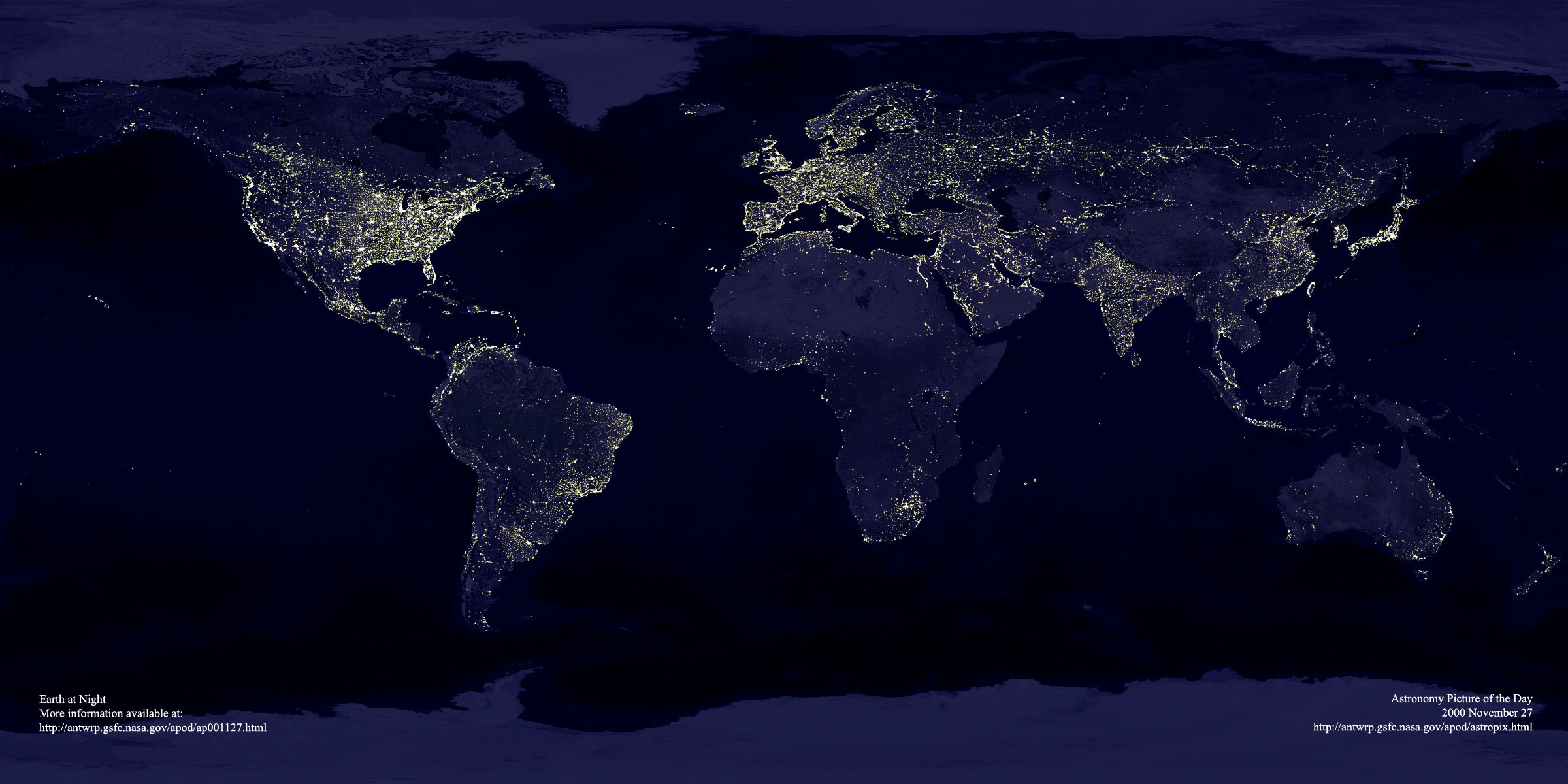
Looking at the ol' the earth at night collage and how lumpy light distribution seems to be around those two urban centers, it would seem that living in those cities is more of a luxury and necessity, with decent amounts of real estate in the countryside available. It would seem that government spending on noise reduction for city dwellers really only forcefully subsidizes urbanization, a trend you should perhaps consider reversing (especially considering the current attitude towards environmentalism in the EU).
"rent is a killer in those cities."
High rent is usually more indicative of people wanting to live there and not necessarily needing to live there.
"Finally, I suspect most european governments are going to finance this simply by giving tax-breaks to people who will overhaul the sound-proofing of their flats and houses, and not tax other home owners."
That's really just a bait-and-switch tactic. It doesn't tax suburban and rual taxpayers directly, but they still see an indirect effect in their taxes by having to make up the loss from the tax breaks given to the urban folks. -
Re:An excellent point from Ray Kurweil
Mod parent up!
That's the whole problem with SETI in a nutshell. It only looks for radio signals. Meaning we are looking for signs of alien intelligence in that super-narrow drop-in-the-bucket window in any given alien civilization's development when they MAY have used radio signals, and it assumes those signals penetrated the aliens upper atmosphere so that we could detect them.
It's like looking for that needle in the haystack, except the needle is only in 1 of a trillion haystacks, and then it's only there for a split second before it disappears and moves to another haystack.
Not to mention almost every instance of convincing alien life in SF and "xenobiology" is so strange and different that the likelihood of them using radio is very small. Think of Card's Buggers, or Vinge's ant-like aliens, or the ever infamous super-intelligent shade of blue.
Maybe their version of a brain sees radio waves the way we see color. Why then would they ever broadcast a global signal? It would be like broadcasting a red tint over everything you see. They would communicate so differently that the idea of them broadcasting radio might be insane. Come to think of it, the whole idea of broadcasting a one-to-many signal might be a human idea. Maybe that kind of broadcasting would be like a human broadcasting something inside a movie theater.. RUDE.
you could go on like this forever. I'm not against SETI. But it sure seems like the equivalent of looking for human life by sticking a big microphone out the window, and then arguing over squirrell chatter vs. possible Bantu language clicks.
In other words, neat, but let's not get carried away. -
Re:The Allan Parson's Project, Phase 1From this NASA page, the CALIPSO laser is identified as a Nd:YAG, diode-pumped, Q-switched laser. The repetition rate is 20 Hz, and the operating wavelengths are 1064 nm (infrared) and the frequency-doubled 532 nm (visible, green.)
There's a PDF here that describes the prototype laser as delivering 110 mJ per pulse. At 20 pulses per second, that's about 2 watts average power--but of course the peak power in each (short) pulse will be much higher.
-
Re:The Allan Parson's Project, Phase 1From this NASA page, the CALIPSO laser is identified as a Nd:YAG, diode-pumped, Q-switched laser. The repetition rate is 20 Hz, and the operating wavelengths are 1064 nm (infrared) and the frequency-doubled 532 nm (visible, green.)
There's a PDF here that describes the prototype laser as delivering 110 mJ per pulse. At 20 pulses per second, that's about 2 watts average power--but of course the peak power in each (short) pulse will be much higher.
-
Lego + NASA
When I went to go watch the launch of MER-B, the KSC visitor center had a Lego model of the rover.
-
Sky-Highway
The virtual highway in the sky sounds pretty cool.
-
Re:Solar physics joke
i dont get that why would a bar be in my small office/home office?
Not that one, the other SOHO. -
Old NASA StudiesSpace colonies do seem an elegant solution (more info here and here).
Space stations could be the ultimate "gated community". Read more of the argument here.
-
Old NASA StudiesSpace colonies do seem an elegant solution (more info here and here).
Space stations could be the ultimate "gated community". Read more of the argument here.
-
Lagrange Points
A really interesting article about Lagrange Points can be found here. What I found really fascinating is the fact that it seems like that the earth pulls/pushes dust around space on the earth-moon Lagrange Points L4 and L5.
-
In case of SlashdottingMilky Way Days
Returning to the new frontier.
By Dennis E. PowellWhen President Bush delivers a speech recognizing the centenary of heavier-than-air-powered flight December 17, it is expected that he will proffer a bold vision of renewed space flight, with at its center a return to the moon, perhaps even establishment of a permanent presence there. If he does, it will mean that he has decided the United States should once again become a space-faring nation. For more than 30 years America's manned space program has limited itself to low Earth orbit; indeed, everyone under the age of 31 more than 125 million Americans was born since an American last set foot on the moon.
The speech will come at a time when events are converging to force some important decisions about the future of American efforts in space. China has put a man in orbit, plans a launch of three Sinonauts together, and has announced its own lunar program. The space shuttle is grounded, and its smaller sibling, the "orbital space plane," may not be built. The International Space Station, behind schedule, over budget, and of limited utility, has been scaled back post-Columbia.
The content of the speech does not appear to be in doubt; the only question is timing. While those who have formulated it have argued that it be delivered on the anniversary of the Wright Brothers' first powered flight, there exists a slight possibility that it will instead be incorporated in the State of the Union address at the end of January. This has its own, less triumphant, significance, which is in the form of a chilling coincidence. Every American who has died in a spacecraft has done so within one calendar week: The Apollo 204 fire on January 27, 1967; the Challenger disaster on January 28, 1986; and the loss of Columbia on February 1, 2003.
If the president goes ahead with the plan to announce an ambitious new program to carry Americans beyond Earth's immediate gravitational pull, he will argue that the new lunar explorations are justified not only for what they themselves might produce but also as a means of developing the technology and skills necessary for a mission to Mars, which is expected to be mentioned, though in less-specific terms, in the address.
Observers might note a familiar ring to the proposal. On July 20, 1989, President George H. W. Bush marked the 20th anniversary of the first Apollo moon landing with a speech at the National Air and Space Museum in Washington in which he called for a permanent American presence on the moon and, ultimately, a mission to Mars.
That address led to the formation of a group called the "Space Exploration Initiative," headed by Vice President Quayle and NASA Administrator Richard Truly, which in the spring of 1991 released a report, "America at the Threshold." It set a long-term goal of landing Americans on Mars, with space activities in the interim leading up to that goal. First, it recommended, would be "Space Station Freedom" now the ISS followed by a return to the moon, in large measure to develop and test systems for keeping people alive on a Mars journey. The development of rocket boosters more powerful than the mighty Saturn V that lifted Apollo astronauts to the moon would be necessary, the report said, as would development of nuclear systems for providing power aboard in-transit spacecraft, and nuclear-powered rockets, to be employed outside Earth's atmosphere, where they could be used on long missions without the need to carry enormous supplies of conventional rocket propellant. None of the recommendations was carried out as envisioned at the time; the only one that got off the ground at all is the space station.
The president's speech could breathe new life into a moribund space program whose recent history has been beset by disappointment and failure. The space shuttle proved neither as reliable or as inexpensive as its pr
-
Re:I couldn't agree more
Empty space isn't made of lunar regolith.
Lunar regolith isn't weathered like the surface debris on Earth. Consequently, it's got sharp edges. It's less like play-sand and more like crushed glass.
The astronauts reported that the stuff got into their suits between the hermetic joints, grinding into their skin. It also chewed up the lunar rovers.