Slashdot Mirror
Domain: nasa.gov
Stories and comments across the archive that link to nasa.gov.
Comments · 16,365
-
Mars Rover!!!
I nominate the Mars Rover! Ok, it was technically a "remote operated vehicle" and not an autonomous robot, but I don't care. It was still the coolest thing I've seen in ages.
-
NASA page on worms in space
-
C. elegans and the value of the research
Not only is the genome mapped out, but C. elegans has been a model organism for development. A complete flow-chart-esque understanding of the division of the first egg cell down to the last of its 959 cells. Its one of the first model organisms for a complete body-plan understanding of genetic development, but knowing the genes and figuring out the genes are 2 differant matters. Hence the experiments in space trying to understand how 0 g and amazingly controled environments affect gene expression.
Seeing as the Columbia Mission was the first *pure science* mission not having to do with Space Station construction in 2 years, I think its a great legacy for those who lost their lives that some really amazing science can come out of their work.
-
NASA TV
For live NASA feeds, check out NASA TV. I watch it every morning while I'm working out. It's mostly stuff for kids at that early hour, but they also broadcast rocket launches, space station dockings, etc.
-
Re:Human nature derived from survival of fittest
What decreasing resources?
Things like fossil fuels, fisheries, mountaintops, tropical forests, etc. We may not be in a crisis situation yet, but we're definitely using up more natural resources than we replace (at least, for some resources).
Decreasing supply leads to higher prices
Well, that's not entirely true. Even if one accepts the simplified economic model of supply and demand, demand plays just as much a role in the price of things as supply (perhaps more).
Also, consider the (hypothetical) scenario where solar energy becomes cheap, efficient and effective. Suppose it's even cheaper than other sources, like fossil fuels. In this case, manufacturers of other energy sources will need to reduce their prices to compete. But that doesn't mean that there are more fossil fuels. It means that there are more energy sources.
So, ultimately, I'd say that the relationship between supply (of any one given thing) and price is more complicated than that.
yet the cost of most basic materials is going DOWN not up
Hmmm... I'm not sure whether that's true or not. Gas prices certainly are going up.
But, take fossil fuels, for example. Oil drilling in the Alaskan wilderness may create a larger supply of fossil fuel on the market. This may lead to lower prices in the short term. But the total amount of fossil fuel on the planet is definitely decreasing (which is why they want to drill in Alaska in the first place).
There may be enough resources to sustain our current population and rate of consumption, but if we continue to use up our resources and continue to grow in population, at some point that no longer will be true.
So, I stand by my statement.
-
Re:Is NASA really relevant??
If you're willing to have an open mind, I'd check out stuff like this.
Most estimates I've seen have the space program paying for itself in the long-run, you just don't see it because the money doesn't show up as income on NASA's budget sheets. -
Re:Moon rainbowsNo idea what saltwater would do, but in Western Canada (where I'm originally from) we could see these things all the time (both around the sun and the moon) when the weather got cold enough. They're commonly called "sundogs"; the technical term is "parhelia".
Some links:
http://imagine.gsfc.nasa.gov/docs/ask_astro/answe
r s/970207e.html
http://www.geocities.com/~kcdreher/sundogs.htmlThey may be pretty, but they'd be easier to appreciate if they didn't signify that it's freakin' cold outside
-
Re:Moon rainbows
It was probably a halo. I've never seen one around the moon, but they do occasionally appear around the sun if it's cold enough. I guess the conditions in Finland are a little different from Houston.
Google for sun halo gives 155 000 hits compared to 91 000 for moon halo, so halos around the moon are apperently not entirely uncommon. On this page is a neat picture of a sun halo, and a short explanation of the phenomenon. -
Re:Is NASA really relevant??
-
More Information
More information, including a map of where the eclipse is visible, can be found here
It also has details for future eclipses. -
Re:Energy != structure
I am not trying to demonstrate that complex organisms will inevitably arise from such reactions, I am just trying to point out that DNA (or something like it) is actually fairly likely to appear given the raw materials and plenty of time.
To cut a long story short, the experts in various fields who have actually done realistic calculations or experiments say no.
For (a classic) example, after the Urey/Miller experiments, Stanley Miller followed up. Google for it if you're interested, but for political reasons don't expect the headlines that greeted his first big experimentt. Far from eliminating the recemisation problem, he established that it was pretty much insurmountable (as were all others). He was also unable to produce any but a few of the simplest amino acids, even racemised, using ignredients-plus-energy experiments. Although the aminos generally represent local minima, most of them have fairly tall maxima on any reasonable "approach" to that minimum. This was (is) very disappointing to Miller; he still holds as an article of faith that spontaneous generation does happen, but has no explanation for how.
It's also sad-but-true that the conditions required for producing amino acids (to say nothing of more complex products) are also fairly hostile to their survival. It's even more frustrating than the bowling-ball-on-curved-rails arcade game in that if you put enough energy into the ball to get it over the first hump, you also put enough in to get it back over the first hump - in real-life chemistry, the hump is asymmetrical (the ball rolls out more readily than it rolls in). Complex chemicals are easier to break than to make.
In living biochemistry, the methods of producing and combining complex chemicals are radically different from those proposed for random formation from raw chemicals. To cut another long story short, it looks plausible on the surface but in implementation is high implausible. And of course a lot of people really, really want to believe that it is plausible, each for their own reasons and none of those reasons (that I've seen yet) are really related to doing raw science.
Now, as for the tornado analogy, I agree, it seems rather impossible. I've always seen it with 747s instead of B52s, but there isn't much difference. It is flawed in that metal parts can be broken down whereas atoms cannot (at least, not under natural circumstances) and a junkyard can contain an almost infinite variety of parts, whereas the universe only has 114 known to us, many of which are man-made and do not exist for more than a few billionths of a second.
Nit to pick: if you count lightning and cosmic rays as a `natural circumstances', each of them can indeed provoke transmutation. Given the amount of "lightning" (electrical discharge) damage that Mars has taken (it's the only force that explains almost all of the characteristics of Valles Marineris - but nobody's got around to figuring out how it happened yet), that may be an avenue worth pursuing.
At the level of the anology, the atoms are (very) like unto the steel, copper, aluminium, plastic, rubber, leather etc of which the B52 is built. An individual component like a bolt or a lens might equate to an amino acid (some structure, but not much). A slightly complex part like an electric motor or guage might correspond to a protein, a very complex part like a bombsight or a jet engine might correspond to a set of genes.
Sigh, I did want to avoid getting stuck in the detail, but in it's own way it's interesting.
Two successive tornadoes might be useful to your cause in that the first one frees up more random small parts (at the boilt and lens level) for the second one to fill gaps with. But what a B52 does is nothing like as complex as, say, E. coli or any other complete single-celled lifeform. It doesn't, for example, self
-
Venus might not be such as bad idea after all
It appears that Venus offers the most Earth-like environment in the entire solar system - not on the ground, but 50 km up in the clouds.
Take a look at Colonization of Venus by Geoffrey Landis. -
Uses for Too Much Money
Why aren't these billionaires exploring the depths of the oceans as James "King of the World" Cameron does?
Surely there's interesting stuff down there, like nucular radiation-enlarged squids, slime monsters and maybe a Godzilla-like creature or two.
Are any of them funding research into solar cells, wind technology, tidal power or geothermal or is it all a great big ego boost? -
Why would anyone want that?
Why would anyone want that, when you can actually talk to the peeps up there, which is free if you have the necessary license/equipment (which is easy to get and cheap)...
-
Re:Is this news?
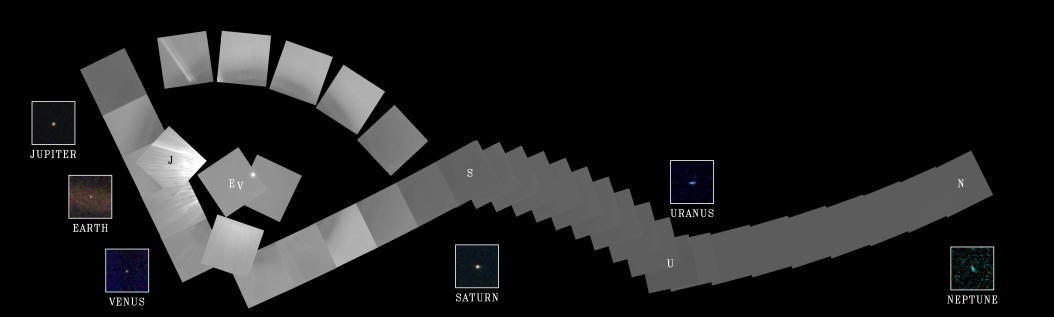
For those who haven't seen the old images....
-
Re:Deciduous trees vs. Coniferous trees
Coniferous forests do not fix carbon all year long--they shut down during the winter:
http://earthobservatory.nasa.gov/Study/BOREASCarbo n/ -
Geeky SIde of NPP Calculation.
The Land NPP algorithm was developed at the NTSG at the University of Montana. I am the Sys Admin for this group.
We developed the software to do the Gross and Net primary productivity calculations (as well as some others), but the main production runs are done at the Goddard Space Flight Center in a room full of SGI Origin servers. Our development environment consists of several smallish linux beowulf clusters (32x1Ghz P3), a few Althon MP boxes, some old AIX dev boxes, and one SGI Oxygen for nasa code certification. Our largest resource is disk space, we have about 12TB of capacity. Keep in mind that this is just for algorithm development and testing. Goddard's production facility is huge, but that's becuase they are producing tons of other data products as well including all the land, ocean, and atmospheric products off of both the Terra and Aqua Satellites. This land productivity data (MOD17 in nasa speak) is derived in part from the MODIS sensor on Terra.
Both of these satellites are in sun syncronous polar orbits meaning that they come down over the earth's day side. This is because many of the sensors (like MODIS) are passive. Terra is the 'AM' satellite, it crosses the equator about mid morning local time, and Aqua being the 'PM' satellite crosses in the afternoon. The reason for this is because there is a significance in AM and PM cloud cover. Cloud cover is difficult to correct for (in fact with MODIS, sometimes you can't correct).
-JungleBoy (aka tweaker)
Melt our server room Axis Camera
Automated GPP Images Site (in devel)
My Lame Website. -
Geeky SIde of NPP Calculation.
The Land NPP algorithm was developed at the NTSG at the University of Montana. I am the Sys Admin for this group.
We developed the software to do the Gross and Net primary productivity calculations (as well as some others), but the main production runs are done at the Goddard Space Flight Center in a room full of SGI Origin servers. Our development environment consists of several smallish linux beowulf clusters (32x1Ghz P3), a few Althon MP boxes, some old AIX dev boxes, and one SGI Oxygen for nasa code certification. Our largest resource is disk space, we have about 12TB of capacity. Keep in mind that this is just for algorithm development and testing. Goddard's production facility is huge, but that's becuase they are producing tons of other data products as well including all the land, ocean, and atmospheric products off of both the Terra and Aqua Satellites. This land productivity data (MOD17 in nasa speak) is derived in part from the MODIS sensor on Terra.
Both of these satellites are in sun syncronous polar orbits meaning that they come down over the earth's day side. This is because many of the sensors (like MODIS) are passive. Terra is the 'AM' satellite, it crosses the equator about mid morning local time, and Aqua being the 'PM' satellite crosses in the afternoon. The reason for this is because there is a significance in AM and PM cloud cover. Cloud cover is difficult to correct for (in fact with MODIS, sometimes you can't correct).
-JungleBoy (aka tweaker)
Melt our server room Axis Camera
Automated GPP Images Site (in devel)
My Lame Website. -
Geeky SIde of NPP Calculation.
The Land NPP algorithm was developed at the NTSG at the University of Montana. I am the Sys Admin for this group.
We developed the software to do the Gross and Net primary productivity calculations (as well as some others), but the main production runs are done at the Goddard Space Flight Center in a room full of SGI Origin servers. Our development environment consists of several smallish linux beowulf clusters (32x1Ghz P3), a few Althon MP boxes, some old AIX dev boxes, and one SGI Oxygen for nasa code certification. Our largest resource is disk space, we have about 12TB of capacity. Keep in mind that this is just for algorithm development and testing. Goddard's production facility is huge, but that's becuase they are producing tons of other data products as well including all the land, ocean, and atmospheric products off of both the Terra and Aqua Satellites. This land productivity data (MOD17 in nasa speak) is derived in part from the MODIS sensor on Terra.
Both of these satellites are in sun syncronous polar orbits meaning that they come down over the earth's day side. This is because many of the sensors (like MODIS) are passive. Terra is the 'AM' satellite, it crosses the equator about mid morning local time, and Aqua being the 'PM' satellite crosses in the afternoon. The reason for this is because there is a significance in AM and PM cloud cover. Cloud cover is difficult to correct for (in fact with MODIS, sometimes you can't correct).
-JungleBoy (aka tweaker)
Melt our server room Axis Camera
Automated GPP Images Site (in devel)
My Lame Website. -
Re:I don't entirely buy this...
This is measuring "productivity" -- how much CO2 is being altered to O2 while the plants produce sugars. Only living carbon sinks are shown, so the geologic sinks which remove carbon for a long time (ocean floor) are not shown. The carbon sources also are not shown, so it is not showing when a tree rots in a wet forest and releases methane and soil (there are other satellite images which do show vegetation fire patterns).
-
For more MODIS information . . .. . . check out the following links:
-
For more MODIS information . . .. . . check out the following links:
-
Re:Interesting
Actually the Amazon takes up 10% of the carbon absorbed by the Earth's land surface with only 5% of the land area--so it's a major source of oxygen. But the Amazon's a pretty complicated place--these maps only show part of what's going on there. Read (shameless plug, but then again the original story is from my site, too) Escape from the Amazon for a few details on the other half of the process.
-
Re:We *are* genetically engineered to be intellige
but the only new ingredient we add is time
If you add a grain or two of sand to your soup, you are unlikely to notice it.
Now add a handful of sand. You begin to notice the grittiness.
Now dump an entire beach of sand onto your dining room table.
Adding ingredients is relative, even if it is only one new one.
Now, I know you're a troll (even if you may not realize it), but go read this, take a look at the image it talks about, then have a little sit down and realize that this planet we're on (and all of your "intelligent designs") are more meaningless than one microscopic speck of silica in the entire ocean.
(Where's a Total Perspective Vortex when you need one....) -
Re:What a suprise
To leave the design as-is is to subject yourself to a risk you have not accounted for.
Unless you study the risks and determine that the existing design is capable of handling it.
I do have an engineering degree and I do have a graduate degree in engineering risk analysis.
So basically, you're saying that you're smarter than the guys running things at NASA and you think you can do things better than they can, right? I just want to be sure that's what you're trying to get off your chest here.
I really hope you realize how unlikely that is, but if you don't: http://www.nasajobs.nasa.gov/
Stop posting on Slashdot and start using your clearly superior education and engineering abilities to fix NASA. -
Re:I know that a shuttle is different in many ways"A design which, if it breaks, opens a gash into the interior structure is thus a flawed design"
"As far as I recall, the shuttle does not have leading egde flaps. Thus it shouldn't be a reason for a 'split' design like the article describes, a solid leading edge panel made of reinforced carbon should be both possible and perhapes even less expensive"
You sound uninformed and are speculating without even attempting to research the subject. The RCC (Reinforced Carbon-Carbon) panels have gaps between them for a reason. The panels are mounted on floating joints to reduce the loads placed on them due to wing deflections. This also helps reduce the effects of mismatched thermal expansion coefficients between the aluminum wing structure and the carbon composite material they are made of. You can read more about the RCC panels and their attachment to the wing structure at:
http://science.ksc.nasa.gov/shuttle/technology/st
s -newsref/sts_sys.html#sts-rccYour comment that a design that causes a breach to the interior structure in case of failure is a flawed one doesn't make too much sense either. The TPS (Thermal Protection System) design is there specifically to protect the orbiter structures that cannot withstand the heat of reentry. Therefore, by design, if the TPS was not there, the structure would be breached. You should look for flaws in the design based on a lack of anticipation of possible external damage modes and not in that it was a very critical system whose loss results in an overall failure of the orbiter.
-
Re:Whitey's on the MoonDumping a bunch of white people on the moon or mars won't improve the lives of the vast majority of the people living on earth.
Odd, it did the last time we tried...
Let's see, where to start... well, there's Velcro and Tang... Er, anyway. Some things that benefit everyone:
Weather satellites, which warn of impending storms and helping people to be prepared, saving thousands of lives. As well as helping reduce property damage by warning people to board up before they get hit.
Smoke dectors, which almost everyone has, to help people get out of their houses should fire break out. Fire fighters wear materials developed by NASA which help them save lives. Medicine has been improved as well.
Now for some links: Space program benefits us all, an article on how the space program is important (although it doesn't list any good examples), and Inventions (Spinoffs) from Space, a list of space inventions, including a game for children to play.
The space program benefits everyone, even if they don't immediately recognize the benefits. Yeah, the deal that blacks/African Americans/whatever is PC got sucks, and racism plagues America to this day. But there's no reason to take it out on the space program, which has helped everyone.
-
More interesting space stuffThis looks really good. There are a lot of intersting developments in space lately. My take on all of this (with redundant links):
Well, sounds like someone might actually build a spacecraft. Scaled Composites has designed a sub-orbital spacecraft launched from the belly of the plane. It is in testing now. They're trying to win the $10 million X-prize, by builing a re-usable spacecraft that can send three people to space (100km) and return them safely. Looks like a neat design, and these guys are for real. Passengers would have a 5-minute micro-gravity environment during the flight. Sounds really cool. Space.com has an excellent write-up.
In other news, the Columbia investigation continues, and Space Daily has a real good (but long) write-up.
But NASA soldiers on. They have 2 Mars missions scheduled for this summer, plus the launch of SIRTF (infra-red telescope), which was recently delayed. Check out Spaceflight Now for details, and the best space coverage, in general.
Oh hell, almost missed this one. Apparently, the founder of PayPal is trying to get into the "microsatellite" launch business, although 1000 pounds is a bit bigger than micro. The company, SpaceX, is based in El Segundo. But, I think these guys are biting off more than they can chew, essentially trying to compete with Boeing, Lockheed, and everyone else. I think Scaled Composites is for real, though; they might pull it off.
-
Re:Military Industrial Complex
Eisenhower's presidency was always marked by contrasts. He really did build up the military to avoid war. He spied on the Soviets in order to prevent misunderstandings. The Soviets knew this. When the U2 with Gary Powers was shot down, Krushev initially wanted to allow Eisenhower to save face, as he knew Ike's motives.
The coverup that was proposed (and indeed attempted) claimed that the U2 was a NASA weather aircraft. (isn't it always?) But Kruschev didn't let it go by. Pics of the U2 with NASA markings -
Re:A time of leaps and bounds
Yeah, I'm a big Valkyrie fan. I've got pics of that accident, and it wasn't the Super Sabre, it was an F-104 that got caught in the vortex and hit one of the XB-70's vertical stabilizers. A few second later, the Valkyrie plummeted to Earth.
A photo of the accident is here.
The Valkyrie WAS too cool for words. There's only one left, and I'll never forget the time I saw it in person. It's at the Air Force Museum at Wright-Patterson AFB in Dayton Ohio. I sat on one of it's tires and had lunch. It was absolutely awesome sitting underneath that thing. Everything else is a compromise as far as I'm concerned.
Some nice Valkyrie pics are here. -
Corona?
What I find interesting is that what most people in the US and the rest of the world thought to be a series of peacefull research sateliets named Discovery, actually was the corona spy satelite system. It's even more amazing when you realise what they actually achived with such a 'primitive' system, starting virtually from scratch.I also found some links to the Thor booster and Agena spacecraft, variants A, B and D on Encyclopedia Astronautica - my favorite webpage for such things.
-
Re:show-stopping problems
Exactly, especially when there are rockets or rocket engines involved. Rockets work via a large controlled explosion. The larger the explosion (the more thrust), the harder it is to control that explosion. Anytime you're strapping people into a vehicle that has close to 6 million pounds of thrust behind it, you're taking a risk that the explosive power behind that ~6 million pounds isn't going to get away from you. And it doesn't take a rocket scientist to see that.
-
Snow Crash guard dogsPasting content from floating atoll:
Take an army of the recently-described feral hunting robots . To each robot, add a GPS chip and wireless mesh networking
Give the people and dogs smart name tags , and have your dogs exchange your "business card" with the other smart name tags. Publish the FOAF url in it, so you can immediately check for compatibility and give the new information to the dogs.
Study the discovered FOAF files , each describing individual traits ("attributes").
Instruct the feral robots to find other people with compatible personalities , but to stay near you. They'll roam around, seeking people whose interests relate to yours.
For bonus points, add solar panels to generate power as it roams around, and electronic boundaries to keep it in safe areas, away from motor traffic.
-
NASA for kidsThey have a really good site, it's a mix of science and fun.
-
NASA's site is quite cool
It's been mentioned a couple of times, but not with enough emphasis. http://www.nasa.gov/ has sub-sections for kids and students.
But I think their multimedia section is the best -- a treat for all ages. The pictures of the day are always cool. -
NASA's site is quite cool
It's been mentioned a couple of times, but not with enough emphasis. http://www.nasa.gov/ has sub-sections for kids and students.
But I think their multimedia section is the best -- a treat for all ages. The pictures of the day are always cool. -
in case of slashdotting - article hereNASA Improves Computers With Tiny Carbon Tubes On Silicon Chips
The life of the silicon chip industry may last 10 or more years longer, thanks to a new manufacturing process developed by NASA scientists.
The novel method, announced in the April 14 issue of the journal Applied Physics Letters, includes use of extremely tiny carbon 'nanotubes' instead of copper conductors to interconnect parts within integrated circuits (ICs). Carbon nanotubes are measured in nanometers, much smaller than today's components.
A nanometer is roughly 10,000 times smaller than the width of an average human hair. ICs are very small groups of electronic components made on silicon wafers.
"NASA needs high-performance computing in small packages for future autonomous spacecraft," said Meyya Meyyappan, director of the Center for Nanotechnology at NASA's Ames Research Center (ARC), Moffett Field, Calif., coauthor of the article.
"The bottom line is that computer chips with more layers and smaller components can do more for us. While we are working on carbon nanotube-based chips for long-term needs, we also are indirectly helping industry to keep silicon-based computer chips in use as long as possible," he said.
One advantage of using carbon nanotube interconnects within integrated circuits is that these interconnects have the ability to conduct very high currents, more than a million amperes of current in a one square centimeter area without any deterioration, which seems to be a problem with today's copper interconnects," said Jun Li, lead scientist of the team at ARC that developed the new process.
"Also, there is no need to create deep, narrow trenches on silicon wafers in which to bury copper conductors, a step that also is becoming a problem as components are made smaller and smaller," Li added.
"Our process allows us to use the tiny carbon nanotubes to replace copper to interconnect network layers on silicon chips," Meyyappan said. "We think this new process may well help to sustain the Moore's Law growth curve."
Moore's Law stemmed from an observation made by computer chip pioneer Gordon Moore in 1964 that the number of transistors in a given area of an IC had doubled every year since its invention. Moore predicted the trend would continue at a rate of about 18 months between doublings.
Continuing down this 'doubling' path is becoming increasingly difficult, according to Meyyappan.
"Roadblocks exist in several common technologies such as interconnects, lithography and others currently used to make the chips," he said. "However, I think our new process could be in use by industry for the next generation of ICs, removing some of these roadblocks," Meyyappan added.
"Using the new process, manufacturers will be able to add more cake-like layers of components to silicon chips to increase computer capability," Li said.
Because copper's resistance to electricity flow increases greatly as the metal's dimensions decrease, there is a limit to how small copper conductors can be.
In contrast, extremely tiny carbon nanotubes can substitute for copper conductors in smaller computer chip electronic configurations, because carbon nanotube electrical resistance is not high.
The new process includes 'growing' microscopic, whisker-like carbon nanotubes on the surface of a silicon wafer by means of a chemical process. Researchers deposit a layer of silica over the nanotubes grown on the chip to fill the spaces between the tubes. Then the surface is polished flat.
Scientists can build more multiple, cake-like layers with vertical carbon nanotube 'wires' that can interconnect layers of electronics that make up the chip.
Related Links
Nanotechnology at NASA -
Re:NASA vs. Intel
nasa's been in the nano game for a long time (since at least 1996)
http://www.nano.gov/2003budget.html will give you an insight into the actual dollars. -
need more info?
oddly enough, for more in depth information, check out the recorded answers they provide for integration into radio broadcasts.
-
lii.org
The Librarians' Index to the Internet is the best place I know of to search for high-quality web sites.
A few moments of searching there found some likely winners:
Space Place
The Kids on the Web
Kids' Castle -
Re:For the Science Tot...
Here is a link to an equally good, but slightly more advanced NASA site with interactive Java simulations on airfoils, turbines, rocket design, etc... I highly recommend it.
-
APOD
Another site that I enjoy is the APOD. Some of the stuff may be a bit over the heads of kids that age (I know lots of it is over mine and I've had some college-level astronomy!), but it's really well linked to a bunch of good sites. And of course the pretty pictures will hopefully only help in getting them interested in science from an early age!
Of course if they're interested in other space types of things there are a bunch of other interactive things at spaceflight.nasa.gov, including the ISS tracker, etc. -
Mind-blowing fun for young and old alike:
-
No, radiation danger was misreportedHere's some of the detail from the Mars Society page about this -- apparently the radiation level on the surface would be only slightly risky:
The Associated Press yesterday issued a wire article claiming that "the radiation on the surface of Mars is so intense that it could endanger astronauts sent to explore the Red Planet." The AP claimed that these were the findings of the MARIE instrument currently operating on the Mars Odyssey spacecraft, and ascribed the view that such radiation doses were too high to allow human explorers to Dr. Cary Zeitlin of the National Space Biomedical Institute in Houston. Dr. Zeitlin is the Principal Investigator for the MARIE radiation detection instrument.
In fact, however, the MARIE data, which is publicly available at the MARIE website at marie.jsc.nasa.gov/Results.html, show exactly the opposite. Currently posted data for January 2003 show radiation levels in low Mars orbit of 25 millirads/day, or 9 rads/year. While this level is slightly less than twice the regulatory dose for persons employed in the nuclear industry, it represents no significant threat. According the conservative "linear hypothesis" for dealing with low doses accepted in the radiation health physics community, a dose of 13 rads delivered over a 1.5 year Mars mission surface stay would represent a statistical increase in likelihood of cancer (at some point later in life) of about one quarter of one percent. In contrast, the average American smoker receives a 20 percent increase in cancer risk. The Mars radiation risk is thus only about 1/100th as dangerous as smoking.
Given the risks that the astronauts will be taking en route, landing, re-entry, etc. this is negligable. Of course, we still need to weigh benefits against risks/costs here... -
Re:Somebody mod this back up
If you want to build complex systems fast, nobody is going to turn to LISP for a solution. There isn't one. LISP is a beautiful language which I think any programmer would benefit to learn, but its not a language to get things done with.
Yeah, nobody writes large systems software in Lisp.LISP is a powerful and interesting language and as a language has its merits. I don't mean to pick on LISP.
Stop contradicting yourself. Also, nowadays the preferred spelling is "Lisp."What irks me is not that Paul Graham is saying this, but that he might get listened to
So because Graham is promoting Lisp, it's not ok for him to spout off BS? Gosling says some pretty dumb things when evangelizing Java, but I don't see anyone complain (and a lot of people sure seem to listen to him). At least Graham has the decency to admit it's BS. -
Not biological
Gray hematite can precipitate out of hotsprings here on Earth, and spectroscopic evidence has been found of gray hematite on Mars. NASA is looking for evidence of ancient hotsprings on Mars, which would only point to liquid water, not life.
-
Re:Hematite?
The problem with Creationists is that they'll post without knowing what they are talking about. Gray hematite can precipitate out of hotsprings here on Earth, and spectroscopic evidence has been found of gray hematite on Mars. NASA is looking for evidence of ancient hotsprings on Mars. The Martian meteorite has nothing to do with it. young-earth's post should be modded Overrated.
-
Soon the cover-up will not be possible!
Real-time imagery of the aliens cannot be denied! I mean, it is clear that this image shows two huge drumsticks aliens are using to play our sun.
-
more
The SXI data has been available for weeks. It replaces x-ray images which were on the Internet for years from the Yohkoh satellite until it saw one too many eclipses and spun out of control in Dec. 2001. Other near-real-time (or at least daily) images of the sun can be found in numerous places: SOHO and SXI are not the only sources. And there already are predictions of solar events.
-
More Imagery at NASA SOHO Site
If you want to see a lot more realtime solar imagery, go to the SOHO web site. This is a satellite installed at the Lagrange point between the Earth and the Sun. It's bristling with sensors, all dedicated to watching the Sun.