Slashdot Mirror
Domain: nasa.gov
Stories and comments across the archive that link to nasa.gov.
Stories · 2,550
-
NASA Video of the Cryosphere
An anonymous reader writes "From the shrinking Arctic sea ice to retreating glaciers and collapsing Antarctic ice shelves, the cryosphere is an important and ongoing news story. NASA satellites captured these snow and ice changes worldwide to help scientists figure out what is happening. A unique global view of all of these scientific issues is presented in a new NASA video, which is being released at this meeting. The video tour takes you around the world to see what is happening through state-of-the-art animations of the latest satellite data. NASA scientist Waleed Abdalati and television producer Michael Starobin will answer questions about new cryosphere research and how the visualizations can be used to illustrate the science." -
NASA Prizes for Builder and Flyer Robots
FleaPlus writes "NASA has recently announced a couple more X-Prize-style Centennial Challenges. The first is a Telerobotic Construction Challenge, for using a team of robots to assemble structures from building blocks with minimal human intervention. The second is an Planetary Unmanned Aerial Vehicle Challenge, to create a robot which can fly a path using visual navigation and hit ground targets with a probe (no GPS allowed). Rules are still being finalized, with the contests scheduled for 2007. Both prizes are for $250,000, the max Congress is allowing NASA to offer." -
The Fountains of Enceladus
EccentricAnomaly writes "Cassini has observed fountain-like plumes from the warm fractures near Enceladus' south pole. This confirms what had been suspected from an image taken last January. And seems to point to these cryo-volcanoes as being the primary source of Saturn's E-ring. There are also more images available from Cassini's raw images archive." -
The Fountains of Enceladus
EccentricAnomaly writes "Cassini has observed fountain-like plumes from the warm fractures near Enceladus' south pole. This confirms what had been suspected from an image taken last January. And seems to point to these cryo-volcanoes as being the primary source of Saturn's E-ring. There are also more images available from Cassini's raw images archive." -
The Fountains of Enceladus
EccentricAnomaly writes "Cassini has observed fountain-like plumes from the warm fractures near Enceladus' south pole. This confirms what had been suspected from an image taken last January. And seems to point to these cryo-volcanoes as being the primary source of Saturn's E-ring. There are also more images available from Cassini's raw images archive." -
The Fountains of Enceladus
EccentricAnomaly writes "Cassini has observed fountain-like plumes from the warm fractures near Enceladus' south pole. This confirms what had been suspected from an image taken last January. And seems to point to these cryo-volcanoes as being the primary source of Saturn's E-ring. There are also more images available from Cassini's raw images archive." -
The Fountains of Enceladus
EccentricAnomaly writes "Cassini has observed fountain-like plumes from the warm fractures near Enceladus' south pole. This confirms what had been suspected from an image taken last January. And seems to point to these cryo-volcanoes as being the primary source of Saturn's E-ring. There are also more images available from Cassini's raw images archive." -
The Fountains of Enceladus
EccentricAnomaly writes "Cassini has observed fountain-like plumes from the warm fractures near Enceladus' south pole. This confirms what had been suspected from an image taken last January. And seems to point to these cryo-volcanoes as being the primary source of Saturn's E-ring. There are also more images available from Cassini's raw images archive." -
The Fountains of Enceladus
EccentricAnomaly writes "Cassini has observed fountain-like plumes from the warm fractures near Enceladus' south pole. This confirms what had been suspected from an image taken last January. And seems to point to these cryo-volcanoes as being the primary source of Saturn's E-ring. There are also more images available from Cassini's raw images archive." -
The Fountains of Enceladus
EccentricAnomaly writes "Cassini has observed fountain-like plumes from the warm fractures near Enceladus' south pole. This confirms what had been suspected from an image taken last January. And seems to point to these cryo-volcanoes as being the primary source of Saturn's E-ring. There are also more images available from Cassini's raw images archive." -
Venus at Peak of Brightness
Jotii writes "The planet Venus is right now at its peak of brightness. Until the third of December, you will actually be able to see shadows cast by Venus. From the article: "Venus is reaching its peak brightness for 2005 and casting its very best shadows right now." More from the article: 'Difficult, yes, but worth the effort, he says. After all, how many people have seen themselves silhouetted by the light of another planet? If you'd like to try, this is the week. Your attempt must come before Dec. 3rd. After that, the crescent moon will join Venus in the evening sky, and any shadows you see then will be moon shadows.'" -
Toxic Moondust Bounces Like A Cannonball
Jotii writes "A new NASA article says that moondust fetched to Earth by Apollo 17 is now being studied. From the article: 'Zen-like, he studies the a single mote of dust suspended inside a basketball-sized vacuum chamber for as long as 10 to 12 days.' Moondust is apparently very static, and bounces like cannonballs. Another article from NASA emphasizes the dust's toxicity: 'In some ways, lunar dust resembles the silica dust on Earth that causes silicosis, a serious disease.'" -
Toxic Moondust Bounces Like A Cannonball
Jotii writes "A new NASA article says that moondust fetched to Earth by Apollo 17 is now being studied. From the article: 'Zen-like, he studies the a single mote of dust suspended inside a basketball-sized vacuum chamber for as long as 10 to 12 days.' Moondust is apparently very static, and bounces like cannonballs. Another article from NASA emphasizes the dust's toxicity: 'In some ways, lunar dust resembles the silica dust on Earth that causes silicosis, a serious disease.'" -
Toxic Moondust Bounces Like A Cannonball
Jotii writes "A new NASA article says that moondust fetched to Earth by Apollo 17 is now being studied. From the article: 'Zen-like, he studies the a single mote of dust suspended inside a basketball-sized vacuum chamber for as long as 10 to 12 days.' Moondust is apparently very static, and bounces like cannonballs. Another article from NASA emphasizes the dust's toxicity: 'In some ways, lunar dust resembles the silica dust on Earth that causes silicosis, a serious disease.'" -
Spirit Marks One Martian Year
hrayr writes to tell us NASA is reporting that Spirit, their proclaimed "wonder child", sent to explore Mars has just wrapped up its first Martian year, equivalent to two Earth years. Originally designed to only last 90 days the small six wheeled machine has lasted far beyond the original scope to bring us immense amounts of data and some 70,000 images. There is still great hope that this data, and more to come will bring us one step closer to Mars habitation. -
Is the Earth in a Vortex of Space-Time?
da6d writes "Apparently, we'll soon know for sure.... NASA has announced in an article that 'A NASA/Stanford physics experiment called Gravity Probe B (GP-B) recently finished a year of gathering science data in Earth orbit. The results, which will take another year to analyze, should reveal the shape of space-time around Earth--and, possibly, the vortex.'" More from the article: "If Earth were stationary, that would be the end of the story. But Earth is not stationary. Our planet spins, and the spin should twist the dimple, slightly, pulling it around into a 4-dimensional swirl. This is what GP-B went to space to check." -
Stereo View of the Sun
Roland Piquepaille writes "NASA's STEREO mission will be launched in 2006 with the goal of imaging the sun and the solar winds in 3-D. According to NASA/Goddard Space Flight Center and to the Johns Hopkins University Applied Physics Laboratory (APL), two identical spacecrafts will be placed in different orbits to provide us with 'stereo' views of the Sun. After the launch in Spring 2006, the two observatories will be separated after a couple of months, one orbiting ahead of the Earth, and the other staying behind. So we should be able to see the Sun in 3-D in less than a year." -
Fireballs Awe Early November Skywatchers
saskboy writes "NASA reports that an unusual number of fireball meteor sightings have been reported recently, possibly due to the larger number of people being outside for Halloween trick or treating, and others looking for the highly visible planet Mars while it's in the planetary neighborhood. From the article: "On Oct. 30, for example, Bill Plaskon of Jonesport, Maine, was 'observing Mars through a 10-inch telescope at 10:04 p.m. EST when a brilliant fireball lit up the sky and left a short corkscrew-like smoke trail that lasted about 1 minute.' The physical cause of the fireballs in the sky are likely the Taurid meteor shower. According to the International Meteor Organization, the Taurid shower peaks between Nov. 5th and Nov. 12th. 'Earth takes a week or two to traverse the swarm. This comparatively long duration means you don't get spectacular outbursts like a Leonid meteor storm,' rather closer to 'one every few hours.'" These meteor sightings have also, of course, sparked UFO speculation. -
5 Years of Habitation on the ISS
An anonymous reader writes "The International Space Station has marked five years of continuous human habitation. People started living on the station on November 2, 2000. In five years, the station has hosted 97 people from 10 countries, including 3 commercial passengers. It survived through the Columbia accident and the suspension of shuttle flights. The station is a testbed for long-duration missions to live and work on the Moon and Mars." -
View the Moon in 3D on Your Desktop
TheBeansprout writes "You can now view the moon in 3D With NASA World Wind with two sets of Clementine data and full placenames. "We have just digested the best of the images, so we can now deliver the moon at 66 feet (20 meters) of resolution" says Patrick Hogan, World Wind project manager at NASA Ames. "This is a first. No one has ever explored our moon in the 3-D interactive environment that World Wind creates," he adds. Download World Wind and view the quick tutorial or tour to interact, and there's some moon screenshots available too. A linux version of World Wind is slated for early 2006." -
View the Moon in 3D on Your Desktop
TheBeansprout writes "You can now view the moon in 3D With NASA World Wind with two sets of Clementine data and full placenames. "We have just digested the best of the images, so we can now deliver the moon at 66 feet (20 meters) of resolution" says Patrick Hogan, World Wind project manager at NASA Ames. "This is a first. No one has ever explored our moon in the 3-D interactive environment that World Wind creates," he adds. Download World Wind and view the quick tutorial or tour to interact, and there's some moon screenshots available too. A linux version of World Wind is slated for early 2006." -
View the Moon in 3D on Your Desktop
TheBeansprout writes "You can now view the moon in 3D With NASA World Wind with two sets of Clementine data and full placenames. "We have just digested the best of the images, so we can now deliver the moon at 66 feet (20 meters) of resolution" says Patrick Hogan, World Wind project manager at NASA Ames. "This is a first. No one has ever explored our moon in the 3-D interactive environment that World Wind creates," he adds. Download World Wind and view the quick tutorial or tour to interact, and there's some moon screenshots available too. A linux version of World Wind is slated for early 2006." -
View the Moon in 3D on Your Desktop
TheBeansprout writes "You can now view the moon in 3D With NASA World Wind with two sets of Clementine data and full placenames. "We have just digested the best of the images, so we can now deliver the moon at 66 feet (20 meters) of resolution" says Patrick Hogan, World Wind project manager at NASA Ames. "This is a first. No one has ever explored our moon in the 3-D interactive environment that World Wind creates," he adds. Download World Wind and view the quick tutorial or tour to interact, and there's some moon screenshots available too. A linux version of World Wind is slated for early 2006." -
View the Moon in 3D on Your Desktop
TheBeansprout writes "You can now view the moon in 3D With NASA World Wind with two sets of Clementine data and full placenames. "We have just digested the best of the images, so we can now deliver the moon at 66 feet (20 meters) of resolution" says Patrick Hogan, World Wind project manager at NASA Ames. "This is a first. No one has ever explored our moon in the 3-D interactive environment that World Wind creates," he adds. Download World Wind and view the quick tutorial or tour to interact, and there's some moon screenshots available too. A linux version of World Wind is slated for early 2006." -
Dawn's First Light
Uosdwis writes "Scientists using NASA's Spitzer Space Telescope say they have detected light that may be from the earliest objects in the universe. If confirmed, the observation provides a glimpse of an era more than 13 billion years ago when, after the fading embers of the theorized Big Bang gave way to millions of years of pervasive darkness, the universe came alive." -
The Rovers That Just Won't Quit
smooth wombat writes "Like the Energizer bunny, the two martian rovers just won't quit. Spirit, after climbing to the top of Husband Hill during the past year, spent two months examining rocks at the top of the hill and scientists confirmed that those rocks were similar to rocks found along the side of the hill indicating that Husband Hill is probably the result of an impact crater. It will take about two months for Spirit to make its way down the hill after which the next target will be a feature called Home Plate located about a half mile away. Opportunity is exploring the northern rim of Erebus Crater, the largest crater between already-explored Endurance Crater and its next destination, Victoria Crater. The rovers were only supposed to last three months but have been operating for almost two years. NASA has also released a 360 degree panorama of images taken by Spirit as it explored Gustav Crater." -
NASA Scraps Shuttle And Returns to Rockets
nathanh writes "NASA is building a launch system that they've informally dubbed Apollo On Steroids. It's a hybrid design of the Apollo capsules and the Shuttle's booster rockets and engines. Crew and cargo are lifted by two different rockets: the crew use a single-booster/single-engine rocket and the cargo is lifted by an awe-inspiring two-booster/five-engine rocket. NASA reckons this craft will take humanity back to the Moon and then to Mars. Has NASA realised that the old designs were better? Or is this all a ploy to recapture the hearts of the public?" -
Deep in the Core
meehawl writes "A video of what is currently thought to be the closest star to the supermassive black hole at the centre of our galaxy. The star orbits the black hole in a highly elliptical orbit with a period of 15 years or so, but at its closest approach it swings within 17 light hours of the black hole (around three times the distance between the Sun and Pluto). In the video, you can see the star ricochet past its closest approach to the black hole. This slingshot effect enabled astronomers to further pinpoint the mass of the black hole, which is confidently estimated at 2 million suns or so. The mass observation, coupled with the size constraints observed, indicates the object at the centre of the galaxy is definitely composed of some exotically dense form of matter." -
Deep in the Core
meehawl writes "A video of what is currently thought to be the closest star to the supermassive black hole at the centre of our galaxy. The star orbits the black hole in a highly elliptical orbit with a period of 15 years or so, but at its closest approach it swings within 17 light hours of the black hole (around three times the distance between the Sun and Pluto). In the video, you can see the star ricochet past its closest approach to the black hole. This slingshot effect enabled astronomers to further pinpoint the mass of the black hole, which is confidently estimated at 2 million suns or so. The mass observation, coupled with the size constraints observed, indicates the object at the centre of the galaxy is definitely composed of some exotically dense form of matter." -
ISS Orbit-Raising Attempt Fails
hpulley writes "ITAR-TASS reports that the Progress cargo ship currently docked at the ISS attempted an orbit raising burn this morning but the engine failed three minutes into the firing. Further burns are cancelled until they figure out the problem and meanwhile, the station continues to lose approximately a kilometer of altitude every week, with the rate increasing as the orbit decays. At present, the schedule says the next Progress, 20P, will be launched on December 21st, nearly 9 weeks from now. Normally the shuttle would also raise the orbit of ISS but it is not scheduled to launch until May 3rd at the earliest. Nominally the ISS orbits at 358km but if it drops to 300km, it may decay in a matter of days. It was down to 340km already on October 13th." -
NASA Jet Propulsion Lab Lays Off 300 Engineers
Ghost of Von Karmen writes "NASA JPL, the lab that brought us missions such as Voyager, Cassini, and the Mars Exploration Rovers will eliminate about 300 engineering related positions due to Congressional budget cuts, according to various sources. The cuts reflect a change in emphasis away from robotic technology and toward human exploration of space. Prof. Elachi, head of JPL has indicated that the lab may pursue Department of Defense contracts to minimize additional reductions in personnel." -
NASA Jet Propulsion Lab Lays Off 300 Engineers
Ghost of Von Karmen writes "NASA JPL, the lab that brought us missions such as Voyager, Cassini, and the Mars Exploration Rovers will eliminate about 300 engineering related positions due to Congressional budget cuts, according to various sources. The cuts reflect a change in emphasis away from robotic technology and toward human exploration of space. Prof. Elachi, head of JPL has indicated that the lab may pursue Department of Defense contracts to minimize additional reductions in personnel." -
NASA Jet Propulsion Lab Lays Off 300 Engineers
Ghost of Von Karmen writes "NASA JPL, the lab that brought us missions such as Voyager, Cassini, and the Mars Exploration Rovers will eliminate about 300 engineering related positions due to Congressional budget cuts, according to various sources. The cuts reflect a change in emphasis away from robotic technology and toward human exploration of space. Prof. Elachi, head of JPL has indicated that the lab may pursue Department of Defense contracts to minimize additional reductions in personnel." -
NASA BlueMarble: Next Generation
gbnewby writes "Remember the NASA Blue Marble composite image of earth from space, completely cloud free? Today a whole new series was released showing earth scenes from cloudless days across all 12 months of 2004. These beautiful images come in many different resolutions and formats. NASA even provided some animations. We and others have set up web, ftp and rsync mirrors; let the Torrents begin!" -
NASA BlueMarble: Next Generation
gbnewby writes "Remember the NASA Blue Marble composite image of earth from space, completely cloud free? Today a whole new series was released showing earth scenes from cloudless days across all 12 months of 2004. These beautiful images come in many different resolutions and formats. NASA even provided some animations. We and others have set up web, ftp and rsync mirrors; let the Torrents begin!" -
Portable Wi-Fi Antenna for Centrino Laptops?
Quinthar asks: "For years I've been reading of amazing extensions to wifi-range, but they always seem to include external hardware rather than what's built into regular laptops. As wifi makes it almost everywhere, is there anything I can use to eek out extra coverage in the coffeeshops? I've read of USB antennae -- are these snakeoil? If not USB, how else can I plug a real antenna into a simple Centrino chipset without the hassle of an external card? My dream would be a tiny parabolic dish with a tripod that folds up neatly. Does such a thing exist? Can I hold a Pringles can up to the right spot and expect results? Basically, what are my options, and which do you recommend?" -
Cassini Returns Photos of Hyperion
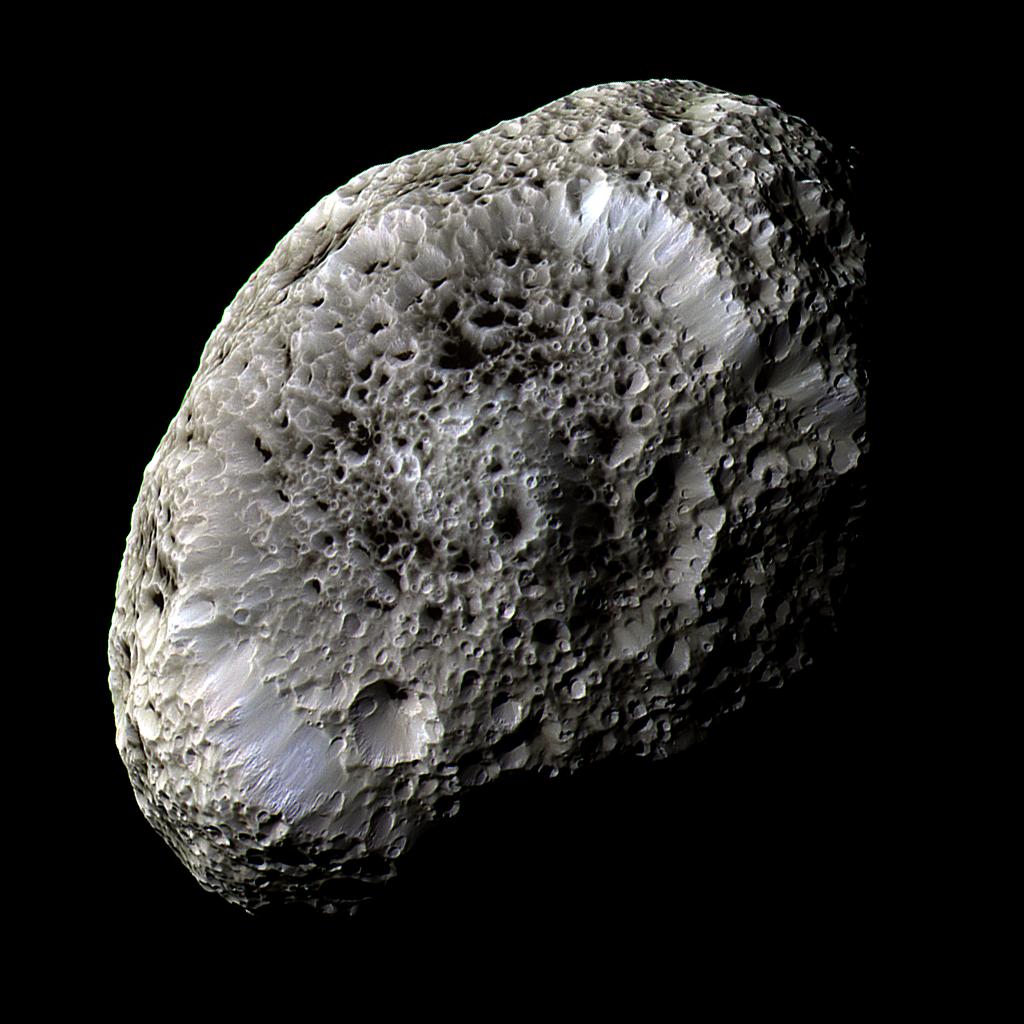
imipak writes "The Cassini Saturn probe has captured the previously unseen northern polar region of Saturn's moon Hyperion. Its weirdly eroded surface looks like nothing else in the solar system seen so far, demonstrating once again that when it comes to planetary exploration, "expect the unexpected" is more than just glib advice from the Hitch-hiker's Guide!" -
Cassini Returns Photos of Hyperion
imipak writes "The Cassini Saturn probe has captured the previously unseen northern polar region of Saturn's moon Hyperion. Its weirdly eroded surface looks like nothing else in the solar system seen so far, demonstrating once again that when it comes to planetary exploration, "expect the unexpected" is more than just glib advice from the Hitch-hiker's Guide!" -
NASA Admin Says Shuttle and ISS are Mistakes
Teancum writes "NASA Administrator Michael Griffin was recently interviewed by the USA Today Editorial Board regarding the current direction of the U.S. Space Program, and in the interview he suggested that the past three decades have been a huge mistake and a waste of resources. As a total cost for both programs that has exceeded $250 Billion, you have to wonder what other useful things could have been developed using the same resources. Griffin quoted in the interview regarding if the shuttle had been a mistake "My opinion is that it was... It was a design which was extremely aggressive and just barely possible." Regarding the ISS: "Had the decision been mine, we would not have built the space station we're building in the orbit we're building it in."" -
Mars Orbiter Sees Changes
pin_gween writes "The long-lived Mars Global Surveyor (8 yrs and flying) has enabled scientists to see changes in the surface of Mars. From the article: 'New gullies that did not exist in mid-2002 have appeared on a Martian sand dune. New impact craters formed since the 1970s suggest changes to age-estimating models. And for three Mars summers in a row, deposits of frozen carbon dioxide near Mars' south pole have shrunk from the previous year's size, suggesting a climate change in progress.' The probe's primary mission ended in 2001 and scientists are hopeful the orbiter's life can be extended for another 5 -10 years." -
Next NASA Centennial Challenge Competition
Andrew-Unit writes "NASA today announced the next competition in the Centennial Challenge series. A prize of $250,000 USD will be awarded to the team that can autonomously deliver the most lunar regolith to a collection device in 30 minutes. From the press release: 'This challenge continues NASA's efforts to broaden interest in innovative concepts ... We hope to see teams from a broad spectrum of technical areas take part in this competition,'" -
The Return of Saturn's Spokes
CheshireCatCO writes "After more than a year in orbit around Saturn, the Cassini spacecraft has finally spotted 'spokes' in the rings. Spokes, large radial structures in the rings, where seen by the Voyager spacecraft and have remained difficult to fully explain. The reappearce of the spokes comes about two years earlier than many models predicted." -
Furthest Gamma-Ray Burst Ever Observed
jd writes "The SWIFT team have announced the furthest-ever observed super-massive gamma-ray burst (from 13 billion light years away). The burst was observed on the 6th of September and lasted for 3 minutes - long enough for a number of other telescopes to home in on the gigantic explosion. The distance is only barely within the reaches of the observable universe. The idea of the SWIFT telescope and follow-up observations is that they will discover both the cause of the bursts and the consequences to the star." -
SALT Telescope First Light
carnun writes "On the 1st of September, 5 years after ground breaking, the SALT Telescope released their first light images to the public. Yesterday one of these images was even displayed on NASA's Astronomy Picture of the Day website. The Southern African Large Telescope, built in South Africa, is the largest telescope in the Southern Hemisphere and (depending on how you define it) the equal largest telescope in the world, but built at a budget of only $30 million, about a tenth cheaper than its nearest competitor. The official opening of the telescope is scheduled for the 10th of November, but scientific observations are already a regular occurence. (Disclaimer: I'm the software engineer responsible for the main telescope server.)" Perhaps as an added bonus carnun could even be persuaded to participate heavily in the discussion. Either way, sounds like a cool project to be a part of. -
The View from the Top of Husband Hill
chriscrick writes "After 14 months of climbing, the Mars rover Spirit has reached the summit of Husband Hill, 269 feet above the edge of the Martian plain. The panoramic view from the top is spectacular. According to lead scientist Steve Squyres, 'What field geologists typically do - and Spirit is a robotic field geologist - is you climb to the top of the nearest hill and take a look around so you get the lay of the land and figure out where you want to go.'" -
The View from the Top of Husband Hill
chriscrick writes "After 14 months of climbing, the Mars rover Spirit has reached the summit of Husband Hill, 269 feet above the edge of the Martian plain. The panoramic view from the top is spectacular. According to lead scientist Steve Squyres, 'What field geologists typically do - and Spirit is a robotic field geologist - is you climb to the top of the nearest hill and take a look around so you get the lay of the land and figure out where you want to go.'" -
Fly To Mars In A Plastic Ship
saskboy writes "NASA reports that an old polymer may be the spaceship material of the future. Polyethylene is in household garbage bags, and it is also an effective solar radiation shield. I learned three years ago in astronomy class that polyethylene is used in the sleeping quarters on current orbiting space vehicles, but now NASA has developed a way to toughen the polymer into a product they call RXF1 which is 'even stronger and lighter than aluminum'. As you may know, radiation in space is currently a major obstacle to manned missions outside of the Earth's magnetic field, so better radiation shielding is essential to planned manned missions to Mars and beyond. Get the mp3 podcast of the article here." -
Fly To Mars In A Plastic Ship
saskboy writes "NASA reports that an old polymer may be the spaceship material of the future. Polyethylene is in household garbage bags, and it is also an effective solar radiation shield. I learned three years ago in astronomy class that polyethylene is used in the sleeping quarters on current orbiting space vehicles, but now NASA has developed a way to toughen the polymer into a product they call RXF1 which is 'even stronger and lighter than aluminum'. As you may know, radiation in space is currently a major obstacle to manned missions outside of the Earth's magnetic field, so better radiation shielding is essential to planned manned missions to Mars and beyond. Get the mp3 podcast of the article here." -
X-15 Pilots Finally Get Astronaut Wings
Ginnungagap42 writes "NASA has a story about pilots Bill Dana, John McKay and Joe Walker finally receiving their astronauts wings for their work in the X-15 program back in the 1960's. Astronauts wings were awarded to the USAF personnel in the 1960's, but not to the civilian NASA pilots until now. The X-15 program was an important testbed for hypersonic flight. It's nice that all the pilots who flew high and fast are finally being recognized." -
Animated View from the Mars Rover
An anonymous reader writes "The Mars Spirit rover is within sight of the summit of Husband Hill, and it's looking out onto a vast plain where it caught sight of dust devils that are presented in a new animation of stills. Meanwhile, on NASA's site is a cool new panorama of 'Rub al Khali' taken by Opportunity." The science of the dust devils was covered previously on Slashdot.