Slashdot Mirror
Domain: nasa.gov
Stories and comments across the archive that link to nasa.gov.
Comments · 16,365
-
Might be hypernova
This promises to be one of the brightest supernova in a long time. I hope they point the hubble torwards it.
There is an excellent site that will track the progress of this supernova here
Space.com has an article about hypernova here. More detail about hypernova mechanics are here and here
If they can catch a Gamma-Ray Burst with this object, then this will be a pretty big deal. -
Re:When did it happen?
-
Re:Dams *have* changed length of earth's days
Any theories on the cause...
I vote for global warming. Since El Niño measurably slowed the earth's rotation, other wholesale redistributions of the Earth's airmass should have pronounced effects.
-
Re:Meet George Jetson!
-
Re:I wonder if trips to space would be cheep?
Gravity has nothing to do with the speed of rotation. Its not intuitive, and its putting my physics circuits into overload
-
Re:Sorry AlabamaI'm pretty close to MCC-- and I'm definately not in Alabama!
Huntsville, AL is the center of activity for the ISS. Excerpt from the site:
The Payload Operations Center at Marshall Space Flight Center is the world's primary science command post for the International Space Station...
-
Re:Ceramic Magnets at RadioShack?
I don't have a Master's Degree in ceramics engineering, but I do have google and according to this site Lodestones are composed of Iron ore which would make them metallic.
-
Re:Here's an interesting thing
Or for someone who posted an inflammatory remark about Sean O'Keefe on slashdot...
neh -
Re:Billions and billions...
I too have recently started reading about space, and one of the nicest sites i've come across is Ask the space scientist at NASA. Lots of very interesting questions asked and answered(well) about every aspect of space you can think of.
-
Re:Welcome to FDPR
There is one thing wrong with this process; rebuild. The latest generation of Java dynamic compilation/optimization does its work behind the scenes and happens automatically which I think is a huge advantage over FDPR. It allows the optimizer to adapt to unforseen changes in the production environment.
Of course, in general, one should optimize for the normal case; i.e. forseen conditions. I would imagine that in most cases an optimization for a normal case would be a pessimization for unforseen cases and vica versa. In other words, optimizing execution for unusual cases would tend to slow down the usual case(s). Also, I don't think that there is anything built into the C/C++ standards that would disallow dynamic feedback from the runtime environment. For example, malloc/::operator new could very well track runtime memory characteristics in its implementation.
However, C/C++ probably do not have many implementations like this because, in practice, the performance of C/C++ programs has not needed this kind of improvement. Java, on the other hand, is new to the game and has certain language features (required array bounds checking) that trade performance for run-time safety which force it to find other ways to get performance improvements. Pure conjecture on my part, though.
Anyway, I continue to think that any/most of the good stuff in Java has been in Lisp for ages and that Lisp tends to do it better, including performance.
-
Correction to my prior post, and a picture
I should have read more carefully - the BBC article *does* incorrectly claim this as a first: "Evident in the map, and seen directly for the first time, is the cigar-shaped bar..."
My apologies to the submitter of this story.
Also, I have checked and found it was COBE (cosmic background explorer) not IRAS that made my poster. Here it is. Notice how this too reveals the squarish, thicker towards the edges shape of the bulge indicating a bar seen obliquely. -
Re:You just know...
It's down: and no one is saying "ow ow ow ow ow my head hurts" so I guess that it all burnt up or unburnt bits didn't hit anything important. Now to check Ebay to see if I can get some Genuine Melted Satellite Gunk at an exorbitant price...
-
Re:And we're going there why?
-
Re:And we're going there why?
-
Re:It would be coolActually, there is some pretty positive development in this area. I was just reading some interesting information regarding advanced space telescopes that may one day be placed in an orbit around the sun at the edge of our solar system. Check out this article
-
Re:VRML?
When has 3d environments *ever* been something useful on the web?
Well one example is the NASA ISS VRML page. If you've ever wanted to see what the station was like from all angles it can show you this. Sure it's not as good as games but it's the best you'll get with limited bandwidth. Does anybody have any better ideas or ways to send 3D models over the net?
-
Re: Warning.NASA's original press release was on the 16th Feb.
That would be a pretty neat trick on NASA's part, considering that 16 February won't happen until next month. Sorry; that's press release #02-16, from 29 January (the number does not correspond with a date), which makes it scarier to you than you thought.
Then again, I don't find it all that worrisome that NASA didn't inform the general public of this issue earlier. What would we have done with extra lead time on such a warning? I mean, besides panic unreasonably?
-
Re:Considering there are 7000 objects in orbit
Also note that due to the periodic mood of solar activity which causes an "expansion" of the atmosphere, more LEO bodies tend to get an early retirement. We're close to a peak now; it's an 11 year cycle and SkyLab went down earlier due to this. See it at Nasa
-
J-Track 3DWhile we're talking about tracking satellites,
NASA's got a cool little Java applet you can play with to see the satellites and their orbits.
It's a simulation based on posted data, I gather, rather than any kind of tracker, and I'm sure there are dozens of black satellites not listed, but it's still very neat. You can zoom in/out and around the earth, pick specific satellites from categories, changes the time speed, etc. There's also all the favourites such as the shuttle (when it's up), the ISS, Mir, Hubble, COBE, etc. You can also load a web page with more info about any given satellite, such as when it was launched, what it carries, and so on.
Enjoy!
-
Re:Warning.
Well this satalite has been planned to come down around the 31st of january since it was launched, according to this link about the project. It doesnt state if they intentionally left the menuvering devices off, or as happens on alot of satalites, somehow malfunctioned during it's life.
To those who are commenting about a self destruct sequence, think about what kind of trouble we would be in if someone hacked all the communication satalites up there... or the military sats. satalite communication equipment is quite easily obtained or built, and current sats employ security by obscurity. -
Warning.
I know there's not a whole lot we can do about it
NASA's original press release was on the 16th Feb.
Even that is a bit worrying. Did NASA only discover 11 days ago that their 3.5 tonne satellite was going to crash? It's not like they behave erratically, is it? -
Re:It doesn't *have* to go anywhere, really.A generic PEM fuel cell doesn't run backwards. I can't remember the technical reasons why, but I worked in a fuel cell lab, and the stuff we were working on didn't have the potential to run backwards. There are different designs that do have this ability (called "regenerative fuel cells"), but I think the catalyst is different, making it less optimal for the regular forward use. Also, very important issues in fuel cells are the humidification of hydrogen and the flow distribution to the PEM, both of which are optimized for one direction or the other. Most work so far has been on fuel cell power generation, not fuel cell hydrogen generation. All the hydrogen right now comes from electrolysis of water or hydrocarbon sources.
One application where the fuel cell will have to run both ways is the Helios Project, where they want to fly a solar plane for 96 hours at above 50,000 feet.
-
Moons
Depends, are kids just a subset of adults?
Some moons are fairly boring chunks of rock (like, say, The Moon), others tell a story of an extremely violent past (like, they've been blasted to bits and only just managed to stay as one entity, like Miranda).
Others have thick atmospheres containing weird-ass chemicals (like Titan), others have vulcanism driven by processes we barely understand (like Triton, or Io)
Some may have oceans, others are small chunks of rock we would barely notice if they weren't orbiting some other body (like Phobos).
The planets may be more interesting in some respects, but there are a lot more moons to look at
-
Re:Hm...
Not just planets, but some moons too.
Some moons are extremely interesting:
- Europa and Callisto may have oceans, thus making them the most likely places that we will find extra-terrestrial life
- Titan has a nitrogen-rich atmosphere that is so thick that astronomers have not yet been able to see the surface.
- The Moon - as has been mentioned before on Slashdot, the Moon may have water at its south pole. It is important to confirm this initial observation. If water does exist there, it could be mined and used as fuel, thus acting as an inter-planetary refuelling point.
-
Hm...
Not just planets, but some moons too.
-
Re:Their deaths saved thousands more - and still d
Here is a quick link to one of NASA's sites that talks about some of their product spinoffs. Not a lot of details, but interesting.
-
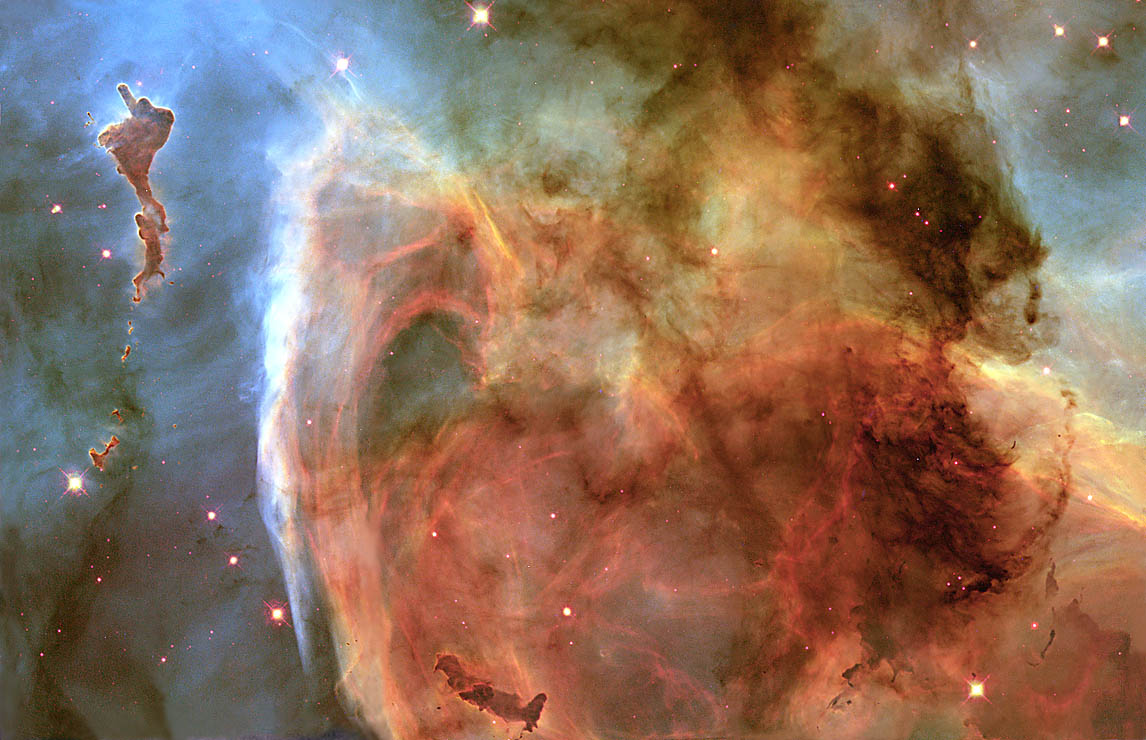
Carina Nebula
Not sure if this is what you are talking about, but this looks like a "flipping finger."
-
Re:Hi-res
-
Re:European Southern Observatory
close... it's actually at http://www.eso.org/outreach/press-rel/pr-2002/pho
t -02-02.html (no space in the uri). it sure does make for a good background at those higher resolutions though...as do a large archive that page points to: an "Astronomy Picture of the Day" -
Re:C/C++ for sure
How did NR ever lead you to believe that numerical programs can be cleanly written in C? The C code in Numerical Recipes is terrible. The authors basically transplanted their Fortran code directly to C, resulting in unreadable programs. They ignore C conventions, for example by using Fortan-style arrays based at 1 instead C's 0-based arrays. Variable names are most often uninformative, at most two letters. Furthermore their algorithms often implement special rather than general cases of the problems they seek to solve. Finally, while the prose can enlightening, it's been questioned whether the authors are even qualified to write such a book. But don't take my word for it, read NASA/JPL's page `Why not use Numerical Recipes,' which begins with the statement, ``We have found Numerical Recipes to be generally unreliable.''
On the topic of OpenGL, your logic doesn't follow. The mathematical content of the 3D graphics routines is implemented within the OpenGL library (not so much the game itself), and these routines are implemented in C, assembly, and hardware, not because these media provide for the most eloquent expression of mathematics, but because they provide for the fastest implementation, and speed is of primary importance in 3D graphics.
You are right that C++ has some interesting applications in mathematics. See for example Yet Another Computer Algebra System. -
Don't blindly trust NR
Most experts in the field of numerical analysis have a low opinion of Numerical Recipies. Check out this page.
-
Mars Rocks
Most people writing in reply to this news are pooh poohing the idea that a few rocks may hold any importance. Take a look at this story and it may jog your memory that it was in martian meteorites that there came the first good evidence for life on another planet. There are also theories that it was from Mars that life on our planet was 'seeded'. Without Martian meteorites there may have been no life on earth, and you know what that means? That's right, no Internet. So next time you laugh at a few rocks, remember how important studying this type of stuff really is.
-
Re: Waaay-Offtopic, but I must correct youActually, you don't have to go to Arctic Canada to find north-south flowing rivers in Canada. If you want to consider north flowing rivers as ones that drain into the Arctic, you just have to be north of the "height of land" divide (the n-s equivalent of the e-w continental divide).
In fact this site has a good explanation. I'll quote a small bit here:
Surprisingly, four of the world's ten longest rivers flow generally in a northern direction. The Nile in Africa, the Ob-Irtysh and the Lena in Eurasia and the Mackenzie-Peace in North America.
Cheers! -
Many rivers run south to north
For example, there's the Willamette (a major river, incidentally one of only a handful in the world that run south to north)...
Actually, that's a commonly-held misconception. Many rivers flow from south to north.
Excerpts from http://www.gsfc.nasa.gov/gsfc/educ/science/1997/02 -17-97.htm:
"An argument can be made that there could be more north-flowing rivers than there are rivers flowing in other directions..."
"So, there are indeed big rivers that flow to the north, as well as to the east, west and south. Why is it then that we think that few rivers flow to the north? Part of the answer is probably related to our geographic chauvinism and our lack of curiosity - we don't know much or care about distant places. In the contiguous U.S., since there are no major rivers that flow northward, we're convinced that this must be the way it is elsewhere. In Europe, where rivers such as the Rhine flow north from the Alps through densely populated areas of Germany, France and the Netherlands and then to the North Sea, the question of whether or not there are many north flowing rivers would be less likely to arise.
"Perhaps a more important reason that it seems that few rivers flow towards the north is our that experience in everyday encounters tells us that things move from up to down and from top to bottom. It just feels right that things should also move from north to south, like the Mississippi, and not the other way around. Maybe this is because we're used to looking at maps in two-dimensional projections." -
Re:Validity of meteorites.. from Mars?Apparently in the distant past, there was at least one impact event on Mars that was large enough to have thrown a good amount of Martian material into solar orbit. The Earth has sweep this material up over the ions and some of the pieces have survived entry into the Earth's atmosphere.
A good bet for the impact location on Mars is the Hellas Basin region. Because this is a low area on the surface of Mars, it is often covered with frost and can be pretty easy to see with a telescope at certain times.
If you look at a globe of Mars, it is interesting to realize that the massive volcanos of the Tharsis region is directly on the other side of the planet. In the image above, Hellas is the big crater to the lower right, Tharsis is left of center - look for four big "mountains."
A nice map as you see Mars in a telescope with markings labeled is here
And my drawings of Mars.
These rocks have a chemical make up that is completely different then any other meteorites found on Earth. Chemical studies of Martian soil done by the Viking spacecraft in the 1970's comfirmed that these rocks come from Mars.
There are lunar meteorites also.
-
Re:Validity of meteorites.. from Mars?Apparently in the distant past, there was at least one impact event on Mars that was large enough to have thrown a good amount of Martian material into solar orbit. The Earth has sweep this material up over the ions and some of the pieces have survived entry into the Earth's atmosphere.
A good bet for the impact location on Mars is the Hellas Basin region. Because this is a low area on the surface of Mars, it is often covered with frost and can be pretty easy to see with a telescope at certain times.
If you look at a globe of Mars, it is interesting to realize that the massive volcanos of the Tharsis region is directly on the other side of the planet. In the image above, Hellas is the big crater to the lower right, Tharsis is left of center - look for four big "mountains."
A nice map as you see Mars in a telescope with markings labeled is here
And my drawings of Mars.
These rocks have a chemical make up that is completely different then any other meteorites found on Earth. Chemical studies of Martian soil done by the Viking spacecraft in the 1970's comfirmed that these rocks come from Mars.
There are lunar meteorites also.
-
NASA and Biomorphic Systems.....
Here, this is a much better link with information on the entire system in which the microflyers would be used and how they would communicate. Evidently the microflyers are a portion of the proposed mission, other little robots and such would join in for a land/air/etc/etc type team.
-
Re:More wierd stuff...
Actually, going by entropic laws, it would seem that the Universe is better described in say, 700 constants, than say, 6 constants.
But the reason these constants _are_ of prime importance is because as a solution to certain tensor calculus equations in relativity, and these constants have been observed to be unattainable, but have been observed. Ofcourse, it is entirely possible like how we once thought that the speed of sound could not be exceeded, we may still be wrong about the speed of light and absolute zero, but that is a remote possibility because no particle in the world has been observed to have c nor have absolute zero (now don't get me started on photons.... as I read somewhere, your guess is as good as mine on what they are).
Good point. But you are forgetting one important point - there has been _some_ evidence showcasing possible black hole like behaviour, which cannot be explained by gravistar theory, atleast not yet. Example - Event horizon, dense areas which are surrounded by matter with an invisible core, and so on. In fact, Chandra has observed the existence of an Event Horizon in M82.
If you have done any amount of tensor calculus & quantum physics related mathematics (which I'm assuming you have), you'll know that Black Holes can be described with considerable ease in a Riemann plane, than gravistars.
Think of the implications these guys are suggesting --
1. You have submanifolds which would overlap as more matter gets in, and so the relativistic frame would in itself be a function carrying many frames. Assuming a standard rate of expansion for each of these frames, you can imagine the number of frames which would be in existence by now.
2. The gravitational effects caused by a tending mass are described in general relativity. These use a mere 16 coupled hyperbolic-elliptic nonlinear partial differential equations, called the Einstein field equations. Now, you have a solution for these called Bertotti-Robinson Solution, and when these are applied to a Black Hole, they work out just fine. This, despite assuming a uniform magnetic field.
However, you will realise owing to the submanifolds, you may not be able to apply the same to a gravistar. It'd be way too complex. And Bertotti-Robinson have been proved
3. Despite what the say about the Schwarzschild Black Hole, the exterior solution for such a black holes _has_ been proved, and it conforms to the field equations proposed by Einstein.
Now these are independent results to the same set of equations. I think I'd rather trust Einstein than these guys
Anyways, it would be interesting to watch how this would get on. I'm not against this theory, just that there _seem to be_ far too many unanswered questions. -
Re:Amaltheathe nasa press release doesn't say anything about the cameras being turned off:
This week, Galileo will make direct measurements of the charged particles and magnetic environment around Io. Also, its camera and instruments for infrared and thermal imaging have been programmed to make observations during the flyby. As much of the data as possible will be transmitted to Earth from the spacecraft's tape recorder in coming months, Theilig said.
and the only mention of Amalthea is this:Before its final plunge, Galileo will make the first close flyby of Amalthea, a small, inner moon of Jupiter, in November 2002.
hmm. well, there's more data on Amalthea here, for those interested. -
Re:Amaltheathe nasa press release doesn't say anything about the cameras being turned off:
This week, Galileo will make direct measurements of the charged particles and magnetic environment around Io. Also, its camera and instruments for infrared and thermal imaging have been programmed to make observations during the flyby. As much of the data as possible will be transmitted to Earth from the spacecraft's tape recorder in coming months, Theilig said.
and the only mention of Amalthea is this:Before its final plunge, Galileo will make the first close flyby of Amalthea, a small, inner moon of Jupiter, in November 2002.
hmm. well, there's more data on Amalthea here, for those interested. -
As a matter of fact...
And pieces of the moon never land on earth do they?
Not unsullied by re-entry heat they don't. And certainly not in the form of cylindrical core samples including compressed surface dust.
Instead of making a fool out of yourself on slashdot, why don't you pick up an introductory geology textbook and do a little basic reading on a subject you seem to be simultaneously fascinated with and yet completely ignorant of. -
As a matter of fact...
And pieces of the moon never land on earth do they?
Not unsullied by re-entry heat they don't. And certainly not in the form of cylindrical core samples including compressed surface dust.
Instead of making a fool out of yourself on slashdot, why don't you pick up an introductory geology textbook and do a little basic reading on a subject you seem to be simultaneously fascinated with and yet completely ignorant of. -
Speaking of fucking with people.
I don't know about you, but when I think "car", I usually imagine something a bit more substantial than a 5hp electric motor strapped to a couple of aluminum bars and wiremesh wheels.
Even in full earth gravity, two or three average men can usually pick up and move a golf cart, and the moon buggy was substantially smaller and lighter than the average golf cart: it weighed all of 80 pounds.
Just what you need for, er, something or other.
The final three Apollo missions were largely devoted to geological surveys and sample-taking. The moon buggy was used to transport the astronauts to craters they would not have been able to reach on foot in order to fulfill those goals.
Ironically, it's those very rock samples that the lunar rover was used to help collect that provide the "hardest" (har har) evidence that the moon landings really happened and that you're a shit-spewing troll, as hundreds of independent geologists have examined the samples, and not one of them has claimed that they were from anywhere other than the moon. -
We're worried about Europa, what about Titan?So I keep reading about bacteria and other Earthly lifeforms in space, and then I hear about how horrible it would be accidently infect Europa, but I have yet to hear anyone even mention what has been done to Cassini's drop-craft into Titan's atmosphere, reputed to be very similar to Earth's primordial atmosphere, to prevent accidental exposure.
what gives?
-
Re:NASA Is A Murderer...This is Not A Troll
-
Re:NASA Is A Murderer...This is Not A Troll
-
Re:NASA Is A Murderer...This is Not A Troll
-
Re:NASA Is A Murderer...This is Not A Troll
-
Re:If we find life on Europa
Did you ever stop to think about how much radiation actually reaches Jupiter from other sources? If Galileo were to explode over earth, it's RTG (Radioisotope Thermoelectric Generators) would have a negligible effect. Worse case scenario on Earth: Galileo explodes in Earths atmosphere. The RTGs break up into particulate form (the RTGs are designed using ceramics fused with the nuclear P-238). Everyone's nuclear exposure is raised by something like
-
Galileo discovers intelligent life on Earth...
According to the details on the NASA site, one of the cruise highlights was the "Discovery of intelligent life" on Earth. Any ideas where they looked exactly?