Slashdot Mirror
Domain: nasa.gov
Stories and comments across the archive that link to nasa.gov.
Comments · 16,365
-
Can't be Curiosity debris
How much magnesium/manganeese is in the metal the skycrane/parachute that delivered curiousity to mars
Doesn't matter, because the Curiosity rover, and the Opportunity rover that discovered this object, are on opposite sides of the planet. http://en.wikipedia.org/wiki/Mars_rover#Image_map_of_Mars_landings
Also, Opportunity has traveled 24 miles from its landing site. http://marsrover.nasa.gov/mission/status_opportunityAll.html
-
NASA says Mars' wind can't move rocks
The wind on Mars is not "strong" enough to move rocks on the surface. Even though winds on Mars can probably reach large speeds, the atmospheric density is so low, that the force the wind can impose on a rock is quite small. For instance, a wind of 10 meters per second (about 20 miles per hour) here on Earth produces a force which is four times stronger than does a 50 meter per second wind (a bit more than 100 miles per hour) on the surface of Mars. So, since a 20 mile per hour wind here on Earth does not generally move rocks about on the surface (though it does raise dust), the winds on Mars don't move rocks on the surface either.
Jim Murphy
Mars Pathfinder ASI/MET Science TeamSource: http://quest.arc.nasa.gov/mars/ask/atmosphere/Feel_of_Wind_on_Mars.txt
-
Re:Which shows that people don't understand
It does. End of story.
Oh, you wanted a document? What about doing your own research, you lazy slacker?
http://nsidc.org/cryosphere/glaciers/questions/climate.html
http://climate.nasa.gov/evidence
http://www.geosociety.org/positions/position10.htm
(etc.. etc...)And you are conflaing two things: the aquifer situation is the western United States, which is very preoccupying, to say the least, and global warming, which is definitely not going to improve the situation of said aquifers.
-
Re:An ode to wankery
Don't know about 0.01%
But NASA claims 3% deny climate change: http://climate.nasa.gov/scientific-consensus
Remember that "scientists" are also mostly non-experts. Just non-experts with a higher average IQ. -
Cloud & Cosmic Ray connection
I would like to point out a theory where a solar lull also results in lower global temperatures -- in a way that may be complementary with the UV-centric approach taken in TA... Svensmark's theories on cosmic rays and their effect on cloud formation. See this documentary Svensmark: The Cloud Mystery. Radiation-seeded cloud formation was first observed by Charles Thomson Rees Wilson in 1896. In BBC: Connections, Death In The Morning (index to 38:15) James Burke describes the events that led to WIlson's great invention, the cloud chamber. I highly recommend the entire Connections series, especially the original first season which begins with "The Trigger Effect".
On clouds... another Good Watch is the BBC documentary on the phenomenon of Global Dimming, especially its opening minutes where David Travis of the University of Wisconsin measured a 1 degree C change in temperature ranges in the days following 9/11, when all aircraft in the US were grounded. This (shocking!) correlation, that could only be ascribed to a particular human activity -- a lack of contrail cloud seeding -- reminds us that our contribution to climate might far exceed pure-chemical CO2 causation.
On clouds... while researching contrails years ago I had a true what-the-fuck moment to see that NASA had also noticed significant human triggered cirrus cloud formation but managed to leverage the presence of cirrus (Minnis et. al) into a net warming effect. This has led to extraordinary ideas like enlarging ice crystal size in cirrus by seeding to 'reduce' this 'warming' effect. I am old school and any claim that increased clouds (of any kind) are net-warming and not net-cooling is an extraordinary claim and should be confirmed by an extraordinary level of proof, not just computer energy-budget models of incoming versus outgoing long-wave radiation. And I'm glad to see that the cirrus net effect is not yet decided by everyone.
On survival during the coming solar minimum... those jolly old River Thames Frost Fairs look like a a real tonne of funne, but faced with the likelihood of global cooling it behooves us to fast-track the development of Thorium based energy. Because MSR/Thorium is the answer for both Global Warming and Global Cooling. I am generally behooved these days.
Also... the timely development of molten salt reactors and supplying the globe with cheaper grid-energy would improve the human race. It would help to offset the effect of driving on women's pelvises by relief from washing clothes by hand.
___
Obligatory bump to the Thorium Alliance and my own letters on energy,
To The Honorable James M. Inhofe, United States Senate
To whom it may concern, Halliburton Corporate -
Amazing Picture from Rosetta of Asteroid Lutetia
http://www.nasa.gov/images/content/468180main_2_Lutetia_and_Saturn_946-710.jpg
With Saturn hanging in the background. Stunning. It's worth it already!
-
quiter than expected but not quiet
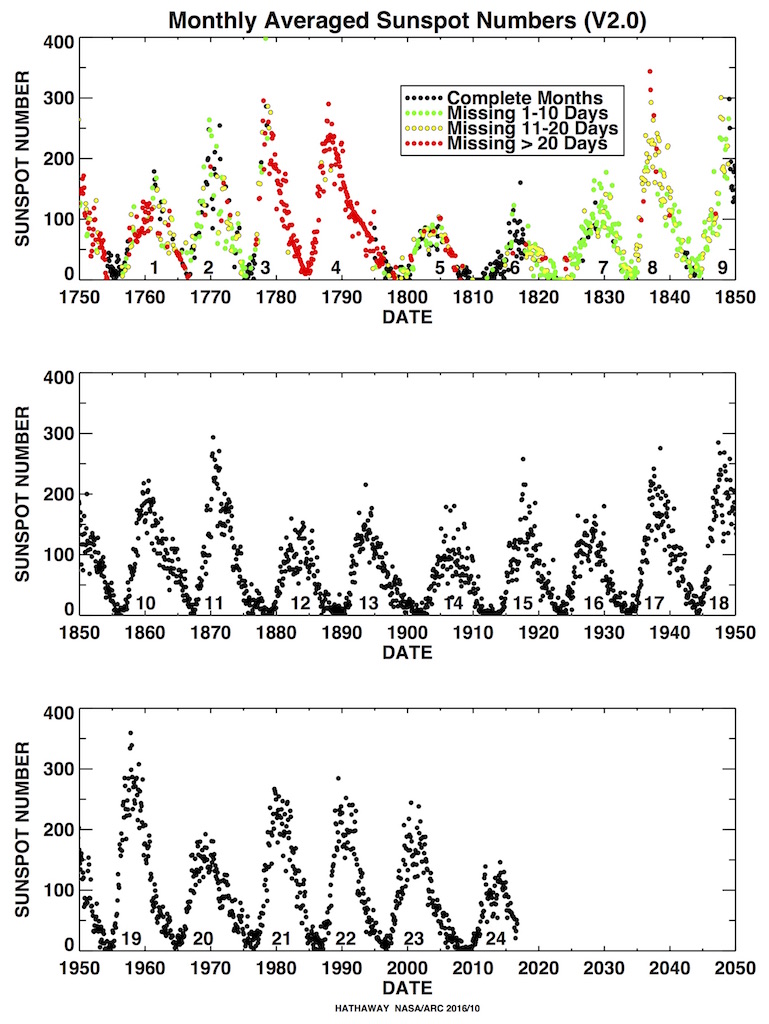
I don't get this summary (or TFA, for that matter). They're saying the sun is too quiet and this could explain the recent cold spell. The sun may have fewer sunspots than expected for this time in the cycle, but it still has more spots than it did during the last minimum: http://solarscience.msfc.nasa.gov/images/Zurich_Color_Small.jpg Certainly we're nowhere near something that looks like the Maunder Minimum (http://en.wikipedia.org/wiki/Maunder_Minimum).
-
Re:Maunder Minimum
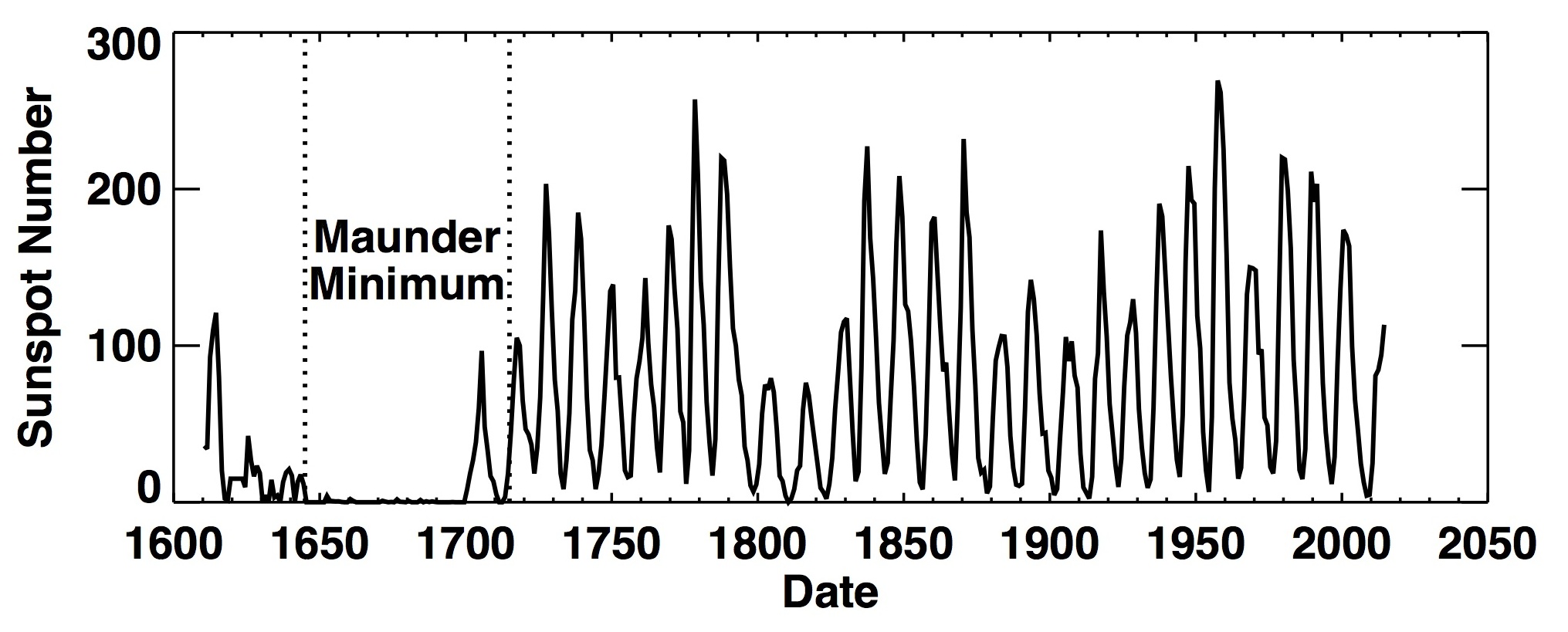
The Maunder Minimum is the degree of deviation from the white line allowed before the trooper cites you for being drunk.
I understand you are trying to make light of the subject at hand, but anyway, please refer to the below graph for the real Maunder Minimum as refer to the extraordinarily quietness of the Sun, as had happened back in the 17th century -
-
Re:Not the sun
On the other hand the "alarmist" logic is: "we already know the cause of the warming, it is humans saturating the atmosphere with too much CO2, we just need to gather and/or create the evidence to support this theory". That's called inductive logic, and is just as unscientific as what you describe coming from the "denialists".
You seem to be creating a strawman for the express purpose of knocking it down.
These "alarmist" scientists are the same type who told us that CFCs were creating a hole in the ozone layer.
We went to great lengths to eliminate CFCs, then lo and behold, the ozone layer fixed itself."Real" science comes from gathering evidence and basing your theories on the evidence gathered. You then determine what it might take to falsify your theory and try as hard as possible to falsify it.
Holy shit! Just like what happened with the ozone layer!
The Ozone Hole Alarmists were right!All I see from the "alarmist" camp is people trying to support their theories at all costs, calling things causation where there is barely correlation, and making very little if any effort to falsify their theories. This behavior is more akin to religion than any sort of science.
Then you haven't looked very hard.
The weight of "Real" science is behind the "alarmists" and not at all behind the "denialists". -
Re:Not the sun
How is that unscientific? Warming caused by excess CO2 in the atmosphere was predicted long before it was ever observed. Isn't that the scientific method, coming up with a hypothesis that makes predictions, then testing the predictions against observations? If we had not observed the warming, you'd have a point, but we've seen not only warming, but also melting ice and sea level rise.
-
Maunder Minimum
Just a link to add for the " Mauder Minimum " that was mentioned in TFA -
http://solarscience.msfc.nasa.gov/SunspotCycle.shtml
Hope this helps !
-
Re:Killed because of the message
This first graph seems to point pretty clearly to a cause.
-
Re:Killed because of the message
"hiding" the decline.
http://climate.nasa.gov/evidence
http://www.ncdc.noaa.gov/extremes/records/
Yet, we keep getting more low temps and even more high temps - more weather extremes - just as predicted.
-
Re:Anonymous Coward
That's because there's a LOT of fucking sea water.
http://climate.nasa.gov/evidence
"The oceans have absorbed much of this increased heat, with the top 700 meters (about 2,300 feet) of ocean showing warming of 0.302 degrees Fahrenheit since 1969."
-
Re:Localized Global Warming?
No, no it hasn't. That's a claim that's pretty well fabricated. oops, you believed and repeated a lie. Are you going to recant?
-
Re:Pshaw... it's just weather!
Had broken it every winter since 1971? Because in australia last year they had to add 2 colors to the temperature charts because how hot things were then, and this year things aren't so far from that, and if 2 years is not enough you have the previous 40 contiguous years where the same trend was there. Thats the difference between long standing climate trends and the weather in a particular season of a limited area. Is the forest the one that matters, not the tree you just stumbled upon. And if you can see the forest because you are not high enough, maybe you should check what the people that can see the whole forest say. The cold fact is that the world as a whole is getting hotter.
-
Re:Localized Global Warming?
How about a source for your temperature claim? I claim the opposite: Anthropogenic Global Warming is occurring. Here's two sources:
http://data.giss.nasa.gov/gistemp/graphs_v3/
http://climatechange.procon.org/view.resource.php?resourceID=003800 -
Re:PHB's strike again
The Columbia crew were dead men walking the moment the foam damaged the tiles. Columba was a wreck the moment the foam caused the damage. She would never reach earth's surface whole once she entered space.
This claim was solidly refuted in the official accident investigation report, which explores parallel scenarios--one for rescue, and another for improvised repair while on orbit.
The report is a fascinating read, by the way, and highly recommended. It manages to be satisfyingly technical without going over the head of a typical engineer or even lay person.
-
Re:They don't understand the difference
NASA says CO2 has been below this level for 650,000 years. Good enough for you?
http://climate.nasa.gov/evidence
This is the one that scares me the most.
"The oceans have absorbed much of this increased heat, with the top 700 meters (about 2,300 feet) of ocean showing warming of 0.302 degrees Fahrenheit since 1969."That's a lot of freaking water heated.
-
Re:Smog's wish
Wait, are you saying that articles are now disproving theories?
That's awesome.
Awesomely stupid.
In the mean time, the temperature is still going up.
http://data.giss.nasa.gov/gistemp/graphs_v3/
http://www.ncdc.noaa.gov/extremes/records/ -
Re:Sure
Wait, a week ago it was COLD! Holy shit global warming must be false!
Wait, that was only in few states, in just the United States?
That can't be true! IT WAS COLD!
Get some actual facts.
-
Re:Egocentrism
And while people do say all those things, none of them are the official position of a major political party in the U.S.
Link. Please go to section called Extreme Events.
Right, how silly of me. How could I forget about our three major political parties. The Democrats, the Republicans, and NASA.
-
Re:Egocentrism
Link. Please go to section called Extreme Events.
It claims that record high temperatures are proof of global warming, from the NASA climate site.
So, from the AGW people who keep using NASA as one of the authorities, they are saying EXATLY that.Once again, an idiot denier who doen't know anything has more knowlege of who said what than the people who claim they know everything.
-
Re:Stop calling it Global Warming
The problem is that is global warming. The global surface temperature (among other indicators) is rising. That brings more energy to the climate system, but that don't means that the effects of that power will mean in the short term only heat episodes, i.e. stronger winds that goes thru the pole will bring cold wind to warmer areas. We are not good visualizing big trends that happens over a year or five in our normal life, we see the day to day episodes, we think that weather==climate, and to make things worse, we always see the toast landing with the butter side down, easily dismissing the other cases.
The bottom line is that the global system is heathing up, that causes changes in the climate patterns, and that causes sometimes more powerful weather conditions (a complex system where small variations causes big changes, remember the butterfly effect). Don't see only the cold weather in US, at the same time been record hot weather in south america and australia, warm winters in north europe and big sea storms in portugal and france, and those too are isolated episodes, but at least is a way to point that the earth is not freezing because you felt cold in US last week.
-
Re:A field of Two
So, you're claiming that government developed and funded the 747 and 787?
The government invested and invests very heavily in the technology, including R&D, both through the military and NASA (and maybe via other agencies I'm not thinking of). For example, here is NASA's Aeronautics Research Mission Directorate.
Boeing is a leading beneficiary of these funds. Also, have Boeing and their competitors received tax breaks and other aid?
-
Cardboard works great
Corrugated cardboard has been used for decades under high-altitude scientific balloon payloads to absorb the impact of landing from a parachute descent. You don't have to put too many of them under several thousand pounds of experiment and gondola. Here is a (not so good) picture of one example. The cardboard provides a very nice low-gee impact.
-
not sure if privatization is a good thing.
theres been a recent boom in privatized space launches and exploration, and while im sure its a good thing for the economy I have my reservations. the START database is an excellent example:
https://standards.nasa.gov/
nasa publishes interesting scientific standards publically which helps further the study of space travel. It also provides a source of independent verification for different components and systems. Privatized space exploration is routinely under intense pressure to redact or restrict access to this information as it is of a "trade secret" nature. Im willing to bet most of the standards data Orbital and SpaceX rely upon and likely refuse to disclose are in fact based upon the START repository.
privatizing space travel and exploration is also in the disinterest of society as historically its natural progression is to increase quarterly revenue in the standard definition of a corporation. issues like environmental impacts then fall to the wayside as 'externalities' and, at worst we turn from sagans starry eyed space voyage to a wal-mart in the stars.
im old, so maybe im overreacting...but I sincerely believe there needs to be some system of independent audit and evaluation in place so that the spirit of space travel doesnt end up a thing of the past. -
Re:interesting
Oh, I also found some info about random non-galaxy stars that theoretically might be "picked up" by a galaxy.
http://starchild.gsfc.nasa.gov/docs/StarChild/questions/question29.html
http://www.astronomycafe.net/qadir/q2486.html -
Also, sign language for the deaf:
-
Re:Thanks Big O!
All the stuff could be done for a fraction of the cost with robotic probes in orbit.
[citation needed]
There is no all purpose robot that I am aware of that is flexible enough to be able to replace the general purpose abilities of a human. There is R&D cost involved in building these robots. It's not as simple as going down to "Space Robots 'R' Us" and charging it to your credit card. Mars Curiosity cost $2.5 billion.
The space shuttle (which was a terribly expensive program compared to what it should have been) ran from 1972 until 2011 at a total cost of $450 billion or a little over $11.5 billion per year, or with 135 missions it cost $3.3 billion per launch. Since the shuttle is no longer in operation, US astronauts cost $71 million per seat to go the the ISS, which is up from the $22 million per seat from back in 2006. So getting there is pretty damn cheap. It's hard to say how much the ISS cost overall, but at the current plans, it will cost $2.3 billion per year, including the $71 million cost per seat to get there. regardless the biggest expense has already taken care of, so it would be pretty damn stupid to abandon it now.
Unfortunately NASA is run by ex-pilots from Houston who think Star Trek was a documentary; they are forever poaching funds from JPL's planetary missions. This is why Carl Sagan and Bruce Murray started the Planetary Society; to stop the siphoning to the manned mission that were always busting their budgets. Now it is worse than ever.
We need both manned and unmanned programs.Eventually we will need to either develop near light-speed travel, spacial warping, etc. or know for sure that it's simply not possible. Either way, there is no reason to think we won't continue to make new discoveries and develop new technologies that will be useful to us in everyday life as we've seen from past manned space flight. There is a bunch of spinoff tech that has come from both the manned and unmanned programs.
Curiosity has just started its mission and has not yet reached its destination, but it already has found clays and proof of running streams on Mars. It has also dispelled the Mars Methane theory or severely constrained it. It has also done some important isotope studies that reflect climate change on Mars.
What destination? Mars? It didn't "just start" its mission. Curiosity was designed for a two year mission. It landed on Mars in August of 2012, so it has completed 17 months of it's original 24 month mission. However it was recently extended indefinitely. Every mission we send to Mars shows more evidence that supports there was once water on Mars surface. But I wasn't aware that Curiosity had single-handedly proven it beyond any doubt. A major part of its mission is also to determine "planetary habitability studies in preparation for future human exploration."
There a lot of other current and past robotic probes that have done far more sciences than manned missions ever will at a fraction of the cost and without killing astronauts. Voyager for instance. More recently, the Kepler probed has discovered a large number of planets orbiting other stars. But that is just a small sample.
They are different types of research. Obviously sending a person up to look through Hubble would be stupid. But discoveries like some of what Donald Pettit did, would not have happened with robots.It's interesting that you mention Kepler. Its mission it to find Earth like planets in habitable distances from their sun. Why do you think that is
-
Re:Thanks Big O!
All the stuff could be done for a fraction of the cost with robotic probes in orbit.
[citation needed]
There is no all purpose robot that I am aware of that is flexible enough to be able to replace the general purpose abilities of a human. There is R&D cost involved in building these robots. It's not as simple as going down to "Space Robots 'R' Us" and charging it to your credit card. Mars Curiosity cost $2.5 billion.
The space shuttle (which was a terribly expensive program compared to what it should have been) ran from 1972 until 2011 at a total cost of $450 billion or a little over $11.5 billion per year, or with 135 missions it cost $3.3 billion per launch. Since the shuttle is no longer in operation, US astronauts cost $71 million per seat to go the the ISS, which is up from the $22 million per seat from back in 2006. So getting there is pretty damn cheap. It's hard to say how much the ISS cost overall, but at the current plans, it will cost $2.3 billion per year, including the $71 million cost per seat to get there. regardless the biggest expense has already taken care of, so it would be pretty damn stupid to abandon it now.
Unfortunately NASA is run by ex-pilots from Houston who think Star Trek was a documentary; they are forever poaching funds from JPL's planetary missions. This is why Carl Sagan and Bruce Murray started the Planetary Society; to stop the siphoning to the manned mission that were always busting their budgets. Now it is worse than ever.
We need both manned and unmanned programs.Eventually we will need to either develop near light-speed travel, spacial warping, etc. or know for sure that it's simply not possible. Either way, there is no reason to think we won't continue to make new discoveries and develop new technologies that will be useful to us in everyday life as we've seen from past manned space flight. There is a bunch of spinoff tech that has come from both the manned and unmanned programs.
Curiosity has just started its mission and has not yet reached its destination, but it already has found clays and proof of running streams on Mars. It has also dispelled the Mars Methane theory or severely constrained it. It has also done some important isotope studies that reflect climate change on Mars.
What destination? Mars? It didn't "just start" its mission. Curiosity was designed for a two year mission. It landed on Mars in August of 2012, so it has completed 17 months of it's original 24 month mission. However it was recently extended indefinitely. Every mission we send to Mars shows more evidence that supports there was once water on Mars surface. But I wasn't aware that Curiosity had single-handedly proven it beyond any doubt. A major part of its mission is also to determine "planetary habitability studies in preparation for future human exploration."
There a lot of other current and past robotic probes that have done far more sciences than manned missions ever will at a fraction of the cost and without killing astronauts. Voyager for instance. More recently, the Kepler probed has discovered a large number of planets orbiting other stars. But that is just a small sample.
They are different types of research. Obviously sending a person up to look through Hubble would be stupid. But discoveries like some of what Donald Pettit did, would not have happened with robots.It's interesting that you mention Kepler. Its mission it to find Earth like planets in habitable distances from their sun. Why do you think that is
-
Re:For what purpose
Couldn't NASA list the experiments, what they are trying to find out and if they have been successful?
NASA does list the experiments. They are sorted in multiple directions too (by date, mission, researchers, and alphabetically). None the less, your point that media outlets don't really pay attention to this list is a good one and something that should be done to smack some of these journalists into reality.
Another really interesting company who is currently sending experiments up to the ISS is Nanoracks, a for-profit company partnering with NASA on the ISS who is willing to put literally anybody's experiment onto the ISS in a standard enclosure. Results can be either transmitted by telemetry or physically returned to the Earth after completion, exposed to the vacuum of LEO space or kept inside depending on your experimental variables. Thanks to some cooperation Nanoracks has even been able to offer 4 inch cubesats (aka about four inches on each side of the cube) that can be launched from the ISS. If you have some spare bucks, one company even allows you to operate your own satellite through a web browser. It only costs $1k per week where you can develop your own software to use the devices on that satellite. That is a price that a mere mortal like myself or even a college student could put together if they cared.... and that company is even interested in high school groups doing experiments in space.
None of this stuff I've mentioned would be possible without the ISS. Admittedly another space station could be built to do the same thing, but that would require simialr capital outlays to get such a station built in the first place. The ISS is currently open and doing this sort of thing, so it seems a shame to waste this opportunity. Companies like Nanoracks are not being subsidized at least for the astronaut's time and expendible supplies (that is part of the cost of sending those experiments to space), so I do think it would be a shame to destroy a perfectly good research lab now that it is built even if you may think it was far too expensive to build in the first place.
-
Re:Thanks Big O!
This is not real science; it is just pork for NASA/Houston. The real science in space is happening at NASA/JPL with their robotic missions such as Curiosity And the O'Admin is trying to kill off all the other planetary missions.
Yes. Curiosity has been playing in the dirt on Mars for two years now. Please do tell what ground breaking "real science" has been done.
Meanwhile the ISS has been used to grow protein crystals which have helped our understanding of Duchenne's muscular dystrophy. This type of research will be helpful for stroke prevention and cancer as well as treatment for emphysema and immune system disorders.
The Materials Science Lab is giving us insights into making better alloys here on earth. There are other experiments going on regarding fluid dynamics and research that helps us better understand superconductors, Additionally there are experiments that we hope will give us a better understanding of combustion to help with efficiencies here on earth.
Astronaut Donald Pettit is known for his own private experiments during his down time. I believe he used cracker crumbs to show how particles tend to clump in microgravity. Prior to this there was no definitive proof about how particles would behave in this environment.
Curiosity is doing some very cool stuff, but please don't' act like the robotics division of NASA is the only one doing "real science". Much of the work on the ISS will have a real impact on our life here on earth. While the various probes we send out will give us a better understanding of the universe around us. See the difference? They are complimentary, not competitive.
-
Re:Cue the climate change deniers ...
The last 9 years in a row have been the hottest on record, the other year over 13,000 cities around the world set record highs. Compared to estimated historic values, we are warming up about 20x faster than any other warm up in the past 1,500 years, and we are at a current high. http://earthobservatory.nasa.gov/Features/GlobalWarming/page3.php
Turns out once you include the deep ocean, the ocean is warming about 10x faster than our atmosphere. It will be interesting to see what happens once the ocean's average temp starts to approach that of our atmosphere.
We're not sure if we're the cause of current global warming, but warming it is. Is reducing waste such a bad thing that you'll say it's not worth it? What if you're wrong, then your mentality has doomed us, if we're wrong, meh, no harm done. -
Re:Global Warming
Here you go, try a little data.
-
Re: World ends at the northern minnesota border
Oh hey, you're right, actually a few people do seem to live up there.
-
Re:They are ridiculing you
The rest of us can look at how far off IPCC predictions are here.
Umm, you just showed us a graph that shows the opposite of your claim. It shows that the IPCC predictions are sometimes less than the actual warming and sometimes more as you would expect when comparing a straight line to climate data, and that the newer IPCC model's upslope has gotten much better in matching the actual temperature upslope over time.
Considering the year-to-year variability in surface global temperature, the 2007 IPCC predictions are not bad at all.
Here's some surface temp graphs to compare: http://data.giss.nasa.gov/gistemp/graphs_v3/ -
Take this with a grain of salt
I made an edit a while back in reference to the "4 billion year mark", because it was inaccurate, even via the cite it provides:
"Median point by which the Andromeda Galaxy will have collided with the Milky Way, which will thereafter merge to form a galaxy dubbed "Milkomeda".[46] The Solar System is expected to be relatively unaffected by this collision.[47] "
If you actually look at the citation (originally, the previous one had something to do with collisions of clouds and particles) at http://www.nasa.gov/mission_pages/hubble/science/milky-way-collide.html, it DOES NOT SAY that it will be "relatively unaffected". To Quote:
"Although the galaxies will plow into each other, stars inside each galaxy are so far apart that they will not collide with other stars during the encounter. However, the stars will be thrown into different orbits around the new galactic center. Simulations show that our solar system will probably be tossed much farther from the galactic core than it is today. To make matters more complicated, M31's small companion, the Triangulum galaxy, M33, will join in the collision and perhaps later merge with the M31/Milky Way pair. There is a small chance that M33 will hit the Milky Way first."
While the sum contents of mass *may* be the same within our solar system, everything will be jumbled pretty good to where it won't even kind of look the same.
Take this timeline with a grain of salt. It is pretty apparent the moderators do little in terms of verification -
Re:Germany
More importantly, when you as a nation have lost the ability to launch your own rockets, and you can only rent payload from communist states -
Take a look here and try to count how many of the little flags represent the United States.
As far as scientific missions...What about the Lunar Reconnaissance Orbiter and Mars Rovers? Don't they count?
-
Re:Space suits?Well, here you go, champ.
http://www.nasa.gov/about/career/index.html#.UsWFe7Ttd0Q
Tell us how it goes with your cocksure " there's all kinds of environmental protection provided by spacesuits that's not needed" during the interview. What is it with you Space Nutters and your juvenile Star Trek view of engineering and physics?
-
Re:Once Again
... We no longer invent. We no longer explore. We are content to sit on our wider and wider asses and make rude noises from the back of the class while our beloved government spends $600 million in a failed attempt to build a web site.
Well, and to also sit around comfortably while remotely exploring the next frontier into this decade thanks to the quality of our engineering.
-
Re:Once Again
... We no longer invent. We no longer explore. We are content to sit on our wider and wider asses and make rude noises from the back of the class while our beloved government spends $600 million in a failed attempt to build a web site.
Well, and to also sit around comfortably while remotely exploring the next frontier into this decade thanks to the quality of our engineering.
-
Re:And this is somehow supposed to be a surprise?we know this is a troll... one last feeding...
I'm guessing that you agree that we do have proven science, so your initial assertion that everything is hypothesis is wrong so you dropped that argument.
I said things start out as a hypothesis, and graduate to the status of Theory when they get enough supporting evidence. That's true. nothing to drop. don't know what you mean. My initial post pointed out there is a so-called "Law" (Newton's) that is over-ridden by a mere Theory (Einstein's) How could this happen if "Laws" are so much stronger than "Theories"? You didn't choose to deal with that. Newton's laws are presumably what you call "proven science." what do you do if it is proven wrong? Why does NASA demote Newton's Laws to mere Theories? http://www-spof.gsfc.nasa.gov/stargaze/Sgravity.htm ?
I have no idea why you then point to an OP-ED piece to describe "Theory" instead of using the definition we have in dictionaries and defined by a couple thousand years of science. Are you trying to redefine the word, or do you accept that a theory is not proven?
http://www.merriam-webster.com/dictionary/theory -
- 1 : the analysis of a set of facts in their relation to one another
- 2 : abstract thought : speculation
- 3 : the general or abstract principles of a body of fact, a science, or an art <music theory>
- 4 : a belief, policy, or procedure proposed or followed as the basis of action <her method is based on the theory that all children want to learn>
- 5 : an ideal or hypothetical set of fact
I take definitions 1, 3, 4, and 5 into account. You are oddly obsessed with meaning 2 to the exclusion of all others.
Until I have proof preaching my belief as better than theirs is foolish because nobody can win the argument.
If you will not accept any proof offerred, then it is unfalsifiable, and by definition, not science. If no-one can win an argument, that doesn't mean both sides are justified. It is possible that one side is simply unreasonable.
-
Re:Using 2,4Ghz in wireless network is not harmful
You want facts? Here are facts for you. I don't make any guarantees that you understand those facts.
http://missionscience.nasa.gov/ems/05_radiowaves.html
http://missionscience.nasa.gov/ems/01_intro.html
https://en.wikipedia.org/wiki/Radio_wave2412Mhz has the wave length of 124mm according to this calculator (http://www.onlineconversion.com/frequency_wavelength.htm). The size of human DNA molecule is far smaller then this. The wavelength of 2,4Ghz and 5Ghz is therefore too big to have any effect on DNA in living animals.
-
Re:Using 2,4Ghz in wireless network is not harmful
You want facts? Here are facts for you. I don't make any guarantees that you understand those facts.
http://missionscience.nasa.gov/ems/05_radiowaves.html
http://missionscience.nasa.gov/ems/01_intro.html
https://en.wikipedia.org/wiki/Radio_wave2412Mhz has the wave length of 124mm according to this calculator (http://www.onlineconversion.com/frequency_wavelength.htm). The size of human DNA molecule is far smaller then this. The wavelength of 2,4Ghz and 5Ghz is therefore too big to have any effect on DNA in living animals.
-
Burned up before it hit the ground
It burned up before it hit the ground, so it probably wasn't anything very big or very solid. Ice or rock, probably. Yawn.
Some space junk does make it all the way down. Titanium or stainless steel pressure tanks often make it relatively intact. Less solid stuff rarely does.
-
Re:Tsunami "Bending" can't work
You've changed your argument to something completely different. There wouldn't have been an issue in the first place if you talked about scale size being an issue as other posters had already, but instead you went someplace completely incorrect by saying tsunamis can't be modeled as waves. You might as well have said that radio waves aren't waves because antennas don't have infinite bandwidth. "as it's highly inappropriate to model tsunamis as waves and solutions as working upon waves" is not correct at all.
And you're still completely backwards about the meaning of tidal wave and why it pisses off researchers and scientists working in related fields. There are actual waves created by tides, some of which can be quite big, although now the accepted term is tidal bore because people get too confused when using the term tidal wave. This is stuff that shows up in lower grade level exercises and science classes these days. "Tsunamis, sometimes erroneously called tidal waves, are ocean waves..." should be a hint the issue is not with calling it a wave.
-
Re:Please pray with me for Curiosity's wheels.
May I be allowed to get back on topic? NASA's website doesn't have the "OH, SHIT!!" factor.
"We want to take a full inventory of the condition of the wheels," Erickson said. "Dents and holes were anticipated, but the amount of wear appears to have accelerated in the past month or so. It appears to be correlated with driving over rougher terrain. The wheels can sustain significant damage without impairing the rover's ability to drive. However, we would like to understand the impact that this terrain type has on the wheels, to help with planning future drives."
Curiosity's recent driving has crossed an area that has numerous sharp rocks embedded in the ground. Routes to future destinations for the mission may be charted to lessen the amount of travel over such rough terrain, compared to smoother ground nearby.
No need to panic. NASA knows its shit (and yes, I'm a fanboy)
-
Re:Tsunami "Bending" can't work
"Can you walk through walls?" Yep. Doors exist. "Become invisible?" Turn off the light. "Bend tsunamis?" Build a sandbar.
"Hang on for a shocking discovery that will rock your world!" Nope. A rolling stone gathers no moss.
"One little trick that can hack physics!" Physicists Hate This One Weird Trick!
-
Meh
Well done them and everything - I mean, I've not managed to put a probe on the moon - but when the USians are getting this back from Mars, I'd be pretty underwhelmed with my achievement if I were the Chinese.