Slashdot Mirror
Domain: nasa.gov
Stories and comments across the archive that link to nasa.gov.
Stories · 2,550
-
Cassini Probe Has Camera Problems
xX_sticky_Xx writes "The BBC is reporting that the last billion dollar NASA probe, Cassini, (enroute to Saturn) is suffering from an unknown source of contamination on its narrow field camera. NASA has attempted to alleviate the contamination, which is causing a haze to appear around images, by "defrosting" it, with so far limited success. Another attempt will be made in January. If this problem can't be resolved this will be extremely disappointing. Cassini is set to expand our knowledge of Saturn more than Galileo did for Jupiter." -
IO's volcano on a plane of sulphur
blamanj writes: "NASA a just released new pictures from the Galileo mission that show a volcano erupting in a vast sulphurous plane. The pictures of Tupan Patera show a field of yellow sulphur deposits, red heat, and black deposits of fresh lava. It's something to behold." -
IO's volcano on a plane of sulphur
blamanj writes: "NASA a just released new pictures from the Galileo mission that show a volcano erupting in a vast sulphurous plane. The pictures of Tupan Patera show a field of yellow sulphur deposits, red heat, and black deposits of fresh lava. It's something to behold." -
3D Images Of Valles Marineris
EccentricAnomaly writes: "Adrian Lark and Olivier de Goursac have made some spectacular 3D renderings of the Valles Marineris of Mars from Mars Global Surveyor data. That site is in French, but space.com has a write-up in English. Some of the images are from the bottom of Melas Chasma, which is a possible landing site for the MER rovers in 2003. Adrian Lark has software that you can use to generate your own images with data from MGS's MOLA instrument." -
3D Images Of Valles Marineris
EccentricAnomaly writes: "Adrian Lark and Olivier de Goursac have made some spectacular 3D renderings of the Valles Marineris of Mars from Mars Global Surveyor data. That site is in French, but space.com has a write-up in English. Some of the images are from the bottom of Melas Chasma, which is a possible landing site for the MER rovers in 2003. Adrian Lark has software that you can use to generate your own images with data from MGS's MOLA instrument." -
3D Images Of Valles Marineris
EccentricAnomaly writes: "Adrian Lark and Olivier de Goursac have made some spectacular 3D renderings of the Valles Marineris of Mars from Mars Global Surveyor data. That site is in French, but space.com has a write-up in English. Some of the images are from the bottom of Melas Chasma, which is a possible landing site for the MER rovers in 2003. Adrian Lark has software that you can use to generate your own images with data from MGS's MOLA instrument." -
Space Shuttle Endeavour Launches (at last)
mumkin writes: "Hey, STS-108 has finally launched! In addition to bringing a new crew to the International Space Station and performing an EVA, Endeavour will be releasing Starshine 2, another orbiting disco-ball for ground-based observers to track." -
Space Shuttle Endeavour Launches (at last)
mumkin writes: "Hey, STS-108 has finally launched! In addition to bringing a new crew to the International Space Station and performing an EVA, Endeavour will be releasing Starshine 2, another orbiting disco-ball for ground-based observers to track." -
Space Shuttle Endeavour Launches (at last)
mumkin writes: "Hey, STS-108 has finally launched! In addition to bringing a new crew to the International Space Station and performing an EVA, Endeavour will be releasing Starshine 2, another orbiting disco-ball for ground-based observers to track." -
Space Shuttle Endeavour Launches (at last)
mumkin writes: "Hey, STS-108 has finally launched! In addition to bringing a new crew to the International Space Station and performing an EVA, Endeavour will be releasing Starshine 2, another orbiting disco-ball for ground-based observers to track." -
NASA Chooses Pluto Mission
CheshireCatCO writes: "NASA announced on Thursday that it has selected Alan Stern's Pluto mission proposal, named New Horizons, for phase B study and (hopefully) eventual launch in 2006. Alan is himself one of the top experts on Pluto, and his team consists of many other leaders in the field. It should be a good mission, if only they get the money for it." CNN has a story with some background on the mission. NASA is having a hard time deciding whether the Pluto-Kuiper Express is actually going to launch or not. -
Endeavour Launch Rescheduled
PyroMosh writes: "Well, NASA scrubbed yesterday's launch of STS-108 after the Russians broke the space station. It's been rescheduled for tonight 7:18 PM EST (0018 GMT). As was noted in yesterday's story, there will be all kinds of frightening new security in place to assure the saftey of Endeavour, her crew, and her mission in these troubled times." -
Endeavour Launch Rescheduled
PyroMosh writes: "Well, NASA scrubbed yesterday's launch of STS-108 after the Russians broke the space station. It's been rescheduled for tonight 7:18 PM EST (0018 GMT). As was noted in yesterday's story, there will be all kinds of frightening new security in place to assure the saftey of Endeavour, her crew, and her mission in these troubled times." -
Endeavour to Launch with Heightened Security
PyroMosh writes: "Well, NASA is scheduled to launch STS-108 today at 7:41 PM EST (0041 GMT). This will be the first shuttle launch following the events of September 11. As such, security is tighter than ever. There will be no public / press farewell to the astronauts as they leave for the pad. The FAA has NOTAMs covering the new airspace restrictions around Cape Canaveral. CNN is reporting that the Air Force has fighters flying Combat Air Patrol and roads and waterways on the surface will be tightly restricted. Also, Endeavour will be carrying nearly 6000 flags, which will be given to families of 9/11 victims, and organizations that helped in the aftermath. It's such a shame. I just moved to FL, and I've never seen a launch. I've seen two landings, including Endeavour's maiden voyage, so I was looking forward to this. I was in NJ on 9/11 and it hit close to home, now it's like the terrorists have taken one more thing from us. I may not be as close as I'd like to be (read: onboard), but I'll be watching anyway. Good luck, Endeavour." -
Endeavour to Launch with Heightened Security
PyroMosh writes: "Well, NASA is scheduled to launch STS-108 today at 7:41 PM EST (0041 GMT). This will be the first shuttle launch following the events of September 11. As such, security is tighter than ever. There will be no public / press farewell to the astronauts as they leave for the pad. The FAA has NOTAMs covering the new airspace restrictions around Cape Canaveral. CNN is reporting that the Air Force has fighters flying Combat Air Patrol and roads and waterways on the surface will be tightly restricted. Also, Endeavour will be carrying nearly 6000 flags, which will be given to families of 9/11 victims, and organizations that helped in the aftermath. It's such a shame. I just moved to FL, and I've never seen a launch. I've seen two landings, including Endeavour's maiden voyage, so I was looking forward to this. I was in NJ on 9/11 and it hit close to home, now it's like the terrorists have taken one more thing from us. I may not be as close as I'd like to be (read: onboard), but I'll be watching anyway. Good luck, Endeavour." -
Endeavour to Launch with Heightened Security
PyroMosh writes: "Well, NASA is scheduled to launch STS-108 today at 7:41 PM EST (0041 GMT). This will be the first shuttle launch following the events of September 11. As such, security is tighter than ever. There will be no public / press farewell to the astronauts as they leave for the pad. The FAA has NOTAMs covering the new airspace restrictions around Cape Canaveral. CNN is reporting that the Air Force has fighters flying Combat Air Patrol and roads and waterways on the surface will be tightly restricted. Also, Endeavour will be carrying nearly 6000 flags, which will be given to families of 9/11 victims, and organizations that helped in the aftermath. It's such a shame. I just moved to FL, and I've never seen a launch. I've seen two landings, including Endeavour's maiden voyage, so I was looking forward to this. I was in NJ on 9/11 and it hit close to home, now it's like the terrorists have taken one more thing from us. I may not be as close as I'd like to be (read: onboard), but I'll be watching anyway. Good luck, Endeavour." -
Listening to Leonids
Bill Kendrick writes: "An interesting article was posted by NASA about reports of people hearing Leonids as they burnt up in the atmosphere. And not 5 minutes later, like you'd expect, but instantly. Apparently this is thanks to very low frequency radio signals given off by the meteors as they burn." -
Mapping Gravity
overThruster writes: "No, you don't need to drink the water... Gravity is less strong in India--enough so that you weigh almost 1% less there. See BBC story about NASA's gravity map." Here's another story about the mission, and the GRACE home page (or NASA's less-informative page). -
Mapping Gravity
overThruster writes: "No, you don't need to drink the water... Gravity is less strong in India--enough so that you weigh almost 1% less there. See BBC story about NASA's gravity map." Here's another story about the mission, and the GRACE home page (or NASA's less-informative page). -
NASA Wants You To Fly The Highway In The Sky
rakerman writes "NASA is working on a program called SATS, the Small Aircraft Transportation System, which is designed to improve the automation and safety of small aircraft travel to the point where you could fly the 'highway in the sky' as easily as you drive your car." I'm ready -- when is the Moller Skycar? -
The Real Mission to Mars
"Hard work, no pay, eternal glory." The Mars Society needs volunteers to simulate Mars exploration, so we're better-prepared for the problems the (hopefully) real astronauts will face. If you have a month free next summer and you'd like to spend it freezing your ass off, read on.The Mars Society is looking for "anyone in good physical condition between 18 and 60 years of age... Scientific, engineering, practical mechanical, wilderness, and literary skills are all considered a plus." Only the passionate need apply: "conditions are likely to be tough and the job will be very trying." And that's before the robot switches into hunter-killer mode.
If you prefer roasting to freezing, there's a mission somewhere in the Australian Outback next year as well. Either way, go visit the Mars Society homepage and check it out.
I spoke with a friend of mine, Daniel Slosberg, who coordinated Mission Support for the Michigan Mars Society during two similar, less-audacious experiments this year. His was the easy job of sitting at home, coordinating communications (chiefly email, with simulated 20-minute round-trip delay), answering questions from the field, and giving advice.
Daniel happens to be working on an idea for distributed mission support; if you're interested in being part of the ground crew, drop him a line.
For the team that actually goes into the wilderness and lives in the "hab," you'll be simulating Mars isolation as accurately as possible. You'll be brutally far north, for one thing. You'll wear a mock-spacesuit every time you go outside, which will help identify where the problems are in e.g. mobility or hygiene. You'll also spend an hour in the airlock when you enter or leave, which will help remind you not to forget your hammer.
The excursions get more sophisticated each year: next year will be the first with an already-completed hab and the first with more than one mock-suit. Your chance to be part of history.
In related news, Odyssey continues aerobraking, and its mission looks good -- if you've read Robinson's Red Mars series, you know how delicate orbital insertion is. Great work, JPL.
And just for kicks, here's a New Scientist article about synthesizing fuel from the Martian atmosphere to power a "hopper"-lander. If you find the practical chemistry of planetary travel interesting, go read Robert Zubrin who is just all about using whatever resources already exist outside Earth's gravity well.
-
The Real Mission to Mars
"Hard work, no pay, eternal glory." The Mars Society needs volunteers to simulate Mars exploration, so we're better-prepared for the problems the (hopefully) real astronauts will face. If you have a month free next summer and you'd like to spend it freezing your ass off, read on.The Mars Society is looking for "anyone in good physical condition between 18 and 60 years of age... Scientific, engineering, practical mechanical, wilderness, and literary skills are all considered a plus." Only the passionate need apply: "conditions are likely to be tough and the job will be very trying." And that's before the robot switches into hunter-killer mode.
If you prefer roasting to freezing, there's a mission somewhere in the Australian Outback next year as well. Either way, go visit the Mars Society homepage and check it out.
I spoke with a friend of mine, Daniel Slosberg, who coordinated Mission Support for the Michigan Mars Society during two similar, less-audacious experiments this year. His was the easy job of sitting at home, coordinating communications (chiefly email, with simulated 20-minute round-trip delay), answering questions from the field, and giving advice.
Daniel happens to be working on an idea for distributed mission support; if you're interested in being part of the ground crew, drop him a line.
For the team that actually goes into the wilderness and lives in the "hab," you'll be simulating Mars isolation as accurately as possible. You'll be brutally far north, for one thing. You'll wear a mock-spacesuit every time you go outside, which will help identify where the problems are in e.g. mobility or hygiene. You'll also spend an hour in the airlock when you enter or leave, which will help remind you not to forget your hammer.
The excursions get more sophisticated each year: next year will be the first with an already-completed hab and the first with more than one mock-suit. Your chance to be part of history.
In related news, Odyssey continues aerobraking, and its mission looks good -- if you've read Robinson's Red Mars series, you know how delicate orbital insertion is. Great work, JPL.
And just for kicks, here's a New Scientist article about synthesizing fuel from the Martian atmosphere to power a "hopper"-lander. If you find the practical chemistry of planetary travel interesting, go read Robert Zubrin who is just all about using whatever resources already exist outside Earth's gravity well.
-
Slashback: HETE, HP, Regression
Slashback with more on cheap satellites, the relative speeds of threads under Linux and two strains of Windows, a skeptical response to the idea that crowds of people are retreating to dial-up access, and some tantalizing hints at products killed along with the HP calculator division. Lies, Damn Lies, Statistics, Benchmarks, Etc. Writing with a followup to the Slashdot post titled, "Who Has Faster Pipes? Linux, Win2000, WinXP Compared" Splinton had this to say: "In this article, Ed Bradford compares semaphores, mutexes and window's critical sections. Pthreads look good, but Win2Ks critical sections are twice as fast again!"The computing equivalent of Area 51? A short while back HP closed its calculator division. Many have thought HP's calculator department was unprofitable. This was not the case. Many have thought they had no innovation. This was not the case. Turns out that management had 4% workforce to kill and they were part of the cut.
This article explains more. It turns out they had designed several Linux based PDA's ready to produce that were killed by management. Sounds interesting? Go check it out.
The biggest expense was the 12 gross of Estes D engines ... Satellite Designer writes: "The topic of low cost satellites having been mooted here recently, I though I'd alert readers to another such project. The HETE-2 satellite recently located a cosmic gamma-ray burst precisely enough that (with a lot of help from friends) an afterglow was detected, identifying its source. HETE-2 cost $26 million, only 1/3 of what a 'small' scientific satellite normally costs.
A lot of commercial 'off the shelf' technology went into HETE. Nothing from Radio Shack, but there are quite a few parts from Digi-Key onboard. You can't save money by using cheap parts (but you *can* save money by using easily obtainable parts), and you can't achieve reliability by using expensive parts (but you *can* help reliability by using the parts best suited for your application). The radical thing about HETE's parts selection was that it considered parts in the application context (as one would do in a normal engineering process), rather than restricting selection to a QPL assembled to meet irrelevant requirements.The real trick to keeping costs down is to do the job with as small a team as possible in the minimum time possible. Rather than employing a large team of specialists, HETE's scientific investigators did much of the engineering and technical work. A small, carefully selected engineering team filled in the knowledge gaps."
Quitting isn't easy, and why bother? dmarsh writes: "This new article from C|Net seems to be a total contradiction to last week's "Dump Broadband, Dig Out Your Modem!" thread's article. I guess the important difference being that this one is backed up by an actual survey by the National Cable and Telecommunications Association."
Goes to show, in a large group of people you can probably find at least some who fit nearly any premise. As always, question the source ;)
-
Kent M. Pitman's Second Wind
Kent M. Pitman has already given you his first 11 answers to the questions you asked him about Lisp, Scheme, the creation of programming standards, and much more -- below are his answers to another eight (starting with answer #12). Thanks again, Kent.12) Good texts for learning Scheme?
by drenehtsralI have recently been working on learning Scheme in my spare time, with the eventual goal of writing a scheme based scripting system to run the guts of a massive adventure game/graphical mud sort of system, everything from environment simulation (predator/prey cycles, etc...) to 3d models (i.e. models will be geometry glued together by scripts so you could have trees that by a random seed and a growth level variable have grown over time and are unique to provide interresting landscape features). Scheme is appealing because it's simple, powerful, and adapts well to the idea of a threaded interpreter.
To further my goal of learning Scheme inside and out, I've been reading "The Little Schemer," as well as "Structure and Interpretation of Computer Programs." Do you have any other recommendations for good Scheme programming texts?
Kent M. Pitman: You can get a list of textbooks from Schemers website. If you can articulate a particular need or preference that you think should help narrow down the many available choices, I'd suggest posting a more specific inquiry to the comp.lang.scheme newsgroup.
13) Overlooked practical aspects of Lisp
by hdingWhy do you think that people so often overlook many of the wonderful things in Common Lisp such as unwind-protect, the whole condition system (which you are of course closely associated with), and so on - things that make it very useful for day-to-day programming, and are there any such things that you'd particularly highlight, or conversely that you wish had become part of the standard but did not.
Incidentally, thank you for all of the insight so generously and regularly poured forth in comp.lang.lisp.
KMP: Well, people program with tools that are familiar to them. Unless Common Lisp is someone's first language, it'd be easy for them to overlook the things it contains that are not like the things they're familiar with. There's a certain irony here because often the reason people will leave a language for another language is that they've reached the limits of what they can do with the first language and they need more power. So you'd expect that they'd aggressively look for features of the new language that were different than the things they've used before. And probably some do. But you're right that others cling to the safety and familiarity of the operators they could just as well have found in the old language they left behind, and so in the process they miss out on what the language can offer them.
Fortunately, unwind-protect is finally (pardon the pun) present in Java. And some hints of the Common Lisp condition system made it into Java as well. So probably people who come to Common Lisp from Java will be inclined to seek out those capabilities. But there's a lot of other stuff there and I hope new users will indulge their curiosity and take the time to explore.
As to what we should have in the language, the main omission of note is some sort of system definition tool (the in-Lisp analog of make). It was a shame that we did a feature-freeze on ANSI Common Lisp in 1988 but didn't get the standard out until 1994, and the suggestion of including such a tool didn't come until the after-freeze period. All vendors offer such a facility, but programs would be more portable if there were a uniform solution.
There are also quite a number of things about Common Lisp that are available in the same or similar forms in nearly all implementations. Multi-tasking, sockets, database access, external function call, windowing, and so on. It wouldn't be bad to have included any of these, but the fact is that they weren't ready for standarization in 1988. At this point, though, I think other mechanisms than standards are the right way to proceed.
The Lisp community used to expect the delivery mechanism for new functionality to be a new language spec. But that requires working through consensus standards bodies. The problem is that, by their nature, standards bodies are synchronization mechanisms. The problem with synchronization mechanisms in a massively parallel world is that they slow things down. The world is not going to wait for us to slow down, so I think we need to evolve mechanisms that will keep up better with a degree of pace that is externally dictated.
I think this is an area where Lisp as a community has been slow to respond. There need to be community mechanisms for sharing the many great commercial and private packages people have been creating in Lisp, so that we can properly reap the cross-product benefits of our community's productivity. I see evidence that this is changing. The Common Lisp Open Code Collection (CLOCC) is one such mechanism that addresses open source code. I'd like to see similar mechanisms arise for the exchange of proprietary products as well.
As to my posts on the comp.lang.lisp newsgroup, thank you. I'm glad you enjoy them. Frankly, I always consider it a victory to hear I haven't bored everyone to death. In background I've been working on putting together several books on Lisp, but one never quite knows if one will finish such things. I regard comp.lang.lisp as a kind of insurance policy, assuring that at least some piece of what I have seen and done in my career gets transferred from individual memory to global group memory.
I think preserving individual experiences for history is quite important. In the future, this will happen naturally due to logs kept by online collaboration tools. But I'm especially worried about the records of what happened between about 1960 (the birth of programming languages) and 1994 (the birth of the web). Most of everything in that time range is recorded on paper and will eventually be lost. Looking back from the future, I expect it to be as confusing to figure out how the information society was born as it is to look back in a telescope to see the birth of the Universe. You'll get very close, but then you'll get to a point where you can see nothing. The informational big bang. I've been working on webbing all of my old hardcopy papers, and I hope others of that era will commit to doing the same.
14) Lisp - Scheme - ML
by Tom7I know a lot of big academic (erstwhile) lisp shops, such as CMU, have transitioned away from lisp to ML [standardml.org] and relatives [inria.fr]. Some of the reasons we might give are:
- Sophisticated type systems, catching most bugs before your program is run, ensuring safety, etc.
- Much more efficient (http://www.bagley.org/~doug/shootout/craps.shtml), partly due to compilation strategies using types
- Increased modularity and abstraction
- Pattern matching, (subjectively) more natural syntax
In fact, I'm one of those people. I've been scoffed at by lisp fans, but most had never used ML. But I have an open mind, so, in the face of more "modern" languages, what advantages do lisp and scheme offer? Do you think that these advantages are fundamentally impossible to achieve in a typed setting?
KMP: First, I assume by "typed" you mean "statically typed." I think of Lisp as "dynamically typed." I think of most machine languages as "untyped." I've heard statically typed languages sometimes called strongly typed, and I sometimes use this terminology myself out of habit, but I've grown to dislike it because it seems to me that the issue of strength ought to refer to whether you check types, not when you do. The terms "static" and "dynamic" seem to me to better get to the heart of the matter.
To quote Abraham Lincoln, admittedly somewhat out of context, "People who like this sort of thing will find this the sort of thing they like." So to somewhat flippantly re-interpret Lincoln's remarks in a modern context, applying perhaps just a bit of obligatory political spin to the result: The fact that functional languages appeal to people who like functional languages is not a proof that functional languages are of general purpose appeal.
I think the real reason that CMU (or any university with a grant-based funding model) changed its direction is good sources of funding in research depend on saying you're doing something "new and different." Such a shift doesn't imply that the thing left behind wasn't "tried and true," but only that "tried and true" is not what gets research dollars. Research must constantly stir the mix, but that doesn't imply obsolescence to what came before. So don't read too much into that.
Answering each of your points in detail might require a whole article, but I'll touch on each in brief:
- Sophisticated type systems, catching most bugs before your
program is run, ensuring safety, etc. Much more efficient partly due to
compilation strategies using types.
Actually, it's funny that you both mention the CMU project and then make this comment. Before moving away from Common Lisp, the CMU crowd was successful in demonstrating to the Lisp community's satisfaction that there were enormous opportunities offered by the Common Lisp language design in terms of type inferencing that still today go untapped by implementations. This is really a market issue, not a language design issue. The fact is that although other languages do a lot more type inferencing, vendors are not getting huge numbers of bug reports saying that better type inferencing is what stands between programmers and the commercial success of their product. Over time, I think you'll see more and more interesting type analysis done, but such work is always balanced against other needs of users, such as CORBA, COM, RMI, and web interfaces, for example, such as UI toolkits and debugging options. When I observe, as I often do, that languages are political parties, this is what I mean. They are each responsive not to the needs of the world, but to the needs of their constituencies. And the Lisp constituency, while it is not oblivious to the value of type inferencing, does not see that issue as its number one priority.
- Increased modularity and abstraction.
This is quite a multidimensional space. I think Lisp provides great opportunities for modularity and abstraction that other languages do not. And yet, there are sometimes things I can't abstract as well as I wish. An example of a minor omission: Common Lisp's CLOS doesn't do protocol abstraction as well as Zetalisp's New Flavors; among other things, one can't declare that certain unimplemented methods are required. But with the use of the macro system and the Meta-Object Protocol (MOP), one can add this kind of thing. Further, the package system is missing certain kinds of inheritance capabilities I've often wished for, but I recently sat down and did the work of writing my own versions of defpackage for my own use, adding the capabilities I wanted in a way that my own tools can use, and I had no difficulty. For the most part, I've found the limitations of Common Lisp's abstraction capabilites to be incidental, and not deep, and I've found its syntactic reorganization capabilities more than capable of making up for it.
-
Pattern matching.
I think you're right that Lisp doesn't do pattern matching. Whether or not that's a good or bad thing is subjective. I think there are people who like pattern matching and people who don't. In fairness to Lisp, though, on the few occasions in my career where I've felt a strong need for pattern matching, I've been able to implement it easily. And, importantly, Lisp's syntactic adaptability has allowed me to make my personal implementation look as natural in the programs I write as if it were natively provided by the language; most other languages don't give me the syntactic control to be able to add new functionality in a way that feels appropriate to the language. So personally, I don't find this a strong negative; rather, I see it as an opportunity for you to create a layered library that supports the needs of yourself and others like you.
-
(Subjectively) more natural syntax.
I don't think you can make the case that much of any language has "natural" syntax. COBOL and HyperTalk gave this the fairest shot and there's a big difference even between them and any natural language. I personally find Lisp syntax remarkably natural in that it focuses on symbols that you could say out loud, marking them minimally to indicate grouping. Other languages contain lots of special-purpose markers like commas, semicolons, asterisks, and braces/brackets/parens that are used in quite nitpicky ways. All this to say that you're right on this one: it's subjective. And as such, I hope I can fairly dismiss this as an even draw.
15) Lisp in Mathematics Programming
by An Anonymous CowardGregory Chaitin has a book called "The Limits of Mathematics." In it he claims that mathematicians should love Lisp because Lisp is basically set theory, and all mathematicians love set theory. I wholeheartedly agree with this, one only needs to look at Chaitin's Lisp programs to realize how quickly and succinctly one can arrive at astonishing incompleteness results in mathematics. So we know Lisp is great for stuff like this, really researching a mathematical subject. Do you see Lisp continuing in this direction, showing and discovering theorems, or will it move into industry? Or has it moved into industry, and we just don't know it? Do the likes of NASA and JPL use Lisp and Scheme religiously? I would bet so.
KMP: Lisp may have started out as a way of addressing abstract topics like math (logic, calculus, prime numbers, etc.) and artificial intelligence, but it long ago made the transition to commercial applications. Both Scheme and Common Lisp have been and continue to be used in real-world applications that might surprise you. These include (but are certainly not limited to) applications in airline scheduling, commercial database manipulation, computer operating systems, bioengineering, web services, document format translation, and, yes, even space exploration. Franz, Inc. has created quite a nice page of Lisp success stories that I think expand on this much better than I could in the space I've allowed myself to answer this question. And speaking of NASA/JPL, they did a comparative study of Lisp vs Java and C++ that some might find interesting.
16) Scheme in CS
by An Anonymous CowardIt seems many of the more popular CS programs in the world use Scheme as a teaching language. A lot of times, students complain about this, saying they'd prefer to learn about C or another language that is considered "apt for industry." I used to be like this too, but have now discovered the error of my thinking. How have you convinced others that while the latest programs might not be written in Scheme, that it is worth a student's time to learn Scheme. Many seem stuck to the point that if they won't use it outside of school, they shouldn't learn it. How can we convince them otherwise, to become scholarly citizens instead of drones?
KMP: I think the thing to explain to a student is that the world is ever changing and that one cannot put ones eggs all in one basket. Furthermore, modern environments are often quite heterogeneous, with different languages and systems being used together cooperatively. Especially for a CS student, who often has the luxury of time that a person in the job world does not, I think it's worth taking time to learn as many different languages as possible. This not only exposes the students to alternate ways of thinking, but it also prepares the student to quickly change modes of thought or languages of expression later. Once on the job, one often can't afford the ramp-up time to learn a new language at the point it becomes necessary to use. Better to already know it and just have to "brush up".
One is much more likely to consider alternative approaches if one has a sense of what is involved in them; it's very easy to fear the unknown, even when the unknown might be of great help. So get to know as many things as you can while you can. Common Lisp and Scheme, which I regard as two very different languages, by the way, should definitely be among the things every student studies. But they should not be the only things the person studies. Like it or not, there is a lot the professional programmer needs to know to be really successful not just tomorrow, but for a lifetime.
As Oliver Wendell Holmes is often quoted as saying, "A mind stretched to a new idea never returns to its original dimensions." In order to stretch a student's mind, I recommend they make a list of "kinds of languages" and then learn as many different kinds as they can. Here are some that come to mind, though I'm sure others with different experience than me might reasonably contribute still others.
- A block-structured language, such as Algol or Pascal or Scheme.
- A line-oriented language, such as Fortran or BASIC.
- A rule-based logic language, such as Prolog or EMYCIN.
- An Englishy language such as HyperTalk or Cobol.
- A "stack" language such as PostScript.
- A "line noise" language (heavy emphasis on one-letter operators) like APL or Teco.
- A dynamic object-oriented language, such as Common Lisp or Smalltalk .
- A strongly-typed, statically analyzed language such as ML or Haskell.
- A dynamically-typed functional programming language, such as Scheme.
- A string or macro processing language, such as Perl or m4 or TeX or Teco.
- A database access language, such as SQL.
- An abstract high-level, assembly language, such as Java.
- A concrete high-level, assembly language, such as C.
- A low-level, traditional assembly language.
- A scripting language, such as Javascript.
- An interface-definition language such as Visual Basic, HyperTalk, or Javascript.
- A document-structuring language such as XSL or TeX.
- A language with a modern error system, such as Common Lisp or Dylan.
- A reflective/introspective language such as Common Lisp or Java.
- A symbolic programming language, such as Common Lisp or Scheme.
- A security-oriented language, such as Java or MOO.
- A language where both programs and data are fully persistent, such as MOO or HyperTalk.
17) A question for Kent
by MarkusQDo you have a maclisp manual I could borrow?
KMP:For those not familiar with Maclisp, it's a defunct dialect of Lisp that predated and strongly influenced the design of Common Lisp.
I've been working on webbing The Revised Maclisp Manual, which I had published on paper back in the early 1980's. It's not quite ready to go out yet, but should finally be ready sometime in the not terribly distant future. Probably a month or two. Watch the site maclisp.info for more information.
18) Open Implementations
by Martin PomijeWhat is your opinion of the idea of Open Implementations from Gregor Kiczales? Do you think that his idea could help Lisp be more widely used?
You can see him giving a lecture about this idea here. [microsoft.com] The video is only available in Windows Media format on this site.
KMP: I hadn't seen Gregor Kiczales's talk on Open Implementations, so I enjoyed watching it. Thanks for the pointer!
The talk made me think back to various related ideas I've seen batted around for a long time, the earliest of which that I can recall is a short paper on something called "Capsules" (an object system where classes were allowed to have multiple implementations) by Richard Zippel back in the late 1970s or early 1980s at MIT. Often, especially in a university environment, people will make up such a concept, bat it around for a bit, and then go on to something else. There are some very interesting ideas there and I'm glad to see that they're being pursued seriously, especially by someone as thoughtful and talented as I know Gregor to be.
As a formalized area of study, this topic of "aspect-oriented programming" is new to me. It reuses some old ideas in new ways, and introduces some new ones along with it. I'm only just barely becoming conversant in the terminology, so I can't really speak to it from a theoretical point of view. But it looks promising. And from a practical point of view, I can note that I'm getting daily on-the-job training in it through my consulting relationship with The Software Smith. They're using Lisp as a vehicle to apply the principles of aspect-oriented programming, and the results they get are quite spectacular.
19) What was up with CLisp's "loop" form?
by JaysonDid you can have anything to do or know who had anything to do with the "loop" form in Common Lisp? Why does it look and feel just like a FOR loop on C (from the Graham book):
(loop for x = 8 then (/x 2)
until (< x 1)
do (princ x))This is one of by biggest minor nags about CLisp and I am very curious what was going through the committee's collective head. Didn't anybody balk at this enough to at least get the syntax cleaned up?
KMP: The example you cite is quite simplistic and if this were the only reason for using LOOP, we wouldn't have it. Lisp has a number of other iteration operators for doing simple loops like this. However, the reason for using LOOP is that it can represent much more complicated arrangements of iteration paths and collection techniques. I used to grumble a lot myself about how "un-Lispy" LOOP seemed, but over time I come to the belief that the benefits outweigh the costs. A loop like this:
(loop for x from 0
for y in some-list
when (good-result? y)
collect (list x y))
is easy to write and maintain, and much easier to explain than the equivalent, but more Lispy:
(do ((x 0 (+ x 1))
(y-list some-list (cdr y-list))
(result '()))
((null y)
(nreverse result))
(let ((y (first y-list)))
(when (good-result? y)
(push (list x y) result))))
The Common Lisp community likes to offer the traditional Lispy notations for places where they enhance readability, but we also offer alternative notations for situations where we've learned there's a call for it. We leave the choice of which style to use up to the individual taste of the programmer. Common Lisp is not a minimalist language offering only one way to do things or rigidly attempting to force people into a single programming paradigm.
By the way, this is a fundamental difference between the ANSI Common Lisp design philosophy and the Scheme design philosophy. The introduction to the Scheme specification states:
Programming languages should be designed not by piling feature on top of feature, but by removing the weaknesses and restrictions that make additional features appear necessary. Scheme demonstrates that a very small number of rules for forming expressions, with no restrictions on how they are composed, suffice to form a practical and efficient programming language that is flexible enough to support most of the major programming paradigms in use today.
By contrast, the charter for X3J13, the group that designed ANSI Common Lisp, stated the following in the X3J13 charter:It will codify existing practice, provide additional features to facilitate portability of code among diverse implementations, and establish normative Common Lisp programming practice. The committee will begin with the language described in Common Lisp: The Language by Guy L. Steele Jr. (Digital Press, 1984), which is the current de facto standard for Common Lisp. Whenever there is a proposal for the standard to differ from Common Lisp: The Language, the committee shall weigh both future costs of adopting (or not adopting) a change and costs of conversion of existing code. Aesthetic criteria shall be a subordinate consideration.
In other words, the Scheme community is a very conservative community that is highly focused on keeping its language specification as highly aesthetic and minimal in size as possible. By contrast, the Common Lisp community is an industrial standard that is concerned with messier issues of compatibility, portability, and commercial need; while the Common Lisp community cares about aesthetics, it does not allow aesthetics to dominate practicality as a design criterion.
The relevance of this here is that the Lisp family of languages is made up of a number of smaller communities who share a few core ideas, but really have some very divergent points of view. Each is worthy of study in its own right. One should not, having looked at Scheme, assume they have good intuitions about Common Lisp, nor vice versa.
-
Major Meteor Shower Next Weekend
IronClad writes: "By some reports, the annual Leonid meteor shower should be the best show in decades, and possibly until 2099. With meteors peaking November 17-18, and particularly over the Pacific, now is the time to check the predicted local meteor flux and buy chips for those star parties. Anyone adding a wireless hub and laptops for a star+lan party?" -
Satellite Observing Black Holes
dragoness.ai writes: "If you have ever wondered how we get all the info on the million light-years away black holes, neutron stars, pulsars...then you should find out more about the Rossi X-ray Timing Explorer and its mission." -
SOHO Produces Images of Sunspot Interiors
Judebert writes: "The Solar and Heliospheric Observatory (SOHO, the one that looks at the Sun) has used a Doppler-like device to look underneath the surface of a sunspot. It turns out to be much shallower than expected, but the data does help explain why sunspots last so much longer than theory dictates. NASA's story is more informative, but the pictures and movies at Stanford are spectacular. I've got a new background!" -
NASA Task Force Recommends Radical Changes
darrellsilver writes: "As reported at the nytimes (free reg, etc) here and msnbc here, an independant task force initiated in July by the now resigning Dan Goldin concluded this week that "radical changes" need to be put into place if the space station is to continue functioning. The full report in PDF format is available from NASA here." We've reported on this before but we didn't have a link to the report itself. Budgetary woes have already taken their toll on the station and this report is recommending even more cuts. -
NASA Task Force Recommends Radical Changes
darrellsilver writes: "As reported at the nytimes (free reg, etc) here and msnbc here, an independant task force initiated in July by the now resigning Dan Goldin concluded this week that "radical changes" need to be put into place if the space station is to continue functioning. The full report in PDF format is available from NASA here." We've reported on this before but we didn't have a link to the report itself. Budgetary woes have already taken their toll on the station and this report is recommending even more cuts. -
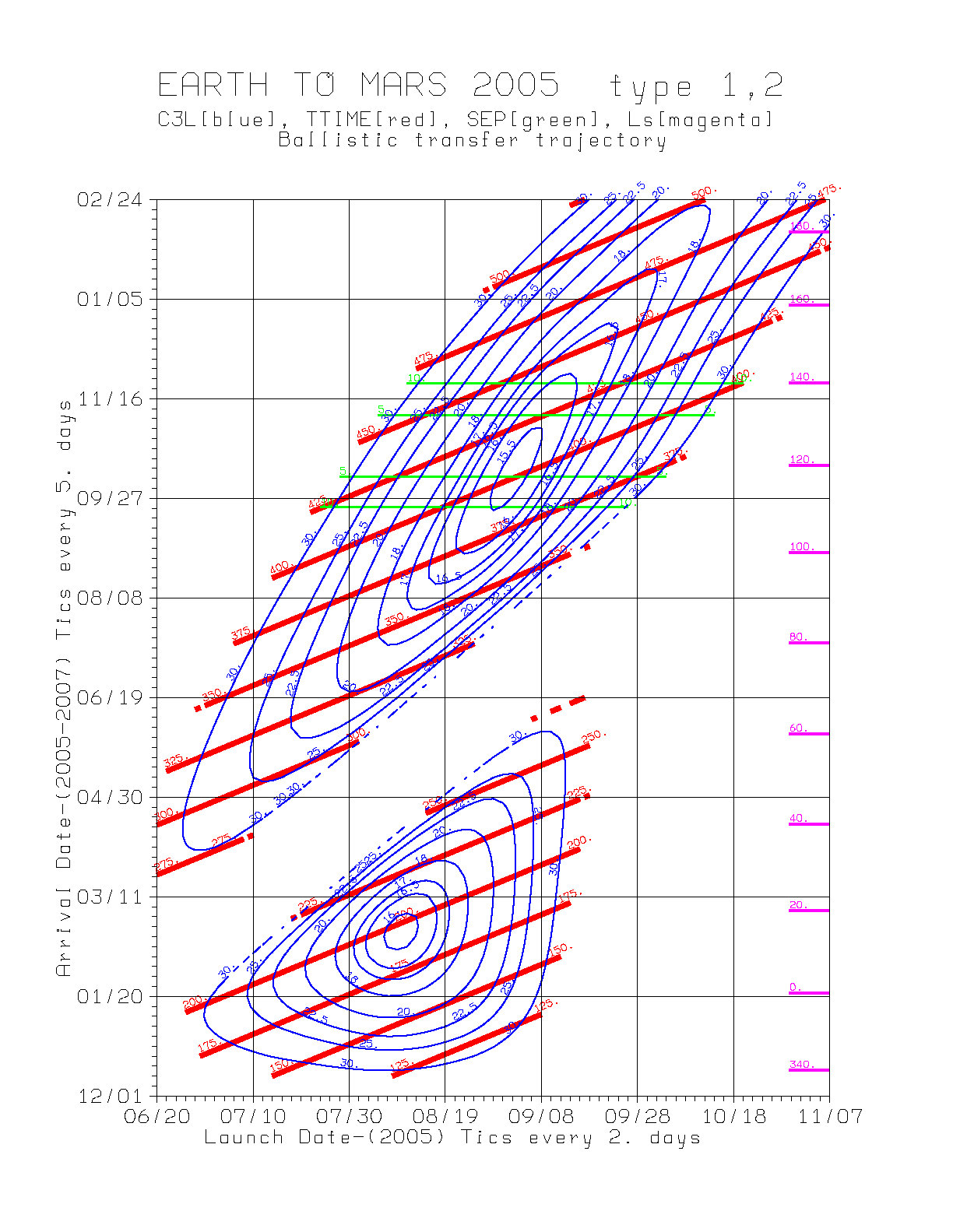
How to Navigate a Spacecraft to Mars
EccentricAnomaly writes "JPL has an article on how to design trajectories to Mars with the porkchop plot. They use an interesting analogy between reading these plots and divining the future from animal entrails. JPL also has the most excellent Basics of Spaceflight, which is an easy to understand tutorial on how to explore deep space." -
How to Navigate a Spacecraft to Mars
EccentricAnomaly writes "JPL has an article on how to design trajectories to Mars with the porkchop plot. They use an interesting analogy between reading these plots and divining the future from animal entrails. JPL also has the most excellent Basics of Spaceflight, which is an easy to understand tutorial on how to explore deep space." -
How to Navigate a Spacecraft to Mars
EccentricAnomaly writes "JPL has an article on how to design trajectories to Mars with the porkchop plot. They use an interesting analogy between reading these plots and divining the future from animal entrails. JPL also has the most excellent Basics of Spaceflight, which is an easy to understand tutorial on how to explore deep space." -
NASA's Mars Odyssey Enters Orbit
maddmike writes "Nasa's Mars explorer Odyssey is scheduled to brake and orbit about Mars today at 7:30PDT. Among the mission's objectives are to understand Mars' climate and geological history and to search for signs of life sustaining environments including water. Main web site is at the JPL website." Update: 10/24 13:12 GMT by T : The BrownFury writes cites a Space.com summary which says "The Mars Odyssey spacecraft appears to have succeeded Tuesday night in one of the most tricky and critical parts of its missions by slipping into orbit around the Red Planet." -
NASA's Mars Odyssey Enters Orbit
maddmike writes "Nasa's Mars explorer Odyssey is scheduled to brake and orbit about Mars today at 7:30PDT. Among the mission's objectives are to understand Mars' climate and geological history and to search for signs of life sustaining environments including water. Main web site is at the JPL website." Update: 10/24 13:12 GMT by T : The BrownFury writes cites a Space.com summary which says "The Mars Odyssey spacecraft appears to have succeeded Tuesday night in one of the most tricky and critical parts of its missions by slipping into orbit around the Red Planet." -
Odyssey Arriving at Mars Tonight
moloader writes: "Odyssey will arrive at Mars on October 24, 2001, 0230 Universal Time (October 23, 7:30pm PDT/ 10:30pm EDT). As it nears its closest point to the planet over the northern hemisphere, the spacecraft will fire its 640-newton main engine for approximately 19.7 minutes to allow itself to be captured into an elliptical, or looping, orbit about 20 hours long. Go Mars!" -
Goldin to Retire from NASA
nervesmiffs writes: "Lots of people hated him. I believe he has been one of the truly great leaders of our time. He has completely turned NASA around during his 10 year tenure. Here's the retirement story." So if you were NASA's next director, what would you do with the agency? Men on Mars? Probes on Europa? Trans-warp drives? -
Ulysses Reaches Unprecedented Solar Lattitude
T.Hobbes writes: "The pioneering European Space Agency's (Esa) Ulysses spacecraft flew over the Sun's north pole on Saturday, reaching a high northern solar latitude of 80 degrees. BBC coverage; ESA site; JPL site" -
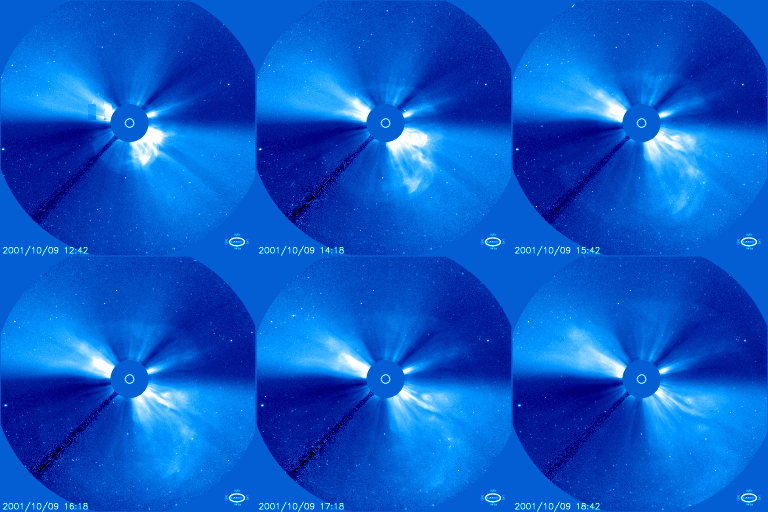
Aurora Alert During The Nights Ahead
Jens Lönn writes: "Magnetic fields above sunspot 9653 erupted yesterday (Oct. 9th at 1110 UT) and hurled a full-halo coronal mass ejection toward Earth. The expanding cloud, which speed away from the Sun traveling approximately 1000 km/s, could strike our planet's magnetosphere as soon as Thursday, Oct. 11th. Sky watchers, especially those living above geomagnetic latitude 50 degrees, should remain alert for Northern Lights during the nights ahead. The best time to spot auroras is usually around local midnight. Note: This is not an alert for a geomagnetic storm, it's just an alert for those who wants to watch great auroras at night." -
One Meteor Shower Coming Up
Jens Lönn writes: "The annual Giacobinid meteor shower (also known as the Draconids) peaks on October 9th and 10th. Most years the shower produces no more than a few shooting stars per hour for northern sky watchers. But there have been some impressive Giacobinid outbursts - most recently in 1998 where the maximum rate was over 500 per hour. The shower's parent comet is far away, so this year's display will probably be modest. You can see the comets orbit simulated here." -
One Meteor Shower Coming Up
Jens Lönn writes: "The annual Giacobinid meteor shower (also known as the Draconids) peaks on October 9th and 10th. Most years the shower produces no more than a few shooting stars per hour for northern sky watchers. But there have been some impressive Giacobinid outbursts - most recently in 1998 where the maximum rate was over 500 per hour. The shower's parent comet is far away, so this year's display will probably be modest. You can see the comets orbit simulated here." -
One Meteor Shower Coming Up
Jens Lönn writes: "The annual Giacobinid meteor shower (also known as the Draconids) peaks on October 9th and 10th. Most years the shower produces no more than a few shooting stars per hour for northern sky watchers. But there have been some impressive Giacobinid outbursts - most recently in 1998 where the maximum rate was over 500 per hour. The shower's parent comet is far away, so this year's display will probably be modest. You can see the comets orbit simulated here." -
Launch Attempt for Kodiak Star Tonight
Jens Lönn writes: "The delayed Launch of the Kodiak Star is scheduled for Saturday, Sept. 29 (.pdf article). This is the first launch into Earth orbit from Kodiak Island. There is a three-hour launch window extending from 5:30 - 8:30 p.m. The effect of the solar flare activity that forced launched cancellation earlier this week is being monitored. The weather forecast for Saturday is favorable for a launch attempt with approximately a 15% chance of weather criteria violation. However, after solar flare activity was factored in, the chance of not meeting the criteria is 60%. Launch coverage on NASA Television and NASA TV on the Web will begin at 8 p.m. EDT. So make sure you're seated, cuz now were gonna light those kick-ass engines and go out into space." Michael noted that this is the first launch from Alaska; one of the four science experiments on board will be the reflective Starshine 3, with mirrors ground and polished by students all over the world. Cross fingers for favorable launch. -
Launch Attempt for Kodiak Star Tonight
Jens Lönn writes: "The delayed Launch of the Kodiak Star is scheduled for Saturday, Sept. 29 (.pdf article). This is the first launch into Earth orbit from Kodiak Island. There is a three-hour launch window extending from 5:30 - 8:30 p.m. The effect of the solar flare activity that forced launched cancellation earlier this week is being monitored. The weather forecast for Saturday is favorable for a launch attempt with approximately a 15% chance of weather criteria violation. However, after solar flare activity was factored in, the chance of not meeting the criteria is 60%. Launch coverage on NASA Television and NASA TV on the Web will begin at 8 p.m. EDT. So make sure you're seated, cuz now were gonna light those kick-ass engines and go out into space." Michael noted that this is the first launch from Alaska; one of the four science experiments on board will be the reflective Starshine 3, with mirrors ground and polished by students all over the world. Cross fingers for favorable launch. -
Third Party Software Support for Linux on SGIs?
Dan Christian asks: "I just got off the phone with SGI support. They tell me that they are no longer offering software support packs for their Linux boxes and my initial 90day support has run out. Where can I find good free information or third party support for my SGI 300L? This is really annoying, since the box is only 4 months old and there was no notice that it was becoming un-supported." -
Big Hopes for Tiny Satellites
shelflife writes: "ST5, according to NASA, will usher in a new era of small, smart spacecraft. Why send a human into space when you can send a computer? And why send something almost as heavy as a UNIVAC if a laptop will do? Compact nanosatellites will have everything you'd want in a full-size, luxury satellite. They will have the attitudinal and navigational capabilities needed to maintain proper orbits, and they will be capable of complex, high-bandwidth communications functions." -
Slashback: Snapshots, Amends, Bazaarity
Slashback brings you some follow-ups tonight about Gartner's recommendation to dump IIS, Charles Connell vs. Eric S. Raymond on Open Source project management, xStore and the GPL, and (yes) the results of Deep Space 1's latest Final Mission.Microsoft is just as secure as the competition, says Microsoft. Jon_E writes: "According to this article Microsoft is responding to the Gartner Report which recommends that enterprises drop IIS by claiming unfair targeting due to their popularity."
Whether because of better-trained or more vigilant administrators, or some other factors, the Apache servers running many web sites certainly haven't seen the devastating outages in the past month (Code Red, Nimda) as certain large IIS installations have.
If animated, this might make a really good Saturday cartoon. cconnell writes "Last September, slashdot published my critique of Eric Raymond's essay The Cathedral and the Bazaar. There was a lively (and sometimes scorching) discussion that followed. Here is Eric's reply to my critique, which Slashdot readers might enjoy. And here is my reply to Eric."
This was not faked in the same studio as the "lunar landings." mrsmalkav writes "Deep Space 1 has passed by Comet Borrelly within 1400 miles and took some very pretty pictures of the comet's core, all while collecting lots of data about said comet. NASA's press release discusses some of the details and findings of the flyby.
This is actually really impressive given that there was very little hope for this mission. From the Mission Logs on DS1's site, '[T]o be honest, DS1's visit with the comet simply is unlikely to work as well as we hope. Many mission logs have described the difficulty of keeping this aged and wounded bird aloft, and the encounter with Borrelly will present Deep Space 1 with the greatest challenge yet in its historic trek through the solar system.'"
Saint Aardvark writes "Space.com has an article about the images taken by DS-1, and they're stunning." And eldurbarn points to the NASA Images of comet Borrelly online at JPL.
How to satisfy customers with license objections, Part II brtb writes: "Soon after Slashdot posted my DiscZerver-GPL writeup last week, xStore added a link in their Download section for information about the use of GPL software in their products. Below is the e-mail I received in response (address changed to protect the spamless). Congratulations to xStore for supporting Free Software and bringing the DiscZervers into compliance with the GPL.
From: "Support" [support@xstoreonline.com]
To: "brtb" [slashdot@brtb.org]
Subject: "RE: GPL SOURCE CODE"xStore is committed to complying to the full letter and spirit of the GPL. We are currently investigating the allegations of non-GPL compliance and communicating with the GNU.ORG and Free Software Foundation on this issue. We will produce a response to your request that is mutually acceptable to the copyright holders of the programs we have used that fall under the GPL and xStore itself. Due to the recent acquisition of this product, we are still in the process of preparing the required source code for distribution. xStore is commited to bring the DiscZerver product into GPL compliance, if it is indeed found to be not in compliance.
In the meantime, please provide xStore with information so that we can send you, the user of this product, the package that you are entitled to. Please provide the serial number of your DiscZerver product and the 'system page' with your response. The 'system page' is located at [http://your_Zerver_name_or_IP_address/admin-cgi/s ystem]. In addition, please send us a self addressed stamped envelope suitable for mailing a CD-ROM along with $14.95 to:
xStore, Inc.
Federal Highway Center
1200 North Federal Highway
Suite 200
Boca Raton, FL 33432After we receive your written request along with the above items, we will process it and promptly send you the disc when it becomes available.
This thanks to the mostly behind-the-scenes work of people at the FSF. Congratulations to xStore for respecting the intent of the programmers whose work they're consolidating and packaging.
-
Slashback: Snapshots, Amends, Bazaarity
Slashback brings you some follow-ups tonight about Gartner's recommendation to dump IIS, Charles Connell vs. Eric S. Raymond on Open Source project management, xStore and the GPL, and (yes) the results of Deep Space 1's latest Final Mission.Microsoft is just as secure as the competition, says Microsoft. Jon_E writes: "According to this article Microsoft is responding to the Gartner Report which recommends that enterprises drop IIS by claiming unfair targeting due to their popularity."
Whether because of better-trained or more vigilant administrators, or some other factors, the Apache servers running many web sites certainly haven't seen the devastating outages in the past month (Code Red, Nimda) as certain large IIS installations have.
If animated, this might make a really good Saturday cartoon. cconnell writes "Last September, slashdot published my critique of Eric Raymond's essay The Cathedral and the Bazaar. There was a lively (and sometimes scorching) discussion that followed. Here is Eric's reply to my critique, which Slashdot readers might enjoy. And here is my reply to Eric."
This was not faked in the same studio as the "lunar landings." mrsmalkav writes "Deep Space 1 has passed by Comet Borrelly within 1400 miles and took some very pretty pictures of the comet's core, all while collecting lots of data about said comet. NASA's press release discusses some of the details and findings of the flyby.
This is actually really impressive given that there was very little hope for this mission. From the Mission Logs on DS1's site, '[T]o be honest, DS1's visit with the comet simply is unlikely to work as well as we hope. Many mission logs have described the difficulty of keeping this aged and wounded bird aloft, and the encounter with Borrelly will present Deep Space 1 with the greatest challenge yet in its historic trek through the solar system.'"
Saint Aardvark writes "Space.com has an article about the images taken by DS-1, and they're stunning." And eldurbarn points to the NASA Images of comet Borrelly online at JPL.
How to satisfy customers with license objections, Part II brtb writes: "Soon after Slashdot posted my DiscZerver-GPL writeup last week, xStore added a link in their Download section for information about the use of GPL software in their products. Below is the e-mail I received in response (address changed to protect the spamless). Congratulations to xStore for supporting Free Software and bringing the DiscZervers into compliance with the GPL.
From: "Support" [support@xstoreonline.com]
To: "brtb" [slashdot@brtb.org]
Subject: "RE: GPL SOURCE CODE"xStore is committed to complying to the full letter and spirit of the GPL. We are currently investigating the allegations of non-GPL compliance and communicating with the GNU.ORG and Free Software Foundation on this issue. We will produce a response to your request that is mutually acceptable to the copyright holders of the programs we have used that fall under the GPL and xStore itself. Due to the recent acquisition of this product, we are still in the process of preparing the required source code for distribution. xStore is commited to bring the DiscZerver product into GPL compliance, if it is indeed found to be not in compliance.
In the meantime, please provide xStore with information so that we can send you, the user of this product, the package that you are entitled to. Please provide the serial number of your DiscZerver product and the 'system page' with your response. The 'system page' is located at [http://your_Zerver_name_or_IP_address/admin-cgi/s ystem]. In addition, please send us a self addressed stamped envelope suitable for mailing a CD-ROM along with $14.95 to:
xStore, Inc.
Federal Highway Center
1200 North Federal Highway
Suite 200
Boca Raton, FL 33432After we receive your written request along with the above items, we will process it and promptly send you the disc when it becomes available.
This thanks to the mostly behind-the-scenes work of people at the FSF. Congratulations to xStore for respecting the intent of the programmers whose work they're consolidating and packaging.
-
Slashback: Snapshots, Amends, Bazaarity
Slashback brings you some follow-ups tonight about Gartner's recommendation to dump IIS, Charles Connell vs. Eric S. Raymond on Open Source project management, xStore and the GPL, and (yes) the results of Deep Space 1's latest Final Mission.Microsoft is just as secure as the competition, says Microsoft. Jon_E writes: "According to this article Microsoft is responding to the Gartner Report which recommends that enterprises drop IIS by claiming unfair targeting due to their popularity."
Whether because of better-trained or more vigilant administrators, or some other factors, the Apache servers running many web sites certainly haven't seen the devastating outages in the past month (Code Red, Nimda) as certain large IIS installations have.
If animated, this might make a really good Saturday cartoon. cconnell writes "Last September, slashdot published my critique of Eric Raymond's essay The Cathedral and the Bazaar. There was a lively (and sometimes scorching) discussion that followed. Here is Eric's reply to my critique, which Slashdot readers might enjoy. And here is my reply to Eric."
This was not faked in the same studio as the "lunar landings." mrsmalkav writes "Deep Space 1 has passed by Comet Borrelly within 1400 miles and took some very pretty pictures of the comet's core, all while collecting lots of data about said comet. NASA's press release discusses some of the details and findings of the flyby.
This is actually really impressive given that there was very little hope for this mission. From the Mission Logs on DS1's site, '[T]o be honest, DS1's visit with the comet simply is unlikely to work as well as we hope. Many mission logs have described the difficulty of keeping this aged and wounded bird aloft, and the encounter with Borrelly will present Deep Space 1 with the greatest challenge yet in its historic trek through the solar system.'"
Saint Aardvark writes "Space.com has an article about the images taken by DS-1, and they're stunning." And eldurbarn points to the NASA Images of comet Borrelly online at JPL.
How to satisfy customers with license objections, Part II brtb writes: "Soon after Slashdot posted my DiscZerver-GPL writeup last week, xStore added a link in their Download section for information about the use of GPL software in their products. Below is the e-mail I received in response (address changed to protect the spamless). Congratulations to xStore for supporting Free Software and bringing the DiscZervers into compliance with the GPL.
From: "Support" [support@xstoreonline.com]
To: "brtb" [slashdot@brtb.org]
Subject: "RE: GPL SOURCE CODE"xStore is committed to complying to the full letter and spirit of the GPL. We are currently investigating the allegations of non-GPL compliance and communicating with the GNU.ORG and Free Software Foundation on this issue. We will produce a response to your request that is mutually acceptable to the copyright holders of the programs we have used that fall under the GPL and xStore itself. Due to the recent acquisition of this product, we are still in the process of preparing the required source code for distribution. xStore is commited to bring the DiscZerver product into GPL compliance, if it is indeed found to be not in compliance.
In the meantime, please provide xStore with information so that we can send you, the user of this product, the package that you are entitled to. Please provide the serial number of your DiscZerver product and the 'system page' with your response. The 'system page' is located at [http://your_Zerver_name_or_IP_address/admin-cgi/s ystem]. In addition, please send us a self addressed stamped envelope suitable for mailing a CD-ROM along with $14.95 to:
xStore, Inc.
Federal Highway Center
1200 North Federal Highway
Suite 200
Boca Raton, FL 33432After we receive your written request along with the above items, we will process it and promptly send you the disc when it becomes available.
This thanks to the mostly behind-the-scenes work of people at the FSF. Congratulations to xStore for respecting the intent of the programmers whose work they're consolidating and packaging.
-
Slashback: Snapshots, Amends, Bazaarity
Slashback brings you some follow-ups tonight about Gartner's recommendation to dump IIS, Charles Connell vs. Eric S. Raymond on Open Source project management, xStore and the GPL, and (yes) the results of Deep Space 1's latest Final Mission.Microsoft is just as secure as the competition, says Microsoft. Jon_E writes: "According to this article Microsoft is responding to the Gartner Report which recommends that enterprises drop IIS by claiming unfair targeting due to their popularity."
Whether because of better-trained or more vigilant administrators, or some other factors, the Apache servers running many web sites certainly haven't seen the devastating outages in the past month (Code Red, Nimda) as certain large IIS installations have.
If animated, this might make a really good Saturday cartoon. cconnell writes "Last September, slashdot published my critique of Eric Raymond's essay The Cathedral and the Bazaar. There was a lively (and sometimes scorching) discussion that followed. Here is Eric's reply to my critique, which Slashdot readers might enjoy. And here is my reply to Eric."
This was not faked in the same studio as the "lunar landings." mrsmalkav writes "Deep Space 1 has passed by Comet Borrelly within 1400 miles and took some very pretty pictures of the comet's core, all while collecting lots of data about said comet. NASA's press release discusses some of the details and findings of the flyby.
This is actually really impressive given that there was very little hope for this mission. From the Mission Logs on DS1's site, '[T]o be honest, DS1's visit with the comet simply is unlikely to work as well as we hope. Many mission logs have described the difficulty of keeping this aged and wounded bird aloft, and the encounter with Borrelly will present Deep Space 1 with the greatest challenge yet in its historic trek through the solar system.'"
Saint Aardvark writes "Space.com has an article about the images taken by DS-1, and they're stunning." And eldurbarn points to the NASA Images of comet Borrelly online at JPL.
How to satisfy customers with license objections, Part II brtb writes: "Soon after Slashdot posted my DiscZerver-GPL writeup last week, xStore added a link in their Download section for information about the use of GPL software in their products. Below is the e-mail I received in response (address changed to protect the spamless). Congratulations to xStore for supporting Free Software and bringing the DiscZervers into compliance with the GPL.
From: "Support" [support@xstoreonline.com]
To: "brtb" [slashdot@brtb.org]
Subject: "RE: GPL SOURCE CODE"xStore is committed to complying to the full letter and spirit of the GPL. We are currently investigating the allegations of non-GPL compliance and communicating with the GNU.ORG and Free Software Foundation on this issue. We will produce a response to your request that is mutually acceptable to the copyright holders of the programs we have used that fall under the GPL and xStore itself. Due to the recent acquisition of this product, we are still in the process of preparing the required source code for distribution. xStore is commited to bring the DiscZerver product into GPL compliance, if it is indeed found to be not in compliance.
In the meantime, please provide xStore with information so that we can send you, the user of this product, the package that you are entitled to. Please provide the serial number of your DiscZerver product and the 'system page' with your response. The 'system page' is located at [http://your_Zerver_name_or_IP_address/admin-cgi/s ystem]. In addition, please send us a self addressed stamped envelope suitable for mailing a CD-ROM along with $14.95 to:
xStore, Inc.
Federal Highway Center
1200 North Federal Highway
Suite 200
Boca Raton, FL 33432After we receive your written request along with the above items, we will process it and promptly send you the disc when it becomes available.
This thanks to the mostly behind-the-scenes work of people at the FSF. Congratulations to xStore for respecting the intent of the programmers whose work they're consolidating and packaging.
-
Flare Sends A Gigaton Of Solar Detritus Toward Earth
Dr. Zowie writes: "This morning at about 10:00 UT, a major explosion occured on the Sun. The solar X-ray output went up by over 1,000 times. About a billion tons of material are speeding toward Earth at over a million miles per hour, and should hit sometime in the next couple of days. Low latitude aurorae and anomalies in radio communications and power service are likely consequences. You can see the event from the SOHO spacecraft's home page -- images and movies are here. In the movies, watch for the burst of radiation hitting SOHO about 13:00 UT -- that's a high energy proton storm caused by the flare itself. You can also see the earthly effects of a similar event from last year."